Cognition (Limites) : Ensemble des facteurs qui réduise l'efficacité des fonctions cognitives.
( ): Voir tableau ci-dessous.
| |
| Limites de la cognition |
| Biais cognitif |
Durée de la mémoire |
Erreur de jugement |
| |
| |
|
 MILLER, G.A. (1956). The magical number seven, plus or
minus two : Some limits on our capacity for processing
information. Psychological Review, 63, 81-97. [PDF] |
|
READ, D.W. (2008). Working memory : A cognitive limit to
non-human primate recursive thinking prior to hominid
evolution ? Evolutionary Psychology, 6 (4),
676-714. [PDF] |
 |
 |
Cognition (Méta-) :
Metacognition, metaknowledge, cognition of cognition.
|
Cognition (Méta-/Humain) : Connaissance
qu'a l'individu de ses propres fonctions
cognitives, de leur fonctionnement correct et des erreurs
commises dans la vie quotidienne (biais
cogntifs). Ce concept a été proposé par Flavell.
EX: Je crois que mon raisonnement ne fonctionne
pas; j'ai fait une erreur de jugement; j'ai un trou de mémoire, je
sais que la capitale de la Mongolie est Oulan-Bator.
Métacognition, cognition et autorégulation. Ce concept a aussi donné lieu à une thérapie, la thérapie métacognitive.
= Prise de conscience,
conscience de soi.
Metacognition,
metaknowledge, cognition of cognition.

| |
|
|
PIAGET, J. (1974). La prise de conscience. Paris
: Presses Universitaires de France. |
POISSANT, H. (2000). La métacognition chez les enfants
présentant des troubles de l'attention : Vers un nouveau
modèle interprétatif. Revue Canadienne de
Psycho-Éducation, 29 (2), 143-151. |
|
FLAVELL, J.H. (1976). Metacognitive aspects of problem
solving. In L.B. Resnick (Ed.), The nature of
intelligence. (pp. 231-235). New Jersey : Lawrence
Erlbaum Associates. |
KUHN, D. (2000). metacognitive development. Current
Directions in Psychological Science, 9 (5),
178-181. |
|
SHIMAMURA, A.P. (2000). Toward a cognitive neuroscience of
metacognition. Consciousness & Cognition, 9, 313-323.
|
|
BROWN, A.L. (1978). Knowing when, where, and how to
remember : A problem of metacognition. In R. Glaser (Ed.),
Advances in instructional psychology (Vol. 1, pp.
77-166). Hillsdale, NJ : Lawrence Erlbaum Associates. |
WAMBACH, C. & BROTHEN, T. (2001). The relationship of
conscientiousness to metacognitive study strategy use by
developmental students. Research & Teaching in
Developmental Education, 18 (1), 25-31. |
|
WELLS, A. & CARTER, K. (2001). Further tests of a
cognitive model of generalized anxiety disorder :
Metacognitions and worry in GAD, panic disorder, social
phobia, depression, and nonpatients. Behavior
Therapy, 32 (1), 85-102. |
|
WELLS, A. (2002). GAD, metacognition, and mindfulness : An
information processing analysis. Clinical Psychology
: Science & Practice, 9 (1), 95-100. |
|
PINTRICH, P. (2002). The role of metacognitive knowledge
in learning, teaching, and assessing. Theory into
Praxtice, 41 (4), 119-225. |
|
FLAVELL, J.H. (1979). Metacognition and cognitive
monitoring : A new area of cognitive-developmental
inquiry. American Psychologist, 34, 906-911. |
TEASDALE, J.D., MOORE, R.G., HAYHURST, H., POPE, M.,
WILLIAMS, S. & SEGAL, Z.V. (2002). Metacognitive
awareness and prevention of relapse in depression :
Empirical evidence. Journal of Consulting &
Clinical Psychology, 70, 278-287. [PDF] |
|
SHIMP, C.P. (1982). Metaknowledge in the pigeon : An
organism's knowledge about its own behavior. Animal
Learning & Behavior, 10 (3), 358-364. |
SMITH, J.D., SHIELDS, W.E. & WASBURN, D.A. (2003). The
comparative psychology of uncertainty monitoring and
metacognition. Behavioral & Brain Sciences, 26
(3), 317-373. |
|
REBER, R., SCHWARZ, N. & WINKIELMAN, P. (2004).
Processing uency and aesthetic pleasure : Is beauty in the
perceiver's processing experience ? Personality &
Social Psychology Review, 7, 364-382. |
|
BERRY, D. (1983). Metacognitive experience and transfer of
logical reasoning. Quarterly Journal of Experimental
Psychology, 35A, 39-49. |
SCHWARZ, N. (2004). Metacognitive experiences in consumer
judgment and decision making. Journal of Consumer
Psychology, 14 (4), 332-348. [PDF] |
|
ZENTALL, T.R. (2004) Evidence both for and against
metacognition is insufficient. Behavioral & Brain
Sciences, 26, 357-358. |
|
LONG, S.O. (2004). Cultural scripts for a good death in
Japan and the United States : similarities and
differences. Social Science & Medicine, 58, 913-928. |
|
SOUCHAY, C. & ISINGRINI, M. (2004). Age related
differences in metacognitive control : Role of executive
functioning. Brain & Cognition, 56 (1),
89-99. |
|
HEYDENBERK, R.A. & HEYDENBERK, W.R. (2005). Increasing
metacognitive competence through conflict resolution. Education & Urban Society, 37 (4) 431-452. |
|
BAKRACEVIC-VUKMAN, K. (2005). Developmental differences in
metacognition and their connections with cognitive
development in adulthood. Journal of Adult
Development, 12 (4), 211-221. |
 |
|
PALINCSAR, A.S. (1986). Metacognitive strategy
instruction. Exceptional Children, 53, 118-124. |
STORM, B.C., BJORK, E.L. & BJORK, R.A. (2005). Social
metacognitive judgments : The role of retrieval-induced
forgetting in person memory and impressions. Journal
of Memory & Language, 52, 535-550. [PDF] |
|
BAKRACEVIC-VUKMAN, K. & DEMETRIOU, A. (2005).
developmental differences in accuracy of metacognitive
evaluations during adulthood. In C.P. Constantinou (Ed.),
Multiple perspectives on effective learning
environments (pp. 1053-1054). Biennial meeting of
european association for research on learning and
instruction |
|
MEVARECH, Z.R. & AMRANY, C. (2008). Immediate and
delayed effects of meta-cognitive instruction on
regulation of cognition and mathematics achievement. Metacognition
& Learning, 3, 147-157. |
|
BENJAMIN, A.S. & BIRD, R.D. (2006). Metacognitive
control of the spacing of study repetitions. Journal
of Memory & Language, 55, 126-137. |
|
WELLS, A. (2007). Cognition about cognition :
Metacognitive therapy and change in generalized anxiety
disorder and social phobia. Cognitive &
Behavioral Practice, 14 (1), 18-25. [PDF] |
|
PALINCSAR, A.S. (1986). Metacognitive strategy
instruction. Exceptional Children, 53 (2),
118-124. |
VEENMAN, M.V.J., VAN HOUTWOLTERS, B.H.A.M. &
AFFLERBACH, P. (2006). Metacognition and learning :
conceptual and methodological considerations. Metacognition
Learning, 1, 3-14. [PDF] |
|
GARNER, R. (1987). Metacognition and reading
comprehension. Norwood : Ablex publishing
corporation. |
ALTER, A.L., OPPENHEIMER, DM., EYRE, R.N. & EPLEY, N.
(2007). Overcoming intuition : Metacognitive difficulty
activates analytic reasoning. Journal of Experimental
Psychology : General, 136 (4), 569-576. [PDF] |
|
PALINCSAR, A.S. & BROWN, D.S. (1987). Enhancing
instructional time through attention to metacognition. Journal
of Learning Disabilities, 20 (2), 66-75. |
KORNELL, N., SON, L. &
TERRACE, H.S. (2007). Transfer of metacognitive skills and
hint seeking in monkeys. Psychological Science, 18
(1), 64-71.
[PDF] |
|
WELLS, A. (2007). Cognition about cognition :
Metacognitive therapy and change in generalized anxiety
disorder and social phobia. Cognitive &
Behavioral Practice, 14 (1), 18-25. [PDF] |
|
MORITZ, S. & WOODWARD, T.S. (2007). Metacognitive
training in schizophrenia : from basic research to
knowledge translation and intervention. Current
Opinion in Psychiatry, 20, 619-625. [PDF] |
|
BROWN, A.L. (1987). Metacognition, executive control and
other more mysterious mechanismes. In F. Weinert & R.
Kluwe (Eds.), Metacognition, motivation and
understanding (pp. 65-116). Hillsdale, Lawrence
Elbaum. |
SCHWARZ, N., SANNA, L.J., SKURNIK, I. & YOON, C.
(2007). Metacognitive experiences and the intricacies of
setting people straight : implications for debiasing and
public information campaigns. Advances in
Experimental Social Psychology, 39, 127-161.
[PDF] |
|
FLAVELL, J.H. (1987). Speculations about the nature and
development of metacognition. In F.E. Weinert & R.H.
Kluwe (Eds.), Metacognition, motivation, and
understanding (pp. 21-29). Hillsdale, NJ : Erlbaum. |
HUET, N., LARIVÉE, S. et BOUFFARD, T. (2007). La
métacognition : modèles développementaux et techniques
d'évaluation. Dans S. Larivée (Ed.), L'intelligence.
(p. 315-340). Presses de l'Université du Québec. |
|
PALINCSAR, A.S. & RANSOM, K. (1988). From the mystery
spot to the thoughtful spot : The instruction of
metacognitive strategies. The Reading Teacher, 41
(8), 784-789. |
MORITZ, S. & WOODWARD, T.S. (2007). Metacognitive
training in schizophrenia : from basic research to
knowledge translation and intervention. Current
Opinion in Psychiatry, 20, 619-625. [PDF] |
|
PALINCSAR, A.S. & RANSOM, K. (1988). From the mystery
spot to the thoughtful spot : The instruction of
metacognitive strategies. The Reading Teacher, 41
(8), 784-789. |
CARRUTHERS, P. (2007). Mindreading underlies
metacognition. Behavioral & Brain Sciences, 32, 164-176.
[PDF] |
|
RAPHAEL, T.E., ENGLERT, C.S. & KIRSCHNER, B.W. (1989).
Students' metacognitive knowledge about writing.
Research in the Teaching of English, 23 (4),
343-379. |
KLEITMAN, S. & STANKOV, L. (2007). Self-confidence and
metacognitive processes. Learning & Individual
Differences, 17 (2), 161-173. |
|
PINARD, A., LEFEBRE-PINARD, M. et BIBEAU, M. (1989). Le
savoir métacognitif portant sur la compréhension :
comparaison entre adultes analphabètes et adultes
alphabétisés. Revue Québécoise de Psychologie, 10
(3), 78-91. |
CASTEL, A.D. (2008). Metacognition and learning about
primacy and recency effects in free recall : The
utilization of intrinsic and extrinsic cues when making
judgments of learning. Memory & Cognition, 36,
429-437. [PDF] |
|
NOËL, B. (1991). La métacognition. Bruxelles :
De Boeck. |
EKERS, D., RICHARDS, D. & GILBODY, S. (2008). A
meta-analysis of randomized trials of behavioural
treatment of depression. Psychological Medicine, 38,
611-623. |
|
SMILEK, D. EASTWOOD, J.D., REYNOLDS, M. & KINGSTONE
A.A. (2008). Metacognition and change detection : do lab
and life really converge ? Consciousness &
Cognition, 17, 1056-1061. |
|
NELSON, T.O. & DUNLOSKY, J. (1991). The delayed-JOL
effect : When delaying your judgements of learning can
improve the accuracy of your metacognitive monitoring.
Psychological Science, 2, 267-270. |
SMITH, J.D., BERAN, M.J., COUCHMAN, J.J. & COUTINHO,
M.V.C. (2008). The comparative study of metacognition :
Sharper paradigms, safer inferences. Psychonomic
Bulletin & Review, 15, 679-691. |
|
|
SHIMAMURA, A.P. (2008). A neurocognitive approach to
metacognitive monitoring and control. In J. Dunlosky &
R.A. Bjork (Eds.), Handbook of metamemory and memory
(pp. 373-390). Psychology Press. |
|
BRÄTEN, I. (1991). Vygotsky as precursor to metacognitive
theory : II. Vygotsky as metacognitivist. Scandinavian
Journal of Educational Research, 35 (4), 305-320.
[PDF] |
YZERBYT, V.Y., KERVYN, N. & JUDD, C.M. (2008).
Compensation versus halo : The unique relations between
the fundamental dimensions of social judgment. Personality
& Social Psychology Bulletin, 34, 1110-1123. |
|
CARDELLE-ElLAWAR, M. (1992). Effects of teaching
metacognitive skills to students with low mathematics
ability. Teaching & Teacher Education, 8 (2),
109-121. |
JOZEFOWIEZ, J., STADDON, J.E.R. & CERUTTI, D.T.
(2009). Metacognition in animals : How do we know that
they know ? Comparative Cognition & Behavior
Reviews, 4, 29-39. [PDF] |
|
NISBETT, R.E. (1992). How is your reasoning ? How do you
know? Contemporary Psychology, 37, 417-418. |
KARPICKE, J.D., BUTLER, A.C. & ROEDIGER, H.L. (2009).
Metacognitive strategies in student learning : Do students
practice retrieval when they study on their own ?
Memory, 17, 471-479. [PDF] |
|
TERRACE, H.S. & SON, L.K. (2009). Comparative
metacognition. Current Opinion in Neurobiology, 19,
67-74. |
|
FLAVELL, J.H. (1992). Metacognition and cognitive
monitoring : A new area of cognitive-developmental
inquiry. In T. Nelson (Ed.), Metacognition : Core
readings (pp. 3-9). Boston : Allyn and Bacon. |
KARPICKE, J.D. (2009). Metacognitive control and strategy
selection : Deciding to practice retrieval during
learning. Journal of Experimental Psychology :
General, 138, 469-486. [PDF] |
|
METCALFE, J., SCHWARTZ, B.L. & JOAQUIM, S.G. (1993).
The cue-familiarity heuristic in metacognition. Journal
of Experimental Psychology : Learning, Memory &
Cognition, 19, 851-861. [PDF] |
CARRUTHERS, P. (2009). How we know our own minds : The
relationship between mindreading and metacognition. Behavioral
& Brain Science, 32 (2), 1-62. [PDF] |
|
METCALFE, J. (1993). Novelty monitoring, metacognition,
and control in a composite holographic associative recall
model : Implications for Korsakoffs amnesia. Psychological
Review, 100, 3-22. [PDF] |
ALTER, A.L. & OPPENHEIMER, D.M. (2009). Uniting the
tribes of fluency to form a metacognitive nation. Personality
& Social Psychology Review, 3, 219-235. [PDF] |
|
FLAVELL, J.H., MILLER, P. & MILLER, S. (1993). Cognitive
development. London : Prentice-Hall international. |
WALKER, M.P. (2009). The role of sleep in cognition &
emotion. New York Academy of Sciences, 1156, 168-197.
[PDF] |
|
NELSON, T.O. (1996). Consciousness and metacognition. American Psychologist, 51, 102-116. |
KORNELL, N. (2009). Metacognition in humans and animals.
Current Directions in Psychology Science, 18 (1),
11-15. [PDF] |
|
REDER, L.M. & SCHUNN, C.D. (1996). Metacognition does
not im ply awareness : Strategy choice is governed by
implicit learning and memory. In L.M. Reder (Ed.), Implicit
memory and metacognition (pp. 45-78). Hillsdale, NJ
: Erlbaum. |
HINES, J.C., TOURON, D.R. & HERTZOG, C. (2009).
Metacognitive influences on study time allocation in an
associative recognition task : An analysis of adult age
differences. Psychology & Aging, 24 (2),
462-475. [PDF] |
|
TAKAHASHI, M. & OVERTON, W.F. (1996). Formal reasoning
in Japanese older adults : The role of metacognitive
strategy, task content, and social factors. Journal of
Adult Development, 3, 81-91. |
CRYSTAL, J.D. & FOOTE, A.L. (2009). Metacognition in
animals : Trends and challenges. Comparative Cognition
& Behavior Reviews, 4, 54-55.
[PDF] |
|
DIMAGGIO, P. (1997). Culture and cognition. Annual
Review of Sociology, 23, 263-287. |
ELLISON-WRIGHT, I. & BULLMORE, E. (2010). Anatomy of
bipolar disorder and schizophrenia : A meta-analysis. Schizophrenia Research, 117, 1-12. [PDF] |
|
LUCANGELI, D., COI, G. & BOSCO, P. (1997).
Metacognitive awareness in good and poor math problem
solvers. Learning Disabilities Research &
Practice, 12(4), 209-212. |
WHITEBREAD, D. (2010). Play, metacognition & self-
regulation. In P. Broadhead, J. Howard & E. Wood
(Eds), Play and learning in the early years.
London : Sage. |
|
|
GOLLWITZER, P.M. (1998). Metacognition in action : The
importance of implementation intentions. Personality
& Social Psychology Review, 2 (2), 124-136. [PDF] |
AGHOTOR, J., PFUELLER, U., MORITZ, S., WEISBROD, M. &
ROESCH-ELY, D. (2010). Metacognitive training for patients
with schizophrenia (MCT) : Feasibility and preliminary
evidence for its efficacy. Journal of Behavior
Therapy & Experimental Psychiatry, 41, 207-211. |
|
AZEVEDO, R., MOOS, D.C., JOHNSON, A.M. & CHAUNCEY,
A.D. (2010). Measuring cognitive and metacognitive
regulatory processes during hypermedia learning : Issues
and challenges. Educational Psychologist, 45, 210-223.
|
|
JOSEPH, N. (2010). Metacognition needed : Teaching middle
and high school students to develop strategic learning
skills. Preventing school failures, 54 (2),
99-103. |
|
KORIAT, A. (1998). Illusions of knowing : The link between
knowledge and metaknowledge. In V.Y. Yzerbyt & G.
Lories (Eds.), Metacognition : Cognitive and social
dimensions (pp. 16-34). Thousand Oaks, CA : Sage. |
KORIAT, A. & ACKERMAN, R. (2010). Metacognition and
mindreading : Judgements of learning for self and other
during self-paced study. Consciousness &
Cognition, 19, 251-264. [PDF] |
|
YZERBYT, V.Y., LORIES, G. & DARDENNE, B. (1998). Metacognition : Cognitive and social dimensions. London : Sage. |
KELLY, K.J. & METCALFE, J. (2011). Metacognition of
emotional face recognition. Emotion, 11, 896-906.
[PDF] |
|
MAZZONI, G. & NELSON, T.O. (1998). Metacognition
and cognitive neuropsychology : Monitoring and control
processes. Lawrence Erlbaum Associates. |
THOMPSON, V.A., TURNER, J.P. & PENNYCOOK, G. (2011).
Choosing between intuition and reason : The role of
metacognition in initiating analytic thinking.
Cognitive Psychology, 63, 107-140. [PDF]
|
|
STRACK, F. & FÖRSTER, J. (1998). Self-reflection and
recognition : the role of metacognitive knowledge in the
attribution of recollective experience. Personality
& Social Psychology Review, 2 (2), 111-123. |
HARGIS, J. & MAROTTA, S.M. (2011). Using flip
camcorders for active classroom metacognitive reflection.
Active Learning in Higher Education, 12 (1),
35-44. [PDF] |
|
BOUFFARD, T. (1998). Système de soi et métacognition. Dans
L. Lafortune & P. Mongeau (Eds.), Métacognition
et compétences réflexives (pp.203-222). Montréal :
Éditions Logiques. |
VAESEN, K. (2012). The cognitive bases of human tool use.
Behavioral & Brain Sciences, 35 (4),
570-571, 203262. [PDF] |
|
JOST, J.T., KRUGLANSKI, A.W. & NELSON, T.O. (1998).
Social metacognition : An expansionist review.
Personality & Social Psychology Review, 2 (2),
137-154. |
BAKRACEVIC-VUKMAN, K. (2012). Metacognitive accuracy and
learning to learn : A developmental perspective. Problems
of Education in the 21e century, 46, 15-21. [PDF] |
|
MARINÉ, C. et HUET, N. (1998). Techniques dévaluation de
la métacognition : les mesures dépendantes de lexécution
de tâche. Revue de l'Année Psychologique, 4, 30. |
WEIL, L.G., FLEMING, S.M., UMONTHEI, L.I., KILFORD, E.J.,
WEIL, R.S., REES, G., DOLANR, J. & BLAKEMORE, S.-J .
(2013). The development of metacognitive ability in
adolescence. Consciousness & Cognition, 22, 264-271.
[PDF] |
|
WEIL, L.G., FLEMING, S.M., DUMONTHEIL, I., KILFORD, E.J.,
WEIL, R.S., REES, G., DOLAN, R.J. & BLAKEMORE, S.-J.
(2013). The development of metacognitive ability in
adolescence. Consciousness & Cognition, 22,
264-271. [PDF] |
|
PAULUS, M., PROUST, J. & SODIAN, B. (2013). Examining
implicit metacognition in 3.5-year-old children : an
eye-tracking and pupillometric study. Frontiers in
Psychology, 4 (145), 1-7. [PDF] |
|
BRYCE, D. & WHITEBREAD, D. (2014). Examining change in
metacognitive knowledge and metacognitive control during
motor learning : What can be learned by combining
methodological approaches ? Psychological Topics, 23(1),
53-76. |
|
MEVARECH, Z.R. (1999). Effects of metacognitive training
embedded in cooperative settings on mathematical problem
solving. The Journal of Educational Research 92 (4),
195-205. |
BRYCE, D., WHITEBREAD, D. & SZUCS, D. (2015). The
relationships among executive functions, metacognitive
skills and educational achievement in 5 and 7 year-old
children, Metacognition & Learning, 10 (2),
181-198. |
|
|
 Voir Thérapie métacognitive, Cognition, Fonction
exécutive et Métacognition/animaux |
| MATLIN,
M. (2001/2004). Cognition. Wiley, John &
Sons, Incorporated/La cognition : Une introduction à la psychologie cognitive. Paris : Deboeck
Université. |
|
|
|
Cognition (Méta-/Animaux) : Métacognition
chez les animaux, notamment
chez les singes.
| |
|
|
HAMPTON, R.R. (2001). Rhesus monkeys know when they
remember. Proceedings of the National Academy of
Science USA, 98 (9), 5359-5362. |
TERRACE, H.S. & SON, L.K. (2009). Comparative
metacognition. Current Opinion in Neurobiology, 19,
67-74. |
|
CALL, J. & CARPENTER M. (2001). Do apes and children
know what they have seen ? Animal Cognition, 4, 207-220.
[PDF] |
SMITH, J.D., BERAN, M.J., COUCHMAN, J.J., COUTINHO, M.V.C.
& BOOMER, J B. (2009). Animal metacognition : Problems
and prospects. Comparative Cognition & Behavior
Reviews, 4, 40-53. [PDF] |
|
FOOTE, L.A. & CRYSTAL, J.D. (2007). Metacognition in
the rat. Current Biology, 17, 551-555.
[PDF] |
HAMPTON, R.R. (2009). Multiple demonstrations of
metacognition in nonhumans : Converging evidence or
multiple mechanisms ? Comparative Cognition &
Behavior Reviews, 4, 17-28. [PDF]
|
|
KORNELL, N., SON, L., TERRACE, H.S. (2007). Transfer of
metacognitive skills and hint seeking in monkeys. Psychological Science, 18 (1), 64-71. [PDF] |
KORNELL, N. (2009). Metacognition in humans and animals. Current
Directions in Psychology Science, 18 (1), 11-15. [PDF] |
|
CALL, J. (2007). Apes know that hidden objects can affect
the orientation of other objects. Cognition, 105,
1-25. [PDF] |
CRYSTAL, J.D. & FOOTE, A.L. (2009). Metacognition in
animals : Trends and challenges. Comparative Cognition
& Behavior Reviews, 4, 54-55.
[PDF] |
|
CARRUTHERS, P. (2008). Meta-cognition in animals : A
skeptical look. Mind & Language, 23, 58-89.
[PDF]
|
CARRUTHERS, P. & BRENDAN, R. (2012). The emergence of
metacognition : affect and uncertainty in animals. In M.
Beran, J. Brandl, J. Perner & J.Proust (Eds.), Foundations
of metacognition. OUP.
[PDF] |
| |
| MATLIN,
M. (2001/2004). Cognition. Wiley, John &
Sons, Incorporated/La cognition : Une introduction à
la psychologie cognitive. Paris : Deboeck
Université. |
Voir aussi Cognition et Métacognition chez les humains |
|
|
Cognition (Pré-) : Forme de perception
extra-sensorielle. Il s'agit en fait d'une croyance,
donc d'une pseudophénomène
qui consisterait en la capacité de prédire
l'avenir. Précognition et parapsychologie.
Precognition.
| |
|
|
FREEMAN, J. (1962). An experiment in precognition. Journal
of Parapsychology, 26, 123-130. |
|
COX, E.X. (1956). Precognition : An Analysis. Journal
of the American Society for Psychical Research, 50,
97-107. |
|
|
|
Cognition (Restructuration) :
Technique thérapeutique
cognitiviste qui consiste à amener le client
à modifier ses perceptions
et ses catégories mentales, afin d'en éliminer les biais et les distorsions. Cognitive restructuring.
| |
|
|
GOLDFRIED, M.R., LINEHAN, M.M. & SMITH, J.L. (1978).
Reduction of test anxiety through cognitive restructuring.
Journal of Consulting & Clinical Psychology, 46,
32-39. |
|
LINEHAN, M.M., GOLDFRIED, M.R. & GOLDFRIED, A.P.
(1979). Assertion therapy : Skill training or cognitive
restructuring. The Behavior Therapy, 10, 372-388. |
|
WOODWARD, R. & JONES, R.B. (1980). Cognitive
restructuring treatment : A controlled trial with anxious
patients. Behaviour Research & Therapy, 18, 401-407. |
|
MATTICK, R.P. & PETERS, L. (1988). Treatment of severe
social phobia : Effects of guided exposure with and
without cognitive restructuring. Journal of
Consulting & Clinical Psychology, 56 (2)
251-260. |
|
MATTICK, R.P., PETERS, L. & CLARKE, J.C. (1989).
Exposure and cognitive restructuring for social phobia : A
controlled study. Behavior Therapy, 20 (1)
3-23. |
| SCHERRER,
B. (1984). Biostatistique. Chicoutimi : Gaëtan Morin. |
|
|
Cognition(Style) :
= Style cognitif.
Cognitive style.
| |
|
|
WITKIN, H.A. (1964). Origins of cognitive style. In C.
Sheerer (Ed.), Cognition : Theory, research, promise.
New York : Harper & Row. |
WITKIN, H.A. & GOODENOUGH, R. (1981). Cognitive
styles : Essence and origins. New York :
International Universities Press. |
|
LEWIS, M., RAUSCH, M., GOLDBERG, S. & DODD, C. (1968).
Error, response time and IQ : Sex differences in cognitive
style of preschool children. Perceptual & Motor
Skills, 26, 563-568. |
TETLOCK, P.E. (1983). Cognitive style and political
ideology. Journal of Personality & Social
Psychology, 45, 118-126. [PDF] |
|
CAMPBELL, S.B., DOUGLAS, V.I. & MORGANSTERN, G.
(1971). Cognitive styles in hyperactive children and the
effect of methylphenidate. Journal of Child
Psychology & Psychiatry, 12, 55-67. |
MESSICK, S. (1984). The nature of cognitive styles :
Problems and promises in educational practice. Educational
Psychologist, 19, 59-74. |
|
LEWIS, M. (1971). Sex differences in cognitive style : A
rejoinder. Perceptual & Motor Skills, 33,
1006. |
TETLOCK, P.E. (1984). Cognitive style and political belief
systems in the British House of Commons. Journal of
Personality & Social Psychology, 46, 365-375. [PDF] |
|
CAMPBELL, S.B. & DOUGLAS, V.I. (1972). Cognitive styles
and responses to the threat of frustration. Canadian
Journal of Behavioural Science, 4, 30-42. |
GLOBERSON, T. & ZELNICKER, T. (Eds.) (1984).
Cognitive style and cognitive development. Norwood,
NJ : Ablex. |
|
LOPICOLLO, J. & BLATT, S.J. (1972). Cognitive style
and sexual identity. Journal of Clinical Psychology,
28, 148-151. |
KIRTON, M.J. & DE CIANTIS, S.M. (1986). Cognitive
styles and personality : The Kirton Adaptation-Innovation
and Cattell 16-PF Personality Factors Inventories. Personality & Individual Differences, 7, 141-146. |
|
CAMPBELL, S.B. (1973). Cognitive styles in reflective,
impulsive, and hyperactive children and their mothers.
Perceptual & Motor Skills, 747-752. |
KOGAN, N. & SAARNI, C. (1990). Cognitive style in
children : Some evolving trends. In O.N. Saracho (Ed.), Cognitive
style and early education (pp. 3-31). New York :
Gordon & Breach. |
|
VERNON, P.E. (1973). Multivariate approaches to the study
of cognitive styles. In J.R. Royce (Ed.), Multivariate
analysis and psychological theory (pp. 125-148).
New York : Academic Press |
RIDING, R. & CHEEMA, I. (1991). Cognitive styles
integration. Educational Psychology, 11,
193-215. |
|
RIDING, R. & SADLER-SMITH, E. (1992). Type of
instructional material, cognitive style and learning
performance. Educational Studies, 18 (3),
323-340. |
|
KOGAN, N. (1973). Creativity and cognitive style : A life
span perspective. In P. Baltes & K.W. Schale (Eds.), Life
span developmentalpsychology : Personality and
socialization (pp. 145-178). New York : Academic
Press. |
GUL, F. (1992). Cognitive styles as a factor in accounting
students' receptions of career-choice factors.
Psychological Reports, 71, 1275-1281. |
|
EHRI, L.C. & MUZIO, I.M. (1974). Cognitive style and
reasoning about speed. Journal of Educational
Psychology, 66, 569-571. |
JACOBSON, C.M. (1993). Cognitive styles of creativity :
Relations of scores on the Kirton Adaptation-Innovation
Inventory and the Myers-Briggs Indicator among managers in
USA. Psychological Reports, 72, 1131-1138. |
|
CAMPBELL, S.B. (1974). Cognitive styles and behavior
problems of clinic boys : A comparison of epileptic,
hyperactive, learning disabled, and normal groups. Journal
of Abnormal Child Psychology, 2, 307-312. |
CLAPP, R.G. (1993). Stability of cognitive style in adults
and some implications : A longitudinal study of the Kirton
Adaptation-Innovation Inventory. Psychological
Reports, 73, 1235-1245. |
|
ALLINSON, C.W. & HAYES, J. (1996). The cognitive style
indEX: a measure of intuition-analysis for organisational
research. Journal of Management Studies, 33 (1),
119-135. |
|
|
KOGAN, N. (1976). Cognitive styles in infancy and
early childhood. New York : Wiley. |
BAILLARGEON, R., PASCUAL-LEONE, J. & RONCARDIN, C.
(1997). Mental-attentional capacity : Does cognitive style
make a difference ? Journal of Experimental Child
Psychology, 70 (3), 143-166. |
|
WITKIN, H.A., MOORE, C.A., GOODENOUGH, D.R. & COX,
P.W. (1977). Field dependent and field independent
cognitive styles and their educational implications. Review
of Educational Research, 47, 1-64. |
GRIGORENKO, E.L. & STERNBERG, R.J. (1997). Styles of
thinking, abilities, and academic performance.
Exceptional Children, 63, 295-312. |
|
GOLDSTEIN, K.M. & BLACKMAN, S. (1978). Cognitive
styles. New York : Wiley. |
STERNBERG, R.J. & GRIGORENKO, E.L. (1997). Are
cognitive styles still in style ? American
Psychologist, 52 (7), 700-712. [PDF] |
|
WITKIN, H.A. & GOODENOUGH, D.R. (1979). Cognitive
styles : essence and origins. Psychological Issues,
Monograph, 51. |
RIDING, R. & RAYNER, S. (1998). Cognitive styles
and learning strategies. Londres : David Fulton. |
|
NODOUSHAN, M.A.S. (2007). Is cognitive style : A precursor
to EFL reading performance ? i-Manager's Journal of
Educational Technology, 4 (1), 66-68. |
|
GUILFORD, J.P. (1980). Cognitive styles : what are they ?
Educational & Psychological Measurement, 40, 715-735. |
JONES, L., SCOTT, J., HAQUE, S., GORDON-SMITH,K., HERON,
J., CAESAR, S., COOPER, C., FORTY, L., HYDE, S., LYON, L.,
GREENING, J., SHAM, P., FARMER, A., McGUFFIN, P., JONES,
I. & CRADDOCK, N. (2005). Cognitive style in bipolar
disorder. The British Journal of Psychiatry, 187,
431-437. [PDF]
|
|
SUTTON, J.M., MINEKA, S., ZINBARG, R.E., CRASKE, M.G.,
GRIFFITH, J.W., ROSE, R.D., WATERS A.M., NAZARIAN, M.
& MOR, N. (2010). The relationships of personality and
cognitive styles with self-reported symptoms of depression
and anxiety. Cognitive Therapy & Research, 35
(4), 381-393. [PDF]
|
|
SHENHAV, A., RAND, D.G. & GREENE, J.D. (2012). Divine
intuition : Cognitive style influences belief in God. Journal
of Experimental Psychology : General, 141, 423-428.
[PDF] |
|
COOLS, E., ARMSTRONG, S.J. & VERBRIGGHE, J. (2014).
Methodological practices in cognitive style research :
Insights and recommendations from the field of business
and psychology. European Journal of Work &
Organisational Psychology, 3 (4), 627-641. |
|
YILDIRIM, I. & ZENGEL, R. (2014). The impact of
cognitive styles on design students' spatial knowledge
from virtual environments. The Turkish Online Journal
of Educational Technology, 13 (3), 210-215. [PDF] |
|
|
|
Voir aussi Cognition |
|
|
FODOR, J.A. & PYLYSHYN, Z.W. (1988).
Connectionism and cognitive architecture : A critical
analysis. Cognition, 28, 3-71. [PDF]
|
| |
|
|
Cognition animale : Discipline au carrefour du cognitivisme
et de la psychologie
animale, qui, comme le nom l'indique, étudie les processus
cognitifs des animaux,
notamment chez les singes. = cognition comparée.
( ): Allen,
Bates, Bekoff,
Call, Doré, Fiset,
Gallup, Kamil,
Menzel, Pepperberg,Povinelli,
Premack, Terrace, Tolman, Tomasello, Vauclair,
Wynne.
Animal cognition, cognition in nonhuman species.
| |
|
|
TOLMAN, E.C. (1932). Purposive behavior in animals
and men. New York : Century. |
TOMASELLO, M. (2000). Primate cognition : Introduction to
the Issue. Cognitive Science, 24 (3), 351-361. [PDF] |
|
KRECHEVSKY, I. (1932). Hypotheses' in rats. Psychological
Review, 39 (6), 516-532. |
SHETTLEWORTH, S.J. (2001). Animal cognition and animal
behaviour. Animal Behaviour, 61, 277-286. [PDF] |
|
WITKIN, H.A. (1942). Hypotheses' in rats : An experimental
critique. III. Summary evaluation of the hypotheses
concept. Psychological Review, 49 (6), 541-568. |
WYNNE, C.D.L. (2001). Animal cognition : The mental
lives of animals. Palgrave Macmillan. [PDF] |
|
TOLMAN, E.C. (1948). Cognitive maps in rats and men. Psychological
Review, 55, 189-208. |
BEKOFF, M. (2002). The cognitive animal. MIT
Press. |
|
MENZEL, E.W. & JOHNSON, M.K. (1978). Commentary :
Cognition and consciousness in nonhuman species. The
Behavioral & Brain Sciences, 4, 586-587. |
PEPPERBERG, I.M. (2002). The value of the Piagetian
framework for comparative cognitive studies. Animal
Cognition, 5, 77-82. |
|
PREMACK, D. (1983). Animal cognition. Annual Review
of Psychology, 34, 351-362. |
MIKLOSI, A., TOPAL, J. & CSANYI, V. (2004).
Comparative social cognition : what can dogs teach us ? Animal
Behaviour, 67, 995-1004. [PDF] |
|
TERRACE, H.S. (1985). Animal cognition : thinking without
language. Philosophical Transactions of Royal Society
London, B308, 113-128. |
KAUFMAN, J.C. & KAUFMAN, A.B. (2004). Applying a
creativity framework to animal cognition. New Ideas in
Psychology, 22 (2), 143-155.
[PDF] |
|
VAUCLAIR, J. (1987). Représentation et intentionnalité
dans la cognition animale. In M. Siguan (Ed.),
Comportement, cognition, conscience (pp. 59-87).
Paris : Presses Universitaires de France. |
PENNISI, E. (2006). Animal cognition. Social animals prove
their smarts. Science, 312 (5781), 1734-1738. |
|
SEYFARTH, R.M., CHENEY, D.L. & BERGMAN, T.J. (2005).
Primate social cognition and the origins of language. Trends
in Cognitive Sciences, 9 (6), 264-266. [PDF] |
|
GALLISTEL, C.R. (1990). Representations in animal
cognition : An introduction. Cognition, 37,
1-22. |
MENZEL, R. & GIURFA, M. (2006). Dimensions of
cognition in an insect, the honeybee. Behavioral
& Cognitive Neuroscience Reviews, 5, 24-40. [PDF] |
|
GADAGKAR, R. (1995). Can animals count ? Current
Science, 68, 1180-1182. [PDF] |
BATES, L.A. & BYRNE, R.W. (2007). Creative or created
: Using anecdotes to investigate animal cognition.
Methods, Special Issue "Neurocognitive Mechanisms of
Creativity : A Toolkit", 42, 12-21. |
|
THOMAS, R.K. (1996). Investigating cognitive abilities in
animals : Unrealized potential. Cognitive Brain
Research, 3, 157-166. [PDF] |
CLAYTON, N.S., DALLY, J.M. & EMERY, N.J. (2007).
Social cognition by food-caching corvids. The western
scrub-jay as a natural psychologist. Philosophical
Transactions of the Royal Society B : Biological
Sciences, 362, 507522. [PDF]
|
|
VAUCLAIR, J. (1996). La cognition animale. Paris
: PUF/Que Sais-je. [PDF] |
BAILEY, A.M., McDANIEL, W.F. & THOMAS, R.K. (2007).
Approaches to the study of higher cognitive functions
related to creativity in nonhuman animals. Methods,
42, 3-14. [PDF] |
|
|
BEKOFF, M. & JAMEISON, D. (1996). Readings in
animal cognition. Cambridge, MA : MIT Press. |
BATES, L.A., POOLE, J.H. & BYRNE, R.W. (2007).
Creative or created : Using anecdotes to investigate
animal cognition. Methods, 42 (1), 12-21. |
|
TOMASELLO, M. & CALL, J. (1997). Primate
cognition. New York : Oxford University Press. |
PREMACK, D. (2007). Human and animal cognition :
Continuity and discontinuity. Proceedings of the
National Academy of Sciences, 104 (35),
13861-13867. [PDF] |
|
FORD, J.K., SMITH, E.M., WEISSHEIN, D.A, GULLY, S.M. &
SALAS, E. (1998). The influence of goal orientation,
metacognitive activity, and practice strategies on
learning outcomes and transfer. Journal of Applied
Psychology, 83, 218-233. |
BYRNE, R.W., POLLE, J.H. & BATES, L.A. (2008).
Elephant cognition. Current Biology, 18 (13),
544-546. [PDF] |
|
PEPPERBERG, I.M. & KAMIL, A.C. (Eds.) (1998).
Animal cognition in nature : The convergence of
psychology and biology in laboratory and field. San
Diego : Academic Press. |
BYRNE, R.W., BATES, L.A. & MOSS, C.J. (2009). Elephant
cognition in primate perspective. Comparative
Cognition & Behavior Reviews, 4, 65-79. [PDF] |
|
VAESEN, K. (2012). The cognitive bases of human tool use.
Behavioral & Brain Sciences, 35 (4),
203262. [PDF] |
|
BOYSEN, S.T. & HIMES, G.T. (1999). Current issues and
emerging theories in animal cognition. Annual Review
of Psychology, 50, 683-705. [PDF] |
HOPPER, L.M. & BROSNAN, S.F. (2012). Primate
cognition. Nature Education Knowledge, 3 (6),
1-5. [PDF] |
|
WYNNE C.D.L. (2016). What is special about dog cognition ?
Current Directions in Psychological Science, 25, 345-350. |
|
MORAND-FERRON, J. & QUINN, J.L. (2015). The evolution
of cognition in natural populations. Trends in
Cognitive Sciences, 19, 235-237. |
|
|
| MATLIN,
M. (2001/2004). Cognition. Wiley, John &
Sons, Incorporated/La cognition : Une introduction à
la psychologie cognitive. Paris : Deboeck
Université. |
Voir aussi Animal et
Cognition |
|
|
|
|
Cognition & Culture : Revue scientifque de psychologie
qui s'intéresse plus particulièrement à la relation entre la cognition
et les cultures. Éditeur : Taylor &
Francis Group.
KNIGHT, N. & NISBETT, R.E. (2007). Culture, class
and cognition : Evidence from Italy. Cognition
& Culture, 7, 283-291.
|
| |
|
|
Cognition & Emotion : Revue
scientifique de psychologie
qui s'intéresse plus particulièrement à la relation entre la cognition
et les émotions. Éditeur :
Taylor & Francis Group.
OATLEY, K. & JOHNSON-LAIRD, P. (1987). Towards
a cognitive theory of emotions. Cognition &
Emotion, 1 (1), 29-50.
|
| |
|
|
Cognition & Instruction : Revue
scientifique de psychologie
qui s'intéresse à la cognition. Éditeur
: Taylor & Francis Group.
CHANDLER, P. & SWELLER, J. (1991). Cognitive load
theory and the format of instruction. Cognition
& Instruction, 8, 293-332. [PDF]
|
|
| |
|
Cognition implicite :
Implicit social cognition, unconscious cognition.
| |
|
|
GREENWALD, A.G. (1992). New Look 3 : Reclaiming
unconscious cognition. American Psychologist, 47,
766-779. [PDF] |
|
GREENWALD, A.G. & BANAJI, M.R. (1995). Implicit social
cognition : Attitudes, self-esteem, and stereotypes. Psychological
Review, 102, 4-27. [PDF] |
|
GREENWALD, A.G., McGHEE, D.E. & SCHWARTZ, J.K.L.
(1998). Measuring individual differences in implicit
cognition : The Implicit Association Test. Journal of
Personality & Social Psychology, 74, 1464-1480.
[PDF] |
|
GREENWALD, A.G. & NOSEK, B.A. (2001). Health of the
Implicit Association Test at age 3. Zeitschrift für
Experimentelle Psychologie, 48 (2), 85-93. [PDF] |
| MATLIN, M. (2001/2004). Cognition. Wiley, John &
Sons, Incorporated/La cognition : Une introduction à
la psychologie cognitive. Paris : Deboeck
Université. |
|
|
Cognition sociale :
Social cognition.
| |
|
|
HIGGINS, E.T., KUIPER, N.A. & OLSON, J.M. (1981).
Social cognition : A need to get personal. In E.T.
Higgins, C.P. Herman, and M.P. Zanna (Eds.), Social
cognition : The Ontario Symposium (pp. 395-420).
Hillsdale, N.J.: Erlbaum. |
SMITH, E.R. & SEMIN, G.R. (2006). Socially situated
cognition as a bridge. In P.A.M. Van Lange (Ed.), Bridging social psychology : Benefits of transdisciplinary approaches. (pp. 145-150). Mahwah, NJ : Lawrence Erlbaum Associates. [PDF] |
|
CAIRNS, R.B., PERRIN, J.E. & CAIRNS, B.D. (1985).
Social structure and social cognition in early adolescence : Affiliative patterns. Journal of Early Adolescence, 5, 339-355. |
STRIANO, T. & REID, V.M. (2006). Social cognition in the first year. Trends in Cognitive Sciences, 10 (10), 471-476. [PDF] |
|
HIGGINS, E.T. & BARGH, J.A. (1987). Social cognition and social perception. Annual Review of Psychology,
38, 369-425. |
AMODIO, D.M. & FRITH, C.D. (2006). Meeting of minds : The medial frontal cortex and social cognition. Nature Reviews Neuroscience, 7, 268-277. [PDF] |
|
ABRAMSON, L.Y. (Ed.) (1988). Social cognition and
clinical psychology : A synthesis. New York :
Guilford. |
CHOUDHURY, S., BLAKEMORE, S.-J. & CHARMAN, T. (2006). Social cognitive development during adolescence. Social Cognitive & Affective Neuroscience, 1 (3), 165-174.
[PDF] |
|
BANDURA, A. (1988). Organizational application of social cognitive theory. Australian Journal of Management, 13(2),
275-302 |
COUTURE, S.M., PENN, D.L. & ROBERTS, D.L. (2006). The functional significance of social cognition in schizophrenia : A review. Schizophrenia Bulletin, 32 (1), 44-63. [PDF] |
|
SHERMAN, S.J., JUDD, C.M. & PARK, B. (1989). Social
cognition. Annual Review of Psychology, 40,
281-326. |
BLAKEMORE, S. & CHOUDHURY, S. (2006). Development of
the adolescent brain : Implications for executive function
and social cognition. Journal of Child Psychology
& Psychiatry, 47 (3-4), 296-312. [PDF] |
|
FISKE, S.T. & TAYLOR, S.E. (1991). Social
cognition. New York : McGraw Hill. |
|
|
GREENWALD, A.G. & BANAJI, M.R. (1995). Implicit social cognition : Attitudes, self-esteem, and stereotypes. Psychological Review, 102, 4-27. [PDF] |
|
|
CARPENTER, M., NAGELL, K. & TOMASELLO, M. (1998).
Social cognition, joint attention, and communicative
competence from 9 to 15 months of age. Monographs of
the Society for Research in Child Development, 63
(4), 1-174. |
|
|
BEKOFF, M. (1999). Social cognition : Exchanging and
sharing information on the run. Erkenntnis, 51,
617-632. |
SAXE, R. (2006). Uniquely human social cognition. Current
Opinion Neurobiology, 16 (2), 235-239.
[PDF] |
|
MARTIN, C.L., FABES, R.A., EVANS, S. & WYMAN, H.
(1999). Social cognition on the playground : Children's
beliefs about playing with girls versus boys and their
relations to sex segregated play. Journal of Personal & Social Relationships, 16, 751-771. |
BEER, J.S. & OCHSNER, K.N. (2006). Social cognition : A multi level analysis. Brain Research, 1079 (1), 98-105. [PDF] |
|
ADOLPHS, R. (1999). Social cognition and the human brain. Trends in Cognitive Sciences, 3 (12), 469-479. [PDF] |
|
|
BODENHAUSEN, G.V. (2000). Social Cognition : Thinking
categorically about others. Annual Review of
Psychology. 51(1), 93-120. |
SERGI, M.J., RASSOVSKY, Y., NUECHTERLEIN, K.H. &
GREEN, M.F. (2006). Social perception as a mediator of the influence of early visual processing on functional status in schizophrenia. American Journal of Psychiatry, 163, 448-454. |
|
HIGGINS, E.T. (2000). Social cognition : Learning about
what matters in the social world. European Journal of
Social Psychology, 30, 3-39. |
LIEBERMAN, M.D. (2006). Social cognitive neuroscience : A
review of core processes. Annual Review of
Psychology, 58, 259-289. [PDF] |
|
ADOLPHS, R. (2001). The neurology of social
cognition. Current Opinion of Neurobiology, 11, 231-239. [PDF] |
|
|
McRAE, C.N. & BODENHAUSEN, G.V. (2001). Social
cognition : Categorical person perception. British
Journal of Psychology, 92, 239255. [PDF] |
MITCHELL, J.P., MASON, M.F., MACRAE, C.N. & BANAJI,
M.R.R. (2006). Thinking about others : The neural
substrates of social cognition. In J.T. Cacioppo, P.S.
Visser & C.L. Pickett (Eds.), Social neuroscience
: People thinking about thinking people (pp.
63-82). Cambridge, MA : MIT Press. |
|
BODENHAUSEN, G.V. (2001). Social cognition : Categorical person perception. British Journal of Psychology, 92
(1), 239-255. |
HERRMANN, E., CALL, J., HERNÀNDEZ-LLOREDA, M.V., HARE, B.
& TOMASELLO, M. (2008). Humans have evolved
specialized skills of scial cognition : The cultural
intelligence hypothesis. Science, 317,
1360-1366. [PDF] |
|
CALL, J. (2001). Chimpanzee social cognition. Trends
in Cognitive Sciences, 5 (9), 388-393. |
PAYNE, B.K. & STEAWART, B.D. (2007). Automatic and
controlled components of social cognition : A process
dissociation approach. In J.A. Bargh (Ed.), Social
psychology and the unconscious : The automaticity of
higher mental processes. New York : Psychology
Press. [PDF] |
|
BECHARA, A. (2002). The neurology of social cognition. Brain,
125 (8), 1673-1675. [PDF] |
|
|
LANCASTER, R.S., EVANS, J.D., BOND, G.R. & LYSAKER,
P.H. (2003). Social cognition and neurocognitive deficits in schizophrenia. The Journal of Nervous & Mental
Disease, 191 (5), 295-299. |
MIKLOSI, A., TOPAL, J. & CSANYI, V. (2007). Big
thoughts in small brains ? Dogs as a model for
understanding human social cognition. Cognitive
Neuroscience & Neuropsychology, 18, 467-471.
[PDF] |
|
|
FAZIO R.H. & OLSON, M.A. (2003). Implicit measures in
social cognition research : Their meaning and uses. Annual Review of Psychology, 54, 297327. [PDF] |
FRITH, C.D. & FRITH, U. (2007). Social cognition in
humans. Current Biology, 17, 724-732. [PDF] |
|
COOPER, J.J., ASHTON, C., BISHOP, S., WEST, R., MILLS,
D.S. & YOUNG, R.J. (2003). Clever hounds : social
cognition in the domestic dog (Canis familiaris). Applied
Animal Behaviour Science, 81, 229-244. [PDF] |
UHLMANN, E.L., PIZARRO, D.A. & BLOOM, P. (2008).
Varieties of social cognition. Journal for the Theory
of Social Behaviour, 38 (3), 293-302. [PDF].
|
|
HALL, J., HARRIS, J.M., SPRENGELMEYER, R., SPRENGELMEYER,
A., YOUNG, A.W., SANTOS, I.M., JOHNSTON, E.C. &
LAWRIE, S.M. (2004). Social cognition and face processing
in schizophrenia. British Journal of Psychiatry, 185,
169-170. [PDF] |
PENN, D.L., SANNA, L. & ROBERTS, D.L. (2008). Social cognition in schizophrenia : An Overview. Schizophrenia Bulletin, 34 (3), 408-411. [PDF] |
|
MIKLOSI, A., TOPAL, J. & CSANYI, V. (2004).
Comparative social cognition : what can dogs teach us ? Animal
Behaviour, 67, 995-1004. [PDF] |
EVANS, J.B.T. (2008). Dual-processing accounts of
reasoning, judgment, and social cognition. Annual
Review of Psychology, 59, 255-278. [PDF] |
|
SMITH, E.R. & SEMIN, G.R. (2004). Socially situated
cognition : Cognition in its social context. Advances in Experimental Social Psychology, 36, 53-117. [PDF] |
ANDERSON, N.H (2008). Unified social cognition. Psychology Press. |
|
PAYNE, B.K. & BISHARA, A.J. (2009). An integrative
review of process dissociation and related models in
social cognition. European Review of Social
Psychology, 20, 272- 314. [PDF] |
|
ROBERT, D.L. & PENN, D.L. (2009). Social cognition and interaction training (SCIT) for outpatients with schizophrenia : A preliminary study. Psychiatry Research, 166, 141-147. |
|
KRUEGER, J.I. & FUNDER, D.C. (2004). Towards a
balanced social psychology : Causes, consequences, and
cures for the problem-seeking approach to social behavior & cognition, Behavioral & Brain Sciences, 27
(3), 313-327. [PDF] |
EACK, S.M., MERMON, S.M., MONTROSE, D.M., MIEWALD, J., GUR, R.E., GUR, R.C., SWEENEY, J.A. & KESHAVAN, M.S. (2009). Social cognition deficits among individuals at
familial high risk for schizophrenia. Schizophrenia
Bulletin, 36 (6), 1081-1088. [PDF] |
|
CONREY, F.R., GAWRONSKI, B., SHERMAN, J.W., HUGENBERG, K. & GROOM, C.J. (2005). Separating multiple processes in
implicit social cognition : The quad model of implicit
task performance. Journal of Personality & Social Psychology, 89 (4), 469-487. [PDF] |
PAYNE, B.K. & GAWRONSKI, B. (2010). A history of
implicit social cognition : Where is it coming from ?
Where is it now ? Where is it going ? In B. Gawronski
& B.K. Payne (Eds.), Handbook of implicit social
cognition : Measurement, theory, and applications. New
York : Guilford Press. [PDF] |
|
PAYNE, B.K. (2005). Conceptualizing control in social
cognition : How executive control modulates the expression
of automatic stereotyping. Journal of Personality
& Social Psychology, 89, 488-503.
[PDF] |
BANAJI, M.R. (2010). Letter to a young social
cognitionist. Social Cognition, 28 (6), 667-674.
[PDF] |
|
BARTHOLOW, B.D. (2010). On the role of conflict and
control in social cognition : Event-related brain
potential investigations. Psychophysiology, 47,
201-212. |
|
GAWRONSKI, B. & BODENHAUSEN, G.V. (2006).
Accessibility effects on implicit social cognition : The role of accessible content versus accessibility experiences. Journal of Personality & Social
Psychology, 89, 6672-685. |
GREEN, M.F. & HORAN, W.P. (2010). Social Cognition in Schizophrenia. Current Directions in Psychological
Science, 19 (4) 243-248. [PDF] |
|
PARK, B. & JUDD, C.M. (2005). Rethinking the link
between categorization and prejudice within the social
cognition perspective. Personality & Social
Psychology Review, 9, 108-130. [PDF] |
PAYNE, B.K. & CAMERON, C.D. (2010). Divided minds,
divided morals : How implicit social cognition underpins
and undermines our sense of social justice. In B.
Gawronski & B.K. Payne (Eds.), Handbook of
implicit social cognition : Measurement, theory, and
applications. New York : Guilford Press. [PDF] |
|
GREEN, M.J., UHLHAAS, P.J. & COLTHEART, M. (2005).
Context processing and social cognition in schizophrenia. Current Psychiatry Reviews, 1, 11-22. [PDF] |
AMODIO, D.M. & RATNER, K.G. (2011). A memory systems
model of implicit social cognition. Current
Directions in Psychological Science, 20 (3),
143-148. [PDF] |
|
SEYFARTH, R.M., CHENEY, D.L. & BERGMAN, T.J. (2005). Primate social cognition and the origins of language. Trends
in Cognitive Sciences, 9 (6), 264-266. [PDF] |
JONAS, K.J. & CESARIO, J. (2013). Introduction to the
special issue : situated social cognition. Social
Cognition, 31 (2), 119-124. [PDF] |
|
|
|
Voir aussi Perception,
Cognition
sociale et Comportement
social |
| MATLIN,
M. (2001/2004). Cognition. Wiley, John &
Sons, Incorporated/La cognition : Une introduction à
la psychologie cognitive. Paris : Deboeck
Université. |
|
|
|
|
|
Cognitive (Réserve) : Ensemble des acquis cognitifs (connaissances,
habiletés cognitives,
fonctions exécutives)
qui atténuent les effets nuisibles de la démence,
lésion cérébrale ou un accident
vasculo-cérébral. Réserve cognitive, Alzheimer
et entrainement
cognitif. Cognitive reserve, reserve
capacity against intellectual decline.
| |
|
|
MORI, E., HIRONO, N., YAMASHITA, H., IMAMURA, T., IKEJIRI,
Y., IKEDA, M., KITAGAKI, H., SHIMOMURA, T. & YONEDA,
Y. (1997). Premorbid brain size as a determinant of
reserve capacity against intellectual decline in
Alzheimer's disease. The American Journal of
Psychiatry, 154 (1), 18-24. |
|
STERN, Y. (2009). Cognitive reserve. Neuropsychologia,
47 (10), 2015-2028. |
|
MUNGAS, D, GAVETT, B., FLETCHER, E., FARIAS, S.T.,
DECARLI, C. & REED, B. (2018). Education amplifies
brain atrophy effect on cognitive decline : implications
for cognitive reserve. Neurobiology of Aging, 68, 142-150. |
|
STERN, Y., GAZES, Y., RAZLIGHI, Q., STEFFENER, J. &
HABECK, C, (2018). A task-invariant cognitive reserve
network. NeuroImage, 178, 36-45. |
|
|
Voir aussi Alzheimer
et entrainement
cognitif |
|
|
|
|
|
Cognitive, Affective & Behavioral Neuroscience : Revue
scientifique de psychologie.
Éditeur : Psychonomic Society.
KNIGHT, D.C., SMITH, C.N., CHENG, D.T., STEIN, E.A.
& HELMSTETTER, F.J. (2004). Amygdala and hippocampal
activity during acquisition and extinction of human fear
conditioning. Cognitive, Affective &
Behaviorial Neuroscience, 4 (3), 317-325. [PDF]
|
| |
|
|
|
|
Cognitive Behaviour Therapy : Revue
scientifique qui consacre ses pages à l'étude des thérapies.
Éditeur : Taylor & Francis Group. Anciennement Scandinavian
Journal of Behaviour Therapy.
GERMAIN, V., MARCHAND, A., BOUCHARD, S., DROUIN, M.-S.
& GUAY, S. (2009). Effectiveness of cognitive
behavioural therapy administered by videoconference for
posttraumatic stress disorder. Cognitive Behaviour
Therapy, 38 (1), 42-53.
|
| |
|
|
|
|
|
|
|
|
|
|
|
|
|
|
|
|
|
|
|
|
|
|
Cognitivisme : Cognitiviste : L'une des principales perspectives
de la psychologie moderne. Son objet d'étude est la connaissance
ou l'information et
ses modes de transformation,
traitement
et de stockage. Pour les
tenants de cette perspective,
le comportement est à
la fois une production (output) et un indice (signe ou symptôme)
de ce qui se déroule dans le cerveau
virtuel (niveau mental et non biologique). Cognitivisme et thérapies
cognitives.
= Perspective ou école de pensée cognitive, quatrième force, science cognitive, psychologie
cognitive.
( ): Voir tableau ci-dessous.
Cognitivism, cognitive psychology, cognitive theory.
| |
|
|
NEISSER, U. (1967). Cognitive psychology. New
York : Appleton, Century Crofts. |
VIGNAUX, G. (1991). Les sciences cognitives, une
introduction. Paris : Éditions La Découverte. |
|
WEINER, B. & SCHNEIDER, K. (1971). Drive versus
cognitive theory : a reply to Boor and Harmon. Journal
of Personality & Social Psychology, 18,
258-262. |
MALOTT, R.W. (1992). Language, rule-governed behavior, and
cognitivism. Behavior & Social Issues, 2,
3341. |
|
ERTMER, P.A. & NEWBY, T.J. (1993). Behaviorism,
cognitivism, constructivism : Comparing critical features
from an instructional design perspective. Performance
Improvement Quarterly, 6 (4), 50-72. [PDF] |
|
DEMBER, W.N. (1974). Motivation and the cognitive
revolution. American Psychologist, 29 (8),
161-168. |
LAMIELL, J.T. (1993). Personality psychology and the
second cognitive revolution. American Behavioral
Scientist, 36, 88-101. |
|
BERLYNE, D.E. (1975). Behaviorism ? Cognitive theory ?
Humanistic psychology ? To Hull with them all ! Canadian
Psychological Review, 16, 69-80. |
TOMIC, W. (1993). Behaviorism and cognitivism in
education. Psychology, a Journal of Human Behavior,
30 (3/4), 39-46. [PDF] |
|
PETRI, H.L. & MISHKIN, M. (1994). Behaviorism,
cognitivism and the neuropsychology of memory. American
Scientist, 82, 30-37. [PDF] |
|
HAUGELAND, J. (1978). The nature and plausibility of
cognitivism. Behavioral & Brain Sciences, 1, 215-226. |
LINDSAY, D.S. & READ, J.D. (1994). Psychotherapy and
memories of childhood sexual abuse : A cognitive
perspective. Applied Cognitive Psychology, 8,
281-338. |
|
MOORE, J., WASSERMAN, E., MARR, J.M., PEAR, J. &
SCHNAITTER, R. (1883). On cognitive and behavioral
orientations to the language of behavior analysis : Why be
concerned over the differences ? The Psychological
Record, 33 (1), 3-30. |
OVERSKEID, G. (1995). Cognitivist or behaviourist - who
can tell the difference ? The case of implicit and
explicit knowledge. British Journal of Psychology,
86, 517-522. |
|
ZENTALL, T.R. (1984). In support of cognitive theories. The
Behavioral & Brain Sciences, 7, 654-655. |
VAN GELDER, T. (1998). The dynamical hypothesis in
cognitive science. Behavioral & Brain Sciences,
21, 615-665. |
|
FREDERICKSEN, N. (1984). Implications of cognitive theory
for instruction in problem-solving. Review of
Educational Research, 54 (3), 363-407. |
LEIGLAND, S. (2000). On cognitivism and behaviorism. American
Psychologist, 55 (2), 273-274. |
|
SKINNER, B.F. (1985). Cognitive science and behaviourism.
British Journal of Psychology, 76, 291-301. |
GREEN, C.D. (2000). Is AI the right method for cognitive
science. Psycoloquy, 11 (61). [LIRE] |
|
EPSTEIN, R. (1985). Why the cognitivists hate the
behaviorists : The pecker-envy hypothesis. The Journal
of Irreproducible Results, 30 (4), 31. |
GREEN, C.D. (2001). Scientific models, connectionist
networks, and cognitive science. Theory &
Psychology 11, 97-117. |
|
STILL, A. (1986). The biology of science : An essay on the
evolution of representational cognitivism. Journal
for the Theory of Social Behaviour, 16 (3),
251-267. |
FREEMAN, D., GARETY, P.A., KUIPERS, E., FOWLER, D. &
BEBBINGTON, P.E. (2002). A cognitive model of persecutory
delusions. British Journal of Clinical Psychology,
41, 331-347. [PDF] |
|
RICHELLE, M. et FONTAINE, O. (1986). Du
comportementalisme au cognitivisme. Confrontations
Psychiatriques, 26, 291-309. |
MAYER, R.E. (2002). Cognitive theory and the design of
multimedia instruction : An example of the two-way street
between cognition and instruction. New Directions for
Teaching & Learning, 89, 55-71.
[PDF] |
|
|
O'DONOHUE, W.T., FERGUSON, K.E. & NAUGLE, A.E. (2003).
The structure of the cognitive revolution : An examination
from the philosophy of science. The Behavior Analyst,
26 (1), 85110. [PDF] |
|
GARDNER, H. (1986). The mind's new science : a
history of the cognitive revolution. New York :
Basic Books. |
MILLER, G.A. (2003). The cognitive revolution : A
historical perspective. Trends in Cognitive Sciences,
7 (3), 141-144. [PDF] |
|
COSTALL, A. (2004). From Darwin to Watson (and
cognitivism) and back again : The principle of
animal-environment mutuality. Behavior &
Philosophy, 32, 179-195. [PDF] |
|
SCHNAITTER, R. (1987). Behaviorism is not cognitive and
cognitivism is not behavioral. Behaviorism, 15
(1), 1-11. [PDF] |
UTTAL, W.R. (2004). Dualism : The original sin of
cognitivism. Lawrence Erlbaum Associates. |
|
HAUGELAND, J. (1987). The nature and plausibility of
cognitivism. In J. Haugeland (Ed.), Mind design. Cambridge
: MIT Press. |
DURAND, M., HULME, C., LARKIN, R. & SNOWLING, M.
(2005). The cognitive foundations of reading and
arithmetic skills in 7- to 10-year old children. Journal
of Experimental Child Psychology, 91, 113-136. |
|
AMSEL, A. (1989). Behaviorism, neobehaviorism and
cognitivism in learning theory. Hillsdale, New
Jersey : Erlbaum. |
DUPUY, J.G. (2005). Aux origines des sciences
cognitives. Paris : La Découverte. |
|
BELL, V., HALLIGAN, P.W. & ELLIS, H.D. (2006).
Explaining delusions : a cognitive perspective. Trends
in Cognitive Sciences, 10 (5), 219-226. [PDF] |
|
SCHNEIDER, M. et STERN, E. (2010). L'apprentissage dans
une perspective cognitive. In H. Dumont, D. Istanc et F.
Benavides (Dirs.), Comment apprend-on ? La recherche
au service de la pratique (pp. 73-95). Paris :
Éditions OCDE. [PDF] |
|
SKINNER, B.F. (1989). The origins of cognitive thought. American Psychologist, 44, 13-18. [PDF] |
PERNER, J. (2010). Who took the cog out of cognitive
science ? Mentalism in an era of anti-cognitivism. In P.
Frensch and R. Schwarzer (Eds.), Cognition and
neuropsychology : International perspectives on
psychological science (Vol. 1). Psychology Press. |
|
GRIFFITHS, P.E. (1989). The degeneration of the cognitive
theory of emotion. Philosophical Psychology 2 (3),
297-313. |
HOBBS, S. & CHIESA, M. (2011). The myth of the
"cognitive revolution". European Journal of Behavior
Analysis, 12 (2), 385-394. [PDF] |
|
LORCH, R.F. & MYERS, J.L. (1990). Regression analyses
of repeated measures data in cognitive research. Journal
of Experimental Psychology : Learning, Memory, &
Cognition, 16 (1), 149-157. |
CHING-CHUNG, G., TALLEY, P.C. & LEE-HUNG, H. (2011).
Translation instruction model from behaviorism,
cognitivism, social constructivism and humanism. Arab
World English Journal, 2 (3), 70-94. [PDF] |
|
THYER, B.A. & MYERS, L.L. (2011). Behavioral and
cognitive theories. In J.R. Brandell (Ed.), Theory
and practice in clinical social work (pp. 21-40).
Thousand Oaks, CA : Sage Publications. |
|
ERTMER, P.A. & NEWBY, T.J. (2013). Behaviorism,
cognitivism, constructivism : Comparing critical features
from an instructional design perspective. Performance
Improvement Quarterly, 6 (4), 50-72.
[PDF] |
|
COSTALL, A. (2013). The unconscious theory in modern cognitivism. In T. Racine & K. Stanley (Eds.) A Wittgensteinian perspective on the use of conceptual analysis in psychology (pp. 312-327). New York : Oxford University Press. [PDF] |
|
OATLEY, K. & JOHNSON-LAIRD, P.N. (2014). Cognitive
approaches to emotions. Trends in Cognitive Sciences,
18 (3), 134140. [PDF] |
|
SCHMIDT, R.A. & DE HOUWER, J. (2016). Time course of
colour-word contingency learning : Practice curves,
pre-exposure benefits, unlearning, and relearning.
Learning & Motivation, 56, 15-30. |
|
MacLEOD, C.M. & RISKO, E.F. (2017). Radical
cognitivism ? Distinguishing behavior from thought. Journal
of Applied Research in Memory & Cognition, 6,
22-26. |
|
LIN, O. Y.-H. & MacLEOD, C.M. (2018). The acquisition
of simple associations as observed in color-word
contingency learning. Journal of Experimental
Psychology : Learning, Memory, & Cognition, 44,
99-106. [PDF] |
|
| |
| TAVRIS,
C., WADE, C., GAGNON, A., GOULET, C. et WIEDMANN, P.
(1999/2007). Introduction à la psychologie : les
grandes perspectives. St-Laurent : ERPI. |
Voir aussi Psychologie
cognitive |
|
|
Cognitivisme américain : Forme de cognitivisme
qui s'est développée autour du modèle
de traitement de
l'information et de l'analogie
fonctionelle
humain-ordinateur. Le cognitivisme américain entretient des
liens très étroits avec la cybernétique,
l'intelligence
artificielle et la neurobiologie.
Son objet d'étude est l'information
sous toutes ses formes (image,
symbole, concept,
proposition, algorithme,
souvenir, etc.) et ses
différents processus de traitement.
Il convient de noter qu'ici le mot américain ne désigne
pas la nationalité des individus qui se réclament de cette
perspective, mais l'origine de ce mouvement, qui a depuis franchi
les frontières de son lieu de naissance. Il existe au moins trois
formes de cognitivisme américain : a) le
cognitivisme classique que l'on appelle le cognitivisme symbolique
ou computationel; b) le connexionisme;
c) le
neurocognitivisme. = perspective
ou école de pensée cognitive américaine, école du traitement de
l'information, école computationnelle symbolique, sciences
cognitives. Cognitivisme américain, connexionisme
et neurocognitivisme.
( ): Abelson,
Allen, Alloway,
Allport, Anastasi,
Anderson, Anderson,
Aram,
Archibald, Atkinson,
Awh, Ayres,
Baars, Baddeley, Bahrick,
Bahrick, Ball,
Barsalou, Bates,
Bäuml,
Bechtel, Beck, Beck,
Beilock,
Bellezza, Bentall, Bernstein,
Berntsen, Besner,
Bialystok, Bjork, Bjork,
Block, Bloom, Bodner,
Bornstein, Boroditsky,
Bower, Brewer, Broadbent,
Brown, Brunswick,
Bui, Bull,
Bundesen, Buxbaum,
Call, Carpenter, Carr,
Ceci, Chabris,
Chan, Chandler,
Cheng, Cherry,
Chi, Chiappe,
Clark, Clark,
Clark, Cohen,
Collins, Colom,
Conrad, Conway, Coolidge,
Costa, Courtney, Covington,
Cowan, Craik,
Cummins, Dawson,
Dawson,
Denis, De Neys, Deutsch,
Dienes,
Digman, Driver,
Duncan, Duncan, Egeth,
Ehlers, Ehring, Einstein,
Elliott, Elman,
Engle, Elliott, Ericsson,
Eriksen,
Evans,
Fagan, Fantz, Fawcett,
Fenn, Fiedler,
Finke, Fitch,
Foa, Fodor, Fox,
Frey, Freyd,
Friedman, Fu,
Fuchs, Gabrielsson,
Galanter, Gardiner,
Gardner, Garner, Gathercole,
Gibbs, Glanzer,
Glaser,
Glass, Goldstein,
Goldstone,
Gosselin, Gotlib,
Graf, Greene, Griggs,
Hale,
Halford, Halpern, Hamlin,
Handley, Hare,
Harnad, Harris, Hasher,
Haun, Hauser,
Haugeland, Hayes,
Hilbig, Hintzman,
Hitch, Hoekstra,
Hofstadter, Holding,
Holland, Holyoak,
Horgan, Howe,
Hulme, Hutchins, Hyman,
Imbo,
Izard, Jacoby, Jahnke,
John, Johnson, Jolicoeur,
Jonides, Joormann,
Kahana,
Kahneman, Kail, Kaiser,
Kalyuga, Kane,
Karpicke, Kellog,
Kiewra, Kihlstrom,
Kintsch,
Kirsh, Klein, Klingberg,
Koening, Konecni,
Koriat,
Kosslyn, Kovacs,
Kramer, Krantz,
Kvavilashvili, Laming,
Landrum, Lanfranchi,
Langer, Langlois,
Lee, Lefevre,
Le Ny, Lesgold,
Leslie, Lettvin, Lockhart,
Loftus, Logan,
Logie, Lorch,
Luck,
Lubow, Lustig, Macleod,
Mamassian, Mammarella,
Mandler, Mandler,
Marks, Markus, Marsch,
Martin, Matlin,
Matsuzawa, Mayer,
Mayr, Mazzoni,
McCarthy,
McClelland, McClosckey,
McCrae, McCulloch,
Mcdaniel, McDermott,
McElree,
McKoon, Medin, Meiran,
Meissner,
Metcalfe, Miller,
Minsky,
Miyake, Monsell, Mordkoff,
Morton, Motley,
Murdock, Murphy,
Nairne,
Naveh-Benjamin, Neill,
Neisser, Newell,
Newstead, Norman, Nosofsky,
Oatley, Oberauer,
Olive, Ortony,
Otani,
Over, Ozonoff,
Paas, Paivio, Pastötter,
Payne, Pecher,
Pellegrino,
Perfect, Perruchet,
Peterson, Peverly, Pezdek,
Piattelli-Palmarini,
Pinker, Piolat,
Piolino, Pisoni,
Pitts, Pohl, Poirier,
Pomerantz, Postman,
Povinelli, Prinzmetal,
Pylyshyn, Quattrone,
Quillian, Raaijmakers,
Radvansky, Rapaport,
Ratcliff, Ravizza,
Reder, Redick, Renninger,
Rhodes, Roediger,
Rohrer, Roitblat,
Rosch, Rosenshine,
Rotello, Rouder,
Rovee-Collier, Rubin,
Rumelhart, Rundus,
Rushton, Russell, Russo,
Salthouse, Salvucci,
Saxe,
Scandura, Schacter,
Schank, Schlottmann,
Schmidt,
Schneider, Scholl, Schwartz,
Scoboria, Seamon,
Shankweiler, Shannon,
Shapiro,
Shapiro, Shepard, Shiffrin,
Siegel,
Siegler, Simon, Simonton,
Slamecka,
Slobin, Sloboda, Sloman,
Slovic,
Smith, Smithson,
Smolensky, Sohn, Sperling,
Stark, Stern,
Sternberg, Stöber,
Stopa, Storm,
Strange, Strayer, Studder-Kennedy,
Swanson, Sweller, Swets,
Szpunar,
Taylor, Teasdale, Tennie,
Terracciano, Thagard,
Tiberghien, Tipper,
Titsworth,
Tomasello, Tomkins, Toppino,
Torgesen, Towse, Treisman,
Tricot, Tulving,
Turing, Turkle,
Turner, Tversky,
Underwood, Unsworth,
Verde, Vogel, Voicu,
Vonk, Wagner, Wason,
Watkins,
Waugh, Weisberg,
Wells, Westerman,
Wheeler,
White, Whitebread,
Whitten, Whittlesea,
Williams, Wilson,
Winograd, Witt, Wixted,
Wright, Wynn,
Xu, Yantis, Zacks,
Zaki,
Zaragoza, Zeelenberg,
Zurbriggen, Zwaan.
|
|
| |
a |
|
SPENCE, K.W. (1950). Cognitive versus stimulus-response
theories of learning. Psychological Review, 57, 159-172. |
NORMAN, D.A. (1980). Twelve issues for cognitive science.
Cognitive Science, 4, 1-32. |
|
SPENCE, K.W. (1963). Cognitive factors in the extinction
of the conditioned eyelid response in humans. Science,
140, 1224-1225. |
GARDNER, H. (1986/93). The mind's new science : a
history of the cognitive revolution /Histoire de la
révolution cognitive - la nouvelle science de l'esprit.
New York : Basic Books/Paris : Payot. |
|
NEISSER, U. (1967). Cognitive psychology.
Englewood Cliffs, N.J. : Prentice Hall. |
RICHELLE, M. (1987). Les cognitivismes : progrès,
régression ou suicide de la psychologie ? in M. Siguan
(Ed.), Comportement, cognition, conscience : la
psychologie à la recherche de son objet. (pp.
181-199). Paris : Presses universitaires de France. |
|
LEVINE, M. (1975). A cognitive theory of learning :
Research on hypothesis texting. Hillsdale :
Lawrence Erlbaum. |
VIGNAUX, G. (1991). Les sciences cognitives, une
introduction. Paris : Éditions La Découverte. |
|
RATCLIFF, R. & McKOON, G. (1979). Roots of modern
cognitive psychology. Contemporary Psychology, 24,
917-918. |
MILLER, G. (2003). The cognitive revolution : a historical
perspective. Trends in Cognitive Science, 7 (3),
141-144. |
|
DUPUY, J.G. (2005). Aux origines des sciences
cognitives. Paris : La Découverte. |
|
|
Voir aussi Analogie
humain-ordinateur et Traitement
de l'information |
| b |
|
|
Voir aussi Connexionisme |
| c |
|
|
Voir aussi Neurocognitivisme |
|
|
|
|
Cognitivisme européen : Forme première du cognitivisme
qui s'articule essentiellement autour des idées de Piaget,
Bruner et Vygotsky.
Son objet d'étude est la connaissance
et ses différents processus de développement.
Cognitivisme européen, piagétisme
et néo-piagétisme.
= Perspective ou école de pensée
cognitive européenne, constructivisme.
( ):Almy, Ausubel,
Baillargeon, Bang, Bickhard,
Brainerd,
Brown, Bruner, Bryant,
Case, Cellérier, Demetriou,
De Vries, De
Ribaupierre, Doré, Duckworth,
Elkind,
Flavell, Gergely,
Gouin-Décari, Gréco, Gruber,
Hatwell,
Houdé, Inhelder, Lambercier,
Lecuyer, Leighton,
Le Manner-Idrissi,
Lourenço, Lubart,Markovits, Miller,
Morf, Noelting,
Overton,
Papert, Piaget, Pierre,
Pinard, Quinn,
Rey, Robert, Rubin,
Siegel,
Sinclair, Spelke, Steffe,
Sternberg, Szeminska,
Thompson, Vauclair,
Vonèche, Vygotsky,
Winer, Zazzo,
Zazzo. European cognitive science.
| |
|
|
HOUDÉ, O. & MAZOYER B. (2003). The roots of cognitive
science : American, yes, but European too. Trends in
Cognitive Sciences, 7, 283-284. |
|
|
|
Voir aussi
Constructivisme |
|
|
Cognitivisme social :
Social-cognitive view.
| |
|
|
BANDURA, A. (1989). Human agency in social cognitive
theory. American Psychologist, 44, 1175-1184.
[PDF] |
|
BANDURA, A. (1989). Social cognitive theory. In R. Vasta
(Ed.), Annals of child development : Six theories of
child development (Vol. 6. pp. 1-60). Greenwich,
CT : JAI Press. [PDF] |
|
ANDERSON, C.A. & HUESMANN, L.R. (2003). Human
aggression : A social-cognitive view. In M.A. Hogg &
J. Cooper (Eds.), The handbook of social psychology.
Sage Publications. |
|
|
|
|
|
|
|
Cohen Annabel J. ( ) : Psychologue
cognitiviste
américaine, spécialisée dans l'étude des fondements cognitifs de
la musique. Collaboratrice
de Sloboda.
 |
COHEN, A.J., THORPE, L.A. & TREHUB, S.E. (1987).
Infants' perception of short transposed melodic sequences.
Canadian Journal of Psychology, 4, 33-47. [PDF] |
|
COHEN, A.J. (1990). Understanding musical soundtracks. Empirical Studies of the Arts, 8 (2), 111-124. |
|
COHEN, A.J. (1994). Introduction to psychology of film
music. Psychomusicology, 13, 2-8. |
|
COHEN, A.J. (1994). Music as a source of emotion in film
(pp. 250-272). [PDF] |
|
COHEN, A.J. (2002). Music cognition and the cognitive
psychology of film structure. Canadian Psychology, 43,
215-232. |
|
|
|
Cohen Bertram (1923-2004) : Psychologue
américain. Collaborateur de Rosenberg.
|
COHEN, B.D., BROWN, G.W. & BROWN, M.L. (1957).
Avoidance learning motivated by hypothalamic stimulation.
Journal of Experimental Psychology, 53 (4),
228-233. |
|
COHEN, B.D. & EPSTEIN, Y. (1981). Empathic
communication in process groups. Psychotherapy :
Theory, Research & Practice, 18 (4), 493-500. |
|
COHEN, B.D. & GARA, M.A. (1992). Self-structure in
borderline personality disorder. American Journal of
Orthopsychiatry, 62 (4), 618-625. |
|
COHEN, B.D., FIDLER, J.W. & ETTIN, M.F. (1998).
Conceptions of leadership : The "analytic stance" of the
group psychotherapist. Group Dynamics : Theory,
Research, & Practice, 2 (2), 118-131. |
|
COHEN, B.D. & SCHERMER, V.L. (2004).
Self-transformation and the unconscious in contemporary
psychoanalytic therapy : The Problem of "depth" within a
relational and intersubjective frame of feference. Psychoanalytic Psychology, 21 (4), 580-600. |
|
|
ROSENBERG, S. (2006). Obituaries : Bertram D. Cohen
(1923-2004). American Psychologist, 61 (6),
637. |
|
|
|
Cohen David ( ) : Sociologue
québécois. Il s'est notamment intéressé à la surmédication
en psychiatrie
et dans notre système
de santé mentale. Collaborateur de
Breggin, Labelle et
Moncrieff.

|
COHEN, D. (1994). Challenging the therapeutic state. Part
two : Further disquisitions on the mental health system. The
Journal of Mind & Behavior, 15 (1-2), 1-202. |
|
COHEN, D. (1994). Les "nouveaux" médicaments de l'esprit.
Sociologie et Sociétés, 23 (2), 17-33. |
|
COHEN, D. et PÉRODEAU, G. (1997). Médicaments psychotropes
: Aspects psychosociaux. Santé Mentale au Québec, 22,
149-301. |
|
COHEN, D. (2000). Critical psychiatry. In A.E. Kazdin
(Ed.), Encyclopedia of psychology. New York :
Oxford University Press & American Psychological
Association. |
|
COHEN, D., DENIAU, E., MATURANA, A., TANGUY, M.L., BODEAU,
N., LABELLE, R., BRETON, J.J. & GUILÉ, J.M. (2008).
Are child and adolescent responses to placebo higher in
major depression than in anxiety disorders ? A systematic
review of placebo-controlled trials. A Public Library
of Science Journal, 3 (7), 26-32. |
|
|
|
|
Cohen David B. (Brooklyn 1941-2004) : Psychologue évolutionniste
américain. Il s'intérese notamment aux origines biologiques de la dépression, au sommeil paradoxal et aux rêves. Il est un des signataires du manifeste du groupe des 52.
|
|
COHEN, D.B. & WOLFE, G. (1973). Dream recall and
repression : Evidence for an alternative hypothesis.
Journal of Consulting & Clinical Psychology, 41,
349-355. |
|
COHEN, D.B. (1974). On the etiology of neurosis. Journal of Abnormal Psychology, 83 (5), 473-479. |
|
COHEN, D.B. (1974). Toward a theory of dream recall. Pyschological Bulletin, 81 (2), 138-154. |
|
COHEN, D.B. (1977). Sources of bias in our characterization of dreams. Perceptual & Motor Skills, 45 (1), 98. |
|
COHEN, D.B. (1994). Dysphoric affect and REM sleep.The
Journal of Abnormal Psychology, 88 (1), 73-77. |
|
|
|
|
Cohen Donald J. (1940-2001) : Psychiatre
et psychanalyste
américain. Collaborateur de Lindsley
et Shaywitz.
 |
COHEN, D.J., LECKMAN, J.F. & SHAYWITZ, B.A. (1985).
The Tourette Syndrome and other tics. In D. Shaffer, A.
Ehrhard & L. Greenhill (Eds.), The clinical guide
to child psychiatry (pp. 566-573). Londres et New
York : The Free Press. |
|
COHEN, D.J. & CICCHETTI, D. (1995). Developmental
psychopathology. Chichester : John Wiley &
Sons. |
|
COHEN, D.J. & VOLLKMAR, F.R. (Eds.) (1997). Handbook
of autism and pervasive developmental disorders.
New York : John Wiley & Sons. |
|
COHEN, D.J. (2001). Into life : autism, Tourette's
syndrome and the community of clinical research. Israel
Journal of Psychiatry & Related Sciences, 38,
226-234. |
|
MARANS, S. & COHEN, D.J. (2002). Child psychoanalytic
theories of development. In Lewis, M. (Ed.), Child
and adolescent psychiatry : A comprehensive textbook
(pp. 196-211). Baltimore, MD : Lippincott, Williams and
Wilkins, Inc. |
|
|
MARTIN, A. (2002). Donald J. Cohen, M.D., 1940-2001. American
Journal of Psychiatry, 159, 1829-1829. |
|
|
|
Cohen Henri ( ) : Psychologue
neurocognitiviste
québécois. Il poursuit des recherches en neuropsychologie
cognitive (neurocognition),
principalement sur les effets des atteintes cérébrales sur
le langage et la parole.
Étudiant de Segalowitz. Professeur
de Richard-Bessette. Collaborateur
de Braun, Lepore,
Lévy,
Proulx et Richer.
 |
COHEN, H. (Dir.) (1993). Neuropsychologie
expérimentale et clinique : Processus, spécialisation,
dysfonctionnement. Boucherville : Gaëtan Morin. |
|
COHEN, H., DOUAIRE, J. & ELSABBAGH, M. (2001).
The role of prosody in discourse processing. Brain
& Cognition, 46, 73-82. |
|
COHEN, H. & LEFEBVRE, C. (2005). Handbook of
categorization in cognitive science. Oxford :
Elsevier. |
|
COHEN, H. & RÉMILLARD, S. (2006). Autism and
Aspergers syndrome : a spectrum of disability. In K.
Brown (Ed.), Encyclopedia of language and linguistics.
Oxford : Elsevier. [PDF]
|
|
COHEN, H., GAGNÉ, M.-H., HESS, U. & POURCHER, E.
(2010). Emotion and object processing in Parkinsons
disease. Brain & Cognition, 72, 457-463. [PDF] |
|
|
|
|
Cohen Jacob (1923-1998) : Psychologue
et statisticien
américain. Il est l'auteur d'une variante du Kappa
et d'un test statistique qui mesure
l'effet de grandeur (D de
Cohen). Collaborateur de Fleiss,
Luborsky et Spitzer.
 |
COHEN, J.A. (1960). Coefficient of agreement for nominal
scales. Educational & Psychological Measurement,
20 (1), 37-46. [PDF] |
|
COHEN, J. (1962). The statistical power of abnormal -
social psychological research : A review. Journal of
Abnormal & Social Psychology, 65, 145-153. |
|
COHEN, J. (1969/87). Statistical power analysis for
the behavioral sciences. New York : Academic Press.
|
|
COHEN, J. (1990). Things i have learned (so far). American
Psychologist, 45, 1304-1312. |
|
COHEN, J. (1994). The earth is round (p < .05). American
Psychologist, 49, 997-1003. [PDF] |
|
|
SHROUT, P.E. (2001). Jacob Cohen (1923-1998) : Obituary.
American Psychologist, 56 (2), 166. |
|
|
|
|
Cohen Jonathan D. (1955-) : Médecin et psychologue
connexioniste américain,
spécialisé dans l'étude de la schizophrénie.
Collaborateur de Dunbar,
Jonides, McCleland,
Servan-Schreiber et Smith.
|
COHEN, J.D., DUNBAR, K. & McCLELLAND, J.L. (1990). On
the control of automatic processes : A parallel
distributed processing account of the Stroop effect. Psychological
Review, 97 (3), 332-361. [PDF]
+ [PDF] |
|
COHEN, J.D.,
SERVAN-SCHREIBER, D. & McCLELLAND, J.L. (1992). A
parallel distributed processing approach to automaticity.
American Journal of Psychology, 105, 239-269. [PDF] |
|
COHEN, J.D. & SERVAN-SCHREIBER, D. (1993). A theory of
dopamine functions and its role in cognitive deficits in
schizophrenia. Schizophrenia Bulletin, 19,
85-104. [PDF] |
|
COHEN, J.D., PERLSTEIN, W.M., BRAVER, T.S., NYSTROM, L.E.,
NOLL, D.C., JONIDES, J. & SMITH, E.E. (1997). Temporal
dynamics of brain activation during a working memory task.
Nature, 386, 604-608. [PDF] |
|
COHEN, J.D., BARCH, D.M., CARTER, C. &
SERVAN-SCHREIBER, D. (1999). Context-processing deficits
in schizophrenia : converging evidence from three
theoretically motivated cognitive tasks. Journal of
Abnormal Psychology, 108 (1), 120-133. [PDF] |
|
|
KANNE, S.M., BALOTA, D.A., SPIELER, D.H. & FAUST, M.E.
(1998). Explorations of Cohen, Dunbar, and McClelland's
(1990) connectionist model of Stroop performance. Psychological Review, 105 (1), 174-187. [PDF] |
|
|
|
Cohen Leslie B. ( ) : Psychologue américain, spécialisé dans l'étude du développement,
notamment de la perception
de la causalité.
|
COHEN, L.B. (1973). A two process model of infant visual
attention. Merrill-Palmer Quarterly, 19,
157-180. |
|
COHEN, L.B., DELOACHE, J.S. & PEARL, R. (1977). An
examination of interference effects in infants memory for
faces. Child Development, 48, 88-96. |
|
COHEN, L.B. (1979). The development of infant perception
and cognition. American Psychologist, 34,
894-899. |
|
COHEN, L.B. & OAKES, L.M. (1993). How infants perceive
a simple causal event. Developmental Psychology, 29,
421-433. |
|
COHEN, L.B. & MARKS, K.S. (2002). How infants process
addition and subtraction events. Developmental
Science, 5 (2), 186-212. [PDF] |
|
|
|
Cohen Lindsey ( ) :
Psychologue cognitivo-béhvioriste américain, spécialisé dans l'étude de la douleur,
notamment chez les enfants et les handicapés. Il s'intéresse
plus particulièrement à la douleur ressentie ou appréhendée lors
des injections.
Collaborateur de Blount.
|
COHEN, L.L., BLOUNT, R.L. & PANOPOULOS, G. (1997).
Nurse coaching and cartoon distraction : An effective and
practical intervention to reduce child, parent, and nurse
distress during immunizations. Journal of Pediatric
Psychology, 22 (3), 355-370. |
|
COHEN, L.L., MacLAREN, J.E., FORSTON, B.L., FRIEDMAN, A.,
DEMORE, M., LIM, C.S., SHELTON, E. & GANGARAM, B.
(2006). Randomized clinical trial of distraction for
infant immunization pain. Pain, 125, 165-171. |
|
COHEN, L.L., FANCHER, A., MacLAREN, J E. & LIM, C.S.
(2006). Correlates of pediatric behavior and distress
during intramuscular injections for invasive dental
procedures. Journal of Clinical Pediatric Dentistry,
31, 44-47. |
|
COHEN, L.L. (2007). Introduction to the special series on
pediatric pain : Contextual issues in childrens pain
management. Childrens Health Care, 36 (3),
197-202. |
|
COHEN, L.L., LEMANEK, K., BLOUNT, R.L., DAHLQUIST, L.M.,
LIM, C.S., PALERMO, T.M., McENNA, K.D. & WEISS, K.E.
(2008). Evidence-Based assessment of pediatric pain.
Journal of Pediatric Psychology, 33, 939-955. |
|
|
|
Cohen Mark S. ( ) :
Neurobiologiste américain, spécialiste des techniques d'imageries
par résonance. Collaborateur de Harris
et Kosslyn.
|
COHEN, M.S. & BOOKHEIMER, S.Y. (1994). Localization of
brain function using magnetic resonance imaging. Trends
in Neuroscience, 17 (7), 268-277. |
|
COHEN, M.S. (1996). Functional MRI : A phrenology for the
1990s ? Journal of Magnetic Resonance Imaging, 6, 273-274.
|
|
COHEN, M.S., KOSSLYN, S.M., BREITER, H.C., DIGIROLAMO,
G.J., TOMPSON, W.L., BOOKHEIMER, S.Y., BELLIBEAU, J.W.
& ROSEN, B.R. (1996). Changes in cortical activity
during mental rotation : A mapping study using functional
magnetic resonance imaging. Brain, 119,
89-100. |
|
COHEN, M.S. (1997). Parametric analysis of fMRI data using
linear systems methods. NeuroImage, 6 (2),
93-103. |
|
COHEN, M.S. (2001). Real-time functional magnetic
resonance imaging. Methods, 25 (2), 201-220. |
|
|
|
Cohen Peter A. ( ) : Psychologue
américain et spécialiste de l'éducation,
notamment de l'évaluation
des enseignants et des enseignements.
Collaborateur de Abrami, Kulik
et Kulik.
|
COHEN, P.A. & McKEACHIE, W. (1980). The role of
colleagues in the evaluation of college teaching. Improving
College & University Teaching, 28, 147-154. |
|
COHEN, P.A. (1980). Effectiveness of student-rating
feedback for improving college instruction : A
meta-analysis. Research in Higher Education, 13,
321-341. |
|
COHEN, P.A. (1981). Student ratings of instruction and
student achievement : A meta-analysis of multisection
validity studies. Review of Educational Research, 51
(3), 281-309. [PDF] |
|
COHEN, P.A., KULIK, J.A. & KULIK, C.L.C. (1982).
Educational outcomes of tutoring : A meta-analysis of
findings. American Educational Research Journal, 19
(2), 237-248. [PDF] |
|
COHEN, P.A. (1982). Validity of student ratings in
psychology courses : A research synthesis. Teaching
of Psychology, 19, 78-82. |
|
|
|
Cohen Sheldon (Détroit 1947-) : Psychologue
américain et spécialiste de l'étude du stress
et du bruit, et des effets
de ces facteurs sur la santé.
Il s'intéresse également au comportement
de fumer et au soutien
social. Collaborateur de
Baum, Glass, Krantz,
Lichtenstein et Singer.
 |
COHEN, S. KAMARCK, T. & MERMELSTEON, R. (1983). A
global measure of perceived stress. Journal of Health
& Social Behavior, 24 (4), 385-396. [PDF] |
|
COHEN, S. & MATTHEWS, K.A. (1987). Social support,
Type A behavior and coronary artery disease. Psychosomatic
Medicine, 49, 325-330. [PDF] |
|
COHEN, S., TYRELL D.A.J. & SMITH, A.P. (1991).
Psychological stress and susceptibility to the common
cold. New England Journal of Medicine, 325,
606-612. [PDF] |
|
COHEN, S., DOYLE, W.J. & BAUM, A. (2006).
Socioeconomic status is associated with stress hormones. Psychosomatic Medicine, 68, 414-420. [PDF] |
|
COHEN, S. & LEMAY, E. (2007). Why would social
networks be linked to affect and health practices ? Health
Psychology, 26, 410-417. [PDF] |
|
|
|
Cohen Stanley (Johannesbourg 1942-2013 Londres) : Sociologue et criminologue
anglais, spécialisé dans l'étude du contrôle
social.
|
COHEN, S. (1971) Directions for research on adolescent
group violence and vandalism. British Journal of
Criminology, 11 (4), 319-340. |
|
COHEN, S. (1979). The punitive city : notes on the
dispersal of social control. Contemporary Crises, 3
(4), 341-363. |
|
COHEN, S. (1985). Visions of social control : Crime,
punishment and classification. Polity Press. |
|
COHEN, S. (1999). Moral panics and folk concepts. Pedagogica
Historica, 35 (3), 585-591. |
|
COHEN, S. (2011). Whose side were we on ? The undeclared
politics of moral panic theory. Crime, Media,
Culture, 7 (3), 237-243. |
|
|
|
Cohen Yolande (Maroc 1965-) : Historienne
et féministe québécoise.
 |
COHEN, Y. (Dir.) (1987). Femmes et contre-pouvoir.
Montréal : Les Éditions du Boréal Express. |
|
COHEN, Y. (2000). Les féministes et la parité à la
rescousse de l'universalisme. Mouvements : Sociétés
Politique, Culture, 11, 99-107. |
|
COHEN, Y. (2000). Une histoire des soins dans les
hopitaux au Québec. Montréal : Les presses de
luniversité de Montréal. |
|
COHEN, Y. et LAMONTAGNE, E. (2004). Les Soeurs Grises à
lUniversité de Montréal, 1923-1947: de la gestion
hospitalière à lenseignement supérieur en nursing. Historical
Studies in Education/Revue dHistoire de lÉducation, 15
(2), 273-297. |
|
COHEN, Y. (2004). Rapports de genre, de classe et
dethnicité : lhistoire des infirmières au Québec.
Canadian Bulletin of Medical Hstory/Bulletin Canadien
dHistoire de la Médecine, 21 (2), 387-409. |
|
|
|
|
Cohen-Kettenis Peggy T. ( ) : Psychologue
néerlandaise spécialisée dans l'étude de l'identité
sexuelle, des troubles
de l'identité sexuelle, de la dysphorie
de genre et du transsexualisme.
Collaborateur de Gooren,
Steensma et Zucker.
= Kettenis.
|
COHEN-KETTENIS, P.T. & VAN GOOZEN, S.H. (1998).
Pubertal delay as an aid in diagnosis and treatment of a
transsexual adolescent. European Child &
Adolescent Psychiatry, 7, 246-248. |
|
COHEN-KETTENIS, P.T. & GOOREN, L.J. (1999).
Transsexualism : a review of diagnosis, etiology, and
treatment. Journal of Psychosomatic Research, 46 (4),
315-333. |
|
COHEN-KETTENIS, P.T. & GOOREN, L.J. (2001). Gender
identity disorder in the DSM ? Journal of the
American Academy of Child & Adolescent Psychiatry,
40, 391. |
|
COHEN-KETTENIS, P.T., DELAMARRE-VAN DE WAAL, H.A. &
GOOREN, L.J.G. (2008). The treatment of adolescent
transsexuals : Changing insights. Journal of Sexual
Medicine, 5, 1892-1897. [PDF] |
|
COHEN-KETTENIS, P.T., STEENSMA, T.D. & DE VRIE, A.L.C.
(2011). Treatment of Adolescents With gender dysphoria in
the Netherland. Child & adolescent psychiatric
clinics of North America, 20 (4), 689-700. |
|
|
|
|
|
Cohérence (psychologique) : Chez Rogers,
désigne l'absence de conflit
au sein du soi. Sense
of coherence.
| |
|
|
SHELDON, K.M. & KRASSER, T. (1995). Coherence and
congruence : Two aspects of personality integration. Journal
of Personality & Social Psychology, 68, 531-543.
[PDF]
|
|
YING, Y.-W., LEE, P.A. & TSAI, J.L. (2007).
Attachment, sense of coherence, and mental health among
Chinese American college students : Variation by migration
status. International Journal of Intercultural
Relations, 31, 531-544. [PDF] |
|
|
|
|
Cohérence
(théorique) : En épistémologie,
propriété d'une théorie
(et par extension de tout raisonnement) dont les concepts
et les principes respectent la
logique, sont dépourvus de flous ou de contradictions.
Pour qu'une théorie soit cohérente, il faut que ses concepts
soient clairement définis (pas nécessairement de manière opérationnelle)
et déduits les uns des autres. L'axiomatisation
ou la formalisation
d'une théorie permet d'augmenter et d'éprouver la cohérence d'une
théorie. NDLR : Une théorie peut être
parfaitement cohérente, mais totalement fausse ! Cohérence
théorique, flou théorique et
véracité. =
cohérence logique interne, cohérence interne d'une théorie,
solidité d'un raisonnement théorique.
Conceptual coherence.
| |
|
|
FIRTH, R. (1964). Coherence, certainty, and epistemic
priority. The Journal of Philosophy, 61,
545-557. |
|
RESCHER, N. (1973). The coherence theory of truth. UPA. |
|
MURPHY, G.L. & MEDIN, D.L. (1985). The role of
theories in conceptual coherence. Psychological
Review, 92, 289-316. [PDF] |
|
THAGARD, P. (1989). Explanatory coherence. Behavioral
& Brain Sciences, 12, 435-467. [PDF] |
|
KEIL, F.C. (1991). On being more than the sum of the parts
: The conceptual coherence of cognitive science. Psychological Science, 2, 283, 287-293. |
|
THAGARD, P. (1998). Coherence as constraint satisfaction.
Cognitive Science, 22 (1), 1-24. [PDF] |
|
THAGARD, P. (2007). Coherence, truth, and the development
of scientific knowledge. Philosophy of Science, 4, 28-47.
[PDF] |
|
THAGARD, P. (2012). Coherence : The price is right.
Southern Journal of Philosophy, 50, 42-49. [PDF] |
|
|
|
Voir aussi Vertu
épistémique, Flou
théorique et
Théorie |
|
|
|
|
Cohérence interne : Technique de mesure de la fidélitéd'un test qui se fonde notamment sur le coefficient de
Cronbach, et qui a pour fonction d'estimer la consistance
interne d'un instrument en le divisant en autant de parties qu'il
comporte de questions.
= Fidélité test-test.
| |
|
|
CRONBACH, L.J. (1951). Coefficient alpha and the internal
structure of tests. Psychometrika, 16, 297-333.
|
|
SHEVLINA, M., MILES, J.N.V., DAVIES, M.N.O. & WALKER,
S. (2000). Coefficient alpha : a useful indicator of
reliability. Personality & Individual Difference,
28, 229-237. [PDF] |
|
|
|
Cohésion : Propriété de
tout ensemble ou système
dont les éléments s'agencent bien, fonctionnent comme un tout,
sans conflit majeur, avec
efficacité. Cohésion, organisation
et cohésion
de groupe.
|
|
| |
BEAL D.J., COHEN, R.R., BURKE, M.J. & McLENDON, C.L.
(2003). Cohesion and performance in groups : A
meta-analytic clarification of construct relations. Journal
of Applied Psychology, 88 (6), 9891004. |
|
|
Voir aussi Groupe
(Cohésion) |
|
|
|
|
|
Cohorte
: Ensemble d'individus
ayant vécu le ou les mêmes événements,
donc à la même époque. EX:
Tous les Québécois nés en 2000; toutes les femmes qui ont accouché
lors du grand verglas. Au sens strict, la cohorte n'est pas un groupe.* Génération.
Cohort.
| |
|
|
RYDER, N.B. (1965). The cohort as a concept in the study
of social change. American Sociological Review, 30, 843-861. |
SCHAIE, K.W., WILLIS, S.L. & PENNACK, S. (2005). A
historical framework for cohort differences in
intelligence. Research in Human Development, 2, 43-67. |
|
SINGLETON, L.C. & ASHER, S.R. (1979). Racial
integration and children's peer preferences : an
investigation of developmental and cohort differences. Child
Development, 50, 936-941. |
BRODY, S., POTTERAT, J.J., MUTH, S.Q. & WOODHOUSE,
D.E. (2005). Psychiatric and characterological factors
relevant to excess mortality in a long-term cohort of
prostitute women. Journal of Sex & Marital
Therapy, 31 (2), 97-112. |
|
COLLINS, L.M., CLIFF, N., CUDECK, R.A., MCCORMICK, D.J.
& ZATKIN, J.L. (1983). Patterns of crime in a birth
cohort. Multivariate Behavioral Research, 18,
235-258. |
NOBLE, S.M. & SCHEWE, C.D. (2003). Cohort segmentation
: An exploration of its validity. Journal of Business
Research, 56 (12), 979-987. |
|
CASPI, A., MOFFITT, T.E., NEWMAN, D.L. & SILA, P.A.
(1996). Behavioral observations at age 3 predict adult
psychiatric disorders : Longitudinal evidence from a birth
cohort. Archives of General Psychiatry, 53,
1033-1039. |
KRINGS, F., BANGERTER, A., GOMEZ, V. & GROB, A.
(2008). Cohort differences in personal goals and life
satisfaction in young adulthood : Evidence for historical
shifts in developemental tasks. Journal of Adult
Development, 15, 93-105. |
|
TRZESNIEWSKI, K.H. & DONNELLAN, M.B. (2010).
Rethinking "Generation me" : A Study of cohort effects
from 1976-2006. Perspectives in Psychological Science,
5, 58-75. |
|
TRZESNIEWSKI, K.H. & DONNELLAN, M.B. (2010).
Rethinking "Generation me" : A study of cohort effects
from 1976-2006. Perspectives on Psychological Science,
5 (1), 58-75. |
|
|
Voir aussi Groupe
de sujets et Génération |
|
|
Coïncidence : Deux événements qui surviennent en même temps (mais
pas nécessairement au même endroit), de manière indépendante, donc
sans que l'un soit la cause (ou l'effet) de l'autre. En science,
lorsqu'une coïncidence survient fréquemment et avec régularité,
on postule entre les événements concernés l'existence d'une
relation de dépendance, voire de cause.
Coïncidence, hasard et
superstition.
Coincidence.
| |
|
|
FISHER, R.A. (1921). A method of scoring coincidences in
tests with playing cards. Proceedings of the Society
for Psychical Research, 34, 181-185. |
|
SKINNER, B.F. (1977). The force of coincidence.
Humanist, 31 (3), 10-11. |
|
FALK, R. (1982). On coincidences. The Skeptical
Inquirer, 6, 18-31. |
|
FALK, R. & MacGREGOR, D. (1983). The surprisingness of
coincidences. In P. Humphrey, O. Svenso & A. Vari
(Eds.), Analysing and aiding decision processes
(pp. 489-502). New York : North-Holland. |
|
MILLER, D.T., TURNBULL, W. & McFARLAND, C. (1989).
When a coincidence is suspicious : The role of mental
simulation. Journal of Personality & Social
Psychology, 57, 581-589. |
|
FALK, R. (1989). The judgment of coincidences : Mine
versus yours. American Journal of Psychology, 102
(4), 477-493. |
|
DIACONIS, P. & MOSTELLER, F. (1989). Methods for
studying coincidences. Journal of the American
Statistical Association, 84 (408), 853-861.
[PDF] |
|
BURGER, J.M. MESSIAN, N., PATEL, S., DEL PRADO, A. &
ANDERSON, C. (2004). What a coincidence ! The effects of
incidental similarity on compliance. Personality
& Social Psychology Bulletin, 30, 35-43.
[PDF] |
|
|
Voir aussi Hasard |
|
|
Coït :
Coitus.
| |
|
|
SUE, D. (1979). Erotic fantasies of college students
during coitus. Journal of Sex Research, 15,
299-305. |
|
|
|
Col blanc : = classe moyenne. White-collar.
| |
|
|
SUTHERLAND, H.E. (1940). White-collar criminality. Sociological Review, 5 (1), 1-12. |
|
|
SUTHERLAND, E.H. (1949). White-collar crime. New
York : Holt, Rinehart & Winston. |
BENSON, M.L. & MOORE, E. (1992). Are white-collar and
common offenders the same ? An empirical and theoretical
critique of a recently proposed general theory of crime. Journal of Crime & Delinquency, 29, 251272. |
|
MILLS, C.W. (1951). White collar : The American
middle classes. Oxford : Oxford University Press. |
|
|
GEIS, G. (1962). Toward a delineation of white-collar
offenses. Sociological Inquiry, 32, 160-71. |
PADAVIC, I. (1992). White-collar work values and women's
interest in blue-collar jobs. Gender & Society, 6,
215-230. |
|
WATKINS, J.C. (1977). White-collar crime, legal sanctions,
and social control : "Idols of the theater" in operation.
Crime & Delinquency, July, 290-303. |
FRIEDRICHS, D.O. (1992). White collar crime and the
definitional quagmire : A provisional solution.
Journal of Human Justice, 3 (3), 5-21. |
|
GEIS, G. (1982). On white-collar crime. Lexington,
MA : Lexington Books. |
|
|
EDELHERTZ, H. (1983). White-Collar and Professional Crime
: The Challenge for the 1980s. American Behavioral
Scientist, 27 (1), 109128. |
FRIEDRICHS, D.O. (1996). Defining white collar crime : In
Defense of an inclusive approach. In J. Helmkamp, R. Ball
& K. Townsend (Eds.), Definitional dilemma : Can
and should there be a universal definition of white
collar crime ? (pp. 263-274). Morgantown, WV :
National White Collar Crime Center. |
|
COLEMAN, J.W. (1987). Toward an integrated theory of
white-collar crime. American Journal of Sociology, 93,
406439. |
COLLINS, J.M. & SCHMIDT, F.L. (1993). Personality,
integrity, and white-collar crime : A construct validity
study. Personnel Psychology, 46, 295311. |
|
WEISBURD, D., CHAYET, E.F. & WARING, EF. (1990). White
collar crime and criminal careers : Some preliminary
findings. Crime & Delinquency, 36 (3),
342-355. |
WALTERS, G.D. & GEYER, M.D. (2004). Criminal thinking
and identity in male white-collar offenders. Criminal
Justice & Behavior, 31 (3), 263-281. |
|
WEISBURD, D., WARING, E. & WHEELER, S. (1990). Class,
status, and the punishment of white-collar criminals.
Law & Social Inquiry, 15 (2), 223-243. |
BLICKLE, G., SCHLEGEL, A., FASSBENDER, P. & KLEIN, U.
(2006). Some personality correlates of business
white-collar crime. Applied Psychology : An
International Review, 55 (2), 220-233. [PDF] |
|
|
Voir aussi Classe
sociale et Statut
socio-économique |
|
|
Col bleu :
Blue-collar.
| |
|
|
PADAVIC, I. & RESKIN, B.F. (1990). Mens behavior and
womens interest in blue-collar jobs. Social Problems,
37, 613-628. |
|
PADAVIC, I. (1992). White-collar work values and womens
interest in blue-collar jobs. Gender & Society,
6, 215-230. |
|
OFARELL, B. (1999). Women in blue collar and related
occupations at the end of the millennium. Quarterly
Review of Economics & Finance, 39, 699-722. |
|
MARTINEZ, J.A., SHER, K.J., KRULL, J.L. & WOOD, P.K.
(2009). Blue-collar scholars ? : Mediators and moderators
of university attrition in first-generation college
students. Journal of College Student Development, 50,
87-103. |
|
|
Voir aussi Classe
sociale et Statut
socio-économique |
|
|
Colace Claudio ( ) : Psychanalyste
italien et spécialiste de l'étude du rêve.
Collaborateur de Boag.
|
COLACE, C. (1999). Dreams in abstinent opiate drug addicts
: a case report study. Sleep, 22 (1), 175-176. |
|
COLACE, C. (2004). Dreaming in addiction : A study on the
motivational bases of dreaming processes. Neuro-psychoanalysis, 6 (2), 167-179. |
|
COLACE, C. (2006). Childrens dreaming : A study based on
questionnaires completed by parents. Sleep &
Hypnosis, 8 (1), 19-32. |
|
COLACE, C. (2013). Are the wish-fulfillment dreams of
children the royal road for looking at the functions of
dreams ? Neuropsychoanalysis, 5 (2), 161-175. |
|
COLACE, C. & BOAG, S. (2015). Persisting myths
surrounding Sigmund Freuds dream theory : a reply to
Hobsons critique of the scientific status of
psychoanalysis. Contemporary Psychoanalysis, 51
(1), 1-19. |
|
|
|
|
|
Cole Michael (Los Angeles 1938-) : Psychologue
cognitivo-béhavioriste
américain, spécialisé en communication
et en éducation. Il
s'intéresse également aux effets culturels.
Collaborateur de Fantino
et Medin.
 |
COLE, M. & ABRAHAM, F. (1962). Extinction and
spontaneous recovery as a function of amount of training
and extinction inter-trial interval. Journal of
Comparative Physiological Psychology, 55, 978-982. |
|
COLE, M. & FANTINO, E. (1966). Temporal variables and
trial discreteness in lever-press avoidance. Psychonomic
Science, 6, 217-218. |
|
COLE, M. (1998). Can cultural psychology help us think
about diversity ? Mind, Culture & Activity, 5
(4), 291-304. [PDF] |
|
COLE, M. (2003). Culture and cognitive science. Outlines,
1, 3-15. [PDF] |
|
COLE, M. (2007). Phylogeny and cultural history in
ontogeny. Journal of Physiology/Paris, 101,
236-246. [PDF] |
|
|
|
Cole Kevin N. ( ) : Spécialiste américain de l'apprentissage
deu langage.
|
|
COLE, K.N. & DALE, P.S. (1986). Direct language
instruction and interactive language instruction with
language delayed preschool children. Journal of
Speech, Language, & Hearing Research, 29 (2),
206-217. |
|
COLE, K.N. MILLS, P.E. & DALE, P.S. (1989). A
comparison of the effects of academic and cognitive
curricula for young handicapped children one and two years
post program. Topics in Early Childhood Special
Education, 9 (3), 110-127.
|
COLE, K.N. & DALE, P.S. & MILLS, P.E. (1991).
Individual differences in language delayed children's
responses to direct and interactive preschool instruction.
Topics in Early Childhood Special Education, 11 (1),
99124.
|
|
COLE, K.N. & DALE, P.S. MILLS, P.E. & JENKINS,
J.R. (1993). Interaction between Early Intervention
Curricula and student characteristics. Exceptional
Children, 60 (1), 17-28. |
|
COLE, K.N. & MILLS, P.E. (1997).
Agreement of Language Intervention Triage Profiles. Topics
in Early Childhood Special Education, 17 (1),
119-130. |
|
|
|
Cole Stephen (1941-) :
Sociologue et méthodologiste américain. Il s'intéresse
notamment à la hiérachie
des sciences.
|
COLE, S. (1969). The unionization of teachers : A
case study of the UFT. New York : Praeger. |
|
COLE, S. (1979). Age and Scientific Performance. American
Journal of Sociology, 84, 958977. |
|
COLE, S. (1983). The hierarchy of the sciences ?
American Journal of Sociology, 89 (1), 111-139. |
|
COLE, S. (1991). The sociology of science.
Cambridge, MA : Harvard University Press. |
|
COLE, S. (1994). Why sociology doesn't make progress like
the natural sciences. Sociological Forum, 9,
133-154. |
|
|
OSMOND, M.W. (1977). Reviewed work : The sociological
method by Stephen Cole. Teaching Sociology, 4
(4), 384-386. |
|
|
|
|
|
Coleman David Anwyll (1946-) : Démographe
britannique et spécialiste de l'étude de l'immigration.
|
|
COLEMAN, D. (2006). Europe's demographic future :
Determinants, dimensions, and challenges. Population
& Development Review, 32 (1), 52-95. |
|
COLEMAN, D. (2006). Immigration and ethnic change in low
fertility countries : A third demographic transition. Population & Development Review, 32 (3), 401-446. |
|
COLEMAN, D. (2008). The demographic effects of
international migration in Europe. Oxford Review of
Economic Policy, 24 (3), 452-476. |
| Population
& Development Review, 36 (3), 441-486. |
| COLEMAN, D. (2016). A demographic rationale for Brexit. OPopulation & Development Review, 42 (4), 681-692.
|
|
|
|
Coleman Stephen R. ( ) : Psychologue
béhavioriste américain
et historien de la
psychologie, spécialisé dans l'étude du béhaviorisme
et de l'oeuvre de Skinner.
Collaborateur de Gormezano.
 |
COLEMAN, S.R. & GORMEZANO, I. (1979). Classical
conditioning and the "law of effect": Historical and
empirical assessment. Behaviorism, 7 (2), 1-3. |
|
COLEMAN, S.R. (1981). Historical context and systematic
functions of the concept of the operant. Behaviorism,
9, 207-226. |
|
COLEMAN, S.R. (1987). Quantitative order in B.F. Skinner's
early research program, 1928-1931. Behavior Analyst,
10, 47-65. [PDF] |
|
COLEMAN, S.R. (1988). Assessing Pavlov's impact on the
American conditioning enterprise. The Pavlovian
Journal of Biological Sciences, 23, 102-106. |
|
COLEMAN, S.R. (2007). Pavlov and the equivalence of
associability in classical conditioning. The Journal
of Mind & Behavior, 28, (2), 115-134. [PDF] |
|
|
|
|
Colère : Émotion soudaine et intense, qui peut se traduire par des comportements colériques, agressifs ou violents, que l'on peut apprendre à contrôler/gérer.
= Rage, crise.
Angry.
| |
|
|
ANASTASI, A., COHEN, N. & SPATZ, D. (1948). A study of
fear and anger in college students through the controlled
diary method. Journal of Genetic Psychology, 73,
243-249. |
MARTIN, R., WATSON, D. & WAN, C.K. (2000). A three-
factor model of trait anger : Dimensions of affect,
behavior, and cognition. Journal of Personality, 68,
869-897. |
|
BARD, P. (1950). Central nervous mechanisms for the
expression of anger in animals. In M.L. Reymert (Ed.), Feelings and emotions (pp. 211-237). New York : McGraw-Hill. |
WHTAKER, S. (2001). Anger control for people with learning
disabilities : A critical review. Cognitive &
Behavioural Psychotherapy, 29, 277-293 |
|
BRIGGS, J.L. (1970). Never in anger : Portrait of an
Eskimo family. Cambridge, MA : Harvard University
Press. |
BLACKBURN, J. (2001). Anger, chronic pain and rational
emotive behaviour therapy. The Rational Emotive
Behaviour Therapist, 9 (1), 23-28. |
|
KONECNI, V.J. (1974). Self-arousal, dissipation of anger,
and aggression. Personality & Social Psychology
Bulletin, 1, 192-194. [PDF] |
LERNER, J.S. & KELTNER, D. (2001). Fear, anger, and
risk. Journal of Personality & Social Psychology,
81, 146-159. [PDF] |
|
TIEDENS, L.Z. (2001). Anger and advancement versus sadness
and subjugation : The effect of negative emotion
expressions on social status conferral. Journal of
Personality & Social Psychology, 80, 86-94. |
|
RUSSELL, J.A. & MEHRABIAN, A. (1974). Distinguishing
anger and anxiety in terms of emotional response factors.
Journal of Consulting & Clinical Psychology, 42, 79-83. |
BUSHMAN, B.J. (2002). Does venting anger feed or
extinguish the flame ? Catharsis, rumination, distraction,
anger, and aggressive responding. Personality &
Social Psychology Bulletin, 28, 724-731. [PDF] |
|
KONECNI, V.J. (1974). The mediation of aggressive behavior
: Arousal level versus anger and cognitive labeling. Journal
of Personality & Social Psychology, 32, 706-712.
[PDF] |
NOVACO, R.W. & TAYLOR, J.L. (2004). Assessment of
anger and aggression among male offenders with
developmental disabilities. Psychological Assessment, 16, 42-50. |
|
NOVACO, R.W. (1975). Anger control : The development
and evaluation of an experimental treatment. Lexington,
MA : Lexington Books. |
JONE, J. & TROWER, P. (2004). Irrational and
evaluative beliefs in individuals with anger problems. Journal
of Rational-Emotive & Cognitive-Behaviour Therapy,
22 (3), 153-170. |
|
KUTEN, J. (1976). Anger, sexuality, and the growth of the
ego. Journal of Sex & Marital Therapy, 2
(4), 289-296. |
HARMON-JONES, E., VAUGHN-SCOTT, K., MOHR, S., SIGELMAN, J.
& HARMON-JONES, C. (2004). The effect of manipulated
sympathy and anger on left and right frontal cortical
activity. Emotion, 4, 95-101. [PDF] |
|
PORTERFIELD, J.K., HERBERT-JACKSON, E. & RISLEY, T.R.
(1976). Contingent observation : an effective and
acceptable procedure for reducing disruptive behavior of
young children in a group setting. Journal of Applied
Behavior Analysis, 9 (1), 55-64.
[PDF] |
DEL VECCHIO, T. & O'LEARY, K.D. (2004). Effectiveness
of anger treatments for specific anger problems : A
meta-analytic review. Clinical Psychology Review, 24,
15-34. |
|
KONECNI, V.J., CROZIER, J.B. & DOOD, A.N. (1976).
Anger and expression of aggression : Effects on aesthetic
preference. Scientific Aesthetics, 1, 47-55. [PDF] |
SMIT, F., BOLIER, L. & CUIJPERS, P. (2004). Cannabis
use and the risk of later schizophrenia : a review. Addiction,
99, 425-430. [PDF] |
|
NOVACO, R.W. (1977). Stress inoculation : A cognitive
therapy for anger. Journal of Consulting &
Clinical Psychology, 45, 600-608. |
BERKOWITZ, L. & HARMON-JONES, E. (2004). More
thoughts. Emotion, 4 (2), 151-155. [PDF] |
|
SCHIMMEL, S. (1979). Anger and its control in Graeco-Roman
and modern psychology. Psychiatry, 42, 320-337. |
BERKOWITZ, L. & HARMON-JONES, E. (2004). Toward an
understanding of the determinants of anger. Emotion,
4 (2), 107-130. [PDF] |
|
TAYLOR, J.L., NOVACO, R.W., GUINAN, C. & STREET, N.
(2004). Development of an imaginal provocation test to
evaluate treatment for anger problems in people with
intellectual disabilities. Clinical Psychology &
Psychotherapy, 11, 233-246. |
|
HUTCHINSON, R.R., PIERCE, G.E., EMLEY, G.S., PRONI, T.J.
& SAUER, R.A. (1977). The laboratory measurement of
human anger. Biobehavioral Reviews, 1 (4),
24-259. |
HUBBARD, J.A. PARKER, E.H., RAMSDEN, S.R., FLANAGAN, K.D.,
RELYEA, N., DEARING, K.F., SMITHYER, C.M., SIMONS, R.F.
& HYDE, C.T. (2004). The relations between
observational, physiological, and self-report measures of
children's anger. Social Development, 13, 14-39.
[PDF] |
|
MARSCH, A., AMBADY, N. & KLECK, R. (2005). The effects
of fear and anger facial expressions on approach- and
avoidance-related behaviors. Emotion 5, 119-124. |
|
|
NOVACO, R.W. (1980). Training of probation officers for
anger problems. Journal of Consulting Psychology, 27,
385~390. |
SMITS, D.J.M. & KUPPENS, P. (2005). The relations
between anger, coping with anger, and aggression, and the
BIS/BAS system. Personality & Individual
Differences, 39, 783-793. [PDF] |
|
LERNER, J. & TIEDENS, L. (2006). Portrait of the angry
decision maker : How appraisal tendencies shape anger's
influence on cognition. Journal of Behavioral
Decision Making, 19, 115-37. |
|
ELLSWORTH, P.C. & TONG, E.M. (2006). What does
it mean to be angry at yourself ? Categories, appraisals,
and the problem of language. Emotion, 6 (4),
572586. |
|
AVERILL, J.R. (1982). Anger and aggression. New
York : Springer-Verlag. |
ZVOLENSKY, M.J., BERNSTEIN, A., SACH-ERICCSON, N.,
SCHMIDT, N.B., BUCKENER, J. & BONN-MILLER, M.O.
(2006). Cannabis use, abuse, and dependence and panic
attacks in a representative sample. Journal of
Psychiatric Research, 40, 477-486. |
|
ENGEL, S.G.,
BOSECK, J.J., CROSBY, R.D., WONDERLICH, S.A., MITCHELL,
E., SMYTH, J., MILTENBERGER, R.G. & STEIGER, S.
(2007). The relationship of momentary anger and
impulsivity to bulimic behavior. Behaviour Research
& Therapy, 45, 437-447. [PDF] |
|
VAN KLEEF, G.A. & CÔTÉ, S. (2007). Expressing anger in
conflict : When it helps and when it hurts. Journal
of Applied Psychology, 92, 1557-1569. |
|
HUBBARD, J.A. McAULIFFE, M.D., RUBIN, R.M. & MORROW,
M.T. (2007). The anger-aggression relation in violent
children and adolescents. In T.A. Cavell and K.T. Malcolm
(Eds.), Anger, aggression, and interventions for
interpersonal violence (pp. 267-280). Mahwah, NJ :
Lawrence Erlbaum. |
|
RADOMSKY, A.S., ASHBAUGH, A.R. & GELFAND, L.A. (2007).
Relationships between anger, symptoms and cognitive
factors in OCD checkers. Behaviour Research &
Therapy, 45 (11), 2712-2725. |
|
TREMBLAY, R.E. (2008). Anger and aggression.
Encyclopedia of infant and early childhood development.
M.M. Haith & J.B. Benson, Academic Press. |
|
DE DREU, C.K. (2008). The virtue and vice of workplace
conflict : food for (pessimistic) thought. Journal of
Organizational Behavior, 29 (1), 5-18 |
|
HOOLE, L. & MORGAN, S. (2008). How to trick "angry" :
Narrative therapy for people with an intellectual
disability who have been referred for anger management. Psychology & Society, 1 (1), 105-115. [PDF] |
|
AVERILL, J.R. (1983). Studies on anger and aggression :
Implications for theories of emotion. American
Psychologist, 38, 1145-1160. [PDF] |
TAYLOR, J.L. (2009). Treatment for anger and aggression
for offenders with intellectual disabilities in secure
settings'. In R. Didden & X. Moonen (Eds.), Met
het oog op behandeling 2 : effectieve behandeling van
gedragsstoornissen bij mensen met een lichte
verstandelijke beperking (pp. 9-14). Amersfoort,
Netherlands : Bergdrukkerij. [PDF] |
|
SIEGEL, J.M. (1984). Anger and cardiovascular risk in
adolescents. Health Psychology, 3 (4), 293-313. |
WATSON, D. (2009). Locating anger in the hierarchical
structure of affect : Comment on Carver and Harmon-Jones.
Psychological Bulletin, 135, 205-208. |
|
YATES, E., BARBAREE, H.E. & MARSHALL, W.L. (1984).
Anger and deviant sexual arousal. Behavior Therapy,
15, 287-294. |
DENSON, T.F., PEDERSEN, W.C., RONQUILLO, J. & NANDY,
A.S. (2009). The angry brain : Neural correlates of anger,
angry rumination, and aggressive personality. Journal
of Cognitive Neuroscience, 21, 734-744. [PDF] |
|
SPIEBLERGER, C.D., KRASNER, S. & SOLOMON, E. (1988).
The experience, expression, and control of anger. In Health
psychology : Individual differences and stress (pp
89-108). New York : Springer. |
ARSLAN, C. (2009). Anger, self-esteem, and perceived
social support in adolescence. Social Behavior &
Personality, 37 (4), 555-564. [PDF] |
|
BAUMEISTER, R.F., STILLWELL, A. & WOTMAN, S.R. (1990).
Victim and perpetrator accounts of interpersonal conflict
: Autobiographical narratives about anger. Journal of
Personality & Social Psychology, 59, 994-1005. |
MOONS, W.G., EISENBERGER, N.I. & TAYLOR, S.E. (2010).
Anger and fear responses to stress have different
biological profiles. Brain, Behavior & Immunity,
24, 215-219. [PDF] |
|
DEATER-DECKARD, K., BEEKMAN, C., WANG, Z., KIM, J.,
PETRILL, S.A., THOMPSON, L.A. & DETHORNE, L.S. (2010).
Approach/positive anticipation, frustration/anger, and
overt aggression in childhood. Journal of
Personality, 78 (3), 991-1010. [PDF] |
|
|
BERKOWITZ, L. (1990). On the formation and regulation of
anger and aggression. American Psychologist, 45,
494-503. |
VAN KLEEF, G.A., ANASTASOPOULOU, C. & NIJSTAD, B.A.
(2010). Can expressions of anger enhance creativity ? A
test of the emotions as social information (EASI) model. Journal
of Experimental Social Psychology, 46, 1042-1048.
[PDF] |
|
GIBSON, D.F. & CALLISTER, R.R. (2010). Anger in
organizations : review and integration. Journal of
Management, 36, 66-93. |
|
POTEGAL, M. & NOVACO, R.W. (2010). A brief history of
anger M.Potegal and R.W. Novaco M. Potegal (Eds.),
International handbook of anger (pp. 9-24).
Springer Science+Business . [PDF] |
|
AVERILL, J.R. (1993). Illusions of anger. In R.B. Felson
& J.T. Tedeschi (Eds.), Aggression and violence :
Social interactionist perspectives (pp. 171-192).
Washington, DC : American Psychological Association. |
KASHDAN, T.B. & COLLINS, R.L. (2010). Social anxiety
and the experience of positive emotions and anger in
everyday life : An ecological momentary assessment
approach. Anxiety, Stress & Coping, 23, 259-272.
[PDF] |
|
KELTNER, D., ELLSWORTH, P.C. & EDWARDS, K. (1993).
Beyond simple pessimism : effects of sadness and anger on
social perception. Journal of Personality &
Social Psychology, 64, 740-52. [PDF] |
DENSON, T.F. & FABIANSON, E.C. (2011). The effects of
anger and anger regulation on negotiation. In J.P. Forgas,
A. Kruglanski & K. Williams (Eds.), Social
conflict and aggression (pp. 139-151). New York :
Psychology Press. [PDF] |
|
AVERILL, J.R. (2011). Ten questions about anger that you
may never have thought to ask In F. Pahlavan (Ed.), Multiple
facets of anger : Getting mad or restoring justice ? (pp.
1-25). New York : Nova Science Publishers. |
|
BERKOWITZ, L. (1994). Is something missing ? Some
observations prompted by the cognitive-neo associationist
view of anger and emotional aggression. In L.R. Huesmann
(Ed.), Human agression : Current perspectives
(pp. 35-60). New York : Plenum |
DENSON, T.F., GRISHAM, J.R. & MOULDS, M.L. (2011).
Cognitive reappraisal increases heart rate variability in
response to anger provocation. Motivation &
Emotion, 35, 14-22. [PDF] |
|
BRODY, L.R., LOVAS, G. & HAY, D. (1995). Sex
differences in anger and fear as a function of situational
context. Sex Roles, 32, 47-78. |
NOVACO, R.W. (2011). Anger dysregulation : Driver of
violent offending. Journal of Forensic Psychiatry
& Psychology, 22, 650-668. |
|
HUTCHERSON, C.A. & GROSS, J.J. (2011). The moral
emotions : A social-functionalist account of anger,
disgust, and contempt. Journal of Personality &
Social Psychology, 100 (4), 719-737.
[PDF] |
|
KEMP, S. & STRONGMAN, K.T. (1995). Anger theory and
management : A historical analysis. The American
Journal of Psychology, 108 (3), 397-417. |
HALPERIN, E., RUSSELL, A.G., DWECK, C.S. & GROSS, J.J.
(2011). Anger, hatred and the quest for peace : Anger can
be constructive in the absence of hatred. Journal of
Conflict Resolution, 55, 274-291. [PDF] |
|
ROSE, J. (1996). Anger management : A group treatment
program for people with mental retardation. Journal
of Developmental & Physical Disabilities, 8,
133-149 |
DEBORDE, A.S. & VANWALLEGHEM, S. (2011). Gestion de la
colère par thérapie cognitivo-comportementale. Journal
de Thérapie Comportementale et Cognitive, 21 (1),
5-11. |
|
LOCHMAN, J.E., BOXMEYER, C.L. & POWELL, N.P. (2012).
Cognitive-behavioral intervention for anger and aggression
: The coping power program. In S.R. Jimerson & M.J.
Furlong (Eds.), Handbook of school violence and
school safety. Routledge. |
|
AHMED, A.G., KINGSTON, D.A., DIGUISEPPE, R., BRADFORD,
J.M. & SETO, M.C. (2012). Developing a clinical
typology of dysfunctional anger. Journal of Affective
Disorders, 136, 139-148. |
|
BARBOUR, K.A.M., ECKHARDT, C.I., DAVISON, G.C. &
KASINOVE, H. (1998). The experience and expression of
anger in maritally violent and maritally
discordant-nonviolent men. Behavior Therapy, 29, 173-191.
[PDF] |
GALPERIN, A., FESSLER, D.M.T., HASELTON, M.G. &
JOHNSON, K.L. (2013). Seeing storms behind the clouds :
Biases in the attribution of anger. Evolution &
Human Behavior, 34, 358-365. [PDF] |
|
HUBBARD, J.A. & SWIFT, L.E. (2013). Treatments for
anger regulation and reactive aggression in young
children. In E. Fernandez (Ed.), Treatments for anger in
specific populations (pp. 197-212). New York : Oxford
University Press. |
|
LESHNER, G., CLAYTON, R.B., BHANDURI, M. & BOLLS, P.D.
(2013). The impact of anger and disgusting images in
anti-tobacco ads on viewers' message processing. Psychophysiology,
50, (S), 45. |
|
LINDSAY, W.R., OVEREND H., ALLAN, R., WILLIAMS, C. &
BLACK, L. (1998). Using specific approaches for individual
problems in the management of anger and aggression. British
Journal of Learning Disabilities, 26, 44-50 |
NOVACO, R.W. (2013). Reducing anger-related offending :
What works. In L. Craig, L. Dixon & T. Gannon (Eds.),
What works in offender rehabilitation : An
evidence-based approach to assessment and treatment. Chichester, UK : John Wiley & Sons. |
|
WESTGATE-FORSTER, A. (2013). Gender differences and
misattribution in anger arousal. The Huron University
College Journal of Learning & Motivation, 51
(1), [PDF] |
|
SCHYNS, P.G. & OLIVA, A. (1999). Dr. Angry and Mr.
Smile : When categorization flexibly modifies the
perception of faces in rapid visual presentations. Cognition,
69, 243-265. |
DENSON, T.F. (2013). The multiple systems model of angry
rumination. Personality & Social Psychology
Review, 17, 103-123. [PDF] |
|
|
|
Voir aussi Émotion
et Comportements
colérique |
|
|
Colère (Contrôle/Gestion) : Capacité de
maîtriser sa colère ou celle d'autrui (un
enfant, un déficient intellectuel, etc).
= Maitrise de la colère, des émotions.
Anger control.
| |
|
|
NOVACO, R.W. (1975). Anger control : The development
and evaluation of an experimental treatment.
Lexington, MA : Lexington Books. |
|
SPIEBLERGER, C.D., KRASNER, S. & SOLOMON, E. (1988).
The experience, expression, and control of anger. In Health
psychology : Individual differences and stress (pp
89-108). New York : Springer. |
|
HINSHAW, S.P., BURHMESTER, D. & HELLER, T. (1989).
Anger control in response to verbal provocation : Effects
of methylphenidate for boys with ADHD. Journal of
Abnormal Child Psychology, 17, 393-407. |
|
DEBORDE, A.S. et VANWALLEGHEM, S. (2011). Gestion de la
colère par thérapie cognitivo-comportementale. Journal
de Thérapie Comportementale et Cognitive, 21 (1),
5-11. |
|
DENSON, T.F. & FABIANSON, E.C. (2011). The effects of
anger and anger regulation on negotiation. In J.P. Forgas,
A. Kruglanski & K. Williams (Eds.), Social
conflict and aggression (pp. 139-151). New York :
Psychology Press. [PDF] |
|
LOCHMAN, J.E., BOXMEYER, C.L. & POWELL, N.P. (2012).
Cognitive-behavioral intervention for anger and aggression
: The coping power program. In S.R. Jimerson & M.J.
Furlong (Eds.), Handbook of school violence and
school safety. Routledge. |
|
HUBBARD, J.A. & SWIFT, L.E. (2013). Treatments for
anger regulation and reactive aggression in young
children. In E. Fernandez (Ed.), Treatments for anger in
specific populations (pp. 197-212). New York : Oxford
University Press. |
|
|
Voir aussi Contrôle
et Colère |
|
|
Colère au clavier : Réponse émotionnelle (farfois
accomfagnées de comfortements agressifs et de bruits de bouche)
manifestées à l'endroit d'un clavier d'ordinateur qui refuse
obstinément d'agir aussi rapidement que le cerveau de l'usager ou
de froduire la &**&?%$#* lettre... P !
|
Colère au volant : Forte colère ressentie par certains conducteurs au prise avec des bouchons de circulation ou les
comportements d'autres conducteurs, et qui se traduit parfois par
une conduite dangereuse ou téméraire. Driving
anger, driver aggression.
| |
|
|
NOVACO, R.W. (1991). Aggression on roadways. In R.
Baenninger (Ed.), Targets of violence and aggression.
Amsterdam : Elsevier Science Publications. |
|
HENNESSEY, D.A. & WIESENTHAL, D.L. (1999). Traffic
congestion, driver stress, and driver aggression.
Aggressive Behavior, 25 (6), 409-423. |
|
SCHULMAN, R. (2005). The deaccelerator : a behavioral
solution to highway speeding. Behavioral Technology
Today, 4, 2-24 [PDF]
|
|
RICHARDS, T.L., DEFFENBACHER, J.L., ROSEN, L.A., BARKLEY,
R.A. & RODRICKS, T. (2006). Driving anger and driving
behavior in adults with ADHD. Journal of Attention
Disorders, 10, 54-64. |
|
NOVACO, R.W. (2011). Anger dysregulation : Driver of
violent offending. Journal of Forensic Psychiatry
& Psychology, 22, 650-668. |
|
|
Voir aussi Colère, Congestion
routière et Frustration |
|
|
Collaborateurs (Et ses...) : Expression utilisée dans
le texte d'un ouvrage scientifique pour désigner les
collaborateurs ou les collègues d'un-e auteur-e qui ont participé
à la rédaction d'un article
scientifique. On dit aussi «et ses collègues». =
Co-auteur, collègues, et
al. and his colleagues.
|
|
|
Collecte de données : Étape de la recherche
empirique qui consiste à utiliser une méthode
de recherche et une technique ou un outil pour évaluer
ou mesurer le ou les
phénomènes à l'étude. La collecte des données peut être qualitative
ou quantitative.
Elle peut se faire auprès de sujets (objet ou animaux), de participants
ou des productions des participants (corpus).
= Cueillette de données, récolte des
données, phase ou étape empirique de la recherche, collecte
d'information.
Data collection.
| |
|
|
BICKMAN, L. (1976). La récolte des données I. Les méthodes
d'observation. Dans C. Selltiz, L. Wrightsman & S.W.
Cook (Éds), Les méthodes de recherche en sciences
sociales (p. 247-265). Montréal : HRW. |
GRAEFF, T.R. & HARMON, S. (2002). Collecting and using
personal data : consumers' awareness and concerns. Journal
of Consumer Marketing, 19 (4), 302-318. |
|
BEZA, A. & LATANÉ, B. (1983). Multipurpose data
collection facility at the Institute for Research in
Social Science. Social Science News Letter, 68,
27-31. |
McDONALD, H. & ADAM, S. (2003). A comparison of online
and postal data collection methods in marketing research.
Marketing Intelligence & Planning, 21 (2),
85-95. |
|
SPROULL, L.S. (1986). Using electronic mail for data
collection in organizational research. Academy of
Management Journal, 29, 159-169. |
BIRNBAUM, M.H. (2004). Human research and data collection
via the Internet. Annual Review of Psychology, 55, 803-832.
[PDF] |
|
DE LEEUW, E. & VAN DER ZOUWEN, J. (1992). Data quality
and mode of data collection : methodology and explanatory
model. Dans La qualité de l'information dans les
enquêtes (pp. 11-31). Dunod : Paris. |
GAUTHIER, B. (Dir.) (2009). Recherche sociale : de la
problématique à la collecte des données. Sillery,
Québec : Presses de l'Université du Québec. |
|
STANTON, J.M. (1998). An empirical assessment of data
collection using the Internet. Personnel Psychology,
51 (3), 709-725. |
SIMMONS, J.P., NELSON, L.D. & SIMONSOHN, U. (2011).
False-positive psychology undisclosed flexibility in data
collection and analysis allows presenting anything as
significant. Psychological Science, 22 (11),
1359-1366. |
|
PRESSER, S. & STINSON, L. (1998). Data collection mode
and social desirability bias in self-reported religious
attendance. American Sociological Review, 63
(1), 137-145. [PDF] |
HOUT, M.C., GOLDINGER, S.D. & FERGURSON, R.W. (2012).
The versatility of spam : A fast, efficient, spatial
method of data collection for multidimensional scaling.
Journal of Experimental Psychology : General, 142 (1),
256-281. [PDF] |
|
| |
|
Voir aussi Recherche
empirique et
Méthode de recherche |
|
|
|
Collectivisme : Type de société,
de culture ou de groupe
dont les valeurs reposent
davantage sur le partage des richesses (que sur la compétition
et l'accumulation des biens) et les droits
collectifs (que sur les droits individuels). EX: Kibboutz.
/Individualisme.
Collectivism.
| |
|
|
LEUNG, K. & BOND, M.H. (1984). The impact of cultural
collectivism on reward allocation. Journal of
Personality & Social Psychology, 47, 793-804. |
TAFARODI, R.W. & SMITH, A.J. (2001).
Individualism-collectivism and depressive sensitivity to
life events : the case of Malaysian sojourners.
International Journal of Intercultural Relations, 25, 73-88. |
|
BOND, M.H. & FORGAS, J. (1984). Linking person
perception to behavior intention across cultures : The
role of cultural collectivism. Journal of
Cross-Cultural Psychology, 15, 337-352. |
MESQUITA, B. (2001). Emotions in collectivist and
individualist contexts. Journal of Personality &
Social Psychology, 80, 68-74.
[PDF] |
|
WAGNER, J.A. & MOCH, M.K. (1986).
Individualism-collectivism : Concepts and measure.
Group & Organization Studies, 11, 280-303. |
CHEN, C.C., PENG, M.W. & SAPARITO, P.A. (2002).
Individualism, collectivism, and opportunism : A cultural
perspective on transaction cost economics. Journal of
Management, 28 (4), 567-583.
[PDF] |
|
VORONOV, M. & SINGER, J. (2002). The myth of
individualism-collectivism : A critical review. Journal
of Social Psychology, 142, 461-480. [PDF] |
|
JETTEN, J., POSTMES T. & McAULIFFE, B J. (2002). We're
all individuals' : Group norms of individualism and
collectivism, levels of identification and identity
threat. European Journal of Social Psychology, 32
(2), 189-207.[PDF] |
|
HUI, C.H. (1988). Measurement of
individualism-collectivism. Journal of Research in
Personality, 22, 17-36. |
OYSERMAN, D., COON, H.M. & KEMMELMEIRER, M. (2002).
Rethinking individualism and collectivism : Evaluation of
theoretical assumptions and meta-analyses.
Psychological Bulletin, 128 (1), 3-72. [PDF] |
|
WHEELER, L., REIS, H.T. & BOND, M.H. (1989).
Collectivism and individualism in everyday life : The
middle kingdom and the melting pot. Journal of
Personality & Social Psychology, 57, 79-86. |
TJOSVOLD, D., LAW, K.S. & SUN, H. (2003).
Collectivistic and individualistic values : Their effects
on group dynamics and productivity in China. Group
Decision & Negotiation, 12, 243-263. |
|
EARLY, C.P. (1989). Social loafing and collectivism : A
comparison of the United States and the people's Republic
of China. Administrative Science Quarterly, 34
(4), 565-581. |
REALO, A. (2003). Comparison of public and academic
discourses : Estonian individualism and collectivism
revisited. Culture & Psychology, 9, 47-77. |
|
TRIANDIS, H.C. (1989). Cross-cultural studies of
individualism and collectivism. In J.J. Berman (Ed.), Cross-cultural
perspectives (pp. 41-133). Lincoln : University of
Nebraska Press. |
NESDALE, D. & NAITO, M. (2005).
Individualism-collectivism and the attitudes to school
bullying of Japanese and Australian students. Journal
of Cross Cultural Psychology, 36, 1-20. |
|
SCHWARTZ, S.H. (1990). Individualism-collectivism :
Critique and proposed refinements. Journal of
Cross-Cultural Psychology, 21, 139-157. |
GREEN. E.G.T., DESCHAMPS, J.-C. & PÀEZ, D. (2005).
Variation of individualism and collectivism within and
between 20 countries : A typological analysis. Journal
of Cross-Cultural Psychology, 36 (3), 321-339. [PDF] |
|
SCHWARTZ, S.H. (1994). Beyond individualism/collectivism :
New cultural dimensions of values. In U. Kim, H.C.
Triandis, C. Kagitcibasi, S.-C. Choi & G. Yoon (Eds.),
Individualism and collectivism : Theory, method and
applications (pp. 85-119). Newbury Park, CA : Sage. |
PROBST, T. & LAWLER, J. (2006). Cultural values as
moderators of the outcomes of job insecurity : The role of
individualism and collectivism. Applied Psychology :
An International Review, 55, 234-254. |
|
KIM, U., TRIANDIS, H.C., KAGITCIBASI, C., CHOI, S. &
YOON, G. (1994). Individualism and collectivism :
Theory, method, and applications. Newbury Park,
CA. : Sage. |
WONG, A.S.H. & TJOSVOLD, D. (2006). Collectivist
values for learning in organizational relationships in
China : The role of trust and vertical coordination. Asia
Pacific Journal of Management, 23, 299-317. |
|
|
KAGITÇIBASI, C. (1994). A critical appraisal of
individualism and collectivism : Toward a new formulation.
In U. Kim, H.C. Triandis, C. Kagitçibasi, S.-C. Choi &
G. Yoon (Eds.), Individualism and collectivism :
Theory, method, and applications (pp. 52-65).
Thousand Oaks, CA : Sage Publications. |
BREWER, M.B. & CHEN, Y-R. (2007). Where (who) are
collectives in collectivism ? Toward conceptual
clarification of individualism and collectivism.
Psychological Review, 114 (1), 133-151. [PDF] |
|
KIM, U. (1994). Individualism and collectivism :
Conceptual clarification and çibasi, S.-C. Choi & G.
Yoon (Eds.), Individualism and collectivism : Theory,
method, and applications (pp. 19-40). Thousand
Oaks, CA : Sage Publications. |
BALCETIS, E., DUNNING, D. & MILLER, R.L. (2008). Do
collectivists know themselves better than individualists ?
Cross-cultural studies of the holier than thou phenomenon.
Journal of Personality & Social Psychology, 95
(6), 1252-1267. [PDF] |
|
SINGELIS, T.M., TRIANDIS, H.C., BHAWUK, D. & GELFAND,
M.J. (1995). Horizontal and vertical dimensions of
individualism and collectivism : A theoretical and
measurement refinement. Cross-Cultural Research : The
Journal of Comparative Social Science, 29, 24-275. |
OYSERMAN, D. & LEE, S. (2008). Does culture influence
what and how we think ? Effects of priming individualism
and collectivism. Psychological Bulletin, 134,
311-342. [PDF] |
|
WAGNER, J.A. (1995). Studies of individualism-collectivism
: Effects on co-operation in groups. Academy of
Management Journal, 38, 152-172. |
CHIAO, J.Y. & BLIZINSKY, K.D. (2010). Culture-gene
coevolution of individualism-collectivism and the
serotonin transporter gene. Proceedings of the Royal
Society B, 277, 529-537. |
|
SCHWARTZ, S.H. & ROS, M. (1995). Values in the West :
A theoretical and empirical challenge to the
individualism-collectivism cultural dimension. World
Psychology, 1, 99-122. |
EISENBERG, D.T.A. & HAYES, M.G. (2010). Testing the
null hypothesis : comments on "Culture-gene coevolution of
individualism-collectivism and the serotonin transporter
gene". Proceedings of the Royal Society B,
doi:10.1098. [PDF] |
|
TRIANDIS, H.C. (1995). Individualism and
collectivism. Boulder, CO : Westview Press. |
KOBAYASKI, E., KERBO, H. & SHARP, S.F. (2010).
Differences in individualistic and collectivistic
tendencies among college students in Japan and the United
States. International Journal of Comparative
Sociology, 51 (1-2), 59-84. [PDF] |
|
KASHIMA, Y., YAMAGUCHI, S., KIM, U., CHOI, S., GELFAND, M.
& YUKI, M. (1995). Culture, gender, and self : A
perspective from individualism-collectivism research. Journal
of Personality & Social Psychology, 69,
925-937. |
|
|
MOORMAN, R.H. & BLAKELY, G.L. (1995).
Individualism-collectivism as an individual difference
predictor of organizational citizenship behavior. Journal
of Organizational Behavior, 16 (2), 127-142. [PDF] |
TJOSVOLD, D., WU, P. & CHEN, Y.F. (2010). The effects
of collectivist and individualistic values on conflict and
decision-making : An Experiment in China. Journal of
Applied Social Psychology, 40 (11), 2904-2926. |
|
WHEELER, L. & KIM, Y. (1997). What is beautiful is
culturally good : The physical attractiveness stereotype
has different content in collectivist cultures. Personality
& Social Psychology Bulletin, 23, 795-800. |
|
|
CHEN, C.C., MEINDL, J.R. & HUNT, R.G. (1997). Testing
the effects of vertical and horizontal collectivism : A
study of reward allocation preferences in China. Journal
of Cross-Cultural Psychology, 28 (1), 44-70. |
|
|
CHEN, C.C., CHEN, X.P. & MEINDL, J.R. (1998). How can
co-operation be fostered ? The cultural effects of
individualism and collectivism. Academy of Management
Review, 23 (2), 285-304. [PDF] |
LEFEBVRE, R. & FRANKE, V. (2013). Culture matters :
Individualism vs. collectivism in conflict
decision-making. Societes, 3, 128-146. [PDF] |
|
TRIANDIS, H.C. & SINGELIS, T.M. (1998). Training to
recognize individual differences in collectivism and
individualism within culture. International Journal
of Intercultural Relations, 22, 35-47. |
HAGGER, M.S., RENTZELAS, P. & CHATZISARANTIS, N.L.D.
(2014). Effects of individualist and collectivist group
norms and choice on intrinsic motivation. Motivation
& Emotion, 38, 215-223. |
|
TRIANDIS, H.C. & GELFAND, M.J. (1998). Converging
measurement of horizontal and vertical individualism and
collectivism. Journal of Personality & Social
Psychology, 74, 118-128. |
|
|
CIALDINI, R.B., WOSINKA, W., BARRETT, D.W., BUTNER, J.
& GORNIK-DUROSE, M. (1999). Compliance with a request
in two cultures : The differential influence of social
proof and commitment/consistency on collectivists and
individualists. Personality & Social Psychology
Bulletin, 25, 1242-1253. |
|
|
|
|
|
Voir Coopération et
Individualisme |
|
|
Collège : Collégial : Cégep : Au
Québec, réseau d'enseignement
qui se situe dans le cursus
entre la fin du secondaire V et l'université.
Cégep signifie collège d'enseigenement général et
professionnel, car dans ces
écoles on y dispense aussi bien une formation
professionnelle qui mène au marché
du travail qu'une formation pré- universitaire.
Collège, méthode
d'enseignement et apprentissage.
=
Collège d' Enseigenement
Général et Professionnel,
post-secondaire, cégep, collégial, réseau
collégial,pré-universitaire.
| |
|
|
PARENT, M.-A. (1963/64). Rapport de de la Commission
royale d'enquête sur l'enseignement dans la province de
Québec. |
|
|
LAVOIE, H. (1987). Les échecs et les abandons au
collégial. Québec : Ministère de lEnseignement
supérieur et de la Science, Direction générale de
lenseignement collégial. |
JENSEN, L.A., ARNETT, J.J., FELDMAN, S.S. & CAUFFMAN,
E. (2002). Its wrong, but everybody does it : Academic
dishonesty among high school and college students. Contemporary
Educational Psychology, 27, 209228. [PDF] |
|
WELLS, V.E., KLERMAN, G.L. & DEYKIN, E.Y. (1987). The
prevalence of depressive symptoms in college students. Social
Psychiatry, 22, 20-28. |
TARDIF, J. (2003). Développer un programme par compétences
: de l'intention à la mise en oeuvre. Pédagogie
Collégiale, 16 (3), 36-45. |
|
GIGUÈRE, H. (1988). L'entrée au collégial : comment se
fait l'adaptation ? Prospectives, 10, 129-133. |
BARRETTE, C. (2004). Vers une métasynthèse des impacts des
TIC sur l'apprentissage et l'enseignement dans les
établissements du réseau collégial québécois. Parcours
méthodologique. Le Bulletin Clic, 56, 16-25. |
|
BISSONNETTE, R. (1989). Caractéristiques
motivationnelles des étudiants de College 1.
Montréal : Collège de Maisonneuve, Service du
développement pédagogique. |
TARDIF, J. (2004). Un passage obligé dans la planification
de l'évaluation des compétences : déterminer des
indicateurs progressifs et terminaux de développement
(1ère et 2e partie). Pédagogie Collégiale, 18
(1), 13-27. [PDF] |
|
BARRETTE, C. (2004). Vers une métasynthèse des impacts des
TIC sur l'apprentissage et l'enseignement dans les
établissements du réseau collégial québécois. De la
recension des écrits à l'analyse conceptuelle. Le
Bulletin Clic, 55, 8-15. |
|
BERTHELOT, M. (1991). Enseigner : quen disent les
profs ? Rapport dune recherche menée auprès du
personnel enseignant du primaire, du secondaire et du
collégial. Québec : Conseil supérieur de
léducation. |
BARRETTE C. (2005). Vers une méta-synthèse des impacts des
TIC sur lapprentissage et lenseignement dans les
établissements du réseau collégial québécois. Mise en
perspective. Clic, 57, 18-24. |
|
RAYMOND, D. (2006). Qu'est-ce qu'apprendre et
qu'est-ce qu'enseigner ? Un tandem en piste !
Montréal, Canada : Association québécoise de pédagogie
collégiale. |
|
SAVILLE, B.K., ZINN, T.E., NEEF, N.A., VAN NORMAN, R.
& FERRERI, S.J. (2006). A comparison of interteaching
and lecture in the college classroom. Journal of
Applied Behavior Analysis, 39 (1), 49-61. [PDF] |
|
THIBOUTOT, J. (1992). Le nouveau programme de sciences
humaines : continuité et changements. Pédagogie
Collégiale, 5 (3), 39-41. [PDF] |
LAPOSTOLLE, L. (2006). Réussite scolaire et réussite
éducative : quelques repères. Pédagogie Collégiale,
19 (4), 5-7. [PDF] |
|
BARBEAU, D. (1994). Analyse de déterminants et
dindicateurs de la motivation scolaire délèves au
collégial. Montréal : Collège de Bois-de-Boulogne,
Centre des ressources didactiques et pédagogiques. |
GOHIER, C., JUTRAS, F. et DESAUTELS, L. (2007). Mise au
jour denjeux éthiques de la profession enseignante au
collégial. Pédagogie Collégiale, 20 (2), 30-35. |
|
LAROSE, S. et ROY, R. (1994). Le réseau social : un
soutien potentiel à la transition secondaire-collégial.
Ste-Foy : Cégep de Ste-Foy. |
BARBEAU, D. (2007). Interventions pédagogiques et
réussite au cégep. Québec : Presses de
lUniversité Laval. |
|
GALOTTI, K.M. (1995). A longitudinal study of real-life
decision making : Choosing a college. Applied
Cognitive Psychology, 9, 459-484. [PDF] |
BOUCHARD, S., ALLARD, M., MICHAUD, M. et DUMOULIN, S.
(2007). Impact d'un programme de prévention des troubles
d'anxiété chez les étudiants du CÉGEP. Revue Quécoise
de Psychologie, 28 (2), 233-254. |
|
GOULET, J-P. (Dir.) (1995). Enseigner au collégial.
Montréal : Association québécoise de pédagogie collégiale. |
PRATTE, M. (2007). Se préparer à l'arrivée importante de
nouveaux professeurs. Pédagogie Collégiale, 20 (4),
19-26. |
|
|
CANTIN, A. et DUBUC, S. (1995). Facteurs
d'intégration et réussite aux études à la première
session. Joliette : Cégep Joliette - De
Lanaudière. |
VAN KLEEF, G.A. & CÔTÉ, S. (2007). Expressing anger in
conflict : When it helps and when it hurts. Journal
of Applied Psychology, 92, 1557-1569. |
|
LAFONTAINE, L. & LEGROS, C. (1995). La maîtrise du
français écrit aux ordres supérieurs d'enseignement :
Profils linguistiques, cognitifs et motivationnels
d'étudiants du postsecondaire faibles en français écrit.
Revue des Sciences de l'Éducation, 21 (1), 121-144. |
BÉLANGER, D.C. (2007). Trois fois, passera... Vers un
profil de compétences unique de la profession enseignante
? Pédagogie Collégiale, 20 (2), 17-22. [PDF] |
|
KASZAP, M. (1996). Perception des exigences de la
réussite scolaire au Cégep. Domaine cognitif, affectif,
créatif, gestion, communication. Une comparaison
professeurs élèves. Une adéquation possible avec les
résultats scolaires. Rapport de recherche présenté au
Programme d'aide à la recherche et à l'apprentissage.
Québec : Ministère de l'Éducation. |
ROY, J., BOUCHARD, J. & TURCOTTE, M.A. (2008).
Étude sur le travail rémunéré en milieu collégial. La
conciliation entre le travail et les études chez les
collégiens : un paradigme en évolution. Recherche
PAREA. Ste-Foy : Cégep de Ste-Foy. [PDF] |
|
ARCHAMBAULT, G. et AUBÉ, R. (1996). Le suivi
personnalisé des élèves à risque dans leur transition du
secondaire au collégial. Saint-Georges : Cégep
Beauce-Appalaches. |
OYSERMAN, D. & LEE, S. (2008). Does culture influence
what and how we think ? Effects of priming individualism
and collectivism. Psychological Bulletin, 134,
311-342. |
|
BARRETTE, C. (2005). Métarecherche sur les effets de
l'intégration des TIC en pédagogie collégiale. Revue
internationale des technologies en pédagogie universitaire
/ International Journal of Technologies in Higher
Education, 6, (2-3), 18-25. [PDF] |
|
BOISVERT, J. (2008). La motivation chez les garçons et
les filles en Sciences humaines au collégial (rapport de
recherche PAREA). St- Jean : Cégep St-Jean sur le
Richelieu.[PDF] |
|
BARRETTE C. (2008). Actualisation de la métasynthèse des
expériences en intégration pédagogique des TIC à
l'enseignement collégial. Le Bulletin Clic, 66,
26-27. [PDF] |
|
BARBEAU, D., MONTINI, A. & ROY, C. (1997). Sur
les chemins de la motivation scolaire. Montréal :
Association Québécoise de Pédagogie Collégiale. |
TRIKI-YAMANI- A. et McANDREW, M. (2009). Perceptions du
traitement de lislam, du monde musulman et des minorités
musulmanes par de jeunes musulmans(es) du cégep au Québec.
Diversité Urbaine, 9 (1), 73-94. [PDF] |
|
BARRETTE, C. (2009). Mieux comprendre les rôles exercés
par le personnel enseignant et les étudiants dans un
contexte d'intégration des TIC. Le Bulletin Clic, 71,
20-21. |
|
BARBEAU, D., MONTINI, A. & ROY, C. (19977). Comment
favoriser la motivation scolaire ? Pédagogie
Collégiale, 11 (1), 9-13. |
BARRETTE, C. (2009). Une grille d'analyse pour jeter un
regard critique sur les activités TIC. Le Bulletin
Clic, 71, 17-19. |
|
FAUCHER, G. et PICHÉ, S. (2009). History of college
research. Pédagogie Collégiale, 22 (4), 4-32. [PDF] |
|
DOUCET, S. (2009). En 2009, cest quoi un "bon prof" ? Pédagogie
Collégiale, 22 (3), 35-37. |
|
GAUDET, É. et LAFORTUNE, L. (1997). La pédagogie
interculturelle dans le réseau collégial : présentation
d'une recherche-action-formation sur des stratégies
d'enseignement. Dans R. Féger (Dir.), L'éducation
face aux nouveaux défis. Montréal : Éditions
Nouvelles. |
BOLDUC, B. (2010). Un aperçu du champ dexercice de la
profession enseignante au collégial. Formation et
Profession, 17 (1), 9-14. |
|
RIVIÈRE, B., SAUVÉ, L. et JACQUES, J. (1997). Les
cégépiens et leurs conceptions de la réussite. Montréal
: Collège de Rosemont. |
MORGAN, E.M., THORNE, A. & ZURBRIGGEN, E.L. (2010). A
longitudinal study of conversations with parents about sex
and dating during college. Developmental Psychology,
46, 139-150. [PDF] |
|
PULVERS, K. & DIEKHOFF, G.M. (1999). The relationship
between academic dishonesty and college classroom
environment. Research in Higher Education, 40 (4),
487-498. |
PICHÉ, S. & LAPOSTOLLE, L. (2011). Pour une
recherche collégiale diffusée, soutenue et reconnue :
Les cégeps : 40 ans... et après ? Québec : Presses
de l'Université Laval. |
|
ARCHAMBAULT, G. (1999). Les pratiques
professionnelles enseignantes au niveau collègial :
Regroupement des collèges. PERFORMA. |
LAMIS, D.A. & MALONE, P.S. (2011). Alcohol-related
problems and risk for suicide among college students : The
mediating roles of belongingness and burdensomeness. Suicide
& Life-Threatening Behavior, 41 (5), 543-553.
[PDF] |
| |
POELHUBER, B., KARSENTI, T., RAYNAUD, J., DUMOUCHEL, G.,
ROY, N., FOURNIER SAINT-LAURENT, S. et al. (2012). Les
habitudes technologiques au cégep : résultats d'une
enquête effectuée auprès de 30 724 étudiants
(Rapport de recherche). Centre de recherche
interuniversitaire sur la formation et la profession
enseignante (CRIFPE). Montréal. |
|
FICHTEN, C.S., NGUYEN, M. N., KING, L., BARILE, M., HAVEL,
A., MIMOUNI, Z., CHAUVIN, A., BUDD, J., RAYMOND, O.,
JUHEL, J.-C. & ASUNCION, J. (2013). Portrait de
l'utilisation des TIC par les collégiens ayant des
troubles d'apprentissage, les bons lecteurs et les très
faibles lecteurs. Pédagogie Collégiale, 26 (4),
38-42. |
|
THIBOUTOT, J. (2013). La réussite collégiale,
connaissances et questions. Carrefour de la
réussite/Fédération des cégeps. [PDF] |
|
CONSEIL SUPÉRIEUR DE L'ÉDUCATION (2000). La formation
du personnel enseignant du collégial : un projet
collectif enraciné dans le milieu. Avis au ministre
de léducation, Québec : CSE. |
FICHTEN, C., AMSEL, R., JORGENSEN, M., NGUYEN, M.N., BUDD,
J., HAVEL, A., KING, L., JORGENSEN, S. & ASUNCION, J.
(2016). Theory of planned behavior : Sensitivity and
specificity in predicting graduation and drop-out among
college and university students ? International
Journal of Learning, Teaching & Educational
Research, 15 (7), 38-52. [PDF] |
|
|
|
Voir Enseignement |
|
|
|
|
|
|
|
|
|
|
Collègues(Et ses...) : Expression utilisée dans
le texte d'un ouvrage scientifique pour désigner les collègues ou
les collaborateurs d'un-e auteur-e qui ont participé à la
rédaction d'un article
scientifique. On dit aussi «et ses collaborateurs». =
Co-auteur, collaborateur,
et al.
and his colleagues.
|
Une étude de Beaugrand et ses
collègues (1991) a montré que l'écart de
taille entre les opposants est un facteur déterminant
dans l'établissement de la dominance.
Une étude de Beaugrand et ses
collaborateurs (1991) a montré que
l'écart de taille entre les opposants est un facteur
déterminant dans l'établissement de la dominance.
|
|
|
|
Collier Andrew (1944-2014) :
Philosophe anglais. Collaborateur de
Archer.
|
COLLIER, A. (1989). Scientific realism and socialist
thought. Lynne Rienner Pub. |
|
COLLIER, A. (2003). In defence of objectivity : On
realism, existentialism and politics. Routledge. |
|
COLLIER, A. (2003). On Christian belief : A defence of a
cognitive conception of religious belief in a Christian
context. Routledge. |
|
COLLIER A. (2004). Design research : Theoretical and
methodological issues. Journal of the Learning
Sciences, 13 (1), 15-42. |
|
COLLIER, A. & CALDER, G. (2015). Values and ontology.
Journal of Critical Realism, 8 (1), 63-90. |
|
|
ARCHER, M. & OUTWHAITE, W. (Eds) (2004). Defending
objectivity : Essays in honour of Andrew Collier.
New York : Routledge. |
|
O'NEILL, J. 2015). In Memoriam : Andrew Collier 1944-2014.
Journal of Critical Realism. 14 (1), 3-6. |
|
ARCHER, M. (2020). Remembering Andrew Collier. Journal
of Critical Realism, 19 (3), 1-5. |
|
|
|
|
|
Collins Allan M. (Orange 1937-2026) : Psychologue cognitiviste américain, spécialisé dans l'étude de la mémoire.
En collaboration avec Quillian et Loftus, il a développé l'un des
tout premiers modèles de mémoire
sémantique. Collaborateur de Brown, Deguid,
Loftus et Quillian.
| |
COLLINS, A.M., LOFTUS, E.F. & QUILLIAN, M.R. (1969).
Retrieval time from semantic memory. Journal of
Verbal Learning & Verbal Behavior, 8 (2),
240-248. [PDF] |
|
COLLINS, A.M. & QUILLIAN, M.R. (1970).
Facilitating retrieval from semantic memory : The effect
of repeating part of an inference. Acta Psychologica,
33, 304-314. |
|
COLLINS, A.M. & LOFTUS, E.F. (1975). A spreading
activation theory of semantic processing. Psychological
Review, 82, 407-428. |
|
COLLINS, A.M. & MICHALSKI, R.S. (1989). The logic
of plausible reasoning : A core theory. Cognitive
Science, 13, 1-49. |
|
COLLINS, A.M., JOSEPH, D. & BIELACZYC, K. (2004).
Design research : Theoretical and methodological issues. Journal
of the Learning Sciences, 13 (1), 15-42. |
|
|
|
|
Collins Harry M. (1943-) : Sociologue britannique et spécialiste de la sociologie
de la connaissance.
|
COLLINS, H.M. (1975). The seven sexes : a study in the
sociology of a phenomenon, or the replication of
experiments in physics. Sociology, 9 (2),
205-224. |
|
COLLINS, H.M. (1981). The place of the "core-set" in
modern science : Social contingency with methodological
propriety in science. History of Science, 19,
6-19. |
|
COLLINS, H.M. (1981). Son of seven sexes : The social
destruction of a physical phenomenon. Social Studies
of Science, 11, 33-62. |
|
COLLINS, H.M. & EVANS, R. (2002).The third wave of
science studies : studies of expertise and experience'. Social
Studies of Science, 32 (2), 235-296. |
|
COLLINS, H.M., EVANS, R., WEINEL, M., LYTTLETON-SMITH, J.,
BARTLETT, A. & HALL, M. ( 2017). The imitation game
and the nature of mixed methods. Journal of Mixed
Methods Research 11 (4), 510-527. [PDF] |
|
COLLINS, H.M. (2018). Are experts right or are they
members of expert groups ? Social Epistemology, 32
(6), 351-357. |
|
|
|
Collins Linda M. ( ) : Psychologue
et méthodologiste américaine,
spécialisée dans l'analyse des données
manquantes et l'optimisation des interventions béhaviorales.
Collaboratrice de Graham,
Schafer et Velicer.
|
COLLINS, L.M. & CLIFF, N. (1990). Using the
longitudinal Guttman Simplex as a basis for measuring
growth. Psychological Bulletin, 108, 128-134 |
|
COLLINS, L.M. (1993). Review of objective measurement :
Theory into practice. Applied Psychological
Measurement, 17, 196-200. |
|
COLLINS, L.M., SCHAFER, J.L. & KAM, C.M. (2001). A
comparison of inclusive and restrictive strategies in
modern missing data procedures. Psychological
Methods, 6 (4), 330-351. |
|
COLLINS, L.M., MURPHY, S.A., NAIR, V. & STRETCHER,
V.A. (2005). Strategy for optimizing and evaluating
behavioral interventions. Annals of Behavioral
Medicine, 30, 65-76. |
|
COLLINS, L.M., DZIAK, J.J. & LI, R. (2009). Design of
experiments with multiple independent variables : A
resource management perspective on complete and reduced
factorial designs. Psychological Methods, 14
(3), 202-224. [PDF] |
|
|
|
Collins Patricia Hill (Philadelphie 1948-) :
Sociologue et féministe
américaine, et figure de proue du féminisme
black.
 |
COLLINS, P.H. (1989). The social construction of black
feminist thought. Signs, 14 (4), 745-773. |
|
COLLINS, P.H. (1990). Black feminist thought in the
matrix of domination. Boston : Unwin Hyman. [PDF] |
|
COLLINS, P.H. (1997). How much difference is too much ?
Black feminist thought and the politics of postmodern
social theory. Current Perspectives in Social Theory,
17, 3-37. |
|
COLLINS, P.H. (1998). Intersections of race, class, gender
and nation : Some implications for black family studies.
Journal of Comparative Family Studies, 29 (1),
27-36. |
|
COLLINS, P.H. (2000). Gender, black feminism, and black
political economy. Annals of the American Academy of
Political & Social Science, 568, 41-53. |
|
|
|
Collins Randall (Knoxville 1941-) : Psychologue
et sociologue
américain, spécialisé dans l'étude des conflits,
de la violence et
de l'escalade de la violence.
|
COLLINS, R. (1968). Competition and social control in
science. Sociology of Education, 41, 123-140. |
|
COLLINS, R. (1974). Three faces of cruelty : Towards a
comparative sociology of violence. Theory &
Society, 1, 415-440. |
|
COLLINS, R. (2004). Rituals of solidarity and security in
the wake of terrorist attack. Sociological Theory,
22, 53-87. |
|
COLLINS, R. (2010). A dynamic theory of battle victory and
defeat. Cliodynamics : The Journal of Theoretical
& Mathematical History, 1, 3-25. |
|
COLLINS, R. (2012). C-Escalation and D-Escalation : A
theory of the time-dynamics of conflict. American
Sociological Review, 77 (1), 1-20. [PDF] |
|
|
|
Collins Willard Andrew : Psychologue
américain et spécialiste du développement
et des effets de la
télévision. Collaborateur de Huesmann,
Maccoby et Simpson.
|
COLLINS, W.A. & GETZ, S.K. (1976). Children's social
responses following modeled reactions to provocation :
Prosocial effects of a television drama. Journal of
Personality, 44, 488-500. |
|
COLLINS, W.A., WELLMAN, H., KENISTON, A.H. & WESTBY,
S.D. (1978). Age-related aspects of comprehension and
inference from a televised dramatic narrative. Child
Development, 49, 389-399. |
|
COLLINS, W.A., SOBOL, B.L. & WESTBY, S. (1981).
Effects of adult commentary on children's comprehension
and inferences about a televised aggressive portrayal. Child
Developmenr, 52, 158-163. |
|
COLLINS, W.A. (1981). Schemata for understanding
television. New Directions for Child & Adolescent
Development, 13, 31-45. |
|
COLLINS, W.A. (1997). Relationships and development during
adolescence : Interpersonal adaptation to individual
change. Personal Relationships, 4, 1-14. |
|
|
|
Colloca Luana ( ) : Anasthésiste et
spécialiste de l'étude de l'effet
placebo. Collaboratrice de
Benedetti et Wager.
|
COLLOCA, L. & BENEDETTI, F. (2006). How prior
experience shapes placebo analgesia. Pain, 124,
126-133. |
|
COLLOCA, L., TINAZZI, M., RECCHIA, S., LE PERA, D.,
FIASCHI A., BENEDETTI, F. & VALERIANI, M. (2008).
Learning potentiates neurophysiological and behavioral
placebo analgesic responses. Pain, 139, 306-314. |
|
COLLOCA, L., PETROVIC, P., WAGER, T.D., INGVAR, M. &
BENEDETTI, F. (2010) How the number of learning trials
affects placebo and nocebo. Pain, 151, 430-439. |
|
COLLOCA, L. PINE, D.S., ERNST, M., MILLER, F.G. &
GRILLON, C. (2016). Vasopressin boosts placebo analgesic
effects in women : A randomized trial. Biological
psychiatry, 79 (10), 794-802. |
|
COLLOCA, L. (2019). The placebo effect in pain therapies.
Annual Review of Pharmacology & Toxicology, 59,
191-211. |
|
|
|
|
|
Colman Andrew M. ( ) : Psychologue
évolutionniste
anglais et spécialiste de la théorie
des jeux. On lui doit également la rédaction d'un dictionnaire
de psychologie.
|
COLMAN, A.M. & BACHARACH, M. (1997). Payoff dominance
and the stackelberg heuristic. Theory & Decision,
43, 1-19. |
|
COLMAN, A.M. (2003). Cooperation, psychological game
theory, and limitations of rationality in social
interaction. Behavioral & Brain Sciences, 26, 139-153. |
|
COLMAN, A.M., PULFOD, B.D. & ROSE, J. (2008).
Collective rationality in interactive decisions : evidence
for team reasoning. Acta Psychologica, 128,
387-397. |
|
COLMAN, A.M., KÖRNER, T.W., MUSY, O. & TZDAÏT, T.
(2011). Mutual support in games : Some properties of Berge
equilibria. Journal of Mathematical Psychology, 55, 166-175.
[PDF] |
|
COLMAN, A.M., PULFOD, B.D., OMTZIGT, D. & AL-NOWAIHI,
A. (2010). Learning to cooperate without awareness in
multiplayer minimal social situations. Cognitive
Psychology, 61, 201-227.
[PDF] |
|
|
|
|
|
|
COLOM, F., VIETA, E., MARTINEZ-ARAN, A., REINARES, M.,
GOIKOLEA, J.M., BENABARRE, A. TORRENT, C., COMES, M.,
CORBELLA, B., PARRAMON, G. & COROMINAS, J. (2003). A
randomized trial on the efficacy of group psychoeducation
in the prophylaxis of recurrences in bipolar patients
whose disease is in remission. Archives General of
Psychitry, 60 (4), 402-407. |
COLOM, F., VIETA, E., REINARES, M., MARTINEZ-ÂRÀN,
A., TORRENT, C., GOIKOLEA, J.M. & GASTÔ, C. (2003).
Psychoeducation efficacy in bipolar disorders : Beyond
compliance enhancement. Journal of Clinical
Psychiatry, 64 (9), 1101-1105.
|
|
COLOM, F., VIETA, E., SÀNCHEZ-MORENO, J.,
MARTINEZ-ÂRÀN, A., TORRENT, C., REINARES, M., GOIKOLEA,
J.M., BENABARRE, A. & COMES, M. (2004).
Psychoeducation in bipolar patients with comorbid
personality disorders. Bipolar Disorders, 6 (4),
294-298. |
|
COLOM, F., VIETA, E., SÀNCHEZ-MORENO, J., MARTINEZ-ÂRÀN,
A., REINARES, M., GOIKOLEA, J.M. & SCOTT,
J. (2005). Stabilizing the stabilizer : Group
psychoe-ducation enhances the stability of serum lithium
levels. Bipolar Disorders, 7, 32-36. |
COLOM, F., VIETA, E., SÀNCHEZ-MORENO, J.,
PALOMINO-OTINIANO, R., REINARES, M., GOIKOLEA, J.M. &
MARTINEZ-ÂRÀN, A. (2009). Group psychoeducation for
stabilised bipolar disorders : 5-year outcome of a
randomised clinical trial. British Journal of
Psychiatry, 194, 260265.
|
|
|
|
|
COLOM, R. & PUEYO-ANDRÈS, A. (2000). The study of
human intelligence : A review at the turn of millennium. Psychology in Spain, 4 (1), 167-182. |
|
COLOM, R., JUAN-ESPINOSA, M., ABAD, F. & GARCIA, L.F.
(2000). Negligible sex differences in general
intelligence. Intelligence, 28, 57-68. |
COLOM, R., FLORES-MENDOZA, C. & REBOLLO, I. (2003).
Working memory and intelligence. Personality &
Individual Differences, 34, 33-39.
|
|
COLOM, R., MARTINEZ-MOLINA, A., CHUN SHISI, P. &
SANTACREU J. (2010). Intelligence, working memory, and
multitasking performance. Intelligence, 38,
543-551. |
COLOM, R., PRIVADO, J., GARCIA, L.F., ESTRADA, E., CUEVAS,
L. & SHIH, P.C. (2015). Fluid intelligence and
working memory capacity : Is the time for working on
intelligence problems relevant for explaining their large
relationship ? Personality & Individual
Differences, 79, 75-80.
|
|
|
|
|
|
Colombie : Pays.
Colombo.
| |
|
|
LABELLE, M., MEINTEL, D., TURCOTTE, G. et KEMPENEERS, M.
(1987). Histoires d'immigrées. Itinéraires d'ouvrières
Colombiennes, Haïtiennes, Grecques, Portugaises de
Montréal. Montréal : Boréal. |
|
|
Voir aussi Pays |
|
|
|
|
COLOMBO, M. (1996). The effects of superior temporal
cortex lesions on the processing and retention of
auditory information in monkeys (Cebus apella). Journal
of Neuroscience, 16, 4501-4517. |
|
COLOMBO, M. & BROADBENT, N. (2000). Is the avian
hippocampus a functional homologue of the mammalian
hippocampus ? Neuroscience &
Biobehavioral Reviews, 24 (4), 465-484. |
|
COLOMBO, M., COTTLE, A. & FROST, N. (2003). Degree
of representation of the matching concept in pigeons (Columba
livia). Journal of Comparative Psychology,
17 (3), 246-256. |
|
COLOMBO, M. & SCARF, D. (2012). Neurophysiological
studies of learning and memory in pigeons. Comparative
Cognition & Behavior Reviews, 7, 23-43. |
|
COLOMBO, M. & SCARF, D. (2020). Are there
differences in intelligence between nonhuman species ?
The role of contextual variables. Frontiers in
Psychology, 11, 1-15.
[PDF] |
|
|
|
Colonisation : Colonialisme : Colonisateur : Stratégie
de groupe (pays,
nation, peuple),
généralement du bloc au pouvoir, qui consiste à dominer
(militairement, économiquement, culturellement) un autre
groupe, généralement considéré comme inférieur ( EX: Ce ne
sont que des sauvages !), dangeureux ( EX: Il faut les
envahir avant qu'ils ne le fassent) ou, au contraire, totalement
inoffensifs ( EX: Ils ne pourront jamais exercer de représailles
contre nous), dans le but de les asservir (esclavage,
main d'oeuvre à bon marché, gouvernement fantoche, république de
banane, etc.) pour s'emparer de leurs ressources,
de leur territoire
et les exploiter sans partage (ou moyennant de faibles redevances
ou d'autres concessions symboliques). Colonisation, domination
et Impérialisme.
/Décolonisation.
Colonialism.
| |
|
|
MANNONI, O. (1950). Psychologie de la colonisation.
Paris : Seuil. |
SHANKAR, S. (2001). Textual traffic : Colonialism,
modernity, and the economy of the text. Albany :
SUNY Press. |
|
HWANG, K.K. (2005). From anticolonialism to
postcolonialism : The emergence of Chinese indigenous
psychology in Taiwan. International Journal of
Psychology, 40 (4), 228-238. |
|
WALDRAM, J.B. (1997). The Aboriginal peoples of Canada :
Colonialism and mental health. In I. Al-Issa & M.
Tousignant (Eds.), Ethnicity, immigration, and
psychopathology (pp. 169-187). New York : Plenum
Press. |
MARKS, J. (2009). Is poverty better explained by history
of colonialism ? Nature, 458 (7235), 145-146. |
|
FERRO, M. (1997). Colonization : A global history.
London : Routledge. |
OLSSON, O. (2009). On the democratic legacy of colonialism. Journal of Comparative Economics, 37, 53-551. |
|
SMITH, L. (1999). Decolonizing methodologies :
Research and indigenous peoples. New York : Zed
Books Ltd. |
ADAMS, G. (2014). Decolonizing methods : African Studies
perspectives and qualitative research. Journal of
Social & Personal Relationships, 31 (4),
467-474. [PDF] |
|
|
Voir Guerre,
Territoire, Impérialisme
et Idéologie |
|
|
Colonne vertébrale : Ensemble des
vertèbres articulées en un axe osseux
qui, chez les mammifères,
va du bassin jusqu'à la base du crâne et qui
soutient le squelette et
protège la moelle épinière.
b) On utilise également ce mot de manière métaphorique
pour désigner les fondements d'une chose, notamment, en science,
d'une théorie, d'un
domaine. EX: Hasard, variation et
probabilité forment la colonne vertébrale des
statistiques.
| |
|
| a |
|
| b |
|
BOYACK, K.W., KLAVANS, R. & BÖRNER, K. (2005). Mapping the backbone of science. Scientometrics, 64 (3),
351-374. [PDF] |
|
|
Voir aussi Moelle
épinière |
|
|
|
|
|
| COG - COMITÉ
- COMMANDE -
COMMOTION - COMMUNIQUER
- COMPARER - COMPÉTENCE - COMPORTEMENT
- COMPRENDRE - COMPULSIF
- CON |
Coma : À la suite d'un traumatisme
craniocérébral, perte de conscience qui s'accompagne d'une
perte totale de la motricité volontaire et d'une diminution
importante de la sensibilité (parfois d'une perte totale). À ce
stade, seul le maintien partiel des fonctions vitales
(respiration, pression sanguine, fonctionnement de base des
organes) permet au malade de demeurer en
vie.
Coma.
|
|
| |
LINDSLEY, O.R. & CONRAN, P. (1962). Operant behavior
during EST : A measure of depth of coma. Diseases of
the Nervous System, 23, 407-409. |
|
TEASDALE, G. & JENNETT, B. (1974). Assessment and
prognosis of coma after head injury. Acta
Neurochirurgica, 34, 45-55. |
|
PLUM, F. & POSNER, J.B. (1980). The diagnosis of
stupor and coma. Philadelphia : F.A. Davis and Co. |
|
NACCACHE, L., PUYBASSET, L., GAILLARD, R., SERVE, E. &
WILLER, J.C. (2005). Auditory mismatch negativity is a
good predictor of awakening in comatose patients : a fast
and reliable procedure. Clinical Neurophysiology, 11 (6),
988-989. |
|
|
Voir aussi Traumatisme
craniocérébral |
|
|
|
Combat : Combattre : a) En psychologie
du développement, le combat est un corps-à-coprs observé
chez les jeunes enfants
qui jouent (jeu
de bataille) ou qui règlent des conflits
(agression
directe). b) En éthologie,
désigne une rencontre entre deux individus (duel)
qui donne lieu à des comportements
agressifs, rencontre qui se solde par la victoire
de l'un (dominant) et la
défaite de l'autre (subordonné).
Contrairement au duel, le combat implique nécessairement des comportements
agonistiques et des
habiletés de combat.
= Bataille.
* Duel.
Fighting, aggressive fighting, confrontation.
| |
|
| a |
|
ALDIS, O. (1975). Play fighting. New York :
Academic Press. |
|
|
Voir aussi Jeu de
bataille |
| b |
|
MARDEN, J.H. & WAAGE, J.K. (1990). Escalated damselfly territorial contests are energetic wars of attrition. Animal Behaviour, 39, 954-959. |
|
SCOTT, J.P. & FREDERICSON, E. (1951). The causes of
fighting in mice and rats. Physiological Zoology, 24, 273-309. |
BOULTON, M.J. (1991). Partner preferences in middle school
children's playful fighting and chasing. Ethology
& Sociobiology, 12, 177-193. |
|
SMITH, S. & HOSKING, E. (1955). Birds fighting. Farberand
Farber : London. |
OLSSON, M. (1992). Contests success in relation to size
and residency in male sand lizards, Lacerta agilis. Animal Behaviour, 44, 386-388. |
|
ULRICH, R.E. & AZRIN, N.H. (1962). Reflexive fighting in response to aversive stimulation. Journal of the Experimental Analysis of Behavior, 5 (4), 511-520.
[PDF] |
MECH, L.D. (1993). Details of a confrontation between two wild wolves. Canadian Journal of Zoology, 71,
1900-1903. |
|
AZRIN, N.H., ULRICH, R.E., HUTCHISON, R.R. & NORMAND,
D.G. (1964). Effect of shock duration on shock-induced
fighting. Journal of the Experimental Analysis of
Behavior, 7 (1), 9-11. [PDF] |
OLSSON, M. (1993). Contests success and mate guarding in
male sand lizards, Lacerta agilis. Animal Behaviour,
46, 408-409. |
|
THORPE, K.E., TAYLOR, A.C. & HUNTINGFORD, F.A. (1995). How costly is fighting ? Physiological effects of sustained exercise and fighting in swimming crabs, Necora puber (L.) (Brachyura, Portunidae). Animal Behaviour, 50, 1657-1666. |
|
AZRIN, N.H., HUTCHISON, R.R. & HAKE, D.F. (1965).
Pain-induced fighting in the squirrel monkey. Journal
of the Experimental Analysis of Behavior, 6 (4),
620. [PDF] |
BOULTON, M.J. (1996). A comparison of 8- and 11-year-old girls' and boys' participation in specific types of rough-and-tumble play and aggressive fighting : Implications for functional hypotheses. Aggressive Behavior, 22 (4), 271-287. |
|
THOMPSON, T. & STURM T. (1965). Classical conditioning of aggressive display in Siamese fighting fish. Journal of the Experimental Analysis of Behavior, 8 (6), 341-344. [PDF] |
HACK, M.A. (1997). Assessment strategies in the contests
of male crickets, Acheta domesticus (L). Animal
Behaviour, 53, 733-747. |
|
ULRICH, R.E. STACHNIK, T.J., BRIERTON, G.R., MABRY, J.H.
& AZRIN, N.H. (1966). Figjting and avoidance in
response to aversive stimulation. Behaviour, 46,
124-129. |
HACK, M.A., THOMPSON, D.J. & FERNANDES, D.M. (1997).
Fighting in males of the autumn spider, Metellina
segmentata : effects of relative body size, prior
residency and female value on contest outcome and
duration. Ethology, 103, 488-498. |
|
ULRICH, R.E. (1967). Interaction between reflexive
fighting and cooperative escape. Journal of the
Experimental Analysis of Behavior, 10 (3),
311-317.
[PDF] |
LADICH, F. (1998). Sound characteristics and outcome of
contests in male croaking gouramis (Teleostei).
Ethology, 104, 517-529. |
| HOGAN, J.A. (1967). Fighting and reinforcement in the Siamese fighting fish (Betta splendens). Journal of Comparative & Physiological Psychology, 64, 356-359. |
MESTERTON-GIBBONS, M. & ADAMS, E.S. (1998). Animal
contest as evolutionary games. American Scientist, 86, 334-341. |
|
DREYER, P.I. & CHURCH, R.M. (1968). Shock-induced
fighting as a function of the intensity and duration of
the aversive stimulus. Psychonomic Science, 10,
271-272. |
TAYLOR, P.W., HASSON, O. & CLARK, D.L. (2001).
Initiation and resolution of jumping spider contests :
roles for size, proximity, and early detection of rivals.
Behavioral Ecology & Sociobiology, 50, 403-413. |
|
PAYNE, R., ANDERSON, D.C. & MURCURIO, J. (1970).
Preshock-produced alterations in pain-elicited fighting. Journal
of Comparative & Physiological Psychology, 72, 258-266. |
HOFMANN, H.A. & SCHILDBERGER, K. (2001). Assessment of strength and willingness to fight during aggressive encounters in crickets. Animal Behaviour, 62,
337-348. [PDF] |
|
|
ROEDIGER, H.L. & STEVENS, M.C. (1970). The effects of delayed presentation of the object of aggression on pain-induced fighting. Psychonomic Science, 21, 55-56. [PDF] |
OLIVEIRA, R.F., LOPES, M., CARNEIRO, L.A. & CANARIO,
A.V.M. (2001). Watching fights raises fish hormone levels
: cichlid fish wrestling for dominance induce an androgen
surge in male spectators. Nature, 409, 475. |
|
DREYER, P.I. & CHURCH, R.M. (1970). Reinforcement of
shock-induced fighting. Psychonomic Science, 18, 147-148.
|
|
|
CAIRNS, R.B. & NAKELSKI, J.S. (1971). On fighting in
mice : Ontogenetic and experiential determinants. Journal
of Comparative & Physiological Psychology, 71,
354-364. |
HOEFLER, C.D. (2002). Is contest experience a trump card ?
The interaction of residency status, experience, and body
size on fighting success in Misumenoides formisopes
(Aranea : Thomisidae). Journal of Insect Behavior,
15, 779-790. |
|
CAIRNS, R.B. (1973). Fighting and punishment from a
developmental perspective. In Nebraska Symposium on
Motivation (pp. 59-124). Lincoln : University of
Nebraska Press. |
MORETZ, J.A. (2003). Aggression and RHP in the Northern
swordtail fish, Xiphophorus cortezi : the relationship
between size and contest dynamics in male-male
competition. Ethology, 109, 995-1008. |
|
HUTZELL, R.R. & KNUTSON, J.F. (1972). A comparison of
shock-elicited fighting and shock-elicited biting in rats.
Physiology & Behavior, 8, 477-480. |
TAYLOR, P.W. & ELWOOD, R.W. (2003). The mismeasure of animal contests. Animal Behaviour, 65, 1195-1202. |
|
FOLLICK, M.J. & KNUTSON, J.F. (1974). Shock source and
intensity : Variables in shock-induced fighting. Behavior
Research Methods & Instrumentation, 6 (5),
477-480. [PDF] |
PRATT, A.E., MCLAIN, D.K. & LATHROP, G.R. (2003). The assessment game in sand fiddler crab contests for breeding
burrows. Animal Behaviour, 65, 945-955. |
|
MAYNARD SMITH, J. & PARKER, G.A. (1976). The logic of
asymmetric contests. Animal Behaviour, 24,
159-175. |
MORRELL, L.J., BACKWELL, P.R.Y. & METCALFE, N.B.
(2005). Fighting in fiddler crabs Uca mjoebergi : what
determines duration ? Animal Behaviour, 70,
653-662. |
|
MORAN, G. & FENTRESS, J.C. (1981). A description of
relational patterns during "ritualized fighting" in
wolves. Animal Behaviour, 29, 1146-1165. |
HSU, Y., EARLY, R.L. & WOLF, L.L. (2006). Modulation
of aggressive behavior by fighting experience : mechanisms
and contest outcomes. Biological Review, 81,
33-74. [PDF] |
|
NEIL, S. (1984). Contests for space in breeding Cichlasoma
meeki : the use of increased apparent size displays. Behaviour,
87, 283-297. |
BRIFFA, M. (2008). Decisions during fights in the house
cricket, Acheta domesticus : mutual or self assessment of
energy, weapons and size ? Animal Behaviour, 75,
1053-1062. [PDF] |
|
|
|
Voir aussi Duel et Habileté
du combat |
|
|
Combattant (Betta Spendens) : Poisson.
Siamese fighting fish.
| |
|
|
ADLER, N. & HOGAN, J.A. (1963). Classical conditioning
and punishment of an instinctive response in Betta
Splendens. Animal Behaviour, 11, 351-354. |
|
THOMPSON, T. (1963). Visual reinforcement in Siamese
fighting fish. Science, 141, 55-57. |
|
THOMPSON, T. & STURM T. (1965). Classical conditioning
of aggressive display in Siamese fighting fish. Journal
of the Experimental Analysis of Behavior, 8 (6),
341-344. [PDF] |
|
LATTAL, K.A. & METZGER, B. (1994). Response
acquisition by Siamese fighting fish (Betta splendens)
with delayed visual reinforcement. Journal of the
Experimental Analysis of Behavior, 61 (1), 35-44.
[PDF] |
|
ELCORO, M., DA SILVA, S.P. & LATTAL, K.A. (2008).
Visual reinforcement in the female Siamese fighting fish,
Betta splendens. Journal of the Experimental Analysis
of Behavior, 90 (1), 53-60. [PDF] |
|
|
Voir aussi Poisson |
|
|
|
|
|
|
|
Comeau Robert ( ) : Historien
québécois. Il enseigne à l'Université
du Québec à Montréal. Collaborateur de
Dionne.
|
COMEAU, R. (1978). L'idéologie petite-bourgeoise des
indépendantistes de La Nation, 1936-1938. Dans F. Dumont,
J.P. Montminy et J. Hamelin (Eds.), Idéologie au
Canada Français, 1930-1939 (pp. 201-214). Québec :
Les Presses de lUniversité Laval. [PDF] |
|
COMEAU, R. et DIONNE, B. (1981). Les Communistes au
Québec, 1936-1956. Sur le Parti communiste du
Canada/Parti ouvrier-progressiste. Montréal : Les
Presses de l'unité. [PDF] |
|
COMEAU, R. & DIONNE, B. (1989). Le droit de se
taire : Histoire des communistes au Québec, de la
Première Guerre mondiale à la Révolution tranquille.
Montréal : VLB, Éditeur. [PDF] |
|
COMEAU, R. (2006). Maurice Séguin et sa critique de
loptique nationaliste-fédéraliste de Lionel Groulx. Dans
R. Comeau et Lavallée (Dirs.), L'historien Maurice
Séguin. théoricien de l'indépendance et de la modernité
québécoise (p. 64-71). Montréal : Éditions
Septentrion.
[PDF] |
|
COMEAU, R. & ROUILLARD, J. (2007). La réforme de
lenseignement de lhistoire et la marginalisation de
lhistoire politique dans les universités francophones. Bulletin
d'Histoire Politique, 15 (3), 173-180.
[PDF] |
|
|
|
|
|
|
|
Comité de lecture : Comité formé de scientifiques
spécialisés dans un domaine (les pairs,
en anglais = peer), dont la tâche consiste à lire et à critiquer
les projets de
recherche et les manuscrits
d'articles scientifiques (=
review) qui sont soumis pour publication
aux éditeurs des
revues scientifiques. La plupart de ces comités fonctionnent
en double aveugle.
Cela signifie que les auteurs
qui soumettent un article à une revue
ne connaissent pas le nom des membres du comité, et vice-versa.
Cet examen critique des manuscrits a pour but d'améliorer la
qualité du travail scientifique. Il permet : 1)
de souligner le manque de clarté, de cohérence
et de précision
de la rédaction; 2) de relever les
biais et les erreurs méthodologiques
ou statistiques; 3) de corriger ou de nuancer
certaines
interprétations théoriques; 4) de dénoncer
la tricherie et
le plagiat; 5)
de favoriser la reconnaissance
du travail d'autrui (notamment en citant
correctement ses sources); 6) d'empêcher
la publication de travaux farfelus (article
bidon) ou non-conformes à l'éthique
ou déjà faits depuis longtemps. En revanche, ces comités peuvent
parfois constituer un frein à la créativité
ou au développement de nouvelles idées qui vont à l'encontre du paradigme
en vigueur, ou à la critique d'idées qui semblent faire
l'unanimité dans un domaine de recherche. Le conservatisme
rigoureux de ce processus d'examen a donc un revers, qui ne
saurait par ailleurs constituer un argument valable pour abolir
ces comités, comme certains le prêchent. Notons également que ces
comités ne sont pas toujours exempts de népotisme
intellectuel (Les idées de mes collègues sont les meilleures
(ou les pires ! (désolé pour les parenthèses :))), surtout dans
les domaines hyper-spécialisés où les chercheurs/évaluateurs, peu
nombreux - sont rarement "aveugles" (puisque l'on reconnait
aisément le style et les idées de l'auteur du manuscrit que l'on
évalue... puisque l'on a dîné avec lui la veille). Comité de
lecture et critique par
les pairs.
= Comité de pairs, comité de révision des articles scientifiques.
Peer review, review process, journal-review process, referee system.
| |
|
|
ZUCKERMAN, H. & MERTON, R.K. (1971). Patterns of
evaluation in science : institutionalisation, structure
and functions of the referee system. Minerva, 9
(1), 66-100. |
HARNAD, S. (1996). Implementing peer review on the Net :
Scientific quality control in scholarly. Electronic
Journals, 103-118. |
|
MAHONEY, M.J. (1977). Publication prejudices : An system.
Cognitive Therapy & Research, 1 (2), 161-175.
[PDF] |
WELLER, A.C. (1996). Editorial peer review : a comparison
of authors publishing in two groups of US medical
journals. Bulletin of the Medical Library
Association, 84 (3), 359-366. |
|
ROSS, P.F. (1980). The sciences' self-management :
manuscript refereeing, peer review, and goals in
science. Lincoln : The Ross Company. |
PRUTHI, S., JAIN, A., WAHID, A., MEHRA, K. & NABI, S.
(1997). Scientific community and peer review system a
case study of a central government funding scheme in
India. Journal of Scientific & Industrial
Research, 56, 398-407. |
|
COLE, S., COLE, J.R. & SIMON, G.A. (1981). Chance and
consensus in peer review. Science, 214, 881. |
ARMSTRONG, J.S. (1997). Peer review for journals :
Evidence on quality control, fairness, and innovation. Science
& Engineering Ethics, 3, 63-84. |
|
ROSENTHAL, R. (1982). Reliability and bias in peer-review
practices. Behavioral & Brain Sciences 5
(2), 235-236. |
HARNAD, S. (1997). Learned inquiry and the Net : The role
of peer review, peer commentary and copyright. Learned
Publishing, 11 (4), 283-292. |
|
PETERS, D.P. & CECI, S.J. (1982). Peer review
practices of psychological journals : the fate of
published articles, submitted again. Behavioral &
Brain Science, 5 (2), 187-255. |
GILLIAND, S.W. & CORTINA, J.M. (1997). Reviewer and
editor decision making in the journal review process. Personnel
Psychology, 50, 427-452. |
|
CECI, S.J. & PETERS, D.P. (1982). Peer review : A
study of reliability. Change, September, 44-49. |
FLETCHER, R.H. & FLETCHER, S.W. (1997). Evidence for
the effectiveness of peer review. Science &
Engineering Ethics, 3 (1), 35-50. |
|
HARNAD, S. (1982). Peer commentary on peer review. Behavioral
& Brain Sciences, 5 (2), 185-186. |
WENNERAS, C. & WOLD, A. (1997). Nepotism and sexism in
peer-review. Nature, 387, 341-343. |
|
OWEN, R. (1982). Reader bias. Journal of the American
Medical Association, 247 (18), 2533-2534. |
CRIGGER, N.J. (1998). What we owe the author : rethink-
ing editorial peer review. Nursing Ethics, 5 (5),
451458.
|
|
ADAIR, R.K. (1982). A physics editor comments on Peters
and Cecis peer-review study. Behavioral & Brain
Sciences, 5, 196. |
LINK, A.M. (1998). US and non-US submission : An analysis
of review bias. Journal of the American Medical
Association, 28 (3), 246-247. |
|
ARMSTRONG, J.S. (1984). Peer-review of scientific papers.
Journal of Biological Responses Modifiers, 3, 10-14.
[PDF] |
FIEDLER, A. & VINYARD, H. (1998). Peer review of grant
applications. Lancet 352 (9133), 1063. |
|
PETERS, D.P. & CECI, S.J. (1984). Peer review :
Objections and obligations. The Behavioral &
Brain Sciences, 5, 246-253. |
VAN ROOYEN, S., GODLEE, F., EVANS, S., SMITH, R. &
BLACK, N. (1998). Effect of blinding and unmasking on the
quality of peer review - a randomized trial. Journal
of the American Medical Association, 280 (3),
234-237. |
|
CECI, S.J. & PETERS, D.P. (1984). How blind is blind
review ? American Psychologist, 39, 1491-1494. |
JUSTICE, A.C., CHO, M.K.,WINKER, M.A., BERLIN, J.A. &
RENNIE, R. (1998). Does masking author identity improve
peer review quality ? Journal of the American Medical
Association, 280 (3), 240-242. |
|
LOCKE S.A. (1985). Difficult balance : editorial peer
review in medicine. London : Nuffield Provincial
Hospitals Trust. |
WESSELY, S. (1998). Peer review of grant applications :
what do we know ? Lancet, 352, 301-305. |
|
HARNAD, S. (1985). Rational disagreement in peer review.
Science, Technology & Human Values, 10, 55-62. |
CAMPANARIO, M. (1998). Peer review for journals at it
stands today : Part 1. Science Communication, 19
(3), 181-211. |
|
|
|
PETERS, D.P. & CECI, S.J. (1985). Peer-review : Beauty
is in the eye of the beholder. Behavioral & Brain
Sciences, 8, 747-749. |
CAMPANARIO, M. (1998). Peer review for journals at it
stands today : Part 2. Science Communication, 19
(4), 277-306. |
|
CAIN, J. (1999). Why be my colleagues keeper? Moral
justifications for peer review. Science &
Engineering Ethics, 5 (4), 531540.
|
|
YANKAUER, A.A. (1985). Peering at peer review. CBE
Views 8 (2), 7-10. |
ROOYEN, S.V., GODLEE, F., EVANS, S., BLACK, N. &
SMITH, R. (1999). Effect of open peer review on quality of
reviews and on reviewers recommendations : A randomized
trial. British Medical Journal, 318, 2327. |
|
EVANS, A.T., MCNUTT, R.A., FLETCHER, R.H. & FLETCHER,
S. W. (1990). The effects of blinding on the quality of
peer review : A randomized trial. Clinical Research,
38 (2), 1371-1376. |
WALSH, E., ROONEY, M., APPLEBY, L. & WILKINSON, G.
(2000). Open peer review : a randomised controlled trial.
British Journal of Psychiatry, 176, 47-51. [PDF] |
|
YANKAUER, A.A. (1990). Who are the peer reviewers and how
much do they review? Journal of the American Medical
Association 263, 1338-1340. |
ROTHWELL, P.M. & MARTYN, C.N. (2000). Reproducibility
of peer review in clinical neuroscience : Is agreement
between reviewers any greater than would be expected by
chance alone ? Brain, 123, 1964-1969. |
|
KRONIK, D.A. (1990). Peer review in 18th-century sci-
entific journalism. Journal of the American Medical
Association, 263, 13211322. |
JAYASINGHE, U.W., MARSH, H.W. & BOND, N. (2001). Peer
review in the funding of research in higher education :
the Australian experience. Educational Evaluation
& Policy Analysis, 23 (4), 343-346. |
|
HORROBIN, D.F. (1990). The philosophical basis of peer
review and the suppression of innovation. Journal of
American Medical Association, 263, 1438-1441. |
CAELLEIGH, A.S., SHEA, J.A. & PENN, G. (2001).
Selection and qualities of reviewers. Academic
Medicine, 76, 914-916. |
|
BLANK, R.M. (1991). The effects of double-blind versus
single-blind reviewing : Experimental evidence from The
American Economic Review. American Economic Review,
81 (5), 1041-1067. |
WELLER, A.C. (2001). Editorial peer review : its
strengths and weaknesses. Medford, NJ : American
Society for Information Science and Technology. |
|
ATKINSON, M. (200). "Peer review" culture. Science
& Engineering Ethics, 7 (2), 193204.
|
|
OXMAN, A.D. & GUYATT, G.H. (1991). Validation of an
index of the quality of review articles. Journal of
Clinical Epidemiology, 44, 1271-1278. |
ROWLAND, F. (2002). The peer review process. Learned
Publishing, 15 (4), 247-258. |
|
EISENHART, M. (2002). The paradox of peer review :
Admitting too much or allowing too little ? Research
in Science Education, 32 (2), 241-255. |
|
SPIER, R.E. (2002). Peer review and innovation. Science
& Engineering Ethics, 8 (1), 99108.
|
|
BYRNE, E.F. (2002). Reviewing academic books : are there
ethical issues ? Journal of Information Ethics, 11 (1),
5765.
|
|
WOOD, F.Q. & WESSELY, S. (2003). Peer review of grant
applications : a systematic review. In F. Godlee & T.
Jefferson (Eds.), Peer review in health sciences
(pp. 14-44). London : BMJ Books. |
|
CICHCHETTI, D.V. (1991). The reliability of peer review
for manuscript and grant submissions : A
cross-disciplinary investigation. Behavioral &
Brain Sciences, 14 (1), 119-135. |
HILLS, S. & PROVOST, F. (2003). The myth of the
double-blind review. SIGKDD Explorations, 2 (5),
179-184. [PDF] |
|
|
|
OXMAN, A.D., GUYATT, G.H., SINGER J., GOLDSMITH C.H.,
HUTCHISON, B.G., MILNER, R.A. & STREINER, D.L. (1991).
Agreement among reviewers of review articles. Journal
of Clinical Epidemiology, 44, 91-98. |
HOJAT, M., GONNELLA, J.S. & CAELLEIGH, A.S. (2003).
Impartial judgment by the "gatekeepers" of science :
Fallibility and accountability in the peer review process.
Advances in Health Sciences Education, 8 (1),
75-96. |
|
ABRAMS, P.A. (1991). The predictive ability of peer review
of grant proposals : The case of ecology and the US
National Science Foundation. Social Studies of
Science, 21 (1), 111-132. |
BACHAND, R.G. & SAWALLIS, P.P. (2003). Accuracy in the
identification of scholarly and peer- reviewed journals
and the peer-review process across disciplines. The
Serials Librarian, 45 (2), 39-59. |
|
BENOS, D., KIRK, K. & HALL, J. (2003). How to
review a paper. Advances in Physiology Education, 27
(2), 4752. |
|
|
|
GORE, S.M., JONES, G. & THOMPSON, S.G. (1992). The
Lancets statistical review process : Areas for
improvement by authors. The Lancet, 340,
100-102. |
SHIMP, C.P. (2004). Scientific peer review : A case study
from local and global analyses. Journal of the
Experimental Analysis of Behavior, 82 (1),
103-116. [PDF] |
|
BORNMANN, L. & DANIEL, H.D. (2005). Reliability,
fairness and predictive validity of committee peer review.
B.I.F. Futura, 19, 7-19. [PDF] |
|
MARTIN, B. (1993). Peer review and the origin of AIDS - a
case study in rejected ideas. BioScience, 43
(9), 624-627. [LIRE] |
BORNMANN, L. & DANIEL, H.D. (2005). Selection of
research fellowship recipients by committee peer review.
Reliability, fairness and predictive validity of Board of
Trustees decisions. Scientometrics, 63 (2),
297-320. |
|
SMITH, R. (2006). Peer review a flawed process at
the heart of science and journals. Journal of the
royal society of medicine, 99 (4), 178-182. |
|
McCOOK, A. (2006). Is peer review broken ? The
Scientist, 20 (2), 26. |
|
GOODMAN, S.N., BERLIN, J. & FLETCHER, S.W. (1994).
Manuscript quality before and after peer review and
editing at Annals of Internal Medicine. Annals of
Internal Medicine, 121, 11-21. |
SNODGRASS, R. (2006). Single-versus double-blind reviewing
: An analysis of the literature. SIGMOD Record, 35 (3),
8-21. [PDF] |
|
LABAND, D.N. (1994). A citation analysis of the impact of
blinded peer review. Journal of the American Medical
Association, 272 (2), 147-149. |
RAMOS-ÀLVAREZ, M.M., VALDÉS-CONROY, B. & CATENA, A.
(2006). Criteria of the peer-review process for
publication of experimental and quasi-experimental
research in psychology. International Journal of
Clinical & Health Psychology, 6 (3), 773-787. [PDF] |
|
HAMES, I. (2007). Peer review and manuscript
management in scientific journals : Guidelines for good
practice. Oxford : Blackwell. |
|
BORNMANN, L. & DANIEL, H.D. (2008). Selecting
manuscripts for a high impact journal through peer review
: a citation analysis of communications that were accepted
by Angewandte Chemie International Edition, or rejected
but published elsewhere. Journal of the American
Society for Information Science & Technology, 59 (11),
1841-1852. |
|
BUDDEN, A.E., TREGENZA, T., AARSSEN, L.W., KORICHEVA, J.,
LEIMU, R. & LORTIE, C.J. (2008). Double-blind review
favours increased representation of female authors.
Trends in Ecology & Evolution, 23 (1), 46.
|
|
ENGQVIST, L. & FROMMEN, J.G. (2008).
Double-blind peer review and gender publication bias. Animal
Behaviour, 76 (3), e1-e2.
|
|
RESNIK, D.B., GUTIERREZ-FORD, C. & PEDDADA, S.
(2008). Perceptions of ethical problems with scientific
journal peer review : an exploratory study. Science
and Engineering Ethics, 14 (3), 305310.
|
|
SANDSTRÖM, U. & HÖLLSTEN, M. (2008). Persistent
nepotism in peer-review. Scientometrics, 74 (2),
175-189. [PDF] |
|
BUDDEN, A.E., LORTIE, C.J. TREGENZA, T., AARSSEN, L.W.,
KORICHEVA, J. & LEIMU, R. (2008). Response to
Webb et al.: Double-blind review : accept with minor
revisions. Trends in Ecology & Evolution, 23 (7),
353354.
|
|
SULS, J. and MARTIN, R. (2009). The air we breathe : a
critical look at practices and alternatives in the
peer-review process. Perspectives on Psychological
Science, 4, 40.
|
|
TAUBES, G. (1994). Peer review in cyberspace. Science
266, 967. |
DEVRIES, D.R., MARSCHALL, E.A. & STEIN, R.A. (2009).
Exploring the peer review process : What is it, does it
work, and can it be improved ? Fisheries, 34
(6), 270-279. [PDF] |
|
FREDA, M.C., KEARNEY, M.H., BAGGS, J.G., BROOME, M.E.
& DOUGHERTY, M. (2009). Peer reviewer training
and editor support : results from an international survey
of nursing peer reviewers. Journal of Professional
Nursing, 25 (2), 101108.
|
|
ABU-SAAD, I. (2008). Where inquiry ends : the peer review
process and indigenous standpoints. American
Behavioral Scientist, 51 (12), 19021918.
|
|
WEBB, T.J., OHARA, B. & FRECKLETON, R.P.
(2008). Does double-blind review benefit female authors ?
Trends in Ecology & Evolution, 23 (7),
351353. |
|
KASSIRER, J.P. & CAMPION, E.W. (1994). Peer review :
crude and understudied, but indispensable. Journal of
American Medical Association, 272 (2), 96-97. |
McCORMACK, N. (2009). Peer review and legal publishing :
What law librarians need to know about open, single-blind,
and double-blind reviewing. Law Library Journal, 101 (59),
12.
[PDF] |
|
BORSUK, R.M., AARSSEN, L.W., BUDDDEN, A.E., KORICHEVA, J.,
LEIMU, R., TREGENZA, T. (2009). To name or not to name :
the effect of changing author der on peer review. Bioscience,
59 (11), 985989. |
|
FISHER, M., FRIEDMAN, S.E. & STRAUSS, B. (1994). The
effects of blinding on acceptance of research papers by
peer review. Journal of American Medical Association,
272, 143-146. |
FOX, J. & PETCHEY, O.L. (2010). Pubcreds : Fixing the
peer review process by "privatizing" the reviewer commons.
Bulletin of the Ecological Society of America, 91,
325-333. |
|
PULVERER, B. (2010). Transparency showcases strength of
peer review. Nature, 468 (7320), 29-31. |
|
|
|
ROSENFELD, R.M. (2010). How to review journal manuscripts.
Otolaryngology-Head & Neck Surgery, 142
(4), 472486. |
|
CALLAHAM, M. & McCULLOCH, C. (2011). Longitudinal
trends in the performance of scientific peer reviewers.
Annals of Emergency Medicine, 57 (2), 141-148. |
|
SOUDER, L. (2011).The ethics of scholarly peer review : a
review of the literature. Learned Publishing, 24,
5574. [PDF] |
|
CALLAOS, N. (2011). Peer reviewing : Weaknesses and
proposed solutions. Orlando, FL, EUA : IIIS. |
|
LIPWORTH, W. L., KERRIDGE, I. H., CARTER, S.M. &
LITTLE, M. (2011). Journal peer review in context : a
qualitative study of the social and subjective dimensions
of manuscript review in biomedical publishing. Social
Science & Medicine, 72 (7), 1056-1063. |
|
HAGGER, M.S. (2012). What makes a "good" review article ?
Some reflections and recommendations. Health
Psychology Review, 6 (2), 141-146. [PDF] |
|
BORNMANN, L. (2012). The Hawthorne effect in journal peer
review. Scientometrics, 91, 857-862. [PDF] |
|
BOHANNON, J. (2013). Who's afraid of peer review ? Science,
342 (6154), 60-65. |
|
CHAMBERS, C.D. (2015). Ten reasons why journals must
review manuscripts before results are known. Addiction,
110, 1011. |
|
SOSIS, R., SPEZIO, M., BULBULIA, J. & WILDMAN, W.
(2016 ). The peer reviewer dilemma : How to appreciate the
underappreciated. Religion, Brain & Behavior, 6
(1), 1-3. [PDF] |
|
WYNDHAM, J.D. (2017). Peer review in controversial topics
A case study of 9/11. Publications, 5 (2), 111.
[PDF] |
|
BEYER, J.M., CHANOVE, R.G. & FOX, W.B. (1995). The
review process and the fates of manuscripts submitted to
AMJ. Academy of Management Journal, 38,
1219-1260. |
D'EON, M. (2020). Peer review : My article was rejected by
the journal I edit. Canadian Medical Education
Journal, 11 (4), 1-4. |
|
EPSTEIN, S. (1995). What can be done to improve the
journal-review process ? American Psychologist, 50,
883-885. |
HEESEN, R. & BRIGHT, L.K. (2020). Is peer review a
good idea ? British Journal of Philosophy of Science,
72 (3), 635-663. [PDF] |
|
|
|
|
Voir Article
scientifique, Biais
de publication, Revue
scientifique et Critique
par les pairs |
|
|
|
|
|
Comité institutionnel de déontologie scientifique : Comité
chargé d'examiner les projets
de recherche universitaires
et collégiaux, et de
veiller aux respects des principes de l'éthique
scientifique. Dans certaines institutions,
ce comité peut aussi recevoir les plaintes du public et
distribuer des blâmes et des sanctions aux checheurs,
s'il y a lieu. Institutional review board,
Research ethics committee, Committee on ethical standards.
| |
|
|
BAUMRIND, D. (1971). Principles of ethical conduct in the
treatment of subjects : Reaction to the draft report of
the Committee on Ethical Standards in Psychological
Research. American Psychologist, 26, 887-896. |
|
KEITH-SPIEGEL, P. & TABACHNICK, B.G. (2006). What
scientists want from their research ethics committee. Journal
of Empirical Research on Human Research Ethics, 1
(1), 67-82. |
|
|
|
|
|
|
|
|
|
Commande verbale : Mand : Concept développé
par Skinner pour désigner
un type de comportements verbaux (il
utilise le mot mand qui est une contraction de command).
La commande est un comportement verbal qui désigne un objet, et
qui est renforcé par
l'obtention de cet objet. EX: «Passez-moi le
sel» est renforcé par l'obtention de la salière (ou de tout objet
qui permet de saler vos aliments). Commande, communication fonctionnelle et tact.
= Demande, commande, consigne.
Mand.
| |
|
|
SKINNER, B.F. (1957). Verbal behavior. New
York : Appleton-Century-Crofts. |
FISHER, W.W. (2001). Functionnal analysis contingencies
between mands and destructive behavior. The Behavior
Analyst Today Year, 2 (3), 176-181. |
|
MADSEN, C.H., BECKER, W.C., HOMAS, D.R., KOSER, L. &
PLAGER, E. (1968). An analysis of the reinforcing function
of "sit down" commands. In R.K. Parker (Ed.), Readings
in educational psychology. Boston : Allyn and
Bacon. |
ARNTZEN, E. & ALMAAS, I.K. (2002). Effects of
mand-tact vs. tact-only training on the acquisition of
tacts. Journal of Applied Behavior Analysis, 35
(4), 419-422. [PDF] |
|
ROGERS-WARREN, A. & WARREN, S.F. (1980). Mands for
verbalization : Facilitating the display of newly trained
language in children. Behavior Modification, 4, 361-382. |
WINBORN, L., WACKER, D.P., RICHMAN D.M., ASMUS J. &
GEIER D. (2002). Assessment of mand selection for
functional communication training packages. Journal
of Applied Behavior Analysis, 35 (3), 295-298. [PDF] |
|
SIMIC, J. & BUCHER, B. (1980). Development of
spontaneous manding in language deficient children. Journal
of Applied Behavior Analysis, 13 (3), 523-552. [PDF] |
SUNDBERG, M.L., LOEB, M., HALE, L. & EIGENHEER, P.
(2002). Contriving establishing operations to teach mands
for information. The Analysis of Verbal Behavior, 18,
14-28. [PDF] |
|
LAMARRE, J. & HOLLAND, J.G. (1985). The functional
independence of mands and tacts. Journal of the
Experimental Analysis of Behavior, 43 (1), 5-19. [PDF] |
MURPHY, C., BARNES-HOLMES, D. & BARNES-HOLMES, Y.
(2003). Derived manding in children with autism :
synthesizing Skinner's Verbal Behavior with Relational
Frame Theory. Journal of Applied Behavior Analysis,
38 (4), 445-462. [PDF] |
|
ROSS, D.E. & GREER, R.D. (2003). Generalized imitation
and the mand : Inducing first instances of speech in young
children with autism. Research in Developmental
Disabilities, 24,58-74. |
|
GREER, R.D. & NIRGUDKAR, A. (2003). The effects
of multiple exemplar instruction on the transformation
of mand and tact function. The 29 Annual
Conference of the Association for Behavior Analysis : San
Francisco. |
|
CAROLL R. & HESSE, B.E. (1987).The effects of
alternating mand and tact training on the acquisition of
tacts. The Analysis of Verbal Behavior, 5,
55-65. [PDF] |
CHAMBERS, M. & REHFELDT, R. (2003). Assessing the
acquisition and generalization of two mand forms with
adults with severe developmental disabilities.
Research in Developmental Disabilities, 24 (4),
265-280. |
|
HALL, G. & SUNDBERG, M.L. (1987). Teaching mands by
manipulating conditioned establishing operations. The
Analysis of Verbal Behavior, 5, 41-53. [PDF] |
SUNDBERG, M.L. (2004). A behavioral analysis of motivation
and its relation to mand training. In L.W. Williams (Ed.),
Developmental disabilities : Etiology, assessment,
intervention, and integration. Reno NV : Context
Press. |
|
TIGER J. H. & HANLEY, G.P. (2004). Developing stimulus
control of preschooler mands : An analysis of
schedule-correlated and contingency-specifying stimuli. Journal
of Applied Behavior Analysis, 37 (4), 517-521. [PDF] |
|
MICHAEL, J.L. (1988). The establishing operation and the
mand. The Analysis of Verbal Behavior, 6, 3-9. [PDF] |
BOURRET J., VOLLMER, T.R. & RAPP, J.T. (2004).
Evaluation of a vocal mand assessment and vocal mand
training procedures. Journal of Applied Behavior
Analysis, 37 (2), 129-143. [PDF] |
|
NUZZOLO-GOMEZ, R. & GREER, N.D. (2004). Emergence of
untaught mands or tacts of novel adjective-object pairs as
a function of instructional history. The Analysis of
Verbal Behavior, 20, 63-76. [PDF] |
|
STAFFORD, M.W., SUNDBERG, M.L. & BRAAM, S.J. (1988). A
preliminary investigation of the consequences that define
the mand and the tact. The Analysis of Verbal
Behavior, 8, 31-41. [PDF] |
FINKEL, A.S., WEBER, K.P. & DERBY, K.M. (2004). Use of
a Braille exchange communication system to improve
articulation and acquire mands with a legally blind and
developmentally disabled female. Journal of
Developmental & Physical Disabilities, 16 (4),
321-336. |
|
SIGAFOOS, J., DOSS, S. & REICHLE, J. (1989).
Developing mand and tact repertoires in persons with
severe developmental disabilities using graphic symbols. Research
in Developmental Disabilities, 10, 183-200. |
MURPHY, C., BARNES-HOLMES, D. & BARNES-HOLMES, Y.
(2005). Derived manding in children with autism :
Synthesizing Skinner's verbal behavior with relational
frame theory. Journal of Applied Behavior Analysis, 8
(4), 445-462. [PDF] |
|
RIBEIRO, A.D. (1989). Correspondence in children's
self-report : Tacting and manding aspects. Journal of
the Experimental Analysis of Behavior, 51, 361-367.
[PDF] |
YI, J.I., CHRISTIAN, L., VITTIMBERGA, G. & LOWENKRON,
B. (2006). Generalized negatively reinforced manding in
children with autism. The Analysis of Verbal
Behavior, 22, 21-33. [PDF] |
|
SUNDBERG, M.L., SAN JUAN, B., DAWDY, M. & ARGUELLES,
M. (1990). The acquisition of tacts, mands, and
intraverbals by individuals with traumatic brain injury.
The Analysis of Verbal Behavior, 8, 83-99. [PDF] |
WALLACE, M., IWATA, B.A. & HANLEY, G.P. (2006).
Establishment of mands following tact training as a
function of reinforcer strength. Journal of Applied
Behavior Analysis, 39, 17-24. [PDF] |
|
SIGAFOOS, J., REICHLE, J., DOSS, S., HALL, K. & PETIT,
L. (1990). "Spontaneous" transfer of stimulus control from
tact to mand contingencies. Research in Developmental
Disabilities, 11,165-176. |
GUTIERREZ, A. VOLLMER, T.R., DOZIER, C.L., BORRERO, J.C.,
RAPP, J.T., BOURRET, J. & GADAIRE, D. (2007).
Manipulating establishing operations to test for stimulus
control during mand training. Journal of Applied
Behavior Analysis 40, 645-658. [PDF] |
|
ENDICOTT, K. & HIGBEE, T.S. (2007). Contriving
motivating operations to evoke mands for information in
preschoolers with autism. Research in Autism Spectrum
Disorders, 1, 210-217. |
|
BONDY, A.S. & FROST, L. A. (1993). Mands across the
water : A report on the application of the
picture-exchange communication system in Peru. The
Behavior Analyst, 16, 123-128. [PDF]
|
PELLACHIA, M. & HINELINE, P.N. (2007). Generalization
of mands in children with autism from adults to peers.
The Behavior Analyst Today, 8, 483-491. [PDF] |
|
SHAFER, E. (1994). A review of interventions to teach a
mand repertoire. The Analysis of Verbal Behavior, 12,
53-66. [PDF] |
HERNANDEZ, E., HANLEY, G.P., INGVARSSON, E.T. & TIGER,
J.H. (2007). A preliminary evaluation of the emergence of
novel mand forms. Journal of Applied Behavior
Analysis, 40, (1), 137-156. [PDF] |
|
TWYMAN, J.S. (1996). The functional independence of impure
mands and tacts of abstracts stimulus properties. The
Analysis of Verbal Behavior, 13, 1-19. [PDF] |
SWEENEY-KERWIN, E.J., CARBONE, V.J, O'BRIEN, L., ZECCHIN,
G. & JANECKY, M.N. (2007). Transferring control of the
mand to the motivating operation in children with autism.
The Analysis of Verbal Behavior, 23 (1), 89-102.
[PDF] |
|
BOWMAN, L.G., FISHER, W.W., THOMPSON, R.H. & PIAZZA,
C.C. (1997). On the relation of mands and the function of
destructive behavior. Journal of Applied Behavior
Analysis, 30 (2), 251-265. [PDF] |
ZIOMEK, M.M. & REHFELDT, R.A. (2008). Investigating
the acquisition, generalization, and emergence of
untrained verbal operants for mands acquired using the
picture exchange communication system in adults with
severe developmental disabilities. The Analysis of
Verbal Behavior, 24 (1), 15-30.
[PDF] |
|
EGAN, C.E. & BARNES-HOLMES, D. (2009). Emergence of
tacts following mand training in young children with
autism. Journal of Applied Behavior Analysis, 42
(3), 691-696.
[PDF] |
|
|
KODAK, T. & CLEMENTS, A. (2009). Acquisition of mands
and tacts with concurrent echoic training. Journal of
Applied Behavior Analysis, 42, 839-844. [PDF] |
|
DRASGOW, E., HALLE, J.W. & OSTROSKY, M.M. (1998).
Effects of differential reinforcement on the
generalization of a replacement mand in three children
with severe language delays. Journal of Applied
Behavior Analysis, 31 (3), 357-374. [PDF] |
PETERSON, S.M., FRIEDER, J.E., SMITH, S L., QUIGLEY, S.P.
& VAN NORMAN, R.K. (2009). The effects of varying
quality and duration of reinforcement on mands to work,
mands for break, and problem behavior. Education
& Treatment of Children, 32 (4), 605-630. |
|
LECHAGO, S.A., CARR, J.E., GROW, L.L., LOVE, J.R. &
ALMASON, S.M. (2010). Mands for information generalize
across establishing operations. Journal of Applied
Behavior Analysis, 43 (3), 381-395. [PDF] |
|
DERBY, K.M., FISHER, W.W., PIAZZA, C.C., WILKE, A.E. &
JOHNSON, W. (1998). The effects of noncontingent and
contingent attention for self-injury, manding, and
collateral responses. Behavior Modification, 22
(4), 474-484. |
BETZ, A.M., HIGBEE, T.S. & POLLARD, J.S. (2010).
Promoting generalization of mands for information used by
young children with autism. Research in Autism
Spectrum Disorders, 4, 501508. |
|
SCHILLINSBURG, M.A. & VALENTINO, A.L. (2011). Teaching
a child with autism to mand for information using "how". The
Analysis of Verbal Behavior, 27, 179-184. [PDF] |
|
HOWLETT, M.A., SIDENER, T.M., PROGAR, P.R. & SIDENER,
D.W. (2011). Manipulation of motivating operations and use
of a script-fading procedure to teach mands for location
to children with language delays. Journal of Applied
Behavior Analysis, 44, 943-947. [PDF] |
|
KODAK, T., PADEN, A. & DICKES, N. (2012). Training and
generalization of peer-directed mands with non-vocal
children with autism. The Analysis of Verbal
Behavior, 28, 119-124. [PDF] |
|
PADEN, A.R., KODAK, T., FISHER, W.W., GAWLEY-BULLINGTON,
E.M. & BOUXSEINT, K.J. (2012). Teaching children with
autism to engage in peer-directed mands using a picture
exchange communication system.Journal of Applied
Behavior Analysis, 45 (2), 425-429.
[PDF] |
|
FRAGALE, C.L., O'REILLY, M.F., AGUILAR, J., PIERCE, N.,
LANG, R., SIGAFOOS, J. & LANCIONI, G. (2012). The
influence of motivating operations on generalization
probes of specific mands by children with autism. Journal
of Applied Behavior Analysis, 45, 565-577.
[PDF] |
|
FALCOMATA, T.S., WACKER, D.P., RINGDAHL J.E., VINQUIST, K,
DUTT, A. (2013). An evaluation of generalization of mands
during functional communication training. Journal of
Applied Behavior Analysis, 46 (2), 444-544. |
|
DRASH, P.W., HIGH, R.L. & TUDOR, R.M. (1999). Using
mand training to establish an echoic repertoire in young
children with autism. The Analysis of Verbal
Behavior, 16, 29-44. [PDF] |
SCHILLINSBURG, M.A., BOWEN, C.N., VALENTINO, A.L. &
PIERCE, L.E. (2014). Mands for information using "who ?"
and "which ?" in the presence of establishing and
abolishing operations. Journal of Applied Behavior
Analysis, 47 (1), 136150.
[PDF] |
|
VLADESCU, J.C. & KODAK, T. (2016). Using a
multiple-schedule arrangement to bring mands under the
control of adult behavior in a child with autism. Behavioral
Interventions, 31, 3-11. |
|
|
| SKINNER, B.F. (1957). Verbal behavior. New York : Appleton-Century-Crofts. |
Voir aussi Comportement
verbal, Tact et
Skinner |
|
|
Commensalisme : Relation
entre deux organismes
(ou plus) d'espèces
différentes qui est avantageuse pour l'un d'eux (le commensal) et
sans bénéfice ni inconvénient pour l'autre (l'hôte).
Commensalisme, mutualisme
et parasitisme.
| |
|
|
MIURA, Y., TANAKA, H., OKAZAKI, M., (1980). Stability
analysis of commensal and mutual relations with
competitive assimilation in continuous mixed culture.
Biotechnology & Bioengineering, 22, 929-948. |
|
MITCHELL, J, (2011). Streptococcus mitis : walking the
line between commensalism and pathogenesis.
Molecular Oral Biology, 26, 89-98. |
|
LITTMAN, D.R. & PAMER, E.G., (2011). Role of the
commensal microbiota in normal and pathogenic host immune
responses. Cell Host & Microbe, 10,
311-323. |
|
POREAU, B. (2011). Commensalisme, mutualisme, parasitisme,
une preuve de l'Évolution pour Etienne Rabaud ? Llull,
Revista de la Sociedad Espanola de Historia de las
Ciencias y de las Técnicas, 2011, 34(74), 355-374. |
|
POREAU, B. (2013). Microbiome et commensalisme :
instabilité d'une association biologique. Bulletin
d'Histoire et d'Épistémologie des Sciences de la Vie, 20
(2), 139-150. |
|
|
Voir aussi Mutualisme
et Parasitisme
|
|
|
|
Comment
: En
science, le «comment» renvoie aux conditions qui permettent
de produire un phénomène.
On utilise souvent le mot technique
pour désigner ces causes.
Souvent opposé au «pourquoi» qui désigne plutôt les causes ou les
mécanisme qui permettent
d'expliquer le phénomène en question. Le comment, le quoi
et le pourquoi,
The
how.
|
|
| |
MARR, M.J. (2003). The what, the how and the why : The
explanation of Ernst Mach. Behavior & Philosophy,
31, 191192. |
|
|
Voir aussi le Quoi et
le Comment |
|
|
|
Commentaire
: Forme d'article
qui a pour but de commenter brièvement un sujet ou un autre article scientifique.
Commentary.
|
PELLEGRIN, K.L. & FRUEH, B.C. (1994). Why
psychologists dont think like philosophers
(Commentary). American Psychologist, 49, 970.
|
|
|
|
Commission
d'enquête : Orgnisation,
souvent ponctuelle (on dit aussi ad hoc), mise sur pied par un gouvernement
pour faire la lumière sur des évènements importants ( EX :
La crise d'octobre au Québec)
ou pour examiner un aspect particulier de la société
( EX : Santé mentale, crime organisé, etc). Une commission
est généralement présidée par un expert,
un ex- juge ou un avocat qui, sauf exception (La commission Grenier), rend publiques ses conclusions sous forme de rapport.
= Commission d'enquête publique.
|
|
|
BRODEUR, J.-P. (1994). La crise d'octobre et les
commissions d'enquête. Criminologie, 13 (2), 79-98. |
| |
|
|
|
Commission
Bastarache (2010-2011) : Au Québec,
en 2011, commission
d'enquête chargée d'examiner le processus de nomination
des juges du Québec.
|
BASTARACHE, M. (2011). Commission d'enquête sur
le processus de nomination des juges de la Cour du
Québec, des cours municipales et des membres du Tribunal
administratif du Québec. Québec : Publications du
Québec. [PDF]
|
|
|
|
Voir aussi Québec
et Commission |
| |
|
|
|
|
CASTONGUAY, C. et NEPVEU, G. (2015). Rapport de la
Commission d'enquête sur la santé et le bien-être social.
Québec : Éditeur officiel du Québec.[PDF]
|
|
|
|
Voir aussi Québec
et Commission |
| |
|
|
|
Commission Charbonneau (2011-2015) : Au Québec,
en 2011, commission
d'enquête chargée d'examiner l'octroi et la gestion des
contrats publics dans l'industrie de la construction.
|
CHARBONNEAU, F. et LACHANCE, R. (2015). Rapport
final de la Commission d'enquête sur l'octroi et la
gestion des contrats publics dans l'industrie de la
construction. Québec : Bibliothèque et Archives
nationales du Québec. [PDF]
|
|
|
|
Voir aussi Québec
et Commission |
| |
|
|
|
Commission Cliche (1974-1975) : Au Québec,
en 1974, commission
royale d'enquête sur l'exercice de la liberté syndicale
dans l'industrie de la construction.
|
CLICHE, T. (1975). Rapport de la Commission d'enquête
sur l'exercice de la liberté syndicale dans l'industrie
de la construction. Québec : Éditeur officiel du
Québec.
[PDF] |
|
|
|
Voir aussi Québec
et Commission |
| |
|
|
|
Commission d'examen des troubles mentaux : Au Québec, commission responsable de toutes les personnes accusées dune infraction criminelle et qui ont fait lobjet dun verdict
dinaptitude à subir leur procès ou dun verdict de non-responsabilité criminelle pour cause de troubles mentaux.
Cette commission est chargé d'examiner le suivi de ces personnes.
|
Commission d'enquête sur le crime organisé (1972-1980)
: Au Québec,
en 1972, commission
d'enquête sur le crime organisé.
= CECO.
|
|
|
DUTIL, J.L. (1975). L'introduction frauduleuse de
viande impropre sur le marché de la consommation humaine
et la fraude en rapport avec la viande chevaline :
rapport intérimaire de l'Enquête sur le crime organisé.
Ste-Foy, Québec : Commission de police de Québec. [PDF]
|
| |
DUTIL, J.L. (1976). La lutte au crime organisé au
Québec : rapport d'enquête sur le crime organisé et
recommandations : rapport partiel. Montréal : La
Commission. Ste-Foy, Québec : Commission de police de
Québec. [PDF]
|
|
DUTIL, J.L. (1976). La lutte au crime organisé au
Québec : rapport d'enquête sur le crime organisé et
recommandations. Montréal : Commission de police du
Québec. [PDF]
|
|
DIONNE, D. (1977). Le crime organisé et le monde des
affaires. Québec : Éditeur officiel du
Québec. [PDF]
|
|
DIONNE, D. (1978). Exploitation du public par certaines
campagnes de souscription et ventes d'annonces.
Québec : Éditeur officiel du Québec. [PDF]
|
|
DIONNE, D. (1980). Rapport d'enquêtes tenues à Québec
et à Montréal en 1979. Québec : la Commission. [PDF] |
|
DIONNE, D. (1980). Rapport d'enquête sur les activités
des groupes de motards de : Havre Saint-Pierre,
Sept-Iles, Mont-Joli, Saint-Gédéon, Sherbrooke et
Asbestos. Québec : La Commission. [PDF]
|
|
MORIER, G. (1980). La criminalité dans certains milieux
d'affaires à Québec. Sainte-Foy, Québec : La
Commission. [PDF]
|
|
|
Voir aussi Québec
et Commission |
|
|
|
|
|
Commission Gendron (1968-1972) : Au Québec,
en 1968, commission
d'enquête sur la situation de la langue
française et sur les droits linguistiques au Québec.
|
|
|
GENDRON, J.D. (1972). Rapport de la Commission
d'enquête sur la situation de la langue française et sur
les droits linguistiques au Québec. Québec :
Éditeur officiel du Québec. [PDF] |
|
GENDRON, J.D. (1972). Report of the
Commission of Inquiry on the Position of the French
Language and on Language Rights in Québec. Québec :
Éditeur officiel du Québec. |
|
|
|
Voir aussi Québec
et Commission
|
| |
|
|
|
|
|
Commission Grenier (2007) : Au Québec,
en 2007, commission
d'enquête menée par le Directeur des Élections du Québec sur
les activités d'Option Canada lors du référendum
pour l'indépendance en 1995, notamment au sujet du
finacement illégal.
|
BÉRUBÉ, P. (2024). Loi sur le processus de publication
des documents issus de lenquête menée par Bernard
Grenier au sujet des activités d'Option Canada à
l'occasion du référendum tenu au Québec en octobre 1995. |
|
|
|
Voir aussi Québec,
Référendum,
Commission
et Tricherie
|
| |
|
|
|
Commission Keable (1977-1981) : Au Québec,
commission d'enquête institué en 1977 sur des
opérations policières illégales
(perquisition illégales, vol de dynamite, incendie criminel d'une grange, vol de
données (liste électorale), faux communiqués, etc.) menées par la
Gendarmerie royale du Canada (GRC) en territoire québécois,
notamment lors de la crise
d'octobre (1972).
| BRODEUR, J.-P. (1994). La crise d'octobre et les
commissions d'enquête. Criminologie, 13 (2), 79-98. |
|
KEABLE, J. (1981). Rapport de la Commission d'enquête
sur des opérations policières en territoire québécois.
Québec : Ministère de la justice. [PDF] |
|
BERNARD, D. (2008). La Commission d'enquête sur des
opérations policières en territoire québécois :
portée réelle et limites du rapport Keable. (Mémoire
de maîtrise). Montréal : Université du Québec à Montréal.
|
|
|
|
Voir aussi Québec,
Commission
et Crise
d'octobre |
| |
|
|
|
|
|
|
LAPOINTE-GAGNON, V. (2018). Panser le Canada. Une
histoire intellectuelle de la commission
Laurendeau-Dunton. Boréal. |
|
-
Voir aussi Canada et
Commission
|
| |
|
|
|
Commission McDonald (1977-1983) :
Au Canada, en 1977, commission
d'enquête sur des allégations de pratiques illégales
commises par la Gendarmerie royale du Canada (usage d'explosifs,
faux document, écoute électronique, introduction par effraction,
vols).
|
McDONALD, D.C. (1979). Sécurité et information. Hull
: Centre d'édition du Gouvernement du Canda. [PDF] |
|
McDONALD, D.C. (1979). La liberté et la sécurité de la
loi Hull : Centre d'édition du Gouvernement du
Canda. [PDF] |
|
BRODEUR, J.-P. (1994). La crise d'octobre et les
commissions d'enquête. Criminologie, 13 (2), 79-98.
|
| BERNARD, D. (2008). La Commission d'enquête sur des opérations policières en territoire québécois :
portée réelle et limites du rapport Keable. (Mémoire
de maîtrise). Montréal : Université du Québec à Montréal.
|
|
Voir aussi Canada et
Commission |
| |
|
|
|
Commission Parent (1961-1966) : Au Québec,
commission royale d'enquête sur l'enseignement/ éducation
mise sur pied par le gouvernement Lesage et présidée par le
vice-recteur de lUniversité
Laval, Mgr Aphonse-Marie Parent. Cette commision, qui a
siégé de 1961 à 1966, avait pour but d'examiner l'organisation, le
fonctionnement et le financement du système d'Éducation. Elle dépose un volumineux
rapport qui mènera à d'importantes réformes, notamment la
création des maternelles
publiques et des Cégeps.
= Commission royale d'enquête sur
l'éducation.
|
PARENT, A.M. (1963). Rapport de la
Commission royale d'enquête sur l'enseignement dans la
province de Québec, Première partie ou tome I: Les
structures supérieures du système scolaire. Les
Publications du Québec. [PDF]
|
| |
PARENT, A.M. (1964). Deuxième partie
ou tome II : Les structures pédagogiques du système
scolaire. A. Les structures et les niveaux de
l'enseignement. Les Publications du Québec. [PDF] |
|
PARENT, A.M. (1966). Deuxième partie
ou tome II : Deuxième partie ou tome II: Les structures
pédagogiques du système scolaire (suite). B. Les
programmes d'études et les services éducatifs. Les
Publications du Québec. [PDF]
|
|
PARENT, A.M. (1966). Troisième
partie ou tome III : L'administration de l'enseignement.
A. Diversité religieuse, culturelle, et unité de
l'administration. Les Publications du Québec. [PDF] |
|
PARENT, A.M. (1966). Troisième partie
ou tome III : L'administration de l'enseignement. B. Le
financement. C. Les agents de l'éducation. Les
Publications du Québec. [PDF] |
|
|
Voir aussi Québec
et Commission |
|
|
|
|
|
|
|
Commotion cérébrale : Traumatisme
cérébral qui se caractérise par une détérioration
post-traumatique immédiate et transitoire de la fonction cérébrale
(altération de la conscience,
des fonctions
exécutives), consécutive à une blessure
à la tête, (chute ou coup direct ou indirect porté à la
tête) ou au corps. Cette blessure
survient lorsque le cerveau
est comprimé le long des parois du crâne. Certains symptômes
sont observables immédiatement après le choc (mais pas toujours),
alors que d'autres se manifestent deux à trois semaines après le
traumatisme. De nombreux sports
comportent des risques élévés de commotion cérébrale (boxe,
football,
hockey, ski/planche, soccer,
vélo, etc). Subir des commotions cérébrales à répétition peut engendrer une encéphalopathie. Commotion cérébrale, lésion et IRMf.
Concussion, Brain damage.
|
| Niveau
de gravité |
Symptômes/Critère |
Autres symptômes |
| Gravité
légère |
Confusion, pas d'amnésie, pas de perte de conscience |
|
| Gravité
modérée |
Confusion
et amnésie, pas de perte de conscience |
|
Gravité sévère |
Perte
de conscience (+ Confusion et amnésie au réveil) |
| |
|
|
|
JOHNSTON, K.M., BLOOM, G.A., RAMSAY, J., KISSICK, J.,
MONTGOMERY, D., FOLEY, D., CHEN, J.K. & PTITO, A.
(2004). Current concepts in concussion rehabilitation. Current
Sports Medicine Reports, 3, 316-323. [PDF] |
SCHATZ, P., MOSER, R.S., COVASSIN, T. & KARPF, R.
(2011). Early indicators of enduring symptoms in high
school athletes with multiple previous concussions. Neurosurgery, 68 (6), 1562-1567. |
|
BLOOM, G.A., HORTON, A.S., McCRORY, P. & JOHNSTON,
K.M. (2004). Sport psychology and concussion : New impacts
to explore. British Journal of Sports Medicine, 38
(5), 519-521. [PDF] |
SULLIVAN, S.J., ALLA, S., LEE, H., SCHNEIDERS, A.G AHMED,
O.H. & McCRORY, P.R. (2012). The understanding of the
concept of "rest" in the management of a sports concussion
by physical therapy students : a descriptive study.
Physical Therapy in Sport, 13 (4), 209-213. |
|
SCHMIDT, J.D., REGISTER-MIHALIK, J.K., MIHALIK, J.P.,
KERR, Z.Y. & GUSKIEWICZ, K.M. (2012). Identifying
Impairments after concussion : normative data versus
individualized baselines. Medicine & Science in
Sports & Exercise, 44 (9), 1621-1628. |
|
GUSKIEWICZ, K.M., MARSHALL, S.W., BAILES, J., McCREA, M.,
CANTU, R.C., RANDOLPH, C. & JORDAN, B.D. (2005).
Association between recurrent concussion and late-life
cognitive impairment in retired professional football
players. Neurosurgery, 57 (4), 719-726. |
MOSER, R.S., GLATTS, C. & SCHATZ, P. (2012). Efficacy
of immediate and delayed cognitive and physical rest for
treatment of sports-related concussion. The Journal
of Pediatrics, 161 (5), 922-926. |
|
MENDEZ, C.V., HURLEY, R.A., LASSONDE, M., LIYING, Z. &
TABER, K.H. (2005). Mild traumatic brain injury :
Neuroimaging of sports-related concussion. Journal of
Neuropsychiatry & Clinical Neuroscience, 17,
297-303. |
CARON, J.G., BLOOM, G.A., LOUGHEAD, T.M., SHAPCOTT,
E.J.B., JOHNSTON, K.M. JOHNSTON, K.M. & SABISTON, C.M.
(2013). Effects of multiple concussions on retired
National Hockey League players. Journal of Sport &
Exercise Psychology, 35 (2), 168-179.
[PDF] |
|
RANDOLPH, C., McCREA, M.A. & BARR, W.B. (2005). Is
neuropsychological testing useful in the management of
sport-related concussion ? Journal of Athletic
Training, 40 (3), 139-152. |
ELLEMBERG, D. (2013). Les commotions cérébrales dans
le sport : Une épidémie silencieuse. Montréal :
Québéc-Livres. |
|
WILLIAMSON, I.J. & GOODMAN, D. (2006). Converging
evidence for the under-reporting of concussions in youth
ice hockey. British Journal of Sports Medicine, 40
(2), 128-132. |
McCRORY, P. & al. (2013). Consensus statement on
concussion in sport. Clinical Journal of Sport
Medicine, 23 (2), 89-117. [PDF] |
|
GUILMETTE, T.J., MALIA, L.A., McQUIGGAN, M.D. (2007).
Concussion understanding and management among New England
high school football coaches. Brain Injuries, 21,1039-1047. |
RESCH, J.E., McCREA, M.A. & CULLUM, C.M. (2013).
Computerized neurocognitive testing in the management of
sport-related concussion : an update. Neuropsychological
Review, 23 (4), 335-334. |
|
SHAPCOTT, E.J.B., BLOOM, G.A., JOHNSTON, K.M., LOUGHEAD,
T.M. & DELANEY, J.S. (2007). The effects of
explanatory style on concussion outcomes in sport. Neuro
Rehabilitation, 22 (3), 161-167. [PDF] |
MOORE, R.D., BROGLIO, S.P. & HILLMAN, C.H. (2014).
Sport-related concussion and sensory function in young
adults. Journal of Athletic Training, 49 (1),
36-41. |
|
BLOOM, G.A., LOUGHEAD, T.M., SHAPCOTT, E.J.B., JOHNSTON,
K.M. & DELANEY, J.S. (2008). The prevalence and
recovery of concussed male and female collegiate athletes.
European Journal of Sport Science, 8 (5),
295-303. [PDF] |
WEST, T.A. & MARION, D.W. (2014). Current
recommendations for the diagnosis and treatment of
concussion in sport : A comparison of three new
guidelines. Journal of Neurotrauma, 31 (2),
159-168. |
|
CARON, J.G., BLOOM, G.A., LOUGHEAD, T.M. & HOFFMANN,
M.D. (2016). Paralympic athlete leaders' perceptions of
leadership and cohesion. Journal of Sport Behavior, 39
(3), 219-238. [PDF] |
|
| |
|
Voir aussi Blessure
à la tête et Traumatisme
craniocérébral |
| |
|
|
Communauté : Groupe d'individus qui partagent au moins une caractéristique
(but, intérêt, fonction, etc), caractéristique commune
autour de laquelle les membres de cette communauté s'organisent, à
des degrés divers, généralement sur un même territoire
(mais pa nécessaire. comme par exemple communauté internationale.
EX: Communauté des affaires d'un quartier.
|
|
|
Communauté d'apprentissage :
= Communauté de pratique, communauté des apprenants.
Learning commuanuty.
|
|
|
Communauté scientifique : Au sens large, ensemble de tous les individus qui participent à la science et collaborent étroitement au développement de ses connaissances. Il peut s'agir des des chercheurs, des techniciens de laboratoire, des doctorants et des post-doctorants en stage, des concepteurs d'outils de collecte de données, des professeurs, des spécialistes en programmation et en analyse statistique et en mathématiques, des philosophe et des experts en éthique, etc. Dans certains contexte, le terme renvoie plus particulièrement aux pairs d'un domaine de recherche. La fonction de la communauté scientifique est triple
: produire et appliquer des
connaissances sous forme de recherche
scientifique, les diffuser et les critiquer (comité de lecture,
sceptiques). Network
in science.
|
|
|
|
|
|
|
Communication : Communiquer : Du latin communicare qui signifie "mettre en commun, partager". Au sens large, la communication est un échange d'information
entre deux ou plusieurs
individus, notamment sous forme de
message. Chez l'humain, cet échange sert à exprimer une idée,
un état ou une émotion au
moyen d'un langage (parlés
ou non), tant chez l'humain que chez l'animal.
Communication, théorie
de la communication et média.
( ): Voir tableau ci-dessous.
Communication, face-to-face communication.
| |
|
|
WIENER, N. (1948). Cybernetics or control and
communication in the animal and the machine.
Hermann and Cie. |
SENAR, J.C. (1990). Agonistic communication in social
species : what is communicated ? Behaviour, 112,
270-282. |
|
SHANNON, C.E. & WEAVER, W. (1949/69). The
mathematical theory of communication. Chicago :
The University of Illinois Press/London : Urbana. |
DURAND, V.M. & CARR, E.G. (1991). Functional
communication training to reduce challenging behavior :
maintenance and application in new settings. Journal
of Applied Behavior Analysis, 24 (1), 251-264. [PDF] |
|
HOVLAND, C.I. & WEISS, W. (1951). The influence of
source credibility on communication effectiveness. Public
Opinion Quarterly, 15, 635-650. [PDF] |
WALTHER, J.B. & BURGOON, J.K. (1992). Relational
communication in computer-mediated interaction. Human
Communication Research, 19 (1) 5088. |
|
HOVLAND, C.I., JANIS, I.L. & KELLEY, H.H. (1953). Communications
and persuasion : Psychological studies in opinion
change. New Haven, CT : Yale University Press. |
BURGOON, J.K. (1993). Interpersonal expectations,
expectancy violations, and emotional communication. Journal
of Language & Social Psychology, 12, 30-48. |
|
GERBNER, G. (1958). On content analysis and critical
research in mass communication. AV Communication
Review, 6 (2), 85-108. |
WALTHER, J.B. (1995). Relational aspects of
computer-mediated communication : Experimental
observations over time. Organization Science, 6
(2), 186203. |
|
ALLYN, J. & FESTINGER, L. (1961). The effectiveness of
unanticipated persuasive communications. Journal of
Abnormal & Social Psychology, 62, 35-40. |
SCHWARZ, N. (1996). Cognition and communication :
Judgmental biases, research methods and the logic of
conversation. Hillsdale, NJ : Erlbaum. |
|
LEVENTHAL, H. (1965). Effect of fear communications in the
acceptance of preventive health practices. Bulletin of
the New York Academy of Medicine, 41, 1144-1168. |
LATANÉ, B. (1996). Dynamic social impact : The creation of
culture by communication. Journal of Communication, 46
(4), 13-25. [PDF] |
|
LEVENTHAL, H. & SINGER, R.P. (1966). Affect arousal
and positioning of recommendations in persuasive
communications. Journal of Personality & Social
Psychology, 4, 137-146. |
WALTHER, J.B. (1996). Computer-mediated communication :
Impersonal, interpersonal and hyperpersonal interaction. Communication
Research, 23 (1) 1-43. |
LEVENTHAL, H. & WATTS, J.C. (1966). Sources of
resistance to fear-arousing communications on
smoking and lung cancer. Journal of Personality, 34,
155-175. |
|
|
MEHRABIAN, A. & WIENER, M. (1967). Decoding of
inconsistent communications. Journal of Personality
& Social Psychology, 6 (1), 109-114. |
KINDER, D.R. (1998). Communication and opinion. Annual
Review of Political Science, 1, 167-198. |
|
WATLAWICK, P. & BEAVIN, J. (1967). Some formal aspects
of communication. American Behavioral Scientist, 10 (8),
4-8. |
BENNETT, M.J. (1998). Intercultural communication : A
current perspective. In Milton J. Bennett (Ed.), Basic
concepts of intercultural communication : Selected
readings. Yarmouth, ME : Intercultural Press. [PDF] |
|
WATLAWICK, P., BEAVIN, J. & JACKSON, D.D. (1967/72). Une
logique de la communication. Paris : Éditions du
Seuil/Collection Points. |
BJORK, R.A. (2000). Independence of scientific publishing
: Reaffirming the principle. American Psychologist,
55, 981-984. |
|
LEVENTHAL, H. & TREMBLY, G. (1968). Negative emotions
and persuasion. Journal of Personality, 36, 154-168. |
|
|
ROSNOW, R.L. (1968). One-sided versus two-sided
communication under indirect awareness of persuasive
intent. Public Opinion Quarterly, 32, 95-101. |
TODOROV, A. (2002). Communication effects on memory and
judgment. European Journal of Social Psychology, 32,
531-546. [PDF] |
|
LEVENTHAL, H. (1970). Findings and theory in the study of
fear communications. Advances in Experimental Social
Psychology, 5, 119-186. |
|
|
GERBNER, G. (1972). Communication and social environment.
Scientific American, 227 (3), 152-160. |
BRETON, P. (2003). L'utopie de la communication. Le
mythe du village planétaire. La découverte. |
|
DANZIGER, K. (1976). Interpersonal communication. New
York : Pergamon. |
BRETON, P. (2003). Largumentation dans la
communication. La Découverte. |
|
WATLAWICK, P. (1978). La réalité de la réalité.
Confusion, désinformation, communication. Paris :
Seuil. |
MATVEEV, A.V. & NELSON, P.E. (2004). Cross-cultural
communication competence and multicultural team
performance : perceptions of American and Russian
managers. International Journal of Cross Cultural
Management, 14, 253-270. |
|
EPSTEIN, R., LANZA, R.P. & SKINNER, B.F. (1978).
Symbolic communication between two pigeons (Columba livia
domestica). Science, 207, 543-545. |
McCROSKEY, J.C., VALENCIC, K.M. & RICHMOND, V.P.
(2004). Toward a general model of instructional
communication. Communication Quarterly, 5 (3),
197-210.
[PDF] |
|
SALOMON, G. (181). Communication and education :
social and paychologicai interactions. Beverly
Hills, CA : Sage. |
HOGG, M.A. & REID, S.A. (2006). Social identity,
self-categorization, and the communication of group norms.
Communication Theory, 16, 7-30. [PDF] |
|
CARR, E.G. & DURAND, V.M. (1985). Reducing behavior
problems through functional communication training. Journal
of Applied Behavior Analysis, 18 (2), 111-126.
[PDF] |
FOGEL, A. (2006). Dynamic systems research on
interindividual communication : The transformation of
meaning-making. Journal of Developmental Processes, 1
(1), 7-30.
[PDF] |
|
SPERBER, D. et WILSON, D. (1986). La pertinence,
communication et cognition. Paris : Minuit. |
PIERCE, T. (2009). Social anxiety and technology :
Face-to-face communication versus technological
communication among teens. Computers in Human
Behavior, 25 (6), 1367-1372. |
|
BRESSON, F. (1987). Les fonctions de representation et de
communication. Dans J. Piaget (Dir.), Encyclopedie de
la Pléiade : Psychologie. Paris : Gallimard. |
OVERALL N.C., SIBLEY, C.G. & TRAVAGLIA, L.K. (2010).
Loyal but ignored : The benefits and costs of constructive
communication behavior. Personal Relationships, 17,
127-148. |
|
ROMSKI, M., SEVCIK, R. & PATE, J. (1988). The
establishment of symbolic communication in persons with
severe retardation. Journal of Speech & Hearing
Disorders, 53, 94-107. |
LUNENBURG, F.C. (2010). Formal communication channels :
Upward, downward, horizontal, and external. Focus on
Colleges, Universities, & Schools, 4 (1), 1-7.
[PDF] |
|
SCHURGIN-O'KEEFFE, G. & CLARKE-PEARSON, K. (2011).
Council on communications and media. The impact of social
media on children, adolescents, and families. Pediatrics,
127 (4) 800-804. [PDF] |
|
KAPPAS, A., STOWER, R. & VANMAN, E.J. (2020).
Communicating with robots : What we do wrong and what we
do right in artificial social intelligence and what we
need to do better. In R.J. Sternberg & A Kosti (Eds.),
Social intelligence and nonverbal communication (pp.
233-254). Springer International Publishing. |
|
|
Voir aussi Média
de masse et Théorie
de la communication |
|
|
Communication (Internet) : Communication
au moyen d'internet, deux
à deux ou en réseau
social virtuel. On line communication,
internet communication, techological communication.
| |
|
|
BRIGNALL, T.W. & VAN VALEY, T. (2005). The impact of
internet communications on social interactions. Sociological
Spectrum, 25, 335-348. |
|
PIERCE, T. (2009). Social anxiety and technology :
Face-to-face communication versus technological
communication among teens. Computers in Human
Behavior, 25 (6), 1367-1372. |
|
VALKENBURG, P.M. & PETER, J. (2007). Preadolescents'
and adolescents' online communication and their closeness
to friends. Developmental Psychology, 43,
267-277. |
|
VALKENBURG, P.M. & PETER, J. (2011). Online
communication among adolescents : An integrated model of
its attraction, opportunities, and risks. Journal of
Adolescent Health, 48, 121-127. [PDF]
|
|
MISRA, S., CHENG, L., GENEVIE, J. & YUAN, M. (2014).
The iphone effect : The quality of i-person social
interactions in the presence of mobile device. Environment
& Behavior, 48 (2), 1-24. [PDF]
|
|
KAPPAS, A., STOWER, R. & VANMAN, E.J. (2020).
Communicating with robots : What we do wrong and what we
do right in artificial social intelligence and what we
need to do better. In R.J. Sternberg & A Kosti?
(Eds.), Social intelligence and nonverbal
communication (pp. 233-254). Springer International
Publishing. |
|
|
Voir aussi Réseau
social virtuel et Internet |
|
|
Communication (Animaux) : Communication
entre les humains et les autres espèces animales.
Communication with animal.
| |
|
|
PFUNGST, O. (1965). Clever Hans (The horse of Mr. Von
Osten) : A contribution to experimental animal and human
psychology. New York : Holt, Rinehart, and
Winston. [LIRE] |
|
SEBEOK, T.A. & ROSENTHAL, R. (Eds.) (1981). The
Clever Hans phenomenon : Communication with horses,
whales, apes, and people. New York : New York
Academy of Sciences. |
|
MIKLOSI, A., POLGARDI, R., TOPAL, J. & CSANYI, V.
(2000). Intentional behaviour in dog-human communication :
an experimental analysis of "showing" behaviour in the
dog. Animal Cognition, 3, 159-166. [PDF] |
|
PONGRÀCZ, P., MIKLOSI, A. & CSÀNYI, V. (2001). Owners'
beliefs on the ability of their pet dogs to understand
human verbal communication : a case of social
understanding. Cahiers de Psychologie Cognitive /
Current Psychology of Cognition, 20, 87-107. |
|
WYNNE C.D.L., UDELL, M.A.R. & LORD, K.A. (2008).
Ontogeny's impacts on human-dog communication. Animal
Behaviour 76, 1-4. [PDF] |
|
KELLOGG, W.N. & KELLOGG, L.A. (1967). The ape and
the child : A study of environmental influence on early
behaviour. New York : Hafner. |
|
|
Voir aussi Animal et
Communication |
|
|
Communication (Autistes) : Ensemble des méthodes développées pour communiquer avec
des enfants et des adultes
autismes, qui présente des
difficultés particulières à comprendre le langage (ou à parler),
notamment à suivre des
instructions/règles. L'effiacité de certaines de ces
méthodes (a) a été empiriquement vérifiée ( EX:
Communication
fonctionelle/functional communication), alors que d'autres
méthodes ne semblent pas fonctionner ou sont même considérées
comme des fraudes b)
Communication facilitée et
autisme. Functional
communication, functional communication training, facilitated
communication.
| |
|
| a |
|
CARR, E.G. & DURAND, V.M. (1985). Reducing behavior
problems through functional communication training. Journal
of Applied Behavior Analysis, 18 (2), 111-126. [PDF] |
HAGOPIAN, L.P., FISHER, W.W., SULLIVAN, M.T., ACQUISTO, J.
& LEBLANC, L.A. (1998). Effectiveness of functional
communication training with and without extinction and
punishment : A summary of 21 inpatient cases. Journal
of Applied Behavior Analysis, 31 (2), 211-229.
[PDF] |
|
|
Voir aussi
Communication Autisme
et Communication
fonctionelle |
| b |
|
CASEY, L.O. (1978). Development of communicative behavior
in autistic children : a parent program using manual
signs. Journal of Autism Childhood Schizophrenia, 8
(1), 45-59. |
JACOBSON, J.W., MULICK, J.A. & SCHWARTZ, A.A. (1995).
A history of facilitated communication : Science,
pseudoscience, and antiscience science working group on
facilitated communication. American Psychologist, 50 (9),
750-765. |
|
BIKLEN, D. (1990). Communication unbound : Autism and
praxis. Harvard Educational Review, 60, 291-315. |
VAZQUEZ, C.A. (1995). Failure to confirm the
word-retrieval problem hypothesis in facilitated
communication. Journal of Autism & Developmental
Disorders, 25 (6), 597-610. |
|
|
Voir aussi Communication
facilitée, Fraude
et Autisme |
|
|
Communication (Animaux) : Communication
chez les animaux, entre
les congénères d'une
même espèce.
Animal communication.
| |
|
|
MENZEL, E.W. (1973). Leadership and communication in young
chimpanzees. In E.W. Menzel (Ed.), Symposium of the
IVth International Congress in Primatology. Vol. 1:
Precultural primate behavior (pp. 192-225). Basel,
Switzerland : Karger. |
|
|
SALZINGER, K. (1973). Animal communication. In D.A.
Dewsbury & D.A. Rethlingshafer (Eds.), Comparative
psychology : A modern survey. New York :
McGraw-Hill. |
HOPKINS, W.D. & CANTERO, M. (2003). From hand to mouth
in the evolution of language : The influence of vocal
behavior on lateralized hand use in manual gestures by
chimpanzees (Pan troglodytes). Developmental Science,
6, 55-61. |
|
RUPPENTHAL, G.C., HARLOW, M.K., EISELE, C.D., HARLOW, H.F.
& SUOMI, S.J. (1974). Development of peer interactions
of monkeys reared in nuclear family environment. Child
Development, 45, 670-682. |
SEYFARTH, R.M. & CHENEY, D.L. (2003). Signalers and
receivers in animal communication. Annual Review of
Psychology, 54, 145-173. [PDF] |
|
WOODRUFF, G. & PREMACK, D. (1979). Intentional
communication in the chimpanzee : The development of
deception. Cognition, 7, 333-362. |
LEAVENS, D.A., HOPKINS, W.D. & THOMAS, R.K. (2004).
Referential communication by chimpanzees (Pan
troglodytes). Journal of Comparative Psychology, 118,
48-57. [PDF] |
|
SAVAGE-RUMBAUGH, E.S., RUMBAUGH, D.M. & BOYSEN, S.
(1980). Do apes use language ? American Scientist 68,
49-61. |
|
|
VAN RIJHIN, J.G. (1980). Communication by agonistic
displays : a discussion. Behaviour, 74, 284-293. |
RENDALL, D., OWREN, M.J. & RYAN, M.J. (2009). Essay
what do animal signals mean ? Animal Behaviour, 78, 233-240.
[PDF] |
|
SAVAGE-RUMBAUGH, E.S., RUMBAUGH, D.M. & McDONALD, K
(1985). Language learning in two species of apes. Neuroscience
& Behavioral Reviews, 9, 653-665. |
|
|
SAVAGE-RUMBAUGH, E.S.,SEVCIK, R.A., RUMBAUGH, D.M. &
RUBERT, E. (1985). The capacity of animals to acquire
language Philosophical Transactions of the Royal
Society B 368, 177-185
|
|
|
SAVAGE-RUMBAUGH, E.S., MCDONALD, K., SEVCIK, R.A.,
HOPKINS, W.D. & RUPERT, E. (1986). Spontaneous symbol
acquisition and communicative use by pygmy chimpanzees
(Pan paniscus). Journal of Experimental Psychology :
General, 115 (3), 211-235. [PDF] |
SAXTON, M. (2010). Can animals acquire human language ?
Shakespeare's typewriter. In M. Saxton (Ed.), Child
language : acquisition and development (pp. ). Los
Angees : SAGE Publications.
[PDF] |
|
SAVAGE-RUMBAUGH, E.S. (1987). Communication,
symboliccommunication, and language. Journal of
Experimental Psychology : General, 116, 288-292 |
|
|
SAVAGE-RUMBAUGH, E.S. (1990). Language as a cause-effect.
Communication System Philosophical Psychology, 3, 57-76. |
|
|
ADAMS, E.S. & MESTERTON-GIBBONS, M. (1995). The cost
of threat displays and the stability of deceptive
communication. Journal of Theoretical Biology, 175,
405-421. |
HANZEL, I. (2012). Sue Savage-Rumbaugh's research into ape
language Science and methodology. Organon F, 19 (2),
201-226. [PDF] |
|
SAVAGE-RUMBAUGH, E.S. (1997). Why are we afraid of apes
with language ? In A.B. Scheibel & J.W. Schopf (Eds.),
The origins and evolution of intelligence (pp.
43-69). Sudbury (MA) : Jones and Bartlett Production. |
|
|
LEAVENS, D.A. & HOPKINS, W.D. (1998). Intentional
communication by chimpanzees : A cross-sectional study of
the use of referential gestures. Developmental
Psychology, 34, 813-822. |
|
|
SAVAGE-RUMBAUGH, E.S., SHANKER, S.G. & TAYLOR, T.J.
(1998). Ape language and the human mind. Oxford : Oxford
University Press. |
|
|
SAVAGE-RUMBAUGH, E.S. (1999). Ape Language In J.B. King,
(Ed.), The origins of language (pp. 115-188).
Santa Fe : School of American Research Press. |
|
|
|
Voir aussi Animal et
Communication |
|
|
|
Communication brève : Article empirique ou critique, volontairement bref et, de ce fait, publié dans les délais plus courts qu'une version de taille ordinaire.
Short communication.
|
|
DI NUOVO, A.G., CATANIA, V., DI NUOVO, S. & BUONO,
S. (2008). Short communication : Psychology with soft
computing : An integrated approach and its applications.
Applied Soft Computing, 8 (1), 829-837.
|
|
|
|
|
Communication de masse : Forme de communication
qui permet de diffuser quelques idées simples auprès d'un vaste
auditoire dans le but d'informer, de convaincre ou de manipuler
cet auditoire. Communication de masse et média.
= Communication publique.
Mass communication.
| |
|
|
GERBNER, G. (1958). On content analysis and critical
research in mass communication. AV Communication
Review, 6 (2), 85-108. |
|
KLAPPER, J.T. (1960). The effects of mass
communication. Glencoe, IL : The Free Press. |
|
WRIGHT, C.W. (1973). Analyse fonctionnaliste et
communication de masse. In F. Balle et J.G. Padilteau
(Dirs.), Sociologie de linformation. Paris :
Hachette. |
|
CHAFFEE, S.H. & METZGER, M.J. (2001). The end of mass
communication ? Mass Communication & Society, 4,
365-379. |
|
ROBERTS, D.F. & BACHEN, C.M. (1982). Mass
communication effects. Annual Review of Psychology,
33, 477-514. |
|
|
|
Voir aussi Média
de masse et Communication |
|
|
Communication Education :
Revue scientifique multidisciplinaire qui consacre ses pages
à l'étude du langage et de
la communication. Éditeur
: Taylor & Francis.
McCROSKEY, J.C. & RICHMOND, V.P. (1983). Power in
the classroom I : Teacher and student perceptions. Communication Education, 32, 175-184. [PDF]
|
| |
|
|
|
|
Communication facilitée : Technique inventée par Crossley, et popularisée par Bicklen, qui consiste à guider sur un clavier d'ordinateur la main d'un enfant autiste afin de lui permettre de communiquer à son entourage ses besoins, ses émotions.
= Communication assistée.
* Communication fonctionnelle.
Facilitated communication, FC, assisted communication, supported typing.
| |
|
|
BIKLEN, D. (1990). Communication unbound : Autism and
praxis. Harvard Educational Review, 60, 291-315. |
JACOBSON, J.W., JACOBSON, J.W., MULICK, J.A. &
SCHWARTZ, A.A. (1995). A history of facilitated
communication : Science, pseudoscience, and antiscience
science working group on facilitated communication.
American Psychologist, 50 (9), 750-765. |
|
BIKLEN, D. & SCHUBERT, A. (1991). New words : The
communication of students with autism. Remedial &
Special Education, 12, 46-57. |
VAZQUEZ, C.A. (1995). Failure to confirm the
word-retrieval problem hypothesis in facilitated
communication. Journal of Autism & Developmental
Disorders, 25 (6), 597-610. |
|
CUMMINS, R.A. & PRIOR, M.P. (1992). Autism and
assisted communication : A response to Biklen. Harvard
Educational Review, 62, 228-241. |
MONTEE, B.B., MILTENBERGER, R.G. & WITTROCK, D.
(1995). An experimental analysis of facilitated
communication. Journal of Applied Behavior Analysis,
28 (2), 189-200. [PDF] |
|
BIKLEN, D. (1992). Typing to talk : Facilitated
communication. American Journal of Speech &
Language Pathology, 2, 15-17, 21-22. |
SIMPSON, R.L. & MYLES, B.S. (1995) Effectiveness of
facilitated communication with children and youth with
autism. Journal of Special Education, 23 (1),
175-183. |
|
CROSLEY, R. (1992). Getting the words out : Casestudiesin
facilitated communication training. Topics in
Language Disorders, 12, 46-59. |
|
|
SILLIMAN, E.R. (1992). Three perspectives of facilitated
communication : Unexpected literacy, Clever Hans, or
enigma ? Topics in Language Disorders, 12,
60-68. |
JANZEN-WILDE, M.L., DUCHAN, J.F. & HIGGINBOTHAM, D. J.
(1995). Successful use of facilitated communication with
an oral child. Journal of Speech & Hearing
Research, 38, 658-676. |
|
JACOBSON, J.W. & MULICK, J.A. (1992). Speak for
yourself, or... I can't quite put my finger on it ! Psychology in Mental Retardation & Developmental Disabilities, 17, 3-7. |
|
|
MULICK, J.A., JACOBSON, J.W. & KOBE, R.H. (1992).
Anguished silence and helping hands : Miracles in autism
with facilitated communication. Skeptical Inquirer,
17, 270-280. |
BIKLEN, D., SAHA, N. & KLIEWER, C. (1995). How
teachers confirm authorship of facilitated communication.
Journal of the Association for Persons With Severe
Handicaps, 20, 45-56. |
|
SZEMPRUCH, J. & JACOBSON, J.W. (1993). Evaluating the
facilitated communications of people with developmental
disabilities. Research in Developmental Disabilities,
14, 253-264. |
SHEEHAN, C.M. & MATUOZZI, R.T. (1996). Investigation
of the validity of facilitated communication through the
disclosure of unknown information. Mental
Retardation, 34 (2), 94-107. |
|
DILLON, K.M. (1993). Facilitated communication, autism,
and ouija. Skeptical Inquirer, 17, 281-287. |
|
|
MOORE, S., DONOVAN, B., HUDSON, A., DYKSTRA, J. &
LAWRENCE, J. (1993). Evaluation of facilitated
communication : Eight case studies. Journal of Autism
& Developmental Disorders, 23, 531-539. |
BECK, A.R. & PIROVANO, C.M. (1996). Facilitated
communicator's performance on a task of receptive
language. Journal of Autism & Development
Disorders, 26 (5), 497-512. |
|
CROSLEY, R. (1993). Facilitated communication : Some
further thoughts. Communicating Together, 1, 14-16. |
|
|
SABIN, L.A. & DONNELLAN, A.M. (1993). A qualitative
study of the process of Facilitated Communication. Journal
of The Association for Persons with Severe Handicaps,
18, 200-211. |
BEBKO, J., PERRY, A. & BRYSON, S. (1996). Multiple
method validation study of facilitated communication : II.
Individual differences and subgroup results. Journal
of Autism & Developmental Disabilities, 26,
19-42. |
|
BIKLEN, D. (1993). Notes on validation studies of facil-
itated communication. Facilitated Communication in
Maine, 2, 2-4. |
|
|
GREEN, G. & SHANE, H.C. (1993). Facilitated
communication : The claims vs. the evidence. Harvard
Mental Health Letter, 10, 4-5. |
WEISS, M.J., WAGNER, S.H. & BAUMAN, M.L. (1996). A
validated case study of facilitated communication. Mental
Retardation, 34 (4), 220-230. |
|
MOORE, S., DONOVAN, B. & HUDSON, A. (1993).
Facilitator-suggested conversational evaluation of
facilitated communication. Journal of Autism &
Developmental Disorders, 23, 541-551. |
|
|
SMITH, M.D. & BELCHER, R.G. (1993). Facilitated
communication with adults with autism. Journal of
Autism & Developmental Disorders, 23 (1),
175-183. |
CARDINAL, D.N., HANSON, D. & WAKEHAMP, J. (1996).
Investigation of authorship in facilitated communication.
Mental Retardation, 34, 231-242. |
|
DUCHAN, J.F. (1993). Issues raised by facilitated
communication for theorizing and research on autism. Journal
of Speech & Hearing Research, 36, 1108-1119. |
|
|
DILLON, K. (1993). Facilitated communication, autism, and
Ouija. Skeptical Inquirer, 17 (3), 281-287. |
|
|
HUDSON, A., MELITA, B. & ARNOLD, N. (1993). Assessing
respect in the absence of facilitated communication. the
validity of facilitated communication : A case study. Journal
of Autism & Developmental Disorders, 1, 165-173. |
|
|
BIKLEN, D. (1993). Questions and answers about facilitated
communication. Facilitated Communication Digest, 2, 10-14. |
|
|
WHEELER, D.L., JACOBSON, J.W., PAGLIERI, R.A. &
SCHWARTZ, A.A. (1993). An experimental assessment of
facilitated communication. Mental Retardation, 31,
49-60. |
|
|
SUNDBERG, M.L. (1993). Selecting a response form for
nonverbal persons : Facilitated communication, pointing
systems, or sign language ? The Analysis of Verbal
Behavior, 11, 99-116. [PDF] |
|
|
GREEN, G. & SHANE, H.C. (1993). Facilitated commu-
research, to discontinue the use of facilitated nication :
The claims vs. the evidence. Harvard Mental Health
Leter, 10, 4-5. |
|
|
SCHWARTZ, A.A. (1993). An experimental assessment
offacilitatedcommunication. Mental Retardation, 31, 49-60. |
|
|
MOORE, S., DONOVAN, B., HUDSON, A., DYKSTRA, J. &
LAWRENCE, J. (1993). Evaluation of eight case studies of
facilitated communication. Journal of Autism &
Developmental Disorders, 23, 531-539. |
CROSSLEY, R. (1997). Speechless : Facilitating
communication for people without voices. New York,
NY : Dutton. |
|
THOMPSON, T. (1993). A reign of error : Facilitated
communication. Kennedy Center News, 22, 3-5. |
KERRIN, R., MURDOCK, J., SHARPTON, W. & JONES, N.
(1998). Who's doing the pointing ? Investigating
facilitated communication in a classroom setting with
students with autism. Focus on Autism & Other
Developmental Disabilities, 13, 73-79. |
|
VAZQUEZ, C. (1994). A multi-task controlled evaluation of
facilitated communication. Journal of Autism &
Developmental Disorders, 24, 369-379. |
|
|
SIMON, E.W., TOLL, D.M. & WHITEHAIR, P.M. (1994). A
naturalistic approach to the validation of facilitated
communication. Journal of Autism & Developmental
Disorders, 24 (5), 647-657. |
|
|
SHANE, H.C. & KEARNS, K. (1994). An examination of the
role of the facilitator in "facilitated communication". American
Journal of Speech-Language Pathology, 3, 48-54. |
GARDNER, M. (2001). Facilited commuunication : A cruel
farce. Skeptical Inquirer, 17, 281-287.
[PDF] |
|
GREEN, G. & SHANE, H.C. (1994). Science, reason, and
facilitated communication. Journal of association
with Severe Handicaps, 19 (3), 151-172. [PDF] |
EMERSON, A., GRAYSON, A. & GRIFFITHS, A. (2001). Can't
or won't : Evidence relating to authorship in facilitated
communication. International Journal of Language
& Communication Disorders, 36, 98-103. |
|
JACOBSON, J.W., EBERLIN, M., MULICK, J.A., SCHWARTZ, A.A.,
SZEMPRUCH, J. & WHEELER D.L. (1994). Autism,
facilitated communication, and future directions. In J.L.
Matson (Ed.), Autism in children and adults :
Etiology, assessment, and intervention (pp. 59-83).
New York : Brooks/Cole. |
NIEMI, J. & KARNA-LIN, E. (2002). Grammar and lexicon
in facilitated communication : A linguistic authorship
analysis of a Finnish case. Mental Retardation, 40, 347-357. |
|
GREEN, G. (1994). Facilitated communication : Mental
miracle or sleight of hand ? Skeptic, 2, 68-76. |
STUBBLEFIELD, A. (2011). Sound and fury : When opposition
to facilitated communication functions as hate speech.
Disability Studies Quarterly, 31 (4), 19. |
|
CROSSLEY, R. (1994). Facilitated communication
training. New York, NY : Teachers College Press. |
CARDINAL, D.N. & FALVEY, M.A. (2014). The maturing of
facilitated communication : A means toward independent
communication. Research & Practice for Persons
with Severe Disabilities, 39 (3) 189-194. |
|
JACOBSON, J.W. & MULICK, J.A. (1994). Facilitated
communication : Better education through applied ideology.
Journal of Behavioral Education, 14, 95-107. |
LILIENFELD, S.O., MARSHALL, J., TODD, J.T. SHANE, H.C.
(2015). The persistence of fad interventions in the face
of negative scientific evidence : Facilitated
communication for autism as a case example. Journal
Evidence-Based Communication Assessment &
Intervention, 8, 62-101. |
|
|
Voir Fraude,
Autisme, Effet
Ouija et Communication
|
|
|
Communication fonctionnelle : Méthode d'enseignement
développée pour communiquer avec des
enfants et des adultes autistes,
qui présente des difficultés particulières à comprendre le langage
(ou à parler), notamment à suivre
des intructions/règles. Cette méthode s'appuie sur l'analyse
fonctionelle du comportement
verbal.
* Communication facilitée.
Functional communication, functional communication training.
| |
|
|
CARR, E.G. & DURAND, V.M. (1985). Reducing behavior
problems through functional communication training. Journal
of Applied Behavior Analysis, 18 (2), 111-126. [PDF] |
BRAITHWAITE, K.L. & RICHDALE, A.L. (2000). Functional
communication training to replace challenging behaviors
across two behavioral outcomes. Behavioral
Interventions, 15, 21-36. |
|
WORSDELL, A.S., IWATA, B.A., HANLEY, G.P., THOMPSON, R.H.
& KAHNG, S. (2000). Effects of continuous and
intermittent reinforcement for problem behavior during
functional communication training. Journal of Applied
Behavior Analysis, 33 (2), 167-179. [PDF] |
|
BIRD, F., DORES, P.A., MONIZ, D. & ROBINSON, J.
(1989). Reducing severe aggressive and self-injurious
behaviors with functional communication training : Direct,
colateral and generalized results. American Journal
of Mental Retardation, 94, 37-48. |
BROWN, K.A., WACKER, D.P., DERBY, K.M., PECK, S.M.,
RICHMAN, D.M., SASSO, G.M., KNUTSON, C.L. & HARDING,
J.W. (2000). Evaluating the effects of functional
communication training in the presence and absence of
establishing operations. Journal of Applied Behavior
Analysis, 33 (1), 53-71.
[PDF] |
|
WACKER, D.P., STEEGE, M.W., NORTHUP, J., SASSO, G.M.,
BERG, W.K., REIMERS, T.M., COOPER, L.J., CIGRAND, K. &
DONN, L. (1990). A component analysis of functional
communication training across three topographies of severe
behavior problems. Journal of Applied Behavior
Analysis, 23 (4), 417-429.
[PDF] |
HANLEY, G.P., IWATA, B.A. & THOMPSON, R.H. (2001).
Reinforcement schedule thinning following treatment with
functional communication training. Journal of Applied
Behavior Analysis, 34, 17-38.
[PDF] |
|
DURAND, V.M. (1990). Severe behavior problems : A
functional communication training approach. New
York : Guilford Press. |
RICHMAN, D.M., WACKER, D.P. & WINBORN, L. (2001).
Response efficiency during functional communication
training : Effects of effort on response allocation. Journal
of Applied Behavior Analysis, 34 (1), 73-76. [PDF] |
|
DURAND, V.M. & CARR, E.G. (1991). Functional
communication training to reduce challenging behavior :
Maintenance and application in new settings. Journal
of Applied Behavior Analysis, 24 (2), 251-264. [PDF] |
WINBORN, L., WACKER, D.P., RICHMAN, D.M., ASMUS, J. &
GEIER, D. (2002). Assessment of mand selection for
functional communication training packages. Journal
of Applied Behavior Analysis, 35 (3), 295-298. [PDF] |
|
FISHER, W., PIAZZA, C., CATALDO, M., HARRELL, R.,
JEFFERSON, G. & CONNER, R. (1993). Functional
communication training with and without extinction and
punishment. Journal of Applied Behavior Analysis, 26 (1),
23-36. [PDF] |
FISHER, W.W., ADELINIS, J.D., VOLKERT, V.M., KEENY, K.M.,
NEIDERT, P.L. & HOVANETZ, A. (2005). Assessing
preferences for positive and negative reinforcement during
treatment of destructive behavior with functional
communication training. Research in Developmental
Disabilities, 26 (2), 153-168. |
|
VOLKERT, V.M., LERMAN, D.C. & VORNDRAN, C.M. (2005).
The effects of reinforcement magnitude on functional
analysis outcomes. Journal of Applied Behavior
Analysis, 38, (2), 147-162. [PDF] |
|
SHIRLEY, M.J., IWATA, B.A., KAHNG, S., MAZALESKI, J.L.
& LERMAN, D.C. (1997). Does functional communication
training compete with ongoing contingencies of
reinforcement ? An analysis during response acquisition
and maintenance. Journal of Applied Behavior
Analysis, 30 (1), 93-104. [PDF] |
TIGER, J.H., HANLEY, G.P. & BRUZEK, J. (2008).
Functional communication training : A review and practical
guide. Behavior Analysis in Practice, 1 (1),
16-23.
[PDF] |
|
HAGOPIAN, L.P., BOELTER, E.W. & JARMO;OWICZ, D.PP
(2011). Reinforcement schedule thinning following
functional communication training: Review and
recommendations. Behavior Analysis in Practice, 4, 4-16. |
|
DERBY, K.M., WACKER, D.P., BERG, W.K., DERAAD, A., ULRICH,
S., ASMUS, J.M., HARDING, J., PROUTY, A., LAFFEY, P. &
STONER, E.A. (1997). The long-term effects of functional
communication training in home settings. Journal of
Applied Behavior Analysis, 30 (3), 507-530.
[PDF] |
FALCOMATA, T.S., WACKER, D.P., RINGDAHL J.E., VINQUIST, K,
DUTT, A. (2013). An evaluation of generalization of mands
during functional communication training. Journal of
Applied Behavior Analysis, 46 (2), 444-544. 107,
218-233. [PDF] |
|
HAGOPIAN, L.P., FISHER, W.W., SULLIVAN, M.T., ACQUISTO, J.
& LEBLANC, L.A. (1998). Effectiveness of functional
communication training with and without extinction and
punishment : A summary of 21 inpatient cases. Journal
of Applied Behavior Analysis, 31 (2), 211-229.
[PDF] |
WACKER, D.P.,HARDING, J.W., MORGAN, T.A., BERG, W.K.,
SCHIELTZ, K.M., LEE, J.F. & PADILLA, Y.C. (2013). An
evaluation of resurgence during functional communication
training. The Psychological Record, 63, 3-20. |
| |
|
Voir Analyse
fonctionnelle du comportement, Autisme,
Comportement
verbal et
Communication |
| |
|
|
|
|
Communication non-verbale : Tout mouvement, volontaire ou non, du corps - contact
visuel, expression du
visage, geste, posture,
toucher - qui transmet au récepteur
des informations sur l'état
de l'émetteur.
= Communication corporelle, message silencieux, parler avec les
yeux, avec les mains.
Body language, bodily
communication, nonverbal communication, nonverbal exchange,
nonverbal aspect of discourse, nonverbal communication skill,
implicit communication, nonverval expression.
| Émetteur : Parole |
 |
Communication
verbale |
|
Récepteur |
| Émetteur : Expressions
du visage |
|
Communication
non-verbale |
|
| |
|
|
MEHRABIAN, A. (1967). Orientation behaviors and nonverbal
attitude communication. Journal of Communication, 17,
324-332. |
|
|
MEHRABIAN, A. & FERRIS, S. (1967). Inference of
attitudes from nonverbal communication in two channels. Journal
of Consulting Psychology, 31 (3), 248-252. |
BRITON, N.J. & HALL, J.A. (1995). Beliefs about female
and male nonverbal communication. Sex Roles, 32, 79-90 |
|
HALL, E.T. (1969/84). The silent language / Le
langage silencieux. Greenwich/Paris : A Fawcett
premier book/Seuil. |
VRIJ, A. & SEMIN, G.R. (1995). Lie experts' beliefs
about nonverbal indicators of deception. Journal of
Nonverbal Behavior, 20 (1), 65-80.
[PDF] |
|
HINDE, R.A. (Ed.) (1972). Non-verbal communication. London
: Cambridge University Press. |
|
|
MEHRABIAN, A. (1972). Nonverbal communication. In J.K.
Cole (Ed.), Nebraska symposium on motivation, 1971
(Vol. 19., pp. 107-161). Lincoln, NE : University of
Nebraska Press. |
|
|
ARGYLE, M. (1975). Bodily communication. London
: Methuen. |
BURGOON, J.K., BULLER, D.B. & WOODALL, W.G. (1996). Nonverbal
communication. New York : McGraw-Hill. |
|
MEHRABIAN, A. (1972). Nonverbal communication. Aldine
Atherton, Inc. |
MURZYNSKI, J. & DEGELMAN, D. (1996). Body language of
women and judgments of vulnerability to sexual assault.
Journal of Applied Social Psychology, 26 (18),
1617-1626. |
|
HALL, J.A. (1978). Gender effects in decoding nonverbal
cues. Psychological Bulletin, 85 (4), 845- 857. |
PEARSON, J.E. (1997). Debunking the 55%, 38%, 7% rule. The
Toastmaster, 63 (11), 24-26. |
|
HALL, E.T. (1979). Proxemics. In S. Weitz (Ed.), Nonverbal
communication. New York : Oxford University Press. |
OESTREICH, H. (1999). Let's dump the 55%, 38%, 7%. Transitions,
7 (2), 11-14.[PDF] |
|
STILLMAN, J.W. & HENSLEY, W.E. (1980). She wore a
flower in a hair : The effect of ornamentation on
nonverbal communication. Journal of Applied
Communication Research, 1, 31-39. |
HOSTETTER, A.B., CANTERO, M. & HOPKINS, W.D. (2001).
Differential use of vocal and gestural communication in
response to the attentional status of a human. Journal
of Comparative Psychology, 115, 337-343. |
|
MEHRABIAN, A. (1981). Silent messages : Implicit
communication of emotions and attitude. Belmont,
CA : Wadsworth. |
CORRAZE, J. (2001). La communication non verbale. Paris
: Presses universitaires de France. |
|
ZUCKERMAN, M., DEPAULO, B.M. & ROSENTHAL, R. (1981).
Verbal and nonverbal communication of deception. In L.
Berkowitz (Ed.), Advances in experimental social
psychology (Vol. 14, pp. 1-57). New York :
Academic Press. |
GUÉGUEN, N. (2004). Nonverbal encouragement of
participation in a course : the effect of touch. Social
Psychology of Education, 7, 89-98. [PDF]
+ [PDF] |
|
HALL, J.A. & HALBERSTADT, A.G. (1981). Sex roles and
nonverbal communication skill. Sex Roles, 7 (3),
273-287. |
CARNEY, D.R., HALL, J.A. & SMITH-LEBEAU, L. (2005).
Beliefs about the nonverbal expression of social power.
Journal of Nonverbal Behavior, 29 (2), 105-123. [PDF] |
|
BEATTIE, G.W. (1983). Talk : An analysis of speech
and non-verbal behaviour in conversation. Milton
Keynes : Open University Press. |
HALL, J.A. (2006). Gender differences in nonverbal
communication : Similarities, differences, stereotypes,
and origins. In V.L. Manusov & M.L. Patterson (Eds.),
The handbook of nonverbal communication (pp.
201-218). Thousand Oaks, CA : Sage. |
|
BURGOON, J.K. & KOPER, V. (1984). Nonverbal and
relational communication associated with reticence.
Human Communication Research, 10, 601-626. |
DOVIDIO, J.F., HEBL, M., RICHESON, J. & SHELTON, J.N.
(2006). Nonverbal communication, race, and intergroup
interaction. In V. Manusov & M.L. Patterson (Eds.), Handbook
of nonverbal communication (pp. 481-500). Thousand
Oaks, CA : Sage |
|
BAVELAS, J.B. (1990). Nonverbal and social aspects of
discourse in face-to-face interaction. Text, 10,
5-8. |
LAPAKKO, D. (2007). Communication is 93 % Nonverbal : An
Urban Legend Proliferates. Communication and eater
Association of Minnesota Journal, 34, 7-19. [PDF] |
|
PATTERSON, M.L. (1991). A functional approach to nonverbal
exchange. In R.S. Feldman & B. Rimé (Eds.), Fundamentals
of nonverbal behavior (pp. 458-495). New York :
Cambridge University Press. |
MEHRABIAN, A. (2007). Nonverbal communication.
New Brunswick, NJ : Aldine Transaction. |
|
VRIJ, A. & WINKEL, F.W. (1992). Crosscultural
police-citizen interactions : The influence of race,
beliefs and nonverbal communication on impression
formation. Journal of Applied Social Psychology, 22,
1546-1559. |
VRIJ, A., GRANHAG, P.A. & PORTER, S. (2010). Pitfalls
and opportunities in nonverbal and verbal lie detection. Psychological
Science in the Public Interest, 11 (3), 89-121. [PDF] |
|
JOHNSON, C.E. (1994). The 7%, 38%, 55% myth. Anchor
Point, 8 (7), 32-36. |
MATSUMOTO, D., FRANK, M.G. & HWANG, H. (2014).
Nonverbal communication : Science and application.
Beverly Hill, CA : Sage. |
|
|
Voir aussi Convivialité,
Communication,
Expression
faciale, Toucher,
Contact visuel et
Comportement non-verbal |
| |
|
|
|
|
|
|
|
|
|
|
Communication Review (The) : Revue
scientifique multidisciplinaire qui consacre ses pages à la
communication. Éditeur : Taylor &
Francis.
SEGERBERG, A. & BENNETT, L.W. (2011). Social media
and the organization of collective action : Using
Twitter to explore the ecologies of two cimate change
protests. The Communication Review, 14 (3),
197-215.
|
| |
|
|
Communication
scientifique : Dernière étape de la recherche
scientifique. Elle consiste à rendre public son travail en
le soumettant au regard et à la critique
de la communauté
scientifique. Ce travail peut prendre la forme d'un livre,
d'un chapitre de livre, d'un article
scientifique, d'une conférence ou
d'une affiche. Dans tous
les cas, l'auteur doit citer ses sources. Il
ne faut pas confondre la communication scientifique, qui concerne
les experts d'une domaine
et plus largement l'ensemble des scientifiques, de la
vulgarisation scientifique qui, elle, s'adresse à monsieur
et madame Tout-le-monde. Communication scientifique, source
scientifique et lecteur.
= Diffusion scientifique, publication scientifique, production scientifique.
Scientific publishing, Scientific communication, scientific paper.
| |
|
|
STERLING, T.D. (1959). Publication decisions and their
possible effects on inferences drawn from tests of
significance : Or vice versa. Journal of the American
Statistical Association, 54, 30-34. |
BJORK, R.A. (2000). Independence of scientific publishing
: Reaffirming the principle. American Psychologist,
55, 981-984. |
|
MAHONEY, M.J. (1977). Publication prejudices : An
experimental study of confirmatory bias in the peer review
system. Cognitive Therapy & Research, 1 (2),
161-175.
[PDF] |
THYER, B.A. (2002). How to write up a social work outcome
study for publication. Journal of Social Work
Research & Evaluation, 3 (2), 215-224. |
|
SMITH, M.L. (1980). Publication bias and meta-analysis. Evaluation
in education : An International Review Series, 4
(1), 22-24. |
OLSON, C.M., RENNIE, D., COOK, D., DICKERSIN, K.,
FLANAGIN, A., HOGAN, J., ZHU, Q., REILING J. & PACE B.
(2002). Publication bias in editorial decision making. Journal
of the Americam Medical Association, 287 (21),
2825-2828. [PDF] |
|
IOANNIDIS, J.P.A. (2005). Why most published research
findings are false. PLoS Medicine, 2, e124. [PDF] |
|
FOX, M. F. (2005). Gender, family characteristics, and
publication productivity among scientists. Social
Studies of Science, 35 (1), 131-150. |
|
GORDON, M.D. (1980). The role of referees in scientific
communication. In J. Hartley (Ed.), The psychology of
written communication : Selected Readings (pp.
263-275). London, England : Kogan. |
DICKERSEIN, K. (2005). Publication bias : Recognizing the
problem, understanding its origins and scope, and
preventing harm. In H. Rothstein, A. Sutton & M.
Borenstein (Eds.), Publication bias in meta-analysis
: Prevention, assessment, and adjustments (pp.
11-33). New York : Wiley. |
|
WÜRBEL, H. (2007). Publications should include an animal
welfare section. Nature, 446, 257. |
|
KOREN, G. (1986). A simple way to improve the chances for
acceptance of your scientific paper. New England
Journal of Medecine, 315, 1298. |
ROSNOW, R.L. & ROSNOW, M. (2008). Writing papers
in psychology. Wadsworth/Cengage Learning. |
|
DORÉ, F.Y. (1988). Diffusion des connaissances
scientifiques. Dans M. Robert (Dir.), Fondements et
étapes de la recherche scientifique en psychologie
(p. 341-366). St-Hyacinthe : Édisem. |
BEINS, B.C. & BEINS, A.M. (2008). Effective
writing in psychology : Papers, posters, and
presentations. Malden : Blackwell Publishing. |
|
MORTON, N.S. (2009). Publication ethics. Pediatric
Anesthesia, 19 (S10), 10111013. |
|
EASTBROOK, J., BERLIN, J.A., GOPALAN, R. & MATTHEWS,
D.R. (1991). Publication bias in clinical research.
Lancet, 337, 867-872. |
MILOSEVIC, I. & RADOMSKY, A.S. (2009). Review of
effective writing in psychology : Papers, posters, and
presentations. Canadian Psychology/Psychologie
Canadienne, 50 (3), 214-216. |
|
SUPPE, F. (1998). The structure of a scientific paper. Philosophy
of Science, 65 (3), 381-405. |
IOANNIDIS, J.P.A. (2012). Scientific communication is down
at the moment, please check again later. Psychological
Inquiry, 23 (3), 267270. |
|
|
Voir aussi Ouvrage
scientifique,
Source scientifique, Citer ses
sources et Communication |
| |
|
|
|
|
|
|
Communication verbale : Information transmise par les mots
produits oralement. Communication verbale, clarté
et comportement
verbal.
| |
|
|
ZUCKERMAN, M., DEPAULO, B.M. & ROSENTHAL, R. (1981).
Verbal and nonverbal communication of deception. In L.
Berkowitz (Ed.), Advances in experimental social
psychology (Vol. 14, pp. 1-57). New York :
Academic Press. |
|
DOWNS, V.C., JAVALDI, M. & NUSSBAUM, J.F. (1988). An
analysis of teachers' verbal communication within the
classroom : Use of humor, self-disclosure, and narratives.
Communication Education, 37, 127-141. |
|
VRIJ, A. & AKEHURST, L. (1998). Verbal communication
and credibility : Statement Validity Assessment. In A.
Memon, A. Vrij & R. Bull (Eds.), Psychology and
law : Truthfulness, accuracy and credibility (pp.
3-31). Maidenhead, Great Britain : McGraw-Hill. |
|
PONGRASZ, P., MIKLOSI, A. & CSANYI, V. (2001). Owners'
beliefs on the ability of their pet dogs to understand
human verbal communication : a case of social
understanding. Cahiers de Psychologie Cognitive /
Current Psychology of Cognition, 20, 87-107. |
|
|
Voir Clarté, Communication
et Comportement verbal |
|
|
|
|
|
|
Communisme : Communiste : Selon Marx,
idéologie et régime
politique qui propose un mode d'organisation
de la société sans classes
sociales et sans salariat,
fondé sur la dictature du
prolétariat et l'abolition de la propriété privée des moyens
de production et d'échange au profit de la propriété collective
dont la fonction est d'assuré la production des biens et service
de manière à combler les besoins de chacun, plutôt qu'à
l'accumulation du capital.
Communist.
| |
|
|
ALLEN, R.B. (1949). Communists should not teach in
American colleges. Educational Forum, 13,
433-440. |
|
CHRISTIE, R. (1956). Eysenck's treatment of the
personality of Communists. Psychological Bulletin,
53, 411-438. |
|
McFARLAND, S.G., AGEYEV, V.S. & DJINTCHARADZE, N.
(1996). Russian authoritarianism two years after
communism. Personality & Social Psychology
Bulletin, 22, 210217. |
|
|
|
|
|
|
Comorbidité : Désigne un ensemble de troubles, composé d'un trouble
principal et d'un ou de plusieurs troubles secondaires, dits concomitants
ou associés. EX: Les adolescentes qui souffrent
d'anorexie (trouble principal) sont souvent anxieuses (trouble
secondaire).
= Troubles associés.
Comorbidity.
| |
|
|
REGIER, D.A., FARMER, M.E., RAE, D.S., LOCKE, B.Z., KEITH,
S.J., JUDD, L.L. & GOODWIN, F.K. (1990). Comorbidity
of mental disorders with alcohol and other drug abuse :
Results from the Epidemiologic Catchment Area (ECA) study.
Journal of the American Medical Association, 264,
2511-2518. |
JACKSON, K.M., SHER, K.J. & WOOD, P.K. (2000).
Prospective analyses of comorbidity : Tobacco and alcohol
use disorders. Journal of Abnormal Psychology, 109,
679-694. |
|
ZUNG, W.K., MAGRUDER-HABIB, K., VELEZ, R. & ALLING, W.
(1990). The comorbidity of anxiety and depression in
general medical patients : A longitudinal study. Journal
of Clinical Psychiatry, 51, 77-80. |
COOLIDGE, F.L. & THEDE, L.L. (2000). Heritability and
the comorbidity of ADHD with behavioral disorders and
executive function deficits : A preliminary investigation.
Developmental Neuropsychology, 17, 273-287. [PDF] |
|
GILGER, J.W., PENNINGTON, B.F. & DEFRIES, J C. (1992).
A twin study of the etiology of comorbidity :
Attention-deficit hyperactivity disorder and dyslexia. Journal
of the American Academy of Child & Adolescent
Psychiatry, 31, 343-348. |
KANDEL, D.B., HUANG, F.Y. & DAVIES, M. (2001).
Comorbidity between patterns of substance use dependence
and psychiatric syndromes among adults. Drug &
Alcohol Dependence, 64, 233-241. |
|
MOLNAR, B.E., BURKA, S.L. & KESSLER, R.C. (2001).
Child sexual abuse and subsequent psychopathology :
Results from the National Comorbidity Survey. American
Journal of Public Health, 91 (5), 753-760. [PDF] |
|
BIEDERMAN, J., FARAONE, S., KEENAN, K., KRIFCHER, B.J.,
MOORE, C., SPRICH-BUCKMINSTER, S., UGAGLIA, K., JELLINEK,
M.S. & STEINGARD, R. (1992). Further evidence for
family-genetic risk factors in attention deficit
hyperactivity disorder. Patterns of comorbidity in
probands and relatives psychiatrically and pediatrically
referred samples. Archives of General Psychiatry, 49,
728-738. |
MEEHL, P.E. (2001). Comorbidity and taxometrics. Clinical
Psychology : Science & Practice, 8, 507-519.
[PDF] |
|
WITTCHEN, H.U. & ESSAU, C.A. (1993). Comorbidity and
mixed anxiety-depressive disorders : is there
epidemiologic evidence ? Journal of Clinical
Psychiatry, 54(S1), 9-15. |
MANTERO, M. & CRIPPA, L. (2002). Eating disorders and
chronic rost traumatic stress disorder : Issues of
psychopathology and comorbidity. European Eating
Disorders Review, 10 (1), 1-16. |
|
BIEDERMAN, J., FARAONE, S.V., SPENCER, T., WILENS, T.,
NORMAN, D., LAPEY, K.A., MICK, E., LEHMAN, B.K. &
DOYLE, A. (1993). Patterns of psychiatric comorbidity,
cognition, and psychosocial functioning in adults with
attention deficit hyperactivity disorder. American
Journal of Psychiatry, 150, 1792-1798. |
EATON, W. (2002). Epidemiologic evidence on the
comorbidity of depression and diabetes. Journal of
Psychosomatic Research, 53, 903-906. |
|
LILIENFELD, S.O. WALDMAN, I.D. & ISRAEL, A.C. (1994).
A critical note on the use of the term and concept of
"comorbidity" in psychopathology research. Clinical
Psychology : Science and Practice, 1, 71-83 |
FOLSOM, D.P., McCAHILL, M., BARTELS, S.J., LINDAMER, L.A.,
GANIATS, T.G. & JESTE, D.V. (2002). Medical
comorbidity and receipt of medical care by older homeless
people with schizophrenia or depression. Psychiatric
Services, 53 (11), 1456-1460. |
|
DAY, R.A. (Ed.) (1994). How to write and publish a
scientific paper. Phoenix : Oryx. |
ABIKOFF, H., JENSEN, P.S., ARNOLD, L.L., HOZA, B.,
HECHTMAN, L., POLLACK, S., MARTIN, D., ALVIR, J., MARCH,
J.S., HINSHAW, S., VITIELLO, B., NEWCORN, J., GREINER, A.,
CANTWELL, D.P., CONNERS, C.L., ELLIOTT, G., GREENHILL,
L.L., KRAEMER, H., PELHAM, W.E., SEVERE, J.B., SWANSON,
J.M., WELLS, K. & WIGAL, T. (2002). Observed classroom
behavior of children with ADHD : Relationship to gender
and comorbidity. Journal of Abnormal Child
Psychology, 30, 349-359. |
|
BAYLÉ, F.J., CACI, H., MILLET, B., RICHA, S. & OLIÉ,
J-P. (2003). Psychopathology and comorbidity of
psychiatric disorders in patients with kleptomania. American
Journal of Psychiatry, 160, 1509-1513. |
|
RODRIGUEZ, B.F., WEISBERG, R.B., PAGANO, M.E., MACHAN,
J.T., CULPEPPER, L. & KELLER, M.B. (2004). Frequency
and patterns of psychiatric comorbidity in a sample of
primary care patients with anxiety disorders. Comprehensive
Psychiatry, 45 (2), 129-137. [PDF] |
|
CURRY, J.F. MARCH, J.S. & HERVEY, A.S. (2004).
Comorbidity of childhood and adolescent anxiety disorders
: Prevalence and implications. In T.H. Ollendick and J.S.
March (Eds.), Phobic and anxiety disorders in children
and adolescents (pp. 116-140). New York : Oxford
University Press. |
|
KESSLER, R.C., SONNEEGA, A., BROMET, E., HUGHES, M. &
NELSON, C.B. (1995). Post-traumatic stress disorder in the
national comorbidity survey. Archives of General
Psychiatry, 52 (12), 1048-1060. |
KAYE, W.H., BULIK, C.M., THORTON, L., BARBARICH, N. &
MASTERS, K. (2004). Comorbidity of anxiety disorders with
anorexia and bulimia nervosa. American Journal of
Psychiatry, 161 (12), 2215-2221. |
|
FRIEDMAN J. & YEHUDA, R. (1995). Post-traumatic stress
disorder and comorbidity : Psychobiological approaches to
differential diagnosis. In J. Friedman, D. Charney &
A. Deutch (Eds.), Neurobiological and clinical
consequences of stress : From normal adaptation to
post- traumatic stress disorder (pp. 429-445).
Philadelphia : Lippincott-Raven. |
SOKAL J., MESSIAS, E., DICKERSON, F.B., KREYENBUHL, J.,
BROWN, C.H., GOLDBERG, R.W. & DIXON, L.B. (2004).
Comorbidity of medical illnesses among adults with serious
mental illness who are receiving community psychiatric
services. Journal of Nervous & Mental Disease,
192, 421-427. |
|
MITCHELL, J.E. & MUSSELL, M.P. (1995). Comorbidity and
binge eating disorder. Addictive Behaviors, 20 (6),
725-732. |
LEVY, F. (2004). Synaptic gating and ADHD : A biological
theory of comorbidity of ADHD and anxiety. Neurospychopharmacology,
29, 1589-1596. |
|
BOURGEOIS, J.A. & KLEIN, M. (1996). Risperidone and
fluoxetine in the treatment of pedophilia with comorbid
dysthymia. Journal of Clinical Psychopharmacology, 16,
257-258. |
GODART, N.T., PERDEREAU, F., JEAMMET, P.H. & FLAMENT,
M.F. (2005). Comorbidity between eating disorders and
anxiety disorders. Encephale, 31 (2), 152-161. |
|
MAGEE, W.J., EATON, W.W., WITTCHEN, H.U., McGONAGLE, K.A.
& KESSLER, R.C. (1996). Agoraphobia, simple phobia,
and social phobia in the National Comorbidity Survey. Archives
of General Psychiatry, 53, 159-168. |
McELROY, S.L., KOTWAL, R., KECK, P.E. & AKISTAL H.S.
(2005). Comorbidity of bipolar and eating disorders :
distinct or related disorders with shared dysregulations ?
Journal of Affective Disorders, 86 (2-3), 107-127. |
|
LEWINSOHN, P., ZINBARG, R., SEELEY, J., LEWINSOHN, M.
& SACK, W. (1997). Comorbidity between anxiety
disorders and between anxiety disorders and other mental
disorders in children. Journal of Anxiety Disorders,
11, 377-394. |
McGOUGH, J.J., SMALLEY, S.L., McCRACKEN, J.T., YANG, M.,
DEL'HOMME, M., LYNN, D.E. & LOO, S. (2005).
Psychiatric comorbidity in adult attention deficit
hyperactivity disorder : findings from multiplex families.
American Journal of Psychiatry, 162, 1621-1627. |
|
|
PETRY, N.M., STINSON, F.S. & GRANT, B.F. (2005).
Comorbidity of DSM-IV pathological gambling and other
psychiatric disorders : Results from the National
Epidemiologic Survey on Alcohol & Related Conditions.
Journal of Clinical Psychiatry, 66, 564-574. |
|
ORSILLO, S.M. (1997). Social avoidance and PTSD : The role
of comorbid social phobia. National Center for PTSD :
Clinical Quarterly, 7, 54-57. |
GRANT, J.E. (2005). Clinical characteristics and
psychiatric comorbidity in males with exhibitionism.
Journal of Clinical Psychiatry, 66 (11),
1367-1371. |
|
LILIENFELD, S.O., WALDMAN, I. & ISRAEL, A.C. (2006). A
Critical examination of the use of the term and concept of
comorbidity in psychopathology research. Clinical
Psychology Science & Practice 1 (1), 71-83. |
|
JENSEN, P.S. & CANTWELL, D. (1997). Comorbidity in
ADHD. Implications for research, practice, and DSM 5.
Journal of the American Academy of Child &
Adolescent Psychiatry, 35, 1065-1079. |
MITTAL, D., FORTNEY, J.C., PYNE, J.M., EDLUND, M.J. &
WETHERELL, J.L. (2006). Impact of comorbid anxiety
disorders on health-related quality of life among patients
with major depressive disorder. Psychiatric Services,
57 (12), 1731-1737. [PDF] |
|
HRANOV, L.G. (2007). Comorbid anxiety and depression :
illumination of a controversy. International Journal
of Psychiatry in Clinical Practice, 11 (3),
171-189. [PDF] |
|
PLISZKA, S.R. (1998). Comorbidity of
attention-deficit/hyperactivity disorder with psychiatric
disorder : an overview. Journal of Clinical
Psychiatry, 59 (S7), 50-58. |
JACOB, C., ROMANOS, J., DEMPFLE, A., HEINE, M.,
WINDERMUTH-KIESELBACK, C., KRUSE, A., REIF, A., WALITZA,
S., ROMANOS, M., STROBEL, A., BROCKE, B., SCHÄFER, H.,
SCHMIDTKE, A., BÖNING, J. & LESCH, K.P. (2007).
Comorbidity of adult attention-deficit/hyperactivity
disorder with focus on personality traits and related
disorders in a tertiary referral center. European
Archives of Psychiatry & Clinical Neuroscience, 257
(6), 309-317. [PDF] |
|
ZANARINI, M.C., FRANKENBURG, F.R. DUBO, E.D., SICKEL,
A.E., TRIKHA, A., LEVIN, A. & REYNOLDS, V. (1998).
Axis I comorbidity of borderline personality disorder.
Americain Journal of Psychiatry 155 (12),
1733-1739. |
KO, C.H., YEN, J.Y., CHEN, C.S., CHEN, C.C. & YEN,
C.F. (2008). Psychiatric comorbidity of internet addiction
in college students : an interview study. CNS
Spectrums, 13 (2), 147-153. |
|
BUYSSE, D.J., ANGST, J., GAMMA, A., AJDACIC, V., EICH, D.
& ROSSIER, W. (2008). Prevalence, course, and
comorbidity of insomnia and depression in young adults. Sleep,
31, 473-480. |
|
RHEE, S.H., WILLCUTT, E.G., HARTMAN, C.A., PENNINGTON,
B.F. & DeFRIES, J.C. (2008). Test of alternative
hypotheses explaining the comorbidity between
Attention-deficit/Hyperactivity disorder and conduct
disorder. Journal of Abnormal Child Psychology, 36,
29-40. |
|
WILHELM, S., KEUTHEN, N.J., DECKERSBACH, T., ENGELHARD,
I.M., FORKER, L.B., O'SULLIVAN, R.L. & JENIKE, M.A.
(1999). Self-injurious skin picking : Clinical
characteristics and comorbidity. Journal of Clinical
Psychiatry, 60, 454-459. |
TITOV, N., GIBSON, M., ANDREWS, G. & McVOY, P. (2009).
Internet treatment for social phobia reduces comorbidity.
Australian & New Zealand Journal of Psychiatry, 43,
754-759. [PDF] |
|
OSTACHER, M.J. (2012). Bipolar and substance use disorder
comorbidity : Diagnostic and treatment considerations. Focus
: The Journal of Lifelong in Pyschiatry, 9 (4),
428-434. |
|
MODESTO-LOWE, V. & KRANZLER, H.R. (1999). Diagnosis
and treatment of acohol-dependent patients with comorbid
psychiatric disorders. Alcohol Research & Health,
23 (2), 144-160. [PDF] |
KING, D.L., DELFABBRO, P.H., ZWAANS, T. & KAPTSIS, D.
(2013). Clinical features and axis I comorbidity of
Australian adolescent pathological Internet and video-game
users. Australian & New Zealand Journal of
Psychiatry, 47, 1058-1067. |
|
RICHTER, K., MYLLYMAEKI, J., SCHAROLD-SCHAEFER, S.,
TOMOVA, I., MAYRER, R. & NIKLEWSKI, G. (2014).
Treating comorbid insomnia in older adults via
cognitive-behavioural treatment, bright light and
exercise. Health, 6, 960-968. [PDF] |
|
ANGOLD, A., COSTELLO, E.J. & ERKANKI, A. (1999).
Comorbidity.Journal of Child Psychology &
Psychiatry, 40 (1), 57-88. |
WILSON, A.J., ANDREWES, S.G., STRUTHERS, H., ROWE, V.M.,
BOGDANOVIC, R. & WALDIE, K.E. (2015). Dyscalculia and
dyslexia in adults : cognitive bases of comorbidity.
Learning & Individual Differences, 37, 118-132.
[PDF] |
|
RHEE, S.H. LAHEY, B.B. & WALDMAN, I.D. (2015).
Comorbidity among dimensions of childhood psychopathology
: converging evidence from the behavior genetics
literature. Child Development Perspectives, 9,
26-31. |
|
|
|
Voir aussi Concomitance et Trouble
concomitant |
|
|
Comparaison : Comparer : La signification de ce terme varie selon les domaines : a) En
psychologie, il existe une branche - la psychologie comparée - qui se consacre à la comparaison systématique
entre l'humain et les
autres espèce animales. Comparative psychology.
b) Toujours en psychologie, on utilise le terme étude comparative (parfois recherche comparative) pour désigner des recherches dont le but est de comparer différentes populations ou caractéristiques psychologiques. c) En psychologie sociale, le terme renvoie à la comparaison qu'un individu
établit entre lui et les autres. Social
comparison. d) En
statistique, la comparaison sert à montrer jusqu'à quel
point deux groupes
ou deux mesures sont
différents, dans le but de démontrer que cette différence
existe au sein de la population.
L'existence d'une différence réelle (Y 1 > ou
< Y 2), et sa mise en relation avec un facteur X
(manipulé ou sélectionné par le chercheur) permet d'inférer
une relation de
causalité entre X et Y (et non le simple effet du hasard).
La comparaison et la mise en évidence de différences sont donc des
étapes préliminaires de l'inférence
statistique.
Multiple comparisons.
e) En logique
et en cognition,
comparer consiste à montrer en quoi deux objets
se ressemblent (ou se distinguent), donc à mettre en évidence les
points communs et les différences
entre ces choses. Comparer et raisonnement.
= Comparaison logique.
Comparison, comparison process.
| |
|
| a |
|
MORGAN, C.L. (1894/1901). An introduction to
comparative psychology. New York : Scribner's. |
|
|
Voir aussi
Psychologie comparée |
| b |
|
DEVAULT, A. et BOUCHARD, C. (1996). Difficultés vécues et stratégies de résolution de problèmes : une comparaison entre pères et mères de familles monoparentales. Revue Québécoise de Psychologie, 17 (3), 5-23. |
| c |
|
FESTINGER, L. (1954). A theory of social comparison
processes. Human Relations, 5, 117-140. [PDF] |
|
|
Voir aussi Comparaison
sociale |
| d |
|
DUNNETT, C.W. (1955). A multiple comparisons procedure for
comparing several treatments with a control. Journal
of the American Statistical Association, 50,
1096-1121. |
|
|
Voir aussi Comparaison
multiple |
| e |
|
DICKSON, G. (1981). A comparaison of attitudes towards
risk among businee managers. Journal of Occupational
Psychology, 54 (3), 157-164. |
|
KOTOVSKY, L. & GENTNER, D. (1996). Comparison and
categorization in the development of relational
similarity. Child Deuplopment, 67, 2797-2822. |
|
MARKMAN, A.B. & GENTNER, D. (2000). Structure-mapping
in the comparison process. American Journal of
Psychology, 113 (4), 501-538. [PDF] |
|
|
Voir aussi
Raisonnement |
|
|
|
Comparaison multiple : Dans un plan factoriel, nombre X de comparaisons statistiques faites deux à deux. On sait,
lorsque ce nombre de comparaison est élevé que, par simple hasard,
certaines de ces comparaisons seront probablement significatives.
Pour résoudre ce problème, on utilise notamment la correction de Bonferonni.
Multiple comparisons, multiple testing.
| |
|
|
TUKEY, J.W. (1953). The problem of multiple
comparisons. Mimeographed notes : Princeton
University. |
|
|
DUNNETT, C.W. (1955). A multiple comparisons procedure for
comparing several treatments with a control. Journal
of the American Statistical Association, 50,
1096-1121. |
SEAMAN, M.A., LEVIN, J.R. & SERLIN, R.C. (1991). New
developments in pairwise multiple comparisons : Some
powerful and practicable procedures. Psychological
Bulletin, 110, 577-586. |
|
DUNNETT, C.W. (1964). New tables for multiple comparisons
with a control. Biometrics, 20 (3), 482-491. |
BENJAMIN, Y. & HOCHBERG, Y. (1995). Controlling the
false discovery rate : a practical and powerful approach
to multiple testing. Journal of the Royal Statistical
Society, B, 57, 289-300. |
|
KEMP, K.E. (1975). Multiple comparisons : Comparison wise
versus experiment wise Type I error rates and their
relationship to power. Journal of Dairy Science, 58,
1373-1378. |
GELMAN, A. & TUERLINCKX, F. (2000). Type S error rates
for classical and Bayesian single and multiple comparison
procedures. Computational Statistics, 15, 373-390. |
|
DUNNETT, C.W. (1982). Robust multiple comparisons.
Communications in Statistics, 11, 2611-2629. |
BENJAMIN, Y. & YEKUTIELI, D. (2001). The control of
the false discovery rate in multiple testing under
dependency. Annals of Statistics, 29 (4),
1165-1188. |
| |
|
Voir aussi Plan
factoriel et Correction
de Bonferonni |
|
|
Comparaison sociale : Processus psychologique, décrit par Festinger, qui consiste à se comparer aux autres, à évaluer s'ils sont meilleurs ou moins bons que nous (évaluation de soi),
afin de se faire une idée de soi-même (perception de soi) et d'établir son rang
au sein d'une hiérarchie, d'un
groupe. NDLR : Il
y a toujours quelqu'un de plus sympathique, de plus intelligent, de
plus modeste ou de plus beau que vous; au jeu de la comparaison
sociale, personne ne sort gagnant... Comparaison sociale,
réseau social réel et virtuel.
Social comparison, comparison.
| |
|
|
FESTINGER, L. (1954). A theory of social comparison
processes. Human Relations, 5, 117-140. [PDF] |
WILSON, A.E. & ROSS, M. (2000). The frequency of
temporal-self and social comparisons in peoples personal
appraisals. Journal of Personality & Social
Psychology, 78, 928-942. |
|
PIERCE, W.D. & SHARON, M. (1982). The effects of
withdrawing performance feedback and social comparison
cues on self and other performance expectations. Canadian
Journal of Sociology, 7, 181-199. |
MUGNY, G., TAFANI, E., FALOMIR, J.-M. & LAYAT, C.
(2000). Source credibility, social comparison and social
influence. International Review of Social Psychology,
3, 151-175. |
|
FISHBEIN, M., RAVEN, B.H. & HUNTER, R. (1963). Social
comparison and dissonance reduction in self-evaluation.
Journal of Abnormal & Social Psychology, 67,
491-501. |
BUUNK, B.P., VAN DER ZEE, K.I. & VAN YPEREN, N.W.
(2001). Neuroticism and social comparison orientation as
moderators of affective responses to social comparison at
work. Journal of Personality, 69, 745-763. |
|
GERARD, H.B. (1963). Emotional uncertainty and social
comparison. Journal of Abnormal & Social
Psychology, 66, 568-573. |
MICHINOV, E. & MICHINOV, N. (2001). The
similarity-attraction relationship : A test of the
moderating role of social comparison orientation.
European Journal of Social Psychology, 31, 549-555. |
|
HAKMILLER, K.L. (1966). Threat as a determinant of
downward comparison Journal of Experimental Social
Psychology, 1 (S), 32-39. |
|
|
DARLEY, J.M. (1966). Fear and social comparison as
determinants of conformity behavior. Journal of
Personality & Social Psychology, 4, 73-78. |
STAPEL A. & TESSER, A. (2001). Self-activation
increases social comparison. Journal of Personality
& Social Psychology, 81 (4), 742-750. |
|
RIJSMAN, J. (1974). Factors in social comparison of
performance influencing actual performance. European
Journal of Social Psychology, 4, 279-311. |
BARTEL, C.A. (2001). Social comparisons in
boundary-spanning work : Effects of community outreach on
members' organizational identity and identification.
Administrative Science Quarterly, 46, 379-413. |
|
TURNER, J.C. (1975). Social identity and social comparison
: Some prospects for intergroup behavior. European
Journal of Social Psychology, 5, 5-34. |
MUGNY, G., FALOMIR, J.-M. & BUTERA, F. (2001). Social
influence and threat in social comparison between self and
source's competence : Relational factors affecting the
transmission of knowledge. In F. Butera & G. Mugny
(Eds.), Social influence in social reality :
Promoting individual and social change (pp.
225-247). Ashland, OH, US : Hogrefe & Huber
Publishers. [PDF] |
|
SANTROCK, J., SMITH, P. & BOURBEAU, P. {1976). Effects
of social comparison on aggression and regression in
groups of young children. Child Development, 47,
831- 837. |
|
|
BRICKMAN, P. & BULMAN, R.J. (1977). Pleasure and pain
in social comparison. In J.M. Suls & R.L. Miller
(Eds.), Social comparison processes : Theoretical and
empirical perspectives (pp. 149-186). Washington,
DC : Hemisphere. |
|
|
GOETHALS, G.R. & DARLEY, J.M. (1977). Social
comparison theory : An attributional approach. In J. Suls
& R.L. Miller (Eds.), Social comparison processes
: Theoretical and empirical perspectives (pp.
259-278). Washington, DC : Halsted-Wiley. |
|
|
COTTRELL, N.B. & EPLEY, S.W. (1977). Affiliation,
social com parison, and socially mediated stress
reduction. In J.M. Suls & R.L. Miller (Eds.), Social
comparison processes : Theoretical and empirical
perspectives (pp.43-68). Washington, DC :
Hemisphere. |
|
|
ALLEN, V.L. & WILDER, D.A. (1977). Social comparison,
self-evaluation, and conformity to the group. In J.M. Suls
& R.L. Miller (Eds.), Social comparison
processes. Theoretical and empirical perspectives
(pp. 187-208). Washington, DC : Hemisphere. |
NEIGHBORS, C. & KNEE, C.R. (2003). Self-determination
and the consequences of social comparison. Journal of
Research in Personality, 37, 529-546. |
|
ELLSWORTH, P., FRIEDMAN, H.S. PERLICK, D. & HOYT, M.
(1978). Effects of direct gaze on subjects motivated to
seek or avoid social comparison. Journal of
Experimental Social Psychology, 14, 69-87. |
DARLEY, J.M. (2004). Social comparison motives in ongoing
groups. In M.B. Brewer & M. Hewstone (Eds.), Emotion
and motivation (pp. 281-297). Oxford, UK :
Blackwell Publishing Ltd. |
|
MOSCOVICI, S. & PAICHELER, G. (1978). Social
comparison and social recognition, two complementary
aspects of identification. In H. Tajfel (Éd.), Differentiation
between social groups : studies in the social psychology
of intergroup relations (pp. 251-266). London :
Academic Press. |
MUGNY, G., BUTERA, F., QUIAMZADE, A., DRAGULESCU, A. et
TOMEI, A. (2003). Comparaisons sociales des compétences et
dynamiques d'influence sociale dans les tâches
d'aptitudes. L'Année Psychologique, 104,
469-496. |
|
ROGERS, C.M., SMITH, M.D. & COLEMAN, J.M. (1978).
Social comparison in the classroom : The relationship
between academic achievement and self-concept. Journal
of Educational Psychology, 70 (1), 50-57. |
LOCKWOOD, P., DOLDERMAN, D., SADLER, P. & GERCHAK, L.
(2004). Feeling better about doing worse : Social
comparisons in romantic relationships. Journal of
Personality & Social Psychology, 87 (1), 80-95.
[PDF] |
|
MYERS, D.G. (1978). Polarizing effects of social
comparison. Journal of Experimental Social
Psychology, 14, 554-563. |
BOHNET, I. & ZECKHAISER, R. (2004). Social Comparisons
in ultimatum bargaining. Scandinavian Journal of
Economics, 106 (3), 495-510. [PDF] |
|
TURNER, J.C., BROWN, R.J. & TAJFEL, H. (1979). Social
comparison and group interest in ingroup favoritism. European
Journal of Social Psychology, 9, 187-204. |
FREY, B.S. & MEIER, S. (2004). Social comparisons and
pro-social behavior : Testing conditional cooperation in a
field experiment. American Economic Review, 94 (5),
1717-1722. [PDF] |
|
FAZIO, R.H. (1979). Motives for social comparison : The
construction-validation distinction. Journal of
Personality & Social Psychology, 37, 1683-1698. |
MUSSWEILER, T., RÜTER, K. & EPSTUDE, K. (2004). The
ups and downs of social comparison : Mechanisms of
assimilation and contrast. Journal of Personality
& Social Psychology, 87 (6), 832-844. |
|
|
WILLS, T.A. (1981). Downward comparison principles in
social psychology. Psychological Bulletin, 90,
245 & 271. |
LOCKWOOD, P., MARSHALL, T.C. & SADLER, P. (2005).
Promoting success or preventing failure : Social
comparisons across cultures. Personality & Social
Psychology Bulletin, 31, 379-394. [PDF] |
|
MARSH, H.W. (1984). Self-concept, social comparison and
ability grouping : A reply to Kulik and Kulik.
American Education Research Journal, 21,799-806. |
PETRY, N.M., STINSON, F.S. & GRANT, B.F. (2005).
Comorbidity of DSM-IV pathological gambling and other
psychiatric disorders : Results from the National
Epidemiologic Survey on Alcohol & Related Conditions.
Journal of Clinical Psychiatry, 66, 564-574. |
|
WOOD, J.V., TAYLOR, S.E. & LICHTMAN, R. (1985). Social
comparison in adjustment to breast cancer. Journal of
Personality & Social Psychology, 49, 1169-1183.
|
LOCKE, K.D. (2005). Connecting the horizontal dimension of
social comparison with self-worth and self-confidence. Personality
& Social Psychology Bulletin, 31 (6), 795-803.
[PDF] |
|
GOETHALS, G. & DARLEY, J.M. (1986). Social comparison
: Self-Evaluation and group life. In B. Mullen & G.
Goethals (Eds.), Theories of group behavior (pp.
136-157). New York : Springer-Verlag. |
HALBESLEBEN, J.R.B. & BUCKLEY, M.R. (2006). Social
comparison and burnout : The role of relative burnout and
received social support. Anxiety, Stress, &
Coping, 19 (3), 259-278. [PDF] |
|
TAKATA, T. (1987). Self-deprecative tendencies in
self-evaluation through social comparison. Japanese
Journal of Experimental Social Psychology, 27,
27-36. |
WEBSTER, J.M., POWELL, C.A.J., DUVALL, J. & SMITH,
R.H. (2006). Augmentation and discounting in affec- tive
reactions to upward and downward social comparisons. Self
& Identity, 5, 267-286. |
|
LEVINE, J.M. & MORELAND, R.L. (1987). Social
comparison and outcome evaluation in group contexts. In
J.C. Masters & W.P. Smith (Eds.), Social
comparison, social justice, and relative deprivation :
Theoretical, empirical, and policy perspectives
(pp. 105-127). Hillsdale, NJ : Erlbaum. |
WHITE, J.B., LANGER, E.J., YARIV, L. & WELCH, J.C.
(2006). Frequent social comparisons and destructive
emotions and behaviors : The dark side of social
comparisons. Journal of Adult Development, 13 (1),
36-44. [PDF] |
|
MILLER, D.T., TURNBULL W. & McFARLAND, C. (1988).
Particularistic and universalistic evaluation in the
social comparison process. Journal of Personality
& Social Psychology, 55, 908-917. |
LOCKWOOD, P. & PINKUS, R.T. (2007). The impact of
social comparisons on motivation. In W.L. Gardner &
J.Y. Shah (Eds.), The handbook of motivation science.
New York : Guilford Press. [PDF] |
|
TAYLOR, S.E. & LOBEL, M. (1989). Social comparison
activity under threat : Downward evaluation and upward
contacts. Psychological Review, 96 (4), 569-575.
[PDF] |
BUUNK, B.P. & GIBBONS, F.X. (2007). Social comparison
: The end of a theory and the emergence of a field. Organizational
Behavior & Human Decision Processes, 102, 3-21. |
|
WOOD, J.V. (1989). Theory and research concerning social
comparisons of personal attributes. Psychological
Bulletin, 106, 231-248. [PDF] |
HOBZA, C.L., WALKER, K.E., YAKUSHKO, O. & PEUGH, J.L.
(2007). What about men ? Social comparison and the effects
of media images on body and self-esteem. Psychology
of Men & Masculinity, 8 (3), 161-172. [PDF] |
|
GIBBONS, F.X. & GERRARD, M. (1989). Effects of upward
and downward comparison on mood states. Journal of
Social & Clinical Psychology, 8, 14-31. |
BUUNK, B.P., COHEN-SCHOTANUS, J. & VAN NEK, R.H.
(2007). Why and how people engage in social comparison
while learning social skills in groups. Group
Dynamics : Theory, Research & Practice, 11 (3),
140-152. |
|
BUUNK, B.P. COLLINS, R.L., TAYLOR, S.E., VAN YPEREN, N.
& DAKOF, G.A. (1990). The affective consequences of
social comparison : Either direction has its ups and
downs. Journal of Personality & Social
Psychology, 59, 1238-1249. [PDF] |
DIXON, R.M., SEATON, M. & DIXON, R.J. (2008). The big
fish strikes again but in a different place : Social
comparison theory and children with special needs. International
Journal of the Humanities, 5 (12), 151-157. [PDF] |
|
SETA, J.J., SETA, C.E. & DONALDSON, S. (1991). The
impact of comparison processes on coactors' frustration
and willingness to expend effort. Personality &
Social Psychology Bulletin, 17, 560-568. |
PINKUS, R.T., LOCKWOOD, P., SCHIMMACK, U. & FOURNIER,
M.A. (2008). For better and for worse : Everyday social
comparisons between romantic partners. Journal of
Personality & Social Psychology, 95 (5),
1180-1201. [PDF] |
|
WOOD, J.V. & TAYLOR, K.L. (1991). Serving
self-relevant goals through social comparison. In J.M.
Suls & T.A. Wills (Eds.), Social comparison :
Contemporary theory and research. Hillsdale, N.J. :
Erlbaum |
WILLIAMS, E. & GILOVICH, T. (2008). Do people really
believe they are above average ? Journal of
Experimental Social Psychology, 44, 1121-1128. [PDF] |
|
|
DIJKSTRA, A, GIBBONS, F.X. & BUUNK, B.P. (2010).
Social comparison theory. Dans J.E. Maddux et J.P. Tangney
(Dir.), Social psychological foundations of clinical
psychology (pp. 195-211). Guilford Press. |
|
WHEELER, L. & MIYAKE, K. (1992). Social comparison in
everyday life. Journal of Personality & Social
Psychology, 62,760-773. |
BUUNK, B.P., CARMONA, C., PEIRO, J.M., DIJKSTRA, A. &
DIJKSTRA, P. (2011). Social comparison at work : The role
of culture, type of organization and gender. Cross-Cultural
Communication, 7 (2), 22-34. [PDF] |
|
HECKHAUSEN, J. & KRUEGER, J. (1993). Developmental
expectations for the self and most other people : Age
grading in three functions of social comparison. Developmental
Psychology, 29, 539-548. |
CORCORAN, K., CRUSIUS, J. & MUSSWEILER, T. (2011).
Social comparison : Motives, standards, and mechanisms. In
D. Chadee (Ed.), Theories in social psychology
(pp. 119-139). Oxford : Wiley-Blackwell. [PDF]
|
|
GIBBONS, F.X., BENBOW, C.P. & GERRARD, M. (1994). From
top dog to bottom half : Social comparison strategies in
response to poor performance. Journal of Personality
& Social Psychology, 67, 638-652. |
WU, Y., ZHANG, D., ELIESON, B. & ZHOU, X. (2012).
Brain potentials in outcome evaluation : When social
comparison takes effect. International Journal of
Psychophysiology, 85, 145-152. [PDF] |
|
BREWER, M.B. & WEBER, J.G. (1994). Self-evaluation
effects of interpersonal versus intergroup social
comparison. Journal of Personality & Social
Psychology, 66, 268-275. |
GARCIA, S.M., TOR, A. & SCHIFF, T.M. (2013). The
Psychology of competition : A social comparison
perspective. Perspectives on Psychological Science 8
(6), 634-650. [PDF]
|
|
GILBERT, P., PRICE, J. & ALLAN, S. (1995). Social
comparison, social attractiveness and evolution : How
might they be related ? New Ideas in Psychology, 13
(2), 149-165. |
ARNOCKY, S. & PICHÉ, T. (2014). Cosmetic surgery as
intrasexual competition : The mediating role of social
comparison. Psychology, 5, 1197-1205. [PDF] |
|
WOOD, J.V. (1996). What is social comparison and how
should we study it ? Personality & Social
Psychology Bulletin, 22, 520-537. |
FITZSIMMONS-CRAFT, E.E., BARDONE-CONE, A.M., BULIK, C.M.,
WONDERLICH, S.A., CROSBY, R.D. & ENGEL, S.G. (2014).
Examining an elaborated sociocultural model of disordered
eating among college women : The roles of social
comparison and body surveillance. Body Image, 11,
488-500. [PDF] |
|
GIBBONS, F.X. (1999). Social comparison as a mediator of
response shift. Social Science & Medicine, 48, 1517-1530. |
SUN, Y. & GUO, S. (2014). Media exposure, social
comparison and self-discrepancy : A model of prediction of
fashion clothing involvement. Intercultural
Communication Studies, 22 (2), 151-172. [PDF] |
|
GIBBONS, F.X. & BUUNK, B.P. (1999). Individual
differences in social comparison : development of a scale
of social comparison orientation. Journal of
Personality & Social Psychology, 76 (1),
129-142.
[PDF] |
FITZSIMMONS-CRAFT, E.E., BARDONE-CONE, A.M., WONDERLICH,
S.A., CROSBY, R.D., ENGEL, S.G. & BULIK, C.M. (2015).
The relationships among social comparisons, body
surveillance, and body dissatisfaction in the natural
environment. Behavior Therapy, 46, 257-271. [PDF] |
|
|
|
VALLERAND, R.J. (Dir.) (1994). Les fondements de la
psychologie sociale. Montréal : Gaëtan Morin. |
Voir aussi Festinger
et Rang |
|
|
Comparative Cognition & Behavior Reviews : Revue
scientifique qui se consacre à l'étude comparative des espèces. Éditeur : Comparative Cognition Society.
ZENTALL, T.R., WASSERMAN, E.A., LAZAREVA, O.F.,
THOMPSON, R.R.K. & RATTERMAN, M.J. (2008). Concept
learning in animals. Comparative Cognition &
Behavior Reviews, 3, 13-45. [PDF]
|
| |
|
|
|
|
Compassion : Sentiment
qui nous pousse à essayer de comprendre
les autres plutôt qu'à les juger. Compassion, compassion de soi et empathie.
= Indulgence.
Compassion.
| |
|
|
SKITKA, L.J. (1999). Ideological and attributional
boundaries on public compassion : Reactions to individuals
and communities affected by a natural disaster. Personality
& Social Psychology Bulletin, 25, 793-792. [PDF] |
|
ARONSON, E. (2000). Nobody left to hate : Teaching
compassion after Columbine. New York : Henry Holt. |
|
ARONSON, E. (2002). Building empathy, compassion, and
achievement in the jigsaw classroom. In J. Aronson (Ed.),
Improving academic achievement : Impact of
psychological factors on education (pp. 209-225).
San Diego, CA : Academic Press. |
|
OVEIS, C., HORBERG, E.J. & KELTNER, D. (2010).
Compassion, pride, and social intuitions of self-other
similarity. Journal of Personality & Social
Psycholog, 98 (4), 618-630. |
|
GOETZ, J.L., KELTNER, D. & SIMON-THOMAS, E. (2010).
Compassion : An evolutionary analysis and empirical
review. Psychological Bulletin, 136 (3),
351-374. |
|
VALDESOLO, P. & DeSTENO, D.A. (2011). Synchrony and
the social tuning of compassion. Emotion, 11 (2),
262-266. |
|
MacBETH, A. & GUMLEY, A. (2012). Exploring compassion :
A meta-analysis of the association between self-compassion
and psychopathology. Clinical Psychology Review, 32
(6), 545- 552. [PDF] |
|
|
Voir aussi Sentiment |
|
|
Compassion de soi : Compassion que
l'on ressent envers soi-même et qui nous amène à amoindrir la
sévérité de notre jugement lorsqu'on agit pas correctement ou que
nos actions ne sont pas à la hauteur de nos attentes ou de nos
standards. C'est cette "petite voix" en nous qui dit "C'est pas ta
faute; c'est pas si grave; tu vas te reprendre, tu peux faire
mieux, le connard, c'est ton beau-frère, etc".
= Auto-compassion.
Self-compassion.
| |
|
|
NEFF, K.D. (2003). The development and validation of a
scale to measure self-compassion. Self & Identity,
2, 223-250. [PDF] |
NEFF, K.D. (2009). Self-Compassion. In M.R. Leary &
R.H. Hoyle (Eds.), Handbook of individual differences
in social behavior (pp. 561-573). New York :
Guilford Press. |
|
NEFF, K.D. (2003). Self-compassion : An alternative
conceptualization of a healthy attitude toward oneself.
Self & Identity, 2, 85-102. [PDF] |
NEFF, K.D. & VONK, R. (2009). Self-compassion versus
global self-esteem : Two different ways of relating to
oneself. Journal of Personality, 77, 23-50. [PDF] |
|
NEFF, K.D., HSEIH, Y. & DEJTTHIRAT, K. (2005).
Self-compassion, achievement goals, and coping with
academic failure. Self & Identity, 4 (3),
263-287. [PDF] |
NEFF, K.D. (2009). The role of self-compassion in
development : A healthier way to relate to oneself.
Human Development, 52, 211-214. [PDF] |
|
NEFF, K.D., RUDE, S.S. & KIKPATRICK, K.L. (2006). An
examination of self-compassion in relation to positive
psychological functioning and personality traits. Journal
of Research in Personality, 41 (4), 908-916. |
NEFF, K.D. & McGEHHE, P. (2009). Self-compassion and
psychological resilience among adolescents and young
adults. Self & Identity, 9 (3), 225-240. |
|
ALLEN, A.B. & LEARY, M.R. (2010). Self-compassion,
stress, and coping. Social & Personality
Psychology Compass, 4(2), 107-118. |
|
ADAMS, C.E. & LEARY, M.R. (2007). Promoting
self-compassionate attitudes toward eating among
restrictive and guilty eaters. Journal of Social
& Clinical Psychology, 26, 1120-1144. |
KELLY, A.C., ZUROFF, D.C., FOA, C.L. & GILBERT, P.
(2010). Who benefits from training in self-compassionate
self-regulation ? A study of smoking reduction. Journal
of Social & Clinical Psychology, 29 (7),
727-755. |
|
LEARY, M.R., TATE, E.B., ADAMS, C.E., ALLEN, A.B. &
HANCOC, J. (2007). Self-compassion and reactions to
unpleasant self-relevant events : The implications of
treating oneself kindly. Journal of Personality &
Social Psychology, 92, 887-904. |
BIRNIE, K., SPECA, M. & CARLSON, L.E. (2010).
Exploring self-compassion and empathy in the context of
mindfulness-based stress reduction (MBSR). Stress
& Health, 26 (5), 359- 371. |
|
BARNARD, L. & CURRY, J.F. (2011). Self-compassion :
Conceptualizations, correlates, and interventions.
Review of General Psychology, 15, 289-303. |
|
NEFF, K.D., KIKPATRICK, K.L. & RUDE, S.S. (2007).
Self-compassion and its link to adaptive psychological
functioning. Journal of Research in Personality, 41,
139-154. |
TERRY, M.L. & LEARY, M.R. (2011). Self-compassion,
self-regulation, and health. Self & Identity, 10 (3),
352-362. [PDF] |
|
LEARY, M.R., TATE, E.B., ADAMS, C.E., ALLEN, A.B. &
HANCOCK, J. (2007). Self-compassion and reactions to
unpleasant events : The implications of treating oneself
kindly. Journal of Personality & Social
Psychology, 92, 887-904. |
ISKENDER, M. (2011). The influence of self-compassion on
academic procrastination and dysfunctional attitudes. Educational
Research & Reviews, 6 (2), 230-234. [PDF] |
|
CONWAY, D.G. (2007). The role of internal resources in
academic achievement : Exploring the meaning of
self-compassion in the adaptive functioning of low-income
college students. Dissertation Abstracts International
Section A : Humanities & Social Sciences, 68
(6-A), 2317. |
MacBETH A. & GUMLEY A. (2012). Exploring compassion :
A meta-analysis of the association between self-compassion
and psychopathology. Clinical Psychology Review, 32
(6), 545- 552. [PDF] |
|
BARNARD, L. & CURRY, J.F. (2012). The relationship of
clergy burnout to self-compassion and other personality
dimensions. Pastoral Psychology, 61, 149-163. |
|
WILLIAMS, J.G., STARK, S.K. & FOSTER, E.E. (2008). The
relationships among self-compassion, motivation, and
procrastination. American Journal of Psychological
Research, 4 (1). |
MOSEWICH, A.D., KOWALSKI, K.C., SABITON, C.M. &
SEDWICK, W.A. (2012). Self-compassion : A potential
resource for young women athletes. Journal of Sport
& Exercise Psychology, 33, 103-123.
[PDF] |
| |
|
Voir aussi Compassion |
|
|
Compatibilité : Compatible : De façon générale, deux choses sont compatibles si, une fois comparées ou réunies, à distance ou non, elles fonctionnent
ensemble, sans trop de ratés ou d'incohérences. En science,
propriété ou qualité d'une
théorie dont les concepts centraux ne sont pas en
contradiction avec les autres théories du même domaine (et donc
qui s'intéresse aux mêmes phénomènes,
au même objet d'étude). /Incompatibilité.
|
| Compatibilité
théorique |
| Non-pertinente |
Compatibilité moyenne |
Forte compatibilité |
Incompatibilité |
| La psychanalyse et le béhaviorisme sont des théories qui
n'ont pas le même objet d'étude, ni le même type d'explication |
La théorie de Pavlov et celle de Skinner ont le même objet
d'étude (comportement) mais des explications différentes
(répondant ou opérant) |
La théorie de Platt (social trap) et celle de Skinner ont le
même objet d'étude (comportement) et le même type
d'explication (contingence et programme de renforcement) |
La cognition américaine et le béhaviorisme radical sont des
théories qui ont le même objet d'étude (comportement) mais
pas le même type d'explication (respectivement internalisme cognitif et
externalisme environnemental) |
|
|
|
Compendium : Du latin compendium ou compenso qui
signifier «peser ensemble, équilibrer». Abrégé des connaissances
d'un domaine, généralement sous forme de livre. Compendium.
|
Compensation cognitive : Raisonnement en deux temps qui prend en considération ce que l'on gagne sur un plan pour soustraire la
même valeur ou la même quantité sur un autre plan. Compensation et
conservation.
Compensation.
| |
|
|
ACREDOLO, C. & ACREDOLO, L. (1979). Identity,
compensation, and conservation. Child Development,
50, 524-535. |
|
GELMAN, C.R. & WEINBERG, D.H. (1986). The relationship
between liquid conservation and compensation. Child
Development, 43, 371-383. [PDF] |
|
|
Voir aussi Conservation |
|
|
Compensation financière : Montant versé à un individu qui accepte de participer à une recherche.
Ce montant est généralement proportionnel aux obligations et aux
contraintes qu'impose cette participation (nombre d'heures,
déplacement, niveau de risque,
effets secondaires, etc.) et est habituellement précisé
dans le formulaire de
consentement que le participant doit signer avant le début
de la recherche. Compensation financière, recrutement
et éthique
de la recherche.
Reward for particiption, incentive, monetary incentive.
| |
|
|
GRIBBIN, K. & SCHAIE, K.W. (1976). Monetary incentive,
age, and cognition. Experimental Aging Research, 2 (5),
461-468. |
|
GUYLL, M., SPOTH, R. & REDMOND, C. (2003). The effects
of incentives and research requirements on participation
rates for a community-based preventive intervention
research study. Journal of Primary Prevention, 24 (1),
25-41. |
|
SHARPS, E.C., PELLETIER, L.G. & LÉVESQUE, C. (2006).
Double-edged sword of rewards for participation in
psychology experiments. Canadian Journal of
Behavioural Science, 38 (3), 269-277.
[PDF] |
|
|
Voir aussi Participer,
Recrutement
et éthique de
la recherche. |
|
|
|
|
|
Compétence : Le mot a plusieurs acceptions : a/b) Pour certains auteurs, la compétence n'est rien d'autre qu'une habileté - à faire une chose - alors que pour d'autres auteurs il s'agit d'un savoir-faire particulier qui permet de faire cette
chose, généralement assez complexe comme lire, écrire, parler,
compter, etc. EX: Pour écrire, il faut connaître
les lettres, les sons, les règles de grammaire et de syntaxe, etc.
Ces auteurs suggèrent donc de distinguer le savoir préalable (la
compétence) à l'exécution à proprement dit ce cette cette chose
(habileté). La compétence varie donc chez un même individu, et
d'un individu à l'autre, d'où l'expression niveau de
compétence. c/d) D'autres auteurs
proposent plutôt de réserver le mot compétence pour
désigner les fonctions
cognitives plus complexes qui permettent d'acquérir ces
connaissances préalables. Finalement, on peut distinguer habileté
et compétence en s'appuyant sur l'idée que la
première est apprise alors que la seconde est innée (compétence
innée à parler chez Chomsky
ou à résoudre des problèmes (intelligence) chez les psychologues
du groupe des 52). Ces
distinctions semblent peu convaincantes, du moins si on se fie à
l'usage de ce concept, qui varie énormément d'un auteur à l'autre.
NDLR : La coexistence de ces deux concepts -
habileté et compétence - illustre à merveille le flou théorique
qui règne en psychologie; une multitude de théories qui se
développent souvent sans souci de cohérence, suivant des principes
épistémologiques et ontologiques forts différents, voire
diamétralement opposés dans certain cas.
= Savoir-faire.
( ):
compétence sociale, compétence transversale.
Competence.
| |
| Statut ontologique de la compétence |
| a |
= Habileté |
| b |
= Connaissances (Savoir) |
| c |
= Fonction cognitive |
| d |
= Fonction cognitive innée |
|
|
| |
|
|
WHITE, R. (1959). Motivation reconsidered : The concept of
competence. Psychological Review, 66 (5),
297-333. |
PERRENOUD, P. (2000). L'approche par compétences, une
réponse à l'échec scolaire ? Genève : Université
de Genève. |
|
McCLELLAND, D.C. (1973). Testing for competence
rather than intelligence. American Psychologist, 28 (1),
1-14. |
TOMASELLO, M. (2000). Do young children have syntactic
competence ? Cognition, 74, 209-253. |
|
SALZINGER, K. (1975). Are theories of competence necessary
? Annals of the New York Academy of Sciences, 263, 178-196. |
|
|
GILBERT, T.F. (1978). Human competence : Engineering
worthy performance. New York : McGraw-Hill. |
|
|
OGBU, J. (1981). Origins of human competence : A
cultural-ecological perspective. Child Development,
52, 413429. |
|
|
LEFEBVRE-PINARD, M. & PINARD, A. (1985). Taking care
of one's cognitive activity : a moderator of competence.
In E.D. Neimard, R. DeLisi & J.L. Newman (Eds.), Moderators
of competence. Hillsdale, N.J. Erlbaum. |
|
|
GELMAN C.R. & MECK, E. & MERKIN, S. (1986). Young
children's numerical competence. Cognitive
Development, 1, 1-29. [PDF] |
|
|
BRADBARD, M.R., MARTIN, C.L., ENDSLEY, R.C. &
HALVERSON, C.F. (1986). Influence of sex stereotypes on
children's exploration and memory : A competence versus
performance distinction. Developmental Psychology,
22, 481-486. |
LEGENDRE, M.F. (2001). À propos des critiques sur la
notion de compétence. Virage, 3 (1), 3. |
|
CHAWLA, L., & HEFT, H. (2002). Children's competence and the ecology of communities : A functional approach to the evaluation of participation. Journal of Environmental Psychology, 22, 201-216. |
|
STIPEK, D.J. & MAC IVER, D. (1989). Developmental
change in childrens assessment of intellectual
competence. Child Development, 60, 521-538. |
TARDIF, J. (2003). Développer un programme par compétences
: de l'intention à la mise en oeuvre. Pédagogie
Collégiale, 16 (3), 36-45. |
|
KOLLIGIAN, J. & STERNBERG, R.J. (Eds.) (1990). Competence
considered. Yale University Press. |
TARDIF, J. (2004). Un passage obligé dans la planification
de l'évaluation des compétences : déterminer des
indicateurs progressifs et terminaux de développement
(1ère et 2e partie). Pédagogie Collégiale, 18
(1), 13-27. [PDF] |
|
RAMEY, C.T. & CAMPBELL, F.A. (1991). Poverty, early
childhood education, and academic competence : The
Abecedarian experience. In A.C. Huston (Ed.), Children
in poverty : Child development and public policy (pp.
190-221). New York : Cambridge University Press. |
LARIVÉE, S., TERRISSE, B. et PITHON, G. (2005). Les
compétences développées dans les programmes de formation
et celles attendues dans les situations professionnelles
sont-elles distinctes, équivalentes ou complémentaires ? Les
cahiers de l'A.C.T.I.F., 28, 344-345, 251-266. |
|
ROSE, A.J. & MONTEMAYOR, R. (1994). The relationship
between gender role orientation and perceived
self-competency in male and female adolescents. Sex
Roles, 1 (9/10), 579-595. [PDF] |
MASTEN, A.S. & OBRADOVIC, J. (2006). Competence and
resilience in development. Annals of the New York
Academy of Sciences, 1094, 13-27. [PDF] |
|
PERRENOUD, P. (1995). Enseigner des savoirs ou
développer des compétences : lécole entre deux
paradigmes. Faculté de psychologie et des sciences
de l'éducation, Université de Genève. |
TARDIF, J. (2006). Lévaluation des compétences.
Documenter le parcours de développement. Montréal :
Chenelière Éducation. |
|
PERRENOUD, P. (1995). Des savoirs aux
compétences : de quoi parle-t-on en parlant de
compétences ? Genève : Faculté de psychologie et
des sciences de léducation de l'Université de Genève. |
MORELAND, A.D. & DUMAS, J.E. (2007). Evaluating child
coping competence : Theory and measurement. Journal
of Child & Family Studies, 17, 437-454. |
|
PERRENOUD, P. (1997/2000). Construire des compétences
dès l'école. Paris : ESF. |
LE BOTERF, G. (2011). Compétence et navigation
professionnelle. Paris : Éditions dOrganisation. |
| |
|
|
Voir aussi Fonction
cognitive et Habileté
sociale |
|
|
Compétence sociale : Terme générique qui désigne les compétences nécessaires nécessaires pour jouer adéquatement son rôle en société. Compétence et habileté sociale.
Social competence.
| |
|
|
CAVELL, T.A. (1990). Social adjustment, social
performance, and social skills : A tri-component model of
social competence. Journal of Clinical Child
Psychology, 19 (2), 111-122. |
|
McCLELLAND, D.C. (1973). Testing for competence rather
than intelligence. American Psychologist, 28, 1-14. |
WENTZEL, K.R. (1991). Social competence at school :
Relation between social responsibility and academic
achievement. Review of Educational Research, 61 (1),
1-24. |
|
GOTTMAN, J.M., GONSO, J. & RASMUSSEN, B. (1975).
Social interaction, social competence, and friendship in
children. Child Development, 46, 709-718. |
ELBERS, E. (1991). The development of competence and its
social contex. Educational Psychology Review, 3
(2), 73-94. |
|
FOSTER, S.L. & RITCHEY, W.L. (1979). Issues in the
assessment of social competence in children. Journal
of Applied Behavior Analysis, 12 (4), 62 5-638. [PDF] |
SCHNEIDER, B. (1993). Social competence in context :
the contributions of family, school and culture. Oxford
: Pergamon Press |
|
WRIGHT, M.J. (1980). Measuring the social competence of
preschool children. Canadian Journal of Behavioral
Science, 12, 16-32. |
HUBBARD, J.A. & COIE, J.D. (1994). Emotional
determinants of social competence in children's peer
relationships. Merrill-Palmer Quarterly, 40,
1-20 |
|
VAUGHN, B.E. & WATERS, E. (1981). Attention structure,
sociometric status, and dominance : Interrelations,
behavioral correlates and relationships to social
competence. Developmental Psychology, 17,
275-288. |
HINSHAW, S.P. (1996). Enhancing social competence for
children with ADHD : Integrating self-management
strategies with behavioral procedures. In E.D. Hibbs and
P.S. Jensen (Eds.), Psychosocial treatments; for
child and adolescent disorders : Empirically based
strategies for clinical practice (pp. 285-309).
Washington, DC : American Psychological Association. |
| WATERS, E. & SROUFE, L.A. (1983). Social competence as a developmental construct. Developmental Review, 3, 79-97.
[PDF] |
ENGLUND, M., LEVY, A., HYSON D. & SROUFE, L.A. (2000).
Adolescent social competence : Effectiveness in a group
setting. Child Development, 71, 1049-1060. |
|
DODGE, K.A., SCHLUNDT, D.C., SCHOCKEN, I. & DELUGASH,
I.D. (1983). Social competence and chidren's sociometric
status : The role of peer group entry strategies.
Merrill-Palmer Quarterly, 29, 309-336. |
VAUGHN, B.E., VOLLENWEIDER, M., BOST, K.K., AZRIA-EVANS,
M.R. & SNIDER, J.B. (2003). Negative interactions and
social competence for preschool children in two samples :
Reconsidering the interpretation of aggressive behavior
for young children. Merrill-Palmer Quarterly :
Journal of Developmental Psychology, 49 (3),
245-278. |
|
WATERS, W., NOYES, D.M., VAUGHN, B.E. & RICKS, M.
(1985). Q-sort definitions of social competence and
self-esteem : discriminant validity of related constructs
in theory and data. Developmental Psychology, 21,
508-522. |
BREGDEN, M., VITARO, F., TURGEON, L., POULIN, F. &
WANNER, B. (2004). Is there a dark side of positive
illusions ? Overestimation of social competence and
subsequent adjustment in aggressive and nonaggressive
children. Journal of Abnormal Child Psychology, 32,
305-320. |
|
PINE, D.S., COSTELLO, J. & MASTEN, A.S. (2005).
Trauma, proximity, and developmental psychopathology : the
effects of war and terrorism on children. Neuropsychopharmacology, 30, 1781-1792. |
|
CLÉMENT, C. et STEPHAN, E. (2006). Favoriser les
compétences sociales à l'école : Un exemple de
recherche-action en Zone dEducation Prioritaire. Pratiques
Psychologiques, 12, 447-463. |
|
BURGESS, R.L. (1986). Social incompetence as a precipitant
to and consequence of child maltreatment. Victimology
: An International Journal, 10, 72-86. |
LIDDLE, B. & NETTLE, D. (2006). Higher-order theory of
mind and social competence in school-age children.
Journal of Cultural & Evolutionary Psychology, 43 (4),
231-246. [PDF] |
|
DODGE, K.A. (1986). A social information processing model
of social competence in children. In M. Perlmutter (Ed.),
Minnesota Symposia on Child Psychology (Vol. 18.
pp. 77-125). Hillsdale NJ : Erlbaum. |
CASTELLI, L., CARRARO, L., GHITTI, C. & PASTORE, M.
(2007). The effects of perceived competence and
sociability on electoral outcomes. Journal of
Experimental Social Psychology, 45, 1152-1155. [PDF] |
|
BREEN, C.G. & HARING, T.G. (1991). EfFects of
contextual competence on social initiations. Journal
of Applied Behavior Analysis, 24, (2), 337-347.
[PDF] |
LADD, G.W. (2007). Social competence : An important
educational objective ? Asia-Pacific Journal of
Research on Early Childhood Education, 1, 3-38. |
|
PINE, D.S., COSTELLO, J. & MASTEN, A.S. (2005).
Trauma, proximity, and developmental psychopathology : the
effects of war and terrorism on children. Neuropsychopharmacology,
30, 1781-1792. |
CARTER, T.J. & DUNNING, D. (2008). Faulty
self-assessment : Why evaluating one's own competence is
an intrinsically difficult task. Social &
Personality Psychology Compass, 2 (1), 346-360. [PDF] |
|
BURGESS, R.L. & YOUNGBLADE, L.M. (1988). Social
incompetence and the intergenerational transmission of
abusive parental practices. In G. Hotaling, D. Finkelhor,
J.T. Kirkpatrick & M.A. Straus (Eds.), Family
abuse and its consequences : New directions in research
(pp. 38-60). Beverly Hills, CA : Sage. |
STONE, V.E. & HYNES, C.A. (2011). Real-world
consequences of social deficits : Executive functions,
social competences, and theory of mind in patients with
ventral frontal damage and traumatic brain injury. In J.
Decety & J.T. Cacioppo (Eds.), The Oxford
handbook of social neuroscience (pp. 455-476). New
York : Oxford University Press. [PDF] |
|
| |
|
Voir aussi Compétence et Habileté
sociale |
|
|
Compétence transversale : Compétence utilisée dans plusieurs domaines. EX: Poser clairement un problème, formuler une hypothèse, développer un argument, tirer logiquement une conclusion, quelque soit le sujet,
la matière.
| |
|
|
REY, B. (1996). Les compétences transversales en
question. Paris : ESF. |
|
GEARY, D.C & SIEGLER, R.S. (1994). Mathematical
development and language. Science, 263, 903. |
|
|
|
|
Compétition : Compétionner : Rivalité
continue entre les individus
d'un même groupe, entre
les groupes d'une même espèce
ou entre les espèces d'une même écosystème
et dont l'objectif, de part et d'autres, est de s'accaparer les ressources
du milieu, d'un territoire
et, si possible, d'y établir sa dominance.
Dans le sport, cette dominance prend la forme d'une victoire.
Dans la nature, chez les animaux,
la compétition résulte souvent en la soumission,
la fuite ou la
mort de l'adversaire.
Compétition, force et
pouvoir.
/Coopération.
Competition, competition learning.
| |
|
|
ROBINSON, J. (1934). What is perfect competition ? Quarterly
Journal of Economics, 49 (1), 10420. |
BOLTON, G.E. & OCKENFELS, A. (2000). ERC : a theory of
equity, reciprocity, and competition. American
Economic Review, 90, 166-193. [PDF] |
|
VAUGHN, J. & DISERENS, C.M. (1938). The experimental
psychology of competition. Journal of Experimental
Education, 7, 76-97. |
HSIEH, C. & UUQUIOLA, M. (2002). When schools
compete. How do they compete ? Mimeo : Princeton
University. |
|
DEUTSCH, M. (1949). An experimental study of effects of
cooperation and competition upon group processes. Human
Relations, 2, 199-231. |
FISKE, S.T., CUDDY, A.J., GLICK, P. & XU, J. (2002). A
model of (often mixed) stereotype content : Competence and
warmth respectively follow from perceived status and
competition. Journal of Personality & Social
Psychology, 82, 878-902. |
|
DEUTSCH, M. (1949). A theory of cooperation and
competition. Human Relations, 2, 129-151. |
JOHNSON, C.A., GRANT, J.W.A. & GIRALDEAU, L.-A.
(2004). The effect of patch size and competitor number on
aggression among foraging house sparrows. Behavioral
Ecology, 15, 412-418. [PDF] |
|
SHERIF, M., HARVEY, O.J., WHITE, B.J., HOOD, W.R. &
SHERIF, C.W. (1961). Intergroup cooperation and
competition : The robbers cave experiment. Norman,
OK : University Book Exchange. |
HARE, B. & TOMASELLO, M. (2004). Chimpanzees are more
skillful in competitive than in cooperative cognitive
tasks. Animal Behaviour, 68, 571-581. [PDF] |
|
CHURCH, R.M. (1961). Effects of a competitive situation on
the speed of response. Journal of Comparative &
Physiological Psychology, 54, 162-166. |
BOWLES, S. (2006). Group competition, reproductive
leveling, and the evolution of human altruism.
Science, 314, 1569-1572. |
|
CHURCH, R.M. (1962). Effect of relative skill on the
amount of competitive facilitation. Psychological
Reports, 11, 603-614. |
CLUTTON-BROCK, T.H., HODGE, S.J., SPONG, G., RUSSELL,
A.F., JORDAN, N.R., BENNETT, N.C., SHARPE, L.L. &
MANSER, M.B. (2006). Intrasexual competition and sexual
selection in cooperative mammals. Nature, 444
(7122), 1065-1068. |
CHURCH, R.M., MILLWARD, R.B. & MILLER, P. (1963).
Prediction of success in a competitive reaction time
situation.
Journal of Abnormal & Social Psychology, 67,
234-240. |
|
CHURCH, R.M. (1962). The effects of competition on
reaction time and palmar skin conductance. Journal of
Abnormal & Social Psychology , 65, 32-40. |
|
|
|
|
|
LINDSLEY, O.R. (1965). Experimental analysis of
cooperation and competition. Harvard Medical
School and Metropolitan State Hosptial. |
LORIMER, R. (2006). The relationship between
self-presentational concerns and competitive anxiety : The
influence of gender. International Journal of Sport
Psychology, 37 (4), 317-329. |
CHURCH, R.M. (1968). Applications of behavior theory to
social psychology : Imitation and competition. In E.C.
Simmel, R.A. Hoppe and G.A. Milton (Eds.), Social
facilitation and imitative behavior. Boston : Allyn & Bacon.
|
|
|
HORNER, M.S. (1969). Sex differences in achievement
motivation and performance in competitive and
non-competitive situations. Dissertation Abstracts
International 30 (1B), 407. |
|
|
LAWLOR, L. & MAYNARD SMITH, J. (1976). The coevolution
and stability of competing species. American
Naturalist, 110, 79-99. |
NIEDERLE, M. & VESTERLUND L. (2007). Do women shy away
from competition ? Do men compete too much ? Quarterly
Journal of Economics, 122, 1067-1101. |
|
JOHNSON, D.W. & JOHNSON, R.T. (1978). Cooperative,
competitive, and individualistic learning. Journal of
Research and Development in Education, 12, 3-15. |
BAUER, E.B. & SMUTS B.B. (2007). Cooperation and
competition during dyadic play in domestic dogs, Canis
familiaris. Animal Behaviour, 73, 489-499. [PDF] |
|
BOURQUE, P., BOUCHER, D., DUPUIS, N. et VAN HOUTEN, R.
(1984). L'affichage en classe : Une analyse des effects de
competition inter-classe. Revue de Modification du
Comportement, 8, 13-18. |
VAHL, W.K., VAN DER MEER, J., MEIJER, K., PIERSMA, T.
& WEISSING, F.J. (2007). Interference competition, the
spatial distribution of food and free-living foragers. Animal
Behaviour, 74, 1493-1503. [PDF] |
|
JOHNSON, D.W. & NOREM-HEBEISEN, A. (1981). The relationship between cooperative, competitive, and individualistic attitudes and differentiated aspects of self-esteem. Journal of Personality, 49, 415-426. |
MURPHY, M.C., STEELE, C.M. & GROSS, J.J. (2007).
Signaling threat : How situational cues affect women in
math, science, and engineering settings. Psychological
Science, 8, 879-885. |
|
REEVE, J., OLSON, B.C. & COLE, S.G. (1985). Motivation
and performance : Two consequences of winning and losing
in competition. Motivation & Emotion, 9 (3),
291-298. [PDF] |
ANDERSON, M., RONNING, E., DE VRIES, R. & MARTINSON B.
(2007). The perverse effects of 483 competition on
scientists' work and relationships. Science &
Engineering Ethics, 13 (4), 437-461. |
|
WILSON, M. & DALY, M. (1985). Competitiveness, risk
taking, and violence : The young male syndrome.
Ethology & Sociobiology, 6 (1), 59-73. [PDF] |
VAN VUGT, M., DE CREMER, D. & JANNSEN, D. (2007).
Gender differences in cooperation and competition : The
male warrior hypothesis. Psychological Science, 18,
19-23. [PDF] |
|
KOHN, A. (1986). No contest : The case against
competition. Boston : Houghton Mifflin. |
GEHRT, S.D. & PRANGE, S. (2007). Interference
competition between coyotes and raccoons : a test of the
mesopredator release hypothesis. Behavioral Ecology,
18 (1), 204-214. [PDF] |
|
VALLERAND, R.J. GAUVIN, L.I. & HALLIWELL, W.R. (1986).
Effects of zero-sum competition on children's intrinsic
motivation and perceived competence. Journal of
Social Psychology, 126, 465-472. [PDF] |
NIEDERLE M. & VESTERLUND, L. (2007). Do women shy away
from competition ? Do men compete too much ? The
Quarterly Journal of Economics, 122, 1067-1101. [PDF] |
|
VALLERAND, R.J. GAUVIN, L.I. & HALLIWELL, W.R. (1986).
Negative effects of competition on children's intrinsic
motivation. Journal of Social Psychology, 126,
649-657. [PDF] |
|
|
HARDY, C.H. & LATANÉ, B. (1988). Social loafing in
cheerleaders : Effects of team membership and competition.
Journal of Sport & Exercise Psychology, 10, 109-114. |
GNEEZY, U., LEONARD, K.L. & LIST, J.A. (2009). Gender
differences in competition : evidence from a matrilineal
and a patriarchal society. Econometrica, 77 (5),
1637-1664. [PDF] |
|
HEMMAT, M. & EGGLESTON, P. (1988). Competitive
interactions in Drosophila melanogaster : recurrent
selection for aggression and response. Heredity, 60,
129-137. |
|
|
BUSS, D.M. (1988). The evolution of human intrasexual
competition : Tactics of mate attraction. Journal of
Personality & Social Psychology, 54, 616-628. |
EISENBERGER, J. & THOMPSON, W.F. (2011). The effects
of competition on improvisers' motivation, stress, and
creative performance. Creativity Research Journal, 23
(2), 129-136. [PDF] |
|
DECI, E.L. & OLSON, B.C. (1988). Motivation and
competition : Their role in sports. Psychology
Press. |
|
|
KNIGHT, G. P. & CHAO, C.-C. (1989). Gender differences
in the cooperative, competitive, and individualistic
values of children. Motivation & Emotion, 13, 125-141. |
|
|
LANZETTA, J.T. & ENGLIS, B.G. (1989). Expectations of
cooperation and competition and their effects on
observers' vicarious emotional responses. Journal of
Personality & Social Psychology, 46, 543-554. |
PUTS, D.A., BARNDT, J.L., WELLING, L.L.M., DAWOOD, K.
& BURRISS, R.P. (2011). Intrasexual competition among
women : Vocal femininity affects perceptions of
attractiveness and flirtatiousness. Personality &
Individual Differences, 50, 111-115. [PDF] |
|
JOHNSON, D.W. & JOHNSON, R. (1989). Cooperation
and competition : Theory and research. Edina :
Interaction Book Company. |
|
|
POLIS, G.A., MYERS, C.A. & HOLT, R.D. (1989). The
ecology and evolution of intraguild predation : potential
competitors that eat each other. Annual Review of
Ecology, Evolution, & Systematics, 20, 297-330. |
|
|
BURT, R. (1992). Structural holes : The social
structure of competition. Cambridge, London :
Harvard University Press. |
GARCIA, S.M., TOR, A. & SCHIFF, T.M. (2013). The
psychology of competition : A social comparison
perspective. Perspectives on Psychological Science, 8
(6), 634-650. [PDF]
|
|
KODRIC-BROWN, A. (1996). Role of male-male competition and
female choice in the development of breeding coloration in
pupfish (Cyprinodon pecosensi). Behavioral Ecology, 7, 431-437. |
|
|
DEE, T. (1998). Competition and the quality of public
schools. Economics of Education Review, 17 (4),
419-427. |
|
FEHR, E. & SCHMIDT K.M. (1999). A theory of fairness,
competition and cooperation. Quarterly Journal of
Economics, 114, 817-868. [PDF]
|
|
|
| |
|
|
Voir aussi Pression
sociale, Évolutive
Choix et Rivalité |
|
|
Compétition des pires : Idée ou principe selon lequel entre deux maux (pires) on choisit toujours le moindre (moins pire). EX: Par évitement, un étudiant peu accomplir des tâches désagréables (faire le ménage = moindre mal) uniquement parce que ces tâches permettent de ne pas
faire des choses encore plus désagréables (faire ses devoirs =
pire des maux). Il y a compétition
car, à un moment donné, on choisit de faire l'un ou l'autre. Il est à noter que, prise individuellement, chaque situation est punitive, et réduirait la fréquence des comportements qui la produirait comme conséquence immédiate (contingence), mais dans un contexte où il y a coexistence de ces deux situations punitives, on choisit toujours la moins punitive.
= Choisir le moindre mal.
|
Compétition génique : Selon Dawkins,
rivalité qui se développe
entre les gènes pour se
propager au sein du genome d'une
espèce.
Gene competition, selfish gene.
| |
|
|
DAWKINS, R. (1976/86). The selfish gene /Le
gène égoïste. Oxford : Oxford University
Press/Paris : Armand Colin. |
|
DAWKINS, R. (1981). In defence of selfish genes. Philosophy,
56, 556-573. |
|
|
Voir aussi Dawkins,
Compétition, Pression évolutive et Gène |
|
|
|
|
Compétition sexuelle : Rivalité entre les individus du même sexe.
Sexual competition.
| |
|
|
WILSON, M. & DALY, M. (1985). Competitiveness, risk
taking, and violence : The young male syndrome. Ethology
& Sociobiology, 6, 59-73. |
|
HONE, L.S.E., McCULLOUGH, M.E. & CARTER, E. C. (2013).
Drinking games as a venue for sexual competition. Evolutionary
Psychology, 11, 889-906. [PDF]
|
|
|
Voir aussi Compétition et Gène |
|
|
|
Compétition spermique :
Sperm competition.
| |
|
|
PARKER, G.A. (1990). Sperm competition games : sneaks and
extra-pair copulations. Proceedings of the Royal
Society of London B, 242, 127-133. |
|
MOLLER, A.P. (1991). Sperm competition, sperm depletion,
paternal care and relative testes size in birds. American
Naturalist, 137, 882906 |
|
BIRKHEAD, T.R., HATCHWELL, B.J. & DAVIES, N.B. (1991).
Sperm competition and the reproductive organs of the male
and female dunnock. Ibis, 133, 306-311. |
|
BRISLIE, J.V. 1992. Copulation patterns and sperm
competition in the polygynandrous Smith's longspur.
Auk, 109, 563-575. |
|
BIRKHEAD, T.R., (1995). Sperm competition : evolutionary
causes and consequences. Reproduction Fertility &
Development, 7, 755-775. |
|
|
Voir aussi Dawkins
et Compétition |
|
|
|
Compétitivité : Qui est en mesure de soutenir la compétition, de tirer son épingle du jeu, même lorsque la rivalité
est grande.
Competivity, competitive advantage.
| |
|
|
BARNEY, J. (1991). Firm resources and sustainable
competitive advantage. Journal of Management, 17,
99-120. [PDF] |
|
|
|
Compiler : Compilation : Signifie traduire ou transformer. a)
En statistique, il
s'agit d'une opération
qui vise à traduire les données
brutes - provenant d'une
grille d'observation, d'un questionnaire
ou d'une entrevue - de
manière à les rendre plus intelligible et de permettre au
chercheur de répondre à ses questions
de recherche. Il peut s'agir de saisir les données dans un
logiciel, produire recenser les données manquantes, éliminer des
données illisibles, produire des tableaux,
des graphiques,
transformer des données en pourcentage,
en taux. Ces dernières opérations recouvrent l'analyse
descriptive préliminaires des données. Data
compliation. b) En informatique,
plus particulièrement en programmation, la compilation consiste à
traduire le code d'un programme rédigé dans un langage évolué ( EX:
C, Python, Java ou Pascal) en un langage plus primitif
qu'un ordinateur peut exécuter ( EX: Code binaire).
Compliation.
| |
|
| a |
|
| b |
|
|
|
Complémentarité : Tendance à
s'intéresser ou à être attiré
par des individus différents
de nous, qui nous complètent sur le plan des
opinions, des attitudes
et des valeurs. =
effet de complementarité. Complementarity.
| |
|
|
BLAZER, J.A. (1963). Complementary needs and marital
happiness. Marriage & Family Living, 25,
89-95. |
HEATERINGTON, L. & FRIEDLANDER, M.L. (1990).
Complementarity and symmetry in family therapy
communication. Journal of Counseling Psychology, 37,
261-268. |
|
PALMER, J. & BYRNE, D. (1970). Attraction toward
dominant and submissive strangers : Similarity versus
complementarity. Journal of Experimental Research in
Personality, 4, 108-115. |
NOWICKI, S. & MANHEIM, S. (1991). Interpersonal
complementarity and time of interaction in female
relationships. Journal of Research in Personality,
25, 322-333. |
|
WHITE, S.G. & HATCHER, C. (1984). Couple
complementarity and similarity : A review of the
literature. American Journal of Family Therapy, 12, 15-25. |
TRACEY, T.J. (1994). An examination of the complementarity
of interpersonal behavior. Journal of Personality
& Social Psychology, 67, 864-878. |
|
BLUHM, C., WIDIGER, T. & MIELE, G. (1990).
Interpersonal complementarity and individual differences.
Journal of Personality & Social Psychology, 55,
464-471. |
DRYER, D.C. & HOROWITZ, L.M. (1997). When do opposites
attract ? Interpersonal complementarity versus similarity.
Journal of Personality & Social Psychology, 72, 592-603.
[PDF] |
|
|
Voir aussi
Similarité |
|
|
|
|
|
|
Complexe d'Adonis :
Adonis complex.
| |
|
|
POPE, H.G., PHILLIPS, K.A. & OLIVARDA, R. (2000).
The Adonis complex : The secret crisis of male body
obsession. New York : The Free Press |
|
|
|
|
Complexe de castration : Terme psychanalytique,
plus précisément freudien,
qui désigne l'après-l'Oedipe. Cette période est marquée par un
renoncement à l'objet
maternel en raison de la peur fantasmatique qu'entretient le
petit garçon (angoisse
de castration) que son père, en lui coupant le pénis
(castration), réprime son amour pour sa mère, et partant sa
sexualité.
Castration complex, phallic castration complex.
| |
|
|
STÄRKE, A. (1921). The castration complex.
International Journal of Psycho-Analysis, 2,
179-201. |
ALEXANDER, F., MENNINGER, C.F. & KANSAS, T. (1935).
Concerning the genesis of the castration complex. Psychoanalytic Review, 22, 49-52. |
|
ABRAHAM, K. (1922). Manifestations of the female
castration complex. International Journal of
Psycho-Analysis, 3, 1-29. |
FENICHEL, O. (1939/42). A supplement to the castration
complex : The sphere of fantasies relating to the os
priapi : Imre Hermann. International Journal of
Psycho-Analysis, 20, 322-329. |
|
ALEXANDER, F. (1923). The castration complex in the
formation of character. International Journal of
Psycho-Analysis, 4, 11-42. |
FLIESS, R. (1956). The déjà raconté : a
transference-delusion concerning the castration complex. Psychoanalytic Quarterly, 25, 215-227. |
|
RIVIERE, J. (1924). The castration complex in a child.
International Journal of Psycho-Analysis, 5,
467-468. |
ROIPHE, H. & GALENSON, E. (1972). Early genital
activity and the castration complex. Psychoanalytic
Quarterly, 41, 334-347. |
|
HORNEY, K. (1924). On the genesis of the castration
complex in women. International Journal of
Psycho-Analysis, 5, 50-65. |
LINDON, J.A. (1992). A reassessment of little Hans, his
parents, and his castration complex. Journal of
American Academy of Psychoanalysis, 20, 375-394. |
|
FLUGEL, J.C. (1924). Polyphallic symbolism and the
castration complex. International Journal of
Psycho-Analysis, 5, 155-196. |
MAYER, E.L. (1995). The phallic castration complex and
primary femininity : Paired developmental lines toward
female gender identity. Journal of the American
Psychoanalytic Association, 43, 17-38. |
|
RIVIERE, J. (1924). The castration complex in a
child. International Journal of Psycho-Analysis, 5,
467-468. |
GREEN, A. (1990/2007). Le complexe de castration.
Paris : PUF/Que sais-je ? |
|
JONES, E. (1926). Deprivation of the senses as a
castration symbol. International Journal of
Psycho-Analysis, 7, 236-237. |
MARUCCO, N.C. (1997). The Oedipus complex, castration and
the fetish : A revision of the psychoanalytic theory of
sexuality. International Journal of Psycho-Analysis,
78, 351-355. |
| |
| HALL,
C.S. (1957). L'ABC de la psychologie freudienne.
Paris : Montaigne. |
Voir aussi Freud et
Angoisse de
castration |
|
|
|
|
|
|
Complexe
d'Oedipe : Terme psychanalytique,
plus précisément freudien,
désignant le conflit
interne qui consiste, chez le garçon, à désirer avoir pour lui
seul sa mère et à considérer son père comme un
rival. Ce sont les pulsions
qui pousse le jeune garçon, lors du stade
phalliqiue, entre deux et trois ans, à ressentir une attirance
pour sa mère et une hostilité pour son père. L'angoisse
de castration met fin au complexe d'Oedipe. Le terme Oedipe
fait référence au mythe
développé par le tragédien Sophocle dans sa pièce l'Oedipe-roi.
NDLR : Il faut prononcer "Édipe" et non "Eudipe";
la majuscule est facultative.
= Conflit oedipien. Oedipus complex, Oedipal
phase, oedipal conflict.
| |
|
|
FREUD, S. (1924). The passing of the Oedipus complex. International
Journal of Psycho-Analysis, 5, 419-424. |
HANBOWSKI, W. (2000). Oedipus complex in the case of
sexual abuse. Psychiatria Polska, 34 (1), 89-98. |
|
KLEIN, M. (1928/68). Les stades précoces du conflit
Oedipien. Essais de psychanalyse. Paris : Payot. |
FUCHSMAN, K. (2001). What does Freud mean by the Oedipus
complex ? Free Associations, 9A, 82-118. |
|
LAMPL-DE GROOT, A. (1928). The evolution of the Oedipus
complex in women. International Journal of
Psycho-Analysis, 9, 332-345. |
DRWIEGA, M. (2002). On controversies around the Oedipus
Complex. Psychiatria Polska, 36 (6), 895-909. |
|
FENICHEL, O. (1931). Specific forms of the Oedipus
complex. International Journal of Psycho-Analysis,
12, 412-430. |
FUCHSMAN, K. (2004). Fathers and sons : Freud's discovery
of the Oedipus complex. Psychoanalysis & History,
6 (1), 23-36. |
|
REICH, W. (1931). The characterological mastery of the
Oedipus complex. International Journal of
Psycho-Analysis, 12, 452-467. |
RUSBRIDGER, R. (2004). Elements of the Oedipus complEX: a
Kleinian account. The International Journal of
Psycho-Analysis, 85 (3), 731-747. |
|
KLEIN, M. (1945). The Oedipus complex in the light of
early anxieties. International Journal of
Psycho-Analysis, 26, 11-33. |
HAUTE, P.V. (2005). Infantile sexuality, primary
object-love and the anthropological significance of the
Oedipus complEX: Re-reading Freud's "female sexuality". International
Journal of Psycho-Analysis, 86, 1661-1678. |
|
HEINMANN, P. (1952). A contribution to the re-evaluation
of the Oedipus complEX: the early stages. International
Journal of Psycho-Analysis, 33, 84-92. |
EASTMAN, J. (2005). Freud, the Oedipus complex, and Greece
or the silence of Athena. Psychoanalytic Review, 92
(3), 335-354. |
|
LAMPL-DE GROOT, A. (1952). Re-evaluation of the r ôle of
the Oedipus complex. International Journal of
Psycho-Analysis, 33, 335-342. |
ALVAREZ-LINCE, V. (2005). From the seduction theory to the
oedipus complex. Vertex, 16 (63), 386-397. |
|
JACKSON, D.D. (1954). Some factors influencing the Oedipus
complex. Psychoanalytic Quarterly, 23, 566-581. |
BOROVECKI-JAKOVJEV, S. & MATACIC, S. (2005). The
Oedipus complex in the contemporary psychoanalysis. Collegium
Antropologicum, 29 (1), 351-360. |
|
POSINSKY, S.H. (1963). The Oedipus complex. Cross-cultural
evidence. Psychoanalytic Quarterly, 32, 415-416. |
HARTCOLLIS, P. (2005). Origins and evolution of the
Oedipus complex as conceptualized by Freud. Psychoanalytic
Review, 92, 315-334. |
|
FROMM, E. & NARVAEZ, F. (1968). The Oedipus complex :
Comments on 'The case of Little Hans'. Contemporary
Psychoanalysis, 4, 178-187. |
GU, M.D. (2006). The filial piety complex : Variations on
the Oedipus theme in chinese literature and culture. Psychoanalytic
Quarterly, 75, 163-195. |
|
GREEN, A. (1969). Un il en trop. Le complexe
d'Oedipe dans la tragédie. Paris : Éditions de
Minuit. |
DIAMOND, D. & YEOMANS, F.E. (2007). Oedipal love and
conflict in the transference/Countertransference Matrix:
Its impact on attachment security and mentalization. In D.
Diamond, J. Lichtenberg & S. Blatt (Eds.),
Attachment and sexuality (pp. 201-255). New Jersey
: Analytic Press. |
|
DELEUZE, G. et GUATTARI, F. (1972/83). L'anti-oedipe
: capitalisme et schizophrénie. Anti-Oedipus :
Capitalism and schizophrenia. Paris : Les
Éditions de Minuit. / Minneapolis MN : University of
Minnesota Press. |
DIMAS, C., REISS, D. & NEIDERHISER, J. (2008).
Triangular relationships in adolescence predict adult
psychopathology : An empirical validation of the Oedipus
complex ? Journal of the American Psychoanalytic
Association, 56, 1342-1348. |
|
GRUNBERGER, B. (1980). The oedipal conflicts of the
analyst. Psychoanalytic Quarterly, 49, 606-630.
|
OSMAN, M.P. (2009). Freud's Rat Man from the perspective
of an early-life variant of the Oedipus complex. The
Psychoanalytic Quarterly, 78 (3), 765-790. |
|
LEBOVICI, S. (1982). The origins and development of the
Oedipus complex. International Journal of
Psycho-Analysis, 63, 201-215. |
PERELBERG, R.J. (2009). Murdered father; dead father :
revisiting the Oedipus complex. The International
Journal of Psycho-analysis, 90 (4), 713-732. |
|
ABRAMS, S. (1984). Fantasy and reality in the Oedipal
phase. PSCh, 39, 83-100. |
|
|
TERMAN, D.M. (1984). The self and the Oedipus complex. Annual
of Psychoanalysis, 12, 87-104. |
SCHMIDT-HELLERAU, C. (2010). The Kore complex : on a
woman's inheritance of her mother's failed Oedipus
complex. The Psychoanalytic Quarterly, 79 (4),
911-933. |
|
LOEWALD, H. (1985). Oedipus complex and development of the
self. Psychoanalytic Quarterly, 54, 435-443. |
|
|
BADCOCK, C.R. (1990). Is the Oedipus complex a darwinian
adaptation ? Journal of American Academy of
Psychoanalysis, 18, 368-377. |
TOBIN, R.D. (2011). Fixing Freud : the Oedipus complex in
early twenty-first century US American novels. Psychoanalysis
& History, 13 (2), 245-264.
[PDF] |
|
MAHON, E.J. (1991). The "dissolution" of the Oedipus
complex : A neglected cognitive factor. Psychoanalytic
Quarterly, 60, 628-634. |
ZEPF, S. & ZEPF, F.D. (2011). "You are requested to
close an eye" : Freud's seduction theory and theory of the
Oedipus complex revisited. Psychoanalytic Review, 98
(3), 287-323. |
|
LEVY, I. (1995). The fate of the Oedipus complex :
Dissolution or waning. International Forum of
Psychoanalysis, 4, 7-14. |
SMADJA, E. (2011). The Oedipus complex, crystallizer of
the debate between psychoanalysis and anthropology. The
International Journal of Psycho-Analysis, 92 (4),
985-1007. |
|
STEINER, J. (1996). Revenge and resentment in the Oedipus
situation. International Journal of Psycho-Analysis,
77, 433-443. |
|
|
MARUCCO, N.C. (1997). The Oedipus complex, castration and
the fetish : A revision of the psychoanalytic theory of
sexuality. International Journal of Psycho-Analysis,
78, 351-355. |
KOLSTEIN, S.K. (2012). From Oedipus complex to Oedipal
complexity : reconfiguring the negative Oedipus complex
and the disowned erotics of disowned sexualities. American
journal of psychoanalysis, 72 (1), 78-79. |
|
MINERBO, V. (1998). The Oedipus complex reconsidered. The
International Journal of Psycho-Analysis, 79 (3),
583-586. |
|
|
QUINODOZ, D. (1999). The Oedipus complex revisited :
Oedipus abandoned, Oedipus adopted. International
Journal of Psycho-Analysis, 80, 15-30. |
APPLEBAUM, J. (2012). Father and son : Freud revisits his
Oedipus complex in Moses and monotheism. American
Journal of Psychoanalysis, 72 (2), 166-184. |
|
MAHON, E.J. (2013). Mourning, dreaming, and the discovery
of the oedipus complex. The Psychoanalytic Quarterly,
82 (4), 877-895. |
|
| |
| HALL,
C.S. (1957). L'ABC de la psychologie freudienne.
Paris : Montaigne. |
Voir aussi Freud |
|
|
Complexe
militaro-industriel : Expression utilisée par le
président américain Eisenhower pour désigner l'alliance
plus ou moins secrète entre les entreprises
et l'armée, dans le but
d'influencer les gouvernements
et faire augmenter les budgets militaires.
= Lobby militaire.
Military-industrial complex.
| |
|
|
ROBIN, R. (2001). The making of the Cold War enemy :
Culture and politics in the military-industrial complex.
Princeton : Princeton University Press. |
|
Voir aussi Armée, Influencer
et Gouvernement |
|
|
|
|
Complexité : État ou propriété
d'un système - vivant (organisme)
ou non (milieu physique) - formé de plusieurs éléments interreliés
et possédant de multiples propriétés (dont certaines peuvent être
irrégulières ou difficile à prédire). EX:
Complexité du cerveau, de l'atome, de la société moderne. C-EX:
Simplicité d'un crystal, d'une particule élémentaire, d'un
réflexe. Par opposition, il existe donc des phénomènes
simples, plus facile à décrire
et à expliquer. La
relation entre les phénomènes peut également être plus ou moins
complexe. Par exemple, on peut avancer qu'un phénomène (E) qui est
déterminé par un seule cause (C1) est plus simple qu'un phénomème
multidéterminé
(C1 + C2 +C3). De la même manière, on peut sans doute dire qu'un
relatiion linéraire entre deux phénomèmes est plus simple qu'une
relation réciproque
(déterminisme réciproque).
/Simplicité.
Complexity.
| |
| Multidéterminisme |
| Simple
|
Complexe |
| C1
---- » E |
C 1+2+3 ---- » E
|
|
|
| |
| |
| Déterminisme réciproque |
| Simple
|
Complexe |
| C
---- » E |
C «---- » E
|
|
|
| |
|
|
BERLYNE, D.E. (1958). The influence of albedo and
complexity of stimuli on visual fixation in the human
infant. British Journal of Psychology, 49,
315-318. |
KAUFFMAN, S. (1996). At home in the universe : The
search for laws of self-organization and complexity.
Oxford University Press. |
|
SIMON, H.A. (1962). The architecture of complexity. Proceedings
of the American Philosophical Society, 106,
467-482. |
HEYLIGHEN, H.C. & AERTS, D. (Eds.) (1996). The
evolution of complexity. Kluwer. |
LEVENTHAL, H. & SINGER, D.L. (1964). Cognitive
complexity, impression formation and impression
change. Journal of Personality, 32, 210-226. |
|
|
TIMBERLAKE, W. & BIRCH, D. (1967). Complexity,
novelty, and food deprivation as determinants of speed of
shift of behavior. Journal of Comparative &
Physiological Psychology, 63, 545-548. [PDF] |
MARR, M.J. (1997). The mechanics of complexity : Dynamical
systems span the quick and the dead. In L. Hayes & P.
Ghezzi (Eds.), Investigations in behavioral
epistemology (pp. 65-80). Reno, NV : Context Press. |
|
NEALE, J.M. & CROMWELL, R.L. (1969). Preference for
complexity in acute schizophrenics. Journal of
Consulting and Clinical Psychology, 33 (2),
245-246. |
RICHARDSON, R.C. (1997). Natural and artificial
complexity. Philosophy of Science, 64 (S),
255-267. |
|
WASON, P.C. (1969). Structural simplicity and
psychological complexity. Bulletin of the British
Psychological Society, 22, 281-284. |
TONONI, G. & EDELMAN, G. (1998). Consciousness and
complexity. Science, 282, 1846-1851. [PDF] |
|
O'KEEFE, D.J. & BRADY, R.M. (1980). Cognitive
complexity and the effects of thought on attitude change.
Social Behavior & Personality, 8, 49-56. |
TONONI, G., EDELMAN, G. & SPORNS, O. (1998).
Complexity and coherency : integrating information in the
brain. Trends in Cognitive Sciences, 2 (12),
474-484. [PDF] |
|
OGDEN, T. (1987). The transitional oedipal relationship in
female development. Internaltional Journal of
Psychoanalysis, 78, 485-498. |
BECKWITH, J. (1999). Simplicity and complexity : Is IQ
ready for genetics ? Cahiers de Psychologie Cognitive
/Current Psychology of Cognition, 18 (2), 161-169.
[PDF] |
|
GELL-MANN, M. (1988). Simplicity and complexity in the
description of nature. Engineering & Science, 5
(3), 2-9. |
SMITH, G. (2000). Learning to live with complexity :
Ethnicity, socioeconomic position, and health in Britain
and the United States. American Journal of Public
Health, 90 (11), 1694-1698. |
|
RICHARDSON, R.C. (2001). Complexity, self organization and
selection. Biology & Philosophy, 16,
655-683. |
|
PRIGOGINE, I. & NICOLIS, G. (1989). Exploring
complexity. San Francisco : W.H. Freeman & Co. |
WOLFRAM, S. (2002). Cellular automata and complexity.
Cambridge, MA : Perseus. |
|
BOVAIR, S., KIERAS, D.E. & POLSON, P.G. (1990). The
acquisition and performance of text-editing skill : A
cognitive complexity analysis. Human-Computer
Interaction, 5, 1-48. |
HOLBROOK, M.B. (2003). Adventures in complexity : An
essay on dynamic open complex adaptive systems,
butterfly effects, self-organizing order, coevolution,
the ecological perspective, fitness landscapes, market
spaces, emergent beauty at the edge of chaos, and all
that jazz. Columbia University : Academy of
Marketing Science.
[PDF] |
|
STREVENS, M. (2004). Bigger than chaos :
Understanding complexity through probability.
Cambridge, MA. : Harvard University Press. |
|
HOLLAND, J.H. (1992). Complex adaptive systems. Daedalus,
121, 17-30. |
STREVENS, M. (2005). How are the sciences of complex
systems posible ? Philosophy of Science, 72, 531-556.
[PDF] |
|
BECHTEL, W. & RICHARDSON, R.C. (1993). Discovering
complexity : Decomposition and localization as
strategies in scientific research. Princeton, NJ :
Princeton University Press. |
GLENN, S.S. & MALOTT, M.E. (2004). Complexity and
selection : implications for organizational change. Behavior
& Social Issues, 13, 89-106. [PDF] |
|
MORIN, E. (1994). La complexité humaine. Paris
: Éditions Flammarion. |
SWELLER, J. (2006). How the human system deals with
complexity. In J. Elen & R.E. Clark (Eds.),
Handling complexity in learning environments (pp.
25). Amsterdam : Elsevier. |
|
MacLEAN, E., MERRITT, D. & BRANNON, E.M. (2008).
Social complexity predicts transitive reasoning in
prosimian primates. Animal Behavior, 76,
479-486. |
|
McDOWELL, J.J. (2013). Representations of complexity : How
nature appears in our theories. Behavior Analyst, 36
(2), 345-359. [PDF] |
|
PETTIT, P. (2014). Just freedom : A moral compass for
a complex world. New York : W.W. Norton &
Company. |
|
STREVENS, M. (2016). Complexity theory. In P. Humphreys
(Ed.), Oxford handbook of the philosophy of science.
Oxford : Oxford University Press. |
|
STREVENS, M. (2017). Ontology, complexity, and
compositionality. In M. Slater & Z. Yudell (Eds.), Essays
on Metaphysics and the Philosophy of Science. Oxford
: Oxford University Press. |
|
|
|
|
|
|
|
|
|
Complice : Le terme a deux acceptions : a) En
recherche, le complice est une personne qui, à la demande d'un
chercheur, participe à une recherche qui recourt à la tromperie, notamment en jouant le rôle d'un
faux-participant.
= Comparse, assistant.
Confederate.
b)
Le complice est aussi celui ou celle qui participe, à des degrés
divers, à la commission du crime
d'une autre personne.
| |
|
| a |
|
MORI, K. & ARAI, M. (2010). No need to fake it :
reproduction of the Asch experiment without confederates.
International Journal of Psychology, 45 (5),
390-397. |
|
HANAYAMA, A. & MORI K. (2011). Conformity of
six-year-old children in the Asch experiment without using
confederates. Psychology, 2 (7), 661-664.
[PDF] |
|
MORI, K., ITO-KOYAMA, A., ARAI, M. & HANAYAMAM, A.
(2014). Boys, be independent ! Conformity development of
Japanese children in the Asch experiment without using
confederates. Psychology, 5 (7), 617-623. [PDF] |
|
|
Voir aussi Tromper |
| b |
|
|
Voir aussi Crime |
|
|
|
Complot : Comploter : Complotisme : Projet préparé et organisé secrètement, généralement par un petit groupe
d'individus, dans le but de commettre un acte ou une série d'actes
socialement ou moralement répréhensibles (ou jugés comme tel par
ceux et celles qui en sont les victimes ou les témoins), acte qui
n'aurait sans doute pas pu être planifié et commis au vu et au su
de tous. Si l'acte est moralement acceptable ou souhaitable, comme
une fête-surprise, il ne s'agit pas d'un complot, car l'intention
n'est pas moralement répréhensible, au contraire. Parmi ces actes
répréhensibles, on compte : le coup d'état, l'assasinat, le
sabotage, la fraude électorale, le terrorisme, etc,
Même éventé, un complot demeure un complot.
S'il se réalise, le complot crée un effet de surprise et souvent
de stupeur ou de terreur chez
ceux et celles qui en ignorent l'existence ou qui en subissent les
conséquences. EX: Rôle du gouvernement Nixon
dans l'affaire du Watergate,
du gouvernement Nixon/Ford dans l'opération Condor ou du gouvernement fédéral Canadien et du quotidien
La Gazette dans le coup de la Brink's au Québec. NDLR : Dans
certain cas, le terme est également utilisé pour jeter le
discrédit sur un raisonnement ou tourner en ridicule un opposant.
En qualifiant une idée de "complotiste", on commet alors un sophisme
qui laisse à penser que si vous postulez l'existence d'un complot
(ce qui est sans doute rare mais possible) pour expliquer un
phénomène X (difficile à expliquer), votre explication sera
forcément considérée comme aussi ridicule ou absurde que les
explications non-conformes à la thèse officielle du 11 septembre 2001, par exemple. Pour certains auteurs, les complots sont à toute société ce que l'inconscient est à un
individu : une part cachée mais néanmoins active du
fonctionnement.
= Ourdir un complot. Complot, terrorisme
et théorie
du complot.
= Machination, ce qui se trame.
Conspiracy.
|
| Conditions nécessaires d'un complot |
| 1 |
Projet tenu secret jusqu'à sa réalisation (ou son échec)
|
| 2 |
Implique au moins deux individus, souvent +
|
| 3 |
Ce qui
se trame est "mal", donc jugé par autrui comme immoral ou
répréhensible |
|
|
|
|
|
WRIGHT, T.L. & ARBUTHNOT, J. (1974). Interpersonal
trust, political preference, and perception of the
Watergate affair. Personality & Social Psychology
Bulletin, 1, 168-170. |
CHARPIER, F. (2005). L'obsession du complot.
Bourin Éditeur. |
|
SIMMEL, G. (1991). Secret et sociétés secrètes.
Circé. |
PERLMUTTER, D.D. & DAHMEN, N.S. (2008). (In)visible
evidence : pictorially enhanced disbelief in the Apollo
moon landings. Visual Communication, 7 (2),
229-251. |
|
PIPES, D. (1997). Conspiracy : How the paranoid style
flourishes and where it comes from. New York : Free
Press. |
DOUGLAS, K.M. & SUTTON, R.M. (2008). The hidden impact
of conspiracy theories : perceived and actual influence of
theories surrounding the death of Princess Diana. The
Journal of Social Psychology, 148, 210-222. |
|
BASHAM, L. (2001). Living with the conspiracy.
Philosophical Forum, 32 (3), 265-280. |
LEWANDOWSKY, S., GIGNAC, G.E. & OBERAUER, K. (2013).
NASA faked the moon landing - therefore (climate) science
is a hoax : An anatomy of the motivated rejection of
science. Psychological Science, 24, 622-633. [PDF] |
|
SHERMER, M. (2014). Conspiracy central. Scientific
American, 311 (6), 94-94. |
|
MELLEY, T. (2002). Agency panic and the culture of
conspiracy. In P. Knight (Ed.), Conspiracy nation
thepolitics of paranoia in postwar America (pp.
57-81). New York, NY : New York University Press. |
DENTITH, M.R.X. (2018). The problem of conspiracism. Argumenta,
3 (2), 327-343. [PDF] |
|
|
Voir Terrorisme,
Watergate,
Golfe du Tonkin,
Lanceur
d'alerte, Théorie
du complot et 11
Septembre |
|
|
|
Comportement : Au sens large, façon d'agir. La signification de ce terme varie beaucoup selon les perspectives.
a) Pour les béhavioristes,
le comportement est un changement
de l'état biologique d'un organisme
attribuable à une modification de l'environnement
physique et social. Suivant cette définition, le comportement peut
être modifié par des techniques qui visent à
contrôler le milieu/environnement du
sujet/ patient. NDLR
: Les Américains écrivent «behavior», alors que les
Anglais/Britannique ajoutent un u «behaviour».
= Faire quelque chose, agissement, conduite, réponse, conduite.
Behavior, behaviour, behavior unit, response.
b) En cognition,
le comportement est le résultat ou du traitement
de l'information.
= Activité, mouvement, réaction, réponse.
c) En biologie et
en neurobiologie, le
comportement est considéré comme une production du cerveau.
= Sortie, extrant (output).
d) Finalement, dans la perspective psychanalytique,
le comportement est un symptôme
ou un indice d'un état
psychique sous-jacent (personnalité, structure psychique, conflit
psychique, etc.).
= Symptôme,
indice, signe.
| |
|
|
|
a
|
|
JENNINGS, H.S. (1906). Behavior of the lower
organisms. New York : Columbia University Press. |
BAER, D.M. (1986). In application, frequency is not the
only estimate of the probability of behaviour units. In T.
Thompson & M.D. Zeiler (Eds.), Analysis and
integration of behavioral units (pp. 117-136).
Hillsdale : LEA. |
|
ANGELL, J.R. (1913). Behavior as a category of psychology.
Psychological Review, 20, 255-270. [LIRE] |
CATANIA, A.C. (1986). On the difference between verbal and
nonverbal behavior. The Analysis of Verbal Behavior,
4, 2-9. [PDF] |
|
WATSON, J.B. (1914). Behavior : an introduction to
comparative psychology. New York : Holt. |
BARRETT, B.H., JOHNSTON, J.M. & PENNYPACKER, H.S.
(1986). Behavior : Its units, dimensions, and measurement.
In R.O. Nelson & S.C. Hayes (Eds.), Conceptual
foundations of behavioral assessment (pp. 156-200).
New York : Guilford, Press. |
|
NEURINGER, A. (1986). Can people behave "randomly" : The
role of feedback. Journal of Experimental Psychology :
General, 115, 62-75. |
|
BODE, B.H. (1918). Consciousness as behavior. Journal
of Philosophy, Psychology & Scientific Methods, 15,
449-453, 255-258. |
NEVIN, J.A., SMITH, L.D. & ROBERTS, J. (1987). Does
contingent reinforcement strengthen operant behavior ? Journal
of the Experimental Analysis of Behavior, 48 (1),
17-33. [PDF] |
|
KANTOR, J.R. (1918). Conscious behavior and the abnormal.
Journal of Abnormal Psychology, 13, 158-167. |
LOS HORCONES, C. (1987). The concept of consequences in
the analysis of behavior. The Behavior Analyst, 10,
291-294. [PDF] |
|
SMITH, S. & GUTHRIE, E.R. (1921). General
psychology in terms of behavior. New York : D.
Appleton & Co. |
THOMPSON, T. (1988). Benedictus behavior analysis : B.F.
Skinners magnum opus at fifty. Contemporary
Psychology, 33, 397-402. |
|
BODE, B.H. (1921). Intelligence and behavior. Journal
of Philosophy, 18 (1), 10-17. |
SPEAR, P.D., PENROD, S.D. & BAKER, T.B. (1988). Psychology
: Perspectives on behavior. New York : Wiley. |
|
KANTOR, J.R. (1923). An objective analysis of volitional
behavior. Psychological Review, 30, 116-144. |
IVERSEN, I.H. (1988). How to change behavior ? The
Behavioral & Brain Sciences, 11, 457-458. |
|
WEISS, A.P. (1925). A theoretical basis of human
behavior. Columbus, OH : R.G. Adams & Co. |
WHITE, K.G., McCARTHY, D. & FANTINO, E. (1989).
Cognition and behavior analysis. Journal of the
Experimental Analysis of Behavior, 52 (3), 197-198.
[PDF] |
|
WARDEN, C.J. (1932). The evolution of human behavior.
New York : The McMillan Company. |
SKINNER, B.F. (1989). The behavior of the listener. In
S.C. Hayes (Ed.), Rule-governed behavior : Cognition,
contingencies, and instructional control (pp.
85-96). New York : Plenum Press. |
|
HUNTER, W.S. (1932). The psychological study of be-havior.
Psychological Review, 39, 1-24. |
GALABICKA, G. (1992). Editorial the dynamics of behavior.
Journal of the Experimental Analysis of Behavior, 57
(3), 243-248. |
|
ALLPORT, G.W. (1933). Institutional behavior.
Chapel Hill : University of North Carolina Press. |
McPHERSON, M. (1992). Is psychology the science of
behavior ? American Psychologist, 47 (2),
329-335. |
|
SKINNER, B.F. (1935). The generic nature of the concepts
of stimulus and response. Journal of General
Psychology, 12, 40-65. |
CAPALDI, E.J. (1992). The organization of behavior.
Journal of Applied Behavior Analysis, 25 (3),
575-577. [PDF] |
|
SYMONDS, P.M. (1937). Motivation of behavior : The
fundamental determinants of human and animal activity. Journal
of Consulting Psychology, 1 (4), 71-72. |
MARR, M.J. (1992). Behavior dynamics : One perspective.
Journal of the Experimental Analysis of Behavior, 57
(3), 249-266. [PDF] |
|
LASHLEY, K.S. (1938). Experimental analysis of instinctual
behavior. Psychological Review, 45 445-471. |
LUNDH, L.G. (1993). The role of behaviour and cognition in
psychotherapy. Towards an integration. Scandinavian
Journal of Behaviour Therapy, 22, 3-30. |
| WALKER, K.F. (1942). The nature and explanation of
behavior. Psychological Review, 49, 569-585. |
NEURINGER, A. & VOSS, C. (1993). Approximating chaotic
behavior. Psychological Science, 4, 113-119.
|
|
|
HULL, C.L. (1943). Principles of behavior. New
York : Appleton-Century. |
MORRIS, E.K., TODD, J.T. & MIDGLEY, B.D. (1993). The
prediction and control of behavior : Watson, Skinner, and
beyond. Mexican Journal of Behavior Analysis, 19,
103-131. [PDF] |
|
GESELL, A. (1945). The embryology of behavior.
New York : Harper & Row. |
MARTIN, P. & BATESON. P.P.G. (1993). Measuring
behaviour. Cambridge University Press : Cambridge. |
|
HEBB, D.O. (1949). Organization of behavior : A
neuropsychological theory. New York : Wiley. |
CARR, E.G. (1993). Behavior analysis is not ultimately
about behavior. The Behavior Analyst, 16, 47-49.
[PDF] |
|
LASHLEY, K.S. (1951). The problem of serial order in
behavior. In L. A. Jeffres (Ed.), Cerebral mechanisms
in behavior. New York : Wiley. |
RACHLIN, H. (1994). Behavior and mind : The roots of
modern psychology. New York : Oxford University
Press. |
|
HULL, C.L. (1951). Essentials of behavior. New
Haven : Yale University Press. |
WOZNIAK, R.H. (Ed.) (1994). Response, reaction,
and reflEX: The early elaboration of theoretical and
methodological behaviourism. London :
Routledge/Thoemmes. |
|
SKINNER, B.F. (1953/70). Science and human behavior.
New York : The Free Press.
[PDF] |
LEE, V.L. (1995). What is a psychological unit ? Behaviour
Change, 12, 98-108. |
|
HAMLYN, D.W. (1953). Behaviour. In V.C. Chapel (Ed.), Philosophy
of mind. Cambridge University Press. |
HAYES, S.C. & WILSON, K.G. (1995). The role of
cognition in complex human behavior : A contextualistic
perspective. Journal of Behavior Therapy &
Experimental Psychiatry, 26, 241-248. |
|
SKINNER, B.F. (1955). The control of human behavior. Transactions
of the New York Academy of Sciences, 17, 547-551. |
GARCIA, J. (1995). Brain and behavior : Bridging the
barranca. In J.L. McGrAugh, F. Bermudez-Rattoni & R.A.
Prado (Ed.), Plasticity in the central nervous system
: Learning and memory (pp. 1-16). Mahwah, NJ :
Lawrence Erlbaum Associates. |
|
|
VERPLANCK, W.S. (1955). Since learned behavior is innate,
and vice versa, what now ? Psychological Review, 62,
139-144. |
KOEGEL, R.L., KERN-KOEGEL, L. & DUNLAP, G. (Eds.)
(1996). The book positive behavioral support :
Including people with difficult behavior in the
community. Paul H. Brookes Publishing Co. |
|
LOGAN, F., OLMSTED, O.L., ROSNER, B.S., SHWARTZ, R.D.
& STEVENS, C.M. (1955). Behavior theory and
social science. New Haven : Yale Univer. Press. |
CHIESA, M. (1996). Cause, explanation, and theory in
a science of behavior. Mexican Journal of Behavior
Analysis, 22, 61-82. |
|
SPENCE, K.W. (1960). Behavior theory and learning. Englewood
Cliffs, New Jersey : Prentice-Hall. |
BULLOCK, D. (1996). Toward a reconstructive understanding
of behavior : A response to Reese. The Behavior
Analyst, 19, 75-78. [PDF] |
|
BROWN, J.S. (1961). The motivation of behavior. New
York : McGraw-Hil. |
MACHADO, A. (1997). Learning the temporal dynamics of
behavior. Psychological Review, 104 (2),
241-265. [PDF] |
|
LABERGE, D. (1962). A recruitment theory of simple
behavior. Psychometrika, 27, 375-396. |
DELANEY, P.F. & AUSTIN, J. (1998). Memory as behavior
: The importance of acquisition and remembering
strategies. The Analysis of Verbal Behavior, 15, 7591.
|
|
McLEISH, J. (1963). The science of behavior.
London : Barrie & Rockliff. |
SHETTLEWORTH, S.J. (1998). Cognition, evolution, and
behavior. Oxford, England : Oxford University
Press. |
|
SKINNER, B.F. (1966). What is the experimental analysis of
behavior ? Journal of the Experimental Analysis of
Behavior, 9 (3), 213-218. [PDF] |
BALSAM, P.D., DEICH, J.D., OHYAMA, T. & STOKES, P.D.
(1998). Origins of new behavior. In W.T. O'Donohue (Ed.),
Learning and behavior therapy (pp. 403-420).
Boston : Allyn & Bacon. |
|
SEILACHER, A. (1967). Fossil behavior. Scientific
American, 217, 72-80. |
MALLE, B.F. (1999). How people explain behavior : A new
theoretical framework. Personality & Social
Psychology Review, 3, 23-48. |
|
WRIGHT, H.F. (1967). Recording and analyzing child
behavior. New York : Harper & Row. |
ESHLEMAN, J.W. (1999). Why focus on behavior. Behaviorology
Today, 5 (2), 12-14. |
|
FERSTER, C.B. & PERROTT, M.C. (1968). Behavior
principles. New York : Appleton-Century-Crofts. |
LEE, V.L. (1999). "Behavior" does not mean "behavior of
the organism" : Why conceptual revision is needed in
behavior analysis. Behavior & Social Issues, 9,
67-80. [PDF] |
|
SHIMP, C.P. (1969). Optimal behavior in free-operant
experiments. Psychological Review, 76 (2),
97-112. |
DAVISON, M. & NEVIN, J.A. (1999). Stimuli,
reinforcers, and behavior : An integration. Journal
of Experimental Analysis of Behavior, 71 (3),
439-482.
[PDF] |
|
OLDS, J. (1969). The central nervous system and the
reinforcement of behaviour. American Psychologist, 24,
114-132. |
OVERSKEID, G. (2000). Why do we think ? Consequences of
regarding thinking as behavior. The Journal of
Psychology, 134 (4), 357-374. |
|
HAMLYN, D.W. (1970). Conditioning and behaviour. In R.
Borger (Ed.), Explanationin the behavioural sciences.
Cambridge University Press. |
MALOTT, R.W., MALOTT, M.E. & TROJAN, E.A. (2000/2006).
Elementary principles of behavior. Upper Saddle
River, NJ : Prentice Hall. |
|
SMITH, S. & GUTHRIE, E.R. (1970). General
psychology in terms of behavior. New York :
Johnson Reprint Corp. |
KILLEEN, P.R. (2000). The four causes of behavior. Current
Directions in Psychological Science, 10, 136-140. |
|
ZEILER, M.D. (1971). Eliminating behavior with reinforcem
ent. Journal of the Experimental Analysis of
Behavior, 16 (3), 401-405. [PDF] |
VANDERBEEKEN, R. & WEBER, E. (2002). Dispositional
explanations of behavior. Behavior & Philosophy,
30, 43-59. [PDF] |
|
|
HALL, R.V. (1971). Behavior modification : The
measurement of behavior. Lawrence, KS : H & H
Enterprises. |
LATTAL, K.A. & CHASE, P.N. (Eds.) (2003). Behavior
theory and philosophy. New York : Plenum
Publishing. |
|
SKINNER, B.F. (1975). The shaping of phylogenic behavior.
Journal of Experimental Analysis of Behavior, 24 (1),
117-120. [PDF] |
STADDON, J.E.R. & CERUTTI, D.T. (2003). Operant
behavior. Annual Review of Psychology, 54,
115-144. |
|
SCHUMAN, H. & JOHNSON, M.P. (1976). Attitudes and
behavior. Annual Review of Sociology, 2,
161-207. |
RIBES-INESTA, E. (2004). Behavior is abstraction, not
ostension : Conceptual and historical remarks on the
nature of psychology. Behavior & Philosophy, 32,
55-68
|
|
KITCHENER, R.F. (1977). Behavior and behaviorism. Behaviorism,
5, 11-71. |
KILLEEN, P.R. (2004). Minding behavior. Behavior
& Philosophy, 32, 125-147. [PDF] |
|
McKEARNY, J.W. (1977). Asking questions about behavior. Perspectives in Biology & Medicine, 21, 109-119. |
BURGOS, J.E. (2004). Realism about behavior. Behavior
& Philosophy, 32, 69-95. [PDF] |
|
REESE, E.P. (1978). Human behavior : Analysis and
application. Dubuque, IA : W.C. Brown. |
ENÇ, B. (2004). Causal theories of intentional behavior
and Wayward causal chains. Behavior & Philosophy,
32, 149-166.
[PDF] |
|
RACHLIN, H. & LACEY, H. (1979). Behavior, cognition
and theories of choice. Behaviorism, 6, 177-202. |
LEARY, D.E. (2004). On the conceptual and linguistic
activity of psychologists : the study of behavior from the
1890s to the 1990s and beyond. Behavior &
Philosophy, 32, 13-35. [PDF] |
|
EPSTEIN, S. (1979). The stability of behavior : I. On
predicting most of the people most of the time. Journal
of Personality & Social Psychology, 37,
1097-1126. |
LÉGAL, J.-P. (2005). Effets non conscients des stéréotypes
sur les comportements et les performances. Préjugés
et Stéréotypes, 1-5. [PDF] |
|
SLOANE, H.N., ENDO, G.T. & DELLA-PIANA, G.M. (1980).
Creative behavior. The Behavior Analyst, 3,
11-22. [PDF] |
WYNNE, C.D.L. (2007). What are animals ? Why is
anthropomorphism still not a scientific approach to
behavior ? Comparative Cognition & Behavior
Reviews, 2, 125-135. |
|
SKINNER, B.F. (1980). The species-specific behavior of
ethologists. The Behavior Analyst, 3 (1), 51. [PDF] |
OVERSKEID, G. (2006). Why behave ? The problem of
initiating causes and the goals of prediction and control.
Psychological Record, 56, 323-340. |
|
CAUTELA, J.R., CAUTELA, J. & ESONIS, S. (1983). Forms
for behavior analysis with children : Research
Press Publication. |
MARR, M.J. (2006). Through the looking glass : Symmetry in
behavior principles ? The Behavior Analyst, 29,
125-128.
[PDF] |
|
MILLER, R.R. (1983). The multiple determinants of
observing behavior. Behavioral & Brain Sciences,
6, 710-711. |
BOUTON, M.E. (2007). Learning and behavior : A
contemporary synthesis. Sunderland, MA : Sinauer. |
|
MAZE, J.R. (1983). The meaning of behavior. London
: Allen & Unwin. |
HOLMAN, G. & KOHLENBERG, R.J. (2008). Biologism is
behavior. Behavior & Social Issues, 16,
214-220. |
|
STADDON, J.E.R. (1983). Adaptive behavior and
learning. Cambridge : Cambridge University Press. |
PÉREZ ÀLVAREZ, M. (2009).The four causes of behavior : International
Journal of Psychology & Psychological Therapy, 9 (1),
45-57. [PDF] |
|
PALMER, D.C. (2010). Behavior under the microscope :
Increasing the resolution of our experimental procedures.
Behavior Analysis, 33 (1), 37-45. [PDF] |
|
BAUM, W.M. (2011). Behaviorism, private events, and the
molar view of behavior. Behavior Analysis, 31
(2), 185-200. [PDF] |
|
HINELINE, P.N. (1984). Can a statement in cognitive terms
be a behavior- analytic interpretation ? The Behavior
Analyst, 7, 97-100. [PDF] |
FRYLING, M.J. & HAYES, L.J. (2011). The concept of
function in the analysis of behavior. Revista Mexicana
de Analisis de la Conducta, 37 (1) 11-20. [PDF] |
|
SKINNER, B.F. (1984). The evolution of behavior.
Journal of the Experimental Analysis of Behavior, 41
(2), 217-221. [PDF] |
SCHNEIDER, S. (2011). The bigger picture : Development,
genes, evolution, and behavior analysis. Behavioral
Development Bulletin, 11, 2011 [PDF] |
|
TIMBERLAKE, W. (1984). Behavior regulation and learned
performance : Some misapprehensions and disagrements. Journal
of the Experimental Analysis of Behavior, 41 (3),
355-375. [PDF]
|
CATANIA, A.C. (2013). A natural science of behavior. Review
of General Psychology, 17 (2), 133-139. |
|
WAHLSTEN, D. (1984). Each behavior is a product of
heredity and experience. Behavioral & Brain
Sciences, 7, 699-700. [PDF]
|
SILVA, K.M., SILVA, F.J. & MACHADO, A. (2019). The
evolution of the behavior systems framework and its
connection to interbehavioral psychology. Behavioural
Processes, 158, 117125.
|
|
RIBES-INESTA, E. (2020). Human behavior is referential
behavior. In M. Fryling, R.A. Rehfeldt, J. Tarbox, &
L.J. Hayes (Eds.), Applied behavior analysis of
language and cognition (pp. 94114). Reno, NV :
Context Press.
|
|
|
Voir aussi Béhaviorisme |
|
b
|
|
ARROW, K.J. (1959). Functions of a theory of behaviour
under uncertainty. Metroeconomica, 11 (1-2),
12-20. |
|
|
MILLER, G.A., GALANTER, E. & PRIBRAM, K.H. (1960). Plans
and the structure of behavior. New York : Henry
Holt and Company. |
FISHBEIN, M.E., BANDURA, A. & TRIANDIS, H.C. (1992). Factors
influencing behavior and behavior change : Final
report-theorists workshop. Rockville : National
Institute of Mental Health |
|
BARNETT, S.A. (1964). The rat : A study in behavior.
Chicago : Aldine. |
|
|
SEGAL, E.M. & LACHMAN, R. (1972). Complex behavior or
higher mental process : Is there a paradigm shift ?
American Psychologist, 27, 46-55. |
NOLFI, S. (2006). Behaviour as a complex adaptive system :
on the role of self-organization in the development of
individual and collective behaviour. Complexus, 2
(3-4), 195-203.
[PDF] |
|
BINDRA, D. (1976). A theory of intelligent behavior. New
York : Wiley. |
GLASMAN, L.R. & ALBARRACIN, D. (2006). Forming
attitudes that predict future behavior : A meta-analysis
of the attitude-behavior relation. Psychological
Bulletin, 132, 778-822. |
|
AJZEN, I. & FISHBEIN, M. (1980). Understanding
attitudes and predicting social behavior. Englewood
Cliffs, NJ : Prentice-Hall. |
NOLFI, S., IKEGAMI, T. & TANI, J. (2008). Behavior and
mind as a complex adaptive system. Adaptive Behavior,
16, 101-103. |
|
AJZEN, I. & FISHBEIN, M. (1980). Understanding
attitudes and predicting social behavior. Englewood
Cliffs, NJ : Prentice-Hall. |
FISHBEIN, M. & AJZEN, I. (2010). Predicting and
changing behavior : The reasoned action approach. New
York : Psychology Press |
|
AJZEN, I. (1988). Attitudes, personality, and
behavior. England : Milton-Keynes-Open University
Press/Chicago : Dorsey Press. |
BAUMEISTER, R.F., MASICAMPO, E.J. & VOHS, K.D. (2011).
Do conscious thoughts cause behavior ? The Annual
Review of Psychology, 62, 331-361.
[PDF] |
|
|
Voir aussi Cognitivisme |
|
|
c
|
|
BERLYNE, D.E. & PIAGET, J. (1960). Théorie du
comportement et opération. Paris : Presses de
l'Université de France. |
PLOTKIN, H.C. (Ed.) (1988). The role of behavior in
evolution. MIT Press. |
|
PFAFFMANN, C. (1962). Sensory processes and their relation
to behavior. In S. Koch ( Ed.), Psychology : A study
of a science (Vol. 4, pp. 380-416). New York :
McGraw Hill. |
WEBB, B. (2001). Can robots make good models of biological
behaviour ? Behavioral & Brain Sciences, 24, 1033-1050.
[PDF] |
|
SEILACHER, A. (1967). Fossil behavior. Scientific
American, 217, 72-80. |
ROBERTOUX, P. (2004). Existe-t-il des gènes du
comportement ? Paris : Odile Jacob. |
|
LEHRMAN, D.S. (Ed.) (1970). Development and evolution
of behaviour. San Francisco : W.H. Freeman and co.
|
DRETSKE, F.I. (2004). Psychological vs. biological
explanations of behavior. Behavior & Philosophy,
32, 167-177. [PDF] |
|
NEBYLITSYN, J.A. & GRAY, J.A. (Eds.) (1972). The
biological basis of individual behavior. New York :
Academic. |
BECHTEL, W. (2005). The challenge of characterizing
operations in the mechanisms underlying behavior. Journal
of the Experimental Analysis of Behavior, 84 (3),
313-325. [PDF] |
|
KARMILOFF-SMITH, A. (2006). The tortuous route from genes
to behavior : a neuroconstructivist approach. Cognitive
Affective & Behavioral Neuroscience, 1, 9-17. [PDF] |
|
FOSSELLA, J.A. & CASEY, B.L. (2006). Genes, brain, and
behavior : Bridging disciplines. Cognitive, Affective
& Behavioral Neuroscience, 6 (1), 1-8. [PDF] |
|
PAGE, E.B. (1972). Behavior and heredity. American
Psychologist, 27, 660-661. |
SHETTLEWORTH, S.J. (2010). Evolution and behavior. Oxford
: Oxford University Press. |
|
LABORIT, H. (1973). Les comportements. Paris :
Masson. |
SCHNEIDER, S. (2011). The bigger picture : Development,
genes, evolution, and behavior analysis. Behavioral
Development Bulletin, 11, 27-30. [PDF] |
|
McGRATH, P.T. (2012). Varieties of behavioral natural
variation. Current Opinion in Neurobiology, 23,1-5.
[PDF] |
|
TOBIAS, R., HUBER, A.C. & TAMAS, A. (2013). A
methodology for quantifying effects and psychological
functioning of behavior-change techniques. SAGE Open,
1-16.
[PDF] |
|
|
|
Voir aussi Neurocognitivisme |
|
d
|
|
Voir aussi Symptôme |
| a-b-c-d |
|
WOJCISZKE, B. (1994). Multiple meanings of behavior :
Construing actions in terms of competence or morality. Journal
of Personality & Social Psychology, 67,
222-232. |
|
| BÉLANGER,
J. (1978). Images et réalités du béhaviorisme.
Philosophiques, 5 (1), 3-110. |
|
|
|
|
|
Comportement (Chaîne) : Suite plus ou moins
régulière de comportements distincts les
uns des autres. Dans une chaîne de comportements, le
premier comportements rend plus probable le second, et ainsi de
suite. EX: Dire bonjour, sourire et donner la
main (= 3 comportements distincts).
Chaining, behavioral chains.
| Comportement 1 |
|
Comportement 2 |
|
Comportement 3 |
|
Renforcement |
| Établir un contact visuel |
Sourire |
Tendre la main |
Poignée de main |
| |
|
|
SKINNER, B.F. (1934). The extinction of chained reflexes.
Proceedings of the National Academy of Sciences, 20,
234-237. |
|
KELLEHER, R.T. (1965). Chaining and conditioned
reinforcement. In W. Honig (Ed.), Operant behavior :
areas of research and application. New York :
Appleton-Century-Crofts. |
|
BOREN, J.J. & DEVINE, D.D. (1968). The repeated
acquisition of behavioral chains. Journal of the
Experimental Analysis of Behavior, 11 (6), 651-660.
[PDF] |
|
BOREN, J.J. (1969). Some variables affecting the
superstitious chaining of responses. Journal of the
Experimental Analysis of Behavior, 11 (6), 651-660.
[PDF] |
|
ZLUTNICK, S., MAYVILLE, W.J. & MOFFAT, S. (1975).
Modification of seizure disorders : The interruption of
behavioral chains. Journal of Applied Behavior
Analysis, 8, 1-12.
[PDF] |
|
MacDUFF, G.S., KRANTZ, P.J. & McCLANNAHAN, L.E.
(1993). Teaching children with autism to use photographic
activity schedules : maintenance and generalization of
complex response chains. Journal of Applied Behavior
Analysis, 26 (1), 89-97. [PDF] |
|
LINDSLEY, O.R. (1996). Is fluency free-operant
response-response chaining ? The Behavior Analyst,
19, 211-224. [PDF] |
|
|
Voir aussi Comportement |
|
|
|
Comportement (Changement) : Modification de
la fréquene, de la
durée, ou de la topographie
d'un comportement. Changement de
comportement, techniques de modification et
analyse fonctionnelle du
comportement.
= Modification du comportement.
/Stabilité du comportement.
Behavior change.
| |
|
|
KELMAN, H.C. (1952). Two phases of behavior change.
Journal of Social Issues, 8 (2), 81-88. |
KADZIN, A.E. (1981). Behavior modification in education :
Contributions and limitations. Developmental Review,
1 (1), 34-57. |
| |
GELLER, E.S., WINETT, R.A. & EVERETT, P.B. (1982). Preserving
the environment : New strategies for behavior change.
New York : Pergamon Press. |
|
O'LEARY, K.D. & BECKER, W.C. (1967). Behavior
modification of an adjustment class : a token
reinforcement program. Exceptional Children, 33
(9), 637-642. |
DUSH, D.M., HIRT, M.L. & SCHROEDER, H.E. (1983).
Self-statement modification in the treatment of child
behavior disorders : A meta-analysis. Psychological
Bulletin, 106 (1), 91-106.
[PDF] |
|
HALL, R.V. & BRODEN, M. (1967). Behavior changes in
brain-injured children through social reinforcement. Journal
of Experimental Child Psychology, 5 (4),
463-479. |
BARLOW, D.H. & HERSEN, M. (1984). Single case
experimental design : Strategies for studying behavior
change in the individual. Elmsford, NY : Pergamon
Press. |
|
O'LEARY, K.D., O'LEARY, S.G. & BECKER, W.C. (1967).
Behavior modification of a deviant sibling interaction
pattern in the home. Behavior Research & Therapy,
5, 113-120. |
CALKIN, A.B. (1990). Changes in behavior as the result of
the death of a relative. Journal of Precision
Teaching, 7 (2), 74-78. |
|
SIBLEY, S.A., ABBOTT, M.S. & COOPER. B.P. (1969).
Modification of the classroom behavior of a disadvantaged
kindergarten boy by social reinforcement and isolation. Journal
of Experimental Child Psychology, 7 (2), 203-219. |
OLSON, J.M. (1992). Psychological barriers to behavior
change. Canadian Family Physician, 38, 309-319. |
|
WASIK, B.H., SENN, K., WELCH, R.H. & COOPER, B.R.
(1969). Behavior modification with culturally deprived
school children : two case studies. Journal of
Applied Behavior Analysis, 2 (3), 181-194. [PDF] |
ROLLINICK, S., EATHER, N. & BELL, A. (1992).
Negotiating behaviour change in medical settings : the
development of brief motivational interviewing. Journal
of Mental Health, 1, 25-37. |
|
BANDURA, A, BLANCHARD, E.B. & RITTER, B. (1969).
Relative efficacy of desensitization and modeling
approaches for inducing behavioral, affective, and
attitudinal changes. Journal of Personality &
Social Psychology, 13 (1), 173-99 |
CARR, E.G., LEVIN, L., McCONNACHIE, G., CARLSON, J.I.,
KEMP, D.C. & SMITH, C.E. (1994). Communication-based
intervention for problem behavior : A user's guide for
producing positive change. Baltimore : Paul H.
Brookes Publishing. |
|
RISLEY, T.R. & WOLF, M.M. (1972). Strategies for
analyzing behavioral change over time. In J. Nessel- Roade
& H. Reese (Eds.), Life-span developmental
psychology-methodologicalisues. (pp. 175-183). New
York : Academic Press. |
PROCHASKA, J.O. & VELICER, W.F. (1997). The
transtheoretical model of health behavior change. American
Journal of Health Promotion, 12, 38-48. |
|
HALL, R.V., AXELROD, S., FOUNDOPOULOS, M., SHELLMAN, J.,
CAMPBELL, R.A. & CRANSTON, S.S. (1971). The effective
use of punishment to modify behavior in the classroom. Educational
Technology, 11, 24- 26. |
PROCHASKA, J.O., JOHNSON, S. & LEE, P. (1998). The
transtheoretical model of behavior change. In S.
Schumaker, E. Schron, J. Ockene & W. McBee (Eds.), The
handbook of health Behavior change. New York :
springer. |
|
|
HORNIK, R. (2002). Public health communication :
Evidence for behavior change. Mahwah, NJ : Lawrence
Erlbaum Associates.
|
|
O'LEARY, K.D. (1972). Behavior modification in the
classroom : A rejoinder to Winett and Winkler. Journal
of Applied Behavior Analysis, 5, 505-511. [PDF] |
PODLESNIK, C.A. & SHAHAN, T.A. (2008).
Response-reinforcer relations and resistance to change. Behavioural
Processes, 77, 109-125. |
|
WINETT, R.A. & WINKLER, R.C. (1972). Current behavior
modification in the classroom : Be still, be quiet, be
docile. Journal of Applied Behavior Analysis, 5 (4),
499-504.
[PDF] |
CHAPMAN, K. & OGDEN, J. (2009). How do people change
their diet ? An exploration into the mechansism of dietary
change. International Journal of Health Psychology,
14, 1229-1242. [PDF] |
|
NUTTIN, J.M. (1975). The illusion of attitude change
: Toward a response contagion theory of persuasion. London-New
York-Leuven : Academic Press-Leuven University Press. |
DE LOS REYES, A. & KAZDIN, A.E. (2006).
Conceptualizing changes in behavior in intervention
research : The range of possible changes model. Psychological
Review, 113 (3), 554-583. |
|
COPELAND, R. & HALL, R.V. (1976). Behavior
modification in the classroom. Progress in Behavior
Modification, 3, 45-78. |
FABIANO, G.A., PELHAM, W.E., GNAGY, E.M., BURROWS-MACLEAN,
L., COLES, E.K., CHACKO, A., WYMBS, B.T., WALKER, K.S.,
GAREFINO, A., KEENAN, J.K., ONYANGO, A.N., HOFFMAN, M.T.,
MASSETTI, G.M. & ROBB, J.A. (2007). The single and
combined effects of multiple intensities of behavior
modification and multiple intensities of methylphenidate
in a classroom setting. School Psychology Review, 36,
195-216. [PDF] |
|
KAZDIN, A.E. (1977). Assessing the clinical or applied
importance of behavior change through social validation. Behavior
Modification, 1, 427-452. |
TOBIAS, R., HUBER, A.C. & TAMAS, A. (2013). A
methodology for quantifying effects and psychological
functioning of behavior-change techniques. SAGE Open,
1-16.
[PDF] |
|
BARRETT, B.H. (1977). The social worker as a facilitator
of behavior change. Social Work Focus, 3 (9), 5. |
REYNOLDS, K.J., SUBASIC, E. & TINDALL, K. (2014). The
problem of behaviour change : From social norms to an
ingroup focus. Social & Personality Psychology
Compass, 112. [PDF] |
|
| |
|
Voir aussi Comportement et Techniques de modification du comportement |
| |
|
|
Comportement : C : (Classe) : Ensemble de comportements
qui, malgré leurs
topographies différentes, entraînent la même conséquence
renforçante (ou punitive). EX: Votre chien a
appris qu'en votre présence (Sd), il peut se rouler par terre,
faire le beau ou donner la patte; dans tous les cas, il recevra un
bonbon (conséquence).
= Classe opérante, équivalence fonctionnelle des réponses.
Responses class, response-class hierarchy.
Sd
(En votre présence) |
|
Comportement1
(Se rouler au sol) |
|
Conséquence
(Obtenir un bonbon) |
|
= |
|
|
Comportement2
(Faire le beau) |
|
|
= |
|
|
Comportement3
(Donner la patte) |
|
| |
|
|
SPRAGUE, J.R. & HORNER, R.H. (1992). Covariation
within functional response clases : Implications for
treatment of severe problem behavior. Journal of
Applied Behavior Analysis, 25 (3), 735-745. [PDF] |
|
LALLI, J.S., MACE, F.C. WOHN, T. & LIVEZEY, K. (1995).
Identification and modification of a response-class
hierarchy. Journal of Applied Behavior Analysis, 28
(4), 551-559. [PDF] |
|
RICHMAN, D.M., WACKER, D.P., ASMUS, J.M., CASEY, S.D.
& ANDELMAN, M. (1999). Further analysis of problem
behavior in response class hierarchies. Journal of
Applied Behavior Analysis, 32 (3), 269-283.
[PDF] |
|
|
MALCUIT, G., POMERLEAU, A. et MAURICE, P. (1995). Psychologie
de l'apprentissage : termes et concepts.
St-Hyacinthe : Edisem. |
|
|
Comportement (Durée) : Paramètre
d'une réponse. Il s'agit du temps qui s'écoule entre le début et
la fin d'un comportement
ou d'une chaîne
de comportement. Duration.
| |
|
|
WHITE, G.D., NIELSEN, G. & JOHNSON, S.M. (1972).
Timeout duration and the suppression of deviant behavior
in children. Journal of Applied Behavior Analysis, 32
(3), 269-283.
[PDF] |
|
ARY, D. & SUEN, H.K. (1982). The use of momentary time
sampling to assess both frequency and duration of
behavior. Journal of Behavioral Assessment, 5,
143-150. |
|
NEILSON, J.C., ECKSTEIN, R.A. & HART, B.L. (1997).
Effects of castration on problem behaviors in male dogs
with reference to age and duration of behavior.
Journal of the American Veterinary Medical Association,
211 (2), 180-182. |
|
|
Voir aussi Comportement et Taux
de réponse |
|
|
|
|
Comportement
(Généralisation) : Tendance à
émettre des comportements différents
(mais de la même classe) en présence d'un même
stimulus lorsque les conséquences renforçantes ou punitives
que l'on obtient sont identiques ou équivalentes. EX:
Votre chien a appris qu'en votre présence (Sd), il peut se rouler
par terre (comportement 1) ou faire le beau
(comportement 2), dans tous les cas il recevra un bonbon
ou une caresse (conséquence positive). On peut donc dire que
«Faire le beau» et «Se rouler au sol» font partie de la même
classe de comportement. Généralisation de la réponse et
classe opérante.
= Généralisation de la réponse,
équivalence fonctionnelle des comportements ou de la réponse.
/Différenciation
de la réponse.
* Généralisation
du stimulus.
Generalization of responses, response generalization.
Sd
(En votre présence) |
|
Comportement1
(Se rouler au sol) |
|
|
|
= |
|
Conséquence
+ (Obtenir un bonbon/caresse) |
|
Comportement2
(Faire le beau) |
|
|
| |
|
|
ARNOLD, W.J. (1945). An exploratory investigation of
primary response generalization. Journal of
Comparative Psychology, 38, 87-102. |
FOWLER, S.A. & BAER, D.M. (1981). Do i have to be good
all day ? The timing of delayed reinforcement as a factor
in generalization. Journal of Applied Behavior
Analysis, 14 (1), 13-24.
[PDF] |
|
BARTON, E.J. (1981). Generalization of sharing across
groups : Assessment of group composition with preschool
children. Behavior Modification, 5 (4), 503-522. |
|
BARTON, E.J. (1982). Classroom sharing : A critical
analysis of assessment, facilitation, and generalization
procedures. Progress in Behavior Modification, 13,
1-50. |
|
SHEPARD, R.N. (1957). Stimulus and response generalization
: A stochastic model relating generalization to distance
in psychological space. Psychometrika, 22, 325-345. |
RHODE, G., MORGAN, D.P. & YOUNG, K.R. (1983).
Generalization and maintenance of treatment gains of
behaviorally handicapped students from resource rooms to
regular classrooms using self-evaluation procedures.
Journal of Applied Behavior Analysis, 16 (2),
171-188. [PDF] |
|
BERRYMAN, B., O'BRIEN, P. & CUMMINS, R. (1983). The
development of fluency, stimulus generalisation and
response maintenance of student academic engaged time with
children in a special school : an educational mainstream
preparation procedure validated against normative peer
data. Educational Psychology : An International
Journal of Experimental Educational Psychology, 3
(1), 43-61. |
|
CHARLOP, M.H. (1983). The effects of echolalia on
acquisition and generalization of receptive labeling in
autistic children. Journal of Applied Behavior
Analysis, 16 (1), 111-126. [PDF] |
|
REYNOLDS, G.S. (1961). Contrast, generalization, and the
process of discrimination. Journal of the Experimental
Analysis of Behavior, 4 (4), 289-294. [PDF] |
WACKER, D.P., BERG, W.K., BERRIE, P. & SWATTA, P.
(1985). Generalization and maintenance of complex skills
by severely handicapped adolescents following picture
prompt training. Journal of Applied Behavior
Analysis, 18 (4), 329-336.
[PDF] |
|
STOKES, T.F. & OSNES, P.G. (1986). Programming the
generalization of children's social behavior. In P.S.
Strain, M.J. Guralnick & H.M. Walker (Eds.),
Children's social behavior : Development, assessment,
and modification. Orlando, FL : Academic Press. |
|
PIERREL, R. & SHERMAN, J.G. (1962). Generalization and
discrimination as a function of the S-D-S delta intensity
difference. Journal of the Experimental Analysis of
Behavior, 5 (1), 67-71. [PDF] |
SHEPARD, R.N. (1987). Toward a universal law of
generalization for psychological science. Science,
237, 1317-1323. [PDF] |
|
|
BIRNBRAUER, J.S. (1968). Generalization of punishment
effects : a case study. Journal of Applied Behavior
Analysis, 1, 201-211. [PDF] |
SAILOR, W., GOETZ, L., ANDERSON, J., HUNT, P. & GEE,
K. (1988). Research on community intensive instruction as
a model forbuilding functional, generalized skils. In R.H.
Horner, G. Dunlap & R.L. Koegel (Eds.), Generalization
and maintenance : Life-style changes in applied settings
(pp. 167-198). Baltimore : Paul H. Brookes. |
|
KALE, R.J., KAYE, J.H., WHELAN, P.A. & HOPKINS, B.L.
(1968). The effects of reinforcement on the modification,
maintenance, and generalization of social responses of
mental patients. Journal of Applied behavior
analysis, 1 (4), 307-314. [PDF] |
FOWLER, S.A. (1988). The effects of peer-mediated
interventions on establishing, maintaining, and
generalizing children's behavior changes. In R.H.Horner,
G. Dunlap & R.L. Koegel (Eds.), Generalization
and maintenance : Life-style changes in applied settings
(pp. 143-170). Baltimore : Paul H. Brookes. |
|
BARTON, E.J. (1970). Inappropriate speech in a severely
retarded child : a case study in language conditioning and
generalization. Journal of Applied Behavior
Analysis, (4), 299-307. [PDF] |
DUNLAP, G. & PLIENIS, A.J. (1988). Generalization and
maintenance of unsupervised responding via remote
contingencies. In R.H. Homer, G., Dunlap & R.L.Koegel
(Eds.), Generalization and maintenance : Life-style
changes in applied settings (pp. 121-142).
Baltimore : Paul H. Brookes. |
|
SAILOR, W. (1971). Reinforcement and generalization of
productive plural allomorphs in two retarded children. Journal
of Applied Behavior Analysis, 4 (4), 305-310. [PDF] |
WINDHOLZ, G. (1989). The discovery of the principles of
reinforcement, extinction, generalization, and
differentiation of conditional reflexes in Pavlov's
laboratories. Pavlovian Journal of Biological
Science, 24 (2), 35-42. |
|
SHEPARD, R.N. (1987). Toward a universal law of
generalization for psychological science. Science,
237, 1317-1323. [PDF] |
|
STOKES, T.F. TOKES, T.F. & OSNES, P.G. (1989). An
operant pursuit of generalization. Behavior Therapy,
20, 337-355. |
|
STOKES, T.F. (1992). Discrimination and
géneralizstion. Journal of Applied Behavior
Analysis, 25 (2), 439-433. [PDF] |
|
CHANDLER, K.L., LUBECK, R. & FOWLER, S.A. (1992).
Generalization and maintenance of preschool children's
social skills : A critical review and analysis. Journal
of Applied Behavior Analysis, 25 (2), 414-428.
[PDF] |
|
GARCIA, E., BAER, D.M. & FIRESTONE, I. (1971). The
development of generalized imitation within
topographically determined boundaries. Journal of
Applied Behavior Analysis, 4 (2), 101-112. [PDF] |
SHORE, B.A., IWATA B.A., LERMAN D.C. & SHIRLEY, M.J.
(1994). Assessing and programming generalized behavioral
reduction across multiple stimulus parameters. Journal
of Applied Behavior Analysis, 27 (2), 371-384. [PDF] |
|
TAYLOR, B.A. & HARRIS, S.L. (1995). Teaching children
with autism to seek information : Acquisition of novel
information and generalization of responding. Journal
of Applied Behavior Analysis, 28 (1), 3-14.
[PDF] |
|
WALKER, H.M. & BUCKLEY, N.K. (1972). Programming
generalization and maintenance of treatment effects across
time and across settings. Journal of Applied Behavior
Analysis, 5 (3), 209-224. [PDF] |
TENENBAUM, J.B. & GRIFFITHS, T.L. (2001). Some
specifics about generalization. Behavioral &
Brain Sciences, 24, 762-778. |
|
GRIFITHS, H. & CRAIGHEAD, W.E. (1972). Generalization
in operant speech therapy for misarticulation. Journal
of Speech & Hearing Disorders, 37, 485-494. |
BAHRICK, L.E. (2002). Generalization of learning in
three-month-old infants on the basis of amodal relations.
Child Development, 73, 667-681.
[PDF] |
|
BJORKLUND, D.F., YUNGER, J.L. BERING, J.M. & RAGAN, P.
(2002). The generalization of deferred imitation in
enculturated chimpanzees (Pan troglodytes). Animal
Cognition, 5, 49-58. |
|
CHAMBERS, M. & REHFELDT, R. (2003). Assessing the
acquisition and generalization of two mand forms with
adults with severe developmental disabilities.
Research in Developmental Disabilities, 24 (4),
265-280. |
|
GARCIA, E. (1974). The training and generalization of a
conversational speech form in non verbal retardates. Journal
of Applied Behavior Analysis, 7 (1), 137-149. [PDF] |
MacDUFF, G.S., KRANTZ, P.J. & McCLANNAHAN, L.E.
(2002). Teaching children with autism to use photographic
activity schedules : maintenance and generalization of
complex response chains. Journal of Applied Behavior
Analysis, 26 (1), 89-97.
[PDF] |
|
WYNN, J.W. & SMITH, T. (2003). Generalization between
receptive and expressive language in young children with
autism. Behavioral Interventions, 18 (2),
245-266. [PDF] |
|
JOHNSTON, J.M., BOLSTAD, O.D. & LOBITZ, G.K. (1976).
Generalization and contrast phenomena in behavior
modification with children. In E. J. Mash, L. A.
Hamerlynck, & L.C. Handy (Eds.), Behavior
modification and families (pp. 160-188). New York :
Brunner/Mazel. |
WAHLER, R.G., VIGILANTE, M.A. & STRAND, P.S. (2004).
Generalization in a child's oppositional behavior across
home and school settings. Journal of Applied
Behavior Analysis, 37 (1), 43-51.
[PDF] |
|
WILLIAMS, G., CARNERERO, J.J. & PEREZ-GONZALEZ, L.A.
(2006). Generalization of tacting actions in children with
autism. Journal of Applied Behavior Analysis, 39, 233-237.
|
|
BELLACK, A.S., HERSEN, M. & TURNER, S.M. (1976).
Generalization effects of social skils training in chronic
and schizophrenics : an experimental analysis. Behaviour
Research & Therapy, 14, 391-398. |
WHEELER, D.S., AMUNDSON, J.C. & MILLER, R.R. (2006).
Generalization decrement in human contingency learning.
Quarterly Journal of Experimental Psychology, 59
(7), 1212-1223. |
|
PELLACHIA, M. & HINELINE, P.N. (2007). Generalization
of mands in children with autism from adults to peers.
The Behavior Analyst Today, 8, 483-491. [PDF] |
|
STOKES, T.F. & BAER, D.M. (1977). An implicit
technology of generalization. Journal of Applied
Behavior Analysis, 10 (2), 349-367. [PDF] |
SCHNEIDER, S.M. & LICKLITER, R. (2010). Operant
generalization in quail neonates after intradimensional
training : Distinguishing positive and negative
reinforcement. Behavioural Processes, 83, 1-7. [PDF] |
|
BARTON, E.J. & ASCIONE, F. R. (1979). Sharing in
preschool children : Facilitation, stimulus
generalization, response generalization, and maintenance.
Journal of Applied Behavior Analysis, 12 (3),
417-430 [PDF] |
FALCOMATA, T.S., WACKER, D.P., RINGDAHL J.E., VINQUIST,
K., DUTT, A. (2013). An evaluation of generalization of
mands during functional communication training. Journal
of Applied Behavior Analysis, 46 (2), 444-544. |
|
JOHNSTON, J.M. (1979). On the relation between
generalization and generality. The Behavior Analyst,
2 (2), 1-6. [PDF] |
SOTO, F.A., NIV, Y. & GERSHMAN, S.J. (2014).
Explaining compound generalization in associative and
causal learning through rational principles of dimensional
generalization. Psychological Review, 121 (3),
526-558. [PDF]
|
|
| |
| MALCUIT,
G., POMERLEAU, A. et MAURICE, P. (1995). Psychologie
de l'apprentissage : termes et concepts.
St-Hyacinthe : Edisem. |
Voir aussi Comportement |
|
|
|
|
Comportement
(Interruption) :
Consiste à mettre fin, volontairement ou non, à un comportement
ou à une chaîne
de comportements. Interruption.
| |
|
|
ZLUTNICK, S., MAYVILLE, W.J. & MOFFAT, S. (1975).
Modification of seizure disorders : The interruption of
behavioral chains. Journal of Applied Behavior
Analysis, 8, 1-12.
[PDF]
|
| ZIMMERMAN, D.H. & WEST, C. (1975). Sex roles, interruptions and silences in conversation. In B. Thorne
& N. Henley (Eds.), Language and sEX:
Difference and dominance. (pp. 311-323). Rowley, MA
: Newbury House. [PDF] + [PDF]
|
|
LENNOX, D., MILTENBERGER, R. & DONNELLY, D. (1987).
Response interruption and DRL for the reduction of rapid
eating. Journal of Applied Behavior Analysis, 20 (3),
279-284. [PDF] |
|
COLON, C.L., AHEARN, W.H., CLARK, K. & MASALSKY, J.
(2012). The effects of verbal operant training and
response interruption and redirection on appropriate and
inappropriate vocalizations. Journal of Applied
Behavior Analysis, 45 (1), 107-120. [PDF] |
|
|
Voir aussi Comportement |
|
|
Comportement (Nouveau) : Comportement
qui n'a jamais été émis, qui n'existe pas dans le répertoire
de l'organisme. Nouveau
comportement et nouveauté.
Novel behavior, new behavior.
| |
|
|
BINDRA, D. & SPINNER, N. (1958). Response to different
degrees of novelty : the incidence of various activities.
The creative porpoise : Training for novel behavior. Journal
of the Experimental Analysis of Behavior, 1,
341-350. [PDF] |
|
PRYOR, K.W., HAAG, R. & O'REILLY, J. (1969). The
creative porpoise : Training for novel behavior. Journal
of the Experimental Analysis of Behavior, 12 (4),
653-661. [PDF] |
|
PARTRIDGE, T., WEISS, E. & GREENBERG, G. (1996).
Individual development and evolution : The genesis of
novel behavior. International Journal of Comparative
Psychology, 9 (2), 99-103. |
|
BALSAM, P.D., DEICH, J.D., OHYAMA, T. & STOKES, P.D.
(1998). Origins of new behavior. In W.T. O'Donohue (Ed.),
Learning and behavior therapy (pp. 403-420).
Boston : Allyn & Bacon. |
|
CATANIA, A.C., ONO, K. & de SOUZA, D. (2000). Sources
of novel behavior : Stimulus control arranged for
different response dimensions. European Journal of
Behavior Analysis, 1, 23-32. [PDF] |
| |
|
Voir aussi Comportement |
|
|
Comportement(Poussée) : Augmentation
soudaine et parfois passagère de la fréquence d'un comportement. On observe ces poussées lorsqu'un renforcement est sur le point d'être obtenu ( EX:
programme de renforcement à intervalle fixe) ou lorsqu'on
cesse soudainement de renforcer un comportement (extinction
burst).
= Accès de comportement.
Burst of behavior.
| |
|
|
LERMAN, D.C. & IWATA, B.A. (1995). Prevalence of the
extinction burst and its attenuation during treatment. Journal
of Applied Behavior Analysis, 28 (1), 9394. [PDF] |
|
LERMAN, D.C., IWATA, B.A. & WALLACE, M.D. (1999). Side
effects of extinction : prevalence of bursting and
aggression during the treatment of self-injurious
behavior. Journal of Applied Behavior Analysis, 32
(1), 201-204. [PDF] |
|
|
Voir aussi Comportement |
|
|
Comportement (Répertoire) : Ensemble des comportements
innés et acquis d'un organisme.
Tout ce qu'un organisme
peut faire ou pourrait faire si les contingences
sociales et physiques le permettaient.
= Répertoire de comportement.
* Éthogramme.
Behavior repertory.
| |
|
|
FINDLEY, J.D. (1962). An experimental outline for building
and exploring multi-operant behavior repertoires. Journal
of Experimental Analysis Behavior, 5 (S1),
113-166. [PDF] |
|
EPSTEIN, R. (1985). The spontaneous interconnection of
three repertoires. Psychological Record, 35,
131-141. |
|
EPSTEIN, R. (1987). The spontaneous interconnection of
four repertoires of behavior in a pigeon. Journal of
Comparative Psychology, 101, 197-201. |
|
PARTINGTON, J.W., SUNDBERG, M.L., NEWHOUSE, L. &
SPENGLER, S. (1994). Overcoming an autistic child's
failure to acquire a tact repertoire. Journal of
Applied Behavior Analysis, 27 (4), 733-734. [PDF] |
|
SHAFER, E. (1994). A review of interventions to teach a
mand repertoire. The Analysis of Verbal Behavior, 12,
53-66. [PDF] |
|
ELLIS, J. & GLENN, S.S. (1995). Behavior analytic
repertoires : Where will they come from and how can they
maintain ? The Behavior Analyst, 18, 225-229. [PDF] |
|
Voir aussi
Comportement |
|
MALCUIT, G., POMERLEAU, A. et MAURICE, P. (1995). Psychologie
de l'apprentissage : termes et concepts.
St-Hyacinthe : Edisem. |
|
|
Comportement (Stabilité) : Propriété d'un comportement
qui varie peu naturellement ou dont la fréquence
ou la topographie est
difficile à modifier.
= Stabilité de la réponse.
/Changement.
Stability of behavior.
| |
|
|
WALKER, E.L. (1961). Quest for stability and change. Contemporary
Psychology, 6, 145-147. |
|
KILLEEN, P.R. (1978). Stability criteria. Journal of
the Experimental Analysis of Behavior, 29 (1),
17-25. [PDF] |
|
EPSTEIN, S. (1979). The stability of behavior : I. On
predicting most of the people most of the time. Journal
of Personality & Social Psychology, 37,
1097-1126. |
|
EPSTEIN, S. (1980). The stability of behavior : II.
Implications for psychological research. American
Psychologist, 35, 790-806. |
|
EPSTEIN, S. (1984). The stability of behavior across time
and situations. In R. Zucker, J. Arnoff & A.I. Rabin
(Eds.), Personality and the prediction of behavior
(pp. 209-268). San Diego, CA : Academic Press. |
|
EPSTEIN, S. (1986). Does aggregation produce spuriously
high estimates of behavior stability ? Journal of
Personality & Social Psychology, 50, 1199-1210. |
|
|
Voir aussi Comportement |
|
|
Comportement (Techniques de modification) : Le mot a deux usages voisins et complémentaires: a) Application dans le milieu naturel d'un organisme des techniques de conditionnement dans le but d'enseigner de nouveaux comportements
mieux adaptés, ou de changer
des comportements dans le répertoire.
Cet organisme peut être un humain ou tout autres espèces en mesure
d'apprendre par conditionnement (chien, singes, cheval, etc). Il convient de préciser que les changements de comportement qui résultent de ces techniques sont généralement planifiés et systématiques. Techniques de modification du comportement, analyse
fonctionnelle et thérapie
béhavioriste.
= Analyse
fonctionnelle, analyse du comportement en milieu naturel,
application des techniques de conditionnement opérant, intervention comportementale intensive.
( ):
Voir tableau ci-dessous.
Behavior modification
technique, reinforcement technique, behavior modification,
behavior change, behavior analysis, clinical behavior analysis,
behavior therapy.
b) Des techniques de
conditionnement
analogues existent dans le but d'enseigner aux animaux
de nouveaux comportements
mieux adaptés, ou de supprimer des comportements
inappropriés ou problématiques. Applied
animal psychology.
| |
|
| Chez les humains |
|
WOLPE, J. (1962). Isolation of a conditioning procedure as
the crucial psychotherapeutic factor : A case study. Journal
of Nervous & Mental Disease, 134, 316-329. |
|
|
PATTERSON, G.R. (1964). An application of conditioning
techniques to the control of a hyperactive child. In
Ullman, L.P. & Krasner, L. (Eds.), Case studies
in behavior modification. New York : Holt,
Rinehart, Winston. |
STOLZ, S.B. (1981). Adoption of innovations from applied
behavioral research : "Does anybody care ?" Journal
of Applied Behavior Analysis, 14 (4), 491-505. [PDF] |
|
PATTERSON, G.R., JONES, R., WHITTIER, J. & WRIGHT,
M.A. (1965). A behavior modification technique for the
hyperactive child. Behavior Research & Therapy,
2, 217-226. |
COOPER, J.O., HERON, T.E. & HEWARD, L. (1987/2007).
Applied behavior analysis. Columbus : OH. Merrill
Publishing Co. |
|
KANFER, F. & SASLOW, G. (1965). Behavioral analysis :
An alternative to diagnostic classification. Archives
of General Psychiatry, 12, 848-853. |
BAER, D.M., WOLF, M.M. & RISLEY, T.R. (1987). Some
still-current dimensions of applied behavior Analysis. Journal
of Applied Behavior Analysis, 20 (4), 91-97. [PDF] |
|
OLEARY, K.D. & BECKER, W.C. (1967). Behavior
modification of an adjustment class : A token
reinforcement program. Exceptional Children, 33,
637-642. |
IVERSEN, I.H. (1988). How to change behavior ? The
Behavioral & Brain Sciences, 11, 457-458. |
|
THARP, R. & WETZEL, R. (1969). Behavior
modification in the natural environment. New York
: Academic Press. |
EDMON, W.K. (1991). Pinpointing the technological fault in
applied behavior analysis. Journal of Applied
Behavior Analysis, 24 (3), 441-444. [PDF] |
|
ZEILBERGER, J., SAMPEN, S.E. & SLOANE, H.N. (1968).
Modification of a child's problem behaviors in the home
with the mother as therapist. Journal of Applied
Psychology, 1 (1), 47-53.
[PDF] |
GELLER, E.S. (1991). Is applied behavior analysis
technological to a fault ? Journal of Applied
Behavior Analysis, 24, 401-406. |
|
BAER, D.M., WOLF, M.M. & RISLEY, T.R. (1968). Some
current dimensions of applied behavior analysis. Journal
of Applied Behavior Analysis, 1 (1), 91-97.
[PDF] |
MARTIN, G. & PEAR, J. (1992). Behavior
modification : What it is and how to do it.
Englewood Cliffs, NJ : Prentice-Hall. |
|
BANDURA, A. (1969). Principles of behavior
modification. New York : Holt, London : Rinehart
& Winston. |
FANTUZZO, J.W. & ATKINS, M.S. (1992). Applied behavior
analysis for education : Teacher centered and classroom
based. Journal of Applied Behavior Analysis, 25,
35-42. [PDF] |
|
BARRETT, B.H. (1969). Behavior modification in the home :
Parents adopt laboratory-developed tactics to bowel-train
a 5 1/2-year-old. Psychotherapy : Theory, Research
& Practice, 6, 172-176. |
FOXX, R.M. (1996). Twenty years of applied behavior
analysis in treating the most severe problem behaviors :
Lessons learned. The Behavior Analyst, 19, 225-235.
[PDF] |
|
WASIK, B.H., SENN, K. WELCH, R.H. & COOPER, B.R.
(1969). Behavior modification with culturally deprived
school children : two case studies. Journal of
Applied Behavior Analysis, 2 (3), 181-194. [PDF] |
MILLER, L.K. (1997). Principles of everyday behavior
analysis.Pacific Grove, CA : Brooks/Cole. |
|
GRAUBARD, P.S., ROSENBERG, H. & MILLER, M.B. (1971).
Student applications of behavior modification to teachers
and environments or ecological approaches to social
deviancy. In E.A. Ramp & B.L. Hopkins (Eds), A
new direction for education : behavior analysis (Vol.
1). Lawrence, Kansas : The Human Development Center. |
|
|
|
KOHLENBERG, R.J., GREENBERG, D., RETMORE, L. & HAAS,
G. (1972). Behavior modification in the dentist's office.
Journal of Dentistry for Children, 3, 61-67. |
CHANCE, P. (1998). First course in applied behavior
analysis. Pacific Grove, CA : Brooks/Cole. |
|
OLEARY, K.D. & OLEARY, S.G. (1972). Classroom
management : The successful use of behavior
modification. Pergamon Press. |
MARTIN, G. & PEAR, J. (1999). Behavior
modification : What it is and how to do it. Upper
Saddle River, NJ : Prentice Hall. |
|
ERICKSSON, M.T. & WILLIAMS, B. (Eds.) (1973). Readings
in behavior modification research with children. New
York : MSS Information Corporation. |
ALBERTO, P.A. & TROUTMAN, A.C. (1999). Applied
behavior analysis for teachers. Upper Saddle River,
NJ : Merrill. |
|
MAHONEY, M.J. (1974). Cognition and behavior
modification. Cambridge, MA : Ballinger. |
BAILEY, J.S. (2000). A futurist perspective on applied
behavior analysis. In J. Austin & J.E. Carr (Eds.),
Handbook of applied behavior analysis. Reno :
Context Press. |
|
STOLZ, S.B., WIENCKOWSKI, L.A. & BROWN, B.S. (1975).
Behavior modification : A perspective on critical isues. American
Psychologist, 30, 1027- 1048. |
MILTENBERGER, R.G. (2001). Behavior modification :
Principles and procedures. Belmont, CA :
Wadsworth. |
|
STAPLETON, J.V. (1975). Legal issues confronting behavior
modification. Behavioral Engineering, 2, 3543. |
SARAFINO, E.P. (2001). Behavior modification :
Principles of behavior change. Mountain View, CA :
Mayfield. |
|
LEBOW, M.D. (Ed.) (1976). Approaches to modifying
behavior (pp. 312-319). New York :
Appleton-Century- Crofts. |
KAZDIN, A.E. (2001). Behavior modification in applied
settings. Belmont, CA : Wadsworth. |
|
BANDURA, A. (1976). Social learning perspective on
behavior change. In A. Burton (Ed.), What makes
behavior change possible ? (pp. 34-57). New York :
Brunner/Mazel. |
BAILEY, J.S. & BURCH, M.R. (2002). Research
methods in applied behavior analysis. Thousand
Oaks, CA : Sage. |
|
RACHLIN, H. (1977). A review of M.J. Mahoney's Cognition
and behavior modification. Journal of Applied
Behavior Analysis, 10 (2), 369-374. [PDF] |
CAMPBELL, J.M. (2003). Efficacy of behavioral
interventions for reducing problem behavior in persons
with autism : a quantitative synthesis of single-subject
research. Research in Developmental Disabilities, 24,
120-138. [PDF] |
|
McGEE, C.S., KAUFMAN, J.M. & NUSSEN, J.L. (1977).
Chil- dren as therapeutic change agents : reinforcement
interventionparadigms. Review of Educational
Research, 47, 451-477. |
KILLEEN, P.R. (2004). Minding behavior. Behavioural
Processes, 32, 125-147. |
|
O'LEARY, K.D. & O'LEARY, S.G. (1977). Classroom
management : The successful use of behavior
modification. Pergamon Press. |
PLOMIN, R. & ASBURY, K. (2005). Nature and nurture :
Genetic and environmental influences on behavior. The
Annals of the American Academy of Political & Social
Science, 600, 86-98. [PDF] |
|
STOLZ, S.B., WIENCKOWSKI, L.A. & BROWN, B.S. (1977).
Behavior modification : A perspective on critical isues.
American Psychologist, 30, 1027-1048. |
KANTER, J.W., CAUTILLI, J.D. BUSCH, A.M. & BARUCH,
D.E. (2005). Toward a comprehensive functional analysis of
depressive behavior : Five environmental factors and a
possible sixth and seventh. The Behavior Analyst
Today, 6 (1), 65-81. [PDF] |
|
POLIRSTOK, R. & GREER, R.D. (19977). Remediation of
mu- tually aversive interactions between a problem student
and four teachers by training the student in reinforcement
techniques. Journal of Applied Behavior Analysis, 10 (4),
707-716. [PDF] |
WOODS, D., MILTENBERGER, R. & CARR, J. (2006).
Introduction to the special section on clinical behavior
analysis. Journal of Applied Behavior Analysis, 39
(4), 407-411. [PDF] |
|
McGEE, C.S., KAUFMAN, J.M. & NUSSEN, J.L. (1977).
Children as therapeutic change agents : reinforcement
intervention paradigms. Review of Educational
Research, 47, 451-477. |
MARTIN, G. & PEAR, J. (2007). Behavior
modification : What it is and how to do it. Upper
Saddle River, NJ : Pearson, Prentice Hall. |
|
KAZDIN, A.E. (1978). History of behavior
modification. Baltimore : University Park Press. |
CARR, J.E., SEVERTSON, J.M. & LEPPER, T.L.
(2008). Noncontingent reinforcement is an empirically
supported treatment for problem behavior exhibited by
individuals with developmental disabilities. Research
in Developmental Disabilities, 30, 44-57. |
|
DEITZ, S.M. (1978). Current status of applied behavior
analysis : Science versus technology. American
Psychologist, 33, 805-814. |
MORRIS, E.K. (2009). A case study in the misrepresentation
of applied behavior analysis in autism : The Gernsbacher
lectures. The Behavior Analyst, 32 (1), 65-81. [PDF]
|
|
WOLF, M. (1978). Social validity : the case for subjective
measurement, or how applied behavior analysis is finding
its heart. Journal of Applied Behavior Analysis, 11,
203-214. |
LAYNG, T.V.J. (2009). The search for an effective clinical
behavior analysis : The nonlinear thinking of Israel
Goldiamond. The Behavior Analyst, 32 (1),
163-184. [PDF] |
|
BIRNBAUEUR, J.S. (1979). Service and the acquisition of
knowledge. Applied Behavior Analysis, 15, 15-21.
[PDF] |
EIKESETH, S. & HAYWARD, D.W., GALE, C., GITLESEN,
J.-P. & ELDEVIK, S. (2009). Intensity of supervision
and outcome for preschool aged children receiving early
and intensive behavioral interventions : A preliminary
study. Research in Autism Spectrum Disorders, 3
(1), 67-73. |
|
PIERCE, W.D. & EPLING, W.F. (1980). What happened to
analysis in applied behavior analysis. The Behavior
Analyst, 1, 1-9. [PDF] |
SMITH, T. (2013). What is evidence-based behavior analysis
? The Behavior Analyst, 36 (1), 733. [PDF] |
|
BECKER, W.C. & CARNINE, D. (1981). Direct instruction
: A behavior theory model for comprehensive educational
intervention with the disadvantaged. In S.W. Bijou &
R. Ruiz (Eds.), Behavior modification : Contributions
to education. Hillsdale, NJ : Lawrence Erlbaum
Associates. |
SLOCUM, T.A., DETRICH, R., WILCZYNSKI, S.M., SPENCER,
T.D., LEWIS, T. & WOLFE, K. (2014). The evidence-based
practice of applied behavior analysis. Behavior
Analyst, 37 (1), 4156. [PDF] |
|
POLING, A., PICKER, M., GOSSETT, D., HALL-JOHNSON, E.
& HOLBROOK, M. (1981). The schism between experimental
and applied behavior analysis : Is it real and who cares ?
The Behavior Analyst, 4, 93-102. [PDF] |
KUNNAVATANA, S.S., BLOOM, S.E., SAMAHA, A.L., SLOCUM, T.A.
& CLAY, C.J. (2018). Manipulating parameters of
reinforcement to reduce problem behavior without
extinction. Journal of Applied Behavior Analysis, 51
(2), 283-302. |
|
|
Voir Intervention
comportementale intensive et Analyse fonctionnelle du comportement |
| Chez les animaux |
|
BRELAND, K. & BRELAND, M. (1951). A field of applied
animal psychology. American Psychologist, 6 (6),
202-204. |
SKINNER, B.F. (1951). How to teach animals. Scientific
American, 185, 26-29. |
|
BURCH, M.R. & BAILEY, J.S. (1999). How dogs learn
: The science of operant conditioning. New York :
Howell Book Publishers. |
BLACKWELL, E.J., TWELLS, C., SEAWRIGHT, A. & CASEY,
R.A. (2008). The relationship between training methods and
the occurrence of behavior problems, as reported by
owners, in a population of domestic dogs. Journal of
Veterinary Behavior, 3, 207-217. [PDF] |
|
|
|
Voir aussi Comportement et Analyse
expérimentale du comportement |
|
MALCUIT, G., POMERLEAU, A. et MAURICE, P. (1995). Psychologie
de l'apprentissage : termes et concepts.
St-Hyacinthe : Edisem. |
|
|
|
Comportement (Topographie) : La
signification de ce concept varie selon le contexte : a)
Pour les béhavioristes,
désigne la forme ou la nature d'un comportement
par opposition à sa fréquence.
Des comportements de topographie différente peuvent engendrer la
même conséquence et donc faire partie de la même classe d'opérant.
= Manière de, façon particulière.
Topography, response topographie.
b)
Pour les béhavioristes,
désigne la forme ou la nature d'un stimulus verbal.
Stimulus control topographies.
|
| Topographie |
et |
Fréquence |
| Se laver les mains dans la cuisine en frottant ses paumes et ses ongles avec les doigts. |
|
Se
laver les mains 10 fois fois par jour. |
|
| Topographie
1 |
=
|
Topographie 1
|
| Pleurer
pour obtenir de l'attention (= conséquence) |
Même classe |
Crier pour obtenir de l'attention (= conséquence) |
|
| |
|
| a |
|
GARCIA, E., BAER, D.M. & FIRESTONE, I. (1971). The
development of generalized imitation within
topographically determined boundaries. Journal of
Applied Behavior Analysis, 4 (2), 101-112. [PDF] |
STOKES, P. & BALSAM, P.D. (1991). The effects of
specific shaping approximations on the topography of the
rat's barpress. Journal of the Experimental Analysis
of Behavior, 55 (2), 213-231. [PDF] |
|
SCHWARTZ, B. & WILLIAMS, D.R. (1972). Two different
kinds of key peck in the pigeon : Some properties of
responses maintained by negative and positive
response-reinforcer contingencies. Journal of the
Experimental Analysis of Behavior, 18 (2),
201-216. [PDF] |
STOKES, P.D. & BALSAM, P.D. (1991). Effects of
reinforcing preselected approximations on the topography
of the rat's bar press. Journal of the Experimental
Analysis of Behavior, 55, 213-231.
[PDF] |
|
BENINGER, R.J. & KENDALL, S.B. (1975). Behavioral
contrast in rats with different reinforcers and different
response topographies. Journal of the Experimental
Analysis of Behavior, 24 (3), 267-280. [PDF] |
DERBY, K.M., WACKER, D.P., PECK, S., SASSO, G., DERAAD,
A., BERG, W., ASMUS. J. & ULRICH, S. (1994).
Functional analysis of separate topographies of aberrant
behavior. Journal of Applied Behavior Analysis, 27,
267-278.
[PDF] |
|
HULL, J.H. (1977). Instrumental response topographies of
rats. Animal Learning & Behavior, 5,
207-212. |
EMERSON, E., THOMPSON, S., REEVES, D., HENDERSON, D. &
ROBERTSON, J. (1995). Descriptive analysis of multiple
response topographies of challenging behaviors across two
settings. Research in Developmental Disabilities, 16,
301-329. |
|
SPETCH, M.L., WILKIE, D.M. & SKELTON, R.W. (1981).
Control of pigeons' key pecking topography by a schedule
of alternating food and water reward. Animal Learning
& behavior, 9 (2), 223-229. [PDF] |
AKINS, C.K. & DOMJAN, M. (1996). The topography of
sexually conditioned behavior : Effects of a trace
interval. Quarterly Journal of Experimental
Psychology, 49B (4), 346-356. |
|
ELDRIDGE, G.D. & PEAR, J.J. (1987). Topographical
variations in behavior during autoshaping,
automaintenance, and omission training. Journal of the
Experimental Analysis of Behavior, 47 (3), 319-333.
[PDF] |
SEVIN, B.M., GULOTTA, C.S., SIERP, B.J., ROSICA, L.A.
& MILLER, L.J. (2002). Analysis of response
covariation among multiple topographics of food refusal. Journal
of Applied Behavior Analysis, 35 (1), 65-68.
[PDF] |
|
MORGAN, L. & NEURINGER, A. (1990). Behavioral
variability as a function of response topography and
reinforcement contingency. Animal Learning &
Behavior, 18, 257-263. |
MOORE, J.W., FISHER, W.W. & PENNINGTON, A. (2004).
Systematic application and removal of protective equipment
in the assessment of multiple topographies of self-injury.
Journal of Applied Behavior Analysis, 37 (1),
73-77.
[PDF] |
|
WACKER, D.P., STEEGE, M.W., NORTHUP, J., SASSO, G., BERG,
W., REIMERS, T., COOPER, L., CIGRAND, K. & DONN, L.
(1990). A component analysis of functional communication
training across three topographies of severe behavior
problems. Journal of Applied Behavior Analysis, 23
(4), 417-429.
[PDF] |
|
|
|
Voir aussi Comportement |
| b |
|
SUNDBERG, C.A. & SUNDBERG, M.L. (1990). Comparing
topography-based verbal behavior with stimulus
selection-based verbal behavior. The Analysis of
Verbal Behavior, 8, 31-41. [PDF] |
|
|
WRAIKAT, R., SUNDBERG, C.T. & MICHAEL, J. (1991).
Topography-based and selection-based verbal behavior : A
further comparison. The Analysis of Verbal Behavior,
9, 1-17.
[PDF] |
POLSON, D.A.D. & PARSONS, J.A. (2000). Selection-based
versus topography-based responding : An important
distinction for stimulus equivalence ? Analysis of
Verbal Behavior, 17, 105-128. [PDF] |
|
McLLVANE, W.J. & DUBE, W.V. & SHIVER, E.K. (1992).
Stimulus control shaping and stimulus control
topographies. The Behavior Analyst, 15, 89-94. [PDF] |
BONES, R., KEENAN, M., ASKIN, D., ADAMS, L., TAYLOR, D.
& NICHOLAS, O. (2001). The effects of response
topography on functional equivalence class formation.
The Psychological Record, 51, 89-110. [PDF] |
|
SHAFER, E. (1993). Teaching topography-based and
selection-based verbal behavior to developmentally
disabled individuals : Some considerations. Analysis
of Verbal Behavior, 11, 117-133.
[PDF] |
CATANIA, C.A., SVEINSDOTTIR, I., DELEON I., CHRISTENSEN,
A. & HINELINE, P.N. (2002). The paradoxical
vocabularies of topography-based and selection-based
verbal behavior. European Journal of Behavior
Analysis, 3, 81-85.
[PDF] |
|
POTTER, B. & BROWN, D.L. (1997). Review of studies
examining the nature of selection-based and
topography-based verbal behavior. The Analysis of
Verbal Behavior, 14, 85-104.
[PDF] |
|
|
|
Voir aussi Stimulus,
Équivalence
du stimulus et
Contôle du stimulus |
|
|
|
Comportement
(Variations) :
Behavioral
natural variation.
| |
|
|
FENNER, D. (1980). The role of contingencies and
"principles of behavioral variation" in pigeons' pecking.
Journal of the Experimental Analysis of Behavior, 34 (1),
1-12.
[PDF] |
|
McGRATH, P.T. (2012). Varieties of behavioral natural
variation. Current Opinion in Neurobiology, 23, 1-5.
[PDF] |
|
MacKAY, J.R.D. & HASKELL, M.J. (2015). Consistent
individual behavioral variation : The difference between
temperament, personality and behavioral syndromes.
Animals, 5, 455-478. [PDF] |
|
SHELTON, S. & MARTINS, E.P. (2017). Behavioral
variation, adaptation and evolution. In J. Call, G.
Burghardt, I. Pepperberg, C.T., Snowdon & T. Zentall
(EdS), APA handbook of comparative psychology : Basic
concepts, methods, neural substrate, and behavior (Vol.
1). American Psychological Association. |
|
|
Voir aussi Comportement |
|
|
|
Comportement à risque : Comportement dont l'émission comporte une part relativement élevé de risque (blessure, perte d'argent, maladie, etc.). La consommation d'alcool et de drogue augmentent la probabilité d'émission de ces comportements.
Risk behaviour, high-risk behavior. risky
lifstyle.
| |
|
|
BIGLAN, A., NOELL, J., OCHS, L., SMOLKOWSKI, K. &
METZLER, C.W. (1995). Does sexual coercion play a role in
the high-risk sexual behavior of adolescent and young
adult women ? Journal of Behavioral Medicine, 18, 549-568. |
ZAPATA, L.B., HILLIS, S.D., MARCHBANKS, P.A., CURTIS, K.M.
& LOWRY, R. (2008). Methamphetamine use is
independently associated with recent risky sexual
behaviors and adolescent pregnancy. Journal of School
Health, 78, 641-648. |
|
JESSOR, R., TURBIN, M.S. & COSTA, F.M. (1997).
Predicting developmental change in risky driving : The
transition to young adulthood. Applied Developmental
Science, 1, 4-16. |
KASHUBECK-WEST, S & SZYMANSKI, D.M. (2008). Risky
sexual behavior in gay and bisexual men : Internalized
heterosexism, sensation seeking, and substance use. The
Counseling Psychologist, 36, 595-614. |
|
JOHNSON, A.C., MERCER, B., ERENS, A., COPAS, S., McMANUS,
K. & WELLINGS, K., FENTON, K.A., KOROVESSIS, C.,
MacDOWALL, W., NANCHAHAL, K., PURDON, S. & FIELD, J.
(2000). Sexual behaviour in Britain : Partnerships,
practices, and HIV risk behaviours. Lancet, 358
(9296), 1835-1842.
[PDF] |
SAEWYC, E.M., TAYLOR, D., HOMMA, Y. & OGILVIE, J.
(2008). Trends in sexual health and risk behaviours among
adolescent students in British Columbia. Canadian
Journal of Human Sexuality, 17, 1-13. |
|
STANTON, B., LI, X., COTTRELL, L. & KALJEE, L. (2001).
Early initiation of sex, drug-related risk behaviors, and
sensation-seeking among urban, low-income African-American
adolescents. Journal of the National Medical
Association, 93, 129-138. |
SNEED, C.D. (2009). Sexual risk behavior among early
initiators of sexual intercourse. AIDS Care, 21,
1395-1400. |
|
COOPER, M.L. (2002). Alcohol use and risky sexual behavior
among college students and youth : Evaluating the
evidence. Journal of Studies on Alcohol, 14 (S),
101-117. |
MARLATT, G.A., LARIMER, M.E. & WITKIEWITZ, K. (2011).
Harm reduction : Pragmatic strategies for managing
high-risk behaviors. Guilford Press. |
|
STUEVE, A. & O'DONNELL, L.N. (2005). Early alcohol
initiation and subsequent sexual and alcohol risk
behaviors among urban youths. American Journal of
Public Health, 95, 887-893. |
VÉZINA, J., HÉBERT, M., POULIN F., LAVOIE, F., VITARO, F.
& TREMBLAY, R.E. (2011). Risky lifestyle as a mediator
between association with deviant peers and dating violence
victimization among adolescent girls. Journal of
Youth & Adolescence, 40, 814-824. |
|
APPLEYARD, K., EGELAND, B., VAN DULMEN, M.H.M. &
SROUFE, L.A. (2005). When more is not better : The role of
cumulative risk in child behavior outcomes. Journal of
Child Psychology & Psychiatry, 6, 235-245. |
XU, A-J., ZWICK, R. & SCHWARZ, N. (2011). Washing away
your (good or bad) luck : Physical cleansing affects/. Journal
of Experimental Psychology : General, 141 (1),
26-30. [PDF] |
| |
|
Voir aussi Comportement, Prise
de risque et Risque |
|
|
Comportement
adaptatif :
Adaptive behavior.
| |
|
|
NIHIRA, K., FOSTER, R., SHELLHAAS, M. & LELAND, H.
(1969). AAMD Adaptive Behavior Scale.
Washington, DC : American Associtation on Mental
Deficency. |
|
|
MEYERS, C.E., NIHIRA, K. & ZETLIN, A. (1979). The
measurement of adaptive behavior. In N.R. Ellis (Ed.), Handbook
of mental deficiency, psychological theory, and research
(pp. 70-91). Hillsdale, NJ : Erlbaum. |
HARRISON, P.L. & OAKLAND, T. (2003). Adaptive
behavior assessment system : Manual. San Antonio :
Psychcorp. |
|
HARRISON, P.L. (1987). Research on adaptive behavior
scales. Journal of Special Education, 21, 37-38. |
|
|
MAURICE, P., MORIN, D. & TASSÉ, M.-J. (1993). ÉQCA
: échelle québécoise de comportements adaptatifs :
manuel technique (version 93,1). Montréal : UQAM. |
TASSÉ, M.J. (2009). Adaptive behavior assessment and the
diagnosis of mental retardation in capital cases. Applied
Neuropsychology, 16, 114-123. |
|
SCHALOCK, R.L. (1999). The merging of adaptive behavior
and intelligence : Implications for the field of mental
retardation. In R.L. Schalock (Ed.), Adaptive
behavior and its measurement : Implications for the
field of mental retardation (pp. 43-59).
Washington, DC : American Association on Mental
Retardation. |
TASSÉ, M.J., SCHALOCK, R.L., BALBONI, G., BERSANI, H,
BORTHWICK-DUFFY, S.A., SPREAT, S., THISSEN, D., WIDAMAN,
K.F. & ZHANG, D. (2012). The construct of adaptive
behavior : Its conceptualization, masurement, and use in
the field of Intellectual Disability. American
Journal on Intellectual & Developmental Disabilities
EAAIDD, 117 (4), 291-303. |
|
NIHIRA, K. (1999). Adaptive behavior : A historical
overview. In R.L. Schalock (Eds.), Adaptive behavior
and its measurement, implications for the field of
mental retardation. (pp. 15-41) Washington :
American Association on Mental Retardation |
RICHER, L., LACHANCE, L. & CÔTÉ, A. (2013). Influence
des comportements problématiques dans l'évaluation du
comportement adaptatif. Revue Francophone de la
Déficience Intellectuelle, 24, 12-20. [PDF] |
|
|
Voir aussi Comportement |
|
|
Comportement agonistique : En éthologie,
ensemble des comportements
agressifs et défensifs
présent chez toutes les espèces,
incluant l'humain. Cet ensemble, que l'on peut déplier sur
un continuum d'intensité aversive,a>
va de la simple menace ( EX:
grogner, montrer ses crocs, brandir le poing, tendre un doigt
d'honneur, etc.) à l'attaque
proprement dite ( EX: chasse,
morsure, coup de griffes,
coup de poing, etc.) qui permettent à un individu d'établir sa dominance.
Ces comportements
sont les éléments d'enchaînement ou de séquence plus complexe que
l'on nomme habileté de combat.
= Comportement agressif.
Agonistic behavior, fighting, combat behaviour, fighting behaviour.
| |
|
|
ULRICH, R.E. & AZRIN, N.H. (1962). Reflexive fighting
in response to aversive stimulation. Journal of the
Experimental Analysis of Behavior, 5 (4), 511-520.
[PDF] |
HYDE, J.S. & SAWYER, T.F. (1980). Selection for
agonistic behavior in wild female mice. Behavior
Genetics, 10, 349-359. |
|
AZRIN, N.H., HUTCHISON, R.R. & HAKE, D.F. (1965).
Pain-induced fighting in the squirrel monkey. Journal
of the Experimental Analysis of Behavior, 6 (4),
620. [PDF] |
SCHUURMAN, T. (1980). Hormonal correlates of agonistic
behaviour in adult male rats. Progress in Brain
Research, 53, 415-420. |
|
AZRIN, N.H., HUTCHISON, R.R. & HAKE, D.F. (1967).
Attack, avoidance, and escape reactions to aversive shock.
Journal of the Experimental Analysis of Behavior, 10 (2),
131-148. [PDF] |
CZIKELLI, H. (1983). Agonistic interactions within a
winter flock of slate-coloured juncos (Junco hyemalis) :
evidence for dominants strategy. Zeitschrift für
Tierpsychologie, 61 (1), 61-66. |
|
TAMM, S. (1985). Breeding territory quality and agonistic
behavior : effects of energy availability and intruder
pressure in humminbirds. Behavioral Ecology &
Sociobiology, 16, 203-207. |
|
VIKEN, R.J. & KNUTSON, J.F. (1992). The relationship
of shock-induced aggression to other laboratory tests of
agonistic behavior in rats. Aggressive Behavior, 18,
53-63. |
|
MYER, J.S. (1968). Associative and temporal determinants
of facilitation and inhibition of attack by pain.
Journal of Comparative & Physiological Psychology,
66, 17-21. |
MARTIN P. & BATESON. P.P.G. (1993). Measuring
behaviour. Cambridge University Press : Cambridge. |
|
ADAMO, S.A. & HOY, R.R. (1995). Agonistic behaviour in
male and female field crickets, Gryllus bimaculatus, and
how behavioural context influences its expression. Animal
Behaviour, 49 (6), 14911501. |
|
AZRIN, N.H., RUBIN, H.B. & HUTCHISON, R.R. (1968).
Biting attack by rats in response to aversive shock.
Journal of the Experimental Analysis of Behavior, 11
(5), 633-639. [PDF] |
MARTIN, F., BEAUGRAND, J.P. & LAGUË, P.C. (1997). The
role of recent experience and weight on hen's agonistic
behaviour during dyadic conflict resolution. Behavioural
Processes, 41, 159-170. |
|
KLEIN, T.W., HOWARD, J. & DEFRIES, J.C. (1970).
Agonistic behavior in mice : Strain differences as a
function of test illumination. Psychonomic Science,
19, 177-178. |
ZUCKER, E.L. & CLARKE, M.R. (1998). Agonistic and
affiliative relationships of adult female howlers
(Alouatta palliata) in Costa Rica over a 4-year period. International
Journal of Primatology, 19, 433-449. |
|
EARLY, R.L., HSU, Y. & WOLF, L.L. (2001). The use of
standard aggression testing methods to predict combat
behaviour and contest outcome in Rivulus marmoratus dyads
(Teleostei : Cyprinodontidae). Ethology, 106,
743-761.
[PDF] |
|
STRAYER, F.F. (1978). Preschool social organization :
Agonistic spacing and atten-tional behaviors. In P.
Pliner, T. Kramer et T. Alloway (Dir.), Recent
advances in the study of communication and affect
(pp. 197-217). New York : Plenum. |
HSU, Y. & WOLF, L.L. (2001). The winner and loser
effect : what fighting behaviours are influenced ? Animal
Behaviour, 61, 777-786. [PDF] |
|
BREED, M.D., SILVERMAN, J.M. & BELL, W.J. (1978).
Agnostic behavior, social interactions and behavioral
specialization in a primitively eusocial bee. Insectes
Sociaux, 25, 351-364. |
KOENIG, A., LARNE, Y.E., LU, A. & BORRIES C. (2004).
Agonistic behavior and dominance relationships in female
Phayre's leaf monkeys : preliminary results. American
Journal of Primatology, 64, 351-357. |
|
|
Voir Comportement, Comportement
agressif, Combat et Défense |
| THINÈS,
G. et LEMPEREUR, A. (1984). Dictionnaire général des
sciences humaines. Louvain-la-Neuve : Cia. |
|
|
|
Comportement agressif : Selon la théorie, comportement qui résulte d'un état interne (agressivité,
frustration) ou qui est
renforcé par les contingences du milieu sociales et physiques.
= Agressivité.
Agressive behavior, agressive reaction, violent behavior.
| |
|
|
GEWIRTZ, J.L. (1950). An investigation of aggressive
behavior in the doll play of young Sac and Fox Indian
children, and a comparison to the aggression of Midwestern
white preschool children. American Psychologist, (S), 294. |
HUESMANN, L.R. & ERON, L.D. (1984). Cognitive
processes and the persistence of aggressive behavior. Aggressive
Behavior, 10, 243-251.
[PDF] |
|
CARON, A.J. & GEWIRTZ, J.L. (1951). An investigation
of the effects of the sex category of the interacting
adult, chronological age (6, 8, and 10), and the sex of
the child, on aggressive (hostile) behavior in doll play.
American Psychologist, (S), 307. |
EAGLY, A.H. & STEFFEN, V.J. (1986). Gender and
aggressive behavior : A meta-analytic review of the social
psychological literature. Psychologica Bulletin, 100
(3), 309-330. [PDF]
|
|
TAYLOR, S. (1967). Aggressive behavior and physiological
arousal as a function of provocation and the tendency to
inhibit aggression. Journal of Personality, 35,
297- 310. |
SCHUTTE, N.S., MALOUFF, J.M., POST-GORDEN, J.C. &
RODASTA, A.L. (1988). Effects of playing video games on
children's aggressive and other behaviors. Journal of
Applied Social Psychology, 18, 454-460. |
GEEN, R.G. (1968). Effects of frustration, attack, and
prior training in aggressiveness upon aggressive behavior.
Journal of Personality & Social Psychology, 9,
316-321.
|
|
|
BOSTOW, D.E. & BAILEY, J.B. (1969). Modification of
severe disruptive and aggressive behavior using brief
timeout and reinforcement procedures. Journal of
Applied Behavioral Analysis, 2 (1), 31-37.
[PDF] |
WACKER, D., STEEGE, M., NORTHUP, J., REIMERS, T., BERG, W.
& SASO,G. (1990). Use of functional analysis and
acceptability measures to assess and treat severe behavior
problems : An out patient clinic model. In A.Repp &
N.Singh (Eds.), Aversive and non-aversive treatment :
The great debate in developmental disabilities (pp.
349-359). Sycamore,IL : Sycamore. |
|
BUTTER C.M., SNYDER, D.R. & McDONALD, J.A. (1970).
Effects of orbitalfrontal lesions on aversive and
aggressive behaviors in rhesus monkeys. Journal of
Comparative & Physiological Psychology, 72,
132-144. |
NORTHUP, J., WACKER, D., SASSO, G., STEEGE, M., CIGRAND,
K., COOK, J. & DERAAD, A. (1991). A brief functional
analysis of aggressive and alternative behavior in an
outclinic setting. Journal of Applied Behavior
Analysis, 24 (3), 509-522. [PDF] |
|
VUKELICH, R. & HAKE, D.F. (1971). Reduction of
dangerously aggressive behavior in a severely retarded
resident through a combination of positive reinforcement
procedures. Journal of Applied Behavior Analysis, 4
(3), 215-225. [PDF] |
HUESMANN, L.R. (Ed.) (1994). Aggressive behavior :
Current perspectives. New York : Plenum. |
|
BARON, R.A. (1971). Exposure to an aggressive model and
apparent probability of retaliation from the victim as
determinants of adult aggressive behavior. Journal of
Experimental Social Psychology, 7, 343-355. |
SIGAFOOS, J. & SAGGERS, E. (1995). A discrete-trial
approach to the functional analysis of aggressive behavior
in two boys with autism. Australia & New Zealand
Journal of Developmental Disabilities, 20, 287-297. |
|
BARON, R.A. (1971). Magnitude of victim's pain cues and
level of prior anger arousai as determinants of adult
aggressive behavior. Journal of Personality &
Social Psychology, 17, 236-243. |
HUESMANN, L.R. & GUERRA, N.C. (1997). Children's
normative beliefs about aggression and aggressive
behavior. Journal of Personality & Social
Psychology, 72 (2), 408-419. [PDF] |
|
CLEMENTE, C.D. & CHASE, M.H. (1973). Neurological
substrates of aggressive behavior. Annual Review of
Physiology, 35, 329-356. [PDF] |
ANDERSON, C.A. & BUSHMAN, B.J. (2001). Effects of
violent video games on aggressive behavior, aggressive
cognition, aggressive affect, physiological arousal, and
prosocial behavior : A meta-analytic review of the
scientific literature. Psychological Science, 12,
353-359. [PDF] |
|
KONECNI, V.J. (1975). The mediation of aggressive behavior
: Arousal level versus anger and cognitive labeling. Journal
of Personality & Social Psychology, 32 (4),
706-712. [PDF] |
HANLEY, G.P. (2001). Functional analysis of aggressive
behavior. Self Injury Abstracts & Reviews, 10,
(2) 12-13. |
|
SHAPIRO, E.S. (1979). Restitution and positive practice in
reducing aggressive-disruptive behavior : A long-term
follow-up. Journal of Behavior Therapy &
Experimental Psychiatry, 10, 131-134. |
VAUGHN, B.E., VOLLENWEIDER, M., BOST, K.K., AZRIA-EVANS,
M.R. & SNIDER, J.B. (2003). Negative interactions and
social competence for preschool children in two samples :
Reconsidering the interpretation of aggressive behavior
for young children. Merrill-Palmer Quarterly :
Journal of Developmental Psychology, 49 (3),
245-278. |
|
|
HUESMANN, L.R., MOISE-TITUS, J., PODOLSKI, C-L. &
ERON, L.D. (2003). Longitudinal relations between
children's exposure to TV violence and their aggressive
and violent behavior in young adulthood : 1977-1992. Developmental
Psychology, 39, 201-221. |
|
WILSON, S.J., LIPSEY, M.W. & DERZON, J. (2003). The
effects on aggressive behavior : A meta-analysis.
Journal of Consulting & Clinical Psychology, 71, 136-149. |
|
PARKE, J. & GRIFFITHS, M. (2005). Aggressive behaviour
in adult slot-machine gamblers : a qualitative
observational study. International Journal of Mental
Health & Addiction, 2 (2), 50-58.
[PDF] |
|
WERNER, N.E. & NIXON, C.L. (2005). Normative beliefs
and relational aggression : An investigation of the
cognitive bases of adolescent aggressive behavior. Journal
of Youth & Adolescence, 34 (3), 229-243. |
|
HSU, Y., EARLY, R.L. & WOLF, L.L. (2006). Modulation
of aggressive behavior by fighting experience : mechanisms
and contest outcomes. Biological Review, 81,
33-74. [PDF] |
|
OLWEUS, D. (1979). Stability of aggressive reaction
patterns in males : A review. Psychological Bulletin,
86, 852-875. |
SCAEFFER, C.M., IALONGO, N., HUBBARD, S., PETRS, H.,
MASYN, K.E., PODUSKA, J. & KELLAM, S. (2006). A
comparison of girls and boys aggressive-disruptive
behavior trajectories across elementary school :
Prediction to young adult antisocial outcomes. Journal
of Consulting & Clinical Psychology, 74 (3),
500-510. [PDF] |
|
OLWEUS, D. (1983). Low school achievement and aggressive
behavior in adolescent boys. In D. Magnusson & V.
Allen (Eds.), Human. development. An interactional
perspective. New York : Academic Press. |
CARRÉ, J.M. & McCORMICK, C.M. (2008). Aggressive
behavior and change in salivary testosterone
concentrations predict willingness to engage in a
competitive task. Hormones & Behavior, 54, 403-409.
[PDF] |
|
| |
|
Voir aussi Comportement, Agressivité
et Comportement
agonistique |
| |
|
|
Comportement alimentaire : Ensemble des comportements normaux et pathologiques
(trouble alimentaire) qui consiste à trouver de la nourriture
(approvisionnement)
et de la manger.
Comportement alimentaire, appétit,
et faim.
= S'alimenter, manger.
Eating behavior, eating, feeding, feeding
behavior, mealtime behavior.
| |
|
|
VERPLANCK, W.S. & HAYES, J.R. (1953). Eating and
drinking as a function of maintenance schedule.
Journal of Comparative Physiology & Psychology, 46
(5), 327-333. |
WRIGHT, C.S. & VOLLMER, T.R. (2002). An evalution of a
treatment package to reduce rapid eating. Journal of
Applied Behavior Analysis, 35 (1), 89-94.
[PDF] |
|
WEISS, B. (1958). Effects of brief exposure to cold on
performance and food intake. Science, 127,467-468. |
AHEARN, W.H. (2002). Effect of two methods of introducing
foods during feeding treatment on acceptance of previously
rejected items. Behavioral Interventions, 17,
111-127. |
|
FERSTER, C.B., NURENBERGER, J. & LEVIT, E. (1962). The
controlofeating. Journal of Mathematics, 1,
87-109. |
PIAZZA, C.C., PATEL, M.R., SANTANA, C.M., GOH, H., DELIA,
M.D. & LANCASTER, B.M. (2002). An evaluation of
simultaneous and sequential presentation of preferred and
nonpreferred food to treat food selectivity. Journal
of Applied Behavior Analysis, 35 (3), 259-269. [PDF] |
|
NISBETT, R.E. (1968). Taste, deprivation, and weight
determinants of eating behavior. Journal of
Personality & Social Psychology, 10, 107-116. |
PINEL, J.P.J., ASSANAND, S. & LEHMAN, D.R. (2000).
Hunger, eating, and ill health. American Psychologis,
55 (10), 1105-1116. [PDF] |
|
HERMAN, C.P. & POLIVY, J. (1975). Anxiety, restraint
and eating behavior. Journal of Abnormal Psychology,
84 (6), 666-672. |
AHEARN, W.H. (2003). Using simultaneous presentation to
increase vegetable consumption in a mildly selective child
with autism. Journal of Applied Behavior Analysis, 36
(3), 361-365. [PDF] |
|
ROWLAND, N. (1981). Feeding behavior : Caused by, or just
correlated with, physiology ? Behavioral & Brain
Sciences, 4, 589-590. |
GREEN, L. & ESTLE, S.J. (2003). Preference reversals
with food and water reinforcers in rats. Journal of
the Experimental Analysis of Behavior, 79 (2),
233-242. [PDF] |
|
RACHLIN, H. & KRASNOFF, J. (1983). Eating and drinking
: An economic analysis. Journal of the Experimental
Analysis of Behavior, 39 (3), 385-404.
[PDF] |
HORNE, P.J., TAPPER, K., LOWE, C.F., HARDMAN, C., JACKSON,
M.C. & WOOLNER, J. (2004). Increasing children's fruit
and vegetable consumption : a peer modelling and rewards
based intervention. European Journal of Clinical
Nutrition, 58, 1649-1660. [PDF] |
|
KLESGES, R.C., COATES, T.J., BROWN, G., STURGEON-TILLISCH,
J., MOLDENHAUER-KLESGES, L.M., HOLZER, B., WOOLFREY, J.
& VOLLMER, J. (1983). Parental influences on
children's eating behavior and relative weight. Journal
of Applied Behavior Analysis, 16 (4), 371-378. [PDF] |
PIAZZA, C.C., FISHER, W.W., BROWN, K.A., SHORE, B.A.,
PATEL, M.R., KATZ, R.M., SEVIN, B.M., GULOTTA, C.S. &
BLAKELY-SMITH, A. (2003). Functional analysis of
inappropriate meal-time behaviors. Journal of Applied
Behavior Analysis, 36 (2), 187-204. [PDF] |
|
NEURINGER, A. & CAMBELL, N. (1983). Eating as a
function of body weight and hours deprivation. Physiology
& Behavior, 30, 863-866. |
LOWE, C.F., HORNE, P.J., TAPPER, K., BOWDERY, M. &
EGERTON, C. (2004). Effects of a peer modelling and
rewards-based intervention to increase fruit and vegetable
consumption in children. European Journal of Clinical
Nutrition, 58, 510-522. [PDF] |
|
WEINGARTEN, H.P. (1985). Stimulus control of eating :
Implications for a two-factor theory of hunger.
Appetite, 6, 387-401. |
ROEFS, A., HERMANB, C.P. MACLEODC, C.M., SMULDERSA, F.T.Y.
& JANSEN, A. (2005). At first sight : how do
restrained eaters evaluate high-fat palatable foods ? Appetite,
44, 103-114.
[PDF] |
|
|
APFELDORFER, G. & ZERMATI, J.P. (2007). Les régimes
amaigrissants sont des troubles du comportement
alimentaire. Réalités en Nutrition, 6, 6-11. |
|
HOFMANN, W., RAUCH, W. & GAWRONSKI, B. (2007). And
deplete us not into temptation : Automatic attitudes,
dietary restraint, and self-regulatory resources as
determinants of eating behavior. Journal of
Experimental Social Psychology, 43 (3), 497-504. |
|
LENNOX, D., MILTENBERGER, R. & DONNELLY, D. (1987).
Response interruption and DRL for the reduction of rapid
eating. Journal of Applied Behavior Analysis, 20 (3),
279-284. [PDF] |
OGDEN, J.J., KARIM, L., CHOUDRY, A. & BROWN, K.
(2007). Understanding successful changes in eating
behaviour. Health Education Research : Theory &
Practice, 22, 397-405. |
|
LAPPALIANEN, R. & EPSTEIN, L.H. (1990). A behavioral
economics analysis of food choice in humans. Appetite,
14, 81-93. |
ANGLESA, M.M., HOCH, H. & TAYLOR, B.A. (2008).
Reducing rapid eating in teenagers with autism : Use of a
pager prompt. Journal of Applied Behavior Analysis,
41 (1), 107-111. [PDF] |
|
OGDEN, J.J. & WARDLE, J. (1990). Control of eating and
attributional style. British Journal of Clinical
Psychology, 29, 445-446. |
LENARD, N.R. & BERTHOUD, H.-R. (2008). Central and
peripheral regulation of food intake and physical activity
: pathways and genes. Obesity, 16 (S), 11-22. |
|
REDD M. & De CASTRO, J.M. (1991). Social facilitation
of eating : Effects of social instruction on food intake.
Physiology & Behavior, 52, 749-754. |
SCAEFFER, C.M., IALONGO, N., HUBBARD, S. PETRAS, H. MASYN,
K.E., PODUSKAJ, J. & KELLAM, S. (2006). A comparison
of girls and boys aggressive-disruptive behavior
trajectories across elementary school : Prediction to
young adult antisocial outcomes. Journal of
Consulting & Clinical Psychology, 74 (3),
500-510.
[PDF] |
|
WOODS, S.C. (1991). The eating paradox : How we tolerate
food. Psychological Review, 98, 488-505. |
EPSTEIN, L.H., TEMPLE, J.L., ROEMMICH, J.N. & BOUTON,
M.E. (2009). Habituation as a determinant of human food
intake. Psychological Review, 116 (2), 384-407.
[PDF] |
|
BARTOSHUK, L.M. (1991). Sensory factors in eating
behavior. Bulletin of the Psychonomic Society, 29,
250-255 |
ALBARRACIN, D., WANG, W. & LEEPER J. (2009). Immediate
increases in eating following exercise promotion messages.
Obesity, 17, 1451-1452. [PDF] |
|
OGDEN, J. (1994). Effects of smoking cessation, restrained
eating, and motivational states on food intake in the
laboratory. Health Psychology, 13 (2), 114-121. |
KRINGELBACH, M.L. & STEIN, A. (2010). Cortical
mechanisms of human eating. Forum of Nutrition, 63,
164-175. |
|
MATHIS, C.E., JOHNSON, D.F. & COLLIER, G.H. (1995).
Procurement time as a determinant of meal frequency and
meal duration. Journal of the Experimental Analysis of
Behavior, 63 (3), 295-311.
[PDF] |
PELAEZ-FERNANDEZ, M.A. & EXTREMERA, N. (2011). The
control dilemma in eating behavior : Influence of
temptation cues in restrained versus unrestrained eaters.
Psicothema, 23 (4), 587-592. [PDF] |
|
HAYCRAFT, E. FARROW, C., MEYER, C., POWELL, F. &
BLISSETT, J. (2011). Relationships between temperament and
eating behaviours in young children. Appetite, 56
(3), 689-692. [PDF] |
|
LUECHA, T. (2011). The effect of using token economy and
social reinforcement to stimulate preschool students'
vegetable and fruit consuming behavior. International
Conference on Social Science & Humanity IPEDR, 5
(2), 19-21. [PDF] |
|
FEDEROFF, I.C., POLIVY, J. & HERMAN, C.P. (1997). The
effect of the pre exposure to food cues on the eating
behavior of restrained and unrestrained eaters. Appetite,
28, 33-47. |
WILLIAMS, K.W. & ELMQUIST, J.K. (2012). From
neuroanatomy to behavior : central integration of
peripheral signals regulating feeding behavior. Nature
Neuroscience, 15, 1350-1355. [PDF] |
|
OGDEN, J., CORDEY, P., CUTLER, L. & THOMAS, H. (2013).
Parental restriction and childrens diets : the chocolate
coin and easter egg experiments. Appetite, 61,
36-44. |
|
MEYER, C. & WALLER, G. (1999). The impact of emotion
upon eating behavior : The role of subliminal visual
processing of threat cues. International Journal of
Eating Disorders, 25 (3), 319-326. [PDF] |
HOFMAN, W., ADRIAANSE, M., VOHS, K.D. & BAUMEISTER,
R.F. (2014). Dieting and the self-control of eating in
everyday environments : An experience sampling study. British
Journal of Health Psychology, 19 (3), 523-539. [PDF] |
|
KELLEY, A.E. (1999). Functional specificity of ventral
striatal compartments in appetitive behaviors. Annals
of the New York Academy of Sciences, 877, 71-90. |
OGDEN, J., COOP, N., COUSINS, C., CRUMP, R., FIELD, L.,
HUGHES, S. & WOODGER, N. (2013). Distraction, the
desire to eat and food intake : towards an expanded model
of mindless eating. Appetite, 62, 119-126.
[PDF] |
|
DAR-NIMROD, I., CHEUNG, B.Y., RUBY, M. & HEINE, S.J.
(2014). Can merely learning about obesity genes affect
eating behavior ? Appetite, 81, 269-276. [PDF] |
|
| |
|
Voir aussi Manger,
Comportement et
Trouble
alimentaire |
| |
|
|
Comportement alternatif : Comportement
émis dans une situation où le comportement habituel (normal ou
dysfonctionnel) ne donne pas la conséquence (renforçante)
habituelle ou attendue, ou bien en attendant de pouvoir émettre ce
comportement. EX: Donnez un coup de poing sur la
portière de la voiture qui refuse de s'ouvrir ou se tourner les
pouces en attendant que le guichet automatique se libère. En thérapie,
on utilise le renforcement
différentiel pour renforcer
les comportements alternatifs (et éteindre les comportements
dysfonctionnel ou pathologiques). Alternative
behavior.
| |
|
|
LEITENBERG, H., RAWSON, R.A. & MULICK, J.A. (1975).
Extinction and reinforcement of alternative behavior. Journal
of Comparative & Physiological Psychology, 88, 640-652. |
PIAZZA, C.C., MOES, D.R. & FISHER, W.W. (1996).
Differential reinforcement of alternative behavior and
demand fading in the treatment of escape-maintained
destructive behavior. Journal of Applied Behavior
Analysis, 29 (4), 569-572. [PDF] |
|
RAWSON, R.A. & LEITENBERG, H. (1973). Reinforced
alternative behavior during punishment and extinction with
rats. Journal of Comparative & Physiological
Psychology, 85, 593-600. |
VOLLMER, T.R., ROANE, H.S., RINGDAHL, J.E. & MARCUS,
B. (1999). Evaluating treatment challenges with
differential reinforcement of alternative behavior. Journal
of Applied Behavior Analysis, 32 (1), 923. [PDF] |
|
MULICK, J.A., RAWSON, R.A. & LEITENBERG, H. (1976).
Alternative response training, differential reinforcement
of other behavior and extinction in squirrel monkeys
(Saimiri scureus). Journal of the Experimental
Analysis of Behavior, 25 (3), 311-320. [PDF]
|
JOHNSON, J.M. (2006). Replacing' problem behavior : An
analysis of tactical alternatives. The Behavior
Analyst, 19 (1), 1-11. [PDF] |
|
NORTHUP, J., WACKER, D., SASSO, G., STEEGE, M., CIGRAND,
K., COOK, J. & DERAAD, A. (1991). A brief functional
analysis of aggressive and alternative behavior in an
outclinic setting. Journal of Applied Behavior
Analysis, 24 (3), 509-522. [PDF]
|
|
| |
|
Voir Programme de
renforcement des comportements alternatifs, Renforcement
alternatif et Comportement
|
|
|
|
Comportement animal : Ensemble des
comportements que l'on observe chez les animaux,
généralement à l'exclusion de l'espèce humaine.
Animal behavior, animal behaviour.
| |
|
|
WHITMAN C.O. (1899). Animal Behavior. Ginn et
Co. |
|
|
TURNER, C.H. (1907). Homing of ants : An experimental
study of ant behavior. Journal of Comparative
Neurology & Psychology, 17 (5), 367-434. |
SHETTLEWORTH, S.J. (2001). Animal cognition and animal
behaviour. Animal Behaviour, 61, 277-286. [PDF] |
|
ELTON, C.H. (1927). Animal ecology. Londres :
Sidgwick & Jackson. |
KRUUCK, H. (2003). Nikos nature : the life of Niko
Tinbergen and his science of animal behaviour.
Oxford : Oxford University Press. |
|
BRELAND, K. & BRELAND, M. (1966). Animal
behavior. New York : Macmillan. |
MANNING, A. & DAWKINS, M.S. (1998). An
introduction to animal behaviour. Cambridge :
Cambridge University Press. |
|
HINDE, R.A. (1970/75). Animal behaviour / Le
comportement animal. Une synthèse d'éthologie et de
psychologie comparative. New York : McGraw-Hill
/Paris : Presses Universitaires de France. |
HARDING, E.J., PAUL, E.S. & MENDL, M. (2004). Animal
behavior-cognitive bias and affective state. Nature,
427, 312. |
|
BANKS, E.M. (1977). Animal Behavior. Educational
Methods. Chicago. |
ZIMECKI, M. (2006). The lunar cycle : effects on human and
animal behavior and physiology. Postepy Higieny I
Medycyny, 60, 1-7. [PDF] |
|
CRAWFORD, M. (1979). Evolution made me do it : Women, men
and animal behavior. International Journal of Women's
Studies, 1, 533-543. |
|
|
HUNTINGFORD, F.A. (1984). The study of animal
behaviour. London : Chapman and Hall. |
GIRALDEAU, L.A. & DUBOIS, F. (2009). Le
comportement animal. Paris : Dunod. |
|
VAUCLAIR, J. (1992). Approche cognitive du comportement
animal. Psychologie Française, 37, 3-6. |
|
|
|
|
Voir aussi Animal et
Comportement |
|
|
Comportement anti-social : Comportement
émis par un individu qui conteste et s'oppose à la norme, à l'ordre établi et qui, de ce fait, est considéré par la société comme anormal ou dangereux.
= Comportement déviant.
/Comportement prosocial.
Antisocial behavior, deviant behavior.
| |
|
|
AKERS, R. (1973). Deviant behavior : a social
learning approach. California : Wadsworth
Publication. |
WALDMAN, I.D. & SLUTSKE, W.S. (2000). Antisocial
behavior and alcoholism : A behavioral genetic perspective
on comorbidity. Clinical Psychology Review, 20,
255-287. |
|
ROBINS, L.N. (1978). Sturdy childhood predictors of adult
antisocial behaviour : replications from longitudinal
studies. Psychological Medicine, 8, 611-622. |
RHEE, S.H. & WALDMAN, I.D. (2002). Genetic and
environmental influences on antisocial behavior : a
meta-analysis of twin and adoption studies. Psychological
Bulletin, 128 (3), 490-529. [PDF]
|
|
ROSENTHAL, R. (1986). Media violence, antisocial behavior,
and the social consequences of small effects. Journal
of Social Issues, 42, 141-154. |
LACOURSE, E., CÔTÉ, S., NAGIN, D., VITARO, F., BRENDGEN,
M. & TREMBLAY, R.E. (2002). A
longitudinal-experimental approach to testing theories of
antisocial behavior development. Development &
Psychopathology, 14, 909-924. [PDF] |
|
HUESMANN, L.R. & MALAMUTH, N.M. (1986). Media violence
and antisocial behavior : An overview. Journal of Social
Issues, 42 (3), 1-6. [PDF] |
KRUEGER, R.F., HICKS, B.M., PATRICK, C.J., CARLSON, S.R.,
IACONO, W.G. & McGUE, M. (2002). Etiologic connections
among substance dependence, antisocial behavior and
personality : Modeling the externalizing spectrum.
Journal of Abnormal Psychology, 111 (3), 411-424. [PDF] |
|
REID, J.B. & PATTERSON, G.R. (1989). The development
of antisocial behavior patterns in childhood and
adolescence. European Journal of Personality, 3,
107-119. |
VEIT, R., FLOR, H., ERB, M., HERMANN, C., LOTZE, M.,
GRODD, W. & BIRBAUMER, N. (2002). Brain circuits
involved in emotional learning in antisocial behavior and
social phobia in humans. Neuroscience Letters 328, 233-236. |
|
DUMAS, J.E. (1989). Treating antisocial behavior in
children. Child and family approaches. Clinical
Psychology Review, 9, 197-222. |
MA, H.K. (2003). The relation of moral orientation and
moral judgment to prosocial and antisocial behavior of
Chinese adolescents. International Journal of
Psychology, 38, 101-111. |
|
OLWEUS, D. (1989). Prevalence and incidence in the study
of antisocial behavior : Definitions and measurement. In
M. Klein (Ed.), Cross-national research in
self-reported crime and delinquency. Dordrecht, The
Netherlands, Kluwer. |
VAN LIER, P.A.C., VITARO, F., WANNER, B., VUIJK, P.
& CRIJNEN, A.M. (2005). Gender differences in
developmental links among antisocial behavior, friends'
antisocial behavior, and peer rejection in childhood:
Results from two cultures. Child Development, 76 (4),
841-855. |
|
LILIENFELD, S.O. & WALDMAN, I.D. (1990). The relation
between childhood Attention-Deficit Hyperactivity Disorder
and adult antisocial behavior reexamined : The problem of
heterogeneity. Clinical Psychology Review, 10,
699-725. |
MOFFITT, T.E. (2005). The new look of behavioral genetics
in developmental psychopathology : Gene - Environment
interplay in antisocial behaviors. Psychological
Bulletin, 131 (4), 522-554. [PDF] |
|
PATTERSON, G.R., DEBARYSH, B.D. & RAMSEY, E. (1990). A
developmental perspective on antisocial behavior. American
Psychologist, 44, 329-335.
[PDF] |
GRANIC, I. & PATTERSON, G.R. (2006). Toward a
comprehensive model of antisocial development : A dynamic
systems approach. Psychological Review, 113 (1),
101-131.
[PDF] |
|
WINDLE, M. (1990). A longitudinal study of antisocial
behaviors in early adolescence as predictors of late
adolescent substance use : Gender and ethnic group
differences. Journal of Abnormal Psychology, 99,
86-91. |
SUSMAN, E.J. (2006). Psychobiology of persistent
antisocial behavior : Stress, early vulnerabilities and
the attenuation hypothesis. Neuroscience &
Biobehavioral Reviews, 30, 376-389. |
|
FARRELL, M. (1992). Personality and anti-social behavior
among emotionally/behaviorally disturbed boys.
Personality & Individual Differences, 13, 51l-517. |
BEELMANN, A. & LÖSEL, F. (2006). Child social skills
training in developmental crime prevention : Effects on
antisocial behavior and social competence. Psicothema,
18 (3), 603-610. [PDF] |
|
|
PATTERSON, G.R., REID, J.B. & DISHION, T.J. (1992). Antisocial
boys. Eugene, Ore : Castalia. |
TRZESNIEWSKI, K.H., MOFFITT, T.E., CASPI A., TAYLOR, A.
& MAUGHAN, B. (2006). Revisiting the association
between reading achievement and antisocial behavior : new
evidence of an environmental explanation from a twin
study. Child Development, 77 (1), 72-88. |
|
PAIK, H. & COMSTOCK, G. (1994). The effects of
television violence on antisocial behavior.
Communication Research, 21, 516-546. |
VAN LIER, P.A.C., WANNER, B. & VITARO, F. (2007).
Onset of antisocial behavior, affiliation with deviant
friends, and childhood maladjustment : A test of the
childhood- and adolescent-onset models. Development
& Psychopathology, 19 (1), 167-185. |
|
WILLS, T.A., SCHREBMAN, D., BENSON, G. & VACCARO, D.
(1994). Impact of parental substance use on adolescents :
A test of a mediational model. Journal of Pediatric
Psychology, 19, 537-556. |
MAGEE, J.C. & LANGNER, C.A. (2008). How personalized
and socialized power motivation facilitate antisocial and
prosocial decision-making. Journal of Research in
Personality, 42 (6), 1547-1559. [PDF] |
|
BIGLAN, A. (1995). Translating what we know about the
context of antisocial behavior in to a lower prevalence of
such behavior. Journal of Applied Behavior Analysis,
28 (4), 479-492. [PDF] |
LEBLANC, L., SWISHER, R., VITARO, F. & TREMBLAY, R.E.
(2008). High school social climate and antisocial behavior
: A 10 year longitudinal and multilevel study. Journal
of Research on Adolescence, 18 (3), 395-419. |
|
TOLAN, P.H., GUERRA, N.G. & KENDALL, P.C. (1995).
Prediction and prevention of antisocial behavior in
children and adolescents. Journal of Consulting and
Clinical Psychology, 63, 515-517. |
|
|
IRWIN, A. & GROSS, A. (1995). Cognitive tempo, violent
video games, and aggressive behavior in young boys.
Journal of Family Violence, 10, 337-350. |
EPSTEIN, L.H., TEMPLE, J.L., ROEMMICH, J.N. & BOUTON,
M.E. (2009). Habituation as a determinant of human food
intake. Psychological Review, 116 (2), 384-407.
[PDF] |
|
MAYER, G.R. (1995). Preventing antisocial behavior in the
schools. Journal of Applied Behavior Analysis, 38 (4),
467-478. [PDF] |
FRICK, P.J. & VIDING, E. (2009). Antisocial behavior
from a developmental psychopathology perspective. Development
& Psychopathology, 21, 1111-1131. [PDF] |
|
GE, X. & CADORET, R.J. (1996). The developmental
interface between nature and nurture : A mutual influence
model of child antisocial behavior and parent behaviors. Developmental Psychology, 32 (4), 574-589. |
SUSMAN, E.J., DOCKRAY, S., GRANGER, D.A., BLADES K.T.,
RANDAZZO, W., HEATON, J.A. & DORN, L.D. (2010).
Cortisol and alpha amylase reactivity and timing of
puberty : Vulnerabilities for antisocial behavior in young
adolescents. Psychoneuroendocrinology, 35 (4),
557-569. [PDF] |
|
WALKER, H.M., HORNER, R.H., SUGAI, G., BULLIS, M. BRICKER,
D. & KAUFMAN, M.J. (1996). Integrated approaches to
preventing antisocial behavior patterns among school-age
children and youth. Journal of Emotional &
Behavioral Disorders, 4, 193-256. |
MA, H.K., LI, S.C. & POW, J.W.C. (2011). The relation of Internet use to prosocial and antisocial behaviour in Chinese adolescents. Cyberpsychology, Behavior, & Social Networking, 14 (3), 123-130. |
|
TOLAN, P.H., GORMAN-SMITH, D., HUESMANN, L.R. & ZELLI,
A. (1997). Assessing family processes to explain risk for
antisocial behavior and depression among urban youth. Psychological
Assessment, 9, 212-223. |
HAMLIN, J.K., WYNN, K., BLOOM, P. & MAHAJAN, N.
(2011). How infants and toddlers react to antisocial
others. Proceedings of the National Academy of
Sciences, USA, 108, 19931-19936. [PDF] |
|
HINSHAW, S.P. & ZUPAN, B.A. (1997). Assessment of
antisocial behavior in children and adolescents. In D.M.
Stoff, J. Breiling & J.D. Maser (Eds.), Handbook
of antisocial behavior (pp. 36-50). New York :
Wiley. |
HAMLIN, J.K. & WYNN, K. (2012). Who knows what's good
to eat ? Infants fail to match the food preferences of
antisocial others. Cognitive Development, 27
(3), 227-239. [PDF] |
|
COIE, J.D. & DODGE, K.A. (1998). Aggression and
antisocial behavior. In N. Eisenberg (Ed.), Handbook
of child psychology : Social, emotional, and personality
development (Vol. 3, pp. 779-862). New York : John
Wiley and Sons. |
HYDE, H.L., SHAW, D.S. & HARIRI, A.R. (2013).
Understanding youth antisocial behavior using neuroscience
through a developmental psychopathology lens : Review,
integration, and directions for research. Developmental
Review 33, 168-223. [PDF] |
|
LAHEY, B.B., WALDMAN, I.D. & McBURNETT, K. (1999).
Annotation : The development of antisocial behavior : An
integrative causal model. Journal of Child Psychology
& Psychiatry, 40, 669-682. |
GARAIGORDOBIL, M. (2017). Antisocial behavior : Connection
with bullying/ cyberbullying and conflict resolution. Psychosocial
Intervention, 26, 47-54. |
|
| |
|
Voir aussi Personnalité
anti-sociale et
Comportement |
|
|
Comportement appétitif :
Appetitive behavior.
|
|
| |
TIMBERLAKE, W. (1983). The functional organization of
appetitive behavior : Behavior system and learning. In M.D.
Zeiler & P. Harzem (Eds.), Advances in analysis
of behavior (Vol 3, pp. 177-221). London :
Willey & Sons. |
|
|
|
Voir aussi Stimulus
appétitif et Comportement
|
|
|
Comportement asociable : Comportement
qui s'éloigne de la norme et
qui, de ce fait, est considéré par la société comme désagréable,
difficile ou nuisible à la vie en société. EX:
boire de l'alcool est normal, mais trop boire engendre des
comportements hostiles. En classe, ou dans
tout autre milieu social, comportement inadapté
qui perturbe le déroulement d'une activité, le cours normal
des choses.
= Comportement
nuisible, comportement disruptif, comportement difficile,
comportement asocial.
( ): Voir tableau ci-dessous.
Disruptive behavior.
| |
|
|
BECKER, W.C., MADSEN, C.H., ARNOLD, C.R. & THOMAS,
D.R. (1967). The contingent use of teacher attention and
praise in reducing classroom behavior problems. Journal
of Special Education, 1, 287-307. |
PORTERFIELD, J.K., HERBERT-JACKSON, E. & RISLEY, T.R.
(1976). Contingent observation : an effective and
acceptable procedure for reducing disruptive behavior of
young children in a group setting. Journal of Applied
Behavior Analysis, 9 (1), 55-64.
[PDF] |
|
THOMAS, D.R., BECKER, W.C. & ARMSTRONG, M. (1968).
Production and elimination of disruptive classroom
behavior by systematically varying teacher's behavior. Journal
of Applied Behavior Analysis, 1 (1), 35-45. [PDF) |
APPLEBY, D.C. (1990). Faculty and student perceptions of
irritating behaviors in the college classroom. Journal
of Staff, Program, & Organization Development, 8,
41-46. |
|
BARRISH, H.H., SAUNDERS, M. & WOLF M.M. (1969). Good
behavior game : effects of individual contingencies for
group consequences on disruptive behavior in a classroom.
Journal of Applied Behavior Analysis, 2 (2),
119124. [PDF] |
ROYER, É. (1995). Behavior disorders, suspension and
social skills : punishment is not education. Therapeutic
Care Education, 4, 32-36. |
|
BOSTOW, D.E. & BAILEY, J.B. (1969). Modification of
severe disruptive and aggressive behavior using brief
timeouts and reinforcement procedures. Journal of
Applied Behavior Analysis, 2 (1), 31-38.
[PDF] |
|
|
GAUDREAU, N. (2022). Comment soutenir lengagement tout en
diminuant la fréquence des comportements perturbateurs des
élèves au secondaire ? Apprendre et Enseigner Aujourd'hui, 12 (1), 14-17. |
|
|
|
|
| |
|
Voir aussi Sociabilitét
et Comportement |
|
|
Comportement autoclitic : Type de comportement verbal proposé par Skinner, dont la fonction consiste à atténuer la portée d'un autre comportement verbal. EX: [Certains auteurs
prétendent que] Skinner a dit que...
= Nuance, litote.
Weasel word, autoclitic processes.
|
|
| |
CATANIA, A.C. (1980). Autoclitic processes and the
structure of behavior. Behaviorism, 8 (2),
175-186. |
|
LODHI, S. & GREER, R.D. (1989). The speaker as
listener. Journal of the Experimental Analysis of
Behavior, 51 (3), 353-359. [PDF] |
|
LUKE, N., GREER, R.D., SINGER-DUDEK, J. & KEHOANE, D.
(2011 The emergence of autoclitic frames in atypically and
typically developing children as a function of multiple
exemplar instruction. The Analysis of Verbal
Behavior, 27, 141-156. [PDF] |
|
|
|
Voir aussi Comportement |
|
|
Comportement automatique : Comportement automatique et automaticité.
Automatic behavior.
| |
|
|
DIJKSTERHUIS, A. & VAN KNIPPENBERG, A. (2000).
Behavioral indecision : Effects of self-focus on automatic
behavior. Social Cognition, 18, 55-74. |
|
DIJKSTERHUIS, A., BARGH, J.A. & MIEDEMAN, J. (2000).
Of men and mackerels : Attention, subjective experience,
and automatic social behavior. In H. Bless & J.P.
Forgas (Eds.), The message within : The role of
subjective experience in social cognition and behavior (pp.
37-51). Philadelphia : Psychology Press. |
|
DIJKSTERHUIS, A., AARTS, H., BARGH, J.A. & VAN
KNIPPENBERG, A. (2000). On the relation between
associative strength and automatic behavior. Journal
of Experimental Social Psychology, 36, 531-544. [PDF] |
|
|
Voir aussi Comportement et automaticité |
|
|
Comportement auxilliaire : Pour les béhavioristes,
comportement parfois problèmatique,
qui n'est pas maintenu pas ses propres conséquences, mais par la
présence d'un autre comportement moins apparent et ses
conséquences EX: Une enfant fait pipi au lit
(comportement collatéral) chaque fois que ses parents la punissent
(conséquence) pour avoir mordu (comportement-cible) son
petit-frère.
= Comportement collatéral.
Adjunctive behavior.
| |
|
|
FALK, J.L. (1971). The nature and determinants of
adjunctive behavior. Physiology & Behavior, 16,
577-588. |
|
WALLACE, M., SANSON, A. & SINGER, G. (1978).
Adjunctive behavior in humans on a food delivery schedule.
Physiology & Behavior, 20, 203-204. |
|
FOSTER, W.S. (1978). Adjunctive behavior : an
under-reported phenomenon in applied behavior analysis ?
Journal of Applied Behavior Analysis, 11 (4),
545-546. [PDF] |
|
ROBERT, S., MATTE, J.J., FARMER, C., GIRARD, C.L. &
MARTINEAU, G.P. (1993). High-fibre diets for sows :
Effects on stereotypies and adjunctive drinking. Applied
Animal Behaviour Science, 37, 297-309. |
|
FALK, J.L. (1998). Solvay Award address. Drug abuse as an
adjunctive behavior. Drug & Alcohol Dependence, 52
(2), 9198. |
|
|
Voir aussi Comportement et Substitution
des symptômes |
|
|
|
Comportement aversif : Pour les béhavioristes,
se dit de tout comportement émis à la
suite d'un stimulus
aversif : l'émetteur de ce comportement peut soit tenter
d'éviter ce stimulus, lui échapper ou tenter de le
neutraliser/éliminer. Lorsque l'on considère la sitaution aversive
du point de vue de celui qui subit le comportement on utilise plutôt
l'expression «commportement agressif» ou
«comportement agonistique».
|
Comportement bizarre : Voir Comportement étrange.
Bizarre behavior, aberrant behavior, bizarre gesture, bizarre speech.
|
Comportement cible : Comportement que l'on souhaite observer, expliquer ou modifier, qui intéresse le chercheur
ou le thérapeute,
qui fait l'objet d'une recherche scientifique ou d'une analyse
fonctionnelle.
= Comportement
analysé, réponse-cible.
Target behavior, desirable behavior.
| |
|
|
HYNAN, M.T. & KNUTSON, J.F. (1976). Target behavior as
a determinant of aggressor's behavior in shock-induced
attack. Psychological Reports, 38, 371-379. |
|
VAN HOUTEN, R. (1979). Social validation : The evolution
of standards of competency for target behaviors. Journal
of Applied Behavior Analysis, 12 (4), 581-591. [PDF] |
|
TREMBLAY, A., STRAIN, P.S., HENDRICKSON, J.M. &
SHORES, R.E. (1981). Social interactions of normal
preschool children : Using normative data for subject and
target behavior selection. Behavior Modification, 5,
237-253. |
|
HAWKINS, P. (1986). Selection of target behavior. In R.O.
Nelson & S.C. Haye (Eds.), Conceptual foundations
of behavioral assessment (pp. 331-385). New York :
Guilford Press. |
|
DUNLAP, G. & KERN, L. (1996). Modifying instructional
activities to promote desirable behavior : A conceptual
and practical framework. School Psychology Quarterly,
11, 297-312. |
|
BOSCH, S. & FUQUA, R.W. (2001). Behavioral cusps : A
model for selecting target behaviors. Journal of
Applied Behavior Analysis, 34 (1), 123-125. [PDF] |
|
Voir aussi Comportement |
|
MALCUIT, G., POMERLEAU, A. et MAURICE, P. (1995). Psychologie
de l'apprentissage : termes et concepts.
St-Hyacinthe : Edisem. |
|
|
Comportement colérique : Chez l'enfant, ensemble de comportements qui marque un refus ou manifeste une frustration. Comportement colérique et colère.
= Crise de bacon.
Tantrum behaviour.
| |
|
|
ROLIDER, A. & VAN HOUTEN, R. (1985). Suppressing
tantrum behavior in public places through the use of
delayed punishment mediated by audio recording.
Behavior Therapy, 16, 181-194. |
WORCESTER, L., McLAUGHLIN, T.F., NEYMAN, J. & BLECHER,
J. (2015). Use of a functional behavior assessment to
address tantrum behavior with a preschooler with
developmental delays. International Journal of English
& Education, 4 (1), 522-538.
|
|
Voir aussi Colère
et Comportement |
|
|
|
|
|
Comportement conforme au sexe/genre :
Sex-typed behaviour.
| |
|
|
ROSENFELD, D. & STEPHAN, W.G. (1978). Sex differences
in attributions for sex-typed tasks. Journal of
Personality, 46, 244-259. |
FAGOT, B.I. & HAGAN, R. (1991). Observations of parent
reactions to sex-stereotyped behaviors : Age and sex
effects. Child Development, 62 (3), 617-628. |
|
BLAKEMORE, J.E.O., LARUE, A.A. & OLEJNIK, A.B. (1979).
Sex-stereotyped toy preference and the ability to
conceptualize toys as sex-role related. Developmental
Psychology, 15, 339-340. |
|
|
LANGLOIS, J.H. & DOWNS, A.C. (1980). Mothers, fathers
and peers as socialization agents of sex-typed play
behaviors in young children. Child Development, 51, 1237-1247.
|
BERENBAUM, S.A. & SNYDER, E. (1995). Early hormonal
influences on childhood sex-typed activity and playmate
preferences. Developmental Psychology, 31, 31-42 |
|
SMETANA, J.G. & LETOURNEAU, K.J. (1984). Development
of gender constancy and children's sex-typed free play
behavior. Developmental Psychology, 20, 691-695. |
BAILEY, J.M. & ZUCKER, K.J. (1995). Childhood
sex-typed behavior and sexual orientation : A conceptual
analysis and quantitative review. Developmental
Psychology, 31, 43-55. |
|
WEINRAUB, M., CLEMENS, L.P., SOCKLOFF, A., ETHRIDGE, R.,
GRACELY E. & MYERS, B. (1984). The development of sex
role stereotypes in the third year : Relationships to
gender labeling, gender identity, sex-typed toy
preferences, and family characteristics. Child
Development, 55, 1493-1503. |
FRIDELL, S.R. (2001). Sex-typed play behavior and peer
relationships of boys with gender identity disorder.
Thèse. [PDF] |
|
O'BRIEN, M. & HUSTON, A.C. (1985). Development of
sex-typed play behavior in toddlers. Developmental
Psychology, 21, 866-871. |
|
|
HEPBURN, C. (1985). Memory for the frequency of sex-typed
versus neutral behaviors : Implications for the
maintenance of sex stereotypes. Sex Roles, 12, 771-776. |
ALEXANDER, G.M. (2003). An evolutionary perspective of
sex-typed toy preferences : Pink, blue, and the brain. Archives
of Sexual Behavior, 32, 7-14. |
|
ZUCKER, K.J. & BRADLEY, S.J., DOERING, R.W. &
LOZINSKI, J.A. (1985). Sex-typed behavior in
cross-gender-identified children : Stability and change at
a one-year follow-up. Journal of the American Academy
of Child Psychiatry, 24 (6), 710-719. |
|
|
HUSTON, A.C. & CARPENTER, C.J. (1985). Gender
differences in preschool classrooms : The effects of
sex-typed activity choice. In L.C. Wilkinson & C.B.
Marett (Eds.), Gender-related differences in the
classroom. New York : Academic Press. |
|
| |
|
Voir aussi Dysphorie
de genre et Différence
sexuelle |
|
|
Comportement complexe : Comportement ou chaîne de comportements moteurs difficile à apprendre par règle (instruction). Le façonnement
est généralement la technique la plus efficace pour apprendre ces
comportements. EX: nager ou faire du vélo.
Complex behavior.
| |
|
|
LOVAAS, O.I. FREITAS, L., NELSON, K. & WHALEN, C.
(1967). The establishment of imitation and its use for the
development of complex behavior in schizophrenic children.
Behavior Research & Therapy, 5 (3), 171-181. |
|
SALZINGER, K.B. (1968). On the operant conditioning of
complex behavior. In J. Shlien & H.F. Hunt (Eds.), Research
in psychotherapy. Washington, DC : APA. |
MADISON, P. (1969). Complex behavior in natural settings.
In T. Mischel (Ed.), Human action : Conceptual
andempiricalisues (pp. 223-259). New York :
Academic Press.
|
|
SCHWARTZ, B. (1980). Development of complex, stereotyped
behavior in pigeons. Journal of the Experimental
Analysis of Behavior, 33, 153-166. [PDF] |
|
DONAHOE, J.W. & PALMER, D.C. (1989). The
interpretation of complex human behavior : Some reactions
to Parallel Distributed Processing. Journal of the
Experimental Analysis, 51 (3), 399-416. [PDF] |
|
DONAHOE, J.W. & PALMER, D.C. (1994). Learning and
complex behavior. Boston, MA : Allyn and Bacon. |
|
BURGOS, J.E. & DONAHOE, J.W. (2000). Structure and
function in selectionism : Implications for complex
behavior. In J. Leslie & D. Blackman (Eds.), Issues
in experimental and applied analyses of human behavior
(pp. 39-57). Reno, NV : Context Press. |
|
O'HARA, D. & BARNES-HOLMES, S. (2001). Stepping up to
the challenge of complex human behavior : a response to
Ribes-Iñestas response. Behavior & Philosophy,
29, 59-60. [PDF] |
|
|
Voir aussi
Comportement |
|
|
Comportement compulsif : Comportement
compulsif et compulsivité.
Compulsive behaviour, compulsive checking.
| |
|
|
RADOMSKY, A.S., RACHMAN, S. & HAMMOND, D. (2001).
Memory bias, confidence and responsibility in compulsive
checking. Behaviour Research & Therapy, 39 (7),
813-822. |
|
RADOMSKY, A.S. & RACHMAN, S. (2004). Symmetry,
ordering and arranging compulsive behaviour. Behaviour
Research & Therapy, 42 (8), 893-913. |
|
|
Voir aussi Compulsivité, Vérification compulsive et Comportement |
| |
|
|
Comportement d'aide : Comportement prosocial que l'on émet pour le bénéfice d'autrui. Il y a
de multiples façons d'aider : en donnant des conseils, du temps,
de l'argent, des encouragements, un coup de pouce, en prêtant
assistance ou en secourant une personne dans le besoin, en
détresse, etc. On peut aider une personne même si elle ne
réclame pas notre aide. Le cas de Kitty Genovese illustre bien les conséquences d'une absence
d'aide. Comportement d'aide, effet
du passant et diffusion
de responsabilité.
= Aider, rendre service.
* Relation
d'aide, aide, altruisme.
Helping behavior, aid, eliciting help, help
giving, responses to emergencies.
| |
|
| RICE, G.E.J. (1964). Aiding behaviour vs.
fear in the albino rat. Psychological Record, 14, 165-170. |
|
|
LATANÉ, B. & DARLEY, J. (1968). Group inhibition of
bystander intervention in emergencies. Journal of
Personality & Social Psychology, 10 (3),
215-221. [PDF]
+ [PDF] |
FREY, D.L. & GAERTNER, S.L. (1986). Helping and the
avoidance of inappropriate interracial behavior : A
strategy that perpetuates a nonprejudiced self-image.
Journal of Personality & Social Psychology, 50 (6),
1083-1090. |
|
DARLEY, J.M. & LATANÉ, B. (1968). When will
people help in a crisis ? Psychology Today,
54-57, 70-71. [PDF] |
EAGLY, A.H. & CROWLEY, M. (1986). Gender and helping
behavior : A meta-analytic review of the social
psychological literature. Psychological Bulletin,
100 (3), 283-308. [PDF] |
|
DARLEY, J.M. & LATANÉ, B. (1968). Bystander
intervention in emergencies. Journal of Personality
& Social Psychology, 8 (4), 377-383.
[PDF] |
SIEM, F. & SPENCE, J.T. (1986). Gender-related
traits and helping behaviors. Journal of
Personality & Social Psychology, 51 (3),
615-621. |
|
LATANÉ, B. & RODIN, J. (1969). A lady in distress :
Inhibiting effects of friends and strangers on bystander
intervention. Journal of Experimental Social
Psychology, 5 (2), 189-202. |
WHELDALL, K., BEVAN, K. & SHORTALL, K. (1986). A
touch of reinforcement : The effects of contingent
teacher touch on the classroom behaviour of young
children. Educational Review, 38, 207-216. |
|
LATANÉ, B. & DARLEY, J. (1969). Bystander apathy. American
Scientist, 57, 244-268. [PDF] |
NADLER, A. & FISHER, J.D. (1986). The role of threat
to self-esteem and perceived control in recipient
reaction to help : Theory development and empirical
validation. In L. Berkowitz (Ed.), Advances in
experimental social psychology (Vol. 19, pp.
81-122). New York : Academic Press. |
|
LATANÉ, B. & DARLEY, J.M. (1970). Unresponsive
bystander : Why doesn't he help ? New York :
Appleton-Century-Crofts. |
CALLERO P.L., HOWARD, J.A. & PILIAVIN, J.A. (1987).
Helping behavior as role behavior : Disclosing social
structure and history in the analysis of prosocial
action. Social Psychology Quarterly, 50, 247-256. |
|
LATANÉ, B. & DARLEY, J. (1970). The unresponsive
bystander : Why doesn't he help ? New York :
Appleton-Century-Crofts. |
JOB S. (1987). The effect of mood on helping behavior.
The Journal of Social Psychology, 127 (4),
323-328. |
|
ADERMAN, D. & BERKOWITZ, L. (1970). Observational
set, empathy, and helping. Journal of Personality
& Social Psychology, 14 (2), 141-148. |
ROSEN, S., MICKLER, S.E. & COLLINS, J.E. (1987).
Reactions of would-be helpers whose offer of help is
spurned. Journal of Personality & Social
Psychology, 53, 288-297. |
|
DARLEY, J.M. & LATANÉ, B. (1970). Norms and
normative behavior : Field studies of social
interdependence. In J. Macauley & L. Berkowitz
(Eds.), Altruism and helping behavior (pp.
83-101). New York : Academic Press. |
STEBLAY, N.M. (1987). Helping behavior in rural and
urban environments : A meta-analysis. Psychology
Bulletin, 102, 346-356. |
|
STAUB, E.A. (1970). Child in distress : The influence of
age and number of witnesses on children's attempts to
help. Journal of Personality & Social
Psychology, 14, 130-140. |
CIALDINI, R.B., SCHALLER, M., HOULIHAN, D., ARPS, K.,
FULTZ, J. & BEAMAN, A.L. (1987). Empathy-based
helping : Is it selflessly or selfishly motivated ?
Journal of Personality & Social Psychology, 52,
749-758. |
|
STAUB, E.A. (1971). A child in distress : The influence
of nurturance and modeling on children's attempts to
help. Developmental Psychology, 5, 124-132. |
JUHNKE, R., BARMANN, B., CUNNINGHAM, M. & SMITH, E.
(1987). Effects of attractiveness and nature of request
on helping behavior. The Journal of Social
Psychology, 127 (4), 317-322.
[PDF] |
|
BICKMAN, L. (1971). The effect of another bystander's
ability to help on bystander intervention in an
emergency. Journal of Experimental Social
Psychology, 1, 367-379. |
BERKOWITZ, L. (1987). Mood, self-awareness, and the
willingness to help. Journal of Personality &
Social Psychology, 52, 721-729. |
|
|
SCHROEDER, D., DOVIDIO, J.F., SIBICKY, M.E., MATTHEWS,
L.L. & ALLEN, J.L. (1988). Empathic concern and
helping behavior : Egoism or altruism ? Journal of
Experimental Social Psychology, 24 (4), 333-353 |
|
GAERTNER, S.L. & BICKMNAN, L. (1971). Effects
of race on the elicitation of helping behavior : The
wrong number technique. Journal of Personality &
Social Psychology, 20, 218-222. |
CARLSON, M., CARLIN, V. & MILLER, N. (1988).
Positive mood and helping behavior : A test of six
hypotheses. Journal of Personality & Social,
Psychology, 55 (2), 211229. |
|
GRUDER, C.L. & COOK, T.D. (1971). Sex, dependency,
and helping. Journal of Personality & Social
Psychology, 19, 290-294. |
BATSON, C.D., OLESON, K.C., WEEKS, J.L., HEALY, S.P.,
PENNY, J.R., JENNING, P. & BROWN, T. (1989).
Religious prosocial motivation : Is it altruistic or
egoistic ? Journal of Personality & Social
Psychology, 57, 873-884. |
|
GRAF, R.G. & RIDDELL, J.C. (1972). Helping behavior
as a function of interpersonal perception. Journal
of Social Psychology, 86 (2), 227-231. |
CUNNINGHAM, M.R., SHAFFER, D.R., BARBEE, P.L. &
KELLEY, D.J. (1990). Separate processes on the relation
of elation and depression to helping : Social versus
personal concerns. Journal of Experimental Social
Psychology, 26, 13-33. |
|
ISEN, A.M. & LEVIN, P.F. (1972). Effect of feeling
good on helping: Cookies and kindness. Journal of
Personality & Social Psychology. 21. 384-388. |
AMATO, P.R. (1990). Personlity and social network
involvement in predictors of helping behavior in
everyday life. Social Psychology Quarterly, 53, 31-43. |
|
CLARK, R.D. & WORD, L.E. (1972). Why don't
bystanders help ? Because of ambiguity ? Journal of
Personality & Social Psychology, 24 (3),
392-400. [PDF] |
BETANCOURT, H. (1990). An attribution-empathy model of
helping behavior : Behavioral intentions and judgments
of help- giving. Personality & Social
Psychology Bulletin, 16 (3), 573-591. |
|
SMITH, R.E., SMYTHE, L. & LIEN, D. (1972).
Inhibition of helping behavior by a similar or
dissimilar nonreactive fellow bystander. Journal of
Personality & Special Psychology, 23 (3),
414-419. [PDF] |
PILIAVIN, J.A. (1991). Is the road to helping paved with
good intentions ? Or inertia based on habit ? In J.
Howard & P.L. Callero (Eds.), The self-society
interface : Cognition, emotion, and action (pp.
259-280). Cambridge : Cambridge University Pess. |
|
PILIAVIN, J.A. & PILIAVIN, I.M. (1972). Effect of
blood on reactions to a victim. Journal of
Personality & Social Psychology, 23 (3),
353-361. |
SEVERY, L. & DAVIS, K. (1991). Helping behavior
among normal and retarded children. Child
Development, 42, 1017-1031. |
|
LIEBHART, E.H. (1972). Empathy and emergency helping :
The effects of personality, self-concern, and
acquaintance. Journal of Experimental Social
Psychology, 8 (5), 404-411. |
NADLER, A. (1991). Help seeking behavior : Psychological
costs and instrumental benefits. Review of
Personality & Social Psychology, 12, 290-310. |
|
ADERMAN, D. (1972). Elation, depression, and helping
behavior. Journal of Personality & Social
Psychology, 24, 91-101. |
CLARY, E. G. & ORENSTEIN, L. (1991). The amount and
effectiveness of help : The relationship of motives and
abilities to helping behavior. Personality &
Social Psychology Bulletin, 17, 58-64. |
|
MOSS, M.K. & PAGE, R.A. (1972). Reinforcement and
helping behavior. Journal of Applied Social
Psychology, 2, 360371. |
SPITZE, G. & LOGAN, J. (1992). Helping as a
component of parent-adult child relations. Research
on Aging, 14, 291-312. |
|
ALLEN H. (1972). Bystander intervention and helping on
the subway. In L. Bickman & T. Henchy (Eds.),
Beyond the laboratory : Field research in social
psychology. New York : McGraw-Hill. |
WILLIAMSON, G.M. & CLARK, M. (1992). Impact of
desired relationship type on affective reactions to
choosing and being required to help. Personality
& Social Psychology Bulletin, 18, 10-18. |
|
ATHANASIOU, R. & GREENE, P. (1973). Physical
attractiveness and helping behaviour.Proceedings of
the 81st Annual Convention of the American
Psychological Association, 8, 289-290. |
GOODMAN, M.D. & GAREIS, K.C. (1992). The influence
of status on decisions to help. The Journal of
Social Psychology, 133 (1), 23-31.
[PDF] |
|
POMAZAL, R. & CLORE, G. (1973) Helping on the
highway : the effects of dependency and sex. Journal
of Applied Social Psychology, 3 (2), 150-164. |
SNYDER, M. & OMOTO, A.M. (1992). Who helps and why ?
The psychology of AIDS volunteerism. In S. Spacapan
& S. Oskamp (Eds.), Helping and being helped :
Naturalistic studies (pp. 213-239). Newbury Park,
CA : Sage. |
|
BICKMAN, L. & KAMZAN, M. (1973). The effect of race
and need on helping behavior. The Journal of Social
Psychology, 89, 73-77. |
TAKEMURA, K. (1992). The effect of interpersonal
sentiments on behavioral intention of helping behavior
among Japanese students. The Journal of Social
Psychology, 133 (5), 675-681. |
|
SCHWARTZ, S.H. (1973). Normative explanations of helping
behavior : A critique, proposal, and empirical test . Journal
of Experimental Social Psychology, 9 (4),
349-364. |
GOODMAN, M.D. & GAREIS, K.C. (1993). The influence
of status on decisions to help. The Journal of
Social Psychology, 133, (1), 23-31. |
|
DARLEY, J.M. & BATSON, C.D. (1973). From Jerusalem
to Jericho - A study of situational and dispositional
variables in helping behavior. Journal of
Personality & Social Psychology, 27, 100-108.
[PDF] |
AMATO, P.R. (1993). Urban-rural differences in helping
friends and family members. Social Psychology
Quarterly, 56, 249-262. |
|
DARLEY, J.M., TEGER, A.L. & LEWIS, L.D. (1973). Do
groups always inhibit individuals responses to potential
emergencies. Journal of Personality & Social
Psychology, 26 (3), 395-399. [PDF] |
BATSON, C.D. (1994). Prosocial motivation : Why do we
help others ? In A. Tesser (Ed.), Advanced social
psychology (pp. 333-381). Boston : Mcgraw-Hill. |
|
CLARK, R.D. (1974). Effects of sex and race on helping
in nonreactive settings. Representative Research in
Social Psychology, 5, 1-6. |
McGUIRE, A.M. (1994). Helping behaviors in the natural
environment : Dimensions and correlates of helping. Personality
& Social Psychology Bulletin, 20, 45-56. |
|
MISAVAGE, R. & RICHARDSON, J.T. (1974). The focusing
of responsibility : An alternative hypothesis in
help-demanding situations. European Journal of
Social Psychology, 4 (1), 515. |
LEVINE, R.V., MARTINEZ, T., BRASE, G. & SORENSON, K.
(1994). Helping in 36 U.S. cities. Journal of
Personality & Social Psychology, 67, 69-82. |
|
NADLER, A., FISHER, J.D. & STREUFERT, S. (1974). The
donor's dilemma : Recipient's reactions to aid from
friend or foe. Journal of Applied Social
Psychology, 4 (3), 275-285. |
|
|
SHERROD, D.R. & DOWNS, R. (1974). Environmental,
determinants of altruism : The effects of stimulus
overload and perceived control on helping. Journal
of Experimental Social Psychology, 10, 468-479. |
SCHROEDER, D.A., PENNER, L.A., DOVIDIO, J.F. &
PILIAVIN, J.A. (1995). The psychology of helping
and altruism. New York : McGraw Hill. |
|
|
HUSTON, T.L. & KORTE, C. (1975). The responsive
bystander. Why he helps. In T. Lichona (Ed.),
Morality : Theory, research and social issues. New
York : Holt, Rhinehart & Winston. |
BELL J., GREKUL J., LAMBA, N., MINAS, C. & HARRELL,
W.A. (1995). The impact of cost on student helping
behavior. Journal of Social Psychology, 135,
49-56. |
|
LEVIN, P. & ISEN, A. (1975). Further studies on
the effect of feeling good on helping. Sociometry,
38 (1), 141-147. |
OMOTO, A.M. & SNYDER, M. (1995). Sustained helping
without obligation : Motivation, longevity of service,
and perceived attitude change among AIDS volunteers.
Journal of Personality & Social Psychology, 68,
671-686. |
|
URANOWITZ, S. (1975). Helping and self-attributions : A
field experiment. Journal of Personality &
Social Psychology, 31, 852-854. |
SMITH, S.M. & PETTY, R.E. (1995). Personality
moderators of mood congruency effects on cognition :
The role of self-esteem and negative mood regulation.
Journal of Personality & Social Psychology, 68, 1092-1107. |
|
KONECNI, V.J. & EBBESEN, E.B. (1975). Effects of the
presence of children on adults' helping behavior and
compliance : Two field studies. Journal of Social
Psychology, 97, 181-193. [PDF] |
WILLIAMSON, G.M., CLARK, M., PEGALIS, L.J. & BEHAN,
A. (1996). Affective consequences of refusing to help in
communal and exchange relationships. Personality
& Social Psychology Bulletin, 22, 34-47. |
|
GAERTNER, S.L. (1975). The role of racial attitudes in
helping behavior. Journal of Social Psychology, 97,
95-101. |
BENDAPUDI, N., SINGH S.N. & BENDAPUDI, V. (1996).
Enhancing helping behavior : An integrative framework
for promotion planning. Journal of Marketing, 60
(3), 33-49. |
|
LATANÉ, B. & DABBS, J.M. (1975). Sex, group size and
helping in three cities. Sociometry, 38 (2),
180-194. |
|
|
HARRIS, M.B. & SMITH, J. (1975). Mood and helping. The
Journal of Social Psychology, 91 (2), 215-221. |
LONG, D.A., MUELLER, J.C. & WYERS, R. (1996).
Effects of gender and dress on helping behavior. Psychological
Reports, 78 (3), 987-994. |
|
KONECNI, V.J., LIBUSER, L., MORTON, H. & EBBESEN,
E.B. (1975). Effects of a violation of personal space on
escape and helping responses. Journal of
Experimental Social Psychology, 11, 288-299. [PDF] |
GILBERT, D.T. & SILVERA, D.S. (1996). Overhelping.
Journal of Personality & Social Psychology, 70,
678-690. |
|
SPRAFKIN, J.N., LIEBERT, R.M. & POULOS, R.W. (1975).
Effects of a prosocial televised example on children's
helping. Journal of Experimental Child Psychology,
20, 119-126. |
RIND, B. (1997). Effect of interest arousal on
compliance with a request for help. Basic &
Applied Social Psychology, 19, 49-59. |
|
DOVIDIO, J.F., GAERTNER, S.L., VALIDZIC., A., MATOKA,
K., JOHNSON, B. & TAYLOR, S. (1997). Extending the
benefits of re-categorization : Evaluations,
self-disclosure and helping. Journal of Experimental
Social Psychology, 33, 401-420. |
|
MIMS, P.R., HARTNETT, J.J. & NAY, W.R. (1975).
Interpersonal attraction and help volunteering as a
function of physical attractiveness. The Journal of
Psychology, 89, 125-131. |
UNGER, L.S. & THUMULURI, L.K. (1997). Trait empathy
and continuous helping : the case of voluntarism. Journal
of Social Behavior & Personality, 12,
785-800. |
|
LI, F. (1997). Helping behaviors and the perception of
helping intentions among chinese students. The
Journal of Social Psychology, 137 (4), 496-501. |
|
WEGNER, D.M. & CRANO, W.D. (1975). Racial factors in
helping behavior : An unobtrusive field experiment.
Journal of Personality & Social Psychology, 32 (5),
901-905. [PDF] |
BARON, R.A. (1997). The sweet smell of... helping :
Effects of pleasant ambient fragrance on prosocial
behavior in shopping malls. Personality &
Social Psychology Bulletin, 23 (5), 498-503. [PDF] |
|
GROSS, A., WALLSTON, B. & PILIAVIN, I. (1975).
Beneficiary attractiveness and cost as determinants of
responses to routine requests help. Sociometry, 38,
131-140. |
BATSON, C.D., SAGER, K. GARST, E., KANG, M. RUBCHINSK,
K. & DAWSON, K. (1997). Is empathy-induced helping
due to self-other merging ? Journal of Personality
& Social Psychology, 73, 495-509. |
|
BATSON, C.D. (1975). Attribution as mediator of
bias in helping. Journal of Personality & Social
Psychology, 32, 455-466. |
PRATKANIS, A.R. & TURNER, M.E. (1999). The
significance of affirmative action for the souls of
white folk : Further implications of a helping model.
Journal of Social Issues, 55 (4), 787-815. |
|
LATANÉ, B. & DABBS, J.M. (1975). Sex, group size and
helping in three cities. Sociometry, 18,
180-194. |
HIGGINS, N.C. & SHAW, J.K. (1999). Attributional
style moderates the impact of causal controllability
information on helping behaviour. Social Behavior
& Personality, 27 (3), 221-236. |
|
BRYAN, J. (1975). Children's cooperation and helping
behaviors. In E. Hetherington (Ed.), Review of
child development (Vol. 5, pp. 127-181). Chicago
: University of Chicago Press. |
AINSCOUGH, T. & MOTLEY, C. (2000). Will you help me
please ? The effects of race, gender and manner of dress
on retail service. Marketing Letters, 11,
129-136. |
|
GREENBERG, M.S. & BAR-TAL, D. (1976). Indebtedness
as a motive for acquisition of "helpful" information.
Representative Research in Social Psychology, 7, 19-27 |
TUSING, K.J. & DILLARD, J.P. (2000). The
psychological reality of the door-in-the-face : It's
helping, not bargaining. Journal of Language &
Social Psychology, 19, 5-25. |
|
KELLY, K. & BYRNE, B. (1976). Attraction and
altruism : With a little help from my friends. Journal
of Research in Personality, 10, 59-68. |
FRITZSCHE, B., FINKELSTEIN, M. & PENNER, L. (2000).
To help or not to help : Capturing individuals' decision
policies. Social Behavior & Personality, 28
(6), 561-578. |
|
KARYLOWSKI, J. (1976). Self-esteem, similarity, liking
and helping. Personality & Social Psychology
Bulletin, 2, 71-74. |
LEVINE, R.V., NORENZAYAN, A. & PHILBRICK, K. (2001).
Cultural differences in the helping of strangers.
Journal of Cross Cultural Psychology, 32,
543-560. |
|
BENSON, P.L., KARABENICK, S.A. & LERNER, R.M.
(1976). Pretty pleases : the effects of physical
attractiveness, race, and sex on receiving help.
Journal of Experimental Social Psychology, 12,
409-415. |
|
|
|
BAR-TAL, D. (1976). Prosocial behavior : Theory and
research. New York : Halsted Press. |
SEINEN, I. & SCHRAM, A. (2001). Social status and
group norms : Indirect reciprocity in a repeated helping
experiment. European Economic Review, 50 (3),
581-602. [PDF] |
|
SHOTLAND, R.L. & STRAW, M. (1976). Bystander
response to an assault : When a man attacks a woman. Journal
of Personality & Social Psychology, 34,
990-999. |
GUÉGUEN, N. (2001), The effect of perfume on prosocial
behavior of pedestrians. Psychological Reports, 88,
1046-1048. [PDF] |
|
PILIAVIN, J.A., PILIAVIN, I.M. & BROLL, L.
(1976). Time of arrival at an emergency and likelihood
of helping. Personality & Social Psychology
Bulletin, 2 (3), 273-276. |
LEVINE, R.V., NORENZAYAN, A. & PHILBRICK, K.
(2001). Cross-cultural differences in helping strangers.
Journal of Cross-Cultural Psychology, 32 (5),
543-560.
[PDF] |
|
NADLER, A., FISHER, J.D. & STREUFERT, S. (1976).
When helping hurts : Effects of donor-recipient
similarity and recipient self-esteem on reactions to
aid. Journal of Personality, 44 (3), 392-409. |
NADLER, A. (2002). Inter-group helping relations as
power relations : Helping relations as affirming or
challenging inter-group hierarchy. Journal of Social
Issues, 58, 487-503 |
|
APPLETON, H.L. & GURWITZ, S.B. (1976). Willingness
to help as determined by the sex-role appropriateness of
the help-seeker's career goals. Sex Roles, 2 (4),
321-329. |
MANER, J.K., LUCE, C.L., NEUBERG, S.L. & SAGARIN,
B.J. (2002). The effects of perspective taking on
motivations for helping : Still no evidence for
altruism. Personality & Social Psychology
Bulletin, 28 (11), 1601-1610. [PDF] |
|
GAERTNER, S.L. & DOVIDIO, J.F. (1977). The subtlety
of white racism, arousal, and helping behavior.
Journal of Personality & Social Psychology, 55,
691-707. |
LEVY, S.R., FREITAS, A.L. & SALOVEY, P. (2002).
Construing action abstractly and blurring social
distinctions : Implications for perceiving homogeneity
among, but also empathizing with and helping, others. Journal
of Personality & Social Psychology, 83,
1224-1238. [PDF] |
|
LINDSKOLD, S., FORTE, R., HAAKE, C. & SCHMIDT, E.
(1977). The effects of directness of face-to-face
requests and sex of solicitor on street corner
donations. The Journal of Social Psychology, 101,
45-51. |
BIERHOFF, H.-W. (2002). Prosocial behaviour.
Hove, UK : Psychology Press. |
|
SOLOMON, H. & HERMAN, L. (1977). Status symbols and
prosocial behavior : The effect of the victim's car on
helping. Journal of Psychology, 97 (2),
271-273. [PDF] |
PERLOW. L. & WEEKS, J. (2002). Who's helping whom ?
Layers of culture and workplace behavior. Journal of
Organizational Behavior, 23, 345-361. |
|
RUSHTON, J.P. (1978). Urban density and altruism :
Helping strangers in a Canadian city, suburb, and small
town. Psychological Reports, 43, 987-990. |
SMALL, D.A. & LOEWENSTEIN, G. (2003). Helping the
victim or helping a victim : Altruism and
identifiability. Journal of Risk & Uncertainty,
26 (1), 5-16. |
|
WEGNER, D.M. & SCHAEFER, D. (1978). The
concentration of responsibility : An objective self
awareness analysis of group size effects in helping
situations. Journal of Personality & Social
Psychology, 36 (1), 147-155. [PDF] |
STRAYERS, D.L., DREWS, F.A. & JOHNSTON, W.A. (2003).
Cell phone induced failures of visual attention during
simulated driving. Journal of Experimental
Psychology Applied 9, 23-32. [PDF] |
|
COKE, J.S., BATSON, C.D. & McDAVS, K. (1978).
Empathic mediation of helping : A two-stage model.
Journal of Personality & Social Psychology, 36,
752-766. |
GUÉGUEN, N. & FISHER-LOKOU, J. (2003). Another
evaluation of touch and helping behavior. Psychological
Reports, 92, 62-64. [PDF] |
|
SOLOMON, L.Z., SOLOMON, H. & STONE, R. (1978).
Helping as a function of number of bystanders and
ambiguity of emergency. Personality & Social
Psychology Bulletin, 4, 318-321. |
McGUIRE, A.M. (2003). "It was nothing" Extending
evolutionary models of altruism by two social cognitive
biases in judgments of the costs and benefits of
helping. Social Cognition 21 (5), 363-394. |
|
WEYANT, J. (1978). Effects of mood states, costs, and
benefits of helping. Journal of Personality &
Social Psychology 36 (10), 1169-1176. |
|
|
WILSON, D.W. (1978). Helping behavior and physical
attractiveness. Journal of Social Psychology, 104,
313-314. |
GUÉGUEN, N. & De GAIL, L. (2003), The effect of
smiling on helping behavior : Smiling and good samaritan
behavior. Communication Reports, 16 (2), 1-8.
[PDF] |
|
BEAMAN, A., BARNES, P., KIENTZ, B. & MCQUIRK, B.
(1978). Increasing helping rates through information
dissemination : Teaching pays. Personality &
Social Psychology Bulletin, 4 (3), 406-411. |
GUÉGUEN, N. & FISHER-LOKOU, J. (2003), Tactile
contact and spontaneous help. The Journal of Social
Psychology, 143 (6), 785-787. [PDF] |
|
SMITH, C.L., GELFAND, D.M., HARTMANN, D.P. &
PARTLOW, M.E.Y. (1979). Children's causal attributions
regarding help giving. Child Development, 50, 203-210. |
BATSON, C.D., VAN LANGE, P.A.M., AHMAD, N. &
LISHNER, D.A. (2003). Altruism and helping behavior. In
M.A. Hogg & J. Cooper (Eds.), Sage handbook of
social psychology (pp. 279-295). London : Sage
Publications. |
|
FOREST, D., CLARK, M.S., MILLS, J. & ISEN, A.M.
(1979). Helping as a function of feeling state and
nature of the helping behavior. Motivation &
Emotion, 3 (2), 161-169. [PDF] |
|
|
GROSS, A.E., WALLSTON, B.S. & PILIAVIN, J.A. (1979).
Reactance, attribution, equity, and the help recipient.
Journal of Applied Social Psychology, 9 (4),
297-313. |
LEWIS, C., THOMPSON, L.F., WUENSCH, K.L., GROSSNICKLE,
W. & COPE, J. (2004). The importance of recipient
list size and priority signs on electronic helping
behavior. Computers in Human Behavior, 20, 633-644. |
|
CUNNINGHAM, M.R. (1979). Weather, mood, and helping
behavior : Quasi experiments with the sunshine
samaritan. Journal of Personality & Social
Psychology, 37 (11), 1947-1956. |
NORTH, A.C., TARRANT, M. & HARGREAVES, D.J. (2004).
The effects of music on helping behavior : A field
study. Environment & Behavior, 36 (2),
266-275. [PDF] |
|
|
WILSON, D.W. (1980). Ambiguity and helping behavior. The
Journal of Social Psychology, 112, 155-156. |
BLAIR, C.A., FOSTER THOMPSON, L. & WUENSCH, K.L.
(2005). Electronic helping behavior : The virtual
presence of others makes a difference. Basic &
Applied Social Psychology, 27 (2), 171-178. [PDF] |
|
WISPÉ, L. & KIECOLT, J. (1980). Victim
Attractiveness as a function of helping and nonhelping.
The Journal of Social Psychology, 112 (1),
67-73. |
|
|
BIZMAN, A., YININ, Y., RONCO, B. & SCHACHAR, T.
(1980). Regaining self-esteem through helping behavior.
Journal of Psychology, 105 (2). 203-209. |
|
|
PEARCE, P.L. & AMATO, P.R. (1980). A taxonomy of
helping : A multidimensional scaling analysis. Social
Psychology Quarterly, 43 (4), 363-371. |
LEVINE, M., PROSSER, A., EVANS, D. & REICHER, S.
(2005). Identity and emergency intervention : How social
group membership and inclusiveness of group boundaries
shape helping behavior. Personality & Social
Psychology Bulletin, 31, 443-453. |
|
BICKMAN, L., YININ, Y., RONCO, B. et SCHACHAR, T.
(1980). Regaining selfesteem through helping behavior. Journal
of Psychology, 105 (2), 203-209. |
NG, K.Y. & VAN DYNE, L. (2005). Antecedents and
performance consequences of helping behavior in work
groups : A multilevel analysis. Group &
Organization Management, 30, 514-540. [PDF] |
|
CUNNINGHAM, M.R., STEINBERG, J. & GREV, R. (1980).
Wanting to and having to help : Separate motivations for
positive mood and guilt-induced helping. Journal of
Personality & Social Psychology, 38, 181-192. |
GUÉGUEN, N., PICHOT, N. & LE DREFF, G. (2005).
Similarity and helping behavior on the Web : The impact
of the convergence of surnames between a solicitor and a
subject in a request made by E-mail. Journal of
Applied Social Psychology, 35 (2), 423-429. [PDF] |
|
MEYER, J.P. & MULHERIN, A. (1980). From attribution
to helping : An analysis of the mediating effects of
affect and expectancy. Journal of Personality &
Social Psychology, 39. 201-21. |
SAUCIER, D.A., MILLER, C.T. & DOUCET, N. (2005).
Differences in helping Whites and Blacks : A
meta-analysis. Personality & Social Psychology
Review, 9, 2-16. [PDF] |
|
YINON, Y. & BIZMAM, A. (1980). Noise, success, and
failure as determinants of helping behavior. Personality
& Social Psychology Bulletin, 6, 125-130. |
|
|
FLEISHMAN, J.A. (1980). Collective action as helping
behavior : Effects of responsibility diffusion on
contributions to a public good. Journal of
Personality & Social Psychology, 38, 629-340. |
DOVIDIO, J.F., PILIAVIN, J.A., SCHROEDER, D.A. &
PENNER, L.A. (2006). The social psychology of
prosocial behavior. Lawrence Erlbaum Associates. |
|
YINON, Y., DOVRAT, M. & AVNI, A. (1981). The
reciprocity-arousing potential of the requester's
occupation and helping behavior. Journal of Applied
Social Psychology, 11, 252-258. |
WARNEKEN, F. & TOMASELLO, M. (2006). Altruistic
helping in human infants and young chimpanzees.
Science, 311, 1301-1303.
[PDF] |
|
JUNI, S. & ROTH, M.M. (1981). Sexism and handicapism
in interpersonal helping. Journal of Social
Psychology, 115, 175-181. |
KARAKASHIAN, M.I., WALTER, M.I., CHRISTOPHER, A.N. &
TOOD, L. (2006). Fear of negative evaluation affects
helping behavior : The bystander effect revisited. North
American Journal of Psychology, 8 (1), 13-32. [PDF]
+
[PDF] |
|
BATSON, D. & COKE, J.S. (1981). Empathy : A source
of altruistic motivation for helping. In J.P. Rushton
and R.M. Sorrentino (Eds.), Altruism and helping
behavior : social, personality, and developmental
perspectives (pp. 167-187). Hillsdale, N. J. :
Lawrence Eribaum Associates, publishers. |
DOVIDIO, J.F., PILIAVIN, J.A., SCHROEDER, D.A. &
PENNER, L.A. (2006). The social psychology of
prosocial behavior. Lawrence Erlbaum Associates. |
|
BULL, R. & GIBSON-ROBINSON, E. (1981). The influence
of eye-gaze, style of dress, and locality on the amounts
of money donated to a charity. Human Relations, 34,
895-905. |
BARTLETT, M.Y. & DESTENO, D. (2006). Gratitude and
prosocial behavior : Helping when it costs you. Psychological
Science, 17 (4), 319-325. [PDF] |
|
RUSHTON, J.P. (1981). Television as a socializer. In
J.P. Rushton & R.M. Sorrentino (Eds.), Altruism
and helping behavior : Social, personality, and
developmental perspectives (pp. 91-108).
Hillsdale, NJ : Erlbaum. |
PAGANO, M.E., PHILLIPS, K.A., STOUT, R.L., MENARD, W.
& PILIAVIN, J.A. (2007). The impact of helping
behaviors on the course of substance use disorders. Journal
of Studies on Alcohol & Drugs, 68 (2),
291-295. [PDF] |
|
KORTE, C. (1981). Constraints on helping behavior in an
urban environment. In J.P. Rushton and R.M. Sorrentino
(Eds.), Altruism and helping behavior : Social,
personality, and developmental perspectives (pp.
315-329). Hillsdale, NJ : Lawrence Eribaum |
MITCHELL-TURNER, M., TAMBORINI, R., LIMON, M.S. &
ZUCKREMAN-HYMAN, C. (2007). The moderators and mediators
of door-in-the-face Requests : Is it a negotiation or a
helping experience ? Communication Monographs, 74
(3), 333-356. [PDF] |
|
LATANÉ, B., NIDA, S. & WILSON, D.W. (1981). The
effects of group size on helping behavior. In J.P.
Rushton & R.M. Sorrentino (Eds.), Altruism and
helping behavior (pp. 287-313). Hillsdalle :
Lawrence Erlbaum. |
CARNAGEY, L., BUSHMAN, B.J. & ANDERSON, C.A. (2007).
The effect of video game violence on physiological
desensitization and helping behavior. Journal of
Experimental Social Psychology, 43 (3), 489-496. |
|
DOVIDIO, J.F. & GAERTNER, S.L. (1981). The effects
of race, status and ability on helping behavior. Journal
of Social Psychology Quarterly, 44, 192-203. |
MANNING, R., LEVINE, M. & COLLINS, A. (2007). The
Kitty Genovese murder and the social psychology of
helping : The parable of the 38 witnesses. American
Psychologist, 62, 555-562. [PDF] |
|
BATSON, C.D., DUNCAN, B.D., ACKERMAN, P., BUCKLEY, T.
& BIRCH, K. (1981). Is empathic emotion a source of
altruistic motivation ? Journal of Personality &
Social Psychology, 40, 290-302. |
GUÉGUEN, N. & CICCOTI, S. (2008). Domestic dog as a
facilitator in social interaction : An evaluation on
helping and courtship behaviors. Anthrozoös, 21
(40), 339-349. [PDF] |
|
LATANÉ, B. & NIDA, S. (1981). Ten years of research
on group size and helping. Psychological Bulletin,
89 (2), 308-324. [PDF] |
DILLARD, A.J., SCHIAVONE, A. & BROWN, S.L. (2008).
Helping behavior and positive emotions : Implications
for health and well-being. In S.J. Lopez (Ed.), Positive
psychology : Exploring the best in people :
Capitalizing on emotional experiences (Vol.2, pp.
101-114). Westport, CT : Praeger. |
|
ROGERS M., MILLER, N., MAYER, F.S. & DUVAL, S.
(1982). Personal responsibility and salience of the
request for help : Determinants of the relation between
negative affect and helping behavior. Journal of
Personality & Social Psychology, 43, 956-970. |
LAMY, L., FISHER-LOKOU, J. & GUÉGUEN, N. (2008).
Semantically induced love and helping behavior. Psychological
Reports, 102, 418-424. [PDF] |
|
FISHER, J.D., NADLER, A. & WHITCHER-ALAGNA, S.
(1982). Recipient reactions to aid : A conceptual
review. Psychological Bulletin, 91, 27-54. |
|
|
|
SCHWARTZ, S.H. & HOWARD, J.A. (1982). Helping and
cooperation : A self-based motivational model. In V.J.
Derlega & J. Grzlelak (Eds), Cooperation and
helping behavior : Theories and research. Academic
Press |
FISHER, J.D., NADLER, A, LITTLE, J.S. & SAGUY, T.
(2008). Help as a vehicle to reconciliation, with
particular reference to help for extreme health needs.
In A. Nadler, T.E. Malloy & J.D. Fisher (Eds.), Social
psychology of intergroup reconciliation (pp.
447-468). New York : Oxford University Press. |
|
GAERTNER, S.L., DOVIDIO, J.F. & JOHNSON, G. (1982).
Race of victim, nonresponsive bystanders, and helping
behavior. Journal of Social Psychology, 117,
69-77. |
GUÉGUEN, N. (2008). Helping on the Web : Ethnic
stereotype and computer-mediating communication. Research
Journal of Social Science, 3, 1-3. [PDF] |
|
TAYLOR, R., MESSICK, D., LEHMAN G. & HIRSCH, J.
(1982). Sex, dependency, and helping behavior. The
Journal of Social Psychology, 118, 59-65. |
PICHON, I. & SAROGLOU, V. (2009). Religion and
helping : Impact of target, thinking styles and
just-world beliefs. Archive for the Psychology of
Religion, 31, 215-236. [PDF] |
|
GIBBONS, F.X. & WICKLUND, R.A. (1982). Self-focused
attention and helping behavior. Journal of
Personality & Social Psychology, 43, 462-474. |
MULLEN, E. & SKITKA, L.J. (2009). Comparing
Americans' and Ukrainians'allocations of public
assistance : The role of affective reactions in helping
behavior. Journal of Cross-Cultural Psychology, 40,
301-318.
[PDF] |
|
FISHER, J.D., NADLER, A. & WHITCHER-ALAGNA, S.
(1982). Recipient reactions to aid. Psychological
Bulletin, 91 (1), 27-54. |
|
|
MARKS, E.L., PENNER, L.A. & TONE, A.V.W. (1982).
Helping as a function of empathic responses and
sociopathy. Journal of Research in Personality, 16,
1-20. |
PILIAVIN, J.A. (2009). Altruism and helping : The
evolution of a field : The 2008 Cooley-Mead
presentation. Social Psychology Quarterly, 72
(3), 209-225. [PDF] |
|
STERLING, B. & GAERTNER, S.L. (1983). The
effects of anger on helping behavior. Academic
Psychology Bulletin, 5 (2), 221-227. |
SCHEIN, E.H. (2009). Helping : how to offer,
give, and receive help. San Francisco :
Berrett-Koehler Pub. |
|
LADD, G.W., LANGE, G. & STREMMEL, A. (1983).
Personal and situational influences on children's
helping behavior : Factors that mediate compliant
helping. Child Development, 54, 488-501. |
VORAUER, J.D. & SASAKI, S.J. (2009). Helpful only in
the abstract ? : Ironic effects of empathy in intergroup
Interaction. Psychological Science, 20 (2),
191-197. |
|
DOVIDIO, J.F. & GAERTNER, S.L. (1983). Racial
attitudes and the effects of a partner's race on asking
for help. In B.M. DePaulo, A. Nadler & J. Fisher
(Eds.), New directions in helping. New York :
Academic Press. |
SAFRILSYAH, S., JUSOFF, K. & FADHIL, R. (2009).
Prosocial behavior motivation of acheness volunteers in
helping tsunami disaster vctims. Canadian Social
Science, 5 (3), 50-55. [PDF] |
|
DOVIDIO, J.F. & GAERTNER, S.L. (1983). The
effects of sex, status and ability on helping behavior.
Journal of Applied Social Psychology, 13 (3),
191-205. |
ANDERSON, C.A., SHIBUYA, A., IHORI, N., SWING, E.L.,
BUSHMAN, B.J., SAKAMATO, A., ROTHSTEIN, H.R., SALEEM, M.
& BARLETT, C.P. (2010). Violent video game effects
on aggression, empathy, and prosocial behavior in
Eastern and Western countries : A meta-analytic review.
Psychological Bulletin, 136 (2), 151-173.
[PDF] |
|
AMATO, P.R. (1983). Helping behavior in urban and
rural environments. Journal of Personality &
Social Psychology, 45, 571-586. |
BERAN, T.N., RAMIREZ-SERRANO, A., KUZYK, R., NUGENT, S.
& FIOR, M. (2011). Would children help a robot in
need ? International Journal of Social Robotics, 3
(1), 83-92. |
|
BELL, P.A. & DOYLE, D.P. (1983). Effects of heat and
noise on helping. Psychological Reports, 53,
955-959. |
GUÉGUEN, N. & LAMY, L. (2011). The effect of the
word "love" on compliance to a request for humanitarian
aid : An evaluation in a field setting. Social
Influence 6 (4), 249-258. [PDF] |
|
DOVIDIO, J.F. (1984). Helping behavior and altruism : An
empirical and conceptual overview. In L. Berkowitz
(Ed.), Advances in experimental social psychology (Vol.
17, pp. 361-427). New York : Academic Press. |
GUÉGUEN, N., MARTIN, A. & MEINERI, S. (2011).
Mimicry and altruism : An evaluation of mimicry on
explicit helping request. The Journal of Social
Psychology, 151 (1), 1-4.
[PDF] |
|
DOVIDIO, J.F. (1984). Helping behavior and altruism : An
empirical and conceptual overview. Advances in
Experimental Social Psychology, 17, 361-427. |
DICKERT, S., SAGARA, N. & SLOVIC, P. (2011).
Affective motivations to help others : A two-stage model
of donation decisions. Journal of Behavioral
Decision Making, 24, 361-376. |
|
STERLING, B. & GAERTNER, S.L. (1984). The
attribution process of arousal and emergency helping : A
bidirectional process. Journal of Experimental
Social Psychology, 20, 586-596. |
GUÉGUEN, N. (2011). Influence of a positive versus
negative social labeling on helping behavior : Testing
the requests connectivity hypothesis. European
Journal of Social Sciences, 19 (2), 175-179. [PDF] |
|
SHARPLEY, C.F. & RODD, J. (1985). The effects of
real versus hypothetical stimuli upon preschool
children's helping behavior. Early Child
Development & Care, 22, 303-313. |
McMAHON, S. & BANYARD, V.L. (2012). When can i help
? A conceptual framework for the prevention of sexual
violence through bystander. Trauma Violence Abuse,
13 (1), 3-14. [PDF] |
|
WILSON, M. & DOVIDIO, J.F. (1985). Effects of
perceived attractiveness and feminist orientation on
helping behaviour. The Journal of Social
Psychology, 125 (4), 415-420. |
SALEEM, M., ANDERSON, C.A. & GENTILE, D.A. (2012).
Effects of prosocial, neutral, and violent video games
on children's helpful and hurtful behaviors. Aggressive
Behavior, 38, 281-287.
[PDF] |
|
GUÉGUEN, N. & LAMY, L. (2013). Weather and helping :
Additional evidence of the effect of the sunshine
samaritan. The Journal of Social Psychology, 153 (2),
123-126. |
|
NADLER, A. & CHERNYAK-HAI, L. (2014). Helping
them stay where they are : Status effects on
dependency/autonomy-oriented helping. Journal of
Personality & Social Psychology, 106, 58-72. |
|
SIERKSMA, J., THIJS, J. & VERKUYTRN, M. &
KOMTER, A. (2014). Children's reasoning about the
refusal to help : The role of need, costs, and social
perspective taking. Child Development, 85, 1134-1149. |
|
SIERKSMA, J., THIJS, J. & VERKUYTRN, M. (2015).
Children's intergroup helping : The role of empathy and
peer group norms. Journal of Experimental Child
Psychology, 126, 369=383. |
|
NADLER, A. (2015). The other side of helping : Seeking and receiving help. In D.A. Schroeder & W.G.
Graziano (Eds.), The Oxford handbook of
prosocial behavior (pp. 307-328). Oxford
University Press. |
|
JUNI, S. & ROTH, M.M. (1985). The influence of hair
color on eliciting help : Do blondes have more fun ?
Social Behavior & Personality, 13 (1), 11-14. |
PLÖTNER, M., OVER, H., CARPENTER, M. & TOMASELLO, M.
(2015). Young children show the bystander effect in
helping situations. Psychological Science, 26 (4)
499-506. [PDF] |
|
SIERKSMA, J. & THIJS, J. (2017). Intergroup helping:
How do children see it ? In E. van Leeuwen & H.
Zagefka (Eds.), Intergroup helping (pp. 65-75).
Dordrecht : Springer. |
|
SIERKSMA, J. & SHUTTS, K. (2020). When helping hurts
: Children think groups that receive help are less
smart. Child Development, 91 (3), 715-723. [PDF] |
|
SIERKSMA, J., LANSU, T.A., KARREMANS, J.C. &
BIJLSTRA, G. (2018). Childrens helping behavior in an
ethnic intergroup context : Evidence for outgroup
helping. Developmental Psychology, 54, 916-928. |
|
| |
|
Voir aussi Kitty
Genovese, Effet
du passant, Diffusion
de responsabilité, Altruisme
et Comportement prosociaux |
| |
|
VALLERAND, R.J. (Dir.) (1994). Les fondements de la
psychologie sociale. Montréal : Gaëtan Morin. |
|
|
Comportement d'approche : Voir Approche.
Approach.
|
|
|
|
|
Comportement d'auto-stimulation : Self-stimulatory behavior.
| |
|
|
LOVAAS, I., LITROWNIK, A. & MANN, R. (1971). Response
latencies to auditory stimuli in autistic children engaged
in self-stimulatory behavior. Behavior Research &
Therapy, 9, 305-310. |
|
WOLERY, M.R. (1978). Self-stimulatory behavior as a basis
for devising reinforcers. AAESPH, Review, 3,
23-29. |
|
RINCOVER, A. & DEVANY, J. (1982). The application of
sensory extinction procedures to self-injury.
Analysis & Intervention in Developmental
Disabilities, 2, 67-81. |
|
ROMANCZYK, R.G., KISTNER, J.A. & PLINETIS, A. (1982).
Self-stimulatory and self-injurious behavior : Etiology
and treatment. In J.J. Steffen & P. Karoly (Eds.), Advances
in child behavioral analysis and therapy : Autism and
severe psychopathology (pp. 189-254). Lexington,
MA : Lexington Books. |
|
RUNCO, M.A., CHARLOP, M.H. & SCHREIBMAN, L.
(1986). The occurrence of autistic children's
self-stimulation as a function of familiar versus
unfamiliar stimulus conditions. Journal of Autism
& Developmental Disorders, 16, 31-44. |
|
LOVAAS, I., NEWSOM, C. & HICKMAN, C. (1987).
Self-stimulatory behavior and perceptual reinforcement. Journal
of Applied Behavior Analysis, 20 (1), 45-68. [PDF] |
|
|
Voir aussi Comportement |
|
|
Comportement d'étude : Voir Étudier.
Study.
|
Comportement d'échappement : Voir Échappement.
Escape behavior.
|
|
|
Comportement d'observation :
Observing behavior.
|
comportement d'observation (d'un organisme) : Voir
Observation/Observer.
Observing behavior,observing response.
|
Comportement d'observation (dans un contexte scientifique) : Voir Observer.
Observing behavior.
|
Comportement d'opposition : Comportement
de refus (la phase du "non"), de colère (le fameux "bacon
frétillant") et de résistance à l'autorité
parentale ou scolaire.
Ce comportement est "normal" puisqu'il permet à l'enfant de
s'affirmer,
d'acquérir de l'autonomie,
ainsi que la capacité
d'influencer les autres (pouvoir social), toute chose
essentielle à un bon developpement.
Mais, dans certains cas, lorsqu'il devient systématique et
agressif, ce comportement peut nuire à l'enfant (ou au
fonctionnement de sa famille
ou de sa classe) et, de ce
fait, manifester plutôt l'existence d'un trouble
de l'opposition avec provocation.
/Obéissance.
Oppositional behavior.
| |
|
WAHLER, R.G. (1968). Behavior therapy for oppositional
children : love is not enough. Paper read at Eastern
Psy- chological Association meeting.
|
|
WAHLER, R.G. (1969). Oppositional children : a quest for
parental reinforcement control. Journal of Applied
Behavior Analysis, 2 (3), 159-170. [PDF]
|
|
GROSS, A.M. & WIXTED, J.T. (1987). Oppositional
behavior. In M. Hersen & V.B. Van Hasselt (Eds.), Behavioral
therapy with children and adolescents : A clinical
approach (pp. 301-324). New York : Wiley. |
|
|
Voir aussi Obéissance |
|
|
|
|
|
|
|
|
|
Comportement de destruction : Comportement agressif qui consiste à détruire des objets.
Il s'agit généralement d'un comportement
nuisible (sauf en construction ou en temps de guerre).
Lorsque la destruction est orienté vers soi, on utilise le terme automutilation.
= Comportement destructeur, briser,
brise-fer.
Destructive behavior.
| |
|
|
EDELSON S.M., TAUBMAN M.T. & LOVAAS, I. (1983). Some
social contexts of self-destructive behavior. Journal
of Abnormal Child Psychology, 11, 299-312. |
ADELINIS, J.D., PIAZZA, C.C. & GOH, H.L. (2001).
Treatment of multiply controlled destructive behavior with
food reinforcement. Journal of Applied Behavior
Analysis, 34 (1), 97-100. [PDF] |
|
ROJAHN, J., MATSON, J.L., LOTT, D., ESBENSEN, A.J. &
SMALLS, Y. (2001). The Behavior Problems Inventory : An
instrument for the assessment of self-injury, stereotyped
behavior, and aggression/destruction in individuals with
developmental disabilities.Journal of Autism & Developmental
Disorders 31, 577-588. |
|
FISHER, W.W., PIAZZA, C.C., BOWMAN, L.G., HAGOPIAN, L.P.
& LANGDON, N.A. (1994). Empirically derived
consequences : a data-based method for prescribing
treatments for destructive behavior. Research in
Development Disabilities, 15 (2), 133-149. |
VALDOVINOS, M.G., NAPOLITANO, D.A., ZARCONE J.R.,
HELLINGS, J.A., WILLIAMS, D.C. & SCHROEDER, S.R.
(2002). Multimodal evaluation of risperidone for
destructive behavior : Functional analysis, direct
observations, rating scales, and psychiatric impressions.
Experimental & Clinical Psychopharmacology, 10 (3),
268-275. |
|
PIAZZA, CC., MOES, D.R. & FISHER, W.W. (1996).
Differential reinforcement of alternative behavior and
demand fading in the treatment of escape-maintained
destructive behavior. Journal of Applied Behavior
Analysis, 29 (4), 569-572. [PDF] |
EBANKS, M.E. & FISHER, W.W. (2003). Altering the
timing of academic prompts to treat destructive behavior
maintained by escape. Journal of Applied Behavior
Analysis, 36 (3), 355-359. [PDF] |
|
BOWMAN, L.G., FISHER, W.W., THOMPSON, R.H. & PIAZZA,
C.C. (1997). On the relation of mands and the function of
destructive behavior. Journal of Applied Behavior
Analysis, 30, 251-265. [PDF] |
ZARCONE J.R., LINDAUER, S.E., MORSE, P.S., CROSLAND, K.A,
VALDOVINOS, M.G., McKERCHAR, T.L., REESE, R.M., HELLINGS,
J.A. & SCHROEDER, S.R. (2004). Effects of Risperidone
on destructive behavior of persons with developmental
disabilities : IV. Functional analysis. American
Journal on Mental Retardation, 109, 310-321. |
|
FISHER, W.W., LINDAUER, S.E., ALTERSON, C.J. &
THOMPSON, R.H. (1998). Assessment and treatment of
destructive behavior maintained by stereotypic object
manipulation. Journal of Applied Behavior Analysis,
31 (4), 513-527. [PDF] |
FISHER, W.W., ADELINIS, J.D., VOLKERT, V.M., KEENY, K.M.,
NEIDERT, P.L. & HOVANETZ, A. (2005). Assessing
preferences for positive and negative reinforcement during
treatment of destructive behavior with functional
communication training. Research in Developmental
Disabilities, 26 (2), 153-168. |
|
FISHER, W.W., O'CONNOR, J.T., KURT, P.F., DELEON, I.G.
& GOTJEN, D.L. (2010). The effects of noncontingent
delivery of high- and low-preference stimuli on
attention-maintained destructive behavior. Journal
of Applied Behavior Analysis, 33 (1), 79-83. [PDF] |
WACKER, D.P., HARDING, J.W., BERG, W.K., LEE JF, SCHIELTZ,
K.M., PADILLA, Y.C., NEVIN, J.A. & SHAHAN, T.A.
(2011). An evaluation of persistence of treatment effects
during long-term treatment of destructive behavior. Journal
of the Experimental Analysis of Behavior, 96 (2),
261-282.
[PDF] |
|
FISHER, W.W., SAINI, V., GREER, B.D., SULLIVAN, W.E.,
ROANE, H.S., FUHRMAN, A.M., CRAIG, A.R. & KIMBALL,
R.T. (2019). Baseline reinforcement rate and resurgence of
destructive behavior. Journal of the Experimental
Analysis of Behavior, 111 (1), 75-93. [PDF] |
| |
|
|
Voir aussi Comportement
agressif et Comportement |
|
|
Comportement de fumer : Voir Fumer.
Cigarette smoking, smoking, smoking behavior.
|
Comportement de jeu : Comportement de jeu, jouet
et jeu.
Play behavior, play.
| |
|
|
SERBIN, L.A. & CONNOR, J.M. (1979). Sex-typing of
childrens play preferences and patterns of cognitive
performance. Journal of Genetic Psychology, 134, 315-316. |
|
PANKSEPP, J., SIVIY, S. & NORMANSELL, L. (1984).
The psychobiology of play : theoretical and methodological
perspectives. Neuroscience & Behavioral Reviews,
8, 465-492. |
|
GOLDBERG, S. & LEWIS, M. (1969). Play behavior in the
year-old infant : Early sex differences. Child
Development, 40, 21-31. |
|
OBRIEN, M. & HUSTON, A.C. (1985). Development of
sex-typed play behavior in toddlers. Developmental
Psychology, 21, 866-871. |
|
ARNTZEN, E., HALSTADRO, A.M. & HALSTADRO, M. (2003).
Training play behavior in a 5-year-old boy with
developmental disabilities. Journal of Applied
Behavior Analysis, 36 (3), 367-370. [PDF] |
|
|
|
Voir aussi Jeu et
Comportement |
|
|
Comportement de jeu complusif : Voir Jeu compulsif.
Gambling behavior.
|
Comportement de peur : Voir Peur.
Fear.
|
Comportement de picorer : Voir Picorer.
Pecking, key pecking, pecking a
key.
|
Comportement de presser sur le levier : Pour un
rat, comportement qui consiste
à appuyer ses pattes antérieures sur le levier d'un boîte
de de Skinner (conditionnenent
opérant) pour obtenir des
granules (= renforcement).
Ce comportement est l'un des comportements-type que l'on observe
et mesure lors de l'analyse
expérimentale du comportement. Presser sur le levier, opérant
et boîte
de Skinner.
Lever pressing, bar-pressing.
| |
|
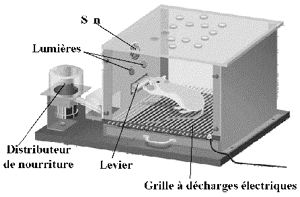 |
|
|
SCHOENFELD, W.N., ANTONITIS, J.J. & BERSH, P.J.
(1950). Unconditioned response rate of the white
rat in a bar-pressing apparatus. Journal of
Comparative and Physiological Psychology, 43 (1),
41-48. |
SING, D. (1970). Preference for bar-pressing to obtain
reward over free-loading in rats and children. Journal
of Comparative & Physiological Psychology, 73,
320-327. |
|
HURWITZ, H.M.B. (1958). A source of error in estimating
the number of reinforcements in a lever-pressing
apparatus. Journal of the Experimental Analysis of
Behavior, 1 (2), 149-152.
[PDF] |
SCHWARTZ, B. & WILLIAMS, D.R. (1971). Discrete trials
spaces responding in the pigeon : the dependence of
efficient performance on the availability of a stimulus
for collateral pecking. Journal of the Experimental
Analysis of Behavior, 16 (2), 145-150.
[PDF] |
|
PREMACK, D. & BAHWELL, R. (1959). Operant-level lever
pressing by a monkey as a function of interest interval. Journal
of the Experimental Analysis of Behavior, 2,
127-131. [PDF] |
SCHWARTZ, B. & WILLIAMS, D.R. (1972). Two different
kinds of key peck in the pigeon : Some properties of
responses maintained by negative and positive
response-reinforcer contingencies. Journal of the
Experimental Analysis of Behavior, 18 (2),
201-216. [PDF] |
|
SHAPIRO, M.M. (1960). Respondent salivary conditioning in
dogs during operant lever pressing in dogs. Science,
132, 361-364. |
PLATT, J.R., KUCH, D.O. & BITGOOG, S.C. (1973). Rats'
lever-press durations as psychophysical judgments of time.
Journal of the Experimental Analysis of Behavior, 19 (2),
239-250. [PDF]
|
|
SHAPIRO, M.M. (1961). Salivary conditioning in dogs during
fixed-interval reinforcement contingent upon lever
pressing. Journal of the Experimental Analysis of
Behavior, 4 (4), 361-364. [PDF] |
|
|
BARON, A. & ANTONITIS, J.J. (1961). Punishment and
preshock as determinants of bar-pressing behavior.
Journal of Comparative and Physiological Psychology, 54,716-720.
|
IVERSEN, I.H. (1975). Interactions between lever pressing
and collateral drinking during VI with limited hold. The
Psychological Record, 25, 49-54. |
|
HERRICK, R.M. & KARNOW, P. (1962). A
displacement-sensing, forces required range from 10 to 20
kg. The constant-torque response lever. Journal of
the Experimental Analysis of Behavior, 5 (4),
461-462. [PDF] |
YOKEL, R.A. & WISE, R.A. (1975). Increased lever
pressing for amphetamine after pimozide in rats :
Implications for a dopamine theory of reward. Science,
187, 547-549. |
|
BARON, A., ANTONITIS, J.J. & CLARK, A.H. (1963). Bar
pressing as a function of test environment area. The
Journal of Genetic Psychology, 102, 159-165. |
|
|
HERRICK, R.M. (1964). The successive differentiation of a
lever displacement response. Journal of the
Experimental Analysis of Behavior, 7 (3), 211-215.
[PDF] |
HINELINE, P.N. & HARRISON, J.F. (1978). Lever biting
as an avoidance response. Bulletin of the Psychonomic
Society, 11, 223-226. |
|
HUNEYCUTT, B.D., CROWDER, W.F. & WILKES, W.P. (1964).
An inexpensive, retracting rat lever. Journal of the
Experimental Analysis of Behavior, 7 (4), 332. [PDF] |
HEMMES, N.S. & RUBINSKY, H.J. (1982). Conditional
acceleration and external disinhibition of operant lever
pressing by prereward, neutral, and reinforcing stimuli. Journal
of the Experimental Analysis of Behavior, 38 (2),
157-168. [PDF] |
|
HOFFMAN, H.S. (1964). A retractable lever for use in
behavioral research. Journal of the Experimental
Analysis of Behavior, 7 (2), 163-164. [PDF] |
|
|
CROWDER, S.F., WIKES, W.P. & HUNEYCUTT, B.C. (1964).
Simple motor-driven devices for feeding and watering
animals. Journal of the Experimental Analysis of
Behavior, 7 (4), 33-314. [PDF] |
|
|
SNAPPER, A.G. SCHOENFELD, W.N., FERRARO, D.P. & LOCKE,
B. (1966). Some properties of the rat's bar-pressing
response under regular reinforcement. Journal of
Comparative & Physiological Psychology, 62 (2),
325-327. |
|
|
COLE, M. & FANTINO, E. (1966). Temporal variables and
trial discreteness in lever-press avoidance. Psychonomic
Science, 6, 217-218. |
SALAMONE, J.D., COUSINS, M.S., McCULLOUGH, L.D., CARRIERO,
D.L. & BERKOWITZ, R.J. (1994). Nucleus accumbens
dopamine release increases during instrumental lever
pressing for food but not free food consumption. Pharmacology, Biochemistry & Behavior, 49, 25-31. |
|
HINELINE, P.N. (1968). Technical note : A rapid
retractable response lever. Journal of the
Experimental Analysis of Behavior, 11 (2), 127-128.
[PDF] |
GRIMES, J.A. & SHULL, R.L. (2001).
Response-independent milk delivery enhances persistence of
pellet-reinforced lever pressing by rats. Journal of
the Experimental Analysis of Behavior, 76 (2),
179-194. [PDF] |
|
| |
|
Voir aussi Conditionnenent
opérant et Comportement |
|
|
Comportement de propreté :
Anti-litter behavior, toilet training, training, early-start potty training.
|
Comportement de propreté (des lieux) : Ensemble de
comportements visant à disposer de ses
déchets, et donc à maintenir son environnement
propre.
= Nettoyer, civisme, comportement anti-pollution.
* Apprentissage
de la propreté, hygyène.
Anti-litter behavior.
| |
|
|
MARLER, L. (1970). A study of anti-liter messages. Journal
of Environmental Education, 3, 52-53. |
GELLER, E.S. (1979). Applications of behavioral analyses
for the item and the resident's hand after several liter
control. In D. Glenwick & L. Jason (Eds.),
Behavioral community psychology : Progress &
prospects. New York : Praeger. |
|
BURGESS, R.L., CLARK, R.N. & HENDEE, J.C. (1971). An
experimental analysis of anti-litter procedures. Journal
of Applied Behavior Analysis, 4 (2), 71-75. [PDF] |
BRASTED, W., MANN, M. & GELLER, E.S. (1979).
Behavioral interventions for litter control : A critical
review. Cornell Journal of Social Relations,
14 (1), 75-90. |
|
CLARK, R.N., BURGESS, R.L. & HENDEE, J.C. (1972). The
development of anti-litter behavior in a forest
campground. Journal of Applied Behavior Analysis, 5
(1), 1-5. [PDF] |
GELLER, E.S., BRASTED, W.S. & MANN, M.F. (1979-80).
Waste receptacle designs as interventions for litter
control. Journal of Environmental Systems, 9,
145-160. |
|
FINNIE, W.C. (1973). Field experiments in liter control. Environment & Behavior, 5, 123-144. |
BACON-PRUE, A., BLOUNT, R., PICKERING, D. & DRABMAN,
R. (1980). An evaluation of three litter control
procedures-trash receptacles, paid workers, and the marked
item technique. Journal of Applied Behavior Analysis,
13 (1), 165-170. [PDF] |
|
KOHLENBERG, R. & PHILLIPS, T. (1973). Reinforcement
and rate of litter depositing. Journal of Applied
Behavior Analysis, 6 (3), 391-396. [PDF] |
O'NEILL, G.W., BLANCK, L.S. & JOYNER, M.A. (1980). The
use of stimulus control over littering in a natural
setting. Journal of Applied Behavior Analysis, 13
(2), 379-381. [PDF] |
|
GELLER, E.S. (1973). Prompting anti-litter behaviors. Proceedings
of the 81st Annual Convention of the American
Psychological Association, 8, 901-902. |
DURDAN, C.A., REEDER, G.D. & HECHT, P.R. (1985).
Litter in a university cafeteria : demographic data and
the use of prompts as an intervention strategy. Environment
& Behavior, 17, 387-404. |
|
GELLER, E.S., FARIS, J.C. & POST, D.S. (1973).
Prompting a consumer behavior for pollution control. Journal
of Applied Behavior Analysis, 6 (4), 367-376. [PDF] |
LEVITT, L. & LEVENTHAL, G. (1986). Litter reduction :
How effective is the New York state bottle Bill ? Environment
& Behavior, 18 (4), 467-479. |
|
POWERS, R.B., GRAYSON-OSBORNE, J. & ANDERSON, E.G.
(1973). Positive reinforcement of litter removal in the
natural environment. Journal of Applied Behavior
Analysis, 6 (4), 579-586. [PDF] |
CIALDINI, R.B., RENO, R.R. & KALLGREN, C.A. (1990). A
focus theory of normative conduct : Recycling the concept
of norms to reduce littering in public places. Journal
of Personality & Social Psychology, 58,
1015-1026. [PDF] |
|
GELLER, E.S. (1974). Increasing desired waste disposals
with instructions. Man-Environment Systems, 5, 125-128. |
GRASMICK, H.G., BURSIK, R.J. & KINSEY, K.A. (1991).
Shame and embarrassment as reterrents to noncompliance
with the law : The case of an antilittering campaign. Environment
& Behavior, 23 (2), 233-251. |
|
CHAPMAN, C. & RISLEY, T.R. (1974). Anti-litter
procedures in an urban high-density area. Journal of
Applied Behavior Analysis, 7 (3), 377-383.
[PDF] |
HUFFMAN, K.T.W., GROSSNICKLE, W.F., COPE, J.G. &
HUFFMAN, K.P. (1995). Litter reduction : A review and
integration of the literature. Environment &
Behavior, 27 (2), 153-183.
[PDF] |
|
LAHART, D. & BAILEY, J.S. (1975). Reducing children's
littering on a nature trail. Journal of Environmental
Education, 7, 37-45. |
DE KORT, Y.A.W., McALLEY, T. & MIDDE, C.J.H. (2008).
Persuasive trash cans. Activation of littering norms by
design. Environment & Behavior, 40 (6),
870-891. [PDF] |
|
HAYES, S.C., JONHSON, V.S. & CONE, J.D. (1975). The
marked item technique : A practical procedure for liter
control. Journal of Applied Behavior Analysis, 8
(3), 381-386. [PDF] |
|
|
WITMER, J.F. & GELLER, E.S. (1976). Facilitating paper
recycling : effects of prompts, raffles, and contests. Journal
of Applied Behavior Analysis, 9 (3), 315-322. [PDF] |
|
|
BALTES, M.M. & HAYWARD, S.C. (1976). Application and
evaluation of strategies to reduce pollution : behavioral
control of littering in a football stadium. Journal of
Applied Psychology, 61, 501-506. |
|
|
| |
|
|
Voir aussi Polluer,
Recycler et Économie d'énergie |
|
|
|
|
|
|
|
|
|
|
|
|
|
|
|
|
Comportement du professeur/enseignant : Voir enseigner.
Teacher's behavior.
|
Comportement échoïque : Chez Skinner,
comportement verbal qui
consiste à reproduire ou imiter ce que l'on entend. Echoic
repertoire.
| |
|
|
SKINNER, B.F. (1957). Verbal behavior. New York
: Appleton-Century-Crofts. |
DRASH, PW., HIGH, R.L. & TUDOR, R.M. (1999). Using
mand training to establish an echoic repertoire in young
children with autism. The Analysis of Verbal
Behavior, 16, 29-44. [PDF] |
|
RISLEY, T.R. & WOLF, M.M. (1967). Establishing
functional speech in echolalic children. Behaviour
Research & Therapy, 5, 73-88. |
ESCH, B.E., CARR, J.E. & MICHAEL, J. (2005).
Evaluating stimulus-stimulus pairing and direct
reinforcement in the establishment of an echoic repertoire
of children diagnosed with autism. The Analysis of
Verbal Behavior, 21, 43-58. [PDF] |
|
BOE, R. & WINOKUR, S. (1978). A procedure for studying
echoic control in verbal behavior. Journal of the
Experimental Analysis of Behavior, 30 (2),
213-217. [PDF] |
TARBOX, J., MADRID, W., AGUILAR, B., JACOBO, W. &
SCHIFF, A. (2009). Use of chaining to increase complexity
of echoics in children with autism. Journal of
Applied Behavior Analysis, 42, 901-906. [PDF] |
|
CHARLOP, M.H. (1986). Setting effects on the occurrence of
autistic children's immediate echolalia. Journal of
Autism & Developmental Disorders, 16, 473-483. |
LÖHR, T. & GILL, M.S.C.A. (2015). Learning by playing
: echo and tact in expanding the verbal repertoire of
infants. SciElO Paidéia, 25, 77-85. |
|
|
Voir aussi Comportement
verbal et Comportement |
|
|
Comportement efféminé : Qualifie le comportement d'un homme que l'on attribue généralement à une femme.
Effeminate behavior, cross-gender behavior.
| |
|
|
FAGOT, B.I. (1977). Consequences of moderate
cross-gender behavior in preschool children. Child
Development, 48, 902-907. |
|
ZUGER, B. (1984). Early effeminate behavior in boys :
Outcome and significance for homosexuality. Journal of
Nervous & Mental Disease, 172, 90-97. |
|
SREENIVASAN, U. (1985). Effeminate boys in a child
psychiatric clinic : Prevalence and associated factors.
Journal of the American Academy of Child &
Adolescent Psychiatry, 24, 689694. |
|
ZUGER, B. (1988). Is early effeminate behavior in
boys early homosexuality ? Comprehensive Psychiatry,
29 (5), 509-519. |
|
SANDBERG, D.E., MEYER-BAHLBURG, H.F.L., EHRHARDT, A.A.
& YAGER, T.J. (1993). The prevalence of
gender-atypical behavior in elementary school children. Journal
of the American Academy of Child & Adolescent
Psychiatry, 32, 306-314. |
|
|
Voir aussi Rôle
sexuel, Homosexualité
et Comportement |
|
|
|
|
Comportement étrange :
=excentricité, comportement atypique, variation inhabituel.
Bizarre behavior, aberrant behavior, bizarre gesture, bizarre speech.
| |
|
|
WEISEBER, P., PASSMAN, R.H. & RUSSELL, J.E. (1973).
Development of verbal control over bizarre gestures of
retardates through imitative and nonimitative
reinforcement procedures. Journal of Applied Behavior
Analysis, 6 (3), 487-495. [PDF] |
|
WEEKS, M. & GAYLORD-ROSS, R. (1981). Task difficulty
and aberrant behavior in severely handicapped students. Journal
of Applied Behavior Analysis, 14 (4), 449-463. [PDF] |
|
MACE, F.C. & LALLI, J.S. (1991). Linking descriptive
and experimental analyses in the treatment of bizarre
speech.Journal of Applied Behavior Analysis, 24
(3), 553-562. [PDF] |
|
MACE, F.C., LALLI, J.S. & LALLI, E.P. (1991).
Functional analysis and treatment of aberrant behavior. Research
in Developmental Disabilities, 12 (2), 155-180. |
|
DERBY, K.M., WACKER, D.P., SASSO, G., STEEGE, M.,
NOTHRTUP, J., CIGRAND, K. & ASMUS, J. (1992). Brief
functional assessment techniques to evaluate aberrant
behavior in an outpatient setting : A summary of 79 cases.
Journal of Applied Behavior Analysis, 25 (3),
713-721. [PDF] |
|
DERBY, K.M., WACKER, D.P., PECK, S., SASSO, G., DERAAD,
A., BERG, W., ASMUS. J. & ULRICH, S. (1994).
Functional analysis of separate topographies of aberrant
behavior. Journal of Applied Behavior Analysis, 27 (2),
267-278.
[PDF] |
|
REARDON, C.L. & FACTOR, R.M. (2008). Bizarre behavior
in a patient treated with Prazosin for PTSD. American
Journal of Psychiatry, 165, 774-775. |
|
|
|
Voir aussi Comportement |
|
|
Comportement exploratoire : Ensemble de comportements qui permettent de découvrir les objets
et leurs propriétés ( EX:
préhension) et
d'explorer de nouveaux environnements
( EX: grimper).
Comportement exploratoire et curiosité.
= Explorer, comportement d'exploration.
Exploratory behavior, exploration.
| |
|
|
BERLYNE, D.E. (1950). Novelty and curiosity as
determinants of exploratory behavior. British Journal
of Psychology, 41, 68-80. |
PELLEGRINI, A.D. (1982). Explorations in preschoolers'
construction of cohesive test in two play contexts.
Discourse Processes, 5, 101-108. |
|
MONTGOMERY, K.C. (1953). The effect of activity
deprivation upon exploratory behavior. Journal of
Comparative & Physiological Psychology, 46,
438-441. |
WOHLWILL, J.F. (1981). A conceptual analysis of
exploratory behavior : The "specific-diversive"
distinction revisited. In Hy I. Day (Ed.), Advances in
intrinsic motivation and aesthetics. New York :
Plenum Press. |
|
HUTT, C. (1966). Exploration and play in children. Symposia
of the Zoological Society of London, 18, 61-81. |
ARCHER, J. & BIRKE, L. (1983). Exploration in
animals and humans. UK : Van Nostrand Reinhold,
Ltd. |
|
BELSKY, J. & MOST, R.K. (1981). From exploration to
play : A cross-sectional study of infant free play
behavior. Developmental Psychology, 17, 630-639. |
COHEN, J.D., McCLURE S.M. & YU, A.J. (2007). Should I
stay or should I go ? How the brain manages the trade-off
between exploitation and exploration. Philosophical
Transactions of Royal Society B, 362, 933-942. [PDF] |
| |
|
Voir aussi Jeu,
Curiosité et
Comportement |
|
|
Comportement hallucinatoire :
Hallucinatory behavior.
| |
|
|
LAYNG, T.V.J. & ANDRONIS, P.T. (1984). Toward a
functional analysis of delusional speech and hallucinatory
behavior. The Behavior Analyst, 7 (2), 139-156.
[PDF] |
|
|
Voir aussi Comportement et Hallucination |
|
|
Comportement inadapté : Comportement qui engendre des conséquences nuisibles à la fois pour l'individu qui émet ce comportement et son entourage. EX: Les
comportements d'automutilation d'un enfant ou d'un enfant trisomique.
= Comportement inadéquat.
* Comportement
indésirable.
Maladaptive behavior, aberrant behavior.
| |
|
|
WEEKS, M. & GAYLORD-ROSS, R. (1981). Task difficulty
and aberrant behavior in severely handicapped students. Journal
of Applied Behavior Analysis, 14 (4), 449-463. [PDF] |
|
LINDAUER, S.E., ZARCONE, J.R., RICHMAN, D.M. &
SCHROEDER, S.R. (2002). A comparison of multiple
reinforcer assessments to identify the function of
maladaptive behavior. Journal of Applied Behavior
Analysis, 35 (3), 299-303. [PDF] |
|
|
|
Voir aussi Comportement |
|
|
Comportement incompatible : Comportement qui, en raison de sa topographie, empêche l'émission ou diminue la fréquence d'un autre comportement (que l'on souhaite modifier).
Incompatible behavior.
| |
|
|
RAY, B.A. (1969). Selective attention : The effects of
combining stimuli which control incompatible behavior.
Journal of the Experimental Analysis of Behavior, 12
(4), 539-550. [PDF] |
|
YOUNG, J.A. & WINCZE, J.P. (1974). The effects of the
reinforcement of compatible and incompatible alternative
behaviors on the self-injurious and related behaviors of a
profoundly retarded female adult. Behavior Therapy,
5, 614-623. |
|
HUGUENIN, N.H. & TOUCHETTE, P.E. (1980). Visual
attention in retarded adults : combining stimuli which
control incompatible behavior. Journal of
Experimental Analysis of Behavior, 33 (1), 77-86. [PDF] |
|
NAITOH, S. & STAATS, A.W. (1980). Positive and
negative transfer of control : Instrumental response
mediation and response competition. Bulletin of the
Psychonomic Society, 15, 317-320. |
|
|
Voir aussi Renforcement
différentiel des comportements incompatibles et
Comportement |
|
|
|
Comportement indésirable/désirable : Comportement
qui n'engendre pas de conséquences
nuisibles pour l'individu qui l'émet, mais qui nuit plus
ou moins à entourage. EX: Les grimaces d'un
enfant trisomique, les comportements répétitifs d'un
schizophrène.
* Comportement
inadapté.
Undesirable behavior.
| |
|
|
ROLIDER, A. & VAN HOUTEN, R. (1985). Movement
suppression time-out : An effective way to suppress
undesirable behavior in psychotic and severe
developmentally delayed children. Journal of Applied
Behavior Analysis, 18 (4), 275-288. [PDF] |
|
DUNLAP, G. (1996). Modifying instructional activities to
promote desirable behavior : A conceptual and practical
framework. School Psychology Quarterly, 11 (4),
297-312. [PDF] |
|
|
|
Voir aussi Comportement |
|
|
Comportement impulsif : Comportement émis sans réflexion préalable ou sans tenir compte du contexte ou des
conséquences possibles. Comportement impulsif et Impulsivité.
Impulsive behavior.
| |
|
|
AINSLIE, G.W. (1974). Impulse control in pigeons.
Journal of the Experimental Analysis of Behavior, 21
(3), 85- 489. [PDF] |
|
AINSLIE, G.W. (1975). Specious reward : A behavioral
theory of impulsiveness and impulse control. Psychological
Bulletin, 82, 463-496. |
|
REYNOLDS, B., ORTENGREN, A., RICHARDS, J.B. & DE WIT,
H. (2001). Dimensions of impulsive behavior : Personality
and behavioral measures. Personality & Individual
Differences, 40 (2), 305-315. |
|
LYNAM, D.R. & MILLER, J.D. (2004). Personality
pathways to impulsive behavior and their relations to
deviance : Results from three samples. Journal of
Quantitative Criminology, 20, 319-341. |
|
LYNAM, D.R., SMITH G.T., WHITESIDE S.P. & CYDERS, M.A.
(2006). The UPPS-P : Assessing five personality
pathways to impulsive behavior (Technical Report).
West Lafayette : Purdue University. |
|
|
|
Voir aussi Comportement et Impulsivité |
|
|
Comportement inapproprié : Expression utilisée par tout ceux qui rechignent à utiliser le terme anormal, qui fait
notamment référence au DSM et
à sa définition floue des troubles
mentaux.
= Comportement problématique.
/Comportement approprié.
Inappropriate behavior, problem behavior.
| |
|
|
ZEILBERGER, J., SAMPEN, S.E. & SLOANE, H.N. (1968).
Modification of a child's problem behaviors in the home
with the mother as therapist. Journal of Applied
Behavior Analysis, 1, 47-53. [PDF] |
CARR, E.G. & DURAND, V.M. (1985). Reducing behavior
problems through functional communication training. Journal
of Applied Behavior Analysis, 18 (2), 111-126. [PDF] |
|
REPP, A.C., DEITZ, S.M. & DEITZ, D.E.D. (1976).
Reducing inappropriate behaviors in classrooms and in
individual sessions through DRO schedules of
reinforcement. Mental Retardation, 14, 11-15. |
ROLIDER, A. & VAN HOUTEN, R. (1990). The role of
reinforcement in reducing inappropriate behavior : Some
myths and misconceptions. In A.C. Repp & N.N. Singh
(Eds.), Perspectives on the use of nonaversive and
aversive interventions for persons with developmental
disabilities (pp. 119-128). Sycamore, IL :
Sycamore. |
|
DEITZ, S.M., REPP, A.C. & DEITZ, D.E.D. (1976).
Reducing inappropriate classroom behaviour of retarded
students through three procedures of differential
reinforcement. Journal of Mental Deficiency Research, 20 (3), 155-170. |
DUNLAP, G., KERN-DUNLAP, L., CLARKE, S. & ROBBINS,
F.R. (1991). Functional assessment, curricular revision,
and severe behavior problems. Journal of Applied
Behavior Analysis, 24 (2), 387-397.
[PDF] |
|
POLVINALE, R.A. & LUTZKER, J.R. (1980). Elimination of
assaultive and inappropriate sexual behavior by
reinforcement and social-restitution. Mental
Retardation, 18 (1), 27-30. |
DIXON, M.R., HAYES L.J., BINDER, L.M., MANTHEY, S.,
SIGMAN, C. & ZDANOWSKI, D.M. (1998). Using a
self-control training procedure to increase appropriate
behavior. Journal of Applied Behavior Analysis, 31
(2), 203- 210. [PDF] |
|
WEEKS, M. & GAYLORD-ROSS, R. (1981). Task difficulty
and aberrant behavior in severely handicapped students. Journal
of Applied Behavior Analysis, 14 (4), 449-463. [PDF] |
McGILL, P. (1999). Establishing operations : Implications
for the assessment, treatment, and prevention of problem
behavior. Journal of Applied Behavior Analysis, 32
(3), 393-418. [PDF] |
|
BACHMAN, J.E. & FUQUA, R.W. (1983). Management of
inappropriate behaviors of trainable mentally impaired
students using antecedent exercise. Journal of
Applied Behavior Analysis, 16 (4), 477-484. [PDF] |
FYFFE, C.E., KAHNG, S., FITTRO, E. & RUSSELL, D.
(2004). Functional analysis and treatment of inappropriate
sexual behavior. Journal of Applied Behavior Analysis,
37 (3), 401-404. [PDF] |
|
|
Voir aussi Comportement |
|
|
Comportement inné : Ensemble de
comportements davantage déterminés par les gènes
que par l'environnement.
Certains comportements comme les réflexes
sont très faiblement influencés par le milieu. Comportement inné,
instinct et hérédité.
= Comportement instinctif.
( ) : réflexe, taxie,
tropisme, stéréotypie
comportementale innée.
Innate behavior, instinctive behavior.
| |
|
|
LASHLEY, K.S. (1938). Experimental analysis of instinctual
behavior. Psychological Review, 45, 445-471. |
|
TINBERGEN, N. (1942). An objective study of the innate
behaviour of animals. Bibliographia Biotheoretica, 1,
39-98. |
|
STONE, C.P. (1947). Methodological resources for the
experimental study of innate behavior as related to
environmental factors. Psychological Review, 54,
342-347. |
|
LEHRMAN, D.S. (1953). A critique of Konrad Lorenz's theory
of instinctive behavior. Quarterly Review of Biology,
28, 337-363. |
|
VERPLANK, W.S. (1955). Since learned behavior is innate,
and vice versa, what now? Psychological Review, 62,
139-144. |
|
THOMPSON, N.S. (1977). "Instinctive behavior" and
"Ethological motivation theory". In B.B. Wolman and L.R.
Pomeroy (Eds.), International Encyclopedia of
Neurology, Psychiatry, Psychoanalysis & Psychology,
6, 67-68 and 4, 388-390. |
|
JACOBS, J. (1981). How heritable is innate behaviour ? Zeitschrift
für Tierpsychologie, 55 (1), 1-18. |
|
|
|
Voir aussi Instinct,
Hérédité et Comportement |
|
|
|
|
Comportement
intraverbal : Intraverbal,
intraverbal behavior.
| |
|
|
VARGAS, E.A. (1982). Intraverbal behavior : The codic,
duplic, and sequelic subtypes. The Analysis of Verbal
Behavior, 1, 5-7. [PDF] |
SUNDBERG, M.L., ENDICOTT, K. & EIGENHEER, P. (2000).
The use of intraverbal prompts to teach tacts to children
with autism. The Analysis of Verbal Behavior, 17, 89-104.
[PDF] |
|
BRAAM, S.J. & POLING, A. (1983). Development of
intraverbal behavior in mentally retarded individuals
through transfer of stimulus control procedures :
Classification of verbal responses. Applied Research
in Mental Retardation, 4, 279-302. |
MIGUEL, C.F., PETURSDOTTIR, A. & CARR, J. (2005). The
effects of multiple-tact and receptive-discrimination
training on the acquisition of intraverbal behavior. The
Analysis of Verbal Behavior, 21, 27-41. [PDF] |
|
CHASE, P.N., JOHNSON, K.R. & SULZER-AZAROFF, B.
(1985). Verbal relations within instruction : Are there
subclasses of the intraverbal ? Journal of the
Experimental Analysis of Behavior, 43 (3), 301-313.
[PDF] |
SAUTTER, R.A., LEBLANC, L.A., JAY, A.A., GOLDSMITH, T.R.
& CARR, J.E. (2011). The role of problem
solving in complex intraverbal repertoires. Journal of
Applied Behavior Analysis, 44 (2), 227244.
[PDF] |
LUCIANO, M.C. (1986). Acquisition, maintenance, and
generalization of productive intraverbal behavior
through transfer of stimulus control procedures.
Applied Research in Mental Retardation, 7, 120. |
PÉREZ-GONZALEZ, L.A. & GARCIA-ASENJO, L. (2007).
Emergence of intraverbal antonyms in children with
pervasive developmental disorder. Journal of Applied
Behavior Analysis, 41 (4), 697-701.
[PDF] |
|
VARGAS, E.A. (1982). Intraverbal behavior. In P.N. Chase
& L.J. Parrott (Eds.), Psychological aspects of language (pp. 128-151). Springfield, IL : Charles C. Tho |
GOLDSMITH, T.R., LEBLANC, L.A. & SAUTTER, R.A. (2007).
Teaching intraverbal behavior to children with autism. Research
in Autism Spectrum Disorders, 1, 1-13. [PDF] |
|
TENENBAUM, H.A. & WOLKING, W.D. (1989). Effects of
oral reading rate and inflection on intraverbal
responding. The Analysis of Verbal Behavior, 7, 83-89.
[PDF] |
CIHON, T.M. (2007). A review of training intraverbal
repertoires : Can precision teaching help. The
Analysis of Verbal Behavior, 23, 123-133. [PDF] |
|
WATKINS, C.L., PACK-TEIXEIRA, L. & HOWARD, J.S.
(1989). Teaching intraverbal behavior to severely retarded
children. The Analysis of Verbal Behavior, 7,
69-81.
[PDF] |
PETURSDOTTIR, I.I., CARR, J.E, LECHAGO, S.A. &
ALMASON, S.M. (2008). An evaluation of intraverbal
training and listener training for teaching categorization
skills. Journal of Applied Behavior Analysis, 41
(1), 53-68. [PDF] |
|
SUNDBERG, M.L., SAN JUAN, B., DAWDY, M. & ARGUELLES,
M. (1990). The acquisition of tacts, mands, and
intraverbals by individuals with traumatic brain injury.
The Analysis of Verbal Behavior, 8, 83-99. [PDF] |
PETURSDOTTIR, I.I., OLAFSDOTTIR, A.R. & ARADOTIR, B.
(2008). The effects of tact and listener training on the
emergence of bidirectional intraverbal relations.
Journal of Applied Behavior Analysis, 41 (3),
411-415. [PDF] |
PARTINGTON, J.W. & BAILEY, J.S. (1993). Teaching
intraverbal behavior to preschool children. The
Analysis of Verbal Behavior, 11, 918. |
SUNDBERG, M.L. & SUNDBERG, C.A. (2011). Intraverbal
behavior and verbal conditional discriminations in
typically developing children and children with autism. The
Analysis of Verbal Behavior, 27, 23-43.
[PDF] |
|
KODAK, T. FUCHTMAN, R. & PADEN, A.R. (2012). A
comparison of intraverbal training procedures for children
with autism. Journal of Applied Behavior Analysis,
45, 155-160. |
|
POLSON, D.A.D., GRABAVAC, D.M. & PARSONS, J.A. (1997).
Intraverbal stimulus-response reversibility : Fluency,
familiarity effects, and implications for stimulus
equivalence. The Analysis of Verbal Behavior, 14,
19-40. [PDF] |
DICKES, N.R. & KODAK, T. (2015). Evaluating the
emergence of bi-directional intraverbals in young children
with autism spectrum disorder. Behavioral
Interventions, 30, 169-190. |
|
KODAK, T. & PADEN, A.R. (2015). A comparison of
intraverbal and listener training for children with autism
spectrum disorder. The Analysis of Verbal Behavior,
31, 137-144. |
|
|
|
Voir aussi Comportement |
|
|
Comportement moral :
Moral behavior.
| |
|
|
GOLDIAMOND, I. (1968). Moral behavior : a functional
analysis. Psychology Today, 2 (9), 31-34, 69-70. |
|
TERMINI, A. & GOLDEN, J. (2007). Moral behaviors :
What can behaviorist learn from the developmental
literature ? International Journal of Behavioral
Consultation & Therapy, 3 (4), 477-493. [PDF] |
|
TANGNEY J.P., STUEWIG J. & MASHEK D.J. (2007). Moral
emotions and moral behavior. Annual Review of
Psychology, 58, 345-372. |
|
|
Voir
Jugement moral, Morale
et Développement
moral |
|
|
|
Comportement moteur : Comportement dont l'exécution nécessite l'usage des muscles
(la motricité). Pour certains auteurs comportement et comportement
moteur sont synonymes. Comportement moteur, habileté motrice et dextérité.
= Mouvement, comportement.
Motor behavior, motor output.
| |
|
|
ALBARRACIN, D., NOGUCHI, K., LI, H., LEEPER, J., BROWN,
R.D., HANDLEY, I.M., McCULLOCH, K.C., EARL, A. & HART,
W.P. (2008). Increasing and decreasing motor and cognitive
output : A model of general action and inaction goals. Journal
of Personality & Social Psychology, 95 (3),
510-523. [PDF] |
|
ADOLPH, K.E. & FRANCHAK, J.M. (2017). The development
of motor behavior. Wiley Interdisciplinary Reviews :
Cognitive Science, 8 (1-2), 1-30. [PDF] |
|
|
Voir Mouvement,
Habileté
motrice et
Comportement |
|
|
|
|
Comportement non-verbal : Comportement moteur; pour certains psychologues ces comportements
révèlent une intention d'agir ou une émotion,
alors que pour d'autres ces intentions
ou émotions n'existent
que dans l'oeil de l'observateur.
= Habileté non-verbale, communication non-verbale.
/Comportement
verbal, communication
verbale.
Nonverbal skil, nonverbal behavior.
| |
|
|
RISLEY, T.R. & HART, B. (1968). Developing
correspondence between the non-verbal and verbal behavior
of preschool children. Journal of Applied Behavior
Analysis, 1 (4), 267-281.
[PDF] |
MOORE, M.M. & BUTLER, D.L. (1989). Predictive aspects
on nonverbal courtship behavior in women. Semiotica,
3, 201-214. |
|
EKMAN, P. & FRIESEN, W.V. (1969). The repertoire of
nonverbal behavior : Categories, origins, usage, and
coding. Semiotica, 1, 49-97. |
CATANIA, A.C., LOWE, C. F. & HORNE, P. (1990).
Nonverbal behavior correlated with the shaped verbal
behavior of children. Analysis of Verbal Behavior, 8,
43-55.
|
|
GOTTMAN, J., MARKMAN, H. & NOTARIUS, C. (1977). A
sequential analysis of verbal and nonverbal behavior. Journal
of Marriage & the Family, 39, 461-477 |
|
|
HALL, J.A., ROSENTHAL, R., ARCHER, D., DIMMATTEO, M.R.
& ROGERS, P.L. (1977). Nonverbal skills in the
classroom. Theory into Practice, 16, 162-66. |
VRIJ, A. (1993). Credibility judgments of detectives : The
impact of nonverbal behavior, social skills and physical
characteristics on impression formation. Journal of
Social Psychology, 133, 601-611. |
|
MAYO, C. & HEMNLEY, N.M. (Eds.) (1981). Gender
and nonverbal behavior. New York :
Springer-Verlag. |
AMBADY, N. & ROSENTHAL, R. (1993). Half a minute :
Predicting teacher evaluations from thin slices of
nonverbal behavior and physical attractiveness. Journal
of Personalitv & Social Psychology, 64,
431-441. |
|
HALL, J.A. & HALBERSTADT, A.G. (1981). Sex roles and
nonverbal communication skills. Sex Roles, 7,
273-87. |
|
|
HALL, J.A., AIST, M.B. & PIKE, K.M. (1983). Nonverbal
behavior and person description in men's and women's
prose. Journal of Nonverbal Behavior, 7,
213-222. |
HALL, J.A., HARRIGAN, J.A. & ROSENTHAL, R. (1995).
Nonverbal behavior in clinician-patient interaction. Applied
& Preventive Psychology, 4, 21-37. |
|
MOORE, M.M. (1985). Nonverbal patterns in women : Context
and consequences. Ethology & Sociobiology, 6, 237-247. |
VRIJ, A., EDWARD, K., ROBERTS, K.P. & BULL, R. (2000).
Detecting deceit via analysis of verbal and nonverbal
behavior. Journal of Nonverbal Behavior, 24 (4),
239-263. [PDF] |
CATANIA, A.C. (1986). Verbal interactions and nonverbal
behavior. In P. N. Chase & L. J. Parrott (Eds.), Psychological
aspects of language (pp. 206-208). Springfield, IL :
Charles C. Thomas.
|
DUNBAR, N.E., JENSEN, M.L., TOWER, D.C. & BURGOON,
J.K. (2014). Synchronization of nonverbal behaviors in
detecting mediated and non-mediated deception. Journal
of Nonverbal Behavior, 38, 355-376. |
|
CATANIA, A.C. (1986). On the difference between verbal and
nonverbal behavior. The Analysis of Verbal Behavior,
4, 2-9. [PDF] |
|
|
|
Voir aussi Communication
non-verbale,
Comportement moteur
et Comportement |
|
|
|
Comportement normal/anormal : On qualifie un comportement
«d'anormal» en vertu d'une norme,
qui varie beaucoup d'une société à l'autre. Dans de nombreux
pays, notamment occidentaux, on se fonde sur le DSM-5
ou le CIM-10 pour
distinguer le normal
de l'anormal (pathologique).
Normal behavior, Abnormal behavior.
| |
|
|
MAIER, N.R.F. & KLEE, J.B. (1943). Studies of
abnormal behavior in the rat. The pattern of
punishment and its relation to abnormal fixations. Journal
of Experimental Psychology, 32, 377-398. |
|
MAIER, N.R.F. (1945). Studies of
abnormal behavior in the rat. XVII. Guidance versus
trial and error in the alternation of habits and
fixations. Journal of Psychology, 19, 133-163. |
|
LURIA, A.R. (1961). The role of speech in the
regulation of normal and abnormal behavior. New
York : Basis Books. |
|
SALZINGER, K. (1980). The behavioral mechanism to
explain abnormal behavior. Annals of the New York
Academy of Sciences, 340, 66-87. |
|
Voir aussi DSM-5, CIM-10
et Comportement |
|
|
|
|
|
Comportement nuisible : Ensemble de comportements
qui, comme le nom l'indique, nuisent aux autres ou à
l'environnement physique des autres, mais qui sont néanmoins
"renforçant" pour celui ou celle qui les émet. En thérapie, ce
sont des comportements que l'on souhaite
modifier, soit en cessant de les renforcer,
soit en les punissant.
Disruptive behavior, behavior problem.
| |
|
|
CAMPBELL, S.B. (1995). Behavior problems in preschool
children : A review of recent research. Journal of
Child Psychology & Psychiatry, 36 (1), 113-149. |
|
GLASCOE, F.P. & DWORKIN, P.H. (1995). The role of
parents in the detection of developmental and behavioral
problems. Pediatrics, 95 (6), 829-836. |
|
KODAK, T., NORTHUP, J. & KELLEY, M.E. (2007). An
evaluation of the types of attention that maintain problem
behavior. Journal of Applied Behavior Analysis, 40
(1), 167-171. [PDF]
|
|
GLASCOE, F.P. & MARKS, K.P. (2011). Detecting children
with developmental- behavioral problems : The value of
collaborating with parents. Psychological Test &
Assessment Modeling, 53 (2), 258-279.
[PDF] |
|
|
Voir aussi
Comportement |
|
|
Comportement opérant : Classe de comportements
acquis par conditionnement
opérant et qui produisent sur l'environnement
la même conséquence, indépendemment
de leur topographie.
=
opérant, réponse opérante, comportement opérant. Operant
behavior.
| |
|
|
LINDSLEY, O.R. (1957). Operant behavior during sleep : a
measure of depth of sleep. Science, 126 (3286),
1290-1291. |
SCHICK, K. (1971). Operants. Journal of the
Experimental Analysis of Behavior, 15 (3),
413-423. [PDF] |
|
MORSE, W.H. & SKINNER, B.F. (1958). Some factors
involved in the stimulus control of operant behavior. Journal
of the Experimental Analysis of Behavior, 1 (1),
103-107. [PDF] |
SKINNER, B.F. (1977). The experimental analysis of operant
behavior. In R.W. Rieber & K. Salzinger (Eds.), The
roots of American psychology : Historical influences and
implications for the future (Vol. 291, pp.
374-385). Annals of the New York Academy of Sciences. |
|
MEDNICK, M.T. & LINDSLEY, O.R. (1957). (1958). Some
clinical correlates of operant behavior. Journal of
Abnormal & Social Psychology, 57 (1), 13-16. [PDF] |
EVANS, M., DUVEL, A., FUNK, M., LEHMAN, B., SPARROW, J.
WATSON, N.T. & NEURINGER, A. (1994). Social
reinforcement of operant behavior in rats : A
methodological note. Journal of the Experimental
Analysis of Behavior, 62, 149-156.[PDF]
|
|
ELLIS, N.R., BARNETT, C.D. & PRYER, M.W. (1960).
Operant behavior in mental defectives : Exploratory
studies. Journal of the Experimental Analysis of
Behavior, 3, 63-69. [PDF] |
KING, B.M., BRANDT, A. & WEATHERLY, J.N. (2002). Up or
down : The influence of upcoming reinforcement on
consummatory and operant behavior. Journal of General
Psychology, 129, 443-461. |
|
LINDSLEY, O.R., HOBIKA, J.H. & ETSTEN, B.E. (1961).
Operant behavior during anesthesia recovery : A continuous
and objective method. Anesthesiology, 22,
937-946. [PDF] |
|
|
SKINNER, B.F. (1963). Operant behavior. American
Psychologist, 18, 503-515. |
LATTAL, K.A. & WACKER. D. (2015). Some dimensions of
recurrent operant behavior. Mexican Journal of
Behavior Analysis, 41 (2), 1-13. [PDF] |
|
|
Voir aussi Conditionnement
opérant et Comportement |
|
|
Comportement optimal :
Optimal behavior.
| |
|
|
SHIMP, C.P. (1969). Optimal behavior in free-operant
experiments. Psychological Review, 76 (2),
97-112. |
|
|
|
Comportement ordalique : Ensemble de comportements
à risque, parfois qualifiés
d'extrêmes.
= Conduite à risque.
|
|
|
Comportement organisationnel : Ensemble des comportements que l'on observe surtout au sein des groupes organisés et qui sont davantage analysés sous
l'angle individuel (leadership, charisme, stratégies des acteurs, etc) que collectif.
Organizational behavior.
| |
|
|
CYERT, R.M. FEIGENBAUM, E.A. & MARCH, J.G. (1959).
Models in a behavioral theory of the firm. Behavioral
Science, 4, 81-95. |
REDMON, W.K. & WILK, L.A. (1991). Organizational
behavior analysis in the U.S. : Public sector In P.A.
Lamal (Ed.), Behavior analysis of societies and
cultural practices (pp. 107-123). Washington, DC :
Hemisphere. |
|
EASTBROOK, J.A. (1959). The effect of emotion on cue
utilization and the organization of behavior. Psychological
Review, 66, 183-201. |
ZEILER, M.D. & HARZEM, P. (1991). Reinforcement
and the organization of behaviour. New York :
Wiley. |
|
ARGYRIS, C. (1960). Human behavior in organizations.
Yale Scientific Magazine, 34 (5), 40-51. |
MAWHINNEY, T.C. (1992). Total quality management and
organizational behavior management : an integration for
continual improvement. Journal of Applied Behavior
Analysis, 25 (3), 524-543. [PDF] |
|
HOUSE, R. & RIZZO, J. (1972). Role conflict and
ambiguity as critical variables in a model of
organizational behavior. Organizational Behavior
& Human Performance, 7, 467-505. |
ARGYRIS, C. (1993). On organizational learning.
Cambridge, MA : Blackwell. |
|
LUTHANS, F. (1973). Organizational behavior. New
York : McGraw-Hill. |
MAWHINNEY, T.C. (1996). Organizational culture,
rule-governed behavior and organizational behavior
management : Theoretical foundations and implications
for research and practice. Haworth Press. |
|
PORTER, L.W, LAWLER, E.E. & HACKMAN, J.R. (1975). Behavior
in organizations. New York : McGraw-Hill. |
LUTHANS, F. (2002). Positive organizational behavior :
Developing and managing psychological strengths. Academy
of Management Executive, 16, 57-72. |
|
MALOTT, M.E. (2003). Paradox of organizational change
: engineering organizations with behavioral systems
analysis. Reno : Context Press. |
|
VARDI Y. & WEITZ, E. (2004). Misbehavior in
organizations : Theory, research and management.
Lawrence Erlbaum Associates, Mahwah, NJ. |
|
GLENN, S.S. & MALOTT, M.E. (2004). Complexity and
selection : implications for organizational change. Behavior
& Social Issues, 13, 89-106. [PDF] |
|
GRIFFIN, R.W. & LOPEZ, Y.P. (2005). "Bad behavior" in
organizations : A review and typology for future research.
Journal of Management, 31, 988-1005. |
|
ILGEN, D.R., FISHER, C.D. & TAYLOR, M.S. (1979).
Consequences of individual feedback on behavior in
organizations. Journal of Applied Psychology, 64,
349-371. |
NICHOLSON, N. & WHITE, R. (2006). Darwinism : A new
paradigm for organizational behavior. Journal of
Organizational Behavior, 27, 111-119. [PDF] |
|
YOUSSEF, C.M. & LUTHANS, F. (2007). Positive
organizational behavior in the workplace : The impact of
hope, optimism, and resilience. Journal of
Management, 33 (5), 774-800. [PDF] |
|
GIST, M.E. (1987). Self-efficacy : Implications for
organiszational behavior and human resource management. Academy
of Management Review, 12 (3), 472-485. [PDF]
|
LUTHANS, F. & YOUSSEF, C.M. (2007). Emerging positive
organizational behavior. Journal of Management, 33,
321-349. |
|
|
Voir aussi Organisation, Leadership et
Comportement |
|
|
|
|
|
|
Comportement planifié : Comportement
dont l'exécution est en partie sous le contrôle d'un plan. Comportement planifié et théorie
du comportement planifiée.
= Action raisonné.
Planned behavior.
| |
|
|
MILLER, G.A., GALANTER, E. & PRIBRAM, K.H. (1960). Plans
and the structure of behavior. New York : Henry
Holt and Company. |
|
AJZEN, I. (1985). From intentions to actions : A theory of
planned behavior. In J. Kuhl & J. Beckman (Eds.),
Action-control : From cognition to behavior (pp.
11-39). Heidelberg, Germany : Springer. |
|
|
Voir aussi Plan
et Comportement |
|
|
Comportement privé : Comportement qui
n'implique aucun mouvement apparent et qui, pour cette raison, ne
peut être décrit que par celui qui l'émet. Pour les béhavioristes skinnériens, la pensée est un ensemble de comportements
privés.
/Comportement
public.
Private event, private
language, covert event, covert behavior, covert response,
private data, privacy.
| |
|
|
BODE, B.H. (1918). Consciousness as behavior. Journal
of Philosophy, Psychology & Scientific Methods, 15,
449-453, 255-258. |
GREENSPOON, J. (1995). Private events for behavior
analysis : A review of an introduction to
neuroendocrinology by R.E. Brown. Behavior &
Social Issues, 5 (1). |
|
DEJNOZKA, J. (1995). Origins of the private language
argument. Dialogos, 66, 59-78.
[PDF] |
|
GARVER, N. (1960). Wittgenstein on private language. Philosophy
& Phenomenological Research, 20 (3), 389-396. |
HUMPHREY, J.A. (1996). Kripke's Wittgenstein and the Journal
of Philosophical Research, 21, 197-207. |
|
McGUIGAN, F. (1966). Covert oral behavior and auditory
hallucinations. Psychophysiology, 3, 73-80. |
GOLDSTEIN, I. (1996). Ontology, epistemology, and private
ostensive definition. Philosophy &
Phenomenological Research, 56 (1), 137-147. |
|
OBSERVER (1973). Comments and queries : Private data, raw
feels, inner experience, and all that. The
Psychological Record, 23, 83-85. |
ANDERSON, C.M., HAWKINS, R.P. & SCOTTI, J.R. (1997).
Private events in behavior analysis : Conceptual basis and
clinical relevance. Behavior Therapy, 28 (1),
157-179. |
|
DAY, W.F. (1976). Analyzing verbal behavior under the
control of private events. Behaviorism, 4 (2). |
TAYLOR, I. & OREILLY, M.F. (1997). Toward a
functional analysis of private verbal self-regulation. Journal
of Applied Behavior Analysis, 30, 43-58. [PDF] |
|
SCHNAITTER, R. (1978). Private causes. Behaviorism, 6,
1-12. |
FRIMAN, P.C., WILSON, K.G. & HAYES, S.C. (1998).
Behavior analysis of private events is possible,
progressive, and nondualistic : A response to Lamal. Journal
of Applied Behavior Analysis, 31 (4), 707-708. [PDF] |
|
CREEL, R.E. (1980). Radical epiphenomenalism : B.F.
Skinner's account of private events. Behaviorism, 8
(1), 31-53. |
LAMAL, P.A. (1998). Advancing backwards. Journal of
Applied Behavior Analysis, 31,705-706. [PDF] |
|
MOORE, J.C. (1980). On behaviorism and private events. Psychological
Record, 30, 459-475. [PDF] |
SALZINGER, K. (1999). Behaviorism inside out : The private
event. The General Psychologist, 34, 82-89. |
|
HAYES, S.C., WILSON, K.G. & GIFFORD, E. V. (1999).
Consciousness and private events. In B.A. Thyer (Ed.), The
philosophical foundations of behaviorism. Dordrecht
: Kluwer.
|
|
SKINNER, B.F. (1984). Coming to terms with private events.
Behavioral & Brain Sciences, 7, 572-579. |
STEMMER, N. (2003). Covert behavior and mental terms : A
reply to Moore. Behavior & Philosophy, 31,
165-171.
[PDF] |
|
MEEHL, P.E. (1984). Radical behaviorism and mental events
: Four methodological queries. The Behavioral &
Brain Sciences, 7, 563-564. |
RACHLIN, H. (2003). Privacy. In K.A. Lattal & P.N.
Chase (Eds.), Behavior theory and philosophy (pp.
187-201). New York : Kluwer Academic/Plenum. |
|
RACHLIN, H. (1985). Pain and behavior. Behavioral
& Brain Sciences, 8, 43-83. |
BARNES-HOLMES, D. (2003). For the radical behaviorist
biological events are not biological and public events are not public. Behavior & Philosophy, 31, 145-150. [PDF] |
|
|
LYONS, W. (1988). Behaviorism and "the problem of
privacy". In A.C. Catania & S. Harnad (Eds.), The
selection of behavior : The operant behaviorism of B.F.
Skinner : Comments and consequences (pp. 328-331).
Cambridge, United Kingdom : Cambridge University Press. |
LEIGLAND, S. (2003). Private events and the language of
the mental : comments on Moore. Behavior &
Philosophy, 31, 159-164. [PDF] |
|
KRIPKE, S. (1990). On rules and private language. Philosophical
Review, 99 (3), [PDF] |
BRAIN, D. (2004). Private languages and private theorists.
Philosophical Quarterly, 54 (216), 427-434. |
|
MALOTT, R.W. & GARCIA, M.E. (1991). The role of
private events in rule-governed behavior. L.J. Hayes &
P. Chase (Eds.), Dialogues on verbal behavior
(pp. 237-254). Reno, NV : Context Press. |
OKOUCHI, I. (2006). An experimental analysis of another
privacy. The Psychological Record, 56, 245-257.
[PDF] |
|
OVERSKEID, G. (1994). Private events and other causes of
behavior : who can tell the difference ? The
Psychological Record, 44, 35-43. |
MARR, M.J. (2006). Through the looking glass : Symmetry in
behavioral principles ? Behavior Analysis, 29
(1), 125-128. [PDF] |
|
ZAMOSHKIN, A. (1992). Private Life, private Interest,
Private Property. Russian Studies in Philosophy, 31
(1), 49-86. |
TOURINHO, E.Z. (2006). Private stimuli, covert responses,
and private events : Conceptual remarks. The Behavior
Analyst, 29 (1), 13-31.
[PDF] |
|
SALZINGER, K. (1993). How do we know when private events
control behavior ? Behavioral & Brain Sciences,
15, 660-661. |
NEVIN, J.A. (2008). Stimuli, reinforcers, and private
events. Behavior Analysis, 31 (2), 113-126. [PDF] |
|
DOUGHER, M.J. (1993). On the advantages and implications
of a radical behavioral perspective on private events for
the behavior therapist. The Behavior Therapist, 16,
204-206. |
MOORE, J.C. (2009). Why the radical behaviorist conception
of private events is interesting, relevant, and important.
Behavior & Philosophy, 37, 21-37. [PDF]
|
|
BAUM, W.M. (1993). The status of private events in
behavior analysis. Behavioral & Brain Sciences,
16, 644. |
MARR, M.J. (2011). Has radical behaviorism lost its right
to privacy ? Behavior Analysis, 34 (2), 213-219.
[PDF] |
|
PLACE, U.T. (1993). A radical behaviorist methodology for
the empirical investigation of private events. Behaviorism
& Philosophy, 20 (2), 25-35. |
TOURINHO, E.Z., BORBA, A., VICHI, C. & LEITE, F.L.
(2011). Contributions of contingencies in modern societies
to "privacy" in the behavioral relations of cognition and
emotion. The Behavior Analyst, 34 (2), 171-180.
[PDF] |
|
JACQUETTE, D. (1992). Wittgenstein on private language and
privat mental objects. Wittgenstein-Studien 1
(1). |
BAUM, W.M. (2011). Evasion, private events, and pragmatism
: a reply to Moores response to my review of conceptual
foundations of radical behaviorism. Journal of the
Experimental Analysis of Behavior, 95 (1), 141-144..
[PDF] |
|
ELLIS, A. (1994). Radical behavioral treatment of private
events : A response to Michael Dougher. The Behavior
Therapist, 17, 219-221. |
BAUM, W.M. (2011). Behaviorism, private events, and the
molar view of behavior. Behavior Analysis, 31
(2), 185-200. [PDF] |
|
|
|
Voir aussi Comportement
verbal et Comportement |
|
|
|
|
Comportement pro-environnemental : Ensemble de comportements prosociaux dont l'objectif avoué est de protéger l'environnement physique et les espèces qui y habitent.
Comportement pro-environnemental, écologie
et réchauffement
climatique.
Pro-environmental behaviour, environmentally responsible behavior, green purchasing behavior.
| |
|
|
STERN, P.C. & GARDNER, G.T. (1981). The place of
behavior change in managing environmental problems.
Zeitschrift für Umweltpolitik, 2, 213-239. |
LAVERGNE, K.J., SHARP, E.C., PELLETIER, L.G. & HOLTBY,
A. (2010). The role of perceived government style in the
facilitation of self-determined and non self-determined
pro-environmental behavior. Journal of Environmental
Psychology, 30, 169-177. |
|
STERN, P.C., DIETZ, T., KALOF, L. & GUAGNANO, G.A.
(1995). Values, beliefs, and proenvironmental action :
Attitude formation toward emergent attitude objects. Journal
of Applied Social Psychology, 25, 1611-1636. |
WELSCH, H. & KÜKLING, J. (2010). Pro-environmental
behavior and rational consumer choice : Evidence from
surveys of life satisfaction. Journal of Economic
Psychology, 31 (3), 405-420. |
|
TATIC, K. & CINJAREVIC, M. (2010). Relationship
between environmental concern and green purchasing
behavior. Interdisciplinary Management Research, 6, |
|
WHITMARSH, L. & O'NEILL, S. (2010). Green identity,
green living ? The role of pro-environmental self-identity
in determining consistency across diverse
pro-environmental behaviours. Journal of
Environmental Psychology, 30 (3), 305-314. |
|
STERN, P.C. (1999). Information, incentives, and
proenvironmental consumer behavior. Journal of
Consumer Policy, 22 (4), 461-478. |
DE GROOT, J.I.M. & STEG, L. (2010). Relationships
between value orientations, self- determined motivational
types and pro-environmental behavioural intentions. Journal
of Environmental Psychology, 30, 368-378. |
|
HARLAND P., STAATS, H. & WILKE, H.A.M. (1999).
Explaining proenvironmental intention and behavior by
personal norms and the theory of planned behavior. Journal
of Applied Social Psychology, 29, 505- 528. |
BASHIR, N.Y., LOCKWOOD, P., DOLDERMAN, D., SARKASSIAN, T.
& QUICK, L.K. (2011). Emphasizing jobs and trees :
Increasing the impact of pro-environmental messages on
migrants. Basic & Applied Social Psychology, 33,
255-265. [PDF] |
|
KAPLAN, S. (2000). Human nature and environmentally
responsible behavior. Journal of Social Issues, 56, 491-508.
|
OSBALDISTON, R. & SCHOTT, J.P. (2012). Environmental
sustainability and behavioral science meta-analysis of
proenvironmental behavior experiments. Environment
& Behavior, 44, 257-299. |
|
STERN, P.C. (2000). New environmental theories : toward a
coherent theory of environmentally significant behavior.
Journal of social issues, 56 (3), 407-424. |
ZHANG, Y., ZHANG, H.-L., ZHANG, J. & CHENG, S. (2014).
Predicting residents' pro-environmental behaviors at
tourist sites : The role of awareness of disaster's
consequences, values, and place attachment. Journal of
Environmental Psychology, 40, 131-146. |
|
BATOR, R.J. & CIALDINI, R.B. (2000). The application
of persuasion theory to the development of effective
pro-environmental public service announcements. Journal
of Social Issues, 56, 527-541. |
STEG, L., BOLDERDIJK, J.W., KEIZER, K. & PERLAVICIUTE,
G. (2014). An integrated framework for encouraging pro-
environmental behaviour : The role of values, situational
factors and goals. Journal of Environmental
Psychology, 38,104-115. |
|
PELLETIER, L.G. (2002). A motivational analysis of
self-determination for pro-environmental behaviors. In
E.L. Deci & R.M. Ryan (Eds.), Handbook of
self-determination research (pp. 205-232).
Rochester, NY : University Of Rochester Press. |
BRUDERER-ENZLER, H. & DIEKMANN, A. (2015). Environmen-
tal impact and pro-environmental behavior : Correlations
to income and environmental concern. ETH Zurich
Sociology Working Papers, 9. |
|
BAMBERG, S. & MOSER, G. (2007). Twenty years after
Hines, Hungerford and Tomera : A new meta-analysis of
psycho-social determinants of pro-environmental behavior.
Journal of Environmental Psychology, 27, 14-25. |
MEYER, A. (2015). Does education increase
pro-environmental behavior ? Evidence from Europe.
Ecological Economics, 116, 108-121. |
|
PELLETIER, L.G. & SHARP, E. (2008). Persuasive
communication and pro-environmental behaviours : How
message tailoring and message framing can improve the
integration of behaviours through self- determined
motivation. Canadian Psychology, 49, 210-217. |
AITKEN, N.M., PELLETIER, L.G. & BAXTER, D.E. (2016).
Doing the difficult stuff : Influence of self-determined
motivation toward the environment on transportation
pro-environmental behaviour. Ecopsychology, 8,
153-162. [PDF] |
|
MORREN, M. & GRINSTEIN, A. (2016). Explaining
environmental behavior across borders : A meta-analysis. Journal
of Environmental Psychology, 47, 91-106. |
|
BRICK, C., SHERMAN, D.K. & KIM, H.S. (2017). Green to
be seen and brown to keep down : Visibility moderates the
effect of identity on pro-environmental behavior.
Journal of Environmental Psychology, 51, 226-238. |
|
MILTFONT, T.L. (2009). The effects of social desirability
on self-reported environmental attitudes and ecological
behaviour. The Environmentalist, 29 (3),
263-269. |
MELO, P.C., GE, J., CRAIG, T., BREWER, M.J. &
THRONICKER, I. (2018). Does work-life balance affect
pro-environmental behaviour ? evidence for the uk using
longitudinal microdata. Ecological Economics, 145, 170-181. |
|
STEG, L. & VIEK, C. (2009). Encouraging
pro-environmental behaviour : An integrative review and
research agenda. Journal of Environmental Psychology,
29, 309-317. |
BLANKBERG, A.-K. & ALHUSEN, H. (2018). On the
determinants of pro-environmental behavior : A
literature review and guide for the empirical economist.
Cege Discussion Papers, No. 350, University of
Göttingen, Center for European, Governance and Economic
Development Research (cege), Göttingen. [PDF] |
|
LADES, L.K., LAFFAN, K. & WEBER, T.0. (2021). Do
economic preferences predict pro-environmental behaviour ?
Ecological Economics 183, |
|
|
|
Voir Comportement
de propreté des lieux, Recycler,
Rechauffement
climatique et Économie
d'énergie |
|
|
|
Comportement prosocial : Ensemble de comportements
sociaux qui favorisent la
promotion, la cohésion
et la stabilité des relations
interpersonnelles au sein d'un groupe
ou d'une société.
Comportement prosocial, habileté
sociale et amitié.
( ): Voir tableau ci-dessous.
/Comportement
asocial, comportement
anti-social.
Prosocial behavior, prosociality, behaviour that serves all of us.
| |
|
|
FRIEDRICH, L.K. & STEIN, A.H. (1975). Prosocial
television and young children's behavior : The effect of
verbal labeling and role playing training. Child
Development, 46, 27-38. |
TYLER, T.R. & BLADER, S.L. (2001). Identity and
prosocial behavior in groups. Group Processes &
Intergroup Relations, 4 (3), 207-226. |
|
SOLOMON, H. & HERMAN, L. (1977). Status symbols and
prosocial behavior : The effect of the victim's car on
helping. Journal of Psychology, 97 (2),
271-273. [PDF] |
GUÉGUEN, N. (2001). The effect of perfume on prosocial
behavior of pedestrians. Psychological Reports, 88, 1046-1048.
[PDF] |
|
WEITMAN, S. (1978). Prosocial behavior and its
discontents. In L. Wispé (Ed.), Altruism, sympathy,
and helping (pp. 229-246). New York : Academic
Press. |
ANDERSON, C.A. & BUSHMAN, B.J. (2001). Effects of
violent video games on aggressive behavior, aggressive
cognition, aggressive affect, physiological arousal, and
prosocial behavior : A meta-analytic review of the
scientific literature. Psychological Science, 12,
353-359. [PDF] |
|
HUSTON-STEIN, A.H. (1978). Televised aggression and
prosocial behavior. In H.L. Pick, H.W. Liebowitz, J.E.
Singer, A. Steinschneider & H.W. Stevenson (Eds.),
Psychology : From research to practice (pp.
75-94). New York : Plenum. |
CARLO, G. & RANDALL, B.A. (2002). The development of a
measure of prosocial behaviors for late adolescents. Journal
of Youth & Adolescence, 31, 31-44. |
|
FRIEDRICH-COFER, L.K., HUSTON-STEIN, A.H., KIPNIS, D.M.,
SUSMAN, E.J. & CLEWETT, A.S. (1979). Environmental
enhancement of prosocial television content : Effects on
interpersonal behavior, imaginative play, and
self-regulation in a natural setting. Developmental
Psychology, 15, 637-646. |
EISENBERG, N. GUTHRIE, I.K., CUMBERLAND, A., MURPHY, B.C.,
SHEPARD, S.A., ZHOU, Q. & CARLO, G. (2002). Prosocial
development in early adulthood : A longitudinal study. Journal
of Personality & Social Psychology, 82 (6),
993-1006. |
|
EISENBERG, N. (Ed.) (1982). The development of
prosocial behavior. New York : Academic Press. |
VAES, J., PALADINO, M.-P. & LEYENS, J-P. (2002). The
lost e-mail : prosocial reactions induced by uniquely
human emotions. British Journal of Psychology, 41, 521534. |
|
TYLER, T.R., ORWIN, R. & SCHURER, L. (1982). Defensive
denial and high cost prosocial behavior. Basic &
Applied Social Psychology, 3, 267-281. |
|
|
CIALDINI, R., KENRICK, D. & BAUMANN, D. (1982).
Effects of mood on prosocial behavior in children and
adults. In N. Eisenberg (Ed.), The development of
prosocial behavior (pp.339-359). New York :
Academic Press. |
CHEN, X., LIU, M., RUBIN, K.H., CHEN, H., WANG, L. &
LI, D. (2002). Sociability and prosocial orientation as
predictors of youth adjustment : A seven-year longitudinal
study in a Chinese sample. International Journal of
Behavioral Development, 26 (2), 128-136. |
|
BATSON, C.D. (1983). Sociobiology and the role of religion
in promoting prosocial behavior : An alternative view.
Journal of Personality & Social Psychology, 45, 1380-1385.
|
GAGNÉ, M. (2003). The role of autonomy support and
autonomy orientation in prosocial behavior engagement. Motivation
& Emotion, 27 (3), 199-223. [PDF] |
|
BROWN, D. & OLOMON, D. (1983). A model for prosocial
learning : An in-progress field study. In D. Bridgeman
(Ed.), The nature of prosocial behavior :
Interdisciplinary theories and strategies (pp.
273-307). New York : Academic Press. |
BATSON, C.D. & POWELL, A.A. (2003). Altruism and
prosocial behavior. In B. Weiner, T. Milton & M.J.
Lerner (Eds.), Handbook of psychology. Personality
and social psychology, (Vol. 5). Hoboken : John
Wiley & Sons, Inc. |
|
LOVELACE, V. & HUSTON, H.C. (1983). Can television
teach prosocial behavior ? Prevention in Human
Services, 2, 93-106. |
WARDEN, D. & MACKINNON, S. (2003). Prosocial children,
bullies and victims : An investigation of their
sociometric status, empathy and social problem-solving
strategies. British Journal of Developmental
Psychology, 21 (3), 367-385. |
|
GOLDMAN, M. & FORDYCE, J. (1983). Prosocial behavior
as affected by eye contact, touch and voice expression. The
Journal of Social Psychology, 121, 125-129. |
BECK, A., HASTING, R.P., DALEY, D.M. & STEVENSON, J.
(2004). Pro-social behaviour and behaviour problems
independently predict maternal stress. Journal of
Intellectual & Developmental Disability, 29,
339-349. |
|
LADD, G.W. (1984). Promoting children's prosocial behavior
and relationships in early childhood classrooms : A look
at four teacher roles. Dimensions, 12, 6-11. |
VAN BAAREN, R.B., HOLLAND, R.W., KAWAKAMI K. & VAN
KNIPPENBERG, A. (2004). Mimicry and prosocial behaviour. Psychological
Science, 14, 71-74. [PDF] |
|
BRIEF, A.P. & MOTOWIDLO, S.J. (1986). Prosocial
organizational behaviors. Academy of Management
Review, 11, 710-725. |
FREY, B.S & MEIER, S. (2004). Social comparisons and
pro-social behavior : Testing conditional cooperation in a
field experiment. American Economic Review, 94 (5),
1717-1722. [PDF] |
|
O'REILLY, C. & CHATMAN, J. (1986). Organizational
commitment and psychological attachment : The effects of
compliance, identification, and internalization on
prosocial behavior. Journal of Applied Psychology, 71
(3), 492-499. |
PENNER, L.A., DOVIDIO, J.F., PILIAVIN, J.A. &
SCHROEDER, D.A. (2005). Prosocial behavior : Multilevel
perspectives. Annual Review of Psychology, 56,
365-392. [PDF] |
|
SIMMONS, C. & ZUMPF, C. (1986). The gifted child :
Perceived competence, prosocial moral reasoning, and
charitable donations. Journal of Genetic Psychology,
147, 610- 613. |
SAROGLOU, V., PICHON, I., ROMPETTE, L., VERSCUHEREN, M.
& DERNELL, R. (2005). Prosocial behavior and religion
: New evidence based on projective measures and peer
ratings. Journal for the Scientific Study of
Religion, 44, 323348. |
|
SILVERN, S.B. & WILLIAMSON, P.A. (1987). The effects
of video-game play on young children's aggression, fantasy
and prosocial behavior. Journal of Applied
Developmental Psychology, 8, 453-462. |
|
|
BATSON, C.D. (1987). Prosocial motivation : It is ever
truly altruistic ? In L. Berkowitz (Ed.), Advances in
Experimental Social Psychology (Vol. 21, pp.
65-122). New York : Academic Press. |
BÉNABOU, R. & TIROLE, J. (2006). Incentives and
prosocial behavior. American Economic Review, 96,
1652-1678. |
|
EISENBERG, N. & MILLER, P.A. (1987). The relation of empathy
to prosocial and related behaviors. Psychological
Bulletin, 101 (1), 91-119. |
SAROGLOU, V. (2006). Religion's role in prosocial behavior
: Myth or reality ? Psychology of Religion
Newsletter, 3 (2), 18.
[PDF] |
|
|
EISENBERG, N. & FABES, R.A. (1988). The development of
prosocial behavior from a life span perspective. In P.
Baltes, D.L. Featherman & M.R. Lerner (Eds.), Life
span development and behavior (Vol. 9, pp.
173-203). New Jersey : Erlbaum and Associates. |
FETCHENHAUER D. & DUNNING, D. (2006). Perception of
prosociality in self and others. In D. Fetchenhauer, A.
Flache, B. Buunk & S. Lindenberg (Eds.), Solidarity
and prosocial behavior : An integration of psychological
and sociological perspectives (pp. 61-76). New
York : Kluwer Academic/Plenum Publishers. |
|
EISENBERG, N. & MUSSEN, P.H. (1989). The roots of
prosocial behavior in children. New York :
Cambridge University Press. |
BARTLETT, M.Y. & DESTENO, D. (2006). Gratitude and
prosocial behavior : Helping when it costs you. Psychological
Science, 17 (4), 319-325. [PDF] |
|
FABES, R.A., FULTZ, J., EISENBERG, N.N., MAY-PLUMLEE, T.
& CHRISTOPHER, F.S. (1989). Effects of rewards on
children's prosocial motivation : A socialization study. Developmental Psychology, 25, 509-515. |
KNAFO, A. & PLOMIN, R. (2006). Prosocial behavior from
early to middle childhood : Genetic and environmental
influences on stability and change. Developmental
Psychology, 42 (5), 771-786. [PDF] |
|
EISENBERG, N. & FABES, R.A. (1990). Empathy :
Conceptualization, measurement and relation to prosocial
behaviour. Motivation & Emotion, 14, 131-149. |
DOVIDIO, J.F., PILIAVIN, J.A., SCHROEDER, D.A. &
PENNER, L.A. (2006). The social psychology of
prosocial behavior. Lawrence Erlbaum Associates. |
|
EISENBERG, N., MILLER, P.A., SHELL, R., McNALLEY, S. &
SHEA, C. (1991). Prosocial development in adolescence : A
longitudinal study. Developmental Psychology, 27, 849-857. |
TWENGE, J.M., BAUMEISTER, R.F., DEWALL, C.N., CIAROCCO,
N.J. & BARTELS, J.M. (2007). Social exclusion
decreases prosocial behavior. Journal of Personality
& Social Psychology, 92 (1), 56-66. [PDF] |
|
ARCHER, R.L. (1991). Dispositional empathy and a pluralism
of prosocial motives. Psychological Inquiry, 2, 123-124. |
PICHON, I., BOCCATO, G. & SAROGLOU, V. (2007).
Nonconscious influences of religion on prosociality : A
priming study. European Journal of Social Psychology,
37, 1032-1045. |
|
CARLO, G., McGINLEY, M., HAYES, R., BATEENHORST, C. &
WILKINSON, J. (2007). Parenting styles or practices ?
Parenting, sympathy, and prosocial behaviors among
adolescents. Journal of Genetic Psychology, 168
(2), 147-176. |
|
CARLO, G., CROCKETT, L.J., RANDALL, B.A. & ROESCH,
S.C. (2007). Parent and peer correlates of prosocial
development in rural adolescents : A longitudinal study.
Journal of Research on Adolescence, 17, 301-324. |
|
EISENBERG, N. & FABES, R.A. (1991). Prosocial
behavior. In M.S. Clark (Ed.), Prosocial behavior and
empathy : A multimethod developmental perspective (pp.
34-61). Newbury Park : Sage. |
IHORI, N., SAKAMOTO, A., SHIBUYA, A. & YUKAWA, S.
(2007). Effect of video games on children's aggressive
behavior and pro-social behavior : A panel study with
elementary school students. Proceedings of DiGRA 2007
Conference, 170-177. [PDF] |
|
MILLER, P., BERNZWEIG, J., EISENBERG, N. & FABES, R.A.
(1991). The development and socialization of prosocial
behavior. In R. Hinde & J. Groebel (Eds.),
Cooperation and prosocial behavior (pp. 54-77). New
York : Cambridge University Press. |
VAN LANGE, P.A.M. & JOIREMAN, J.A. (2008). How can we
promote behaviour that serves all of us in the future. Social
Issue & Policy Review, 2, 127-157. |
|
LOURENÇO, O. (1993). Toward a Piagetian explanation of the
development of prosocial behavior in children : The force
of negational thinking. British Journal of
Developmental Psychology, 11, 91-106. [PDF] |
MAGEE, J.C. & LANGNER, C.A. (2008). How personalized
and socialized power motivation facilitate antisocial and
prosocial decision-making. Journal of Research in
Personality, 42 (6), 1547-1559. [PDF] |
|
SOBUS, M.S. (1995). Mandating community service :
Psychological implications of requiring prosocial
behavior. Law & Psychology Review, 19, 153-182. |
HIRSCHBERGER, G., EIN-DOR, T. & ALMAKIAS, S. (2008).
The self-protective altruist : Terror management and the
ambivalent nature of prosocial behavior. Personality
& Social Psychology Bulletin, 34 (5). 666-678. |
|
PENNER, L.A., FRITZSCHE, B.A., CRAIGER, J.P. &
FREIFELD, T.R. (1995). Measuring the prosocial
personality. In J. Butcher & C.D. Spielberger (Eds.),
Advances in personality assessment (Vol. 10, pp.
147-163). Hillsdale, NJ : LEA. |
NORENZAYAN, A. & SHARIFF, A.F. (2008). The origin and
evolution of religious prosociality. Science, 322, 58-62.
[PDF] |
|
EISENBERG, N., CARLO, G., MURPHY, B. & VANCOURT, P.
(1995). Prosocial development in late adolescence : A
longitudinal study. Child Development, 66,
1179-1197. |
GRANT, A.M., MOLINSKY, A., MARGOLIS, J., KAMIN, M. &
SCHIANO, W. (2009). The performer's reactions to
procedural injustice : When prosocial identity reduces
prosocial behavior. Journal of Applied Social
Psychology, 39, 319-349. |
|
YAGMURLU, B. & SANSON, A. (2009). Parenting and
temperament as predictors of prosocial behavior in
Australian and Turkish Australian children. Australian
Journal of Psychology, 61, 77-88. |
|
TIGGERMANN M. & PICKERING, A.S. (1996). Role of
television in adolescent women's body dissatisfaction and
drive for thinness. International Journal of Eating
Disorders, 20 (2), 199-203. |
KRUPKA, E. & WEBER, R.A. (2009). The focusing and
informa- tional effects of norms on pro-social behavior. Journal
of Economic Psychology, 30 (3), 307-320. |
|
MILLER, P., EISENBERG, N., FABES, R.A. & SHELL, R.
(1996). Relations of moral reasoning and vicarious emotion
to young children's prosocial behavior towards peers and
adults. Developmental Psychology, 32, 210-219. |
GRANT, A.M., PARKER, S.K. & COLLINS, S.G. (2009).
Getting credit for proactive behavior : Supervisor
reactions depend on what you value and how you feel. Personnel
Psychology, 62, 31-55. |
|
ROBERTS, W. & STRAYER, J. (1996). Empathy, emotional
expressiveness, and prosocial behavior. Child
Development, 67, 449-470. |
KIRSCHNER, S. & TOMASELLO, M. (2010). Joint music
making promotes prosocial behavior in 4-year- old
children. Evolution & Human Behavior, 31
(5), 354-364. |
|
PULKKINEN, L. (1996). Proactive and reactive aggression in
early adolescence as precursors to anti- and prosocial
behavior in young adults. Aggressive Behavior, 22,
241-257. |
PIFF, P.K., KRAUSS, M.W., CÔTÉ, S., SCHENG, B.H. &
KELTNER, D. (2010). Having less, giving more : The
influence of social class on prosocial behavior.
Journal of Personality & Social Psychology, 99 (5),
771-784. [PDF]
|
|
EISENBERG, N., FABES, R.A., KARBON, M., MURPHY, B.C.,
CARLO, G. WOSINSKI, M. POLAZZI, L., CARLO, G. &
JUHNKE, C. (1996). The relations of children's
dispositional prosocial behavior to emotionality,
regulation, and social functioning. Child
Development, 67, 974-992. [PDF] |
ANKER, A.E., FEELEY, T.H. & KIM, H. (2010). Examining
the attitude-behavior relationship in prosocial donation
domains. Journal of Applied Social Psychology, 40
(6), 1293-1324. |
|
VAN LANGE, P.A.M., OTTEN, W., DE BRUIN, E.N.M. &
JOIREMAN, J.A. (1997). Development of prosocial,
individualistic, and competitive orientations : Theory and
preliminary evidence. Journal of Personality &
Social Psychology, 73, 733-746. |
PRESTON, J.L., RITTER, R.S. & HERNANDEZ, J.I. (2010).
Principles of religious prosociality : A review and
reformulation. Social & Personality Psychology
Compass 4, 574-590.
[PDF] |
|
BATSON, C.D. (1998). Altruism and prosocial behavior. In
D.T. Gilbert, S.T. Fiske & G. Lindzey (Eds.), The
handbook of social psychology (Vol. 2, pp.
282-316). New York : McGraw-Hill. |
ANDERSON, C.A., SHIBUYA, A., IHORI, N., SWING, E.L.,
BUSHMAN, B.J., SAKAMATO, A., ROTHSTEIN, H.R. & SALEEM,
M. (2010). Violent video game effects on aggression,
empathy, and prosocial behavior in Eastern and Welstern
countries : A meta-analytic review. Psychological
Bulletin, 136 (2), 151-173.
[PDF] |
|
CARLO, G., KNIGHT, J.P., McGINLEY, M., ZAMBOAGA, B.L.
& JARVIS, L. (2010). The multidimensionality of
prosocial behaviors : Evidence of measurement invariance
in early Mexican American and European American
adolescents. Journal of Research on Adolescence, 20
(2), 334-358. |
|
WIEGAN, O. & Van SCHIE, E.G. (1998). Video game
playing and its relations with aggressive and prosocial
behavior. British Journal of Social Psychology, 37
(3), 367-378. |
GRANT, A.M. & GINO, F. (2010). A little thanks goes a
long way : Explaining why gratitude expressions motivate
prosocial behavior. Journal of Personality &
Social Psychology, 98 (6), 946-955. [PDF]
|
|
EISENBERG, N. & FABES, R.A. (1998). Prosocial behavior
and development. In B. Damon (Ed.), Handbook of child
psychology (pp. 701-778). New York : Academic
Press. |
HAMLIN, J.K. & WYNN, K. (2011). Young infants prefer
prosocial to antisocial others. Cognitive
Development, 26, 30-39. |
|
CHANDLER, L. (1998). Promoting positive interaction
between preschool-age children free play : The PALS
center. Young Exceptional Children, 1 (3),
14-19. |
ZAFAR, B. (2011). An experimental investigation of why
individuals conform. European Economic Review, 55 (6),
774-798. |
|
|
BARTAL, I.B.A., DECETY, J. & MASON, P. (2011). Empathy
and pro-social behavior in rats. Science, 334 (6061),
1427-1430. |
|
FISHER-LOKOU, J., MARTIN, A., GUÉGUEN, N. & LAMY, L.
(2011). Mimicry and propagation of prosocial behavior in a
natural setting. Psychological Reports, 108 (2),
599-605. |
|
VASCONCELOS, M., HOLLIS, K., NOWBAHARI, E. & KACELNIK,
A. (2012). Prosociality without empathy. Biology
Letters, 8, 910-912. |
|
GRANT, A.M. & DUTTON, J.E. (2012). Beneficiary or
benefactor : The effects of reflecting about receiving
versus giving on prosocial behavior. Psychological
Science, 23, 1033-1039. |
|
ANDERSON, C.A., GENTILE, D.A. & DILL, K.E. (2012).
Prosocial, antisocial, and other effects of recreational
video games. In D.G. Singer & J.L. Singer (Eds.), Handbook
of children and the media (pp. 249-272). Thousand
Oaks. [PDF] |
|
YOO, H., FENG, X. & DAY, R.D. (2013). Adolescents'
empathy and prosocial behavior in the family context : A
longitudinal study. Journal of Youth &
Adolescence, 42, 1858-1872. |
|
ALBERT, P.A. & THILAGAVATHY, T. (2014). A study on
pro-social behaviour and stress perception of higher
secondary students. Indian Streams Research Journal,
4 (1), |
|
ZHANG, J.W., PIFF, P.K., KELTNER, D., IYER, R. &
KOLEVA, S. (2014). An occasion for unselfing : Beautiful
nature leads to prosociality. Journal of
Environmental Psychology, 37, 61-72. |
|
KELTNER, D., KROGAN, A., PIFF, P.K. & SATURN, S.
(2014). The sociocultural appraisals, values, and emotions
(SAVE) framework of prosociality : Core processes from
gene to meme. Annual Review of Psychology, 65, 425-460. |
|
GUPTA, D. & THAPLIYAL, G. (2015). A study of prosocial
behaviour and self concept of adolescents. I-manager's
Journal on Educational Psychology, 9 (1), 38-45. [PDF] |
|
HAY, D.F., CASTLE, J., DAVIES, L., DEMETRIOU, H. &
STIMSON, C.A. (1999). Prosocial action in very early
childhood. Journal of Child Psychology &
Psychiatry, 40, 905-916. |
PIFF, P.K., DIETZE, P., FEINBERG, M., STANCATO, D.M. &
KELTNER, D. (2015). Awe, the small self, and prosocial
behavior. Journal of Personality & Social
Psychology, 108, 883-899. [PDF] |
|
SAFRA, L., TECU, T., LAMBERT, S., SHESKIN, M., BAUMARD, N.
& CHEVALLIER, C. (2016). Neighborhood deprivation
negatively impacts children's prosocial behavior. Frontiers
in psychology, 7. |
|
TYLER, T.R. (2016). Justice and prosocial behavior. In D.
Schroeder (Ed.), Oxford handbook of prosocial
behavior. Oxford : Oxford University Press. |
|
KRAUS, M.W. & CALLAGHAN, B. (2016). Social class and
pro-social behavior : The moderating role of public versus
private contexts. Social Psychological &
Personality Science, 7, 769-777. [PDF]
|
|
FABES R. A., CARLO, G., KUPANOFF, K. & LAIBLE, D.
(1999). Early adolescence and prosocial/moral behavior I :
The role of individual processes. Journal of Early
Adolescence. 19 (1), 5-16 . |
PIFF, P.K. & ROBINSON, A.R. (2017). Social class and
prosocial behavior : Current evidence, caveats, and
questions. Current Opinion in Psychology, 18,
6-10. [PDF] |
|
YANG, Y., LI, P., FU, X. & KOU, Y. (2017).
Orientations to happiness and subjective well-being in
Chinese adolescents : The roles of prosocial behavior and
Internet addictive behavior. Journal of Happiness
Studies, 18, 1747-1762. |
|
CARLO, G., FABES R.A., LAIBLE, D. & KUPANOFF, K.
(1999). Early adolescence and prosocial/moral behavior II
: The role of social and contextual influences. Journal
of Early Adolescence, 19 (2), 133-147. |
ROBINSON, A.R. & PIFF, P.K. (2017). Deprived, but not
depraved : Prosocial behavior is an adaptive response to
lower socioeconomic status. Behavioral & Brain
Sciences, 40, E341. |
|
WENTZEL, K., FILLISETTI, L. & BARRY, C.M. (2018).
Prosocial behavior. In R.J.R. Levesque (Ed.),
Encyclopedia of adolescence (pp. 2902-2910). New
York, NY : Springer. |
|
VAN DER GRAAFF, J., CARLO, G., CROCETTI, E., KOOT. H.M.
& BRANJE, S. (2018). Prosocial behavior in adolescence
: Gender differences in development and links with
empathy. Journal of Youth & Adolescence, 47,
1086-1099. |
|
WENTZEL, K.R. & McNAMARA, C.C. (1999). Interpersonal
relationships, emotional distress, and prosocial behavior
in middle school. Journal of Early Adolescence, 19, 114-125. |
DI GIUNTA, L., PASTORELLI, C., THARTORI, E., BOMBI, A.S.,
BAUMGARDNER, E., FABES, R., MARTIN, C. & ENDERS, C.K.
(2018). Trajectories of Italian Children's Peer Rejection
: Associations with aggression, prosocial behavior,
physical attractiveness, andadolescent adjustment. Journal
of Abnormal Child Psychology, 46 (5), 1021-1035. |
|
|
|
Voir Amitié, Habileté
sociale, Comportement
antisocial et Comportement
d'aide |
| |
|
|
Comportement
public : Comportement qui
peut être observé par autrui. EX: Pour les béhavioristes skinnériens, marcher, écrire ou jouer aux échecs sont des comportements publics.
/Comportement privé.
Over behavior.
| |
|
|
MATHEWS, C.O. (1937). Factors which contribute to
undesirable overt behavior. Journal of Consulting
Psychology, 1 (3), 41-48. |
|
VAN LENNEP, D.J. & HOUWINK, R.H. (1955). Projection
tests and overt behavior. Acta Psychologica, 9,
240-253. |
|
LINN, L.S. (1965). Verbal attitudes and overt behavior : A
study of racial discrimination. Social Forces, 43, 353-364. |
|
ANDERSON, C.M., HAWKINS, R P. & SCOTTI, J.R. (1997).
Private events in behavior analysis : Conceptual basis and
clinical relevance. Behavior Therapy, 28,
157-179. |
|
|
|
Voir aussi Comportement
privé |
|
|
|
|
|
|
Comportement responsable :
Responsible behaviour.
| |
|
|
THOGERSEN, J. (2006). Norms for environmentally
responsible behaviour : An extended taxonomy. Journal
of environmental Psychology, 26 (4), 247-261. |
|
|
|
|
|
Comportement sexuel : Ensemble des comportements
qui assure la reproduction
et procure un plaisir
sexuel. Comportement sexuel, sexualité
et relation
sexuelle.
Sexual behavior.
| |
|
|
BYRNE, D. (1977). Social psychology and the study of
sexual behavior. Personality & Social Psychology
Bulletin, 3, 3-30. |
STUEVE, A. & O'DONNELL, L.N. (2005). Early alcohol
initiation and subsequent sexual and alcohol risk
behaviors among urban youths. American Journal of
Public Health, 95, 887-893. |
|
LEARY, M.R. & SNELL, W.E. (1988). The relationship of
instrumentality and expressiveness to sexual behavior in
males and females. Sex Roles, 18, 509-522. |
|
|
RODGERS, J.L. & ROWE, D.C. (1993). Social contagion
and adolescent sexual behavior : A developmental EMOSA
model. Psychological Review, 100, 479-510. |
|
|
DOMJAN, M.P. (1994). Formulation of a behavior system for sexual conditioning. Psychonomic Bulletin &
Review, 1, 421-428. [PDF] |
WARD, L.M. & FRIEDMAN, K. (2006). Using TV as a guide
: Associations among television viewing and adolescents
sexual attitudes and behaviors. Journal of Research
on Adolescents, 16, 133-156. |
|
RODGERS, J.L., ROWE, D.C. & BUSTER, M. (1998). Social
contagion, adolescent sexual behavior, and pregnancy : A
nonlinear dynamic EMOSA model. Developmental
Psychology, 34, 1096-1113. |
ZURBRIGGEN, E.L. & MORGAN, E.M. (2006). Who wants to
marry a millionaire ? Reality dating television programs,
attitudes toward sex, and sexual behaviors. Sex
Roles, 54, (1/2), 1-17. [PDF] |
|
ZURBRIGGEN, E.L. (2000). Social motives and cognitive
power/sex associations : Predictors of aggressive sexual
behavior. Journal of Personality & Social
Psychology, 78, 559-581. |
YOST, M.R. & ZURBRIGGEN, E.L. (2006). Gender
differences in the enactment of sociosexuality : An
examination of implicit social motives, sexual fantasies,
coercive sexual attitudes and aggressive sexual behavior.
Journal of Sex Research, 43, 163-173. |
|
BAILEY, R.D., FOOTE, W.E. & THROCKMORTON, B. (2000).
Human sexual behavior : a comparison of college and
Internet surveys. In M.H. Birnbaum (Ed.), Psychological
experiments on the Internet (pp. 141-168). San
Diego : Academic. |
CHIA, S.C. (2006). How peers mediate media influence on
adolescents sexual attitudes and sexual behavior.
Journal of Communication, 56, 585-606. |
|
JOHNSON, A.C., MERCER, B., ERENS, A., COPAS, S., McMANUS,
K. & WELLINGS, K., FENTON, K.A., KOROVESSIS, C.,
MacDOWALL, W., NANCHAHAL, K., PURDON, S. & FIELD, J.
(2000). Sexual behaviour in Britain : Partnerships,
practices, and HIV risk behaviours. Lancet, 358
(9296), 1835-1842.
[PDF] |
BONELL, C., ALLEN, E., STRANGE, V., OAKLEY, A., CAPAS, A.,
JOHNSON, A. & STEPHENSON, J. (2006). Influence of
family type and parenting behaviours on teenage sexual
behaviour and conceptions. Journal of Epidemiology
& Community Health, 60 (6), 502-506. [PDF] |
|
WOODSON, J.C. (2002). Including "learned sexuality" in the
organization of sexual behavior. Neuroscience &
Biobehavioral Reviews, 26, 69-80.
[PDF] |
|
|
GIUGLIANO, J.R. (2003). A psychoanalytic overview of
excessive sexual behavior and addiction. Sexual
Addiction & Compulsivity, 10, 275-290. [PDF] |
|
|
HUGHES, S.M. & GALLUP, G.G. (2003). Sex differences in
morphological predictors of sexual behavior. Shoulder to
hip and waist to hip ratios. Evolution & Human
Behavior, 24 (3), 173-178. |
DELAMATER, J. & MOORMAN, S. (2007). Sexual behavior in
later life. Journal of Aging & Health, 19,
921-945. [PDF] |
|
NETTING, N.S. & BURNETT, M.L. (2004). Twenty years of
student sexual behaviour : Subcultural adaptations to a
changing health environment. Adolescence, 39
(153), 19-38. |
ZIMMER-GEMBECK, M.J. & HELFAND, M. (2008). Ten years
of longitudinal research on U.S. adolescent sexual
behavior : Developmental correlates of sexual intercourse,
and the importance of age, gender and ethnic background.
Developmental Review, 28, 153-224. |
|
FYFFE, C.E., KAHNG, S., FITTRO, E. & RUSSELL, D.
(2004). Functional analysis and treatment of inappropriate
sexual behavior. Journal of Applied Behavior Analysis,
37, 401-404. [PDF] |
DOMJAN, M. & AKINS, C.K. (2011). Applications of
Pavlovian conditioning to sexual behavior and
reproduction. In T. Schachtman & S. Reilly (Eds.), Associative
learning and conditioning theories : Human and non-human
applications. Oxford University Press. |
|
AKINS, C.K. (2004). The role of Pavlovian conditioning in
sexual behavior : A comparative analysis of human and
nonhuman animals. International Journal of
Comparative Psychology, 17, 241-262. [PDF] |
|
|
|
|
|
|
Comportement social : Comportement renforcé
ou puni par un congénère, ou à tout le moins influencé d'une quelconque manière par autrui, par la société. Comportement
social et contingence
sociale.
/Comportement moteur.
Social behavior, social response.
| |
|
|
|
ETKIN, W. (1954). Social behavior and the evolution of
man's mental faculties. The American Naturalist, 88,
129-142. |
GADAGKAR, R. (1980). Seminar on evolution of social
behaviour. Journal of Scientific Industrial Research,
39, 298-301. |
|
|
HUSTON-STEIN, A.H., FOX, S., GREER, D., WATKINS, B.A.
& WHATAKER, J. (1981). The effects of action and
violence in television programs on the social behavior and
imaginative play of preschool children. Journal of
Genetic Psychology, 138, 183-191. |
|
|
PARROTT, L.J. (1983). Defining social behavior : An
exercise in scientific system building. The
Psychological Record, 33 (4), 533-550. |
|
|
WYNNE C.D.L. (1962). Animal dispersion in relation to
social behavior. London : Oliver & Boyd |
BENJAMIN, L.S. (1984). Principles of prediction using of
Structural Analysis of Social Behavior. In R.A. Zucker, J.
Aronoff & A.J. Rabin (Eds.), Personality and the
predicition of behavior. New York : Academic
Press. |
|
|
ETKIN, W. (1963). Social behavioral factors in the
emergence of man. Human Biology, 35, 299-310. |
WEGNER, D.M., VALLACHER, R.R., KIERSTED, G. & DIZADJI,
D. (1986). Action identification in the emergence of
social behavior. Social Cognition, 4, 18-38. [PDF]
|
|
|
HAMILTON, W.D. (1964). The genetical evolution of social
behaviour, I. Journal of Theoretical Biology, 7, 1-16.
[PDF] |
SILK, D. (1987). Social behavior in evolutionary
perspective. In B.B. Smuts, D.L. Cheney, R.M. Seyfarth,
R.W. Wrangham & T.T. Struthsaker (Eds.), Primate
societies (pp. 318- 329). Univerity of Chicago
Press. |
|
|
KAGAN, J. (1988). Tempermental contributions to social
behavior. American Psychology, 44, 668-674. [PDF]
|
|
|
HAMILTON, W.D. (1964). The genetical evolution of social
behaviour II. Journal of Theoretical Biology, 7,
17-52. [PDF] |
GUERIN, B. (1994). Analyzing social behavior :
Behavior analysis and the social sciences. Reno, NV
: Context Press. |
|
|
BARGH, J.A., CHEN, M. & BURROW, L. (1996).
Automaticity of social behavior : Direct effects of trait
construct and stereotype activation on action. Journal
of Personality & Social Psychology, 71,
230-244. |
|
|
HAHN, E. & WRIGHT, J.C. (1998). The influence of genes
on social behavior of dogs. In T. Grandin (Ed.), Genetics
and the behavior of domestic animals (pp 299-318).
San Diego : Academic Press. [PDF] |
|
|
LOVAAS, O.I., SCHAEFFER, B. & SIMMONS, J.Q. (1965).
Building social behavior in autistic children by use of
electric shock. Journal of Experimental Research in
Personality, 1, 99-109. [PDF] |
KRUEGER, J.I. & FUNDER, D.C. (2004). Towards a
balanced social psychology : Causes, consequences, and
cures for the problem-seeking approach to social behavior
& cognition, Behavioral & Brain Sciences, 27
(3), 313-327. [PDF] |
|
|
KALL, R.J., KAYE, J.H., WHELAN, A.P. & HOPKINS, B.K.
(1968). The effects of prompts and reinforcement on the
modification, maintenance, and generalization of social
responses. Journal of Applied Behavior Analysis, 1
(3), 307-314. [PDF] |
STRACK, F. & DEUTSCH, R. (2004). Reflective and
impulsive determinants of social behavior. Personality
& Social Psychology Review, 8 (3), 220-247. [PDF] |
|
|
HARRÉ, R. & SECORD, P.F. (1972). The explanation
of social behaviour. Oxford : Basil Blackwell. |
WILSON, D.S. (2008). Social Semantics : Toward a genuine
pluralism in the study of social behavior. Journal of
Evolutionary Biology, 21 (1), 368-373. [PDF] |
|
|
BENJAMIN, L.S. (1974). Structural analysis of social
behavior. Psychological Review, 81, 392-425. |
CESARIO, J., PLAKS, J.E., HAGIWARA, N., NAVARETE, C.D.
& HIGGINS, E.T. (2010). The ecology of automaticity :
How situational contingencies shape action semantics and
social behavior. Psychological Science, 21,
1311-1317. [PDF] |
|
|
KUMSTA, R. & HEINRICHS, M. (2012). Oxytocin, stress
and social behavior : neurogenetics of the human oxytocin
system. Current Opinion in Neurobiology, 23,
1-6. [PDF]
|
|
|
WELLS, K.D. (1977). The social behaviour of anuran
amphibians. Animal Behaviour, 25, 666-693. |
SCHRÖDER, T. & THAGARD, P. (2013). The affective
meanings of automatic social behaviors : Three mechanisms
that explain priming. Psychological Review, 120,
255-280. [PDF]
|
|
|
DUNNING, D. (2017). Normative goals and the regulation of
social behavior : The case of respect. Motivation
& Emotion, 41 (3), 285-293. |
|
|
NORTHRUP, J.B., LEEZENBAUM, N.B. & CAMPBELL, S.B.
(2021). Observed social behavior at 22- months predicts a
later ASD diagnosis in high-risk siblings. Journal of
Autism & Developmental Disorders, 51, 3187-3198.
|
|
|
|
|
|
Voir aussi
Comportement et
Société |
|
|
|
|
Comportement spontané : Comportement produit sans but apparent, de manière répétitive. EX:
Chez l'humain, se mordiller les lèvres, renifler, se racler la
gorge, etc; Chez le sportif professionnel, commencer toutes ses
phrases par "définitivement". Peut devenir un tic.
= Habitude, tic.
Spontaneous activity.
| |
|
|
SKINNER, B.F. (1933). The measurement of "spontaneous
activity". Journal of General Psychology, 9,
3-23. |
|
PALESE, R.P. & BRONSTEIN, P.M. (1976). Exploration and
spontaneous activity in young rats. Psychonomic
Society, 7, 352-354. |
|
|
|
Voir aussi Comportement |
|
|
Comportement stéréotypé (acquis) : Répétition
involontaire de comportements
verbaux ou moteur
(tic), sans fonction apparente, comportements
appris souvent en bas âge, notamment chez les autistes,
les déficients
intellectuels ou les personne souffrant de démence.
Stereotypy, stereotyped act, stereotypic
behavior, rhythmical stereotypie.
| |
|
|
BAUMEISTER, A.A. & FOREHAND, R. (1973). Stereotyped
acts. In N.R. Ellis (Ed.), International review of
research in mental retardation (pp. 55-96). New
York : Academic Press. |
LANOVAZ, M.J. & ARGUMEDES, M. (2010). Immediate and
subsequent effects of differential reinforcement of other
behavior and non-contingent matched stimulation on
stereotypy. Behavioral Interventions, 25,
229-238. |
|
THELEN, E. (1979). Rhythmical stereotypies in normal human
infants. Animal Behavior, 27 (3), 699-715. |
|
|
SCHWARTZ, B. (1980). Development of complex, stereotyped
behavior in pigeons. Journal of the Experimental
Analysis of Behavior, 33, 153-166. [PDF] |
LANOVAZ, M.J. & SLADECZEK, I.E. (2011). Effects of
music on vocal stereotypy in children with autism. Journal
of Applied Behavior Analysis, 44 (3), 647-651. [PDF] |
|
BERKSON, G. (1983). Repetitive stereotyped behaviors. American
Journal of Mental Deficiency, 88, 239-246. |
FRITZ, J.N., IWATA, B.A., ROLIDER, N.U., CAMP, E.M. &
NEIDWERT, P.L. (2012). Analysis of self-recording in
self-management interventions fo stereotypy. Journal
of Applied Behavior Analysis, 45 (1), 55-68. [PDF] |
|
REPP, A.C., FELCE, D. & BARTON, L.E. (1988). Basing
the treatment of stereotypic and self-injurious behaviors
on hypotheses of their causes.Journal of Applied
Behavior Analysis, 21 (3), 281-289. [PDF] |
|
|
AHEARN, W.H., CLARK, K., GARDENIER, N., CHUNG, B. &
DUBE, W.V. (2003). Persistence of automatically reinforced
stereotypy : Examining the effects of external
reinforcers. Journal of Applied Behavior Analysis, 36
(4), 439-448. [PDF] |
|
|
FALCOMATA, T. S., ROANE, H.S., HOVANETZ, A N., KETTERING,
T.L. & KEENEY, K.M. (2004). An evaluation of response
cost in the treatment of inappropriate vocalizations
maintained by automatic reinforcement. Journal of
Applied Behavior Analysis, 37, 83-87. [PDF] |
|
|
RAPP, J.T., VOLLMER, T.R., ST. PETER, C., ST. PETER, C.
& COTNOIR, N. (2004). Analysis of response allocation
in individuals with multiple forms of stereotyped
behavior. Journal of Applied Behavior Analysis, 37
(4), 481-500. [PDF] |
|
|
GOODWIN, M.S., CONSIDINE, S., GRODEN, J., BARON, M.G.,
GRODEN, G., VELICER, W.F., LIPSITT, L.P. & HOFMANN,
S.H. (2004). Exploring heart rate responses to
stereotypical behavior in an individual with autism. Autism
& Related Developmental Disabilities Newsletter, 20,
1-4. |
|
|
RAPP, J.T. & VOLLMER, T.R. (2005). Stereotypy I : A
review of behavioral assessment and treatment / Stereotypy
II : A review of neurobiological interpretations and
suggestions for an integration with behavioral methods. Research
in Developmental Disabilities, 26, 527-547,
548-564. |
|
|
TAYLOR, B.A., HOCH, H. & WEISSMAN, M. (2005). The
analysis and treatment of vocal stereotypy in a child with
autism. Behavioral Interventions, 20, 239- 253. |
|
|
AHEARN, W.H., CLARK, K., MacDONALD, R.P.F. & CHUNG,
B.I. (2007). Vocal stereotypy : Assessing and treating
acontextual vocalizations in children with autism. Journal
of Applied Behavior Analysis, 40 (2), 263-275. [PDF] |
LANOVAZ, M.J., RAPP, J.T. & FERGUSON, S. (2012). The
utility of assessing musical preference before
implementation of noncontingent music to reduce vocal
stereotypy. Journal of Applied Behavior Analysis, 45 (4),
845-851. [PDF] |
|
LANOVAZ, M.J. & ARGUMEDES, M. (2009). Using the
three-component multiple-schedule to examine the effects
of treatments on stereotypy. Journal on Developmental
Disabilities, 15 (3), 64-68. |
LANOVAZ, M.J. & SLADECZEK, I.E. (2012). Vocal
stereotypy in children with autism spectrum disorders : A
review of behavioral interventions. Behavior
Modification, 36, 146-164. |
|
ATHENS, E.S., VOLLMER, T.R., SLOMAN, K. & PIPKIN, C.P.
(2008). An analysis of vocal stereotypy and therapist
fading. Journal of Applied Behavior Analysis, 41
(2), 449-452. [PDF] |
|
|
CUNNINGHAM, A.B. & SCHREIBMAN, L. (2008). Stereotypy
in autism : The importance of function. Research in
Autism Spectrum Disorders, 2 (3), 469-479. |
SAYLOR, S., SIDENER, T.M., REEVE, S.A., FETHERSTON, A.
& PROGAR, P.R. (2012). Effects of three types of
noncontingent auditory stimulation on vocal stereotypy in
children with autism. Journal of Applied Behavior
Analysis, 44 (1), 185-190.
[PDF] |
|
LANOVAZ, M.J., FLETCHER, S.E. & RAPP, J.T. (2009).
Using relative measures to identify stimuli that alter
immediate and subsequent levels of vocal stereotypy : A
further analysis of functionally matched stimulation. Behavior
Modification, 33, 682-704. |
LANOVAZ, M.J. ROBERTSON, K., SOERENO, K. & WATKINS, N.
(2013). Effects of reducing stereotypy on other behaviors
: A systematic review. Research in Autism Spectrum
Disorders, 7, 1234-1243. |
|
HAGOPIAN, L.P. & TOOLE, L.M. (2009). Effects of
response blocking and competing stimuli on stereotypic
behavior. Behavioral Interventions, 24 (2),
117-125. |
LANOVAZ, M.J., RAPP, J.T. & FERGUSON, S. (2013).
Assessment and treatment of vocal stereotypy associated
with television : A pilot study. Journal of Applied
Behavior Analysis, 42 (2), 544-548. |
|
LANOVAZ, M.J. & ARGUMEDES, M. (2009). Using the
three-component multiple-schedule to examine the effects
of treatments on stereotypy. Journal on Developmental
Disabilities, 15 (3), 64-68. |
LANOVAZ, M.J., RAPP, J.T., MACIA, I., PRÉGENT-PELLETIER,
É., DORION, C., FERGUSON, S. & SAADE, S. (2014).
Effects of multiple interventions for reducing vocal
stereotypy : Developing a sequential intervention model. Research
in Autism Spectrum Disorders, 8, 529-545. [PDF] |
| |
|
Voir aussi Autisme |
|
|
Comportement stéréotypé (inné) : Chaîne de comportements
innés émis sans interruption jusqu'à sa fin, déclenché par
un mécanisme inné de
déclenchement. Stéréotypie, instinct et comportement inné.
Fixed action pattern, instinctive fixed action pattern.
| |
|
|
MOLTZ, H. (1965). Contemporary instinct theory and the
fixed action pattern. Psychological Review, 72,
27-47. |
|
DEWSBURY, D.A. (1978). What is (was ?) the fixed action
pattern ? Animal Behaviour, 26, 310-311. |
|
BELL, R.D., ALEXANDER, G.M., SCHWERTZMAN, R.J. & YU,
J. (1982). The methylphenidate-induced stereotypy in the
awake rat : local cerebral metabolism. Neurology, 32
(4), 377-381. |
|
VICKERY, S. & MASON, G. (2004). Stereotypic behavior
in Asiatic Black and Malayan SunbBears. Zoo Biology,
23, 409-430. [PDF] |
|
BERRIDGE, K.C., ALDRIDGE, J.W., HOUCHARD, K.R. &
ZHUANG, X. (2005). Sequential super-stereotypy of an
instinctive fixed action pattern in hyper-dopaminergic
mutant mice : a model of obsessive compulsive disorder and
Tourette's. BMC Biology, 3 (4), 1-16. [PDF] |
|
|
Voir aussi Instinct
et Comportement
inné |
|
|
|
|
Comportement superstitieux : Comportement appris ou maintenu par suite d'une relation accidentelle
avec un renforcement,
donc sans contingence.
EX: Un joueur souffle sur ses dés pour obtenir
un 7 car, à quelques reprises, ce comportement a été renforcé (il
a gagné des $ en agissant ainsi, alors il recommence même si le
gain n'est pas une conséquence du geste). Comportement
superstitieux, superstition
et illusion
de contrôle.
=superstition.
Superstitious behavior, superstitious.
| |
|
|
SKINNER, B.F. (1948). "Superstition" in the pigeon. Journal
of Experimental Psychology, 38, 168-172. [LIRE] |
REBERG, D., MANN, B. & INNIS, N.K. (1978).
Superstitious behavior for food and water in the rat. Physiology
& Behavior, 19, 803-806. |
|
KILLEEN, P.R. (1978). Superstition : a matter of
bias, not detectability. Science, 199, 88-90. |
|
REBERG, D., INNIS, N.K., MANN, B. & EIZENGA, C.
(1978). "Superstitious" behavior resulting from periodic
response-independent presentations of food or water.
Animal Behaviour, 26, 507-519. |
|
MORSE, W.H. & SKINNER, B.F. (1957). A second type of
superstition in the pigeon. American Journal of
Psychology, 70, 308-311. |
ALLAN, L.G. & JENKINS, H.M. (1980). The judgment of
contingency and the nature of the response alternatives. Canadian
Journal of Psychology, 34, 1-11. |
|
TIMBERLAKE, W. & LUCAS, G.A. (1985). The basis of
superstitious behavior : Chance contingency, stimulus
substitution, or appetitive behavior ? Journal of the
Experimental Analysis of Behavior, 44 (3), 279-299.
[PDF] |
|
IGLER B. (1963). Experimental self-punishment and
superstitious escape behavior. Journal of the
Experimental Analysis of Behavior, 6 (3), 371-385.
[PDF] |
LOBMEYER, D.L. & WASSERMAN, E.A. (1986). Preliminaries
to free shooting superstitious behavior ? Journal of
Sport Behavior, 9, 70-78. |
|
JENKINS, H.M. & WARD, W.C. (1965). Judgement of
contingency between responses and outcomes. Psychological
Monographs, 79, (1). |
VAN RAALTE, J.L., BREWER, B.W., NEMEROFF, C.J. &
LINDER, D.E. (1991). Chance orientation and superstitious
behaviour on the putting green. Journal of Sport
Behavior, 14, 41-50. |
|
LEE, V.L. (1996). Superstitious location changes By human
beings. Psychological Record, 46 (1), 71-86. |
|
LEIGLAND, S. (1996). An experimental analysis of ongoing
verbal behavior : Reinforcement, verbal operants, and
superstitious behavior. The Analysis of Verbal
Behavior, 13, 79-104. [PDF] |
|
HERRNSTEIN, R.J. (1966). Superstition : A corollary to the
principles of operant conditioning. In W.K. Honig (Ed.), Operant
behavior : Areas of research and application (pp.
33-51). New York : Appleton-Century-Crofts. |
VYSE, S.A. (1997). Believing in magic : The
psychology of superstition. New York : Oxford
University Press. |
|
DOMJAN, M.P. (1969). Superstitious escape in the albino
rat. Psychological Record, 19, 53-58. |
BLEAK, J.L. & FREDERICK, C.M. (1998). Superstitious
behavior in sport : Levels of effectiveness and
determinants of use in three collegiate sports.
Journal of Sport Behavior, 21, 1-15. |
|
RUDSKI, J.M. (2000). Effect of delay of reinforcement on
superstitious inferences. Perceptual & Motor
Skills, 90, 1047-1058. |
|
BURGER, J.M. & LYNN, A.L. (2005). Superstitious
behavior among American and Japanese professional baseball
players. Basic & Applied Social Psychology, 27 (1),
71-76. [PDF] |
|
BOREN, J.J. (1969). Some variables affecting the
superstitious chaining of responses. Journal of the
Experimental Analysis of Behavior, 11 (6), 651-660.
[PDF] |
ALFERINK, L.A. (2007). Educational practices,
superstitious behavior, and mythed opportunities. Scientific
Review of Mental Health Practices, 5, 21-30. |
|
STADDON, J.E.R. & SIMMELHAG, V. (1971). The
"superstition" experiment : A reexamination of its
implications for the principles of adaptive behavior. Psychological
Review, 78, 3-43. |
THOMPSON, S.C., NIERMAN, A., SCHLEHOFER, M.M., CARTER, E.,
BOVIN, M.J., WURZMANR, L., TAUBER, P., TRIFSKIN, S.,
MARKS, P., SUMNER, J., JACKSON, A. & VONASCH, A.
(2007). How do we judge personal control ? Unconfounding
contingency and reinforcement in control judgments. Basic
& Applied Social Psychology, 29 (1), 75-84. |
| |
|
Voir aussi Comportement, Superstition
et Illusion
de contrôle |
|
|
|
|
|
|
Comportement verbal : Terme proposé par Skinner
pour désigner les comportements
(généralement produits par l'appareil
phonatoire, mais pas nécessairement) qui ne sont renforcés
que par la communauté verbale. Ces
comportements sont appris (notamment par conditionnement
opérant) comme tous les autres comportements. En revanche,
contrairement au comportement non-verbal (ou moteur) ils n'ont pas
d'effet physique sur l'environnement et ils ne peuvent être
adéquatement renforcé que par des individus qui ont été soumis aux
mêmes contingences linguistiques (communauté verbale), donc
àl'intéraction entre ceux qui parle (speaker) et ceux qui écoutent
(listener). Ils peuvent également être transformés en règle
de contingence. (voir command).
Langage, parole et
comportement verbal.
= Langage, parler.
/Comportement non-verbal.
( ): Voir tableau ci-dessous.
Verbal behavior, verbal response, linguistic behavior, language as
behavior.
| |
|
|
WATSON, J.B. (1920). Is thinking merely the action of
language mechanisms ? British Journal of Psychology,
11, 87-104. |
PLACE, U.T. (1985). Three senses of the word "tact". Behaviorism, 13 (1), 63-74. |
|
KANTOR, J.R. (1929). Language as behavior and as
symbolism. Journal of Philosophy, 26, 150-159. |
BENTALL, R.P., LOWE, C.F. & BEASTY, A. (1985). The
role of verbal behavior in human learning II.
Developmental differences. Journal of the
Experimental Analysis of Behavior, 43 (2), 165-181. |
COHEN, B.D., KALISH, H.I., THURSTONE, J.R. & COHEN, E.
(1954). Experimenta1·manipulation of verbal behavior. Journal
of Experimental Psychology, 47, 106-110.
|
|
|
HARTMAN, C.H. (1955). Verbal behavior of schizophrenic and
normal subjects as a function of types of social
reinforcement. Dissertation Abstract, 15,
1652-1653. |
PLACE, U.T. (1985). A response to Sundberg and Michael. The
Analysis of Verbal Behavior, 3, 41-47. [PDF] |
|
GREENSPOON, J. (1950). The effect of a verbal stimulus as
a reinforcement. Proceedings of the Indian National
Science Academy, 59, 287. |
MICHAEL, J. (1985). Two kinds of verbal behavior plus a
third. The Analysis of Verbal Behavior, 3, 1-4.
[PDF] |
|
SIDOWSKI, J.B. (1954). Influence of awareness of
reinforcement on verbal conditioning. Journal of
Experimental Psychology, 48 (5), 355-360. |
SKINNER, B.F. (1985). Reply to place : Three senses of the
word "tact". Behaviorism, 13 (1), 75-76. |
|
GREENSPOON, J. (1955). The effects of reinforcing stimuli
on two verbal response classes. American Journal of
Psychology, 68, 409-416. |
CATANIA, A.C. & CERUTTI, D. (1986). Some nonverbal
properties of verbal behavior. In T. Thompson & M.
D.Zeiler (Eds.), Analysis and integration of behavioral
units (pp. 185-211). Erlbaum.
|
|
GREENSPOON, J. (1955). The reinforcing effect of two
spoken sounds on the frequency of two responses.
American Journal of Psychology, 68 (3), 409-416. |
CATANIA, A.C. (1986). On the difference between verbal and
nonverbal behavior. The Analysis of Verbal Behavior,
4, 2-9. [PDF] |
|
SKINNER, B.F. (1957). Verbal behavior. New York
: Appleton-Century-Crofts. |
ZETTLE, R.D. & HAYES, S.C. (1986). Dysfunctional
control by verbal behavior. The context of reason-giving.
The Analysis of Verbal Behavior, 4, 30-38. [PDF] |
|
KRASNER, L. (1958). Studies of the conditioning of verbal
behavior. Psychological Bulletin, 55 (3),
148-170. |
SKINNER, B.F. (1986). The evolution of verbal behavior.
Journal of the Experimental Analysis of Behavior, 45
(1), 115-122. [PDF] |
|
RIBES-INESTA, E. (1986). Language as behavior : Functional
mediation vs. morphological description. In H.W. Reese
& L.J. Parrott (Eds.), Behavior science :
Philosophical, methodological and empirical advances
(pp. 115138). Hillsdale, NJ : Lawrence Erlbaum Associates
|
|
SALZINGER, K. (1959). Experimental manipulation of verbal
behavior : a review. Journal of General Psychology,
61, 65-94. |
SIDMAN, M. (1986). Functional analysis of emergent verbal
classes. In T. Thompson & M.D. Zeiler (Eds.), Analysis
and integration of behavioral units (pp. 213-24).
Hillsdale, NJ : Erlbaum. |
|
ISSACS, W., THOMAS, J. & GOLDIAMOND, I. (1960).
Application of operant conditioning to reinstate verbal
behavior in psychotics. Journal of Speech &
Hearing Disorders, 25, 8-12. |
BENTALL, R.P. & LOWE, C.F. (1987). The role of verbal
behavior in human learning : III. Instructional effects in
children. Journal of the Experimental Analysis of
Behavior, 47 (2), 177-190. [PDF] |
|
SALZINGER, K. & PISONI, S. (1960). Reinforcement of
verbal affect responses of normal subjects during the
interview. Journal of Abnormal & Social
Psychology, 60, 127-130. |
LEE, V.L. & SANDERSON, G.M. (1987). Some contingencies
of spelling. The Analysis of Verbal Behavior, 5,
1-13. [PDF] |
|
AZRIN, N.H., HOLZ, W., ULRICH, R. & GOLDIAMOND, I.
(1961). The control of content of conversation through
reinforcement. Journal of the Experimental Analysis of
Behavior, 4, 25-30.
[PDF] |
DALY, P.M. (1987). A description of the verbal behavior of
students during two reading instruction methods. The
Analysis of Verbal Behavior, 5, 67-76. [PDF] |
|
BABLADELIS, G. (1961). Personality and verbal conditioning
effects. Journal of Abnormal Psychology, 62,
41-43. |
CARROLL, R.J. & HESSE, B.E. (1987). The effects of
alternating mand and tact training on the acquisition of
tacts. The Analysis of Verbal Behavior, 5, 55-65.
[PDF] |
|
SALZINGER, K. & PISONI, S. (1961). Some parameters of
the conditioning of verbal affect responses in
schizophrenic subjects. Journal of Abnormal &
Social Psychology, 63, 511-516. |
WATKINS, C.L., PACK-TEIXEIRA, L. & HOWARD, J.S.
(1989). Teaching intraverbal behavior to severely retarded
children. The Analysis of Verbal Behavior, 7, 69-81.
[PDF] |
|
STAATS, A.W. (1961). Verbal-habit-families, concepts, and
the operant conditioning of word classes. Psychological
Review, 68, 190-204. |
PERONE, M. (1988). Laboratory lore and research practices
in the experimental analysis of human behavior : Use and
abuse of subjects' verbal reports. The Behavior
Analyst, 11, 71-77.
[PDF] |
|
DULANY, D.E. (1961). Hypotheses and habits in verbal
"operant conditioning". Journal of Abnormal &
Social Psychology, 63, 251-263. |
LEIGLAND, S. (1989). On the relation between radical
behaviorism and the science of verbal behavior. The
Analysis of Verbal Behavior, 7, 25-41. [PDF] |
|
KRASNER, L., WEISS, R.L., ULLMAN, L.P. & COLLINS, B.
(1961). Responsivity to verbal conditioning as a function
of three different examiners. Journal of Clinical
Psychology, 17, 411-415. |
GLENN, S.S. (1989). Verbal behavior and cultural
practices. Behavior Analysis & Social Action, 7, 10-14. |
|
|
SUNDBERG, C.T. SUNDBERG, M.L. (1990). Comparing
topography-based verbal behavior with stimulus
selection-based verbal behavior. The Analysis of
Verbal Behavior, 8, 31-41. [PDF] |
|
SALZINGER, S., SALZINGER, K., PORTNOY, S., ECKMAN, J.,
BACON, N., DEUTSCH, M. & ZUBIN, J. (1962). Operant
conditioning of continuous speech in young children.
Child Development, 33, 683-695. |
VARGAS, J.S. (1990). Cognitive analysis of language and
verbal behavior : Two separate fields. In L.J. Hayes &
P.N. Chase (Eds.), Dialogues on verbal behavior
(pp. 197-201). Reno, NV : Context Press. |
|
RICHARDS, I.A. & SKINNER, B.F. (1962). Verbal
behaviour. Encounter, 42-44. |
CATANIA, A.C., LOWE C.F. & HORNE, P. (1990). Nonverbal
behavior correlated with the shaped verbal behavior of
children. Analysis of Verbal Behavior, 8, 43-55.
[PDF] |
|
CENTERS, R. (1963). A laboratory adaptation of the
conversational procedure for the conditioning of verbal
operants. Journal of Abnormal & Social Psychology,
67, 334-339. |
VARGAS, E.A. (1991). Verbal behavior : A four-term
contingency relation. In W. Ishaq (Ed.), Human
behavior in today's world (pp. 99-108). New York :
Praeger.
|
|
LOCKERT, E. & BRYAN, J. (1963). Motor activity and
verbal behavior. Perceptual Motor Skills, 16,
585-587. |
WRAIKAT, R., SUNDBERG, C.T. & MICHAEL, J. (1991).
Topography-based and selection-based verbal behavior : A
further comparison. The Analysis of Verbal Behavior,
9, 1-18. [PDF] |
|
STAATS, A.W., STAATS, C.K. & FINLEY, J.R. (1964).
Operant conditioning of serially-ordered verbal responses.
Journal of General Psychology, 74, 145-155. |
WULFERT, E., DOUGHER, M. & GREENWAY, D.E. (1991).
Protocol analysis of the correspondence of verbal behavior
and equivalence class formation. Journal of the
Experimental Analysis of Behavior, 56 (3),
489-504. [PDF] |
|
SALZINGER, K., FELDMAN, R.S., COWART, J.E. &
SALZINGER, S. (1965). Operant conditioning of verbal
behavior of two young speech-deficient boys. In L. Krasner
and L. P. Ullmann (Eds.), Research in behavior
modification : new developments and implication
(pp. 82). New York : Holt, Rinehart & Winston, |
BRAAM, S.J. & SUNDBERG, M.L. (1991). The effects of
specific versus nonspecific reinforcement on verbal
behavior. The Analysis of Verbal Behavior, 9, 1-17.
[PDF] |
|
ENDLER, N.S. (1965). The effects of verbal reinforcement
on conformity and deviant behavior. Journal of Social
Psychology, 66, 147-154. |
DRASH, P.W. & TUDOR, R.M. (1991). A standard
methodology for the analysis, recording, and control of
verbal behavior. The Analysis of Verbal Behavior, 9,
49-60. [PDF] |
|
SHERMAN, J.A. (1965). Use of reinforcement and imitation
to reinstate verbal behavior in mute psychotics.
Journal of Abnormal Psychology, 70, 155-164. |
HAYES, L.J. & CHASE, P.N. (1991). Dialogues on
verbal behavior : The first international institute on
verbal relations. Reno, NV : Context Press. |
|
STAATS, A.W. & STAATS, C.K. & MINKE, K.A. (1966).
Operant conditioning of a class of word associates. Journal
of General Psychology, 74, 157-164. |
KNAPP, T.J. (1992). Verbal Behavior : The other reviews. The
Analysis of Verbal Behavior, 10, 87-95. [PDF] |
|
HOLZ, W.C. & AZRIN, N.H. (1966). Conditioning human
verbal behavior. In W.K. Honig (Ed.), Operant behavior :
areas of research and application (pp. 790-826). New York
: Appleton-Century-Crofts. |
HAYES, S.C. & HAYES, L.J. (Eds.) (1992).
Understanding verbal relations. Reno, NV : Context
Press. |
|
LOVAAS, O.I., BERBERICH, J.P., PERLOFF, B.F. &
SCHAEFFER, B. (1966). Acquisition of imitative speech by
schizophrenic children. Science, 151, 705-707. |
DRASH, P.W. & TUDOR, R.M. (1993). A functional
analysis of verbal delay in preschool children :
Implications for prevention and total recovery. The
Analysis of Verbal Behavior, 11, 19-29. [PDF] |
|
SALZINGER, K., PORTNOY, S. & FELDMAN, R.S. (1966).
Verbal behavior in schizophrenics and some comments toward
a theory of schizophrenia. In P. Hoch & J. Zubin
(Eds.), Psychopathology of schizophrenia. New
York : Grune & Stratton. |
SCHLINGER, H.D. (1993). Separating discriminative and
function-altering effects of verbal stimuli. The
Behavior Analyst, 16 (1), 9-23. [PDF] |
|
GREENSPOON, J. & BROWNSTEIN, A.J. (1967). Awareness in
verbal conditioning. Journal of Experimental Research
in Personality, 2, 295-308. |
VRIJ, A. (1993). Credibility judgments of detectives : The
impact of nonverbal behavior, social skills and physical
characteristicson impression formation. Journal of
Social Psychology, 133, 601-612. |
|
SHAFER, E. (1993). Teaching topography-based and
selection-based verbal behavior to developmentally
disabled individuals : Some considerations. The
Analysis of Verbal Behavior, 11, 117-133. [PDF] |
|
FINLEY, J.R. & STAATS, A.W. (1967). Evaluative meaning
words as reinforcing stimuli. Journal of Verbal
Learning & Verbal Behavior, 6, 193-197. |
HAYES, S.C. & WILSON K.G. (1993). Some applied
implications of a contemporary behavior-analytic account
of verbal events. The Behavior Analyst, 16 (2),
283-301. [PDF] |
|
SALZINGER, K. & SALZINGER, S. (Eds.) (1967). Research
in verbal behavior and some neurophysiological
implications. New York : Academic Press. |
SHAFER, E. (1994). A review of interventions to teach a
mand repertoire. The Analysis of Verbal Behavior, 12,
53-66. [PDF] |
|
DIXON, T.R. & HORTON, D.C. (Eds.) (1968). Verbal
behavior and general behavior theory. Englewood
Cliffs, NJ : prentice-Hall. |
LEIGLAND, S. (1996). An experimental analysis of ongoing
verbal behavior : Reinforcement, verbal operants, and
superstitious behavior. The Analysis of Verbal
Behavior, 13, 79-104. [PDF] |
|
|
RISLEY, T.R. & HART, B. (1968). Developing
correspondence between the non-verbal and verbal behavior
of preschool children. Journal of Applied Behavior
Analysis, 1 (4), 267-281.
[PDF] |
HORNE, P.J. & LOWE, C.F. (1996). On the origins of
naming and other symbolic behavior. Journal of the
Experimental Analysis of Behavior, 65 (1),
185-241. [PDF] |
|
BRIGHAM, T.A. & SHERMAN, J. (1968). Experimental
analysis of verbal imitation in preschool children.
Journal of Applied Behavior Analysis, 1 (2),
151-158.
[PDF] |
POTTER, B., HUBER, S. & MICHAEL, J. (1997). The role
of mediating verbal behavior in selection-based
responding. The Analysis of Verbal Behavior, 14,
41-56. [PDF] |
|
RISLEY, T.R. & HART, B. (1968). Developing
correspondence between the non-verbal and verbal behavior
of preschool children. Journal of Applied Behavior
Analysis, 1 (4), 267-281. [PDF] |
HORNE, P.J. & LOWE, C.F. (1997). Toward a theory of
verbal behavior. Journal of the Experimental Analysis
of Behavior, 68, 271-296. [PDF] |
|
EHRLICH, S. (1968/69). Les mécanismes du comportement
verbal. Bulletin de Psychologie, 18-19, 1151-1153.
|
LEIGLAND, S. (1997). Is a new definition of verbal
behavior necessary in light of derived relational
responding ? The Behavior Analyst, 20, 3-10. [PDF] |
|
POTTER, B., HUBER, S. & MICHAEL, J. (1997). The role
of mediating verbal behavior in selection-based
responding. The Analysis of Verbal Behavior, 14, 41-56.
[PDF] |
|
HARMATZ, M.G. & LAPUC, P.S. (1968). A technique for
employing a yoked control in free operant verbal
conditioning experiments. Behavior Research &
Therapy, 6 (4), 483. |
LEIGLAND, S. (1998). The methodological challenge of the
functional analysis of verbal behavior. The Analysis
of Verbal Behavior, 15, 125-127. [PDF] |
|
CATANIA, A.C. (1998). The taxonomy of verbal behavior. In
K. A. Lattal & M. Perone (Eds.), Handbook of
research methods in human operant behavior (pp.
405-433). Plenum.
|
|
SALZINGER, K. (1969). The place of operant conditioning of
verbal behavior in psychotherapy. In C.M. Franks (Ed.), Behavior
therapy : Appraisal and status. New York : McGraw
Hill. |
CATANIA, A.C. & SHIMOFF, E. (1998). The experimental
analysis of verbal behavior. The Analysis of Verbal
Behavior, 15, 97-100. [PDF] |
|
MEICHENBAUM, D.H. & GOODMAN, J. (1969). The
developmental control of operant motor responding by
verbal operants. Journal of Experimental Child
Psychology, 7, 553-565. |
SHIMOFF, E. & CATANIA, A.C. (1998). The verbal
governance of behavior. In M. Perone (Ed.), Handbook
of research methods in human operant behavior (pp.
371-404). New York : Plenum. |
|
SCHUMAKER, J. & SHERMAN, J.A. (1970). Training
generative verb usage by imitation and reinforcement
procedures. Journal of Applied Behavior Analysis, 3
(4), 273-287. [PDF] |
SUNDBERG, M.L. (1998). Realizing the potential of
Skinner's analysis of verbal behavior. The Analysis of
Verbal Behavior, 15, 9143-9147. [PDF] |
|
SALZINGER, K. (1998). The verbal operant : Cause and/or
effect. The Analysis of Verbal Behavior, 15,
135-137. |
|
LAPUC, P.S., HARMATZ, M.G. & MORTON, G. (1970). Verbal
conditioning and therapeutic change.Journal of
Consulting & Clinical Psychology, 35 (1),
70-78. |
VRIJ, A., EDWARD, K., ROBERTS, K.P. & BULL, R. (2000).
Detecting deceit via analysis of verbal and nonverbal
behavior. Journal of Nonverbal Behavior, 24 (4),
239-263. [PDF] |
|
SALZINGER, K., HAMMER, M., PORTNOY, S. & POLGAR, S.
(1970). Verbal behavior and social distance. Language
& Speech, 13, 25-37. |
HAYES, S.C., BARNES-HOLMES, D. & ROCHE, B. (2001).
Relational frame theory : A post-Skinnerian account of
human language and cognition. New York : Plenum. [PDF] |
|
WHEELER, A.J. & SULZER, B. (1970). Operant training
and generalization of a verbal response form in a
speech-deficient child. Journal of Applied Behavior
Analysis, 3 (2), 139-147. [PDF] |
LEIGLAND, S. (2001). Toward a science of verbal behavior :
Progress and challenges. The Behavior Analyst Today,
2 (3), 166-169. [PDF] |
|
MacQUORDALE, K. (1970). A reply to Chomsky's review of
Skinner's Verbal Behavior. Journal of the
Experimental Analysis of Behavior, 13 (1), 83-99.
[PDF] |
SUNDBERG, M.L. & MICHAEL, J. (2001). The benefits of
Skinner's analysis of verbal behavior for teaching
children with autism. Behavior Modification, 25,
698-724. [PDF]
+ [PDF] |
|
NORDQUIST, V.M. (1971). A method for recording verbal
behavior in free-play settings. Journal of Applied
Behavior Analysis, 4 (4), 327-331.
[PDF] |
EWING, C.B., MAGEE, S.K. & ELLIS, J. (2002). The
functional analysis of problematic verbal behavior. The
Analysis of Verbal Behavior, 18, 51-60. [PDF] |
|
NORMAND, M.P. (2002). Verbal behavior : History and
future. The Behavior Analyst Today, 3, 41-(1),
44. [PDF] |
|
MIGUEL, C.F., CARR, J.E. & MICHAEL, J. (2002). The
effects of a stimulus-stimulus pairing procedure on the
vocal behavior of children diagnosed with autism. The
Analysis of Verbal Behavior, 18, 3-13. [PDF] |
|
SAILOR, W. & TAMAN, T. (1972). Stimulus factors in the
training of prepositional usage in three autistic
children. Journal of Applied Behavior Analysis, 5
(2), 183-190. [PDF] |
SALZINGER, K. (2003). Some verbal behavior about verbal
behavior. The Behavior Analyst, 26 (1), 29-40.
[PDF] |
|
ISRAEL, A. (1973). Developing correspondence between
verbal and nonverbal behavior : Switching sequences.
Psychological Reports, 32, 1111-1117. |
SALZINGER, K. (2003). On the verbal behavior of relational
frame theory : A post-Skinnerian account of human language
and cognition. The Analysis of Verbal Behavior, 19,
7-9. [PDF] |
|
SALZINGER, K. & FELDMAN, R.S. (Eds.) (1973).
Studies in verbal behavior : An empirical approach. New
York : Pergamon. |
HIXSON, M.D. (2004). Autism as a contingency-shaped
disorder of verbal behavior : Evidence obtained and
evidence needed. The Analysis of Verbal Behavior, 20,
49-53. [PDF] |
|
AZRIN, N.H., HOLZ, W., ULRICH, R. & GOLDIAMOND, I.
(1973). The control of the content of conversation through
reinforcement. Journal of Applied Behavior Analysis,
6, 187-192. [PDF] |
LIN, F.-Y. & KUBINA, R.M. (2004). Learning channels
and verbal behavior. The Behavior Analyst Today, 5
(1), 1-14. [PDF] |
|
GREER, R.D. & KEOHANE, D.D. (2005). The evolution of
verbal behavior in children. Behavioral Development
Bulletin, 12 (1), 3147. |
|
ANDERY M. A., MICHELETTO, N. & SERIO, T.M. (2005).
Meaning and verbal behavior in Skinner's work from 1934 to
1957. The Analysis of Verbal Behavior, 21, 163-174.
[PDF] |
|
HART, B. & RISLEY, T.R. (1974). The use of preschool
materials for modifying the language of disadvantaged
children. Journal of Applied Behavior Analysis, 7 (2),
243-256. [PDF] |
YI, J.I., CHRISTIAN, L., VITTIMBERGA, G. & LOWENKRON,
B. (2006). Generalized negatively reinforced manding in
children with autism. The Analysis of Verbal
Behavior, 22, 21-33. [PDF] |
|
LACEY, H. (1974). The scientific study of linguistic
behavior : A perspective on the Skinner-Chomsky
controversy. Journal for the Theory of Social
Behavior, 4, 17-51. [PDF] |
CATANIA, A.C. (2006). Words as behavior. The Analysis
of Verbal Behavior, 22, 87-88. [PDF] |
|
HENSON, F.O. (1975). An investigation of the effects of
token reinforcement on divergent verbal responding. Journal
of Applied Behavior Analysis, 8 (4), 459. [PDF] |
SAUTTER, R.A. & LEBLANC, L. (2006). Empirical
applications of Skinners analysis of verbal behavior with
humans. The Analysis of Verbal Behavior, 22,
35-48. [PDF] |
|
RICHELLE, M. (1976). Formal analysis and functional
analysis of verbal behavior : Notes on the Skinner and
Chomsky debate. Behaviorism, 4, 209-221. |
ARNTZEN, E., TÖNNESSEN, I. & BROUWER, G. (2006).
Reducing aberrant verbal behavior by building a repertoire
of rational verbal behavior. Behavioral Interventions,
21, 177- 193. |
|
WINOKUR, S. (1976). A primer of verbal be havior : An
operant view. Englewood Cliffs, NJ : Prentice-Hall. |
PALMER, D.C. (2007). Verbal behavior : What is the
function of structure ? European Journal of Behavior
Analysis, 8 (2), 161-176. [PDF] |
|
WILLIAMS, B.A. (1977). Verbal operant conditioning without
subjects' awareness of reinforcement contingencies. Canadian
Journal of Psychology, 31 (2), 90101. |
PASSOS, M.L.R.F. (2007). Skinner's definition of verbal
behavior and the arbitrariness of the linguistic signal. Temas
em Psicologia, 15 (2), 161-172. [PDF] |
|
ISRAEL, A. & BROWN, M. (1977). Correspondence
training, prior verbal training and control of nonverbal
behavior via verbal behavior. Journal of Applied
Behavior Analysis, 10, 333-338. [PDF] |
DYMOND, S. & WHELAN, R. (2007). Verbal relations and
the behavior analysis of gambling. Analysis of
Gambling Behavior, 1 (1), 19-20. [PDF] |
|
RISLEY, T.R. (1977). The development and maintenance of
language : An operant model. In B.C. Etzel, J.M. LeBlanc
& D.M. Baer (Eds.), New developments in
behavioral research : Theory, method, and application (pp.
81-102). Hillsdale, NJ : Erlbaum. |
SUNDBERG, M.L. (2007). Verbal behavior. In J.O. Cooper,
T.E. Heron & W.L. Heward (Eds.), Applied
behavior analysis (pp. 526-547). Upper Saddle
River, NJ : Merrill/Prentice Hall.
[PDF] |
|
PETERSON, N. (1978). An introduction to verbal
behavior. Grand Rapids : Behavior Associates. |
PASSOS, M.L.R.F. (2007). Bloomfield and Skinner :
speech-community, functions of language, and scientific
activity. The Journal of Speech-Language Pathology
& Applied Behavior Analysis, 1 (4)/2 (2),
76-96. [PDF] |
|
|
DAVIS, D.E., BOSTOW, D.E. & HEIMISSON, G.T. (2007).
Strengthening scientific verbal behavior : An experimental
comparison of progressively prompted and unprompted
programmed instruction and prose tutorials. Journal of
Applied Behavior Analysis, 40 (1), 179184. [PDF] |
|
BOE, R. & WINOKUR, S. (1978). A procedure for studying
echoic control in verbal behavior. Journal of the
Experimental Analysis of Behavior, 30 (2),
213-217. [PDF] |
LEIGLAND, S. (2007). Fifty years later : Comments on the
further development of a science of verbal behavior. The
Behavior Analyst Today, 8 (3), 336-346. [PDF] |
|
LUCE, S.C., DELQUADRI J. & HALL, R.V. (1980).
Contingent exercise : A mild but powerful procedure for
suppressing inappropriate verbal and aggressive behavior.
Journal of Applied Behavior Analysis, 13 (4),
583-594. [PDF] |
PALMER, D.C. (2008). On Skinner's definition of verbal
behavior. International Journal of Psychology &
Psychological Therapy, 8, 295-307. |
|
SCHNAITTER, R. (1980). Science and verbal behavior. Behaviorism,
8, 153-160. |
SCHLINGER, H.D. (2008). Listening is behaving verbally. The
Behavior Analyst, 31, 145-161. [PDF] |
|
RUBIN, D.C. (1980). 51 Properties of 125 words : A unit
analysis of verbal behavior. Journal of Verbal
Learning & Verbal Behavior, 19, 736-755. |
SALZINGER, K. (2008). Skinner's verbal behavior. International
Journal of Psychology & Psychological Therapy, 8,
(3), 287-294. [PDF] |
|
SKINNER, B.F. (1981). How to discover what you have to say
: a talk to students. The Behavior Analyst, 4 (1),
1-7. [PDF]
|
GREER, R.D. & ROSS, D.E. (2008). Verbal behavior
analysis : Developing and expanding verbal capabilities
in children with language delays. Boston : Allyn
& Bacon/Merrill. |
|
PLACE, U.T. (1981). Skinner's Verbal behavior II-what is
wrong with it. Behaviorism, 9, 131-152. |
PETURSDOTTIR, A.I., PETERSON, S.P. & PETERS, A.C.
(2009). A quarter century of the Analysis of Verbal
Behavior : An analysis of impact. The Analysis of
Verbal Behavior, 25, 109-122. [PDF] |
|
PLACE, U.T. (1981). Skinner's verbal behavior : why we
need it. Behaviorism, 9, 1-24. |
MOORE, J. (2009). Some thoughts on the relation between
derived relational responding and verbal behavior.
European Journal of Behavior Analysis, 10 (1),
31-47. [PDF] |
|
MICHAEL, J. (1982). Skinner's elementary verbal relations
: some new categories. The Analysis of Verbal
Behavior, 1, 1-3. [PDF] |
GREER, R.D. & SPECKMAN, J.M. (2009). The integration
of speaker and listener responses : A theory of the
development of verbal behavior. Psychological Record,
59 (3), 449488. |
|
CATANIA, A.C., MATTHEWS, B.A. & SHIMOFF, E. (1982).
Instructed versus shaped human verbal behavior :
Interactions with nonverbal responding. Journal of the
Experimental Analysis of Behavior, 38 (3),
233-248. [PDF] |
SHILLINGBURG, M.A., KELLEY, M.E., ROANE, H.S., KISAMORE,
A. & BROWN, M.R. (2009). Evaluation and training of
yes-no responding across verbal operants. Journal of
Applied Behavior Analysis, 42 (2), 209-223. [PDF] |
|
HAKE, D.F. (1982). The basic-applied continuum and the
possible evolution of human operant social and verbal
research. Behavior Analyst, 5 (1), 21-28. [PDF] |
MATOS, M.A. & PASSOS, M.L.R.F. (2010). Emergent verbal
behavior and analogy : Skinnerian and linguistic
approaches. The Behavior Analysis, 33 (1),
65-81. [PDF] |
|
GREER, R.D. & LONGANO, J. (2010). A rose by naming :
How we may learn how to do it. The Analysis of Verbal
Behavior, 26, 73-106. [PDF] |
|
MOORE, J., WASSERMAN, E., MARR, J.M., PEAR, J. &
SCHNAITTER, R. (1883). On cognitive and behavioral
orientations to the language of behavior analysis : Why be
concerned over the differences ? The Psychological
Record, 33 (1), 3-30. |
MICHAEL, J., PALMER, D. & SUNDBERG, M.L. (2011). The
multiple control of verbal behavior. The Analysis of
Verbal Behavior, 27 (1), 3-22. [PDF] |
|
LOWE, C.F., BEASTY, A. & BENTALL, R.P. (1983). The
role of verbal behavior in human learning : infant
performance on fixed-interval schedules. Journal of
the Experimental Analysis of Behavior, 39 (1),
157-164. [PDF] |
PASSOS, M.L.R.F. (2012). B.F. Skinner : The writer and his
definition of verbal behavior. The Behavior Analysis,
35 (1), 115-126. [PDF] |
|
BURNS, C.E.S., HEIBY, E.M. & THARP, R.G. (1983). A
verbal behavior analysis of auditory hallucinations.
The Behavior Anayist, 6 (2), 133-143. [PDF] |
COLON, C.L., AHEARN, W.H., CLARK, K. & MASALSKY, J.
(2012). The effects of verbal operant training and
response interruption and redirection on appropriate and
inappropriate vocalizations. Journal of Applied
Behavior Analysis, 45 (1), 107-120. [PDF] |
|
PLACE, U.T. (1983). Skinner's Verbal behavior IV-how to
improve Part IV, Skinner's account of syntax. Behaviorism,
11 (2), 163-186. |
VARGAS, E.A. (2013). The importance of form in Skinner's
analysis of verbal behavior and a further step. The
Analysis of Verbal Behavior, 29, 167-183. [PDF] |
|
GLENN, S.S. (1983). Maladaptive functional relations in
client verbal behavior. The Behavior Analyst, 6,
47-56. [PDF] |
SUNDBERG, M.L. (2015). The most important verbal operant.
VB NEWS, 14, 3-5. [LIRE] |
|
SUNDBERG, M.L. & PARTINGTON, J.W. (1983). Skinner's
Verbal Behavior : An update on the 1982 reference list. The
Analysis of Verbal Behavior, 2, 9-10. |
|
|
MICHAEL, J. (1984). Verbal behavior. Journal of
Experimental Analysis of Behavior, 42 (3), 363-376.
[PDF] |
SUNDBERG, M.L. (2017). Recollections of Jack Michael and
the application of Skinner's analysis of verbal behavior.
The Analysis of Verbal Behavior, 33, 260-268. [PDF] |
|
SAVAGE-RUMBAUGH, E.S. (1984). Verbal behavior at a
procedural level in the chimpanzee. Journal of the
Experimental Analysis of Behavior, 43 (2),
223-250. [PDF] |
SUNDBERG, M.L. (2017). Skinner's book verbal behavior : It
is certainly about time. Operants, Issue, 4,
17-20. [PDF] |
|
| |
|
Voir aussi
Comportement,
Règle de contingence et Verbal
Behavior |
| SKINNER,
B.F. (1957). Verbal behavior. New York :
Appleton-Century-Crofts. |
|
|
|
|
|
Comportementalisme : Ce terme a au moins deux acceptions : a) Il
est synonyme de béhaviorisme
(plus en France qu'au Québec). Ce terme est tombé en
désuétude, même si, au strict point de vue de la langue, il est
préférable au mot béhaviorisme. b) Il
désigne également un ensemble de théoriciens qui ont le comportement
pour objet d'étude, mais qui ne partagent pas nécessairement les
mêmes méthodes ou les mêmes explications. Dans ce contexte, le
mot béhavioralisme, aussi calqué de l'anglais, serait
un synonyme plus acceptable. = béhaviorisme,
perspective béhavioriste, école béhavioriste, approche
béhavioriste, science du comportement. Behaviorism.
| |
|
|
GUILBERT, P. et DORNA, A. (1982). Signification du
comportementalisme. Toulouse : Éditions Privat. |
|
RICHELLE, M. et FONTAINE, O. (1986). Du
comportementalisme au cognitivisme. Confrontations
psychiatriques, 26, 291-309. |
|
|
|
|
|
|
Compréhension : Comprendre : Ce terme a au moins trois acceptions :
a) Il est parfois utilisé comme synonyme d'explication
scientifique.
= Comprendre le monde.
b) Il renvoie à un processus cognitifs de
haut niveau, l'une des dernières étapes du traitement de
l'information, qui vise à donner une signification
à un texte, à des paroles,
à une matière enseignée, une équation,
etc.
= Compréhension de texte.
c)
Finalement, il désigne l'explication que le sujet ou
l'acteur donne à ses propres comportements. Pour de nombreux
théoriciens des sciences humaines, l'objectif de la science est de
saisir le point de vue l'acteur (= sa compréhension du monde), et
non d'expliquer objectivement ses comportements. Compréhension
et recherche
qualitative.
= Point de vue, perception, explication subjective.
* Expliquer/explication.
Comprehension, understanding.
| |
|
| a |
|
|
Voir Explication
scientifique |
| b |
|
JOHNSON, M.K., BRANSFORD, J.D., NYBERG, S.E. & CLEARY,
J.J. (1972). Comprehension factors in interpreting memory
for abstract and concrete sentences. Journal of
Verbal Learning & Verbal Behavior, 11, 451-454.
[PDF] |
GERNSBACHER, M.A., VARNER, K.R. & FAUST, M.E. (1990).
Investigating differences in general comprehension skill.
Journal of Experimental Psychology : Learning, Memory
& Cognition, 16, 430-445. |
|
JOHNSON, M.K., BRANSFORD, J.D., NYBERG, S.E. & CLEARY,
J.J. (1972). Comprehension factors in interpreting memory
for abstract and concrete sentences. Journal of
Verbal Learning & Verbal Behavior, 11, 451-454.
[PDF] |
ENTWISTLE, N.J. & ENTWISTLE, A.C. (1991). Contrasting
forms of understanding for degree examinations : the
student experience and its implications. Higher
Education, 22, 205-227. |
|
JOHNSON, M.K., BRANSFORD, J.D. & SOLOMON, S.K. (1973).
Memory for tacit implications of sentences. Journal
of Experimental Psychology, 98, 203-205. [PDF] |
JUST, M.A. & CARPENTER, P.A. (1992). A capacity theory
of comprehension. Psychological Review, 99, 122-149. |
|
BRANSFORD, J.D. & JOHNSON, M.K. (1973). Considerations
of some problems of comprehension. In W. Chase (Ed.),
Visual information processing (pp. 383-438). New
York : Academic Press. [PDF]
|
HALFORD, G.S. (1993). Childrens understanding : The
development of mental models. Hillsdale, NJ :
Erlbaum. |
|
PIAGET, J. (1974). Réussir et comprendre. Paris
: Presses Universitairesde France. |
ZWAAN, R.A. (1994). Effect of genre expectations on text
comprehension. Journal of Experimental Psychology -
Learning Memory & Cognition, 20, 920-933. |
|
PEZDEK, K. & ROYER, J.M. (1974). The role of
comprehension in learning concrete and abstract sentences.
Journal of Verbal Learning & Verbal Behavior, 13
(5), 551-558. |
ANDERSON, G. & BEAL, C.R. (1995). Children's
recognition of inconsistencies in science texts : Multiple
measures of comprehension monitoring. Applied
Cognitive Psychology, 9, 261-272. |
|
COLE, M. (1975). Perception and understanding in young
children : An experimental approach. International
Journal of Mental Health, 4 (3), 96-97. |
ENGLE, R.W. & CONWAY, A.R.A. (1998). Working memory
and comprehension. In R.H. Logie & K.J. Gilhooly,
(Eds.), Working memory and thinking (pp
67-92). East Sussex, UK : Psychology Press. [PDF] |
|
KINTSCH, W., KOZMINSKY, E., STREBY, W.J., McKOON, G. &
KEENAN, J.M. (1975). Comprehension and recall as a
function of content variables. Journal of Verbal
Learning & Verbal Behavior, 14, 196-214. |
KINTSCH, W. (1998). Comprehension : A paradigm for
cognition. New York : Cambridge University Press. |
|
KINTSCH, W. & VAN DIJK, T.A. (1978). Towards a model
of text comprehension and production. Psychological
Review, 85, 363-394. |
KINTSCH, W., PATEL, V. & ERICSSON, K.A. (1999). The
role of long-term working memory in text comprehension. Psychologia,
42, 186-198. |
|
AUBLE, P.M. & FRANKS, J.J. (1978). The effects of
effort toward comprehension on recall. Memory &
Cognition, 6, 20-25. |
ALLINGTON, R.L. & WOODSIDE-GIRNO, H. (1998). Decodable
texts in beginning reading : Are mandates based on
research ? ERS Spectrum, 16 (2), 3-11. |
|
MARKMAN, E.M. (1979). Realizing that you dont understand
: Elementary school childrens awareness of
inconsistencies. Child Development, 50, 643655. |
GERSTEN, R. FUCHS, L., WILLIAMS, J. & BAKER, S.
(2001). Teaching reading comprehension strategies to
students with learning disabilities : A review of
research. Review of Educational Research, 7,
279-320. |
|
AUBLE, P.M. & FRANKS, J.J. & SORACI, S.A. (1979).
Effort toward comprehension : Elaboration or "aha !" ? Memory
& Cognition, 7, 426-434. |
BLOCK, C., GAMBRELL, L. & PRESSLEY, M. (Eds.) (2002).
Improving comprehension Instruction : Rethinking
research, theory, and classroom practice. San
Francisco, CA : Jossey-Bass. |
|
PEZDEK, K. (1980). Arguments for a constructive approach
to comprehension and memory. In F. B. Murray (Ed.),
Reading and understanding. Newark, DE :
International Reading Association. |
OVERTON, W.F. (2002). Understanding, explanation, and
reductionism : Finding a cure for cartesian anxiety. In L.
Smith and T. Brown (Eds.), Reductionism (pp. 29-
51). Mahwah, NJ : Lawrence Erlbaum Associates. |
|
BRAINE, M. & RUMAIN, B. (1981). Development of
comprehension of "or" : Evidence for sequence of
competencies. Journal of Experimental Child
Psychology, 31, 46-70. |
OAKHILL, J., CAIN, K. & BRYANT, P. (2003). The
dissociation of word reading and text comprehension :
Evidence from component skills. Language &
Cognitive Processes, 18 (4), 443-468. |
|
PEZDEK, K. & HARTMAN, E.F. (1983). Children's
television viewing : Attention and comprehension of
auditory versus visual information. Child
Development, 54, 1015-1023. |
SQUIRE, S. & BRYANT, P.E. (2003). Children's
understanding and misunderstanding of the inverse relation
in division British Journal of Developmental
Psychology, 22, 507-526. |
|
BEAGLES-ROOS, J. & GAT, I.J. (1983). Specific impact
of radio and television on children's story comprehension.
Journal of Educational Psychology, 75, 128-137. |
APPLEBEE, A.N., LANGER, J.A., NYSTRAND, M. & GAMORAN,
A. (2003). Discussion-based approaches to developing
understanding : Classroom instruction and student
performance in middle and high school English. American
Educational Research Journal, 40, 685-730. |
|
|
LANGEVIN J. (1983). La mémorisation de textes et les
personnes handicapées sur le plan cognitif. Repères,
2 (2), 5-61. |
|
|
PEZDEK, K. (1986). Comprehension : It's even more
complex than we thought. In J.H. Danks, I. Kurcz &
G.W. Shugar (Eds.), Knowledge and language.
Amsterdam : North-Holland.
|
KINTSCH, W. (2004). The construction : Integration model
of text comprehension and its implications for
instruction. In R.B. Ruddell & N.J. Unrau (Eds.), Theoretical
models and processes of reading (pp. 1270-1328).
Newark, DE : International Reading Association. |
|
PEZDEK, K. (1987). Television comprehension as an example
of applied cognitive psychology. In D. Berger, K. Pezdek
& W.P. Banks (Eds.), Applications of cognitive
psychology : Problem solving, education and
computing. Hillsdale, NJ : Erlbaum. |
MILLS, C.M. & KEIL, F.C. (2004). Knowing the limits of
one"s understanding : The development of an awareness of
an illusion of explanatory depth. Journal of
Experimental Child Psychology, 87, 1-32. |
|
PALINSCAR, A.S. (1987). Reciprocal teaching. Can student
discussions boost comprehension ? Instructor, 56-60. |
PERFETTI, C.A., LANDI, N. & OAKHILL, J. (2005). The
acquisition of reading comprehension skill. In M.J.
Snowling, C. Hulme & M. Seidenberg (Eds.), The
science of reading. Oxford, UK : Blackwell. |
|
PEZDEK, K., SIMON, S., STOECKERT, J. & KIELEY, J.
(1987). Individual differences in television
comprehension. Memory & Cognition, 15 (5),
428-435. |
|
|
KINTSCH, W. (1988). The role of knowledge in discourse
comprehension construction-integration model. Psychological
Review, 95, 163-182. |
THOTHATHIRI, M. & SNEDEKER, J. (2008). Give and take :
Syntactic priming during spoken language comprehension. Cognition,
108 (1), 5168. |
|
WITTROCK, M.C. (1989). Generative processes of
comprehension. Educational Psychologist, 24 (4),
345-376. |
COYNE, M.D., ZIPOLI R. P., CHARD, D.J., FAGGELLA-LUBY, M.,
RUBY, M., SANTORI, L.E. & BAKER, S. (2009). Direct
instruction of comprehension : Instructional examples from
intervention research on listening and reading
comprehension. Reading & Writing Quarterly, 25,
221-245. |
|
GERNSBACHER, M.A., VARNER, K.R. & FAUST, M. (1990).
Investigating differences in general comprehension skill.
Journal of Experimental Psychology : Learning, Memory,
& Cognition, 16, 430-445. |
LINDERHOLM, T. & WILDE, A. (2010). College students'
beliefs about comprehension when reading for different
purposes. Journal of College Reading & Learning, 40 (2), 7-19. |
|
|
|
Voir aussi Théorie
implicite, Théorie
de l'esprit,
Lecture (compréhension) et Littéracie |
| c |
|
|
|
Voir aussi Théorie
implicite et Attribution
|
|
|
|
|
|
|
|
|
|
|
|
|
Compter : Voir Calculer.
Counting, calculus, mental calculation, counting process, mathematical logic, arithmetic behavior, early arithmetic, numerical competence.
|
Compulsif : Compulsion : Compulsivité : Qualifie la répétition
inutile ou souffrante d'un comportement
sur lequel l'idividu a peu ou pas d'emprise ou de contrôle.
Il s'agit de l'un des deux éléments du trouble
obsessionnel-compulsif. Compulsivité, Trouble
d'accumulation compulsive et vérification
compulsive. Compulsivity.
| |
|
|
REMSCHMIDT, H. & DAUNER, I. (1970). Aspects of
learning in the genesis of compulsion phenomena. Acta
Paedopsychiatrica, 37 (6), 154-160. |
HYMAN, S.E. & MALENKA, R.C. (2001). Addiction and the
brain : the neurobiology of compulsion and its
persistence. Nature Reviews : Neuroscience, 2,
695-703. [PDF] |
|
GABBARD, G.O. (1985). The role of compulsiveness in the
normal physician. Journal of the American Medical
Association, 254 (20), 2926-2929. |
KYRIOS, M., FROST, R.O. & SEKETEE, G. (2004).
Cognitions in compulsive buying and acquisition.
Cognitive Therapy & Research, 28, 241-258. |
|
FROST, R.O., KRAUSE, M., McMAHON, M., PEPPE, J., EVANS,
M., McPHEE, A. & HOLDEN, M. (1993). Compulsivity and
superstitiousness. Behaviour Research & Therapy,
31, 423-426. |
WANG, C., LEE, M.K.O. & HUA, Z. (2014). Understanding
and predicting compulsive smartphone use : An extension of
reinforcement sensitivity approach. Thirty Fifth
International Conference on Information Systems, 1-12.
[PDF] |
|
DODES, L.M. (1996). Addiction and compulsion. Journal
of the American Psychoanalytic Association 44,
815-835. |
EVERITT, B.J. & ROBBINS, T.W. (2005). Neural systems
of reinforcement for drug addiction : from actions to
habits to compulsion. Nature Neuroscience, 8, 1481-1489.
[PDF] |
|
|
Voir aussi TOC, Vérification
compulsive et TAC |
|
|
Computation : Synonyme de
traitement de l'information, de calcul machine. Concept
utilisé par analogie avec
l'ordinateur pour décrire les opérations
mentales du cerveau virtuel
humain et animal, qui consiste à manipuler les symboles
et les nombres afin de résoudre
des problèmes.
= Calcul machine, temps machine, calcul.
Computation,compuational mind.
| |
|
|
TURING, A.M. (1950). Computing machinery and intelligence.
Mind, 59, 433-460. |
VAN GELDER, T. (1995). What might cognition be, if not
computation ? Journal of Philosophy, 92 (7),
345-381. |
|
MARR, D. (1982/90). Vision : A computational
investigation into the human representation and
processing of visual information. San Francisco :
W.H. Freeman. |
PLAUT, D.C., MCLELLAND, J.L. PATTERSON, K. &
SEIDENBERG, M.S. (1996). Understanding normal and impaired
word reading : Computational principles in quasi-regular
domains. Psychological Review, 103 (1), 56-115.
[PDF] |
|
PYLYSHYN, Z.W. (1984). Computation and cognition :
Toward a foundation for cognitive science. Cambridge
: MIT Press. |
McCLAMROCK, R. (1995). Existential cognition :
Computational mnds in the world. University of
Chicago Press, Chicago. |
|
BICKHARD, M.H. (1996). Troubles with computationalism. In
W. O'Donohue, R.F. Kitchener (Eds.), The philosophy of
psychology (pp. 173-183). London : Sage. |
|
KOSSLYN, S.M. (1987). Seeing and imagining in the cerebral
hemispheres : A computational approach. Psychological
Review, 94, 148-175. |
HUBERMAN, B.A. (1998). The ecology of computation.
New York : North Holland Publishing. |
|
JACKENDOFF, R. (1987). Consciousness and the
computational mind. Cambridge, MA : The MIT Press. |
SUN, R. (1999). Computational models of consciousness : An
evaluation. Journal of Intelligent Systems, 9, 507-562. |
|
SEJNOWSKI, T.J. KOCH, C. & CHURHLAND, P.S. (1988).
Computational neuroscience. Science, 241,
1299-1306. [PDF] |
GREEN, C.D. (2000). Dispelling the "mystery" of
computational cognitive science. History of
Psychology, 3, 62-66. |
|
CHURCHLAND, P.M. (1989). A neurocomputational
perspective. Cambridge, MA : MIT Press. |
SPERLING, G. REEVES, A., BLASER, E., LU, Z.-L. &
WEICHSELGARTNER, E. (2001). Two computational models of
attention. In J. Braun, C. Koch & J.L. Davis (Eds.), Visual
attention and cortical circuits (pp. 177-214).
Cambridge, MA : MIT Press. |
|
WAGNER, A.R. & DONEGAN, N. (1989). Some relationships
between a computational model (SOP) and an essential
neural circuit for Pavlovian (rabbit eyeblink)
conditioning. In R.D. Hawkins and G.H. Bower (Eds.), Computational
models of learning in simple neural systems : The
psychology of Learning & Motivation (Vol. 23,
pp. 157-203). New York : Academic Press. |
JORDAN, M.I. & RUSSEL, S. (2001). Computational
intelligence. In R.A. Wilson & F.C. Keil (Eds.),The
MIT encyclopedia of the cognitive sciences.
Cambridge, MA : MIT Press. |
|
O'REILLY, R.C., KOSSLYN, S.M., MARSOLEK, C.J. &
CHABRIS, C.F. (1990). Receptive field characteristics that
allow parietal lobe neurons to encode spatial properties
of visual input : a computational analysis. Journal
of Cognitive Neuroscience, 2, 141-155. [PDF]
+ [PDF] |
LANE, P.C.R. & GOBET, F. (2003). Developing
reproducible and comprehensible computational models.
Artificial Intelligence, 144, 251-263. |
|
GALLISTEL, C.R. & GELMAN, R. (1992). Preverbal and
verbal counting and computation. Cognition, 44,
43-74. |
PICCININI, G. (2004). The first computational theory of
mind and brain : A close look at McCulloch and Pitts's
logical calculus of ideas immanent in nervous activity.
Synthese, 141, 175-215. [PDF] |
|
|
HUBERMAN, B.A. (1992). Computation : the micro and
the macro view. World Scientific Publishing |
|
|
CHURCHLAND, P.S. & SEJNOWSKI, T.J. (1992). The
computational brain. Cambridge, MA : MIT Press. |
SCHMAJUK, N.A., LARRAURI, J.A., HAGENBUCH, N., LEVIN,
E.D., FELDON, J. & YEE, B.K. (2006). Startle and
pre-pulse inhibition as a function of background noise : A
computational and experimental analysis. Behavioural
Brain Research, 170, 182-196. |
|
MUMFORD, D. (1992). On the computational architecture of
the neocortex II. The role of cortico-cortical loops. Biological
Cybernetics, 66, 241-251. |
O'REILLY, R.C. & FRANK, M.J. (2006). Making working
memory work : a computational model of learning in the
prefrontal cortex and basal ganglia. Neural Computer,
18, 283-328. [PDF] |
|
SEARLE, J.R. (1993). The failures of computationalism. Think,
2, 12-78. |
JONES, F., GOBET, F. & PINE, J.M. (2007). Linking
working memory and long-term memory : A computational
model of the learning of new words. Developmental
Science, 10 (6), 853-873. [PDF] |
|
WILSON, R. (1994). Wide computationalism. Mind, 103,
351-72. |
HERNANDEZ, A.E. & LI, P. (2007). Age of acquisition :
Its neural and computational mechanisms. Psychological
Bulletin, 133, 638-650. [PDF] |
|
SMOLENSKY, P. (1994). Computational theories of mind. In
S. Guttenplan (Ed.), A companion to the philosophy of
mind (pp.176-185). Blackwell Publishers. |
PICCININI, G. & SCARANTINO, A. (2011). Information
processing, computation, and cognition. Journal of
Biological Physics, 37, 138. [PDF] |
|
CHALMERS, D.J. (1994). On implementing a computation. Minds
& Machines, 4, 391-402. |
RAMIREZ-MORENO, D.F. & SEJNOWSKI, T.J. (2012). A
computational model for the modulation of the prepulse
inhibition of the acoustic startle reflex. Biological
Cybernetics, 106 (3), 169-176.
[PDF] |
|
|
|
Voir aussi
Traitement de l'information |
|
|
Computers & Education : Revue
scientifique qui consacre ses pages à la relation entre l'humain
et l'ordinateur.
Éditeur : Elsevier.
SANA, F., WESTON, T. & CEPEDA, N.J. (2013). Laptop
multitasking hinders classroom learning for both users
and nearby peers. Computers & Education, 62,
24-31. [PDF]
|
| |
|
|
|
|
Computers in Human Behavior : Revue
scientifique qui consacre ses pages à la relation entre l'humain
et l'ordinateur.
Éditeur : Elsevier.
WALTHER, J.B. (2007). Selective self-presentation
incomputer-mediated communication : Hyperpersonal
dimensions of technology, language, and cognition. Computers
in Human Behavior, 23, 2538-2557.
|
| |
|
|
Comstock George A. (1932-) : Psychologue sociale américain. Il s'est notamment intéressé à l'influence de la
télévision sur le comportement, notamment les comportements agressifs et sociaux.
|
COMSTOCK, G.A. & RUBINSTEIN , E.A. (1972). Television and social behavior reports and papers : Media content and control. (Vol 1). Newbury
Park, CA : Sage. [PDF] |
|
COMSTOCK, G.A. (1975). Television and human behavior :
The key studies. Santa Monica, CA : Rand
Corporation. |
|
COMSTOCK, G.A. (1981). Influences of mass media on child health behavior. Health Education Quarterly, 8 (1), 32-38. |
|
COMSTOCK, G.A. (1989). The evolution of American
television. Newbury Park : Sage. |
|
COMSTOCK, G.A. & PAIK, H.J. (1991). Television and
the American child. New York : Academic Press. |
|
|
|
Comte Auguste (1798-1857) : Philosophe
français et père du positivisme.
Il aurait dit : «Savoir c'est prévoir et prévoir c'est pouvoir ».
 |
COMTE, A. (1963). Discours sur lesprit positif.
Paris : 10-18. |
|
COMTE, A. (1972). La science sociale. Paris :
Gallimard. |
|
|
LEWES, G.H. (1853). Comte's philosophy of the
sciences. London : Henry G. Bohn. |
|
LEVY-BRÜHL, L. (1900). La Philosophie d'Auguste
Comte. Paris : Alcan. |
| IRONS, D. & LEVY-BRÜHL, L. (1900). Philosophical Review, 9 (5), 563. |
|
SCHWEBER, S. S. (1991). Auguste Comte and the nebular
hypothesis. In R.T. Bienvenu & M. Feingold (Eds.), In
the presence of the past (pp. 131-191). Dordrecht,
Netherlands : Kluwer. |
|
LENZER, G. (1998). Introduction : Auguste Comte and modern
positivism. In G. Lenzer (Ed.), A. Comte, Auguste
Comte and positivism : The essential writings. New
Brunswick, NJ : Transaction Publishers. |
|
|
|
|
|
|
|
COM - CONCEPT - CONCEPTEUR
- CONDITION -
CONDITIONNEMENT - CONFIANCE - CONFLIT
- CONFORMISME - CONNAISSANCE - CONNEXION
-
CONS |
Concentration : Capacité de maintenir son attention
sur un même stimulus ou
une même tâche pendant un
laps de temps donné (suffisamment long pour permettre l'exécution
de cette tâche, l'acquisition d'une nouvelle information
ou l'apprentissage
d'un nouveau comportement).
Dans plusieurs théories, la concentration est la seconde étape de
l'attention (sustain function), après le repérage du stimulus (détection) et
avant le filtrage des caractéristiques du stimulus.
Concentration, sustain function.
| |
|
| |
|
| ALEXANDER M.P., STUSS, D.T., SHALLICE, T., PICTON, T.W. & GILLINGHAM, S. (2005). Impaired concentration due to frontal lobe damage from two distinct lesion sites. Neurology, 65 (4), 572-579. |
|
ROBINSON, J.P., BURWINKLE, T. & TURK, D.C. (2007).
Perceived and actual memory, concentration, and attention
problems after whiplash-associated disorders (Grades I and
II) : Prevalence and predictors. Archives of Physical
Medicine & Rehabilitation, 88, 774-779. [PDF] |
|
|
|
|
Concept : Au sens large, cette notion désigne toute représentation
d'une classe d'objet. De
façon plus précise, un concept est une structure
cognitive commune à un ensemble de représentations.
Sauf exception, cette structure se
forme progressivement au fil des expériences.
L'ensemble de ces concepts forme un
réseau, stocké en mémoire
sémantique. Contrairement à l'image, qui renvoie à un objet
en particulier (Je vois mon vélo), le concept est une abstraction
ou une synthèse des propriétés
nécessaires et essentielles d'une classe
d'objets (J'imagine un vélo). Concept, formation
des concepts et apprentissage
conceptuel.
= Schème conceptuel, concept naturel, signifié, objet imaginé.
Concept, mental construction, mental structure, conception.
| |
| Concept de chien chez un enfant de 3 ans |
| Intension |
1) petit animal
2) qui a quatre pattes
3) qui a du poil
4) qui fait wouf |
Synonyme d'intension = définition |
| Extension |
Mon chihuahua Quick
Le chien du voisin Brutus |
Synonyme d'extension = exemple |
| Contre-exemple |
Grigri,
le chat de la voisine |
|
| |
| |
|
|
FREGE, G. (1892/1971). Concept et objet. In G. Frege
(1892/1971). Écrits logiques et philosophiques. Paris
: Seuil. |
PAZZANI, M.J. (1991). Influence of prior knowledge on
concept acquisition : Experimental and computational
results. Journal of experimental Psychology :
Learning, Memory & Cognition, 17 (3), 416-432.
[PDF] |
|
PIAGET, J. (1921). Essay on some aspects of the
development of the concept of "part" in the child. Journal
de Psychologie, 18, 449-480. |
MEDIN, D.L. & GOLDSTONE, R.L. (1991). Concepts. In B.
Blackwell (Ed.) Dictionary of Cognitive Psychology
(pp 77-83). Oxford : Oxford University Press. |
|
PIAGET, J. (1921). How children form mathematical
concepts. Scientific American, 189 (5), 74-79. |
PANACCIO, C. (1991). Les mots, les concepts et les
choses. Paris, Montréal : Vrin/Bellarmin. |
|
REICHARD, S., SCHNEIDER, M. & RAPAPORT, D. (1944). The
development of concept in children. American Journal of
Orthopsychiatry, 14 (1), 156-161. |
|
|
RESCHER, N. & OPPENHEIM, P. (1955). Logical analysis
of gestalt concepts. British Journal for the
Philosophy of Science, 6 (22), 89-106. |
ROZEBOOM, W.W. (1991). Conceptual rigor. Where is it ? Theory
& Psychology, 1 (3), 383-388. [PDF] |
|
BOURNE, L.E. & RESTLE, F. (1959). Mathematical theory
of concept identification. Psychological Review, 66,
278-296. |
|
|
GOSS, A.E. (1961). Verbal mediating responses and concept
formation. Psychological Review, 68, 248-74. |
KOMATSU, L.K. (1992). Recent views of conceptual
structure. Psychological Bulletin, 112, 500-526.
[PDF] |
|
GARNER, W.R. (1962). Uncertainty and structure as
psychological concepts. New York : Wiley. |
BIERWISH, M. & SCHREUDER, R. (1992). From concepts to
lexical items. Cognition, 42, 23-60. |
|
PERKINS, C.C. (1968). An analysis of the concept of
reinforcement. Psychological Review, 75 (2),
155-172. |
BARSALOU, L.W. (1992). Frames, concepts, and conceptual
fields. In E. Kittay & A. Lehrer (Eds.), Frames,
fields, and contrasts : New essays in semantic and
lexical organization (pp. 21-74). Hillsdale, NJ :
Lawrence Erlbaum Associates. |
|
BIJOU, S.W. (1968). Studies in the experimental
development of left-right concepts in retarded children
using fading techniques. International review of
research in mental retardation 3, 65-96. |
VERPLANCK, W.S. (1992). Verbal concept "mediators" as
simple operants. Analysis of Verbal Behavior, 10, 45-68.
[PDF] |
|
JACOBY, L.L. & RADTKE, R.C. (1969). Effects of
contiguity and meaningfulness of relevant and irrelevant
attributes on concept formation. Journal of
Experimental Psychology, 81, 454-459. [PDF] |
VOSNIADOU, S. & BREWER, W.F. (1992). Mental models of
the earth: a study of conceptual change in childhood. Cognitive
Psychology, 24, 535-585. [PDF] |
|
LOWENKRON, B. & DRIESSEN, E.C. (1971). Solution mode
in concept-identification problems and magnitude of the
overlearning reversal effect. Journal of Experimental
Psychology, 89 (1), 85-91. |
PEACOKE, C. (1992). A study of concepts.
Cambridge : MA, MIT Press. |
|
HERRNSTEIN, R.J., LOVELAND, D.H. & CABLE, C. (1976).
Natural concepts in pigeons. Journal of Experimental
Psychology : Animal Behavior Processes, 2, 285-301. |
BARSALOU, L.W. (1993). Challenging assumptions about concepts. Cognitive Development, 8, 169-180. |
|
MILLER, L.K. & WEAVER, H. (1976). A behavioral
technology for producing concept formation in university
students. Journal of Applied Behavior Analysis, 9,
289-300. [PDF] |
BARSALOU, L.W. (1993). Flexibility, structure, and lin-
guistic vagary in concepts : Manifestations of a com-
positional system of perceptual symbols. In A. F. Collins,
S. E. Gathercole, M.A. Conway & P.E. Mathis (Eds.), Theories
of memory (pp. 29-89). Hillsdale, NJ : Erlbaum. |
|
|
BRACHMAN, R.J. (1977). What's in a concept : structural
foundation for semantic networks. International
Journal of Man Machine Studies, 9 (2), 127-152. |
GOLDSTONE, R.L. (1996). Isolated and interrelated
concepts. Memory & Cognition, 24, 608-628.
[PDF] |
|
HERRNSTEIN, R.J. (1979). Acquisition, generalization, and
discrimination reversal of a natural concept. Journal
of Experimental Psychology : Animal Behavior Processes,
5, 116-129. |
BLOOM P. (1996). Intention, history, and artifact
concepts. Cognition, 60, 1-29. [PDF] |
|
BRAINERD, C.J. (1979). Une modele néo-Piagetian de
l'apprentissage du concept chez l'enfant. Bulletin de
Psychologie, 32, 509-521. |
COOK, R.G., KATZ, J.S. & CAVOTO, B.R. (1997). Pigeon
same-different concept learning with multiple stimulus
classes. Journal of Experimental Psychology : Animal
Behavior Processes, 23, 417-433. |
|
STEMMER, N. (1980). Natural concepts and generalization
classes. The Behavior Analyst, 3, 41-48. [PDF] |
KÖTTER, R. & STEPHAN, K.E. (1997). Useless or helpful
? The "limbic system" concept. Reviews in the
Neurosciences, 8 (2), 139-145. [PDF] |
|
SMITH, E.E. & MEDIN, D.L. (1981). Categories and
concepts. Cambridge : Havard University Press. |
FODOR, J.A. (1998). Concepts : where cognitive
science went wrong. New York : Oxford University
Press. |
|
SIEGLER, R.S. (1981). Developmental sequences within and
between concepts. Society for Research in Child
Development Monographs, 46 (Whole No. 189). |
MARGOLIS, E. (1998). How to acquire a concept ? Mind
& Language, 13 (3), 347-369. [PDF] |
|
PINARD, A. (1981). The conservation of conservation :
The child's acquisition of a fundamental concept.
Chicago : University of Chicago Press. |
LEVINE, A. &
BICKHARD, M.H. (1999). Concepts : Where Fodor Went Wrong.
Philosophical Psychology, 12 (1), 5-23. |
|
McCLOSKEY, M. (1982). Review of categories and concept. American
Journal of Psychology, 95, 527-528. |
LAURENCE, S. & MARGOLIS, E. (1999). Concepts and
cognitive science In E. Margolis & S. Laurence (Eds.),
Concepts : Core readings. Cambridge, Mass.: MIT
Press.
[PDF] |
|
MACHADO, A., LOURENÇO, O. & SILVA, F.J. (2000). Facts,
concepts, and theories : The shape of psychology's
epistemic triangle. Behavior & Philosophy, 28,
1-40. [PDF]
|
|
BARSALOU, L.W. (1982). Context-independent and
context-dependent information in concepts. Memory
& Cognition, 10, 82-93. |
POTHOS, E.M. & HAHN, U. (2000). So concepts aren't
definitions, but do they have necessary or sufficient
features ? British Journal of Psychology, 91, 439-450.
|
|
MEDIN, D.L. & SMITH, E.E. (1984). Concepts and concept
formation. Annual Review of Psychology, 35,
113-138. |
BARSALOU, L.W. (2000). Concepts : Structure. In A.E.,
Kazdin (Ed.), Encyclopedia of psychology (Vol.
2, pp. 245-248). New York : Oxford University Press. |
|
LIN, E.L. & MURPHY, G.L. (2001). Thematic relations in
adults' concepts. Journal of Experimental Psychology :
General, 130 (1), 3. |
|
SCHRIER, A. M., ANGARELLA, R. & POVAR, M.L. (1984).
Studies of concept formation by stumptailed monkeys :
Concepts, humans, monkeys and letter A. Journal of
Experimental Psychology : Animal Behavior Processes, 10,
564-584. |
VONK, J. & MacDONALD, S.E. (2002). Natural concepts in
a juvenile gorilla (Gorilla gorilla gorilla) at three
levels of abstraction. Journal of the Experimental
Analysis of Behavior, 78 (3), 315-332. [PDF] |
|
HOWARD-JONES, P. & MARTIN, R.J. (2002). The effect of
questioning on concept learning within a hypertext system.
Journal of Computer Assisted Learning, 18 (1),
10-20. |
|
SMITH, E.E., MEDIN, D.L. & RIPS, L.J. (1984). A
psychological approach to concepts : Comments on Rey's
"concepts and stereotypes". Cognition, 17,
265-274. |
VONK, J. (2002). Can orangutans (Pongo abelii) and
gorillas (Gorilla gorilla gorilla) acquire concepts for
social relationships ? International Journal of
Comparative Cognition, 15, 257-277. [PDF] |
|
VERGNAUD, G. (1985). Concepts et schèmes dans une théorie
opératoire de la représentation. Concepts and schemes in a
working theory of representation. Psychologie
Française, 30, 245-252. |
PRINZ, J.J. (2002). Furnishing the mind : Concepts
and their perceptual basis. Boston, MA : MIT Press. |
|
TENNYSON, R.D. & COCCHIARELLA, M.J. (1986). An
empirically based instructional design theory for teaching
concepts. Review of Educational Research, 56,
40-71. |
MURPHY, G.L. (2002). The big book of concepts.
Cambridge : MIT Press. |
|
ROSS, R., NELSON, K., WETSTONE, H. & TANOUYE, E.
(1986). Acquisition and generalization of novel object
concepts by young language learners. Journal of Child
Language, 13, 67-83. |
NGUYEN, S.P. & MURPHY, G.L. (2003). An apple is more
than just a fruit : Cross-classification in children's
concepts. Child Development, 74, 1783-1806. [PDF] |
|
|
RIBES-INESTA, E. (2003). Concepts and theories : Relation
to scientific categories. In K. A. Lattal & P. Chase
(Eds.), Behavior theory and philosophy (pp.
147164). New York, NY : Kluwer-Plenum. |
|
LAURENCE, E. & MARGOLIS, E. (2003). Concepts and conceptual analysis. Philosophy & Phenomenological Research, 67, (2), 253-282. [PDF]
|
RIBES-INESTA, E. (2003). Concepts and theories : Relation
to scientific categories. In K. A. Lattal & P. Chase
(Eds.), Behavior theory and philosophy (pp.
147164). New York, NY : Kluwer-Plenum. |
|
|
BARSALOU, L.W. (2005). Continuity of the conceptual system
across species. Trends in Cognitive Sciences, 9, 309-311.
[PDF] |
|
DASSER, V. (1988). A social concept in Java monkeys. Animal
Behaviour 36, 225-230. |
YEH, W. & BARSALOU, L.W. (2006). The situated nature
of concepts. American Journal of Psychology, 119,
349-384. [PDF] |
|
MEUNIER, J.-G. (2006). Le concept : De la singularité à la
synthèse. Les Cahiers du laboratoire d'Analyse
Cognitive de l'Information, 6, 1-16. [PDF] |
|
BARSALOU, L.W. (2008). Contextual processing of abstract
concepts reveals neural representations of nonlinguistic
semantic content. Journal of Cognitive Neuroscience,
25, 920-935. |
|
CAREY, S. (2009). The origin of concepts. New
York : Oxford University Press. |
|
KEIL, F.C. (1989). Concepts, kinds, and cognitive
development. Cambridge, MA : MIT Press. |
MAHON, B.Z. & CARAMAZZA, A. (2009). Concepts and
categories : A cognitive neuropsychological perspective. Annual
Review of Psychology, 60, 27-51. [PDF] |
|
BICKHARD, M.H. (2011). On the concept of concept. Journal
of Theoretical & Philosophical Psychology, 31
(2), 102-105. |
|
MEDIN, D.L. (1989). Concepts and conceptual structure. American
Psychologist, 44, 1469-1481. [PDF] |
MASSON, S., POTVIN, P., RIOPEL, M., BRAULT FOISY, L.-M.
& LAFORTUNE, S. (2012). Using fMRI to study conceptual
change : Why and how ? International Journal of
Environmental & Science Education, 7 (1),
19-35. [PDF] |
|
MARESHAL, D. & QUINN, P.C. & SEG, L. (2013). The
making of human concepts. Oxford University Press. |
|
BARSALOU, L.W. (2013). Contextual processing of abstract
concepts reveals neural representations of nonlinguistic
semantic content. Journal of Cognitive Neuroscience,
25 (6), 920-935. [PDF] |
|
ZWAAN, R.A. (2016). Situation models, mental simulations,
and abstract concepts in discourse comprehension. Psychonomic
Bulletin & Review, 23, 1028-1034. [PDF] |
|
KEMMERER, D. (2017). Categories of object concepts across
languages and brains : the relevance of nominal
classification systems to cognitive neuroscience. Language,
Cognition & Neuroscience, 32 (4), 401-424. |
|
PECHER, D. & ZWAAN, R.A. (2017). Flexible concepts : A
commentary on Kemmerer (2016). Language, Cognition
& Neuroscience, 32 (4), 444-446. [PDF] |
|
| |
|
Voir Concept
scientifique,
Formation et Organisation
des concepts |
|
|
|
Concept (Définition) : Voir Définition (Concept).
Development of the concept, concept formation, acquisition of concept, making of concept.
|
Concept (Formation) : Ensemble des processus
à l'oeuvre lors du développement
et qui permettent d'expliquer comment un humain acquiert
progressivement des concepts. Ces
mécanismes sont : observer un objet (Ceci est un X), nommer
cet objet (Ce x = chien), distinguer/ discriminer
ses propriétés (Ce chien jappe), abstraire/généraliser et
mémoriser ces propriétés (Tous les chiens jappent),
classer/catégoriser les objets (Si un
X jappe = chien), développer un nouveau concept (Si
un X jappe = chien, sinon Y).
= Développement des concepts, apprentissage des concepts. Formation des concepts et apprentissage conceptuel.
Development of the concept, concept formation, acquisition of concept, making of concept.
| |
| Étapes |
Exemple |
| Observer |
Un X
jappe |
| Discriminer |
X
jappe/Pas Y |
| Généraliser |
Tous
les X jappent/Aucun Y |
| Associer |
Ceux
qui jappent ont aussi du poil |
| Abstraire |
Tous
les X jappent, ont du poil, quatre pattes |
| Nommer |
Ce X =
chien |
| Exclure
les erreurs |
Ce X ne
jappe pas mais c'est tout de même un X |
| Classer/Catégoriser |
Tous
les X qui jappent sont des chiens |
|
|
| |
|
|
PIAGET, J. (1921). Essay on some aspects of the
development of the concept of "part" in the child. Journal
de Psychologie, 18, 449-480. |
PAZZANI, M.J. (1991). Influence of prior knowledge on
concept acquisition : Experimental and computational
results. Journal of experimental Psychology :
Learning, Memory & Cognition, 17 (3), 416-432.
[PDF] |
|
PIAGET, J. (1921). How children form mathematical
concepts. Scientific American, 189 (5), 74-79. |
SCHYNS, P. G., GOLDSTONE, R.L. & THIBAUT, J.P. (1998).
The development of features in object concepts. Behavioral
& Brain Sciences, 21, 1-54. |
|
GOSS, A.E. (1961). Verbal mediating responses and concept
formation. Psychological Review, 68, 248-274. |
MACHADO, A., LOURENÇO, O. & SILVA, F.J. (2000). Facts,
concepts, and theories : The shape of psychology's
epistemic triangle. Behavior & Philosophy, 28,
1-40. [PDF] |
|
JACOBY, L.L. & RADTKE, R.C. (1969). Effects of
contiguity and meaningfulness of relevant and irrelevant
attributes on concept formation. Journal of
Experimental Psychology, 81, 454-459. [PDF] |
BINDER, J.R., WESTBURY, C.F., McKIERNAN, K.A., POSSING,
E.T. & MEDLER, D.A. (2005). Distinct brain systems for
processing concrete and abstract concepts. Journal of
Cognitive Neuroscience, 17, 905-917. |
|
MILLER, L.K. & WEAVER, H. (1976). A behavioral
technology for producing concept formation in university
students.Journal of Applied Behavior Analysis, 9 (3),
289-300. [PDF] |
MEUNIER, J.-G. (2006). Le concept : De la singularité à la
synthèse. Les Cahiers du laboratoire d'Analyse
Cognitive de l'Information, 6, 1-16. [PDF] |
|
COHEN, L.B. & STRAUSS, M.S. (1977). Concept
acquisition in the human infant. Child Development,
50, 419-424 |
|
|
BRAINERD, C.J. (1979). Une modele neo-Piagetian de
l'apprentissage du concept chez l'enfant. Bulletin de
Psychologie, 32, 509-521. |
CAREY, S. (2009). The origin of concepts. New
York : Oxford University Press. |
|
POSNER, G.J., STRIKE, K.A., HEWSON, P.W. & GERTZOG,
W.A. (1982). Accommodation of a scientific conception :
Toward a theory of conceptual change. Science
Education, 66, 211-227. |
GELMAN, S.A. (2009). Learning from others : Children's
construction of concepts. Annual Review of
Psychology, 60 (1), 115140. |
|
MEDIN, D.L. & SMITH, E.E. (1984). Concepts and concept
formation. Annual Review of Psychology, 35,
113-138. |
MARESHAL, D. & QUINN, P.C. & SEG, L. (2013). The
making of human concepts. Oxford University Press. |
|
ROSS, R., NELSON, K., WETSTONE, H. & TANOUYE, E.
(1986). Acquisition and generalization of novel object
concepts by young language learners. Journal of Child
Language, 13, 67-83. |
PULVERMÜLLER, F. (2014). The case of CAUSE :
neurobiological mechanisms for grounding an abstract
concept. Philosophical Transactions of the Royal
Society London B: Biological Sciences, 373 (1752),
1-10. [PDF] |
|
|
|
|
Concept
(Organisation) : Relations
entre les concepts au sein
de la mémoire à long terme.
Ces relations forment des réseaux
de concept au sein de la mémoire
sémantique.
= Organisation des idées.
Conceptual organization.
| |
|
|
COFER, C.N. (1967). Does conceptual organization influence
the amount retained in free recall ? In B. Kleinmuntz
(Ed.), Concepts and the structure of memory. New
York : Wiley. |
|
|
|
Concept
(Pré-) :
|
Concept
(Volume/Taille) : En science,
nombre ou étendu de phénomènes
qu'un concept embrasse
réellement (ou non) à un moment précis de son histoire (En
bleu dans l'exemple ci-dessous). Ce volume est défini par deux
paramètres, le premier logique, soit la définition
du concept, qui renvoie à l'ensemble des propriétés nécessaires et suffisantes (théorie)
et le second empirique, soit l'ensemble des recherches
qui permettent de confirmer
ou non l'existence de des propriétés de ces phénomènes. La
définition permet d'exclure des phénomènes (en gris ci-dessous).
Les concepts ne sont pas toujours parfaitement défini; en
conséquence, il existe souvent une zone floue autour des concepts
(en blanc, ci-dessous).
/Extension
d'un concept.
|
Exemple
: Concept de chien
|
|
|
Hyène
|
Loup
|
|
Chacal
|
Coyote |
|
|
Berger allemand, Chihuahua, Caniche, etc
|
Chien-loup
(Tamaskan)
|
|
|
Renard
|
|
| |
|
|
Concept abstrait : Concept qui ne représente pas un objet, mais désigne plutôt l'une de ses propriétés ou sa relation avec
d'autres objets. EX: L'infini et l'éternité
sont des propriétés respectivement du cosmos et du temps.
Abstract concepts.
| |
|
|
SCHWANENFLUGEL, P.J. & SHOBEN, E.J. (1983).
Differential context effects in the comprehension of
abstract and concrete verbal materials. Journal of
Experimental Psychology : Learning, Memory, &
Cognition, 9, 82-102. |
|
SCHWANENFLUGEL, P.J. (1991). Why are abstract concepts
hard to understand ? In P.J. Schwanenflugel (Ed.), The
psychology of word meaning (pp. 223-250). Mahwah :
Erlbaum. |
|
CASASANTO, D. (2009). Embodiment of abstract concepts :
good and bad in right-and left-handers. Journal of
Experimental Psychology : General, 138 (3), 351. |
|
CASASANTO, D. & CHRYSIKOU, E.G. (2011). When left is
"right" motor fluency shapes abstract concepts. Psychological
Science, 22 (4), 419-422. |
|
WILSON-MENDENHALL, C.D., SIMMONS, W.K., MARTIN, A. &
BARSALOU, L.W. (2013). Contextual processing of abstract
concepts reveals neural representations of non-linguistic
semantic content. Journal of Cognitive Neuroscience,
25, 920-935. |
|
ZWAAN, R.A. (2016). Situation models, mental simulations,
and abstract concepts in discourse comprehension. Psychonomic
Bulletin & Review, 23, 1028-1034. [PDF] |
|
|
|
Concept de soi : Voir Soi.
Self-concept.
|
Concept central :
Core concept.
| |
|
|
LANDRUM, R.E. (1993). Identifying core concepts in
introductory psychology. Psychological Reports, 72,
659-666. |
|
ZIMBARDO, P.G., JOHNSON, R.L. & WEBER, A.L.
(1995). Psychology : Core concepts. Pearsons. |
|
LANDRUM, R.E. (2005). Core terms in undergraduate
statistics. Teaching of Psychology, 32, 249-251. |
|
|
|
|
Concept chez les animaux :
Categorical differentiation of animal species.
| |
|
|
HERNSTEIN, R.J., LOVELAND, D.H. & CABLE, C. (1976).
Natural concepts in pigeons. Journal of Experimental
Psychology : Animal Behavior Processes, 2, 285-301. |
|
SCHRIER, A. M., ANGARELLA, R. & POVAR, M.L. (1984).
Studies of concept formation by stumptailed monkeys :
Concepts, humans, monkeys and letter A. Journal of
Experimental Psychology : Animal Behavior Processes, 10,
564-584. |
|
DASSER, V. (1988). A social concept in Java monkeys. Animal
Behaviour 36, 225-230. |
|
QUINN, P.C. & EIMAS, P.D. (1996). Perceptual cues that
permit categorical differentiation of animal species in
infants. Journal of Experimental Child Psychology,
63, 189-211. |
|
VONK, J. & MacDONALD, S.E. (2002). Natural concepts in
a juvenile gorilla (Gorilla gorilla gorilla) at three
levels of abstraction. Journal of the Experimental
Analysis of Behavior, 78 (3), 315-332. [PDF] |
|
VONK, J. (2002). Can orangutans (Pongo abelii) and
gorillas (Gorilla gorilla gorilla) acquire concepts for
social relationships ? International Journal of
Comparative Cognition, 15, 257-277. [PDF] |
|
|
|
Concept empirique : Concept dont
l'intension (signification) correspond en tout (et non
seulement en parties) à des éléments observables ou
potentiellement observables. Concept empirique et
opérationnalisation.
= Concept concret.
/Concept abstrait.
Empirical concept.
| |
|
|
BIJOU, S.W., PETERSON, R.F. & AULT, M.H. (1968). A
method to integrate descriptive and experimental field
studies at the level of data and empirical concepts. Journal
of Applied Behavior Analysis, 1 (2), 175-191. [PDF] |
|
|
|
Concept
flou : Fuzzy concept.
| |
|
|
RUSSELL, J.A. & BULLOCK, M. (1986). Fuzzy concepts and
the perception of emotion in facial expressions. Social
Cognition, 4, 309-341. |
|
RUSSELL, J.A. & FEHR, B. (1994). Fuzzy concepts in a
fuzzy hierarchy : Varieties of anger. Journal of
Personality & Social Psychology, 67, 186-205. |
|
|
|
|
|
Concept-poubelle : En science, concept vide de sens en raison soit de son ambiguïté (absence de définition claire) ou de son imprécision
(définition qui ratisse trop large) et que l'on utilise à toutes
les sauces pour expliquer
un ensemble de phénomènes.
EX: Capacité.
(en psychologie) ou Gauche/droite (en politique).
Garbage concept.
|
Concept scientifique : Concept
développé par un
scientifique, le plus souvent dans le cadre d'une théorie.
Contrairement au concept naturel, le
concept scientifique a une intension
et une extension
explicite, qui tout deux font l'objet de recherches empiriques (à
quelle réalité exactement ce concept renvoie-t-il ?) et de débats
théoriques (ce concept est-il cohérent avec les théories actuelles
? Quelle en est la signification exacte ?), méthodologique
(comment mesure-t-on ce concept ?) et historique (quand et dans
quel contexte a t-il été proposé ?).
= Construit
scientifique, construit théorique.
Concept, scientific concept.
| |
|
|
SARTORI, G. [Ed.] (1984). Social sciences concepts :
A systematic analysis. Thousand Oaks : Sage. |
|
|
HOROWITZ, L.M. & MALLE, B.F. (1993). Fuzzy concepts in
psychotherapy research. Psychotherapy Research, 3, 131-148. |
MACHADO, A., LOURENÇO, O. & SILVA, F J. (2000). Facts,
concepts, and theories : The shape of psychologys
epistemic triangle. Behavior & Philosophy, 28,
1-40. [PDF]
|
|
MALLE, B.F. (1998). Whose psychological concepts ? A
review of J. Smedslund's «The structure of psychological
common sense.» Contemporary Psychology, 43, 671-672.
[PDF] |
COLE, P.M., MARTIN, S.E. & DENNIS, T.A. (2004).
Emotion regulation as a scientific construct :
Methodological challenges and directions for child
development research. Child Development, 75,
317-333. [PDF] |
|
NERSESSIAN, N.J. (2008). Creating scientific
concepts. Cambridge, MA : MIT Press. |
| |
|
Voir aussi Théorie,
Définition, Définition
opérationnelle, Construit,
Signification
logique et Opérationnaliser |
| Concepts scientifiques : Exemple |
|
JOHANNSEN, W. (1911). The genotype conception of heredity.
American Naturalist, 45, 129-159. |
GROSSMAN, W.I. (1991). Pain, aggression, fantasy, and
concepts of sadomasochism. Psychoanalytic Quarterly,
60, 22-51. [PDF] |
|
HOLT, E.B. (1914). The concept of consciousness. London
: George Allen & Company, Ltd. |
WAKEFIELD, J.C. (1992). The concept of mental disorder : On
the boundary between biological facts and social values. American
Psychologist, 47, 373-380. [PDF] |
|
SHAW, F.B. (1937). A modern concept of education. American
Journal of th Public Health, 27, 587- 590. [PDF] |
VAILLANT, G.E. (1992). The historical origins and future
potential of Sigmund Freud's concepts. International
Review of Psycho-analysis, 19, 35-50. |
|
TARSKI, A. (1944). The semantic conception of truth and
the foundations of semantics. Philosophy &
Phenomenological Research, 4, 341-376. |
STRELAU, J. (1994). The concepts of arousal and
arousability as used in temperament studies. In J.E. Bates
& T.D. Wachs (Eds.), Temperament : Individual
differences at the interface of biology and behavior
(pp. 117-141). Washington, D.C. : American Psychological
Association. |
|
LANSKA, D.J. & KULLER, L.H. (1995). The geography of
stroke mortality in the United States and the concept of a
stroke belt. Stroke, 26 (7), 1145-1149. |
|
GALBRAITH, J.K. (1952). American capitalism : The concept
of countervailing power. Boston : Houghton Mifflin. |
SCHEIN, E.H. (1996). Culture : The missing concept in
organizational studies. Administrative Science
Quarterly, 41, 229-240. [PDF] |
|
HUNT, E.B. (1997). The status of the concept of
intelligence. Japanese Psychological Research, 39
(1), 111. [PDF] |
|
HELMES-HAYES, R.C. (2000). The concept of social class :
The contribution of Everett Hughes. Journal of the
History of the Behavioral Sciences, 36 (2),
127-147. |
|
SMEDSLUND, J. (1963). The concept of correlation in
adults. Scandinavian Journal of Psychology, 4, 165-173. |
KOLB, R. (2001). Le droit international public et le
concept de guerre civile depuis 1945. Relations
internationales, 105, 9-29. |
|
MARCOVITZ, E. (1963). The concept of the Id. Journal
of the American Psychoanalytic Association, 11,
151-160. |
TOWSE, J.N. & HOUSTON-PRICE, C.M.T. (2001).
Reflections on the concept of the central executive. In J.
Andrade (Ed.), Working memory in perspective (pp.
240-260). Hove, England : Psychology Press. |
|
ROZEBOOM, W.W. (1965). The concept of memory. The
Psychological Record, 15, 329368. [PDF] |
ABRAMOWITZ, J.S. & HOUTS, A.C. (2002). What is OCD and
what is not : Problems with the OCD spectrum concept. Scientific
Review of Mental Health Practice, 1, 139-156. [PDF] |
|
BANTON, M. (1970). The concept of racism. In S.
Zubaida (Ed.), Rce and racialism. London :
Tavistock. |
BRÜLDE, B. (2003). The concept of mental disorder. Philosophical
Communications, Web Series, No. 29 Dept. of Philosophy.
Sweden : Göteborg University. [PDF] |
|
MAZE, J. (1973). The concept of attitude. Inquiry,
16, 168-205. |
|
|
CATANIA, A.C. (1973). The concept of the operant in the
analysis of behavior. Behaviorism, 1, 103-116. |
|
|
NICHOLLS, J.G. (1975). The differentiation of the concept
of difficulty and ability. Child Development, 54,
951-959. |
KING, P. (2004). Two conceptions of experience. Medieval
Philosophy & Theology, 11, 1-24. [PDF] |
|
BICKHARD, M.H. & FORD, B.L. (1976). Adler's concept of
social interest : A critical explication. Journal of
Individual Psychology, 32 (2), 27-49. |
BRIGANDT, I. (2005). The instinct concept of the early
Konrad Lorenz. Journal of the History of Biology, 38
(3), 571-608. [PDF] |
|
BOORSE, C. (1977). Health as a theoretical concept. Philosophy
of Science, 44, 542573. |
MEUNIER, J.-G. (2006). Le concept : De la singularité à la
synthèse. Les Cahiers du laboratoire d'Analyse
Cognitive de l'Information, 6, 1-16. [PDF] |
|
NICHOLLS, J.G. (1980). The development of the concept of
difficulty. Merrill-Palmer Quarterly, 26, 271-281. |
MacLEOD, C.M. (2007). The concept of inhibition in
cognition. In C.M MacLEOD & D.S. Gorfein (Eds.),
Inhibition in cognition (pp. 3-23). Washington,
DC, US : American Psychological Association. [PDF] |
|
ABELSON, R.P. (1981). Psychological status of the script
concept. American Psychologist, 36 (7), 715-729. |
ANDERSSON, G. & WESTIN, V. (2008). Understanding
tinnitus distress : Introducing the concepts of moderators
and mediators. International Journal of Audiology, 47
(S2), 106-111. |
|
GAGNÉ, F. (1983). Douance et talent : deux concepts à ne
pas confondre. Apprentissage et Socialisation, 6,
146-159. |
FLETCHER, J.M., (2009). Dyslexia : The evolution of a
scientific concept. Journal of the International
Neuropsychological Society, 15, 501-508. |
|
VINCENT, C.A. & RICHARDSON, P.H. (1986). The
evaluation of therapeutic acupuncture : concepts and
methods. Pain, 24, 1-13. |
FRYLING, M.J. & HAYES, L.J. (2011). The concept of
function in the analysis of behavior. Revista Mexicana
de Analisis de la Conducta, 37 (1) 11-20. [PDF] |
|
GARRISON, D.R. & BAYNTON, M. (1987). Beyond
independence in distance education : The concept of
control. The American Journal of Distance Education,
1 (1), 3-15. |
STAIR,S, A.M., SMITH, G.T., ZAPOLSKI, T.C.B., COMBS, J.L.
& SETTLES, R.E. (2012). Clarifying the construct of
perfectionism. Assessment, 19, 146-166. [PDF] |
|
WISPE, L. (1987). History of the concept of empathy. In N.
Eisenberg & J. Strayer (Eds.), Empathy and its
development (pp. 17-37). Cambridge : Cambridge
University Press. |
GOLLWITZER, P.M. (2018). The goal concept : A helpful tool
for theory development and testing in motivation science.
Motivation Science, 18, 185-205. [PDF] |
|
| MATLIN, M. (2004/2001). Cognition / La cognition : Une
introduction à la psychologie cognitive. Wiley,
John & Sons, Incorporated/Paris : Deboeck Université. |
Voir aussi Concept et Définition |
| |
|
|
Concepteur de site internet pédagogique : Tout professeur
ou enseignantqui
utilise les ordinateurs
et notamment Internet
pour enseigner la psychologie
et les sciences en
général. La plupart de ces professeurs conçoivent des sites
internets pédagogiques. Au Québec, hors des structures
scolaires et de Wikipédia en français, il n'existe malheureusement
aucun association qui fasse la promotion du patrimoine
intellectuel sur internet. ( ):
Ballantyne, Bégin,
Beaugrand, Bélanger,
Boeree, Dawson,
Desgroseillers,
Falardeau, Forget, Gaulin,
Goulet, Richard-Bessette,
Paquette, Urunuela, Webb et Yanez.
|
Conception du monde : Ensemble d'idées plus ou moins organisées et cohérentes, parfois totalement fausses ou à demi-vraies, mais qui s'imposent pour diverses raisons, souvent parce qu'elles sont
simples et nouvelles, parfois parce qu'elles sont en partie vraies
et utiles. Une conception du monde devient une théorie lorsqu'un
effort systématique est fait dans le but d'organiser logiquement
ses idées (cohérence théorique) et de les soumettre à l'épreuve des faits (empirisme scientifique). EX: Darwinisme, la théorie des quantas. Mais elle devient une doctrine ou un dogme
si l'objectif premier et plus ou moins avoué est de faire des
adeptes ou des disciples. EX: Scientologie. La
conception du monde est moins rigide que la doctrine et le dogme;
contrairement à eux, elle peut se transformer pour le meilleur ou
pour le pire. Mais comme eux, elle peut parvenir à convaincre les
masses, et même à influencer certains de leurs comportements,
surtout si elle est promue et soutenue par les pouvoirs en place
(gouvernement, entreprises, syndicats, religion, etc).
= Vision du monde.
World view.
| |
|
|
KOTKO-RIVERA, M.E. (2004). The psychology of worldviews. Review of General Psychology, 8 (1), 3-58. [PDF] |
|
|
|
|
Conceptualiser
: Conceptualisation :
Conceptualization.
| |
|
|
CAREY, S. (1985). Conceptual changes in childhood.
MIT Press. |
|
VERGNAUD, G. (1991). Morphismes fondamentaux dans les
processus de conceptualisation. In G. Vergnaud (Dir.), Les
Sciences cognitives en débat (p. 15-23). Paris :
Éditions du C.N.R.S. |
|
WASSERMAN, E.A. & BHATT, R.S. (1992).
Conceptualization of natural and artificial stimuli by
pigeons. In W.K. Honig & J.G. Fetterman (Eds.), Cognitive
aspects of stimulus control (pp. 203-223).
Hillsdale, NJ : Erlbaum. |
|
VERGNAUD, G. (1996). Au fond de l'action, la
conceptualisation. In J-M. Barbier (Dir.), Savoirs
théoriques et savoirs d'action. Paris : Presses
Universitaires de France. |
|
|
|
|
Concerta
: Marque déposée du methylphénidate.
| |
|
PELHAM, W.E., GNAGY, E.M., BURROWS-MACLEAN, L.,
WILLIAMS, A., FABIANO, G.A., MORRISEY, S.M., CHRONIS,
A.M., FOREHAND, G.L., NGUYEN, C.A., HOFFMAN, M.T., LOCK,
T.M., FIELBELKORN, K., COLES, E.K., PANAHON, C.J.,
STEINER, R.L., MEICHENBAUM, D.L., ONYANGO, A.N. &
MORSE, G.D. (2001). Once-a-day ConcertaTM
methylphenidate versus t.i.d. methylphenidate in
laboratory and natural settings. Pediatrics, 107
(6), 1-14. [PDF]
|
|
|
|
Concertation : Concerter : Négociation
entre les parties en vue de trouver une position commune avantde
prendre une décision, d'agir.
| |
|
|
SÉNÉCAL, G., CLOUTIER, G., MÉTHÉ-MYRAND, G., DUBÉ, A. et
A. CHEVALIER, A. (2010). Les effets de la concertation
: étude sur les Tables intersectorielles de quartier de
Montréal. Montréal : Institut national de la
recherche scientifique, Centre - Urbanisation Culture
Société. |
|
|
|
Conciliation
: Concilier : Négociation
en vue de trouver une position intermédiaire afin de satisfaire
les intérêts souvent
opposés des uns et des autres (parties).
|
|
|
Conclusion (Raisonnement) : Proposition
tirée d'arguments qui clôt un
raisonnement.
= Conclusion logique.
Logical conclusion.
| |
|
|
MARKOVITS, H. & NANTEL, G. (1989). The belief-bias
effect in the production and evaluation of logical
conclusions. Memory & Cognition, 17, 11-17. |
|
|
|
|
|
|
|
|
|
Concomitance : Concomitant : À mi-chemin entre le hasard et la
causalité, ce terme désigne ou qualifie la relation entre des
phénomènes qui coïncident souvent dans le temps et l'espace, ce
qui laisse entendre qu'ils sont probablement associés, sans que
l'on soit par ailleurs parvenu à en faire la démonstration.
Concomitance, indicateur
secondaire et trouble
concomitant.
= Synchronie, corrélation.
|
|
|
|
|
|
|
Condition : Le terme a au moins trois acceptions : a)
En logique, il désigne une proposition de type Si x donc y.
= Si.
b) De façon générale, il renvoie à l'état d'un organisme.
c) En méthodologie,
le terme décrit les caractéristiques d'une situation de
recherche.
| |
|
|
KNEALE, W.C. & KNEALE, M. (1988). The development
of logic. Oxford : Oxford Press. |
|
|
Condition
artificielle : Désigne les caractéristiques d'une recherche
réalisée en laboratoire.
En science, artificiel
ne signifie pas faux, mais plutôt sous le contrôle
du chercheur. Pour qu'une recherche en laboratoire soit pleinement
valide, il faut que les conditions créent par le chercheur pour
vérifier son hypothèse soit équivalentes à celles qui existent en
milieu naturel;
si tel est le cas, on dira que sa recherche a une validité
écologique élevée.
Laboratory task.
| |
|
|
DURANTE, K.M., LI, N.P. & HASELTON, M.G. (2008).
Changes in womens choice of dress across the ovulatory
cycle : Naturalistic and laboratory task-based evidence.
Personality & Social Psychology Bulletin, 34, 1451-1460.
[PDF] |
|
|
|
|
|
|
Condition humaine : Au sens général, ce concept renvoie à l'état des choses, donc à ce qui caractérise la vie et le
bien-être des individus d'une société à un moment
donné (et non aux humains, en général, à titre d'espèce, comme
pourrait le laisser croire cette expression).
|
Condition naturelle : Désigne les caractéristiques d'une recherche
réalisée dans le milieu
naturel du sujet. EX:
Une famille, s'il s'agit d'un enfant ou la jungle, s'il s'agit
d'un gorille des montagnes. = In vivo,
milieu naturel, en situation naturelle, sur le terrain, dans la
réalité. /expérience, laboratoire.
In situ, field setting, naturalistic task,
naturalistic social situations.
| |
|
|
WAHLER, R.G. (1967). Child-child interactions in free
field settings : Some experimental analyses. Journal
of Experimental Child Psychology, 5, 278-293. |
|
WOLFE, B. & BARON, R.A. (1971). Laboratory aggression
related to aggression in naturalistic social situations :
Effects of an aggressive model on the behavior of college
student and prisoner observers. Psychonomic Science,
24 (4), 193-194. [PDF] |
|
MONSON, T.C., TANKE, E.D. & LUND, J. (1980).
Determinants of social perception in a naturalistic
setting. Journal of Research in Personality, 14, 104-120. |
|
GUÉGUEN, N. (2001). Toucher et soumission à une requête :
Réplications expérimentales en situation naturelle et
évaluation de l'impact du statut. Revue
Internationale de Psychologie Sociale, 14 (3),
113-158. [PDF] |
|
DURANTE, K.M., LI, N.P. & HASELTON, M.G. (2008).
Changes in womens choice of dress across the ovulatory
cycle : Naturalistic and laboratory task-based evidence.
Personality & Social Psychology Bulletin, 34, 1451-1460.
[PDF] |
|
|
Voir aussi Validité
écologique et Artificiel |
|
|
|
|
|
Condition nécessaire et suffisante : Ensemble des facteurs X qui
explique l'apparition d'un phénomène donné (Y). Ces facteurs ou conditions doivent nécessairement être réunies pour que le phénomène Y
apparaisse (necessité); toutefois, il n'est pas nécessaire qu'il
y en est d'autres, puisque ces facteurs suffisent à
produire le phénomène en question (suffisance).
= Cause.
Necessary and sufficient condition, necessary and sufficient factor.
| |
|
|
EISENBERGER, R., KARPMAN, M. & TRATTNER, J.
(1967). What is the necessary and sufficient condition for
reinforcement in the contingency situation ? Journal
of Experimental Psychology, 74, 342-350. |
|
HARRIS, F.A. & TRYON, W.W. (1983). Some necessary and
sufficient conditions for the experimental induction of
learned helplessness. Journal of Social &
Clinical Psychology, 1, 15-26. |
|
GALEF, B.G. (1990). Necessary and sufficient
conditions for communication of diet preferences by Norway
rats. Animal Learning & Behavior, 18, 347-351. |
|
WACHS, T.D. (2000). Necessary but not sufficient :
The respective roles of single and multiple influences
on individual development. Washington, DC :
American Psychological Association. |
|
ARONSON, J., LUSTINA, M.J., GOOD, C., KEOUGH, K., STEELE,
C.M. & BROWN, J. (1999). When Whit emen cant do math
: Necessary and sufficient factors in stereotype threat. Journal
of Experimental Social Psychology, 35, 29-46. |
| KNEALE, W.C. & KNEALE, M. (1988). The development of logic. Oxford : Oxford Press. |
|
|
Condition physique : Condition physique, exercice
physique et sport.
Physical fitness.
| |
|
|
MARSH, H.W. (1993). Physical fitness self-concept :
Relations to field and technical indicators of physical
fitness for boys and girls aged 9-15. Journal of
Sport & Exercise Psychology, 15, 184-206. |
|
MARSH, H.W. (1993). The multidimensional structure of
physical fitness : Invariance over gender and age. Research
Quarterly for Exercise & Sport, 64, 256-273. |
|
MARSH, H.W. & REDMAYNE, R.S. (1994). A
multidimensional physical self-concept and its relations
to multiple components of physical fitness. Journal
of Sport & Exercise Psychology, 15, 43-55. [PDF] |
|
RENAUD, M. & BHERER, L. (2005). Limpact de la
condition physique sur le vieillissement cognitif. Psychologie
et NeuroPsychiatrie du Vieillissement, 3 (3),
199-206. [PDF] |
|
RENAUD, M., BHERER, L. & MAQUESTIAUX, F. (2010).
A high level of physical fitness is associated with more
efficient response preparation in older adults. The
Journals of Gerontology, Series B : Psychological
Sciences & Social Sciences, 65B (3), 317-322. |
|
|
Voir aussi Exercice
physique et Sport |
|
|
|
|
|
|
|
|
Conditionner : Conditionnement : Forme d'apprentissage
qui met en oeuvre des associations entre des stimuli
de l'environnement et les comportements
d'un organisme. En
laboratoire, le conditionnement peut se faire dans une boîte de Skinner, une navette d'évitement ou un labyrinthe,
etc.
( ): Voir tableau ci-dessous.
Conditioning.
| |
|
|
GUTHRIE, E.R. (1930). Conditioning as a principle of
learning. Psychological Review, 37, 412-428. |
MACKINTOSH, N.J. (1983). Conditioning and associative
learning. Oxford : Oxford University Press. |
|
SKINNER, B.F. (1936). The effect on the amount of
conditioning of an interval of time before reinforcement.
Journal of General Psychology, 14 (2), 279-295. |
MACKINTOSH, N.J. (1986). Tolman and modern conditioning
theory. British Journal of Psychology, 77 (4),
517-523. |
|
WENTINK, E.A. (1938). The effects of certain drugs and
hormones upon conditioning. Journal of Experimental
Psychology, 22, 150. |
PITMAN, R.K. & ORR, SP. (1986). Test of the
conditioning model of neurosis : Differential aversive
conditioning of angry and neutral facial expressions in
anxiety disorder patients. Journal of Abnormal
Psychology, 95, 208-213. |
|
MUELLER, C.G. (1950). Theoretical relationships among some
measures of conditioning. Proceedings of the National
Academy of Sciences, 36 (2), 123-130.
[PDF] |
PITMAN, R.K. (1988). Post-traumatic stress disorder,
conditioning, and network theory. Psychiatric Annals,
18, 182-189. |
|
SPENCE, K.W. (1956). Behavior theory and
conditioning. New Haven : Yale University Press. |
ZINBARG, R. & REVELLE, W. (1989). Personality and
conditioning : A test of four models. Journal of
Personality & Social Psychology, 57, 301-314.
[PDF] |
|
LE NY, J.F. (1962). Le conditionnement. Paris :
Presses Universitaires de France. |
KEHOE, E.J. (1989). Connectionist models of conditioning :
A tutorial. Journal of the Experimental Analysis of
Behavior, 52 (3), 427-440. [PDF] |
|
HILGARD E.R. & MARQUIS, D.G. (1961). Conditioning
and learning. New York : Appleton
Century-Crofts/Gregory A. Kimble. |
MILLER, R.R. & BARNET, R.C. (1993). The role of time
in elementary associations. Current Directions in
Psychological Science, 2, 106-111. |
|
SHEFFIELD, F.D. (1965). Relation between classical
conditioning and instrumental conditioning. In W.F.
Prokasy (Ed.), Classical conditioning (pp.
208-225). New York : Appleton-Century-Crofts. |
MACKINTOSH, N.J. (1998). Conditioning. Encyclopedia of
cognitive sciences. Cambridge, Mass. : MIT Press. |
|
WRIGHT, L., NUNNERY, A., EICHEL, B. & SCOTT, R.
(1968). Application of conditioning principles to problems
of tracheostomy addiction in children. Journal of
Consulting & Clinical Psychology, 32, 603-606.
|
HOFMANN, S.G., EHLERS, A. & ROTH, W.T. (1995).
Conditioning theory : A model for the etiology of public
speaking anxiety ? Behaviour Research & Therapy,
33, 567-571. |
|
WILSON, R.S. (1969). Cardiac response : determinants of
conditioning. Journal of Comparative &
Physiological Psychology Monograph, 68 (1), 1-23. |
GALLISTEL, C.R. (1999). Can a decay process explain the
timing of conditioned responses ? Journal of the
Exper- imental Analysis of Behavior, 71, 264-271. [PDF] |
|
WRIGHT, L., WOODCOCK, J. & SCOTT, R. (1969).
Conditioning children when refusal of oral medication is
life threatening. Pediatrics, 44, 970-972. |
GALLISTEL, C.R. & GIBBON, J. (2000). Time, rate and
conditioning. Psychological Review, 107,
289-344. [PDF] |
|
RICHELLE, M. (1970). Malentendus sur les apports du
conditionnement. Revue de Comportement Animal, 4,
22-31. |
DOMJAN, M. (2000). The essentials of conditioning and
learning. Pacific Grove, CA : Brooks/Cole. |
|
HAMLYN, D.W. (1970). Conditioning and behaviour. In R.
Borger (Ed.), Explanationin the behavioural sciences.
Cambridge University Press. |
DE HOUWER J., THOMAS, S. & BAEYENS, F. (2001).
Associative learning of likes and dislikes : A review of
25 years of research on human evaluative conditioning. Psychological
Bulletin, 127 (6), 853-869. [PDF] |
|
QUINN, W.G., HARRIS, W.A. & BENZNER, S. (1974).
Conditioned behavior in Drosophila melanogaster. Proceedings
of the National Academy of Sciences, 71, 708-712. |
KNIGHT, D.C., SMITH, C.N., CHENG, D.T., STEIN, E.A. &
HELMSTETTER, F.J. (2004). Amygdala and hippocampal
activity during acquisition and extinction of human fear
conditioning. Cognitive, Affective & Behaviorial
Neuroscience, 4 (3), 317-325. [PDF] |
|
WIKLER, A. (1976). Symposium on conditioning and addiction
The Pavlovian Journal of Biological Science : Official
Journal of the Pavlovian, 11, 191-194. |
CLÉMENT, C. (2006). Apprentissage et conditionnements.
Paris : Dunod. |
|
FANTINO, E. (1977). Conditioned reinforcement : Choice and
information. In W.K. Honig & J.E.R. Staddon (Eds.), Handbook
of operant behavior (pp. 313-339). Englewood
Cliffs, NJ : Prentice Hall. |
COLOMB, J. & BREMBS, B. (2010). The biology of
psychology : Simple conditioning ? Communicative
& Integrative Biology, 3 (2), 142-145. [PDF]
|
|
HENTON, W.W. & IVERSEN, I.H. (1978). Classical
conditioning and operant conditioning : A response
pattern analysis. New York : Springer-Verlag. |
HOFMANN, W., HOUWER, J., PERUGINI, M., BAEYENS, F. &
CROMBEZ, G. (2010). Evaluative conditioning in humans : A
meta-analysis. Psychological Bulletin, 136 (3),
390-421.
[PDF] |
|
NADEL, L. & WILLNER, J. (1980). Context and
conditioning : A place for space. Physiological
Psychology, 8, 218-228. |
CLÉMENT, C. (2013). Conditionnements, apprentissage et
comportement humain. Paris : Dunod. |
|
|
|
|
Voir aussi Apprentissage,
Conditionnement opérant et Répondant |
|
TAVRIS, C., WADE, C., GAGNON, A., GOULET, C. et WIEDMANN,
P. (1999/2007). Introduction à la psychologie : les
grandes perspectives. St-Laurent : ERPI. |
|
|
|
Conditionnement
(Contre-) : Dans le conditionnement
répondant, processus et technique de modification
du comportement consistant à associer un stimulus
conditionnel déclenchant une réponse
conditionnelle non désirée, que l'on souhaite donc voir
disparaître, à un autre stimulus déclenchant une réponse
incompatible avec la première. Contre-conditionnement, désensibilisation
systématique et comportement
incompatible. Counterconditioning.
| |
|
|
JACKSON, R. (1969). A case of voyeurism treated by
counter-conditioning. Behaviour Research &
Therapy, 7, 133-144. |
|
BROOKS, D.C., HALE, B., NELSON, J.B. & BOUTON, M.E.
(1995). Reinstatement after counterconditioning.
Animal Learning & Behavior, 23, 383-390. |
|
|
MALCUIT, G., POMERLEAU, A. et MAURICE, P. (1995). Psychologie
de l'apprentissage : termes et concepts.
St-Hyacinthe : Edisem. |
Voir aussi Conditionnement |
|
|
Conditionnement (Pré-) :
Preconditioning.
| |
|
|
RESCORLA, R.A. (1980). Simultaneous and successive
associations in sensory preconditioning. Journal of
Experimental Psychology : Animal Behavior Processes,
6, 207-216. |
|
WARD-ROBINSON, J. & HALL, G. (1998). Backward sensory
preconditioning when reinforcem ent is delayed. The
Quarterly Journal of Experimental Psychology, 51B (4),
349-362. [PDF] |
|
|
MALCUIT, G., POMERLEAU, A. et MAURICE, P. (1995). Psychologie
de l'apprentissage : termes et concepts.
St-Hyacinthe : Edisem. |
Voir aussi Conditionnement |
|
|
Conditionnement
(Pseudo-) : Artéfact
créé de toute pièce par les manipulations visant à établir un conditionnement.
La réponse souhaitée apparaît, mais elle ne résulte pas de l'association
en contiguïté entre le
stimulus neutre et le stimulus
inconditionnel (= le vrai conditionnement), mais plutôt de
l'influence d'une variable parasite non contrôlée.
Pseudoconditioning.
| |
|
|
SKINNER, B.F. (1935). Two types of conditionned reflex and
psedo type. Journal of General Psychology, 12,
66-77. |
MARTIN, I. (1962). GSR conditioning and pseudoconditioning. British Journal of Psychology, 53
(4), 365-371. |
|
GRETHER, W.F. (1938). Pseudo-conditioning without paired
stimulation encountered in attempted backward
conditioning. Journal of Comparative Psychology, 25
(1), 91-96. |
OVERMIER, J.B. & CURNOW, P.G. (1969). Classical
conditioning, pseudoconditioning, and sensitization in
"normal" and forebrainless goldfish. Journal of
Comparative & Physiological Psychology, 68,
193-198. |
|
EPSTEIN, S., BURSTEIN, K. & SMITH, B. (1971). Stimulus
generalization of the GSR following a variety of
conditioning and pseudoconditioning procedures. Psychophysiology,
8, 714-726. |
|
WICKENS, D.D. & WICKENS, C.D. (1942). Some factors
related to pseudo-conditioning. Journal of
Experimental Psychology, 31 (6), 518-526. |
DI GUSTO, E.L. & BON, D.N. (1977). Enhancement of
pseudoconditioning and retardation of escape by low doses
of ethanol. Pharmacology Biochemistry & Behavior,
6 (2), 175-177. |
|
MAY, M.A. (1949). An interpretation of
pseudo-conditioning. Psychological Review, 56 (4),
177-183. |
ERICKSON, pseudoconditioning and sensitization by siphon
responses in Aplysia : novel response selection after
training. Journal of Neuroscience, 8 (8),
3000-3010. |
|
|
MALCUIT, G., POMERLEAU, A. et MAURICE, P. (1995). Psychologie
de l'apprentissage : termes et concepts.
St-Hyacinthe : Edisem. |
Voir aussi Conditionnement |
|
|
Conditionnement
aversif : Forme de
conditionnement. Conditionnement aversif, expérience
du Petit Albert et thérapie
par aversion. Aversion conditioning.
| |
|
|
WATSON, J.B. & RAYNER, R. (1920). Conditioned
emotional reactions. Journal of Experimental
Psychology, 3 (1), 1-14. |
GUSTAVSON, C.R., GARCIA, J., HANKINS, W.G. & RUSINIA,
K.W. (1974). Coyote predation control by aversive
conditioning. Science, 184, 581-583. |
|
PITMAN, R.K. & ORR, S.P. (1986). Test of the
conditioning model of neurosis : differential aversive
conditioning of angry and neutral facial expressions in
anxiety disorder patients. Journal of Abnormal
Psychology, 95 (3), 208-213. |
|
DOMJAN, M., FOSTER, K. & GILLAN, D.J. (1979). Effects
of distribution of the drug unconditioned stimulus on
taste aversion learning. Physiology &
Behavior,23, 931-938. |
|
SIDMAN, M. (1953). Avoidance conditioning with brief shock
and no exteroceptive warning signal. Science, 118 (3058),
157-158. |
BOVBJERG, D.H., REDD, W.H., JACOBSON, P.B., MANNE, S.L.,
TAYLOR, K.L., SURBORNEW, A., CROWN, J.P., NORTON, L.,
GILEWSKI, T.A., HUDIS, C.A., REICHMAN, B.S., KAUFMAN,
R.J., CURRIE, V.E. & HAKES, T.B. (1992). An
experimental analysis of classically conditioned nausea
during cancer chemotherapy. Psychosomatic Medicine,
54, 623-637. |
|
PERI, T, BEN-SHAKHAR, G., ORR, S.P. & SHALEV, Y.
(2000). Psychophysiologic assessment of aversive
conditioning in posttraumatic stress disorder.
Biological Psychiatry, 47 (6), 512-519. |
|
LUCKEY, R.E., WATSON, C.M. & MUSICK, J.K. (1968).
Aversive conditioning as a means of inhibiting vomiting
and rumination. American Journal of Mental
Deficiency, 73 (1), 139-142. |
DELGADO, M.R., LABOULIERE, C.D. & PHELPS, E.A. (2006).
Fear of losing money ? Aversive conditioning with
secondary reinforcers. Social Cognitive &
Affective Neuroscience, 1 (3), 250-259. [PDF] |
|
GALBRAITH, D.A., BYRICK, R.J. & RUTLEDGE, J.T. (1970).
An aversive conditioning approach to the inhibition of
chronic vomiting. Canadian Psychiatry Association
Journal, 15, 311-313. |
BALDI, E., MARIOTTINI, C. & BUCHERELLI, C. (2007). The
role of the nucleus basalis magnocellularis in fear
conditioning consolidation in the rat. Learning &
Memory, 14 (12), 855860. [PDF] |
|
| HILGARD,
E.R., MARQUIS, D.G. & KIMBLE, G.A. (1961). Conditioning
and learning. New York : Appleton Century Crofts. |
Voir aussi
Réponse émotionnelle conditionnée |
|
|
Conditionnement
aversif alimentaire : CAA : Phobie
alimentaire développée,
selon les béhavioristes,
par conditionnement
répondant. EX: dégoût prononcé pour le
poisson, les oeufs ou les huîtres. Découvert par Garcia,
cette forme d'apprentissage
entre un aliment et un
stimulus aversif
(poissons rances, odeurs fortes, etc.) se fait généalement assez
rapidement, parfois en une
seule association (one trial learning).
= effet Garcia, dégoût incontrôlé, répugnance ou
répulsion alimentaire, phobie alimentaire, apprentissage
alimentaire aversif.
Conditioned aversion on
food intake, conditioned food aversion, taste aversion,
Taste-aversion conditioning, taste aversion learning, Garcia
effect.
| |
|
|
GARCIA, J., KIMELDORF, D.J. & KOELLING, R.A. (1955).
Conditioned aversion to saccharin resulting from exposure
to gamma radiation. Science, 122 (3160),
157-158. |
ROYET, J.P. (1983). Les aspects comportementaux de
l'aversion conditionnée et de la néophobie. L'Année
Biologique, 22, 113-167 |
|
GARCIA, J. & KOELLING, R.A. (1967). A comparison of
aversions induced by x-rays, toxins, and drugs in the rat.
Radiation Research Supplement, 7, 439-450. |
KLOSTERHALFEN, S. & KLOSTERHALFEN, W. (1985).
Conditioned taste aversion and traditional learning. Psychological
Research, 47, 71-94. |
|
ROZIN, P. (1967). Specific aversions as a component of
specific hungers. Journal of Comparative &
Physiological Psychology, 64, 237-242. |
LOGUE, A.W. (1985). Conditioned food aversion learning in
humans. In N.S. Braveman & P. Bronstein (Eds.), Experimental
assessments and clinical applications of conditioned
food aversions (pp. 316-329). New York : New York
Academy of Sciences. |
|
KALAT, J.W. ROZIN, P. (1971). The role of interference in
taste-aversion learning. Journal of Comparative &
Physiological Psychology, 77, 53-58. |
DAVIS, S.F., BEST M.R., RICHARD, M.M. & GROVER C.A.
(1987). Taste-aversion conditioning disrupts instrumental
performance : the effects of novel taste and locus of
conditioning. The Psychological Record, 37 (3),
399-407. |
|
DOMJAN, M. & WILSON, N.E. (1972). Contribution of
ingestive behaviors to taste-aversion learning in the rat.
Journal of Comparative & Physiological Psychology,
80, 403-412. |
ARWAS, S., ROLNICK, A. & LUBOE, R.E. (1989).
Conditioned taste aversion in humans using motion-induced
sickness as US. Behaviour Research & Therapy, 27,
295-301. |
|
DOMJAN, M. (1972). CS preexposure in taste-aversion
learning : Effects of deprivation and preexposure
duration. Learning & Motivation, 3, 389-402. |
DU TOIT, J.T., PROVENZA, F.D. & NASTIS, A. (1990).
Conditioned taste aversions : how sick must a ruminant get
before it learns about toxicity in foods ? Applied
Animal Behaviour Science, 30 (1-2), 35-46. |
|
DOMJAN, M. & WILSON, N.E. (1972). Specificity of cue
to consequency in aversion learning in the rat. Psychonomic
Science, 26, 143-145. |
ROSAS, J.M. & BOUTON, M.E. (1997). Renewal of a
conditioned taste aversion upon return to the conditioning
context after extinction in another one. Learning
& Motivation, 28 (2), 216-229. |
|
KALAT, J.W. & ROZIN, P. (1973). Learned safety as a
mechanism in long delay taste-aversion learning in rats.
Journal of Comparative & Physiological Psychology,
83, 198-207. |
MILLER, J.S., FROMBACH, J.C., SCHERER, S.L. & JAGIELO,
J.A. (1997). Pain sensitivity following taste aversion
conditioning : Analgesia depends on the method used to
assess taste aversion learning. Learning &
Motivation, 28 (1), 129-139. |
|
DOMJAN, M. & BOWMAN, T.G. (1974). Learned safety and
the CS-US delay gradient in taste-aversion learning. Learning
& Motivation, 5, 409-423. |
BERNSTEIN, I.L., GOEHLER, L.E. & BOUTON, M.E. (1983).
Relative potency of foods and drinks as targets in
aversion conditioning. Behavioral & Neural
Biology, 37, 134-148. |
|
DOMJAN, M. (1975). Poison-induced neophobia in rats : Role
of stimulus generalization of conditioned taste aversions.
Animal Learning & Behavior, 3, 205-211. |
GALEF, B.G., WIGMORE, S.W. & KENNETT, D.J. (1983). A
failure to find socially mediated taste-aversion learning
in Norway rats (R. norvegicus). Journal of
Comparative Psychology, 97, 358-363. |
|
DOMJAN, M. (1975). The nature of the thirst stimulus : A
factor in conditioned taste-aversion behavior.
Physiology & Behavior, 14, 809-813. |
DU TOIT, J.T., PROVENZA, F.D. & NASTIS, A. (1990).
Conditioned taste aversions : how sick must a ruminant get
before it learns about toxicity in foods ? Applied
Animal Behaviour Science, 30 (1-2), 35-46. |
|
PAGER, J. & ROYET, J.P. (1976). Some effects of
conditioned aversion on food intake and olfactory bulb
electrical responses in the rat. Journal of
Comparative & Physiological Psychology, 90, 67-77. |
OKIFUJI, A. & FRIEDMAN, A.G. (1992). Experimentally
induced taste aversion. in humans : effects of
overshadowing on aquisition. Behaviour Research &
Therapy, 30, 23-32. |
|
PAGER, J. & ROYET, J.P. (1976). Some effects of
conditioned aversion on food intake and olfactory bulb
electrical responses in the rat. Journal of
Comparative & Physiological Psychology, 90, 67-77. |
. |
| RILEY, A.L., JACOBS, W.J. & LOLORDO, V.M. (1976). Drug exposure and the acquisition and retention of a conditioned taste aversion. Journal of Comparative & Physiological Psychology, 90 (8), 799-807.
537-542. |
ROSAS, J.M. & BOUTON, M.E. (1998). Context change and
retention interval have additive, rather than interactive,
effects after taste aversion extinction. Psychonomic
Bulletin & Review, 5, 79-83. |
|
KENDLER, H.S., HENNESSEY, J., SMOTHERMAN, W. & LEVINE,
S. (1976). An ACTH effect on recovery from conditioned
taste aversion. Behavioral Biology, 17, 225-229. |
TERNENT, M.A. & GARSHELIS, D.L. (1999). Taste-aversion
conditioning to reduce nuisance activity by black bears in
a Minnesota military reservation. Wildlife Society
Bulletin, 27 (3), 720-728. |
|
DOMJAN, M. & GREGG, B. (1977). Long-delay backward
taste-aversion conditioning with lithium. Physiology
& Behavior, 18, 59-62. |
BATSELL, W.R. & BATSON, J.D. (1999). Augmentation of
taste conditioning by a preconditioned odor. Journal
of Experimental Psychology : Animal Behavior Processes,
25, 374-388. |
|
|
|
GILLAN, D.J. & DOMJAN, M.P. (1977). Taste-aversion
conditioning with expected versus unexpected drug
treatment. Journal of Experimental Psychology :
Animal Behavior Processes, 3, 297-309. |
|
|
BEST, M.R. & GEMBERLING, G.A. (1977). The role of
short-term processes in the CS preexposure effect and the
delay of reinforcement gradient in long-delay
taste-aversion learning. Journal of Experimental
Psychology : Animal Behavior Processes, 3, 253-263. |
BATSELL, W.R. (2000). Augmentation : Synergistic
conditioning in taste- aversion learning. Current
Directions in Psychological Science, 9, 164-168. |
|
GREGG, B., KITTRELL, E.M., DOMJAN, M. & AMSEL, A.
(1978). Ingestional aversion learning in preweanling rats.
Journal of Comparative & Physiological Psychology,
92, 785-795. |
KLOSTERHALFEN, S., RUNTTGERS, A., KRUMREY, E., OTTO, B,
STOCKHORST, U., RIEPL, R.L., PROBST, T.H. & ENCK, P.
(2000). Pavlovian conditioning of taste aversion using a
motion sickness paradigm. Psychosomatic Medicine, 62,
671-677. |
|
LOGUE, A.W. (1979). Is a food phobia eating you? National
Health, 1 (2), 13. |
WEZL, H., D'ADAMO, P & LIPP, H.-P. (2001). Conditioned
taste aversion as a learning and memory paradigm. Behavioural
Brain Research, 125, 205-213. [PDF] |
|
CAMPBELL, B.A. & ALBERTS, J.R. (1979). Ontogeny of
long-term memory for learned taste aversions. Behavioral
& Neural Bioloogy, 25, 139-156.
[PDF] |
HETH, C.D., INGLIS, P., RUSSELL, J.C. & PIERCE, W.D.
(2001). Conditioned taste aversion induced by wheel
running is not due to novelty of the wheel. Physiology
& Behavior, 74, 53-56. |
|
GILLAN, D.J. (1979). Learned suppression of ingestion :
Role of discriminative stimuli, ingestive responses, and
aversive tastes. Journal of Experimental
Psychology : Animal Behavior Processes, 5,
258-272. |
|
|
DOMJAN, M.P., FOSTER, K. & GILLAN, D.J. (1979).
Effects of distribution of the drug unconditioned stimulus
on taste-aversion learning. Physiology & Behavior,
23, 931-938. |
SALVY, S., PIERCE, W.D., HETH, C.D. & RUSSELL, J.C.
(2004). Conditioned taste aversion induced by wheel
running : Further evidence on wheel running duration. Behavioural
Processes, 66, 101-106. |
|
DOMJAN, M.P. (1980). Effects of the intertrial interval on
taste-aversion learning in rats. Physiology &
Behavior, 25, 117-125. |
ROSAS, J.M. & CALLEJAS-AGUILLERA, J.E. (2007).
Acquisition of a conditioned taste aversion becomes
context dependent when it is learned after extinction. Quarterly
Journal of Experimental Psychology, 60, 9-15. |
|
JONES, L. (1980). Taste aversion conditioning and t-maze
behaviour. Australian Journal of Psychology, 32
(2), 95-110. |
ROSAS, J.M., GARCIA-GUTIÈRREZ, A. &
CALLEJAS-AGUILLERA, J.E. (2007). AAB and ABA renewal as a
function of the number of extinction trials in conditioned
taste aversion. Psicologica, 28, 129-150. [PDF]
|
|
ENNS, M.P. & GRINKER, J.A. (1980). Conditioned
aversion to sweet and salt in genetically obese and lean
Zucker rats. Chemical Senses, 5, 219-231. |
MICKLEY, G.A., DISORBOA, A. WILSON, G.N., HUFFMAN, J.,
BACIK, S. HOXHA, Z., BIADA, J.M. & KIM, Y.-H. (2009).
Explicit disassociation of a conditioned stimulus and
unconditioned stimulus during extinction training reduces
both time to asymptotic extinction and spontaneous
recovery of a conditioned taste aversion. Learning
& Motivation, 40 (2), 209-220. [PDF]
|
|
LOGUE, A.W., OPHIR I. & STRAUSS, K.E. (1981). The
acquisition of taste aversions in humans. Behaviour
Research & Therapy, 19, 319-333. |
|
|
BOUTON, M.E. (1982). Lack of reinstatement of an
extinguished taste aversion. Animal Learning &
Behavior, 10, 233-241. |
COLOMB, J. & BREMBS, B. (2010). The biology of
psychology : Simple conditioning ? Communicative
& Integrative Biology, 3 (2), 142-145. [PDF]
|
|
DOMJAN, M., MILLER, V. & GEMBERLING, G.A. (1982). Note
on aversion learning to the shape of food by monkeys. Journal
of the Experimental Analysis of Behavior, 38 (1),
87-91. [PDF] |
BERNAL-GAMBOA, R., JUÀREZ, Y., GONZALEZ-MARTIN, G.,
CARNAZA, R., SANCHEZ-CARRASCO, L. & NIETO, J. (2012),
ABA, AAB and ABC renewal in taste aversion learning. Psicológica,
33, 1-13. [PDF]
|
|
|
|
|
Voir Conditionnement, Aversion
et Phobie alimentaire |
| BELLACK,
S.A. & HERSEN, M. (1987). Dictionary of behavior
therapy techniques. New York : Pergamon. |
|
|
|
|
|
|
Conditionnement des réponses émotionnelles : Emotional conditioning.
| |
|
|
WATSON, J.B. & RAYNER, R. (1920). Conditioned
emotional reactions. Journal of Experimental
Psychology, 3 (1), 1-14. |
|
ÖHMAN, A. & SNARES, J.U. (1998). Emotional
conditioning to masked stimuli : expectancies for aversive
outcomes following non-recognized fear-relevant stimuli. Journal
of Experimental Psychology : General, 127, 69-82.
|
|
KNIGHT, D.C., SMITH, C.N., CHENG, D.T., STEIN, E.A. &
HELMSTETTER, F.J. (2004). Amygdala and hippocampal
activity during acquisition and extinction of human fear
conditioning. Cognitive, Affective & Behaviorial
Neuroscience, 4 (3), 317-325. [PDF] |
|
|
|
|
Conditionnement instrumental : Notion ambiguë, employée au moins de trois façons : a) Pour certains auteurs, il
s'agit d'une forme d'apprentissage
découverte par Konorski et
Miller et qui consiste à introduire une réponse motrice dans le
schéma classique du conditionnement répondant de Pavlov. EX:
On produit un son de cloche (SN), on fléchit la patte
d'un rat (réponse motrice), puis on présente la nourriture (SI).
Après un certain nombre de pairages, non seulement l'animal salive-t-il (conditionnement classique de type I), mais en plus il
fléchit la patte sans intervention du chercheur (conditionnement
instrumental ou de type II).
= Conditionnement de type II.
b) Forme d'apprentissage par essais et erreurs qui consiste à ne renforcer que le dernier comportement d'une chaîne de réponses. EX: Après plusieurs
essais et erreurs (ou comportements non-renforcés), un rat placé
dans un labyrinthe finit par trouver la nourriture (conséquence
positive renforçante ou réussite). Pour certains auteurs, la
différence entre le conditionnement instrumental et le
conditionnement opérant réside moins dans l'explication théorique
du phénomène (il s'agit dans les deux cas d'une association entre
une réponse et un stimulus appétitif ou renforçant) que dans les
instruments et les dispositifs utilisés pour le mettre en
évidence. Dans le conditionnement instrumental, les chercheurs
utilisent habituellement un labyrinthe,
alors qu'en opérant, ils utilisent une boîte
de Skinner. En instrumental, l'animal, souvent un rat, est
retiré du labyrinthe puis replacé à la case départ chaque fois
qu'il trouve sa nourriture (renforcement). L'opération est répétée
jusqu'à ce que le rat trouve sa nourriture sans faire d'erreur ou
dans le laps de temps le plus cours possible, ou en tenant compte
de ces deux paramètres, vitesse et précision. Dans ce contexte,
seul le dernier comportement émis par l'animal est renforcé,
tandis que tous les autres comportements sont, en principe,
non-renforcés. En opérant, chaque pression sur le levier peut être
renforcée (renforcement
continu), alors que tous les autres comportements peuvent
être volontairement ignorés par le chercheur.
= Conditionnement ou apprentissage par essais et erreurs,
apprentissage instrumental.
c) Enfin, pour
certains auteurs les conditionnements instrumental et opérant sont
de simples synonymes; car au-delà des différences de procédure,
ils mettent en oeuvre le même mécanisme d'apprentissage. Instrumental conditioning, instrumental learning.
| |
a
|
|
|
b
|
|
|
c
|
|
WILLIAMS, D.R. (1965). Negative induction ininstrumental
behavior reinforced by central stimulation.
Psychonomic Science, 2, 341-342. |
COLWILL, R.M. & RESCORLA, R.A. (1990). Evidence for
the hierarchical structure of instrumental learning.
Animal Learning & Behavior, 18 (1), 71-82. |
|
SHEFFIELD, F.D. (1965). Relation between classical
conditioning and instrumental conditioning. In W. F.
Prokasy (Ed.), Classical conditioning (pp.
208-225). New York : Appleton-Century-Crofts. |
SHANKS, D.R. (1993). Human instrumental learning : A
critical review of data and theory. British Journal
of Psychology, 84, 319-354. |
|
MILLER, N.E. & DICARA, L.V. (1967). Instrumental
learning of heart rate changes in curarized rats :
Shaping, and specificity to discriminative stimulus. Journal
of Comparative & Physiological Psychology, 63
(1), 12-19. |
DICKINSON, A. (1994). Instrumental conditioning. In N.J.
Mackintosh (Ed.), Animal cognition and learning
(pp. 45-79). London : Academic Press. |
|
ISON, J.R. (1967). The effect of secondary reinforcement
on differential instrumental conditioning in rats. Psychonomic
Science, 7, 161-162 [PDF] |
|
|
TRAPOLD, M.A. & WINOKUR, S. (1967). Transfer from
classical conditioning and extinction to acquisition,
extinction, and stimulus generalization of a positively
reinforced instrumental response. Journal of
Experimental Psychology, 73 (4), 517-525. |
|
|
DICARA, L.V. & MILLER, N.E. (1968). Changes in heart
rate instrumentally learned by curarized rats as avoidance
responses. Journal of Comparative & Physiological
Psychology, 65 (1), 8-12. |
SHANKS, D.R. (1994). Human associative learning. In N.J.
Mackintosh (Ed.), Animal learning and cognition.
San Diego, CA : Academic Press. |
|
DICARA, L.V. & MILLER, N.E. (1968). Instrumental
learning of peripheral vasomotor responses by the
curarized rat. Communications in behavioral biology,
1, 209-212. |
SAKSIDA, L.M., RAYMOND, S.M. & TOUTETZKY, D.S. (1997).
Shaping robot behavior using principles from instrumental
conditioning. Robotics & Autonomous Systems, 22,
231-249. [PDF] |
|
TRAPOLD, M.A. (1968). Reversal of an instrumental
discrimination by classical discriminative conditioning. Journal
of Experimental Psychology 78 (4), 686-689. |
|
|
KIMMEL, E. & KIMMEL, H.D. (1968). Instrumental
conditioning of the gsr : Serendipitous escape and
punishment training. Journal of Experimental
Psychology, 77 (1), 48-51. |
HUITT, W. & HUMMEL, J. (1997). An introduction to
operant (instrumental) conditioning. Educational
Psychology Interactive. Valdosta, GA : Valdosta
State University. |
|
DICARA, L.V. & MILLER, N.E. (1968). Instrumental
learning of vasomotor responses by rats : learning to
respond differentially in the two ears. Science, 159,
(3822), 1485-1486. |
|
|
DICARA, L.V. & MILLER, N.E. (1968). Instumental
learning of systolic blood pressure responses by curarized
rats : Dissociation of cardiac and vascular changes. Psychosomatic
Medicine, 30 (5), 489-494. [PDF] |
CORBIT, L.H. & BALLEINE, B.W. (2000). The role of the
hippocampus in instrumental conditioning. Journal of
Neuroscience, 20, 4233-4239. |
|
BITTERMAN, M.E. & SCHOEL. W.M. (1970). Instrumental
learning in animals : Parameters of reinforcement. Annual
Review of Psychology, 21, 367-436. |
|
|
FIELDS, C. (1970). Instrumental conditioning of the rat
cardiac Ccontrol systems. Proceedings of the National
Academy of Sciences, 65 (2), 293-299. [PDF] |
|
|
DICARA, L.V., BRAUN, J.J. & PAPPAS, B.A. (1970).
Classical conditioning and instrumental learning of
cardiac and gastrointestinal responses following removal
of neocortex in the rat. Journal of Comparative &
Physiological Psychology, 73 (2), 208-216. |
|
|
TRAPOLD, M.A. & OVERMIER, J.B. (1972). The second
learning process in instrumental learning. In A.H. Black
& W.F. Prokasy (Eds.), Classical conditioning II
: Current research and theory (pp. 427-452).
Appleton Century Croft. |
BALLEINE, B. (2001). Incentive processes in instrumental
conditioning. In R. Mowrer & S. Klein (Eds.), Handbook
of contemporary learning theories (pp. 307-366).
Mahwah, NJ : Lawrence Erlbaum Associates. |
|
ELDER, S.T., RUIZ, Z.R., DEABLER, H.L. & DILLENKOFFER,
R.L. (1973). Instrumental conditioning of diastolic blood
pressure in essential hypertensive patients. Journal
of Applied Behavior Analysis, 6 (3), 377-382. [PDF] |
|
|
WOODS, P.J. (1974). A taxonomy of instrumental
conditioning. American Psychologist, 29, 584-
597. |
PARKINSON, J.A., ROBERTS, A.C., EVERITT, B.J. & DI
CIANO, P. (2005). Acquisition of instrumental conditioned
reinforcement is resistant to the devaluation of the
unconditioned stimulus. The Quarterly journal of
experimental psychology. B, Comparative &
physiological psychology, 58 (1), 19-30. |
|
MYER, J. & HULL, J. (1974). Autoshaping and
instrumental learning in the rat. Journal of
Comparative & Physiological Psychology, 86,
724-729. |
GAMEZ, A.M. & ROSAS, J.M. (2005). Transfer of stimulus
control across instrumental responses is attenuated by
extinction in human Instrumental conditioning. International
Journal of Psychology & Psychological Therapy, 5 (3),
207-222. [PDF] |
|
MACKINTOSH, N.J. (1978). Limits on reinterpreting
instrumental conditioning in terms of classical
conditioning. The Behavioral & Brain Sciences, 1,
67. |
BALLEINE, B.W. & OSTLUND, S.B. (2007). Still at the
choice-point : action selection and initiation in
instrumental conditioning. Annals of the New York
Academy of Sciences, 1104, 147-171. |
|
THOMAS, G.V. (1983). Contiguity and contingency in
instrumental learning. Learning & Motivation, 14,
513-526. |
BALLEINE, B. & DICKINSON, A. (2000). The effect of
lesions of the insular cortex on instrumental conditioning
: evidence for a role in incentive memory. The
Journal of neuroscience : the official journal of the
Society for Neuroscience, 20 (23), 8954-8964. [PDF] |
|
| |
|
HILGARD, E.R., MARQUIS, D.G. & KIMBLE, G.A.
(1961). Conditioning and learning. New York :
Appleton Century Crofts. |
Voir aussi Conditionnement |
|
|
Conditionnement opérant : Forme d'apprentissage
découverte par Skinner et
qui consiste à associer en
contingence une réponse
et ses conséquences en
présence d'un stimulus
discriminatif ou d'une
règle de contingence. Les premières expériences de
conditionnement opérant ont été réalisées avec des rats
et des pigeons. Le
conditionnement opérant consiste en une relation réciproque et
séquentielle de dépendance entre un organisme
et son milieu : l'organisme transforme le milieu, il opère un
changement (ajout ou
retrait d'un stimulus), et ce changement du milieu, en
retour, modifie l'organisme en augmentant ou en diminuant ses comportements
(renforcement ou
punition de la réponse).
Cette relation ou boucle
de rétroaction entre l'organisme et son
environnement est la plupart du temps précédé d'une
caractéristique de ce milieu qui signale la contingence que l'on
nomme stimulus discriminatif (Sd). Opérant et programmes
de renforcementpunition.
= Conditionnement instrumental, sélection par les conséquences.
( ): conditionnement
opérant par contingence,
Operant conditioning, type II or type S conditioning.
conditioned reinforcement, free-operant conditioning,
three-contingency model, operant setting.
| |
|
Si R  = Punition (P) |
|
Si retrait d'un Stimulus = Négatif (-) |
| Stimulus discriminatif (Sd) |
: |
Réponse (R) |
|
Stimulus Conséquence (C+-) |
 |
| |
|
Si R  = Renforcement (R) |
|
Si
ajout d'un Stimulus = Positif (+) |
| |
|
|
SKINNER, B.F. (1938). The behavior of organisms
: An experimental analysis. New York :
Appleton-Century-Crofts. |
SHIMP, C.P. (1984). Relations between memory and operant
behavior, according to an associative learner. Canadian
Journal of Psychology, 38, 269-284. |
|
CATANIA, A.C. (1984). The operant behaviorism of B.F.
Skinner. Behavioral & Brain Sciences, 7 (4),
473-475 |
|
FULLER, P. (1949). Operant conditioning of a vegetative
human organism. American Journal of Psychology, 62, 587-590. |
HINELINE, P.N. (1986). Re-tuning the operant-respondent
distinction. In T. Thompson & M.D. Zeiler (Eds.), Analysis
and integration of behavioral units (pp. 55-76).
Hillsdale, NJ : Erlbaum. |
|
JAMES, W.T. (1950). Operant conditioning apparatus for
dogs. Journal of General Psychology, 43, 143-145. |
LOWE, C.F., HORNE, P.J. & HIGSON, P.J. (1987). Operant
conditioning : the hiatus between theory and practice in
clinical psychology. In H.J. Eysenck & I. Martin
(Eds.), Theoretical foundations of behavior therapy
(pp. 153-165). New York : Plenum. |
|
FERSTER, C.B. (1953). The use of the free operant in
the analysis of behavior. Psychological Bulletin, 50,
263-274. |
NEVIN, J.A., SMITH, L.D. & ROBERTS, J. (1987). Does
contingent reinforcement strengthen operant behavior? Journal
of the Experimental Analysis of Behavior, 48 (1),
17-33. [PDF] |
|
HUNT, H.F. & BRADY, J.V. (1955). Some effects of
punishment and intercurrent "anxiety" on a simple operant.
Journal of Comparative & Physiological Psychology,
48, 305-310. |
DAVEY, G. & CULLEN, C. (1988). Human operant
conditioning and behavior modification. Wiley. |
|
VERPLANCK, W.S. (1956). The operant, from rat to man
: An introduction to some recent experiment on human
behavior. Transactions of the New York Academy of
Science, 17, 594-601. |
HEARST, E.S. (1988). Fundamentals of learning and
conditioning. In R.C. Atkinson, R.J. Herrnstein, G.
Lindzey & R.D. Luce (Eds.), Stevens' handbook of
experimental psychology : Learning and cognition (Vol.
2, pp. 3-109). Oxford, England : John Wiley & Sons. |
|
LINDSLEY, O.R. (1956). Operant conditioning methods
applied to research in chronic schizophrenia. Psychiatric
Research Report, 5, 118-153. [PDF] |
STEIN, L. & BELLUZZI, J.D. (1988). Operant
conditioning of individual neurons. In M. Commons, R.M.
Church, J.R. Stellar & A. Wagner (Eds.),
Quantitative analyses of behavior : Biological
determinants of reinforcement (pp. 249-264).
Hillsdale, NJ : Erlbaum. |
|
CLARK, F.C. (1956). The acquisition and extinction of an
operant response-sequence. Chapel Hill : University of
North Carolina. |
COOK, D.G. & CAREW, T.J. (1989). Operant conditioning
of head-waving in Aplysia. I. Identified muscles involved
in the operant response. Journal of Neuroscience, 9,
3097-3106. |
|
DEWS, P.B. (1956). Free-operant behavior under conditions
of delayed reinforcement. I. CRF-type schedules Journal
of Experimental Analysis Behavior, 3 (3), 221-234.
[PDF] |
DURAND, V.M. & CARR, E.G. (1989). Operant learning
methods with chronic schizophrenia and autism : Aberrant
behavior. In J.L. Matson (Ed.), Chronic schizophrenia
and adult autism : Isues on diagnosis, assessment, and
psychological treatment (pp. 231-273). New York :
Springer. |
|
GILBERT, T.F. (1958). Fundamental dimensional properties
of the operant. Psychological Review, 65 (5),
272-282. |
COOK, D.G. & CAREW, T.J. (1989). Operant conditioning
of head-waving in Aplysia. II. Contingent modification of
electromyographic activity in identified muscles. Journal
of Neuroscience, 9, 3107-3114. |
|
PREMACK, D. & BAHWELL, R. (1959). Operant-level lever
pressing by a monkey as a function of interest interval. Journal
of the Experimental Analysis of Behavior, 2,
127-131. [PDF] |
MACHADO, A. (1989). Operant conditioning of behavioral
variability using a percentile reinforcement schedule. Journal
of the Experimental Analysis of Behavior, 52 (2),
155-166. [PDF] |
|
ISSACS, W., THOMAS, J. & GOLDIAMOND, I. (1960).
Application of operant conditioning to reinstate verbal
behavior in psychotics. Journal of Speech &
Hearing Disorders, 25, 8-12. |
COOK, D.G. & CAREW, T.J. (1989). Operant conditioning
of head-waving in aplysia. III. Cellular analysis of
possible reinforcement pathways. Journal of
Neuroscience, 9, 3115-3122. |
|
LINDSLEY, O.R. (1960). Characteristics of the behavior of
chronic psychotics as revealed by free-operant
conditioning methods. Diseases of the Nervous system,
Monograph supplement, 21 (2) 66-78. [PDF] |
FOXX, R.M. (1990). Suggested common North American
translations of expressions in the field of operant
conditioning.The Behavior Analyst, 13, 95-96. |
|
DULANY, D.E. (1961). Hypotheses and habits in verbal
"operant conditioning". Journal of Abnormal &
Social Psychology, 63 (2), 251-263. |
SMITH, C. & WONG, P.T.P. (1991). Paradoxical sleep
increases predict successful learning in a complex operant
task. Behavioral Neuroscience, 105, 282-288. |
|
SALZINGER, S., SALZINGER, K., PORTNOY, S., ECKMAN, J.,
BACON, P., DEUTSCH M. & ZUBIN, J. (1962). Operant con-
ditioning of continuous speech in young children.
Child Development, 13, 683-695. |
SVARTDAL, F. (1991). Operant modulation of low-level
attributes of rule-governed behavior by nonverbal
contingencies. Learning & Motivation, 22, 406-420. |
|
|
PREMACK, D. & SCHAEFFER, R.W. (1962). Distributional
properties of operant-level locomotion in the rat.
Journal of the Experimental Analysis of Behavior, 5
(1), 89-95.
[PDF] |
|
|
LINDSLEY, O.R. (1962). Operant conditioning techniques in
the measurement of psycho pharmacologic response. The
First Hahnemann Symposium on Phychosomatic Medicine,
373-383. [PDF] |
|
|
LEVIN, G. & SHAPIRO, D. (1962). The operant
conditioning of conversation. Journal of the
Experimental Analysis of Behavior, 5 (3), 309-316.
[PDF]
|
SHULL, R.L. (1991). Mathematical description of operant
behavior : an introduction. In I.H. Iversen & K.A.
Lattal (Eds.), Experimental analysis of behavior
(Vol. 2, pp. 243-282). New York : Elsevier.
[PDF] |
|
BARRETT, B.H. (1962). Reduction in rate of multiple tics
by free operant conditioning methods. Journal of
Nervous & Mental Disease, 135, 187-195.
[PDF] |
BYRNE, J.H. (1992). Classical conditioning and operant
conditioning. In L.R. Squire (Ed.), Encyclopedia of
learning and memory (pp. 44-47). New York :
MacMillan Publishing Company. |
|
WEINER, H. (1962). Some effects of response cost upon
human operant behavior. Journal of the Experimental
Analysis of Behavior, 5 (2), 201-208. [PDF] |
VERPLANCK, W.S. (1992). Verbal concept "mediators" as
simple operants. Analysis of Verbal Behavior, 10, 45-68.
[PDF] |
|
LINDSLEY, O.R. (1963). Free-operant conditioning and
psychotherapy. Current Psychiatric Therapies, 3,
47-56. |
GLENN, S.S., ELLIS, J. & GREENSPOON, J. (1992). On the
revolutionary nature of the operant as a unit of
behavioral selection. American Psychologist, 47,
1329-1336. [PDF] |
|
MOLLIVER, M.E. (1963). Operant control of vocal behavior
in the cat. Journal of the Experimental Analysis of
Behavior, 6 (2), 197-202. [PDF] |
|
|
WEINER, H. (1963). Operant programming with transistorized
digital elements. Journal of Experimental Analysis of
Behavior, 6 (2), 193-195. [PDF] |
IVERSEN, I. H. (1992). Skinner's early research : From
reflexology to operant conditioning. American
Psychologist, 47, 1318-1328. |
|
SKINNER, B.F. (1963). Operant behavior. American
Psychologist, 18, 503-515. |
TONNEAU, F. (1993). Stimulus correlations in complex
operant settings. Behavioral & Brain Sciences, 16,
393-394. |
|
McDIARMIND, C.G. & RILLING, M.E. (1965). Reinforcement
delay and reinforcement rate as determinants of schedule
preference. Psychonomic Science, 2, 195-196. [PDF] |
MALOTT, R.W. (1993). The three-contingency model applied
to performance management in higher education. Educational
Technology, 33, 21-28. |
|
SALZINGER, K., FELDMAN, R.S., COWAN, J. & SALZINGER,
S. (1965). Operant conditioning of verbal beha vior of two
young speech-deficient boys. In L. Krasner and L.P. Ullman
(Eds.), Research in behavior modification. New
York : Holt, Rinehart, and Winston. |
|
|
AZRIN, N.H., HUTCHISON, R.R. & McLAUGHLIN, R. (1965).
The opportunity for aggression as an operant reinforcer
during aversive stimulation Journal of the
Experimental Analysis of Behavior, 8 (3), 171-180.
[PDF] |
TAUB, E., CRAGO, J.E., BURGIO, L.D., GROOMES, T.E., COOK,
E.W., DELUCA, S.C. & MILLER, N. (1994). An operant
approach to rehabilitation medicine : Overcoming learned
nonuse by shaping. Journal of the Experimental
Analysis of Behavior, 61 (2), 281293. [PDF] |
|
SCHOENFELD, W.N. (1966). Symposium : The transition from
animals to humans in operant conditioning. American
Psychologist, 21, 710-711. |
MACKINTOSH, N.J. (1994). Classical and operant
conditioning. In A.M. Colman (Ed.), Encyclopedia of
Psychology (pp. 379-396). London : Routledge. |
|
UBER, D.C. & WEISS, B. (1966). Computer control of
operant behavior experiments via telephone lines.
Journal of the Experimental Analysis of Behavior, 9 (5),
507-513. [PDF] |
|
|
HONIG, W.K. (1966). Operant conditioning : Areas of
research and application. New York :
Appleton-Century-Crofts. |
MECHNER, F., HYTEN, C., FIELD, D.P. & MADEN, G.J.
(1997). Using revealed operants to study the structure and
properties of human operant behavior. Psychological
Record, 47, 45-68. |
|
WOLF, M., RISLEY, T., JOHNSTON, M., HARRIS, F. &
ALLEN, E. (1967). Application of operant conditioning
procedures to the behavior problems of an autistic child :
a follow-up and extension. Behaviour Research &
Therapy, 5 (2), 103-111. |
HUITT, W. & HUMMEL, J. (1997). An introduction to
operant (instrumental) conditioning. Educational
Psychology Interactive. Valdosta, GA : Valdosta
State University. |
|
SCHROEDER, S.R. & HOLLAND, J.G. (1968). Operant
control of eye movements. Journal of Applied Behavior
Analysis, 1 (2), 161166. [PDF] |
NARGEOT, R., BAXTER, D.A. & BYRNE, J.H. (1997).
Contingent-dependent enhancement of rhythmic motor
patterns : An in vitro analog of operant conditioning.
Journal of Neuroscience, 17, 8093-8105. |
|
LYON, D.O. (1968). Conditioned suppression : operant
variables and aversive control. Psychological
Record, 18, 317-338. |
KNAPP, T.J. (1998). Current status and future directions
of operant research on verbal behavior : baselines. The
Analysis of Verbal Behavior, 15, 121-123. |
|
SALZINGER, K. (1968). On the operant conditioning of
complex behavior. In J. Shlien & H.F. Hunt (Eds.), Research
in psychotherapy. Washington, DC : APA. |
LATTAL, K.A. & PERONE, M. (Eds.) (1998). Handbook
of research methods in human operant behavior. New
York : Kluwer Academic/Plenum Publishers. |
|
REYNOLDS, G.S. (1968/75). A primer of operant
conditioning. Scott Foresman and Co. |
MADDEN, G.J., CHASE, P.N. & JOYCE, J. (1998). Making
sense of sensitivity in the human-operant literature. The
Behavior Analyst, 21 (1), 1-12. [PDF] |
|
GOLDIAMOND, I. (1969). Applications of operant
conditioning. In C.A. Thomas (Ed.), Current trends in
army medical service psychology (pp. 198-231).
Department of the Army, Fitzsimmons General Hospital. |
NARGEOT, R., BAXTER, D.A., PATTERSON, G.W. & BYRNE,
J.H. (1999). Dopaminergic synapses mediate neuronal
changes in an analogue of operant conditioning. Journal
of Neurophysiology, 81, 1983-1987. |
|
SHIMP, C.P. (1969). Optimal behavior in free-operant
experiments. Psychological Review, 76 (2),97-112.
|
BREMBS, B. & HEISENBERG, M. (2000). The operant and
the classical in conditioned orientation of drosophila
melanogaster at the flight simulator. Learning &
Memory, 7 (2), 104-115. [PDF] |
|
|
SALZINGER, K. (1969). The place of operant conditioning of
verbal behavior in psychotherapy. In C.M. Franks (Ed.), Behavior
therapy : Appraisal and status. New York : McGraw
Hill. |
CHIESA, M. (2001). Does terminology from biology work in
the realm of operant behaviour ? Behavioral &
Brain Sciences, 24 (3), 533-534. |
|
McALLISTER, L.W., STACHOWIAK, J.G., BAER, D.M. &
CONDERMAN, L. (1969). The application of operant
conditioning techniques in a secondary school classroom. Journal
of Applied Behavior Analysis, 2 (4), 277285. [PDF]
|
FLOR, H., KNOST, B. & BIRBAUMER, N. (2002). The role
of operant conditioning in chronic pain : An experimental
investigation. Pain, 95, 111-118. |
|
ZIMMERMAN, D.W. (1969). Concurrent schedules of primary
and conditioned reinforcement in rats. Journal of the
Experimental Analysis of Behavior, 12, 261-268. [PDF] |
DEWSBURY, D.A. (2003). Expanding visions : 1950s
applications and extensions of Skinner's operant
psychology. The Behavior Analyst, 26, 233-234.
[PDF] |
|
WHEELER, A.J. & SULZER, B. (1970). Operant training
and generalization of a verbal response form in a
speech-deficient child. Journal of Applied Behavior
Analysis, 3 (2), 139-147. [PDF] |
DEWSBURY, D.A. (2003). Conflicting approaches : Operant
psychology arrives at a primate laboratory. The Behavior
Analyst, 26 (2), 253-265. [PDF] |
|
SMOLEV, S.R. (1971). Use of operant techniques for the
modification of self-injurious behavior. American
Journal of Mental Deficiency, 76 (3), 295-305. |
STADDON, J.E.R. & CERUTTI, D.T. (2003). Operant
behavior. Annual Review of Psychology, 54, 115-144.
[PDF] |
|
KRANTZ, D.L. (1971). The separate worlds of operant and
non-operant psychology. Journal of Applied Behavior
Analysis, 4 (1), 61-70. [PDF] |
MORRIS, E.K. (2003). Comments on the 1950s applications
and extensions of Skinner's operant psychology. The
Behavior Analyst, 26 (2), 281-295.
[PDF] |
|
SCHICK, K. (1971). Operants. Journal of the
Experimental Analysis of Behavior, 15 (3), 413-423.
[PDF] |
KIRSCH, I., LYNN, S.J., VIGORITO, M. & MILLER, R.R.
(2004). The role of cognition in classical and operant
conditioning. Journal of Clinical Psychology, 60 (4),
369-392. [PDF] |
|
GROSSBERG, S. (1971). On the dynamics of operant
conditioning. Journal of Theoretical Biology, 33,
225-255. |
TONNEAU, F. & GONZALEZ, C. (2004). Function transfer
in human operant experiments : the role of stimulus
pairings. Journal of the Experimental Analysis of
Behavior, 93 (3), 239-255. [PDF] |
|
SHLAER, R. & MYERS, M.L. (1972). Operant conditioning
of the pretrigeminal cat. Brain Research, 38,
222-225. |
SVARTDAL, F. (2006). Operant contingencies and unconscious
contingency control. European Journal of Behavior
Analysis, 7 (2), 147-150.
[PDF] |
|
KRANTZ, D.L. (1972). Schools and systems : The mutual
isolation of operant and non-operant psychology as a case
study. Journal of the History of the Behavioral
Sciences, 8, 86-102. |
BLOOMSMITH, M.A., MARR, J.M. & MAPLE, T.L. (2006).
Addressing nonhuman primate behavioral problems through
the application of operant conditioning : Is the human
treatment approach a useful model ? Applied Animal
Behaviour Science, 102, 205-222. |
|
CATANIA, A.C. (1973). The concept of the operant in the
analysis of behavior. Behaviorism, 1, 103-116. |
|
|
KOHLENBERG, R.J. (1973). Operant control of multiple
personality. Behavior Therapy, 4, 137-140. |
BRANCH, M.N. (2006). Operant conditioning. In N.J. Salkind
(Ed.), Encyclopedia of human development (Vol.
2, pp. 939-942). Thousand Oaks, CA : Sage. |
|
SHAPIRO, D. & SURWIT, R.S. (1974). Operant
conditioning : A new theoretical approach in psychosomatic
medicine. International Journal of Psychiatry in
Medicine, 5, 377-387. |
|
|
BREWER, W.F. (1975). There is no convincing evidence for
operant or classical conditioning in adult humans. In W.
B. Weimer & D. S. Palermo (Eds.), Cognitive and
symbolic processes (pp. 1-56). Hillsdale, NJ. :
Erlbaum. |
SCHLUND, M.V. & CATALDO, M.F. (2007). Occipitoparietal
contributions to recognition memory : stimulus encoding
prompted by verbal instructions and operant contingencies.
Behavioral & Brain Functions, 3 [44],
1-11.
[PDF] |
|
HENTON, W.W. & IVERSEN, I.H. (1978). Classical
conditioning and operant conditioning : A response
patern analysis. New York : Springer-Verlag. |
BREMBS, B. (2008). Operant learning of drosophila at the
torque meter. Journal of Visualized Experiments, 16,
- e731, DOI: 10.3791/731 [LIRE] |
|
HARZEM, P. & MILES, T.R. (1978). Conceptual
issues in operant psychology. Chichester, England :
Wiley. |
BREMBS, B. (2008). Operant conditioning. In U. Windhorst,
M.D. Binder and N. Hirokawa (Eds.), Encyclopedia of
neuroscience (pp. 3031-3033). Springer, Berlin
Heidelberg. |
|
HENTON, W.W. & IVERSEN, I.H. (1978). Classical
conditioning and operant conditioning : A response
pattern analysis. New York : Springer-Verlag. |
DALLA, C. & SHORS, T.J. (2009). Sex differences in
learning processes of classical and operant conditioning.
Physiology & Behavior, 97, 229-238. [PDF]
|
|
SCHWARTZ, B., SCHULDENFREI, R. & LACEY, H. (1978).
Operant psychology as factory psychology. Behaviorism,
6, 229-254. [PDF] |
LINDSLEY, O.R. (1996). The four free-operant freedoms. The
Behavior Analyst, 19 (2), 199-210.? [PDF] |
|
CATANIA, A.C. (1980). Operant theory : Skinner. In G. M.
Gazda & R.J. Corsini (Eds.), Theories of learning
(pp. 135-177). Itasca, IL : F. E. Peacock. |
COLOMB, J. & BREMBS, B. (2010). The biology of
psychology : "Simple" conditioning ? Communicative
& Integrative Biology, 3 (2), 142-145. [PDF]
|
|
COLEMAN, S.R. (1981). Historical context and systematic
functions of the concept of the operant. Behaviorism,
9, 207-226. |
LATTAL, K.A. (2010). Delayed reinfocement of operant
behavior. Journal of the Experimental Analysis of
Behavior, 93 (1), 129-139.
[PDF] |
|
BUSKIST, W.F. & MILLER, H.L. (1982). The analysis of
human operant behavior : A brief census of the literature
: 1958-1981. The Behavior Analyst, 5 (2),
137-141. [PDF] |
MECHNER, F. & JONES L. D. (2015). Effects of
repetition frequency on operant strength and resurgence of
non-criterial features of operants. Mexican Journal of
Behavior Analysis, 41, 63-83. [PDF]
|
|
BARON, A. & PERONE, M. (1982). The place of the human
subject in the operant laboratory. The Behavior
Analyst, 5 (2), 143-158. [PDF] |
PODLESNIK, C.A. & KELLEY, M.E. (2014). Translational
research on the relapse of operant behavior. Mexican
Journal of Behavior Analysis, 41 (2), 226-251. [PDF] |
|
SCHARFF, J.L. (1982). Skinner's concept of the operant :
From necessitarian to probabilistic causality. Behaviorism,
10, 45-54. |
LATTAL, K.A. & WACKER. D. (2015). Some dimensions of
recurrent operant behavior. Mexican Journal of
Behavior Analysis, 41, 1-13. |
|
BLACKMAN, D.E. (1966). (2017). Operant conditioning :
An Experimental analysis of behaviour. Routledge. |
|
|
| MALCUIT,
G., POMERLEAU, A. et MAURICE, P. (1995). Psychologie
de l'apprentissage : termes et concepts.
St-Hyacinthe : Edisem. |
Voir aussi Conditionnement
et Apprentissage |
|
|
Conditionnement
opérant (Principes) : Selon
Skinner, pour qu'un
organisme apprenne par conditionnement
opérant, il faut : 1) que la réponse
et la conséquence
apparaissent ou soient présentés en contingence (principe de
contingence); 2) que le délai entre la
réponse et la conséquence soit le plus court possible (principe de
contiguïté ou délai
de renforcement et de punition) ; 3) que le
stimulus discriminatif, la
réponse et la conséquence apparaissent ou soient présentés à
plusieurs reprises
(principe de la répétition).
| |
|
|
FAGOT, B.I. (1985). Beyond the Reinforcement priciple. :
Another step toward understanding sex role development Developmental
Psychology, 21, 1097-1104. |
| MALOTT,
R.W. & TROJAN SUAREZ, E.A. (2004). Principles of
behavior. New Jersey : Prentice-Hall/Pearsons. |
|
|
|
|
Conditionnement
opérant par règle : Une forme d'apprentissage
qui consiste à associer en contingence
un comportement et ses conséquences
en présence d'une instruction (règle),
instruction qui décrivent les contingences réelles ou fictives
d'un situation.
= Conditionnement opérant par règle de contingence.
Rules-governed behavior.
| |
|
Si R = Punition (P) |
|
Si
retrait d'un Stimulus = Négatif (-) |
| Règle |
: |
Réponse (R) |
|
Stimulus Conséquence (C+-) |
|
|
|
Si R
= Renforcement (R) |
|
Si
ajout d'un Stimulus = Positif (+) |
| |
|
 |
|
Voir aussi Règle de
contingence |
| MALCUIT,
G., POMERLEAU, A. et MAURICE, P. (1995). Psychologie
de l'apprentissage : termes et concepts.
St-Hyacinthe : Edisem. |
|
|
Conditionnement par essais et erreurs : Forme d'apprentissage
découverte par Thorndike,
qui consiste à répéter les comportements
qui sont suivis d'une conséquence agréable (Ex: nourriture) et à
cesser d'émettre ceux qui aboutissent à une erreur. EX:
Après plusieurs essais (comportements), un
rat placé dans un labyrinthe
finit par trouver la nourriture.
= Apprentissage par essais et erreurs.
| |
|
| MALCUIT,
G., POMERLEAU, A. et MAURICE, P. (1995). Psychologie
de l'apprentissage : termes et concepts.
St-Hyacinthe : Edisem. |
|
|
Conditionnement privé : Forme de conditionnement
proposée par Cautela, dans laquelle le
patient/client imagine les conséquences de ses comportements (=
privé), plutôt que de les vivre, comme en conditionnements
opérant et répondant.
= Conditionnement couvert.
Covert conditioning, covert sensitization.
| |
|
|
CAUTELA, J.R. (1966). Treatment of compulsive behavior by
covert sensitization. Psychological Record, 16,
33-41 |
CAUTELA, J.R. & KEARNEY, A.J. (1986). The covert
conditioning Handbook. New York : Springer. |
|
CAUTELA, J.R. (1967). Covert sensitization. Psychological
Reports, 20 (2), 459-468. |
CAUTELA, J.R. & KEARNEY, A.J. (1990). Behavior
analysis, cognitive therapy, and covert conditioning. Journal
of Behavior Therapy & Experimental Psychiatry, 21
(2), 83-90. |
|
CAUTELA, J.R. (1970). The treatment of alcoholism by
covert sensitization. Psychotherapy : Theory,
Research & Practice, 7 (2), 86-90. [PDF] |
CAUTELA, J.R. & KEARNEY, A.J. (1993). Covert
conditioning casebook. Pacific Grove : Brooks/Cole
Pub. |
|
CAUTELA, J.R. (1982). Covert conditioning with children.
Journal of Behavior Therapy & Experimental
Psychiatry, 13 (3), 209-214. |
PANIAGUA, F.A. (1993). Anomalies in covert conditioning. Psychological Reports, 73 (1), 323-327. |
|
CAUTELA, J.R., CAUTELA, J. & ESONIS, S. (1983). Forms
for behavior analysis with children : Research
Press Publication. |
|
|
|
Voir aussi Conditionnement |
|
|
|
Conditionnement répondant : Forme d'apprentissage
découverte par Pavlov, dans
laquelle un stimulus neutre, associé
à un stimulus
inconditionnel, se transforme en stimulus
conditionnel et finit par produire une réponse
conditionnelle. Le répondant est donc une association
entre deux stimuli, un stimulus neutre qui à l'origine ne produit
aucune réponse (sauf parfois une réponse
d'orientation) et un stimulus
inconditionnel qui produit une réponse
inconditionnelle. Pour que cette association puisse se
faire, il faut : 1) que le stimulus neutre soit présenté avant le
stimulus inconditionnel; 2) que le délai entre le stimulus neutre
et le stimulus inconditionnel soit le plus court possible; 3) et,
sauf exception (apprentissage-éclair),
il faut présenter au sujet ces deux stimuli plusieurs fois (répétition).
Conditionnement répondant, modèle
de Rescorla-Wagner et réflexologie.
= conditionnement classique, conditionnement pavlovien,
conditionnement de type I, pairage de stimuli. ( ):
Conditionnement répondant de premier degré, conditionnement
répondant de second degré.
Classical or pavlovian conditioning, respondent or type I conditioning, conditioning of type S, pavlovian learning.
| 2
Conditions de départ |
Stimulus
Neutre (SN) |
|
Aucune
réponse (sauf parfois une réponse d'orientation) |
| |
ET |
|
| Stimulus
Inconditionnel (SI) |
|
Réponse
Inconditionelle (RI) |
| |
|
= |
|
| Pairage
-- > |
Stimulus
Neutre + Stimulus Inconditionnel |
|
Réponse
Inconditionelle (RI) |
| |
|
|
|
| Si
apprentissage = |
Stimulus
Conditionnel (SC) |
|
Réponse
Conditionelle (RC) |
| |
|
|
PAVLOV, I.P. (1927). Conditioned reflexes : An
investigation of the physiological activity of the
cerebral cortex. London : Oxford University Press. |
TONNEAU, F. (1990). From reflex to memory : Molar
sequences in Pavlovian and instrumental conditioning. Psychological
Record, 40, 587-607. |
|
BECHTEREV, V.M. (1928/1973). General principles of
human reflexology. New York : Arno Press. |
PAPINI, M.R. & BITTERMAN, M.E. (1990). The role of
contingency in classical conditioning. Psychological
Review, 97, 396-403. |
|
GANTT, W.H. (1944). Experimental basis for neurotic
behavior : Origin and development of artificially
produced disturbances of behavior in dogs. New York
: Paul B. Hoeber. |
SHIMP, T.A., STUART, E.W. & ENGLE, R.W. (1991). A
program of classical conditioning experiments testing
variations in the conditioned stimulus and context. Journal
of Consumer Research, 18, 1-12. |
|
STAATS, C.K. & STAATS, A.W. (1957). Meaning
established by classical conditioning. Journal of
Experimental Psychology, 54, 74-80. |
MOORE, J.C. (1991). Implementing connectionist algorithms
for classical conditioning in the brain. In M.L. Commons,
S. Grossberg & J.E.R. Staddon (Eds.), Neural
network models of conditioning and action : A volume in
the quantitative analysis of behavior series.
Lawrence Erlbaum. |
|
STAATS, A.W. & STAATS, C.K. (1958). Attitude
established by classical conditioning. Journal of
Abnormal & Social Psychology, 57, 37-40. [PDF] |
SCHMAJUK, N.A. & DI CARLO, J.J. (1992). A neural
network approach to hippocampal function in classical
conditioning. Behavioral Neuroscience, 105 (1),
82-110. [PDF] |
|
CHURCH, R.M. & PFAFFMAN, C. (1959). A
respondent-conditioning apparatus for the student
laboratory. American Journal of Psychology, 72,
267-270. |
SCHMAJUK, N.A. & DI CARLO, J.J. (1992). Stimulus
configuration, classical conditioning, and hippocampal
function. Psychological Review, 9 (2), 268-305.
[PDF] |
|
PROKASY, W.F & CHAMBLISS, D.J. (1960). Temporal
conditioning : Negative results. Psychological
Reports, 7, 539-542. |
FUREDY, J.J. (1992). Reflections on human Pavlovian
decelerative heart-rate conditioning with negative tilt as
US : Alternative approaches. Integrative
Physiological & Behavioral Science, 27, 347-355.
|
|
GORMEZANO, I.N., SCHEIDERMAN, E. DEAUX, E. & FUENTES,
I. (1962). Nictitating membrane : Classical conditioning
and extinction in the albino rabbit. Science, 138,
33-34. |
BYRNE, J.H. (1992). Classical conditioning and operant
conditioning. In L.R. Squire (Ed.), Encyclopedia of
learning and memory (pp. 44-47). New York :
MacMillan Publishing Company. |
|
STAATS, A.W., STAATS, C.K., FINLEY, J.R. & MINKE, K.A.
(1963). Meaning established by classical conditioning
controlling associates to the UCS. Journal of General
Psychology, 69, 247-252. |
SHORS, T.J., WEISS, C. & THOMPSON, R.F. (1992).
Stress-induced facilitation of classical conditioning. Science,
257, 537-539. |
|
ADLER, N. & HOGAN, J.A. (1963). Classical conditioning
and punishment of an instinctive response in Betta
Splendens. Animal Behaviour, 11, 351-354. |
BOV, D.H., REDD, W.H., JACOBSEN, P.B. & MANNE, S.L.
(1992). An experimental analysis of classically
conditioned nausea during cancer chemotherapy. Psychosomatic
Medicine, 54, 623-637. |
|
BOWER, G.H. & KAUFMAN, R. (1963). Transfer across
drives of the discriminative effect of a Pavlovian
conditioned stimulus. Journal of the Experimental
Analysis of Behavior, 6 (3), 445-448. [PDF] |
BOUTON, M.E. (1993). Context, time, and memory retrieval
in the interference paradigms of Pavlovian learning. Psychological
Bulletin, 114, 80-99. |
|
LINDSLEY, O.R. (1964). Discussion of "Pavlovian
conditioning and American psychiatry". In G. Razran and
W.H. Bridger (Eds.), Group for the Advancement of
Psychiatry Symposium (Vol 9, pp. 206-211). |
MACKINTOSH, N.J. (1994). Classical and operant
conditioning. In A.M. Colman (Ed.), Encyclopedia of
psychology (pp. 379-396). London : Routledge. |
|
THOMPSON, T. & STRUM, T. (1965). Classical
conditioning of aggressive display in Siamese fighting
fish. Journal of the Experimental Analysis of
Behavior, 8 (6), 397-403. [PDF] |
BAEYENS, F., CROMBEZ, G. & EELEN, P. (1995). Pavlovian
associations are forever : On classical conditioning and
extinction. Journal of Psychophysiology, 9,
127-141. |
|
SHEFFIELD, F.D. (1965). Relation between classical
conditioning and instrumental conditioning. In W.F.
Prokasy (Ed.), Classical conditioning (pp.
208-225). New York : Appleton-Century-Crofts. |
FERRANTE, L.S. & WOODRUFF-PAK, D.S. (1995).
Longitudinal investigation of eyeblink classical
conditioning in the old-old. Journal of Gerontology :
Psychological Science, 50B, 42-50. |
|
SCHOENFELD, W.N. (1966). Some old work for modem
conditioning theory. Conditional Reflex, 1,
219-233. |
|
|
|
RESCORLA, R.A. (1967). Pavlovian conditioning and its
proper control procedures. Psychological Review, 74,
71-80. |
MILLER, R.R., BARNET, R.C. & GRAHAME, N.J. (1995).
Assessment of the Rescorla-Wagner model. Psychological
Bulletin, 117 (3), 363-386. |
|
TRAPOLD, M.A. & WINOKUR, S. (1967). Transfer from
classical conditioning and extinction to acquisition,
extinction, and stimulus generalization of a positively
reinforced instrumental response. Journal of
Experimental Psychology, 73 (4), 517-525. |
|
|
SUBOSKI, M.D., GREENER, R.T. & PAPPAS, P. (1967). The
law of effect and the origin of the classically
conditioned response. Canadian Journal of Psychology,
21, 409-415. |
JOYNES, R.L. & GRAU, J.W. (1996). Mechanisms of
Pavlovian conditioning : Role of protection from
habituation in spinal conditioning. Behavioral
Neuroscience, 110, 1375-1387. |
|
TRAPOLD, M.A. (1968). Reversal of an instrumental
discrimination by classical discriminative conditioning. Journal
of Experimental Psychology, 78 (4), 686-689. |
POWELL, D.A., MAXWELL, B. & PENNEY, J. (1996).
Neuronal activity in the medial prefrontal cortex during
Pavlovian eyeblink and nictitating membrane conditioning.
Journal of Neuroscience, 19, 6296-6306. [PDF] |
|
SMITH, M.C. (1968). CS-US interval and US intensity in
classical conditioning of the rabbit's nictitating
membrane response. Journal of Comparative &
Physiological Psychology, 66, 679-687. |
BAEYENS, F., WRZESNIEWSKI, A., DE HOUWER J. & EELEN,
P. (1996). Toilet rooms, body messages, and smells : Two
field studies on human evaluative odor conditioning. Current
Psychology, 15, 77-96. |
|
STAATS, A.W. (1969). Experimental demand characteristics
and the classical conditioning of attitudes. Journal
of Personality & Social Psychology, 11,
187-192. |
DADDS, M., BOVBJERG, D., REDD, W. & CUTMORE, T.
(1997). Imagery in human classical conditioning.
Psychological Bulletin, 122 (1), 89-103. |
|
SMITH, M.C., COLEMAN, S.R. & GORMEZANO, I. (1969).
Classical conditioning of the rabbit's nictitating
membrane response at backward, simultaneous, and forward
CS-US intervals. Journal of Comparative &
Physiological Psychology, 69, 226-231. |
CARRILLO, M.C. THOMPSON, L.T. GABRIELI, J.D.E. &
DISTERHOFT, J.F. (1997). Variation of the intertrial
interval in human classical conditioning . Psychobiology,
25 (2), 152-157. [PDF] |
|
DICARA, L.V., BRAUN, J.J. & PAPPAS, B.A. (1970).
Classical conditioning and instrumental learning of
cardiac and gastrointestinal responses following removal
of neocortex in the rat. Journal of Comparative &
Physiological Psychology, 73 (2), 208-216. |
MIGNAULT, A. & MARLEY, A.A.J. (1997). A real-time
neuronal model of classical conditioning. Adaptive
Behavior, 6 (1), 3-61. |
|
FUREDY, J.J. (1970). A test of the
preparatory-adaptive-response interpretation of aversive
classical autonomic conditioning. Journal of
Experimental Psychology, 84, 301-307. |
HOLLIS, K.L., PHARR, V.L., DUMAS, M.J., BRITTON, G.B.
& FIELD, J. (1997). Classical conditioning provides
paternity advantage for territorial male blue gouramis
(Trichogaster trichopterus). Journal of Comparative
Psychology, 111, 219-225. |
|
GARCIA, J., McGOWAN, B. & GREEN, K.F. (1971).
Biological constraints on conditioning. In A.H. Black and
W.R. Prokasy (Eds.), Classical conditioning I.
New York : Appleton-Century-Crofts. |
BOUTON, M.E. & NELSON, J.B. (1998). The role of
context in classical conditioning : Some implications for
cognitive behavior therapy. In W. O'Donohue (Ed.), Learning
and behavior therapy (pp. 59-84). Needham Heights,
MA : Allyn & Bacon. |
|
KRANTZ, D.L. (1971). The separate worlds of operant and
non-operant psychology. Journal of Applied Behavior
Analysis, 4, 61-70. |
|
|
GAMZU, E. & WILLIAMS, D.R. (1971). Classical
conditioning of a complex skeletal response. Science,
171, 923-925. |
DIXON, M.R., HAYES L.J., BINDER, L.M., MANTHEY, S.,
SIGMAN, C. & ZDANOWSKI, D.M. (1998). Using a
self-control training procedure to increase appropriate
behavior. Journal of Applied Behavior Analysis, 31,
203-210. [PDF] |
|
RESCORLA, R.A. & WAGNER, A.R. (1972). A theory of
Pavlovian conditioning : Variations in the effectiveness
of reinforcement and nonreinforcement. In A.H. Black &
W.F. Prokasy (Eds.), Classical conditioning II :
Current theory and research (pp. 64-99). New York :
Appleton-Century-Crofts. [PDF]
|
WALKER, D.J. & BRANCH, M.N. (1998). Response
suppression during cumulative dosing : A role for
Pavlovian conditioning. Behavioural Pharmacology, 9,
255-271. |
|
RESCORLA, R.A. (1972). Informational variables in
Pavlovian conditioning. In G.H. Bower (Ed.), The
psychology of learning and motivation (Vol. 6, pp.
1-46). New York : Academic. |
LALUMIÈRE, M.L. & QUINSEY, V.L. (1998). Pavlovian
conditioning of sexual interests in human males.
Archives of Sexual Behavior, 27, 241-252. |
|
WAGNER, A.R. & RESCORLA, R.A. (1972). Inhibition in
Pavlovian conditioning : Application of a theory. In R.A.
Boakes & M.S. Halliday (Eds.), Inhibition and
learning (pp. 301-336). London : Academic Press. |
LEVENS, N. & AKINS, C.K. (1999). Sign stimuli and the
sexual behavior system : Learning in a Pavlovian
conditioning paradigm. Psychological Record, 49,
579-588. |
|
ZIMMER-HART, C.L. & RESCORLA, R.A. (1974). Extinction
of Pavlovian conditioned inhibition. Journal of
Comparative & Physiological Psychology, 86 (5),
837-845 |
BREMBS, B. & HEISENBERG, M. (2000). The operant and
the classical in conditioned orientation of drosophila
melanogaster at the flight simulator. Learning &
Memory, 7 (2), 104-115. [PDF] |
|
LEVEY, A.B. & MARTIN, I. (1975). Classical
conditioning of human "evaluative" : responses. Behavior
Research & Therapy, 13, 221-226. |
KIRKPATRICK.K. & CHURCH, R.M. (2000). Stimulus and
temporal cues in classical conditioning. Journal of
Experimental Psychology : Animal Behavior Processes, 26
(2), 206-219. [PDF] |
|
BREWER, W.F. (1975). There is no convincing evidence for
operant or classical conditioning in adult humans. In W.
B. Weimer & D. S. Palermo (Eds.), Cognitive and
symbolic processes (pp. 1-56). Hillsdale, NJ. :
Erlbaum. |
CUNNINGHAM, A. (2001). Ivan Pavlov and the conditioning of
physiological responses. Advances in Mind-Body
Medicine, 17, 7-8. |
|
MURCH, G.M. (1976). Classical conditioning of the
McCollough effect : Temporal parameters. Vision
Research, 16, 615-619. |
DE HOUWER, J., THOMAS, S. & BAEYENS, F. (2001).
Associative learning of likes and dislikes : A review of
25 years of research on human evaluative conditioning. Psychological
Bulletin, 127 (6), 853-869. [PDF] |
|
BERGER, T.W., ALGER, B.E. & THOMPSON, R.F. (1976).
Neuronal substrate of classical conditioning in the
hippocampus. Science, 192 (4238), 483-485. [PDF] |
OLSON, M.A. & FAZIO, R.H. (2001). Implicit attitude
formation through classical conditioning. Psychological
Science, 12 (5), 413-417.
[PDF] |
|
STAATS, A.W. (1977). Fictions in formal analysis'
conception of classical conditioning : A case of
operantism. American Psychologist, 32, 231. |
CLARK, R.E., MANNS, J.R. & SQUIRE, L.R. (2002).
Classical conditioning, awareness, and brain systems. Trends
in Cognitive Sciences, 6 (12), 524-531. [PDF] |
|
|
SCHWARTZ, B. & GAMZU, E. (1977). Pavlovian control of
operant behavior. In W.K. Honig & J.E.R. Staddon
(Eds.), Handbook of operant behavior. Englewood
Clifs, N.J. : Prentice-Hall. |
COLEMAN, S.R. (2002). Circumstances and themes in the
history of classical conditioning. In J.W. Moore (Ed.), A
neuroscientists guide to classical conditioning
(pp. 1-13). New York : Springer-Verlag. |
|
BLACKMAN, D.E. (1977). Conditioned suppression and the
effects of classical conditioning on operant behavior. In
W.K. Honig & J. E. R. Staddon (Eds.), Handbook
of operant behavior (pp. 340-363). Englewood
Clifs, NJ : Prentice-Hall. |
AYERS, A.D. & POWELL, D.A. (2002). Multiple response
measures during classical conditioning. Journal of
Neuroscience Methods, 114, 33-38. [PDF] |
| |
LOVIBOND, P.F. & SHANKS, D.R. (2002). The role of
awareness in Pavlovian conditioning : Empirical evidence
and theoretical implications. Journal of Experimental
Psychology : Animal Behavior Processes 28, 3-26. |
|
MILLENSON, J.R., KEHOE, E.J. & GORMEZANO, I. (1977).
Classical conditioning of the rabbits nictitating
membrane response under fixed and mixed CS-US intervals. Learning
& Motivation, 8, 351-366. [PDF] |
KIRKPATRICK.K. & CHURCH, R.M. (2000). (2003). Tracking
of expected times in classical conditioning. Learning
& Behavior, 31, 321.
|
|
HENTON, W.W. & IVERSEN, I.H. (1978). Classical
conditioning and operant conditioning : A response
patern analysis. New York : Springer-Verlag. |
RESCORLA, R.A. (2003). Contemporary study of Pavlovian
conditioning. Spanish Journal of Psychology, 6,
185-195 |
|
MARTIN, I. (1978). Evaluative conditioning. Advances
in Behaviour Research & Therapy, 1 (2),
57-101. |
JANISZEWSKI, C. & WARLOP, L. (2003). The Influence of
classical conditioning procedures on subsequent attention
to the conditioned brand. Journal of Consumer
Research, 20 (2), 171-189, [PDF] |
|
DICKINSON A. & MACKINTOSH, N.J. (1978). Classical
conditioning in animals. Annual Review of Psychology,
29, 587-612. |
SUNSAY, C., STETSON, L. & BOUTON, M E. (2004). Memory
priming and trial spacing effects in Pavlovian learning. Learning
& Behavior, 32, 220-229. |
|
HENTON, W.W. & IVERSEN, I.H. (1978). Classical
conditioning and operant conditioning : A response
pattern analysis. New York : Springer-Verlag. |
KIRSCH, I., LYNN, S.J., VIGORITO, M. & MILLER, R.R.
(2004). The role of cognition in classical and operant
conditioning. Journal of Clinical Psychology, 60 (4),
369-392. [PDF] |
|
PERRUCHET, P. (1979). Conditionnement classique chez
l'homme et facteurs cognitifs, 1 : le conditionnement
végétatif. Année Psychologique, 79, 527-557. |
LEVENS, N. & AKINS, C.K. (2004). Chronic cocaine
pretreatment facilitates Pavlovian sexual conditioning in
male Japanese quail. Pharmacology, Biochemistry,
& Behavior, 79, 451-457. |
|
COLEMAN, S.R. & GORMEZANO, I. (1979). Classical
conditioning and the "law of effect" : Historical and
empirical assessment. Behaviorism, 7 (2), 1-3.
[PDF] |
TROISI, J. & AKINS, C.K. (2004). The discriminative
stimulus effects of cocaine in a Pavlovian approach
paradigm in male Japanese quail. Experimental &
Clinical Psychopharmacology, 12 (4), 237-242. |
|
MACKINTOSH, N.J. & DICKINSON, A. (1979). Instrumental
(type II) conditioning. In A. Dickinson & R.A. Boakes
(Eds.), Mechanisms of learning and motivation
(pp. 143-169). Hillsdale, N.J. : Erlbaum Associates. |
DELAMATER, A.R. (2004). Experimental extinction in
Pavlovian conditioning : behavioural and neuroscience
perspectives. The Quarterly Journal of Experimental
Psychology, 57B (2), 97-132. [PDF] |
|
OVERMIER, J.B. & LAWRY, J.A. (1979). Pavlovian
conditioning and the mediation of avoidance behavior. In
G. Bower (Ed.), The psychology of learning and
motivation (Vol. 13. pp 1-55). New York : Academic
Press. |
AKINS, C.K. (2004). The role of Pavlovian conditioning in
sexual behavior : A comparative analysis of human and
nonhuman animals. International Journal of
Comparative Psychology, 17, 241-262. [PDF] |
|
OLSSON, A. & PHELPS, E.A. (2004). Learned fear of
"unseen" faces after pavlovian, observational, and
instructed fear. Psychological Science, 15 (12),
822-828. [PDF] |
|
PEARCE, J.M. & HALL, G. (1980). A model of Pavlovian
learning : Variations in the effectiveness of conditioned
but not unconditioned stimuli. Psychological Review,
87, 532-552. |
TIMBERLAKE, W. (2004). Trends in Pavlovian conditioning. International Journal of Comparative Psychology, 17, 119-130. [PDF] |
|
|
REISS, S. (1980). Pavlovian conditioning and human fear :
An expectancy model. Behavior Therapy, 11,
380-396. |
SILVERMAN, K. (2004). Exploring the limits and utility of
operant conditioning in the treatment of drug addiction. The
Behavior Analyst, 23 (2), 209-230. [PDF] |
|
LANZETTA, J.T. & ORR, S.P. (1980). Influence of facial
expressions on the classical conditioning of fear. Journal
of Personality & Social Psychology, 39,
1081-1087. |
AKINS, C.K. (2004). The role of Pavlovian conditioning in
sexual behavior : A comparative analysis of human and
nonhuman animals. International Journal of Comparative
Psychology, 17 (2), 241-262. [PDF] |
|
RESCORLA, R.A. & DURLACH, P.J. (1981). Within-event
learning in Pavlovian conditioning. In N.E. Spear &
R.R. Miller (Eds.), Information processing in animals
: Memory mechanisms (pp. 83-111 ). Hillsdale, NJ :
Ertbaum. |
DOMJAN, M.P. (2005). Pavlovian conditioning : A functional
perspective. Annual Review of Psychology, 56, 179-206.
[PDF] |
|
RASHOTTE, M.E. (1981). Second-order autoshaping :
Contributions to the research and theory of Pavlovian
reinforcement by conditioned stimuli. In C.M. Locurto,
H.S. Terrace & J. Gibbon (Eds.), Autoshaping and
conditioning theory (pp. 139-180). New York :
Academic Press. |
WATANABE, H. & MIZUNAMI, M. (2006). Classical
conditioning of activities of salivary neurones in the
cockroach. The Journal of Experimental Biology, 209,
766-779. [PDF] |
|
LANZETTA, J.T. & ORR, S.P. (1981). Stimulus properties
offacial expressions and their influence on the classical
conditioning of fear. Motivation & Emotion, 5, 225-234. |
BANGASSER, D.A., WAXLER, D.E., SANTOLLO, J. & SHORS
T.J. (2006). Trace conditioning and the hippocampus : The
importance of contiguity. Journal of Neuroscience, 26,
8702-8706.
[PDF] |
|
ÖHMAN, A. (1983). The orienting response during Pavlovian
conditioning. In D. Siddle (Ed.), Orienting and
habituation : Perspectives in human research (pp.
315-369). New York : Wiley. |
SCHMAJUK, N.A. & LARRAURI, J.A. (2006). Experimental
challenges to theories of classical conditioning :
Application of a computational model of storage and
retrieval. Journal of Experimental Psychology :
Animal Behavior Processes, 32, 1-30. |
|
BERSH, P.J., WHITEHOUSE, W.G., BLUSTEIN, J.E. & ALLOY,
L.B. (1986). Interaction of Pavlovian conditioning with a
zero operant contingency : Chronic exposure to signaled
inescapable shock maintains learned helplessness effects.
Journal of Experimental Psychology : Animal Behavior
Processes, 12, 277-290. |
KEHOE, E.J. (2006). Repeated acquisitions and extinctions
in classical conditioning of the rabbit nictitating
membrane responses. Learning & Memory, 13, 366-375.
[PDF] |
|
HINELINE, P.N. (1986). Re-tuning the operant-respondent
distinction. In T. Thompson & M.D. Zeiler (Eds.), Analysis
and integration of behavioral units (pp. 55-76).
Hillsdale, NJ : Erlbaum. |
DAY, J.J. & CARELLI, R.M. (2007). The nucleus
accumbens and Pavlovian reward learning. Neuroscientist,
13 (2), 148-159. [PDF] |
|
PEARCE, J.M. (1987). A model for stimulus generalization
in Pavlovian conditioning. Psychological Review, 94,
61-75. |
WAGNER, A.R. (2008). Evolution of an elemental theory of
Pavlovian conditioning. Learning & Behavior, 36,
253-265. [PDF] |
|
SCHMAJUK, N.A. (1987). Classical conditioning, signal
detention, and evolution. Behavioral Processes, 14,
277-289. |
THYER, B.A. (2008). Respondent learning theory. In B.A.
Thyer (Ed.), Comprehensive handbook of social work
and social welfare : Human behavior in the social
environment (Vol. 2, pp. 39-67). New York : Wiley. |
|
VERNOY, M.W. (1987). Demonstrating classical conditioning
in introductory psychology : Needles do not always make
balloons pop! Teaching of Psychology, 14, 176-177. |
SCHMAJUK, N.A. (2008). Classical conditioning. Scholarpedia,
3 (3), 2316. |
|
STUART, E.W., SHIMP, T.A. & ENGLE, R.W. (1987).
Classical conditioning of consumer attitudes : Four
experiments in an advertising context. Journal of
Consumer Research, 14, 334-349. |
DALLA, C. & SHORS, T.J. (2009). Sex differences in
learning processes of classical and operant conditioning.
Physiology & Behavior, 97 (2), 229-238. [PDF] |
|
WOODRUFF-PAK, D.S. (1988). Aging and classical
conditioning: Parallel studies in rabbits and humans. Neurobiology
of Aging, 9, 511-522. |
KEHOE, E.J., LUDVIG, E.A. & SUTTON, R.S. (2009).
Magnitude and timing of CRs in delay and trace classical
conditioning of the nictitating membrane response of the
rabbit (Oryctolagus cuniculus). Behavioral
Neuroscience, 123, 1095-1101. |
|
WOODRUFF-PAK, D.S. & THOMPSON, R. F. (1988). Classical
condi- tioning of the eyeblink response in the delay
paradigm in adults aged 18-83 years. Psychology &
Aging, 3, 219-229. |
DOMJAN, M.P. & AKINS, C.K. (2010). Applications of
Pavlovian conditioning to sexual behavior and
reproduction. In T.R. Schachtman & S. Reilly (Eds.), Associative
learning and conditioning theory : Human and non-human
applications. Oxford University Press. |
|
BAEYENS, F., CROMBEZ, G., VAN DER BERGH, O. & EELEN,
P. (1988). Once in contact always in contact : Evaluative
conditioning is resistant to extinction. Advances in
Behaviour Research & Therapy, 10, 179-199. |
HOFFMANN, H. (2010). Hot and bothered : Classical
conditioning of sexual incentives in humans. In T.R.
Schachtman & S. Reilly (Eds.), Associative
learning and conditioning theory : Human and non-human
applications. Oxford University Press. |
|
RESCORLA, R.A. (1988). Pavlovian conditioning : It's not
what you think it is. American Psychologist, 43,
151-160. [PDF] |
COLOMB, J. & BREMBS, B. (2010). The biology of
psychology : Simple' conditioning ? Communicative
& Integrative Biology, 3 (2), 142-145. [PDF]
|
|
IWATA, J. & LEDOUX, J.E. (1988). Dissociation of
associative and nonassociative concomitants of classical
fear conditioning in the freely behaving rat.
Behavioral Neuroscience, 102, 66-76. |
JOZEFOWIEZ, J., WITNAUER, J.E. & MILLER, R.R. (2011).
Two components of responding in Pavlovian lick
suppression. Learning & Behavior, 39,
138-145. [PDF] |
|
WINDHOLZ, G. (1989). The discovery of the principles of
reinforcement, extinction, generalization, and
differentiation of conditional reflexes in Pavlovs
laboratories. Pavlovian Journal of Biological
Science, 24 (2), 35-42. |
MATSUMOTOA, Y., MENZEL, R., SANDOZE, J.C. & GIURFAA,
M. (2012). Revisiting olfactory classical conditioning of
the proboscis extension response in honey bees : A step
toward standardized procedures. Journal of
Neuroscience Methods, 211, 159-167. [PDF] |
|
HOLLIS, K.L., CADIEUX, E.L. & MAURA, C.M. (1989). The
biological function of Pavlovian conditioning : A
mechanism for mating success in the blue gourami
(Trichogaster trichopterus). Journal of Comparative
Psychology, 103 (2), 115-121. |
DELAMATER, A.R. (2012). Issues in the extinction of
specific stimulus-outcome associations in Pavlovian
conditioning. Behavioural Processes, 90, 9-19. [PDF] |
|
WOLPE, J. & ROWAN, V.C. (1988). Panic disorder : A
product of classical conditioning. Behaviour Research
& Therapy, 26 (4), 41-450. |
ALONSO, E. & SCHMAJUK, N.A. (2012). Computational
Models of Classical Conditioning guest editors'
introduction. Learning & Behavior, 40 (3),
231-240.
[PDF] |
|
ESCOBAR, R. (2014). From relays to microcontrollers : The
adoption of technology in operant research. Revista
Mexicana de Análisis de la Conducta/Mexican Journal of
Behavior Analysis, 40 (2), 127-153. [PDF] |
|
|
|
MALCUIT, G., POMERLEAU, A. et MAURICE, P. (1995). Psychologie
de l'apprentissage : termes et concepts.
St-Hyacinthe : Edisem. |
Voir aussi Conditionnement |
|
|
Conditionnement répondant (Principes) : Pour
qu'un organisme apprenne par conditionnement répondant, il faut : 1) que le stimulus neutre apparaissent ou soient présentés simultanément ou avant le stimulus
inconditionnel; 2) que le délai entre la
réponse et la conséquence soit le plus court possible (principe de
contiguïté); 3)
que le stimulus neutre et le stimulus inconditionnel
apparaissent ou soient présentés à plusieurs reprises (principe de
répétition). Le respect de ces trois règles est une condition nécessaire à l'apprentissage (sauf le troisième principe dans le cas de
l'apprentissage-éclair).
| |
|
|
SKINNER, B.F. (1936). The effect on the amount of
conditioning of an interval of time before reinforcement.
Journal of General Psychology, 14 (2), 279-295. |
|
MILLER, R.R. & BARNET, R.C. (1993). The role of time
in elementary associations. Current Directions in
Psychological Science, 2, 106-111. |
| MALOTT,
R.W. & TROJAN SUAREZ, E.A. (2004). Principles of
behavior. New Jersey : Prentice-Hall/Pearsons. |
|
|
Conditionnement répondant de 1er degré : Est l'association en contiguïté entre un stimulus neutre et un stimulus
inconditionnel.
= Conditionnement répondant de premier niveau.
First-order conditioning.
| 2 Conditions de départ |
Stimulus
Neutre (SN) |
|
Aucune
réponse (sauf parfois une réponse d'orientation) |
| |
ET |
|
| Stimulus
Inconditionnel (SI) |
|
Réponse
Inconditionelle (RI) |
| |
|
= |
|
| Pairage
-- > |
Stimulus
Neutre + Stimulus Inconditionnel |
|
Réponse
Inconditionnelle (RI) |
| |
|
|
|
| Si
apprentissage = |
Stimulus
Conditionnel (SC) |
|
Réponse
Conditionelle (RC) |
|
|
STAATS, A.W., STAATS, C.K. & CRAWFORD, H.L.
(1962). First-order conditioning of meaning and the
parallel conditioning of a GSR. Journal of General
Psychology, 67, 159-167. |
|
ZAMBLE, E., HADAD, G.M., MITCHELL, J.B. & CUTMORE,
T.R. (1985). Pavlovian conditioning of sexual arousal :
first- and second-order effects. Journal of
Experimental Psychology : Animal Behavior Processes, 20,
598-610. |
|
STANHOPE, K.J. (1992). The representation of the
reinforcer and the force of the pigeon's keypeck in first-
and second-order conditioning. Quarterly Journal of
Experimental Psychology, 44B, 137-158. |
|
AMUNDSON, J.C., ESCOBAR, M. & MILLER, R.R. (2003).
Proactive interference in first-order Pavlovian
conditioning.Journal of Experimental Psychology :
Animal Behavior Processes, 29, 311-322. |
|
|
MALCUIT, G., POMERLEAU, A. et MAURICE, P. (1995). Psychologie
de l'apprentissage : termes et concepts.
St-Hyacinthe : Edisem. |
Voir aussi Conditionnement répondant |
|
|
Conditionnement répondant de 2e degré : L'association en contiguïté
entre un stimulus neutre et un
stimulus déjà conditionné. =conditionnement répondant de niveau supérieur.
High-order or second-order conditioning, pavlovian second-order conditioning.
| Conditions
de départ |
Stimulus
Neutre (SN) |
|
Aucune
réponse (sauf parfois une réponse d'orientation) |
| |
ET |
|
| Stimulus
Conditionnel (SC1) |
|
Réponse
Conditionelle (RC1) |
| |
|
= |
|
| Pairage
-- > |
Stimulus
Neutre + Stimulus Conditionnel (SC1) |
|
Réponse
Conditionelle (RC1) |
| |
|
|
|
| Si
apprentissage = |
Stimulus
Conditionnel (SC2) |
|
Réponse
Conditionelle (RC2) |
| |
|
|
|
KELLEHER, R.T. (1966). Conditioned reinforcement in
second-order schedules. Journal of Experimental
Analysis of Behavior, 9 (5), 475-485. [PDF] |
BARNET, R.C. GRAHMAE, N.J. & MILLER, R.R. (1991).
Comparing the magnitudes of second-order conditioning and
sensory preconditioning effects. Bulletin of the
Psychonomic Society, 29, 133-135. |
|
KAMIL, A.C. (1969). Some parameters of the second-order
conditioning of fear in rats. Journal of Comparative
Psychology, 67, 364-369. |
STANHOPE, K.J. (1992). The representation of the
reinforcer and the force of the pigeon's keypeck in first-
and second-order conditioning. Quarterly Journal of
Experimental Psychology, 44B, 137-158. |
|
STUBBS, A. (1971). Second-order schedules and the problem
of conditioned reinforcement. Journal of Experiental
Psychology, 16 (3), 289-313. |
YIN, H., BARNET, R.C. & MILLER, R.R. (1994).
Second-order conditioning and Pavlovian conditioned
inhibition : Operational similarities and differences. Journal
of Experimental Psychology : Animal Behavior Processes,
20 (4), 419-428. |
|
HOLLAND, P.C. & RESCORLA, R.A. (1975). Second-order
conditioning with food unconditioned stimulus. Journal
of Comparative Psychology, 88, 459-467. |
CRAWFORD L.L. & DOMJAN, M.P. (1995). Second-order
sexual conditioning in male Japanese quail (Coturnix
japonica). Animal Learning & Behavior, 23, 327-334. |
|
RESCORLA, R.A. (1979). Aspects of the reinforcer learned
in second-order Pavlovian conditioning. Journal of
Experimental Psychology : Animal Behavior Processes, 5,
79-95. |
HALL, D. & SUBOSKI, M.D. (1995). Sensory
preconditioning and second-order conditioning of alarm
reactions in zebra danio fish (Brachydanio rerio). Journal
of Comparative Psychology, 109, 76-84. |
|
RESCORLA, R. & GILLAN, D.J. (1980). An analysis of the
facilitative effect of similarity on second-order
conditioning. Journal of Experimental Psychology :
Animal Behavior Processes, 6 (4), 339-351. |
|
|
RESCORLA, R.A. & CUNNINGHAM, C.L. (1979). Spatial
contiguity facilitates Pavlovian second-order
conditioning. Journal of Experimental Psychology :
Animal Behavior Processes, 5 (2), 152-161. |
BARNET, R.C. & MILLER, R.R. (1996). Second-order
excitation mediated by a backward conditioned inhibitor. Journal
of Experimental Psychology : Animal Behavior Processes,
22, 279-296. |
|
AMIRO, T.W. & BITTERMAN, M.E. (1980). Second-order
appetitive conditioning in goldfish. Journal of
Experimental Psychology : Animal Behavior Processes, 6,
41-48. |
BARNET, R.C., COLE, R.P. & MILLER, R.R. (1997).
Temporal integration in second-order conditioning and
sensory preconditioning. Animal Learning &
Behavior, 25, 221-233. |
|
RESCORLA, R.A. (1980). Pavlovian second-order
conditioning. Hilsdale, N.J. : Erlbaum. |
HAWKINS, R.D., GREENE, W. & KANDEL, E.D. (1998).
Classical conditioning, differential conditioning, and
second-order conditioning of the Aplysia gill-withdrawal
reflex in a simplified mantle organ preparation.
Behavioral Neuroscience, 112, 636-645. |
|
GREEN, L. & SCHWEITZER, L. (1980). Second-order
conditioning of the pigeon's key-peck using an autoshaping
procedure. American Journal of Psychology, 93 (1),
25-39. |
STOUT, S.C., ARCEDIANO, F., ESCOBAR, M. & MILLER, R.R.
(2003). Overshadowing as a function of trial number :
Dynamics of first- and second-order comparator stimuli.
Learning & Behavior, 31, 85-97. |
|
MORAN, G. (1981). Second-order classical conditioning of
meaning in the Staats format. Bulletin of the
Psychonomic Society, 18 (6), 299-300. [PDF] |
STOUT, S.C., ESCOBAR, M. & MILLER, R.R. (2004). Trial
number and temporal relationship as joint determinants of
second-order conditioning and conditioned inhibition.
Learning & Behavior, 32, 230-239. |
|
ZAMBLE, E., HADAD, G.M., MITCHELL, J.B. & CUTMORE,
T.R. (1985). Pavlovian conditioning of sexual arousal :
first- and second-order effects. Journal of
Experimental Psychology : Animal Behavior Processes, 20,
598-610. |
HUSSAINI, S.A., KOMISCHHE, B. MENZEL, R. & LACHNIT, H.
(2007). Forward and backward second-order Pavlovian
conditioning in honeybees. Learning & Memory, 14,
678-683. |
|
ROSS, R.T. (1986). Pavlovian second-order conditioned
analgesia. Journal of Experimental Psychology :
Animal Behavior Processes, 12, 32-39 |
WITNAUER, J.E. & MILLER, R.R. (2011). Some
determinants of second-order conditioning. Learning
& Behavior, 39, 12-26. |
|
DOMJAN, M. & AKINS, C.K. (2011). Applications of
Pavlovian conditioning to sexual behavior and
reproduction. In T. Schachtman & S. Reilly (Eds.), Associative
learning and conditioning theories : Human and non-human
applications. Oxford University Press. |
|
|
| MALCUIT,
G., POMERLEAU, A. et MAURICE, P. (1995). Psychologie
de l'apprentissage : termes et concepts.
St-Hyacinthe : Edisem. |
Voir aussi Conditionnement répondant |
|
|
Conditionnement répondant de trace : Forme particulière de
conditionnement répondant dans laquelle le stimulus
neutre (SN) et le stimulus
inconditionnel (SI) sont séparés par un intervalle
de temps.
Trace conditioning.
| Conditions de départ |
|
| SN |
Durée du stimulus |
Aucune réponse |
| Cloche |
Durée du stimulus |
Aucune réponse |
| ET |
| SI |
Durée du stimulus |
Réponse inconditionnelle |
| Nourriture |
Durée du stimulus |
Salivation |
|
| Pairage SN + SI |
|
| Durée du SN/SC |
Intervalle de temps |
Durée du SI |
Réponse inconditionnelle |
| ------------- Passage du temps ----------> |
| Cloche |
5 secondes |
Nourriture |
Salivation |
|
| Si apprentissage... |
| SC |
Durée du stimulus |
Réponse conditionnelle |
| Cloche |
Durée du stimulus |
Salivation |
| |
| |
|
SCHNEIDERMAN, N. (1966). Interstimulus interval function
of the nictitating membrane response of the rabbit under
delay versus trace conditioning. Journal of
Comparative & Physiological Psychology, 62 (3),
397-402. |
|
BLAZIS, D.E. & MOORE, J. W. (1991). Conditioned
stimulus duration in classical trace conditioning : test
of a real-time neural network model. Behavioral Brain
Research, 43, 73- 78. |
|
BROWN, B.L., HEMMES, N.S. & CABEZA DE VACA, S. (1997).
Timing of the CS-US interval by pigeons in trace and delay
autoshaping. The Quarterly Journal of Experimental
Psychology B : Comparative & Physiological
Psychology, 50B, 40-53 |
|
POWELL, D.A., CHURCHWELL, J. & BURRISS, L. (2005).
Medial prefrontal lesions and pavlovian eyeblink and heart
rate conditioning : Effects of partial reinforcement on
delay and trace conditioning in rabbits (Oryctolagus
cuniculus). Behavioral Neuroscience In the Public
Domain, 19 (1), 180-189. [PDF] |
|
WADDELL, J., ANDERSON, M.L. & SHORS, T.J. (2011).
Changing the rate and hipocampal dependence of trace
eyeblink conditioning : slow learning enhances survival of
new neurons. Neurobiology of Learning & Memory,
95, 159-165. [PDF] |
|
| MALCUIT,
G., POMERLEAU, A. et MAURICE, P. (1995). Psychologie
de l'apprentissage : termes et concepts.
St-Hyacinthe : Edisem. |
Voir aussi Conditionnement répondant |
|
|
Conditionnement répondant différé : Forme particulière de conditionnement répondant dans laquelle le stimulus
neutre (SN) et le stimulus
inconditionnel (SI) ne sont séparés par aucun intervalle de temps.
Delay conditioning.
| Conditions de départ |
|
| SN |
Durée du stimulus |
Aucune réponse |
| Cloche |
Durée du stimulus |
Aucune réponse |
| ET |
| SI |
Durée du stimulus |
Réponse inconditionnelle |
| Nourriture |
Durée du stimulus |
Salivation |
|
| Pairage SN + SI |
|
| Durée du SN (SC) |
Aucun intervalle |
Durée du SI |
Réponse inconditionnelle |
| ------------- Passage du temps ----------> |
| Cloche |
0 seconde |
Nourriture |
Salivation |
|
| Si apprentissage... |
| SC |
Durée du stimulus |
Réponse conditionnelle |
| Cloche |
Durée du stimulus |
Salivation |
| |
|
|
SCHNEIDERMAN, N. (1966). Interstimulus interval function
of the nictitating membrane response of the rabbit under
delay versus trace conditioning. Journal of Comparative & Physiological Psychology, 62 (3), 397-402. |
|
POWELL, D.A., CHURCHWELL, J. & BURRISS, L. (2005).
Medial prefrontal lesions and pavlovian eyeblink and heart
rate conditioning : Effects of partial reinforcement on
delay and trace conditioning in rabbits (Oryctolagus
cuniculus). Behavioral Neuroscience In the Public
Domain, 19 (1), 180-189. [PDF] |
|
|
MALCUIT, G., POMERLEAU, A. et MAURICE, P. (1995). Psychologie
de l'apprentissage : termes et concepts.
St-Hyacinthe : Edisem. |
Voir aussi Conditionnement répondant |
|
|
Conditionnement répondant proactif : Forme particulière de conditionnement répondant dans laquelle le début du stimulus neutre (SN) précède toujours le début du stimulus inconditionnel.
Forward conditioning.
| Conditions de départ |
|
| SN |
Durée du stimulus |
Aucune réponse |
| Cloche |
Durée du stimulus |
Aucune réponse |
| ET |
| SI |
Durée du stimulus |
Réponse inconditionnelle |
| Nourriture |
Durée du stimulus |
Salivation |
|
| Pairage SN + SI |
|
| Durée du SN (SC) |
Durée du SI |
Réponse inconditionnelle |
| ------------- Passage du temps ----------> |
| Cloche |
Nourriture |
Salivation |
|
| Si apprentissage... |
| SC |
Durée du stimulus |
Réponse conditionnelle |
| Cloche |
Durée du stimulus |
Salivation |
| |
|
|
SMITH, M.C., COLEMAN, S.R. & GORMEZANO, I. (1969).
Classical conditioning of the rabbits nictitating
membrane response at backward, simultaneous, and forward
CS-US intervals. Journal of Comparative &
Physiological Psychology, 69, 226-231. |
|
DESS, N.K., PATTERSON, J. & OVERMIER, J.B. (1986). The
relative effectiveness of concurrent forward/backward vs
simple forward and simple backward Pavlovian conditioning
procedures. American Journal of Psychology, 99,
31-34. |
|
|
MALCUIT, G., POMERLEAU, A. et MAURICE, P. (1995). Psychologie
de l'apprentissage : termes et concepts.
St-Hyacinthe : Edisem. |
Voir aussi Conditionnement répondant |
|
|
Conditionnement répondant rétroactif : Forme particulière de
conditionnement répondant dans laquelle le début du stimulus
neutre (SN) suit toujours le début du stimulus
inconditionnel.
Backward conditioning.
| Conditions de départ |
|
| SN |
Durée du stimulus |
Aucune réponse |
| Cloche |
Durée du stimulus |
Aucune réponse |
| ET |
| SI |
Durée du stimulus |
Réponse inconditionnelle |
| Nourriture |
Durée du stimulus |
Salivation |
|
| Pairage SN + SI |
|
| Durée du SI |
Durée du SN (SC) |
Réponse inconditionnelle |
| ------------- Passage du temps ----------> |
| Nourriture |
Cloche |
Salivation |
|
| Si apprentissage... |
| SC |
Durée du stimulus |
Réponse conditionnelle |
| Cloche |
Durée du stimulus |
Salivation |
| |
|
|
SMITH, M.C. COLEMAN, S.R. & GORMEZANO, I. (1969).
Classical conditioning of the rabbits nictitating
membrane response at backward, simultaneous, and forward
CS-US intervals. Journal of Comparative &
Physiological Psychology, 69, 226-231. |
SPETCH, M.L., WILKIE, D.M. & PINEL, J.P.J. (1981).
Backward conditioning : Are evaluation of the empirical
evidence. Psychological Buletin, 89, 163-175. |
|
SIEGEL, S. & DOMJAM, M. (1971). Backward conditioning
as an inhibitory procedure. Learning &
Motivation, 2, 1-11. |
DESS, N.K., PATTERSON, J. & OVERMIER, J.B. (1986). The
relative effectiveness of concurrent forward/backward vs
simple forward and simple backward Pavlovian conditioning
procedures. American Journal of Psychology, 99,
31-34. |
|
SIEGEL, S. & DOMJAM, M. (1974). The inhibitory effect
of backward conditioning as a function of the umber of
backward pairings. Bulletin of the Psychonomic
Society, 4, 122-124. |
TAIT, R.W. & SALADIN, M.E. (1986). Concurrent
development of excitatory and inhibitory associations
during backward conditioning. Animal Learning &
Behavior, 14, 133-137. |
|
PLOTKIN, H.C. & OAKLEY, D.A. (1975). Backward
conditioning in the rabbit (Oryctolagus cuniculus). Journal
of Comparative & Physiological Psychology, 88,
586-590. |
AYRES J.J.B., HADDAD, C. & ALBERT, M. (1987).
One-trial excitatory backward conditioning as assessed by
conditioned suppression of licking in rats : concurrent
observations of lick suppression and defensive behaviors.
Animal Learning & Behavior, 15, 212-217. |
|
ARCEDIANO, F., ESCOBAR, M. & MILLER, R.R. (2003).
Temporal integration and temporal backward associations in
human and nonhuman subjects. Learning & Behavior,
31, 242-256. |
|
WAGNER, A.R. & TERRY, W.S. (1975). Backward
conditioning to a CS following an expected vs. a
surprising UCS. Animal Learning & Behavior, 3,
370-374. |
CHANG, R.C., BLAISDELL, A.P. & MILLER, R.R. (2003).
Backward conditioning : Mediation by the context.
Journal of Experimental Psychology : Animal Behavior
Processes, 29, 171-183. [PDF] |
| |
| MALCUIT,
G., POMERLEAU, A. et MAURICE, P. (1995). Psychologie
de l'apprentissage : termes et concepts.
St-Hyacinthe : Edisem. |
Voir aussi Conditionnement répondant |
|
|
|
|
Conditionnement social : Expression qui désigne les formes de conditionnement qui implique l'influence de l'environnement social sur le comportement. Il s'agit essentiellement du conditionnement opérant et de l'apprentissage par modèle. Conditionnement renforcement social et contingence sociale.
Social conditioning.
| |
|
|
RHEINGOLD, H.L., GEWIRTZ, J.L. & ROSS, H.W. (1959).
Social conditioning of vocalization in the infant.
Journal of Comparative & Physiological Psychology,
52, 6873. |
|
WEISBERG, P. (1963). Social and nonsocial conditioning of
infant vocalizations. Child Development, 34, 377388. |
|
BLOOM, K. & ESPOSITIO, A. (1975). Social conditioning
and its proper control procedures. Journal of
Experimental Child Psychology, 19, 209222. |
|
|
|
Conditionnement verbal :
Verbal conditioning,
conditioning word.
| |
|
|
TAFFEL, C. (1955). Anxiety and the conditioning of verbal
behavior. Journal of Abnormal Psychology, 51 (3),
496-501. |
DENIKE, L.D. & STEIN, L.S. (1965). Anxiety and
verbal conditioning. Journal of Personality &
Social Psychology, 1, 229-239. |
|
SIDOWSKI, J.B. (1956). Influence of awareness of
reinforcement on verbal conditioning. Journal of
Experimental Psychology, 48 (5), 355-360. |
KRASNER, L. (1965). Verbal conditioning and
psychotherapy. In L. Krasner & P. Ullmann,
(Eds.), Research in behavior
modification, (pp. 211-228). New York : Holt,
Rinehart and Winston. |
GROSSBERG, J.M. (1956). The effect of reinforcement
schedule and response class on veblal conditioning. Dissertation
Abstract, 16, 2211.
|
|
|
BINDER, A., McCONELL, D. & SJOHOLM, N. (1957). Verbal
conditioning as a function of experimenter
characteristics. Journal of Abnormal & Social
Psychology, 55, 309-314. |
LIPINSKI, B.G. & LIPINSKI, E. (1966). Verbal
conditioning as a psychoyherapeutic model : The effects
of social deprivation. Canadian Psychiatric
Association Journal, 11 (5), 485-491. [PDF]
|
SARASON, I.G. (1958). Inter-relation among individual
difference variables, behavior in psychotherapy, and
verbal conditioning. Journal of Abnormal & Social
Psychology, 55, 359-344
|
|
|
KRASNER, L. (1958). Studies of the conditioning of verbal
behavior. Psychological Bulletin, 55 (3), 148-170. |
|
|
WILLIAMS, R.I. (1958). Verbal conditioning in
psychotherapy. American. Psychologist, 14, 388.
[PDF] |
KATKIN, E., RISH, R. & SPIELBIERGER, C. (1966). The
effects of experimenter status and subject awareness on
verbal conditioning. Journal of Experimental Research
in Personality, 1, 153-160. |
|
ZEDEK, M. (1959). The conditioning of.verbal behavior with
negative cultural connotations. Journal of
Personality, 477-486.
[PDF] |
|
|
SALZINGER, K. (1959). Experimental manipulation of verbal
behavior : a review. Journal of Genetic Psychology 61,
65-94. |
|
KANFER, F. & KARAS, S. (1959). Prior
experimenter-subject interaction and verbal conditioning.
Psychological Reports, 5, 343-353
|
LANYON, R.I. (1967). Verbal conditioning : Transfer of
training in a therapy-like situation. Journal of
Abnormal Psychology, 72, 30-34 |
|
CARPENTER, J.T. (1960). Generalization in verbal
conditioning. Dissertation Abstracts, 20, 3396. |
THAVER, F. & OAKES, F. (1967). Generalization
and awareness in verbal operant conditioning. Journal
of Personality & Social Psychology, 6, 391-399.
|
WEIDE, T. (1960). Conditioning and generalizing of.the
affect-relevant words. Dissertation Abstracts, 20,
3393
|
BRYAN, J.H. & KAPCHE, R. (1967). Psychopathy and
verbal conditioning. Journal of Abnormal Psychology,
72, 71-73 |
|
SAPOLSKY, A. (1960). Effects of interpersonal
relationships upon ver-bal conditioning. Journal of
Abnormal & Social Psychology, 60, 241-246 |
DOUBROS, S.G. (1967). An investigation of verbal
conditioning in levelII adolescent retardates. American
Journal of Mental Deficiency, 71, 806-810. |
|
SALZINGER, K. & PISIONI, S. (1960). Reinforcement of
verbal affect responses of normal subjects during interview.
Journal of Abnormal & Social Psychology, 60, 127-130. |
MILLER, A.W. (1968). The dimensionality of awareness in
verbal conditioning. Journal of Psychology, 70,
99-111. |
|
ROSENBERG, A. (1961). The generalization of verbal
conditioning. Dissertation Abstracts, 1, 326 |
HERSEN, M. (1968). Awareness in verbal operant
conditioning: some comments. Journal of General
Psychology, 78, 287-296. |
|
MATTHEWS, G. & DIXON, T. (1968). Differential
reinforcement in verbal conditioning as a function. of
preference.for the-experimenter's voice. Journal of
Experimental Psychology, 76, 84-88 |
|
KESSEL, P. & BARBER, K.J. (1968). Experimenter-subject
interaction in verbal conditioning : review of the
literature. Psychology Reports, 22 (1), 59-74. |
|
JOHNS, J. & QUAY, H. (1962). The effect of social
reward on verbal conditioning in psychopathic and neurotic
military offenders. Journal of Consulting Psychology,
26, 217-220. |
MONDY, L.W. (1968). Degrees of awareness and intentions to
comply in verbal conditioning. Psychology Reports, 22
(2), 339-343. |
|
MONTMOLIN, G. de, G. & LE NY, J.-F. (1962).
Conditionnement d'attitude et conditionnement verbal. Psychologie
Française, 7, 67-74. |
HIRAI, H., SATO, H., HARUKI, Y., HAYASHI, Y. & MINAMI,
T. (1969). Studies on verbal conditioning. Shinrigaku
Kenkyu, 39 (6), 319-334. |
|
GREENSPOON, J. (1962). Verbal conditioning and clinical
psychology. In A.J. Bachrach (Ed.), Experimental
foundations of clinical psychology (pp. 510-553)
New York : Basic Books.
|
DAS, J. (1969). Verbal conditioning and behaviour. London : Pergamon.
|
|
DENNER, B. (1970). Etiquette of verbal conditioning. Journal
of Consulting & Clinical Psychology, 34, 80-85.
|
|
ULLMANN, L.P., WEISS, R.L. & KRASNER L. (1963). The
effect of verbal conditioning of emotional words on
recognition of threatening stimuli. Journal of
Clinical Psychology, 19, 182-183. |
DONOHUE, G.B. & TRYON, W.W. (1985). A functional
analysis of social reinforcement in vicarious verbal
conditioning. The Pavlovian Journal of Biological
Science, 20 (3), 140-148. |
|
WIMSATT, W.R. &
VESTRE, N.D. Extra experimental effects in verbal
conditioning. Journal of Consulting & Clinical
Psychology, 27, 400-404. |
|
| BEECH, H.R. & ADLER, F. (1963). Some aspects of verbal conditioning in psychiatric patients. Behaviour
Research & Therapy, 1, 273282. |
CAUTILLI, J., RILEY-TILLMAN, T.C. & AXELROD, S.
(2005). The role of verbal conditioning in third
generation behavior therapy. The Behavior Analyst
Today, 6 (2), 137-146. [PDF] |
|
|
|
Voir aussi Conditionnement opérant
et
Comportement verbal |
| |
|
|
Condom : Condom, SIDA
et contraception.
Condom.
| |
|
|
ARONSON, E., FRIED, C. & STONE, J. (1991). Overcoming
denial and increasing the intention to use condoms through
the induction of hypocrisy. American Journal of
Public Health, 81, 1636-1638. |
HAIGNERE, C.S., GOLD, R., MASKOVSKY, J, AMBROSINI, J.,
ROGERS, C.L. & GOLLUB, E. (2000). High-risk
adolescents and female condoms : knowledge, attitudes, and
use patterns. Journal of Adolescent Health, 26 (6),
392-398. |
|
DICLEMENTE, R.J. (1992). Psychosocial determinants of
condom use among adolescents. In R.J. DiClemente (Ed.), Adolescents
and AIDS : A generation in jeopardy. Newbury Park,
CA : Sage Publications. |
WHITAKER, D.J. & MILLER, K.S. (2000).
Parent-adolescent discussions about sex and condoms :
Impact on peer influences of sexual risk behavior.
Journal of Adolescent Research, 15, 251-273. |
|
TREFFKE, H., TIGGEMANN, M. & ROSS, M.W. (1992). The
relationship between attitude, assertiveness and condom
use. Psychology & Health, 6, 45-52. |
ALBARRACIN, D., JOHNSON, B., FISHBEIN, D. &
MUELLERLEILE, P. (2001). Theories of reasoned action and
planned behavior as models of condom use : a meta-
analysis. Psychological Bulletin, 127, 142-161.
[PDF] |
|
RISE, J. (1992). An empirical study of the decision to use
condoms among Norwegian adolescents using the theory of
reasoned action. Journal of Community & Applied
Social Psychology, 2, 185-197. |
MARSHALL, S., GIBLIN, P., SIMPSON, P. & BACKOS, A.
(2002). Adolescent girls' perception and experiences with
the reality female condom. Journal of Adolescent
Health, 31 (1), 5-6. |
|
SONENSTEIN, F. L. (1992). Condom use. Science, 257, 861. |
ALBARRACIN, D., KUMKALE, G.T. & JOHNSTON, B.T. (2004).
Influences of social power and resources on condom use
decisions : A research synthesis. AIDS Care, 16,
700- 723. |
|
REISEN, C.A. & POPPEN, P.J. (1995). College women and
condom use : Importance of partner relationship. Journal
of Applied Social Psychology, 25, 1485-1498. |
|
|
SHEENAN, P. & TAYLOR, S. (1999). Predicting intentions
to use condoms : A meta-analysis and comparison of the
theories of reasoned action and planned behavior.
Journal of Applied Social Psychology, 28, 1624-1675. |
ROTERMANN, M. (2008). Tendances du comportement sexuel et
de l'utilisation du condom à l'adolescence. Rapports
sur la Santé, 19 (3), 57-61. |
|
ALBARRACIN, D., FISHBEIN, D. & MIDDLESTADT, S. (1998).
Generalizing behavioral findings across times, samples and
measures : A study of condom use. Journal of Applied
Social Psychology, 28, 657-674. |
MATSON, P.A., ADLER, N.E., MILLSSTEIN, S.G., TSCHANN, J.M.
& ELLEN, J.M. (2010). Developmental changes in condom
use among urban adolescent females : Influence of partner
context. Journal of Adolescent Health, 48 (4),
386-390. [PDF] |
| |
|
|
|
|
Conduction
cutanée : Activité électrique enregistrée à la
surface de la peau.
= Conduction électrodermale, conductance cutané, Réaction
psychogalvanique.
Skin conductance, galvanic skin response (GSR), electrodermal response
| |
|
|
DITTES, J.E. (1957). Galvanic skin responses as a measure
of patient's reaction to therapist's permissiveness. Journal
of Abnormal & Social Psychology, 55, 295-303. |
CHURCH, R.M. (1962). The effects of competition on
reaction time and palmar skin conductance. Journal of
Abnormal &
Social Psychology , 65, 32-40 |
|
LYKKEN, D.T., MILLER, R. & STRAHAN R. (1968). Some
properties of skin conductance and potential. Psychophysiology,
5, 253-268. |
|
LYKKEN, D.T. & VENABLES, P. (1971). Direct measurement
of skin conductance : A proposal for standardization. Psychophysiology, 8, 656-672. |
|
|
|
|
|
Conduire : Consiste à diriger une voiture,
une moto pu tout autre transport. Conduire, accident
et colère au volant.
= Chauffer, prendre le
volant, piloter.
Driving, highwayspeeding.
| |
|
|
BROWN, I.D., TICKNER, A.H. & SIMMONDS, D.C.V. (1969).
Interference between concurrent tasks of driving and
telephoning. Journal of Applied Psychology, 53,
419-424. |
STRAYER, D.L. & JOHNSTON, W.A. (2001). Driven to
distraction : Dual- task studies of simulated driving and
conversing on a cellular telephone. Psychological
Science, 12, 462-466. [PDF]
|
|
PELTZMAN S. (1975). The effects of automobile safety
regulation. Journal of Political Economics, 83,
677-725. |
SALVUCCI, D.D. (2001). Predicting the effects of in-car
interface use on driver performance : An integrated model
approach. International Journal of Human-Computer
Studies, 55, 85-107.
[PDF] |
|
GADALLAH, A.A. (1976). Driver response to voluntary and
mandatory speed limits. Trafic Engineering, 46,
32-35. |
ARTHUR, W. & DOVERSPIKE, D. (2001). Predicting motor
vehicle crash involvement from a personality measure and a
driving knowledge test. Journal of Prevention &
Intervention in the Community, 22, 35-42. |
|
GALIZIO, M., JACKSON, L.A. & STELE, F.O. (1979).
Enforcement symbols and driving speed : The overreaction
effect. Journal of Applied Psychology, 64 (3),
311-315. |
LEE, J.D., VAVEN, B., HAAKE, S. & BROWN, T.L. (2001).
Speech- based interaction with in-vehicle computers : The
effects of speech-based E-mail on drivers' attention to
the roadway. Human Factors, 43, 631-640. |
|
VAN HOUTEN, R., NAU, P.A. & MARINI, Z. (1980). An
analysis of public posting in reducing speeding behavior
on an urban highway. Journal of Applied Behavior
Analysis, 13, (3), 383-395. |
SALVUCCI, D.D., BOER, E.R. & LIU, A. (2001). Toward an
integrated model of driver behavior in a cognitive
architecture. Transportation Research Record, 1779,
9-16.
[PDF] |
|
|
VAN HOUTEN, R. & NAU, P.A. (1981). A comparison of the
effects of posted feedback and increased police
surveillance on highway speeding. Journal of Applied
Behavior Analysis, 14 (3), 261-271.[PDF] |
|
|
GELLER, E.S., CASALI, J.G. & JOHNSON, R.P. (1980).
Seat belt usage : A potential target for applied behavior
analysis. Journal of Applied Behavior Analysis, 13,
669-675. [PDF] |
SALVUCCI, D.D. & MACUGA, K.L. (2002). Predicting the
effects of cellular-phone dialing on driver performance. Cognitive
Systems Research, 3, 95-102. |
|
NAU, P.A. & VAN HOUTEN, R. (1981-82). The effects of
prompts, feedback and an advertising campaign on the use
of safety belts by automobile drivers in Nova Scotia. Journal
of Environmental Systems, 11, 351-361. |
BARKLEY, R.A., MURPHY, K.R., DUPAUL, G.R. & BUSH, T.
(2002). Driving in young adults with attention deficit
hyperactivity disorder : Knowledge, performance, adverse
outcomes and the role of executive functions. Journal
of the International Neuropsychological Society, 8,
655-672. |
|
VAN HOUTEN, R. & NAU, P.A. (1983). Feedback
interventions and driving speed : A parametric
andcomparative analysis. Journal of Applied Behavior
Analysis, 16 (3), 253-281.
[PDF] |
SALVUCCI, D.D. & LIU, A. (2002). The time course of a
lane change : Driver control and eye-movement behavior. Transportation
Research Part F, 5, 123-132. [PDF] |
|
VAN HOUTEN, R., ROLIDER, A., FRIEDMAN, R., BECKER, M.,
CHALADOVSKY, I. & SCHERER, M. (1985). Large-scale
reductions in speeding and accidents in Canada and Israel
: A behavioral ecological perspective. Journal of
Applied Behavior Analysis, 18 (1), 87-93. [PDF] |
NASAR, J.L. (2003). Prompting drivers to stop for crossing
pedestrians. Transportation Research Part F: Traffic
Psychology and Behaviour, 6 (3),175-182. [PDF] |
|
VAN WOLFFELAAR, P.C., ROTHENGATTER, J.A. & BROUWER,
W.H. (1991). Elderly drivers' traffic merging decisions.
In A. Gale (Ed.), Vision in vehicles III (pp. pp
247-255). Amsterdam : Elsevier Science Publishers. |
STRAYER, D.L. & DREWS, F.A. (2004). Profiles in driver
distraction : Effects of cell phone conversations on
younger and older drivers. Human Factors, 46,
640-649.
[PDF] |
|
BROOKHUIS, K.A., DE VRIES, G. & DE WAAR, D. (1991).
The effects of mobile telephoning on driving performance.
Accident Analysis & Prevention, 23, 309-316. |
SALVUCCI, D.D. & GRAY, R. (2004). A two-point visual
control model of steering. Perception, 33,
1233-1248. [PDF] |
|
LUDWIG, T.D. & GELLER, E.S. (1991). Improving the
driving practices of pizza deliverers : Response
generalization and moderating effects of driving history.
Journal of Applied Behavior Analysis, 24 (1),
31-44. [PDF] |
BARKLEY, R.A., MURPHY, K.R., O'CONNELL, T., ANDERSON, D.
& CONNOR, D.F. (2006). Effects of two doses of alcohol
on simulator driving performance in adults with attention
deficit hyperactivity disorder. Neuropsychology, 20,
77-87. |
|
RAY, W. FOUGHT, R. & DECKER, M. (1993). Psychoactive
drugs and the risk of injurious motor vehicle crashes in
elderly drivers. American Journal of Epidemiology,
992, (136), 873-883. |
STRAYER, D.L., DREWS, F.A. & CROUCH, D.J. (2006). A
comparison of the cell phone driver and the drunk driver.
Human Factors, 48, 381-391. [PDF] |
|
WEST, R.J., ELANDER, J. & FRENCH, D. (1993). Mild
social devi- ance, type A behavior pattern and
decision-making style as predictors of self-reported
driving style and trafic accident risk. British
Journal of Psychology, 84, 207-219. |
SALVUCCI, D.D. (2006). Modeling driver behavior in a
cognitive architecture. Human Factors, 48,
362-380.
[PDF] |
|
BARKLEY, R.A., GUEVREMONT, D.G., ANSTPOULOS, A.D., DUPAUL,
G.J. & SHELTON, T.L. (1993). Driving-related risks and
outcomes of attention deficit hyperactivity disorder in
adolescents and young adults : A 3-5 year follow-up
survey. Pediatrics, 92, 212-218. |
RICHARDS, T.L., DEFFENBACHER, J.L., ROSEN, L.A.,
BARKLEY, R.A. & RODRICKS, T. (2006). Driving anger and
driving behavior in adults with ADHD. Journal of
Attention Disorders, 10, 54-64. |
|
NAU, P., VAN HOUTEN, R., ROLIDER, A. & BRIAN, J.
(1994). The Failure of Feedback of Alcohol Impairment to
Reduce Impaired Driving. Journal of Applied Behavior
Analysis, 26 (3), 763-765 |
STRAYER, D.L. & DREWS, F.A. (2007). Cell-phone-induced
driver distraction. Current Directions In
Psychological Science, 16, 128-131. [PDF]
|
|
ALM, H. & NILSSON, L. (1995). The effects of a mobile
telephone task on driver behaviour in a car following
situation. Accident Analysis & Prevention, 27, 707-715. |
BARKLEY, R.A. & COX, D. (2007). A review of driving
risks and impairments associated with
attention-deficit/hyperactivity disorder and the effects
of stimulant medication on driving performance. Journal
of Safety Research, 38, 113-138. |
|
ARTHUR, W. & GRAZIAO, W.G. (1996). The five-factor
model, conscientiousness, and driving accident
involvement. Journal of Personality, 63,
593-618. |
YUEN, H., TERRY, D., BARKLEY, R.A., BOYD G.M. &
MORGAN, L. (2007). Driving performance in patients with
head and neck cancer : A pilot study. Archives of
Otolaryngology Head Neck Surgery, 133 (9),
904-909. |
|
HORNE, J.A. & REYNER, L.A. (1996). Counteracting
driver sleepiness : Effects of napping, caffeine, and
placebo. Psychophysiology, 33, 306-309. |
SALVUCCI, D.D., MANDALIA, H.M., KUGE, N. & YAMAMURA,
T. (2007). Lane-change detection using a computational
driver model. Human Factors, 49, 532-542. |
|
BARKLEY, R.A., MURPHY, K.R. & KWASNIK, D. (1996).
Motor vehicle driving performance and risks in young
adults with ADHD. Pediatrics, 98, 1089-1095. |
FISHER, M., BARKLEY, R.A., SMALISH, L. & FLETCHER, K.
(2007). Hyperactive children as young adults : Driving
ability, safe driving behavior, and adverse driving
outcomes. Accident Analysis & Prevention, 39,
94-105. |
|
LUDWIG, T.D. & GELLER, E.S. (1997). Assigned versus
participatory goal-setting and response generalization :
Managing injury control among professional pizza
deliverers. Journal of Applied Psychology, 82,
253-261. |
SALVUCCI, D.D. & BELTOWSKA, J. (2008). Effects of
memory rehearsal on driver performance : Experiment and
theoretical account. Human Factors, 50, 834-844.
[PDF] |
|
JESSOR, R., TURBIN, M.S. & COSTA, F.M. (1997).
Predicting developmental change in risky driving : The
transition to young adulthood. Applied Developmental
Science, 1, 4-16. |
GUNZELMANN, G., MOORE, L.R., SALVUCCI, D.D. & GLUCK,
K.A. (2011). Sleep loss and driver performance :
Quantitative predictions with zero free parameters.
Cognitive Systems Research, 12, 154-163.
[PDF] |
|
LUDWIG, T.D. & GELLER, E.S. (1999). Behavioral impact
of a corporate driving policy : Undesirable side-effects
reflect countercontrol. Journal of Organizational
Behavior Management 19, 25-34. [PDF] |
STRAYER, D.L., WATSON, J.M. & DREWS, F.A. (2011).
Cognitive distraction while multitasking in the
automobile. In B. Ross (Ed.), The psychology of
learning and motivation (Vol. 54, pp. 29-58).
Burlington : Academic Press. [PDF] |
|
| |
|
|
Voir aussi Ceinture de
sécurité et Phobie
de la conduite |
|
|
Conduite
: Au sens large, manière d'agir, de faire les choses. Pour Piaget,
synonyme de comportement.
= Comportement,
réponse.
Conduct.
| |
|
|
DEWEY, J. (1930). Conduct and experience. In C.
Murchison (Ed.), Psychologies of 1930 (pp.
408-422). Worcester : Clark University Press. |
|
ZAZZO, R. (1962/68). Conduite et conscience.
Neuchâtel : Delachaux et Niestlé. |
|
BEAUDIN, L., DUMAS, J.E. et VERLAAN, P. (1995). Les
désordres de la conduite (2): Approches thérapeutiques à
base empirique. Revue canadienne de Psycho-éducation,
24, 71-91. |
|
LEE, V.L. (1986). Behavior as a constituent of conduct. Behaviorism,
11 (2), 199-224. [PDF] |
|
LEE, V.L. (1987). The structure of conduct. Behaviorism,
15 (2), 141-148. [PDF] |
|
DUMAS, J.E. (1988). Les désordres de la conduite chez
l'enfant. In P. Durning (Ed.), Education familiale :
Un panorama des recherches internationales (pp.
93-133). Paris : Matrice. |
|
|
|
|
|
|
Cône : Récepteur
situé sur la rétine
et qui réagissent aux différentes longueurs d'onde, ce qui nous
permet de voir les
couleurs. Cônes et batonnets.
Cone.
| |
|
|
SVAETICHIN, G. (1953). The cone action potential. Acta
Psychiatrica Scandanvica, 29, 565-600. |
GOURAS, P. (1968). Identification of cone mechanisms in
monkey ganglion cells in monkey retina. Journal of
Physiology, 199, 533-547. |
|
RUSHTON, W.A.H. (1963). A cone pigment in the protanope. Journal
of Physiology, 168, 345-359. |
ALPERN, M., RUSHTON, W.A.H. & TORII, S. (1970).
Signals from cones. Journal of Physiology, 207,
463-475. |
|
MARKS, W.B., DOBELLE, W.H. & MacNICHOL, E.F. (1964).
Visual pigments of single primate cones. Science, 143,
1181-1183. |
BAYLOR, D.A. & FUORTES, M.G.F. (1970). Electrical
responses of single cones in the retina of the turtle. Journal
of Physiology, 207, 77-92. |
|
BAKER, H.D. & RUSHTON, W.A.H. (1965). The
red-sensitive pigment in normal cones. Journal of
Physiology, 176, 56-72. |
SCHNAPS, J.L., NUNN, B.J., MEISTER, M. & BAYLOR, D.A.
(1990). Visual transduction in cones of the monkey Macaca
fascicularis. Journal of Physiology, 427,
681-713. |
|
MARKS, W.B. (1965). Visual pigments of single goldfish
cones. Journal of Physiology, 178, 14-32. |
THAPAN, K., ARENDT, J. & SKENE, D.J. (2001). An action
spectrum for melatonin suppression : evidence for a novel
non-rod, non-cone photoreceptor system in humans. Journal
of Physiology, 535, 261-267. |
|
|
|
Conelea Christine A. ( ) : Psychologue
cognitivo-béhavioriste
américaine spécialisée dans l'étude du syndrome
de Gilles de la Tourette, des
tics et de la trichotillomanie.
Collaboratrice de Flessner,
Keuthen et Woods.
|
CONELEA, C.A. & WOODS, D.W. (2008). Examining the
impact of distraction on tic suppression in children and
adolescents with Tourette syndrome. Behaviour
Research & Therapy, 46 (11), 1193-1200. |
|
CONELEA, C.A. & WOODS, D.W. (2008). The role of
contextual factors in tic expression. Journal of
Psychosomatic Research, 65, 487-496. |
|
CONELEA, C.A., BRANDT, B.C. & WOODS, D.W. (2011). The
impact of a stress induction task on tic frequencies in
youth with Tourette syndrome. Behaviour Research
& Therapy, 49, 492-497. |
|
CONELEA, C.A., WOODS, D.W., ZINNER, S.H., BUDMAN, C.,
MURPHY, T.K., SCAHILL, L.D., COMPTON, S.N. & WALKUP,
J.T. (2011). The impact of Tourette syndrome in adults :
results from the Tourette syndrome impact survey. Community
Mental Health Journal, 49 (1), 110-120. |
|
CONELEA, C.A. & KLEIN-TASMAN, B.P. (2013). Habit
reversal therapy fo body-focused repetitive behaviors in
Williams Syndrome : A case study. Journal of
Developmental & Physical Disabilities, 25 (6),
597-611. |
|
|
|
Conférence : Conférencier : Communication
orale des résultats d'une
recherche
scientifique ou d'un problème théorique devant un auditoire
réel ou virtuel. On appelle congrès, colloque ou symposium,
un ensemble de conférences. On utilise également ce terme
lorsqu'un professeur invite un collègue ou toute autre personne à
s'adresser à sa classe. Conférence et enseignement à distance.
= Oral.
Talk, lecturer, conference.
| |
|
|
BALES, R.F. (1955). How people interact in conferences.
Scientific American, 192 (3), 31-35. |
TREAGUST, D., WALDRIP, B. & HORLEY, J. (1993).
Effectivenss of ISDN video-conferencing : A case study of
two campuses and two different courses. Distance
Education, 14, 315-330. |
|
WILLIAMS, E. (1977). Teleconferencing : Social and
psychological factors. Journal of Communication, 28,
125-131. |
MERWYN, A. (1993). Videoconferencing goes to work. New
Media, 3 (11), 60-64. |
|
JOHANSEN, R. (1977). Social evaluations of
teleconferencing. Telecommunications Policy, 1 (5),
395-419. |
GILLES, D. (2008). Student perspectives on
videoconferencing in teacher education at a distance. Distance
Education, 29 (1), 107-118. |
|
ZHIKOVA, H. (1992). Evaluation of the lecturer : The ideal
and reality. Annals of Community-Oriented Education,
5, 215-222. |
ROBERTS, R. (2009). Video conferencing in distance
learning : A New Zealand school's perspective. Journal
of Distance Learning, 13, 91-107. |
|
|
Voir Enseignement
à distance et
Colloque |
|
|
Conférence
(Assister) :
Lecture attendance.
| |
|
|
WESTRICK, S.C., HELMS, K.L., MCDONOUGH, S.K. &
BRELAND, M.L. (2009). Factors influencing pharmacy
students' attendance decisions in large lectures.
American Journal of Pharmaceutical Education, 73 (5),
1-9. |
|
LEUFER, T. & CLEARY-HOLDFORTH, J. (2010). Reflections
on the experience of mandating lecture attendance in one
school of nursing in the Republic of Ireland. All
Ireland Journal of Teaching & Learning in Higher
Education, 2 (1), 1-14. [PDF] |
|
BOLLMEIER, S.G., WENGER, P.J. & FORINASH, A.B. (2010).
Impact of online lecture-capture on student outcomes in a
therapeutics course. American Journal of
Pharmaceutical Education, 74 (7), 1-6. |
|
BATI, A.H., MANDIRACIOGLU, A., ORGUN, F. & GOVSA, F.
(2013). Why do students miss lectures ? A study of lecture
attendance amongst students of health science. Nurse
Education Today, 33 (6), 596-601. |
|
MAYNOR, L.M., BARRICKMAN, A.L., STAMATAKIS, M.K. &
ELLIOTT, D.P. (2013). Student and faculty perceptions of
lecture recording in a doctor of pharmacy curriculum. American
Journal of Pharmaceutical Education, 77 (8), 1-7.
[PDF] |
|
|
|
Confession : Se confesser : Du latin fateor, qui signifie « avouer,
reconnaître son erreur, ses fautes». Aveu que l'on fait à autrui
relatif à des paroles ou à des gestes que l'on considère comme des
fautes ou des erreurs, et qui sont même parfois de nature criminelle.
Dans la religion catholique, «autrui» est un curé, un prêtre ou un
vicaire. Confession, criminalité et
religion. Confession.
| |
|
|
KASSIN, S.M. & WRIGHTMAN, L.S. (1980). Prior
confessions and mock juror verdicts. Journal of
Applied Social Psychology, 10, 133-146. [PDF] |
KASSIN, S.M. (2008). Confession evidence : Commonsense
myths and misconceptions. Criminal Justice &
Behavior, 35 (10), 1309-1322.
[PDF] |
|
KASSIN, S.M. & KIECHEL, K. (1996). The social
psychology of false confessions : Compliance,
internalization, and confabulation. Psychological
Science, 7, 125-128. [PDF] |
KASSIN, S.M. (2008). False confessions : Causes,
consequences, and implications for reform. Current
Directions in Psychological Science, 14 (4),
249-256. [PDF]
|
|
KASSIN, S.M. & SUKEL, H. (1997). Coerced confessions
and the jury : An experimental test of the "harmless
error" rule. Law & Human Behavior, 21 (1),
27-46. [PDF] |
HASEL, L. & KASSIN, S.M. (2009). On the presumption of
evidentiary independence : Can confessions corrupt
eyewitness identifications ? Psychological Science,
20, 122-126.
[PDF] |
|
KASSIN, S.M. & NEUMANN, K. (1997). On the power of
confession evidence : An experimental test of the
"fundamental difference" hypothesis. Law & Human
Behavior, 21, 469-484.
[PDF] |
PERILLO, J. & KASSIN, S.M. (2011). Inside
interrogation : The lie, the bluff, and false confessions.
Law & Human Behavior, 35, 327-337. [PDF]
|
|
KASSIN, S.M. & GUDJONSSON, G.H. (2004). The psychology
of confession evidence : A review of the literature and
issues. Psychological Science in the Public Interest,
5, 35-69. [PDF] |
HOUSTON, K.A., MEISSMER, C.A. & EVANS, J.R. (2014).
Psychological processes underlying true and false
confessions. In R. Bull (Ed.), Investigative
interviewing (pp. 19-34). New York : Springer. |
|
RUSSANO, M., MEISSNER, C., NARCHET, F. & KASSIN, S.
(2005). Investigating true and false confessions in a
novel experimental paradigm. Psychological Science,
16, 481-486. [PDF] |
MEISSMER, C.A., REDLICH, A.R., MICHAEL, S.W., EVANS, J.R.,
CAMILLETTI, C.R., BHATT, S. & BRANDON, S. (2014).
Accusatorial and information-gathering interrogation
methods and their effects on true and false confessions :
A meta-analytic review. Journal of Experimental
Criminology, 10, 459-486. |
|
KASSIN, S.M. (2005). On the psychology of confessions :
Does innocence put innocents at risk ? American
Psychologist, 60, 215-228. [PDF]
|
|
| |
|
Voir aussi Criminalité,
Interrogatoire
et Religion |
|
|
Confiance : Sentiment
que l'on éprouve lorsque l'on juge qu'un événement agréable à une
forte probabilité de
se produire (ou qu'un événement désagréable à une faible
probabilité de survenir).
Trust, confidence.
| |
|
|
DEUTSCH, M. (1960). Trust, trustworthiness and the F.
Scale. Journal of Abnormal & Social Psychology,
61, 138-140. |
SIEGRIST, M. & CVETKOVICH, G. (2000). Perception of
hazards : The role of social trust and knowledge. Risk
Analysis, 20 (5), 713-719. |
|
DEUTSCH, M. (1962). Cooperation and trust : Some
theoretical notes. In M.R. Jones (Ed.), Nebraska
symposium on motivation (Vol. 10, pp. 275-319).
Lincoln : University of Nebraska Press. |
GLAESER, E.L., LAIBSON, D.I., SCHEINKMAN, J.A. &
SOUTTER, C.L. (2000). Measuring trust. The Quarterly
Journal of Economics, 115, 811-846. |
|
WRIGHTMAN, L.S. (1966). Personality and attitudinal
correlates of trusting and trustworthy behaviors' in a
two-person game. Journal of Personality & Social
Psychology, 4, 328-332. |
MORAY, N., INAGAKI, T. & ITOH, M. (2000). Adaptive
automation, trust, and self-confidence in fault management
of time-critical tasks. Journal of Experimental
Psychology : Applied, 6 (1), 44-58. |
|
ROTTER, J.B. (1967). A new scale for measurement of
interpersonal trust. Journal of Personality, 35
(4), 651665. |
OMODEI, M. & MCLENNAN, J. (2000). Conceptualizing and
measuring global interpersonal mistrust-trust. Journal
of Social Psychology, 140 (3), 279-294. |
HAMSTER, J.H., GELLER, J.D. & ROTTER, J.B.
(1968). Interpersonal trust, internal-external control,
and the warren commission report. Journal of
Personality & Social Psychology, 9, 210215.
|
BROWER, H., SCHOORMAN, F. & TAN, H. (2000). A model of
relational leadership : The integration of trust and
leader-member exchange. Leadership Quarterly, 11
(2), 227-250. |
|
ROTTER, J.B. (1971). Generalized expectancies of
interpersonal trust. American Psychologist, 26,
443-452. |
BEKOFF, M. (2001). Social play behaviour cooperation,
fairness, trust, and the evolution of morality.
Journal of Consciousness Studies, 8 (2), 81-90. [PDF] |
|
CITRIN, J. (1974). Comment : The political relevance of
trust in government. American Political Science
Review, 68, 973-988. |
RELMAN, A. (2001). Trust me, Im a scientist. New
Scientist, 46-47. |
|
LUHMANN, N. (1979). Trust and power. London :
John Wiley. |
YAMAGASHI, T. (2001). Trust as a form of social
intelligence. In K. Cook (Ed.), Trust in society (pp.
121-147). New York : Russell Sage Foundation. |
|
WHELESS, L.R. & GROTZ, J. (1977). The measurement of
trust and its relationship to self- disclosure. Human
Communication Research, 3, 250-257. |
DE CREMER, D., SNYDER, M. & DEWITTE, S. (2001). "The
less I trust, the less I contribute (or not) ? " The
effects of trust, accountability and self-monitoring in
social dilemmas. European Journal of Social
Psychology, 31 (1), 93-107. |
|
KORIAT, A. LICHTENSTEIN, S. & FISCHHOFF, B. (1980).
Reasons for confidence. Journal of Experimental
Psychology : Human Learning & Memory, 6, 107-118. |
DIRKS, K. T. & FERRIN, D. (2002). Trust in leadership
: Meta-analytic fndings and implications for research and
practice. Journal of Applied Psychology, 87 (4),
611-628. |
|
SHELAT, B. & EGGER F.N. (2002). What makes people
trust online gambling sites ? In Proceedings of the
Conference on Human Factors in Computing Systems CHI
2002 (pp. 852-853). Minneapolis, MN : ACM Press.
|
|
BARBER, B. (1983). The logic and limits of trust. Rutgers
University Press, New Brunswick. |
BOECKMANN, R. & TYLER, T.R. (2002). Trust, respect,
and the psychology of public engagement. Journal of
Applied Social Psychology, 32, 2067-2088. |
|
TOBACYK, J. (1983). Paranormal beliefs, interpersonal
trust and social interest. Psychological Reports, 53,
229-230. |
MORELAND, R.L. & LEVINE, J.M. (2002). Socialization
and trust in work groups. Group Processes &
Intergroup Relations, 5, 185-201. |
|
REMPEL J.K., HOLMES J.G. & ZANNA, M.P. (1985). Trust
in close relationships. Journal of Personality &
Social Psychology, 49, 95-112. |
ALESINA, A. & LA FERRARA, E. (2002). Who trusts others
? Journal of Public Economics, 85 (2), 207234. |
|
BÈGUE, L. (2002). Beliefs in justice and faith in people :
Just world, religiosity and interpersonal trust. Personality
& Individual Differences, 32 (3), 375-382. |
|
|
HOLMES, J.G. & REMPEL, J.K. (1989). Trust in close
relationships. In C. Hendrick (Ed.), Close
relationships (pp. 187-220). Newbury Park, CA :
Sage. |
ADOLPHS, R. (2002). Trust in the brain. Nature
Neuroscience, 5, 89. |
|
GIGERENZER, G., HOFFRAGE, U. & KLEINBÖLTING, H.
(1991). Probabilistic mental models : a Brunswikian theory
of confidence. Psychological Review, 98 (4),
506-528.[PDF] |
MAEDA, Y. & MIYAHARA, M. (2003). Determinants of trust
in industry, government, and citizen's groups in Japan. Risk
Analysis, 23 (2), 303-310. |
|
KASPERSON, R.E., GOLDING, D. & TULER, S. (1992).
Social distrust as a factor in siting hazardous facilities
and communicating risks. Journal of Social Issues, 48,
161-187. |
WHITE, M.P., PAHL, S., BUEHNER, M. & HAYE, A. (2003).
Trust in risky messages : The role of prior attitudes. Risk
Analysis, 23, 717-726. |
|
LEE, J.D. & MORAY, N. (1992). Trust, control strategies
and allocation of function in human- machine systems. Ergonomics,
35 (10), 1243-1270. |
MILLER, A.S. & MITAMURA, T. (2003). Are surveys on
trust trustworthy ? Social Psychology Quarterly, 66 (1),
6270. |
|
GRIFFIN, D. & TVERSKY, A. (1992). The weighting of
evidence and the determinants of confidence. Cognitive
Psychology, 24 (3), 411-435. |
POORTINGA, W. & PIDGEON, N. (2003). Exploring the
dimensionality of trust in risk regulation. Risk
Analysis, 23 (5), 961-972. |
|
SLOVIC, P. (1993). Perceived risk, trust, and democracy.
Risk Analysis, 13 (6), 675-682. [PDF] |
TYLER, T.R. (2003). Trust within organizations.
Personnel Review, 32, 556-568. |
|
FLYNN, J. & SLOVIC, P. (1993). Nuclear wastes and
public trust. Forum for Applied Research & Public
Policy, 8, 92-100. |
|
|
LUNDEBERG, M.A., FOX, P.W. & PUNCOCHAR, J. (1994).
Highly confident but wrong : Gender differences and
similarities in confidence judgments. Journal of
Educational Psychology, 86 (1), 114-21. |
WATSON, M. (2003). Learning to trust. San
Francisco : Jossey-Bass. |
|
MUIR, B.M. (1994). Trust in automation : Part 1
Theoretical issues in the study of trust and human
intervention in automated systems. Ergonomics, 37 (11),
1905-1922. |
GACHTER, S., HERRMANN, B. & THONI, C. (2004).
Trust, voluntary cooperation, and socio- economic
background : survey and experimental evidence. Journal
of Economic Behavior & Organization, 55 (4),
505531. |
|
YAMAGISHI, T. & YAMAGISHI, M. (1994). Trust and
commitment in the United States and Japan. Motivation
& Emotion, 18, 129-166. |
SCHUL Y., MAYO, R. & BURNSTEIN, E. (2004) Encoding
under trust and distrust : The spontaneous activation of
incongruent cognitions. Journal of Personality &
Social Psychology, 86, 668-679. |
|
LEE J.D. & MORAY, N. (1994). Trust, self-confidence,
and operators' adaptation to automation. International
Journal of Human-Computer Studies, 40, 153-184. |
POORTINGA, W. & PIDGEON, N. (2004). Trust, the
asymmetry principle and the role of prior beliefs.
Risk Analysis, 24 (6), 1475-1486. |
|
EREV, I., WALLSTEN, T.S. & UDESCU, D.V. (1994).
Simultaneous overconfidence and conservatism in judgment :
implications for research and practice. Psychological
Review, 101, 19-27. |
SOSIS, R. (2005). Does religion promote trust ? The role
of signaling, reputation, and punishment.
Interdisciplinary Journal of Research on Religion, 1,
1-30. [PDF]+ [PDF] |
|
MAYER R.C., DAVIS, J.H. & SCHOORMAN, F.D. (1995). An
integrative model of organizational trust. Academy of
Management Review, 20 (3), 709-734. |
WHITE, M.P. & EISER, J.R. (2005). Information
specificity and hazard risk potential as moderators of
trust asymmetry. Risk Analysis, 25 (5),
1187-1198. |
|
GULATI, R. (1995). Does familiarity breed trust ? The
implications of repeated ties for contractual choice in
alliances.Academy of Management Journal, 38 (1),
85-112. |
KOSFELD, M., HEINRICHS, M., ZAK, P.J., FISCHBCHER, U.
& FEHR, E. (2005). Oxytocin increases trust in humans.
Nature, 435, 673-676.
[PDF] |
|
BERG, J. DICKHAUT, J. & MCCABE, K. (1995). Trust,
reciprocity, and social history. Games & Economic
Behavior, 10 (1), 122-142. [PDF] |
|
|
|
WONG, A.S.H. & TJOSVOLD, D. (2006). Collectivist
values for learning in organizational relationships in
China : The role of trust and vertical coordination. Asia
Pacific Journal of Management, 23, 299-317. |
|
HOSMER, L. (1995). Trust : The connecting link between
organizational theory and philosophical ethics. Academy
of Management Review, 20 (2), 379-403. |
SIMPSON, J.A., McGRIMMON, T. & IRWIN, K. (2007). Are
Blacks really less trusting than Whites ? Revisiting the
race and trust question. Social Forces, 86 (2),
525-552. |
|
MORAY, N., HISKES, D., LEE, J. & MUIR, B. (1995).
Trust and human intervention in automated systems. In
Expertise and technology : Cognition and human-computer
cooperation (pp. 183-194). Hillsdale, NJ : Lawrence
Erlbaum Associates. |
SIMPSON, J.A. (2007). Psychological foundations of trust.
Current Directions in Psychological Science, 16, 264-268.
[PDF] |
|
MUIR, B.M. & MORAY, N. (1996). Trust in automation.
Part II. Experimental studies of trust and human
intervention in a process control simulation. Ergonomics,
39 (3), 429-460, |
SUTTER, M. & KOCHER, M.G. (2007). Trust and
trustworthiness across different age groups. Games and
Economic Behavior, 59 (2), 364382.
|
|
WILLIAMS, B.T. (2007). Trust, betrayal, and authorship :
Plagiarism and how we perceive students. Journal of
Adolescent & Adult Literacy, 51 (4), 350-354. |
|
LEWICKI, R. & BUNKER, B. (1996). Developing and
maintaining trust in work relationships. In Kramer, R.
& Tyler, T. (Eds.), Trust in organizations :
Frontiers of theory and research (pp. 114-139).
Thousand Oaks, CA, US : Sage Publications, Inc. |
SIMPSON, J.A. (2007). Foundations of interpersonal trust.
In A.W. Kruglanski & E.T. Higgins (Eds.), Social
psychology : Handbook of basic principles (pp.
587-607). New York : Guilford. |
|
MISHRA, A. (1996). Organizational responses to crisis :
The centrality of trust. In R.M. Kramer & T.R. Tyler
(Eds.), Trust in organizations : Frontiers of theory
and research (pp. 261-287). London : Sage. |
SINGER, T., SNOZZI, R., BIRD, G., PETROVIC, P., SILANI,
G., HEINRICHS, M. & DOLAN, R.J. (2008). Effects of
oxytocin and prosocial behavior on brain responses to
direct and vicariously experienced pain. Emotion, 8, 781-791. |
|
STANKOV, L. & CRAWFORD, J.D. (1997). Self-confidence
and performance on tests of cognitive abilities. Intelligence,
25 (2), 93-109. |
SCHUL, Y., MAYO, R. & BURNSTEIN, E. (2008). The value
of distrust. Journal of Experimental Social
Psychology, 44, 1293-1302. |
|
WIENS, S., GOLKAR, A., PEIRA, N. & ÖHMAN, A. (2008).
Recognizing masked threat : Fear betrays, but disgust you
can trust. Emotion, 8 (6), 810-819. |
|
WOOD, R.T.A. & GRIFFITHS, M.D. (2008). Why Swedish
people play online poker and factors that can increase or
decrease trust in poker websites : A qualitative
investigation. Journal of Gambling Issues, 21,
80-97. |
|
HARVEY, N. (1997). Confidence in judgment. Trends in
Cognitive Sciences, 1 (2), 78-82. |
TROPP, L.R. (2008). The role of trust in intergroup
contact : Its significance and implications for improving
relations between groups. In U. Wagner, L.R. Tropp, G.
Finchilescu & C. Tredoux (Eds.), Improving
intergroup relations : Building on the legacy of Thomas
F. Pettigrew (pp. 91-106). Malden, MA : Blackwell. |
|
|
GRANT, A.M. & SUMANTH, J.J. (2009). Mission possible ?
The performance of prosocially motivated employees depends
on manager trustworthiness. Journal of Applied
Psychology, 94 (4), 927-944. |
|
NAEF, M. & SCHUPP, J. (2009). Measuring trust :
Experiments and surveys in contrast and combination.
IZA Discussion Paper No. 4087. [PDF] |
|
YANG, S.-U. & LIM, J. (2009). The effects of
blog-mediated public relations on relational trust. Journal
of Public Relations Research, 21, 341-359. |
|
FETCHENHAUER, D. & DUNNING, D. (2009). Do people trust
too much or too little ? Journal of Economic
Psychology, 30, 263-276. [PDF] |
|
SANDMAN, P.M. & WEINSTEIN, N.D. (1997). Communications
to reduce risk overestimation and underestimation.
Risk Decision & Policy, 2, 93-108. |
FETCHENHAUER, D. & DUNNING, D. (2010). Why so cynical
? Asymmetric feedback underlies misguided skepticism in
the trustworthiness of others. Psychological Science,
21, 189-193. [PDF] |
|
PETERS, R.G., COVELLO, V.T. & McCALLUM, D.B. (1997).
The determinants of trust and credibility in environmental
risk communication : An empirical study. Risk
Analysis, 17 (1), 43-54. |
DUNNING, D. & FETCHENHAUER, D. (2010). Understanding
the psychology of trust. In D. Dunning (Ed.), Social
motivation (pp. 147-170). New York : Psychology
Press. |
|
COOK, C. (1997). The transformation of trust ? : exploring
the utility of "trust" as a social scientific concept. Health
Sociology Review, 7 (1), 1-10. |
DUNNING, D. & FETCHENHAUER, D. (2010). Trust as an
expressive rather than an instrumental act. Advances
in Group Processes, 27, 97-127. |
|
LEWICKI, R., MCALLISTER, D. & BIES, R. (1998). Trust
and distrust : New relationships and realities. Academy
of Management Review, 23 (3), 438-445. |
BARTZ, J., SIMEON, D., HAMILTON, H., KIM, S., CRYSTAL, S.,
BRAUN, A., VICENS, V. & HOLLANDDR, E. (2011). Oxytocin
can hinder trust and cooperation in borderline personality
disorder. Social Cognitive & Affective
Neuroscience 6, 556-563. [PDF]
|
|
PRATI, B., PIETRATONI, L. & ZANI, B. (2011).
Compliance with recommendations for pandemic influ- enza
H1N1 2009: The role of trust and personal beliefs. Health
Education Research, 26 (5), 761-769. |
|
MIKULINCER, M. (1998). Attachment working models and the
sense of trust : An exploration of interaction goals and
affect regulation. Journal of Personality & Social
Psychology, 74 (5), 1209-1224. |
KOSCIK, T.R. & TRANEL, D. (2011). The human amygdala
is necessary for developing and expressing normal
interpersonal trust. Neuropsychologia, 49 (4),
602-611. [PDF] |
|
FETCHENHAUER, D. & DUNNING, D. (2012). Betrayal
aversion versus principled trustfulness : How to explain
risk avoidance and risky choices in trust games. Journal
of Economic Behavior & Organization, 81,
534-541. [PDF] |
|
YAMAGISHI, T., COOK, K.S. & WATABE, M. (1998).
Uncertainty, trust, and commitment formation in the United
States and Japan. American Journal of Sociology, 104,
165-194. |
DUNNING, D., FETCHENHAUER, D. & SCHLOESSER, T.,
(2012). Trust as a social and emotional act : Noneconomic
considerations in trust behavior. Journal of Economic
Psychology, 33, 686-694. [PDF] |
|
HAMPES, W.H. (1999). The relationship between humor and
trust. Humor : International Journal of Humor
Research, 12, 253-260. |
BALLIET, D. & VAN LANGE, P.A.M. (2013). Trust,
conflict, and cooperation : A meta-analysis. Psychological
Bulletin, 139 (5). 1090-1112. [PDF] |
|
PARKS, C.D., JOIREMAN, J. & VAN LANGE, P.A.M. (2013).
Cooperation, trust, and antagonism : How publicly
beneficial goods are promoted. Psychological Science
in the Public Interest, 14, 119-165. |
|
KRAMER, R.M. (1999). Trust and distrust in organizations :
Emerging perspectives, enduring questions. Annual
Review of Psychology, 50, 569-598. |
DUNNING, D., ANDERSON, J.E., SCHLOESSER, T., EHLEBRACHT,
D. & FETCHENHAUER, D. (2014). Trust at zero
acquaintance : More a matter of respect than expectation
of reward. Journal of Personality & Social
Psychology, 107, 122-141. [PDF] |
|
PAXTON, P. & GLANVILLE, J. (2015). Is trust rigid or
malleable ? A laboratory experiment. Social
Psychology Quarterly, 78, 194-204. |
|
KASPERSON, R.E., GOLDING, D. & KASPERSON, J.X. (1999).
Risk, trust and democratic theory. In G. Cvetkovich &
R. Lofstedt (Eds.) (1999). Social trust and the
management of risk (pp. 42-52). Earthscan :
London. |
NAVE, G., CAMERER, C. & McCULLOUGH, M.E. (2015). Does
oxytocin increase trust in humans ? A critical review of
research. Perspectives on Psychological Science, 10
(6), 772-789. [PDF]
|
|
WIESELQUIST, J., RUSBULT, C.E., FOSTER, C.A. & AGNEW,
C.R. (1999). Commitment, pro-relationship behavior, and
trust in close relationships. Journal of Personality
& Social Psychology, 77, 942-966. |
SCHLOESSER, T., MENSCHING, O. & DUNNING, D. (2015).
Trust and rationality : Shifting normative analyses of
risks involving other people versus nature. Social
Cognition, 33 (5), 459-482. |
|
FARAH, M.J. & HOOK, C.J. (2017). Trust and the poverty
trap. Proceedings of the National Academy of Sciences,
114 (21), 5327-5329. [PDF]
|
|
JACHIMOWICZ, J.M., CHAFIK, S., MUNRAT, S., PRABHU, J.C.
& WEBER, E.U. (2017). Community trust reduces myopic
decisions of low-income individuals. Proceedings of
the National Academy of Sciences, 114, 5401-5406. |
|
THIELMAN, I. & HIBIG, B.E. (2017). Should versus want
: On the relative contribution of injunctive norms and
preferences on trust decisions. Journal of Behavioral
Decision Making, 302 (2), 446-452. |
|
BALLIET, D., TYBUR, J.M., WU, J., ANTONNELIS, C. & VAN
LANGE, P.A.M. (2018). Political ideology, trust, and
cooperation : In-group favoritism among republicans and
democrats during a US National Election. Journal of
Conflict Resolution, 62 (4), 797-818.
|
|
YAMAGISHI, T., KIKUCHI, M. & KOSUGI, M. (1999). Trust,
gullibility, and social intelligence. Asian Journal
of Social Psychology, 2 (1), 145-161. |
ORESKES, N. (2019). Why trust science ? New
Jersey : Princeton University Press. |
|
| |
|
Voir aussi Confiance
excessive, Honnêteté
et Risque |
|
|
Confiance(Mesures/Évaluations) :
Ensemble des tests
et des outils de collecte de
données qui permettent
d'évaluer et de mesurer
la confiance Measurement of trust, measuring trust, scale of trust.
| |
|
|
DEUTSCH, M. (1960). Trust, trustworthiness and the F.
Scale. Journal of Abnormal & Social Psychology,
61, 138-140. |
GLAESER, E.L., LAIBSON, D.I., SCHEINKMAN, J.A. &
SOUTTER, C.L. (2000). Measuring trust. The Quarterly
Journal of Economics, 115, 811-846. |
|
ROTTER, J.B. (1967). A new scale for measurement of
interpersonal trust. Journal of Personality, 35
(4), 651665. |
OMODEI, M. & MCLENNAN, J. (2000). Conceptualizing and
measuring global interpersonal mistrust-trust. Journal
of Social Psychology, 140 (3), 279-294. |
|
JIAN, J., BISANTZ, A. and DRURY, C. (2000). Foundations
for an empirically determined scale of trust in automated
systems. International Journal of Cognitive
Ergonomics, 4 (1), 53-71. |
|
WHELESS, L.R. & GROTZ, J. (1977). The measurement of
trust and its relationship to self- disclosure. Human
Communication Research, 3, 250-257. |
MILLER, A.S. & MITAMURA, T. (2003). Are surveys on trust
trustworthy ? Social Psychology Quarterly, 66 (1),
6270. |
|
NAEF, M. & SCHUPP, J. (2009). Measuring trust :
Experiments and surveys in contrast and combination.
IZA Discussion Paper No. 4087. [PDF]
|
| |
|
Voir aussi Confiance |
|
|
|
|
|
|
Confiance
excessive : Biais
cognitif qui consiste à
surestimer ses habiltés ou ses connaissances. =
Si tu veux, tu peux. Overconfidence,
overconfidence effect.
| |
|
|
OSKAMP, S. (1982). Overconfidence in case-study judgments.
In D. Kahneman, P. Slovic & A. Tversky (Eds.), Judgment
under uncertainty : Heuristics and biases (pp.
287293). Cambridge : Cambridge University Press. |
BARBER, B.M. & ODEAN, T. (2001). Boys will be boys :
gender, overconfidence, and common stock investment. The
Quarterly Journal of Economics, 116 (1), 261-292.
[PDF] |
|
MAY, R.S. (1986). Inferences, subjective probability, and
frequency of correct answers : a cognitive approach to the
overconfidence phenomenon. In B. Brehmer, B. Jungermann,
P. Lourens. & G. Sevon. (Eds.), New directions in
research on decision making. Amsterdam :
North-Holland. |
DANIEL, K.D., HIRSHLEIFER, D. & SUBRAHMANYAM, A.
(2001). Overconfidence, arbitrage, and equilibrium asset
pricing. Journal of Finance, 56 (3), 921-965. |
|
HIRSHLEIFER, D. & GUO, Y.L. (2001). On the survival of
overconfident traders in a competitive securities market.
Journal of Financial Markets, 4 (1), 73-84. |
|
ARKES, H.R., CHRISTENSEN, C., LAI, C. & BLUMER, C.
(1987). Two methods of reducing overconfidence. Organizational
Behavior & Human Decision Processes, 39 (1),
133-144. |
McGRAW, P.A., MELLERS, B.A. & RITOV, I. (2004). The
affective costs of overconfidence. Journal of
Behavioral Decision Making, 17, 281-295. [PDF] |
|
BLOCK, R.A. & HARPER, D.R. (1991). Overconfidence in
estimation : Testing the anchoring-and-adjustment
hypothesis. Organizational Behavior & Human
Decision Processes, 49 (2), 188-207. |
SOLL, J.B. & KLAYMAN, J. (2004). Overconfidence in
interval estimates. Journal of Experimental
Psychology : Learning, Memory & Cognition, 30 (2),
299-314. |
|
MALMENDIER, U. (2005). Does overconfidence affect
corporate investment ? CEO overconfidence measures
revisited. European Financial Management, 11
(5), 649-659. [PDF] |
|
MAHAJAN, J. (1992). The overconfidence effect in marketing
management predictions. Journal of Marketing Research
29 (3), 329-342. |
HOELZL, E. & RUSTICHINI, A. (2005). Overconfident : do
you put your money on it ? Economic Journal, 115, 305-318. |
|
MALMENDIER, U. & TATE, G. (2005). CEO Overconfidence
and corporate investment. Journal of Finance, 60
(6), 2661-2700. |
|
RUSSO, J.E. & SCHOEMAKER, P.J.H. (1992). Managing
overconfidence. Sloan Management Review, 33 (2),
7-17. |
KÖSZEGI, B. (2006). Ego utility, overconfidence, and task
choice. Journal of the European Economic Association,
4 (4), 673-707.
[PDF] |
|
JUSLIN, P. (1994). The overconfidence phenomenon as a
consequence of informal experimenter-guided selection of
almanac items. Organizational Behavior & Human
Decision Processes, 57, 226-246. |
KOELLINGER, P., MINNITI, I. & SCHADE, C. (2007). "I
think I can, I think I can" : Overconfidence and
entrepreneurial behavior. Journal of Economic
Psychology, 28 (4), 502-527. |
|
YAMAGISHI, T. & YAMAGISHI, M. (1994). Trust and
commitment in the United States and Japan. Motivation
& Emotion, 18, 129-166. |
GLASER, M. & WEBER, M. (2007). Overconfidence and
trading volume. The GENEVA Risk & Insurance
Review, 32 (1), 1-36. |
|
PFEIFER, P.E. (1994). Are we overconfident in the belief
that probability forecasters are overconfident ? Organizational
Behavior & Human Decision Processes, 58,
203-213. |
MAMASSIAN, P. (2008). Overconfidence in an objective
anticipatory motor task. Psychological Science, 19
(6), 601-606. [PDF] |
|
DAWES, R.M. & MULFORD, M. (1996). The false consensus
effect and overconfidence : Flaws in judgment or flaws in
how we study judgment ? Organizational Behavior &
Human Decision Processes, 65 (3), 201-211. |
MALMENDIER, U. & TATE, G. (2008). Who makes
acquisitions ? Ceooverconfidence and the market's
reaction. Journal of Financial Economics, 89
(1), 20-43. |
|
SOLL, J.B. (1996). Determinants of overconfidence and
miscalibration : The roles of random error and ecological
structure. Organizational Behavior & Human
Decision Processes, 65 (2), 117-137. |
McKENZIE, C.R.M., LIERSCH, M.J. & YANIV, I. (2008).
Overconfidence in interval estimates : What does expertise
buy you ? Organizational Behavior & Human
Decision Processes, 107 (2), 179-191. |
|
BENOS, A.V. (1998). Aggressiveness and survival of
overconfident traders. Journal of Financial Markets, 1
(3-4), 353-83. |
MOORE, D.A. & HEALY, P.J. (2008). The trouble with
overconfidence. Psychological Review, 115 (2),
502-517.
[PDF] |
|
YAMAGISHI, T., KIKUCHI, M. & KOSUGI, M. (1999). Trust,
gullibility, and social intelligence. Asian Journal of
Social Psychology, 2, 145-161. |
MANNES, A. & MOORE, D. (2013). A behavioral
demonstration of overconfidence in judgment. Psychological
Science, 24 (7), 1190-1197. [PDF] |
|
| |
|
Voir aussi Jugement
et Effet
Kruger-Dunning |
|
|
|
Confiance
mutuelle :
Mutual trust.
| |
|
|
PARCO, J.E., RAPOPORT, A. & STEIN, W.E. (2002).
Effects of financial incentives on the breakdown of mutual
trust. Psychological Science, 13, 292-297. |
|
|
|
|
|
|
|
Confinement : Confiner : Forme d'isolement social - volontaire ou imposé - individuel ou collecitif qui vise à se soustraire de conditions extérieures nocives ou
dangeureuses (virus, capsule
spatiale, station polaire, guerre, etc). Isolement
social et Quarantaine.
Lockdown, social containment.
| |
|
|
LONG, N.J. (2020). From social distancing to social
containment : Reimagining sociality for the coronavirus
pandemic. Medicine Anthropology Theory, 7 (2),
247-260. [PDF]
|
|
SMITH, C. (2020). All in this together ? Isolation and
housing in "Lockdown London". Social Anthropology, 28
(2), 357-358. [PDF] |
|
BLOCK, P., HOFFMAN, M., RAABE, I.J. (2020). Social
network-based distancing strategies to flatten the
COVID-19 curve in a post-lockdown world. Nature Human
Behaviour, 4, 588-596. [PDF] |
|
|
Voir aussi Isolement
social et Covid |
|
|
|
Confirmation : Désigne l'une des deux issues possibles de la démarche
scientifique, qui conduit un chercheur à vérifier
si son raisonnement,
et par extension son hypothèse,
et vrai (confirmation) ou faux (infirmation). Cette démarche
- la vérification
empirique - consiste à montrer qu'une hypothèse
existentielle (il existe un x) correspond ou non à un
certain nombre de faits ou
résultats significatifs (il y a bel et bien un x). Les
données probantes d'un domaine recherche sont des résultats
maints fois confirmés. EX: L'hypothèse «Il
existe un gros minet» est confirmée par l'existence du gros minet
en question : «I tought i saw a pussycat. I did, i did saw a
pussycat ! ». Confirmation, méta-analyse
et reproduction
scientifique.
= Appui empirique.
/Infirmation,Controverse.
* Preuve.
Confirmation, evidence, good empirical fits, models match the data.
| |
|
|
HOSIASSON-LINDENBAUM, J. (1940). On confirmation. The
Journal of Symbolic Logic, 5 133-148. |
|
|
HEMPEL, C.G. (1943). A purely syntactical definition of
confirmation. The Journal of Symbolic Logic, 8, 122-43. |
THAGARD, P. & NISBETT, R.E. (1982). Variability and
confirmation. Philosophical Studies, 50,
250-267. |
|
HEMPEL, C.G. & OPPENHEIM, P. (1945). A definition of
"degree of confirmation". Philosophy of Science, 12, 98115. |
KLAYMAN, J. & HA, Y. (1987). Confirmation,
disconfirmation, and information in hypothesis testing. Psychological
Review, 94 (2), 211-228. [PDF] |
|
HEMPEL, C.G. (1945). Studies in the logic of confirmation.
Mind, 54, (213), 1-26. |
|
|
HEMPEL, C.G. (1945). Studies in the logic of confirmation.
Mind, 54, (214), 97-120. |
|
|
ROZEBOOM, W.W. (1968). New dimensions of confirmation
theory. Philosophy of Science, 35, 134155. [PDF] |
|
|
HESSE, M. (1970). Theories and the transitivity of
confirmation. Philosophy of Science, 37, 5063. |
|
|
SCHEFFLER, I. & GOODMAN, N. (1972). Selective
confirmation and the ravens. The Journal of
Philosophy, 69 (3), 78-83. |
|
|
MUSGRAVE, A.E. (1974). Logical versus historical theories
of confirmation. British Journal for the Philosophy
of Science, 25, 1-23. |
HUBER, F. (2008). Hempel's logic of confirmation. Philosophical
Studies, 139, 181-189. |
|
MYNATT, C.R., DOHERTY, M.E. & TWENEY, R.D. (1977).
Confirmation bias in a simulated research environment : an
experimental study of scientific inference. Quarterly
Journal of Experimental Psychology, 29, 85-95. |
ZAMORA-BONILLA, J.P. (2013). Why are good theories good ?
Reflections on epistemic values, confirmation, and formal
epistemology. Synthese, 190 (9), 1533-1553. [PDF] |
|
MYNATT, C.R., DOHERTY, M.E. & TWENEY, R.D. (1978).
Consequences of confirmation and disconfirmation in a
simulated research environment. Quarterly Journal of
Experimental Psychology, 30, 395-406. |
|
|
FRIEDMAN, M. (1979). Truth and confirmation. Journal
of Philosophy, 76, 361-382. |
|
|
|
|
Voir aussi Hypothèse
et
Théorie de la confirmation |
| Confirmation : Exemples
|
|
FRENKEL-BRUNSWICK, E. (1961). Confirmation of
psychoanalytic theories. In P.G. Frank (Ed.), The
validation of scientific theories (pp. 95-110).
New York : Collier Books. |
CLARK, S.E. & GRONLUND, S.D. (1996). Global matching
models of recognition memory : How the models match the
data. Psychonomic Bulletin & Review, 3,
37-60. |
|
GREENWALD, A.G. & RONIS, D.L. (1981). On the
conceptual disconfirmation of theories. Personality
& Social Psychology Bulletin, 7, 131-137. |
CHAMBLESS D.L., BAKER, M.J., BAUCOM, D. H., BEUTLER, L.,
CALHOUN, K.S., CRIS CHRISTOPH, P. & al. (1998). Update
on empirically validated therapies, II. Clinical
Psychologist, 51, 3-16. |
|
NILSSON, L.-G., LAW, J. & TULVING, E. (1988).
Recognition failure of recallable unique names : Evidence
for an empirical law of memory and learning. Journal
of Experimental Psychology, 14 (2), 266-277. [PDF] |
BARLOW D.H., LEVITT J.T. & BUUFKA, L.F. (1999). The
dissemination of empirically supported treatments : a view
to the future. Behaviour Research & Therapy, 37
(S1), 147-162. |
|
SWELLER, J. & CHANDLER, P. (1991). Evidence for
cognitive load theory. Cognition & Instruction,
8, 351-362. |
RODGERS, J.L. & ROWE, D.C. (2002). Theory development
should begin (but not end) with good empirical fits : A
comment on Roberts and Pashler (2000). Psychological
Review, 109, 599-604. |
|
LIPSEY, M.W. & WILSON, D.B. (1993). The efficacy of
psychological, educational, and behavioral treatment :
Confirmation from meta-analysis. American
Psychologist, 48, 1181-1209. [PDF] |
WINN, W. (2003). Research methods and types of evidence
for research in educational psychology. Educational
Psychology Review, 1 367-373. |
|
NATHAN, P. (2004). The evidence base for evidence-based
mental health treatments : Four continuing controversies.
Brief Treatment & Crisis Intervention, 4 (3),
243-254. [PDF] |
|
| |
|
Voir aussi
Données probantes, Infirmation,
Raisonnement scientifique hypothèse
et Reproductibilité scientifique |
|
|
|
|
Conflit : Le concept a deux acceptions voisines : 1)
Opposition entre deux ou plusieurs
individus/ groupes
ayant des objectifs, des stratégies ou des intérêts différents,
divergents ou parfois diamétralement opposés. Les conflits crée
de l'insatisfaction
chez au moins l'une des deux parties prenantes. On appelle «résolution
de conflit» la tentative formelle de mettre fin à un conflit.
Conflit, paix et
guerre.
= Conflit social,
dispute, division, impasse, cul-de-sac, mur infranchissable.
Conflict, social conflict, animal conflict.
2) En psychologie,
on utilise également ce concept pour désigner une opposition au
sein d'un même individu, entre ses buts,
ses rôles, ses pensées (dissonance
cognitive), etc.
=
Conflit intrapsychique, conflit interne, conflit psychique.
Inner conflict, role conflic, psychic conflict.
| |
|
| a |
|
LURIA, A.R. (1932). The nature of human conflicts.
New York : Liveright. |
WALL, J.A. & CALLISTER, R.R. (1995). Conflict and its
management. Journal of Management, 21 (3),
515-558. [PDF] |
|
GUTHRIE, E.R. (1938). The psychology of human
conflict. New York : Harper. |
KELTNER, D. & ROBINSON, R.J. (1996). Extremism, power,
and the imagined basis of social conflict. Current
Directions in Psychological Science, 5, 101-105. [PDF] |
|
MASLOW, A. (1943). Conflict, frustration, and the theory
of threat. Journal of Abnormal & Social
Psychology, 38, 81-86. |
JOHNSON, D. & JOHNSON, D.R. (1996). Conflict
resolution and peer mediation programs in elementary and
secondary schools : A review of the research. Review
of Educational Research, 66 (4), 459-506. [PDF] |
|
PEPITONE, A. & HAYDEN, R.G. (1955). Some evidence for
conflict resolution in impression formation. Journal
of Abnormal Psychology, 51 (2), 302-307. |
AMASON, A.C. (1996). Distinguishing the effects of
functional and dysfunctional conflict on strategic
decision making: Resolving a paradox for top management
groups. Academy of Management Journal, 39, 123-148. |
|
MACK, R.W. & SNYDER, R.C. (1957). The analysis of
social conflict - Toward an overview and synthesis.
Journal of Conflict Resolution, 1, 212-248. |
JEHN, K. (1997). Affective and cognitive conflict in work
groups : Increasing performance through value-based
intragroup conflict. In C.K.W. De Dreu & E. Van de
Vliert (Eds.), Using conflict in organizations
(pp. 87-100). London : Sage. |
|
BERLYNE, D.E. (1960). Conflict, arousal, and
curiosity. New York : McGraw-Hill. |
VAN DE VLIERT, E. (1997). Complex interpersonal
conflict behaviour. Hove, UK : Psychology Press. |
|
SCHELLING, T. (1960). The strategy of conflict.
New York : Oxford University Press. |
JEHN, K., CHATWICK, C. & THATCHER, S.M.B. (1997). To
agree or not to agree : The effects of value congruence,
individual demographic dissimilarity, and conflict on
workgroup outcomes. International Journal of Conflict
Management, 8, 287-305. |
|
SHERIF, M., HARVEY, O.J., WHITE, B.J., HOOD, W.R. &
SHERIF, C.W. (1961). Intergroup cooperation and
conflict : The robbers cave experiment. Norman, OK
: University of Oklahoma Book Exchange. |
JEHN, K., (1997). A qualitative analysis of conflict types
and dimensions in organizational groups. Administrative
Science Quarterty, 42, 530-557. |
|
BLAKE, R.R. & MOUTON, J.S. (1964). The managerial
grid. Houston : Gulf. |
KELTNER, D. & ROBINSON, R.J. (1997). Defending the
status quo : Power and bias in social conflict. Personality
& Social Psychology Bulletin, 23, 1066-1077.
|
|
KAHN, R.L., WOLFE, D.M., QUINN, R.P., SNOEK, J.S. &
ROSENTHAL, R.A. (1964). Organizational stress :
Studies in role conflict and ambiguity. New York :
Wiley. |
VAN VUGT, M. (1998). The conflicts of modern society. The
Psychologist, 11, 289-292. [PDF] |
|
BLAKE, R.R., SHEPARD, H.A. & MOUTON, J.S. (1964). Managing
intergroup conflict in industry. Houston, Texas :
Gulf, 1964. |
KRIESBERG, L. (1998). Constructive conflict : From
escalation to resolution. Rowman & Littlefield
Publishers. |
|
SHERIF, M. (1966). Group conflict and cooperation. London
: Routledge Kegan Paul. |
VAN DE VLIERT, E., NAUTA, A, GIELBELS, E. & JANSENN,
O. (1999). Constructive conflict at work. Journal of
Organizational Behavior, 20 (4), 475-491. |
|
REX, J. & MOORE, R. (1967). Race, community and
conflict. Oxford : Oxford University Press. |
JEHN, K., NORTHCRAFT, G.B. & NEALE, M.A. (1999). Why
differences make a difference : A field study of
diversity, conflict, and performance in workgroups. Administrative
Science Quarterly, 44, 741-763. |
|
FINK, C.F. (1968). Some conceptual difficulties in the
theory of social conflict. Journal of Conflict
Resolution, 12 (4), 412-460. |
SILK, J.B., KALDOR, E. & BOYD, R. (2000). Cheap talk
when there are conflict of interest. Animal
Behaviour, 59, 423-432. [PDF] |
|
|
DEUTSCH, M. (1969). Conflicts : Productive and
destructive. Journal of Social Issues, 25, 7-41. |
GADAGKAR, R. (2000). The origin and resolution of
conflicts in animal societies - The case of the bees and
the birds. Resonance - Journal of Science Education,
5 (4) 62-73. [PDF] |
|
RIZZO, J., HOUSE, R. & LIRTZMAN, S. (1970), Role
conflict and ambiguity in complex organizations. Administrative
Science Quarterly, 15, 150-163. |
AURELI, F. & DE WAAL, F.B.M. (2000). Natural
conflict resolution. University of California
Press. |
|
HOUSE, R. & RIZZO, J. (1972). Role conflict and
ambiguity as critical variables in a model of
organizational behavior. Organizational Behavior
& Human Performance, 7, 467-505. |
BOTVINICK, M.M., BRAVER, T.S., BARCH, D.M, CARTER, C.S.
& COHEN, J.D. (2001). Conflict monitoring and
cognitive control. Psychological Review, 108
(3), 624-652. [PDF] |
|
MAYNARD SMITH, J. & PRICE, G.R. (1973). The logic of
animal conflict. Nature, 246, 15-18. |
AUGOUSTINOS, M. & REYNOLDS, K.J. (Eds.) (2001).
Understanding prejudice, racism and social conflict.
London : Sage. |
|
MAYNARD SMITH, J. (1974). The theory of games and animal
conflicts. Journal of Theoritecal Biology, 47,
209-221. [PDF] |
MONTOYA-WEISS, M.M., MASSEY, A.P. & SONG, M. (2001).
Getting it together : Temporal coordination and conflict
management in global virtual teams. Academy of Man-
agement Journal, 44 (6), 1251-1262. |
|
RAPPAPORT, A. (1974). Game theory as a theory of
conflict resolution. D. Riedel Publishing Company. |
JEHN, K.A. & MANNIX, E.A. (2001). The dynamic nature
of conflict : A longitudinal study of intragroup conflict
and group performance. Academy of Management Journal,
44 (2), 38-251. |
|
TRIVERS, R.L. (1974). Parent-offspring conflict. American
Zoologist, 14, 249-264. |
TAYLOR, N. & McGARTY, C. (2001). The role of
subjective group memberships and perceptions of power in
industrial conflict. Journal of Community &
Applied Social Psychology, 11, 389-393. |
|
MUGNY, G. DOISE, W. & PERRET-CLERMONT, A.-N.
(1975-1976). Conflit de centrations et progrès cognitif .
Bulletin de Psychologie, 29, 199-204. |
DE DREU, C.K.W. & WEINGART, L.R. (2003). Task versus
relationship conflict, team performance, and team member
satisfaction : a meta-analysis. Journal of Applied
Psychology, 88 (4), 741-749. [PDF] |
|
KELLER, R.T. (1975). Role conflict and ambiguity :
correlates with job satisfaction and values. Personnel
Psychology, 28, 57-64. [PDF] |
FISHER-LOKOU, J. & GUÉGUEN, N. (2003). Le toucher
comme mode de régulation du conflit : de l'influence d'une
variable non-verbale (pp. 27-38). In B.M. Garreau (Ed.), Dynamiques
du conflit. Lorient : CRELLIC, Université de
Bretagne-Sud. [PDF] |
|
DEUTSCH, M. (1977). The resolution of conflict;
Constructive and destructive processes. New Haven :
Yale University Press. |
NEMETH, C.J., PERSONNAZ, B., PERSONNAZ, M. & GONCALO,
J.A. (2004). The liberating role of conflict in group
creativity : A study in two countries. European
Journal of Social Psychology, 34, 365374. [PDF] |
|
MILES, R.H. & PERREAULT, W.D. (1976). Organizational
role conflict : Its antecedents and consequences. Organizational
Behavioral & Human Performance, 17, 19-44. |
GADAGKAR, R. (2005). The logic of animal conflict. Resonance
- Journal of Science Education, 10 (11), 5. [PDF] |
|
CHLOE, K., KEIL, F.C. & BLOOM, P. (2005).
Childrens understanding of the Ulysses conflict. Developmental
Science, 8 (5),387-392. [PDF] |
|
SCHULER, R.S., ALDAG, R.J. & BRIEF, A.P. (1977). Role
conflict and ambiguity : A scale analysis. Organizational
Behavior & Human Performance, 20, 111-128. |
MULLER, M.N. & MITANI, J.C. (2005). Conflict and
cooperation in wild chimpanzees. Advances in the
Study of Behavior, 35, 275-331. [PDF] |
|
|
JOHNSON, D.W. & JOHNSON, R. (1979). Conflict in the
classroom : Controversy and learning. Review of
Educational Research, 49, 51-70. |
CHEN, G. & TJOSVOLD, D.W. (2005). Conflict management
for effective top management teams and innovation in
China. Journal of Management Studies, 42 (2),
277-300. |
|
TJOSVOLD, D.W. (1980). Social face and organizational
conflict. Organizational Behavior, Administrative
Sciences Association of Canada, 1 (4), 174-179. |
VAN KLEEF, G.A., De BREU, C.K.W. & MANSTEAD, A.S.R
(2006). Supplication and appeasement in conflict and
negotiation : The interpersonal effects of disappointment,
worry, guilt, and regret. Journal of Personality
& Social Psychology, 91, 124-142. |
|
VAN DE VLIERT, E. (1981). Siding and other reactions to a
conflict : A theory of escalation toward outsiders. Journal
of Conflict Resolution, 25, 495-520. |
KAMMRATH, L.K. & DWECK, C. (2006). Voicing conflict :
Preferred conflict strategies among incremental and entity
theorists. Personality & Social Psychology
Bulletin, 32, 1497-1508. [PDF] |
|
HUTCHFUL, E. & ANING, K. (2006). The political economy
of conflict. In A. Adekeye & R. Ismail (Eds.),
West Africa's security challenges : Building peace in a
troubled region (pp. 195-223). Boulder, CO : Lynne
Rienner. |
|
BOBO, L. (1983). Whites' opposition to busing : Symbolic
racism or realistic group conflict ? Journal of
Personality & Social Psychology, 45, 1196-1210. |
DEUTSCH, M., COLEMAN, P.T. & MARCUS, E.E. (Eds.)
(2006). The handbook of conflict resolution : Theory
and practice. San Francisco, CA : Jossey-Bass. |
|
DEUTSCH, M. (1985). The resolution of conflict :
constructive and destructive processes. New Haven :
Yale University Press. |
VAN KLEEF, G.A. & CÔTÉ, S. (2007). Expressing anger in
conflict : When it helps and when it hurts. Journal
of Applied Psychology, 92, 1557-1569. |
|
SEARS, D.O. & KINDER, D.R. (1985). Whites' opposition
to busing : On conceptualizing and operationalizing group.
Journal of Prsonality & Social Psychology, 48 (5),
1141-1147.
[PDF] |
BEHFAR, K.J., PETERSON, R.S., MANNIX, E.A. & TROCHIM,
W.M.K. (2008).The critical role of conflict resolution in
teams : A close look at the links between conflict type,
conflict management strategies, and team outcomes. Journal
of Applied Psychology, 93, 170-188. |
|
WALL, J.A. & NOLAN, L.L. (1986). Perceptions of
inequity, satisfaction, and conflict in task in
task-oriented groups. Human Relations, 39 (11),
1033-1052. |
STEPHAN, W.G. (2008). Psychological and communication
processes associated with in tergroup conflict resolution.
Small Group Processes, 39 (1), 28-41. |
|
HUNTINGFORD, F. & TURNER, A. (1987). Animal
conflict. London : Chapman & Hall. |
TJOSVOLD, D.W. & HUANG, Y.U., JOHNSON, D.W. &
JOHNSON, R.T. (2008). Is the way you resolve conflicts
related to your psychological health ? An empirical
investigation. Peace & Conflict : Journal of
Peace Psychology, 14, 1-34. |
|
STOTT, C. & REICHER, S. (1988). How conflict escalates
: the inter-group dynamics of collective football crowd
"violence". Sociology, 3 (2), 353-377. |
DOVIDIO, J.F., SAGUY, T. & SHNABEL, N. (2009).
Cooperation and conflict within groups : Bridging
intragroup and intergroup processes. Journal of
Social Issues, 65 (2), 429-449.
[PDF] |
|
WOMACK, D.F. (1988). A review of conflict instruments in
organizational settings. Management Communication
Quarterly, 1 (3), 437-445. |
TEKLEAB, A.G., QUIGLEY, N.R. & TESLUK, P.E. (2009). A
longitudinal study of team conflict, conflict management,
cohesion, and team effectiveness. Group Organization
Management, 34 (2), 170-205. |
|
VAN DE VLIERT, E. & KABANOFF, B. (1990). Toward
theory-based measures of conflict management. Academy
of Management Journal, 33, 199-209. |
TJOSVOLD, D.W., YU, Z.Y. & WU, P. (2009). Empowering
individuals for team innovation in China : Conflict
management and problem-solving. Negotiation &
Conflict Management Research, 2, 185-206. |
|
BEAUGRAND, J.P., GOULET, C. & PAYETTE, D. (1991).
Outcome of dyadic conflict in male green swordtail fish
(Xiphophorus helleri) : Effects of body size and prior
dominance. Animal Behaviour, 41, 187-194. |
ABELE, S., STASSER, G. & CHARTIER, C. (2010). Conflict
and coordination in the provision of public goods : A
conceptual analysis of continuous and step-level games. Personality
& Social Psychology Review, 14, 385-401. |
|
TVERSKY, A. & SHAFIR, E. (1992). Choice under conflict
: The dynamics of deferred decision. Psychological
Science, 3 (6), 358-361. |
EAGLY, A.H., BARON, R.M. & HAMILTON, L. (2010). The
social psychology of group identity and social conflict
: Theory, application, and pactice. American
Psychological Association. |
|
KOLB, D.M. & PUTMAN, L. (1992). The multiple faces of
conflict in organizations. Journal of Organizational
Behavior, 13, 311-324. |
GADAGKAR, R. (2011). War and peace - Conflict and
cooperation in an insect society. Science Reporter,
1, 8-12. [PDF] |
|
PRUITT, D.G. & CARNEVALE, P.J. (1993). Negotiation
in social conflict. Buckingham, UK : Open
University Press. |
BRADLEY, B.H., POSTLETHWAITE, B.E., KLOTZ, A.C., HAMDANI,
M.R. & BROWN, K.G. (2011). Reaping the benefits of
task conflict in teams : The critical role of team
psychologi- cal safety climate. Journal of Applied
Psychology, 97 (1), 151-158. |
|
PéREZ, J.A. & MUGNY, G. (1993). Influences
sociales : La théorie de l'élaboration du conflit. Neuchâtel
: Delachaux et Niestlé. |
SHAW, J.D., ZHU, J., DUFFY, M.K., SCOTT, K. L., SHIH, H.
& SUSANTO, E. (2011). A contingency model of conflict
and team effectiveness. Journal of Applied Psychology,
96 (2), 391-400. |
|
EVANS, J.H. (2011). Epistemological and moral conflict
between religion and science. Journal for the
Scientific Study of Religion, 50, 707-727. |
|
MINTZ, A. & GEVA, N. (1993). Experimental analysis of
conflict processes project : preliminary finding. International
Studies Notes, 18 (2), 15-20. |
FRANZ, M., VAN DER POST, D., SCHÜLKE, O. & OSTNER, J.
(2011). The evolution of cooperative turn-taking in animal
conflict. BMC Evolutionary Biology, 11, 323-337.
[PDF] |
|
MOSCOVICI, S. & DOISE, W. (1994). Conflict and
consensus. London : Sage Publications. |
BALLIET, D. & VAN LANGE, P.A.M. (2012). Conflict, and
cooperation : A meta-analysis. Psychological
Bulletin, 139 (5), 1090-1112. |
|
JEHN, K. (1994). Enhancing effectiveness : An
investigation of advantages and disadvantages of
value-based intragroup conflict. International
Journal of Conflict Management, 5, 223-238. |
OVERALL N.C., FLETCHER, G.J.O. & KENNY, D.A. (2012).
When bias and insecurity promote accuracy : Mean-level
bias and tracking accuracy in couples' conflict. Personality
& Social Psychology Bulletin Discussions, 38
(5), 642-655.
[PDF] |
|
VAN DE VLIERT, E. & EUWEMA, M.C. (1994). Agreeableness
and activeness as components of conflict behavior.
Journal of Personality & Social Psychology, 66,
674-687. |
BALLIET, D. & VAN LANGE, P.A.M. (2013). Trust,
conflict, and cooperation : A meta-analysis. Psychological
Bulletin, 139 (5), 1090-1112. [PDF] |
|
MOSCOVICI, S. (1994). Three concepts : Minority, conflict
and behavioral style. In S. Moscovici, A. Mucchi-Faina and
A. Maass (Eds.), Minority influence (pp.
233-251). Chicago : Nelson-Hall. |
TJOSVOLD, D.W., WONG, A.S.H. & FENG-CHEN, N.Y. (2014).
Constructively managing conflicts in organizations.
Annual Review of Organizational Psychology &
Organizational Behavior, 1, 545-568. [PDF] |
|
| |
|
Voir aussi Pouvoir,
Escalade de la
violence, Dilemme
social, Équipe de travail et Guerre |
| b |
|
LURIA, A.R. (1932). The nature of human conflicts.
New York : Liveright. |
|
HORNEY, K. (1945). Our inner conflicts. New York
: Norton. |
|
BRENNER, C. (2002). Conflict, compromise formation and
structural theory. Psychoanalytic Quarterly, 71,
397-417. |
|
|
Voir aussi Résolution
de problème et Conflit
intrapsychique |
|
|
|
Conflit
(Résolution) : Résolution de conflit
et problème.
Conflict resolution, managing conflict.
| |
|
|
KELMAN, H.C. & SMITH, C.G. (Eds.) (1955). Conflict
resolution : Contributions of the behavioral sciences.
Notre Dame, In : University of Notre Dame Press. |
FISHER, R.J. (1990). The social psychology of
intergroup and international conflict resolution.
New York : Springer-Verlag. |
|
PEPITONE, A. & HAYDEN, R.G. (1955). Some evidence for
conflict resolution in impression formation. Journal
of Abnormal Psychology, 51 (2), 302-307. |
WONG, C.L., TJOSVOLD, D. & LEE, F. (1992). Managing
conflict in a diverse work force. Small Group
Research, 23, 302-321. |
|
WALL, J.A. & CALLISTER, R.R. (1995). Conflict and its
management. Journal of Management, 21 (3),
515-558. [PDF] |
| |
JOHNSON, D. & JOHNSON, D.R. (1996). Conflict
resolution and peer mediation programs in elementary and
secondary schools : A review of the research. Review
of Educational Research, 66 (4), 459-506. |
|
FISHER, R.J. (1997). Interactive conflict resolution.
Syracuse, NY : Syracuse University Press. |
|
BLAKE, R.R. & MOUTON, J.S. (1964). The managerial
grid. Houston : Gulf. |
KELMAN, H.C. (1997). Group processes in the resolution of
international conflicts : Experiences from the
Israeli-Palestinian case. American Psychologist, 52, 212-220.
[PDF] |
|
KATZ, D. (1965). Nationalism and strategies of
international conflict resolution. In H.C. Kelman (Ed.), International
behavior : A social psychological analysis. (pp.
356-390). New York : Holt, Rinehart & Winston. |
KRIESBERG, L. (1998). Constructive conflict : From
escalation to resolution. Lanham, MD : Rowman
& Littlefield. |
|
GADAGKAR, R. (2000). The origin and resolution of
conflicts in animal societies - The case of the bees and
the birds. Resonance - Journal of Science Education,
5 (4), 62-73. [PDF] |
|
|
MILLER, R.R. (1967). No play : A means of conflict
resolution. Journal of Personality & Social
Psychology, 6, 150-156. |
DEUTSCH, M. & COLEMAN, P. (Eds.) (2000). The
handbook of conflict resolution : Theory and practice.
San Francisco : Jossey-Bass |
|
WALTON, R.E. & DUTTON, J.M. (1969). The management of
interdepartmental conflict : A model and review. Administrative
Science Quarterly, 14, 73-84. |
RAHIM, M.A. (2002). Toward a theory of managing
organizational conflict. The International Journal of
Conflict Management, 13, 206-235. |
|
FISHER, R.J. (1972). Third party consultation : A method
for the study and resolution of conflict. Journal of
Conflict Resolution, 16, 67-94. |
STEPHAN, W.G. (2008). Psychological and communication
processes associated with in tergroup conflict resolution.
Small Group Processes, 39 (1), 28-41. |
|
DEUTSCH, M. (1973). The resolution of conflict.
New Haven, CT : Yale University Press. |
KAMMRATH, L.K. & DWECK, C. (2006). Voicing conflict :
Preferred conflict strategies among incremental and entity
theorists. Personality & Social Psychology
Bulletin, 32, 1497-1508. [PDF] |
|
RAHIM, M.A. & BONOMA, T.V. (1979). Managing
organizational conflict : A model for diagnosis and
intervention. Psychological Reports, 44 (S3),
1323-1344. |
TJOSVOLD, D., YU, Z.Y. & WU, P. (2009). Empowering
individuals for team innovation in China : Conflict
management and problem-solving. Negotiation &
Conflict Management Research, 2, 185-206. |
|
RAHIM, M.A. (1983). A measure of styles of handling
interpersonal conflict. Academy of Management
Journal, 26 (2), 368-376. [PDF] |
KELMAN, H.C. (2010). Interactive problem solving :
Changing political culture in the pursuit of conflict
resolution. Peace & Conflict : Journal of Peace
Psychology, 16 (4), 389-413.
[PDF] |
|
DEUTSCH, M. (1983). Conflict resolution : Theory and
practice. Political Psychology, 4, 431-453. |
TJOSVOLD, D. & WONG, A.S.H. (2010). Conflict
management for justice and innovation and strategic
advantage in organizational partnerships. Journal of
Applied Social Psychology, 40 (3), 636-665. |
|
ZARTMAN, I. & TOUVAL, S. (1985). International
mediation : Conflict resolution and power politics.
Journal of Social Issues, 41, 27-45. |
BALLIET, D. & VAN LANGE, P.A.M. (2013). Trust,
conflict, and cooperation : A meta-analysis. Psychological
Bulletin, 139 (5). 1090-1112. [PDF] |
|
DEUTSCH, M. (1985). The resolution of conflict :
constructive and destructive processes. New Haven :
Yale University Press. |
|
|
|
|
Voir aussi Escalade
de la violence et Conflit
|
|
|
Conflit
animal : Conflit entre deux congénères
(ou plus) de la même espèces.
Animal conflict, dyadic conflict.
| |
|
|
MAYNARD SMITH, J. & PRICE, G.R. (1973). The logic of
animal conflict. Nature, 246, 15-18. |
BEAUGRAND, J.P., GOULET, C. & PAYETTE, D. (1991).
Outcome of dyadic conflict in male green swordtail fish
(Xiphophorus helleri) : Effects of body size and prior
dominance. Animal Behaviour, 41, 187-194. |
|
MAYNARD SMITH, J. (1974). The theory of games and animal
conflicts. Journal of Theoritical Biology, 47,
209-221. [PDF] |
SILK, J.B., KALDOR, E. & BOYD, R. (2000). Cheap talk
when there are conflict of interest. Animal
Behaviour, 59, 423-432. [PDF] |
|
TRIVERS, R.L. (1974). Parent-offspring conflict. American
Zoologist, 14, 249-264. |
MULLER, M.N. & MITANI, J.C. (2005). Conflict and
cooperation in wild chimpanzees. Advances in the
Study of Behavior, 35, 275-331. [PDF] |
|
HUNTINGFORD, F. & TURNER, A. (1987). Animal
conflict. London : Chapman & Hall. |
FRANZ, M., VAN DER POST, D., SCHÜLKE, O. & OSTNER, J
(2011). The evolution of cooperative turn-taking in animal
conflict. BMC Evolutionary Biology, 11, 323-337.
[PDF] |
|
|
Voir Résolution
de problème chez les animaux et Conflit
|
|
|
Conflit
approche-évitement : Dans certaines théories de l'apprentissage,
ce terme désigne la présence simultanée de drives
opposées (ou d'un renforcement et d'une punition), qui pousse
l'organisme à s'approcher d'un stimuli ( stimulus
appétitif) et à le fuir simultanément (stimulus
aversif).
= Relation amour-haine.
Approach-avoidance conflict.
| |
|
|
MILLER, N.E. & KRAELING, D. (1952). Displacement :
Greater generalization of approach than avoidance in a
generalized approach-avoidance conflict. Journal of
Experimental Psychology, 43, 217-221. |
FENZ, W.D. & EPSTEIN, S. (1965). Theory and experiment
on the measurement of approach-avoidance conflict. Journal
of Abnormal & Social Psychology, 64, 97-112. |
|
BOWER, G.H. & MILLER, N.E. (1960). Effects of amount
of reward on strength of approach in an approach-avoidance
conflict. Journal of Comparative & Physiological
Psychology, 53, 59-62. |
BACHMANN, R.F. & ARMUS, H.L. (1970). Effect of
avoidance-avoidance conflict on startle magnitude.
Psychological Reports, 26, 363-367. |
|
TRAPOLD, M.A., MILLER, N.E. & COONS, E.E. (1960).
All-or-none versus progressive approach in an
approach-avoidance conflict. Journal of Comparative
& Physiological Psychology, 53, 293-296. |
EPSTEIN, S. (1978). Approach-avoidance, the fifth basic
conflict. Journal of Consulting & Clinical
Psychology, 46, 1016-1022. |
|
FENZ, W.D. & EPSTEIN, S. (1962). Measurement of
approach-avoidance conflict by a stimulus dimension in a
test of thematic apperception. Journal of Personality,
30, 613-632. |
|
|
MILLER, N.E. (1963). Comments on "Approach-avoidance
conflict in the mother-surrogate situation". Psychological
Reports, 12, 773-774. |
GANNON, S., ROCHE, B., KANTER, J., FORSYTH, J.P. &
LINEHAN, C. (2011). A derived relations analysis of
approach-avoidance conflict : Implications for the
behavioral analysis of human anxiety. The
Psychological Record, 61, 227-252. [PDF] |
|
|
|
Voir aussi Conflit |
|
|
|
|
Conflit
d'intérêt : Situation particulière où la neutralité
et l'impartialité de celui ou celle qui doit prendre une décision
ou rendre un jugement sont compromises. Conflicts
of interest.
| |
|
|
LO, B., WOLF, B.E. & BERKELEY, A. (2000).
Conflict-of-interest policies for investigators in
clinical trials. New England Journal of Medicine,
343, 1616-1620. |
|
WARNER, T.D. & GLUCK, J.P. (2003). What do we really
know about conflicts of interest in biomedical research ?
Psychopharmacology, 171, 36-46. |
|
FAVA, G. (2007). Financial conflicts of interest in
psychiatry. World Psychiatry, 6 (1), 19-24.
[PDF] |
|
THAGARD, P.R. (2007). The moral psychology of conflicts of
interest : Insights from affective neuroscience. Journal
of Applied Philosophy, 24, 367-380. [PDF] |
|
HENGARTNER, M.P. (2017). Methodological flaws, conflicts
of interest, and scientific fallacies : Implications for
the evaluation of antidepressants' efficacy and harm.
Frontiers in Psychiatry, 8 [275], 1-7. [PDF] |
|
|
Voir aussi Conflit |
|
|
Conflit
de rôles : Conflit entre deux
ou plusieurs rôles, notamment
entre les rôles sexuels.
Conflit des rôles, conflit et
ambiguïté des rôles. Role
conflict.
| |
|
|
RIZZO, J., HOUSE, R. & LIRTZMAN, S. (1970). Role
conflict and ambiguity in complex organizations. Administrative
Science Quarterly, 15, 150-163. |
SHARPE, M.J. & HEPPNER, P.P. (1991). Gender role,
gender-role conflict, and psychological well-being in men.
Journal of Counseling Psychology, 38, 323-330. |
|
TOSI, H.L. & TOSI, D. (1970). Some correlates of role
conflict and ambiguity among public school teachers. Journal
of Human Relations, 18, 1068-1075. |
|
|
HOUSE, R. & RIZZO, J. (1972). Role conflict and
ambiguity as critical variables in a model of
organizational behavior. Organizational Behavior
& Human Performance, 7, 467-505. |
MILLER, J.L & LEVY, G.D. (1996). Gender role conflict,
gender-typed characteristics, self- concepts, and sport
socialization in female athletes and non athletes. Sex
Roles, 35, 111-122. |
|
MILES, R.H. (1976). A comparison of the relative impacts
of role perceptions of the ambiguity and conflict by role.
Academy of Management Journal, 19 (1), 25-35. |
FRAGOSO, J.M. & KASHUBECK, S. (2000). Machismo, gender
role conflict, and mental health in Mexican American men.
Psychology of Men & Masculinity, 1 (2),
87-97. |
|
KELLER, R.T. (1975). Role conflict and ambiguity :
correlates with job satisfaction and values. Personnel
Psychology, 28, 57-64. [PDF] |
SHEPARD, D.S. (2002). A negative state of mind : Patterns
of depressive symptoms among men with high gender role
conflict. Psychology of Men & Masculinity, 3,
3-8. |
|
LIU, M.W., ROCHLEN, A. & MOHR, J.J. (2005). Real and
ideal gender-role conflict : Exploring psychological
distress among men. Psychology of Men &
Masculinity, 6, 137-148. |
|
MILES, R.H. & PERREAULT, W.D. (1976). Organizational
role conflict : Its antecedents and consequences. Organizational
Behavioral & Human Performance, 17, 19-44. |
LANE, J.M. & ADDIS, M.E. (2005). Male gender role
conflict and patterns of help seeking in Costa Rica and
the United States. Psychology of Men &
Masculinity, 6, 155-168. [PDF] |
|
SCHULER, R.S., ALDAG, R.J. & BRIEF, A.P. (1977). Role
conflict and ambiguity : A scale analysis. Organizational
Behavior & Human Performance, 20, 111-128. |
LIU, M.W. & IWAMOTO, D.K. (2006). Asian American mens
gender role conflict : The role of Asian values,
self-esteem, and psychological distress. Psychology of
Men & Masculinity, 7, 153-164. |
|
SAGE, G.H. & LOUDERMILK, S. (1979). The female athlete
and role conflict. Research Quarterly, 50, 88-96. |
|
|
BEGER-GROSS, V. & KRAUT, A I. (1984). "Great
expectations" : A no-conflict explanation of role
conflict. Journal of Applied Psychology, 69,
261-271. |
STEINFELDT, J.A., WONG, Y.J., HAGAN, A.R., HOAH, J.M.
& STEINFELDT, M.C. (2011). A contextual examination of
gender role conflict among college football players. Psychology
of Men & Masculinity, 12 (4), 311-323. [PDF] |
|
|
|
|
Voir aussi Rôle, Ambiguïté
des rôles et Conflit |
|
|
|
|
|
|
|
|
Conflit extrapsychique : Pour Freud,
Conflit entre les exigences du moi
et le monde extérieur. Ce concept n'a de sens qu'en
opposition avec celui de conflit
intrapsychique.
= Test de la réalité.
/Conflit intrapsychique.
|
Conflit
familial : Conflit entre mari
et femme au sein de la famille. Marital
conflict.
| |
|
|
CUMMINGS, E.M. & DAVIES, P.T. (1994). Children
and marital conflict : The impact of family dispute and
resolution. New York : Guilford Press. |
|
LÉVEILLÉ, S. et JULIEN, D. (1995). Conflits conjugaux :
analyse des échanges entre conjoints et leurs aidants
naturels. Sciences et Comportements, 24, 67-85. |
|
TURGEON, L., JULIEN, D. & DION, E. (1998). Temporal
linkages between wive's pursuit and husbands' withdrawal
during marital conflict. Family Process, 37, 323-334. |
|
|
Voir aussi Conflit |
|
|
|
|
Conflit
intergroupe : Conflit entre
deux ou plusieurs groupes, qui
réduit l'efficacité
de ces groupes. /Conflit intragroupe.
Intergroup conflict, Conflcit between group, group conflict.
| |
|
|
SHERIF, M. & SHERIF, C.W. (1957). Experiments on
conflict and harmony between groups. Education &
Psychology, Sastry Memorial Volume, 192-205. |
TAJFEL, H. (1982). Social psychology of intergroup
relations. Annual Review of Psychology, 33,
1-39. |
|
SHERIF, M. (1958). Superordinate goals in the reduction of
intergroup conflict. American Journal of Sociology,
63, 349-356. [LIRE] |
BOBO, L. (1983). Whites' opposition to busing : Symbolic
racism or realistic group conflict ? Journal of
Personality & Social Psychology, 45, 1196-1210. |
|
SHERIF, M., HARVEY, O.J., WHITE, B.J. & SHERIF, C.W.
(1961). Intergroup cooperation and conflict : The
robbers cave experiment. Norman, OK : University
of Oklahoma Book Exchange. |
SEARS, D.O. & KINDER, D.R. (1985). Whites' opposition
to busing : On conceptualizing and operationalizing group.
Journal of Personality & Social Psychology, 48 (5),
1141-1147.
[PDF] |
|
SHERIF, M. (1963). Superordinate goals in the reduction of
intergroup conflict : An experimental evaluation.
American Journal of Orthopsychiatry, 33, 241-243. |
BOBO, L. (1996). Perceptions of racial group conflict :
Extending Blumer's theory of group position to a
multiracial social context. American Sociological
Review, 61, 951-972. |
|
TAJFEL, H., BILLIG, M.G., BUNDY, R.P. & FLAMENT, C.
(1971). Social categorization and intergroup behavior.
European Journal of Social Psychology, 1 (2),
149-178. |
GALINSKY, A.D. (2002). Creating and reducing intergroup
conflict : the role of perspective-taking in affecting
out-group evaluations. Toward Phenomenology of Groups
& Group Membership, 4, 85-113.
[PDF] |
|
TAJFEL, H. & TURNER, J.C. (1979). An integrative
theory of intergroup conflict. In W. Austin & S.
Worchel (Eds.), The social psychology of intergroup
relations (pp. 33-48). Monterey, CA : Brooks/Cole. |
DOVIDIO, J.F., SAGUY, T. & SHNABEL, N. (2009).
Cooperation and conflict within groups : Bridging
intragroup and intergroup processes. Journal of
Social Issues, 65 (2), 429-449.
[PDF] |
|
|
|
Voir aussi Conflit et
Groupe |
|
|
Conflit
international : Conflit entre
deux ou plusieurs pays.
Certains de ces conflits dégénèrent en guerre.
International conflict.
| |
|
|
ROUSSEAU, D.L. (2005). Democracy and war :
Institutions, norms, and the evolution of international
conflict. Stanford, CA : Stanford University Press. |
|
DIXON, W. (1994). Democracy and the peaceful settlement of
international conflict. American Political Science
Review, 88 (1), 14-32. |
|
WINTER, D.G., KEMMELMEIRER, M. & WINTER, D.G. (2000).
Putting threat into perspective : Experimental studies on
perceptual distortion in international conflict. Personality
& Social Psychology Bulletin, 26, 795-809. |
|
|
Voir aussi Guerre,
Conflit, Relations
internationales et
Pays |
| |
|
|
Conflit interpersonnel : Conflit entre
deux individus. Conflit
et relation intime.
= Conflit interindividuel.
Interpersonal conflict.
| |
|
|
EXLINE, R.V. (1959). Status congruency and interpersonal
conflict in decision-making groups. Human Relations,
12 (2), 147-162. |
|
HOLMES, J.G. & MILLER, D.T. (1976). Interpersonal
conflict. In J.W. Thibaut, J.T. Spence & R.C. Carson
(Eds.), Contemporary Topics in Social Psychology
(pp. 265-307). Morristown, NJ : General Learning Press. |
|
BRAIKER, H.B. & KELLEY, H.H. (1979). Conflict in the
development of close relationships. In R.L. Burgess &
T.L. Huston (Eds.), Social exchange in developing
relationships (pp. 135-168). New York : Academic
Press. |
|
BAVELAS, J.B., ROGERS, L.E. & MILLAR, F.E. (1985).
Interpersonal conflict. In T.A. Van Dijk (Ed.), Handbook
of discourse analysis : Discourse in society (Vol.
4, pp. 9-26). London : Academic Press. |
|
LAWLER, K.A., YOUNGER, J.Y., PIFERI, R.A., BILLINGTON, E.,
JOBE, R., EDMONDSON, K. & JONES, W.H. (2003). A change
of heart : Cardiovascular correlates of forgiveness in
response to interpersonal conflict. Journal of
Behavioral Medicine, 26, 373-393. |
|
RICAUD-DROISY, H. & ZAOUCHE-GAUDRON, C. (2003).
Interpersonal conflict resolution strategies in children :
A father-child co-construction. European Journal of
Psychology of Education, 18 (2), 157-169. |
|
|
|
Voir aussi Conflit et
Relation intime |
|
|
|
|
Conflit intrapsychique : Pour Freud,
opposition entre des exigences contraires à l'intérieur même de la
personnalité, entre
d'une part les exigences instinctuelles du ça
(= pulsions) et le moi, et
d'autre part les pressions morales du surmoi
et le moi. Ces conflits,
qui produisent de l'angoise,
peuvent être résolu grâce aux mécanismes
de défense.
= Conflit psychique, conflit inconscient.
= Conflit extrapsychique.
Inner conflict.
| |
|
|
HORNEY, K. (1945). Our inner conflicts. New York
: Norton. |
|
ABEND, S. (1981). Psychic conflict and the concept of
defense. Psychoanalytic Quarterly, 50, 67-76. |
|
BRENNER, C. (1982). The mid in conflict. New
York : International Universities Press. |
|
BRENNER, C. (2002). Conflict, compromise formation, and
structural theory. Psychoanalytic Quarterly, 71,
397-417. |
|
|
|
Voir aussi Freud, Conflit
et Conflit extrapsychique |
|
|
|
Conflit
Israélo-Palestinien : Conflit entre ethnie qui s'est
transformé en Guerre
entre la Palestine et Israêl.
Arab-Israeli dispute.
| |
|
|
KELMAN, H.C. (1978). Israelis and Palestinians :
Psychological prerequisites for mutual acceptance.
International Security, 3 (1), 162-186.
[PDF) |
KELMAN, H.C. (1987). The political psychology of the
Israeli-Palestinian conflict : How can we overcome the
barriers to a negotiated solution ? Political
Psychology, 8 (3), 347-363.
[PDF] |
|
KELMAN, H.C. (1983). Conversations with Arafat : A
social-pscyhological assessment of the propects for
Israeli-Palestinian peace. American Psychologist, 38,
203-216.
[PDF) |
KELMAN, H.C. (1997). Group processes in the resolution of
international conflicts : Experiences from the
Israeli-Palestinian case. American Psychologist, 52, 212-220.
[PDF] |
|
SHIPLER, D.K. (1986). Arab and Jew : Wounded spirits
in a promised land. New York : Penguin Group. |
SAJID, A. (2005). Islamophobia : A new word for an old
fear. Palestine - Israel. Journal of Politics,
Economics & Culture, 12 (2), 31-40. |
|
KRESSEL, N.J. (1987). Biased judgments of mass media : A
case study of the Arab-Israeli dispute. Political
Psychology, 8, 211-224. |
KELMAN, H.C. (2011). A one-country / two-state solution to
the Israeli-Palestinian conflict. Middle East Policy
Journal, 18 (1), 27-41. [PDF] |
|
|
Voir aussi Conflit
et Guerre |
|
|
|
Conflit organisationnel : Au sein d'une
organisation/ entreprise,
Conflit entre deux ou plusieurs individus
ou sous-groupes ayant
des objectifs, des stratégies ou des intérêts différents ou
divergeants.
Organizational conflict, conflict
management.
| |
|
|
MILES, R.H. & PERREAULT, W.D. (1976). Organizational
role conflict : Its antecedents and consequences. Organizational
Behavioral & Human Performance, 17, 19-44. |
|
TJOSVOLD, D. (1980). Social face and organizational
conflict. Organizational Behavior, Administrative
Sciences Association of Canada, 1 (4), 174-179. |
|
HEMPEL, P.S., ZHANG, Z.X. & TJOSVOLD, D. (2009).
Conflict management between and within teams for trusting
relationships and performance in China. Journal of
Organization Behavior, 30, 41-65. |
|
|
Voir aussi Conflit,
Entreprise et Organisation |
|
|
|
|
|
|
|
Conflit science-religion : Conflit
entre la logique scientifique et les valeurs et les croyances religieuse.
= Impossible dialogue.
Conflict between religion and science.
| |
|
|
SPERRY, R.W. (1988). Psychology's mentalist paradigm and
the religion /Science tension. American Psychologist,
43 (8), 607-613. [PDF] |
DAWKINS, R. (2006). The God delusion. Boston, MA
: Houghton Mifflin. |
|
PRESTON, J. & EPLEY, N. (2009). Science and God : An
automatic opposition between ultimate explanations. Journal
of Experimental Social Psychology, 45, 238-241.
|
|
JONES, S.L. (1994). A constructive relationship for
religion with the science and profession of psychology :
Perhaps the boldest model yet. American
Psychologist, 49 (3), 184199. |
EVANS, J.H.. (2011). Epistemological and moral conflict
between religion and science. Journal for the
Scientific Study of Religion, 50, 707-727. |
|
CARUSSO, G. (Ed.) (2014). Science and religion : Five
questions. Automatic Press. |
|
CLOBERT, M. & SAROGLOU, V. (2015). Religion,
paranormal beliefs, and distrust in science : Comparing
East versus West. Archive for the Psychology of
Religion, 37, 185-199.
|
|
DITTES, J.E. (1997). Science vs. religion. In J.A. Belzen
& O. Wikstrom (Eds.), Taking a step back :
Assessments of the psychology of religion (pp.
56-65). Uppsala : Acta Universitatis Upsaliensis. |
GINGRAS, Y. (2016). L'impossible dialogue.
Montréal : Boréal. |
|
DAVIS, E.B. (2005). Science and religious fundamentalism
in the 1920s : Religious pamphlets by leading scientists
of the Scopes era provide insight into public debates
about science and religion. American Scientist, 93,
253-260. |
SHTULMAN, A. & YOUNG, A.G. (2020). Why do logically
incompatible explanations seem psychologically compatible
? Science, pseudoscience, religion, and superstition. In
K. McCain & K. Kampourakis (Eds.), Scientific
knowledge ? An introduction to contemporary epistemology
of science (pp. 163-178). London : Routledge. [PDF] |
|
|
Voir aussi Conflit et
Groupe |
|
|
Conflit social : Conflit entre deux ou
plusieurs groupes ayant des
objectifs, des stratégies ou des intérêts différents ou
divergents, et parfois totalement incompatibles. EX:
Conflit entre le gouvernement et un syndicat. C-EX:
Conflit entre vous et votre meilleur ami. Social
conflict.
| |
|
|
LEWIN, K. (1948). Resolving social conflicts.
New York : Harper. |
|
DEUTSCH, M. (1977). Recurrent themes in the study of
social conflict. Journal of Social Issues, 33,
222-225. |
|
PRUITT, D.G. & CARNEVALE, P J. (1993). Negotiation
in social conflict. Buckingham, England : Open
University Press and Pacific Grove, CA :
Brooks/Cole. |
|
REYNOLDS, K.J., OAKES, P.J., HASLAM, S.A., NOLAN, M.A.
& DOLNIK, L. (2000). Responses to powerlessness :
Stereotyping as an instrument of social conflict. Group
Dynamics : Theory, Research & Practice, 4 (4),
275-290. |
|
DOVIDIO, J.F., GAERTNER, S.L., ESSES, V.M. &
BREWER, M.B. (2003). Social conflict and integration. In
T. Millon & M. Lerner (Eds.), Comprehensive
handbook of psychology : Personality and social
psychology (Vol. 5, pp. 485-506). Hoboken : John
Wiley & Sons. |
|
PRUITT, D.G. & KIM, S.H. (2004). Social conflict :
Escalation, stalemate, and settlement. New York :
McGraw-Hill. |
|
EVANS, J.H. (2011). Epistemological and moral conflict
between religion and science. Journal for the
Scientific Study of Religion, 50, 707-727. |
|
|
|
Voir aussi Conflit et
Groupe |
|
|
Conflit travail-famille : Conflit entre les exigences et les
pressions du travail
et la vie familiale.
Work and family conflict.
| |
|
|
MILKOVICHG, T. & GOMEZ, L.R. (1976). Daycare and
selected employee work behaviors. Academy of
Management Journal, 19, 111115. |
FRONE, M.R. (2000). Workfamily conflict and employee
psychiatric disorders : The national comorbidity survey. Journal
of Applied Psychology, 85 (6), 888-895. |
|
PLECK, J.H., STAINES, G.L. & LANG, L. (1980). Conflicts
between work and family life. Monthly Labor Review,
103, 2932. |
ALLEN, T.D., HERST, D.E.L., BRUCK, C.S. & SUTTON, M.
(2000). Consequences associated with work- to-family
conflict : A review and agenda for future research. Journal
of Occupational Health Psychology, 5, 278308. |
|
KOPELMAN, R.E., GREENHAUS, J.H. & CONNOLLY, T.F.
(1983). A model of work, family, and interrole conflict :
A construct validation study. Organizational Behavior
& Human Performance, 32, 198215. |
|
|
FRIEDMAN, D.E. (1990). Work and family : The new strategic
plan. Human Resource Planning, 13, 7989. |
|
|
CHRISTENSEN, K.E. & STAINES, G.L. (1990). Flextime : A
viable solution to work/family conflict ? Journal of
Family Issues, 11, 455476. |
|
|
GOFF, S.J., MOUNT, M.K. & JAMISON, R.L. (1990).
Employer supported child care, work/family conflict, and
absenteeism : A field study. Personnel Psychology,
43, 793-809. |
|
|
WIERSMA, U.J. & VAN DER BERG, P. (1991). Workhome
role conflict, family climate, and domestic
responsibilities among men and women in dual-earner
families. Journal of Applied Social Psychology, 21,
1207-1217. |
PARKER, L. & ALLEN, T.D. (2001). Work/family benefits
: Variables related to employees fairness perceptions. Journal
of Vocational Behavior, 58, 453-468. |
|
GUTEK, B.A., SEARLE, S. & KLEPA, L. (1991). Rational
versus gender role explanations for work-family conflict.
Journal of Applied Psychology, 76, 560-568. |
KOSSEK, E.E., COLQUITT, J.A. & NOE, R.A. (2001).
Caregiving decisions, well-being, and performance : The
effects of place and provider as a function of dependent
type and workfamily climates. Academy of Management
Journal, 44, 2944. |
|
FRONE, M.R., RUSSELL, M. & COOPER, M.L. (1992).
Antecedents and outcomes of workfamily conflict : Testing
a model of the workfamily interface. Journal of
Applied Psychology, 77, 6578. |
ALLEN, T.D. (2001). Family-supportive work environments :
The role of organizational perceptions. Journal of
Vocational Behavior, 58, 414-435. [PDF] |
|
FRIEDMAN, D.E. & GALLINSKY, E. (1992). Work and family
issues : A legitimate business concern. In S. Zedeck
(Ed.), Work, families, and organizations (pp.
168207). San Francisco : JosseyBass. |
|
|
|
HIGGINS, C.A., DUXBURY, L.A. & IRVING, R.H. (1992).
Workfamily conflict in the dual-career family. Organizational
Behavior & Human Decision Processes, 51, 5175. |
MARTINS, L.L., EDDLESTON, K.A. & VEIGA, J.F. (2002).
Moderators of the relationship between workfamily
conflict and career satisfaction. Academy of
Management Journal, 45, 399409. |
|
GILBERT, L.A., HALLETT, M. & ELDRIDGE, N.S. (1994).
Gender and dual-career families : Implications and
applications for the career counseling of women. In W.B.
Walsh & S.H. Osipow (Eds.), Career counseling for
women (pp. 135-164). Hillsdale, NJ : Erlbaum
Associates. |
GOLDEN, T.D., VEIGA, J.F. & SIMSEK, Z. (2006).
Telecommuting's differential impact on work-family
conflict : Is there no place like home ? Journal of
Applied Psychology, 91, 1340-1350. |
|
PERLOW, L.A. (1995). Putting the work back into
work/family. Group & Organization Management, 20,
227239. |
BAKKER, A.B., DEMEROUTI, E. & DOLLARD, M.F. (2008).
How job demands affect partners' experience of exhaustion
: Integrating work-family conflict and crossover theory. Journal
of Applied Psychology, 93, 901911. |
|
THOMAS, L.T. & GANSTER D.C. (1995). Impact of
family-supportive work variables on workfamily conflict
and strain : A control perspective. Journal of
Applied Psychology, 80 (1), 6-15. |
|
|
GLASS, J. & FUJOMOTO, T. (1995). Employer
characteristics and the provision of family responsive
policies. Work & Occupations, 22, 380411. |
|
|
ADAMS, G.A., KING, L.A. & KING, D.W. (1996).
Relationships of job and family involvement, family social
support, and workfamily conflict with job and life
satisfaction. Journal of Applied Psychology, 81,
411420. |
GOLDEN, T.D. (2011). Altering the effects of work and
family conflict on exhaustion : Telework during
traditional and nontraditional work hours. Journal of
Business & Psychology, 27 (3), 255-269. [PDF] |
|
MORRIS, B. (1997). Is your family wrecking your career ?
(and vice versa). Fortune, 135 (5), 7080. |
|
|
FRONE, M.R., YARDLEY, J.K. & MARKEL, K.S. (1997).
Developing and testing an integrative model of the
workfamily interface. Journal of Vocational
Behavior, 50, 145167. |
|
|
SCANDURA, T.A. & LANKAU, M.J. (1997). Relationships of
gender, family responsibility and flexible work hours to
organizational commitment and job satisfaction. Journal
of Organizational Behavior, 18, 377391. |
|
|
KOSSEK, E.E. & OZEKI, C. (1998). Workfamily conflict,
policies, and the joblife satisfaction relationship : A
review and directions for organizational behaviorhuman
resources research. Journal of Applied Psychology, 83,
139149. |
BIDART C., BOURDON S. & CHARBONNEAU, J. (2011). Le
rapport au travail de jeunes au Québec et en France : mise
en perspective longitudinale. Dans A. Degenne, C. Marry
& S. Moulin (Dirs.), Les catégories sociales et
leurs frontières (pp. 85-110). Québec Presses de
l'Université Laval. |
|
KOSSEK, E.E. & OZEKI, C. (1998). Workfamily conflict,
: A review and directions for organizational
behavior-human resources research. Journal of Applied
Psychology, 83, 139149. |
|
|
MILLIKEN, F.J., MARTINS, L.L. & MORGAN, H. (1998).
Explaining organizational responsiveness to workfamily
issues : The role of human resource executives as issue
interpreters. Academy of Management Journal, 41, 580592. |
|
|
THOMPSON, C.A., BEAUVAIS, L.L. & LYNESS, K.S. (1999).
When work-family benefits are not enough : The influence
of work-family culture on benefit utilization,
organizational attachment, and work-family conflict. Journal
of Vocational Behavior, 54, 392-415. |
|
|
|
| |
Voir aussi Conflit,
Travail et
Famille |
|
|
Conformisme : Consiste pour un individu à agir ou à penser
comme un groupe, sous l'influence
ou la pression de
ce dernier, groupe auquel l'individu appartient
ou s'identifie.
Asch et Sherif
furent les premiers à étudier expérimentalement
ce phénomène.
Conformisme et tâche
de jugement de Asch.
= Conformité (terme autrefois utilisé).
Conformity, conformity behavior, conforming behavior, conformity effect, conformity development.
| |
|
|
ALLPORT, F.H. (1934). The j-curve hypothesis of
conforming behavior. Journal of Social Psychology 5,
141-183. |
|
|
ASCH, S.E. (1951). Effects of group pressure upon the
modification and distortion of judgements. In Guetzkow, H.
(Ed.), Groups, leaders, and men (pp. 177-190). |
ENDLER, N.S., WIESENTHAL, D.L., COWARD, T., EDWARDS, J.
& GELLER, S.H. (1975). Generalization of relative
competence mediating conformity across differing tasks.
European Journal of Social Psychology, 5, 281-287. |
|
CRUTCHFIELD, R.S. (1955). Conformity and character. American
Psychologist, 10, 191-198. |
NORDHOLM, L.A. (1975). Effects of group size and stimulus
ambiguity on conformity. Journal of Social
Psychology, 97, 123-130. |
|
STOUFFER, S. (1955). Communism, conformity, and civil
liberties. New York : John Wiley & Sons. |
GOLDBERG, C. (1975). Conformity to majority type as a
function of task and acceptance of sex-related
stereotypes. Journal of Psychology, 89, 25-37 |
|
ASCH, S.E. (1955). Opinions and social pressure. Scientific
American, 193 (5), 31-35.
[PDF] + [PDF] |
ASKEVIS-LEHERPEUX, E. & ZALESKA, M. (1975). Une
approche expérimentale de certains aspects du conformisme
et de l'innovation dans le petits groupes / An
experimental approach to certain aspects of conformity and
innovation in small groups. Psychologie Française,
20, 105-112. |
|
DITTES, J.E. & KELLEY, H.H. (1956). Effects of
different conditions of acceptance upon conformity to
group norms. Journal of Abnormal & Social
Psychology, 53, 6-74. |
STANG, D.J. (1976). Group size effects on conformity. Journal
of Social Psychology, 98, 175-181. |
|
ASCH, S.E. (1956). Studies of independence and conformity
: a minority of one against a unanimous majority. Psychological
Monographs : General & Applied, 70 (9), 1-70. [PDF] |
COOPER, H.M. (1979). Statistically combining independent
studies : A meta-analysis of sex differences in conformity
research. Journal of Personality & Social
Psycholoy, 37 (1), 131-146. |
|
BELOFF, H. (1958). Two forms of social conformity :
Acquiescence and conventionality. Journal of Abnormal
& Social Psychology, 54, 172-175. |
BERNT, T.J. (1979). Developmental changes in conformity to
peers and parents. Developmental Psychology, 15, 608-616. |
|
LARSEN, K.S., TRIPLET, J.S., BRANT, W.D. & LANGENBERG,
D. (1979). Collaborator status, subject characteristics,
and conformity in the Asch paradigm. The Journal of
Social Psychology, 108 (2), 259-263. |
|
PERRIN, S. & SPENCER, C.P. (1980). The Asch - A child
of its time. Bulletin of the British Psychological
Society, 94,303-304. |
|
COLEMAN, J.F., BLAKE, R.R. & MOUTON, J.S. (1957). Task
difficulty and conformity pressures. Journal of
Abnormal & Social Psychology, 57, 120-122. |
LAMB, T. & ALSIKAFI, M. (1980). Conformity in the Asch
experiment : Inner-other directedness and the defiant
subject. Social Behavior & Personality, 8,
13-16. |
|
COHEN, B.P. (1958). A probability model for conformity. Sociometry,
21, 69-81. |
PERRIN, S. & SPENCER, C.P. (1981). Independence or
conformity in the Asch experiment as a reflection of
cultural and situational factors. British Journal of
Social Psychology, 20 (3), 205-209. |
|
KELMAN, H.C. (1958). Compliance, identification, and
internalization : Three processes of attitude change. Journal
of Conflict Resolution, 2 (1), 51-60. [PDF] |
EAGLY, A.H., WOOD, W. & FISHBAUGH, L. (1981). Sex
differences in conformity : surveillance by the group as a
determinant of male nonconformity. Journal of
Personality & Social Psychology, 40, 384-394. |
|
HOLLANDER, E.P. (1958). Conformity, status and idiosyncrasy
credit.Psychological Review, 65 (2), 117-127. |
DONAS, M. & VAN AVERMAET, E. (1981). The conformity
effect : A timeless phenomenon. Bulletin of the
British Psychological Society, 34, 383-385. |
|
|
LARSEN, K.S. (1982). Cultural conditions and conformity :
The Asch affect. Bulletin of the British
Psychological Society, 35, 347. [PDF] |
|
PAULSON, S.F. (1958). Pressures toward conformity in group
discussion. Quarterly Journal of Speech, 44, 50-55.
|
BROCKNER, J., PRESSMAN, B., CABITT, J. & MORAN, P.
(1982). Nonverbal intimacy, sex, and compliance : A field
study. Journal of Nonverbal Behavior, 6,
253-258. |
|
McDAVID, J.W. (1959). Personality and situational determinants of conformity. Journal of Abnormal & Social Psychology, 58, 241-246. |
AMIR, T. (1984). The Asch conformity effect : A study in
Kuwait. Social Behavior & Personality, 12, 187-190. |
|
HOLLANDER, E.P. (1960). Competence and conformity in the
acceptance of influence. Journal of Abnormal &
Social Psychology, 61, 360-365. |
WILLIAMS, T.P. & SOGON, S. (1984). Group composition
and conforming behavior in Japanese students. Japanese
Psychological Research, 26 (4), 231-234. [PDF] |
|
ROKEACH, M. (1961). Authority, authoritarianism, and
conformity. In I.A. Berg & B.M. Bass (Eds.), Conformity
and deviation (pp. 230-257). New York : Harper. |
INSKO, C.A., SMITH, R.H., ALICKE, M.D., WADE, J. &
TAYLOR, S. (1985). Conformity and group size : The concern
with being right and the concern with being liked. Personality & Social Psychology Bulletin, 11, 41-50. |
|
MILGRAM, S. (1961). Nationality and conformity.
Scientific America, 205 (6), 45-52. |
LIBERMAN, D. & MEYERHOFF, M.K. (1986). Differential
conformity rates to perceptual and logical tasks.
Journal of Social Psychology, 126, 273-275. |
|
ROSENBERG, L.A. (1961). Group size, prior experience, and
conformity. Journal of Abnormal & Social
Psychology, 63, 436-437. |
EAGLY, A.H. & CHRALA, C. (1986). Sex differences in
conformity : Status and gender role interpretations. Psychology
of Women Quarterly, 10, 203-220 |
|
BECKET, S.W. & CARROLL, J. (1962). Ordinal position
and conformity. Journal of Abnormal & Social
Psychology, 65, 129-131. |
BURGER, J.M. (1987). Desire for control and conformity to
a perceived norm. Journal of Personality & Social
Psychology, 53, 355-360. [PDF] |
|
WILLIS, R.H. (1963). Two dimensions of conformity-
nonconformity. Sociometry, 26, 499-513. |
SCHEFF, T.J. (1988). Shame and conformity : The
deference-emotion system. American Sociological
Review, 53 (3), 395-406. |
|
COHEN, B.P. (1963). Conflict and conformity : A
probability model and its application. Cambridge,
MA : MIT Press. |
FRIEND, R., RAFFERTY, Y. & BRAMEL, D. (1990). A
puzzling misinterpretation of the Asch conformity study. European
Journal of Social Psychology, 20, 29-44. [PDF] |
|
McDAVID, J.W. & SISTRUNK, F. (1964). Personality
correlates of two kinds of conforming behavior.
Journal of Personality, 32, 42-35. |
BERNHEIM, D.B. (1994). A theory of conformity. Journal
of Political Economy, 102 (5), 841-877. |
|
REITAN, H.T. & SHAW, M.E. (1964). Group membership,
sex-composition of the group, and conformity behavior. The
Journal of Social Psychology, 64, 45-51. |
SMITH, J.M. & BELL, P.A. (1994). Conformity as a
determinant of behavior in a resource dilemma. Journal
of Social Psychology, 134, 191-200. |
|
NETO, E. (1995). Conformity and independence revisited. Social Behavior & Personality, 23, 217-222. |
|
ENDLER, N.S. (1965). The effects of verbal reinforcement
on conformity and deviant behavior. Journal of Social
Psychology, 66, 147-154. |
BATEMAN, A.W. (1996). Conformism as a symptom of
adolescent breakdown : a clinical case. Psychoanalytic
Psychotherapy, 10, 135-142. |
|
ALLEN, V.L. (1965). Situational factors in conformity. In
L. Berkowitz (Ed.), Advances in experimental social
psychology. (Vol. 2, pp. 133-176). New York :
Academic Press. |
BARON, R.S., VANDELLO, J.A. & BRUNSMAN, B. (1996). The
forgotten variable in conformity research : Impact of task
importance on social influence. Journal of
Personality & Social Psychology, 71, 915-927. |
|
|
ZIMBARDO, P.G., WEISENBERG, M., FIRESTONE, I. & LEVY,
B. (1965). Communicator effectiveness in producing public
conformity and private attitude change. Journal of
Personality, 33, 233-256. |
WALKER, M.B. & ANDRADE, M.G. (1996). Conformity in the
Asch task as a function of age. The Journal of Social
Psychology, 136 (3), 67-372. |
|
BOND, R. & SMITH, P.B. (1996). Culture and conformity
: a meta-analysis of studies using Asch's (1952, 1956).
line judgment task. Psychological Bulletin, 119,
111-137.
[PDF] + [PDF] |
|
CIALIDNI, R.B. & TROST, M. (1998). Social influence :
Social norms, conformity, and compliance. In D.T. Gilbert,
S.T. Fiske & G. Lindzey (Eds.), The handbook of
social psychology (Vol. 2, pp. 151-192). New York :
McGray-Hill |
|
BIKHCHANDANI, S., HIRSHLEIFER, D. & WELCH, I. (1998).
Learning from the behavior of others : Conformity, fads,
and informational cascades. The Journal of Economic
Perspectives, 12 (3), 151-170. |
|
HENRICH, J. & BOYD, R. (1998). The evolution of
conformist transmission and the emergence of between-group
differences. Evolution & Human Behavior, 19 (4),
215-241.
[PDF] |
|
KIESLER, C.A., ZANNA, M.P. & DESALVO, J. (1966).
Deviation and conformity : Opinion change as a function of
commitment, attraction, and presence of a deviate.
Journal of Personality & Social Psychology, 3,
458-467. |
KIM, H. & MARKUS, K. (1999). Deviance or uniqueness,
harmony or conformity : A cultural analysis. Journal
of Personality & Social Psychology, 77 (4),
785-800. [PDF] |
|
WRIGHT, D.B., SELF, G. & JUSTICE, C. (2000). Memory
conformity : Exploring misinformation effects when
presented by another person. British Journal of
Psychology, 91, 189-202. |
|
DARLEY, J.M. (1966). Fear and social comparison as
determinants of conformity behavior. Journal of
Personality & Social Psychology, 4, 73-78. |
HENRICH, J. & BOYD, R. (2001). Why people punish
defectors : Weak conformist transmission can stabilize
costly renforcement of norms in cooperative dilemmas. Journal
of Theoretical Biology, 208, 79-89. [PDF] |
|
ALIEN, V.L. (1966). Effect of knowledge of deception on
conformity. Journal of Social Psychology, 101-106. |
GUÉGUEN, N. & PICHOT, N. (2001), The influence of
status in the failure to observe a road safety rule among
pedestrians. The Journal of Social Psychology, 141 (3),
413-415. [PDF] |
|
COSTANZO, P.R. & SHAW. M.E. (1966). Conformity as a
function of age level. Child Development, 37,
967-975. |
DEYOUNG, C.G., PETERSON, J.B. & HIGGINS, D.M. (2002).
Higher-order factors of the Big Five predict conformity :
Are there neuroses of health ? Personality &
Individual Differences, 33, 533-552. [PDF] |
|
ENDLER, N.S. & HOY, E. (1966). Conformity as related
to reinforcement schedules. Journal of Personality
& Social Psychology, 4, 175-180. |
AARTS, H., DIJKSTERHUIS, A. & CUSTERS, R. (2003).
Automatic normative behavior in environments : The
moderating role of conformity in activating situational
norms. Social Cognition, 21, 447-464. [PDF] |
|
BERRY, J.W. (1967). Independence and conformity in
subsistence- level societies. Journal of Personality
& Social Psychology, 7, 415-418. |
COULTAS, J.C. (2004). When in Rome... An evolutionary
perspective on conformity group. Group Processes
& Intergroup Relations, 7 (4), 317-331. |
|
CLAEYS, W. (1967). Conformity behavior and personality
variables in Congolese students. International
Journal of Psychology, 2, 13-23. |
CIALDINI, R.B. & GOLDSTEIN, N.J. (2004). Social
influence : Compliance and conformity. Annual Review
of Psychology, 55, 591-621.
[PDF] |
|
SCHULMAN, G.I. (1967). Asch conformity studies :
Conformity to the experimenter and/or to the group ?
Sociometry, 30, 26-40. |
MARTIN, N. et ALAPHILIPPE, D. (2005). Pressions sociales
et vieillissement : le conformisme chez des sujets âgés. Bulletin
de Psychologie, 478, 447-454. [PDF] |
|
STRICTER, L.J., MESSIER, S. & JACKSON, D.N. (1967).
Suspicion of deception : Implications for conformity
research. Journal of Personality & Social
Psychology, 5, 379-389. |
WHITEN, A., HORNER, V. & DE WAAL, F.B.M. (2005).
Conformity to cultural norms of tool use in chimpanzees.
Nature, 437, 737-740. |
|
BALANCE, W.G. (1968). Acquiescence : Acquiescent response
style, social conformity, authoritarianism, and visual
field dependency. Dissertation Abstracts, 28B,
1165. |
BOND, R. (2005). Group size and conformity. Group
Processes & Intergroup Relations, 8 (4),
331-354.
[PDF] |
|
CRITCHCLOW, K.F., HERRUP, R. & DABBS, J.M. (1968).
Experimenter influence in a conformity situation. Psychological Reports, 23, 408-410. |
PRONIN, E., MOLOUKI, S. & BERGER, J. (2007). Alone in
a crowd of sheep : Asymmetric perceptions of conformity
and their roots in an introspection illusion. Journal
of Personality & Social Psychology, 92 (4),
585-595. [PDF] |
|
MYERS, D.G. & ARENSON, S.J. (1968). Stimulus factors
in conformity. Journal of Social Psychology, 76,
37-41. |
ERIKSSON, K. & COULTAS, J.C. (2007). Are people really
conformist-biased ? An empirical test and a new
mathematical model. Journal of Evolutionary
Psychology, 7 (1), 5-21. [PDF] |
|
GERARD, H.B., WILHELMY, R.A. & CONOLLEY, E.S. (1968).
Conformity and group size. Journal of Personality
& Social Psychology, 8, 79-82. |
RENKEMA, L.J., STAPEL D.A. & VAN YPEREN, N.W. (2008).
Go with the flow : Conformity in the face of existential
threat. European Journal of Social Psychology, 38,
747-756. |
|
MORI, K. & MORI, H. (2008). Conformity among
cowitnesses sharing same or different information about an
event in experimental collaborative eyewitness testimony.
Perceptual & Motor Skills, 106, 275-290. [PDF] |
|
REITAN, H.T. (1969). Conformity, majority effect and
perceived competence Dissertation Abstracts
International, 29B, 1163. |
GOOD, J.J. & SANCHEZ, D.T. (2010). doing gender for
different reasons : why gender conformity positively and
negatively predicts self-esteem. Psychology of Women
Quarterly, 34, 203-214. [PDF] |
|
|
ALLEN, V.L. & LEVINE, J.M. (1969). Consensus and
conformity. Journal of Experimental Social
Psychology, 5, 389-399. |
MORI, K. & ARAI, M. (2010). No need to fake it :
reproduction of the Asch experiment without confederates.
International Journal of Psychology, 45 (5),
390-397. |
|
KOHN, M.L. (1969). Class and conformity.
Homewood, IL : Dorsey Press. |
HANATAMA, A. & MORI, K. (2011). Conformity of
six-year-old children in the Asch experiment without using
confede- rates. Psychology, 2, 661-664. |
|
BRAGG, W.B. & ALLEN, V. (1970). Ordinal position and
conformity : A role theory analysis. Sociometry, 33 (4), 371-381. |
MURRAY, D.R., TRUDEAU, R. & SCHALLER, M. (2011). On
the origins of cultural differences in conformity : Four
tests of the pathogen prevalence hypothesis. Personality
& Social Psychology Bulletin, 37 (3), 318-329.
[PDF] |
|
GLINSKI, R.J., GLINSKI, B.C. & SLATIN, G.T. (1970).
Nonnaivety contamination in conformity experiments :
Sources, effects, and implications for control. Journal
of Personality & Social Psychology, 16,
478-485. |
HAUN D.B.M., REKERS, Y. & TOMASELLO, M. (2011).
Children conform to the behavior of peers; Other great
apes stick with what they know. Psychological
Science, 25 (12), 2160-2167. [PDF] |
|
CRANO, W.D. (1970). Effects of sex, response order, and
expertise in conformity : A dispositional approach. Sociometry,
33, 239-252. |
AQUATIAS, S. (2012). Se différencier ou se conformer :
enjeux de la recherche en sociologie sur les cultures
juvéniles, enjeux des cultures juvéniles... Nouvelles
perspectives en Sciences Sociales : Revue Internationale
de Systémique Complexe et d'Études Relationnelles, 8
(1), 83-117. |
|
HOROWITZ, I.A. & ROTHSCHILD, B.H. (1970). Conformity
as a function of deception and role playing. Journal
of Personality & Social Psychology, 14, 224-226. |
HAUN D.B.M. & TOMASELLO, M. (2011). Conformity to peer
pressure in preschool children. Child Development, 82
(6), 1759-1767. [PDF] |
|
SISTRUNK, F. (1970). Negro-White comparisons in social
conformity. The Journal of Social Psychology, 85
(1), 77-85. |
HANAYAMA, A. & MORI K. (2011). Conformity of
six-year-old children in the Asch experiment without using
confederates. Psychology, 2 (7), 661-664.
[PDF] |
|
LONG, H.B. (1970). Relationshipsof selected personal and
social vari- ables in conforming judgment. Journal of
Social Psychology, 81, 177-182. |
KONDO, C., SAITO, C., DEGUCHI, A. HIRAYAMA, M. & ACAR,
A. (2010). Social conformity and response bias revisited :
The influence of "others" on Japanese respondents. Human
Affairs, 20 (4), 356-363. [PDF] |
|
COSTANZO, P.R. (1970). Conformity development as a
function of self-blame. Journal of Personality &
Social Psychology, 14, 366-374. |
BERAN, T.N., MCLAUGHLIN K., ALANSARI, A. & KASSAM, A.
(2012). Conformity of behaviors among medical students :
Impact on performance of knee arthrocentesis in
simulation. Advances in Health Sciences Education, 18
(4), 589-596. |
|
FRAGER, R. (1970). Conformity and anti-conformity in
Japan. Journal of Personality & Social
Psychology, 15, 203-210. |
LAGHI, F., LIGA, F., BAUMGARTNER, E. & BAIOCCO, R.
(2012). Identity and conformism among Italian adolescents
who binge eat and drink. Health, Risk & Society,
14 (4), 361-376. [PDF] |
|
CULL, J. (1971). Conformity behavior in schizophrenics. Journal
of Social Psychology, 84, 45-49. |
VAN LEEUWN, E.J.C. & HAUN, D.B.M. (2012). Conformity
in nonhuman primates : fad or fact ? Evolution &
Human Behavior, 34, 1-7. [PDF] |
|
SISTRUNK, F. & HALCOMB, C.G. (1971). Liberals,
conservatives, and conformity. Psychonomic Science,
17 (6), 349-350. [PDF] |
HAUN D.B.M., VAN LEEUWEN, E.J.C. & EDELSON, M.G.
(2013). Majority influence in children and other animals.
Developmental Cognitive Neuroscience, 3, 61-71. |
|
SISTRUNK, F. & McDAVID, J.W. (1971). Sex variable in
conforming behavior. Journal of Personality &
Social Psychology, 17 (2), 200-207. |
SALDANA, J. (2013). Power and conformity in today's
schools. international Journal of Humanities &
Social Science, 3 (1), 228-232. [PDF] |
|
SISTRUNK, F., CLEMENT, D.E. & GUENTHER, Z.C. (1971).
Developmental comparisons of conformity across two
cultures. Child Development, 42 (4), 1175-1185. |
MORI, K., ITO-KOYAMA, A., ARAI, M. & HANAYAMAM, A.
(2014). Boys, be independent ! Conformity development of
Japanese children in the Asch experiment without using
confederates. Psychology, 5 (7), 617-623. [PDF] |
|
SISTRUNK, F. (2013). Liberals, conservatives, and
conformity. Psychonomic Science 17 (6), 349-350. |
|
MONTGOMERY, R.L. (1971). Status, conformity, and
resistance to compliance in natural groups. Journal
of Social Psychology, 84 (2), 197-206. |
VAN DER WALL, E.V., BORGEAUD, C. & WHITEN, A. (2013).
Potent social learning and conformity shape a wild
primate's for-aging decisions. Science, 340,
483-485. |
|
SISTRUNK, F., CLEMENT, D.E. & GUENTHER, Z.C. &
ULLMAN, J.D. (1972). Effect of reinforcement magnitude on
non-conformity. Journal of Social Psychology, 86
(1), 11-22. |
VAN LEEWEN, E.J.C. & HAUN D.B.M., (2014). Conformity
with- out majority ? The case for demarcating social from
majority influences. Animal Behaviour, 96,
187-194. |
|
LONG, H.B. (1972). Differences between content conformity
and visual conformity. Adult Education, 22,
282-290. |
SESTON-SCHILLACI, R. & KELEMEN, D. (2014). Children's
conformity when acquiring novel conventions : The case of
artifacts. Journal of Cognition & Development, 15
(4), 569-583. [PDF] |
|
SISTRUNK, F. (1972). Masculinity-Femininity and
conformity. The Journal of Social Psychology 87
(1), 161-162. |
BERNHEIM, B.D. & EXLEY, C.L. (2015). Understanding
conformity : An experimental investigation. Harvard
Business School.
[PDF] |
|
CULL, J.G. & PARKER, L.E. (1973). Mental retardation
and conformity behavior. Training School Bulletin,
69, 168-173. |
BERAN, T., DREFS, M., KABA, A., Al BAZ, N. & HARBI, N.
(2015). Conformity of responses among graduate students in
an online environment. The Internet & Higher
Education, 25, 63-89.
[PDF] |
|
LARSEN, K.S. (1974). Conformity in the Asch experiment.
The Journal of Social Psychology, 94, 303-304. |
SUN, S. & YU, R. (2016). Social conformity persists at
least one day in 6-year-old children. Scientific
Reports, 6, 1-9. [PDF] |
|
DARLEY, J.M., MORIARTY, T., DARLEY, S. & BERSHEID, E.
(1974). Increased conformity to a fellow deviant as a
function of prior deviation. Journal of Experimental
Social Psychology, 10, 211-223. |
MUTHUKRISHNA, M., MORGAN, T.J.H. & HENRICH, J. (2016).
The when and who of social learning and conformist
transmission. Evolution & Human Behavior, 37 (1),
10-20. [PDF] |
|
GOLDBERG, C. (1974). Sex roles, task competence, and
conformity. Journal of Psychology, 86, 157-164. |
SOWDEN, S., KOLETSI, S. LYMBEROPOULOS, E., MILITARU, E.,
CATMUR, C. & BIRD, G. (2018). Quantifying compliance
and acceptance through public and private social
conformity. Consciousness & Cognition, 65,
359-367. [PDF] |
|
|
|
Voir Taille/Groupe,
Acquiescement,
Expérience/Asch, Majorité/minorité,
Influence
et Pression
sociale |
|
|
|
Conformisme (Anti-) : Refus de se conformer
- généralement justifié sur le plan idéologique ou moral - alors
que la situation l'exige. Anti-conformity.
| |
|
|
WILLIS, R.H. (1965). Conformity, independence, and
anticonformity. Human Relations, 18, 373-388 |
|
FRAGER, R. (1970). Conformity and anti-conformity in
Japan. Journal of Personality & Social
Psychology, 15, 203-210. |
|
MEADE, R.D. & BARNARD, W.A. (1973). Conformity and
anticonformity among Americans and Chinese. The
Journal of Social Psychology, 89, 15-24. |
|
GRISKEVICIUS, V., GOLDSTEIN, N.J., MORTENSEN, C.R.,
CIALDINI, R.B. & KENRICK, D.T. (2006). Going along
versus going alone : When fundamental motives facilitate
strategic (non)conformity. Journal of Personality
& Social Psychology, 91, 281-294. |
|
SIEDLECKI, P., SZWABINSKI, J. & WEON, T. (2016). The
interplay betwee nconformity and anticonformity and its
polarizing effect on society. Journal of Artificial
Societies & Social Simulation, 19 ( 4), 1-19.
[PDF] |
|
|
|
Conformisme (Non-) : Absence de conformisme.
Non-conformity.
| |
|
|
SISTRUNK, F., CLEMENT, D.E. & GUENTHER, Z.C. &
ULLMAN, J.D. (1972). Effect of reinforcement magnitude on
non-conformity. Journal of Social Psychology, 86
(1), 11-22. |
|
QURAISHI, Z.M., MOTVANI, V. & KAURA, M.C. (1982). A
study of conformity and non-conformity behavior with
reference to age, sex and education. Journal of
Psychological Researches, 75, 67-71. |
|
|
|
Conformité : Le fait de correspondre à un standard, à une norme, d'être en accord avec une chose. Contrairement au conformisme
social, la conformité ne désigne pas le processus
d'influence sociale qui permet de correspondre à des normes ou ou à des standards, mais simplement le
résultat de ce processus ou son constat.
* Conformisme.
Conformity.
|
|
|
|
|
|
|
Confucianisme : Religion.
Confusion.
| |
|
|
SHRYOCK, J.K. (1966). The origin and development of
the state cult of Confucius : An introducutory study.
New York : Paragon. |
YAO, X.Z. (2000). An introduction to confucianism. Cambridge,
UK : Cambridge University Press. |
|
DE GROOT, J.J.M. (1912). Religion in China :
Universism, a key to the study of taoism and
confucianism. New York : P. Putnam. |
HWANG, K.K. (2001). The deep structure of confucianism : a social psychological approach. Asian Philosophy, 11 (3),
179-204. |
|
FINGARETTE, H. (1972). Confucius : The secular as the
sacred. New York : Harper Torchbooks. |
HWANG, K.K. (2005). The development of indigenous
counseling in Ccontemporary confucian communities. The
Counseling Psychologist, 37 (7), 930-943. [PDF] |
|
HWANG, K.K. (1999). Filial piety and loyalty : Two types
of social identification in Confucianism. Asian
Journal of Social Psychology, 2, 163-183. |
CHANG, J. & HWANG, K.K. (2009). Self-cultivation :
Culturally sensitive psychotherapies in Confucian
societies. The Counseling Psychologist, 37,
1010-1032. |
|
|
Voir aussi Religion |
|
|
Congé de maladie :
Sick day.
| |
|
|
PICHERT, J., SNYDER, G., KINZER, C. & BOSWELL, E.
(1994). Problem solving anchored instruction about sick
days for adolescents with diabetes. Patient Education
& Counseling, 23, 115-124. |
|
|
Voir aussi Maladie |
|
|
Congédier : Congédiement : Consiste à priver un travailleur
de son son emploi. Licenciement.
|
Congénère : Organisme
qui appartiennent à notre espèce.
Conspecific.
| |
|
|
LEIMGRUBER, K.L., WARD, A.F., WIDNESS, J., NORTON, M.I.,
OLSON, K.R., GRAY, K. & SANTOS, L.R. (2014). Give what
you get : Capuchin monkeys (Cebus apella) and 4-year-old
children pay forward positive and negative outcomes to
conspecifics. PLoS ONE, 9 (1), 1-8.
[PDF] |
|
|
|
Voir aussi Organisme,
Pair et Espèce |
|
|
|
|
Conger Jay Alden ( ) : Spécialiste américain de l'étude du leadership
et des leaders
charismatiques. Collaborateur de Riggio
et Sims.
|
CONGER, J.A. (1990). The dark side of leadership. Organizational
Dynamics, 19 (2), 44-55. [PDF] |
|
CONGER, J.A. (1998). Qualitative research as the
cornerstone methodology for understanding Leadership. Leadership
Quarterly, 9 (1), 107-121. |
|
CONGER, J.A., KANUNGO, R.N. & MENON, S.T. (2001).
Charismatic leadership and follower effects. Journal
of Organizational Behavior, 21 (7), 747-767. |
|
CONGER, J.A. & FULMER, R. (2003). Developing Your
leadership pipeline. Harvard Business Review, 81 (12),
76-84. |
|
CONGER, J.A. & READY, D.A. (2004). Rethinking
leadership competencies. Leader to Leader, 32,
41-47. |
|
|
|
Conger John J. (1921-2006) : Psychologue
américain spécialisé dans l'étude du développement,
notamment chez les adolescents.
Président de l'APA en
1981.
|
CONGER, J.J., SAWREY, W.L. & TURRELL, E.S. (1956). An
experimental investigation of the role of psychological
factors in the production of gastric ulcers in rats. Journal
of Comparative Physiology & Psychology, 49 (5),
457-461. |
|
CONGER, J.J. (1956). Alcoholism : Theory, problem, and
challenge : II. Reinforcement theory and the dynamics of
alcoholism. Quarterly Journal of Studies on Alcohol,
17, 296-305. |
|
CONGER, J.J. & PETERSON, A.C. (1984). Adolescence
and youth : Psychological development in a changing
world. New York : Haper & Row. |
|
CONGER, J.J. & GALAMBOS, N.L. (1997). Adolescence
and youth : Psychological development in a changing
world. New York : Longman. |
|
|
ZIMET, C.N. (2007). John J. Conger (1921-2006). American Psychologist, 62 (1), 48-49. |
|
|
|
Congestion routière :
Traffic congestion.
| |
|
|
HENNESSEY, D.A. & WIESENTHAL, D.L. (1999). Traffic
congestion, driver stress, and driver aggression.
Aggressive Behavior, 25 (6), 409-423. |
|
STOKOLS, D. NOVACO, R. W., STOKOLS, J. & CAMPBELL, J.
(1978). Traffic congestion, Type-A behavior, and stress. Journal of Applied Psychology, 63, 467-480. |
|
|
Voir Colère au volant, Frustration
et Bruit des
voitures et camions |
|
|
|
Congruence : Chez Rogers, état
psychologique de bien être
qui caractérise la personne en accord avec elle-même.
/incongruence.
| |
|
|
SHELDON, K.M. & KRASSER, T. (1995). Coherence and
congruence : Two aspects of personality integration. Journal
of Personality & Social Psychology, 68, 531-543.
[PDF]
|
|
|
TAVRIS, C., WADE, C., GAGNON, A., GOULET, C. et WIEDMANN,
P. (1999/2007). Introduction à la psychologie : les
grandes perspectives. St-Laurent : ERPI. |
|
|
Conjecture : Le mot a au moins trois sens très voisins : a)
Au sens large, il renvoie à tout énoncé que l'on tient pour vrai,
même si on ne peut en faire la démonstration. En ce sens, le mot
est synonyme d'hypothèse, de spéculation ou de supposition.
= Spéculation.
Supposition, speculation.
b) Chez Popper...
Conjecture.
c) Finalement, en mathématiques, le terme désigne une proposition que l'on tient pour vrai, mais que l'on n'est pas encore parvenu à démontrer, à prouver.
| |
|
| a |
|
| b |
|
POPPER, K. (1963/85). Conjectures et réfutations : la
croissance du savoir scientifique. Paris : Payot. |
|
GROSSBERG, S. (2001). Theory versus speculation in visual
perception. Perception, 30, 1505-1507. |
| c |
|
|
|
|
Connaissance : Connaître : Le mot a quatre acceptions très voisines
: a) Ensemble des informations
que possède un individu sur les caractéristiques
et les propriétés des objets
de son environnement social et physique, et sur soi-même. Il
existe donc trois sources de connaissance : 1) le monde physique
ou les objets inanimés; 2) le monde social ou les autres; 3) le
monde intérieur ou soi-même.
= Information, savoir.
( ): Voir tableau ci-dessous.
Knowledge, knowing.
b) En éducation,
désigne ce que l'élève/étudiant
doit savoir pour atteindre les objectifs
d'apprentissage de son programme
et réussir ses
cours.
= Matière.
c) Le terme désigne aussi une personne
que l'on reconnaît
mais avec qui on n'entretient pas une relation
étroite, même si elle peut nous être très très familière.
EX: Le caissier de votre épicerie, la
mécanicienne de votre garage. Connaissance, amour
et
amitié. d) Finalement, le terme désigne
la connaissance acquise grâce à la méthode scientifique.
Scientific knowledge.
| |
|
| a |
|
RUSSELL, B. (1910-11). Knowledge by acquaintance and
knowledge by description. The Proceedings of the
Aristotelian Society, 11, 209-232. |
GLISKY, E.L., SCHACTER D.L. & TULVING, E. (1986).
Computer learning by memory-impaired patients :
Acquisition and retention of complex knowledge. Neuropsychologia,
24, 313-328. [PDF] |
|
PIAGET, J. (1925). Psychologie et critique de la
connaissance. Archives de psychologie, 19 (75),
193-210. [PDF] |
BONJOUR, L. (1986). The structure of empirical
knowledge. Cambridge, MA : Harvard University
Press. |
|
COOLEY, C.H. (1926). The roots of social knowledge. American
Journal of Sociology, 32, 59-79.
[LIRE] |
SHULMAN, L. (1986). Those who understand : Knowledge
growth in teaching. Educational Researcher, 15
(2), 4-14. |
|
DEWEY, J. & BENTLEY, A. (1949). Knowing and the
known. Boston, MA : Beacon Press. |
MOSER, P.K. (Ed.) (1986). Empirical knowledge :
Readings in contemporary epistemology. Totowa, NJ
: Rowman & Littlefield. |
|
SZÉKELY, L. (1950). Knowledge and thinking. Acta
Psychologica, 7, 1-24. |
PATELl, V.L. & GROEN, G.L. (1986). Knowledge based
solution strategies in medical reasoning. Cognitive
Science, 10, 91-116. |
|
AYER, A.J. (1952). The concept of knowledge.
Evanston : Northwestern University Press. |
BAR-TAL, D. & KRUGLANSKI, A.W. (Eds.) (1988).
The social psychology of knowledge. New York :
Cambridge University Press. |
|
WOOZLEY, A.D. (1953). Knowing and not knowing. Proceedings
of the Aristotelian Society, 53, 151-172. |
GILBERT, D.T. & KRULL, D.S. (1988). Seeing less
and knowing more : The benefits of perceptual
ignorance. Journal of Personality & Social
Psychology, 54, 193-202. [PDF] |
|
PIAGET, J. (1955/56). La formation des connaissances. Bulletin
de Psychologie, 9, 148-156, 269-273, 483-495,
701-727. |
TULVING, E. (1989). Memory : Performance, knowledge, and
experience. European Journal of Cognitive
Psychology, 1, 3-26. [PDF] |
|
RESCHER, N. (1959). Presuppositions of knowledge. Revue
Internationale de Philosophie 13, 418-429. |
OCHIAI, M. (1989). The role of knowledge in the
development of the life concept. Human Development,
32, 72-78. |
|
GAGNÉ, R.M. & PARADISE, N.E. (1961). Abilities and
learning sets in knowledge acquisition. Psychological
Monographs : : General & Applied, 75 (14),
1-23. |
WATKINS, M. (1989). The knowledge argument against the
knowledge argument. Analysis, 49, 158-160. |
|
GAGNÉ, R.M. (1962). The acquisition of knowledge. Psychological
Review, 69, 355-365. |
TURVEY, M.T., SOLOMON, H.Y. & BURTON, G. (1989). An
ecological analysis of knowing by wielding. Journal
of the Experimental Analysis of Behavior, 52 (3),
387-407. [PDF] |
|
|
BAHRICK, H.P. & HALL, L.K. (1991).
Preventive and corrective maintenance of access to
knowledge. Applied Cognitive Psychology, 5, 1-18.
|
|
GETTIER, E. (1963). Is justified true belief knowledge ?
Analysis, 23, 121-123. |
ENGLE, R.W., NATIONS, J.K. & CANTOR, J. (1990). Is
"working memory capacity" just another name for word
knowledge ? Journal of Educational Psychology, 82 (4),
799-804. [PDF] |
|
LEHRER, K. (1965). Knowledge, truth and evidence. Analysis, 25 (5), 168-75. |
MOSER, P.K. (1991). Knowledge and evidence.
Cambridge : Cambridge University Press. |
|
RADFORD, C. (1966). Knowledge By examples. Analysis,
27, 1-11. |
SPELKE, E.S. (1991). Physical knowledge in infancy :
Reflections on Piaget's theory. In S. Carey & R.
Gelman (Eds.), Epigenesis of mind : Studies in
biology and cognition. Hillsdale, NJ :
Erlbaum. |
|
PIAGET, J. (1967). Biologie et connaissance.
Paris : Gallimard. |
BAHRICK, H.P. (1992). Stabilized memory of
unrehearsed knowledge. Journal of Experimental
Psychology : General, 121, 112-113 |
|
GOLDMAN, A.I. (1967). A causal theory of knowing. Journal of Philosophy, 64, 357-372. |
REDER, L.M. & RITTER, F. (1992). What determines
initial feeling of knowing ? Familiarity with question
terms, not with the answer. Journal of Experimental
Psychology : Learning, Memory, & Cognition, 18 (3), 435-451. [PDF] |
|
PIAGET, J. (1967). Logique et connaissance
scientifique. Encyclopédie de la Pléiade. |
SPELKE, E.S., BREINLINGER, K., MACOMBER, J. &
JACOBSON, K. (1992). Origins of knowledge.
Psychological Review, 99, 605-632. [PDF] |
|
SKYRMS, B. (1967). The explication of "X knows that p".
Journal of Philosophy, 64, 373-389. |
STANOVICH, K.E. & CUNNINGHAM, A.E. (1993). Where
does knowledge come from ? Specific associations between
print exposure and information acquisition. Journal
of Educational Psychology, 85 (2), 211-229. [PDF] |
|
UNGER, P. (1968). An analysis of factual knowledge. Journal
of Philosophy, 65, 157-70. |
CONEE, E. (1994). Phenomenal knowledge. Australasian
Journal of Philosophy, 72 (2), 136-150. |
|
LEHRER, K. (1968). Belief and knowledge. The
Philosophical Review, 77, 491-499. |
SPELKE, E. (1994). Initial knowledge : six suggestions.
Cognition, 50, 431-445.
[PDF] |
|
LEHRER, K. & PAXSON, T.D. (1969). Knowledge :
Undefeated justified true belief. Journal of
Philosophy, 66, 225-237. |
ARROW, K. (1994). Methodological individualism and
social knowledge. American Economic Review, 84 (2),
1-9. [PDF]
|
|
FURTH, H.G. (1969). Piaget and knowledge.
Prentice-Hall : New Jersey. |
ALEXANDER, P.A. & DOCHY.
F.J.R.C. (1995). Conceptions of knowledge and beliefs :
A comparison across varying cultural and educational
communities. American Educational Research Journal,
32, 413-442. |
|
DRETSKE, F.I. (1969). Seeing and knowing.
Chicago : The University of Chicago Press. |
STANOVICH, K.E., WEST, R F. & HARRISON, M.R. (1995).
Knowledge growth and maintenance across the life span :
The role of print exposure. Developmental
Psychology, 31, 811-826. [PDF] |
|
NATSOULAS, T. (1970). Concerning introspective
"knowledge". Psychological Bulletin, 73 (2),
89-111. |
SHELDON, K.M. & Kasser, T. (1995). Coherence and
congruence : Two aspects of personality integration. Journal
of Personality & Social Psychology, 68, 531-543.
[PDF] |
|
HAMLYN, D.W. (1970). Theory of knowledge.
Garden City : Anchor Books. |
|
|
BUTCHVAROV, P. (1970). The concept of knowledge. Evanston,
Ill. : Northwestern University Press. |
BAILLARGEON, R., KOTOVSKY, L. & NEDDHAM, A. (1995).
The acquisition of physical knowledge in infancy. In D.
Sperber & D. Premack (Eds.), Causal cognition :
A multidisciplinary debate (pp. 79-116). New York
: Clarendon Press/Oxford University Press. |
|
POPPER, K.R. (1972/98). Objective knowledge : An
evolutionary approach / La connaissance
objective. Oxford : Oxford University Press/Paris
: Flammarion. |
LEWIS, D. (1996). Elusive knowledge. Australasian
Journal of Philosophy, 74, 549-567. |
|
|
MARGOLIS, J. (1973). Knowledge and existence.
New York : Oxford University Press. |
|
|
INHELDER, B., SINCLAIR, H., BOVET, M. (1974). Apprentissage
et structures de la connaissance. Paris :
Presses universitaires de France. |
MOSER, P.K. (1996). Empirical knowledge. Rowman
& Littlefield Publishers, Inc. |
|
ARMSTRONG, D.M. (1973). Belief, truth and
knowledge. London : Press. |
HETHERINGTON, S. (1996). Knowledge puzzles : An
introduction to epistemology. Boulder : Westview
Press. |
|
LEHRER, K. (1974). Knowledge. London :
Oxford University Press. |
NEWMAN, F. & HOLZMAN, L. (1997). The end of
knowing : A new developmental way of learning.
London : Routledge. |
|
GOLDMAN, A.I. (1976). Discrimination and perceptual
knowledge. Journal of Philosophy 73, 771-91. |
MANDLER, J.M. & McDONOUGH, L. (1998). On developing
a knowledge base in infancy. Developmental
Psychology, 34, 1274-1288. |
|
TRAILL, R.R. (1976). Acquisition of knowledge without
transcendental assistance : an extended Piagetian
approach. Kybernetes, 5 (2), 73-82. |
HETHERINGTON, S. (1998). Actually knowing. Philosophical
Quarterly, 48, 453-469. |
|
BARNES, S.B. (1977). Interests and the growth of
knowledge. London : Routledge and Kegan Paul. |
TEO, T. (1999). Functions of knowledge in psychology. New
Ideas in Psychology, 17 (1), 1-15. [PDF] |
|
GOLDSTEIN, I. & PAPERT, S. (1977). Artificial
intelligence, language, and the study of knowledge. Cognitive
Science, 1, 84123. [PDF]
|
BERGER, S.A., HALL, L.K. & BAHRICK, H.P.
(1999). Stabilizing access to marginal and sub-marginal
knowledge. Journal of Experimental Psychology :
Applied, 5, 438-447.
|
|
RING, M. (1977). Knowledge : The cessation of belief. American Philosophical Quarterly, 14, 51-59. |
AUSUBEL, D.P. (2000). The acquisition and retention
of knowledge : A cognitive view. Springer. |
|
BONJOUR, L. (1980). Externalist theories of empirical
knowledge. Midwest Studies in Philosophy, 5,
53-73.[PDF] |
WILLIAMSON, T. (2000). Knowledge and its limits.
New York : Oxford University Press. |
|
BAHRICK, H.P. (2000). Long-term maintenance of
knowledge. In E.Tulving & F.I.S.Craik (Eds.), The
Oxford handbook of memory. New York : Oxford
University Press. |
|
POJMAN, L.P. (2000). What can we know ?
Wadsworth. |
|
FLAVELL, J.H. (2000). Development of childrens
knowledge about the mental world. International
Journal of Behavioral Development, 24, 15-23. [PDF] |
|
CHISHOLM, R.M. (1982). The foundations of knowing.
Minneapolis : University of Minnesota Press. |
HETHERINGTON, S. (2001). Good knowledge, bad
knowledge : On two dogmas of epistemology. Oxford
: Oxford University Press. |
|
GERGEN, K.J. (1982). Towards transformation in
social knowledge. New York : Springer-Verlag. |
STANLEY, J. & WILLIAMSON, T. (2001). Knowing how. Journal
of Philosophy, 98, 411-444. |
|
MINSKY, M. (1981). A framework for representing
knowledge. In J. Haugeland (Ed.), Mind design :
Philosophy, artifical intelligence (pp. 85-128).
Montgomery : Bradfor Books. |
WILLIAMS M. (2001). Problems of knowledge. Oxford
: Oxford. |
|
STEMMER, N. (1983). The roots of knowledge.
Oxford : Blackwell. |
EVANS, E.M., SCHWEINGRUBER, H. & STEVENSON, H.W.
(2002). Gender differences in interest and knowledge
acquisition : The United States, Taiwan, and Japan. Sex
Roles, 47 (3/4), 153-167. [PDF] |
|
SHOPE, R.K. (1983). The analysis of knowing : A
decade of research. Princeton : Princeton
University Press. |
JACKSON, F. (2003). The knowledge argument. Richmond
Journal of Philosophy, 3, 1-6. [PDF] |
|
HINELINE, P.N. (1983). When we speak of knowing. The
Behavior Analyst, 6, 183-186. |
COGBURN, J. (2004). Inferentialism and tacit knowledge.
Behavior & Philosophy, 32, 503-524. [PDF] |
|
GEERTZ, C. (1983). Local knowledge. New York
: Basic Books. |
MORGAN, J. (2004). Distinguishing truth, knowledge, and
belief. Modern China, 30 (3), 398-427. |
|
TSOUKAS, H. (2005). Complex knowledge :
Studies in organizational epistemology.
Oxford : Oxford University Press. |
|
DAVIS, S. (Ed.) (1983). Causal theories of mind.
Action, knowledge, memory, perception, and
reference. Berlin and New YorK : De Gruyter. |
HOFFMAN, A. & MURPHY, G.L. (2006). Category
dimensionality and feature knowledge : When more
features are learned as easily as fewer. Journal of
Experimental Psychology : Learning, Memory &
Cognition, 32, 301-315. [PDF] |
|
GLASER, R. (1984). Education and thinking : The role of
knowledge. American Psychologist, 39, 93-104.
|
JEFFERIES, E., PATTERSON, K. & LAMBON RALPH, M.A.
(2008). Deficits of knowledge versus executive control in semantic cognition : Insights from cued naming. Neuropsychologia, 46, 649-658. |
|
PRITCHARD, D. (2009). The value of knowledge. The
Harvard Review of Philosophy 16, 2-19.
[PDF] |
|
SHUKLA, S. (2014). Construction of knowledge among
young children before their entry to school. OSR
Journal of Humanities & Social Science, 19
(5), 88-92.
[PDF] |
|
MOUSAVIRAD, S.J. (2024). Is
knowledge a justified belief ? Journal of
Philosophical Theological Research. 26 (3),
175-192.[PDF]
|
|
|
Voir aussi Informations |
| b |
|
GLASER, R. (1984). Education and thinking : The role of
knowledge. American Psychologist, 39, 93-104. |
|
| c |
|
|
| d |
|
POPPER, K. (1972/91). Conjectures and refutations,
The growth of scientific knowledge. London :
Routledge. / La connaissance objective. Paris :
Aubier. |
|
|
|
Voir aussi Méthode
scientifique |
|
|
Connaissance complexe :
Complex knowledge.
|
|
|
SIMON, H. (1962). The architecture of complexity.
Proceedings of the American Philosophical Society, 106,
467482. |
| |
GLISKY, E.L., SCHACTER D.L. & TULVING, E. (1986).
Computer learning by memory-impaired patients :
Acquisition and retention of complex knowledge. Neuropsychologia, 24, 313-328. [PDF] |
|
TSOUKAS, H. (2005). Complex knowledge : Studies in
organizational epistemology. Oxford : Oxford
University Press. [PDF] |
SORENSON, O., RIVKIN, J. & FLEMING,
L. (2006). Complexity, networks and knowledge flow.
Research Policy, 35, 9941017
|
|
BALLAND, P.-A. & RIGBY, D. (2017). The geography of
complex knowledge. Economic Geography, 93 (1),
1-23. [PDF]
|
|
|
|
|
Connaissance déclarative : Information ou élément de la mémoire
déclarative se rapportant à des faits, à des règles, à des
concepts, à des événements ou à des souvenirs. Déclaratif
signifie que l'on peut dire, donc déclarer (par opposition à ce
que l'on peut faire = mémoire procédurale).
= Mémoire déclarative.
( ): Voir tableau ci-dessous.
Declarative knowledge.
| |
|
|
COHEN, N.J., EICHENBAUM, H., DEACEDO, B.S. & CORKIN,
S. (1985). Different memory systems underlying acquisition
of procedural and declarative knowledge. Annals of
the New York Academy of Sciences, 444, 54-71. |
|
|
TAVRIS, C., WADE, C., GAGNON, A., GOULET, C. et WIEDMANN,
P. (1999/2007). Introduction à la psychologie : les
grandes perspectives. St-Laurent : ERPI. |
Voir aussi Mémoire
déclarative |
| |
|
|
Connaissance de soi : Ensemble des connaissances que l'on détient sur soi.
Self-knowledge.
| |
|
|
DUVAL, S. & WICKLUND, R. A. (1972). A theory of
objective self-awareness. New York : Academic
Press. |
|
MITCHELL, R.W. (1994). The evolution of primate
cognition : Simulation, self-knowledge, and knowledge of
other minds. In D. Quiatt & J. Itani (Eds.), Hominid
culture in primate perspective (pp. 177-232).
Boulder, CO : University Press of Colorado. |
|
MITCHELL, R.W. (1996). Self-knowledge, knowledge of other
minds, and kinesthetic-visual matching. Behavioral
& Brain Sciences, 19, 133. |
|
BOLLICH, K.L., JOHANNET, P.M. & VAZIRE, S. (2011). In
search of our true selves : Feedback as a path to
self-knowledge. Frontiers in Psychology, 2 [312]
[PDF] |
| TAVRIS,
C., WADE, C., GAGNON, A., GOULET, C. et WIEDMANN, P.
(1999/2007). Introduction à la psychologie : les
grandes perspectives. St-Laurent : ERPI. |
|
|
Connaissance empirique :
Empirical knowledge.
| |
|
|
BONJOUR, L. (1976). The coherence theory of empirical
knowledge. Philosophical Studies, 30, 281-312. |
|
BONJOUR, L. (1980). Externalist theories of empirical
knowledge. Midwest Studies in Philosophy, 5,
53-73. |
|
BONJOUR, L. (1985). The structure of empirical
knowledge. Cambridge, MA : Harvard University
Press. |
| TAVRIS,
C., WADE, C., GAGNON, A., GOULET, C. et WIEDMANN, P.
(1999/2007). Introduction à la psychologie : les
grandes perspectives. St-Laurent : ERPI. |
|
|
Connaissance épisodique : Souvenirs contenu dans la
mémoire épisodique, qui se constituent à partir
d'expériences personnelles et du contexte (moment et lieu) dans
lequel ces expériences ont eu lieu. Les connaissances épisodiques
sont des informations indexées.
en mémoire à long terme.
= mémoire épisodique.
| Exemples
|
Hier,
à l'épicerie, j'ai acheté deux pintes de lait et un
fromage. |
À
Noël, quand j'étais petit, on plaçait un ange au sommet du
sapin. |
| |
| |
|
| TAVRIS,
C., WADE, C., GAGNON, A., GOULET, C. et WIEDMANN, P.
(1999/2007). Introduction à la psychologie : les
grandes perspectives. St-Laurent : ERPI. |
Voir aussi Mémoire
épisodique |
|
|
Connaissance explicite : Type de connaissance.
Ce que l'on sait et que l'on peut dire ou écrire plus ou
moins clairement. Explicit knowledge.
| |
|
|
SCHACTER, D.L., McANDREWES, M.P. & MOSCOVITCH, M.
(1988). Access to consciousness : Dissociations between
implicit and explicit knowledge in neuropsychological
syndromes. In L. Weiskrantz (Ed.), Thought without
language. London, UK : Oxford University Press. |
SUN, R., MERRILL, E. & PETERSON, T. (2001). From
implicit to explicit knowledge : A bottom-up model of
skill learning. Cognitive Science, 25, 203-244.
[PDF] |
|
DAVIES, M. (2001). Knowledge (explicit and implicit) :
philosophical aspects. In N.J. Smelser & P.B. Baltes
(Eds.), International Encyclopedia of the Social
& Behavioral Sciences. |
|
SMITH, E.A. (2001). The role of tacit and explicit
knowledge in the workplace. Journal of Knowledge
Management, 5 (4), 311-321. [PDF] |
|
DIENES, Z., BROADBENT, D.E. & BERRY, D.C. (1991).
Implicit and explicit knowledge bases in artificial
grammar learning. Journal of Experimental Psychology
: Learning, Memory & Cognition, 17, 875-882. [PDF] |
HOGARTH, L., DICKINSON, A. & DUKA, T. (2005). Explicit
knowledge of stimulus-outcome contingencies and stimulus
control of selective attention and instrumental action in
human smoking behaviour. Psychopharmacology, 177, 428-437.
|
|
ELLIS, R., LOEWEN, S., ERLAM, R., PHILIP, J., ELDER, C.
& REINDERS, H. (2009). Implicit and explicit
knowledge in a second language learning, testing and
teaching. Clevedon : Multilingual Matters. |
|
HÉLIE, S., PROULX, R. & LEFEBVRE, B. (2011). Bottom-up
learning of explicit knowledge using a Bayesian algorithm
and a new Hebbian learning rule. Neural Networks, 24,
219-232. |
|
DIENES, Z. & PERNER, J. (1999). A theory of implicit
and explicit knowledge. Behavioral & Brain
Sciences, 22, 735-808. [PDF] |
KIRSH, D. (2009). Knowledge, explicit vs implicit. In T.
Bayne, A. Cleeremans & P. Wilken (Eds.), The
Oxford Companion to Consciousness (pp. 397-402).
Cambridge : Oxford University Press. [PDF] |
|
| |
|
TAVRIS, C., WADE, C., GAGNON, A., GOULET, C. et WIEDMANN,
P. (1999/2007). Introduction à la psychologie : les
grandes perspectives. St-Laurent : ERPI. |
Voir aussi Mémoire
explicite |
|
|
Connaissance implicite : Type de connaissance.
Ce que l'on sait, mais que l'on ne parvient pas à dire ou que l'on
croit à tort ignorer. Connaissance,
mémoire implicite et appentissage
implicite.
= Connaissance tacite.
Implicit knowledge, tacit knowledge.
| |
|
|
POLANYI, M. (1967). The tacit dimension. London
: Routledge and Kegan Paul. |
OCHAT, P. et GOUBET, N. (2000). Connaissance implicite du
corps au début de la vie. Enfance, 3, 275-285. |
|
EVANS, G. (1981). Semantic theory and tacit knowledge. In
S.H Holtzmann & C.M. Leich (Eds.), Wittgenstein :
To follow a rule. London : Routledge and Kegan
Paul. |
|
|
WAGNER, R.K. & STERNBERG, R.J. (1985). Practical
intelligence in real-world pursuits : The role of tacit
knowledge. Journal of Personality & Social
Psychology, 49 (2), 436-458. |
|
|
WAGNER, R.K. & STERNBERG, R.J. (1986). Tacit knowledge
and intelligence in the everyday world. In R. J. Sternberg
& R. K. Wagner (Eds.), Practical intelligence :
Nature and origins of competence in the everyday world
(pp. 51-83). New York : Cambridge University Press. |
DAVIES, M. (2001). Knowledge (explicit and implicit) :
philosophical aspects. In N.J. Smelser & P.B. Baltes
(Eds.), International Encyclopedia of the Social and
Behavioral Sciences. |
|
WAGNER, R.K. (1987). Tacit knowledge in everyday
intelligent behavior. Journal of Personality &
Social Psychology, 52, 1236-1247. |
|
|
DAVIES, M. (1987). Tacit knowledge and semantic theory :
Can a five per cent difference matter ? Mind, 96,
441-462. |
SUN, R., MERRILL, E. & PETERSON, T. (2001). From
implicit to explicit knowledge : A bottom-up model of
skill learning. Cognitive Science, 25, 203-244.
[PDF] |
|
SCHACTER, D.L., McANDREWES, M.P. MOSCOVITCH, M. (1988).
Access to consciousness : Dissociations between implicit
and explicit knowledge in neuropsychological syndromes. In
L. Weiskrantz (Ed.), Thought without language.
London, U.K. : Oxford University Press. |
NUNES, T. (2003). The sociocultural construction of
implicit knowledge. Cognitive Development, 18, 451-454. |
|
REBER, A.S. (1989). Implicit learning and tacit knowledge.
Journal of Experimental Psychology : General, 118,
219-235. |
FRAPPAOLO, F. (2008). Implicit knowledge. Knowledge
Management Research & Practice, 6, 23-25. |
|
DIENES, Z., BROADBENT, D.E. & BERRY, D.C. (1991).
Implicit and explicit knowledge bases in artificial
grammar learning. Journal of Experimental Psychology
: Learning, Memory & Cognition, 17, 875-882. [PDF] |
ZIORI, E. & DIENES, Z. (2006). Subjective measures of
unconscious knowledge of concepts. Mind & Society
5, 105-122. [PDF] |
|
DIENES, Z. & PERNER, J. (1996). Implicit knowledge in
people and connectionist networks. In G. Underwood (Ed.),
Implicit cognition (pp. 227-256). Oxford
University Press. [PDF] |
|
|
REBER, A.S. (1996). Implicit learning and tacit
knowledge : An essay on the cognitive unconscious.
Oxford University Press. |
ELLIS, R., LOEWEN, S., ERLAM, R., PHILIP, J., ELDER, C.
& REINDERS, H. (2009). Implicit and explicit
knowledge in a second language learning, testing and
teaching. Clevedon : Multilingual Matters. |
|
REBER, A.S. (1996). Implicit learning and tacit
knowledge : An essay on the cognitive unconscious.
Oxford University Press. |
KIRSH, D. (2009). Knowledge, explicit vs implicit. In T.
Bayne, A. Cleeremans & P. Wilken (Eds.), The
Oxford Companion to consciousness (pp. 397-402).
Cambridge : Oxford University Press. [PDF] |
|
STERNBERG, R.J. & HORVATH, J.A. (Eds.) (1999). Tacit
knowledge in professional practice. Mahwah, NJ :
Lawrence Erlbaum Associates. |
|
|
DIENES, Z. & ALTMANN, G. (1997). Transfer of implicit
knowledge across domains ? How implicit and how abstract ?
In D. Berry (Ed.), How implicit is implicit learning ?
Oxford University Press. |
|
|
WAGNER, R.K., SUJAN, H., SUJAN, M., RASHOTTE, C.A. &
STERNBERG, R.J. (1999). Tacit knowledge in sales. In R. J.
Sternberg & J.A. Horvath (Eds.), Tacit knowledge
in professional practice (pp. 155-182). Mahwah, NJ
: Lawrence Erlbaum Associates. |
|
|
DIENES, Z. & PERNER, J. (1999). A theory of implicit
and explicit knowledge. Behavioral & Brain
Sciences, 22, 735-808. [PDF] |
|
| |
|
Voir aussi Intelligence
pratique et Mémoire
implicite |
|
|
Connaissance procédurale : Éléments de la mémoire
procédurale associés à l'accomplissement de tâches ou à des
habiletés.
= Mémoire procédurales, savoir-faire.
| Exemples |
Pour
calculer une moyenne, il faut : 1) Faire la sommation des
X; 2) Diviser le résultat de cette sommation par le nombre
(n) de x. |
Pour
changer un pneu, il faut : 1) Trouver le cric, la clef à
roue et le pneu de rechange dans le coffre de la voiture;
2) Serrer le frein à main; 3) Desserrer les boulons du
pneu crevé; 4) Placer le cric sous la voiture et la
soulever; 5) Enlever les boulons; 6) Échanger le pneu
crevée pour le pneu neuf et replacer les boulons; 7)
Abaisser la voiture, enlever le cric et replacer le tout
dans le coffre de la voiture. |
| |
| |
|
|
WILLINGHAM, D.B., NISSEN, M.J. & BULLEMER, P. (1989).
On the development of procedural knowledge. Journal of
Experimental Psychology : Learning, Memory &
Cognition, 15, 1047-1060. |
|
STAR, J.R. (2000). On the relationship between knowing and
doing in procedural learning. In B. Fishman & S.
O'Connor-Divelbiss (Eds.), Fourth International
Conference of the Learning Sciences (pp. 80-86).
Mahwah, NJ : Erlbaum. [PDF] |
|
HALLETT, D., NUNES, T. & BRYANT, P. (2010). Individual
differences in conceptual and procedural knowledge when
learning fractions. Journal of Educational Psychology
102, 395-406. |
|
| TAVRIS,
C., WADE, C., GAGNON, A., GOULET, C. et WIEDMANN, P.
(1999/2007). Introduction à la psychologie : les
grandes perspectives. St-Laurent : ERPI. |
Voir aussi Mémoire
procédurale |
|
|
Connaissance scientifique : Ensemble de connaissances
obtenues grâce à la méthode
scientifique, toutes sciences
confondues. = Connaissance empirique,
fait scientifique, savoir scientifique, connaissance
objective, données
probantes.
/Mythe.
( ): faits
scientifiques, théories
scientifiques.
Scientific knowledge, empirical knowledge.
| |
|
|
AYER, A.J. (1940). The foundations of empirical
knowledge. London : Macmillan. |
DORÉ, F.Y. (1988). Diffusion des connaissances
scientifiques. Dans M. Robert (Dir.), Fondements et
étapes de la recherche scientifique en psychologie
(p. 341-366). St-Hyacinthe : Édisem. |
|
PIAGET, J. (1967). Logique et connaissance
scientifique. Paris : Gallimard. |
FEYERBAND, P.K. (1989). Dialogues sur la
connaissance. Paris : Seuil. |
|
DRETSKE, F.I. (1969). Seeing and knowing . Chicago
: university of Chicago Press. |
ROSNOW, R.L. & ROSENTHAL, R. (1989). Statistical
procedures and the justification of knowledge in
psychological science. American Psychologist, 44
(10), 1276-1284. |
|
FOUCAULT, M. (1972). The archaeology of knowledge and
the discourse on language. New York, NY :
Pantheon. |
BUDGE, G. & KATZ, B. (1995). Constructing
psychological knowledge : Reflections on science,
scientists and epistemology in the APA Publication Manual.
Theory & Psychology, 5 (2), 217- 231. |
|
ZIMAN, J. (1976). Reliable knowledge : An exploration
of the grounds for belief in science. Cambridge :
Cambridge University Press. |
MOSER, P.K. (1996). Empirical knowledge. Rowman
& Littlefield Publishers, Inc. |
|
POPPER, K. (1972/91). Conjectures and refutations,
The growth of scientific knowledge. London :
Routledge. / La connaissance objective. Paris :
Aubier. |
NUTHALL, G. (2000). The role of memory in the acquisition
and retention of knowledge in science and social science
units. Cognition & Instruction, 18, 83-139. |
|
ARMSTRONG, D.M. (1973). Belief, truth and knowledge.
London : Cambridge University Press. |
WILLIAMSON, T. (2000). Knowledge and its limits. Oxford
: Oxford University Press. |
|
BONJOUR, L. (1978). Can empirical knowledge have a
foundation ? American Philosophical Quarterly, 15
(1), 1-13. |
|
|
KNORR-CETINA, K.D. (1981). The manufacture of
knowledge. An essay on the constructivist and contextual
nature of science. Pergamon Press. |
ADAIR, J.G. & VOHRA, N. (2003). The explosion of
knowledge, references and citations : Psychology's unique
response to a crisis. American Psychologist, 58 (1),
15-23. [PDF] |
|
TRUSTED, J. (1981). An introduction to the philosophy
of knowledge. Macmillan. |
THAGARD, P. (2007). Coherence, truth, and the development
of scientific knowledge. Philosophy of Science, 4, 28-47.
[PDF] |
|
DRESTKE, F.I. (1981). Knowledge and the flow of
information. Cambridge : MIT Press. |
HARZEM, P. (2007). A brief history of knowledge : Science
and non-science in the understanding of human nature. In
E. Ribes-Inesta & J.E. Burgos (Eds.), Knowledge,
cognition, and behavior : Proceedings of the 9th
Biannual Symposium on the Science of Behavior (pp.
11-30). Guadalajara, Mexico : Universidad de Guadalajara. |
|
KOCH, S. (1981). The nature and limits of psychological
knowledge : Lessons of a century qua "science". American
Psychologist, 36, 257-269. [PDF] |
BOGHOSSIAN, P. (2009). La peur du savoir : Sur le
relativisme et le constructivisme de la connaissance. Marseille
: Agone. |
|
MccGUIRE, W.J. (1983). A contextualist theory of knowledge
: its implications for innovation and reform in
psychological research. Advances in Experimental
Social Psychology, 16, 147. |
SHTULMAN, A. & VALCAREL, J. (2012). Scienti c
knowledge suppresses but does not supplant earlier
intuitions. Cognition, 124, 209215.[PDF] |
|
MORIN, E. (1984). La connaissance de la connaissance
: la méthode. Paris : Seuil. |
SHTULMAN, A. & YOUNG, A.G. (2020). Why do logically
incompatible explanations seem psychologically compatible
? Science, pseudoscience, religion, and superstition. In
K. McCain & K. Kampourakis (Eds.), Scientific
knowledge ? An introduction to contemporary epistemology
of science (pp. 163-178). London : Routledge. [PDF] |
|
McCAIN, K. & KAMPOURAKIS, K. (2119). What is
scientific knowledge ? An introduction to contemporary
epistemology of science. Routledge Taylor &
Francis Group. |
| |
|
Voir aussi Théorie,
Méthode scientifique et Marchandisation
de la connaissance |
| |
|
Connaissance sémantique : Éléments de la mémoire
sémantique se rapportant aux connaissances
générales, y compris les faits,
les règles, les
concepts et les propositions.
= Mémoire sémantique.
Semantic knowledge.
| Exemples |
| Oulan Bator est la capitale de la Mongolie |
| La psychologie est une science |
| Ce lexique est gratuit |
|
|
| |
|
|
CECI S.J. & HOWE, M.J.A. (l978). Semantic knowledge as
a determinant of developmental differences in recall. Journal
of Experimental Child Psychology, 26, 230-245. |
|
| TAVRIS,
C., WADE, C., GAGNON, A., GOULET, C. et WIEDMANN, P.
(1999/2007). Introduction à la psychologie : les
grandes perspectives. St-Laurent : ERPI. |
Voir aussi Mémoire
sémantique |
|
|
Connection Science : Revue scientifique multidisiplinaire qui consacre ses pages aux sciences
cognitives et à la modélisation.
Éditeur : Taylor & Francis.
COUSINEAU, D., LACROIX, G.L. & HÉLIE, S. (2003).
Redefining the rules : Providing race models with a
connectionist learning rule. Connection Science,
15, 27-43.
|
|
|
|
Connectivisme :
| |
|
|
SIEMENS, G. (2005). Connectivism : A learning theory for
the digital age. International Journal of
Instructional Technology & Distance Learning, 2
(1), 3-10. [LIRE] |
|
|
|
Connectivité :
| |
|
|
INGALHALIKAR, M., SMITH, A., PARKER, D., SATTERWAITE,
T.D., ELLIOT, M.A., RUPAREI, K., HAKONARSON, H., GUR,
R.E., GUR, R.C. & VERMA. R. (2014). Sex differences in
the structural connectome of the human brain. Proceedings
of the National Academy of Sciences, USA, 111,
823-828. [PDF] |
|
|
|
Connell Raewyn W. (Sydney 1944-) : Sociologue
et féministe
australienne, spécialisée dans l'étude des
différences de genre et de la masculinité.
|
CONNELL, R.W. (1990). State, gender and sexual politics :
Theory and appraissal. Theory & Society, 19
(5), 507-544. [PDF] |
|
CONNELL, R.W. (1992). A very straight gay : masculinity,
homosexual experience and the dynamics of gender. American
Sociological Review, 57 (6), 735-751. [PDF]
|
|
CONNELL, R.W. (1993). Big picture : Masculinities in a
recent world history. Theory & Society, 22
(S5), 597-623. [PDF]
|
|
CONNELL, R.W. (1997). Gender politics for men. The
International Journal of Sociology & Social Policy,
17 (1), 62-77. [PDF] |
|
CONNELL, R.W. & MESSERSCHMIDT, J.W. (2005). Hegemonic
masculinity : Rethinking the concept. Gender &
Society, 19 (6), 829-859. [PDF] |
|
|
WEDGWOOD, N. (2009). Connell's theory of masculinity - its
origins and influences on the study of gender.
Journal of Gender Studies, 18 (4), 329-339. [PDF] |
|
|
|
|
|
Conner Mark ( ) : Psychosociologue
anglais et spécialiste de médecine
béhaviorale et de la psychologie
de la santé. Collaborateur de Courneya
et Sedikides.
|
CONNER, M., WARREN, R., CLOSE, S. & SPARKS, P. (1999).
Alcohol consumption and the theory of planned behavior :
An examination of the cognitive mediation of past
behavior. Journal of Applied Social Psychology, 29, 1676-1704. |
|
CONNER, M. & KIRK, S.F.L., CADE, J.E. & BARRETT,
J.H. (2001). Why do women use dietary supplements ? The
use of the theory of planned behaviour to explore beliefs
about their use. Social Science & Medicine, 52 (4),
621-633. |
|
CONNER, M., NORMAN, P. & BELL, R. (2002). The theory
of planned behavior and healthy eating. Health
Psychology, 21, 194-201. |
|
CONNER, M., ABRAHAM, C., PRESTWICH, A., HUTTER, R.,
HALLAM, J., SYKES-MUSKETT, B., MORRIS, B. & HURLING,
R. (2016). Impact of goal priority and goal conflict on
the intention-health-behavior relationship : Tests on
physical activity and other health behaviors. Health
Psychology, 35 (9), 1017-1026. |
|
|
|
Conners C. Keith ( ) :
Médecin américain et spécialiste de l'étude et du traitement
et de l'évaluation du déficit
d'attention avec hyperactivité. On lui doit une
échele d'évaluation de ce trouble qui porte son nom
(Conners' Teacher Rating Scale).
|
CONNERS, C.K. (1966). The effect of dexedrine on rapid
discrimination and motor control of hyperkinetic children
under stress. Journal of Nervous & Mental
Diseases, 142, 429-433. |
|
CONNERS, C.K. (1969). A teacher rating scale for use in
drug studies with children. American Journal of
Psychiatry, 126, 884-888. |
|
CONNORS, C.K. (1997). Conners' rating scales :
Revised technical manual. North Towanda, NY :
Multi-Health Systems. |
|
CONNERS, C.K., SITARENOIS, G., PARKER, J.D. & EPSTEIN,
J.N. (1998). The revised Conners Parent Rating Scale
(CPRS-R) : factor structure, reliability, and criterion
validity. Journal of Abnormal Child Psychology, 26,
257-268. |
|
CONNERS, C.K. (1999). Clinical use of rating scales in
diagnosis and treatment of attention-deficit/hyperactivity
disorder. Pediatric Clinics of North America, 46
(5), 857-870. |
|
|
|
Connexion neuronale : Lien biochimique entre deux neurones, qui permet le passage de l'influx nerveux dans le cerveau. Connexion neuronale, synapse et loi du tout ou rien.
Cortical connection.
| |
|
|
LEGROS-CLARK, W.E. (1932). The structure and connections
of the thalamus. Brain, 55, 406-470. |
|
ZEKI, S. & SHIPP, S. (1988). The functional logic of
cortical connections. Nature, 335, 311-317. |
|
LOZSADI, D.A. (1995). Organization of connections between
the thalamic reticular and the anterior thalamic nuclei in
the rat. Journal of Comparative Neurology, 358, 233-246.
|
|
|
PINEL, J. (2007). Biopsychologie. Pearsons. |
|
|
Connexionnisme : Branche de la perspective cognitive
américaine, au carrefour de la psychologie,
de la biologie et de la cybernétique,
qui met l'accent sur la formalisation
et la modélisation
des propriétés cognitives du cerveau,
plus particulièrement les neurones.
Connexionnisme, modèle
connexionniste et réseau
neural. ( ): Anderson,
Anderson, Ashby,
Bechtel, Bégin, Cohen,
Cousineau, Craver,
Dawson, Dienes,
Elman, Hélie,
Horgan,
Lacouture, Lacroix, Maddox,
Marcus, Mareschal,
Marley, Marr, McClelland,
Pearce, Proulx,
Ratcliff,
Rogers, Roitblat, Rumelhart,
Schneider,
Seidenberg, Shultz, Smolensky,
Sun,
Townsend, Ward. = Connexionnisme, perspective connxionniste.
Connectionism.
| |
|
|
MILNER, P.M. (1957). The cell assembly : Mark II.
Psychological Review, 64 (4), 242-252. |
|
|
ANDERSON, J.A. (1979). States : brain and computer. Contemporary
Psychology, 24, 172-173. |
McLAUGLIN, B.P. (1993). The connectionism/classicism
battle to win souls. Philosophical Studies, 71,
163-190. |
|
McCLELLAND, J.L. & RUMELHART, D.E. (1981). An
interactive activation model of context-effects in letter
perception : An account of basic findings. Psychological
Review, 88, 375-407. |
AIZAWA, K. (1994). Representations without rules,
connectionism, and the syntactic argument. Synthese,
101, 465-492. |
|
FELDMAN, J.A. & BALLARD, D.H. (1982). Connectionist
models and their properties. Cognitive Science, 6,
205-254. |
a href="definitionsm.htm#mclaughlinb">
McLAUGLIN, B.P. & WARFIELD, T. (1994). The allures of
connectionism reaxamined. Synthese, 101,
365-400. |
|
ANDERSON, J.R. (1983). The architecture of
cognition. Harvard : Harvard University Press. |
SEIDENBERG, M.S. (1994). Language and connectionism :
The developing interface. Cognition, 50, 385-401.
[PDF] |
|
RUMELHART, D.E. & McCLELLAND, J.L. (Ed.) (1986). Parallel
distributed processing : Explorations in the
microstructure of cognition. Cambridge MA : MIT
Press/Bradford Books. |
PEARCE, J.M. (1994). Similarity and discrimination : A
selective review and a connectionist model. Psychological
Review, 101, 587-607. |
|
SMOLENSKY, P. (1987). The constituent structure of
connectionist mental states : A reply to Fodor and
Pylyshyn. The Southern Journal of Philosophy, 26
(S), 137-161. |
SHULTZ, T.R., SCHMIDT, W.C., BUCKINGHAM, D. &
MARESCHAL, D. (1995). Modeling cognitive development with
a generative connectionist algorithm. In Simon, T. &
Halford, G. (Eds.), Developing cognitive competence :
New Approaches to process modeling (pp. 347-362).
Hillsdale, NJ : LEA. |
|
SCHNEIDER, W. & DETWEILER, M. (1987). A
connectionist/control architecture for working memory. In
G.H. Bower (Ed.), The psychology of learning and
motivation (Vol. 21, pp. 53-119). New York :
Academic. |
McCLELLAND, J.L. (1995). A connectionist perspective on
knowledge and development. In T.J. Simon & G.S.
Halford (Eds.), Developing cognitive competence : New
approaches to process modeling (pp. 157-204).
Hillsdale, NJ : Erlbaum. |
|
CUMMINS, R. & SCHWARTZ, G. (1987). Radical
connectionism. The Southern Journal of Philosophy, 26
(S), 43-61. |
ELMAN, J.L, BATES, E.A., JOHNSON, M.H., KARMILOFF-SMITH,
A., PARISI, D. & PLUNKETT, K. (1996). Rethinking
innateness : A connectionist perspective on development.
Cambridge, MA : MIT Press. |
|
FAHLMAN, S.E. & HINTON, G.E. (1987). Connectionist
architectures for artificial intelligence. Computer,
20, 100-109. |
TIBERGHIEN, G. (1996). Le connexionnisme : Stade suprême
du behaviorisme ? In V. Rialle & D. Fisette (Eds.), Penser
l'esprit : Des sciences de la cognition à une
philosophie de l'esprit (pp. 27-41). Grenoble :
Presses Universitaires de Grenoble. |
|
|
BECHTEL, W. (1987). Connectionism and the philosophy of
mind : An overview. The Southern Journal of
Philosophy, 26 (S), 17-41. |
MARESCHAL, D. & SHULTZ, T.R. (1996). Generative
connectionist architectures and constructivist cognitive
development. Cognitive Development, 11, 571-605. |
|
SCHNEIDER, W. (1987). Connectionism : Is it a paradigm
shift for psychology ? Behavior Research Methods,
Instruments & Computers, 19, 73-83. [PDF] |
SMITH, E.R. (1996). What do connectionism and social
psychology offer each other ? Journal of Personality
& Social Psychology, 70, 893-912. [PDF] |
|
FODOR, J.A. & PYLYSHYN, Z.W. (1988).
Connectionism and cognitive architecture. Cognition,
28, 3-71. |
HORGAN, T.E. & TIENSON, J. (1996). Connectionism
and the philosophy of psychology. Bradford : M.I.T.
|
|
ELMAN, J.L., BATES, E. A, JOHNSON, M. H.,
KARMILOFF-SMITH, A., PARISI, D. & PLUNKETT, K. (1996).
Rethinking innateness : A connectionist perspective on
development. Cambridge, MA : MIT Press. |
|
FODOR, J.A. & PYLYSHYN, Z. (1988).
Connectionismand cognitive architecture : A critical
analysis. In S. Pinker & J. Mehler (Eds.), Connections
and symbols. Cambridge, MA : MIT Press. |
TIBERGHIEN, G. (1996). Le connexionnisme : Stade suprême
du behaviorisme ? In V. Rialle et D. Fisette. (Eds.), Penser
l'esprit : Des sciences de la cognition à une
philosophie de l'esprit. Grenoble : Presses
Universitaires de Grenoble. |
|
DYER, M.G. (1988). The promise and problems of
connectionism. Behavioral & Brain Sciences, 11,
32-33. |
PHAF, R.H. & WOLTERS, G. (1997). A constructivist and
connectionist view on conscious and nonconscious
processes. Philosophical Psychology, 10,
287-307. |
|
WALTZ, D. & FELDMAN, J.A. (1988). Connectionist
models and their implications. Norwood, NJ: Ablex. |
CHRISTIANSEN, M.H., ALLEN, J. & SEIDENBERG, M.S.
(1998). Learning to segment speech using multiple cues : A
connectionist model. Language & Cognitive
Processes, 13, 221-268. |
|
ESTES, W.K. (1988). Toward a framework for combining
connectionist and symbol-processing models. Journal
of Memory & Language, 27, 196-212. |
MARCUS, G.F. (1998). Can connectionism save constructivism
? Cognition, 66, 153-182. [PDF] |
|
SMOLENSKY, P. (1988). Putting together connectionism
: again. Behavioral & Brain Sciences, 11, 59-74.
|
MARCUS, G.F. (1998). Rethinking eliminative connectionism.
Cognitive Psychology, 37, 243-282. |
|
SMOLENSKY, P. (1988). On the proper treatment of
connectionism. Behavioral & Brain Sciences, 11
(1), 1-23. [PDF] |
SEHON, S. (1998). Connectionism and the causal theory of
action explanation. Philosophical Psychology, 11 (4),
511-532. |
|
MASSARO, D.W. (1988). Some criticisms of connectionist
models of human performance. Journal of Memory &
Language, 27, 213-234. |
JOANISSE, M.F. & SEIDENBERG, M.S. (1999). Impairments
in verb morphology after brain injury : A connectionist
model. Proceedings of the National Academy of
Sciences, U.S.A., 96, 75927597. [PDF] |
|
FODOR, J.A. & PYLYSHYN, Z.W. (1988). Connectionism and
cognitive architecture : A critical analysis. Cognition,
28, 3-71. |
JOANISSE, M.F. & HASKELL, T.R. (1999). The
dual-mechanism model of inflectional morphology : A
connectionist critique. (Commentary on Clahsen, 1999). Behavioral
& Brain Sciences 22 (6), 1026-1027. |
PINKER,
S. & PRINCE, A. (1988). On language and
connectionism : Analysis of parallel distributed
processing model of language acquisition.Cognition, 28,73-193.
|
JOANISSE, M.F. & SEIDENBERG, M.S. (2003). Phonology
and syntax in specific language impairments : Evidence
from a connectionist model. Brain & Language, 86,
40-56. [PDF]
|
|
CUSSINS, A. (1988). The connectionist construction of
concepts. Palo Alto, CA : Xerox Palo Alto Research
Center. |
SUN, R. (1999). Accounting for the computational basis of
consciousness : A connectionist approach. Consciousness
& Cognition, 8, 529-565. |
|
McCLELLAND, J.L. (1988). Connectionist models and
psychological evidence. Journal of Memory &
Language, 27, 107-123. |
RATCLIFF, R., VAN ZANDT, T. & McKOON, G. (1999).
Connectionist and diffusion models of reaction time. Psychological
Review, 106, 261-300. [PDF] |
NEILL, W.T. & KLEIN, R.M. (1989). Reflexions on
modularity and connectionism. In D.S. Gorfein (Ed.),
Resolving semantic ambiguity (pp. 276-293). New
York : Springer-Verlag |
|
|
PATTERSON, K., SEIDENBERG, M.S. & McCLELLAND, J.L.
(1989). Connections and disconnections : Acquired dyslexia
in a computational model of reading processes. In R.G.M.
Morris (Ed.), Parallel distributed processing :
Implications for psychology and neurobiology (pp.
132-181). Oxford : Clarendon Press. |
|
|
SHANKS, D.R. (1990). Connectionism and the learning of
probabilistic concepts. Quarterly Journal of
Experimental Psychology, 42A, 209-237. |
MARCUS G.F. (1999). Connectionism : with or without rules
? Trends in Cognitive Sciences. Response to J.L.
McClelland and D.C. Plaut (1999). Trends in Cognitive
Sciences, 3, 168-170. |
|
BESNER, D., TWILLEY. L., MCCANN, R.S. & SEERGOBIN, K.
(1990). On the association between connectionism and data
: Are a few words necessary ? Psychological Review,
97, 432-446. |
GREEN, C.D. (1999). Are connectionist models theories
of cognition ? In W. Maiers, T. Sloan, B. Esgalhado, R.
Jorna & E. Schraube (Eds.), Challenges to
theoretical psychology. Toronto : Captus Press. |
|
HANSON, S.J. & BURR, D.J. (1990). What connectionist
models learn : Learning and representation in
connectionist networks. Behavioral & Brain
Sciences, 13, 471-518. |
|
|
SHANKS, D.R. (1991). Categorization by a connectionist
network. Journal of Experimental Psychology :
Learning, Memory & Cognition, 17, 433-443. |
JOANISSE, M.F. & SEIDENBERG, M.S. (1999). Impairments
in verb morphology following brain injury : A
connectionist model. Proceedings of the National
Academy of Sciences, 96, 7592-7597.
[PDF] |
|
BECHTEL, W. & ABRAHAMSEN, A. (1991). Connectionism
and the mind. Cambridge, MA : Basil Blackwell. |
|
|
|
WAGNER, A.R. & BRANDON, S.E. (1989). Evolution of a
structured connectionist model of Pavlovian conditioning
(ÆSOP). In S.B. Klein and R.R. Mowrer (Eds.), Contemporary
learning theories : Pavlovian conditioning and the
status of traditional learning theories (pp.
149-189). Hillsdale, NJ : Erlbaum. |
McCLELLAND, J.L. (2000). Connectionist models of memory.
In E. Tulving & F.I.M. Craik (Eds.), The Oxford
handbook of memory (pp. 583-596). New York : Oxford
University Press. |
|
ELMAN, J.L. (1990). Structured representations and
connectionist models. In G. Altmann (Ed.), Computational
and psycholinguistic approaches to speech processing. New
York : Academic Press. |
GREEN, C.D. (2001). Scientific models, connectionist
networks, and cognitive science. Theory &
Psychology 11, 97-117. |
|
RATCLIFF, R. (1990). Connectionist models of recognition
memory : Constraints imposed by learning and forgetting
functions. Psychological Review, 97, 285-308. |
MARCUS G.F. (2001). The algebraic mind: Integrating
connectionism and cognitive science. Cambridge, MA
: MIT Press. |
|
FODOR, J.A. & McLAUGHLIN, B. (1990).
Connectionism and the problem of systematicity : Why
Smolensky's solution doesn't work. Cognition, 35,
183-204. [PDF] |
PEARCE, J.M. (2002). Evaluation and development of a
connectionist theory of configural learning. Animal
Learning & Behavior, 30, 73-95. |
|
BARNDEN, I.A. & POLLACK, J.B. (Eds.) (1991).
Advances in connectionist and neural computation theory,
Vol. I : High-level connectionist models. Norwood,
NJ : Ablex. |
COUSINEAU, D., LACROIX, G.L. & HÉLIE, S. (2003).
Redefining the rules : Providing race models with a
connectionist learning rule. Connection Science, 15,
27-43. |
|
HOLYOAK, K.J. (1991). Symbolic connectionism : Toward
third-generation theories of expertise. In A. Ericsson
& J. Smith (Eds.), Toward a general theory of
expertise : Prospects and limits (pp. 301-355).
Cambridge, UK : Cambridge University Press. |
SMOLENSKY, P. (2003). Connectionism. In W.J. Frawley
(Ed.), International encyclopedia of linguistics. Oxford,
England : Oxford University Press. |
|
SHANKS, D.R. (1991). Categorization by a connectionist
network. Journal of Experimental Psychology :
Learning., Memory & Cognition, 17, 433-443. |
THELEN, E. & BATES, E. (2003). Connectionism and
dynamic systems : Are they really different ? Developmental
Science, 6, 378-391. |
|
McCLOSKEY, M. (1991). Networks and theories : The place of
connectionnism in cognitive science. Psychological
Science, 2 (6), 387-395. [PDF] |
SCHLEZINGER M. & PARISI, D. (2004). Beyond backprop :
Emerging trends in connectionist models of development. Developmental
Science, 7, 131-132. |
|
VAN GELDER, T. (1991). Classical questions, radical
answers : Connectionism and the structure of mental
representations. In T. Horgan & J. Tienson (Eds.), Connectionism
and the philosophy of mind, studies in cognitive systems
(Vol. 9). Dordrecht : Kluwer Academic Publishers. |
DAWSON, M.R.W. (2004). Minds and machines :
Connectionism and psychological modeling. Oxford,
UK : Blackwell Publishers. |
|
BECHTEL, W. & ABRAHAMSEN, A. (1991/93). Connectionism
and the mind : an introduction to parallel processing in
networks / Le connexionnisme et l'esprit : Introduction
au traitement parallèle par reseaux. New
York/Paris : Basil Blackwell/Éditions la Decouverte. |
SEIDENBERG, M.S. (2005). Connectionist models of
reading. Current Directions in Psychological Science,
14, 238-242. [PDF] |
|
LACOUTURE, Y. & MARLEY, A.A.J. (1991). A
connectionist model of choice and reaction time in
absolute identification. Connection Science, 3,
401-433. |
ELMAN, J.L. (2005). Connectionist models of cognitive
development : where next ? Trends in Cognitive
Sciences, 9 (3), 111117. [PDF] |
|
CUMMINS, R. (1991). The role of representation in
connectionist explanation of cognitive capacities. In W.
Ramsey, S.P. Stich & D.M. Rumelhart (Eds.), Philosophy and connectionist theory (pp. 91-114).
Hillsdale, N.J.: Lawrence Erlbaum. |
ABRAHAMSEN, A. & BECHTEL, W. (2006). Phenomena and
mechanisms : Putting the symbolic, connectionist, and
dynamical systems debate in broader perspective. In R.
Stanton (Ed.), Contemporary debates in cognitive
science. Oxford : Basil Blackwell. |
|
AIZAWA, K. (1992). Connectionism and artificial
intelligence : History and philosophical interpretation. Journal
for Experimental & Theoretical Artificial
Intelligence, 2 (4), 295-313. |
SEIDENBERG, M.S. & ZEVIN, J.D. (2006).
Connectionist models in developmental cognitive
neuroscience : Critical periods and the paradox of
success. In Y. Munakata & M. Johnson (Eds.), Attention
& performance XXI : Processes of change in brain and
cognitive development (pp. 585-612). Oxford
University Press. |
|
DIENES, Z. (1992). Connectionist and memory array models
of artificial grammar learning. Cognitive Science,
16, 41-79. [PDF]
|
MORF, C.C. & HORVATH, S. (2007). Connectionism as
metaphor : Toward an integrated, unified conception of
self-system and individual differences. Psychological
Inquiry, 18, 108-113. |
|
SUPPES, P. (1992). Problem spaces, language and
connectionism : Issues for cognition. Behavioral
& Brain Sciences, 15, 457-458. |
McCLELLAND, J.L, BOTVINICK, M. B., NOELLE, D., ROGERS,
T.T., SEIDENBERG, M. & SMITH, L. (2010). Letting
structure emerge : connectionist and dynamic systems
approaches to cognition. Trends in Cognitive Science,
14, 348-356. |
|
SEIDENBERG, M.S. (1992). Connectionism without tears.
In S. Davis. (Ed.), Connectionism : Theory and
practice (pp. 84-122). New York : Oxford University
Press. |
HÉLIE, S. & SUN, R. (2010). Incubation, insight, and
creative problem solving : A unified theory and a
connectionist model. Psychological Review, 117,
994-1024. [PDF] |
|
|
Voir aussi Traitement
parallèle et
Modèle connexioniste |
|
|
|
|
|
|
|
|
|
|
CONRAD, P. (1975). The discovery of hyperkinesis : Notes
on the medicalization of deviant behavior. Social
Problems, 23 (1), 12-21. |
|
CONRAD, P. (1978). Implications of changing social Policy
for the medicalization of deviance. Contemporary
Crises, 4 (2), 195-205. |
|
CONRAD, P. & SCHNEIDER, J.W. (1980). Deviance and
medicalization : From badness to sicknes. St.
Louis, MO : C.V. Mosby Company. |
|
CONRAD, P. (1992). Medicalization and social control. Annual
Review of Sociology, 18, 209-232. |
|
CONRAD, P. (2007). The medicalization of society : On
the transformation of human conditions into treatable
disorders. Johns Hopkins University Press. |
|
|
|
Conrad Reuben (Londres 1916-2020) : Psychologue
cognitiviste
américain d'origine anglaise, spécialisé dans l'étude de la
mémoire, notamment la mémoire
à court terme. Collaborateur de Baddeley.
|
CONRAD, R. (1955). Some effects on performance of
changes in perceptual load. Journal of Experimental
Psychology, 49 (5), 313322. |
|
CONRAD, R. & HULL, A.J. (1964). Information,
acoustic confusion and memory span. British Journal
of Psychology, 55, 429-432. |
|
CONRAD, R. (1965). Order error in immediate recall of
sequences. Journal of Verbal Learning & Verbal
Behavior, 4 (3), 49-54. |
|
CONRAD, R. & HULL, A.J. (1966). The role of the
interpolated task in short-term retention.
The Quarterly Journal of Experimental Psychology, 18
(3), 266-269. |
|
CONRAD, R. (1967). Interference or decay over short
retention intervals ? Journal of Verbal Learning
& Verbal Behavior, 6 (1), 49-54. |
|
|
|
|
| CON
- CONSCIENCE
- CONSENTEMENT - CONSÉQUENCE - CONSERVATION - CONSOMMER -
CONSTANCE - CONSTRUCTIVISME
- CONSTRUIT - CONT
|
|
|
Conscience : Conscient : Au sens strict, intuition
ou sentiment de sa propre existence, et par extension de son milieu;
Pour certains béhavioristes,
capacité ou aptitude à décrire son environnement et ses états
internes. Pour Rogers,
capacité qu'a un individu de se représenter son expérience au
moyen de symboles, comme
des mots ou des images, de manière conforme à la réalité. Pour de
nombreux philosophes, la conscience est une propriété irréfragable
de l'esprit ou du cerveau.
Il ne faut pas confondre conscience et sensation.
Conscience et problème
de la conscience/inconscient.
= sentiment de soi.
/Inconscient.
Consciousness, awareness.
| |
|
|
JAMES, W. (1890). The principles of psychology.
London : MacMillan. |
/td>
|
|
JAMES, W. (1904). Does "consciousness" exist ? Journal
of Philosophy, Psychology & Scientific Methods, 1, 477-491. |
BAARS, B.J. (1997). In the theatre of consciousness :
The workspace of the mind. Oxford : Oxford
University Press. |
|
PERRY, R.B. (1904). Conceptions and misconceptions of
consciousness. Psychological Review, 11,
282-296. |
KIHLSTORM, J.F. (1997). Consciousness and me-ness. In J.
Cohen & J. Schooler (Eds.), Scientific approaches
to consciousness (pp. 451-468). Mahwah, N.J. :
Erlbaum. |
|
DEWEY, J. (1906). The terms "conscious" and
"consciousness". Journal of Philosophy, Psychology
& Scientific Method, 3, 39-41. [LIRE] |
DULANY, D.E. (1997). Consciousness in the explicit
(deliberative) and implicit (evocative). In J.D. Cohen
& J.W. Schooler (Eds.), Scientific approaches to
consciousness (pp. 179-211). Hillsdale, NJ :
Erlbaum. |
|
STRATTON, G.M. (1906). The character of conscience. Psychological Bulletin, 3, 117-124. |
BLOCK, N. FLANAGAN, O. & GÜZELDERE, G. (Eds.) (1997).
The nature of consciousness : Philosophical debates.
Cambridge : MIT Press. |
|
BODE, B.H. (1908). Some recent definitions of
consciousness. Psychological Review, 15,
255-264. |
BAARS, B.J. (1997). Some essential differences between
consciousness and attention, perception and memory.
Consciousness & Cognition, 6 (2/3), 363-371. |
|
JUDD, C.H. (1910). Evolution and consciousness. Psychological Review, 17, 77-97. |
DRETSKE, F.I. (1997). What good is consciousness ?
Canadian Journal of Philosophy, 27 (1), 1-15. |
|
MEAD, G.H. (1910). Social consciousness and the
consciousness of meaning. Psychological Bulletin, 7, 397-405. |
ROSENTHAL, D.M. (1997). A theory of consciousness. In N.
Block, O. Flanagan & G. Güzeldere (Eds.), The
nature of consciousness : philosophical debates (pp.
729-753). Cambridge, MA : MIT Press. |
|
ANGELL, J.R. (1911). Philosophical and psychological usage
of the terms mind, consciousness, and soul.
Psychological Bulletin, 8, 46-47. |
SEARLE, J. (1997). The mystery of consciousness.
New York : New York Review Books. |
|
BODE, B.H. (1911). Realistic conceptions of consciousness.
Philosophical Review, 20 (3), 265-279. |
BLOCK, N. (1997). Biology versus computation in the study
of consciousness. Behavior & Brain Sciences, 20
(1), 159-165. |
|
FROST, E.P. (1912). Can biology and physiology dispense
with consciousness ? Psychological Review, 19,
246-252. |
NÙNEZ, R. (1997). Eating soup with chopsticks : Dogmas,
dfficulties, and alternatives in the study of conscious
experience. Journal of Consciousness Studies, 4 (2),
143-166. [PDF] |
|
HOLT, E.B. (1914). The concept of consciousness. London
: George Allen & Company, Ltd. |
CRICK, F. & KOCH, C. (1997). The problem of
consciousness. Scientific American Mysteries of the
Mind, Special Issue, 7 (1), 18-26. |
|
BODE, B.H. (1918). Consciousness as behavior. Journal
of Philosophy, Psychology, & Scientific Methods, 15,
449-453. |
PHAF, R.H. & WOLTERS, G. (1997). A constructivist and
connectionist view on conscious and nonconscious
processes. Philosophical Psychology, 10,
287-307. |
|
KANTOR, J.R. (1918). Conscious behavior and the abnormal.
Journal of Abnormal Psychology, 13, 158-167. |
NATSOULAS, T. (1997). Blindsight and consciousness. American
Journal of Psychology, 110 (1), 1-33. |
|
LASHLEY, K.S. (1923). The behavioristic interpretation of
consciousness. Psychological Review, 30,
237-272, 329-353. |
|
|
CULBERTSON, J.T. (1950). Consciousness and behavior.
Dubuque, Iowa : Wm. C. Brown. |
ZEKI, S. & BARTELS, A. (1998). The asynchrony of
consciousness. Proceedings of the Royal Society B :
Biological Sciences, 265 (1405), 1583-1585. [PDF] |
|
PLACE, U.T. (1956). Is consciousness a brain process ? In
B. Beakley & P. Ludlow (Eds.), The philosophy of
mind : Classical problems/contemporary issues (pp.
33-39). Cambridge : MIT Press. / British Journal of
Psychology, 47, 44-50. |
BAARS, B.J. (1998). Metaphors of consciousness and
attention in the brain. Trends in Neurosciences, 21
(2), 58-62. |
|
PLACE, U.T. (1956). Is consciousness a brain process ? British
Journal of Psychology, 47, 44-50. [PDF] |
WEISKRANTZ, L. (1998). Consciousness and commentaries. International
Journal of Psychology, 33 (3), 227233. |
|
ADAMS, J. (1957). Laboratory studies of behavior without
awareness. Psychological Bulletin, 54, 383-405. |
|
|
|
ERIKSEN, C.W. (Ed.) (1962). Behavior and awareness. Durham,
N.C. : Duke University Press. |
NATSOULAS, T. (1998). Tertiary consciousness. Journal
of Mind & Behavior, 19 (2), 141-176. |
|
GREENSPOON, J. & BROWNSTEIN, A.J. (1967). Awareness in
verbal conditioning. Journal of Experimental Research
in Personality, 2, 295-308. |
SEARLE, J.R. (1999). Le mystère de la conscience.
Paris : Odile Jacob. |
|
DULANY, D.E. (1968). Awareness, rules, and propositional
control : A confrontation with S-R behavior therapy. In Verbal
behavior and general behavior therapy (pp.
340-387). Englewood Cliffs, NJ : Prentice Hall. |
DAMASIO, A.R. (1999). The feeling of what happens :
Body and emotion in the making of consciousness / Le
sentiment même de soi, corps, émotions, conscience.
New York : Harcourt Brace/Paris : Odile Jacob. |
|
SPERRY, R.W. (1969). A modified concept of consciousness.
Psychological Review, 76, 532-536. |
BARTELS, A. & ZEKI, S. (1999). Toward a theory of
visual consciousness. Consciousness & cognition 8
(2), 225-259. |
|
DENNETT, D.C. (1969/86). Content and consciousness. Routledge
& Kegan Paul Books Ltd. |
ZELAZO, P. D. (1999). Language, levels of consciousness,
and the development of intentional action. In P.D. Zelazo,
J.W. Astington & D.R. Olson (Eds.), Developing
theories of intention : Social understanding and
self-control. Erlbaum. [RAC] |
|
JAYNES, J. (1976). The origin of consciousness in the
breakdown of the bicameral mind. Boston : Houghton
Mifflin. |
NATSOULAS, T. (1999). A commentary system for
consciousness ?! Journal of Mind & Behavior, 20
(2), 155-181. |
|
NATSOULAS, T. (1977). Consciousness : Consideration of an
inferential hypothesis. Journal for the Theory of
Social Behaviour, 7 (1), 29-39. |
CHURCHLAND, P.M. (1999). Matière et conscience.
Paris : Champ Vallon. |
|
HILGARD, E.R. (1977). The problem of divided consciousness
: A neodissociation interpretation. Annals of the New
York Academy of Sciences, 298, 48-59. [PDF] |
UMILTÀ. C. (2000). Conscious experience depends on
multiple brain systems. European Psychologist, 5, 3-18. |
|
NATSOULAS, T. (1978). Toward a model for consciousness in
the light of B.F. Skinner's contribution. Behaviorism,
6 (2), 139-175. |
CARRUTHERS, P. (2000). Phenomenal consciousness : a
naturalistic theory. Cambridge : Cambridge
University Press. |
|
NATSOULAS, T. (1978). Consciousness. American
Psychologist, 33 (10), 906-914. |
EDELMAN, G. et TONONI, G. (2000). How matter becomes
imagination. New York : Basic Books / Comment
la matière devient conscience. Paris : Éditions
Odile Jacob. |
|
NATSOULAS, T. (1978). The unity of consciousness. Behaviorism, 7 (2), 45-63. |
VELMANS, M. (2000). Understanding consciousness. London and Philadelphia : Routledge. |
|
|
|
HILGARD, E. (1980). Consciousness in contemporary
psychology. Annual Review of Psychology, 31,
1-26. |
BLOCK, N. (2001). Paradox and cross purposes in recent
work on consciousness. Cognition, 79 (1-2),
197219. |
|
NATSOULAS, T. (1981). Basic problems of consciousness.
Journal of Personality & Social Psychology, 41
(1), 132-178. |
DEHAENE, S. & NACCACHE, L. (2001). Towards a cognitive
neuroscience of consciousness : basic evidence and a
workspace framework. Cognition, 79, 1-37 |
|
DENNETT, D.C. (1982). How to study consciousness
empirically : or, nothing comes to mind. Synthese,
53, 159-180. |
PERRY, J. (2001). Knowledge, possibility, and
consciousness. Cambridge MA : MIT Press. |
|
FINE, M. (1983). Coping with rape : Critical perspectives
on consciousnes. Imagination. Cognition, &
Personality, 3 (3), 49-267. |
DENNETT, D.C. (2001). Are we explaining consciousness yet
? Cognition, 79, 221-237 |
|
NATSOULAS, T. (1984). Freud and consciousness : I.
Intrinsic consciousness. Psychoanalysis &
Contemporary Thought, 7 (2), 195-232 |
DEHAENE, S. & NACCACHE, L. (2001). Towards a cognitive
neuroscience of consciousness : basic evidence and a
workspace framework. Cognition, 79, 1-37. [PDF] |
NATSOULAS, T. (1984). Thomas personality and consciousness
: A theoretical essay. Cognition & Brain Theory, 7 (2), 135-166.
|
LEVINE, J. (2001). Purple haze : The puzzle of
consciousness. Oxford and New York : Oxford
University Press. |
|
BURGHARDT, G.M. (1985). Animal awareness : current
perceptions and historical perspective. The American
Psychologist, 40, 905-919. |
CHALMERS, D.J. (2002). Consciousness and its place in
nature. In D.J. Chalmers (Ed.), Philosophy of mind :
Classical and contemporary readings. New York :
Oxford. |
|
TULVING, E. (1985). Memory and consciousness. Canadian
Psychology, 26 (1), 1-12. [PDF] |
REES, G, KREIMAN, G. & KOCH, C. (2002). Neural
correlates of consciousness in humans. Nature Reviews
Neuroscience, 3, 261-270. |
|
|
BALINT, E. (1987). Memory and consciousness. International
Journal of Psychoanalysis, 68, 475-483. |
PERRUCHET, P. & VINTER, A. (2002). The self-organizing
consciousness. Behavioral & Brain Sciences, 25, 297-388.
[PDF] |
|
ROSENTHAL, D.M. (2002). Consciousness and the mind. Jerusalem Philosophical Quarterly, 51, 227-251.
[PDF] |
|
LYCAN, W.G. (1987). Consciousness. Bradford
Books-MIT Press. |
BAARS, B.J. (2002). The conscious acces of hypothesis :
origins and recent evidence. Trends in Cognitive
Science, 6 (1), 47-52. [PDF] |
|
JACKENDOFF, R. (1987). Consciousness and the
computational mind. Cambridge, MA : The MIT Press. |
BARGH, J.A. (2002). Losing consciousness : Automatic
influences on consumer judgment, behavior, and motivation.
Journal of Consumer Research, 29 (2), 281285. |
|
BAARS, B.J. (1988). A cognitive theory of
consciousness. Cambridge : Cambridge University
Press. |
ROSENTHAL, D.M. (2002). How many kinds of consciousness ?
Consciousness & Cognition, 11 (4), 653665.
[PDF] |
|
CLARK, R.E., MANNS, J.R. & SQUIRE, L.R. (2002).
Classical conditioning, awareness, and brain systems. Trends
in Cognitive Sciences, 6 (12), 524-531. [PDF] |
|
PINARD, A. (1989). La conscience psychologique - Les
vicissitudes dans l'histoire de la psychologie. Montréal
: Presses de l'Université du Québec. |
DIENES, Z. & PERNER, J. (2002). What sort of
representation is conscious ? Behavioral & Brain
Sciences, 25, 336-337. |
|
RADNER, D. & RADNER, M. (1989). Animal
consciousness. Buffalo : Prometheus Books. |
WEGNER, D.M. (2002). The illusion of conscious will. Cambridge,
MA : The MIT Press. |
|
EDELMAN, G. (1990). The remembered present : A
biological theory of consciousness. New York :
Basic Books. |
PAPINEAU, D. (2002). Thinking about consciousness.
New York : Oxford University Press. |
|
SEARLE, J. (1990). Consciousness, explanatory
inversion, and cognitive science. Behahavioral &
Brain Sciences 13, 585-595. |
BLACKMORE, S. (2002). There is no stream of consciousness.
Journal of Consciousness Studies, 9, 5-6. |
|
THAU, M. (2002). Consciousness and cognition.
Oxford : Oxford University Press. |
|
HARNAD, S. (2003). Can a machine be conscious ? How ? Journal
of Consciousness Studies, 10 (4-4), 69-75. |
|
ROSSANO, M.J. (2003). Expertise and the evolution of
consciousness. Cognition, 89 (3), 207-236.
[PDF] |
|
ZEKI, S.M. (2003). The disunity of consciousness. Trends
in Cognitive Sciences, 7, 214-218. |
|
LIBET, B. (2003). Can conscious experience affect brain
activity ? Journal of Consciousness Studies, 10 (12),
24-28.
[PDF] |
|
ROSENTHAL, D.M. (2003). Unity of consciousness and the
self. Proceedings of the Aristotelian Society, 103, 325352.
[PDF] |
|
COLEMAN, A.A., COLMAN, A.A. & THOMAS, R.M. (1990).
Cooperation without awareness : A multiperson
generalization of the minimal social situation. Behavioral
Science, 35, 115-121. |
BLACKMORE, S. (2003). Consciousness : An
introduction. Oxford University Press. |
|
McGINN, C. (1991). The problem of consciousness. Oxford,
UK : Basil Blackwell. |
COONEY, J.W. & GAZZANIGA, M.S. (2003). Neurological
disorders and the structure of human consciousness. Trends
in Cognitive Sciences, 7, 161-165. [PDF] |
|
NATSOULAS, T. (1991). The concept of consciousness : The
personal meaning. Journal for the Theory of Social
Behaviour, 21 (3), 339367. |
WEGNER, D.M. (2004). Frequently asked questions about
conscious will. Behavioral & Brain Sciences, 27, 679-692.
|
|
DENNET, D.C. (1991/93). Consciousness explained.
Boston, MA : Little, Brown. La conscience expliquée.Paris
: Odile Jacob. |
DAINTON, B. (2004). Précis : Stream of consciousness.
Psyche, 10 (1), 1-29. [PDF] |
|
WEGNER, D.M. (2004). Précis of The illusion of conscious
will. Behavioral & Brain Sciences, 27, 649-692.
[PDF] |
|
CRICK, F.C. & KOCH, C. (1992). The problem of
consciousness. Scientific American, 267, 152-159. |
TONNEAU, F. (2004). Consciousness outside the head.
Behavior & Philosophy, 32, 97-123. [PDF] |
|
MERIKLE, P.M. (1992). Perception without awareness :
Critical issues. American Psychologist, 47, (6),
792-795. |
CHALMERS, D.J. (2004). How can we construct a science of
consciousness ? M. Gazzaniga (Ed.), The cognitive
neurosciences III. MIT Press [PDF] |
|
NATSOULAS, T. (1992). Is consciousness what psychologists
actually examine ? American Journal of Psychology, 105
(3), 363-384. |
KRIEGEL, U. (2004). Consciousness and self-consciousness.
The Monist, 87, 182-205. [PDF] |
|
NATSOULAS, T. (1992). Toward an improved understanding of
Sigmund Freuds conception of consciousness. Journal
of Mind & Behavior, 13 (2), 171-192. |
KRIEGEL, U. (2004). Consciousness as intransitive
self-consciousness : Two views and an argument. Canadian
Journal of Philosophy, 33, 103-132. [PDF] |
|
TORIBIO, J. (1993). Why there still has to be a theory of
consciousness. Consciousness & Cognition, 2,
28-47. |
MANDLER, G. (2005). The consciousness continuum : From
"qualia" to "free will". Psychological Research, 56, 330-337. [PDF] |
|
JACOBY, L.L., TOTH, J.P. & YONELINS, A P. (1993).
Separating conscious and unconscious influences of memory
measuring recollection. Journal of Experimental
Psychology : General, 122 (2), 139154. |
LEHAR, S. (2005). The world in your head : A gestalt
view of the mechanism of conscious experience.
Mahwah, N.J. : Erlbaum. |
|
SPERRY, R.W. (1993). A mentalist view of
consciousness. Social Neuroscience Bulletin, 6 (2),
15-19. |
BLACKMORE, S. (2005). Consciousness : A very short
introduction. Oxford University Press. |
|
NATSOULAS, T. (1993). The importance of being conscious. Journal
of Mind & Behavior, 14 (4), 317-340. |
KOCHANSKA, R., FORMAN, D.R., AKSAN, N. & DUNBAR, S.B.
(2005). Pathways to conscience : early mother-child
mutually responsive orientation and childrens moral
emotion, conduct, and cognition. Journal of Child
Psychology & Psychiatry, 46 (1), 19-34. [PDF] |
|
DRETSKE, F.I. (1993). Conscious experience. Mind, 102
(406), 263-283. |
ROSENTHAL, D.M. (2005). Mind and consciousness.
Oxford : Oxford University Press. |
|
BLOCK, N. (2005). Two neural correlates of consciousness.
Trends in Cognitive Sciences, 9 (2), 4652. |
|
NATSOULAS, T. (1993). What is wrong with the appendage
theory of consciousness ? Philosophical Psychology, 6
(2), 137-154. |
CHARTRAND, T.L. (2005). The role of conscious awareness in
consumer behavior. Journal of Consumer Psychology,
15, 203-210. [PDF] |
|
BAARS, B.J. & McGOVERN, K. (1993). Does philosophy
help or hinder scientific work on consciousness ? Consciousness
& Cognition, 2, 18-27. |
PERLOVSKY, L.I. (2006). Toward physics of the mind :
Concepts, emotions, consciousness, and symbols. Physics
of Life Reviews, 3 (1), 22-55.
[PDF] |
|
BOAG, S. (2006). Can repression become a conscious process
? Behavioral & Brain Sciences, 29, 513-514. |
|
| |
LEVINE, J. (2006). Awareness and self-representation. In
U. Kriege & K. Williford (Eds.),
Self-representational approaches to consciousness.
Cambridge MA : MIT Press. |
|
JACOBY, L.L., TOTH, J.P., YONELINS, A P. & DEBNER,
J.A. (1994). The relationship between conscious and
unconscious influences : Independence or redundancy ? Journal
of Experimental Psychology : General, 123 (2),
216219. |
KRIEGEL, U. (2006). Consciousness : Phenomenal
consciousness, access consciousness, and scientific
practice. In P. Thagard (Ed.), Handbook of philosophy
of psychology and cognitive science (pp. 195-217).
Amsterdam : North-Holland. [PDF] |
|
DEHAENE, S., CHANGEUX, J.-P., NACCACHE, L., SACKUR, J.
& SERGENT, C. (2006). Conscious, preconscious, and
subliminal processing : a testable taxonomy. Trends
in Cognitive Sciences, 10 (5), 204-211.
[PDF] |
|
EDELMAN, G.M. (1994). Biologie de la conscience.
Paris : Odile Jacob. |
KRIEGEL, U. (2006). Subjective consciousness
: A self-representational theory. Oxford : Oxford
University Press. |
|
PENROSE, R. (1994). Shadows of the mind : A search
for the missing science of consciousness. Oxford :
Oxford University Press. |
BLOCK, N. (2007). Consciousness, accessibility, and the
mesh between psychology and neuroscience. Behavioral
& Brain Sciences, 30, 481-548. [PDF] |
|
HORGAN, J. (1994). Can science explain consciousness ? Scientific American, 271, 88-94. |
UMILTÀ, C. (2007). Consciousness and control of action. In
P.D. Zelazo, M. Moscovitch & E. Thompson (Eds.), The
Cambridge handbook of consciousness (pp. 327-352).
Cambridge, U.K. : Cambridge University Press. |
|
DELACOUR, J. (1995). An introduction to the biology of
consciousness. Neuropsychologia, 33 (9),
1061-1074. |
SCHLINGER, H.D. (2008). Consciousness is nothing but a
word. Skeptic, 13, 58-63. [PDF] |
|
CHALMERS, D.J. (1995). Facing up to the problem of
consciousness. Journal of Consciousness Studies, 3,
200-219.
[PDF] |
ROSENTHAL, D.L. (2008). Consciousness and its function.
Neuropsychologia, 46 (3), 829-840. [PDF] |
|
TYE, M. (1995). Ten problems of consciousness.
Cambridge, Mass. : MIT Press. |
TONONI, G. (2008). Consciousness as integrated information
: a provisional manifesto. Biological Bulletin, 215,
216-242. [PDF] |
|
KOCH, C. & TONONI, G. (2008). Machines be conscious ?
IEEE Spectrum, 45 (6), 55-59. [PDF]
|
|
WEISKRANTZ, L. (1995). The origins of consciousness. In J.
Changeux & J. Chavaillon (Eds.), Origins of the
human brain (pp. 239-248). Oxford : Clarendon
Press. |
TYE, M. (1996). Ten problems of consciousness. Cambridge,
MA : MIT Press. |
|
CHALMERS, D.J. (1995). The puzzle of conscious experience.
Scientific American, 273 (6), 62-68. [PDF] |
BOAG, S. (2010). Repression, suppression, and conscious
awareness. Psychoanalytic Psychology, 27 (2),
164-181. |
|
CHALMERS, D.J. (1995). Facing up to the problem of
consciousness. Journal of Consciousness Studies, 2,
200-219. [PDF] |
BAUMEISTER, R.F., MASICAMPO, E.J. & VOHS, K.D. (2011).
Do conscious thoughts cause behavior ? The Annual
Review of Psychology, 62, 331-361.
[PDF] |
|
BLOCK, N. (1995). On a confusion about a function of
consciousness. Behavioral & Brain Sciences, 18,
227-287. [PDF] |
SIEWERT, C. (2011). Embodied consciousness and the
explanatory gap. Journal of Consciousness Studies, 18
(5-6), 117-138. |
|
GRAY, J.A., (1995). The contents of consciousness : A
neuropsychological conjecture. Behavioural &
Brain Sciences, 18,617-680. |
KRIEGEL, U. (2011). Self-representationalism and the
explanatory gap. In J. Liu & J. Perry (Eds.), Consciousness
and the self (pp. 51-75). Cambridge and New York :
Cambridge University Press. [PDF] |
|
TEIXEIRA, M.T. (2011). The stream of consciousness and the
epochal theory of time. European Journal of
Pragmatism & American Philosophy, 3 (1),
131-145. [PDF] |
|
BLOCK, N. (2011). The higher order approach to
consciousness is defunct. Analysis, 71 (3),
419-431. [PDF] |
|
PERLOVSKY, L.I. & ILLIN, R. (2012). Brain. Conscious
and unconscious mechanisms of cognition, emotions, and
language. Brain Sciences, 2 (4), 790-834. [PDF] |
|
DENNETT, D.C. (1996). Facing backwards on the problem of
consciousness. Journal of Consciousness Studies, 3 (1),
4-6. |
EARL, B. (2014). The biological function of consciousness.
Frontiers in Psychology, 5 (697), 1-18. [PDF] |
|
LYCAN, W. (1996). Consciousness and experience.
Bradford Books-MIT Press. |
THAGARD, P. & STEWART, T.C. (2014). Two theories of
consciousness : Semantic pointer competition vs.
information integration. Consciousness &
Cognition, 30, 73-90. [PDF] |
|
CHALMERS, D.J. (1996). The conscious mind. Oxford
and New York : Oxford University Press. |
SEJNOWSKI, T.J. (2015). Consciousness. Daedalus, 144,
123-132. [PDF] |
|
PETTIT, P. (1974). Consciousness incorporated. Journal
of Social Philosophy, 49, 12-37. [PDF]
|
|
|
|
Voir aussi Inconscient |
|
|
Conscience (Conception) : Il existe de nombreuses conceptions de la conscience. De ce lot, se dégagent deux visions diamétralement opposées. La première conception considère que la conscience est une propriété du cerveau humain, propriété qui nous distingue fondamentalement des autres espèces animales. La
conscience serait le guide de la pensée complexe et du langage, le
propre de humain. Une fonction exécutive indispensable à notre
singularité. La seconde conception considère que la conscience est
un épiphénomène. Elle
joue donc un rôle très secondaire, voire négligeable, dans le
développement humain. La conscience serait ici l'équivalent du
témoin lumineux d'un aspirateur : si le témoin est éteint (absence
de conscience), l'aspirateur continue de fonctionner; et s'il est
allumé (pleine conscience), l'appareil ne fonctionne pas mieux.
|
| Émergentisme |
«-- Autres conceptions --» |
Épiphénoménisme |
| Nous somme une espèce singulière, différente des autres |
Nous sommes des animaux; certains savent voler, d'autres
respirent sous l'eau; nous, on a la conscience d'exister |
| La conscience est une fonction exécutive ou du moins la
propriété d'une propriété : la pensée du cerveau |
La conscience n'est qu'un épiphénomène |
|
|
|
|
Conscience (États) :
|
|
|
Conscience/Conscient (Pré-) : Pour Freud, processus psychique se déroulant
hors du champ de la conscience, dans un
lieu intermédiaire entre la conscience et l'inconscient, qui contient un ensemble de souvenirs auxquels on ne peut accéder qu'en faisant des efforts, par introspection.
Preconscious.
| |
|
|
KRIS, E. (1950). On preconscious mental processes. Psychoanalytic
Quarterly, 19, 540-560. |
|
|
GREEN, A. (1974). Surface analysis, deep analysis : The
role of the preconscious in psychoanalytical technique.
International Review of Psycho-analysis, 1,
415-423. |
KANTROWITZ, J.L. (1999). The role of the preconscious in
psychoanalysis. Journal of the American
Psychoanalytic Association, 47, 65-89. |
|
DIXON, N.F. (1981). Preconscious processing. Chichester
: Wiley. |
|
|
EPSTEIN, S. (1983). The unconscious, the preconscious and
the self-concept. In J. Suls & A. Greenwald (Eds.), Psychological
perspectives on the self (Vol. 2, pp. 219- 247).
Hillsdale, NJ : Erlbaum. |
ROSS, J.M. (2003). Preconscious defence analysis, memory
and structural change. International Journal of
Psycho-Analysis, 84, 59-76. |
|
PARÉ, D. & LLINAS, R. (1995). Conscious and
preconscious processes as seen from the standpoint of
sleep-waking cycle neurophysiology. Neuropsychologia,
33, 1155-1168. |
DEHAENE, S., CHANGEUX, J.-P., NACCACHE, L., SACKUR, J.
& SERGENT, C. (2006). Conscious, preconscious, and
subliminal processing : a testable taxonomy. Trends
in Cognitive Sciences, 10 (5), 204-211.
[PDF] |
|
|
Voir aussi Inconscient
et Conscience |
|
|
Conscience animale :
Animal consciousness, animal thinking, animal awareness.
| |
|
|
GRIFFIN, D.R. (1976). The question of animal
awareness : Evolutionary continuity of mental
experience. New York : Rockefeller University
Press. |
|
GRIFFIN, D.R. (1984). Animal thinking. American
Scientist, 72, 456-464. |
|
GRIFFIN, D.R. (1985). Animal consciousness. Neuroscience
& Biobehavioral Reviews, 9, 615-622. |
|
ALLEN, C. (1998). The discovery of animal consciousness :
an optimistic assessment. Journal of Agricultural
& Environmental Ethics, 10, 217-225. |
|
CALL, J. & TOMASELLO, M. (1994). Production and
comprehension of referential pointing by orangutans (Pongo
pygmaeus). Journal of Comparative Psychology, 108,
307-317. |
|
WEISKRANTZ, L. (1995). The problem of animal consciousness
in relation to neuropsychology. Behavioural Brain
Research, 71 (12), 171-175. |
|
|
Voir aussi Conscience, Reconnaissance
de soi et Animal |
|
|
|
Conscience de classe : Prise de conscience de son appartenance à un groupe d'individus (la classe), aux intérêts commun de cette classe et à son opposition aux autres classe du procès de reproduction du capital.
Class consciousness.
| |
|
|
LUKACS, G. (1919/22/60). Histoire et conscience de
classe : Essai de dialectique marxiste. Éditions de
Minuit : Paris. [PDF] |
|
HANDY, K.M. (1984). Race and class consciousness among
southern blacks. Journal Sociological Spectrum, 4,
383-403. |
|
BURGHARDT, G.M. (1985). Animal awareness : current
perceptions and historical perspective. The American
Psychologist, 40, 905-919. |
|
SCHULMAN, M.D., ZINGRAFF, R. & REIF, L. (1985). Race,
gender, class consciousness and union support : An
analysis of southern textile workers. The Sociological
Quarterly, 26 (2), 187-204. |
|
DURANT, T.J. & SPARROW, K.H. (1997). Race and class
consciousness among lower-and middle-class Black. Journal
of Black Studies, 27 (3), 334-335. |
|
|
|
|
|
Conscience de race :
Race consciousness.
| |
|
|
HANDY, K.M. (1984). Race and class consciousness among
southern blacks. Journal Sociological Spectrum, 4,
383-403. |
|
SCHULMAN, M.D., ZINGRAFF, R. & REIF, L. (1985). Race,
gender, class consciousness and union support : An
analysis of southern textile workers. The Sociological
Quarterly, 26 (2), 187-204. |
|
DURANT, T.J. & SPARROW, K.H. (1997). Race and class
consciousness among lower- and middle-class Black. Journal
of Black Studies, 27 (3), 334-335. |
|
|
Voir aussi Race |
|
|
|
Conscience de soi : Conscience que l'on a de soi, de nos émotions, de nos processus cognitifs, de nos états physiologiques, de nos comportements. Certains auteurs divisent la conscience de soi en deux sous-phénomènes : la reconnaissance de soi et la conscience d'exister.
=reconnaissance de soi, métacognition.
Self-awareness, self-consciousness.
| |
|
|
DUVAL, S. & WICKLUND, R.A. (1972). A theory of
objective self awareness. New York : Academic
Press. |
MORIN, A. (1997). History of exposure to self-focusing
stimuli as a developmental antecedent of
self-consciousness. Psychological Reports, 80,
1252-1254. |
|
SPERRY, R.W., ZAIDEL, E. & ZAIDEL, D. (1979).
Self-recognition and social awareness in the deconnected
minor hemisphere. Neuropsychologia 17, 153-166.
[PDF] |
FRITH, U. & HAPPE, F. (1999). Theory of mind and self
consciousness : What is it like to be autistic ? Mind
& Language, 14, 82-89. |
|
EPSTEIN, R., LANZA, R.P. & SKINNER, B.F. (1981).
"Self-awareness" in the pigeon. Science, 212,
695-696. [PDF] |
FLAVELL, J.H., GREEN, F.L. & FLAVELL, E.A. (2000).
Development of children's awareness of their own thoughts.
Journal of Cognition & Development, 1, 99. |
|
HULL, J.G. (1981). A self-awareness model of the causes
and effects of alcohol consumption. Journal of
Abnormal Psychology, 90, 586-600. |
DUVAL, T.S. & SILVIA, P.J. (2001). Self-awareness and
causal attribution : A dual systems theory. Boston :
Kluwer Academic Publishers. |
|
PRENTICE-DUNN, S. & ROGERS, R. W. (1982). Effects of
public and private self-awareness on deindividuation and
aggression. Journal of Personality & Social
Psychology, 43, 503-513 |
|
|
GALLUP, G.G. (1982). Self-awareness and the emergence of
mind in primates. American Journal of Primatology, 2,
237248. |
MORIN, A. (2002). Right hemispheric self-awareness : A
critical assessment. Consciousness & Cognition,
11 (3), 396-401.
[PDF] |
|
HULL, J.G. & YOUNG, R.D. (1983). Self-consciousness,
self-esteem, and success-failure as determinants of
alcohol consumption in male social drinkers. Journal
of Personality & Social Psychology, 44, 1097-1109. |
|
|
HULL, J.G. & YOUNG, R.D. (1983). The self-awareness
reducing effects of alcohol consumption : Evidence and
implications. In J. Suls & A.G. Greenwald (Eds.), Psychological
perspectives on the self (Vol. 2). Hillsdale, N.J.
: Erlbaum. |
|
|
HULL, J.G., LEVENSON, R.W., YOUNG, R.D. & SHER, K.J.
(1983). The self-awareness reducing effects of alcohol
consumption. Journal of Personality & Social
Psychology, 44, 461-473. |
|
|
FRANZOI, S.L. & BREWER, L.C. (1984). The experience of self-awareness and its relation to level of self-consciousness : An experiential sampling study. Journal of Research in Personality, 18 522-540. |
|
|
FRANZOI, S.L. & DAVIS, M.H. (1985). Adolescent
self-disclosure and loneliness : Private
self-consciousness and parental influences. Journal of Personality & Social Psychology, 48, 768-780. |
|
|
HULL, J.G., YOUNG, R.D. & JOURILES, E. (1986).
Applications of the self-awareness model of alcohol
consumption. Journal of Personality & Social
Psychology, 51, 790-796. |
|
|
FRANZOI, S.L. & SWEENEY, P.D. (1986). Another look at the relation between private self-consciousness and
self-attribution. Journal of Research in Personality, 20, 187-206. |
|
|
|
GALLUP, G.G. & SUAREZ, S.D. (1986). Self-awareness and
the emergence of mind in humans and other primates. In J.
Suls and A. Greenwald (Eds.), Psychological
perspectives on the self (Vol. 3, pp. 326).
Hillsdale, NJ : Erlbaum. |
ROCHAT, P. (2003). Five levels of self-awareness as they
unfold early in life. Consciousness & Cognition,
12, 717-731. [PDF] |
|
HULL, J.G. (1987). The self-awareness model of alcohol
use. In H. T. Blane & K.E. Leonard (Eds.), Psychological
theories of drinking and alcoholism. New York :
Guilford. |
MORIN, A. (2004). A neurocognitive and socioecological
model of self-awareness. Genetic, Social, &
General Psychology Monographs, 130 (3), 197-222.
[PDF] |
|
HULL, J.G., VAN TREUTEN, R.R. ASHFORD, S.J., PROPSOM, P.
& ANDRUS, B.W. (1988). Self-consciousness and the
processing of self-relevant information. Journal of
Personality & Social Psychology, 54, 452-465. |
|
|
FRANZOI, S.L. & DAVIS, M.H. & MARKWIESER, B.
(1990). A motivational explanation for the existence of
private self-consciousness differences. Journal of
Personality, 58, 641-659. |
FRANZOI, S.L. & DAVIS, M.H. (2005). Self-awareness and
self-consciousness. In V. Derlega, B. Winstead & W.
Jones (Eds.), Personality : Contemporary theory and
research (pp. 281-308). Belmont, CA : Thomson
Wadsworth. |
|
MORIN, A. & EVERRET, J. (1991). Self-awareness and
"introspective" private speech in 6-year-old children. Psychological Reports, 68, 1299-1306. [PDF] |
DEMETRIOU, A. & KAZI, S. (2006). Self-awareness in g
(with processing efficiency and reasoning).
Intelligence, 34, 297-317. |
|
VAN VELSOR, E., TAYLOR, S. & LESLIE, J. (1993). An
examination of the relationships among self-perception
accuracy, self-awareness, gender, and leader
effectiveness. Human Resources Management, 32
(2/3), 249-263. |
MORIN, A. (2006). Levels of consciousness and
self-awareness : A comparison and integration of various
neurocognitive views. Consciousness & Cognition,
15 (2), 358- 371. [PDF] |
|
MORIN, A. (1993). Self-talk and self-awareness : On the
nature of the relation. The Journal of Mind &
Behaviour, 14 (3), 223-234. [PDF] |
MORIN, A. (2007). Self-awareness and the left hemisphere :
The dark side of selectively reviewing the literature. Cortex,
8, 1068-1073. [PDF] |
|
CALL, J. & TOMASELLO, M. (1994). Production and
comprehension of referential pointing by orangutans (Pongo
pygmaeus). Journal of Comparative Psychology, 108,
307-317. |
IZARD, C.E., QUINN, P.C. & MOST, S.B. (2008). Many
ways to awareness : A developmental perspective on
cognitive access. Behavioral & Brain Sciences, 30,
506-507. |
|
CHURCH, A.H. (1997). Managerial self-awareness in
high-performing individuals in organizations. Journal
of Applied Psychology 82 (2), 281-292. [PDF] |
MORIN, A. (2011). Self-awareness Part 1: Definitions,
measures, effects, function, and antecedents. Social
& Personality Psychology Compass, 5/10,
807-823. [PDF] |
|
MITCHELL, R.W. (1997). A comparison of the self-awareness
and kinesthetic-visual matching theories of
self-recognition : Autistic children and others. New
York Academy of Sciences, 818, 39-62. |
MORIN, A. (2011). Self-awareness Part 2: Neuroanatomy and
importance of inner speech. Social & Personality
Psychology Compass, 5 (12), 1004-1012. [PDF] |
|
| |
|
Voir aussi Soi, Test
du miroir et Dépersonnalisation |
|
|
|
|
Conscience morale : Chez Freud,
conception du mal, des règles morales inculquées aux enfants par
leurs parents. La conscience morale et l'idéal
du moi font partie du surmoi.
|
Conscience phonémique : Chez le lecteur,
connaissance et reconnaissance des phonèmes,
et capacité d'utiliser les sons isolés de la langue parlée (ou phonèmes)
pour décomposer/recomposer
les mots (segmentation), afin
de les écrire et de les lire
correctement et d'en comprendre
le sens. Cette conscience se développe au fur et à mesure
que l'enfant apprend à relier les phonème (langue parlée) aux
graphèmes de la langue écrite. La conscience phonémique
favorise la fluidité verbale.
Pour de nombreux psychologues, le faible niveau de conscience
phonémique serait l'une des causes de la dyslexie.
NDLR : L'utilisation du mot conscience
laisse ici entendre que cette connaissance de la langue de la part
du locuteur
nécessiterait une capacité métacognitive d'en décrire formellement
les phonèmes ou leurs relations avec les graphèmes, alors qu'il
n'en est rien. Dans ce contexte, le mot habileté ou compétence
phonémique serait sans doute plus approprié... Conscience
phonémique, lecture et
méthode syllabique.
= Jouer avec les sons, conscience
phonologique, conscience phonémique, conscience acoustique, la
conscience phonétique, analyse phonétique, discrimination des
sons.
Phonemic awareness, phoneme awareness,
phonemic processing abilities, phonemic skill, phonemic
knowledge, ability to manipulate speech, phoneme segmentation.
| |
|
|
LIBERMAN, I.Y., SHANKWEILLER, D., FISHER, W., CARTER, B.
(1974). Explicit syllable and phoneme segmentation in the
young child, Journal of Experimental Child
Psychology, 18, 201-212. |
WOOD, C. (2000). Rhyme awareness, orthographic analogy
use, phonemic awareness and reading : An examination of
relationships. Educational Psychology, 20 (1),
5-15. |
|
LUNDBERG, I., OLOFFSSON, A. & WALL, S. (1980). Reading
and spelling skills in the first school years predicted
from phonemic awareness skills in kindergarten. Scandinavian
Journal of Psychology, 21 (1), 159-173. |
YOPP, H.K. & YOPP, R.H. (2000). Supporting phonemic
awareness development in the classroom. The Reading
Teacher, 54 (2), 130-143. [PDF] |
|
WILLIAMS, J.P. (1980). Teaching decoding with an emphasis
on phoneme analysis and phoneme blending. Journal of
Educational Psychology, 72, 1-15. |
|
|
LUNDBERG, I. (1982). Linguistic awareness as related to
dyslexia. In Y. Zotterman (Ed.), Dyslexia : Neuronal,
cognitive and linguistic aspects. (pp. 141-153).
Oxford : Pergamon Press. |
|
|
OLOFSSON, A. & LUNDBERG, I. (1983). Can phonemic
awareness be trained in kindergarten ? Scandinavian
Journal of Psychology, 24, 35-44. |
|
|
BENTIN, S. & KATZ, L. (1984). Semantic awareness in a
nolexical task. Bulletin of the Psychonomic Society,
22, 381-384.
[PDF] |
|
|
READ, C., YUN-FEI, Z., HONG-YIN, N. & BAO-QING, D.
(1986). The ability to manipulate speech sounds depends on
knowing alphabetic writing. Cognition, 24, 31-44.
[PDF] |
|
|
PERFETTI, C.A., BECK, I., BELL, L.C. & HUGHES, C.
(1987). Phonemic knowledge and learning to read are
reciprocal : A longitudinal study of first grade children.
Merrill-Palmer Quarterly, 33 (3), 283-319. |
FROST, J. (2001). Phonemic awareness, spontaneous writing,
and reading and spelling development from a preventive
perspective. Reading & Writing : An
Interdisciplinary Journal, 14 (5-6), 487-513. |
|
YOPP, H.K. (1988). The validity and reliability of
phonemic awareness tests. Reading Research Quarterly,
23, 159-177. |
EHRI L.C., NUNES, S.R., WILLOWS, D.M., SCHUSTER, B.V.,
YAGHOUB-ZADEH, Z. & SHANAHAN, T. (2001). Phonemic
awareness instruction helps children learn to read :
evidence from the National Reading Panel's meta-analysis.
Reading Research Quarterly, 36 (3), 250-287. |
|
BYRNE, B. & FIELDING-BARNSLEY, R. (1989). Phonemic
awareness and letter knowledge in the child's acquisition
of the alphabetic principle. Journal of Educational
Psychology, 81(3), 313-321. |
|
|
CUNNINGHAM, A.E. (1990). Explicit versus implicit
instruction in phonemic awareness. Journal of
Experimental Child Psychology, 50, 429-444. |
|
|
LUNDBERG, I. (1991). Phonemic awareness can be developed
without reading instruction. In S.A. Brady & D.P.
Shankweiler (Eds.), Phonological processes in
literacy. A tribute to Isabelle Y. Liberman. (pp.
47-53). Hillsdale NJ : Erlbaum. |
|
|
BALL, E.W. & BLACHMAM, B.A. (1991). Does phoneme
awareness training in kindergarten make a difference in
early word recognition and developmental spelling ? Reading
Research Quarterly, 26 (1), 49-99. |
|
|
BYRNE, B. & FIELDING-BARNSLEY, R. (1991). Evaluation
of a program to teach phonemic awareness to young
children. Journal of Educational Psychology, 83,
451-455. |
ALLOR, J.H. (2002). The relationships of phonemic
awareness and rapid naming to reading development. Learning
Disability Quarterly, 25, 47-57. |
|
GRIFFITH, P. & OLSON, N.W. (1992). Phonemic awareness
helps beginning readers break the code. The Reading
Teacher, 45 (7), 516-523. |
|
|
YOPP, H.K. (1992). Developing phonemic awareness in young
children. The Reading Teacher, 45 (9), 696-703.
|
|
|
WARRICK, N., RUBIN, H. & ROWE-WALSH, S. (1993).
Phoneme awareness in language delayed children :
Comparative studies and intervention. Annals of
Dyslexia, 43, 153-173. |
|
|
MANN, V. (1993). Phoneme awareness and future reading
ability. Journal of Learning Disabilities, 26
(4), 259-269. |
HEMPENSTALL, K. (2004). Beyond phonemic awareness : What
educational role for other phonological processes ? Australian
Journal of Learning Disabilities, 9 (1), 3-15. |
|
|
HURFORD, D.P., DARROW, L., EDWARDS, T.L., HOWERTON, C.J.,
MOTE, C.R., SCHAUF, J.D. & COFFEY, P. (1993). An
examination of phonemic processing abilities in children
during their first-grade year. Journal of Learning
Disabilities, 26 (3), 167-177. |
GILLON, G.T. (2005). Facilitating phoneme awareness
development in 3- and 4-year-old children with speech
impairment. Language, Speech, & Hearing Services
in Schools, 36, 308-324. [PDF] |
|
WARRICK, N., RUBIN, H. & ROWE-WALSH, S. (1993).
Phoneme awareness in language-delayed children :
Comparative studies and intervention. Annals of
Dyslexia, 43, 153-173. |
CARAVOLAS, M., VOLIN J. & HULME, C. (2005). Phoneme
awareness is a key component of alphabetic literacy skills
in consistent and inconsistent orthographies : Evidence
from Czech and English children. Journal of
Experimental Child Psychology, 92 (2), 107-139. |
|
MORRIS, D. (1993). The relationship between children's
concept of word in text andd phoneme awareness in learning
to read : A longitudianl study. Research in the
Teaching of English, 7, 133-154. |
|
|
YOPP, H.K. (1995). Read-aloud books for developing
phonemic awareness : An annotated bibliography. The
Reading Teacher, 48, 538-542. |
|
|
SPECTOR, J. (1995). Phonemic awareness training :
Application of principles of direct instruction.
Reading & Writing Quarterly, 11, 37-51. |
HULME, C., GOETZ, K., GOOCH, D., ADAMS, J. & SNOWLING,
M. (2007). Paired-associate learning, phoneme awareness
and learning to read. Journal of Experimental Child
Psychology, 96, 150-166. |
|
YOPP, H.K. (1995). A test for assessing phonemic awareness
in young children. The Reading Teacher, 49 (1),
20-29. |
|
|
BYRNE, B. & FIELDLING-BARNSLEY, R. (1995). Evaluation
of a program to teach phonemic awareness to young
children. Journal of Educational Psychology, 83 (4),
451-455. |
WISE, J.C., SEVCIK, R.A., MORRIS, R.D., LOVETT, M.W. &
WOLF, M. (2007). The growth of phonological awareness by
children with reading disabilities : A result of semantic
knowledge or knowledge of grapheme-phoneme correspondences
? Scientific Studies of Reading, 11 (2), 151-164. |
|
RICHGELS, D., POREMBA, K. & MCGEE, L. (1996).
Kindergartners talk about print : Phonemic awareness in
meaningful contexts. The Reading Teacher, 49,
632-641. |
|
|
YOPP, H.K. & YOPP, R.H. (1996). Oo-pples and
boo-noo-noos : Songs and activities for phonemic
awareness. Orlando, FL : Harcourt Brace School
Publishers. |
|
|
FIITZPATRICK, J. (1997). Phonemic awareness, playing
with sounds to strengthen Bbeginning reading skills.
Creative Teaching Press. Cypress, CA. |
|
|
NATION, K. & HULME, C. (1997). Phonemic segmentation,
not onset-rime segmentation, predicts early reading and
spelling skills. Reading Research Quarterly, 32
(16), 154-167. |
YOPP, H.K. & STAPLETON, L. (2008). Conciencia fonémica
en español (Phonemic awareness in Spanish). The
Reading Teacher, 61 (5), 374-382. [PDF] |
|
HEMPENSTALL, K. (1997). The role of phonemic awareness in
beginning reading : A review. Behaviour Change, 14
(4), 1-14. |
|
|
ADAMS, M.J., FOORMAN, B.R., LUNDBERG, I. & BEELER, T.
(1997). Phonemic awareness in young children : A
classroom curriculum. Baltimore, MA : Brookes
Publishing. |
GOETZ, K., BRIGSTOKE, S., SNOWLING, M., CARROLL, J.,
NASIR, L. & HULME, C. (2008). Training reading and
phoneme awareness skills in children with Down syndrome. Reading & Writing, 21, 395-412. |
|
ADAMS, M.J., FOORMAN, B.R.I., LUNDBERG, I. & BEELER,
T. (1998). Phonemic awareness in young children : A
classroom curriculum. Paul Brookes Publishing Co. |
|
|
MORAIS, J., MOUSTY, P. & KOLINSKY, R. (1998). Why and
how phoneme awareness helps learning to read. In C. Hulme
& R.M. Joshi (Eds.), Reading and spelling :
Development and disorders (pp. 127-152). Mahwah,
NJ : Lawrence Erlbaum. |
de GRAAF, S., HASSELMAN, F., VERHOEVEN, L. & BOSMAN,
A.M.T. (2011). Phonemic awareness in Dutch kindergarteners
: Effects of task, phoneme position, and phoneme class. Learning
& Instruction, 21, 163-173. |
|
TORGESEN, J.K. (1999). Assessment and instruction for
phonemic awareness and word recognition skills. In H.W.
Catts & A.G. Kamhi (Eds.), Language and reading
disabilities (pp. 128-153). Needham Heights, MA :
Allyn & Bacon. |
OUELLETTE, G & HALEY, A. (2013" One complicated
extended family : The influence of alphabetic
knowledge and vocabulary on phonemic
awareness, Journal of Research in Reading, 36(1),
29-41. |
| DUBOIS,
J., GIACOMO, M., GUESPIN, L., MARCELLESI, C., MARCELLESI,
J.-P. et MÉVEL, J.-P. (1999). Dictionnaire
linguistique et des sciences du langage. Paris :
Larousse. |
SUGGATE, S.P. (2016). A meta-analysis of the long-term
effects of phonemic awareness, phonics, fluency, and
reading comprehension interventions. Journal of
Learning Disabilities, 49 (1), 77-96. |
|
| |
|
Voir aussi Conscience
phonologique, Fluidité
verbale, Lire,
Dyslexie, Phonème
et Méthode syllabique |
|
|
Conscience phonologique : Chez le lecteur,
connaissance et reconnaissance des sons ( phonèmes,
syllabe et rime). Cette
connaissance permet d'utiliser les sons isolés de la langue parlée
(ou phonèmes) pour décomposer/recomposer
les mots (segmentation), afin
de les écrire , de les lire
et d'en comprendre
le sens. Cette conscience se développe au fur et à mesure
que l'enfant apprend à relier les phonèmes (langue parlée) aux
graphèmes (langue écrite). La conscience phonémique
favorise la fluidité verbale.
Pour de nombreux psychologues, le faible niveau de conscience
phonémique serait l'une des causes de la dyslexie.
NDLR : Ici l'utilisation/traduction du mot
conscience laisse entendre que cette connaissance de la
langue nécessiterait une capacité métacognitive d'en décrire
formellement les phonèmes ou sa relation avec les graphèmes, alors
qu'il n'en est rien. En français, le mot habileté ou compétence
phonologique serait sans doute plus approprié pour
qualifier ce phénomène... Conscience phonémique, lecture
et méthode
syllabique.
= Jouer avec les
sons, découper/recomposer les sons, conscience phonologique,
conscience acoustique, la conscience phonétique, analyse
phonétique, discrimination des sons.
Phonological awareness, phonological skill, awareness of speech,
phonological processing skills.
| |
|
|
ZHUROVA, L.E. (1963). The development of analysis of words
into their sounds by preschool children. Soviet
Psychology & Psychiatry, 2, 17-27. |
STERNE, A. & GOSWANI, U. (2000). Phonological
awareness of syllables, rhymes, and phonemes in deaf
children. Journal of Child Psychology & Psychiatry
& Allied Disciplines, 41, 609625. |
|
BRUCE, D.J. (1964). The analysis of word sounds. British
Journal of Educational Psychology, 34, 158-170. |
GILLON, G.T. (2000). The efficacy of phonological
awareness intervention for children with spoken language
impairment. Language, Speech, & Hearing Services
in Schools, 31, 126-141. |
|
LIBERMAN, I.Y., SHANKWEILER, D., FISCHER, F.W. &
CARTER, B. (1974). Reading and the awareness of linguistic
segments. Journal of Experimental Child Psychology,
18, 201-212. |
CUPPLES, L. & IACONO, T. (2000). Phonological
awareness and oral reading skill in children with Down
syndrome. Journal of Speech, Language, & Hearing
Research, 43, 595-608. |
|
FOX, B. & ROUTH, D.K. (1975). Analyzing spoken
language into words, syllables and phonemes : A
developmental study. Journal of Psycholinguistic
Research, 4, 331-342. |
KAY-RAINING-BIRD, E., CLEAVE, P.L. & McCONNELL, L.
(2000). Reading and phonological awareness in children
with Down syndrome : A longitudinal study. American
Journal of Speech-Language Pathology, 9, 319-330. |
|
MORAIS, J., CARY, L., ALEGRIA, J. & BERTHELSON, P.
(1979). Does awareness of speech as a sequence of phones
arise spontaneously ? Cognition, 7, 323-331. [PDF] |
COURCY, A., BELAND, R. & PITCHFORD, N.J. (2000).
Phonological awareness in French-speaking children at risk
for reading disabilities. Brain & Cognition, 43
(1-3), 124-130. |
|
BRADLEY, L.L. & BRYANT, P.E. (1981). Visual memory and
phonological skills in reading and spelling backwardness.
Psychological Research, 43, 193-199. |
GOSWAMI, U. (2000). Phonological and lexical processes. In
R. Barr, M. Kamil, P. Mosenthal & D. Pearson (Ed.),
Handbook of Reading Research (Vol. 3, pp.
251-268). |
|
STANOVICH, K.E., CUNNINGHAM, A.E. & CRAMER, B.B.
(1984). Assessing phonological awareness in kindergarten
children; Issues of task compatibility. Journal of
Experimental Child Psychology, 38, 175-190. |
BLACHMAN, B.A. (2000). Phonological awareness. In M.L.
Kamil, P.B. Mosenthal, P.D. Pearson & R. Barr (Eds.),
Handbook of reading research (vol. III, pp.
483-502). Mahwah, NJ : Lawrence Erlbaum. |
|
TORNEUS, M. (1984). Phonological awareness and reading : A
chicken and egg problem ? Journal of Educational
Psychology, 76 (6), 1346-1358. |
|
|
INGVAR, D.H. (1985). Memory of the future : an essay on
the temporal organization of conscious awareness.
Human Neurobiology, 4(3), 127-136. |
|
|
VELLUTINO, F.R. & SCANLON, D. (1987). Phonological
coding, phonological awareness, and reading ability :
Evidence from a longitudinal and experimental study.
Merrill-Palmer Quarterly, 33, 321-363. |
|
|
BRYANT, P.E. & GOSWANI, U. (1987). Phonological
awareness and learning to read. In J.R. Beech et A.M.
Colley (Eds.), Cognitive approach to reading. John
Willey. |
|
|
COSSU, G., SHANKWEILER, D., LIBERMAN, I.Y., KATZ, L. &
TOLA, G. (1988). Awareness of phonological segments and
reading ability in Italian children Applied
Psycholinguistics, Vol. 9 pp. 1-16 [PDF] |
|
|
|
LUNDBERG, I., FROST, J. & PETERSEN, O. (1988). Effects
of an extensive program for stimulating phonological
awareness in preschool children. Reading Research
Quarterly, 23, 263-284. |
|
|
ZIMMERMAN, H.R.S. & KATZ, R.B. (1989). Phonological
knowledge and naming ability in children with reading
disability. Reading & Writing, 1 (4),
393-404. |
|
|
BERTHELSON, P. & DE GELDER, B. (1990). The emergence
of phonological awareness : Comparative approaches. In
I.G. Mattingly & M. Studdert-Kennedy (Eds.), Modularity
and the motor theory of speech perception.
Hillsdale, NJ : Erlbaum. |
|
|
RAZ, I. & BRYANT, P.E. (1990). Social background,
phonological awareness and children's reading. British
Journal of Developmental Psychology, 8, 209-225. |
|
|
MORAIS, J. (1991). Phonological awareness : A bridge
between language & literacy. In D. Sawyer & B. Fox
(Eds.), Phonological awareness in reading : The
evolution of current perspectives (pp. 31-71). New
York : Springer-Verlag. |
|
|
BENTIN, S., HAMMER, R. & CAHAN, S. (1991). The effects
of aging and first year schooling on the development of
phonological awareness. Psychological Science, 2,
271-274. |
|
|
BOWEY, J.A. & FRANCIS, J. (1991). Phonological
analysis as a function of age and exposure to reading
instruction. Applied Psycholinguistics, 12,
91-121. |
|
|
LIBERMAN, I.Y. & SHANKWEILER, D. (1991). Phonology and
beginning reading : A tutorial. In L. Rieben and C.A.
Perfetti (Eds.), Learning to read : Basic research
and its implications. Hillsdale, NJ : Lawrence
Erlbaum, Publiishers . |
MUTER, V. & DIETHELM, K. (2001). The contribution of
phonological skills and letter knowledge to early reading
development in a multilingual population. Language
Learning, 51, 187-219. |
|
BRADLEY, L.L. & BRYANT, P.E. (1991). Phonological
skills before and after learning to read. In S.A. Brady
& D.P. Shankweiler (Eds.), Phonological processes
in literacy : A tribute to Isabelle Y. Liberman
(pp. 37-45). Hillsdale, NJ : Erlbaum. |
AIDINIS, A. & NUNES, T. (2001). The role of different
levels of phonological awareness in the development of
reading and spelling in Greek. Reading & Writing,
14, 145-177. |
|
BRYANT, P.E. (1991). Phonological awareness is a
precursor, not a prerequisite of reading. Mind &
Language, 6, 102-106. |
FLETCHER, H. & BUCKLEY, S. (2002). Phonological
awareness in children with Down syndrome. Down
Syndrome Research & Practice, 8 (1), 11-18. |
|
BOWEY, J.A. & FRANCIS, J. (1991). Phonological
analysis as a function of age and exposure to reading
instruction. Applied Psycholinguistics, 12,
91-121. |
HEMPENSTALL, K. (2002). Phonological processing and phonics
: Towards an understanding of their relationship to each
other and to reading development. Australian
Journal of Learning Disabilities, 7 (1), 4-29. |
|
BRUCK, M. (1992). Persistence of dyslexics' phonological
awareness deficits. Developmental Psychology, 28 (5),
874-886. |
|
|
CORNWALL, A. (1992). The relationship of phonological
awareness, rapid naming and verbal memory to severe
reading and spelling disability. Journal of Learning
Disabilities, 25 (8), 532-538. |
|
|
BENTIN, S. (1992). Phonological awareness, reading, and
reading acquisition : A survey and appraisal of current
knowledge. Haskins Laboratories Status Report Speech
Rersearch, 111/112, 167-180. [PDF] |
|
|
TORGESEN, J.K., MORGAN, S.T. & DAVIS, C. (1992).
Effects of two types of phonological awareness training on
word learning in kindergarten children. Journal of
Educational Psychology, 84, 364-370. |
|
|
WARICK, N., RUBIN, H. & ROWE-WALSH, S. (1993). Phoneme
awareness in language-delayed children : comparative
studies and intervention. Annals of Dyslexia, 43
(1), 1253-1273. |
|
|
BENTIN, S. & LESHEM, H. (1993). On the interaction
between phonological awareness and reading acquisition :
It's a two-way Street. Annals of Dyslexia, 43
(1), 125-148. |
KENNEDY, E.J. & FLYNN, M.C. (2003). Training
phonological awareness skills in children with Down
syndrome. Research in Developmental Disabilities, 24,
44-57. [PDF] |
|
|
BALL, E.W. (1993). Phonological awareness : What's
important and to whom ? Reading & Writing : An
Interdisciplinary Journal, 5, 141-159. |
GIBBS, S.J. (2003). Do pictures make a difference ? A test
of the hypothesis that performance in tests of
phonological awareness is eased by the presence of
pictures. Educational Psychology in Practice, 19
(3), 219-228. |
|
CARLISLE, J. & NOMANDBHOY, D. (1993). Phonological and
morphological awareness in first graders. Applied
Psycholinguistics, 14, 177-195. |
KENNEDY, E.J. & FLYNN, M.C. (2003). Training
phonological awareness skills in children with Down
syndrome. Research in Developmental Disabilities, 24,
44-57. [PDF] |
|
TORGESEN, J.K., WAGNER, R.K. & RASHOTTE, C.A. (1994).
Longitudinal studies of phonological processing and
reading. Journal of Learning Disabilities, 27, 276-286. |
WRIGHT, J. & JACOBS, B. (2003). Teaching phonological
awareness and metacognitive strategies to children with
reading difficulties : A comparison of the two
instructional methods. Educational Psychology, 23
(1), 17-45. |
|
LINDAMMOD, P.C. (1994). Issues in researching the link
between phonological awareness, learning disabilities, and
spelling. In G.R. Lyon (Ed.), Frames of reference for
the assessment of learning disabilities : New views on
measurement issues (pp. 351-374). Baltimore, PH :
Brookes Publishing Co. |
DEACON, H.D. & KIRBY, J.R. (2004). Morphological
awareness : Just "more phonological" ? The roles of
morphological and phonological awareness in reading
development. Applied Psycholinguistics, 25,
223-238. |
|
SIMMONS, D.C., GUNN, B., SMITH, S.B. & KAMEENU, E.J.
(1994). Phonological awareness : Applications of
instructional design. Learning Disabilities Forum, 19
(2), 7-10. |
GIBBS, S.J. (2004). Phonological awareness : An
investigation into the developmental role of vocabulary
and short-term memory. Educational Psychology, 24
(1), 13-25. |
|
STANOVICH, K.E. & SIEGLE, L.S. (1994). Phenotypic
performance profiles of children with reading disabilities
: A regression-based test of the phonological-core
variable-difference model. Journal of Educational
Psychology, 86, 24-53. |
CARROLL, J. & SNOWLING, M. (2004). Language and
phonological skills in children at high risk of reading
difficulties. Journal of Child Psychology &
Psychiatry, 45(3), 631-640. |
|
WEBSTER, P.E. & PLANTE, A.S. (1995). Productive
phonology and phonological awareness in preschool
children. Applied Psycholinguistics, 16, 43-57. |
GILLON, G.T. (2004). Phonological awareness : From
research to practice. New York, NY : Guilford
Press. |
|
YOPP, H.K. (1995). Read-aloud books for developing
phonemic awareness : An annotated bibliography. The
Reading Teacher, 48, 538-542. |
GILLON, G. (2004). Phonological awareness intervention.
instructional frameworks. In Phonological awareness : From
research to practice (pp. 146-182). New York : The
Guilford Press. |
|
WEBSTER, P.E. & PLANTE, A.S. (1995). Productive
phonology and phonological awareness in preschool
children. Applied Psycholinguistics, 16, 43-57. |
ANTHONY, J.L. & LONIGAN, C.J. (2004). The nature of
phonological awareness : Converging evidence from four
studies of preschool and early grade school children.
Journal of Educational Psychology, 96, 43-55. |
|
BIRD, J., BISHOP, D.M.V. & FREEMAN, N.H. (1995).
Phonological awareness development in children with
expressive phonological impairments. Journal of
Speech & Hearing Research, 38, 446-462. |
|
|
SHARE, D.L. (1995). Phonological recoding and
self-teaching : Sine qua non of reading acquisition.
Cognition, 55(2), 151-218 . |
|
|
WISE, B.W. & OLSON, R.K. (1995). Computer-based
phonological awareness and reading instruction. Annals
of Dyslexia, 45, 99-122. |
RUNHE, T.J. & WATKINS, M.W. (2006). The structure of
phonological awareness among kindergarten students. School
Psychology Review, 35 (3), 370-386. |
|
GORRIE, B. & PARKINSON, E. (1995). Phonological
awareness procedure. Northumberland : STASS
Publications. |
KATZIR, T., YOUNGSUK, K., WOLF, M., KENNEDEY, B., LOVETT,
M. & MORRIS, R. (2006). The relationship of spelling
recognition, RAN, and phonological awareness to reading in
older poor readers and younger reading-matched controls. Reading
& Writing, 19, 845-872. |
|
TORGESEN, J.K. (1995). Phonological awareness : A
critical factor in dyslexia, Orton Dyslexia
Society. |
KYTE, C.S. & JOHNSON, C.J. (2006). The role of
phonological recoding in orthographic learning.
Journal of Experimental Child Psychology, 93 (2),
166-185. |
|
TORGESEN, J.K. & DAVIS, C. (1996). Individual
difference variables that predict response to training in
phonological awareness. Journal of Experimental Child
Psychology, 63 (1), 1-21. |
KATZIR T., WOLF, M., KENNEDY, B., LOVETT, M. & MORRIS,
R. (2006). The relationship of spelling recognition, RAN,
and phonological awareness to reading skills in older poor
readers and younger reading-matched controls. Reading
& Writing, 19, 845-872. |
|
GIBBS, S.J. (1996). Categorical speech perception and
phonological awareness in the early stages of learning to
read. Language & Communication, 16 (1),
37-60. |
WOOD, C. (2006). Metrical stress sensitivity in young
children and its relationship to phonological awareness
and reading. Journal of Research in Reading, 29
(3), 270-287. |
|
HO, C.S.-H. & BRYANT, P.E. (1997). Phonological Skills
are important in learning to read chinese.
Developmental Psychology, 33 (6), 946-951 |
PLAZA, M. & COHEN, H. (2007). The contribution of
phonological awareness and visual attention in early
reading and spelling. Dyslexia, 13, 67-73. |
|
LEITAO, S., HOGBEN, J. & FLETCHER, J. (1997).
Phonological processing skills in speech and language
impaired children. European Journal of Disorders of
Communication, 32, 73-93. |
SAUNDERS, K.J. & DEFULIO, A. (2007). Phonological
awareness and rapid naming predict word attack and word
identification in adults with mild mental retardation.
American Journal on Mental Retardation, 112,
155-166. |
|
BLACHMAN, B.A. (1997). Early intervention and phonological
awareness : A cautionary tale. In B. Blachman (Ed.),
Foundations of reading acquisition and dyslexia
(pp. 409-430). Hillsdale, NJ : Lawrence Erlbaum
Associates. |
OWEN, A.M. & COLEMAN, M.R. (2008). Using neuroimaging
to detect awareness in disorders of consciousness. Functional
Neurology, 23 (4), 189-194. |
|
BURGESS, S. (1997). The role of shared reading in the
development of phonological awareness : A longitudinal
study of upper class children. Early Child Development
& Care, 127-128, 191-198. |
|
|
HO, C.S.-H. & BRYANT, P.E. (1997). Development of
phonological awareness of chinese children in Hong Kong Journal
of Psycholinguistic Research, 26 (1), 109-126. |
|
|
|
GILLON, G. & DODD, B. (1997). Enhancing the
phonological processing skills of children with specific
reading disability. European Journal of Disorders of
Communication, 32, 67-90. |
DE JONG, P.F., BITTER, D.J.L., VAN SETTEN, M. &
MARINUS, E. (2009). Does phonological recoding occur
during silent reading and is it necessary for orthographic
learning ? Journal of Experimental Child Psychology,
104 (3), 267-282. |
|
BRENNAN, F. & IRESON, J. (1997). Training phonological
awareness : A study to evaluate the effects of a program
of meta-linguistic games in kindergarten. Reading
& Writing : An Interdisciplinary Journal, 9, 241-263. |
|
|
BLACHMAN, B.A. (1997). Early literacy and phonological
awareness : A cautionary tale. In B.A. Blachman (Ed.), Foundations
of reading acquisition and dyslexia : Implications for
early intervention. Mahwah, NJ : Erlbaum. |
|
|
TORGESEN, J.K. (1998). What every teacher should kow
about phonological awareness. Bureau of
Instructional Support and Community Services. [PDF] |
BOLDUC, J. (2009). Effects of a music programme on
kindergartners' phonological awareness skills. International
Journal of Music Education, 27 (1), 37-47. [PDF] |
|
VAN KLEEK, A., GILLAM, R.B. & McFADDEN, T.U. (1998). A
study of classroom based phonological awareness training
for preschoolers with speech and/or language disorders. American
Journal of Speech-Language Pathology, 7 (3), 65-76. |
Al OTAIBA, S., PURANIK, C.S., ZIOLKOWSKI, R.A. &
MONTGOMERY, T.M. (2009). Effectiveness of early
phonological awareness interventions for students with
speech or language impairments. Journal of Special
Education, 43 (2), 107-128. |
|
METSALA, J.L., STANOVICH, K.E. & BROWN, G.D.A. (1998).
Regularity effects and the phonological deficit model of
reading disabilities : A meta-analytic review. Journal
of Educational Psychology, 90, 279-293. |
|
|
GILBERTSON, M. & BRAMLETT, R.K. (1998). Phonological
awareness screening to identify at-risk readers :
Implications for practitioners. Language, Speech,
& Hearing Services in Schools, 29, 109-116. |
|
|
SHARE, D.L. (1999). Phonological recoding and orthographic
learning : A direct test of the self-teaching hypothesis.
Journal of Experimental Child Psychology, 72 (2),
95-129. |
|
|
TROIA, G.A. (1999). Phonological awareness intervention
research : A critical review of the experimental
methodology. Reading Research Quarterly, 34 (1),
28-52. |
|
|
CHARD, D.J. & DICKSON, S.V. (1999). Phonological
awareness : Instructional and assessment guidelines.
Intervention in School & Clinic, 34 (5),
261-270. |
|
|
METSALA, J.L. (1999). Young children's phonological
awareness and nonword repetition as a function of
vocabulary development. Journal of Educational
Psychology, 91, 3-19. |
|
|
HARBERS, H.M., PADEN, E.P. & HALLE, J.W. (1999).
Phonological awareness and production : Changes during
intervention. Language, Speech, & Hearing
Services in Schools, 30, 50-60. |
|
|
BURT, L., HOLM, A. & DODD, B. (1999). Phonological
awareness of 4-year-old British children : An assessment
and development data. International Journal of
Language & Communication Disorders, 34 (3),
311-335. |
CUNNINGHAM, P.M. (2011). Best practices in teaching
phonological awareness and phonics. In L.M. Morrow &
L.B. Gambrell (Eds.), Best practices in literacy
instruction (pp. 199-223). New York : Guilford. |
|
DE JONG, P.F. & VAN DER LEIJ, A. (1999). Specific
contributions of phonological abilities to early reading
acquisition : Results from a Dutch latent variable
longitudinal study. Journal of Educational
Psychology, 91, 450476. |
HARPER, L.J. (2011). Nursery rhyme knowledge and
phonological awareness in preschool children. The
Journal of Language & Literacy Education, 7
(1), 65-78. [PDF] |
|
BUS, A.G. & VAN IJZENDOORN, M.H. (1999). Phonological
awareness and early reading : A meta-analysis of
experimental training studies. Journal of Educational
Psychology, 91, 403-414. |
METSALA, J.L. (2011). Repetition of less common sound
patterns : A unique relationship to young children's
phonological awareness and word reading. International
Journal of English Linguistics, 1 (2), 3-7. [PDF] |
|
| DUBOIS,
J., GIACOMO, M., GUESPIN, L., MARCELLESI, C., MARCELLESI,
J.-P. et MÉVEL, J.-P. (1999). Dictionnaire
linguistique et des sciences du langage. Paris :
Larousse. |
|
|
|
Voir aussi Conscience
phonémique, Fluidité
verbale, Lire,
Dyslexie et Enseignement/Méthode syllabique |
|
|
Conscience sociale :
Social consciousnes.
| |
|
|
MEAD, G.H. (1910). Social consciousness and the
consciousness of meaning. Psychological Bulletin, 7,
397. |
|
AMES, E.S. (1911). Social consciousness and its object. Psychological
Bulletin 8, 407-416.
[LIRE] |
|
|
|
|
|
|
|
Conseil : Le terme a deux acceptions complémentaires :
a) Ce que l'on suggère à autrui de dire, de
faire ou d'essayer. On trouve notamment des conseillers en politique et en psychologie.
Advice. b) En français, le terme
renvoie à un organisme, généralement gouvernemental,
qui a pour fonction de conseiller l'état
en diverses matières (éducation, science, langue, économie, etc).
Committee, board.
| |
|
| a |
|
GILBERT, D.T., KILLINGWORTH, M.A., EYRE, R.N. &
WILSON, T.D. (2000). The surprising power of neighborly
advice. Science, 323, 1617-1619. |
|
GRIFFITHS, M.D. (2003). Videogames : Advice for teachers
and parents. Education & Health, 21 (3),
48-49. [PDF] |
|
|
Voir aussi Psychologie-conseil |
| b |
|
CONSEIL SUPÉRIEUR DE L'ÉDUCATION (2000). La formation
du personnel enseignant du collégial : un projet
collectif enraciné dans le milieu. Avis au ministre
de l'éducation, Québec : CSE. |
| |
|
|
|
|
|
|
|
|
|
|
|
|
Consensus : Accord entre
plusieurs personnes au sein d'un groupe,
d'une équipe, d'une société.
/faux
consenssus, dissension.
Social consensus, consensus.
| |
|
|
STEVENS, S.S. (1966). A metric for the social consensus. Science,
151, 530-541. |
ZUCKERMAN, M., MANN, R.W. & BERNIERI, F.J. (1982).
Determinants of consensus estimates : Attribution,
salience, and representativeness. Journal of
Personality & Social Psychology, 42, 839-852. |
|
ALLEN, V.L. & LEVINE, J.M. (1969). Consensus and
conformity. Journal of Experimental Social
Psychology, 5, 389-399. |
HOCH, S.J. (1987). Perceived consensus and predictive
accuracy : The pros and cons of projection. Journal
of Personality & Social Psychology, 53 (2),
221-234. |
|
DE GROOT, M.H. (1974). Reaching a consensus. Journal
of the American Statistical Association, 69,
118-121. |
KENNY, D.A., ORNER, C., KASHY, D.A. & CHU, L.-C.
(1992). Consensusat zero acquaintance : Replication,
behavioral cues, and stability. Journal of
Personality & Social Psychology, 62 (1), 88-97.
[PDF] |
|
LEHRER, K. (1975). Social consensus and rational
agnoiology. Synthese, 31, 141-160. |
MOSCOVICI, S. & DOISE, W. (1994). Conflict and
consensus. London : Sage Publications. |
|
|
Voir aussi Groupe,
Équipe et Faux
consenssus |
|
|
Consensus (Faux-) : Biais cognitif qui consiste à croire que les gens de notre entourage partagent nos idées, nos valeurs
et nos opinions, ou du
moins à surestimer l'existence ou la solidité de ce consensus.
= Illusion de consensus, consensus
illusoire, effet du faux consensus.
= Effet du faux consensus.
False consensus, false consensus effect.
| |
|
|
ROSS, L., GREENE, D. & HOUSE, P. (1977). The false
consensus effect : An egocentric bias in social perception
and attribution processes. Journal of Experimental
Social Psychology, 13, 279-301. |
DAWES, R.M. (1989). Statistical criteria for establishing
a truly false consensus effect. Journal of
Experimental Social Psychology, 25, 1-17. |
|
GILOVICH, T., JENNINGS, D.L. & JENNINGS, S. (1983).
Causal focus and estimates of consensus : An examination
of the false consensus effect. Journal of Personality
& Social Psychology, 45, 550-559. |
GILOVICH, T. (1990). Differential construal and the false
consensus effect. Journal of Personality & Social
Psychology, 59, 623-634.
[PDF] |
|
TABACHNICK, N., CROCKER, J. & ALLOY, L.B. (1983).
Depression, social comparison, and the false consensus
effect. Journal of Personality & Social
Psychology, 45, 688-699. |
RYAN, C.S. & JUDD, C.M. (1992). False consensus and
outgroup homogeneity : A methodological note on their
relationship. British Journal of Social Psychology,
31, 269-283. |
|
FABRIGAR, L.R. & KROSNICK, J.A. (1995). Attitude
importance and the false consensus effect. Personality
& Social Psychology Bulletin, 21 (5), 68-479.
[PDF] |
|
VAN DER PLIGT, J. (1984). Attributions, false consensus
and valence : Two field studies. Journal of
Personality & Social Psychology, 46, 57-68. [PDF] |
ALICKE, M. & LARGO, E. (1995). The role of the self in
the false consensus effect. Journal of Experimental
Social Psychology, 31, 28-47. |
|
MARKS, G. & MILLER, N. (1987). Ten years of research
on the false consensus effect : an empirical and
theoretical review. Psychological Bulletin, 102
(1), 72-90. |
DAWES, R.M. & MULFORD, M. (1996). The false consensus
effect and overconfidence : Flaws in judgment, or flaws in
how we study judgment ? Organizational Behavior &
Human Decision Processes, 65, 201-211. |
|
|
|
Consensus (Article) : Format d'article scientifique qui présente le consensus
auquel est parvenu un groupe de scientifiques autour d'un
problème ou d'une question parfois litigieuse. Ces articles sont
généralement signés par de nombreux auteurs. Ils font parfois
l'objet d'une critique. Consensus scientifique, confirmation
et
données probantes.
| Consensus scientifique |
| Consensus |
Critique du consensus |
|
BARKLEY, R.A., COOK, E.H. & DIAMOND, A. (2002).
International consensus statement on ADHD. Clinical
Child & Family Psychology Review, 5, 89-111. [PDF] |
TIMIMI, S. & al. (2004). A critique of the
international consensus statement on ADHD. Clinical
Child & Family Psychology Review, 7, 59-63. [PDF]
+ [LIRE] |
|
Consensus
scientifique : En science,
état de «ce que l'on sait» avec clarté et certitude sur un sujet
précis.
Scientific consensus, international consensus.
|
|
| |
BARKLEY, R.A., COOK, E.H. & DIAMOND, A. (2002).
International consensus statement on ADHD. Clinical
Child & Family Psychology Review, 5, 89-111. [PDF] |
|
ORESKES, N (2004). The scientific consensus on
climate change. Science, 306, 1686. |
|
ANDEREGG, W.R.L., PRALL, J.W., HAROLD, J. & SCHNEIDER,
S.H. (2010). Expert credibility in climate change.
Processing of National Academy of Science,
USA 107, 121071209. |
|
COOK, J., NUCCITELLI, D., GREEN, S.A., RICHARDSON, M.,
WINKLER, B., PAINTING, R., WAY, R., JACOBS, P. &
SKUCE, A. (2013). Quantifying the consensus on
anthropogenic global warming in the scientific literature.
Environmental Research Letters, 8 (2), 1-7. [PDF] |
|
VAN DER LINDEN, S., LEISEROWITZ, A., FEINBERG, G. &
MAIBACH, E. (2014). How to communicate the scientific
consensus on climate change : plain facts, pie charts or
metaphors ? Climat Change, 126, 255-262. |
|
MAIBACH, E.W., MYERS, T. & LEISEROWITZ, A.A. (2014).
Scientists need to set the record straight : There is a
scientific consensus that human-caused climate change is
happening. Future Earth, 2 (5), 295-298. |
|
VAN DER LINDEN, S., MAIBACH, E. & LEISOROITZ, A.
(2019). Exposure to scientific consensus does not cause
psychological reactance. Environmental Communication,
17 (1), 1-8. |
|
|
|
|
|
Consentement (libre et éclairé) : En thérapie
et en recherche,
obligation qui est faite au clinicien/chercheur de : 1)
présenter aux patient/sujets de la thérapie/recherche tous les
risques et les avantages inhérents au traitement; 2)
et, une fois les patient/sujets informés, d'obtenir leur
consentement pour participer à cette thérapie/recherche.
Consentement éclairé, désistement
et code
d'éthique.
Consent, informed consent.
| |
|
|
PRESSER, S. (1994). Informed consent and confidentiality
in survey research. Public Opinion Quarterly, 58,
446-459. |
|
MORTON, W.J. & WESTWODD, M. (1997). Informed consent
in children and adolescents. Paediatric Child Health,
2 (5), 329-333. [PDF] |
|
COHEN, D. & JACOBS, D. (2000). A model consent form
for psychiatric drug treatment. Journal of Humanistic
Psychology, 20 (1), 59-64. |
|
|
|
Consentement (après coup) : Il arrive qu'un chercheur
soit obligé d'observer les
participants de sa recherche
à leur insu ou de les tromper
en leur cachant le véritable objectif de la rechrche. En effet,
certains phénomènes ne
peuvent être correctement étudiés si les participants se sentent
ou se savent observés
(manque de naturel, comportements simulés, désirabilité sociale). On observe donc les sujets avant d'obtenir leur accord donc, évidemment, sans leur consentement libre et éclairé.
Pour agir ainsi, il faut observer trois conditions : a)
faire la démonstration que le dévoilement
des objectifs de la recherche pourrait nuire à la validité
et à la qualité des observations; b) s'assurer
que l'observation ne produira aucun tort ou préjudice aux
participants; c) obtenir leur consentement
après-coup (sinon le chercheur ne peut disposer des données
obtenues auprès des individus qui refusent de participer à la
recherche).
Consent.
|
|
|
Conséquence : Au sens large, résultat de la cause, donc synonyme d'effet.
En sciences humaines, on semble privilégier le mot conséquence
pour désigner des effets non-physiques ( EX: conséquences
morales) ou lointains ( EX: Les conséquences de
première guerre mondiale). En conditionnement
opérant, terme qui désigne l'ajout ou le retrait d'un stimulus
à la suite du comportement. La
conséquence peut être positive (stimulus ajouté) ou négative
(stimulus retranché). En ce sens, elle est synonyme d'effet
immédiat. Cette conséquence peut avoir pour effet d'augmenter (renforcement)
ou de diminuer (punition)
la fréquence/probabilité du comportement. Conséquence, contingence
et sélection
par les conséquences.
=effet
immédiat, effet à court terme. ( ): Voir
tableau ci-dessous.
Consequence.
|
| Conséquences ------ » |
Ajout
(+) d'un stimulus |
Retrait
(-) d'un stimulus |
| La
fréquence du comportement augmente |
Renforcement
+ |
Renforcement
- |
| La
fréquence du comportement diminue |
Punition
+ |
Punition
- |
|
|
|
| |
|
|
SKINNER, B.F. (1981). Selection by consequences. Science,
213 (4507), 501-504. [PDF] |
GUERIN, B. (1995). Generalized social consequences,
ritually reinforced behaviors, and the difficulties of
analysing social contingencies in the real world. Experimental
Analysis of Human Behavior Bulletin, 13, 11-14. |
|
AKERLOF, G. & DICKENS, W. (1982). The economic
consequences of cognitive dissonance. American
Economic Review, 72 (3), 307-319. [PDF] |
JOHNS, G. (1997). Contemporary research on absence from
work : Correlates, causes, and consequences. Interna-
tional Review of Industrial & Organizational
Psychology, 12, 115-173. |
|
SKINNER, B.F. (1983). A matter of consequences.
New York : Knopf. |
|
|
SKINNER, B.F. (1984). Selection by consequences. Behavioral
& Brain Sciences, 7 (4), 477-510. |
THOMPSON, R.F. & IWATA, B.A. (2001). A descriptive
assessment of social consequences following problem
behavior. Journal of Applied Behavior Analysis, 34 (2),
169-178.
[PDF] |
|
SCHELLING, T.C. (1984). Choice and consequence.
Harvard : Harvard University Press. |
BIGLAN, A. (2003). Selection by consequences : One
unifying principle for a transdisciplinary science of
prevention. Prevention Science, 4 (4), 213-232.
[PDF] |
|
LOS HORCONES, C. (1987). The concept of consequences in
the analysis of behavior. The Behavior Analyst, 10,
291-294. [PDF] |
WHELAN, R. & BARNES-HOLMES, D. (2004). The
transformation of consequential functions in accordance
with the relational frames of same and opposite.
Journal of Experimental Analysis of Behavior, 82
(2), 177-195. [PDF] |
|
| MALCUIT,
G., POMERLEAU, A. et MAURICE, P. (1995). Psychologie
de l'apprentissage : termes et concepts.
St-Hyacinthe : Edisem. |
Voir aussi
Contingence |
|
|
|
|
Conséquentialisme : Doctrine philosophique
qui s'intéesse plus particulièrement au jugement moral.
Consequentialism.
| |
|
|
JACKSON, F. (1991). Decision-theoretic consequentialism
and the nearest and dearest objection. Ethics, 101, 461-482. |
|
MULGAN, T. (1993). Slote's satisficing consequentialism. Ratio,
6, 121-134. |
|
BRADLEY, B. (2006). Against satisficing consequentialism.
Utilitas, 18, 97-108. |
|
PORTMORE, D. (2007). Consequentializing moral theories. Pacific
Philosophical Quarterly, 88, 39-73. |
|
PORTMORE, D. ( 2008). Dual-ranking act consequentialism.
Philosophical Studies, 138, 409-427. |
|
VESSEL, J.-P. (2009). Defending a possibilist insight in
consequentialist thought. Philosophical Studies, 142,
183-195. |
|
|
|
Conservation : Le terme a au moins trois usages, le premier étant sans doute, en psychologie, le plus fréquent : a)
Selon Piaget, aptitude
à reconnaître que les objets
concrets et abstraits
conservent certaines de leurs propriétés - quantité, poids,
etc. - lorsqu'ils subissent des changements ou des transformations
Ces propriétés sont des invariants. La démonstration de
l'existence de cette aptitude se fait lors d'une tâche dite de
conservation.
= Rien ne se crée, rien ne se perd, tout se conserve.
Conservation, piagetian conservation, piagetian task. b)
On utilise parfois le mot conservation pour désigner le stockage
des informations en mémoire.
=
Stockage.c) Finalement, le terme
renvoie à la préservation et la sauvegarde des espèces,
aussi bien dans leur habitat (condition naturelle) que dans des
environnements qui recrée partiellement leurs conditions de vie
(zoo).
Storage.
| |
|
| a |
|
PIAGET, J. (1936). La genèse des principes de
conservation dans la physique de l'enfant. Annuaire
de l'Instruction Publique en Suisse, 27, 31-44. |
SCANDURA, J.M. & SCANDURA, A. (1980). Structural
learning and concrete operations : An approach to
piagetian conservation. New York : Praeger. |
|
ELKIND, D. (1961). Children's discovery of the
conservation of mass, weight, and volume : Piaget
replication study II. The Journal of Genetic
Psychology Research & Theory on Human Development,
98 (2), 219-227. |
|
|
VERGNAUD G. (1965). Note sur un cas de fausse
conservation. Psychologie Française, 11,
277-279. |
GLASS, G.V. & STEPHENS, B. (1980). Reply to Humphreys'
and Parsons' "Piagetian tasks measure intelligence and
intelligence tests assess cognitive development". Intelligence,
4 (2), 171-174. |
|
GELMAN, R. (1969). Conservation acquisition : A problem of
learning to attend to relevant attributes. Journal of
Experimental Child Psychology, 7, 167-187. [PDF] |
PINARD, A. (1981). The conservation of conservation :
The child's acquisition of a fundamental concept.
Chicago : University of Chicago Press. |
|
DE LEMOS, M. (1969). The development of conservation in
aboriginal children. International Journal of
Psychology, 4 (4), 255 269 |
MUNCER, S.J. (1983). "Conservations" with a chimpanzee. Developmental
Psychology, 16, 111. |
|
BRAINERD, C.J. (1970). Continuity and discontinuity
hypotheses in studies of conservation. Developmental
Psychology, 3, 225-228. |
BORDEN, K.A., BROWN, R.T. & WYNNE, M.E. (1987).
Piagetian conservation and response to cognitive therapy
in attention deficit disordered children. Journal of
Child Psychology & Psychiatry, 28 (5),
755-764. |
| |
|
| DASEN, P.R. (1972). The development of conservation in
aboriginal children. A replication study.
International Journal of Psychology, 7 (2), 75-85. |
WINER G., HEMPHILL, J. & CRAIG, R. (1988). The effect
of misleading questions in promoting nonconservation
responses in children and adults. Developmental
Psychology, 24, 197-202. |
|
BRAINERD, C.J. (1972). The age-stage issue in conservation
acquisition. Psychonomic Science, 29, 115-117. |
AU, T., SIDLE, A. & ROLLINS, K. (1993). Developing an
intuitive understanding of conservation and contamination
: Invisible particles as a plausible mechanism. Developmental
Psychology, 29, 286-299. |
|
BRAINERD, C.J. (1972). Reinforcement and reversibility in
quantity conservation acquisition. Psychonomic
Science, 27, 114-116. |
ROAZZI, A. & BRYANT, P.E. (1997). Explicitness and
conservation : Social class differences International
Journal of Behavioral Development, 21 (1), 51-70. |
|
ROSE, S.A. & BLANK, M. (1974). The potency of context
in children's cognition : An illustration through
conservation. Child Development, 45, 199-502. |
SHIMOFF, E. (1998). Piagetian conservation in college
students : A classroom demonstration. Teaching of
Psychology, 25, 48-49. |
|
SACKS, H. SCHEGLOFF, E.A. & JEFFERSON, G. (1974). A
simplest systematics for the organization of turn-taking
for conversation. Language, 50 (4), 696-735.
[PDF] |
SHULTZ, T.R. (1998). A computational analysis of
conservation. Developmental Science, 1, 103-126.
[PDF] |
|
BRAINERD, C.J. & HOOPER, F.H. (1975). A methodological
analysis of developmental studies of identity conservation
and equivalence conservation. Psychological Bulletin,
82, 725-737. |
HOUDÉ, O. & GUICHART, E. (2001). Negative priming
effect after inhibition of number/ length interference in
a Piaget-like task. Developmental Science, 4,
71-74. |
|
OVERTON, W.F. & HORNBLUM, J. (1976). Area and volume
conservation among the elderly : Assessment and training.
Developmental Psychology, 12, 68-74. |
PSALTIS, C. & DUVEEN, G. (2007). Conversation types
and conservation : Forms of recognition and cognitive
development. British Journal of Developmental
Psychology, 25, 79-102. |
|
SZEMINSKA, A. (1977). De l'identification à la
conservation opératoire. Bulletin de Psychologie, 30 (327),
369-375. [PDF] |
|
|
ACREDOLO, C. & ACREDOLO, L. (1979). Identity,
compensation, and conservation. Child Development,
50, 524-535. |
ZHANG, Q., SHI, J., FAN, Y., LIU, T., LUO, Y., SANG, H.
& SHEN, M. (2008). An event-related brain potential
study of children's conservation. Neuroscience
Letters, 431 (1), 17-20. |
|
HUMPHREYS, L.G. & PARSONS, C.K. (1979). Piagetian
tasks measure intelligence and intelligence tests assess
cognitive development : A reanalysis. Intelligence, 3
(4), 369-381. |
HOUDÉ, O., PINEAU, A., LEROUX, G., POIREL, N., PERCHEY,
G., LANOË, C., LUBIN, A., TURBELIN, M.-R., ROSSI, S.,
SIMON, G., DELCROIX, N., LAMBERTON, F., VIGNEAU, M.,
WISNIEWSKI, G., VICET, J.-R. & MAZOYER, B. (2011).
Functional MRI study of Piaget's conservation-of-number
task in preschool and school-age children : A
neo-Piagetian approach. Journal of Experimental Child
Psychology, 110 (3), 332-346. |
|
|
Voir aussi Intelligence
et Piaget
|
| b |
|
GLANZER, M. & CUNITZ, A.R. (1966). Two storage
mechanisms in free recall. Journal of Verbal Learning
& Verbal Behaviour, 5, 351-360.
[PDF] |
|
|
|
Voir aussi
Traitement de l'information et Stockage |
| c |
|
MARGALIDA, A, CAMPION, D. & DONAZAR, J. (2014).
Vultures vs livestock : conservation relationships in an
emerging conflict between humans and wildlife. Oryx,
48 (2), 172176. |
SAFFORD, R., ANDEVSKI, J., BOTHA, A., BOWDEN, C.,
CROCKFORD, N., GARBETT, R., MARAGALIDA, A., RAMIREZ, I.,
SHOBRAK, M., TAVARES, J. & WILLIAMS, N. (2019).
Vulture conservation : the case for urgent action. Bird
Conservation International, 29 (1), 19. |
|
|
Voir aussi Espèce |
|
|
|
|
Conservation des liquides (Épreuves) : Test
psychologique conçu par Piaget
pour évaluer la conservation
des quantités, des volumes et d'autres propriétés des liquides
comme l'horizontalité des surfaces.
= Conservation des volumes, tâche de conservation des liquides.
Liquid conservation, conservation of liquid, water-level task
performance, Piagetian liquid conservation. 
| |
|
|
PELUFFO, N. (1962). Les notions de conservation et de
causalité chez les enfants provenant de différents milieux
physiques et socio culturels. Archives of Psychology,
38, 275-291. |
PASCUAL-LEONE, J. & MORRA, S. (1991). Horizontality of
water level : a neo-Piagetian developmental review. Advances
in Child Development & Behavior, 23, 231-276. |
|
BRUNER, J.S. (1966). On the conservation of liquids. In
J.S. Bruner, R.R. Olver & P.M. Greenfield (Eds.),
Studies in cognitive growth : A collaboration at the
center for cognitive studies (pp. 183-207). New
York : Wiley. |
LIBEN, L.S. (1991). The Piagetian water-level task :
Looking beneath the surface. In R. Vasta (Ed.), Annals
of child development (Vol. 8, pp. 81-143). London :
Jessica Kingsley Publishers. |
|
MERMELSTEIN, E. & SHULMAN, L.S. (1967). Lack of formal
schooling and the acquisition of conservation. Child
Development, 38, 39-52. |
PASCUAL-LEONE, J. & MORRA, S. (1991). Horizontality of
water level : a neo-Piagetian developmental review. In
H.W. Reese (Ed.), Advances in child development and
behavior (Vol. 23, pp. 231-276). San Diego :
Academic Press. |
|
GREENFIELD, P.M. (1967). On culture and conservation. In
J.S. Bruner (Eds.), Studies in cognitive growth.
New York : Wiley. |
HECHT, H. & PROFFITT, D.R. (1995).The price of
expertise : Effects of experience on the water-level task.
Psychological Science, 6, 90-95. |
|
GELMAN, C.R. & WEINBERG, D.H. (1986).The relationship
between liquid conservation and compensation. Child
Development, 43, 371-383. [PDF] |
|
|
PINARD, A., MORIN, E. et LEFEBVRE, M. (1973).
Apprentissage de la conservation des quantités liquides
chez des enfants rwandais et canadiens français. International
Journal of Psychology, 8 (1), 15-23. |
VASTA, R., KNOTT, J.A. & GAZE, C.E. (1996). Can
spatial training erase the gender differences on the
water-level task ? Psychology of Women Quarterly, 20,
549567. |
|
SIGNORELLA, M.L. & JAMISON, W. (1978). Sex differences
in the correlations among field dependence, spatial
ability, sex role orientation, and performance on Piaget's
water-level task. Developmental Psychology, 14,
689-690. |
CALL, J. & ROCHAT, P. (1996). Liquid conservation in
orangutans. Individual differences and perceptual
strategies. Journal of Comparative Psychology, 100,
219-232. |
|
WOODRUFF, G., PREMACK, D. & KENNEL, K. (1978).
Conservation of liquid and solid quantity by the
chimpanzee. Science, 202, 991-994. |
BENNABI, M. (2001). Faits de genèse et cultures : Quelle
méthodologie ? Intercultural studies of development :
Methodological questions. Archives de Psychologie, 69
(268-9), 29-37. |
|
ROBERT, M. & CHARBONNEAU, C. (1980). Apprentissage de
la conservation par observation d'un modèle. L'Année
Psychologique, 80 (2), 411-431. |
SUDA, C. & CALL, J. (2004). Piagetian liquid
conservation in the great apes. Journal of Comparative
Psychology, 118, 265-279.
[PDF] |
|
KENYON, J. (1984). Paper-and-pencil tests of Piaget's
water-level test : Sex differences and test modality. Perceptual
& Motor Skills, 59, 739742. |
SUDA, C. & CALL, J. (2006). What does an intermediate
success rate mean ? An analysis of a Piagetian liquid
conservation task in the great apes. Cognition, 99,
53-71. [PDF] |
|
KALICHMAN, S.C. (1988). Individual differences in
water-level task performance : A component-skills
analysis. Developmental Review, 8 (3), 273-295.
|
HESPOS, S.J., FERRY, A.L. & RIPS, L.J. (2009).
Five-month-old infants have different expectations for
solids and liquids. Psychological Science, 20,
603-611.
[PDF] |
|
|
|
Voir aussi Piaget |
|
|
Conservation des quantités physiques (Épreuve) :
Test psychologique conçu par Piaget
pour évaluer la conservation
des quantités. Conservation, quantité
et perception
des quantités.
= Tâche de conservation des quantités.
Conservation of quantities
| |
|
|
PIAGET, J. et SZEMINSKA, A. (1939). Quelques
expériences sur la conservation des quantités continues
chez l'enfant. Journal de Psychologie Normale et
Pathologique, 36 (1-2), 36-64. |
|
PIAGET, J. et INHELDER, B. (1941). Le développement
des quantités physiques chez l'enfant. Genève :
Delachaux et Niestlé. |
|
PRICE WILLINIS, R.A. (1961). A study concerning concepts
of conservation of quantities among primitive children. Acta
Psychologica, 18, 293-305. |
|
LEFEBVRE-PINARD, M. et PINARD, A. (1972). Apprentissage de
la conservation des quantités par une méthode de conflit
cognitif. Revue Canadienne des Sciences du
Comportement, 4 (1), 1-12. |
|
BRAINERD, C.J. & BRAINERD, S.H. (1972). Order of
acquisition of number and quantity conservation. Child
Development, 43, 1401-1406. |
|
PING, R.M. & GOLDIN-MEADOW, S. (2008). Hands in the
air : using iconic gestures to teach children conservation
of quantity. Developmental Psychology, 44 (5),
1277-1287. |
|
|
Voir aussi Piaget |
|
|
Conservation des masses (Épreuve) : Test
psychologique conçu par Piaget
pour évaluer la conservation
des masses.
= Tâche de conservation des quantités.
Weight conservation, conservation of solid, conservation of mass.
| |
|
|
SMEDSLUND, J. (1961). The acquisition of conservation of
substance and weight in children : introduction. Scandinavian
Journal of Psychology, 2, 11-20. |
|
ELKIND, D. (1961). Children's discovery of the
conservation of mass, weight, and volume : Piaget
replication study II. The Journal of Genetic
Psychology Research & Theory on Human Development,
98 (2), 219-227. |
|
SMEDSLUND, J. (1961). The acquisition of conservation of
substance and weight in children : V Practice in conflict
situations without external reinforcement. Scandinavian
Journal of Psychology, 2, 153-155. |
|
HERON, A. & SIMONSSON, M. (1969). Weight conservation
in Zambian children. A non verbal approach.
International Journal of Psychology, 4 (4),
281-292. |
|
BAT-HAEE, M.A. (1971). Conservation of mass, weight, and
volume in intermediate grades. Psychological Reports,
28(1), 163-168. |
|
GRAVES AVIS, J. (1972). Attainment of conservation of
mass, weight and volume in minimally educated adults.
Development Psychology, 7 (2), 233. |
|
WOODRUFF, G., PREMACK, D. & KENNEL, K. (1978).
Conservation of liquid and solid quantity by the
chimpanzee. Science, 202, 991-994. |
| |
|
Voir aussi Piaget |
|
|
Conservation du nombre (Épreuve) : Test psychologique conçu par Piaget
pour évaluer la conservation du
nombre. = tâche de conservation
du nombre. Conservation of number.
| |
|
|
PIAGET, J. (1939). La construction psychologique du nombre
entier. Compte Rendu des Séances de la Société de
Physique et d'Histoire Naturelle de Genève, 56,
92-94. |
FUSON, K.C., SECADA, W.G. & HALL, J.W. (1983).
Matching, counting, and conservation of numerical
equivalence. Child Development, 54, 1 (1),
91-97. |
|
PIAGET J. et SZEMINSKA, A. (1941). La genèse du
nombre. Neuchâtel : Delachaux et Niestlé/The child's
conception of number. London : Routeledge &
Kegan Paul. |
HALFORD, G.S. & BOYLE, F.M. (1985). Do Young Children
Understand conservation of number ? Child
Development, 56 (1), 165-176. |
|
PIAGET, J. (1952). Child's conception of number.
New York, NY, USA. : Routledge & Kegan Paul. |
|
|
WOHLWILL, J.F. & LOWE, R.C. (1962). Experimental
analysis of the development of the conservation of number.
Child Development, 33 (1), 153-167. |
|
|
GRUEN, G.E. (1965). Experiences affecting the development
of number conservation in children. Child
Development, 36 (4), 963-979. |
|
|
ROTHENBERG, B.B. & COURTNEY, R.G. (1968). Conservation
of number in very young children : A replication of and
comparison with Mehler and Bever's study BB Rothenberg, RG
Courtney. The Journal of Psychology :
Interdisciplinary and Applied, 70 (2), 205-212. |
AGGER, C. (2007). Conservation of number task with small
and large quantities on male and female preschool
children. Indiana Undergraduate Journal of Cognitive
Science, 2, 28-32. [PDF] |
|
SIEGEL, L.S. & GOLDSTEIN, A.G. (1969). Conservation of
number in young children : Recency versus relational
response strategies. Developmental Psychology, 1 (2),
128-130. |
|
|
ROTHENBERG, B.B. (1969). Conservation of number among
four- and five-year-old children : Some methodological
considerations. Child Development, 40 (2),
383-406. |
|
|
ROTHENBERG, B.B. (1969).The training of conservation of
number in young children. Child Development, 40
(3), 707-726. |
HOUDÉ, O., PINEAU, A., LEROUX, G., POIREL, N., PERCHEY,
G., LANOË, C., LUBIN, A., TURBELIN, M.R., ROSSI, S.,
SIMON, G., DELCROIX, N., LAMBERTON, F., VIGNEAU, M.,
WISNIEWSKI, G., VICET, J.R. & MAZOYER, B. (2011).
Functional MRI study of Piaget's conservation-of-number
task in preschool and school-age children : a
neo-Piagetian approach. Journal of Experimental Child
Psychology, 110, 332-346. |
|
POIREL, N., BORST, G., SIMON, G., CASSOTTI, M., PINEAU, A.
& HOUDÉ, O. (2012). Number conservation is related to
children's prefrontal inhibitory control : an fMRI study
of a Piagetian task. PLoS ONE, 7 (7), 1-7.
[PDF] |
|
DE NEYS, W., LUBIN, A. & HOUDÉ, O. (2014). The
smart non-conserver : preschoolers detect their number
conservation errors. Child Development Research,
2014, 1-7.
[PDF] |
BORST, G., POIREL, N., PINEAU, A., CASSOTTI, M. &
HOUDÉ, O. (2012). Inhibitory control in number
conservation and class inclusion tasks : a neo-Piagetian
inter-tasks priming study. Cognitive Development, 27,
283-298. |
|
BROWN, A.L. (1973). Conservation of number and continuous
quantity in normal, bright, and retarded children. Child
Development, 44 (2), 376-379. |
WUBBENA, Z.C. (2013). Mathematical fluency as a function
of conservation ability in young children. Learning
& Individual Differences, 26, 153-155. |
|
LAPOINTE, K. & O'DONNELL, J.P. (1974). Number
conservation in children below age six : Its relationship
to age, perceptual dimensions, and language comprehension.
Developmental Psychology, 10 (3), 422-428. |
BORST, G., SIMON, G., VIDAL, J. & HOUDÉ, O. (2013).
Inhibitory control and visuo-spatial reversibility in
Piaget's seminal number conservation task : a high density
ERP study. Frontiers in Human Neuroscience, 7, 1-10. |
|
HARDEMAN, M. & PEISACH, E. (1977). Conservation of
Equality and Inequality. The Journal of Genetic
Psychology Research & Theory on Human Development,
131 (1), 157-158. |
LUBIN, A., SIMON, G. & HOUDÉ, O. (2014). Inhibition,
con ict detection, and number conservation. ZDM : The
International Journal on Mathematics Education, 47 (5),
793-800.
[PDF] |
|
|
|
Voir aussi Piaget, Compter
et Nombre |
|
|
Conservation des volumes (Épreuve) :
Test psychologique conçu par Piaget
pour évaluer la conservation
des volumes.
= Tâche de conservation des volumes.
Volume conservation.
| |
|
|
ELKIND, D. (1961). Children's discovery of the
conservation of mass, weight, and volume : Piaget
replication study II. The Journal of Genetic
Psychology Research & Theory on Human Development,
98 (2), 219-227. |
|
OVERTON, W.F. & HORNBLUM, J. (1976). Area and volume
conservation among the elderly : Assessment and training.
Developmental Psychology, 12, 68-74. |
| |
|
Voir aussi Piaget |
|
|
Conservatisme : Conservateur : Doctrine
et idéologie politique,
morale et religieuse qui prône le maintien des valeurs
traditionnelles et de l'ordre
établi, et qui, per conséquent, voit souvent (mais pas
toujours) le changement d'un mauvais oeil et considèrent les
agents de changement comme des facteurs nuisibles de
déstabilisation de la société.
Conservatisme et libéralisme.
= Maintien de l'état des choses.
/Progressisme.
Conservatism, conservative orientation,
conservative political ideology.
| |
|
|
McCLOSKEY, H. (1958). Conservatism and personality. American
Political Science Review, 52, 27-45. |
|
|
GUTTERMAN, A. (1964). Washington Irving and the
conservative imagination. American Literature, 36, 165-173. |
|
|
WRIGHT, J.H. & HICKS, J.M. (1966). Construction and
validation of a Thurstone scale liberalism-conservatism. Journal
Psychology, 50, 9-12. |
MULLER, J.Z. (2001). Conservatism : Historical aspects. In
N.J. Smelser & P.B. Baltes (Eds.), International
encyclopedia of the social and behavioral sciences
(Vol. 4, pp. 2624-2628). Amsterdam : Elsevier. |
|
PARKIN, F. (1967). Working class conservatism : the theory
of political deviance. British Journal of Sociology,
18, 278-290. |
BOCK-CÔTÉ, M. (2002). Pour une pensée conservatrice :
critique de léthique démocratique dans la compréhension
de lidentité nationale québécoise . Horizons
Philosophiques, 12 (2), 57-73. [PDF]
|
|
WILSON, G.D. & PATTERSON, J.R. (1968). A new measure
of conservatism. British Journal of Social &
Clinical Psychology, 8, 264-269. |
VAN HIEL, A. & MERVIELDE, I. (2002). Explaining
conservative beliefs and political preferences : A
comparison of social dominance orientation and
authoritarianism. Journal of Applied Social
Psychology, 32, 965-996. |
|
SCHOENBERGER, R.A. (1968). Conservatism, personality and
political extremism. American Political Science
Review, 62, 868-877. |
|
|
WILSON, G.D. (1968). Authoritarianism or conservatism ? Papers
in Psychology, 2, 58. |
BOUCHARD, T.J., SEGAL, N.L., TELLEGEN, A., McGUE, M.,
KEYES, M. & KRUEGER, R. (2003). Evidence for the
construct validity and heritability of the
Wilson-Patterson Conservatism Scale : A reared-apart twins
study of social attitudes. Personality &
Individual Differences, 34 (6), 959-969. |
|
BOSHIER, R. (1969). The relationship between self-concept
and conservatism. Journal of Social Psychology, 33, 139-141. |
JOST, J.T., GLASER, J., KRUGLANSKI, A.W. & SULLOWAY,
F.J. (2003). Political conservatism as motivated social
cognition. Psychological Bulletin, 129 (3),
339-375. [PDF] |
|
SISTRUNK, F. & HALCOMB, C.G. (1971). Liberals,
conservatives, and conformity. Psychonomic Science,
17 (6), 349-350. [PDF] |
VAN HIEL, A., PANDELAERE, M. & DURIEZ, B. (2004). The
impact of need for closure on conservative beliefs and
racism : Differential mediation by authoritarian
submission and authoritarian dominance. Personality
& Social Psychology Bulletin, 30, 824-837. |
|
BAGLEY, C., WILSON, G.D. & BOSHIER, R. (1970). The
Conservatism Scale : A factor structure comparison of
English, Dutch, and New Zealand samples. Journal of
Social Psychology, 81, 267-268. |
KOPFF, E.C. (2005). Conservatism and creativity in A.E.
Housman. Modern Age, 47, 229-239. |
|
STACEY B.G. & GREEN, R.T. (1971). Working-class
conservatism : A review and an empirical study.
British Journal of Social & Clinical Psychology, 10,
10-26. |
VAN HIEL, A., DURIEZ, B. & KOSSOWSKA, M. (2006). The
presence of left-wing authoritarianism in Western Europe
and its relationship with conservative ideology. Political
Psychology, 27 (5), 769-793. [PDF]
|
|
RAY, J.J. (1971). A new measure of conservatism -- Its
limitations. British Journal of Social & Clinical
Psychology, 10, 79-80. [LIRE] |
ROETS, A. & VAN HIEL, A. (2006). Need for closure
relations with authoritarianism, conservative beliefs and
racism : the impact of urgency and permanence tendencies.
Psychologica Belgica, 46 (3), 235-252. [PDF] |
|
RAY, J.J. (1972). Are conservatism scales irreversible ?
British J. Social & Clinical Psychology 11,
346-352. [LIRE]
|
|
|
WILSON, G.D., AUSMAN, J. & MATHEWS, T.R. (1973).
Conservatism and art preferences. Journal of
Personality & Social Psychology, 25, 286 -288. |
AMODIO, D.M., JOST, J.T., MASTER, S.L. & YEE, C.M.
(2007). Neurocognitive correlates of liberalism &
conservatism. Nature Neuroscience, 10, 1246-1247.
[PDF] |
|
WILSON, G.D. (Ed.) (1973). The psychology of
conservatism. London : Academic Press. |
BATALHA, L., AKRAMI, N. & EKEHAMMAR, B. (2007).
Outgroup favoritism : the role of power perception,
gender, and conservatism. Current Research in Social
Psychology, 13 (4), 38-49. [PDF] |
|
WEBSTER A.C. & STEWART, R.A.C. (1973). Theological
conservatism. In G.D. Wilson (Ed.), The psychology of
conservatism (pp. 129-147). London : Academic
Press. |
DOLLINGER, S.J. (2007). Creativity and conservatism. Personality
& Individual Differences, 43, 1025-1035. [PDF] |
|
|
HANSONN, R.O., KEATING, J.P. & TERRY, C. (1974). The
effects of mandatory time limits in the voting booth on
liberal-conservative voting patterns. Journal of
Applied Social Psychology, 4 (4), 336-342. |
CARNEY, D.R., JOST, J.T., GOSLING, S.D. & POTTER, J.
(2008). The secret lives of liberals and conservatives :
Personality profiles, interaction styles, and the things
they leave behind. Political Psychology, 29 (6),
807-840. |
|
BAHR, H.M. & CHADWICK, B.A. (1974). Conservatism,
racial intolerance, and attitudes toward racial
assimilation among Whites and American Indians. Journal
of Social Psychology, 94, 45-56. |
CHOMA, B., BUSSERI, M. & STANLEY, W. (2009). Liberal
and conservative political ideologies : different routes
to happiness ? Journal
of Research in Personality, 43, 502505 |
|
MIDDENCORP, C. (1978). Progressiveness and
conservatism. The fundamental dimensions of ideological
controversy and their relationship to social class.
Den Haag/Paris/New York : Mouton. |
STENNER, K. (2009). Three kinds of "conservatism". Psychological
Inquiry, 20, 142-169. |
|
RAY, J.J. (1979). Does authoritarianism of personality go
with conservatism ? Australian Journal of Psychology
31, 9-14. [LIRE] |
ZAMBONI, G., GOZZI, M., KRUEGER, F., DUHAMEL, J., SIRIGU,
A. & GRAFMAN, J. (2009). Individualism, conservatism,
and radicalism as criteria for processing political
beliefs : A parametric fMRI study. Social
Neuroscience, 4, 367-383. |
|
FEATHER, N.T. (1979). Value correlates of conservatism.
Journal of Personality & Social Psychology, 37,
1617-1630. |
GRAHAM. J., HAIDT, J. & NOSEK, B. (2009). Liberals and
Conservatives rely on different sets of moral foundations.
Journal of Personality & Social Psychology, 96
(5), 1029-1946. [PDF] |
|
EISENBERG-BERG, N. & MUSSEN, P. (1980). Personality
correlates of sociopolitical liberalism and conservatism
in adolescents. Journal of Genetic Psychology, 137,
165-177. |
CORNELIS, I., VAN HIEL, A., ROETS, A. & KOSSOWSKA,
M. (2009). Age differences in conservatism : evidence on
the mediation effects of personality and cognitive style.
Journal of Personality, 77, 51 -88. |
|
MERVER, W.G. & CAIRNS, E. (1981). Conservatism and its
relationship to general and specific ethnocentrism in
Northern Ireland. British Journal of Social
Psychology, 20, 13-16. |
TYBUR, J.M., MERRIMAN, L.A., HOOPER, A.E.C., MCDONALD,
M.M. & NAVARRETE, C.D. (2010). Extending the
behavioral immune system to political psychology : Are
political conservatism and disgust sensitivity related ?
Evolutionary Psychology, 8, 599-616. |
|
RAY, J.J. & FURNHAM, A. (1984). Authoritarianism,
conservatism and racism. Ethnic & Racial Studies
7, 406-412. [LIRE] |
VAN HIEL, A. & BREBELS, L. (2011). Conservatism is
good for you : Cultural conservatism protects self-esteem
in older adults. Personality & Individual
Differences, 50, 120-123. |
|
RAY, J.J. (1984). Achievement motivation as a source of
racism, conservatism and authoritarianism. Journal of
Social Psychology 123, 21-28. [LIRE] |
THORISDOTTIR, H. & JOST, J.T. (2011). Motivated
closed-mindedness mediates the effect of threat on
political conservatism. Political Psychology, 32, 785-811.
|
|
GLASGOW, M.R. & CARTIER, A.M. (1985). Conservatism,
sensation-seeking, and music preferences. Personality
& Individual Differences, 6, 395-396. |
|
|
GILLIES, J. & CAMPBELL, A.M. (1985). Conservatism and
poetry preferences. British Journal of Social
Psychology, 24, 223-227. |
SOERENS, B. & DURIEZ, B. (2012). Does conservatism
have a self-esteem enhancing function ? An examination of
associations with contingent self-worth and ill-being in
late adults. Personality & Individual
Differences, 52, 728-732. [PDF] |
|
ATIEH, J.M., BRIEF A.P. & VOLRATH, D.A. (1987). The
Protestant work ethic conservatism paradox : Beliefs and
values in work and life. Personality & Individual
Differences, 8, 577-580. |
KROSCH, A.R., BERNTSEN, L., AMODIO, D.M., JOST, J.T. &
VAN BAVEL, J.J. (2013). On the ideology of hypodescent :
Political conservatism predicts categorization of racially
ambiguous faces as Black. Journal of Experimental
Social Psychology, 49, 1196-1203. [PDF] |
|
OJHA, H. & SAH, B. (1990). Personality and
socio-familiar correlates of conservatism on Indian youth.
International Journal of Psychology, 25, 295304. |
|
|
SUGAR, J.A., VINEY, W. & ROHE, J. (1992). A comparison
of contemporary and historical conservatism. The
Journal of General Psychology, 119 (1), 89-97. |
|
|
STONE, W.F. & SMITH, L.D. (1993). Authoritarianism :
Left and right. In W.F. Stone, G. Lederer & R.
Christie (Eds.), Strenghth and weakness : The
Authoritarian Personality Today (pp. 144-156). New
York : Springer Verlag. |
|
|
MILLER, A.S. (1994). Dynamic indicators of self-perceived
conservatism. Sociological Quarterly, 35,
175-182. |
|
|
CHEUNG, C.-K. & KWOK, S.-T. (1996). Conservative
orientation as a determinant of hopelessness. Journal
of Social Psychology, 136, 333-347. |
|
|
HENNINGHAM, J.P. (1996). A 12-item scale of social
conservatism. Personality & Individual
Differences, 20, 517-519. |
|
|
MEHRABIAN, A. (1996). Relations among political attitudes,
personality, and psychopathology assessed with new
measures of libertarianism and conservatism. Basic
& Applied Social Psychology, 18, 469-491. |
|
|
SIDANIUS, J., PRATTO, F. & BOBO, L. (1996). Racism,
conservatism, affirmative action, and intellectual
sophistication : A matter of principled conservatism or
group dominance ? Journal of Personality & Social
Psychology, 70, 476-490. |
|
|
| |
|
Voir aussi Idéologie
et Libéralisme |
|
|
|
|
Considération positive : Manifestation de sentiments
positifs d'une personne envers une autre, qui se traduit dans le
langage courant par des termes comme : chaleur accueil, respect,
acceptation, encouragement, empathie, etc. Considération positive
et regard
positif.
( ): considération
positive conditionnelle, considération
positive inconditionnelle.
Positive regard.
| |
|
| TAVRIS,
C., WADE, C., GAGNON, A., GOULET, C. et WIEDMANN, P.
(1999/2007). Introduction é la psychologie : les
grandes perspectives.St-Laurent : ERPI. |
|
|
Considération positive conditionnelle : Chez Rogers,
considération positive accordée à une personne si cette
dernière satisfait à certaines conditions. EX:
Si tu poursuis tes études, nous allons tous t'admirer, sinon... = Regard positif conditionnel.
/Considération positive inconditionnelle.
Conditional positive regard.
| |
|
| TAVRIS,
C., WADE, C., GAGNON, A., GOULET, C. et WIEDMANN, P.
(1999/2007). Introduction à la psychologie : les
grandes perspectives.St-Laurent : ERPI. |
|
|
Considération positive inconditionnelle : Chez Rogers,
considérationpositive
accordée à une personne, sans conditions. Le préfixe in
signifie "sans".
= Regard positif inconditionnel.
/Considération
positive conditionnelle.
Unconditional positive regard.
| |
|
| TAVRIS,
C., WADE, C., GAGNON, A., GOULET, C. et WIEDMANN, P.
(1999/2007). Introduction à la psychologie : les
grandes perspectives.St-Laurent : ERPI. |
|
|
Consignes : Le terme à trois acceptions voisines : a) En
méthodologie, le mot
désigne ce qu'un chercheur explique oralement ou par écrit aux participants
avant le début de sa recherche
(et parfois pendant). Consignes et éthique
du chercheur.
= Directives aux participants.
Experimenter's instructions.
b) Le mot désigne également les instructions
verbales ou écrites que l'on donne à un patient ou à un sujet
avant le début de la phase
d'apprentissage.
Instruction. c)
Finalement, le terme renvoie également aux instructions
verbales ou écrites que l'on donne à un étudiant avant un
examen, un exercice,
un devoir,
des lectures à faire.
= Directives, règles, suivre des consignes.
Instruction, assigmnent.
| |
|
|
|
|
COSSAIRT, A., HALL, R.V. & HOPKINS, B.L. (19The efects
of experimenter's instructions, feedback, and praise on
teacher praise and student attending behavior. Journal
of Applied Behavior Analysis, 6, 89-100. |
|
CROTEAU, H. (1995). Manuel de test et d'examen.
L'importance des directives. Montréal : Évatest. |
|
|
Voir aussi Méthodologie,
Recherche
et Éthique du
chercheur |
|
b
|
|
GREEN, E.J. (1967). The learning process and
programmed instruction. New York : Holt, Rinehart
& Winston, Inc. |
|
COREY, S.M. (1967). The nature of instruction. In P.
C. Lange (Ed.), Programmed instruction : The
sixty-sixth yearbook of the National Society of the
Study of Education (pp. 5-27). Chicago, IL : The
University of Chicago Press. |
|
CASE, R. (1978). A developmentally based theory and
technology of instruction. Review of Educational
Research, 48, 439-463. |
|
CASE, R. & BEREITER, C. (1984). From behaviourism
to cognitive behaviorism to cognitive development : Steps
in the evolution of instructional design. Instructional
Science, 13, 141-158. |
|
CROSBIE, J. & KELLY, G. (1993). A computer-based
personalized system of instruction course in applied
behavior analysis. Behavior Research Methods,
Instruments & Computers, 25, 366-370. |
|
CROSBIE, J. & KELLY, G. (1994). Effects of imposed
postfeedback delays in programmed instruction. Journal
of Applied Behavior Analysis, 27 (3), 483-491. [PDF] |
|
|
Voir aussi Phase
d'apprentissage |
|
c
|
|
BURCHFIELD, C.M. & SAPPINGTON, J. (2000). Compliance
with required reading assignments. Teaching of
Psychology, 27, 58-60. |
|
HOWARD, J. (2004). Just-in-time teaching in sociology, or
how I convinced my students to actually read the
assignment. Teaching Sociology, 3(2), 385-390. |
|
|
Voir aussi Examen,
Exercice, Devoir
et Lectures à
faire |
|
|
|
|
|
|
Consolidation : Reconsolidation (de la mémoire) : Ensemble des boucles de
rétroaction positive qui favorise le maintien d'une information
en mémoire de travail
ou en mémoire à long terme.
Sur le plan biologique, ce processus se déroule notamment dans
l'amygdale.
Consolidation, boucle
de rétroaction positive et répétition.
Consolidation.
| |
|
|
WEINGARTNER, H. & PARKER, E.S. (1984). Memory
consolidation : Psychobiology of cognition. New York
: Psychology Press. |
VOGEL, E.K., WOODMAN, G.F. & LUCK, S.J. (2006). The
time course of consolidation in visual working memory.
Journal of Experimental Psychology : Human Perception
& Performance, 2 (6), 1436-1451. |
|
KEPPEL, G. (1984). Consolidation and Forgetting Theory. In
G. Weingartner & E.S. Parker (Eds.), Memory
consolidation : Psychobiology of cognition. New York
: Psychology Press. |
DAVIDSON, M., DORRIS, L., OREGAN, M. & ZUBERI, S.M.
(2007). Memory consolidation and accelerated forgetting in
childrenwith idiopathic generalized epilepsy. Epilepsy
& Behavior, 11 (3), 394-400. |
|
|
|
ALVAREZ, P. & SQUIRE, L.R. (1994). Memory
consolidation and the medial temporal lobe : A simple
network model. Proceedings of the National Academy of
Sciences, 91 (5), 7041-7045. [PDF] |
STEVANOSKI, B. & JOLICOEUR, P. (2007). Visual short-term
memory : Central capacity limitations in short-term
consolidation. Visual Cognition, 15, 532-563 |
|
SQUIRE, L.R. & ALVAREZ, P. (1995). Retrograde amnesia
and memory consolidation : a neurobiological perspective.
Current Biology, 5, 169-177. |
CLAY, F., BOWERS, J.S., DAVIS, C.J. & HANLEY, D.A.
(2007). Teaching adults new words : The role of practice
and consolidation. Journal of Experimental Psychology
: Learning, Memory & Cognition, 33 (5),
970-976. [PDF] |
|
NADEL, L. & MOSCOVITCH, M. (1997). Consolidation,
retrograde amnesia and the hippocampal formation. Current
Opinion in Neurobiology, 7, 217-227. |
HUPBACH, A., GOMEZ, R., HARDT, O. & NADEL, L. (2007).
Reconsolidation of episodic memories : A subtle reminder
triggers integration of new information. Learning
& Memory, 14, 47-53. |
|
NADEL, L. & MOSCOVITCH, M. (1997). Memory
consolidation, retrograde amnesia and the hippocampal
complex. Current Opinion in Neurobiology, 7,
217-227. |
NADER, K. & HARDT, O. (2009). A single standard for
memory : The case for reconsolidation. Nature Reviews
Neuroscience, 10, 224-234. |
|
JOLICOEUR, P.E. & DELLA'ACQUA, R. (1998). The
demonstration of short-term consolidation. Cognitive
Psychology, 36, 138-202. |
MAKKAR, S.R., ZHANG, S.Q. & CRANNEY, J. (2010).
Behavioral and neural analysis of GABA in the acquisition,
consolidation, reconsolidation, and extinction of fear
memory. Neuropsychopharmacology, 35, 1625-1652.
[PDF] |
|
PLIHAL, W. & BORN, J. (1999). Memory consolidation in
human sleep depends on inhibition of glucocorticoid
release. Neuroreport, 10, 2741-2747. |
MURAYAMA, K. & KUHNABDER, C. (2011). Money
enhances memory consolidation - But only for boring
material. Cognition, 119 (1), 120-124.
|
|
MILLER, R.R. & MATZEL, L.D. (2000). Memory involves
far more than "consolidation". Nature Reviews
Neuroscience, 3, 214-216. |
SEDERBERG, P.B., GERSHMAN, S.J., POLYN, S.M., NORMAN,
K.A., (2011). Human memory reconsolidation can be
explained using the temporal context model. Psychonomic
Bulletion & Review 18, 455-468. |
|
NADER, K., SCHAFE, G.E. & LEDOUX, J.E. (2000). The
labile nature of consolidation theory. Nature Reviews
Neuroscience, 1 (3), 216-219. [PDF] |
WINOCUR, G. & MOSCOVITCH, M. (2011). Memory
transformation and systems consolidation. Journal of
the International Neuropsychological Society, 17,
766-780.[PDF] |
|
McGAUGH, J.L., McINTYRE, C.K. & POWER, A.E. (2002).
Amygdala modulation of memory consolidation : Interaction
with other brain systems. Neurobiology of Learning
& Memory 78, 539-552. [PDF] |
FENN, K.M. & HAMBRICK, D.Z. (2012). Individual
differences in working memory capacity predict
sleep-dependent memory consolidation. Journal of
Experimental Psychology : General, 141 (3),
404-410. [PDF] |
|
VOGEL, E.K. & LUCK, S.J. (2002). Delayed working
memory consolidation during the attentional blink. Psychonomic
Bulletin & Review, 9 (4), 739-743. [PDF] |
NADEL, L., HUPBACH, A., GOMEZ, R. & MEWMAN-SMITH, K.
(2012). Memory formation, consolidation and
transformation. Neuroscience & Biobehavioral
Reviews, 36, 1640-1645. [PDF] |
|
|
WALKER, M.P., BRAKEFIELD, T., HOBSON, J.A. &
STICKGOLD, R. (2003). Dissociable stages of human memory
consolidation and reconsolidation. Nature, 425, 616-620. |
COOK, S.W., DUFFY, R.G. & FENN, K.M. (2013).
Consolidation and transfer of learning via hand gesture. Child
Development, 84 (6), 1863-1871. [PDF]
|
|
FENN, K.M., NUSBAUM, H.C. & MARGOLIASH, D. (2003).
Consolidation during sleep of perceptual learning of
spoken language. Nature, 425, 614-616. [PDF] |
FENN, K.M., MARGOLIASH, D. & NUSBAUM, H.C. (2013).
Sleep restores generalized, but not rote learning of
synthetic speech. Cognition, 128 (3), 280-286. [PDF] |
|
MURAYAMA, K. & KITAGAMI, S. (2014). Consolidation
power of extrinsic rewards : reward cues enhance long-
term memory for irrelevant past events. Journal of
Experimental Psychology : General, 143 (1), 1520.
|
|
PAYNE, J.D. & NADEL, L. (2004). Sleep, dreams, and
memory consolidation : The role of the stress hormone
cortisol. Learning & Memory, 11, 671-678. [PDF] |
WIXTED, J.T. & CAI, D.J. (2014). Memory consolidation.
In S. Kosslyn & K. Ochsner (Eds.), Oxford handbook
of cognitive neuroscience. New York : Oxford
University Press. [PDF] |
|
RICKER, T.J. (2015). The role of short-term
consolidation in memory persistence. AIMS
Neuroscience, 2 (4), 259279. |
|
REMONDES, M., SCHUMAN, E.M. (2004). Role for a cortical
input to hippocampal area CA1 in the consolidation of a
long-term memory. Nature, 431, 699-703. |
BAYLISS, D.M., BOGDANOVS, J. & JARROLD, C. (2015).
Consolidating working memory : Distinguishing the effects
of consolidation, rehearsal and attentional refreshing in
a working memory span task. Journal of Memory &
Language 81, 34-50. |
|
GAIS, S. & BORN, J. (2004). Declarative memory
consolidation : Mechanisms acting during human sleep.
Learning & Memory, 11 (6), 679-685. [PDF] |
HELFER, P . & SHULTZ, T.R. (2020). A computational
model of systems memory reconsolidation and extinction. Hippocampus,
30, 659-677. |
|
| |
|
Voir aussi Mémoire
et Boucle de
rétroaction positive |
|
|
|
|
Consommer : Consommateur : Consommation : Comportement
du client qui consiste à choisir
des objets (biens et services),
à en planifier l'obtention
et, finalement, à les acquérir, généralement en l'achetant
(mais on peut aussi l'acquérir en le troquant
pour un autre). Le consommateur achète des objets pour combler ses
besoins ou ses désirs,
se comparer
socialement aux autres, augmenter son pouvoir,
parfois sur un coup de tête, de manière impulsive,parfois
à la suite d'un examen minitieux (analyse des
coûts/bénéfices). Consommer,
satisfaction des consommateurs et Trouble
de consommation compulsive.
= Comportement de consommation, acheter, acquérir un bien.
Consumer choice, consumption, buyer behavior, purchasing behaviour,
consume, shopping, shopping behaviour.
| |
|
|
LAIRD, D.A. (1932). How the consumer estimates quality by
subconscious sensory impressions : with special reference
to the role of smell. Journal of Applied Psychology,
16 (3), 241-246. |
|
|
STONE, G.P. (1954). City shopper and urban identification,
observations on the social psychology of city life.
American Journal of Sociology, 60, 36-45. |
BARGH, J.A. (2002). Losing consciousness : Automatic
influences on consumer judgment, behavior, and motivation.
Journal of Consumer Research, 29 (2), 280-285. [PDF] |
|
MARTINEAU, P. (1958). The personality of the retail store.
Harvard Business Reviews, 36 (1), 47-55. |
TONGLET, M. (2002). Consumer misbehaviour : An exploratory
study of shoplifting. Journal of Consumer Behaviour,
1 (4), 336-354. |
|
KATONA, G. (1964). The mass consumption society. New
York : McGraw-Hill. |
JACOB, C. et GUÉGUEN, N. (2002). Variations du volume
d'une musique de fond et effets sur le comportement de
consommation : Une évaluation dans des bars. Recherche
et Applications Marketing, 4, 1-9. [PDF] |
|
BURNS, T. (1967). Consumer behaviour : A sociological
view. European Journal of Sociology, 7, 313-329. |
GUÉ, N., JACOB, C. et LEGOHÉREL, P. (2002). L'effet d'une
musique d'ambiance sur le comportement du consommateur :
Une illustration en extérieur. Décisions Marketing,
25, 53-59.
[PDF] |
|
ENGEL, J.F., KOLLAT, D.T. & BLACKWELL, R.D. (1968). Consumer
behavior. New York : Holt, Rinehart and Winston. |
LEMOINE, J.-F. (2002). Perception de l'atmospère du point
de vente et réactions comportementales et émotionnelles du
consommateur. 5e colloque Etienne THI, 1-20.
[PDF] |
|
HOWARD, J.A. & SHETH, J.N. (1969). The theory of
buyer behavior. New York : Wiley. |
IBRAHIM, M.F. & NG, C.W. (2002). Determinants of
entertaining shopping experiences and their link to
consumer behaviour, Case studies of shopping centres in
Singapore. Journal of Leisure Poperty, 2 (4),
338-357. |
|
DOOB, A.N., CARLSMITH, M., FREEDMAN, J.L., LANDAUER T. K.
& TOM, S. (1969). Effect of initial selling price on
subsequent sales. Journal of Personality & Social
Psychology, 11, 345-350. |
|
|
AAKER, D.A. & DAY, G.S. (1971). Introduction : A guide
to consumerism. In D.A. Aaker & G.S.Day (Eds.), Consumerism
: Search for the consumer interest (pp. 1-19). New
York : Free Pres. |
|
|
TAUBER, E. (1972). Why do people shop. Journal of
Marketing, 36, 46-59. |
SIT, J., MERRILEES, B. & BIRCH, D. (2003).
Entertainment-seeking shopping centre patrons : the
missing segments. International Journal of Retail
& Distribution Management, 31, 80-94. |
|
BROWN, A. & DEATON, A. (1972). Models of consumer
behaviour : A survey. Economic Journal, 82 (328),
1145-1228. [PDF] |
BULOCK, K. & KORAN, L. (2003). Psychopharmacology of
compulsive buying. Drugs Toda, 39 (9), 695-700.
|
|
ENGEL, J.F., KOLLAT, D.T. & BLACKWELL, R.D. (1973). Consumer
behavior. New York : Holt, Rinehart, & Winston. |
|
|
BATTALIO, R.C., KAGEL, J.H., WINKLER, R. C., FISHER, E.B.,
BASSMAN, R.L. & KRASNER, L. (1974). An experimental
investigation of consumer behavior in a controlled
environment. Journal of Consumer Research, 1 (2),
52-60. |
WILSON, S. (2003). The effect of music on perceived
atmosphere and purchase intentions in a restaurant. Psychology
of Music, 31 (1), 93-112. [PDF] |
|
GROSSBART, S.L., ROBERT A., MITTELSTAEDT, R.A., CURTIS,
W.N. & ROGERS, R.D. (1975). Environmental sensitivity
and shopping behavior. Journal of Business Research,
3, 281-294. |
FOXALL, G.R. & SCHREZENMAIER, T.C. (2003). The
behavioural economics of consumer brand choice :
Establishing a methodology. Journal of Economic
Psychology, 24, 675-695. |
|
HENRY, W.A. (1976). Cultural values do correlate with
consumer behavior. Journal of Marketing Research, 13,
121-127. |
ZWICK, R., RAPOPORT, A., LO, A.K.C. & MUTHUKRISHNAN,
A.V. (2003). Consumer search : Not enough or too much ?
Marketing Science, 22 (4), 503-519. [PDF] |
|
BELLENGER, D., ROBERTSON, D. & GREENBERG, B. (1977).
Shopping centre patronage motives. Journal of
Retailing, 53 (2), 29-38. |
SCHWARZ, N. (2003). Self-reports in consumer research :
The challenge of comparing cohorts and cultures. Journal
of Consumer Research, 29, 588-594. [PDF] |
|
ENGEL, J.F., KOLLAT, D. & BLACKWELL, R.D. (1978). Consumer
behavior. New York : Dryden Press. |
CHEBAT, J.-C. & MICHON, R. (2003). Impact of ambient
odors on mall shoppers' emotions, cognition, and spending
A test of competitive causal theories. Journal of
Business Research, 56, 529-539. [PDF] |
|
BAGOZZI, R.P. (1979). Buyer behavior : Toward a theory of
the middle range. Der Markt, 70, 177-182. |
GARBARINO, E. & STRAHILEVITZ M.A. (2004). Gender
differences in the perceived risk of buying online and the
effects of receiving a site recommendation. Journal
of Business Research, 57, 768-775. [PDF] |
|
BETTMAN, J.R. (1979). An information processing
theory of consumer choice. Addison Wesley, MA,
Reading. |
FOXALL, G.R., OLIVEIRA-CASTRO, J.M. & SCHREZENMAIER,
T.C. (2004). The behavioral economics of consumer brand
choice : patterns of reinforcement and utility
maximization. Behavioural Processes, 66, 235-260. |
|
THALER, R. (1980). Toward a positive theory of consumer
choice. Journal of Economic Behavior &
Organization, 39, 36-90. |
SÉNÉCAL, S. & NANTEL, J. (2004). The influence of
online product recommendations on consumers' online
choices. Journal of Retailing, 80 (2) 159-169. [PDF] |
|
NEVIN, J. & HOUSTON, N. (1980). Image as a component
of attraction to intraurban shopping arreas. Journal
of Retailing, 56 (1), 77-93. |
VAN WESSEL, M. (2004). Talking about consumption : How an
Indian middle class dissociates from middle-class life. Cultural
Dynamics, 16, 93-116. |
|
HOWELL, R. & ROGERS, J. (1980). Research into shopping
mall choice behavior. Advances in Consumer Research,
8, 671-681. |
GARBARINO, E. & STRAHILEVITZ, M. (2004). Gender
differences in the perceived risk of buying online and the
effects of receiving a site recommendation. Journal of
Business Research, 57, 768-775. [PDF] |
|
GAUTSCHI, D.A. (1981). Specification of patronage models
for retail centre choice. Journal of Marketing
Research, 18, 162-174. |
YEUNG, C.W.M. & WYER, R.S. (2004). Affect, appraisal,
and consumer judgment. Journal of Consumer Research,
31, 412-424. [PDF] |
|
KALWANI, M.U. & SILK, A.J. (1982). On the reliability
and predictive validity of purchase intentions measures. Marketing
Science, 1 (3), 243-286. |
SCHWARZ, N. (2004). Metacognitive experiences in consumer
judgment and decision making. Journal of Consumer
Psychology, 14 (4), 332-348. [PDF] |
|
WEINBERG, P. & GOTTWALD, W. (1982). Impulsive consumer
buying as a result of emotions. Journal of Business
Research, 10, 43-57. |
DHOLAKIA, U.M., BAGOZZIA, R.P. & PEARO, L.K. (2004). A
social influence model of consumer participation in
network- and small-group-based virtual communities.
International Journal of Research in Marketing, 21,
241-263. [PDF] |
|
|
MILLIMAN, R.E. (1982). Using background music to affect
the behavior of supermarket shoppers. Journal of
Marketing, 46 (3), 86-91. [PDF] |
NORTH, A.C., SHILCOCK, A. & HARGREAVES, D.J. (2005).
The effect of musical style on restaurant customers'
spending. Environment & Behavior, 35 (5),
712-718. |
|
DONOVAN, R. & ROSITER, J. (1982). Store atmosphere :
an environmental psychology approach. Journal of
Retailing, 58, 34-57. |
LEE, S.L., IBRAHIM, M.F. & HSUEH-SHAN, C. (2005).
Shopping-centre attributes affecting male shopping
behavior. Journal of Retail & Leisure Property, 4
(4), 324-340. |
|
CURTIN, R. (1982). Indicators of consumer behavior : The
University of Michigan Surveys of Consumers. Public
Opinion Quarterly, 46, 340-352. |
DITTMAR, H. (2005). Compulsive buying-a growing concern ?
An examination of gender, age, and endorsement of
materialistic values as predictors. British Journal
of Psychology, 96 (4), 467-491. |
|
HOLBROOK, M.B. & HIRSCHMAN, E.C. (1982). The
experiential aspects of consumption : consumer fantasies,
feelings, and fun. Journal of Consumer Research, 9 (1),
132-140. |
WINKIELMAN, P., BERRIDGE, K.C. & WILBARGER, J.L.
(2005). Unconscious affective reactions to masked happy
versus angry faces influence consumption behavior and
judgments of value. Personality & Social
Psychology Bulletin, 31, 121-135. [PDF] |
|
GREENE, B.F. & NEISTAT, M.D. (1983). Behavior analysis
in consumer affairs : encouraging dental professionals to
provide consumers with shielding from unnecessary X-ray
exposure. Journal of Applied Behavior Analysis, 16
(1), 13-27. [PDF] |
DHOLAKIA, U.M. & SIMONSON, I. (2005). The effect of
explicit reference points on consumer choice and online
bidding behavior. Marketing Science, 24 (2),
206-217. |
|
WEISBROD, G., PARCELLS, R. & KERN, C. (1984). A
disaggregate model for predicting shopping area market
attraction. Journal of Retailing, 60 (1),
65-83. |
GUÉGUEN, N. (2005). 100 petites expériences en
psychologie du consommateur : Pour mieux comprendre
comment on vous influence. Paris : Dunod. |
|
GREENE, B.F., ROUSE, M. GREEN, R.B. & CLAY, C. (1984).
Behavior analysis in consumer affairs : Retail and
consumer response to publicizing food price information. Journal
of Applied Behavior Analysis, 17 (1), 3-21. [PDF] |
DIJKSTERHUIS, A., SMITH, P.K., VAN BAAREN, R.B. &
WIGBOLDUS, D.H.J. (2005). The unconscious consumer :
Effects of environment on consumer behavior. Journal
of Consumer Psychology, 15, 193-202. |
|
FOLKES, V.S. (1984). Consumer reactions to product failure
: an attributional approach. Journal of Consumer
Research, 10 (4), 398-409. |
COX. A.D., COX, D. & ANDERSON, R.D. (2005).
Reassessing the pleasures of store shopping. Journal
of Business Research, 58, 250-259. |
|
WESTBROOK, R.A. & BLACK, W. (1985). A motivation-based
shopper typology. Journal of Retailing, 61,
78-103. |
CHEBAT, J.C., GÉLINAS-CHEBAT, C. & THERRIEN, K.
(2005). Lost in a mall, the effects of gender, familiarity
with the shopping mall and the shopping value on shoppers
wayfinding process. Journal of Business Research, 58,
1590-1598. |
|
GARDNER, M.P. (1985). Mood states a and consumer behavior
: A critical review. Journal of Consumer Research, 12,
281-300. [PDF] |
CHARTRAND, T.L. (2005). The role of conscious awareness in
consumer behavior. Journal of Consumer Psychology,
15, 203-210. [PDF] |
|
ZAICHKOWSKY, J.L. (1985). Measuring the involvement
construct. Journal of Consumer Research, 12, 341-352.
[PDF] |
FOXALL, G.R. & YANI-DE-SORIANO, M.M. (2005).
Situational influences on consumers' attitudes and
behavior. Journal of Business Research, 58,
518-525. |
|
THALER, R. (1985). Mental accounting and consumer choice.
Marketing Science, 4 (3), 199-214. [PDF] |
MÄGI, A.W. & JULANDER, C.R. (2005). Consumers
store-level price knowledge, Why are some consumers more
knowledgeable than others. Journal of Retailing, 81, 319-329. |
|
WEE, C.H. (1986). Shopping area image : its factor
analytic structure and relationships with shopping trips
and expenditure behavior. Advances in Consumers
Research, 48-52. |
KALTCHEVA, V.D. & WEITZ, B.A. (2006). When should a
retailer create an exciting store environment. Journal
of Marketing, 70, 7-118. |
|
ARNDT, J. (1986). Paradigms in consumer research : A view
of perspectives and approaches. European Journal of
Marketing, 20, 23-40. |
YANG, Z. & PETERSON, R.T. (2006). Customer perceived
value, satisfaction, and loyalty : The role of switching
costs. Psychology & Marketing, 21 (10),
799-822.
[PDF] |
|
MILLIMAN, R.E. (1986). The influence of background music
on the behavior of restaurant patrons. Journal of
Consumer Research, 46 (3), 286-289. |
FRIESE, M.W., WÄNKE, M. & PLESSNER, H. (2006).
Implicit consumer preferences and their influence on
product choice. Psychology & Marketing, 23,
727-740. |
|
GARDNER, M.P. & SIOMKOS, G.J. (1986). Toward a
Methodology for Assessing Effects of In-store atmosphere.
VAdvances in Consumer Research, 13, 27-31. |
ROMERO, S., FOXALL, G.R, SCHREZENMAIER, T.,
OLIVEIRA-CASTRO, J. & JAMES, V. (2006). Deviations
from matching in consumer choice. European Journal of
Behavior Analysis, 7 (2), 15-40.
[PDF] |
|
HOLBROOK, M.B. & BATRA, R. (1987). Assessing the role
of emotions as mediators of consumer responses to
advertising. Journal of Consumer Research, 14,
404-420. |
RINTAMÄKI, T., KANTO, A., KUUSELA, H. & SPENCE, M.T.
(2006). Decomposing the value of department store shopping
into utilitarian, hedonic and social dimensions : Evidence
from Finland. International Journal of Retail &
Distribution Management, 34, 6-24. |
|
LOEWENSTEIN, G. (1987). Anticipation and the valuation of
delayed consumption. The Economic Journal, 97 (387),
666-684. |
|
|
O'SAHUGHENESSY & HOLBROOK, M.B. (1988), Understanding
consumer behavior : The linguistic turn in marketing
research. Journal of the Market Research Society, 30
(2) 197-223. |
|
|
AHN, K.H. & GHOSH, A. (1989). Hierarchical models of
store choice. International Journal of Retailing, 4
(5), 39-52. |
ROSA, J.A., GARBARINO, E.C. & MALTER, A.J. (2006).
Keeping the body in mind : The influence of body esteem
and body boundary aberration on consumer beliefs and
purchase intentions. Journal of Consumer Psychology,
16 (1), 79-91. |
|
YALCH, R.F. & SPANGERBERG, E.R. (1990). Effects of
store music on shopping behaviour. Journal of
Services Marketing, 4 (1), 31-39. |
HAN, S., LERNER, J.S. & KELTNER, D. (2007). Feelings
and consumer decision making : The appraisal-tendency
framework. Journal of Consumer Psychology, 17
(3), 158-168. [PDF] |
|
MULLER, T.E., TSE, D.K. & VENKATASUBRAMANIAM, R.
(1991). Post- consumption emotions : exploring their
emergence and determinants. Journal of Consumer
Satisfaction, Dissatisfaction & Complaining
Behavior, 4, 13-20.
[PDF] |
KNUTSON, B., RICK, S., WIMMER, G.E., PRELEC, D. &
LOEWENSTEIN, G. (2007). Neural predictors of purchases.
Neuron, 53, 147-157. [PDF] |
|
COHEN, J.B. & ARENI, C.S. (1991). Affect and consumer
behavior. In T.S. Robertson & H.J. Kassarjian (Dir.),
Handbook of consumer behavior. Englewood Cliffs,
NJ : Prentice Hall. |
CHEBAT, J.C., GÉLINAS-CHEBAT, C. & THERRIEN, K.
(2007). Gender-related wayfinding time of mall shoppers. Journal
of Business Research, 61, 1076-1082. |
|
|
SHETH, J., BRUCE, N., NEWMAN, I. & GROSS, B.L. (1991).
Why we buy what we buy : A theory of consumption values. Journal
of Business Research, 2, 159-170. [PDF] |
ROSE, P. (2007). Mediators of the association between
narcissism and compulsive buying : The roles of
materialism and impulse control. Psychology of
Addictive Behaviors, 21, 576-581. |
|
HORNIK, J. (1992). Tactile stimulation and consumer
response. Journal of Consumer Research, 19,
449-458. [PDF] |
CURTIN, R. (2007). Consumer Sentiment Surveys : Worldwide
review andassessment. Journal of Business Cycle
Measurement & Analysis, 3 (1), 7-42. |
|
FABER, R.J. & O'GUINN, T.C. (1992). A clinical
screener for compulsive buying. Journal of Consumer
Researc, 19, 459-469 |
|
|
BELLIZZI, J.A. & HITE, R.E. (1992). Environmental
color, consumer feelings, and purchase likelihood. Psychology
& Marketing, 9, 347-363. |
VIDA, I., OBADIA, C. & KUNZ, M.B. (2007). The effects
of background music on consumer responses in a high-end
supermarket. Distribution & Consumer Research, 5,
469-482. |
|
BITNER, M.J. (1992). Servicescapes : the impact of
physical surroundings on customers and employees. Journal
of Services Marketing, 16 (6), 515-534. |
FRIESE, M., HOFMANN, W. & WÄNKE, M. (2008). When
impulses take over : Moderated predictive validity of
explicit and implicit attitude measures in predicting food
choice and consumption behaviour. British Journal of
Social Psychology, 47, 397-419.
[PDF] |
|
BLODGETT, J.G. & GRANBOIS, D.H. (1992). Toward an
integrated conceptual model of consumer complaining
behavior. Journal of Consumer Satisfaction,
Dissatisfaction & Complaining Behavior, 5, 93-103.
[PDF] |
BAUMEISTER, R.F., SPARKS, E.A., STILLMAN, T.F. & VOHS,
K.D. (2008). Free will in consumer behavior :
Self-control, ego depletion, and choice. Journal of
Consumer Psychology, 18 (1), 4-13. [PDF] |
|
ZOLLINGER, M. (1993). Le concept de prix de référence dans
le comportement du consommateur : dune revue de
littérature à lélaboration dun modèle prix de référence-
acceptabilité. Recherche et Applications en
Marketing, 8 (2), 61-77.
[PDF] |
ARONOVSKY, A. & FURNHAM, A. (2008). Gender portrayals
in food commercials at different times of the day : A
content analytic study. Communications, 33 (2),
169-190. |
|
PETROV, J.V. (1993). Comportement du consommateur et
marketing. Laval : Les presses de l'Université
Laval. |
|
|
FILSER, M. (1993). Le comportement du consommateur :
Précis. Paris : Dalloz. |
PERKINS, A., FOREHAND, M., GREENWALD, A.G. & MAISON,
D. (2008). The influence of implicit social cognition on
consumer behavior : Measuring the non-conscious. In C.
Haugtvedt, P. Herr & F. Kardes (Eds.), Handbook
of consumer psychology (pp. 461-475). Hillsdale, NJ
: Lawrence Erlbaum Associates. [PDF] |
|
PUTSIS, W.P. & SRINIVASAN, N. (1994). Buying or just
browsing ? The duration of purchase deliberation.
Journal of Marketing Research, 31 (3), 393-402. |
|
|
BABIN, B.J., DARDEN, W.R. & GRIFFIN, M. (1994). Work
and or fun, measuring hedonic and utilitarian shopping
value. Journal of Consumer Research, 20, 644-656. |
GOLDSTEIN, D.G., JOHNSON, E.J. HERMANN, A. & HEITMANN,
M. (2008). Nudge your customers toward better choices. Harvard
Business Review, 86 (12), 99-105. [PDF] |
|
FOXALL, G.R. (1994). Consumer psychology and behaviour
analysis. Journal of Economic Psychology, 14,
5-91. |
CHARTRAND, T.L., HUBER, J., SHIV, B. & TANNER, R.J.
(2008). Nonconscious goals and consumer choice. Journal
of Consumer Research, 35, 189-201. |
|
FINN, A. & LOUVIÈRE, J. (1996). Shopping centre image,
consideration, and choice : anchor store contribution. Journal
of Business Research, 35, 241-251. |
RAJJPOT N.A., SHARMA, A. & CHEBAT, J.C. (2008). The
role of gender and work status in shopping centre
patronage. Journal of Business Research, 61,
825-833. |
|
BLACK, D.W. (1996). Compulsive buying : A review. Journal
of Clinical Psychiatry, 57, 50-55. |
|
|
OLIVER, R.L. (1997). Satisfaction : A behavioral
perspective on the consumer. New York :
McGraw-Hill. |
FORMAN, C., GHOSE, A. & WIESENFELD, B. (2008).
Examining the relationship between reviews and sales : The
role of reviewer identity disclosure in electronic
markets. Information Systems Research, 19 (3),
291-313.
[PDF] |
|
FOXALL, G.R. (1997). Explaining consumer behavior : From
social cognition to environmental control. In C.L. Cooper
& I.T. Robertson (Eds.), International review of
industrial and organizational psychology (pp.
229-287). Chichester : Wiley. |
|
|
LYNN, M. & HARRIS, J. (1997). Individual differences
in the pursuit of uniqueness through consumption.
Journal of Applied Social Psychology, 27,
1861-1883. |
ARIELY, D. & NORTON, M.I. (2009). Conceptual
consumption. Annual Review of Psychology, 60, 475-499.
[PDF]
|
|
NYER, P.U. (1997). Modeling the cognitive antecedents of
post- consumption emotions. Journal of Consumer
Satisfaction, Dissatisfaction & Complaining
Behavior, 10, 80-90.
[PDF] |
PEMPEK, T.A. & CALVERT, S.L. (2009). Tipping the
balance : Advergames to promote low-income African
American children's consumption of nutritious foods and
beverages. Archives of Pediatrics & Adolescent
Medicine, 163 (7), 633-637.
[PDF] |
|
LYNN, M. & HARRIS, J. (1997). The desire for unique
consumer products : A new individual differences scale. Psychology
& Marketing, 14, 601-616. |
ALLARD, T., BABIN, B.J. & CHEBAT, J.C. (2009). When
income matters : Customers evaluation of shopping mall's
hedonic and utilitarian orientations. Journal of
Retailing & Consumer Services, 16, 40-49. |
|
WAKEFIELD, K.L. & BAKER, J. (1998). Excitement at the
mall : determinants and effects on shopping response. Journal
of Retailing, 74 (4), 515-539. |
VAN DEN BROEK, E.L. & WESTERINK, J.H.D.M. (2009).
Considerations for emotion-aware consumer proucts. Applied
Ergonomics, 40 (6), 1055-1064. [PDF] |
|
NORTH, A.C. & HARGREAVES, D.J. (1998). The effect of
music on atmosphere and purchase intentions in a
cafeteria. Journal of Applied Social Psychology, 28
(24), 2254-2273. |
|
|
BUSHMAN, B.J. (1998). Effects of warning and information
labels on consumption of full-fat, reduced-fat, and no-fat
product. Journal of Applied Psychology, 83 (1),
97-101. [PDF] |
|
|
LYNN, M., LE, J.-M. & SHERWYN, D. (1998). Reach out
and touch your customers. Cornell Hotel and
Restaurant Administration Quarterly, 39, 60-65. |
TSAI, S. (2009). Shopping mall management and
entertainment experience : a cross-regional investigation.
The Service Industries Journal, 30 (3), 321-337. |
|
NYER, P.U. (1998). The effects of satisfaction and
consumption emotion on actual purchasing behaviour : An
exploratory study. Journal of Consumer Satisfaction,
Dissatisfaction & Complaining Behavior, 11,
62-68. |
PENTECOST, R. & ANDREWS, L. (2010). Fashion, retailing
and the bottom line, the effect of generational cohorts,
gender, fashion fanshop, attitudes and impulsive buying on
fashion expenditure. Journal of Retailing &
Consumer Services, (17), 43-52. |
|
RAWWAS, M.Y.A. & SINGHAPAKDI, A. (1998). Do consumers'
ethical beliefs vary with age ? : A substantiation of
Kohlberg's typology in marketing. Journal of
Marketing Theory & Practice, 6, 26-38 |
DECKER, R. & TRUSOV, M. (2010). Estimating aggregate
consumer preferences from online product reviews. International
Journal of of Research in Marketing, 27, 293-307.
[PDF] |
|
HOLBROOK, M.B. (1999). Consumer value : a framework
for analysis and research. London : Routledge. |
SYLVAN, L.J. & HRISDOULOU, J.A. (2010). Understanding
the role of neuroscience in brain based products : a guide
for educators and consumers. Mind, Brain, &
Education 4, 1-7. [PDF] |
|
HIRSMAN, E.C. & STERN, B.B. (1999). The roles of
emotion in consumer research. Consumer Research
Advances in Consumer Research, 26, 4-10. [PDF] |
WAGNER, T. & RUDOLPH, T. (2010). Towards a
hierarchical theory of shopping motivation. Journal
of Retailing & Consumer Services, 17,
415-429. |
|
OLIVER, R.L. (1999). Whence consumer loyalty ? Journal
of Marketing, 63 (S), 33-44. [PDF] |
FARRAG, D.A., El SAYED, I.M. & BELK, R.W. (2010). Mall
shopping motives and activities, a multimethod approach.
Journal of International Consumer Marketing, 22
(2), 95-115. |
|
FOXALL, G.R. & GREENLEY, G. E. (1999). Consumers'
emotional responses to service environments. Journal
of Business Research, 46, 149-158. |
DROLET, A., YOON, C. & SCHWARZ, N. (Eds.) (2010).
The aging consumer : Perspectives from psychology and
economics. New York : Routledge. |
|
SNYDER, C.M. (1999). Why do large buyers pay lower prices
? Intense supplier competition. Economics Letters 58,
205-209. |
WISEMAN, R. & WATT, C. (2010). Judging a book by its
cover : The unconscious influence on pupil size on
consumer choice. Perception, 39 (10), 1417-1419. |
|
WIRTZ, J. & BATESON, J.E.G. (1999). Consumer
satisfaction with services : integrating the environment
perspective in services marketing into the traditional
disconfirmation paradigm. Journal of Business
Research, 44(1), 55-66. |
|
|
BAGOZZI, R.P. & LEE, K.H. (1999). Consumer resistance
to, and acceptance of, innovations. Advances in
Consumer Research, 26, 218-225. |
|
|
BELL, S. (1999). Image and consumer attraction to
intraurban retail areas : an environmental psychology
approach. Journal of Retailing & Consumer
services, 6, 67-78. |
CHEBAT, J.C, SIRGY, J. & GRZESKOWIAK S. (2010). How
can shopping mall management best capture mall image. Journal
of Business Research, 63, 735-740. |
|
WOODWARD, I., EMMISON, M. & SMITH, P. (2000).
Consumerism, disorientation and postmodern space : A
modest test of an immodest theory. British Journal of
Sociology, 51 (3), 339-354. |
BORGES, A., CNEBAT, J.C. & BABIN, B.J. (2010). Does a
companion always enhance the shopping experience. Journal
of Retailing & Consumer Services, 17, 294-299. |
|
SIMPSON, E., T. SNUGGS, T., CHRISTIANSEN, T. &
SIMPLES, K.E. (2000). Race, homophily, and purchase
intentions and the black consumer. Psychology &
Marketing, 17 (10), 877-889. |
KIM, H., PARK, K. & SCHWARZ, N. (2010). Will this trip
really be exciting ? The role of incidental emotions in
product evaluation. Journal of Consumer Resaerch, 36,
983-991. [PDF] |
|
YALCH, R.F. & SPANGENBERG, E.R. (2000). The effects of
music in a retail setting on real and perceived shopping
times. Journal of Business Research, 49 (2),
139-147. |
JACKSON, V., STOEL L. & BRANTLEY, A. (2010). Mall
attributes and shopping value, differences by gender and a
generational cohort. Journal of Retailing &
Consumer Services, 18, 1-9. |
|
|
KIMMEL, A.J. (1999). Consumer behavior exercises that
really work. Teaching of Psychology, 26, 203-206.
|
KIMMEL, A.J. (2010). Connecting with consumers :
Marketing for new marketplace realities. Oxford, UK
: Oxford University Press.
|
|
WIRTZ, J., MATTILA, A.S. & TAN, R.L.P. (2000). The
moderating role of target-arousal on the impact affect on
satisfaction - an examination in the context of service
experiences. Journal of Retailing, 76 (3),
347-365. |
JOIREMAN, J., KEES, J. & SPROTT, D. (2010). Concern
with immediate consequences magnifies the impact of
compulsive buying tendencies on college students' credit
Card. Journal of Consumer Affairs, 44 (1),
155-178. [PDF] |
|
SÉNÉCAL, S. & NANTEL, J. (2000). Stopping variables in
online buying processes : An innovation diffusion
approach. Proceedings of the 6th Americas Conference
on Information Systems, 5, 1380-1385. |
FERREIRA, D.C.S. & OLIVEIRA-CASTRO, J.M. (2011).
Effects of background music on consumer behaviour :
behavioural account of the consumer setting. Journal
The Service Industries Journal, 31 (15), 2571-2585.
|
|
TURLEY, L.W. & MILLIMAN, R.E. (2000). Atmospheric
effects on shopping behavior, A review of the experimental
evidence. Journal of Business Research, 49,
193-211. |
CORDELIER, B. (Dir.) ( 2011). Web social, communautés
virtuelles et consommation. Acte du Colloque de
l'ACFAS. [PDF] |
|
ZALTMAN, G. (2000). Consumer Researchers : Take A Hike! Journal
of Consumer Research, 26 (4), 423-428. |
SUNDIE, J.M., KENRICK, D.T., GRISKEVICIUS, V., TYBUR,
J.M., VOHS, K.D. & BEAL, D.J. (2011). Peacocks,
Porsches, and Thorstein Veblen : Conspicuous consumption
as a sexual signaling system. Journal of Personality
& Social Psychology, 100, 664-680. |
|
FOXALL, G.R. & GREENLEY, G.E. (2000). Predicting and
explaining responses to consumer environments : An
empirical test and theoretical extension of the behavioral
perspective model. The Service Industries Journal,
20, 39-63. |
BOLKAN, S. & GOODBOY, A.K. (2011). Consumer
complaining behavior, imagined interactions, and
communication traits : Cognitive processing following an
organizational failure. Communication Quarterly, 59,
465-483. |
|
O'CASS, A. (2000). An assessment of consumers product,
purchase decision, advertising and consumption involvement
in fashion clothing. Journal of Economic Psychology,
21 (5), 545-576.
[PDF] |
MASSICOTTE, M.C., MICHON, R., CHEBAT, J.C., SIRGY, M.J.
& BORGES, A. (2011). Effects of mall atmosphere on
mall evaluation, teenage versus adult shoppers. Journal
of Retailing & Consumer Services, 18, 74-80. |
|
ANDERSON, S.T., KELLOGG, R., SALLEE, J. & CURTIN, R.T.
(2011). Forecasting gasoline prices using consumer
surveys. American Economic Review : Papers &
Proceedings, 101 (3), 110-114 [PDF] |
|
CURTIN, R., PRESSER, S. & SINGER, E. (2000). The
effects of response rate changes on the index of consumer
sentiment. Public Opinion Quarterly, 64 (2),
413-428. [PDF] |
TOBACYK, J., BABIN, B., ATTAWAY, J., SOCHA, S., SHOWS, D.
& JAMES, K. (2011). Materialism through the eyes of
Polish and American consumers. Journal of Business
Research, 64, 944-950. |
|
MATTILA, A.S. & WIRTZ, J. (2001). Congruency of scent
and music as a driver of in-store evaluations and
behavior. Journal of Retailing, 77, 273-289. [PDF] |
VELTKAMP, M., CUSTERS, R. & AARTS, H. (2011).
Motivating consumer behavior by subliminal conditioning in
the absence of basic needs : Striking even while the iron
is cold. Journal of Consumer Psychology, 21,
49-56.
[PDF] |
|
FOXALL, G.R. (2001). Foundations of consumer behaviour
analysis. Marketing Theory, 1, 165-199. |
MOORE, D.J. & LEE, S.P. (2012). How advertising
Influences consumption impulse, the role of visualization,
anticipated emotions, taste anticipation, and hedonic
rationalization. Jounal of Advertising, 41, 107-120. |
|
DENNIS, C. MARSHLAND, D. & COCKETT, T. (2001). The
mystery of consumer behavior : market segmentation and
shoppers' choiches of shopping centres. International
Journal of New Product Development & Innovation
Management, 223-239. |
ANGELL, R., MEGICKS, J., MEMERY, J., HEFFERNAN T. &
HOWELL, R. (2012). Understanding the older shopper : A
behavioural typology. Journal of Retailing &
Consumer Services, 19,259-269. |
|
FRASQUET, M., GIL, L. & MOLLA, A. (2001). Shopping
centre selection modeling : a segmentation approach. International
Reviews of Retail Distribution and Consumer Research, 11
(1), 23-38. |
ESPINAR-RUIZ, E. & GONZLES-DIAZ, C. (2012). Gender
portrayals in food commercials : A content analysis of
Spanish television advertisements. Observatorio
Journal, 6 (4), 109-126. [PDF] |
|
MAISON, D., GREENWALD, A.G. & BRUIN, R. (2001). The
implicit association test as a measure of implicit
consumer attitudes. Psychological Bulletin, 32 (1),
1-9. [PDF] |
WONG, Y., OSMAN, SYUHAILEY, O., JAMALUDDIN, A. &
YIN-FAH, B.C. (2012). Shopping motives, store attributes
and shopping enjoyment among Malaysian youth.
Journal of Retailing & Consumer Services, 19,
240-248. |
|
PAYNE, C.R., PARRY, B.L., HUFF, S.C., OTTO, S.D. &
HUNT, H.K. (2001). Consumer complimenting behavior :
exploration and elaboration. Journal of Consumer
Satisfaction, Dissatisfaction & Complaining
Behavior, 15, 128-147. [PDF] |
MIN, LI, Z.Y. & DONG, X.C. (2012). Factors influencing
consumption experience of mobile commerce : A study from
experiential view. Internet Research, 22 (2),
120-141. |
|
GUÉGUEN, N. (2001). L'effet d'influence du toucher sur le
comportement du consommateur : 2 illustrations
expérimentales en extérieur. Direction et Gestion : La
Revue des Sciences de Gestion, 190-191, 123-132. |
WOOD, W. & HAYES, T. (2012). Social influence on
consumer decisions. Journal of Consumer Psychology,
22, 324-328. [PDF] |
|
MATHWICK, C., MALHOTRA, N. & RIGDON, E. (2001).
Experiential value : Conceptualization, measurement and
application in the catalog and internet shopping. Journal
of Retailing, 77(1), 39-56. |
AKHTER, S.H. (2012). Who spends more online ? The
influence of time, usage variety, and privacy concern on
online spending. Journal of Retailing & Consumer
Services, 19, 109-115. |
|
FOXALL, G.R. & JAMES, V.K. (2001). The behavioural
basis of consumer choice : A preliminary analysis.
European Journal of Behaviour Analysis, 2, 209-220. |
ANDERSSON, P.K., KRISTENSSON, P., WÄSTLUND, E. &
GUSTAFSSON, A. (2012). Let the music play or not : The
influence of background music on consumer behavior.
Journal of Retailing & Consumer Services, 19 (6),
553-560. |
|
FOXALL, G.R. (2001). Explaining consumer choice.
London and New York : Palgrave Macmillan. |
MAZZOCCO, P.J., RUCKER, D.D., GAALINSKY, A.D. &
ANDERSON, E.T. (2012). Direct and vicarious conspicuous
consumption : Identification with low-status groups
increases the desire for high-status goods. Journal of
Consumer Psychology, 22, 520-528. |
|
SWEENEY, J.C. & SOUTAR, G.N. (2001). Consumer
perceived value : The development of a multiple item
scale. Journal of Retailing, 77 (2), 203-220. |
ABRAHAM, V. (2013). Does consumer animosity impact
purchase involvement ? International Journal of
Business & Social Science, 4 (1), 1-11. [PDF] |
|
KIMMEL, A.J. (2015). People and products : Consumer
behavior and product design. Routledge. New York :
Routledge. |
|
MATTOS, C.N., KIM, H.S., REQUIAO, M., MARASALDI, R.,
FILOMENSKY, T.Z., HODGINS, D.C. & TAVARES, H. (2016).
Gender differences in compulsive buying disorder :
Assessment of demographic and psychiatric co-morbidities.
Plos One, 11 (12), 1-11. [PDF] |
|
HETTICH, D., HATTULA, S. et BORNEMANN, T. (2017). Consumer
decision-making of older people : A 45-Year review. The
Gerontologist, 58 (6), 349-368. |
|
KRAFT, F.B. & MARTIN, C.L. (2001). Customer
compliments as more than complementary feedback.
Journal of Consumer Satisfaction, Dissatisfaction &
Complaining Behavior, 14, 1-13. [PDF] |
VICHIENGIOR, T., ACKERMAN, C.-L. & PALMER, A. (2019).
Consumer anticipation : antecedents, processes and
outcomes. Journal of Marketing Management, 35
(1-2), 130-159.
[PDF] |
|
MATTOS, C.N., KIM, H.S., REQUIAO, M., MARASALDI, R., DE
OLIVEIRA, E.C.B., FILOMENSKY, T.Z & TAVARES, H.
(2020). A 12-week randomized, double-blind,
placebo-controlled clinical trial of topiramate for the
treatment of compulsive buying disorder. Journal of
Clinical Psychopharmacology, 40 (2), 186-190. |
|
| |
|
Voir aussi Client,
Publicité, Homo oeconomius et
Satisfaction du consommateur |
|
| |
|
Consommation à distance : Consiste à consommer
un bien ou un service
à distance, au moyen d'un ordinateur,
d'une tablette ou d'un téléphone.Online buying process, Buying
on the Internet, buying online, consumers'
online choice.
| |
|
|
SÉNÉCAL, S. & NANTEL, J. (2000). Stopping variables in
online buying processes : An innovation diffusion
approach. Proceedings of the 6th Americas Conference
on Information Systems, 5, 1380-1385. |
CORDELIER, B. (Dir.) (2011). Web social, communautés
virtuelles et consommation. Acte du Colloque de
l'ACFAS. [PDF] |
|
DITTMAR, H., LONG, K. & MEEK, R. (2004). Buying on the
Internet : Gender differences in on-line and conventional
buying motivations. Sex roles, 50 (5), 423-444 |
|
|
SÉNÉCAL, S. & NANTEL, J. (2004). The influence of
online product recommendations on consumers' online
choices. Journal of Retailing, 80 (2) 159-169. [PDF] |
MIN, LI, Z.Y. & DONG, X.C. (2012). Factors influencing
consumption experience of mobile commerce : A study from
experiential view. Internet Research, 22 (2),
120-141. |
|
GARBARINO, E. & STRAHILEVITZ, M.A. (2004). Gender
differences in the perceived risk of buying online and the
effects of receiving a site recommendation. Journal
of Business Research, 57, 768-775. [PDF] |
AKHTER, S.H. (2012). Who spends more online ? The
influence of time, usage variety, and privacy concern on
online spending. Journal of Retailing & Consumer
Services, 19, 109-115. |
|
|
Voir Client,
Publicité,
Homo oeconomicus et
Satisfaction du consommateur |
| |
|
|
|
|
Consommation ostentatoire : Concept proposé par Veblen
pour désigner toute forme de consommation
dont la fonction première n'est pas de satisfaire un besoin,
mais plutôt de susciter la comparaison
sociale, l'admiration d'autrui, la
jalousie.
= Surconsommation.
Conspicuous consumption.
| |
|
|
VEBLEN, T.B. (1899). Theory of the leisure class. An
economic study of institutions. New York : The
Modem Library. |
| |
|
Voir aussi Comparaison sociale
et Consommation |
|
|
Consonne : Son du langage oral ( (phonème) produit par l'obstruction du passage de l'air dans le larynx. En français, il en existe 18, qui se caractérisent par
leur mode d'articulation (occlusive orale, occlusive nasale,
fricative, latérale) et leur lieu d'articulation (bilabial,
labio-dental, dental, post-alvéolaire, palatal, vélaire,
uvulaire). Consonne, voyelle et
lettre.
= Unité de base des syllabes.
Consonant.
|
Articulation
(Lieu) |
| Articulation
(Mode) |
Bilabial |
Labio-dental |
Dental |
Post-alvéolaire |
Palatal |
Vélaire |
Uvulaire |
| Occlusive
orale |
[p] [b] |
|
[t] [d]
|
|
|
[k] [g]
|
|
| Occlusive
nasale |
[m] |
|
[n] |
|
[gn] |
[ng] |
|
| Fricative |
|
[f] [v]
|
[s] [z]
|
[ch]
[j] |
|
|
[r] |
| Latérale |
|
|
[l] |
|
|
|
|
|
| |
|
|
LIBERMAN, A.M., DELATTRE, P.C. & COOPER, F.S. (1952).
The role of selected stimulus variables in the perception
of the unvoiced-stop consonants. American Journal of
Psychology, 65, 497-516. |
|
LIBERMAN, A.M., DELATTRE, P.C. & COOPER, F.S. (1954).
The role of consonant-vowel transitions in the perception
of the stop and nasal consonants. Psychological
Monographs, 68 (8), 1-10. [PDF] |
|
DELATTRE, P.C., LIBERMAN, A.M. & COOPER, F.S. (1964).
Formant transitions and loci as acoustic correlates of
place of articulation in American fricatives. Studia
Linguistica, 16, 104-121. |
|
JOHNSTON, J.M. & JOHNSTON, G.T. (1972). Modification
of consonant speech sound articulation in young children.
Journal of Applied Behavior Analysis, 5 (3),
233-246. [PDF] |
|
ADES, A.E. (1977). Theoretical notes. Vowels, consonants,
speech, and nonspeech. Psychological Review, 84
(6), 524-530. |
|
METZ, D.E., CONTURE, E.G. & CARUSO, A. (1979). Voice
onset time, frication, and aspiration during stutterers'
fluent speech. Journal of Speech & Hearing
Research, 22, (3), 649-656. |
|
SVARTDAL, F. & IVERSEN, T. (1989). Consistency in
synesthetic experience to vowels and consonants : Five
case studies. Scandinavian Journal of Psychology, 30,
220-227. [PDF] |
|
|
|
Voir aussi Phonème,
Syllabe Voyelle
et Lettre |
|
|
|
|
Constante : Phénomène
qui ne varie pas, ou peu, quelque soit le contexte dans lequel il
se produit. EX: La vitesse de la lumière.
Mesure du phénomène qui décrit son invariabilité. Une constante
est donc un phénomène donc la
variance est nulle (ou quasi-nulle). Il existe peu de
constance en sciences humaines.
/Variable.
Constant.
|
Constance de la forme :
Shape constancy.
|
Constance de la couleur :
Color constancy.
|
Constance de la taille : La taille perçue d'un objet est égale à la distance perçue multipliée par l'angle visuel.
Size constancy.
|
Constance de la brillance :
Brightness constancy.
|
|
|
Constance perceptive :
|
Constipation :
Constipation.
| |
|
|
ROLIDER, A. & VAN HOUTEN, R. (1985). The treatment of
constipation-caused encopresis by a negative reinforcement
procedure. Journal of Behavior Therapy &
Experimental Psychiatry, 16, 67- 70. |
|
|
|
|
|
Constriction : Chez Kelly, rétrécissement du système de construits
personnels afin de réduire les incompatibilités et les
incohérences entre les construits.
Constriction.
|
Construction : Idée ou conception généralement assez complexe que l'on se fait d'une chose.
= Élaboration, concept, conception,
construit. Construction.
| |
|
|
RIKE, J.L. (1996). The cycle of violence and feminist
constructions of selfhood. Contagion Journal of
Violence Mimesis & Culture, 3 (1), 21-42. [PDF] |
|
HAACK, S. (2002). The same, only different. Journal
of Aesthetic Education, 6 (3), 34-39. [PDF] |
|
|
|
Constructivisme : Constructivisme, socioconstructivisme
et
cognitivisme européen.
Constructivism.
| |
|
|
DE VRIES, R. & KOHLBERG, L. (1977). Constructivist
early education. Washington, DC : National
Association for the Education of Young Children. |
VRASIDAS, C. (2000). Constructivism versus objectivism :
Implications for interaction, course design, and
evaluation in distance education. International
Journal of Educational Telecommunications 6 (4),
339-362. [PDF] |
|
DELIA, J.G., O'KEEFE, B.J. & O'KEEFE, D.J. (1982). The
constructivist approach to communication. In F.E.X. Dance
(Ed.), Human communication theory : Comparative essays
(pp. 147-191). New York : Harper and Row. [PDF] |
CHARMAZ, K. (2000). Grounded theory : Objectivist and
constructivist methods. In N. Denzin & Y. Lincoln
(Eds.), Handbook of qualitative research (pp.
509-535). Thousand Oaks, CA : Sage. |
COBB, P. & STEFFE, L.P. (1983). The constructivist
researcher as teacher and model builder. Journal for
Research in Mathematics Education, 14 (2), 8394.
|
|
|
FORMAN, G. & PUFALL, P. (Eds.) (1986). Constructivism
in the computer age. Hillsdale, NJ : Erlbaum. |
JENKINS, E.W. (2000). Constructivism in school science
education : Powerful model or the most dangerous
intellectual tendency ? Science & Education, 9,
599-610. |
|
GLASERSFELD, E. von (1989). Constructivism in education. In
T. Husen & T.N. Postlethwaite (Eds.), The
International Encyclopedia of education (Vol.1. pp.
162-163). New York : Pergamon Press. |
SPERR, S. (2000). Let's get real ? feminism,
constructionism and the realism/relativism debate. Feminism
& Psychology, 10 (4), 519-530. |
|
GLASERSFELD, E. (1989). Cognition, construction of
knowledge, and teaching. Synthese, 80 (1),
121-140. |
MATTHEWS, M.R. (2000). Constructivism in science and
mathematics education. In D.C. Phillips (Ed.), National
Society for the Study of Education 99th Yearbook
(pp. 161- 192). Chicago : National Society for the Study
of Education. |
|
DAVIS, R., MAHER, C. & NODDINGS, N. (1990).
Introduction : Constructivist views on the teaching and
learning of mathematics. In R. Davis, C. Maher & N.
Noddings (Eds.), Constructivist views on the teaching
and learning of mathematics (pp. 7-18). Reston :
National Council of Teachers of Mathematics. |
|
|
JONASSEN, D. (1991). Objectivism vs. constructivism. Educational
Technology Research & Development, 39 (3),
5-14. |
JONES, M.G. & BRADER-ARAJE, L. (2002). The impact of
constructivism on education : Language, discourse, and
meaning. American Communication Journal, 5 (3),
1-9.
[PDF] |
|
TROYER, R. (1992). Some consequences of contextual
constructionism. Social Problems, 39 (1),
35-37. |
|
|
BOHAN, J. (1993). Regarding gender : Essentialism,
constructionism, and feminist psychology. Psychology
of Women Quarterly, 17, 5-21. |
MAHONEY, M.J. (2002). Constructivism and positive
psychology. In C.R. Snyder & S.J. Lopez (Eds.), Handbook
of positive psychology (pp. 745-750). Oxford, UK :
Oxford University Press. |
|
BROOKS, J. & BROOKS, M. (1993). The case for the
constructivist classrooms. Alexandria, Va : ASCD. |
|
|
BICKHARD, M.H. (1993). On why constructivism does not
yield relativism. Journal of Experimental and
Theoretical Artificial Intelligence, 5, 275-284. |
COHEN, L.B., CHAPUT, H.H. & CASHON, C.H. (2002). A
constructivist model of infant cognitive development. Cognitive
Development, 17, 1323-1343. |
|
LEBOW, D. (1993). Constructivist values for instructional
systems design : Five principles toward a new mindset. Educational
Technology Research & Development, 41 (3),
4-16. |
MAHONEY, M.J. (2003). Constructive psychotherapy :
Practices, processes, and personal revolutions. New
York : Guilford. |
|
ARÇA, M. & CARAVITA, S. (1993). Le constructivisme me
résout pas tous les problèmes. ASTER, 16, 77-101.
[PDF] |
|
|
ERTMER, P.A. & NEWBY, T.J. (1993). Behaviorism,
cognitivism, constructivism : Comparing critical features
from an instructional design perspective. Performance
Improvement Quarterly, 6 (4), 50-72. [PDF] |
MAHONEY, M.J. (2003). Minding science : Constructivism and
the discourse of inquiry. Cognitive Therapy &
Research, 27, 105-123. |
|
DE VRIES, R. & ZAN, B. (1994). Moral classrooms,
moral children : Creating a constructivist atmosphere in
early education. New York : Teachers College
Press. |
MALLON, E. (2004). Passing, traveling and reality : Social
constructionism and the metaphysics of race. Noûs, 38
(4), 644-673. [PDF] |
|
BLOOM, P. & WYNN, K. (1994). The real problem with
constructivism. Behavioral & Brain Sciences, 17,
707-708. |
|
|
STANOVICH, K.E. (1994). Constructivism in reading
education. The Journal of Special Education, 23 (3),
259-274. |
LESGOLD, A.M. (2004). Contextual requirements for
constructivist learning. International Journal of
Educational Research, 41, 495-502. |
|
STEFFE, L. & GALE, J. (Eds.) (1995).
Constructivism in education. Hillsdale, NJ :
Lawrence Erlbaum Associates, Inc. |
JOHNSON, G.M. (2004). Constructivist remediation :
Correction in context. International Journal of
Special Education, 19 (1), 72-88. |
|
|
GLASERSFELD, E von (1995). Radical constructivism : A
way of knowing and learning. London : Falmer
Press. |
KARAGIORGI, Y. & SYMEOU, L. (2005). Translating
constructivism into instructional design : Potential and
limitations. Journal of Educational Technology &
Society, 8 (1), 17-27. |
|
ZAHORIK, J.A. (1995). Constructivist teaching. Phi
Delta Kappa Educational Foundation. |
|
|
BURR, V. (1995). An introduction to social
constructionism. London : Routledge. |
DUCKWORTH, E.R. & JULYAN, C. (2005). A constructivist
perspective on teaching and learning science. In C.T.
Fosnot (Ed.), Constructivism : Theory, perspectives,
and practice (pp. 61-79). New York : Teachers
College Press. |
|
ROBLYER, M.D. (1996). The constructivist/objectivist
debate : Implications for instructional technology
research. Learning & Leading With Technology, 24,
12-16. |
GLASERSFELD, E von (2005). Thirty years constructivism. Constructivist
Foundations 1 (1), 9-12. |
|
COBB, P. & YACKEL, E. (1996). Constructivist, emergent
and sociocultural perspectives in the context of
developmental research. Educational Psychologist, 31,
175-190. |
PASCUAL-LEONE, J. & JOHNSON, J. (2005). A dialectical
constructivist view of developmental intelligence. In O.
Wilhelm & R. Engle (Eds.), Handbook of
understanding and measuring intelligence. Londres
: Sage Pulications. |
|
CRAHAY, M. (1996). Learning to think or learning to
memorize ? A constructivist reformulation of an old
dilemme. Prospect, 26 (1), 55-84. |
KISCHNER P.A., SWELLER, J. & CLARK, R.E. (2006). Why
minimally guided instruction does not work : An analysis
of the failure of constructivist, discovery,
problem-based, experiential, and inquiry-based teaching.
Educational Psychologist, 41 (2), 75-86. |
|
CRAHAY, M. (1996). Tête bien faite, tête bien pleine, un
recadrage constructiviste d'un vieux dilemme. Perspectives,
26 (1), 55-84. |
MILLS, J., BONNER, A. & FRANCIS, K. (2006). The
development of constructivist grounded theory. International
Journal of Qualitative Methods, 5 (1), 1-10.
[PDF] |
|
APPLETON, J. (1997). Constructivism : A naturalistic
methodology for nursing inquiry. Advances in Nursing
Science, 20 (2), 13-22. |
|
|
QUARTZ, S.R. & SEJNOWKI, T.J. (1997). The neural basis
of cognitive development : a constructivist manifesto. Behavioural
& Brain Sciences, 20, 537-596. |
|
|
PHAF, R.H. & WOLTERS, G. (1997). A constructivist and
connectionist view on conscious and nonconscious
processes. Philosophical Psychology, 10,
287-307. |
|
|
REDDY, W.M. (1997). Against constructionism : The
historical ethnography of emotions. Current
Anthropology, 38 (3), 327-351. |
SWELLER, J. (2009). What human cognitive architecture
tells us about constructivism ? In S. Tobias & T.
Duffy (Eds.), Constructivism theory applied to
instruction : Success or failure ? Hillsdale, NJ :
Lawrence Erlbaum Associates. |
|
HAYES, R. & OPPENHEIM, R. (1997). Constructivism :
Reality is what you make it. In T. Sexton & B. Griffin
(Eds.), Constructivist thinking in counseling
practice, research and training (pp. 19-41). New
York : Teachers College Press. |
MEYER, R. (2009). The poverty of constructivism. Educational
Philosophy & Theory, 41 (3), 332-341. |
|
DUIT, R. & TREAGUST, D. (1998). Learning in science :
From behaviorism towards social constructivism and beyond.
In B.J. Fraser & K.G. Tobin (Eds.), International
handbook of science education (Part 1). Dordrecht :
Kluwer Academic Publishers. |
|
|
AUSLOOS, G. (1998). Qu'en est-il du constructionnisme
post-moderne. Thérapie Familiale, 19 (1), 5-11. |
|
|
MÜELLER, U., SOKOL, B. & OVERTON, W.F. (1998).
Reframing a constructivist model of the development of
mental representations. The role of higher-order
operations. Developmental Review, 18, 155-201. |
BODEN, M. A. (2010). Against constructivism. Constructivist
Foundations, 6 (1), 8489. |
|
ANDERSON, J.R., REDER, L.M. & SIMON, H. (1998).
Radical constructivism and cognitive psychology. In D.
Ravitch (Ed.), Brooking papers on education policy.
Washington, DC : Brookings Institute. |
|
|
PETRAGLIA, J. (1998). The real world on a short leach :
the (mis)application of constructivism to the design of
educational technology. Educational Technology
Research & Development, 46 (3), 53-65. |
|
|
MÜLLER, U.,SOKOL, B. & OVERTON, W.F. (1998).
Constructivism and development : Reply to Smith's
commentary. Developmental Review, 18, 228-236. |
ERTMER, P.A. & NEWBY, T.J. (2013). Behaviorism,
cognitivism, constructivism : Comparingc critical features
from an instructional design perspective. Performance
Improvement Quarterly, 6 (4), 50-72.
[PDF] |
|
ZURIFF, G.E. (1998). Against metaphysical social
constructionism in psychology. Behavior &
Philosophy, 26 (1), 5-28. [PDF] |
|
|
MARCUS, G.F. (1998). Can connectionism save constructivism
? Cognition, 66, 153-182. [PDF] |
|
|
BROOKS, J.G. & BROOKS, M.G. (1999). In search of
understanding : The case for constructivist classrooms.
New Jersey : Prentice Hall. |
|
|
DE VRIES, R. (1999). Implications of Piaget's
constructivist theory for character education. In M.
Williams & E. Schaps (Eds.), Character education.
Washington, DC : Character Education Partnership. |
KRAHENBUHL, K. (2016). Student-centered education
and constructivism : Challenges, concerns, and clarity for
teachers. Clearing House, 89 (3), 97-105. |
|
DE VRIES, R. & EDMIASTON, R. (1999). Misconceptions
about constructivist education. The Constructivist,
13 (3), 12-19. |
|
|
|
|
Voir aussi Socioconstructivisme
et Cognitivisme européen |
|
|
|
Constructivisme de Kelly : Nom donné à la position philosophique de Kelly,
qui postule qu'il n'existe pas de réalité sociale objective ou
absolue, mais seulement diverses manières d'interpréter cette
réalité.
Constructive alternativism.
| |
|
|
PERVIN, L.A. & OLIVER, P.J. (2001). Personality
theory and research. New York : John Wiley and son. |
|
|
|
|
Constructivisme radical :
Radical constructivism.
| |
|
|
GLASERSFELD, E. von (1984). An introduction to radical
constructivism. In P. Watzlawick (Ed.), The invented
reality (pp. 17-40). New York : W.W. Norton. |
ANDERSON, J.R., REDER, L.M. & SIMON, H. (1998).
Radical constructivism and cognitive psychology. In D.
Ravitch (Eds.), Brooking papers on education policy
1998. Washington, DC : Brookings Institute. |
|
FILLACI, C. (1989). Psychosomatics and radical
constructivism. American Journal of Family Therapy,
17, 73-6. |
MADILL, A., JORDAN, A. & SHIRLEY, C. (2000).
Objectivity and reliability in qualitative analysis :
Realist, contextualist and radical constructionist
epistemologies. British Psychological Society, 91,
1-20. |
|
STEFFE, L.P. & THOMPSON P.W. (Eds.) (2000). Radical
constructivism in action : Building on the pioneering
work of Ernst von Glasersfeld. Falmer Press,
London. |
|
STEFFE, L.P. & KIEREN, T. (1994). Radical
constructivism and mathematics education. Journal for
Research in Mathematics Education, 25 (6), 711-733. |
GLASERSFELD, E. von (2001). Constructivisme radical et
enseignement. Revue Canadienne de l'Enseignement des
Sciences, des Mathématiques et des Technologies, 1
(2), 211-222. |
|
STEFFE, L.P. (2007). Radical constructivism : A scientific
research program. Constructivist Foundations, 2
(2-3), 4149.
|
|
STEFFE, L.P. (2007). Radical constructivism and school
mathematics. In M. Larochelle. (Ed.), Glasersfeld E.
von, Key works in radical constructivism (pp.
279289). Rotterdam : Sense Publishers.
|
|
GLASERSFELD, E. von (1995). Radical constructivism :
A way of knowing and learning. London : Falmer
Press. |
LAROCHELLE, M. & DÉSAUTELS J. (2011). The science wars
go local : The reception of radical constructivism in
Quebec. Constructivist Foundations, 6 (2),
248-253. |
|
RIEGLER, A. & STEFFE, L.P. (Eds.) (2014). Forty years
of radical constructivism in educational research. Constructivist
Foundations, 9 (3), 297-301. |
|
Voir aussi Socioconstructivisme
et Constructivisme |
|
|
|
|
Constructivisme
symbolique :
|
Construit : Le mot a plusieurs significations voisines : a)
En science, on y a souvent
recours pour désigner un concept
scientifique. b) Dans la théorie
de Kelly, structure
cognitive qui permet à l'individu d'interpréter les
événements, la réalité. Un construit possède toujours un pôle de
similarité et un pôle de différence. EX: Deux
personnes sourient à un enfant qui pleure (pôle de similarité de
la gentillesse) et un autre l'ignore (pôle de la différence de la
gentillesse donc la méchanceté).
= Concept, structure cognitive, structure mentale.
( ): Voir
tableau ci-dessous.
Construct.
| |
|
| a |
|
KANTOR, J.R. (1957). Constructs and events in psychology :
Philosophy : Banished and recalled. The Psychological
Record, 7, 55-60. |
|
|
GERNSBACHER, M.A. & GOLDSMITH, H.H. (1983). Evaluating
cognitive constructs using structural equation modeling. Proceedings
of the Cognitive Science Society, 5, 133-145. |
|
|
HURTIG, M.-C. ; PICHEVIN, M.-F. (1985). La variable sexe
en psychologie : donné ou construct ? Cahiers de
psychologie cognitive, 5, 187-228. |
|
|
ZAICHKOWSKY, J.L. (1985). Measuring the involvement
construct. Journal of Consumer Research, 12, 341-352.
[PDF] |
|
|
BLACKWELL, D. (1988). Non-ontological constructs :
The Effects of Abaelard's logical and ethical theories
on his theology. Berne/Paris/NYC. |
VAILLANCOURT, T. (2005). Indirect aggression among humans
: Social construct or evolutionary adaptation ? In R.E.
Tremblay, W.W. Hartup and J. Archer (Eds.),
Developmental origins of aggression (pp.
158-177). New York : Guilford. |
|
TAYLOR, G.J., BAGBY, R.M. & PARKER, J.D.A. (1991). The
alexithymia construct : A potential paradigm for
psychosomatic medicine. Psychosomatics, 32, 153-164. |
|
|
KROSNICK, J.A., BONINGER, D.S., CHUANG, Y.C., BERENT, M K.
& CARNOTT, C.G. (1993). Attitude strength : One
construct or many related constructs ? Jouranal of
Personality & Social Psychology, 65 (6),
1132-1151. |
HERSHKOWITZ, R., HADAS, N., DREYFUS, T. & SCHWARZ, B.
(2007). Processes of abstraction, from the diversity of
individuals' constructing of knowledge to a group's
"shared knowledge". Mathematical Education Research
Journal, 19, 41-68. |
|
WITZIG, R. (1996). The medicalization of race : scientific
legitimization of a flawed social construct. Annals
of Internal Medicine, 125 (8), 675679. |
FRYLING, M.J. & HAYES, L.J. (2009). Psychological
events and constructs : An alliance with Smith. The
Psychological Record, 59, 133-142. |
|
LAW, K.S., WONG, C.-S. & MOBLEY, W.H. (1998). Toward a
taxomy of multidimensional constructs. Academy of
Management Review, 23, 741-755. |
STEVER, G.S. (2011). Celebrity worship : Critiquing a
construct. Journal of Applied Social Psychology, 41
(6), 1356-1370. |
|
|
Voir aussi Concept
scientifique |
| b |
|
KELLY, G. (1955). The psychology of personal
constructs. New York : Norton. |
KELLY, G.A. (2008). Psychopathy as a clinical and
empirical construct. Annual Review of Clinical
Psychology, 4, 217-246. [PDF] |
|
|
| PERVIN,
L.A. & OLIVER, P.J. (2001). Personality theory
and research. New York : John Wiley and son. |
Voir aussi Structure
cognitive et
Kelly |
|
|
|
|
Construit central : Dans la théorie
de Kelly, structure
cognitive fondamentale, dont la modification ou le moindre
changement entraîne des répercussions importantes sur le système
de construits.
Core construct.
| |
|
|
Voir aussi Construit |
|
|
PERVIN, L.A. & OLIVER, P.J. (2001). Personality
theory and research. New York : John Wiley and son. |
|
|
Construit empirique :
Empricial construct.
| |
|
|
HARE, R.D. & NEUMANN, C.S. (2008). Psychopathy as a
clinical and empirical construct. Annual Review of
Clinical Psychology, 4, 217-246. [PDF] |
|
|
Voir aussi Construit |
|
|
|
Construit
englobé : Dans la théorie
de Kelly, structure
cognitive qui constitue un élément d'un construit
plus large. Superordinate construct.
| |
|
|
Voir aussi Construit |
|
|
PERVIN, L.A. & OLIVER, P.J. (2001). Personality
theory and research. New York : John Wiley and son. |
|
|
Construit hypothétique : Au sein d'une
théorie, phénomène
dont on postule l'existence mais qui n'a pas encore été
directement observé ou vérifié par les faits. Tout comme une
variable intermédiaire, la fonction d'un construit hypothèse est d'expliquer
la relation entre X et Y. Construit hypothétique et
variable intermédiaire.
* Variable
intermédiaire.
Hypothetical construct.
| |
|
|
MacCORQUODALE, K. & MEEHL, P.E. (1948). On a
distinction between hypothetical constructs and
intervening variables. Psychological Review, 55,
95-107. [PDF] |
|
KRECH, D. (1950). Dynamic systems, psychological fields,
and hypothetical constructs. Psychological Review, 57,
283-290. |
|
MARX, M.H. (1951). Intervening variable or hypothetical
construct ? Psychological Review, 58, 235-247. |
|
KENNEDY, C.H. (1994). Automatic reinforcement : Oxymoron
or hypothetical construct ? Journal of Behavioral
Education, 4, 387-396. |
|
MOORE, J.C. (1998). On behaviorism, theories, and
hypothetical constructs. Journal of Mind &
Behavior, 19, 215-242. |
|
|
Voir aussi Construit |
|
|
Construit
imperméable : Dans la théorie
de Kelly, structure
cognitive fermée, qui ne peut englober de nouvelle
information. Impermeable construct.
| |
|
|
Voir aussi Construit |
|
|
PERVIN, L.A. & OLIVER, P.J. (2001). Personality
theory and research. New York : John Wiley and son. |
|
|
Construit périphérique : Dans la théorie
de Kelly,
construit secondaire, qui peut-être modifié sans engendrer
de changement majeur au sein du système de construits. Peripheral
construct.
| |
|
|
Voir aussi Construit |
|
|
PERVIN, L.A. & OLIVER, P.J. (2001). Personality
theory and research. New York : John Wiley and son. |
|
|
Construit perméable : Dans la théorie
de Kelly, structure
cognitive non fermée, qui peut englober de nouvelles
informations. Permeable construct.
| |
|
|
Voir aussi Construit |
|
|
PERVIN, L.A. & OLIVER, P.J. (2001). Personality
theory and research. New York : John Wiley and son. |
|
|
Construitpréverbal : Dans la théorie
de Kelly, structure
cognitive que l'on utilise sans pouvoir la traduire en mot,
parce qu'elle a été formé avant l'apprentissage du langage. Preverbal
construct.
| |
|
|
Voir aussi Construit |
|
|
PERVIN, L.A. & OLIVER, P.J. (2001). Personality
theory and research. New York : John Wiley and son. |
|
|
Construit verbal submergé : Dans la théorie
de Kelly, construit qui
peut s'exprimer en mots mais dont l'un des deux pôles ne peut être
verbalisé. Submerged construct.
| |
|
|
Voir aussi Construit |
|
|
PERVIN, L.A. & OLIVER, P.J. (2001). Personality
theory and research. New York : John Wiley and son. |
|
|
Construit verbal : Dans la théorie
de Kelly, construit
ou idée que l'on peut traduire en mot. Verbal
construct.
| |
|
|
Voir aussi Construit |
|
|
PERVIN, L.A. & OLIVER, P.J. (2001). Personality
theory and research. New York : John Wiley and son. |
|
|
Consultation : Consultant : Expert qui offre ses services sous formes de conseils,
tant auprès des individus (expertise psycho-légale,
thérapie, etc.), du gouvernement
que des entreprises. EX: Engager un consultant
en organisation pour résoudre un problème le leadership au sein
d'une entreprise.
|
|
|
| CONS
- CONTACT
- CONTIGUÏTÉ - CONTINGENCE
- CONTRA - CONTRE -
CONTRÔLE - CONTROVERSE
- CONWAY - COOPER
- COOPÉRATION - COR |
|
|
Contact physique : Moment où s'établit un lien physique entre
deux individus. Contact,
rapprochement et
toucher. =
se toucher. Contact tactile.
| |
|
|
GUÉGUEN, N. (2010). The effect of a woman's incidental
tactile contact on men's later behavior. Social
Behavior & Personality, 38 (2), 257-266. [PDF] |
|
GUÉGUEN, N., AFFIFI, F., BRAULT, S., CHARLES-SIRE, V.,
LEFORESTIER, P.M., MORZEDEC, A. & PIRON, E. (2011).
Failure of tactile contact to increase request compliance
: The case of blood donation behavior. Journal of
Articles in Support of the Null Hypothesis, 7 (3),
77-84. [PDF] |
|
MÉHU, M. (2011). Smiling and laughter in naturally
occurring dyadic interactions : Relationship to
conversation, body contacts, and displacement activities.
Human Ethology Bulletin, 26 (1), 10-28. [PDF] |
|
|
Voir aussi Rapprochement
et Toucher |
|
|
Contact social (Hypothèse/Théorie) :
Voir Théorie du contact
social.
Contact hypothesis, intergroup
contact theory, intergroup contact.
|
|
|
Contact visuel : Comportement prosocial qui consiste en un regard
réciproque entre deux individus qui permet d'établir la communication
(et sert à la fois de Sd
et de renforcement aux
comportements
verbaux). Contact visuel, regarder
et obtenir
l'attention (sociale). Eye contact,
looking.
| |
|
|
ARGYLE, M. & DEAN, J. (1965). Eye contact, distance
and affiliation. Sociometry, 28, 289-304. [PDF] |
KELLER, H. & ZACH, U. (1991). Developmental
consequences of early eye contact behavior. Acta
Paedopsychiatrica, 54 (1), 1-8. |
|
McCONNELL, O.L. (1967). Control of eye contact in an
autistic child. Journal of Child Psychology &
Psychiatry, 8,249-255. |
KNACKSTEDT, G. & KLEINKE, C. (1991). Eye contact,
gender, and personality judgments. The Journal of
Social Psychology, 131, 303-304. [PDF] |
|
STRONGMAN, K.I. & CHAMPNESS, B.G. (1968). Dominance
hierarchies and conflict in eye contact. Acta
Psychologica, 28, 376-386. |
ROLIDER, A., CUMMINGS, A. & VAN HOUTEN, R. (1992).
Side effects of therapeutic punishment on academic
performances and eye contact of two developmentally
handicapped adults. Journal of Applied Behavior
Analysis, 24 (4), 763-775. [PDF] |
|
STEPHENSON, G.M. & RUTTER, D.R. (1970). Eye-contact,
distance and affiliation : a re-evaluation. British
Journal of Psychology, 61, 385-393. |
GOMEZ, J.-C. (1996). Ostensive behavior in great apes :
The role of eye contact. In A. E. Russon, K.A. Bard, &
S.T. Parker (Eds.), Reaching into thought : The minds
of the great apes (pp. 131-151). Cambridge,
England : Cambridge University Press. |
|
PELLEGRINI, R.J., HICKS, R.A. & GORDON, L. (1970). The
effect of an approval seeking conduct on eye contact in
dyads. British Journal of Social & Clinical
Psychology, 9, 374-383. |
|
|
WHITE, J.H., HEGARTY, J.R. & BEASLEY, N.A. (1970). Eye
contact and observer bias : a research note. British
Journal of Psychology, 61, 271-273. |
|
|
MODIGLIANI, A. (1971). Embarrassment, facework and
eye-contact : testing a theory of embarrassment, Journal
of Personality & Social Psychology, 17, 15-24. |
|
|
BURROUGHS, W., SCHULTZ, W. & AUTREY, S. (1973).
Quality of argument, leadership votes, and eye contact in
three-person leaderless groups. The Journal of Social
Psychology, 90, 89-93. |
|
|
KNIGHT, D.J., LANGMEYER, D.L. & LUNDGREN, D.C. (1973).
Eye-contact, distance and affiliation : the role of
observer bias. Sociometry, 36, 390-401. |
|
|
NEVILL, D, (1974). Experimental manipulation of dependency
motivation and its effects on eye contact measures of
field dependency, Journal of Personality & Social
Psychology, 29, 72-79. |
FARRONI, T., CSIBRA, G., SIMION, F. & JOHNSON, M.H.
(2002). Eye contact detection in humans from birth. Proceedings
of the National Academy of Sciences, 99, 9602-9605. |
|
RUSSO, N.P. (1975). Eye-contact, interpersonal distance,
and the equilibrium theory, Journal of Personality
& Social Psychology, 31, 497-502. |
|
|
FOXX, R.M. (1977). Attention training : The use of
overcorrection avoidance to increase the eye contact of
autistic and retarded children. Journal of Applied
Behavior Analysis, 10 (4), 489-499.
[PDF] |
|
|
ADAMS, R.M. & KIRKEVOLD, B. (1978). Looking, smiling,
laughing, and moving in restaurants : Sex and age
differences. Environmental Psychology & Nonverbal
Behavior, 3, 117-121. |
|
|
GOLDMAN, M. & FORDYCE, J. (1983). Prosocial behavior
as affected by eye contact, touch and voice expression. The
Journal of Social Psychology, 121, 125-129. |
|
|
HAMLET, C.C., AXELROD, S. & KUERSCHNER, S. (1984). Eye
contact as an antecedent to compliant behavior.Journal
of Applied Behavior Analysis, 24 (4), 553-557.
[PDF] |
GUÉGUEN, N., FISHER-LOKOU, J., LEFEBVRE, L. & LAMY, L.
(2008). Womens eye contact and mens later interest : Two
field experiments. Perceptual & Motor Skills,
106, 63-66. |
|
WALSH, D.G. & HEWITT, J. (1985). Giving men the
come-on : Effect of eye contact and smiling in a bar
environment. Perceptual & Motor Skills, 61,
873-874. |
|
|
BROOKS, C., CHURCH, M. & FRASER, L. (1985). Effects of
duration of eye contact on judgments of personality
characteristics. The Journal of Social Psychology,
126 (1), 71-78. |
|
|
| |
|
Voir Comportement
prosocial, Communication
non-verbale, Regard
et Attention
sociale |
| |
|
|
Contagion : Contagieux : Qualifie un phénomène qui se répand,
qui se multiplie, sans que l'on puisse l'arrêter ou le ralentir.
Contagion et virus.
Contagion.
| |
|
|
PROVINE, R.R. (1992). Contagious laughter : Laughter is a
sufficient stimulus for laughs and smiles. Bulletin
of the Psychonomic Society, 30, 1-4. |
|
RODGERS, J.L & ROWE, D.C. (1993). Social contagion and
adolescent sexual behavior : A developmental EMOSA model.
Psychological Review, 100, 479-510. |
|
HATFIELD, E., CACIOPPO, J.T. & RAPSON, R.L. (1994). Emotional contagion. Cambridge University Press. |
|
RODGERS, J.L., ROWE, D.C. & BUSTER, M. (1998). Social
contagion, adolescent sexual behavior, and pregnancy : A
nonlinear dynamic EMOSA model. Developmental
Psychology, 34, 1096-1113. |
|
|
Voir aussi Virus |
|
|
|
Contamination : Contaminer : En recherche,
la contamination est un problème méthodologique qui survient
lorsqu'un sujet qui a
participé à une recherche
révèle à un sujet potentiel, sciemment ou par inadvertance, le but
de la recherche, les réponses d'un test ou tout autre élément
susceptible de modifier le "comportement naturel" du sujet que
l'on souhaite étudier de manière objective. Contamination et
validité interne
d'une recherche.
Data contamination.
| |
|
|
BERNARDI, R.A. & ADAMAITIS, K.L. (2006). Data
contamination by social desirability response bias : An
international study of student' cheating behavior. Research
on Professional Responsibility & Ethics in
Accounting, 11, 157-184. |
|
|
Voir aussi Recherche
et Validité
interne |
|
|
|
|
Contandriopoulos André-Pierre (Dieulefit 1943-) : Économiste
québécois, d'origine française, et spécialiste de l'étude
des systèmes de
santé et des
politiques publiques en ce domaine. Collaborateur de
Contandriopoulos.
|
CONTANDRIOPOULOS, A.P., CHAMPAGNE, F., DENIS, J.L. et
AVARGUES, M. (2000). L'évaluation dans le domaine de la
santé : concepts et méthodes. Revue d'Épidémiologie
et Santé Publique, 48, 517-539. |
|
CONTANDRIOPOULOS, A.P. (2001). Quel avenir pour le système
de soins canadien ? Revue canadienne de recherche
sur les politiques/Canadian Journal of Policy Research,
1 (1), 39-43. |
|
CONTANDRIOPOULOS, A.P. (2002/3). Pourquoi est-il si
difficile de faire ce qui est souhaitable ? Gestion,
27, 142-150. |
|
MINVIELLE, É. et CONTANDRIOPOULOS, A.P. (2003/4). La
conduite du changement. Quelles leçons tirer de la
restructuration hospitalière ? Revue Française de
Gestion, 150, 29-53. [PDF] |
|
CONTANDRIOPOULOS, A.P. (2008). La gouvernance dans le
domaine de la santé : une régulation orientée par la
performance. Santé Publique, 20 (2), 191-199. [PDF] |
|
|
|
Contandriopoulos Damien ( ) : Politologue
québécois et spécialiste de l'étude des systèmes
de santé et des
politiques publiques en la matière. Collaborateur de Contandriopoulos.
 |
CONTANDRIOPOULOS, D., DENIS, J.-L. & LANGLEY, A.
(2004). Defining the "public" in a public healthcare
system. Human Relation, 57, 1573-1596. |
|
CONTANDRIOPOULOS, D. & BILODEAU, H. (2008). The
political use of poll results about public support for a
privatized healthcare system in Canada. Health Policy,
90 (1), 104-112. |
|
CONTANDRIOPOULOS, D. et BILODEAU, H. (2009). Les réformes
du système de santé québécois : une constance dans
l'échec. Sciences de la Société, 76, 15-29. |
|
CONTANDRIOPOULOS, D. (2011). On the nature and strategies
of organized interests in health care. Policy Making
Administration & Society, 43 (1), 4565. |
|
CONTANDRIOPOULOS, D., ABELSON, J., LAMARCHE, P. &
BOHÉMIER, K. (2012). The visible politics of the
privatization debate in Québec. Healthcare Policy, 8
(1), 67-79. [PDF] |
|
|
|
|
|
Contemporary Psychoanalysis (Journal) : Revue
de psychanalyse.
Éditeur : The William Alanson White Institute.
FROMM, E. (1964). Humanism and psychoanalysis. Contemporary Psychoanalysis, 1, 69-79.
|
| |
|
|
Contemporary Psychology : APA Review of Books :
CAPLAN, P.J. (2004). Review of rethinking mental health
and disorder. Contemporary Psychology, 49 (6),
794-797.
|
|
|
|
Contenu latent : Chez Freud,
signification cachée d'un rêve,
d'un cauchemar. Cette
censure de la signification réelle est, selon
Freud, le produit de l'inconscient.
| |
|
|
FREUD, S. (1900/27). The interpretation of dreams. London
: George Allen and Unwin Ltd. / Interprétation des
rêves. Paris : Gallimard. [LIRE] |
|
|
HALL, C.S. (1957). L'ABC de la psychologie
freudienne. Paris : Montaigne. |
Voir aussi Freud et
rêve |
|
|
Contenu manifeste : Chez Freud,
signification première et évidente d'un rêve,
d'un cauchemar; ce que le sujet ou le
patient décrit sans effort. Manifest
dream.
| |
|
|
FREUD, S. (1900/27). The interpretation of dreams. London
: George Allen and Unwin Ltd. / Interprétation des
rêves. Paris : Gallimard. [LIRE] |
|
ROTH, N. (1958). Manifest dream content and acting out. Psychoanalytic
Quarterly, 27, 547-554. |
|
|
HALL, C.S. (1957). L'ABC de la psychologie
freudienne. Paris : Montaigne. |
|
|
|
Contexte : Le concept, souvent évoqué comme expédient pour
expliquer les phénomènes,
renvoie aux conditions particulières qui prévalent au moment/lieu
où se déroule le phénomène en question. Pour les béhavioristes,
le contexte désigne l'environnemet immédiat d'un organisme
et joue donc un rôle déterminant dans l'apprentissage.
Context.
| |
|
|
FANTINO, E. (2001). Context : a central concept.
Behavioural Processes, 54, 95-110. |
|
|
Voir aussi Variable
contextuelle |
|
|
Contexte économique :
Economic context.
|
Contexte social : Situation particulière, sur
le plan personnel, social ou économique, qui permet d'expliquer
les comportements
d'un individu ou d'un groupe
d'individu. Pour les
béhavioristes, le contexte est l'ensemble des stimuli
et des contingences d'une
situation d'apprentissage.
Le terme est également utilisé pour désigner la situtation
particulière d'un groupe. EX: Contexte
économique, contexte social. Contexte, variable
contextuelle et environnement.
= Environnement ou milieu
particulier, contexte.
Context, social context, setting, environmental context.
| |
|
|
BIRNBAUM, M.H., PARDUCCI, A. & GIFFORD, R.K. (1971).
Contextual effects in information integration. Journal
of Experimental Psychology, 88 (2), 158-170. |
|
|
SMITH, S.M., GLENBERG, A.M. & BJORK, R.A. (1978).
Environmental context and human memory. Memory &
Cognition, 6, 342-353. |
REIS, T., COLLINS, W.A. & BERSCHEID, E. (2000). The
relationship context of human behavior and development. Psychological
Bulletin, 126 (6), 844-872. [PDF] |
|
BRONFENBRENNER, U. (1979). Contexts of child rearing :
Problems and prospects. American Psychologist, 34 (10),
84-89. |
FANTINO, E. (2001). Context : a central concept.
Behavioural Processes, 54, 95-110. |
|
CECI, S.J. & BRONFENBRENNER, U. (1985). Dont forget
to take the cupcakes out of the oven : Prospective memory,
time- monitoring and context. Child Development, 56,
152-164. |
VERKUYTEN, M. & THIJS, J. (2001). Ethnic and gender
bias among Dutch and Turkish children in late childhood :
The role of social context. Infant & Childhood
Development, 10, 203-217. |
|
BOUTON, M.E. & KING, D.A. (1986). Effect of context on
performance to conditioned stimuli with mixed histories of
reinforcement and nonreinforcement. Journal of
Experimental Psychology : Animal Behavior Processes, 12,
4-15. |
KIRSH, D. (2001). The context of work. Human Computer
Interaction, 16 (2-4), 305-322. [PDF] |
|
WYER, R.S. & SRULL, T.K. (1986). Human cognition in
its social context. Psychological Review, 93,
322-359. |
JOHNS, G. (2006). The essential impact of context on
organizational behaviour. Academy of Management
Review, 31, 386-408. |
|
DUMAS, J.E. (1989). Let's not forget the context in
behavioral assessment. Behavioral Assessment, 11,
231-247. |
RIPOLL, M.M., RODRIGUEZ, F.G., BARRASA, A. & ANTINO,
M. (2010). Leadership in entrepreneurial organizations :
Context and motives. Psicothema, 22 (4),
880-886. [PDF] |
|
DURAND, V.M. & CARR, E.G. (1991). Functional
communication training to reduce challenging behavior :
maintenance and application in new settings. Journal
of Applied Behavior Analysis, 24 (2), 251-264. [PDF] |
GERSHMAN, S.J., BLEI, D.M. & NEIV, Y. (2010). Context,
learning, and extinction. Psychological Review, 117 (1),
197-209. [PDF] |
|
DUMAS, J.E. (1991). Recherche et intervention sur
l'interaction mère-enfant. L'importance du contexte. In
M.A. Provost & R.E. Tremblay (Eds.), Famille.
Inadaptation et intervention (pp. 19-39). Ottawa :
Agence d'Arc. |
FULMER, C. A., GELFAND, M. J., KRUGLANSKI, A. W.,
KIM-PRIETO, C., DIENER, E., PIERRO, A. & HIGGINS, E T.
(2010). On "feeling right" in cultural context : How
person-culture match affects self-esteem and subjective
well-being. Psychological Science, 21, 1563-1569.
[PDF] |
|
|
Voir aussi
Contingence sociale |
|
|
Contexte théorique : Dans une problématique,
le contexte théorique renvoie à ce que l'on sait d'un thème
ou d'un problème de recherche particulier. On y trouve des
théories, des faits, des définitions et des éléments historiques,
structurés de manière à cerner un sujet/thème, puis à formuler
un problème. Parfois utilisé comme synonyme de problématique
ou de l'état de la question. Pour certains auteurs, il s'agirait
d'un calque de l'anglais.
= État de la question, ensemble des connaissances d'un domaine.
Theoretical
context.
|
Contextualisme :
Contextualism.
|
|
|
SARBIN, T.R. (1977). Contextualism : A world view for
modern psychology. In A.W. Landfield (Ed.), Nebraska
symposium on motivation, 1976 (Vol. 24, pp. 1-41).
Lincoln : University of Nebraska Press. |
HAYES, S.C., HAYES, L.J., REESE, H.W. & SARBIN,
T.R. (Eds.) (1993). Varieties of scientific
contextualism. Reno, NV : Context Press. |
|
ROSNOW, R.L. & GEORGOUDI, M. (1985). The emergence of
contextualism. Journal of Communication, 35,
76-88. |
MADILL, A., JORDAN, A. & SHIRLEY, C. (2000).
Objectivity and reliability in qualitative analysis :
Realist, contextualist and radical constructionist
epistemologies. British Psychological Society, 91,
1-20. |
|
ROSNOW, R.L. & GEORGOUDI, M. (1986). The spirit of
contextualism. In R.L. Rosnow & M. Georgoudi (Eds.), Contextualism
and understanding in behavioral science : Implications
for research and theory (pp. 3-22). Praeger. |
KRAUS, M.W., PIFF, P.K. MENDOZA-DENTON, R., RHEINSCHMIDT,
M.L. & KELTNER, D. (2012). Social class, solipsism, and
contextualism : How the rich are different from the poor.
Psychological Review, 119, 546-572. [PDF]
|
|
ROSNOW, R.L. & JAEGER, M.E. (1988). Contextualism and
its implications for psychological inquiry. British
Journal of Psychology, 79, 63-75. |
|
|
|
|
|
Contextualisme fonctionel :
Contextualism.
| |
|
|
HAYES, S.C. (1987). A contextual approach to
therapeutic change. In N. Jacobson (Ed.), Psychotherapists
in clinical practice : Cognitive and behavioral
perspectives (pp. 327-387). New York : Guilford
Press. |
|
HAYES, S.C., HAYES, L.J., REESE, H.W. & SARBIN, T.R.
(Eds.) (1993). Varieties of scientific contextualism.
Reno, NV : Context Press. |
|
PELAEZ, M. (1994). Contextualism in behavior analysis of
development : Upon further reflection. Behavioral
Development, 4 (2), 8-12. |
|
FOX, E.J. (2006). Constructing a pragmatic science of
learning and instruction with functional contextualism . Educational
Technology Research & Development, 54 (1),
5-36.
[PDF] |
|
HAYES, S.C., BARNES-HOLMES, D. & WILSON, K.G. (2012).
Contextual behavioral science : Creating a science more
adequate to the challenge of the human condition. Journal
of Contextual Behavioral Science, 1 (1-2), 1-16. [PDF] |
|
HERBERT, J.D. & PADOVANI, F. (2015).
Contextualism, psychological science, and the question of
ontology. Journal of Contextual Behavioral Science, 4,
225-230. |
|
|
|
Contiguïté (Principes) : Dans la théorie
de Pavlov, condition au
cours de laquelle deux ou plusieurs stimuli
surviennent côte à côte dans le temps et l'espace. L'une des trois
règles du conditionnement répondant. EX:
Vous voyez un éclair (premier stimulus), puis,
quelques secondes plus tard, en contiguïté, vous entendez le
tonnerre (second stimulus). L'intervalle de temps qui sépare deux
stimuli se nomme intervalle interstimuli.
= Loi de la contiguïté, concomitance.
Contiguity, CS-US interval.
| |
|
|
SMITH, M.C. (1968). CS-US interval and US intensity in
classical conditioning of the rabbit's nictitating
membrane response. Journal of Comparative &
Physiological Psychology, 66, 679-687. |
IVERSEN, I.H. (1982). Contiguity and response
generalization. Behavior Analysis Letters, 2,
185 |
|
STUBBS, A. (1969). Contiguity of briefly presented stimuli
with food reinforcement. Journal of Experimental
Psychology, 12 (2), 271-278. [PDF] |
DAVIS, E.R. & PLATT, J.R. (1983). Contiguity and
contingency in the acquisition and maintenance of an
operant. Learning & Motivation, 14, 487-512. |
|
JACOBY, L.L. & RADTKE, R.C. (1969). Effects of
contiguity and meaningfulness of relevant and irrelevant
attributes on concept formation. Journal of
Experimental Psychology, 81, 454-459. [PDF] |
THOMAS, G.V. (1983). Contiguity and contingency in
instrumental learning. Learning & Motivation, 14,
513-526. |
|
VERPLANK, W.S. & LAHEY, B.B. (1970). Contiguity and
reinforcement factors in multiple-choice verbal learning :
parametric influences. Psychonomic Science, 19 (2),
93-95. |
WASSERMAN, E.A. (1989). Pavlovian conditioning : Is
contiguity irrelevant ? American Psychologist, 44, 1550-1551. |
|
BLOOMFIELD, T.M. (1972). Reinforcement schedules :
Contingency or contiguity ? In R.M. Gilbert & J.R.
Millenson (Eds.), Reinforcement : Behavioral
analyses. New York : Academic Press. |
SCHNEIDER, S.M. (1990). The role of contiguity in
free-operant unsignaled delay of positive reinforcement :
A brief review. The Psychological Record, 40,
239-257. |
|
RESCORLA, R.A. & CUNNINGHAM, C.L. (1979). Spatial
contiguity facilitates Pavlovian second-order
conditioning. Journal of Experimental Psychology.
Animal Behavior Processes, 5 (2), 152-161. |
SCHNEIDER, S.M. & MORRIS, E.K. (1992). Sequences of
spaced responses : Behavioral units and the role of
contiguity. Journal of the Experimental Analysis of
Behavior, 58 (3), 537-555. [PDF] |
|
FANTINO, E. (1981). Contiguity, response strength, and the
delay-reduction hypothesis. In P. Harzem & M.D. Zeiler
(Eds.), Advances in analysis of behaviour :
Predictability, correlation, and contiguity (Vol.
2. pp. 169- 201). Chichester, England : Wiley. |
LICKLITER, R., LEWKOWICZ, D.J. & COLUMBUS, R.F.
(1996). Intersensory experience and early perceptual
development : The role of spatial contiguity in bobwhite
quail chicks's responsiveness to multimodal maternal cues.
Developmental Psychobiology, 29 (5), 403-416. [PDF] |
|
THOMAS, G.V. (1981). Contiguity, reinforcement and the law
of effect. Quarterly Journal of Experimental
Psychology, 33b, 33-43. |
BANGASSER, D.A., WAXLER, D.E., SANTOLLO, J. & SHORS,
T.J. (2006). Trace conditioning and the hippocampus : the
importance of contiguity. Journal of Neuroscience, 26,
8702-8706. [PDF] |
|
ESCOBAR, R. & BRUNER, C.A. (2008). Effects of the
contiguity between the extinction and the reinforcement
components in observing-response procedures. Mexican
Journal of Behavior Analysis, 34 (2), 333-347.
[PDF] |
|
|
|
Voir aussi Conditionnement répondant |
|
|
Continent : Division géo-morphologique de la terre en cinq
parties, qui regroupent tous les
pays.
Continent.
|
Contingence : Le terme a au moins trois acceptions fort différentes : a) En français, au sens strict,
le terme signifie événement fortuit, imprévisible, généralement de
peu d'importance. EX: Cette femme est parue peu
préoccupée par les contingences matérielles de la vie quotidienne.
= Éventualité, circonstances fortuites,
hasards de la vie. b) Emprunté à l'anglais, et
utilisé dans le contexte des théories de l'apprentissage, le terme renvoie à la relation séquentielle de dépendance entre le comportement
et ses conséquences physiques et
sociales. EX: le comportement de ce joueur
compulsif est sous le contrôle de contingences
de renforcements
intermittents.
= Conséquence
d'un comportement. NDLR : Dans ce contexte bien
précis, le mot contingence est un anglicisme.
=
contingence de renforcement et de punition. Contingency.
c) En statistique,
le terme désigne la mesure ou le degré de liaison/ association
entre deux variables
qualitatives nominales.
= coefficient de contingence.
Contingency coefficient.
|
|
|
Contingence de renforcement et de punition : Dans la théorie de Skinner,
relation séquentielle de dépendance entre le comportement et ses conséquences physiques et sociales. Séquentiel signifie ici que, pour permettre
l'apprentissage, le laps de temps qui s'écoule entre le
comportement et la conséquence doit être court, et dépendance
que la conséquence n'apparaît que si et seulement si le
comportement est émis (alors que l'inverse est possible). Cette
relation s'établit dans un milieu précis que l'on nomme stimulus discriminatif. Il y a quatre types de contingences (voir tableau ci-dessus). Par extension, le mot désigne également l'une
des trois règles ou principes
du conditionnement opérant. Contingence, règle de contingence et sélection
par les conséquence.
= Loi de la contingence.
( ): Voir tableau ci-dessous.
Contingency, contingency of
reinforcement, three term contingency, shaped human behavior, if
this, then that; if not this, then not that.
| |
|
|
FLAMENT, C., LE NY, J.-F. & RITTER, M. (1962).
Incertitude de la réponse et renforcement contingent dans
un comportement prédictif. Psychologie Française, 7,
293-300. |
SNAPPER, A.G. (1990). Control of contingencies of
reinforcement in the laboratory. The Behavior
analyst, 13, (1), 61-66.
[PDF] |
|
BANDURA, A. (1965). Influence of models' reinforcement
contingencies on the acquisition of imitative responses.
Journal of Personality & Social Psychology, 1,
589-595. [PDF] |
PAPINI, M.R. & BITTERMAN, M.E. (1990). The role of
contingency in classical conditioning. Psychological
Review, 97, 396-403. |
|
SKINNER, B.F. (1966). Contingencies of reinforcement in
the design of a culture. Behavioral Science, 11, 159-66.
|
SCHNEIDER, S.M. (1990). The role of contiguity in
free-operant unsignaled delay of positive reinforcement :
A brief review. The Psychological Record, 40,
239-257. |
|
BROWNING, R.M. (1967). A same-subject design for
simultaneious comparison of three reinforcement
contingencies. Behavior Research & Therapy, 5, 137-243. |
SVARTDAL, F. (1991). Operant modulation of low-level
attributes of rule-governed behavior by nonverbal
contingencies. Learning & Motivation, 22, 406-420. |
|
REYNOLDS, N.J & RISLEY, T.R. (1968). The role of
social and material reinforcers in increasing talking of a
culturally deprived preschool child. Journal of
Applied Behavior Analysis, 1, 253-262. [PDF] |
CERUTTI, D.T. (1991). Discriminative versus reinforcing
properties of contingencies as determinants of
schedule-insensitivity in humans. Psychological
Record, 41, 51-67. |
|
BUSHELL, D., WROBEL, P.A. & MICHAELIS, M.L. (1968).
Applying "group" contingencies to the classroom study
behavior of preschool children. Journal of Applied
Behavior Analysis, 1 (1), 55-61. [PDF] |
STITZER, M.L.,
IGUCHI, M.Y. & FELCH, L.J. (1992). Contingent
take-home incentive : Effects on drug use of methadone
maintenance patients. Journal of Consulting &
Clinical Psychology, 60, 927-934. |
|
HART, B.M., REYNOLDS, N.J., BAER, D.M., BRAWLEY, E.R.
& HARRIS, F.R. (1968). Effect of contingent and
non-contingent social reinforcement on the cooperative
play of a preschool child. Journal of Applied Behavior
Analysis, 1 (1), 73-76. [PDF] |
MISTR, K.N. & GLENN, S.S. (1992). Evocative and
function altering effects of contingency-specifying
stimuli. Analysis of Verbal Behavior, 10, 10-21.
[PDF] |
|
VOLLMER, T.R., IWATA, B.A., ZARCONE, J.R., SMITH, R.G.
& MAZALESKI, J.L. (1993). The role of attention in the
treatment of attention-maintained self-injurious behavior
: noncontingent reinforcement and differential
reinforcement of other behavior. Journal of Applied
Behavioral Analysis, 26 (1), 9-21. [PDF] |
|
BARRISH, H.H., SAUNDERS, M. & WOLF M.M. (1969). Good
behavior game : effects of individual contingencies for
group consequences on disruptive behavior in a classroom.
Journal of Applied Behavior Analysis, 2 (2),
119-124. [PDF] |
WASSERMAN, E.A., ELEK, S.M., CHALOSH, D.L. & BAKER,
A.G. (1993). Rating causal relations : The role of
probability in judgments of response-outcome contingency.
Journal of Experimental Psychology : Learning, Memory
& Cognition, 19 (1), 174-188. |
|
CANTRELL, R.P., CANTRELL, M.L., HUDDLESTON, C.M. &
WOOLDRIDGE, R.L. (1969). Contingency contracting with
school problems . Journal of Applied Behavior
Analysis, 2 (3), 215-220. [PDF] |
MARKHAM, M.R., DOUGHER, M.J. & WULFERT, E. (1993).
Social contingencies and the effects of punishment in
alcoholics and nonalcoholics. Behavior Therapy, 24,
277-284. [PDF] |
|
LOVITT, T.C. & CURTIS, K.A. (1969). Academic response
rate as a function of teacher and self-imposed
contingencies. Journal of Applied Behavior Analysis,
2 (1), 49-53.
[PDF] |
SVARTDAL, F. (1995). When feedback contingencies and rules
compete : Testing a boundary condition for verbal control
of instrumental performance. Learning &
Motivation, 26 (3), 221-238. |
|
SKINNER, B.F. (1969/71). Contingencies of
reinforcement : A theoretical analysis. New York :
Appleton-Century-Crofts. / L'analyse expérimentale du
comportement. Paris : Seuil. |
LATTAL, K.A. (1995). Contingency and behavior analysis. The
Behavior Analyst, 18 (2), 209-224. [PDF] |
|
SKINNER, B.F. (1969). Contingency management in the
classroom. Education, 90, 93-100. |
GUERIN, B. (1995). Generalized social consequences,
ritually reinforced behaviors, and the difficulties of
analysing social contingencies in the real world. Experimental
Analysis of Human Behavior Bulletin, 13, 11-14. |
|
McMICHAEL, J.S. & COREY, J.R. (1969). Contingency
management in an introductory psychology course produces
better learning. Journal of Applied Behavior
Analysis, 2 (2), 79-83.
[PDF] |
HUNZIKER, M.H., SALDANA, R.L. & NEURINGER, A. (1996).
Behavioral variability in SHR and WKY rats as a function
of rearing environment and reinforcement contingency. Journal
of the Experimental Analysis of Behavior, 65 (1),
129-144.
[PDF] |
|
BARRISH, H.H., SAUNDERS, M. & WOLF, M.M. (1969). Good
behavior game : Effects of individual contingencies for
group consequences on disruptive behavior in a classroom.
Journal of Applied Behavior Analysis, 2, (2),
119-124. [PDF] |
TRYON, W.W. (1996). Observing contingencies : Taxonomy and
methods. Clinical Psychology Review, 16, 215-230. |
|
|
FAGOT, B.I. & PATTERSON, G.R. (1969). An in vivo
analysis of reinforcing contingencies for sex-role
behaviors in the preschool child. Developmental
Psychology, 5, 563-568. [PDF] |
|
|
LATTAL, K.A. (1969). Contingency management of
toothbrushing behavior in a summer camp for children. Journal
of Applied Behavior Analysis, 2 (3), 195-198. [PDF] |
WATSON J.S. (1997). Contingency and its two indices within
conditional probability analysis. The Behavior
Analyst, 20 (2), 129-140. [PDF] |
WOOTEN, C.L. & MATTHEWS, T.J. (1970). Contingency
between a response and an aversive event in the rat. Journal
of Comparative & Physiological Psychology , 72,
476-485.
|
|
|
WILTON, R.N. & CLEMENTS, R.O. (1971). Observing
responses and informative stimuli. Journal of the
Experimental Analysis of Behavior, 15 (2),
99-204. [PDF] |
RIBES-INESTA, E. (1997). Causality and contingency : Some
conceptual considerations. The Psychological Record,
47, 619-635. |
|
WINOKUR, S. (1971). Skinner's theory of behavior : An
examination of B.F. Skinner's "Contingencies of
reinforcement" : A theoretical analysis. Journal of
the Experimental Analysis of Behavior, 15 (2),
253-259. [PDF] |
LATTAL, K.A. & SHAHAN, T.J. (1997). Differing views on
contingency : How contiguous ? The Behavior Analyst,
20, 149-154. [PDF] |
|
BRIGHAM, T.A., GRAUBARD, P.S. & STANS, A. (1972).
Analysis of the effects of sequential reinforcement
contingencies on aspects of composition. Journal of
Applied Behavior Analysis, 5 (4), 421-430. [PDF] |
LATTAL, K.A. & SHAHAN, T.J. (1997). Differing views on
contingency : How contiguous ? The Behavior Analyst,
20, 149-154. [PDF] |
SCHOENFELD, W.N., COLE, B. K., LANG, J. & MANKOFF, R.
(1973). Contingency in behavior theory. In FJ. McGuigan
& D. B. Lumsden (Eds.), Contemporary approaches to
condi- tioning and learning (pp. 151-172). New York
: Wiley.
|
|
|
LATTAL, K.A. (1975). Reinforcement contingencies as
discriminative stimuli. Journal of the Experimental
Analysis of Behavior, 23 (2), 241-246. [PDF] |
BOHR, K. & ELLIS, J. (1998). Analysis of contingencies
and metacontingencies in a private workplace. Behavior
& Social Issues, 8, 41-52. [PDF] |
|
PORTEFIELD J.K., HERBERT-JACKSON, E. & RISLEY, T.R.
(1976). Contingent observation : An effective and
acceptable procedure for reducing disruptive behavior of
young children in a group seting. Journal of Applied
Behavior Analysis, 9 (1), 421-430. [PDF] |
GUERIN, B. (1998). Religious behaviors as strategies for
organizing groups of people : A social contingency theory.
The Behavior Analyst, 21, 53-72. [PDF] |
|
GOLDIAMOND, I. (1976). Protection of human subjects and
patients : a social contingency analysis of distinctions
between research and practice, and its implications. Behaviorism,
4 (1), 1- 41. |
MUELLER, M.M., MOORE, J.W., DOGGETT, A. & TINGSTROM,
D.H. (2000). The effectiveness of contingency-specific and
contingency-nonspecific prompts in controlling bathroom
graffiti. Journal of Applied Behavior Analysis, 33 (1),
89-92. [PDF] |
|
MATTHEWS, B.A., SHIMOFF, E., CATANIA, A.C. &
SAGVOLDEN, T. (1977). Uninstructed human responding :
sensitivity to ratio and interval contingencies. Journal
of the Experimental Analysis of Behavior, 27 (3),
453-467. [PDF] |
WORSDELL, A.S., IWATA, B.A., CONNERS, J., KAHNG, S.W.
& THOMPSON, R.H. (2000). Relative influences of
establishing operations and reinforcement contingencies on
self-injurious behavior during functional analyses. Journal
of Applied Behavioral Analysis, 33 (4), 451-461. [PDF] |
|
WILLIAMS, B.A. (1977). Verbal operant conditioning without
subjects' awareness of reinforcement contingencies. Canadian
Journal of Psychology, 31 (2), 90101. |
THOMPSON, R.H. & IWATA, B.A. (2000). Response
acquisition under direct and indirect contingencies of
reinforcement. Journal of Applied Behavior Analysis,
33 (1), 1-11. [PDF] |
|
JONES, F.D., STRAYER, S.J., WICHLACZ, C.R., THOMAS, L.
& LIVINGSTONE B.L. (1977). Contingency management of
hospital diagnosed character and behaviour disorder
soldiers. Journal of Behaviour Therapy &
Experimental Psychiatry, 8, 333-337. |
SIDMAN, M. (2000). Equivalence relations and the
reinforcement contingency. Journal of the
Experimental Analysis of Behavior, 74 (1),
127-146. [PDF] |
|
GALIZIO, M. (1979). Contingency-shaped and rule-governed
behavior : instructional control of human loss avoidance.
Journal of the Experimental Analysis of Behavior, 31 (1),
53-70. [PDF] |
LAMAL P.A., RAKOS, R.F. & GREENSPOON, J. (2000).
Collegiate contingencies. The Behavior Analyst, 23, 219-238.
[PDF] |
|
|
FENNER, D. (1980). The role of contingencies and
"principles of behavioral variation" in pigeons' pecking.
Journal of the Experimental Analysis of Behavior, 34 (1),
1-12.
[PDF] |
CLÉMENT, C. DARCHEVILLE J-C. et RIVIÈRE, V. (2001).
Modélisations du contrôle temporel sous contingences de
renforcement : Une revue de question. Acta
Comportamentalia, 9,
213-250. |
|
HAMMOND, L.J. (1980). The effect of contingency upon the
appetitive conditioning of free-operant behavior.
Journal of the Experimental Analysis of Behavior, 34, 297-304.
[PDF] |
WILLIAMS, B.A. (2001). The critical dimensions of the
response-reinforcer contingency. Behavioural
Processes, 54, 111-126. |
|
STITZER, M.L. & BIGELOW, G.E. (1982). Contingent
reinforcement for reduced carbon monoxide levels in
cigarette smokers. Addictive Behaviors, 7,
403-412. |
DE HOUWER, J. & BECKERS, T. (2002). A review of recent
developments in research and theory on human contingency
learning. Quarterly Journal of Experimental
Psychology, 55B, 289-310. [PDF] |
|
CATANIA, A.C., MATTHEWS, B.A. & SHIMOFF, E. (1982).
Instructed versus shaped human verbal behavior :
Interactions with nonverbal responding. Journal of
the Experimental Analysis of Behavior, 38 (1),
233-248. [PDF] |
KUDADKIE-GYAMFI, E. & RACHLIN, H. (2002).
Rule-governed versus contingency-governed behavior in a
self-control task : effects of changes in contingencies. Behavioural Processes, 57, 529535. |
|
STITZER, M.L. & BIGELOW, G.E. (1983). Contingent
payment for carbon monoxide reduction : Effects of pay
amount. Behavior Therapy, 14, 647-656. |
TIMBERLAKE, W. (2003). Is the operant contingency enough
for a science of purposive behavior ? Behavior &
Philosophy, 31, 1-33. [PDF] |
|
DAVIS, E.R. & PLATT, J.R. (1983). Contiguity and
contingency in the acquisition and maintenance of an
operant. Learning & Motivation, 14, 487-512. |
VILLATTE, M., SCHOLIERS, D. & FREIXA i BAQUÉ, E.
(2004). Learning optimal behavior in the Monty Hall
dilemma through exposure to contingencies. Acta
Comportamentalia, 12, 5-24. |
|
THOMAS, G.V. (1983). Contiguity and contingency in
instrumental learning. Learning & Motivation, 14,
513-526. |
VARGAS, J.S. (2004). Contingencies over B.F. Skinner's
discovery of contingencies. European Journal of
Behavior Analysis, 5, 137-142. [PDF] |
|
STITZER, M.L.
& BIGELOW, G.E. (1983). Contingent payment for carbon
monoxide reduction : Effects of pay amount. Behavior
Therapy, 14, 647-656. |
LUMAN, M., OOSTERLAN, J & SERGEANT, J.A. (2005). The
impact of reinforcement contingencies on AD/HD : A review
and theoretical appraisal. Clinical Psychology
Review, 25, 183-213. [PDF]
|
|
HAMMOND, L.J. & PAYNTER, W.E. (1983). Probabilistic
contingency theories of animal conditioning : A critical
analysis. Learning & Motivation, 14,
527-550. |
CLAYTON, M.C. (2006). Self-management contingencies European
Journal of Behavior Analysis, 7 (2), 143-145.
[PDF] |
|
KILLEEN, P.R. & SMITH, J.P. (1984). Perception of
contingency in conditioning : Scalar timing, response
bias, and the erasure of memory by reinforcement. Journal
of Experimental Psychology : Animal Behavior Processes,
10, 333-345. |
MALONE, J.C. (2006). Response-contingent reinforcement :
Notes on the law of effect. European Journal of
Behavior Analysis, 7 (2), 103-106. [PDF] |
|
VARGAS, E.A. (1985). The ABP contingency. The
Behavior Analyst, 8 (1), 131-132. [PDF] |
DONAHOE, J.W. (2006). Contingency : Its meaning in the
experimental analysis of behavior. European Journal
of Behavior Analysis, 7 (2), 111-114. [PDF] |
|
SCOTT, G.K. & PLATT, J.R. (1985). Model of
response-reinforcer contingency. Journal of
Experimental Psychology Animal Behavior Processes, 11
(2), 152-171. |
IVERSEN, I.H. (2006). Contingencies of reinforcement in
stimulus control. European Journal of Behavior
Analysis, 7 (2), 137-142. [PDF] |
|
TRICE, A.D. (1985). The ABP contingency. The Behavior
Analyst, 8 (1), 129. [PDF] |
SVARTDAL, F. (2006). Operant contingencies and unconscious
contingency control. European Journal of Behavior
Analysis, 7 (2), 147-150.
[PDF] |
|
STITZER, M.L.,
RAND, C.S., BIGELOW, G.E. & MEAD, A.M. (1986).
Contingent payment procedures for smoking reduction and
cessation. Journal of Applied Behavior Analysis, 19
(2), 197-202.
[PDF] |
MACE, C.F., GRITTER, A.K., JOHNSON, P.E., MALLEY, J.L.
& STEEGE, M.W. (2006). Contingent reinforcement in
context. European Journal of Behavior Analysis, 7 (2),
115-119. [PDF] |
|
SCHLINGER, H.D. & BLAKELY, E. (1987).
Function-altering effects of contingency-specifying
stimuli. The Behavior Analyst, 10, 41-45. [PDF] |
SCHLUND, M.V. & CATALDO, M.F. (2007). Occipitoparietal
contributions to recognition memory : stimulus encoding
prompted by verbal instructions and operant contingencies.
Behavioral & Brain Functions, 3 [44],
1-11.
[PDF] |
|
NEVIN, J.A., SMITH, L.D. & ROBERTS, J. (1987). Does
contingent reinforcement strengthen operant behavior ? Journal
of Experimental Analysis of Behavior, 48 (1),
17-33. [PDF] |
LAMB, R.J., MORRAL, A.R., KIRBY, K.C. MARTIN, A.J.,
GALBICKA, G. & IGUCH, M.Y. (2007). Contingencies for
change in complacent smokers. Experimental &
Clinical Psychopharmacology, 15 (3), 245-255. |
|
HACKENBERG, T.D. & HINELINE, P.N. (1987). Remote
effects of aversive contingencies : Disruption of
appetitive behavior by adjacent avoidance sessions.
Journal of the Experimental Analysis of Behavior, 48, 161-173.
[PDF] |
MECHNER, F. (2008). Behavioral contingency analysis.
Behavioural Processes, 78, 124-144. |
|
GLENN, S.S. (1988). Contingencies and metacontingencies :
Toward a synthesis of behavior analysis and cultural
materialism. The Behavior Analyst, 11, 161-179.
[PDF] |
|
|
LATTAL, K.A. (1989). Contingencies on response rate and
resistance to change. Learning and Motivation, 20,
191-203. |
MECHNER, F. (2010). Anatomy of deception : a behavioral
contingency analysis. Behavioural Processes, 84,
516-520. |
|
HINELINE, P.N. & WANCHISEN, B.A. (1989). Correlated
hypothesizing and the distinction between
contingency-shaped and rule-governed behavior. In S.C.
Hayes (Ed.), Rule-governed behavior : cognition,
contingencies and instructional control (pp.
221-236). New York : Plenum. |
MECHNER, F. (2011). Why behavior analysis needs a formal
symbolic language for codifying behavioral contingencies.
European Journal of Behavior Analysis, 12 (1),
93-104. [PDF] |
|
CATANIA, A.C. (2011). Basic operant contingencies : Main
effects and side effects. In W.W. Fisher, C.C. Piazza
& H.S. Roane (Eds.). Handbook of applied
behavior analysis. New York : Guilford.
|
|
STRICKLAND, B. R. (1989). Internal-external control
expectancies : From contingency to creativity. American
Psychologist, 44, 1-12. |
BAUM, W.M. (2012). Rethinking reinforcement : Allocation,
induction, and contingency. Journal of the
Experimental Analysis of Behavior, 97 (1), 101-124.
[PDF] |
|
|
| MALCUIT,
G., POMERLEAU, A. et MAURICE, P. (1995). Psychologie
de l'apprentissage : termes et concepts.
St-Hyacinthe : Edisem. |
Voir aussi Conditionnement opérant |
|
|
Contingence (Adhésion aux règles)
: Observance plus ou moins stricte des règles
de contingence. Adhérence et règles
de contingence.
= Adhérence aux
règles de contingences.
Sensitivity to operant contingencies, sensitivity of rule-governed behavior.
| |
|
|
JOYCE, J.H. & CHASE, P.N. (1990). Effects of response
variability on the sensitivity of rule-governed behavior.
Journal of the Experimental Analysis of Behavior, 54
(3), 251-262. [PDF] |
|
WULFERT, E., GREENWAY, D.E., FARKAS, P., HAYES, S.C. &
DOUGHER, M.J. (1994). Correlation between self-reported
rigidity and rule-governed insensitivity to operant
contingencies. Journal of Applied Behavior Analysis,
127 (4), 659-671.
[PDF] |
|
|
Voir aussi Règles
de contingence |
|
|
Contingence (Auto-) :
Autocontingency.
| |
|
|
DAVIS, H. & MEMMOTT, J. & HURWITZ, H.M.B. (1975).
Autocontingencies : A model for subtle behavioral con-
trol. Journal of Experimental Psychology : General,
104, 169-188. |
|
DAVIS, H., HERRMANN, T., MACFADDEN, L. & ELLEN, P.
(1977). Do septal lesions eliminate behavioral control by
an autocontingency ? Physiological Psychology, 5, 339-342. |
|
DAVIS, H. & MACFADDEN, L. (1978). Is autocontingency
control established when a traditional contingency is
simultaneously available ? Bulletin of the Psychonomic
Society, 11, 387-389. |
|
DAVIS, H., HERRMANN, T. & SHATTUCK, D. (1979).
Summation of excitatory and inhibitory control produced by
traditional tone- shock contingencies and
autocontingencies. Pavlovian Journal of Biological
Science, 14, 254-262. |
|
DAVIS. H., SHATTUCK, D. & WRIGHT, J. (1981).
Autocontingencies : Factors underlying control of operant
baselines by compound tone/shock/no-shock contingencies. Animal
Learning & Behavior, 9, 322-331. |
|
DAVIS, H. & MEMMOTT, J. (1983). Autocontingencies :
Rats count to three to predict safety from shock. Animal
Learning & Behavior, 11 (1), 95-100. [PDF] |
|
DAVIS, H. & MEMMOTT, J. (1984). Autocontingencies :
Suppressive and accelerative effects of pairs of shocks
superimposed on a positively reinforced operant baseline.
Journal of Experimental Analysis of Behavior, 42
(1), 75-86.
[PDF] |
|
|
Voir aussi
Contingence |
|
|
|
|
Contingence (Conscience/Perception) : Conscience
qu'à un individu de l'effet de son comportement
sur l'environnement et, en retour, de l'influence de
cet environnment sur la fréquence de son propre
comportement. Pour certains auteurs, la conscience de cette contingence
est nécessaire à l'apprentissage par conditionnement
opérant. Les recherches montrent clairement que la
conscience n'est pas nécessaire, mais si parfois elle est
présente.
Contingency awareness, awareness of reinforcement, contingency judgement.
| |
|
|
SIDOWSKI, J.B. (1954). Influence of awareness of
reinforcement on verbal conditioning. Journal of
Experimental Psychology, 48, 355-360. |
BAEYENS, F., EELEN, P., CROMBEZ, G. & VAN DER BERGH,
O. (1992). Human evaluative conditioning : Acquisition
trials, presentation schedule, evaluative style and
contingency awareness. Behavior Research &
Therapy, 30, 133-142. |
|
LEVIN, S.M. (1961). The effects of awareness on verbal
conditioning. Journal of Experimental Psychology, 61,
67-75. |
|
|
SPIELBERGER, C.D. (1962). The role of awareness in verbal
conditioning. In C.W. Eriksen (Ed.), Behaviorism and
awareness (pp. 73-101). Durham : Duke University
Press. |
|
|
JENKINS, H.M. & WARD, W.C. (1965). The judgment of
contingency between responses and outcomes. Psychological
Monographs, 79, 1-17. |
|
|
WILLIAMS, B.A. (1977). Verbal operant conditioning without
subjects' awareness of reinforcement contingencies. Canadian
Journal of Psychology, 31 (2), 90101. |
|
|
ALLOY, L.B. & ABRAMSON, L.Y. (1979). The judgment of
contingency in depressed and nondepressed students :
Sadder but wiser ? Journal of Experimental Psychology
: General, 108, 441-485. |
ALLAN, L.G. (1993). Human contingency judgements : Rule
based or associative ? Psychological Bulletin, 114
(3), 435-448. [PDF] |
|
ALLAN, L.G. (1980). A note on measurement of contingency
between two binary variables in judgment tasks. Bulletin
of the Psychonomic Society, 15, 147-149. |
SVARTDAL, F. (1994). Is awareness necessary for operant
conditioning in humans ? Behavioral & Brain
Sciences, 17, 424-425. |
|
ALLAN, L.G. & JENKINS, H.M. (1980). The judgment of
contingency and the nature of the response alternatives. Canadian
Journal of Psychology, 34, 1-11. |
LIEBERMAN, D.A., SUNNUCKS, W.L. & KIRK, J.D.J. (1998).
Reinforcement Without Awareness : I. Voice Level. Quarterly
Journal of Experimental Psychology, 51b (4),
301-316. [PDF] |
|
ABRAMSON, L.Y. & ALLOY, L.B. (1980). Judgment of
contingency : Errors and their implications. In A. Baum
& J. Singer (Eds.), Advances in environmental
psychology (Vol. 2). Hillsdale, NJ : Erlbaum. |
|
|
ABRAMSON, L.Y., ALLOY, L.B. & ROSOFF, R. (1981).
Depression and the generation of complex hypotheses in the
judgment of contingency. Behaviour Research &
Therapy, 19, 35-45. |
ALLAN, L.G., TANGEN, J.M., WOOD, R. & SHAH, T. (2003).
Temporal contiguity and contingency judgments : A
Pavlovian analogue. Integrative Physiological &
Behavioral Science, 38 (3), 214-229. [PDF] |
|
VASQUEZ, C. (1987). Judgment of contingency : Cognitive
biases in depressed and nondepressed subjects.Journal
of Personality & Social Psychology, 52 (2),
419-431.
[PDF] |
SVARTDAL, F. (2006). Operant contingencies and unconscious
contingency control. European Journal of
Behavior Analysis, 7 (2), 147-150.
[PDF] |
| |
|
Voir aussi
Contingence |
|
|
Contingence (Gestion) : Gestion des contingences de son milieu dans le but de modifier son propre comportement.
Gestion des contingences et auto-renforcement.
Self-management contingencies.
| |
|
|
NINNESS, H.A., FUERST, J., RUTHERFORD, R.D. & GLENN,
S.S. (1991). Effects of self-management training and
reinforcement on the transfer of improved conduct in the
absence of supervision. Journal of Applied Behavior
Analysis, 24 (3), 499-508. [PDF] |
|
EPSTEIN, R. (1997). Skinner as self-manager. Journal
of Applied Behavior Analysis, 30 (3), 545-568. [PDF] |
|
CLAYTON, M.C. (2006). Self-management contingencies European
Journal of Behavior Analysis, 7 (2), 143-145.
[PDF] |
|
|
Voir aussi
Contingence |
|
|
Contingence (Histoire) : Somme des apprentissages
d'un individu qui résultent de l'intéraction avec son
environnement physique et social (contingences).
Histoire des contingences et programme
de renforcement/punition. Reinforcement
history, conditioning history, behavioral history.
| |
|
BERSH, P.J., SCHOENFELD, W.N. & NOTTERMAN, J.M.
(1950). The effect of reinforcement history on extinction
after reconditioning. Science/New Series, 112
(2921), 743-745.
|
|
|
WEINER, H. (1964). Conditioning history and human
fixed-interval performance. Journal of Experimental
Analysis of Behavior, 7 (5), 383-385.
[PDF] |
COHEN, S.L., PEDERSEN, J., KINNEY, G.G. & MYERS, J.
(1995). Effects of reinforcement history on responding
under progressive-ratio schedules of reinforcement. Journal
of the Experimental Analysis of Behavior, 63 (1),
375-387. [PDF] |
|
BANDURA, A. & WHALEN, C.K. (1966). The influence of
antecedent reinforcement and divergent modeling cues on
patterns of self-reward. Journal of Personality &
Social Psychology, 3 (4), 373-382. [PDF] |
BARON, A. & LEINENWEBER, A. (1995). Effects of a
variable-ratio conditioning history on sensitivity to
xed-interval contingencies in rats. Journal of the
Experimental Analysis of Behavior, 63 (1), 97-110.
[PDF] |
|
WEINER, H. (1969). Conditioning history and the control of
human avoidance and escape conditioning. Journal of
th e Experimental Analysis of Behavior, 12,
1039-1043.
[PDF] |
SALZINGER, K. (1996). Reinforcement history : A concept
underutilized by behavior analysts. Journal of
Behavior Therapy & Experimental Psychiatry, 27, 199-207. |
|
TRYON, W.W. (1982). Reinforcement history as probable
basis for the relationship between self- percepts of
efficacy and response to treatment. Journal of
Behavior Therapy & Experimental Psychiatry, 13,
201-202. |
MARTENS B.K., BRADLEY T.A. & ECKERT, T.L. (1997).
Effects of reinforcement history and instructions on the
persistence of student engagement. Journal of Applied
Behavior Analysis, 30 (3), 569-572. [PDF] |
|
BOUTON, M.E. & KING, D.A. (1986). Effect of context on
performance to conditioned stimuli with mixed histories of
reinforcement and nonreinforcement. Journal of
Experimental Psychology : Animal Behavior Processes, 12,
4-15. |
TATHAM, T.A. & WANCHISEN, B.A. (1998). Behavioral
history : A definition and some common findings from two
areas of research. The Behavior Analyst, 21,
241-251. [PDF] |
|
WANCHISEN, B.A., TATHAM, T.A. & MOONEY, S.E. (1989).
Variable-ratio conditioning history produces high- and
low-rate fixed-interval performance in rats. Journal
of the Experimental Analysis of Behavior, 52 (2),
167-179. [PDF] |
MELCHIORI, L.E., DE SOUZA, D.G. & DE ROSE, J.C.
(2000). Reading, equivalence, and recombination of units :
a replication with students with different learning
histories. Journal of Applied Behavior Analysis, 33,
97-100. |
|
WANCHISEN, B.A. (1990). Forgetting the lessons of history.
The Behavior Analyst, 13 (1), 31-37. [PDF] |
COLE, M.R. (2001). The long-term effect of high- and
low-rate responding histories on fixed-interval responding
in rats. Journal of the Experimental Analysis of
Behavior, 75 (1), 43-54. [PDF] |
|
WANCHISEN, B.A. & TATHAM, T.A. (1991). Behavioral
history : A promising challenge in explaining and
controlling human operant behavior. The Behavior
Analyst, 14, 139-144. [PDF] |
OKOUCHI, H. (2003). Stimulus generalization of behavioral
history. Journal of the Experimental Analysis of
Behavior, 80 (2), 173-186.
[PDF] |
|
JOHNSON, L.M., BICKEL, W.K., HIGGINS, S.T. & MORRIS,
E.K. (1991). The effects of schedule history and the
opportunity for adjunctive responding on behavior during a
fixed-interval schedule of reinforcement. Journal of
the Experimental Analysis of Behavior, 55 (3),
313-322. [PDF] |
OKOUCHI, H. (2007). An exploration of remote history
effects in humans. The Psychological Record, 57,
241-263. [PDF] |
|
FREEMAN, T.J. & LATTAL, K.A. (1992). Stimulus control
of behavioral history. Journal of the Experimental
Analysis of Behavior, 57, 5-15. [PDF] |
ST-PETER-PIPKIN, C. & VOLLMER, T.R. (2009). Applied
implications of reinforcement history effects. Journal
of Applied Behavior Analysis, 42 (1), 83-103. [PDF] |
|
DAY, W.F. (1992). The concept of reinforcement-theory amd
explanation in behaviorism. In W.F. Day (Ed.), Radical
behaviorism : Willars Day on psychology and philosophy
(pp. 177-122). Reno : Context Press. |
OKOUCHI. H. & LATTAL, K.A., SONODA, A. & NAKAMAE,
T. (2014). Stimulus control and generalization of remote
behavioral history. Journal of the Experimental
Analysis of Behavior, 101 (2), 31-42. |
|
LEFRANÇOIS, J.R. & METZGER, B. (1993). Low-response-
rate conditioning history and fixed-interval responding in
rats. Journal of the Experimental Analysis of
Behavior, 59 (3), 543-549. [PDF] |
|
|
|
|
Voir aussi Programme
de renforcement et
Contingence |
|
|
Contingence
(Méta-) : Métacontingence et
Contingence.
Metacontingency.
| |
|
|
LAMAL, P.A. (1984). Contingency Management in the People's
Republic of China. The Behavior Analyst, 7,
121-130. |
|
|
GLENN, S.S. (1986). Metacontingencies in Walden Two.
Behavior Analysis & Social Action, 5, 2-8. |
BOHR, K. & ELLIS, J. (1998). Analysis of contingencies
and metacontingencies in a private workplace. Behavior
& Social Issues, 8, 41-52. [PDF] |
|
GLENN, S.S. (1988). Contingencies and metacontingencies :
Toward a synthesis of behavior analysis and cultural
materialism. The Behavior Analyst, 11, 161-179.
[PDF] |
MATTAINI, M.A. (2004). Systems, metacontingencies, and
cultural analysis : Are we there yet ? Behavior &
Social Issues, 14, 124-130. |
|
LAMAL, P.A. (1991). Three metacontingencies in the
pre-Perestroika Soviet Union. Behavior & Social
Issues, 1 (1), 75-90.
[PDF] |
GLENN, S.S. (2004). Individual behavior, culture, and
social change. The Behavior Analyst, 27, 133-151.
[PDF] |
|
LAMAL, P.A. (1991). Aspects of some contingencies and
metacontingencies in the Soviet Union. In P.A. Lamal
(Ed.), Behavioral analysis of societies and cultural
practices (pp. 13-37). New York : Hemisphere
Publishing Corporation. |
HOUMANFAR, R. & RODRIGUES, J. (2006). The
metacontingency and the behavioral contingency : points of
contact and departure. Behavior & Social Issues,
15, 13-30. [PDF] |
|
GLENN, S.S. (1991). Contingencies and metacontingencies :
Relations among behavioral, cultural, and biological
evolution. In P.A. Lamal (Ed.), Behavioral analysis of
societies and cultural practices (pp. 39-73).
Washington, DC : Hemisphere Press. |
TODOROV, J.C. (2006). The metacontingency as a conceptual
tool. Behavior & Social Issues, 15, 92-94. [PDF] |
| ELLIS J. (1991). Contingencies and metacontingencies in correctional settings. In P.A. Lamal (Ed.), Behavioral
analysis of societies and cultural practices (pp.
201-217). New York : Hemisphere. |
VICHI, C., ANDERY, M.A.P. & GLENN, S.S. (2009). A
metacontingency experiment : The effect of contingent
consequence on patterns of interlocking contingencies of
reinforcement. Behavior & Social Issues, 18,
41-57. [PDF] |
|
LAMAL, P.A. & GREENSPOON, J. (1992). Congressional
metacontingencies. Behavior & Social Issues, 2, 71-81. |
HOUMANFAR, M.A., RODRIGUES, N.J. & WARD, T.A. (2010).
Emergence and metacontingency : Points of contact and
departure. Behavior & Social Issues, 19,
78-103. [PDF] |
|
MAWHINNEY, T.C. (1992). Evolution of organizational
cultures as selection by consequences : The Gaia
hypothesis, metacontingencies, and organizational ecology.
Journal of Behavior Management, 12, 1-26. |
GLENN, S.S. (2010). Metacontingencies, selection and OBM :
comments on "emergence and metacontingency". Behavior
& Social Issues, 19, 79-85. [PDF] |
|
MORFORD, Z.H. & CIHON, T.M. (2013). Developing an
experimental analysis of metacontingencies :
Considerations regarding cooperation in a four-person
prisoner's dilemma game. Behavior & Social Issues,
22, 5-20. |
|
| |
|
Voir aussi
Contingence |
|
|
|
|
Contingence
(Perception/Cnscience) : Voir
Conscience des contingences.
Contingency awareness,
awareness of reinforcement, contingency judgement.
|
Contingence (Règle) : Pour Skinner, il existe deux formes ou variantes du
conditionnement opérant : le conditionnement par
contingences et le conditionnement par
règle. La règle est un
comportement verbal
qui décrit les contingences
d'une situation ou d'un milieu donné. Il peut s'agir d'un conseil,
d'une recommandation, d'un ordre, d'une directive, d'une remarque,
d'une croyance ou d'un
avis que l'individu énonce avant d'agir et qui guide l'individu
vers «ce qu'il faut faire» pour être renforcé
ou ne pas être puni dans
un contexte donné. La règle décrit les trois éléments de la
contingence, soit le comportement à émettre (= R), la conséquence
souhaitée ou attendue de ce comportement (ajout ou retrait d'un
stimulus) et le contexte de la réponse (stimulus
discriminatif). EX: « Si tu vas Chez Tony
(Sd), commande une pizza (R), ce sont les meilleures en ville (R+
attendu)». Certaines règles ne décrivent que le comportement (=R),
la conséquence et la situation étant sous-entendues. EX:
«Cours !» en présence d'un ours. À l'instar du stimulus
discriminatif, la règle précède le comportement et rend plus
probable son émission. Règle de contingence, contingence et
apparentissage. =
règle, instruction.
Rule-governed behavior, instructional control, instruction, self-instruction.
| |
|
| |
|
|
KAUFMAN, A., BARON, A. & KOPP, R.E. (1966). Some
effects of instructions on human operant behavior. Psychonomic
Monograph S1, 243-250. |
GLENN, S.S. (1989). On rules and rule-governed behavior :
A reply to Catania's reply. The Analysis of Verbal
Behavior, 7, 51-52. [PDF] |
|
LIPPMAN, L.G. & MEYER, M.E. (1967). Fixed interval
performance as related to subjects' verbalizations of the
contingencies. Psychonomic Science, 8, 135-136. |
|
|
OLEARY, K.D. (1968). The effects of self-instruction on
immoral behavior. Journal of Experimental Child
Psychology, 6,297-301. |
REESE, H.W. (1989). Rules and rule-governance : cognitive
and behavioristic views. In S.C. Hayes (Ed.), Rule-governed
behavior : Cognition, contingencies, and instructional
control (pp. 3-84). New York : Plenum Press. |
|
SKINNER, B.F. (1969/71). Contingencies of reinforcement :
A theoretical analysis. New York :
Appleton-Century-Crofts. / L'analyse expérimentale du
comportement. Paris : Seuil. |
CERUTTI, D.T. (1989). Discrimination theory of
rule-governed behavior. Journal of the Experimental
Analysis of Behavior, 51 (2), 259-276.
[PDF] |
|
WEINER, H. (1970). Instructional control of human operant
responding during extinction following fixed-ratio
conditioning. Journal of the Experimental Analysis of
Behavior, 13, 391-394 [PDF] |
CATANIA, A.C. (1989). Rules as classes of verbal behavior
: A reply to Glenn. The Analysis of Verbal Behavior,
7, 49-50. [PDF] |
|
BLOOMFIELD, T.M. (1972). Reinforcement schedules :
Contingency or contiguity ? In R.M. Gilbert & J.R.
Milleinson (Eds.), Reinforcerment : behavioral
analysis (pp. 165-208). New York : Academic Press. |
HAYES, S.C. (Ed.) (1989). Rule-governed behavior :
Cognition, contingencies & instructional control. New
York : Plenum. |
|
SEGAL, E.M. & STACY, E.W. (1975). Rule governed
behavior as a psychological process. American
Psychologist, 30, 54l-552. |
SVARTDAL, F. (1989). Shaping of rule-governed behavior.
Scandinavian Journal of Psychology, 30, 304-314. |
|
GALIZIO, M. (1979). Contingency-shaped and rule-governed
behavior : instructional control of human loss avoidance.
Journal of the Experimental Analysis of Behavior, 31 (1),
53-70. [PDF] |
HINELINE, P.N. & WANCHISEN, B.A. (1989). Correlated
hypothesizing and the distinction between
contingency-shaped and rule-governed behavior. In S.C.
Hayes (Ed.), Rule-governed behavior : cognition,
contingencies and instructional control (pp.
221-268). New York : Plenum. |
|
|
CATANIA, A.C., MATTHEWS, B.A. & SHIMOFF, E. (1982).
Instructed versus shaped human verbal behavior :
Interactions with nonverbal responding. Journal of
the Experimental Analysis of Behavior, 38 (3),
233-248. [PDF] |
RIEGLER H.C. & BAER, D.M. (1989). A developmental
analysis of rule-following. In H.W. Reese (Ed.), Advances
in child development and behavior (Vol. 21, pp.
191-219). San Diego : Academic Press |
|
ZETTLE, R.D. & HAYES, S.C. (1982). Rule-governed
behavior : A potential theoretical framework for
cognitive-behavioral therapy. Advances in
Cognitive-Behavioral Research & Therapy, 1,
73-117. |
SNAPPER, A.G. (1990). Control of contingencies of
reinforcement in the laboratory. The Behavior analyst,
13, 61-66. |
|
ZETTLE, R.D. & HAYES, S.C. (1982). Rule governed
behavior : A potential theoretical framework for
cognitive-behavior therapy. In Advances in
Cognitive-Behavior Research & Therapy (Vol. 1,
pp. 248). New York : Academic Press. |
JOYCE, J.H. & CHASE, P.N. (1990). Effects of response
variability on the sensitivity of rule-governed behavior.
Journal of the Experimental Analysis of Behavior, 54
(3), 251-262. [PDF] |
|
BARON, A. & GALIZIO, M. (1983). Instructional control
of human operant behavior. Psychological Record, 33,
495-520. |
ZETTLE, R.D. (1990). Rule-governed behavior : a radical
behavioral answer to the cognitive challenge. The
Psychological Record, 40 (1), 41-49. |
|
LOWE, C.F., BEASTY, A. & BENTAL, B.P. (1983). The role
of verbal behavior in human learning : infant performance
on fixed-interval schedules. Journal of Experimental
Analysis of Behavior, 39 (2), 157-164. [PDF] |
SCHLINGER, H.D. (1990). A reply to behavior analysts
writing about rules and rule-governed behavior. The
Analysis of Verbal Behavior, 8, 77-82. [PDF] |
|
CATANIA, A.C., MATTHEWS, B. A. & SHIMOFF, E. (1990).
Properties of rule-governed behaviour and their
implications. In D.E. Blackman & H. Lejeune (Eds.), Behaviour
analysis in theory and practice :Contributionsand
controversies (pp. 215-230). Erlbaum.
|
|
CATANIA, A.C. (1985). Rule-governed behavior and the
origins of language. In C.F. Lowe, M. Richelle, D.
E.Blackman & C. Bradshaw (Eds.), Behavior analysis
and contemporary psychology (pp. 135-156). Erlbaum. |
RIBES E. & MARTINEZ, H. (1990). Interaction of
contingencies and rules instructions in the performance of
human subjects in conditional discrimination. The
Psychological Record, 40, 565-586. |
|
BROWNSTEIN, A.J. & SHULL, R.L. (1985). On terms : A
rule for the use of the term "Rule-governed behavior". The
Behavior Analyst, 8 (2), 265-267. [PDF] |
INESTA, E.R. & SANCHEZ, H.M. (1990). Interaction of
contingencies and rule instructions in the performance of
human subjects inconditional discrimination. The
Psychological Record, 40, 565-586. |
|
HAYES, S.C., BROWNSTEIN, A.J., ZETTLE, R.D., ROSENFALB,
A.J. & KORN, Z. (1986). Rule-governed behavior and
sensitivity to changing consequences of responding. Journal
of the Experimental Analysis of Behavior, 45 (3),
237-256. [PDF] |
CHASE, P.N. & DANFORTH, J.S. (1991). The role of rules
in concept learning. In L.J. Hayes & P.N. Chase
(Eds.), Dialogues on verbal behavior (pp.
205-225). Reno, NV : Context Press. |
|
BUSKIT, W F. & MILLER, H.L. (1986). Interaction
between rules and contingencies in the control of human
fixed-interval performance. The Psychological Record,
36, 109-116. |
SVARTDAL, F. (1991). Operant modulation of low-level
attributes of rule-governed behavior by nonverbal
contingencies. Learning & Motivation, 22 (4),
406-420. |
|
HAYES, S.C., BROWNSTEIN, A.M., HAAS, J.R. & GREENWAY
D.E. (1986). Instructions, multiple schedules, and
extinction : Distinguishing rule-governed from
schedule-controlled behavior. Journal of the
Experimental Analysis of Behavior, 46 (2), 137-147.
[PDF] |
BURNS, G.L. & STAATS, A.W. (1991). Rule-governed
behavior : Unifying radical and paradigmatic behaviorism.
The Analysis of Verbal Behavior, 9, 127-143. [PDF] |
|
PARROTT, L.J. (1987). Rule-governed behavior : An implicit
analysis of reference. In S. Modgil & C. Modgil
(Eds.), B.F. Skinner : Consensus and controversy
(pp. 265-282). New York : Falmer Press. |
MALOTT, R.W. (1992). Language, rule-governed behavior, and
cognitivism. Behavior & Social Issues, 2, 33-41. |
|
GLENN, S.S. (1987). Rules as environmental events. The
Analysis of Verbal Behavior, 5, 29-32. [PDF] |
MALOTT, R.W., SHIMAMUNE, S. & MALOTT, M.E. (1993).
Rule-governed behavior and organizational behavior
management : An analysis of interventions. Journal of
Organizational Behavior Management, 12, 103-116. |
|
DEACON, J.R. & KONARSKI, E.A. (1987). Correspondence
training : An example of rule-governed behavior.
Journal of Applied Behavior Analysis, 20, 391-400.
[PDF] |
MALOTT, R.W. (1993). A theory of rule-governed behavior
and organizational behavior management. Journal of
Organizational Behavior Management, 12, 45-65. |
|
VAUGHAN, M.E. (1987). Rule-governed behavior and higher
mental processes. In S. Modgil & C. Modgil C. (Eds.),
B.F. Skinner : Consensus and controversy (pp.
257-264). New York : Falme. |
WULFERT, E., GREENWAY, D.E., FARKAS, P., HAYES, S.C. &
DOUGHER, M.J. (1994). Correlation between self-reported
rigidity and rule-governed insensitivity to operant
contingencies. Journal of Applied Behavior Analysis,
27 (4), 659-671.
[PDF] |
|
SVARTDAL, F. (1995). When feedback contingencies and rules
compete : Testing a boundary condition for verbal control
of instrumental performance. Learning &
Motivation, 26 (3), 221-238. |
|
|
SCHLINGER, H.D. & BLAKELY, E. (1987).
Function-altering effects of contingency-specifying
stimuli. The Behavior Analyst, 10, 41-45. [PDF] |
BAUM, W.M. (1995). Rules, culture, and fitness. The
Behavior Analyst, 18 (1), 1-21. [PDF] |
|
MAWHINNEY, T.C. (1996). Organizational culture,
rule-governed behavior and organizational behavior
management : Theoretical foundations and implications
for research and practice. Haworth Press. |
|
BLAKELY, E. & SCHLINGER, H.D. (1987). Rules :
Function-altering contingency-specifying stimuli. The
Behavior Analyst, 10, 183-187. [PDF] |
KUNKEL, J.H. (1997). The analysis of rule-governed
behavior in social psychology. The Psychological
Records, 47, 699-716.
[PDF] |
|
MALOTT, R.W. (1988). Rule-governed behavior and behavioral
anthropology. The Behavior Analyst, 11, 181-203.
[PDF] |
PELAEZ, M. & MORENO, R. (1998). A taxonomy of rules
and their correspondence to rule-governed behavior.
Mexican Journal of Behavior Analysis, 24, 197-214. |
|
VARGAS, E.A. (1988). Verbally-governed and event-governed
behavior. The Analysis of Verbal Behavior, 6,
11-22. [PDF] |
SHIMOFF, E. & CATANIA, A.C. (1998). The verbal
governance of behavior. In M. Perone (Ed.), Handbook
of research methods in human operant behavior (pp.
371-404). New York : Plenum Press. |
| |
PELAEZ, M. & MORENO, R. (1999). Four dimensions of
rules and their correspondence to rule-governed behavior :
A taxonomy. Behavior Development Bulletin, 8,
21-27. [PDF] |
|
RIBES-INESTA, E. (2000). Instructions, rules, and
abstraction : a misconstrued relation. Behavior &
Philosophy, 28, 41-55. [PDF] |
|
CATANIA, A.C. (2003). Verbal governance, verbal shaping,
and attention to verbal stimuli. In K.A. Lattal & P.N.
Chase (Eds.), Behavior theory and philosophy (pp.
301-321). Kluwer/Academic Press.
|
|
KUDADKIE-GYAMFI, E. & RACHLIN, H. (2002).
Rule-governed versus contingency-governed behavior in a
self-control task : effects of changes in contingencies. Behavioural
Processes, 57, 529535. |
|
VAUGHAN, M.E. (1989). Rule-Governed behavior in behavior
analysis : A theoretical and experimental history. In S.C.
Hayes (Ed.), Rule-governed behavior : Cognition,
contingencies and instructional control (pp.
97-115). New York : Plenum Press. |
MARTINEZ, H. & TAMAYO, R. (2005). Interactions of
contingencies, instructional accuracy, and instructional
history in conditional discrimination. The
Psychological Record, 55, 633-646. [PDF] |
|
CATANIA, A.C., SHIMOFF, E. & MATTHEWS, B.A. (1989). An
experimental analysis of rule-governed behavior. In S.C.
Hayes (Ed.), Rule-governed behavior. Cognition,
contingencies and instructional control (pp.
119-150). New York : Plenum Press. |
LABERGE, M., FORGET, J., RIVARD, M. & CLÉMENT, C.
(2007). Les effets différentiels des règles et des
contingences de renforcement sur le comportement des
enfants (Differential effects of rules and contingencies
of reinforcement on infant behavior). Acta
Comportamentalia, 17 (3), 279-297. [PDF]
+ [PDF] |
|
HAYES, S.C., ZETTLE, R. & ROSENFARB, I. (1989).
Rule-following. In S.C. Hayes (Ed.), Rule-Governed
Behavior : Cognition, contingencies, and instructional
control (pp. 191-220). New York : Plenum Press |
TÖRNEKE, N., LUCIANO, C. & SALAS, S.V. (2006).
Rule-governed behavior and psychological problems.
International Journal of Psychology and Psychological
Therapy, 8 (2), 141-156. [PDF] |
|
SALZINGER, K. (2011). More rules and regulations : Why we
need reporting standards for research. PsyCritiques,
56 (9). |
|
| |
|
Voir aussi
Contingence,
Comportement verbal et
Conditionnement opérant |
| MALCUIT,
G., POMERLEAU, A. et MAURICE, P. (1995). Psychologie
de l'apprentissage : termes et concepts.
St-Hyacinthe : Edisem. |
|
|
|
|
|
Contingence (Sensibilité) : Ensemble des facteurs
qui modifient la probabilité qu'un organisme
soit influencé par les contingences
du milieu. Ces facteurs
sont : le sommeil, les drogues,
la faim, la fatigue,
certaines maladies et certains facteurs biologiques (voir apprentissage-éclair.)
/limites
de l'apprentissage. Sensitivity to
reinforcement schedules, reinforcement sensitivity, sensitivity
to reward.
| |
|
|
MATTHEWS, B.A., SHIMOFF, E., CATANIA, A.C. &
SAGVOLDEN, T. (1977). Uninstructed human responding :
Sensitivity to ratio and interval contingencies. Journal
of the Experimental Analysis of Behavior, 27 (3),
453-467. [PDF]
|
TRIPP, G. & ALSOP, B. (2001). Sensitivity to reward
delay in children with attention deficit hyperactivity
disorder (AD/HD). Journal of Child Psychology &
Psychiatry, 42, 691-698. |
|
ÀVILA, C. & PARCET, M.A. (2002). Individual
differences in reward sensitivity and attentional focus.
Personal Individual Differences, 33, 979-996. [PDF] |
|
DAVISON, M. (1983). Bias and sensitivity to reinforcement
in a concurrent-chains schedule. Journal of the
Experimental Analysis of Behavior, 40 (1), 15-34.
[PDF] |
SCHLUND, M.V. (2002). Effects of acquired brain injury on
adaptive choice and the role of reduced sensitivity to
contingencies. Brain Injury, 16, 527535. |
|
SHIMOFF, E., MATTHEWS, B. & CATANIA, A.C. (1986).
Human operant performance : Sensitivity and
pseudosensitivity to contingencies. Journal of
Experimental Analysis of Behavior, 46 (2), 149-157.
[PDF] |
NEEF, N.A., MARCKEL, J., FERRERI, S., JUNG, S., NIST, L.
& ARMSTRONG, N. (2004). Effects of modeling versus
instructions on sensitivity to reinforcement schedules. Journal
of Applied Behavior Analysis, 37 (3), 267-281.
[PDF] |
|
SVARTDAL, F. (1992). Sensitivity to nonverbal operant
contingencies : Do limited processing resources affect
operant conditioning in humans ? Learning &
Motivation, 23, 383-405. |
CORR, P.J. (2004). Reinforcement sensitivity theory and
personality. Neuroscience & Biobehavioral
Reviews, 28, 317-332.
[PDF] |
|
ÀVILA, C. (1994). Sensitivity to punishment and resistance
to extinction : a test of Grays behavioural inhibition
system. Personal Individual Differences, 17,
845-847. |
BRATCHER, N.A., FARMER-DOUGAN, V., DOUGAN, J.D.,
HEINDENREICH, B.A. & GARRIS, P.A. (2005). The role of
dopamine in reinforcement : Changes in reinforcement
sensitivity induced by D1-type, D2-type, and nonselective
dopamine receptor agonists. Journal of Experimental
Analysis of Behavior, 84 (3), 371-399. [PDF] |
|
ÀVILA, C., MOLTO, J., SEGARARA, P. & TORRUHIA, R.
(1995). Sensitivity to primary or secondary reinforcers,
what is the mechanism underlying passive avoidance
deficits in extraverts ? Journal of Research in
Personality, 29, 373-394. |
|
|
KOLLINS, S.H., NEWLAND, M.C. & CRITCHFIELD, T.S.
(1997). Human sensitivity to reinforcement in operant
choice : How much do consequences matter ? Psychonomic
Bulletin & Review, 4, 208-220. Erratum : Psychonomic
Bulletin & Review, 4, 431. |
|
|
PICKERING, A.D., CORR, P.J., POWELL, J.H., KUMARI, V.,
THORTON, J.C. & GRAY, J.A. (1999). Individual
differences in reactions to reinforcing stimuli are
neither black nor white : to what extent are they Gray ?
In H. Nyborg (Ed.), The scientific study of human
nature : tribute to Hans J. Eysenck at eighty (p.
36-67). London : Elsevier. |
|
|
DERENNE, A. & BARON, A. (1999). Human sensitivity to
reinforcement : A comment on Kollins, Newland, and
Critchfield's (1997) quantitative literature review.
The Behavior Analyst, 22, 35-41. |
|
TRIPP, G. & ALSOP, B. (1999). Sensitivity to reward
frequency in boys with attention-deficit hyperactivity
disorder. Journal of Clinical Child Psychology, 28,
366-375. |
|
|
PICKERING, A.D., CORR, P.J. & GRAY, J.A. (1999).
Interactions and reinforcement sensitivity theory : a
theoretical analysis of Rusting and Larsen (1997). Personal
Individual Differences, 26, 357-365. |
LUMAN, M., TRIPP, G. & SCHERE, A. (2010). Identifying
the neurobiology of altered reinforcement sensitivity in
ADHD : A review and research agenda. Neuroscience
& Biobehavioral Reviews, 34, 744-754. [PDF] |
|
|
Voir aussi
Contingence |
|
|
Contingence (Trois éléments) :
Expression qui désigne les trois éléments de la contingence,
à savoir le stimulus
discriminatif, le comportement
et ses conséquences.
Three-tem contingency.
|
|
| |
MOERK, E.L. (1990). Three-term contingency patterns in
mother-child verbal interactions during first-language
acquisition. Journal of the Experimental Analysis of
Behavior, 54, 293-305. [PDF] |
|
ALNERS, A.E. & GREER, R.D. (1991). Is the 3-term
contingency trial a predictor of effective instruction ?
Journal of Behavioral Education, 1, 337-354. |
|
WILLIAMS, B.A. & PEARLBERG, S.L. (2006). Learning
of three-term contingencies correlates with Raven scores,
but not with measures of cognitive processing. Intelligence,
34 (2), 177-191. |
|
|
Voir aussi
Contingence |
|
|
Contingence artificielle : Par opposition aux contingences
naturelles du milieu social et physique, les contingences
artificielles désignent les contingences mises en place par un
chercheur dans son laboratoire ou par un thérapeute dans le milieu
naturel de son client/patient.
= Contingences arrangées.
( ): renforcement
arrangé, punition arrangées.
Arranging reinforcement contingencency.
| |
|
|
DELEON, I.G., BULLOCK, C.E. & CATANIA, A. C.
(2013). Arranging reinforcement contingencies in
appliedsettings : Fundamentals and implications of recent
basic and applied research. In G.J. Madden (Ed.), APA
handbook of behavior analysis : Translating Principles
into Practice (pp. 47-75). AmericanPsychological
Association. |
|
|
Voir aussi
Contingence |
|
|
Contingence
aversive : Aversive contingency.
| |
|
|
HINELINE, P.N. & SODETZ, F.J. (1987). Appetitive and
aversive schedule preferences : Schedule transitions as
intervening events. In M.L. Commons, H. Rachlin & J.
Mazur (Eds.), Quantitative analyses of behavior
(Vol. 5, Reinforcement value -- The effects of delay
and intervening events. Hillsdale, N.J. :
Earlbaum. |
|
HACKENBERG, T.D. & HINELINE, P.N. (1987). Remote
effects of aversive contingencies : Disruption of
appetitive behavior by adjacent avoidance sessions. Journal
of the Experimental Analysis of Behavior, 48 (1),
161-173. [PDF] |
|
|
Voir aussi
Contingence |
|
|
|
|
Contingence
naturelle : Par opposition aux renforcement
arrangé et aux contingences
sous le contrôle de l'expérimentateur,
les contingences naturelles désignent les contingences du milieu
naturel du sujet (famille, milieu de travail, etc.), et
donc l'individu n'a pas nécessairement conscient.
= Contingence réelles, milieu naturel, condition
naturelle.
/Contingence artificielle,
contingence expérimentale, renforcement
arrangé.
( ): Renforcement
naturel, punition naturelle.
Natural reinforcement, natural contingency.
| |
|
|
FERSTER, C.B. (1967). Arbitrary and natural
reinforcement. The Psychological Record, 22,
1-16. |
|
|
Voir aussi
Contingence |
|
|
|
|
Contingence sociale : Par opposition aux contingences
physiques (objets), les contingences sociales désignent les
individus (amis, parents, famille, milieu de travail, etc.) qui
influent sur les comportements
d'une personne, en augmentant
leur fréquences ou en la diminuant.
/Contingence
physique.
Cultural contingency, social contingency.
| |
|
|
PARSONSON, B.S., BAER, A.M. & BAER, D.M. (1974). The
application of generalized correct social contingencies :
an evaluation of a training program. Journal of
Applied Behavior Analysis, 7, 427-437. [PDF] |
|
BUDD, K.S., GREEN, D.R. & BAER, D.M. (1976). An
analysis of multiple misplaced parental social
contingencies. Journal of Applied Behavior Analysis,
9 (4), 459-470. [PDF] |
|
MARKHAM, M.R., DOUGHER, M.J. & WULFERT, E.
(1993). Social contingencies and the effects of punishment
in alcoholics and nonalcoholics. Behavior Therapy,
24, 277-284. [PDF] |
|
LAMAL P.A. (Ed.) (1997). Cultural contingencies :
Behavior analytic perspectives on cultural practices.
Westport, CT : Praeger. |
| MALCUIT,
G., POMERLEAU, A. et MAURICE, P. (1995). Psychologie
de l'apprentissage : termes et concepts.
St-Hyacinthe : Edisem. |
|
|
Continuité évolutive (Principe) :
Principe selon lequel l'être humain est une espèce
animale à part entière. Par conséquent, l'humain doit être
étudié au moyen des méthodes qui permettent d'étudier les autres
espèces animales (observation, expérimentation, etc).
= Continuisme.
/Rupture évolutive, discontinuité évolutive.
Genetic continuity.
| |
DYMOND, S., ROCHE, B. & BARNES-HOLMES, B. (2003). The
continuity strategy, human behavior, and behavior analysis
The Psychological Record, 53, 333-347. [PDF]
|
|
WASSERMAN, E.A. (2008). On possible discontinuities
between human and nonhuman minds. Behavioral &
Brain Sciences, 31, 151-152. [PDF] |
|
|
|
Voir aussi Espèce
et Évolution |
|
|
Continuum : IIl existe deux cas de figure : l peut s'agir d'une variations d'états intermédiaires d(au moins un) situés entre les deux pôles d'un phénomène ( EX: spectre politique); ou bien le continuum renvoie à une variation qui s'étend entre un minimum et un maximum d'intensité. Ce concept s'applique autant aux
propriétés des objets physiques ( EX:
Dégradé de couleur) qu'aux concepts ( EX:
Variation de force des comportements agressifs
ou de la
violence). NDLR : Le mot spectrum
est un anglicisme.
= Flot continu, spectre, variation.
/État binaire.
Continuum, spectrum, stream, gradient.
| |
| Pôle |
États intermédiaires |
Pôle |
|
OU |
|
| Minimum |
États intermédiaires |
Maximum |
| |
|
|
CARNAP, R. (1952). The continuum of inductive
methods. Chicago : University of Chicago Press. |
CROW, T.J. (1995). A continuum of psychosis, one human
gene, and not much else - the case for homogeneity. Schizophrenia Research, 17, 135-145. [PDF] |
|
CAPEK, M. (1950). Stream of consciousness and "durée
réelle". Philosophy & Phenomenological Research,
10 (3), 331-353. |
NOLEN-HOEKSEMA, S. (1998). The other end of the continuum
: The costs of rumination. Psychological Inquiry, 9,
216-219. |
|
LAWRENCE, D.H. (1952). The transfer of a discrimination
along a continuum. Journal of Comparative &
Physiological Psychology, 45, 511-516. |
BLACKMORE, S. (2002). There is no stream of consciousness.
Journal of Consciousness Studies, 9, 5-6. |
|
NORMAN, D.A. (1973). Is sensation continuous or quantal ?
A reply to Corso. Science, 181, 468-469. |
SCHYNS, P.G. (2003). Categorizing and perceiving objects :
Exploring a continuum of information use. Psychology
of Learning & Motivation, 42, 193-224. |
|
LIBBY, M.E. & CHURCH, R.M. (1975). Fear gradients as a
function of the temporal interval between signal and
aversive event in the rat. Journal of
Comparative & Physiological Psychology, 88,
911-916. |
STERNBERG, R.J., KAUFMAN, J.C. & PERETZ, J.E. (2002).
The creativity conundrum. Philadelphia :
Psychology Press.
|
|
HAKE D.F. (1982). The basic-applied continuum and the
possible evolution of human operant social and verbal
research. Behavior Analyst, 5 (1), 21-28. |
DAINTON, B. (2004). Précis : Stream of consciousness.
Psyche, 10 (1), 1-29. [PDF] |
|
CROW T.J. (1986). The continuum of psychosis and its
implication for the structure of the gene. British
Journal of Psychiatry, 149 (4), 419-429. |
MANDLER, G. (2005). The consciousness continuum : From
"qualia" to "free will". Psychological Research, 56,
330-337. [PDF] |
|
SMITH, B.C. (1987). The correspondence continuum. Stanford, CA : Center for the Study of Language and Information |
SANDERS-PHILLIPS, K. (2009). Racial discrimination : A
continuum of violence exposure for children of color. Clinical Child & Family Psychology Review, 12, 174-195. |
|
CUMMINGS, E.M. (1990). Classification of attachment on a
continuum of felt security. In M.T. Greenberg, D.
Cicchetti & E.M. Cummings (Eds.), Attachment in
the preschool years : Theory, research, and intervention
(pp. 311-338). Chicago : University of Chicago Press. |
SUGAI, G. & HORNER, R.H. (2010). School-wide positive
behavior support : Establishing a continuum of evidence
based practices. Journal of Evidence-based Practices
for Schools, 11 (1), 62-83.
|
|
CORR, P.J. (2010). The psychoticism-psychopathy continuum
: A neuropsychological model of core deficits. Personality
& Individual Differences, 48, 695-703. [PDF] |
|
TEIXEIRA, M.T. (2011). The stream of consciousness and the
epochal theory of time. European Journal of
Pragmatism & American Philosophy, 3 (1),
131-145. [PDF] |
|
|
|
Voir aussi Phénomène
et Variation |
|
|
Contraception : Contraception, condom
et grossesse.
Contraceptive behavior.
| |
|
|
MAXWELL, J.W., SACK, A.R., FRARY, R.B. & KELLER, J.F.
(1977). Factors influencing contraceptive behavior of
single college students. Journal of Sex & Marital
Therapy, 3 (4), 265-273. |
|
ZELNIK, M. & KANTNER J.F. (1980). Sexual activity,
contraceptive use, and pregnancy among metropolitan-area
teenagers : 1971-1979. Family Planning Perspectives,
12, 230-237. |
|
BURGER, J.M. & BURNS, L. (1988). The illusion of
unique invulnerability and the use of effective
contraception. Personality & Social Psychology
Bulletin, 14, 264-270. |
|
GERRARD, M., BREDA, C. & GIBBONS, F.X. (1990). Gender
effects in couples' decision making and contraceptive use.
Journal of Applied Social Psychology, 20, 449-464. |
|
LÉVY, J.J., FRIGAULT, L.R., SAMSON, J.M., DUPRAS, A. et
CAPPON, P. (1994). Les scénarios sexuels et contraceptifs
des étudiants universitaires francophones et anglophones
de Montréal. Revue Sexologique, 2 (2), 39-56. [PDF] |
|
FORTENBERRY, J.D., COSTA, F.M., JESSOR, R. &
DONOVAN, J.D. (1997). Contraceptive behavior and
adolescent lifestyles : A structural modeling approach.
Journal of Research on Adolescence, 7, 307-329. |
|
KELLY, J. & BAZZINI, D.G. (2001). Gender, sexual
experience, and the sexual double standard : Evaluations
of female contraceptive behavior. Sex Roles, 45
(11-12), 785-799.
[PDF] |
|
|
Voir aussi Condom
et Grossesse |
|
|
Contradiction : Se contredire : En épistémologie
et en logique, désigne au
sein d'une même théorie ou
d'un même raisonnement,
deux arguments qui
s'opposent, qui affirment des réalités contraires, qui ne peuvent
coexister en un même espace/temps. L'axiomatisation permet souvent de révéler les contradictions d'une théorie. Contradiction et paradoxe.
= Dire la chose et son
contraire, raisonnement boiteux, théorie incohérente.
/cohérence.
| |
|
|
PIAGET, J. (1974). Recherches sur la contradiction.
Paris : Presses Universitaires de France. |
|
WASON, P. (1977). Self contradictions. In P. Johnson-Laird
& P. Wason (Eds.), Thinking : Readings in
cognitive science. Cambridge, England : Cambridge
University Press. |
|
PENG, K. & NISBETT, R.E. (1999). Culture, dialectics,
and reasoning about contradiction. American
Psyhologist, 54, 741-754. |
|
|
Voir aussi Argument et
Axiomatisation |
| KNEALE,
W.C. & KNEALE, M. (1988). The development of
logic. Oxford : Oxford Press. |
|
|
Contrainte : Contraignant : Le terme a souvent une connotation péjorative. Il désigne soit : a) un facteur
que l'on doit respecter ou contourner avant d'agir ou de prendre
une décision; b)
un facteur qui agit sur les individus à leur insu, de manière
désagréable ou aversive.
= Obligation, facteur négatif,
obstacle, nécessaire, Contrainte, double contrainte
organisationnelle et théorie de la double contrainte.
|
|
|
Contrainte organisationnelle (Double-) : Dans
une organisation,
situation qui contraint lacteur
qui désire atteindre ses objectifs
personnels (première contrainte) à prendre en considération
l'objectif commun de
l'organisation
(seconde contrainte); car si le groupe
échoue, lindividu a peu de chance datteindre ses propres
objectifs. Lindividu a donc tout avantage à ce que le groupe
parvienne à ses fins. Il doit donc opter pour une stratégie qui
lui permettra tout à la fois de contribuer à l'efficacité du
groupe et à l'atteinte de ses objectifs personnels, et ce même si
les objectifs des uns et des autres sont en contradiction.
|
|
|
|
|
|
|
 Contraire : Les antonymes, ou
mots-contraire, proposés dans ce lexique ne respectent pas
toujours l'usage scientifique consacré. Ils ont davantage pour but
d'éclaircir la signification des mots auxquels ils s'opposent. Par
conséquent, il est possible que certaines suggestions vous
paraissent peu orthodoxes. Exemple
de
/ |
|
|
Contrat béhavioral : Entente
formelle et écrite entre un thérapeute
(béhavioriste ou cognitivo-béhavioriste) et son patient,
qui fixe les objectifs
comportementaux de la thérapie,
ainsi que leurs conséquences (renforçantes ou punitives). Il
s'agit d'une technique
thérapeutique comportemental et cognitive.
= Contrat thérapeutique.
Behavior contract, contingency contracting.
| |
|
|
CANTRELL, R.P., CANTRELL, M.L., HUDDLESTON, C.M. &
WOOLDRIDGE, R.L. (1969). Contingency contracting with
school problems. Journal of Applied Behavior
Analysis, 2 (3), 215-220. [PDF] |
|
WINETT, R.A. (1973). Parameters of deposit contracts in
the modification of smoking. The Psychological
Record, 23, 49-60. |
|
KANFER, F.H. (1975). Self-management methods. In F.H.
Kanfer & A.P. Goldstein (Eds.), Helping people
change (pp 309-356). New York : Pergamon. |
|
WEISS, R.L. (1975). Contracts, cognition, and change :
A behavioral approach to marriage therapy. The
Counseling Psychologist, 5 (3), 15-26. |
|
WHITE-BLACKBURN, G., SEMB, S. & SEMB, G. (1977). The
effects of a good-behavior contract on the classroom
behaviors of sixth-grade students. Journal of Applied
Behavior Analysis, 10 (2), 312. [PDF] |
|
BELLACK, S.A. & HERSEN, M. (1987). Dictionary of
behavior therapy techniques. New York : Pergamon. |
|
|
Voir aussi Thérapie
comportemental et cognitive |
|
|
|
|
|
|
|
|
Contrebalancement : Contrebalancer : Stratégie
de contrôle qui permet de neutraliser au moins partiellement
les effets d'ordre et
les effets de séquence
de la variable indépendante. Le
contrebalancement peut être complet, toutes les séquences
possibles étant alors présentées un même nombre de fois, ou
partiel : seuls certains ordres sont alors présentés. Le
contrebalancement peut de plus être intra-sujet (groupes
à mesures répétées) ou inter-sujet (groupes
indépendants). Il est dit intra-sujet lorsqu'un
même individu reçoit tous les ordres possibles ou ceux retenus et
inter-sujet (ou de groupe) lorsque divers sujets épuisent
les ordres possibles ou retenus. EX: avec 2
stimuli (ou tests) A et B : Contrebalancement inter-sujet complet
: la moitié des sujets recevront les stimuli dans l'ordre A B et
l'autre moitié dans l'ordre B A, Contrebalancement intra-sujet :
chaque sujet recevra les stimuli ou tests dans les ordres A B et B
A un nombre égal de fois, soit de façon systématique. EX:
ABBA, ou dans un ordre aléatoire, AB AB BA AB BA. Lorsque le
nombre de stimuli est supérieur à 2, le contrebalancement partiel
s'impose et le choix des séquences pourra se faire à l'aide d'un carré-latin
ou en générant les n! ordres possibles pour n'en retenir qu'un
certain nombre, choisis au
hasard. Contrebalancement et stratégie
de contrôle. Counterbalancing.
|
|
|
|
|
|
|
Contrefaçon : Production systématique d'objets de faible valeur
qui ressemblent - parfois à s'y méprendre - à des objets de grande
valeur. Selon Goscinny : «Il faut un vrai pour faire un faux sinon
le faux ne fait pas vrai, pas vrai ?».
=réplique.
Counterfeit.
| |
|
|
WILCOX, K., KIM, H.M. & SEN, S. (2009). Why do
consumers buy counterfeit luxury brands ? Journal of
Marketing Research, 46 (2), 247-259.
[PDF] |
|
|
|
|
|
|
|
|
|
|
|
|
|
|
|
Contribution : Contribuer : Qui participe, en partie, à la production d'un phénomène, naturel
ou artificiel, à
sa réussite, à son déroulement, à son bon fonctionnement, etc. EX
: Contribution des gaz à effet de serre (phénomène
naturel) au réchauffement climatique. Contribution des travaux de
Skinner à la compréhension de l'apprentissage (phénomène
artificiel).
Contribute.
|
|
|
SWANSON, H.L. & SIEGELl, L. (2001). Learning
disabilities as a working memory deficit. Issues in
education. Contributions of Educational Psychology,
7 (1), 1-48.
|
| |
|
|
|
|
Contrôle : Contrôler : Notion fondamentale de la psychologie
scientifique. On dénombre
pas moins de sept significations distinctes mais néanmoins
voisines de ce concept :
a) Le contrôle est l'un des objectifs de la science.
Contrôler consiste à modifier volontairement un phénomène
ou les conditions qui en influencent son apparition, afin d'en
augmenter ou d'en réduire la fréquence
ou l'intensité. Si ce contrôle s'exerce en
laboratoire, de manière systématique, selon un plan,
on le nomme contrôle
expérimental. Deux phénomènes particuliers sont l'objet de
ce contrôle, soit la variable
indépendante et les variables
parasites. Contrôler, manipuler
et méthode
expérimentale. Experimental control.
b) En thérapie,
en particulier chez les béhavioristes,
on utilise ce terme pour désigner les efforts planifiés et
systématiques visant à modifier le
comportement d'un client
/ patient.
Behavioral control, control of human behavior. c)
On utilise également le terme en psychologie pour désigner la
capacité de réguler ou de gérer ses propres états internes (émotion, la colère ou stress) ou ceux des autres.
= Réguler, gérer.
Anger control.
d) Le terme renvoie également
aux mesures prises (psychotrope,
thérapie
médicamenteuse) par les autorités
(psychiatrie, police, etc.) pour calmer les patients
agités ou ceux qui ne respectent pas les règles sociales.
Social control.
Dans ce
contexte, il est préférable d'utiliser le mot «maîtriser ou
conduire» pour désigner le contrôle des objets. Physical
control.
e) La capacité de coordonner
pensée et comportement se nomme contrôle
cognitif. Cognitive control.
f) Finalement, lorsqu'il s'applique à la relation entre
deux individus ou deux
groupes, le mot contrôle est souvent synonyme de pouvoir
ou d'influence.
Social power, social influence.
g) On utilise
également ce terme pour désigner la capacité de diriger un objet
(une voiture, un avion,
un parachute, un jeu vidéo). h) En neurobiologie,
on emploie ce terme pour désigner la relation entre le cerveau et les muscles,
et plus précisément pour comprendre la manière dont le cerveau
entraîne et dirige les muscles lors de l'exécution d'un mouvement.
= Motricité.
Motor control.
| |
|
| a |
|
BORING, E.G. (1954). The nature and history of
experimental control. American Journal of Psychology,
67, 573-589. |
|
CAMPBELL, D.T. (1969). Prospective : Artifact and control.
In R. Rosenthal & R.L. Rosnow (Eds.), Artifact in
behavioral research (pp. 351-382). New York :
Academic Press. |
|
Voir aussi Laboratoire,
Plan ou Contrôle
expérimentale |
| b |
|
STUART, R.B. (1967). Behavioral control of overeating. Behavior
Research & Therapy, 5, 337-365. [PDF] |
|
|
Voir aussi Contrôle du
comportement, Thérapie
béhavioriste et Modifier
le comportement |
| c |
|
NOVACO, R.W. (1975). Anger control : The development
and evaluation of an experimental treatment.
Lexington, MA : Lexington Books. |
|
OCHSNER, K.N. & GROSS, J.J. (2005). The cognitive
control of emotion. Trends in Cognitive Sciences, 9
(5), 242-249. [PDF] |
|
|
Voir aussi Contrôle de la
colère, des émotions |
| d |
|
SCULL, A. (1991). Psychiatry and social control in the
nineteenth and twentieth centuries. History of
Psychiatry, 2 (6), 149-169. |
|
|
|
Voir aussi Contrôle social et Antipsychiatrie |
| e |
|
POSNER, M.I. & SNYDER, C.R.R. (1975). Attention and
cognitive control. In R.L. Solso (Ed.), Information
processing and cognition : the Loyola symposium.
Hillsdale, N.J : L. Erlbaum Associates. |
|
|
Voir aussi Contrôle cognitif |
| f |
|
KANANAGH, K., YOUNGBLADE, L.M., REID, J.B. & FAGOT,
B.I. (1988). Interactions between children and abusive
versus control parents. Journal of Clinical Child
Psychology, 17, 137-142. |
|
|
Voir aussi Contrôle social et Pouvoir |
| g |
|
GRODAL, T. (2000). Grodal, T. (2000). Video games and the
pleasures of control. In D. Zillmann & P. Vorderer
(Eds.), LEA's communication series. Media
entertainment : The psychology of its appeal (pp.
197-213). Mahwah, NJ, US : Lawrence Erlbaum Associates
Publishers. [PDF] |
| h |
|
TODOROV, E. (2000). Direct cortical control of muscle
activation in voluntary arm movements : a mode.
Nature Neuroscience, 3 (4), 391-398. |
|
|
|
Voir aussi Contrôle moteur |
| |
|
|
Contrôle (Illusion) : Tendance à
surestimer sa capacité d'influencer
un individu/événement ou
sa probabilité de
gain (quand il s'agit d'un jeu
de hasard). Illusion de contrôle, contrôle
et comportement
supersticieux.
= Illusion de pouvoir.
Illusion of control, perceived control, sense of control, belief about control.
| |
|
|
LANGER, E.J. (1975). The illusion of control. Journal
of Personality & Social Psychology, 32 (2),
311-328. |
SKINNER, E.A. (1990). Age differences in the dimensions of
perceived control during middle childhood : Implications
for developmental conceptualizations and research.
Child Development, 61 (6), 1882-1890. [PDF] |
|
WOOLFOLK, A. & HOY, W. (1990). Prospective teachers'
sense of efficacy and beliefs about control. Journal
of
Educational Psychology, 82 (1), 81-91. |
|
LANGER, E.J. & ROTH, J. (1975). Heads I win, tails
it's chance : The illusion of control as a function of the
sequence of outcomes in a purely chance task. Journal
of Personality & Social Psychology 32 (6),
951-955. |
KOENIG, L.J., CLEMENTS, C.M. & ALLOY, L.B. (1992).
Depression and the illusion of control : The role of
esteem maintenance and impression management. Canadian
Journal of Behavioural Science, 24, 233-252. |
|
ALLOY, L.B., ABRAMSON, L.Y. & VISCUSI, D. (1981).
Induced mood and the illusion of control. Journal of
Personality & Social Psychology, 41, 1129-1140. |
ALLOY, L.B. & CLEMENTS, C.M. (1992). Illusion of
control : Invulnerability to negative affect and
depressive symptoms after laboratory and natural
stressors. Journal of Abnormal Psychology, 101,
234-245. |
|
ALLOY, L.B., ABRAMSON, L.Y. (1982). Learned helplessness,
depression, and the illusion of control. Journal of
Personality & Social Psychology, 42, 1114-1126. |
SKINNER, E.A. (1995). Perceived control, motivation,
and coping. Newby Park, CA : Sage publications. |
|
SKINNER, E.A. (1996). A guide to constructs of control. Journal
of Personality & Social Psychology, 7 (3),
549-570. [PDF] |
|
PRESSON, P.K. & DENASSI, V.A. (1996). Illusion of
control : A meta-analytic review. Journal of Social
Behavior & Personality, 11, 493-510. |
|
LANGER, E.J. (1982). The illusion of control. In D.
Kahneman & A. Tversky (Eds.), Judgment under
uncertainty : Heuristics and biases. New York :
Cambridge University Press. |
MOGHADDAM, F.M. & STUDER, C. (1998). Illusions of
control. Westport, CT : Praeger. |
|
KINDER, D.R. & REEDER, L.G. (1975). Ethnic differences
in beliefs about control. Sociometry, 38, 261-272. |
|
TENNEN, H. & SHARP, J.P. (1983). Control orientation
and the illusion of control. Journal of Personality
Assessment, 47 (4), 369-374. |
DIXON, M.R., HAYES, L.J. & EBBS, R.E. (1998). Engaging
in "illusory control" during repeated risk-taking. Psychological
Reports, 83, 959-962. |
|
DIXON, M.R. (2000). Manipulating the illusion of control :
Variations in gambling as a function of perceived control
over chance outcomes. Psychological Record, 50 (4),
705-719. [PDF] |
|
RUDSKI, J.M. (2001). Competition, superstition and the
illusion of control. Current Psychology, 20,
68-84. |
|
MARTIN, D., ALLOY, L.B. & ABRAMSON, L.Y. (1984). The
illusion of control for self and others in depressed and
nondepressed college students. Journal of Personality
& Social Psychology, 46, 125-136. |
WOHL, M.J.A. & ENZLE, M.E. (2002). The deployment of
personal luck : Illusory control in games of pure chance.
Personality & Social Psychology Bulletin, 28,
1388-1397. |
|
GOLLWITZER, P.M. (2003). Why we thought that action
mind-sets affect illusions of control. Psychological
Inquiry, 14, 259-267. [PDF] |
|
BLACKMORE, S. & TROSCIANKO, T. (1985). Relief in the
paranormal : probability judgements, illusory control, and
the "chance baseline shift". British Journal of
Psychology, 76 (4), 459-468. |
FENTON-O'CRREVY, M., NICHOLSON, N., SOANE, E. &
WILLMAN, P. (2003). Trading on illusions : Unrealistic
perceptions of control and trading performance. Journal
of Occupational & Organisational Psychology 76,
53-68. |
|
SKINNER, E.A. CHAPMAN, M. & BALTES, E.B. (1988).
Control, means- ends, and agency beliefs : A new
conceptualization and its measurement during childhood. Journal
of Personality & Social Psychology 54, (1),
117-133. |
RUDSKI, J.M. (2004). The illusion of control,
superstitious belief, and optimism. Current
Psychology, 22, 306-315. |
|
DIXON, M.R., JACKSON, J.W., DELANEY, J., HOLTON, B. &
CROTHERS, M.C. (2007). Assessing and manipulating the
illusion of control of video poker players. Analysis
of Gambling Behavior, 1 (2), 90-108. |
|
GOLLWITZER, P.M. & KINNEY, R.F. (1989). Effects of
deliberative and implemental mind-sets on illusion of
control. Journal of Personality & Social
Psychology, 56 (4), 531-542. |
DANNEWITZ, H. & WEATHERLY, J.N. (2007). Investigating
the illusion of control in mildly depressed and
nondepressed individuals during video-poker play. The
Journal of Psychology : Interdisciplinary & Applied,
141, 307-319. |
|
|
|
Voir Résignation
acquise, Dépression,
Lieu de contrôle, Comportement
supersticieux, et Perception
de contrôle |
| |
|
|
Contrôle
(Lieu) : Concept développé par
Rotter pour décrire les attentes
et les explications que les individus développent et entretiennent
face aux causes (interne ou externe) de leurs comportement
et de ceux d'autrui, attentes et explications qui pourraient
moduler l'effet des renforcements et des punitions. Selon Rotter,
pour expliquer leurs comportements, certain individus mettent
davantage l'accent sur les causes internes (leurs habiletés, leurs
capacités, etc), alors que d'autres insistent davantage sur des
causes externes (les autres, le destin, le hasard).
= Locus de contrôle, perception de contrôle.
Locus of control.
| |
|
|
ROTTER, J.B. (1966). Generalized expectancies for internal
versus external control of reinforcement. Psychological
Monographs, 80 (1), 609. |
LACHMAN, M.E. (1986). Locus of control in aging research :
A case for multidimensional and domain-specific
assessment. Journal of Psychology & Aging, 1,
34-40. |
|
LEFCOURT, H.M. (1966). Internal versus external control of
reinforcement : A review. Psychological Bulletin, 65,
206-220. |
IRWIN, H.J. (1986). The relationship between locus of
control and belief in the paranormal.
Parapsychological Journal of South Africa, 7, 1-23. |
|
ZANNA, M.P., LEWIS, L.D. & GOLDSTEIN, M. (1972). Locus
of control and attitudes concerning military service. Psychological
Reports, 31, 1009-1010. |
SCHMALT, H.D. (1987). Power motivation and the perception
of control. In F. Halisch et J. Kuhls (Ed.), Motivation,
intention and volition (pp. 101-113). Berlin :
Springer-Verlag. |
|
HIROTO, D.S. (1974). Locus of control and learned
helplessness. Journal of Experimental Psychology, 102,
187-193. |
TOBACYK, J., NAGOT, E. & MILLER, M. (1988). Paranormal
beliefs and locus of control : A multidimensional
examination. Journal of Personality Assessment, 52 (2),
241-246. |
|
ORGAN, D.W. & GREENE C.M. (1974). Role ambiguity,
locus on control, and work satisfaction. Journal of
Applied Psychology, 59, 101-102. |
HONG, Y. & CHIU, C. (1988). Sex, locus of control, and
illusion of control in Hong Kong as correlates of gambling
involvement. Journal of Social Psychology, 128, 667-673. |
|
ROTTER, J.B. (1975). Some problems and misconceptions
related to the construct of internal versus external
control of reinforcement. Journal of Consulting &
Clinical Psychology, 43, 56-67. |
SOH, K. (1988). Teacher locus of control scale : A
study of its reliability and validity by discriminant
analysis. Singapore : Institute of education. |
|
TOBACYK, J.J., BROUGHTON, A. & VAUGHT, G. (1975).
Effects of congruence-incongruence between locus of
control and field dependence on personality functioning. Journal
of Consulting and Clinical Psychology, 43, 81-85. |
|
|
PHARES, E.J. (1976). Locus of control. In H. London &
J.E. Exner (Eds) Dimensions of personalify. New
York : Wiley. |
|
|
LEFCOURT, H.M. (1976). Locus of control : Current
trends in theory and research. Hillsdale, NJ :
Lawrence Erlbaum. |
FOXMAN, E.R., RAVEN, P.V. & STEM, D.E. (1990). Locus
of control, fatalism, and responses to dissatisfaction : a
pilot study. Journal of Consumer Satisfaction,
Dissatisfaction & Complaining Behavior, 3, 21-28. |
|
COHEN, S. ROTHBART, M. & PHILLIPS, S. (1976). Locus of
control and generality of learned helplessness in humans.
Journal of Personality & Social Psychology, 34,
1049-1056.
[LIRE] |
RICHAUD, M.C. (1991). Age changes in children's beliefs of
internal and external control. Journal of Genetic
Psychology, 152 (2), 217-224. |
|
STERN, G.S. & MANIFOLD, B. (1977). Internal locus of
control as a value. Journal of Research in
Personality, 11, 237-242. |
LEFCOURT, H.M. (1992). Durability and impact of the locus
of control construct. Psychological Bulletin, 112,
411-414. |
|
BAR-TAL, D. & BAR-ZOHAR, Y. (1977). The relationship
between perception of locus of control and academic
achievement. Contemporary Educational Psychology, 2,
859-853. |
FURNHAM, A. & STEELE, H. (1993). Measures of locus of
control : A critique of childrens, health and
work-related locus of control questionnaires. British
Journal of Psychology, 84, 443479. |
|
HOUSTON, J.P. (1977). Four components of Rotters
internal-external scale and cheating behavior. Contemporary
Educational Psychology, 2 (3), 275-283. |
|
|
WALLSTON, B.S. & WALLSTON, K.A. (1978). Locus of
control and health : A review of the literature. Health
Education & Behavior, 6 (1), 107-117. |
FOWERS, B.J. (1994). Perceived control, illness status,
stress, and adjustment to cardiac illness. The
Journal of Psychology, 128 (5), 567-576. |
|
TOBACYK, J.J. (1978). Factor structure of Rotter's I-E
Scale in female Polish university students. Journal of
Social Psychology, 106, 3-10. |
BOSCHEN, K. (1996). Correlates of life satisfaction,
residential satisfaction, and locus of control among
adults with spinal cord injuries. Rehabilitation
Counseling Bulletin, 39 (4), 230-243. |
|
MILLER, D.T. (1978). The effect of locus of control
orientation on ability to delay gratification : When it is
better to be an external. Journal of Research in
Personality, 12, 49-56. |
WALLSTON, K.A. (1997). Perceived control and health
behavior. In A. Baum, C. McManus, S. Newman, J. Weinman
& R. West (Eds.), Cambridge handbook of
psychology, health and medicine. Cambridge, England
: Cambridge University Press. |
|
|
REITZ, H.J. & JEWELL, L.N. (1979). Sex, locus of
control, and job involvement : A six-country
investigation. Academy of Management Journal, 22, 72-80. |
|
|
COOPER, H., BURGER, J. & GOOD, T.L. (1981). Gender
differences in the academic locus of control beliefs in
young children. Journal of Personality & Social
Psychology, 40 (3), 562-572. |
KIM, L.S., SANDLER, I.N. & TEIN, J.Y. (1997). Locus of
control as a stress moderator and mediator in children of
divorce. Journal of Abnormal Child Psychology, 25 (2),
145-155. |
|
LEFCOURT, H.M. (1981). Research with the locus of
control construct : Vol. 1. Assessment methods. New
York : Academic Press. |
|
|
WALLSTON, B.S. & WALLSTON, K.A. (1981). Health locus
of control scales. In Resarch with the locus of
control construct (Vol. 1, pp. 189-243).
Assessment Methods. [PDF] |
HANS T.A. (2000). A meta-analysis of the effects of
adventure programming on locus of control. Journal of
Contemporary Psychotherapy, 30, 33 60. |
|
LAU, R.R. (1982). Origins of health locus of control
beliefs. Journal of Personality & Social
Psychology, 42 (2), 322-334. |
JUDGE, T.A. & BONO, J. (2001). Relationship of core
self-evaluations traits self-esteem, generalized
self-efficacy, locus of control, and emotional stability
with job satisfaction and job performance : A
meta-analysis. Journal of Applied Psychology, 86
(1), 80-92. [PDF] |
|
WALLSTON, K.A. (1982). Health locus of control beliefs.
Patient Education Newsletter, 5, 56-57. |
WALLSTON, K.A. (2001). Conceptualization and
operationalization of perceived control. In A. Baum, T.
Revenson & J.E. Singer (Eds.), The handbook of
health psychology (pp. 49-58). Mahwah, NJ :
Erlbaum. |
|
HALL, J.A., MROZ, B.J. & BRAUNWALD, K.G. (1983).
Expression of affect and locus of control. Journal of
Personality & Social Psychology, 45, 156-162. |
AJZEN, A. (2002). Perceived behavioral control,
self-efficacy, locus of control, and the theory of planned
behavior. Journal of Applied Social Psychology, 32,
665-683. |
|
WALDMAN, D.A., VINEY, W., BELL, P.A., BENNETT, J.B. &
HESS, S. (1983). Internal and external locus of control in
relation to beliefs in free will and determinism.
Psychological Reports, 53, 631-634. |
OVERSKEID, G. (2006). Why behave ? The problem of
initiating causes and the goals of prediction and control.
The Psychological Record, 56, 323-340. |
|
TRIMLE, J. & RICHARDSON, S. (1983). Perceived personal
and societal forms of locus of con- trol measures among
American Indians. White Cloud Journal of American
Indian Mental Health, 3 (1), 3-14. |
YEIGH, T. (2007). Information-processing and perceptions
of control : How attribution style affects task-relevant
processing. Australian Journal of Educational &
Developmental Psychology, 7, 120-138. [PDF] |
|
LEFCOURT, H.M. (1983). Research with the locus of
control construct : Developments and social problems.
New York : Academic Press. |
FURNHAM, A. (2009). Locus of control and attribution
style. In D. Leary & R.E. Hoyle (Eds.), Handbook
of individual differences in social behaviour (pp.
274-287). New York : Guilford. |
|
LEFCOURT, H.M., MARTIN, R.A. & WARE, E.E. (1984).
Locus of control, causal attributions, and affects in
achievement-related contexts. Canadian Journal of
Behavioral Science, 16, 57-64. |
KORMANIK, M.B. & ROCCO, T.S. (2009). Internal versus
external control of reinforcement : A review of the locus
of control construct. Human Resource Development
Review, 8 (4) 463-483. [PDF] |
|
LEFCOURT, H.M. (1984). Research with the locus of
control construct : Vol. 3: Extensions and limitations.
New York : Academic Press. |
AWAN, R.N., NOUREEN, G., AZIZ, S. & HASSAN, H. (2011).
Locus of control as moderator of relationship between
leadership behaviors of principals and their faculty
outcomes : A path-goal approach. International Journal
of Social Sciences & Education, 1 (4), 657-668.
[PDF] |
|
LEFCOURT, H.M., MARTIN, R.A. & SALEH, W.E. (1984).
Locus of control and social support : Interactive
moderators of stress. Journal of Personality &
Social Psychology, 47, 378-389. |
BELLINI, ZANCHI, C., MARTELOSS, S., DI LEO, G., NOT, T.,
VENTURA, A. (2011). Compliance with the gluten-free diet :
The role of locus of vontrol in celiac disease.The
Journal of Pediatrics, 158 (3), 463-466. |
|
BREWIN, C.R. & SHAPIRO, D.A. (1984). Beyond locus of
control : Attribution of responsibility for positive and
negative outcomes. British Journal of Psychology, 75,
43-49. |
AKÇA, F. (2012). An investigation into the
self-handicapping behaviors of undergraduates in terms of
academic procrastination, the locus of control and
academic success. Journal of Education &
Learning, 1 (2), 288-297. [PDF] |
|
MOLINARI, V. & NIEDEREHE, G. (1984). Locus of control,
depression, and anxiety in young and old adults : A
comparison study. International Journal of Aging
& Human Development, 20, 41-52. |
HAMEDOGLU, M.A., KANTOR, J. & GÜLAY, E. (2012). The
effect of locus of control and culture on leader
preferences. International Online Journal of
Educational Sciences, 4 (2), 319-324. [PDF] |
|
LEFCOURT, H.M., MARTIN, R.A., FICK, C.M. & SALEH, W.E.
(1985). Locus of control for affiliation and behavior in
social interactions. Journal of Personality &
Social Psychology, 48, 755-759. |
WALLACE, M.T., BARRY, C.T., ZEIGLER-HILL, V. & GREEN,
B.A. (2012). Locus of control as a contributing factor in
the relation between self-perception and adolescent
aggression. Aggressive Behavior, 38, 213-221. [PDF] |
|
SARASON, B.R., SARASON, I.G., HACKER, T.A. & BASHAM,
R.B. (1985). Concomitants of social support : social
skills, physical attractiveness, and gender. Journal
of Personality & Social Psychology, 49,
469-480. |
|
|
| |
|
Voir aussi Attribution
et Attente |
|
|
Contrôle (méthodologique) : En méthodologie,
dans le cadre d'une recherche
empirique, ensemble des conditions que le chercheur tente de
neutraliser (stratégies
de contrôle) ou de manipuler
(contrôle de la VI). Le contrôle
est l'un des objectifs de la science.
Contrôler consiste à modifier volontairement un phénomène
ou les conditions qui en influencent son apparition, afin d'en
augmenter ou d'en réduire la fréquence
ou l'intensité. Si ce contrôle s'exerce en
laboratoire, de manière systématique, selon un plan,
on le nomme contrôle
expérimental. Deux phénomènes particuliers sont l'objet de
ce contrôle, soit la variable
indépendante et les variables
parasites. Le contrôle, c'est donc ce qui permet au
chercheur d'appliquer le principe Toutes
choses égales par ailleurs et d'affirmer avec un
haut degré de certitude
que le X - la variable qu'il a manipulée - est bel est bien la cause
de Y, la variable qu'il a mesurée/évaluée. En ce sens, plus le contrôle d'un phénomène est grand, plus forte ou puissante sera 'explication proposée de ce phénomène. Contrôle, manipuler et
stratégie de contrôle.
= Contrôle experimental.
Control, experimental control, control design.
| |
|
|
BORING, E.G. (1954). The nature and history of
experimental control. American Journal of Psychology,
67, 573-589. |
|
SKINNER, B.F. (1955). The control of human behavior. Transactions
of the New York Academy of Science, 17, 547-551. |
|
BORING, E.G. (1969). Perspective : Artifact and control.
In R. Rosenthal & R.L. Rosnow (Eds.), Artifacts
in behavioral research (pp. 1-11). New York :
Academic Press. |
|
ROBERT, M. (1988). Validité, variable et contrôle. Dans M.
Robert (Dir.), Fondements et étapes de la recherche
scientifique en psychologie (p. 79-118).
St-Hyacinthe : Édisem. |
|
CHURCH, R.M. (1989). The yoked control design. In T.
Archer & L. Nilsson (Eds.), Aversion, avoidance
and anxiety : Perspectives on aversively motivated
behavior (pp 403-415). Hillsdale, NJ : Erlbaum. |
|
KLEIST, P. (2006). Randomisée. Contrôlée. En double
aveugle. Pourquoi ? Curriculum : Forum Medical
Suisse, 6, 46-51. [PDF]
|
| |
|
Voir aussi Méthode
expérimentale, Stratégie
de contrôle, Neutraliser
ou Manipuler |
|
|
|
Contrôle (Perception/Sentiment) :
Sentiment ou impression de pouvoir modifier les choses,
d'influencer les autres.
= Sentiment de contrôle.
Perceived control, sense of control.
| |
|
|
WEISZ, J.R. (1979). Perceived control and learned
helplessness in mentally retarded and nonretarded children
: A developmental analysis. Developmental Psychology,
15, 311-319. [PDF] |
SKINNER, E.A. (1990). Age differences in the dimensions of
perceived control during middle childhood : Implications
for developmental conceptualizations and research.
Child Development, 61 (6), 1882-1890. [PDF] |
|
WEISZ, J.R. (1980). Developmental change in perceived
control : Recognizing noncontingency in the laboratory and
perceiving it in the world. Developmental Psychology,
16, 385-390. [PDF] |
SKINNER, E.A., WELLBORN, J.G. & CONNELL, J.E. (1990).
What it takes to do well in school and whether I've got it
: The role of perceived control in children's engagement
and school achievement. Journal of Educational
Psychology, 82 (1), 22-32.
[PDF] |
|
STIPEK, D.J. & WEISZ, J.R. (1981). Perceived control
and children's academic achievement : A review and
critique of the locus of control research. Review of
Educational Research, 51, 101-137. [PDF] |
AELES, R. (1991). Sense of control, quality of life, and
frail older people. In J. Birren, J. Lubben, J. Rowe &
D. Deutschman (Eds,), The concept and measure of
quality of lfe in the frail elderly (pp. 297-314).
San Diego, CA : Academic Press. |
|
WEISZ, J.R. & STIPEK, D.J. (1982). Competence,
contingency, and the development of perceived control. Human
Development, 25 (4), 250-281. |
|
|
ROTHBAUM, F., WEISZ, J.R., SNYDER, S. (1982). Changing the
world and changing the self : A two-process model of
perceived control. Journal of Personality &
Social Psychology, 42, 5-37. |
THOMPSON, S.C., SOBOLEW-SHUBIN, A., GALBRAITH, M.E.,
SCHWANKOVSKY, L. & CRUZEN, D. (1993). Maintaining
perceptions of control : Finding perceived control in
low-control circumstances. Journal of Personality
& Social Psychology, 64, 293-304. |
|
WEISZ, J.R. (1983). Can I control it ? The pursuit of
veridical answers across the life span. in P.B. Baltes
& O.G. Brim (Eds.), Life-span development and
behavior (pp. 233-300). San Diego, CA : Academic
Press. |
|
|
BALTES, M.M. & BALTES, P.B. (1986). The psychology
of control and aging. Hillsdale, NJ : Erlbaum. |
SKINNER, E.A. (1995). Perceived control, motivation,
and coping. Newby Park, CA : Sage publications. |
|
AFFIECK, G., TENNEN, H., PFEIFFER, C. & FIFIELD, J.
(1987). Appraisals of control and predictability in
adapting to a chronic disease. Journal of
Personality & Social Psychology, 53, 273-279. |
SKINNER, E.A. (1996). A guide to constructs of control. Journal of Personality & Social Psychology, 7 (3),
549-570. [PDF] |
|
WEISZ, J.R., WEISS, B., WASWERMAN, A.A. & RINTOUL, B.
(1988). Control-related beliefs and depression among
clinic-referred children and adolescents. Journal of
Abnormal Psychology, 96 (1), 58-63. [PDF] |
|
|
SKINNER, E.A., CHAPMAN, M. & BALTES, E.B. (1988).
Control, means- ends, and agency beliefs : A new
conceptualization and its measurement during childhood. Journal
of Personality & Social Psychology 54, 117-133. |
SULLIVAN, D., LANDAU, M.J. & ROTHSCHILD, Z.K. (2010).
An existential function of enemyship : Evidence that
people attribute influence to personal and political
enemies to compensate for threats to control. Journal
of Personality & Social Psychology, 98,
434-449. [PDF] |
| |
|
Voir aussi Lieu de contrôle,
Illusion de contrôle et Contrôle |
| |
|
|
Contrôle (Stratégies) : En méthodologie,
dans le cadre d'une recherche
empirique, mesure prise par le chercheur en vue de contrôler
et neutraliser les effets nuisibles des variables
parasites, de manière à d'augmenter la validité
interne de sa recherche.
= Procédure de contrôle, technique de contrôle. ( ): Voir tableau ci-dessous.
= Contrôle de recherche.
|
| Exemple |
|
Variable dépendante |
| Variable Indépendante |
Nombre de passants qui constatent une urgence |
|
Comportement d'aide |
| Variable parasite |
Présence d'un policier en service |
| Stratégie de contrôle |
Faire la recherche en l'absence de policier (contrôle par élimination) |
|
|
|
|
| |
|
|
KLEIST, P. (2006). Randomisée. Contrôlée. En double
aveugle. Pourquoi ? Curriculum : Forum Medical
Suisse, 6, 46-51. [PDF]
|
|
|
Voir aussi
Validité interne |
|
|
|
Contrôle articulatoire : Dans le modèle de Baddeley et Hitch, processus d'autorépétition subvocale, équivalant à un langage intérieur.
= Langage intérieur, langage subvocal, répétition mentale.
Sub-vocal articulation.
| |
|
|
MURRAY D.J. (1968). Articulation and acoustic
confusability in short term memory. Journal of
Experimental Psychology, 78, 679-684. |
|
BADDELEY, A.D. & HITCH, G.J. (1974). Working
memory. In G.A. Bower (Ed.), Recent advances in
learning & motivation (Vol. 8, pp. 47-90). New
York : Academic Press. |
|
BADDELEY, A. (1984). Working memory : The interface
between memory and cognition. In D.L. Schacter & E.
Tulving (Eds.), Memory systems (pp. 351-367).
Cambridge, MA : MIT Press. |
|
|
Voir aussi Modèle
de Baddeley et Hitch |
| MATLIN,
M. (2004/2001). Cognition. Wiley, John &
Sons, Incorporated / La cognition : Une introduction
à la psychologie cognitive. Paris : Deboeck
Université. |
|
|
Contrôle cognitif : Opération mentale qui consiste à préparer
et à coordonner la pensée
et les comportement,
afin de faire ce que l'on à planifier.
Cognitive control, executive control,
executive control function, mental control.
| |
|
|
POSNER, M.I. & SNYDER, C.R.R. (1975). Attention and
cognitive control. In R.L. Solso (Ed.), Information
processing and cognition : the Loyola symposium.
Hillsdale, N.J : L. Erlbaum Associates. |
DICKINSON, A. & BALLEINE, B. (2000). Causal cognition
and goal-directed action. In C. Heyes & L. Huber
(Eds.), The evolution of cognition (pp. 185-204).
Cambridge, MA : The MIT Press. |
|
GLOSSER, G. & GOODGLASS, H. (1990). Disorders in
executive control functions among aphasic and other
brain-damaged patients. Journal of Clinical &
Experimental, 12 (4), 485-501. |
MILLER, E.K. & COHEN, J.D. (2001). An integrative
theory of prefrontal cortex function. Annual Review
of Neuroscience, 24 (1), 167-202.
[PDF] |
|
WEGNER, D.M. & ERBER, R.E. (1993). Social foundations
of mental control. In D.M. Wegner & J.W. Pennebaker
(Eds.), Handbook of mental control (pp. 36-56).
Englewood Cliffs, NJ : Prentice-Hall. [PDF] |
ANDERSON, M.C. & GREEN, C. (2001). Suppressing
unwanted memories by executive control. Nature, 410
(6826), 366-369. |
|
WEGNER, D.M. & PENNEBAKER, J.W. (1993). Changing our
minds : An introduction to mental control. In D.M. Wegner
& J.W. Pennebaker (Eds.), Handbook of mental
control (pp. 1-12). Englewood Cliffs, NJ :
Prentice-Hall. [PDF] |
BOTVINICK, M.M., BRAVER, T.S., BARCH, D.M, CARTER, C.S.
& COHEN, J.D. (2001). Conflict monitoring and
cognitive control. Psychological Review, 108
(3), 624-652. [PDF] |
|
WEGNER, D.M. (1994). Ironic processes of mental control. Psychological
Review, 101, 34-52. [PDF] |
RICHER, F. et BOULET, C. (2002). Les lobes frontaux et le
contrôle cognitif. Revue Québécoise de Psychologie,
23 (2), 1-16. [PDF] |
|
WEGNER, D.M. & WENZLAFF, R.M. (1996). Mental control.
In E.T. Higgins & A. Kruglanski (Eds.), Social
psychology : Handbook of basic mechanisms and processes
(pp. 466-492). New York : Guilford. [PDF] |
OCHSNER, K.N. & GROSS, J.J. (2005). The cognitive
control of emotion. Trends in Cognitive Sciences, 9
(5), 242-249. [PDF] |
|
LOGAN, G.D. & SCHNEIDER, D.W. (2006). Priming or
executive control ? Associative priming of cue encoding
increases "switch costs" in the explicit task-cuing
procedure. Memory & Cognition, 34,
1250-1259. |
|
VAN STEENBERGEN, H., BAND, G.P.H. & HOMMEL, B. (2009).
Reward counteracts conflict adaptation. Evidence for a
role of affect in executive control. Psychological
Science, 20, 1473-1477. |
|
KIESEL, A., STEINHAUSER, M., WENDT, M., FALKENSTEIN, M.,
JOST, K., PHILIPP, A. M. & KOCH, I. (2010). Control
and interference in task switching : A review.
Psychological Bulletin, 136, 849-874. |
|
GLÄSCHER, J., ADOLPHS, R., DAMASIO, H., BECHARA, A.,
RUDRAUF, D., CALAMIA, M., PAUL, L.K. & TRANEL, D.
(2012). Lesion mapping of cognitive control and
value-based decision-making in the prefrontal
cortex. Proceedings of the National Academy of
Sciences, 109, 14681-14686. |
|
| MATLIN,
M. (2004/2001). Cognition. Wiley, John & Sons,
Incorporated / La cognition : Une introduction
à la psychologie cognitive. Paris : Deboeck
Université. |
Voir aussi Planifier |
|
|
|
|
Contrôle conjoint : Association entre un tact
et un comportement échoic qui permet
d'expliquer un nouveaux comportement. Joint
control.
| |
|
|
LOWENKRON, B. (1991). Joint control and the generalization
of selection-based verbal behavior. The Analysis of
Verbal Behavior, 9, 121-126. [PDF] |
|
LOWENKRON, B. (1996). Joint control and word-object
bi-directionality. Journal of the Experimental
Analysis of Behavior, 65 (1), 252-255. [PDF] |
|
LOWENKRON, B. (1997). The role of joint control in the
development of naming. Journal of the Experimental
Analysis of Behavior, 68 (2), 244-247. [PDF] |
|
LOWENKRON, B. (1998). Some logical functions of joint
control. Journal of the Experimental Analysis of
Behavior, 69 (3), 327-354. [PDF] |
|
SIDENER, D. (2006). Joint control for dummies : An
elaboration of Lowenkron's model of joint (stimulus)
control. The Analysis of Verbal Behavior, 22, 119-123.
[PDF] |
|
TU, J. (2006). The role of joint control in the manded
selection responses of both vocal and non-vocal children
with autism. The Analysis of Verbal Behavior, 22, 193-209.
[PDF] |
|
LOWENKRON, B. (2006). An introduction to joint control. The
Analysis of Verbal Behavior, 22 (1), 123-127. [PDF] |
| |
|
Voir aussi Tact et Comportement
échoic |
|
|
|
|
|
|
Contrôle de soi : Modulation et correction en grande partie
automatique et quotidienne de son comportement,
de ses émotions. Le terme
désigne également toute une gamme de techniques qui permettent
d'obtenir le même résultat chez les indivdus dont la maîtrise de
soi est déficiente. contrôle. Contrôle de soi, délai
de renforcement et procrastination.
= autocontrôle,
maîtrise de soi, gestion de soi.
/impulsivité.
Self-control, self-menagement, self-regulation,
self-modification, personal adjustment.
| |
|
|
GOLDIAMOND, I. (1965). Self-control procedures in personal
behavior problems. Psychological Reports, 17, 851-868. |
KING, G.R. & LOGUE, A.W. (1990). Choice in aself-
control paradigm : Effects of reinforcer quality. Behavioural
Processes, 22, 89-99. |
|
KLAUSNER, E.Z. (1965). The quest for self-control.
New York : The Free Press. |
HORN, W.F., IOLONGO, N., GREENBERG, G., PACKARD, T. &
SMITH-WINBERRY, C. (1990). Additive effects of behavioral
parent training and self-control therapy with attention
deficit hyperactivity disordered children. Journal of
Clinical Child Psychology, 19, 98-110. |
|
MEICHENBAUM, D.H. & GOODMAN, J. (1971). Training
impulsive children to talk to themselves : A means of
developing self-control. Journal of Abnormal
Psychology, 77, 115-126. |
AINSLIE, G.W. & HASLAM, N. (1992). Self-control. In G.
Loewenstein & J. Elster J. (Eds.), Choice over
time (pp. 177-209). New York : Russell Sage. |
|
RACHLIN, H. & GREEN, L. (1972). Commitment, choice,
and self-control. Journal of the Experimental
Analysis of Behavior, 17 (1), 15-22.
[PDF] |
LOGUE, A.W. & CHAVARRO, A. (1992). Self-control and
impulsiveness in preschool children. Psychological
Record, 42, 189-204. |
|
KANFER, F.H. & KAROLY, P. (1972). Self-control : A
behavioristic excursion into the lions den. Behavior
Therapy, 3, 398-416. |
WEGNER, D.M. & PENNEBAKER, J.W. (Eds.) (1993). Handbook
of mental control. Englewood Cliffs, N.J. :
Prentice-Hall. |
|
KORIAT, A., MELKMAN, R., AVERILL, J.R. & LAZARUS, R S.
(1972). The self-control of emotional reactions to a
stressful film. Journal of Personality, 40,
601-619. |
|
|
LOGAN, F.A. (1973). Self-control as habit, drive, and
incentive. Journal of Abnormal Psychology, 81,
127-136. |
LYNAM, D., MOFFITT, T. & STOUTHAMER-LOEBER, M. (1993).
Explaining the relation between IQ and delinquency :
Class, race, test motivation, school failure, or
self-control ? Journal of Abnormal Psychology, 102, 187-196. |
|
GOLDFRIED, M.R. & MERBAUM, M. (Eds.) (1973). Behavior
change through self-control. New York : Holt,
Rinehart & Winston |
TOBIN, H., CHELONIS, J.J. & LOGUE, A.W. (1993). Choice
in self-control paradigms using rats. The
Psychological Record, 43, 441-454. |
|
RACHLIN, H. (1974). Self-control. Behaviorism, 2, 94-107. |
BAUMEISTER, R.F., HEATHERTON, T.F. & TICE, D.M.
(1994). Losing control : How and why people fail at
self-regulation. San Diego, CA : Academic Press. |
|
THORESEN, C. & MAHONEY, M. (1974). Behavioral
self-control. New York : Hart, Rinehart &
Winston. |
FORZANO, L.B. & LOGUE, A.W. (1994). Self-control in
adult humans : Comparison of qualitatively different
reinforcers. Learning & Motivation, 25, 65-82. |
|
PATTERSON, C.J. & MISCHEL, W. (1976). Effects of
temptation-inhibiting and task-facilitating plans on
self-control. Journal of Personality & Social
Psychology, 33, 209-217. |
TOBIN H. & LOGUE, A.W. (1994). Self-control across
spe- cies ( Columba livia, Homo sapiens, and Rattus
norvegicus ). Journal of Comparative Psychology,
108, 126-133.
|
|
MISCHEL, W. & PATTERSON, C.J. (1976). Structural and
substantive elements of effective plans for self-control.
Journal of Personality & Social Psychology, 34,
942-950. |
|
|
|
NAVARICK, D.J. & FANTINO, E. (1976). Self-control and
general models of choice. Journal of Experimental
Psychology : Animal Behavior Processes, 2, 75-87. |
|
|
SANDERS, M.R. (1978). Behavioural self-control with
children and adolescents : a review and critical analysis
of educational applications. The Exceptional Child,
25 (2), 83-104. |
|
|
SAGOTSKY, G., PATTERSON, C.J. & LEPPER, M.R. (1978).
Training children's self-control : A field experiment in
self-monitoring and goal-setting in the classroom.
Journal of Experimental Child Psychology, 25, 242-
253. |
|
|
MAZUR J.E. & LOGUE, A.W. (1978). Choice in a
"self-control" paradigm : Effects of a fading procedure. Journal
of the Experimental Analysis of Behavior, 30 (1),
11-17. [PDF] |
FORZANO, L.B. & LOGUE, A.W. (1995). Self-control and
impulsiveness in children and adults : effects of food
preferences. Journal of the Experimental Analysis of
Behavior, 64 (1), 33-46. [PDF] |
|
CARTER, D.B., PATTERSON, C.J. & QUASEBARTH, S.J.
(1979). Development of the ability to use plans for
self-control. Cognitive Therapy and Research, 3, 407-413. |
|
|
O'LEARY, S.G. & DUBEY, D.R. (1979). Applications
ofself-control procedures by children : A review. Journal
of Applied Behavior Analysis, 12 (3), 449-465. [PDF] |
SCHWEITZER, J.B. & SULZER-AZAROFF, B. (1995).
Self-control in boys with attention-deficit hyperactivity
disorder : Effects of added stimulation and time. Journal
of Child Psychology & Psychiatry, 36, 671-686. |
|
BRIGHAM, T.A. (1980). Self-control revisited : Or why
doesn't anyone actually read Skinner (1953). The
Behavior Analyst, 3, 25-33. [PDF] |
KILLEEN, P.R. (1995). The future of an illusion : Self and
its control. Behavioral & Brain Sciences, 18
(1), 33-134. |
|
BARKLEY, R.A., COPELAND, A. & SIVAGE, C. (1980). A
self-control classroom for hyperactive children. Journal
of Autism & Developmental Disorders, 10, 75-89. |
EISENBERGER, R. (1995). Does behaviorism explain
self-control ? Behavioral & Brain Sciences, 18,
125. |
|
ROSENBAUM, M. (1980). A schedule for assessing
self-control behaviors : preliminary findings. Behavior
Therapy, 11 (1), 109-121. |
|
|
JAMES, J.E. (1981). Behavioral self-control of stuttering
using time-out from speaking. Journal of Applied
Behavior Analysis, 14 (1), 25-37. [PDF] |
|
|
GREEN, L., FISHER, E.B., PERLOW, S. & SHERMAN, L.
(1981). Preference reversal and self-control : Choice as a
function of reward amount and delay. Behaviour
Analysis Letters, 1, 43-51 |
|
|
GROSCH, J. & NEURINGER, A. (1981). Self-control in
pigeons under the Mischel paradigm. Journal of the
Experimental Analysis of Behavior, 35, 3-21.
[PDF] |
|
|
BERKOWITZ, M.W. (1982). Self-control development and
relation to prosocial behavior : A response to Peterson. Merrill-Palmer
Quarterly, 28, 223-236. |
TOBIN, H., LOGUE, A.W., CHELONIS, J.J., ACKERMAN, K.T.
& MAY J.G. (1996). Self-control in the monkey Macaca
fascicularis. Animal Learning & Behavior, 24,
168-174. |
|
ANDERSON, L.M. & PRAWAT, R.S. (1983). Responsibility
in the classroom : A synthesis of research on teaching
self-control. Educational Leadership, 40, 62-66 |
|
|
MISCHEL H.N. & MISCHEL, W. (1983). The development of
childrens knowledge of self-control strategies. Child
Development, 54 , 603610. |
|
|
DELUTY, M.Z., WHITEHOUSE, W.G., MELLITZ, M. &
HINELINE, P.N. (1983). Self-control and commitment
involving aversive events. Behaviour Analysis Letters,
3, 213-219. |
WATSON, D.L. & THARP, R.G. (1997). Self-directed
behavior : Self-modification for personal adjustment. Pacific
Grove, CA : Brooks/Cole. |
|
STEVENSON, H. & FANTUZZO, J. (1984). Application of
the generalization map to a self-control intervention with
school-aged children. Journal of Applied Behavior
Analysis, 17, 193-212. [PDF] |
|
|
PENIA-CORREAL, T.E & LOGUE, A.W., (1984). Self-control
and responding during reinforcement delay. In J. Gibbon
& L. Allan (Eds.), Timing and time perception (pp.
618-621). New York : The New York Academy of Sciences. |
|
|
|
LOGUE, A.W., RODRIGUEZ, M.L., PENIA-CORREAL, T.E. &
MAURO, B.C. (1984). Choice in a self-control paradigm :
Quantification of experience-based differences.
Journal of the Experimental Analysis of Behavior, 41
(1), 53-67. [PDF] |
|
|
ROSENBAUM, M. & BAKER, E. (1984). Self-control
behavior in hyperactive and nonhyperactive children. Journal
of Abnormal Child Psychology, 12, 303-318. |
DIXON, M.R., HAYES L.J., BINDER, L.M., MANTHEY, S.,
SIGMAN, C. & ZDANOWSKI, D.M. (1998). Using a
self-control training procedure to increase appropriate
behavior. Journal of Applied Behavior Analysis, 31 (2),
203- 210. [PDF] |
|
BARKLEY, R.A. (1985). Treatment of poor self-control in
preschool hyperactive children. Human Sexuality, 22,
10. |
WERTENBROCH, K. (1998). Consumption self-control by
rationing purchase quantities of virtue and vice. Marketing
Science, 17, 317-337. |
|
LOPATTO, D. & LEWIS, P. (1985). Contributions of
elicitation to measures of self-control. Journal of
the Experimental Analysis of Behavior, 44 (1),
69-77.
[PDF] |
CARVER, C.S. & SCHEIER, M.F. (1998). On the
self-regulation of behavior. Cambridge, UK :
Cambridge University Press. |
|
BOEHME, R., BLAKELY, E. & POLLING, A. (1986). Runway
length as a determinant of self-control in rats. The
Psychological Record, 36, 285-288. |
BINDER, D.L., DIXON, M.R & GHEZZI, P.M. (2000). A
procedure to teach self-control to children with attention
deficit hyperactivity disorder. Journal of Applied
Behavior Analysis, 33 (2), 233-237. [PDF] |
|
LOGUE, A.W., PENIA-CORREL, T.E., RODRIGUEZ, M.L. &
KABELA, E. (1986). Self-control in adult humans :
Variation in positive reinforcer amount and delay. Journal
of the Experimental Analysis of Behavior, 46 (2),
159-173. [PDF] |
NEEF, N.A., BICARD, D F. & ENDO, S. (2001). Assessment
of impulsivity and the development of self-control in
students with attention deficit hyperactivity disorder. Journal
of Applied Behavior Analysis, 34 (4), 397-408. [PDF] |
|
STEVENSON, H.C. & FANTUZZO, J.W. (1986). The
generality and social validity of a competency-based
self-control training intervention for underachieving
students. Journal of Apply Behavior Analysis, 19
(3), 269-276. [PDF] |
CHENG, K., PENA, J., PORTER, M.A. & IRWIN, J.D.
(2002). Self-control in honeybees. Psychonomic
Bulletin & Review, 9, 259-263. |
|
EISENBERGER, R. & ADORNETTO, M. (1986). Generalized
self-control of delay and effort. Journal of
Personality & Social Psychology, 51, 1020-1031. |
AINSLIE, G.W. & MONTESSORO, J. (2003). Building blocks
of self-control : Increased tolerance for delay with
bundled rewards. Journal of the Experimental Analysis
of Behavior, 79 (1), 83-94. [PDF] |
|
SCHWEITZER, J.B. & SULZER-AZAROFF, B. (1988).
Self-control : Teaching tolerance for delay in impulsive
children. Journal of the Experimental Analysis of
Behavior, 50 (2), 173-186. [PDF] |
UNNEVER, J.D. & CORNELL, D.G. (2003). Bullying,
self-control, and ADHD. Journal of Interpersonal
Violence, 18, 129-147. |
|
ANDERSON, K.G. & WOOLVERTON, W.L. (2005). Effects of
clomipramine on self-control choice in Lewis and Fischer
344 rats. Pharmacology, Biochemistry & Behavior,
80, 387-393. |
|
CLÉMENT, C., SCHWEINBERG, A.C. & STEPHAN, E. (2005).
Favoriser le self-control face à la nourriture chez
l'enfant grâce à l'économie de jetons. Journal de
Thérapie Comportementale et Cognitive, 15, 129-133. |
|
LOGUE, A.W. (1988). Research on self-control : an
integrating framework. Behavioral & Brain
Sciences, 11 (40), 665-679. |
KIVTZ, R. & ZHENG, Y. (2006). Determinants of
justification and self-control. Journal of
Experimental Psychology : General, 135, 572-587.
[PDF] |
|
VAN HAARAN, F., VAN HEST, A. & VAN DE POLL, N.E.
(1988). Self-control in male and female rats. Journal
of the Experimental Analysis of Behavior, 49 (2),
201-211. [PDF] |
KHAN, U. & DHA, R. (2007). Where there is a way, Is
there a will ? The effect of future choices on
self-control. Journal of Experimental Psychology :
General Copyright 2007 by the American Psychological
Association, 136 (2), 277-288. [PDF] |
|
SCHWEITZER, J.B. & SULZER-AZAROFF, B. (1988).
Self-control : teaching tolerance for delay in impulsive
children. Journal of the Experimental Analysis of
Behavior, 50 (2), 173-186.
[PDF] |
BAUMEISTER, R.F., SPARKS, E.A., STILLMAN, T.F. & VOHS,
K.D. (2008). Free will in consumer behavior :
Self-control, ego depletion, and choice. Journal of
Consumer Psychology, 18 (1), 4-13.
[PDF] |
|
EVANS, T.A., PERDUE, B.M., PARRISH, E.A. & BERAN, M.J.
(2014). Working and waiting for better rewards :
Self-control in two monkey species (Cebus apella and
Macaca mulatta). Behavioural Processes, 103,
236-242. |
|
EISENBERGER, R. (1988). Perception and learning in
self-control. Behavioral & Brain Sciences, 11,
682-683 |
HOFMAN, W., ADRIAANSE, M., VOHS, K.D. & BAUMEISTER,
R.F. (2014). Dieting and the self-control of eating in
everyday environments : An experience sampling study. British
Journal of Health Psychology, 19 (3), 523-539. [PDF] |
|
LIU, J., XIAO, B., HIPSON, W.E., COPLAN, R.J., LI, D.
& CHEN, X. (2017). Self-control, peer relationships,
and loneliness in Chinese children : A three year
longitudinal study. Social Development, 26,
876-890. |
|
SONUGA-BARKE, E.J.S., LEA, S.E.G. & WEBLEY, P. (1989).
The development of adaptive choice in a self-control
paradigm. Journal of the Experimental Analysis of
Behavior, 51 (1), 77-85. [PDF] |
PARRISH, A.E., JAMES, B.T., ROSSETTIE, M.S., SMITH, T.,
OTALORA-GARCIA, A. & BERAN, M.J. (2018). Investigating
the depletion effect : Self-control does not waiver in
capuchin monkeys. Animal Behavior & Cognition, 5
(1), 118-138. [PDF] |
|
|
|
|
|
|
Contrôle de soi (Mesures/Évaluations) :
Ensemble des critères
de diagnostic, des
tests et des outils
de collecte de données qui permettent
d'évaluer et de mesurer
le contrôle de soi.
Measures of self-control.
| |
|
|
DUTTWEILER, P.C. (1984). The Internal Control IndEX: A
newly developed measure of locus of control. Educational
and Psychological Measurement, 44, 209-221. |
|
LOPATTO, D. & LEWIS, P. (1985). Contributions of
elicitation to measures of self-control. Journal of
the Experimental Analysis of Behavior, 44 (1),
69-77.
[PDF] |
|
|
Voir aussi Contrôle de soi |
|
|
|
Contrôle
du comportement : Control of human
behavior, behavioral control.
| |
|
|
SKINNER, B.F. (1955). The control of human behavior. Transactions
of the New York Academy of Science, 17, 547-551. |
|
STUART, R.B. (1967). Behavioral control of overeating. Behavior
Research & Therapy, 5, 337-365. [PDF] |
|
BLACK, A.H. (1971). The direct control of neural processes
by reward and punishment. American Scientist, 59, 236-244. |
|
STAINBACK, W., STAINBACK, S. & DEDRICK, C. (1979).
Controlling severe maladaptive behaviors. Behavioral
Disorders, 4, 99-115. |
|
SKINNER, E.A. (1996). A guide to constructs of control. Journal of personality & social psychology, 71,
549-570. |
| DOLL, B.B., JACOBS, W.J., SANFEY, A.G. & FRANK M.J. (2009). Instructional control of reinforcement
learning : A behavioral and neurocomputational investigation. Brain Research, 1299, 74-79.
[PDF] |
|
|
Voir aussi Règle de contingence et Technique de modification du comportement |
|
|
|
|
|
Contrôle
moteur : Capacité motrice
de contrôler ses
muscles afin de produire un mouvement.
Motor control.
|
|
|
OGDEN, R. & FRANZ, S.I. (1917). On cerebral motor
control : The recovery from experimentally produced
hemiplegia. Psychobiology, 1, 33-49. |
| |
LAWRENCE, D.G. & HOPKINS, D.A. (1976). The development
of motor control in the rhesus monkey : Evidence
concerning the role of corticomotor-neuronal connections.
Brain, 99, 235-254. |
|
ROY E.A. & HALL, C. (1992). Limb apraxia. A process
approach. In P. Luce & E. Digby (Eds.), Vision and
motor control (pp. 261-282). Amsterdam : Elsevier. |
COLLYER, C.E., BROADBENT, H.A. & CHURCH, R.M. (1992).
Categorical time production : Evidence for discrete timing
in motor control. Perception & Psychophysics, 51,
134-144.
|
|
ROY, E.A. & HALL, C. (1992). Limb apraxia : A clinical
perspective. Geriatrics & Aging, 5 (4), 15-21.
[PDF] |
|
PRESTON, L.A. (2006). Evaluation of motor control. In H.M.
Pendleton & W. Schultz-Krohn (Eds.), Pedretti's
occupational therapy : Practice skills for physical
dysfunction (pp. 403-428). St-Louis : Mosby
Elsevier. |
|
PURVES, D., AUGUSTINE, G.J., FITZPATRICK, D., HALL, W.C.,
LAMANTIA, A.-S., MCNAMARA, J.O. & WHITE, L.E. (Eds.)
(2008). Les motoneurones et le contrôle moteur.
In (Ed.), Neuroscience (pp. 371-392).
Bruxelles. |
|
TURVEY, M.T. & FONSECA, S. (2009). Nature of motor
control : perspectives and issues. Advances in
Experimental Medicine & Biology, 629, 93-123. |
|
GOLDENBERG, G. (2014). Apraxia - the cognitive side of
motor control. Cortex, 57, 270-274. |
|
|
Voir aussi Motricité
Mouvement et Contrôle de
soi |
|
|
|
Contrôle social : Concept utilisé en sociologie et en
psychologie, notamment par les béhavioristes,
les
psychosociologues et les psychiatres.
a) Pour les béhavioristes et les
psychosociologues, il désigne l'influence que l'environnement
physique et social exerce sur l'individu, et vice-versa. Le
contrôle sur autrui peut être exercer par un individu ou un objet.
EX: Un ordinateur contrôle l'usager en renforçant ses
moindres mouvements sur le clavier. On peut exercer délibérément
un contrôle sur autrui, mais la conscience ou la planification des
comportements visant le contrôle d'un individu n'est pas une
condition nécessaire de ce concept. C'est sans doute ce qui permet
de distinguer contrôle et pouvoir (exercice
volontaire et consciente du contrôle). Le contrôle peut également
servir à manipuler autrui (mauvais escient), mais il peut
également permettre à un thérapeute de modifier les comportements
pathologiques de son patient (bon escient). En ce sens, le concept
de contrôle n'implique aucune finalité, aucune intention bonne ou
mauvaise. S'apparente au concept de pouvoir sans en être un
synonyme. En effet, le contrôle peut s'exercer sur un objet (une
machine à sous, jeu vidéo, TV,
etc.), alors que le pouvoir ne s'exerce que sur autrui. Contrôle,
illusion de contrôle
et contre-contrôle.
* Manipulation,
pouvoir.
Social
control. b) Dans la plupart des
sociétés, le contrôle social est assuré par la police
(contravention, balle de caoutchouc, canon à eau, poivre de
cayenne, etc) et la psychiatrie.
La psychiatrie a recours aux médicament
(psychotrope) et
aux thérapies
médicamenteuse pour soigner les patients/ psychiatrisés,
mais aussi, dans certain cas, pour calmer/neutraliser ceux et
celles qui n'obéissent pas aux règles sociales, sont agités,
violents ou hostiles envers autrui.
| |
|
| a |
|
SKINNER, B.F. (1955). The control of human behavior. Transactions
of the New York Academy of Science, 17, 547-551. |
CHENEY, C.D. (1991). The source and control of behavior.
In W. Ishaq (Ed.), Human Behavior in Today's World
(pp. 73-86). New York : Praeger. |
|
SKINNER, B.F. (1955/56). Freedom and the control of men. American
Scholar, 25, 47-65. |
BURGER, J.M. (1992). Desire for control :
Personality, social and clinical perspectives. New
York : Plenum. |
|
ROGERS, C.R. & SKINNER, B.F. (1956). Some issues
concerning the control of human behavior : A symposium.
Science, 124, 1057-1066. |
BAARS, B.J. (Ed.) (1992). The experimental psychology
of human error : Implications for the architecture of
voluntary control. New York : Plenum Press. |
|
SIDMAN, M. (1958). By-products of aversive control. Journal
of the Experimental Analysis of Behavior, 1,
265-280. [PDF] |
WHITE HARRISON, C. (1992). Identity and control : A
structural theory of social action. Princeton :
Princeton University Press. |
|
ORNE, M.T. & EVANS, F. J. (1965). Social control in
the psychological experiment : Antisocial behavior and
hypnosis. Journal of Personality & Social
Psychology, 1, 189-200. |
STEIGER M. & HUNT M. (1992). Who's in control ? Journal
of Precision Teaching, 9 (1), 56. |
|
LEFCOURT, H.M. (1966). Internal versus external control of
reinforcement : A review. Psychological Bulletin, 65,
206-220. |
|
|
STEINMAN, W.M. (1970). The social control of generalized
imitation. Journal of Applied Behavior Analysis, 3
(3), 159-167. [PDF] |
FISKE, S.T. (1993). Controlling other people : The impact
of power on stereotyping. American Psychologist, 48,
621-628. |
|
GOLDIAMOND, I. (1970). Human control over human behavior.
In M. Wertheimer (Ed.), Confrontation : Psychology
and the problems of today (pp. 254- 406). Glenview
: Scott Foresman, and Company. |
HECKHAUSEN, J. & SCHULZ, R. (1995). A life-span theory
of control. Psychological Review, 102, 284-304. |
|
AINSLIE, G.W. (1974). Impulse control in pigeons.
Journal of the Experimental Analysis of Behavior 21,
485-489. [PDF] |
NAUTH, L.L. (1995). Power and control in the male
antisocial personality. Journal of Rational-Emotive
& Cognitive-Behavior Therapy, 13 (4),
215-224. |
|
LANGER, E. (1975). The illusion of control. Journal of
Personality & Social Psychology, 32, 311-328. |
HACKENBERG, T.D. (1995). Jacques Loeb, B.F. Skinner, and
the legacy of prediction and control. The Behavior
Analyst, 18, 225-236. [PDF] |
|
AINSLIE, G.W. (1975). Specious reward : A behavioral
theory of impulsiveness and impulsive control. Psychological
Bulletin, 82, 463-496. |
SKINNER, E.A. (1996). A guide to constructs of control. Journal
of personality & social psychology, 71,
549-570. |
|
MEEHL, P.E. (1975). Control and countercontrol : A panel
discussion. In T. Thompson & W.S. Dockens (Eds.), Applications
of behavior modification (pp. 509-521). New York :
Academic Press. |
TIMBERLAKE, W. (1997). An animal-centered, causal-system
approach to the understanding and control of behavior. Applied
Animal Behaviour Science, 53, 107-129. |
|
|
COHEN, S. (1979). The punitive city : notes on the
dispersal of social control. Contemporary Crises, 3
(4), 341-363. |
|
|
BURGER, J.M. & COOPER, H.M. (1979). The desirability
of control. Motivation & Emotion, 3, 381-393. |
HAIDT, J. & RODIN, J. (1999). Control and efficacy as
interdisciplinary bridges. Review of General
Psychology, 3, 317-337. [PDF]
|
|
LANGER, E. (1983). The psychology of control.
Beverly Hills, CA : Sage Publications. |
SUISSA, J.A. (2001). Cannabis, social control and
exclusion : the importance of social ties.
International Journal of Drug Policy, 2 (5-6),
385-396. |
|
WEISZ, J.R., ROTHBAUM, F.M. & BLACKBURN, T.C. (1984).
Standing out and standing in : The psychology of control
in America and Japan. American Psychologist, 39,
955-969.
[PDF] |
|
|
GLASSER, W. (1984). Control theory : A new
explanation of how we control our lives. New York :
Harper and Row. |
|
|
HINELINE, P.N. (1984). Aversive control : A separate
domain ? Journal of the Experimental Analysis of
Behavior, 42 (3), 495-509. [PDF] |
MANZO, J. (2005). Social control and the management of
"personal" space in shopping malls. Space &
Culture, 8 (1), 83-97. [PDF] |
|
COHEN, S. (1985). Visions of social control : Crime,
punishment and classification. Polity Press. |
|
|
GLASSER, W. (1986). Control theory in the classroom. New
York : Harpercollins. |
SULLIVAN, D., LANDAU, M.J. & ROTHSCHILD, Z.K. (2010).
An existential function of enemyship : Evidence that
people attribute influence to personal and political
enemies to compensate for threats to control. Journal
of Personality & Social Psychology, 98,
434-449. [PDF] |
|
BURGER, J.M. (1987). Desire for control and conformity to
a perceived norm. Journal of Personality & Social
Psychology, 53, 355-360. [PDF] |
SUISSA, J.A. (2013). Toxicomanies, aide sociale et
réinsertion : le facteur temps et le contrôle social. L'intervenant.
Association des intervenants en toxicomanie du Québec,
29 (3), 4-5. |
|
| |
|
Voir aussi Illusion
de contrôle, Contre-contrôle,
Manipulation
et pouvoir |
| b |
|
SCULL, A. (1991). Psychiatry and social control in the
nineteenth and twentieth centuries. History of
Psychiatry, 2 (6), 149-169. |
|
|
Voir aussi Antipsychiatrie |
|
|
Contrôler
: Voir Contrôle et Auto-contrôle.
Control,
social control, self-control,
self-menagement, self-regulation, self-modification, personal
adjustment.
|
Controverse : En science, divergence entre deux
théories (ou plus) autour d'un problème
ou d'un ensemble de problèmes que les faits à eux seuls ne
permettent pas de trancher. Les controverses jouent un rôle
important en science car
elles : 1) permettent de réexaminer ou
d'approfondir une question que l'on croyait réglée; 2)
incitent les théoriciens à se pencher sur les théories de leurs
adversaires; 3) incitent les scientifiques à
réaliser une recherche ou une expérience cruciale qui permettra de trancher la question litigieuse
une bonne fois pour toute (inférence
forte). Controverse, article-bidon
et mythe.
/Confirmation.
Controversy, affair.
| |
|
|
GIARD, A. (1904). Controverses transformistes.
Paris : Naud. |
RIND, B., TROMOVITCH, P. & BAUSERMAN, R. (2000).
Condemnation of a scientific article. Sexuality &
Culture, 4 (2), 1-62. |
|
BORING, E.G. (1929). The psychology of controversy. Psychological
Review, 36, 97-121. |
|
|
DIBNER, B. (1952). Galvani - Volta. A controversy
that led to the discovery of useful electricity.
Norwalk : Burndy Library. |
GARB, H.N., WOOD, J.M., NEZWORSKI, M.T., GROVE, W.M. &
STEJSKAL, W.J. (2001). Toward a resolution of the
Rorschach controversy. Psychological Assessment, 13
(4), 433-448. [PDF] |
|
DIXON, N.F. (1971). Subliminal perception : The
nature of a controversy. London : McGraw Hill. |
CHAMBLESS, D.L. & OLLENDICK, T.H. (2001). Empirically
supported psychological interventions : Controversies and
evidence. Annual Review of Psychology, 52, 685-716. |
|
CRONBACH, L.J. (1975). Five decades of public controversy
over mental testing. American Psychologist, 30, 1-14. |
LILIENFIELD, S.O. (2002). When worlds collide : Social
science, politics, and the Rind et al. (1998) child sexual
abuse meta-analysis. American Psychologist, 57, 176-188. |
|
HARWOOD, J. (1976). The race-intelligence controversy : A
sociological approach I - Professional factors. Social
Studies of Science, 6, 369-394. |
GARRISON, E.G. & KOBER, P.C. (2002). Weathering a
political storm : A contextual perspective on a
psychological research controversy. American
Psychologist, 57, 165-175. |
|
BLOCK, N. & DWORKIN, G. (Eds.) (1976). The I.Q.
controversy : Critical readings. Pantheon Books. |
ALBEE, G.W. (2002). Exploring a controversy. American
Psychologist, 57 (3), 161-164. [PDF] |
|
HARWOOD, J. (1977). The race-intelligence controversy : A
sociological approach II - "External" factors. Social
Studies of Science, 7, 1-30. |
WOLFE, J.M. (2003). Moving towards solutions to some
enduring controversies in visual search. Trends in
Cognitive Sciences, 7, 70-76. [PDF] |
|
BIRNBAUM, M.H. (1982). Controversies in psychological
measurement. In B. Wegener (Ed.), Social attitudes and
psychophysical measurement (pp. 401-485).
Hillsdale, N.J.: Lawrence Erlbaum Associates. [PDF] |
|
|
|
SIEGEL, L.S. & HODKIN, B. (1982). The garden path to
the understanding of cognitive development : Has Piaget
led us into the poison ivy ? In S. Modgil & C. Midgil
(Eds.), Jean Piaget : Consensus and controversy.
New York : Praeger |
LILIENFELD, S.O. & LYNN, S.J. (2003). Dissociative
identity disorder : Multiple personalities, multiple
controversies. In S.O. Lilienfeld, S.J. Lynn & J.M.
Lohr (Eds.), Science and pseudoscience in clinical
psychology (pp. 109-142). New York : Guilford
Press. |
|
FANCHER, R.E. (1985). The intelligence men : Makers of
the IQ controversy. New York : Norton. |
WOOD, J.M., NEZWORSKI, M.T., LILIENFELD, S.O. & GARB,
H.N. (2003). What's wrong with the Rorschach :
Science confronts the controversial inkblot test.
New York : Jossey-Bass. |
|
SMITH, J.C. (1986). Meditation, biofeedback, and the
relaxation controversy : A cognitive-behavioral
perspective. American Psychologist, 41,
1007-1009. |
NATHAN, P. (2004). The evidence base for evidence-based
mental health treatments : Four continuing controversies.
Brief Treatment & Crisis Intervention, 4 (3),
243-254. [PDF] |
|
SKINNER, B. F. (1987). Controversy ? In S. Modgil & C.
Modgil (Eds.), B.F. Skinner : Consensus and
controversy (pp. 11-12). New York : Falmer. |
HEMPENSTALL, K. (2005). The whole language-phonics
controversy : An historical perspective. Australian
Journal of Learning Disabilities, 10 (3-4),
19-33. |
|
MODGIL, S. & MODGIL, C. (Eds.) (1987). B.F.
Skinner : Consensus and controversy. Sussex,
England : Falmer Press. |
JUSSIM, L. (2005). Accuracy : Criticisms, controversies,
criteria, components, and cognitive processes.
Advances in Experimental Social Psychology, 37, 1-93.
[PDF] |
|
SNYDERMAN, M. & ROTHMAN, S. (1988). The IQ
controversy, the media and public policy. New
Brunswick, NJ : Transaction. |
GRIFFITHS, P.E. & TABERY, J. (2008). Behavioral
genetics and development : Historical and conceptual
causes of controversy. New Ideas in Psychology, 26
(3), 332-352. [PDF] |
|
JOYNSON, R.B. (1989). The Burt affair. London :
Routledge. |
TUCKER, W.H. (2009). The Cattell controversy : Race,
science, and ideology. University of Illinois
Press. |
|
HEALY, D. (1994). The fluoxetine and suicide controversy.
CNS Drugs 1, 252-254. [PDF] |
ALBE, V. (2009). Enseigner les controverses.
Rennes (France) : Presses Universitaires de Rennes. |
|
HEMPENSTALL, K. (1997). The whole language-phonics
controversy : An historical perspective. Educational
Psychology, 17, 399-418. |
DUNLOP, L. & VENEU, F. (2019). Controversies in
science : To teach or not to teach. Science &
Education, 28 689-710. |
|
| |
|
Voir aussi Mythe et
Théorie |
|
|
Conture Edward G. ( ) : Spécialiste
américain du bégaiement.
 |
CONTURE, E.G., SCHWARTZ, H.D. & BREWER, D.W. (1985).
Laryngeal behavior during stuttering : a further study.
Journal of Speech & Hearing Research, 28 (2),
233-240. |
|
CONTURE, E.G. & KELLY, E.M. (1991). Young stutterers'
nonspeech behaviors during stuttering. Journal of
Speech & Hearing Research, 34 (5), 1041-1056. |
|
CONTURE, E.G. & GUITAR, B. (1993). Evaluating efficacy
of treatment of stuttering : School-age children.
Journal of Fluency Disorders, 18, 253-287. |
|
CONTURE, E.G. (1996). Treatment efficacy : Stuttering. Journal
of Speech & Hearing Research, 39 (5), 18-26. |
|
CONTURE, E.G., KELLY, E.M. & Walden T.A. (2013). T
emperament, speech and language : an overview. Journal
of Communication Disorders, 46 (2), 125-142. |
|
|
|
Convention : Ce qu'un groupe d'individus, influents ou en en
autorité, convient tacitement de dire ou de faire dans un
contexte donné. Parfois, les conventions font l'objet d'accord
formel et deviennent alors des règlements
ou des lois.
Convention.
|
|
|
Convention scientifique : En science, ce qu'il convient de dire ou de faire dans un contexte
donné, rarement pour des raisons logiques mais parce qu'il est
pratique de le faire ainsi, parce qu tout le monde le fait ou
parce qu'il n'y a tout simplement pas de raison valable de faire
autrement. EX: La rédaction d'un ouvrage
scientifique obéit à de nombreuses conventions; ainsi, on cite
le nom des auteurs
entre parenthèses,
mais pas leur prénom; il s'agit donc d'une convention.
Scientific convention.
| |
|
|
BICCHIERI, C. (1988). Methodological rules as conventions.
Philosophy of the Social Sciences, 18, 477-495. |
|
|
|
Convention sociale : Ce qu'il convient de dire ou de faire dans un contexte social donné, rarement pour des raisons logiques
mais parce qu'il est pratique de le faire ainsi, parce qu tout le
monde le fait ou parce qu'il n'y a tout simplement pas de raison
valable de faire autrement. EX: La rédaction
d'un ouvrage scientifique
obéit à de nombreuses conventions; ainsi, on cite
le nom des auteurs
entre parenthèses,
mais pas leur prénom; il s'agit donc d'une convention.
Social convention.
|
Conventionalisme : Conventionnalisme :Doctrine
philosophique qui postule que les théories
scientifiques sont des conventions
verbales plus ou moins utiles pour expliquer
la réalité, et non des descriptions vraies de cette réalité. ( ): Ayer, Duhem,
Hempel, Quine,
Poincarré. Conventionalism.
| |
|
|
QUINE, W. (1936). Truth by convention/Ways of
paradox and other essays. Cambridge, MA : Harvard
University Press. |
|
LEWIS, D. (1969). Convention : a philosophical study.
Cambridge : Harvard University Press. |
|
NYE, M.J. (1979). The Boutroux circle and Poincare's
conventionalism. Journal of the History of Ideas, 40
(1), 107-120. |
|
RICKETTS, T. (1994). Carnap's principle of tolerance,
empiricism, and conventionalism. In B. Hale & P. Clark
(Eds.), Reading Putnam (pp. 176-200). Oxford :
Blackwell. |
|
AUDUREAU, E. (2004). Le conventionalisme, conséquence de
lintuitionisme. Philosophiques, 31 (1), 57-88. |
|
|
|
Convergence des intérêts : Forme d'explication qui permet de
comprendre comment deux individus (ou ) adoptent le même
comportement ou optent pour la même solution sans se consulter.
Dans bien des cas, cette explication permet d'éviter de recourir à
l'hypothèse d'un complot.
|
Conversation
: Échange d'information
entre deux individus ou
plus. = discussion, communication,
message. Conversation.
| |
|
|
SACKS, H. (1972). An initial investigation of usability of
conversationnal data for doing sociology. In D. Sudnow
(Ed.), Studies in social interaction (pp.
31-74). New York : The Free Press. |
|
| AZRIN, N.H., HOLZ, W., ULRICH, R. & GOLDIAMOND,
I. (1973). The control of the content of conversation
through reinforcement. Journal of Applied Behavior
Analysis, 6 (1), 187-192. |
SCHEGLOFF, E.A. (1991). Conersational analysis and
socially shared cognition. In L.B. Resnick, J.M. Levine
& S.D. Teasley (Ed.), Perspectives on socially
shared cognition. Washington, DC : American
Psychological Association. |
|
SACKS, H., SCHEGLOFF, E.A. & JEFFERSON, G. (1974). A
simplest systematics for the organization of turn-taking
for conversation. Language, 50 (4), 696-735.
[PDF] + [PDF] |
MOORE, S., DONOVAN, B. & HUDSON, A. (1993).
acilitator-sugested conversational evaluation of
facilitated communication. Journal of Autism &
Developmental Disorders, 23, 541-551. |
| ZIMMERMAN, D.H. & WEST, C. (1975). Sex roles, interruptions and silences in conversation. In B. Thorne
& N. Henley (Eds.), Language and sEX:
Difference and dominance. (pp. 311-323). Rowley, MA
: Newbury House. [PDF] + [PDF] |
SCHWARZ N. (1994). Judgment in a social context : Biases,
shortcomings, and the logic of conversation. Advances
in Experimental Social Psychology, 26, 123-162. |
|
GRICE, H.P. (1975). Logic and conversation. In P. Cole
& J. Morgan (Eds.), Syntax and semantics
(Vol. 3, pp. 41-58). New York : Academic Press. |
|
|
MOSCOVICI, S. & PERSONNAZ, B. (1980). Minority
influence and conversion behavior in a perceptual task. Journal
of Experimental Social Psychology, 16, 270-282. [PDF] |
SACKS, H. (1995). Lectures on conversation. Jefferson
: Oxford : Blackwell. |
|
HALL, J.A. & BRAUNWALD, K.G. (1981). Gender cues in
conversations. Journal of Personality & Social
Psychology, 40, 99-110 |
|
|
SUSSMAN, N. & ROSENFELD, H. (1982). Influence of
culture, language and sex on conversational distance. Journal
of Personality & Social Psychology, 42, 66-74.
[PDF] |
SCHWARZ, N. (1996). Cognition and communication :
Judgmental biases, research methods and the logic of
conversation. Hillsdale, NJ : Erlbaum. |
|
BEATTIE, G.W. (1983). Talk : An analysis of speech
and non-verbal behaviour in conversation. Milton
Keynes : Open University Press. |
VAN ZEE, E.H., IWASYK, M., KUROSE, A., SIMPSON, D. &
WILD, J. (2001). Student and teacher questioning during
conversations about science. Journal of Research in
Science Teaching, 38, 159-190. |
|
TENENBAUM, H.R. & LEAPER, C. (2003). Parent-child
conversations about science : The socialization of gender
inequities ? Developmental Psychology, 39,
34-47. [PDF] |
|
STRAYER, D.L. & DREWS, F.A. (2004). Profiles in driver
distraction : Effects of cell phone conversations on
younger and older drivers. Human Factors, 46,
640-649. [PDF] |
|
ZIMMERMAN, D.H. (2005). Introduction : Conversation
analysis and social problems. Social Problems, 52 (4),
445448. |
| WILSON, T.P. & ZIMMERMAN, D.H. (1986). The
structure of silence between turns in two-party
conversation. Discourse Processes, 9 (4), 375-390. |
MORGAN, E.M., THORNE, A. & ZURBRIGGEN, E.L. (2010). A
longitudinal study of conversations with parents about sex
and dating during college. Developmental Psychology,
46, 139-150. [PDF] |
|
LEARY, M.R., KNIGHT, P.D. & JOHNSON, K.A. (1987).
Social anxiety and dyadic conversation : A verbal response
analysis. Journal of Social & Clinical
Psychology, 5, 34-50. |
MÉHU, M. (2011). Smiling and laughter in naturally
occurring dyadic interactions : Relationship to
conversation, body contacts, and displacement activities.
Human Ethology Bulletin, 26 (1), 10-28. [PDF] |
|
|
|
Voir aussi Communication
et Distance
interpersonnelle |
|
|
|
Conversion :
Conversion behavior.
| |
|
|
MOSCOVICI, S. (1980). Toward a theory of conversion
behavior. In L. Berkowitz (Ed.), Advances in
experimental social psychology (Vol. 13, pp.
209-239). New York : Academic Press. |
|
MOSCOVICI, S. & PERSONNAZ, B. (1980). Minority
influence and conversion behavior in a perceptual task. Journal
of Experimental Social Psychology, 16, 270-282. [PDF] |
|
PERSONNAZ, B. & PERSONNAZ, M. (1987). Un paradigme
pour l'étude expérimentale de la conversion. Dans S.
Moscovici et G. Mugny (Dirs.), Psychologie de la
conversion : études sur l'influence inconsciente
(p. 35-68). Fribourg : Cousset Delval. |
|
|
|
Conviction : Idée ou opinion
que l'individu tient pour vrai, essentiel et immuable (même si ce
n'est pas forcément le cas). Bref, raisons de croire que l'on a
raison de croire ce que l'on croit. La conviction, contrairement à
la simple opinion, est
difficile à modifier. /sentiment.
Conviction.
|
Convivialité : Le terme renvoie a trois réalités distinctes : a)
En ergonomie, l'ensemble
des mesures prises par une entreprise pour rendre plus agréable et
efficace les postes de travail, souvent en simplifiant l'usage des
machines et des appareils électroniques, notamment des ordinateurs,
ou en aménageant plus adéquatement les lieux de
travail.
b) En communication,
on utilise ce concept, proposé par Mehrabian,
pour désigner les comportements
non-verbaux (contact visuel, sourire,
posture, etc) qui
favorisent un rapprochement (physique et psychologique) entre deux
individus.
= Convivialité sociale.
Immediacy.
c) En pédagogie,
la capacité d'un enseignant/ professeur
à créer un climat de convivialité et de bon entente avec ses étudiants/élèves
est considérée comme une qualité,
car elle favorise les apprentissages.
Pour certains auteurs, la communication
verbale fait aussi partie de cette convivialité.
= Prof cool, climat favorable à l'apprentissage, prof compréhensif, enseignant motivant.
Teacher immediacy.
| |
|
| a |
|
|
Voir aussi Interface,
Ordinateur, Travail
et Utilisibilité |
| b |
|
MEHRABIAN, A. (1969). Some referents and measures of
nonverbal behavior. Behavioral Research Methods &
Instrumentation, 1, 213-217. |
ROBINSON, R.Y. & RICHMOND, V.P. (1995). Validity of
the verbal immediacy scale. Communication Research
Reports, 12, 8-84. |
|
THOMAS, C.E., RICHMOND, V.P. & McCROSKEY, J.C. (1994).
the association between immediacy and socio-communicative
style. Communication Research Reports, 11,
107-115. |
MESSMAN, S.J. & JONES-CORLEY, J. (2001). Effects of
communication environment, immediacy, and communication
apprehension on cognitive and affective learning.
Communication Monographs, 68, 184-200. |
|
|
Voir aussi comportements
non-verbaux |
| c |
|
ANDERSEN, J.F. (1979). Teacher immediacy as a predictor of
teaching effectiveness. In D. Nimmo (Ed.), Communication
yearbook 3 (pp. 543-559). New Brunswick, NJ :
Transaction Books. |
PRISBELL, M. & HILT, M.L. (2000). Differences in
immediacy between traditional and non-traditional
students. Psychological Reports, 87, 323-324. |
|
ANDERSEN, P. & ANDERSEN, J.F. (1982). Nonverbal
immediacy in instruction. In L. Barker (Ed.), Communication
in the classroom (pp. 98-120). Englewood Cliffs,
NJ : Prentice-Hall. |
BARRINGER, D.K. & McCROSKEY, J.C. (2000). Immediacy in
the classroom : student immediacy. Communication
Education, 50 (2), 178-186. [PDF] |
|
KEARNEY, P., PLAX, T.G. & WENDT-WASCO, N.G. (1985).
Teacher immediacy for affective learning in divergent
college classes. Communication Quarterly, 33
(1), 61-74. |
WITT, P.L. & WHEELESS, L.R. (2001). An experimental
study of teachers' verbal and nonverbal immediacy and
students' affective and cognitive learning.
Communication Education, 50, 327-342. |
|
RICHMOND, V.P., McCROSKEY, J.C., PLAX, T.G. & KEARNEY,
P. (1986). Teacher nonverbal immediacy training and
student affect. World Communication, 15 (2),
181-194. [PDF] |
|
|
PLAX, T.G., KEARNEY, P., MCCROSKEY, J.C. & RICHMOND,
V.P. (1986). Power in the classroom VI : Verbal control
strategies, nonverbal immediacy and affective learning. Communication
Education, 35, 43-55. [PDF] |
WILSON J.H. & TAYLOR, K.W. (2001). Professor immediacy
behaviors associated with liking students. Teaching of
Psychology, 28, 136-138. |
|
RICHMOND, V.P., GORHAM, J.S. & McCROSKEY, J.C. (1987).
The relationship between selected immediacy behaviors and
cognitive learning. Communication Yearbook, 10,
574-590. [PDF] |
CARRELL, L.J. & MENZEL, K.E. (2001). Variations in
learning, motivation, and perceived immediacy between live
and distance education classrooms. Communication Education, 50, 230-240. |
|
RICHMOND, V.P., GORHAM, J.S. & McCROSKEY, J.C. (1987).
The relationship between selected immediacy behaviors and
cognitive learning. In M. McLaughlin (Ed.),
Communication yearbook 10 (pp. 574-590). Beverly
Hills, CA : Sage. |
HESS, J.A. & SMYTHE, M.J. (2001). Is teacher immediacy
actually related to student cognitive learning ? Communication
Studies, 52, 197-219. |
|
GORHAM, J. (1988). The relationship between verbal teacher
immediacy and student learning. Communication
Education, 37 (1), 40-53. |
CHESEBRO, J.L. & McCROSKEY, J.C. (2001). The
relationship of teacher clarity and immediacy with student
state receiver apprehension, affect, and cognitive
learning. Communication Education, 50, 59-68. [PDF] |
|
KEARNEY, P., PLAX, T.G., SMITH, V.R. & SORENSON, G.
(1988) Effects of teacher immediacy and strategy type on
college student resistance to on-task demands. Communication
Education, 37, 54-67. |
|
|
|
KELLEY, D. & GORHAM, J. (1988). Effects of immediacy
on recall of information. Communication Education,
37, 198-207. |
EDWARDS, A. & EDWARDS, C. (2001). The impact of
instructor verbal and nonverbal immediacy on student
perceptions of attractiveness and homophily. Journal
of Excellence in College Teaching, 12 (2), 5-17. |
|
POWELL, R. & HARVILLE, B. (1990). The effects of
teacher immediacy and clarity on instructional outcomes :
An intercultural assessment. Communication Education,
39, 369-379. |
RICHMOND, V.P. (2002). Teaching nonverbal immediacy. In
J.L. Chesebro (Ed.), Communication for teachers (pp.
230). Boston, MA : Allyn & Bacon. |
|
SANDERS J. & WISEMAN, R. (1990). The effects of verbal
and nonverbal teacher immediacy on perceived cognitive,
affective, and behavioral learning in the multicultural
classroom. Communication Education, 39, 341-353. |
BAKER, J.D. (2003). Investigation of relationships among
instructor immediacy and affective and cognitive learning
in the online classroom. Internet & Higher
Education, 7, 1-13. |
|
RICHMOND, V.P. (1990). Communication in the classroom :
Power and motivation. Communication Education, 39, 181-195. |
RICHMOND, V.P., McCROSKEY, J.C. & JOHNSON, A.E.
(2003). Development of the Nonverbal Immediacy Scale (NIS)
: Measures of self- and other-perceived nonverbal
immediacy. Communication Quarterly, 51, 502-515.
[PDF] |
|
HACKMAN, M. & WALKER, K. (1990). Instructional
communication in the televised classroom : The effects of
system design and teacher immediacy on student learning
and satisfaction. Communication Education, 39, 196-206. |
CHESEBRO, J.L. (2003). Effects of teacher clarity and
nonverbal immediacy on student learning, receiver
apprehension, and affect. Communication Education,
52, 135-147. |
|
GORHAM, J. & CHRISTOPHEL, D. (1990). The relationship
of teachers' use of humor in the classroom to immediacy
and student learning. Communication Education, 39, 46-62. |
WITT, P.L., WHEELESS, L.R. & ALLEN, M. (2004). A
meta-analytical review of the relationship between teacher
immediacy and student learning. Communication
Monographs, 71 (2), 184-207. |
|
WITT, P.L. & WHEELESS, L.R. & ALLEN, M. (2004). A
meta-analytical review of the relationship between teacher
immediacy and student learning. Communication
Monographs, 71, 184-207. |
|
CHRISTOPHEL, D.M. (1990). The relationships among teacher
immediacy behaviors, student motivation, and learning.
Communication Education, 39, 323-340. [PDF] |
TEVEN, J.J. & HANSON, T.L. (2004). The impact of
teacher immediacy and perceived caring on teacher
competence and trustworthiness. Communication
Quarterly, 52 (1), 39-53. [PDF] |
|
GORHAM, J. & ZAKAHI, W. (1990). A comparison of
teacher and student perceptions of immediacy and learning
: Monitoring process and product. Communication
Education, 39, 354-368. |
TITSWORTH, B.S. (2004). Students' notetaking : The effects
of teacher immediacy and clarity. Communication
Education, 53 (4), 305-320. |
|
SANDERS, J.A. & WISEMAN, R.L. (1990). The effects of
verbal and nonverbal teacher immediacy on perceived
cognitive, affective, and behavioral learning in the
multicultural classroom. Communication Education, 39,
341-353. |
ZHANG, Q. & ZHANG, J. (2006). Dimensions of teacher
immediacy as predictors of student learning : A Chinese
perspective. Communications Research Reports, 23 (3),
199-207. |
|
McCROSKEY, J.C. & RICHMOND, V. (1992). Increasing
teacher influence through immediacy. In V. Richmond &
J. McCroskey (Eds.), Power in the classroom :
Communication, control, and concern (pp. 101-119).
Hillsdale, NJ : Erlbaum. |
POGUE, L.L. & AHYUN, K. (2006). The effect of teacher
nonverbal immediacy and credibility on student motivation
and affective learning. Communication Education, 55
(3), 331-344. |
|
|
BUTLAND, M.J. & BEEBE, S.A. (1992). Teacher immediacy
and power in the classroom : The application of implicit
communication theory. Paper presented at the Annual
Meeting of the International Communication Association.
Miami, FL. |
GARNER, R.L. (2006). Humor in pedagogy : How Ha-Ha can
lead to Aha! College Teaching, 54 (1), 177-180. |
|
THOMAS, C.E., RICHMOND, V.P. & McCROSKEY, J.C. (1994).
The association between immediacy and socio-communicative
style. Communication Research Reports, 11, 107-114.
[PDF] |
WITT, P.L. & SCHRODT, P. (2006). The influence of
instructional technology use and teacher immediacy on
student affect for teacher and course. Communication
Reports, 19 (1), 1-15. |
|
FRYMIER, A.B. (1994). A model of immediacy in the
classroom. Communication Quarterly, 42, 133-143. |
ALLEN, M., WITT, P.L. & WHEELESS, L.R. (2006). The
role of teacher immediacy as a motivational factor in
student learning : Using meta-analysis to test a causal
model. Communication Education, 55 (1), 21-31. |
|
McCROSKEY, J.C., RICHMOND, V.P., SALLINEN, A., FAYER, J.M.
& BARRACLOUGH, R.A. (1995). A cross-cultural and
multi-behavioral analysisi of the relationship between
nonverbal immediacy and teacher evalation.
Communication Education, 44, 281-291. [PDF] |
SCHRODT, P. & WITT, P.L. (2006). Students'
attributions of instructor credibility as a function of
students' expectations of instructional technology use and
nonverbal immediacy. Communication Education, 55, 1-20. |
|
FRYMIER, A.B. & THOMPSON, C. (1995). Using student
reports to measure immediacy : Is it a valid methodology ?
Communication Research Reports, 12, 85-93. |
WITT, P.L., WHEELESS, L.R. & ALLEN, M. (2006). The
relationship between teacher immediacy and student
learning : A meta-analysis. In B.M. Gayle, R.W. Preiss, N.
Burrell & M. Allen (Eds.), Classroom
communication and instructional processes : Advances
through meta-analysis (pp. 149-168). Mahwah, NJ :
Lawrence Erlbaum. |
|
CHRISTOPHEL, D.M. & GORHAM, J. (1995). A test-retest
analysis of student motivation, teacher immediacy and
perceived sources of motivation and demotivation in
college classes. Communication Education, 44,
292-305. |
TEVEN, J.J. (2007). Effects of supervisor social
influence, nonverbal immediacy, and biological sex on
employees' perceptions of satisfaction, liking, and
supervisor credibility. Communication Quarterly, 55,
155-177. |
|
McCROSKEY, J.C., SALLINEN, A., FAYER, J.M., RICHMOND, V.
& BARRACLOUGH, R.A. (1996). Nonverbal immediacy and
cognitive learning : A cross-cultural investigation. Communication
Education, 45, 293-305. [PDF] |
ZHANG, Q. & OETZEL J.G. (2006). A cross-cultural test
of immediacy-learning models in Chinese classrooms. Communication
Education, 55, 313-330. |
|
McCROSKEY, J.C., FAYER, J.M., RICHMOND, V., SALLINEN, A.
& BARRACLOUGH, R.A. (1996). A multi-cultural
examnination of the relationship between nonverbal
immedicacy and affective laerning. Communication
Quarterly, 44, (3), 297-307.
[PDF] |
ZHANG, Q., OETZEL J.G., GAO, X., WILCOX, R. & TAKAI,
J. (2007). Teacher immediacy scales : Testing for validity
across cultures. Communication Education, 56,
228248. |
|
MOORE, A., MASTERSON, J., CHRISTOPHEL, D. & SHEA, K.
(1996). College Teacher Immediacy and Student Ratings of
Instruction. Communication Education, 45, 29-39. |
BOZKAYA, M. & ERDEM AYDIN, I. (2007). The relationship
between teacher immediacy behaviors and learners'
perceptions of social presence and satisfaction in open
and distance education : the case of Anadolu University
open education faculty. The Turkish Online Journal
of Educational Technology, 6 (4), 72-78. [PDF] |
|
THWEATT, K.S. & McCROSKEY, J.C. (1996). Teacher
nonimmediacy and misbehavior : Unintentional negative
communication. Communication Research Reports, 13
(2), 98-204. [PDF] |
GOODBOY, A. & McCROSKEY, J.C. (2008). Toward a
theoretical model of the role of organizational
orientations and machiavellianism on nonverbal immediacy
behavior and job satisfaction. Human Communication,
11 (3), 287-302.
[PDF] |
|
RODRIGUEZ, J., PLAX, T.G. & KEARNEY, P. (1996).
Clarifying the relationship between teacher nonverbal
immediacy and student cognitive learning : Affective
learning as the central causal mediator. Communication
Education, 45, 293-305. |
HSU, L. (2008). The impact of teacher immediacy on
students'; affective learning in English classes.
Journal of General Education, National Taichung
Institute of Technology, 2, 141-158. |
|
VELEZ, J. & CANO, J. (2008). The relationship between
teacher immediacy and student motivation. Journal of
Agricultural Education, 76 (3), 76-86.
[PDF] |
|
SCHUTT, M., ALLEN, B. & LAUMAKIS, M. (2009). The
effects of instructor immediacy behaviors in online
learning environments. The Quarterly Review of
Distance Education, 10, 135-148. |
|
NEULIEP, J.W. (1997). A cross-cultural comparison of
teacher immediacy in American and Japanese college
classrooms. Communication Research, 24, 431-452. |
HSU, L. (2009). The relationship between teachers' verbal
immediacy behaviors and students'affective learning for
English. Hwa Kang Journal of English Language &
Literature, 15, 107-130. |
|
GOODBOY, A.K., WEBER, K. & BOLKAN, S. (2009). The
effects of instructor nonverbal and verbal immediacy on
recall and multiple student learning outcomes. Journal
of Classroom Interaction, 44, 4-12. |
|
THWEATT, K.S. & McCROSKEY, J.C. (1998). The impact of
teacher immediacy and misbehaviors on teacher credibility.
Communication Education, 47, 348-358. [PDF] |
HSU, L. (2010). The impact of perceived teachers'
nonverbal immediacy on students' motivation for learning
english. Asian EFL Journal, 12 (4), 1-17. [PDF] |
|
CHRISTENSEN, L.J. & MENTZEL, K.E. (1998). The linear
relationship between student reports of teacher immediacy
behaviors and perceptions of state motivation, and of
cognitive, affective, and behavioral learning. Communication
Education, 47, 82-90. |
WITT, P.L., SCHRODT, P. & TURMAN, P. (2010). Teacher
immediacy : Connection, community, and classroom learning.
In D.L. Fassett & J.T. Warren (Eds.), The Sage
handbook of communication and instruction (pp.
201-219). Thousand Oaks, CA : Sage. |
|
HSU, L. & HO, T.C. (2010). The effect of teachers'
nonverbal immediacy behaviors on students' affect for
English subject. Journal of Applied Foreign Language,
National Kaohsiung First University of Science &
Technology, 13, 23-47. |
|
CHESEBRO, J.L. & McCROSKEY, J.C. (1998). The
relationship of teacher clarity and teacher immediacy with
students' experiences of state receiver apprehension. Communication
Quarterly, 46, 446-456. [PDF] |
BAKER, C. (2010). The impact of instructor immediacy and
presence for online student affective learning, cognition,
and motivation. The Journal of Educators Online, 7
(1), 1-30. [PDF] |
|
GOODBOY, A.K., BOLKAN, S., BEEBE, S.A. & SCHULTZ, K.
(2010). Cultural differences in students' use of
rhetorical and relational communication behavior with
instructors in the United States and China. Journal
of Intercultural Communication, 39, 1-12. |
|
MENZEL, K. & CARRELL, L. (1999). The impact of gender
and immediacy on willingness to talk and perceived
learning. Communication Education, 48, 31-40. |
TEVEN, J.J. (2010). The effects of supervisor nonverbal
immediacy and power use on employees' ratings of
credibility and affect for the supervisor. Human
Communication, 13, 69-85. |
|
WITT, P.L. & KERSSEN-GRIEP, J. (2011). Instructional
feedback I: The interaction of facework and immediacy on
students' perceptions of instructor credibility. Communication
Education, 60 (1), 75-94. |
|
SANTILLI, V., MILLER, A.N. & KATT, J. (2011). A
comparison of the relationship between instructor
nonverbal immediacy and teacher credibility in Brazilian
and U.S. classrooms. Communication Research Reports,
28 (3), 266-274. [PDF] |
|
JENSEN, K.K. (1999). Training teachers to use verbal
immediacy. Communication Research Reports, 16
(3), 223-232. |
LEFEBVRE, L. & ALLEN, M. (2014). Teacher immediacy and
student learning : An examination of lecture/laboratory
and self-contained course section. Journal of the
Scholarship of Teaching & Learning, 14 (2),
29-45.
[PDF] |
|
FURLICH, S.A. (2016). Understanding Instructor Nonverbal
Immediacy, Verbal Immediacy, and Student Motivation at a
Small Liberal Arts University. Journal of the
Scholarship of Teaching & Learning, 16 (3),
11-22.
[PDF] |
|
BARTLETT-ELLIS, R.J., CARMON, A.F. & PIKE, C. (2016).
A review of immediacy and implications for
providerpatient relationships to support medication
management. Patient Prefer & Adherence, 10, 918.
[PDF] |
|
|
|
Voir aussi Classe et Qualités
d'un enseignant/professeur |
| |
|
|
Convivialité : (Mesures/Évaluations) :
Ensemble des critères
de diagnostic, des
tests et des outils
de collecte de données qui permettent
d'évaluer et de mesurer
la convivialité. Immediacy
scale.
| |
|
|
ROBINSON, R.Y. & RICHMOND, V.P. (1995). Validity of
the verbal immediacy scale. Communication Research
Reports, 12, 8-84. |
|
RICHMOND, V.P., McCROSKEY, J.C. & JOHNSON, A.E.
(2003). Development of the Nonverbal Immediacy Scale (NIS)
: Measures of self-and-other-perceived nonverbal
immediacy. Communication Quarterly, 51, 502-515. |
|
ZHANG, Q. & OETZEL J.G., GAO, X., WILCOX, R. &
TAKAI, J. (2007). Teacher immediacy scales : Testing for
validity across cultures. Communication Education,
56, 228248. |
|
|
|
|
|
|
|
Conway Andrew R.A. ( ) : Psychologue
cognitiviste
américain, spécialisée dans l'étude de la mémoire
de travail. Collaborateur de Baddeley,
Cowan, Engle,
Gathercole,
Hitch, Kane Miyake,
Skitka et Towse.
|
CONWAY, A.R.A. & ENGLE, R.W. (1994). Working memory
and retrieval : A resource-dependent inhibition model. Journal
of Experimental Psychology : General, 123 (4),
354-373. [PDF] |
|
CONWAY, A.R.A. & ENGLE, R.W. (1996). Individual
differences in working memory capacity : More evidence for
a general capacity theory. Memory, 4 (6),
577-590. [PDF] |
|
CONWAY, A.R.A., KANE, M.J., BUNTING, M.F., HAMBRICK, D.Z.,
WILHELM, O. & ENGLE, R.W. (2003). Working memory span
tasks : A review and a user's guide. Psychonomic
Bulletin & Review, 12 (5), 769-786. [PDF]
+ [PDF] |
|
CONWAY, A.R.A., MOORE, A.B. & KANE, M.J. (2009).
Recent trends in the cognitive neuroscience of working
memory. Cortex, 45, 262-268. [PDF] |
|
CONWAY, A.R.A. & GETZ, S.J. (2010). Cognitive ability
: Does working memory training enhance intelligence ? Current
Biology, 20 (8), 362-364. [PDF] |
|
|
|
Conway Martin A. (Darlington 1952-2022 Newcastle) :
Psychologue cognitiviste
américain, d'origine anglaise, spécialisée dans l'étude de
la mémoire
autobiographique. Collaborateur de Baddeley,
Logie et Rubin.
|
CONWAY, M.A. (1990). Associations between autobiographical
memories and concepts. Journal of Experimental
Psychology : Learning, Memory, & Cognition, 16
(5), 799-812. |
|
CONWAY, M.A. & RUBIN, D.C. (1993). The structure of
autobiographical memory. In A.E. Collins, S.E. Gathercole,
M.A. Conway & P.E. Morris (Eds.), Theories of
memory (pp. 103-137). Hove : Erlbaum. |
|
CONWAY, M.A., ANDERSON, S.J., LARSEN, S.F., DONNELLY,
C.M., MCDANIEL, M.A., MCCLELLAND, A.G.R. & LOGIE, R.H.
(1994). The formation of flashbulb memories. Memory
& Cognition, 22, 326-343. |
|
CONWAY, M.A. & PLEYDELL-PEARCE, C.W. (2000). The
construction of autobiographical memories in the
self-memory system. Psychological Review, 107
(2), 261-288. |
|
CONWAY, M.A. (2009). Episodic memories. Neuropsychologia,
47, 2305-2313. |
|
|
|
Co-occurence : Événements - au moins deux - qui
surviennent fréquemment et simultanément ou quasi simultanément dans un même contexte.
= Corrélation, Concomitance.
Co-occurrence.
|
|
|
Cook Michael ( ) : Psychologue
cognitivo-béhavioriste
américain, spécialisé dans l'étude de la peur,
de la phobie et de l'anxiété,
notamment chez les animaux.
Collaborateur de Mineka.
|
COOK, M., MINEKA, S., WOLKENSTEIN, B. & LAITSCH, K.
(1985). Observational conditioning of snake fear in
unrelated rhesus monkeys. Journal of Abnormal
Psychology, 94, 591-610. |
|
COOK, M. & MINEKA, S. (1989). Observational
conditioning of fear to fear-relevant versus
fear-irrelevant stimuli in rhesus monkeys. Journal of
Abnormal Psychology, 98 (4), 448-459. [PDF] |
|
COOK, M. & MINEKA, S. (1990). Selective associations
in the observational conditioning of fear in rhesus
monkeys. Journal of Experimental Psychology : Animal
Behavior Processes, 16, 372-389. [PDF] |
|
|
|
|
|
Cook Robert G. ( ) : Psychologue
cognitivo-béhavioriste
américain et spécialiste de l'étude des pigeons.
|
COOK, R.G., WRIGHT, A.A. & SANDS, S.F. (1991).
Interstimulus interval and viewing time effects in monkey
list memory. Animal Learning & Behavior, 19,
153-163.
[PDF] |
|
COOK, R.G. (1993). The experimental analysis of cognition
in animals. Psychological Science, 4, 174-178.
[PDF] |
|
COOK, R.G. & BLAISDELL, A.P. (2006). Short-term item
memory in successive same-different discriminations. Behavioural
Processes, 72, 255-264. [PDF] |
|
COOK, R.G. & ROSEN, H.A. (2010). Temporal control of
internal states in pigeons. Psychonomic Bulletin and
Review, 17, 915-922. [PDF] |
|
COOK, R.G., WRIGHT, A.A. & DRACHMAN, E.E. (2013).
Categorization of birds, mammals, and chimeras by pigeons.
Behavioural Processes, 93, 98-110. [PDF] |
|
|
|
Cook
Thomas Dixon (Birkenhead 1941-) : Sociologue
et méthodologiste
américain d'origine britannique, Collaborateur de Campbell,
Gottfredson et Shadish.
|
COOK, T.D., COOK, F.L. & MARK, M.M. (1977). Randomized
and quasi-experimental designs in evaluation eesearch : An
introduction. In L. Rutman (Ed.), Evaluation research
methods : A basic guide. Beverly Hills : Sage
Publications. |
|
COOK, T.D. & CAMPBELL, D.T. (1979). Quasi-experimentation
: Designs and analysis issues for field settings. Boston
: Hougton Mifflin Company. |
|
COOK, T.D. & SRRAW, R.B. (1981). Quasi-experimentation
: An introduction to its priority questions and mechanics.
Contemporary Drug Problems, 10, 391-418. |
|
COOK, T.D. (2000). The false choice between theory-based
evaluation and experimentation. New directions in
evaluation : Challenges and opportunities in program
theory evaluation 87, 27-34. |
|
COOK, T.D., SHADISH, W.R. & WONG, V.C. (2008). Three
conditions under which experiments and observational
studies produce comparable causal estimates : New findings
from within-study comparisons. Journal of Policy
Analysis & Management, 27, 724-750. |
|
|
|
Cooke Lynn Price ( ) : Spécialiste anglaise
de l'étude de la division
du travail et du partage des
tâches domestiques au sein de la famille.
|
|
COOKE, L.P. (2004). The gendered division of labor and
family outcomes in Germany. Journal of Marriage &
Family, 66 (5), 1246-1259. |
|
COOKE, L.P. (2006)."Doing" gender in context : household
bargaining and risk of divorce in Germany and the United
States. American Journal of Sociology, 112,
442-472. |
|
COOKE, L.P. (2006). Policy, preferences, and patriarchy :
the division of domestic labor in East Germany, West
Germany, and the United States. Social Politics :
International Studies in Gender, State & Society,
13, 117-143. |
|
COOKE, L.P. & BAXTER, J. (2010). "Families" in
international context : comparing institutional effects
across western societies. Journal of Marriage &
Family, 72 (3), 516-536. |
|
COOKE, L.P. & HOOK, J. (2018). Productivity or gender
? The impact of domestic tasks across the wage
distribution. Journal of Marriage & Family, 80 (3),
721-736. |
|
|
|
Cooley Charles Horton (1864-1929) : Sociologue
américain.
|
COOLEY, C.H. (1897). The process of social change.
Political Science Quarterly 12, 63-81. [LIRE] |
|
COOLEY, C.H. (1897). Genius, fame and the comparison of
races. Annals of the American, 9, 1-42. [LIRE] |
|
COOLEY, C.H. (1907). Social consciousness. Publications
of the American Sociological Society, 1, 97-109. |
|
COOLEY, C.H. (1926). Heredity or environment. Journal
of Applied Sociology 10, 303-307.
[LIRE] |
|
COOLEY, C.H. (1928). Case study of small institutions as a
method of research. Publications of the American
Sociological Society, 22, 123-132.
[LIRE] |
|
|
|
Coolidge Frederick L. (1912-1988) : Psychologue
cognitiviste américain et
spécialiste de l'étude des
troubles de la personnalité, notamment chez les dictateurs.
Collaborateur de Wynn.
|
|
COOLIDGE, F.L. & MERWIN, M.M. (1992). Reliability and
validity of the Coolidge Axis II Inventory : A new
inventory for the assessment of personality disorders. Journal
of Personality Assessment, 59, 223-238. |
|
COOLIDGE, F.L., BURNS, E.M. & MOONEY, J.A. (1995).
Reliability of observer ratings in the assessment of
personality disorders : A preliminary study. Journal
of Clinical Psychology, 51, 22-28. |
|
COOLIDGE, F.L. & WYNN, T. (2005). Working memory, its
executive functions, and the emergence of modern thinking.
Cambridge Archaeological Journal 15, 5-26. [PDF] |
|
COOLIDGE, F.L. & SEGAL, D.L. (2007). Was Saddam
Hussein like Adolf Hitler ? A personality disorder
investigation. Military Psychology, 19 (4),
289-299. [PDF] |
|
COOLIDGE, F.L., DAVIS, F.L. & SEGAL, D.L. (2007).
Understanding madmen : A DSM-IV assessment of Adolf
Hitler. Individual Differences Research, 5 (1),
30-46. [PDF] |
|
|
|
Cools Roshan (Nijmegen 1975-) : Neurocognitiviste
danoise et spécialiste des effets psychologiques du Parkinson. Étudiante de Robbins.
Collaboratrice de Owen.
|
COOLS, R. BARKER, R.A., SAHAKIAN, B.J. & ROBBINS, T.W
(2001). Mechanisms of cognitive set flexibility in
Parkinson's disease. Brain, 124, 2503-2512. [PDF] |
|
COOLS, R., STEFANOVA, E., BARKER, R.A., SAHAKIAN, B.J.,
ROBBINS TW. & OWEN, A.M. (2002). Dopaminergic control
of the striatum for high-level cognition. Brain, 125,
584-594. [PDF] |
|
COOLS, R., CLARK, L. & ROBBINS, T.W. (2004).
Differential responses in human striatum and prefrontal
cortex to changes in object- and rule-relevance.
Journal of Neurosciences, 24, 1129-1135. [PDF] |
|
COOLS, R., LEWIS, S.J.G., CLARK, L., BARKER, R.A. &
ROBBINS, T.W. (2007). L-dopa disrupts activity in the
nucleus accumbens during reversal learning in Parkinson's
disease. Neuropsychopharmacology, 32, 180-189. [PDF] |
|
COOLS, R. (2011). Dopaminergic control of the striatum for
high-level cognition. Current Opinion in Neurobiology,
21, 402-407 |
|
|
|
|
|
Coombs Clyde Hamilton (1912-1988) : Psychologue
américain et méthodologiste,
spécialisé en méthodes
quantitative et dans l'étude du risque.
Étudiant de Thurstone.
Professeur de Tversky.
 |
COOMBS, C.H. (1950). Psychological scaling without a unit
of measurement. Psychological Review, 57,
145-158. |
|
COOMBS, C.H., RAIFFA, H. & THRALL, R.M. (1954). Some
views on mathematical models and measurement theory. Psychological
Review, 61, 132-144. |
|
COOMBS, C. (1964). A theory of data. New York :
John Wiley. |
|
COOMBS, C.H. & HUANG, L. (1970). Polynomial
psychophysics of risk. Journal of Mathematical
Psychology, 7, 317-338. |
|
COOMBS, C.H. & BOWEN, J.N. (1971). A test of
VE-theories of risk and the effect of the central limit
theorem. Acta Psychologica, 35, 15-28. |
|
|
DAWES, R.M. & TVESKY, A. (1989). Obituary : Clyde
Hamilton Coombs (1912-1988). American Psychologist, 44
(11), 1415-1416. |
|
|
|
Coombs W. Timothy ( ) : Spécialiste de la communication.
Il s'intéresse notamment aux crises
au sein des organisations
et à l'attribution des
responsabilités.
|
COOMBS, W.T. (1995). Choosing the right words : The
development of guidelines for the selection of
appropriate' crisis response strategies. Management
Communication Quarterly, 8, 447-476. |
|
COOMBS, W.T. & HOLLADAY, S.J. (1996). Communication
and attributions in a crisis : An Experimental study in
crisis communication. Journal of Public Relations
Research, 8, 279-295. |
|
COOMBS, W.T. & HOLLADAY, S.J. (2002). Helping crisis
managers protect reputational assets : Initial tests of
the situational crisis communication theory. Management
Communication Quarterly, 16, 165-186. |
|
COOMBS, W.T. (2007). Attribution theory as a guide for
post-crisis communication research. Public Relations
Review, 33, 135-139. |
|
COOMBS, W.T. & HOLLADAY, S.J. (2012). The paracrisis :
The challenges created by publicity managing crisis
prevention. Public Relations Review, 38 (3),
408-415. |
|
|
|
|
|
Cooper Al ( ) : Spécialiste de la dépendance
à internet et à la pornographie.
Collaborateur de Young.
|
|
COOPER, A. (1998). Sexuality and the internet : Surfing
into the new millennium. CyberPsychology &
Behavior, 1, 181-187. |
|
COOPER, A., SCHERER, C., BOIES, S. & GORDON, B.
(1999). Sexuality on the Internet : from sexuale
exploration to pathological expression. Profesionnal
Psychology : Research & Practice, 3 (2),
154-164. |
|
COOPER, A., DELMONICO, D.L. & BURG, R. (2000).
Cybersex users, abusers, and compulsives : New findings
and implications. Sexual Addiction &
Compulsivity, 7, 5-29. |
|
COOPER, A., MANSSON, S-A., DANEBACK, K., TIKKANEN, R.
& ROSS, M. (2003). Predicting the future
of Internet sEX: Online sexual activities in Sweden.
Sexual & Relationship Therapy 18 (3),
277-291. |
|
COOPER, A., GALBREATH, N. & BECKER, M.A. (2004).
Sex on the Internet : Furthering our understanding of men
with online sexual problems. Psychology of Addictive
Behaviors, 18 (3), 223-230. |
|
|
|
|
|
Cooper Franklin S. (1908-1999) : Ingénieur
et linguiste américain.
Pionnier de l'étude de la perception de la parole
et co-fondateur (avec Haskins) des laboratoires Haskins.
Collaborateur de Delattre,
Liberman,
Mattingly,
Shankweiler et
Studdert-Kennedy.
|
COOPER, F.S., LIBERMAN, A.M. & BORST, J.M. (1951). The
interconversion of audible and visible patterns as a basis
for research in the perceptionof speech. Proceedings
of the National Academy of Science, 37, 318-325. |
|
COOPER, F.S., DELATTRE, P.C., LIBERMAN, A.M., BORST, J.M.
& GERSTMAN, L.J. (1952). Some experiments on the
perception of synthetic speech sounds. Journal of the
Acoustical Society of America, 24, 597-606. |
|
COOPER, F.S. & MATTINGLY, I.G. (1969).
Computer-controlled PCM system for investigation of
dichotic speech perception. Journal of the Acoustical
Society of America, 46, 115. |
|
COOPER, F.S. (1980). Acoustics in human communication :
Evolving ideas about the nature of speech. Journal of
the Acoustical Society of America, 68, 18-21. |
|
COOPER, F.S., GAITENBY, J.H. & NYE, P.W. (1984).
Evolution of reading machines for the blind : Haskins
Laboratories' research as a case history. Journal of
Rehabilitation Research & Development, 2l
(1), 51-87. |
|
|
|
Cooper Harris M. ( ) : Psychologue
et méthodologiste
américain, spécialisé en éducation.
Collaborateur de Bushman,
Good, Hedges et Mosteller.
|
COOPER, H.M., BARON, R.M. & LOWE, C.A. (1975). The
importance of race and social class information in the
formation of expectancies about academic performance. Journal
of Educational Psychology, 67 (2), 312-319. |
|
COOPER, H.M. (1989). Synthesis of research on homework. Educational
Leadership, 47 (3), 85-91. |
|
COOPER, H.M. & VALENTINE, J. (2001). Using research to
answer practical questions about homework. Educational
Psychologist, 36 (3), 143-153. |
|
COOPER, H.M. & PATALL, E.A. (2009). The relative
benefits of meta-analysis using individual participant
data and aggregate data. Psychological Method, 14, 165-176. |
|
|
|
Cooper Joel ( ) : Psychosociologue
américain et spécialiste de la
dissonance cognitive. Collaborateur de
Darley, Fazio, Hogg
et Zanna.
|
COOPER, J. & DUNCAN, L. (1971). Cognitive dissonance
as a function of self-esteem and logical inconsistency. Journal
of Personality, 39 (2), 163-302. |
|
COOPER, J. & FAZIO, R. (1989). Research traditions,
analysis, and synthesis : Building a faulty case around
misinterpreted theory. Personality & Social
Psychology Bulletin, 15, 519-529. |
|
COOPER, J., HALL, J. & HUFF, C. (1990). Situational
stress as a consequence of sex stereotyped software. Personality
& Social Psychology Bulletin, 16, 419-429. |
|
COOPER, J. (1998). Unlearning cognitive dissonance :
Toward an understanding of the development of cognitive
dissonance. Journal of Experimental Social
Psychology, 34 (6), 562-575. |
|
COOPER, J. & COOPER, G. (2002). Subliminal
motivation : A story revisited. Journal of Applied
Social Psychology, 32, 2213-2277. |
|
|
|
Cooper
Mick ( ) : Psychologue
existentialiste
anglais et spécialiste de la
thérapie existentielle.
|
COOPER, M. (2003). Existential therapies. Sage. |
|
COOPER, M. (2005). Scottish secondary school teachers'
attitudes towards, and conceptualistaions of counselling.
British Journal of Guidance & Counselling, 33
(2), 199-211. |
|
MEARNS, D. & COOPER, M. (2005). Working at
relational depth in counselling and psychotherapy. Sage. |
|
COOPER, M. (2008). Essential research findings in
counselling and psychotherapy. Sage. |
|
COOPER, M. & McLEOD, J. (2010). Pluralistic
counselling and psychotherapy. London : Sage. |
|
|
|
Cooper Peter J. ( ) : Psychologue
cognitivo-béhavioriste
anglais, spécialisé dans l'étude de
l'anxiété et des
troubles alimentaires, notamment la boulimie.
Collaborateur de Cooper
et Fairburn.
|
COOPER, P.J., TAYLOR, M.J., COOPER, Z. & FAIRBURN,
C.G. (1987). The development and validation of the body
shape questionnaire. International Journal of Eating
Disorders, 6, 485-494. |
|
COOPER, P.J. & COOPER, Z. (1987). The nature of
bulimia nervosa. Pediatric Reviews &
Communications, 1, 217-237. |
|
COOPER, P.J. & COOPER, Z. & HILL, C. (1989).
Behavioral treatment of bulimia nervosa. International
Journal of Eating Disorders, 8, 87-92. |
|
COOPER, P.J., FEARN, V., WILLETTS, L., SEABROOK, H. &
PARKINSON, M. (2006). Affective disorder in the parents of
a clinic sample of children with anxiety disorders. Journal
of Affective Disorders, 93 (1-3), 205-212. |
|
COOPER, P.J., GALLOP, C., WILLETTS, L. & CRESWELL, C.
(2008). Treatment response in child anxiety is
differentially related to the form of maternal anxiety
disorder. Behavioural & Cognitive Psychotherapy,
36 (1), 41-48. |
|
|
|
Cooper Zafra ( ) : Psychiatre
cognitivo-béhavioriste
anglaise, spécialisée dans l'étude et le traitement
des troubles alimentaires, notamment la boulimie.
Collaboratrice de Cooper, Fairburn
et Shafran.
|
COOPER, Z. & FAIRBURN, C.G. (2003), Refining the
definition of binge eating disorder and nonpurging bulimia
nervosa. International Journal of Eating Disorders, 34
(S), 89-95. |
|
COOPER, Z. & SHAFRAN, R. (2008). Cognitive behaviour
therapy for eating disorders. Behavioural &
Cognitive Psychotherapy, 36, 713-722. |
|
COOPER, Z., DOLL, H., HAWKER, D.M. BYRNE, S., BONNER, G.,
EELEY, E., O'CONNOR, M.E. & FAIRBURN, C.G. (2010).
Testing a new cognitive behavioural treatment for obesity
: A randomized controlled trial with three-year follow-up.
Behaviour Reseaech & Therapy, 48, 706-713. [PDF] |
|
COOPER, Z. & FAIRBURN, C.G. (2011). The evolution of
"enhanced" cognitive behavior therapy for eating disorders
: Learning from treatment nonresponse. Cognitive
& Behavioral Practice, 18, 394-402. |
|
COOPER, Z., DOLL, H., BAILEY-STRAEBLER, S., KLUCZNIOK, D.,
MURPHY, R., O'CONNOR, M.E. & FAIRBURN, C.G. (2015).
The development of an online measure of therapist
competence. Behaviour Research & Therapy, 64, 43-48.
[PDF] |
|
|
|
Coopération : Coopérer : Situation où deux ou plusieurs individus
unissent leur force/ ressources
(= comportement
prosocial), plutôt que de rivaliser
ou de tricher, afin
d'atteindre leur but respectif ou d'éviter une conséquence
désagréable. Coopération, alliance
et dilemme du prisonnier.
= Collaboration, partage,
entraide, réciprocité.
/Rivalité,
compétition.
Cooperation, social cooperation, mutualism,
reciprocal altruism.
| |
|
|
DEUTSCH, M. (1949). An experimental study of effects of
cooperation and competition upon group processes. Human
Relations, 2, 199-231. |
FRANK, R.H., GILOVICH, T. & REGAN, D.T. (1993). Does
studying economics inhibit cooperation ? Journal of
Economic Perspectives, 7, 159-171.
[PDF] |
|
DEUTSCH, M. (1949). A theory of cooperation and
competition. Human Relations, 2, 129-151. |
BENDOR, J. (1993). Uncertainty and the evolution of
cooperation. Journal of Conflict Resolution, 37,
709-734. |
|
NASH, J. (1951). Non-cooperative games. The Annals of
Mathematics, 54 (2), 286-295. |
FRANK, R.H., GILOVICH, T. & REGAN, D.T. (1993). The
evolution of one-shot cooperation : An experiment. Ethology
& Sociobiology, 14, 247-256. |
|
MAIENSCHEIN, J. (1993). Why collaborate ? Journal of
the History of Biology, 26, 167-183. |
|
NASH, J. (1953). Two-person cooperative games.
Econometrica, 21 (1), 128-140. [PDF] |
BAY-HINITZ, A.K., PETERSON, R.F. & QUILITCH, H.R.
(1994). Cooperative games : a way to modify aggressive and
cooperative behaviors in young children. Journal of
Applied Behavior Analysis, 27 (3), 435-446. [PDF] |
|
BRONSTEIN, J.L. (1994). Our current understanding of
mutualism. Quarterly Review of Biology, 69,
31-51. |
|
AZRIN, N.H. & LINDSLEY, G. (1956). The reinforcement
of cooperation between children. Journal of Abnormal
& Social Psychology, 52, 100-102. [PDF] |
CONNOR, R.C. (1995). The benefits of mutualism : a
conceptual framework. Biological Reviews, 1-31. |
|
ROSENBERG, S. (1960). Cooperative behavior in dyads as a
function of reinforcement parameters. Journal of
Abnormal & Social Psychology, 60 (3), 318-333. |
QIN, Z., JOHNSON, D.W. & JOHNSON, R.T. (1995).
Cooperative versus competitive efforts and problem
solving. Review of Educational Research, 65 (2),
129-143. |
|
SMITH, K. (1996). Cooperative Learning : make groupwork
work. New Directions for Teaching and Learning, 67,
71-82. |
|
SHERIF, M., HARVEY, O.J., WHITE, B.J., HOOD, W.R. &
SHERIF, C.W. (1961). Intergroup cooperation and
competition : The Robbers Cave experiment. Norman,
OK : University Book Exchange. |
SOSIS, R., FELDSTEIN, S. & HILL, K. (1997). Bargaining
theory and cooperative fishing participation on Ifaluk
Atoll. Human Nature, 9, 163-203. [PDF] |
|
COHEN, D.J. & LINDSLEY, O.R. (1964). Catalysis of
controlled leadership in cooperation by human stimulation.
Journal of Child Psychology & Psychiatry, 5,
119-137. |
DUGATKIN, L.A. (1997). Cooperation among animals. An
evolutionary approach. Oxford Series in Ecology and
Evolution. Oxford, UK : Oxford University Press. |
|
HINGTGEN, J.N., SANDERS, B.J. & DEMYER, M.K. (1965).
Shaping cooperative responses in early childhood
schizophrenics. In L. Ullmann and L. Krasner, (Eds.), Case
studies in behavior modification (pp. 130-138). New
York : Holt, Rinehart and Winston. |
AXELROD, R. (1997). The complexity of cooperation :
Agent-based models of cooperation and collaboration.
Princeton, NJ : Princeton University Press. |
|
LINDSLEY, O.R. (1965). Experimental analysis of
cooperation and competition. Harvard Medical
School and Metropolitan State Hosptial. |
LOTEM, A., FISHMAN, M.A. & STONE, L. (1999). Evolution
of cooperation between individuals Nature, 400, 226-227. |
|
FEHR, E. & SCHMIDT K.M. (1999). A theory of fairness,
competition and cooperation. Quarterly Journal of
Economics, 114, 817-868. [PDF] |
|
SHERIF, M. (1966). In common predicament : Social
psychology of intergroup conflict and cooperation.
Boston : Houghton-Mifflin. |
BACHARACH, M. (1999). Interactive team reasoning : a
contribution to the theory of cooperation. Research
in Economics, 53, 117-147. |
|
SOSIS, R. (2000). Religion and intragroup cooperation :
Preliminary results of a comparative analysis of utopian
communities. Cross-Cultural Research, 34, 70-87. |
|
BROTSKY, J.S. & THOMAS, K. (1967). Cooperative
behavior in preschool children. Psychonomic Science,
9, 337-338. |
JOHNSON, D.W., JOHNSON, R. & SMITH, K. (2000).
Constructive controversy : The educative power of
intellectual conflict. Change, 32 (1), 28-37. |
|
|
KESER, C. & VAN WINDEN, F. (2000). Conditional
cooperation and voluntary contributions to public goods.
Scandinavian Journal of Economics, 102 (1), 23-39. |
|
VOGLER, R.E. (1968). Possibility of artifact in studies of
cooperation. Psychological Reports, 23, 9-10. [PDF] |
RIOLO, R.L., COHEN, M.D. & AXELROD, R. (2001).
Evolution of cooperation without reciprocity. Nature,
414, 441-443. |
|
TAYLOR, J. & ERSPRAMER, R. (1971). Amethodforthemea-
surement of cooperative behavior in Albino rats. The
Psychological Record, 21, 121-124. |
LEIMAR, O. & HAMMERSTEIN, P. (2001). Evolution of
cooperation through indirect reciprocity. Proceedings
of the Royal Society of London. Series B, 268, 745753.
[PDF] |
|
HAKE, D.F., VUKELICH, R. (1972). A classification and
review of cooperation procedures. Journal of the
Ex-perimental Analysis of Behavior, 18 (2),
333-343. [PDF] |
FISCHBACHER, U., GAETCHER, S. & FEHR, E. (2001). Are
people conditionally cooperative ? Evidence from a public
goodsexperiment. Economics Letters, 71 (3),
390-404. |
|
HENRICH, J. & BOYD, R. (2001). Why people punish
defectors : Weak conformist transmission can stabilize
costly enforcement of norms in cooperative dilemmas. Journal
of Theoretical Biology, 208, 79-89. |
|
BEKOFF, M. (2001). Social play behaviour cooperation,
fairness, trust, and the evolution of morality.
Journal of Consciousness Studies, 8 (2), 81-90. [PDF] |
|
HAKE, D.F. & VUKELICH, R. (1973). Analysis of the
control exerted by a complex cooperation procedure. Journal
of the Experimental Analysis of Behavior, 19 (1),
3-16. [PDF] |
WILSON, D.S. (2001). Cooperation and altruism. In C.W.
Fox, D.A. Roff & D.J. Fairbairn (Eds.), Evolutionary
ecology : Concepts and case studies (pp. 222-231).
Oxford : Oxford University Press. [PDF] |
|
HAKE, D.F., VUKELICH, R. & KAPLAN, D.J. (1973). Audit
responses : responses maintained by access to existing
self or coactor scores during non-social, parallel work,
and cooperation procedures. Journal of the
Experimental Analysis of Behavior, 19 (3), 409-423.
[PDF] |
WEST, S.A., PEN, I. & GRIFFIN, A.S. (2002). Conflict
and cooperation : cooperation and competition between
relatives. Science, 296, 72-75. |
|
FEHR, E. (2002). FISCHBACHER, U. & GÄTCHER, S. (2002).
Strong reciprocity, human cooperation, and the enforcement
of social norms. Human Nature, 13, 1-25. [PDF] |
|
SHIMOFF, E. & MATTHEWS B.A. (1975). Unequal
reinforcement magnitudes and relative preference for
cooperation in the dyad. Journal of the Experimental
Analysis of Behavior, 24 (1), 1-16. [PDF] |
DE CREMER, D. (2002). How do leaders promote cooperation ?
The effects of charisma and procedural fairness. Journal
of Applied Psychology, 87 (5), 858-866. |
|
HAKE, D.F., VUKELICH, R. & OLIVERA, D. (1975). The
measurement of sharing and cooperation as equity effects
and some relationships between them. Journal of the
Experimental Analysis of Behavior, 9 (3), 233-237.
[PDF] |
De CREMER, D. (2002). Charismatic leadership and
cooperation in social dilemmas : A matter of transforming
motives ? Journal of Applied Social Psychology, 32, 997-1016. |
|
COOK, S.W. (1978). Interpersonal and attitudinal outcomes
in cooperating interracial groups. Journal of Research
& Development in Education, 12, 97-113. |
RILLING, J.K., GUTMAN, D.A., ZEH, T.R., PAGONI, G., BERNS,
G.S. & KILTS, C.D. (2002). A neural basis for social
cooperation. Neuron, 35, 395-405. |
| |
SOSIS, R. & BRESSLER, E. (2003). Cooperation and
commune longevity : a test of the costly signaling theory
of religion. Cross-Cultural Research 37,
211-239.
[PDF] |
|
DAWES, R.M. & THALER, R.H. (1979). Anomalies :
Cooperation. Journal of Economic Perspectives, 2
(3), 187-197. [PDF] |
BOESCH, C. (2003). Cooperation complexities among Taï
chimpanzees. In F. de Waal & P. Tyac (Eds.),
Animal Social Complexity : Intelligence, culture and
individualized societies (pp. 93-110). Cambridge :
Harvard University Press. |
|
WORCHEL, S. (1979). Cooperation and the reduction of
intergroup conflict : some determining factors. In W.G.
Austin & S. Worchel (Eds), The social psychology
of intergroup relations. Monterey : Brooks/Cole. |
SMEESTERS, D., WARLOP, L., VAN AVERMAET, E., CORNEILLE, O.
& YZERBYT, V. (2003). Do prime hawks with doves : The
interplay of construct activation and consistency of
social value orientation on cooperative behavior.
Journal of Personality & Social Psychology, 84, 972-987. |
|
| |
SOSIS, R. & RUFFLE, B.J. (2003). Religious ritual and
cooperation : Testing for a relationship on Israeli
religious and secular kibbutzim. Current
Anthropology, 44 (5), 713-722. [PDF] |
|
SILVERMAN, L.T. & SPRAFKIN, J.N. (1980). The effects
of "Sesame Street's" prosocial spots on cooperative play
between young children. Journal of Broadcasting, 24,
135-147. |
COLMAN, A.M. (2003). Cooperation, psychological game
theory, and limitations of rationality in social
interaction. Behavioral & Brain Sciences, 26, 139-153. |
|
ORLICK, T. (1981). Positive socialization via cooperative
games. Developmental Psychology, 17, 426-429. |
STEVENS, J.R. & HAUSER, M.D. (2004). Why be nice ?
Psychological constraints on the evolution of cooperation.
Trends in Cognitive Sciences, 8, 60-65. |
| |
SOSIS, R. & RUFFLE, B.J. (2003). Ideology, religion,
and the evolution of cooperation : Field tests on Israeli
Kibbutzim. Research in Economic Anthropology, 23,
89-117. |
|
JOHNSON, D.W. & NOREM-HEBEISEN, A. (1981). The
relationship between cooperative, competitive, and
individualistic attitudes and differentiated aspects of
self-esteem. Journal of Personality, 49, 415-426. |
HARE, B. & TOMASELLO, M. (2004). Chimpanzees are more
skillful in competitive than in cooperative cognitive
tasks. Animal Behaviour, 68, 571-581. [PDF] |
| |
HENRICH, J. (2004). Cultural group selection,
coevolutionary processes and large-scale cooperation. Journal
of Economic Behavior & Organization, 53, 3-35. |
| |
FREY, B.S. & MEIER, S. (2004). Social comparisons and
pro-social behavior : Testing conditional cooperation in a
field experiment. American Economic Review, 94 (5),
1717-1722. [PDF] |
| |
LEVINE, J.M. & MORELAND, R.L. (2004). Collaboration :
The social context of theory development. Personality
& Social Psychology Review, 8, 164-172. |
|
AXELROD, R. & HAMILTON, W.D. (1981). The evolution of
cooperation. Science, 211 (4489), 1390-1396. |
MULLER, M.N. & MITANI, J.C. (2005). Conflict and
cooperation in wild chimpanzees. Advances in the
Study of Behavior, 35, 275-331. [PDF] |
| |
TANIS, M. & POSTMES, T. (2005). A social identity
approach to trust : Interpersonal perception, group
membership and trusting behaviour. European Journal of
Social Psychology, 35 (3), 413-424. |
|
BROWN, J.L. (1983). Cooperation : a biologists dilemma.
In J.S. Rosenblatt (Ed.), Advances in the study of
behavior. (pp, 1-37). New York : Academic Press. |
LEHMAN, L. & KELLER, L. (2006). The evolution of
cooperation and altruism : a general framework and
classification of models. Journal of Evolutionary
Biology, 19, 136-1376. |
|
AXELROD, R. (1984). The evolution of cooperation. New
York : Basic Books. |
NOWAK, M.A. (2006). Five rules for the evolution of
cooperation. Science, 314 (5805), 1560-1565. [PDF] |
|
COOK, S.W. (1984). Cooperative interaction in multiethnic
contexts. In N. Miller & M.B. Brewer (Eds.), Groups
in contact : The psychology of desegregation (pp.
155-185). Orlando, FL : Academic Press. |
MURPHY, R.O., RAPOPORT, A. & PARCO, J.E. (2006).
Breakdown of cooperation in iterative real-time trust
dilemmas. Experimental Economics, 9, 147-166. [PDF] |
|
CONNOR, R.C. (1986). Pseudo-reciprocity : Investing in
mutualism. Animal Behavior 34, 1562-1566. |
VAN VUGT, M., DE CREMER, D. & JANNSEN, D. (2007).
Gender differences in cooperation and competition : The
male warrior hypothesis. Psychological Science, 18,
19-23. [PDF] |
|
ANDRONIS, P.T. (1987). Spontaneous cooperation between
pigeons : An experimental analysis of some determinants of
a complex social pattern. Proceedings of the American
Association for the Advancement of Science, 153. |
STEVENS, J.R. & HAUSER, M.D. (2004). Why be nice ?
Psychological constraints on the evolution of cooperation.
Trends in Cognitive Sciences, 8, 60-65. [PDF] |
|
|
WILKINSON, G. (1987). Reciprocal altruism in bats and
other mammals. Ethology & Sociobiology, 9,
85-100. |
FEHR, E. & FISCHBACHER, U. (2004). Social norms and
human cooperation. Trends in Cognitive Sciences, 8, 185-190. |
|
FEISENTHAL, D, RAPOPORT, A. & MAOZ, A. (1988). Tacit
cooperation in three alternative non cooperative voting
games : a new model of sophisticated behavior under the
plurality procedure. Electoral Studies 7, 143-161. |
UTZ, S. (2004). Self-construal and cooperation : Is the
interdependent self more cooperative than the independent
self ? Self & Identity, 3, 177-190. |
|
PACKER, C. & RUTTAN, L. (1988). The evolution of
cooperative hunting. The American Naturalist, 132
(2), 159-198. [PDF] |
JOHNSON, D.D.P. & BERING, J.M. (2006). Hand of god,
mind of man : Punishment and cognition in the evolution of
cooperation. Evolutionary Psychology, 4, 219-233.
[PDF] |
|
AXELROD, R. & DION. A. (1988). The further evolution
of cooperation. Science, 242, 1385-1390. |
WEST, S.A., GRIFFIN, A.S. & GARDNER, A. (2007). Social
semantics : Altruism, cooperation, mutualism and strong
reciprocity. Journal of Evolutionary Biology, 20,
415-432. |
|
KNIGHT, G. P. & CHAO, C.-C. (1989). Gender differences
in the cooperative, competitive, and individualistic
values of children. Motivation & Emotion, 13, 125-141. |
DE CREMER, T. & TYLER, T.R. (2007). The effects of
trust and procedural justice on cooperation. Journal
of Applied Psychology, 92,639-649. |
|
JOHNSON, D.W. & JOHNSON, R. (1989). Cooperation
and competition : Theory and research. Edina :
Interaction Book Company. |
NOWAK, M.A. & SIGMUND, K. (2007). How populations
cohere : five rules for cooperation. In R.M. May & A.
McLean (Eds.), Theoretical ecology : Principles and
applications (pp.7-16). Oxford : Oxford University
Press. [PDF] |
|
AUMANN, R.J. & SORIN, S. (1989). Cooperation and
bounded recall. Games & Economic Behavior, 1, 5-39. |
BAUER, E.B. & SMUTS, B.B. (2007). Cooperation and
competition during dyadic play in domestic dogs, Canis
familiaris. Animal Behaviour, 73, 489-499. [PDF] |
|
OLSON, K.R. & SPELKE, E.S. (2008). Foundations of
cooperation in young children. Cognition, 108, 222-231.
[PDF] |
|
THOGERSEN, J. (2008). Social norms and cooperation in
real-life social dilemmas. Journal of Economic
Psychology, 29 (4), 458-472. |
|
GADAGKAR, R. (2008). Cooperation. In S.E. Jorgensen and
B.D. Fath (Eds.), Behavioural ecology of encyclopedia
of ecology (Vol 1, pp. 776-777). Oxford : Elsevier
Ltd. |
|
LANZETTA, J.T. & ENGLIS, B.G. (1989). Expectations of
cooperation and competition and their effects on
observers' vicarious emotional responses. Journal of
Personality & Social Psychology, 46, 543-554. |
SULLIVAN, B.A., SNYDER, M. & SULLIVAN, J.L. (2008). Cooperation
: The political psychology of effective human
interaction. Malden, MA : Blackwell Publishing. |
|
COLEMAN, A.A., COLMAN, A.A. & THOMAS, R.M. (1990).
Cooperation without awareness : A multiperson
generalization of the minimal social situation. Behavioral
Science, 35, 115-121. |
WILTERMUTH, S.S. & HEATH, C. (2009). Synchrony and
cooperation. Psychological Science, 20, 1-5. |
|
BICCHIERI, C. (1990). Norms of cooperation. Ethics,
100, 838-861. |
CLUTTON-BROCK, T.H. (2009). Cooperation between non-kin in
animal societies. Nature Reviews, 46 (2), 51-57.
[PDF] |
|
FEHR, E. (1990). Cooperation, harassment and involuntary
unemployment ? American Economic Review, 80, (3),
624-630. [PDF] |
DOVIDIO, J.F., SAGUY, T. & SHNABEL, N. (2009).
Cooperation and conflict within groups : Bridging
intragroup and intergroup processes. Journal of
Social Issues, 65 (2), 429-449.
[PDF] |
|
BENDOR, J. & DILIP, M. (1990). Norms, third-Party
sanctions, and cooperation. Journal of Law, Economics
& Organization 6, 33-63. |
JOHNSON, D.W. & JOHNSON, R.T. (2009). An educational
psychology success story : Social interdependence theory
and cooperative learning. Educational Researcher, 38
(5), 365-379. |
|
HINDE, R.A. & GROBEL, J. (Eds.) (1991). Cooperation,
prosocial behavior, trust and commitment. Cambridge
: Cambridge University Press. |
KOPELMAN, S. (2009).The effect of culture and power on
cooperation in commons dilemmas : Implications for global
resource management. Organizational Behavior &
Human Decision Processes, 108 (1), 153-163. |
|
SANNA, L.J., LUNDBERG K.B., PARKS, C.D. & CHANG, E. C.
(2010). Think and act globally, think and act locally :
Cooperation depends on matching construal to action levels
in social dilemmas. Journal of Experimental Social
Psychology, 46(6), 1126-1129. |
|
|
BOYD, R. & RICHERSON, P.J. (1991). Culture and
cooperation. In R.A. Hinde & J. Groebel (Eds.),
Cooperation and prosocial behaviour. Cambridge :
Cambridge University Press. |
COLMAN, A.M., PULFOD, B.D., OMTZIGT, D. & AL-NOWAIHI,
A. (2010). Learning to cooperate without awareness in
multiplayer minimal social situations. Cognitive
Psychology, 61, 201-227.
[PDF] |
| |
REKERS, Y., HAUN, D.B.M. & TOMASELLO, M. (2011).
Children, but not chimpanzees, prefer to collaborate. Current
Biology, 21, 1756-1758. |
|
SLAVIN, R.E. (1991). Synthesis of research on cooperative
learning. Educational Leadership, 48 (5), 71-
82. |
BALLIET, D., MULDER, L.B. & VAN LANGE, P.A.M. (2011).
Reward, punishment, and cooperation : a meta-analysis. Psychological
Bulletin, 137, 594-615. |
|
YOUNG, H.P. & FOSTER, D. (1991). Cooperation in the
short and in the long run. Games & Economic
Behavior, 3, 145-156. [PDF] |
BALLIET, D., McFARLAN, S.J., LI, N.P. & VAN VUGT, M.
(2011). Sex differences in cooperation : A meta-analytic
review of social dilemmas. Psychological Bulletin,
137 (6), 881-909.
[PDF] |
|
ARGYLE, M. (1991). Cooperation : The basis of
sociability. London : Routledge. |
ARON, S. et PASSERA, L. (2011). Les sociétés animales
: Évolution de la coopération et organisation sociale.
De Boeck. |
|
SMALDINO, P.E. & SCHANK, J.C. (2012). Movement
patterns, social dynamics, and the evolution of
cooperation. Theoretical Population Biology, 82,
48-58. |
|
LOCEY, M. & RACHLIN, H. (2012). Temporal dynamics of cooperation Journal of Behavioral Decision Making, 25 (3), 257-263. |
|
LA BARBERA, F. & CARIOTA FARRARA, P. (2012). The
effect of European identity on cooperation. Testing,
Psychometrics, Methodology in Applied Psychology, 19 (3),
165-175. [PDF] |
|
PARKS, C.D., JOIREMAN, J. & VAN LANGE, P.A.M. (2013).
Cooperation, trust, and antagonism : How publicly
beneficial goods are promoted. Psychological Science
in the Public Interest, 14, 119-165. |
|
GUMMERUM, M., LEMAN, P.J. & HOLLINS, T.S. (2013).
Children's collaborative recall of shared and unshared
information. British Journal of Developmental
Psychology, 31 (3), 302-317. |
|
JOHNSON, D.D.P. (2013). The uniqueness of human
cooperation : Cognition, cooperation and religion. In M.A.
Nowak & S. Coakley (Eds.), Evolution, games and
god : The principle of cooperation (pp. 168-185).
Cambridge : Harvard University Press. |
|
SILVA, A.S. & MACE, R. (2014). Cooperation and
conflict : field experiments in Northern Ireland. Proceeding
of the Royal Society B, 281 [1792] 1-8. [PDF] |
|
SILVA, A.S. & MACE, R. (2015). Inter-group conflict
and cooperation : Field experiments before, during and
after sectarian riots in Northern Ireland. Frontiers
in Psychology, 6 [1790], 1-7. [PDF] |
|
MOSKOWITZ, J. & PIFF, P.K. (2017). Cooperation. In R.
Biswas-Diener & E. Diener (Eds), Noba textbook
series : The Science of Social Psychology. Champaign,
IL : DEF Publishers. |
|
SMITH, A., PEDERSEN, E.J., FORSTER, D.E., McCULLOUGH, M.E.
& LIEBERMAN, D. (2017). Cooperation : The roles of
interpersonal value and gratitude. Evolution &
Human Behavior, 38, 18-26.
[PDF] |
|
GADAGKAR, R. (2020). Cooperation in social insects. In
T.K. Shackelford and V.A. Weekes-Shackelford (Eds.), Encyclopedia
of evolutionary psychological science (pp.1-9).
Cham : Springer International Publishing. |
|
|
|
Voir aussi Réciprocité,
Apprentissage
coopératif/Collaboratif, Alliance et Altruisme |
| |
|
|
Coopter : Individu élu ou choisi par les (seuls) membres de son
groupe. EX: Ce sont les membres de l'Académie française qui ont choisi ou élu Dany Laferrière, et non l'ensemble des Français.
|
Coordination : (schèmes/mouvements/habiletés) : Le concept a deux acceptions voisines : a)
Chez Piaget, les schèmes se développent de manière distincte, puis de concert (en coordination), afin de permettre à l'individu de s'adapter. EX: L'individu regarde (schème 1) ce qu'il va saisir (schème 2), ce qui rend sa conduite plus efficace (ou adaptée). b) Le terme est également
utilisé pour désigner la coordination des mouvements d'un organisme en vue d'émettre un comportement ou d'atteindre un objet, sans référence
aucune aux schèmes, mais plutôt en faisant appel aux concepts de contrôle
et de régulation.
Coordination.
| |
|
| a |
|
VON HOFSTEN, C. (1982). Eye-hand coordination in the
newborn. Developmental Psychology, 18, 450-461. |
McCARTY, M.E. & ASHMEAD, D.H. (1999). Visual control
of reaching and grasping in infants. Developmental
Psychology, 35 (3), 620-631. |
|
VON HOFSTEN, C. & FAZEL-ZANDY, S. (1984). Development
of visually guided hand orientation in reaching. Journal
of Experimental Child Psychology, 38, 208-219. |
McCARTY, M.E., CLIFTON, R.K., ASHMEAD, D.H., LEE, P. &
GOUBET, N. (2001). How infants use vision for grasping
objects. Child Development, 72 (4), 973-987. |
|
BARRETT, T.M., TRAUPMAN, E. & NEEDHAM, A. (2008).
Infants' visual anticipation of object structure in grasp
planning. Infant Behavior & Development, 31,
1-9. [PDF] |
|
|
Voir aussi
Nourrisson,
Préhension et Schème |
| b |
|
WERTHEIMER, M. (1961). Psychomotor coordination of
auditory-visual space of birth. Science, 134,
1692. |
YEE, P.L., HUNT, E. & PELLIGRINO, J.W. (1991).
Coordinating cognitive information : Task effects and
individual differences in integrating information from
several sources. Cognitive Psychology, 23 (4),
615-680. |
|
NEWELL, K.M. (1986). Constraints on the development of
coordination. In M.G. Wade & H.T.A. Whiting (Eds.),
Motor skill acquisition in children : Aspects of
coordination and control (pp. 341-360). Amsterdam :
Martinus Nijhoff. |
BRIL, B. & LEDEBT, A. (1998). Head coordination as a
means to assist sensory integration in learning to walk. Neuroscience
& Biobehavioral Reviews, 22, 555-563. |
|
SCHÖNER, G. & KELSO, J.A.S. (1988). A synergetic
theory of environmentally-specified and learned patterns
of movement coordination : I. Relative phase dynamics. Biological
Cybernetics, 58, 71-80. |
|
|
SCHÖNER, G. & KELSO, J.A.S. (1988b). A synergetic
theory of environmentally-specified and learned patterns
of movement coordination : II. Component oscillator
dynamics. Biological Cybernetics, 58, 81-89. |
|
|
SCHÖNER, G. (1989). Learning and recall in a dynamic
theory of coordination patterns. Biological
Cybernetics, 62, 39-54. |
|
|
NEWELL, K.M., KUGLER, P.N., VAN EMMERICK, R.E.A. &
McDONALD, P.V. (1989). Search strategies and the
acquisition of coordination. In S. A. Wallace (Ed.), Perspectives
on the coordination of movement (pp. 85-122).
Amsterdam : North-Holland. |
|
|
|
Voir aussi Mouvement, Sport
et Habileté
motrice |
|
|
|
Copier : Copiage : Copieur : Lors d'un examen, forme de
tricherie qui consiste à retranscrire sur sa copie les
réponses de ses camarades de classe
ou à obtenir ces réponses par d'autres moyens frauduleux
(message codé,
aide-mémoire, téléphone,
etc).
Copying.
| |
|
|
HOUSTON, J.P. (1976). Amount and loci of classroom answer
copying, spaced seating, and alternate test forms. Journal
of Educational Psychology, 68 (6), 729-735. |
FRARY, R.B. (1993). Statistical methods of detecting
multiple-choice answer copying : Review and commentary. Applied
Measurement in Education, 6, 153-165. |
|
HOUSTON, J.P. (1976). The assessment and prevention of
answer copying on undergraduate multiple-choice exams. Research
in Higher Education 5 (4), 301-311. |
|
|
HOUSTON, J.P. (1983). Classroom answer copying : Roles of
acquaintanceship and free versus assigned seating. Journal
of Educational Psychology, 78 (3), 230-232. |
FRARY, R.B. & TIDEMAN, T.N. (1997). Comparison of two
indices of answer copying and development of a spliced
index. Educational & Psychological Measurement,
57, 20-32. |
|
HOUSTON, J.P. (1983). Alternate test forms as a means of
reducing multiple choice answer copying in the classroom.
Journal of Educational Psychology, 75 (4), 572-575.
|
|
|
HOUSTON, J.P. (1986). Classroom answer copying : Roles of
acquaintanceship and free versus assigned seating. Journal
of Educational Psychology, 78 (3), 230-232. |
SOTARIDONA, L.S. & MEIJER, R.R. (2001). Two new
statistics To detect answer copying. Research
Report, Twente University, Enschede (Netherlands). Faculty
of Educational Science and Technology. |
|
|
Voir aussi Tricherie
et Plagiat |
|
|
Copier-coller : Le mot renvoie à deux usages : a) Consiste à copier un extrait au moyen d'un ordinateur dans le but de le
coller ailleurs, dans un un autre document. b) Lors
de la réaction d'un travail,
forme de tricherie qui
consiste à retranscrire dans son texte un extrait provenant d'une
source sans citer sa référence ou sans placer cet extrait entre
guillemets. Il s'agit d'une forme de
plagiat.
|
Copieur : Espèce de paresseux nain qui utilise mon site
internet sans me citer. Cette espèce compte de nombreuses
sous-espèces (suceur de site, pillard d'hyperliens, cambrioleur de code, etc.). Il n'existe malheureusement aucun produit pour éradiquer cette vermine qui "souille le net":0).
Copy fat.
|
Coplan Robert J. ( ) : Psychologue
canadien et spécialiste de
l'éducation. Il s'intéresse notamment au jeu
et au rôle de la timidité
dans la réussite
scolaire. Collaborateur de
Rubin.
|
COPLAN, R.J., RUBIN, K.H., FOX, N.A., CALKINS, S.D. &
STEWART, S.L. (1994). Being alone, playing alone, and
acting alone : Distinguishing among reticence and passive
and active solitude in young children. Child
Development, 65, 129-137. |
|
COPLAN, R.J. & RUBIN, K.H. (1998). Exploring and
assessing nonsocial play in the preschool : The
development and validation of the Preschool Play Behavior
Scale. Social Development, 7, 72-91. |
|
COPLAN, R.J. & ABEAU, K.A. (2008). The stresses of a
"brave new world" : Shyness and school adjustment in
kindergarten. Journal of Research in Childhood
Education, 22, 377-389. |
|
COPLAN, R.J. & WEEKS, M. (2009). Shy and soft-spoken :
Shyness, pragmatic language, and socio-emotional
adjustment in early childhood. Infant & Child
Development, 18 (3), 238-254. |
|
COPLAN, R., HUGHES, K., ROSE-KRASNOR, L. & BOSACKI, S.
(2011). Is silence golden ? Elementary school teachers'
strategies and beliefs towards hypothetical shy-quiet and
talkative-exuberant children. Journal of Educational
Psychology, 103 (4), 939-951. |
|
|
|
Copulation : Copuler Synonyme d'accouplement
ou de relation
sexuelle. Souvent réservé pour d'écrire le
comportement sexuel de toutes les espèces,
à l'exclusion des humains.
Copulatory ability, copulatory behaviour.
| |
|
|
STONE, C.P. (1924). The awakening of copulatory
ability in the male albino rat. American Journal of
Physiology, 68, 407-24. |
|
STONE, C.P. (1924). Delay in the awakening of
copulatory ability in the male albino rat incurred by
defective diets. I. Quantitative deficiency. Journal
of Comparative Psychology, 4 195-224. |
|
STONE, C.P. (1925). Delay in the awakening of
copulatory ability in the male albino rat incurred by
defective diets. II. Qualitative deficiency. Journal
of Comparative Psychology, 5 177-203. |
|
BROWN, R.E., FREEMAN, S. & McFARLAND, D.J.
(1974). Towards a model of the copulatory behaviour of the
male rat. In D.J. McFarland (Ed.), Motivational
control systems analysis (pp. 461-510). London and
New York : Academic Press. |
|
Voir aussi Accouplement
et Relation
sexuelle |
|
|
Coppens Yves (Vannes 1934-2022 Paris) : Paléantologue
français et spécialiste de l'évolution
humaine. Co-découvreur de Lucy.
Collaborateur de Picq.
 |
COOPENS, Y. (1975). Évolution des hominidés et de leur
environnement au cours du plio-pléistocène dans la basse
vallée de l'Omo en Éthiopie. Comptes Rendus de
l'Académie des sciences, 281, 1693-1696. |
|
COOPENS, Y. (1987). L'origine de l'Homme : le milieu, la
découverte, la conscience, la création. Revue des
Sciences morales et politiques, 4, 507-532. |
|
COOPENS, Y. (1991). Origine(s) de la bipédie chez les
hominidés (direction de la publication en coll.
avec B. Senut) : Cahiers de paléoanthropologie du CNRS. |
|
COOPENS, Y. (1992). Le premier peuplement de l'Europe :
l'extraordinaire histoire de l'Homme de Néandertal. Bulletin
de l'Académie Nationale de Médecine, 176 (9),
1465-1471. |
|
COOPENS, Y. (1999). Le genou de Lucy : l'histoire de
l'homme et l'histoire de son histoire. Paris : Odile
Jacob. |
|
|
|
Coprolalie
: Du grec copros qui signifie «excréments» et
lalie qui veut dire «parler». Tics
du langage qui consiste
à dire des vulagarités. S'observe notamment chez les schizophrènes.
Coprolalia.
|
Coprophagie : Du grec copros qui signifie "excréments" et phagie qui veut dire «avaler ou absorber». Trouble
alimentaire qui consiste à manger ses excréments ou à boire son urine.
= Scatophagie.
Coprophagy, coprophagia.
| |
|
|
FOXX R.M. & MARTIN, E.D. (1975). Treatment of
scavenging behavior (coprophagy and pica) by
overcorrection. Behavior Research & Therapy, 13
(2-3), 153-162. |
|
BUGLE, C. & RUBIN, H.B. (1993). Effects of a
nutritional supplement on coprophagia : a study of three
cases. Research in Developmental Disabilities, 14
(6), 445-456. |
|
KRIEF, S., JAMART, A. & HLADIK, C.M. (2004). On the
possible adaptive value of coprophagy in free-ranging
chimpanzees. Primates, 45 (2), 141-145.
[PDF] |
|
HARADA, K.I., YAMAMOTO, K. & SAITO, T. (2006).
Effective treatment of coprophagia in a patient with
schizophrenia with the novel atypical antipsychotic drug
perospirone. Pharmacopsychiatry, 39 (3), 113. |
|
|
Voir aussi Pica et Trouble
alimentaire |
|
|
Coprophalie : Du grec copros qui signifie «excréments» et phalie qui veut dire «aimer». Paraphilie
qui consiste à chercher une excitation
sexuelle en pensant (fantaisies et fantasmes répétés et
intenses) à des excréments ou à de l'urine, ou en utilisant ces
substances lors de
d'une relation sexuelle.
Coprophilia.
|
Coquerelle : Insecte.
= Blatte, cafard.
Cockroach.
| |
|
|
MINAMI, H. & DALLENBACH, K.M. (1946). The effect of
activity upon learning and retention in the cockroach. American
Journal of Psychology, 59, 1-58. |
|
ZAJONC, R.B., HEINGARTNER, A. & HERMAN, E.M. (1969).
Social enhancement and impairment of performance in the
cock-roach. Journal of Personality & Social
Psychology, 13, 83-92. |
|
SAKURA, M. & MIZUNAMI, M. (2001). Olfactory learning
and memory in the cockroach Periplaneta americana. Zoological
Science, 18, 21-28. |
|
WATANABE, H., KOBAYASHI, Y., SAKURA, M., MATSUMOTO, Y.
& MIZUNAMI, M. (2003). Classical olfactory
conditioning in the cockroach Periplaneta americana. Zoological
Science, 20, 1447-1454. |
|
WATANABE, H. & MIZUNAMI, M. (2006). Classical
conditioning of activities of salivary neurones in the
cockroach. The Journal of Experimental Biology, 209,
766-779. [PDF] |
|
HALLOY, J., SEMPO, G., CAPRARI, G., RIVAULT, C., ASADPOUR,
M., TÂCHE, F., SAÏD, I. DURIER, V., CANONGE. S., AMÉ,
J.M., DETRAIN, C., CORRELL, N., MARTINOLI, A., MONDADA,
F., SIEGWART, R. & DENEUBOURG, J.L. (2007). Social
integration of robots into groups of cockroaches to
control self-organized choices. Science, 318, 1155-1158. |
|
Voir aussi Insecte |
|
|
| CONT - CORPS - CORRÉLER - CORTEX
- CORTISOL - COSMIDES - COSTA - COT - COULEUR - COURBE - COVARIABLE - COVID - COW - COX /COY-CR |
Corbeau : Corneille (Corvus moneduloides, Corvus brachyrhynchos, Corvus corone, Corvis corax) : Oiseaux de la famille des
corvidés.
= Oiseau de malheur.
Crow, raven.
| |
|
|
FRINGS, H. & FRINGS, M. (1959). The language of crows.
Scientific American, 201, 119-131. |
|
|
THOMPSON, N.S. (1968). Counting and communication in
crows. Communications in Behavioral Biology, Part A,
2, 223-225. |
|
|
THOMPSON, N.S. (1969). Individual identification and
temporal patterning in the cawing of common crows. Communications
in Behavioral Biology, Part A, 3. |
|
|
THOMPSON, N.S. (1969). Physical properties of cawing in
the common crow. Communications in Behavioral
Biology, Part A, 4, 269-271. |
CHAPELL, J. & KACELNIK, A. (2002). Tool selectivity in
a non-mammal, the New Caledonian crow (Corvus
moneduloides). Animal Cognition, 5 (2), 71-78. [PDF] |
|
THOMPSON, N.S. (1969). Caws and affect in the
communication of common crows. Bulletin of the
Ecological Society of America, 50, 142. |
|
|
POWELL, R.W. (1972). Responding under basic schedulesof
reinforcement in the crow. Journal o f Comparative
and Physiological Psychology, 79, 156-164. |
WEIR, A.A.S., CHAPELL, J. & KACELNIK, A. (2002).
Shaping of hooks in New Caledonian crows. Science,
297 (5583), 981. |
|
POWELL, R.W. (1972). Operant conditioning in the common
crow (Corvus brachyrhynchos). The Auk, 89,
738-742. [PDF] |
|
|
POWELL, R.W. (1973). Operant responding in the common crow
(Corvus brachyrhynchos). Bulletin of the Psychonomic
Society, 401-403. |
|
|
POWELL, R.W. (1973). Time-based responding in pigeons and
crows. The Auk, 90 (4), 803-808. [PDF] |
|
|
POWELL, R.W. (1974). Comparison of DRL responding in
pigeons and crows. Journal of Comparative &
Physiological Psychology, 86, 736-746. |
BOND, A.B., KAMIL, A.C. & BALDA, R.P. (2003). Social
complexity and transitive inference in corvids. Animal
Behaviour, 65, 479-487. |
|
POWELL, R.W. (1974). Some measures of feeding behavior in
captive common crows. The Auk, 91 571-574. [PDF] |
EMERY, N.J. (2004). Are corvids "feathered apes" ?
Cognitive evolution in crows, jays, rooks and jackdaws. In
Watanabe, S. (Ed.), Comparative analysis of minds.
Keio University Press : Tokyo. In press. [PDF] |
|
POWELL, R.W., KELLY, W. & SANTISTEBAN, D. (1975).
Response-independent reinforcement in the crow : Failure
to obtain autoshaping or positive automaintenance. Bulletin
of the Psychonomic Society, 6 (5), 513-516. [PDF] |
KENWARD, B., WEIR, A.A.S., RUTZ C. & KALCENIK, A.
(2005). Tool manufacture by naive juvenile crows. Nature,
433, 121 |
|
POWELL, R.W. & KELLY, W. (1976). Responding under
positive and negative response contingencies in pigeons
and crows. Journal of the Experimental Analysis of
Behavior, 25 (2), 219-225. [PDF] |
KACELNIK, A., CHAPELL, J., WEIR, A.A.S. & KENWARD, B.
(2006). Cognitive adaptations for tool-related behaviour
in New Caledonian Crows. In E.A. Wasserman & T.R.
Zentall (Eds.), Comparative ognition : experimental
explorations of animal intelligence (pp. 515-528).
Oxford : Oxford University Press. [PDF] |
|
RICHARDS, D.B. & THOMPSON, N.S. (1978). Critical
properties of the assembly call of the common American
crow. Behavior, 64, 3-4. |
BLUFF, L.A., WEIR, A.A.S., RUTZ, C., WIMPENNY, J.H. &
KACELNIK, A. (2007). Tool-related cognition in New
Caledonian crows. Comparative Cognition &
Behavior Reviews, 2, 1-25. |
|
HARRINGTON, F.H. (1978). Ravens attracted to wolfe to wolf
howling. Condor, 80, 236-237. [PDF] |
|
|
POWELL, R.W. & PALM, L.J . (1982). Responding under
variable- interval, variable-time, and extinction
schedules in pigeons and crows. Bulletin of the
Psychonomic Society, 19, (1), 55-58. [PDF] |
|
|
|
THOMPSON, N.S. (1982). A comparison of cawing in the
European carrion crow (Corvus corone) and the American
common crow (Corvus brachyrhynchos). Behavior, 80,
106-117. |
HOLZHAIDER, J.C., HUNT, G.R. & Gray, R.D. (2010).
Social learning in New Caledonian crows. Learning
& Behavior, 38, 206-219. |
|
WILSON, B., MACKINTOSH, N.J. & BOAKES, R.A. (1985).
Transfer of relational rules in matching and oddity
learning by pigeons and corvids. Quarterly Journal of
Experimental Psychology, 37B, 313-332. |
|
|
PALM, L.J . & POWELL, R.W. (1985). Crows and pigeons
differ under autoshaping. Bulletin of the Psychonomic
Society, 23 (4), 55-58. [PDF] |
|
|
OLSON, D.J., KAMIL, A.C., BALDA, R.P. & NIMS, P.J.
(1995). Performance of four seed-caching corvid species in
operant tests of nonspatial and spatial memory. Journal
of Comparative Psychology, 109, 173-181. |
|
|
BALDA, R.P., KAMIL, A.C. & BEDNEKOFF, P.A. (1997).
Predicting cognitive capacities from natural histories :
Examples from four corvid species. Current
Ornithology, 13, 33-66. |
|
|
TEMPLETON, J.J., KAMIL, A.C. & BALDA, R.P. (1999).
Sociality and social learning in two species of corvids.
Journal of Comparative Psychology, 113, 450-455. |
COLOMBO, M. (2019). Avian brains : Primate-like functions of neurons in the crow brain. Current Biology, 29, 794-796. |
|
|
|
Voir aussi Animal,
Corvidé et Oiseau
|
|
|
Corcos Alain François (Paris 1925-2025) : Biologiste
et botaniste américain,
d'origine française, spécialisé dans l'étude de l'hérédité.
Il s'intéresse également au concept et au
mythe de race et d'ethnie, ainsi qu'aux travaux de Mendel.
 |
CORCOS, A.F. (1979). The origin and nature of race : A
values clarification lesson. The American Biology
Teacher, 41 (4), 245-246 |
|
CORCOS, A.F. (1983). Biology of skin color. The
American Biology Teacher, 45 (2), 90-95. |
|
CORCOS, A.F. (1985). Some myths about Mendel's
experiments. The American Biology Teacher, 47
(4), 233-236. |
|
CORCOS, A.F. (1985). More about Mendel's experiments :
Where is the bias ? Journal of Heredity, 76 (5),
384. |
|
CORCOS, A.F. & MONAGHAN, F.V. (1990). Mendel's work
and its rediscovery : A new perspective. Critical
Reviews in Plant Sciences, 9 (3), 197-212. |
|
|
|
Corée (Sud/Nord) :
Pays.
Korea.
| |
|
|
KEEHN, R.J. (1980). Follow-up studies of World War II and
Korean conflict prisoners : Mortality to January 1, 1976.
American Journal of Epidemiology, 3, 194-202. |
BYRON, A.S. (2006). The role of linguistic indirectness
and honorifics in achieving linguistic politeness in
Korean requests. Journal of Politeness Research, 2
(2), 247-27 |
|
CHOI, S. & BOWERMAN, M. (1991). Learning to express
motion events in English and Korean : The influence of
language-specific lexicalization patterns. Cognition,
41, 83-121. |
SUH, C., KIM, J., YOO, H., HWANG, J., KIM, B., SHIN, M.
& CHO, S. (2007). Comparison of the child behavior
checklist profiles between community- and clinic-based
children with attention deficit hyperactivity disorder in
korea. The Canadian Journal of Psychiatry / La Revue
Canadienne de Psychiatrie, 52 (1), 61-65. |
|
SHIN, Y. (2007). Peer relationships, social behaviours,
academic performance and loneliness in Korean primary
school children. School Psychology International, 28
(2), 220-236. |
|
KANG, Y., NA, D.L. & HAHN, S.H. (1997). A validity
study on the Korean version of Mini-Mental State
Examination in dementia patients. Journal of Korean
Neurological Association, 15, 300-307. |
ZUCKER, K.J., BLANCHARD, R., KIM, T.S., PAE, C.U. &
LEE, C. (2007). Birth order and sibling sex ratio in
homosexual transsexual South Korean men : Effects of the
male-preference stopping rule. Psychiatry &
Clinical Neurosciences, 61 (5), 529-533. |
|
NOH, S., KASPAR, V. & XINYIN, C. (1998). Measuring
depression in Korean immigrants : Assessing validity of
the translated Korean Version of CES-D Scale. Cross-Cultural
Research, 32 (4), 358-377. |
DONG, T., ANDERSON, R.C., KIM, I. & LI, Y. (2008).
Collaborative reasoning in China and Korea. Reading
Research Quarterly, 43 (4), 400-424. |
|
KIM, O. (1999). Mediation effect of social support between
ethnic attachment and loneliness in older Korean
immigrants. Research in Nursing & Health, 22, 169-175. |
BISSELL, K.L. & CHUNG, J.L. (2009). Americanized
beauty ? Predictors of perceived attractiveness from US
and South Korean participants based on media exposure,
ethnicity, and socio-cultural attitudes toward ideal
beauty. Asian Journal of Communication, 19 (2),
227-247. |
|
PARK, C. (2000). Learning style preferences of secondary
english learners : Armenian, Hmong, Korean, Mexican, and
Vietnamese. The CATESOL Journal, 12 (1), 21-35.
[PDF] |
BROWN, L. (2010). Politeness and second language learning
: The case of Korean speech styles. Journal of
Politeness Research, 6 (2), 243-269 |
|
CHAE, P.K., JUNG, H. & NOH, K. (2001). Attention
deficit hyperactivity disorder in korean juvenile
delinquents. Adolescence, 36 (144), 707-725. |
CHEN, Y.F. & TJOSVOLD, D. (2010). Collectivist values
for productive teamwork between Korean and Chinese
employees. Working Paper Series Centre for Asian
Pacific Studies, 192, 1-21. [PDF] |
|
SHIN, S.J. & ZHOU, J. (2003). Transformational
leadership, conservation, and creativity : Evidence from
Korea. Academy of Management Journal, 46,
703-714. |
PARK, S., CHO, M.J., JEON, H.J., LEE, H.W., BAE, J.N.,
PARK, J.I., SOHN, J.H., LEE, Y.R., LEE, J.Y. & HONG,
J.P. (2010). Prevalence, clinical correlations,
comorbidities, and suicidal tendencies in pathological
Korean gamblers : Results from the Korean Epidemiologic
Catchment Area Study. Social Psychiatry &
Psychiatric Epidemiology, 45, 621-629. |
|
LIM, Y.-J., YU, B.H., KIM, D.K. & KIM, J.-H. (2010).
The positive and negative affect schedule : Psychometric
properties of the Korean version. Psychiatry
Investigation, 7, 163-169. [PDF] |
|
ARKES, H.R., HIRSHLEIFER, D., JIANG, D. & LIM,
S. (2010). A cross-cultural study of reference point
adaptation : Evidence from China, Korea, and the US. Organizational
Behavior & Human Decision Processes, 112,
99-111. |
|
SHIN, S.E., KIM, N.S. & JANG, E.Y. (2011). Comparison
of problematic internet and alcohol use and attachment
styles among industrial workers in Korea.
Cyberpsychology, Behavior, & Social Networking, 14 (11),
665-672. |
|
TE NIJENHUIS, J., CHO, S.H., MURPHY, R. & LEE, K. H.
(2012). The Flynn effect in Korea : Large gains. Personality
& Individual Differences, 53 (2), 147-151. |
|
FU, K.-W. & CHAN, C.H. (2013_. A study of the impact
of thirteen celebrity suicides on subsequent suicide rates
in South Korea from 2005 to 2009. PLoS One, 8
(1), 1-7. [PDF] |
|
BROWN, L. (2013).«Mind your own esteemed business» :
Sarcastic honorifics use and impoliteness in Korean TV
dramas. Journal of Politeness Research, 9
(2), 159-186. |
|
LEE, R.M. (2005). Resilience against discrimination :
Ethnic identity and other-group orientation as protective
factors for Korean Americans. Journal of Counseling
Psychology, 52 (1), 36-44. |
WILLIAMS, R. J., LEE, C.K. & BACK, K.J. (2013). The
prevalence and nature of gambling and problem gambling in
South Korea. Social Psychiatry & Psychiatric
Epidemiology, 48, 821-834. |
|
SEOL, S.-H., KWON, J.S., KIM, Y.Y., KIM, S.N., SHIN, M.-S.
(2016). Internet-based cognitive behavioral therapy for
obsessive-compulsive disorder in Korea. Psychiatric
Investigation, 13 (4), 373-382. [PDF] |
|
BAEK, M.J., KIM, K., PARK, Y.H. & KIM, S. (2016). The
validity and reliability of the Mini-Mental State
Examination-2 for detecting mild cognitive impairment and
alzheimer's disease in a Korean population. PLoS One,
11 [9], 1-19. [PDF] |
|
YI, H., HWANG, J., BAE, H.-J. & KIM, N. (2019). Age and sex
subgroups vulnerable to copycat suicide : evaluation of
nationwide data in South Korea. Scientific Reports, 9
(1), 1-9. |
|
HA, J. & YANG, H-S. (2021). The Werther effect of
celebrity suicides : Evidence from South Korea. PLoS
ONE 16, (4), 1-15. [PDF] |
|
|
|
Voir aussi Pays et Guerre de Corée |
|
|
|
|
Corkin Suzanne (Hartford 1937-2016 Danvers) : Neuropsychologue
américaine. Collaboratrice
de Milner.
= Suzanne Janet Hammond.
|
CORKIN, S. (1965). Tactually-guided maze learning in man :
Effects of unilateral cortical excisions and bilateral
hippocampal lesions. Neuropsychologia, 3, 339351. |
|
CORKIN, S. (1968). Acquisition of motor skill after
bilateral medial temporal-lobe excision. Neuropsychologia,
6, 255265. |
CORKIN, S. (1974). Serial-ordering deficits in inferior
readers. Neuropsychologia, 12, 347-354.
|
|
CORKIN, S. (1984). Lasting consequences of bilateral
medial temporal lobectomy : clinical course and
experimental findings in H.M. Seminars in Neurology,
4, 249-259. |
|
CORKIN, S. (2013). Permanent present tense : the
unforgettable life of the amnesic patient, H.M. New
York : Basics Books. |
|
|
|
CRONIN-GOLOMB, A. (2013). The elements of style : A
tribute to Suzanne Corkin. Journal of Cognitive
Neuroscience, MIT Press Journals, 25
(1), 143155 |
WATTS, G. (2016). Obituary Suzanne Corkin. The
Lancet, 388 (10042), 336.
|
|
|
|
Corne d'Ammon : L'une des trois parties de l'hippocampe.
Ammon's horn, ammonic system.
| |
|
|
LORENTE DE NO, R. (1934). Studies on the structure of the
cerebral cortEX: II. continuation of the study of the
ammonic system. Journal für Psychologie und
Neurologie, 46, 113-177. |
|
AMARAL, D.G. & WITTER, M.P. (1989). Structure of the
cerebral cortex. Continuation of the study of the "ammonic
system". Journal of Neurology & Psychology -
Avens Publishing Group, 46, 113-177. |
|
MILLER, M.J., LEIGHTON, P.M., KHANG-CHENG, H. &
HAUGHTON, V.M. (1996). MR Appearance of the Internal
Architecture of Ammon's Horn. AJNR : American Journal
of Neuroradiology, 17, 23-26. [PDF] |
|
PEARCE, J.M. (2001). Ammon's horn and the hippocampus. Journal
of Neurology, Neurosurgery, & Psychiatry, 71
(3), 351. [PDF] |
|
BLÜMCKE, I. & WIESTLER, O.D. (2002). Ammon's horn
sclerosis : A maldevelopmental disorder associated with
temporal lobe epilepsy. Brain Pathology, 12 (2),
199-211. |
|
|
Voir aussi Subiculum,
Gyrus dentelé
et Hippocampe |
|
|
|
|
|
|
Corneille Olivier ( ) : Psychosociologue
belge et spécialiste de l'étude de la catégorisation
sociale. Collaborateur de Judd,
Klein,Saroglou
et Yzerbyt.
|
CORNEILLE, O., KLEIN, O, LAMBERT, S. & JUDD, C.M.
(2002). On the role of familiarity with units of
measurement in categorical accentuation : Tajfel and
Wilkes (1963) revisited and replicated. Psychological
Science, 4, 380-383.
[PDF] |
|
CORNEILLE, O., HUART, J., BECQUART, E. & BRÉDART, S.
(2004). When memory shifts towards more typical category
exemplars : Accentuation effects in the recollection of
ethnically ambiguous faces. Journal of Personality
& Social Psychology, 86, 236-250.
[PDF] |
|
CORNEILLE, O., MONIN, B. & PLEYERS, G. (2005). Is
positivity a cue or a response option ? Warm glow vs
evaluative matching in the familiarity for attractive and
not-so-attractive faces. Journal of Experimental
Social Psychology, 41, 431-437. [PDF] |
|
CORNEILLE, O., HUGENBERG, K. & POTTER, Y. (2007).
Applying the attractor field model to social cognition :
Perceptual discrimination is facilitated but memory is
impaired for faces displaying evaluatively-congruent
expressions. Journal of Personality & Social
Psychology, 93, 335-352. |
|
CORNEILLE, O., YZERBYT, V.Y., PLEYERS, G. &
MUSSWEILER, T. (2009). Beyond awareness and resources :
Evaluative conditioning may be sensitive to processing
goals. Journal of Experimental Social Psychology, 45,
279-282. [PDF] |
|
|
|
|
|
Corps : Le terme a deux acceptions complémentaires : a)
Substance matérielle d'un organisme.
Du corps, Descartes a dit qu'il s'agit «d'une machine qui se remue
de soi-même». La conception moderne du corps considère que cette
substance matérielle est de nature biochimique. Corps et
problème du corps
et de l'esprit.
= Matière, res extensa, organisme.
/ Esprit.
Corporeal substance, body. b)
Par extension, le terme sert à désigner certains
structures (matérielles) du corps, notamment celles situées dans
le cerveau.
Corpus, body.
| |
|
| a |
|
| b |
|
MINER, N., SPERRY, R.W. & STAMM, J.S. (1956).
Relearning tests for interocular transfer following
division of optic chiasma and corpus callosum in cats. Journal
of Comparative & Physiological Psychology, 49,
529-533. |
|
|
|
|
Corps (Température) : Température interne du
corps.
= Température corporelle.
Body, temperature.
| |
|
|
YATES, A.J. (1984). Individual differences in the ability
to discriminate the direction of spontaneous changes in
peripheral finger temperature. Biofeedback & Self
Regulation, 9 (4), 439-450. |
|
|
|
|
|
Corps calleux :
Commissure interhémisphérique qui unit les deux hémisphères
du cerveau et permet
notamment la
communication interhémisphérique. Corps calleux, différence
sexuelle et cerveau
divisé. Corpus callosum.
| |
|
|
STAMM, J.S., MINER, N. & SPERRY, R.W. (1956).
Relearning tests for interocular transfer following
division of optic chiasm and corpus callosum in cats. Journal
of Comparative & Physiological Psychology, 49,
529-533. |
LASSONDE, M., SAUERWEIN, H.C., GEOFFROY, G. & DÉCARIE,
M. (1990). Long term neuropsychological effects of corpus
callosotomy in children. Journal of Epilepsy, 3,
279-286. |
|
STAMM, J.S. & SPERRY, R.W. (1957). Function of corpus
callosum in contralateral transfer of somesthetic
discrimination in cats. Journal of Comparative &
Physiological Psychology, 50, 138-143. |
KOSSLYN, S.M., LESUEUR, L.L., DROR, I. & GAZZANIGA,
M.S. (1993). The role of the corpus callosum in the
representation of lateral orientation. Neuropsychologia,
31 (7), 675-686. [PDF]
|
|
MOHR, B., PULVERMÜLLER, F., RAYMAN, J. & ZAIDEL, E.
(1994). Interhemispheric cooperation during lexical
processing is mediated by the corpus callosum : evidence
from the split-brain. Neuroscience Letters, 181,
17-21. |
|
IACOBONI, M. & ZAIDEL, E. (1995). Channels of the
corpus callosum. Evidence from simple reaction times to
lateralized flashes in the normal and the split brain.
Brain, 118 (3), 779-788.
|
|
SPERRY, R.W. (1958). Corpus callosum and interhemispheric
transfer in the monkey, Macaca mulatta. Anatomical
Record, 131, 297. |
SCHLAUG, G., JÄNCKE, L., HUANG, Y., STAIGER, J.F. &
STEINMETZ, H. (1995). Increased corpus callosum size in
musicians. Neuropsychologia, 33 (8), 1047-1055.
[PDF]
|
|
MYERS, R.E. & SPERRY, R.W. (1958). Interhemispheric
communication through the corpus callosum. Archives
of Neurology & Psychiatry, 80, 298-303. |
BISHOP, K.M. & WALHSTEN, D. (1997). Sex difference in
the human corpus callosum : Myth or reality ? Neuroscience
Behavioral Review, 21, 581-601.
[PDF] |
|
SPERRY, R.W. & GREEN, S.M. (1964). Corpus callosum and
perceptual integration of visual half-fields. Anatomical
Record, 148, 237. |
ZATORRE, R.J. & BERMUDEZ, P. (2001). Sexual dimorphism
in the corpus callosum : methodological considerations in
MRI morphometry. NeuroImage, 13, 1121-1130.
[PDF] |
|
DE LACOSTE-UTAMSING, M.C. & HOLLOWAY, R.L. (1982).
Sexual dimorphism in the human corpus callosum. Science,
216, 1431-1432. [PDF] |
ACHIRON, R., LIPITZ, S. & ACHIRON, A. (2001).
Sex-related differences in the development of the human
fetal corpus callosum : In utero ultrasonographic study. Prenatal
Diagnosis, 21, 116-120. |
|
GEOFFROY, G., LASSONDE, M., DELISLE, F. & DÉCARIE, M.
(1983). Corpus callosotomy for control in intractable
seizure in children. Neurology, 33, 891-897. |
LUDERS, E., REX, D.E., NARR, K.L., WOODS, R.P., JANCKE,
L., THOMPSON, P.M., MAZZIOTTA, J.C. & TOGA, A.W.
(2003). Relationships between sulcal asymmetries and
corpus callosum size, gender and handedness effects. Cerebral
Cortex, 13, 1084-1093. [PDF] |
|
QUIGLEY, M., CORDES, D., TURSKI, P., MORITZ, C., HAUGHTON,
V., SETH, R. & MEYERAND, M.E. (2003). Role of the
corpus callosum in functional connectivity. American
Journal of Neuroradiology 24, 208-212. |
|
MOELLER, F.G. HASAN, K.M., STEINBERG, J.L., KRAMER, L.A.,
DOUGHERTY, D.M., SANTOS, R.M., SWANN, A.C., BARRATT, E.S.
& NARAYANA, P.A. (2005). Reduced anterior corpus
callosum white matter integrity is related to increased
impulsivity and reduced discriminability in
cocaine-dependent subjects : Diffusion tensor imagin. Neuropsychpharmacology,
30, 600-617. |
|
|
HACKMAN, R.L., HOLLOWAY, R.L. & DE LA COSTE, M.C.
(1985). Sexual dimorphism in the human corpus callosum :
an extension and replication study. Human
Neurobiology, 5, 87-91. [PDF] |
PAUL, L.K., BROWN, W.S., ADOLPHS, R., TYSZKA, J.M.,
RICHARDS, L.J., MUKHERJEE, P. & SHERR, E.H. (2007). A
genesis of the corpus callosum : Genetic, developmental
and functional aspects of connectivity. Nature Reviews
: Neuroscience, 8, 287-299. [PDF] |
|
LASSONDE, M., SAUERWEIN, H.C., GEOFFROY, G. & DÉCARIE,
M. (1986). Effects of early and late transection of the
corpus callosum in children. Brain, 109,
953-967. |
FAGARD, J., SACCO, S., YVENOU, C., DOMELLÖF, F.E.,
KIEFFER, V., TORDJMAN, S., MOUTARD, M.L. & MAMASSIAN,
P. (2008). The role of the corpus callosum in the
perception of reversible figures in children. Vision
Research, 48 (23-24), 2451-2455. [PDF] |
|
HOLLOWAY, R.L. & DE LACOSTE, M.C. (1986). Sexual
dimorphism in the human corpus callosum : an extension and
replication study. Human Neurobiology, 5, 87-91.
[PDF] |
GLICKTEIN, M. & BERLUCCHI, G. (2008). Classical
disconnection studies of the corpus callosum. Cortex,
44 (8), 914-927. |
|
LASSONDE, M., SAUERWEIN, H.C., McCABE, N. & GEOFFROY,
G. (1988). Extent and limits of cerebral adjustment to
early section or congenital absence of the corpus
callosum. Behavior & Brain Research, 30,
165-181. |
BABIKIAN, T., MARION, S.D., COPELAND, S., ALGER, J.R.,
O'NEIL, J., CAZALIS, F., MINK, R., GIZA, C.C., VU, J.A.,
HILEARY, S.M., KERNAN, C.L., NEWMAN, N. & ASARNOW,
R.F. (2010). Metabolic levels in the corpus callosum and
their structural and behavioral correlates after moderate
to severe pediatric TBI. Journal of Neurotrauma, 27
(3), 473-481. [PDF] |
|
HOLLOWAY, R.L. (1990). Sexual dimorphism in the human
corpus callosum : its evolutionary and clinical
implications. In G.H. Sperber (Ed.), From apes to
angels : Essays in anthropology in honor of Phillip V.
Tobias (pp. 221-228). New York : Wiley-Liss, Inc.
[PDF] |
GUPTA, E., HAN, A.A., RAMESH BABU, C.S., LALWANI, R. &
AEJA, S. (2011). Sexual dimorphism of splenial thickness
of corpus callosum. Current Neurobiology, 2 (1),
63-66. [PDF] |
|
PRADILA PRAMINI, M. & NARASINGA RAO, B. (2012). Sexual
dimorphism of corpus callosum occurs in human foetuses Peoples
Journal of Scientific Research, 5 (1), 15-18. [PDF] |
|
ARDEKANA, B.A., FIGARSKY, K. & SIDITIS, J.J., (2013).
Sexual dimorphism in the human corpus callosum : an MRI
study using the OASIS brain database. Cerebral Cortex,
23 (10), 25142520
|
|
LÜDERS, E., TOGA, A.W. & THOMPSON, P.M. (2014). Why
size matters : differences in brain volume account for
apparent sex differences in callosal anatomy : the sexual
dimorphism of the corpus callosum. Neuroimage, 84, 820-824. |
|
|
|
Voir aussi Fibre
nerveuse, Communication
interhémisphérique et Hémisphères |
|
|
|
|
|
|
|
Corps mamillaire : Ensemble de noyaux de
l'hypothalamus relié à
l'hippocampe par le
fornix/Trigone.
= Tubercules mamillaires, structure mamillaires.
Mammillary body mammillary nuclei.
| |
|
|
ZOLA-MORGAN, S., SQUIRE, L.R. & AMARAL, D.G. (1989).
Lesions of the hippocampal formation but not lesions of
the fornix or the mammillary nuclei produce long-lasting
memory impairment in monkeys. Journal of
Neuroscience, 9, 898-913. |
|
|
BERACOCHEA, D.J. & KRAZEM, A. (1991). Effects of
mammillary body and mediodorsal thalamic lesions on
elevated plus maze exploration. Neuroreport, 2
(12), 793-796. |
BEGLINGER, L.J., HAUT, M.W. & PARSONS, M.W. (2006).
The role of the Mammillary bodies in memory : A case of
amnesia following bilateral resection. European
Journal of Psychiatry, 20 (2), 88-95. |
|
WIRTSHAFTER, D. & STRATFORD, T.R. (1993). Evidence for
gabaergic projections from the tegmental nuclei of Gudden
to the mammillary body in the rat. Brain Research,
630 (1-2), 188-194. |
|
|
BERACOCHEA, D.J., MICHEAU, J. & JAFFARD, R. (1995).
Alteration of cortical and hip- pocampal cholinergic
activities following lesion of the mammillary bodies in
mice. Brain Research, 670 (1), 53-58. |
|
|
BERACOCHEA, D.J. & JAFFARD, R. (1995). The effects of
mammillary body lesions on delayed matching and delayed
non-matching to place tasks in the mice. Behavioural
Brain Research, 68 (1), 45-52. |
VANN, S.D.R., TSIVILIS, D., DENBY, C.E., QUAMME, J.R.,
YONELINAS, A.P., AGGLETON, J.P., MONTALDI, D. & MAYES,
A.R. (2009). Impaired recollection but spared familiarity
in patients with extended hippocampal system damage
revealed by 3 convergent methods. Proceedings of the
National Academy of Sciences, 106, 5442-5447. [PDF] |
|
TANAKA, Y., MIYAZAWA, Y., AKAOKA, F. & YAMADA, T.
(1997). Amnesia following damage to the mammillary bodies.
Neurology, 48, 160-165. |
VANN, S.D. (2010). Re-evaluating the role of the
mammillary bodies in memory. Neuropsychologia, 48, 2316-2327.
[PDF] |
|
BRIESS, D., COTTER, D., DOSHI, R. & EVERALL, I.
(1998). Mamillary body abnormalities in schizophrenia. Lancet,
352 (9130), 789-790. |
|
|
BLAIR, H.T., CHO, J.W. & SHARP, P.E. (1998). Role of
the lateral mammillary nucleus in the rat head direction
circuit : A combined single unit recording and lesion
study. Neuron, 21 (6), 1387-1397. |
|
|
VANN, S.D. & AGGLETON, J.P. (2003). The mammillary
bodies : two memory systems in one ? Nature Reviews
Neuroscience, 5, 35-44. |
WRIGHT, N.F., ERICHSEN, J.T., VANN, S.D., O'MARA, S.M.
& AGGLETON, J.P. (2010). Parallel but separate inputs
from limbic cortices to the mammillary bodies and anterior
thalamic nuclei in the rat. Journal of Comparative
Neurology, 518, 2334-2354. |
|
VANN, S.D. & AGGLETON, J.P. (2003). Evidence of a
spatial encoding deficit in rats with lesions of the
mammillary bodies or mammillothalamic tract. Journal
of Neuroscience, 23 (8), 3506-3514. [PDF] |
YODER, R.M. & TAUBE, J.S. (2011). Projections to the
anterodorsal thalamus and lateral mammillary nuclei arise
from different cell populations within the postsubiculum :
implications for the control of head direction cells. Hippocampus,
21 (10), 1062-1073. [PDF] |
|
VANN, S.D. & AGGLETON, J.P. (2004). The mammillary
bodies - two memory systems in one ? Nature Reviews
Neuroscience, 5, 35-44. |
VANN, S.D. & NELSON, A.J.D. (2015). The mammillary
bodies and memory : more than a hippocampal relay. Progress
in Brain Research, 219, 163-185. [PDF] |
|
|
|
Voir aussi
Hypothalamus,
Hippocampe et Fornix |
|
|
|
|
|
|
Corr Phillip J. ( ) : Neuropsychologue
anglais et spécialiste de la personnalité.
|
CORR, P.J. (2004). Reinforcement sensitivity theory and
personality. Neuroscience & Biobehavioral
Reviews, 28, 317-332.
[PDF] |
|
CORR, P.J. (2010). Automatic and controlled processes in
behavioral control : Implications for personality
psychology. European Journal of Personality, 24,
376-403. |
|
CORR, P.J. (2010). The psychoticism-psychopathy continuum
: A neuropsychological model of core deficits. Personality
& Individual Differences, 48, 695-703. [PDF] |
|
CORR, P.J. (2013). Approach and avoidance behavior :
Multiple systems and their interactions. Emotion
Review, 5 (3), 286-291. [PDF] |
|
CORR, P.J., DEYOUNG, C.G. & McNAUGTON, N. (2013).
Motivation and personality : A neuropsychological
perspective. Social & Personality Psychology
Compass, 7, 158-175.
[PDF] |
|
|
|
Correcteur orthographique :
Spelling checker.
| |
|
|
GUPTA, R. (1998). Can spelling checkers help the novice
writer ? British Journal of Educational Technology, 29
(3), 255-266. |
|
FIGEUREDO, L. & VARNHAGEN, C.K. (2006). Spelling and
grammar checkers : are they intrusive ? British
Journal of Educational Technology, 37 (5),
721-732. |
|
|
|
|
|
Correction d'un article : En science, il arrive qu'un scientifique
rédige un article dans le but de corriger l'une de ses erreurs
commise dans un article précédent.
= Erratum.
Correction to a paper.
|
RUSHTON, J.P. (1993). Corrections to a paper on race and
sex difference in brain size and intelligence.
Personality & Individual Differences, 15 (2),
229-231. [PDF]
|
|
Correction de Bonferonni : Correction proposée par
Bonferonni qui permet de résoudre le problème de la comparaison
multiple.
Bonferroni adjustments, Bonferroni procedure.
| |
|
|
OLEJNIK,S., LI, J., SUPATTATHUM, S. & HUBERTY, C.J.
(1997). Multiple testing and statistical power with
modified Bonferroni procedures. Journal of Educational
& Behavioral Statistics, 22, 389-406. |
|
PERNEGER, T.V. (1998). What's wrong with Bonferroni
adjustments. British Medical Journal, 316, 1236-1238. |
|
ARMSTRONG, R.A. (2014). When to Use the Bonferroni
Correction. Ophthalmic & Physiological Optics,
34, 502-508. |
|
|
|
Corrélat biologique : Groupe de neurones ou sous-partie du cerveau en corrélation avec un comportement,
une pensée, une émotion.
Corrélat biologique et déterminant
neurogénétique.
Neural correlate, neuroanatomical correlate.
| |
|
|
LANE, R.D., REIMAN, E.M., AHERN, G.L., SCHWARTZ, G.E.
& DAVIDSON, R.J. (1997). Neuroanatomical correlates of
happiness, sadness, and disgust. American Journal of
Psychiatry, 154 (7), 926-933. |
|
BARTELS A. & ZEKI, S. (2004). The neural correlates of
maternal and romantic love. Neuroimage, 21,
1155-1166. [PDF] |
|
ANDERSON, A.K. CHRISTOFF, K., PANITZ, D.A., DE ROSA, E.
& GABRIELI, J.D.E. (2003). Neural correlates of the
automatic processing of threat facial signals. Journal
of Neuroscience, 23, 5627-5633. |
|
WILD, B., RODDEN, F.A., GRODD, W. & RUCH, W. (2003).
Neural correlates of laughter and humour. Brain, 126,
2121-2238. |
|
ZEKI, S.M. & ROMAYA, J. (2008). Neural correlates of
hate. PLoS ONE, 3 (10), 1-8. [PDF] |
|
HABIB, R. & NYBERG, L. (2008). Neural correlates of
availability and accessibility in memory. Cerebral
Cortex, 18, 1720-1726. |
|
|
|
Corrélation : Corréler : Coccurrence entre au moins deux phénomènes, que l'on nomme variables X et Y. Cette co-occurrence est mesurée par des indices ou coefficients de corrélation qui ont été standardisés et dont les
valeurs sont comprises entre +1 et -1. +1 indique une corrélation
parfaite et positive entre X et Y; plus X prend une valeur élevée,
plus Y prend aussi une valeur élevée. -1 indique aussi une
corrélation parfaite mais inverse (ou opposée), i.e., que plus X
prend une valeur élevée, plus Y prend une valeur inverse ou
faible. Un coefficient de corrélation de 0 (zéro) ou nul indique
une absence de corrélation, mais n'implique pas nécessairement que
X et Y sont des variables indépendantes l'une de l'autre (il faut
considérer leurs distributions respectives). Les coefficients de
corrélation les plus fréquemment utilisés sont le r de
Bravais-Pearson, le tau de Kendall et le rho de Spearman.
= Interdépendance, relation statistique, lien, association.
Correlation, coefficient of correlation, association between two things.
| |
|
|
GALTON, F. (1890). Kinship and correlation. Statistical
Science, Institute of Mathematical Statistics, 4
(2), 81-86. [PDF] |
OLKIN, I. & FINN, J.D. (1995). Correlations redux. Psychological
Bulletin, 118, 155-164. |
|
EDGEWORTH, F.Y. (1893). Note on the calculation of
correlation between organs. Philosophical Magazine,
36, 350-351. |
RUSHTON, J.P. & ANKEY, C.D. (1996). Brain size and
cognitive ability : Correlations with age, sex, social
class, and race. Psychonomic Bulletin & Review, 3
(1), 21-36. |
|
JOHNS, G. (1997). Contemporary research on absence from
work : Correlates, causes, and consequences. International Review of Industrial & Organizational Psychology, 12, 115-173. |
|
SPEARMAN, C.E. (1904). Proof and measurement of
association between two things. American Journal of
Psychology, 15, 72-101. [PDF] |
BURNS, D.D. (1998). Why are depression and anxiety
correlated ? A test of the tripartite model. Journal of
Consulting & Clinical Psychology, 66, 461-473. |
|
YULE, G.U. (1907). On the theory of correlation for any
number of variables, treated by a new system of notation.
Proceedings of the Royal Society of London, Series A, 79, (529), 182-193. |
GRAF, R.G. & ALF, E.F. (1999). Correlations redux :
Asymptotic confidence limits for partial and squared
multiple correlations. Applied Psychological
Measurement, 23 (2), 116-119. |
|
FISHER, R.A. (1915). Frequency distribution of the values
of the correlation coefficient in samples from an
indefinitely large population. Biometrika, 10
(4), 507-521. [PDF] |
ROSNOW, R.L. & ROSENTHAL, R. & RUBIN, D.B. (2000).
Contrasts and effect sizes in behavioral research : A
correlational approach. Cambridge University Press. |
|
FISHER, R.A. (1921). On the probable error of a
coefficient of correlation deduced from a small sample.
Metron, 1, 3-32. [PDF] |
ROSNOW, R.L., ROSENTHAL, R. & RUBIN, D.B. (2000).
Contrasts and correlations in effect-size estimation. Psychological
Science, 11, 446-453. [PDF] |
|
SIMON, H.A. (1954). Spurious correlation : A causal
interpretation. Journal of the American Statistical
Association, 49, 467-479. |
HARNAD, S. (2000). Correlation vs. causality : How/why the
mind/body problem is hard. Journal of Consciousness
Studies, 7 (4), 54-61.
[LIRE] |
|
LE NY, J.-F. (1959). Influence de la corrélation entre
deux dimensions du stimulus sur une différenciation
complexe. Psychologie Française, 4, 242-251. |
DOUGHER, M.J. (2001). What is an indirect correlation ? European
Journal of Behavior Analysis, 2, 56-58. |
|
SMEDSLUND, J. (1963). The concept of correlation in
adults. Scandinavian Journal of Psychology, 4, 165-173. |
SHI, R. & CONRAD, S. (2009).
Correlation and regression analysis. Annals of Allergy, Asthma & Immunology, 103, 35-41. |
|
ZIMMERMAN, M.E., PAN, J.W., HETHERINGTON, H.P., LIPTON,
M.L., BAIGI, K. & LIPTON, R.B. (2009). Hippocampal
correlates of pain in healthy elderly adults : A pilot
study. Neurology, 73, 15671570. |
|
JONES, M.C. (1965). Psychological correlates of somatic
development. Child Development, 36, 899-911. |
SHANG, W., WANG, D. & WANG, J. (2010). Prevalence and
socioeconomic status correlation of depressive symptoms
among children living in urban Beijing. North
American Journal of Medicine & Science, 3 (3),
153-159. [PDF] |
|
BIRNBAUM, M.H. (1973). The Devil rides again : Correlation
as an index of fit. Psychological Bulletin, 79
(4), 239-242. [PDF] |
KIM. Y. & CHANG, H. (2011). Correlation between
attention deficit hyperactivity disorder and sugar
consumption, quality of diet, and dietary behavior in
school children. Nutrition Research & Practice, 5
(3), 236-245. [PDF] |
|
YEANY, R. (1976). A study of the correlation between
elementary student teachers selection of science teaching
strategies and average class ability and size. Journal
of Research in Science Teaching, l3, 249-252. |
FIEDLER, K. (2011). Voodoo correlations are everywhere :
Not only in neuroscience. Perspectives on
Psychological Science, 6, 163-171. |
|
BERMAN, J.S. & KENNY, D.A. (1976). Correlational bias
in observer ratings. Journal of Personality &
Social Psychology, 34, 263-273. |
|
|
SCHOON, C.G., KALEY, M. & STERN, I. (1979).
Correlation of performance on clinical laboratory
proficiency examination with performance in clinical
laboratory practice. Myattsville, MD : Department of
Health, Education, & Welfare |
NELSON, P.T., ALAFUZOFF, I., BIGIO, E.H., BOURAS, C.,
BRAAK, H., CAIRNS, N.J., CASTELLANI, R.J., CRAIN, B.J.,
DAVIES, P., DEL TREDICI, K., DUYCKAERTS, C., FROSCH, M.P.,
HAROUTUNIAN, V., HOF, P.R., HULETTE, C.M., HYMAN, B.T.,
IWATSUBO, T., JELLINGER, K.A., JICHA, G.A., KÖVARI, E.,
KUKULL, W.A., LEVERENZ, J.B., LOVE, S., MACKENZIE, I.R.,
MANN, D.M., MASLIAH, E., MCKEE, A.C., MONTINE, T.J.,
MORRIS, J.C., SCHNEIDER, J.A., SONNEN, J.A., THAL, D.R.,
TROJANOWSKI, J.Q., TRONCOSO, J.C., WISNIEWSKI, T.,
WOLTJER, R.L. & BEACH, T.G. (2012). Correlation of
Alzheimer disease neuropathologic changes with cognitive
status : a review of the literature. Journal of
Neuropathology & Experimental Neurology, 71 (5),
362-381. [PDF] |
|
KENNY, D.A. (1979). Correlation and causality.
New York : Wiley-Interscience. [PDF] |
EZZATI, A., ZIMMERMAN, M.E., KATZ, J.M. & LIPTON, R.B.
(2013). Hippocampal correlates of depression in healthy
elderly adults. Hippocampus, 23 (12),
11371142. [PDF] |
|
HEMBREE, R. (1988). Correlates, causes, effects, and
treatment of test anxiety. .Review of Educational Research,
58, 47-77. |
SCHÖNBRODT, F.D. & RERUGINI, M. (2013). At what sample
size do correlations stabilize ? Journal of Research
in Personality, 47, 609-612. |
|
THOMAS, C.B., HALL, J.A., MILLER, F.D., DEWHIRST, J.R.
FINE, A., ROSNOW, R.L. & TAYLOR, M.C. (1979).
Evaluation apprehension, social desirability, and the
interpretation of test correlations. Social Behavior
& Personality, 7, 193-197. |
DeSOTO, K.A. & ROEDIGER, H.L. (2014). Positive and
negative correlations between confidence and accuracy for
the same events in recognition of Categorized Lists. Psychological
Science, 25 (3), 781-788. |
|
RODGERS, J.L. & NICEWANDER, W.A. (1988). Thirteen ways
to look at the correlation coefficient. The American
Statistician, 42, 186-195. |
BOEKEL, W., WAGENMAKERS, E.J., BELAY, L., VERHAGEN. J.,
BROWN, S. & FORSTMANN, B.U. (2015). A purely
confirmatory replication study of structural
brain-behavior correlations. Cortex, 66, 115-133.
[PDF] |
|
|
Voir aussi Recherche corrélationelle |
|
|
|
|
|
|
|
|
Corrélation canonique : Technique statistique
multivariée employée pour mettre en relation deux ensembles
de variables. Canonical correlation.
| |
|
|
BARTLETT, M.S. (1941). The statistical significance of
canonical correlations. Biometrika, 32 (1),
29-37. |
THORNDIKE, R.M., WEISS, D.J. & DAWIS, R.V. (1968). Canonical correlation of vocational interests and vocational needs. Journal of Psychoeducational Assessment 8 (3), 412-435. |
|
THORNDIKE, R.M. (1977). Canonical analysis And predictor selection. Multivariate Behavioral Research, 12 (1), 75-87. |
|
BAGOZZI, R.P., FORNELL, C. & LARCKER, D.F. (1981).
Canonical correlation analysis as a special case of a
structural relations model. Multivariate Behavioral
Research, 16, 437-454. |
|
KOCH, H.J., GÜRTLER, K., FISCHER-BARNICOL, D., SZECSRY, A.
& IBACH, B. (2003). Determination of reliability of
psychometric tests in psychiatry using canonical
correlation. Psychiatrische Praxis, 30 (S2),
157-160. |
|
MASTERS, K.S. & WALLSTON, K.A. (2005). Canonical
correlation reveals important relations between health
locus of control, coping, affect and values. Journal
of Health Psychology, 10, 719-731. |
|
HWANG H., JUNG K., TAKANE, Y. & WOODWARD, T.S. (2011).
Functional multiple-set canonical correlation analysis. Psychometrika, 77 (1), 48-64. [PDF] |
|
|
|
Corrélation croisée : Corrélation entre deux variables distinctes, par opposition à la corrélation entre
la même variable avec un décalage temporel aussi appelée autocorrélation.
Cross correlation.
|
|
|
Corrélation de rang : Mesure de la corrélation entre deux variables constituées de rangs. Il s'agit d'une
modification du r de Bravais-Pearson.
Rank correlation.
| |
|
|
SPEARMAN, C.E. (1904). The proof and measurement of
association between two things. American Journal of
Psychology, 15, 72-101. PDF] |
|
KENDALL M.G. (1938). A new measure of rank
correlation. Biometrika, 30,81-93. |
|
WILCOXON, F. (1945). Individual comparisons by
ranking methods. Biometrics, 1, 80-83. |
|
KENDALL M.G. (1962). Rank correlation methods.
Londres : Griffin. |
|
LAURENCELLE, L. (1994). Corrélation et décalage de rangs.
In Laurencelle, L. (Dir.), Trois essais de
méthodologie quantitative (p. 1-34). Québec :
Presses de l'Université du Québec. |
|
ZIMMERMAN, D.W. (1994). A note on modified rank
correlation. Journal of Educational & Behavioral
Statistics, 19, 357-362. |
|
BEGG, C.B. & MAZUMDAR, M. (1994). Operating
characteristics of a rank correlation test for publication
bias. Biometrics, 50, 1088-1099. |
|
|
|
Corrélation illusoire : Tendance à voir des relations de cause à effet là où il n'y a que hasard
et coïncidences.
= Coïncidence.
Illusory correlation, illusion of causality, illusion of
correlation.
| |
|
|
CHAPMAN, L.J. (1967). Illusory correlation in
observational report. Journal of Verbal Learning
& Verbal Behavior, 5, 151-155. |
FIEDLER, K. (1991). The tricky nature of skewed frequency
tables : An information loss account of
distinctiveness-based illusory correlations. Journal
of Personality & Social Psychology, 60 (1),
24-36. |
|
CHAPMAN, L.J. & CHAPMAN, J.P. (1975).The basis of
illusory correlation. Journal of Abnormal Psychology
84 (5), 574-575 |
|
|
HAMILTON, D.L. & GIFFORD, R.K. (1976). Illusory
correlation in interpersonal perception : A cognitive
basis of stereotypic judgments. Journal of
Experimental Social Psychology, 12, 392-407. |
|
|
BERMAN, J.B. & KENNY, D.A. (1977). Correlational bias
: Not gone and not to be forgotten. Journal of
Personality & Social Psychology, 35, 882-887.
|
FIEDLER, K. (2000). Illusory correlations : A simple
associative algorithm provides a convergent account of
seemingly divergent paradigms. Review of General
Psychology, 4 (1), 25-58. |
|
KENNY, D.A. & BERMAN, J.B. (1980). Statistical
approaches to the correction of correlational bias.
Psychological Bulletin, 88, 288-295. |
BERNDSEN, M., MCGARTY, C., VAN, D. & SPEARS, R.
(2001). Meaning-seeking in the illusory correlation
paradigm : The active role of participants in the
categorization process. British Journal of Social
Psychology, 40, 209-233. |
|
HAMILTON, D.L. & ROSE, T.L. (1980). Illusory
correlation and the maintenance of stereotypical beliefs.
Journal of Personality & Social Psychology, 39, 832-845. |
BERNDSEN, M., SPEARS, R., VAN, D. & MCGARTY, C.
(2002). Illusory correlation and stereotype formation :
Making sense of group differences and cognitive biases.
In C. McGarty, V.Y. Yzerbyt & R. Spears (Eds.), Stereotypes
as explanations : The formation of meaningful beliefs
about social groups (pp. 90-110). Cambridge
University Press. |
|
SPEARS, R. VAN DER PLIGT, J. & EISER, J.R. (1985).
Illusorycorrelation in the perception of group attitudes.
Journal of Personality & Social Psychology, 48, 863-875.
|
WHITE, P.A. (2006). The causal asymmetry.
Psychological Review, 113 (1), 132-147. [PDF] |
|
SPEARS, R., VAN DER PLIGT, J. & EISER, J.R. (1986).
Generalizing the illusory correlation effect. Journal
of Personality & Social Psychology, 51 (6),
1127-1134. [PDF] |
RISEN, J.L., GILOVICH, T.D. & DUNNING, D. (2007).
One-shot illusory correlations and stereotyping. Personality
& Social Psychology Bulletin, 33, 1492-1502. [PDF] |
|
SPEARS, R. VAN DER PLIGT, J. & EISER, J.R. (1987).
Furtherevidence for expectation-based illusory
correlations. European Journal of Social Psychology,
17, 253-258. |
FIEDLER, K. (2011). Voodoo correlations are everywhere :
Not only in neuroscience. Perspectives on
Psychological Science, 6, 163-171. |
|
SANBONMATSU, D.M., SHERMAN, S.J. & HAMILTON, D.L.
(1987). Illusory correlation in the perception of
individuals and groups. Social Cognition, 5 (1),
1-25. |
MATUTE, H., YARRITU, I. & VADILLO, M.A. (2011).
Illusions of causality at the heart of pseudoscience.
British of Journal of Psychology, 102 (3), 392-405.
[PDF] |
|
|
Voir aussi Perception
de la causalité |
|
|
|
|
Corrélation multiple : Multiple correlation.
| |
|
|
FISHER, R.A. (1928). The general sampling distribution of
the multiple correlation coefficient. Proceedings of
the Royal Society, Series A, 121, 654-673. |
|
GUTTMAN, L. (1957). Simple proofs of relations between
communality problem and multiple correlation. Psychometrika,
22, 147-157. |
|
LEE, Y.S. (1971). Tables of the upper percentage points of
the multiple correlation. Biometrika, 59,
175-189. |
|
GATSONIS, C. & SAMPSON, A.R. (1989). Multiple
correlation : Exact power and sample size calculations. Psychological
Bulletin, 106, 516-524. [PDF] |
|
DING, C.G. (1996). On the computation of the distribution
of the square of the sample multiple correlation
coefficient. Computational Statistics & Data
Analysis, 22, 345-350. |
|
|
|
Corrélation négative : Relation inversement proportionnelle entre
deux variables : quand x
augmente, y diminue, ou vice-versa. Corrélation négative et
positive.
= Variation opposée.
Negative correlation.
|
|
| |
DeSOTO, K.A. & ROEDIGER, H.L. (2014). Positive and
negative correlations between confidence and accuracy for
the same events in recognition of categorized lists. Psychological
Science, 25 (3), 781-788. |
|
|
|
Corrélation nulle : Absence de relation entre deux phénomènes (ou plus). Dans un article
empirique, résultat qui indique qu'il n'y a aucune
association statistique ou de co-occurence entre deux variables.
Noncorrelation.
|
Corrélation partielle : Technique de corrélation multivariée employée pour connaître la relation entre deux variables
dont on soustrait l'effet d'une troisième variable.
Partial correlation.
| |
|
|
VELICER, W.F. (1976). Determining the number of components
from the matrix of partial correlations. Psychometrika,
41, 321-327. |
|
|
|
Corrélation positive : Relation proportionnelle entre deux variables
: quand x augmente, y augmente, ou vice-versa. Corrélation
positive et négative.
= Variation opposée.
Positive correlation.
|
|
| |
LEHOFER, M., LIEBMAN, P.M., MOSER, M. & SCHAUENSTEIN,
K. (1998). Nervousness and pain sensitivity : I. A
positive correlation. Psychiatry Research, 79, 51-53. |
|
DeSOTO, K.A. & ROEDIGER, H.L. (2014). Positive and
negative correlations between confidence and accuracy for
the same events in recognition of categorized lists. Psychological
Science, 25 (3), 781-788. |
|
|
|
Corrélation semipartielle : Technique de corrélation multivariée employée pour connaître la relation entre deux
variables dont on soustrait l'effet d'une troisième variable sur
l'une d'entre elles (et non les deux).
Part correlation, semipartial correlation.
|
Corrélation sérielle :
= Autocorrélation, corrélation en série.
Autocorrelation, serial correlation.
|
|
|
Correll Joshua ( ) : Psychosociologue
américain et spécialiste de l'étude et de l'évaluation des stéréotypes,
notamment dans le milieu policier.
Collaborateur de Judd, Park
et Wittenbrink.
|
CORRELL, J., PARK, B., JUDD, C.M. & WITTENBRINK, B.
(2002). The police officers dilemma : Using ethnicity to
disambiguate potentially threatening individuals. Journal
of Personality & Social Psychology, 83 (6),
1314-1329. [PDF] |
|
CORRELL, J., ITO, T.A. & URLAND, G.R. (2006).
Event-related potentials and the decision to shoot : The
role of threat perception and cognitive control. Journal
of Experimental Social Psychology, 42, 120-128. |
|
CORRELL, J., PARK, B., JUDD, C.M. & WITTENBRINK, B.
(2007). The influence of stereotypes on decisions to
shoot. European Journal of Social Psychology, 37,
1077-1345. [PDF] |
|
CORRELL, J., PARK, B., JUDD, C.M., WITTENBRINK, B.,
SADLER, M.S. & KEESE, T. (2007). Across the thin blue
line : Police officers and racial bias in the decision to
shoot. Journal of Personality & Social
Psychology, 92, 1006-1023. [PDF] |
|
CORRELL, J., PARK, B., JUDD, C.M. & WITTENBRINK, B.
& GOYLE, A. (2011). Dangerous enough : Moderating
racial bias with contextual threat cues. Journal of
Experimental Social Psychology, 47 (1), 184-189. [PDF] |
|
|
|
Correns Carl Erich (Mnuich 1864-1933 Berlin) :
Botaniste et généticien allemand. Ses recherches sur l'hérédité, notamment sur les pois, le maïs et la mouche à vinaigre (drosophile)
ont influencé les travaux de Morgan.
On lui doit la redécouverte des
lois de Mendel.
|
CORRENS, C. ( 1900). G. Mendel's Regel über das Verhalten
der Nachkommenschaft der Rassenbastarde". Berichte
der Deutschen Botanischen Gesellschaft, 18, 158-168. |
|
|
|
|
|
|
SAHA, M.S. (1981). The Carl Correns papers. Mendel
News, 21, 1-6. |
|
CORCOS, A.F. & MONAGHAN, F.V. (1987). Correns, an
independent discoverer of Mendelism ? An
historical/critical note. Journal of Heredity, 78
(5), 330. |
|
RHEINBERGER, H.-J. (2000). Mendelian inheritance in
Germany between 1900 and 1910. The case of Carl Correns
(1864-1933)". Comptes Rendus de l'Académie des
Sciences, 323 (12), 1089-1096. |
|
|
|
|
Correspondance : Relation d'équivalence ou de réciprocité plus ou moins grande entre au moins deux objets/individus ou classes d'objets/individus.
Correspondence.
|
|
|
Correspondance écrite : En science,
échange écrit, sous forme de lettres, d'article
ou de courriel, entre deux
ou plusieurs scientifiques.
| |
|
|
MAY, R. (1982). The problem of evil : An open letter to
Carl Rogers. Journal of Humanistic Psychology, 22,
10-21. |
|
CHOMSKY, N., PLACE, U.T. & SCHONEBEGER, T. (Eds.)
(2000). The ChomskyPlace correspondence 19931994. The
Analysis of Verbal Behavior, 17, 738. |
|
|
|
|
|
Correspondance graphème-phonème : Correspondance entre les sons (phonèmes)
et les signes (graphèmes).
= Correspondance grapho-phonologique.
Grapheme-phoneme correspondence, graphemephoneme acquisition.
| |
|
|
BRYANT, P.E. & GOSWANI, U. (1987). Beyond
grapheme-phoneme correspondence. Cahiers de
Psychologie Cognitive, 7, 439-443. |
|
BEAL-ALVAREZ, J., LEDERBERG, A.R. & EASTERBROOKS, S.R.
(2011). Graphemephoneme acquisition of deaf preschoolers.
Journal of Deaf Studies & Deaf Education, 17
(1), 39-60. [PDF] |
|
|
|
|
|
Corruption : Utilisation de l'argent, du sexe ou de la menace pour obtenir les faveurs d'une personne qui, eu égard à ses fonctions,
à son rang ou à son statut, utilise son pouvoir pour agir de
façon malhonnête (à l'encontre de la loi et des règlements en
vigueur) ou immorale (à l'encontre des valeurs, des principes et
des coutumes en usage dans la société concernée).
Corruption.
| |
|
|
KELMAN, H.C. (1976). Some reflections on authority,
corruption, and punishment : The social-psychological
context of Watergate. Psychiatry, 39, 303-317. |
CHEN, E.S. & TYLER, T.R. (2001). Cloaking power :
Legitimatizing myths and the psychology of the advantaged.
In A.Y. Lee-Chai & J.A. Bargh (Eds), The use and
abuse of power : Multiple perspectives on the causes of
corruption (pp. 241-261). Philadelphia : Psychology
Press. |
|
BARGH, J.A. & ALVAREZ, J. (2001). The road to hell :
Good intentions in the face of nonconscious tendencies to
misuse power. In A.Y. Lee-Chai & J.A. Bargh (Eds), The
use and abuspe of power : Multiple perspectives on the
causes of corruption (pp. 41-55). Philadelphia :
Psychology Press. |
|
BRIEF, A.P., BUTTRAM, R.T. & DUKERICH, J.M. (2001).
Collective corruption in the corporate world : Toward a
process model. In M.E. Turner (Ed.), Groups at work :
Theory and research (pp. 471-499). Mahwah, NJ :
Erlbaum
|
|
CHIBNALL, S. & SAUNDERS, P. (1977). Worlds apart :
Notes on the social reality of corruption. British
Journal of Sociology, 28, 138-154. |
ASHFOTH, B.E. & VIKAS, A. (2003). The normalization of
corruption in organizations. Research in
Organizational Behavior, 25 (1), 152. |
|
SHENNAN, L.W. (1980). Three models of organizational
corruption in agencies of social control. Social
Problems, 27, 478-491. |
DeCELLES, K.A. & PFARRER, M.D. (2004). Heroes or
villains ? Corruption and the charismatic leader.
Journal of Leadership & Organisational Studies, 11 (1),
67. |
|
MARTIN, B. (1998). Information liberation :
Challenging the corruptions of information. London
: Freedom Press. [PDF] |
ROCK, M.T. (2009). Corruption and democracy. Journal
of Development Studies, 45 (1), 55-75. |
|
MARTIN, B. (2009). Corruption, outrage and whistleblowing.
In R.J. Burke & C.L. Cooper (Eds.), Research
companion to corruption in organizations (pp.
206-216). Cheltenham, UK : Edward Elgar. |
|
|
|
Voir aussi Pouvoir, Argent
Tricherie
|
|
|
Cortex : Revue scientifique qui se consacre à l'étude du cerveau et
ses relations avec les phénomènes
psychologiques. Éditeur : Elsevier.
SAADAH, E.S. & MELZACK, R. (1994). Phantom limb
experiences in congenital limb-deficient adults. Cortex,
30 (3), 479-485.
|
| |
|
|
Cortex : Structure du cerveau
composée de plusieurs couches de neurones
recouvrant les hémisphère
cérébraux. Lieu où se déroule de nombreuses (pensée abstraite, raisonnement,etc.).
= Cortex cérébral.
Cerebral cortex, cortical connection.
| |
|
|
|
|
|
LEWIS BEVAN, W. (1881). Researches on the comparative
structure of the cortex cerebri. Philosophical
Transactions of the Royal Society of London, 171,
35-64. |
|
|
HORSLEY, V. & SCHÄFER, E.A. (1888). A record of
experiments upon the functions of the cerebral cortex. Philosophical
Transactions of the Royal Society of London (B), 179,
1-45. |
|
|
FARRAR, C.B. (1903). On the motor cortex. American
Journal of Insanity, 59, 477-514. |
ECCLES, J.C. (1990). A unitary hypothesis of mind-brain
interaction in the cerebral cortex. Proceedings of
the Royal Society B : Biological Sciences, 240 (1299),
433-451. |
|
PAVLOV, I.P. (1927). Conditioned reflexes, an
investigation of the physiological activity of the
cerebral cortex. London : Oxford University Press,
Humphrey Milford. |
FELLEMAN, D.J. & VAN ESSEN, D.C. (1991). Distributed
hierarchical processing in the primate cerebral cortex.
Cerebral Cortex, 1, 1-47. |
|
AJURIAGUERRA, J. De & HÉCAEN, H. (1949). Le cortex
cérébral, étude neuro-psycho-pathologique. Paris :
Masson. |
KASTNER, S. & UNGERLEIDER, L.G. (2000). Mecanism of
visual attention in the human cortex. Annual Review
Neuroscience, 23, 315-341.
[PDF] |
|
BAILEY, P. & Von BONIN, G. (1951). The
isocortex of man. University of Illinois Press,
Urbana. |
BALLEINE, B. & DICKINSON, A. (2000). The effect of
lesions of the insular cortex on instrumental conditioning
: Evidence for a role in incentive learning. Journal
of Neuroscience, 20, 8954-8964. |
|
LI, C.-L. & JASPER, H. (1953). Microelectrode studies
of the cerebral cortex in the cat. Journal of
Physiology, 121, 117-140. |
FUSTER, J.M. (2002). Cortex and mind : Unifying
cognition. New York : Oxford University Press. |
|
KRIEG, W.J.S. (1963). Connections of the
cerebral cortex. Brain Books Evanston. |
GEGENFURTNER, K.R. (2003). Cortical mechanisms of colour
vision. Nature Reviews Neuroscience, 4, 563-572.
[PDF] |
|
LURIA, A.R. (1980). Higher cortical functions in Man.
New York : Basic Books. |
GROSSBERG, S. (2003). How does the cerebral cortex work ?
Development, learning, attention, and 3D vision by laminar
circuits of visual cortex. Behavioral & Cognitive
Neuroscience Reviews, 2, 47-76. |
|
ATALLAH, H.E., FRANK, M.J. & O'REILLY, R.C. (2004).
Hippocampus, cortex and basal ganglia : Insights from
computational models of complementary learning systems. Neurobiology
of Learning & Memory, 82, 253-267. [PDF] |
|
GOLDMAN-RAKIC, P.S. & BROWN, R.M. (1982). Postnatal
development of monoamine content and synthesis in the
cerebral cortex of rhesus monkeys. Brain Research,
256, 339-349. |
GUTKIN, B.S. & STIEFEL, K. (2007). Phase-resetting
curves and neuromodulation of action potential dynamics in
the cortex. SIAM News, 40 (2), [PDF] |
|
EDELMAN, G.M. & FINKEL, L.H. (1984). Neuronal Group
selection in the cerebral cortex. In G.M. Edelman, W.E.
Gall & W.M. Cowan (Eds.), Dynamic aspects of
neurocortical function (pp. 653-695). New York :
Wiley. |
SCHOLZ, J., KLEIN, M. & JOHANSEN-BERG, H. (2011).
Training-related cortical thickness changes. Proceeding
of International Society for Magnetic Resonance in
Medicine, 19, 539. [PDF] |
|
BOSTAN, A. C., DUM, R.P. & STRICK, P.L. (2013).
Cerebellar networks with the cerebral cortex and basal
ganglia. Trends in Cognitive Sciences, 17, 241-254.
[PDF] |
|
ZEKI, S.M. & SHIPP, S. (1988). The functional logic of
cortical connections. Nature, 335, 311-317. |
BURGALETA, M., JOHNSON, W., WABER, D.P., COLOM, R. &
KARAMA, S. (2014). Cognitive ability changes and dynamics
of cortical thickness development in healthy children and
adolescents. Neuroimage, 84, 810819. |
| |
|
Voir aussi Lésion, Lobe
et Cerveau |
|
CARPENTER, M.B. & SUTIN, J. (1983). Human
neuroanatomy. Londres : Williams & Wilkins. |
|
|
Cortex (Néo-) : Littéralement, nouveau cerveau.
Neocortex, neocortical commissures.
| |
|
|
SPERRY, R.W. (1968). Apposition of visual half-fields
after section of neocortical commissures. Anatomical
Record, 160, 498-499. |
BIENENSTOCK, E. (1994). A model of neocortex. Network,
6, 179-224. |
|
SEJNOWSKI, T.J., CHATTARJI, S. & STANTON, P.K. (1990).
Homosynaptic long-term depression in hippocampus and
neocortex. The Neurosciences, 2, 355-363. [PDF] |
DUNBAR, R.I.M. (1995). Neocortex size and group size in
primates : a test of the hypothesis. Journal of Human
Evolution, 28, 287-296. |
|
DUNBAR, R.I.M. (1992). Neocortex size as a constraint on
group size in primates. Journal of Human Evolution,
20, 469-493. |
GRAFMAN, J., PARTIOT, A. & HOLLNAGEL, C. (1995).
Fables in the prefrontal cortex. Behavioral &
Brain Sciences, 18, 349-358. |
|
MUMFORD, D. (1992). On the computational architecture of
the neocortex II. The role of cortico-cortical loops. Biological
Cybernetics, 66, 241-251. [PDF] |
McCLELLAND, J.L., McNAUGHTON, B.L. & O'REILLY, R.C.
(1995). Why there are complementary learning systems in
the hippocampus and neocortEX: Insights from the
successes and failures of connectionist models of learning
and memory. Psychological Review, 102 (3),
419-457. [PDF] |
|
GOULD, E., REEVES, A., GRAZINO, M.S.A. & GROSS, C.G.
(1999). Neurogenesis in the neocortex of adult primates. Science,
286, 548552. |
|
DUNBAR, R.I.M. (1993). Co-evolution of neocortical size,
group size and language in humans. Behavioral &
Brain Sciences, 16, 681-735. |
MOSCOVITCH, M., CABEZA, R., WINOCUR, G. & NADEL, L.
(2016). Episodic memory and beyond : The hippocampus and
neocortex in transformation. Annual Review of
Psychology, 67, 105-134. [PDF] |
|
|
Voir Cortex,
Lésion, Lobe et
Cerveau |
|
|
Cortex (Stimulation) : Décharge
électrique, au moyen d'électrodes, de certaines parties du cortex.
Brain stimulation, cortex stimulation, electrical
stimulation of the septal area.
| |
|
|
OLDS, J. & MILNER, P.M. (1954). Positive
reinforcement produced by electrical stimulation of the
septal area and other regions of the rat brain. Journal
of Comparative & Physiological Psychology, 47, 419-427.
|
|
MILNER, P.M. (1991). Brain stimulation reward : a
review. Canadian Journal of Psychology, 45,136
|
|
|
|
Cortex auditif : Cortex auditif, ouïe et oreille.
Auditory cortex.
| |
|
|
KOHLER, W. & WEGENER, J. (1955). Currents of the human
auditory cortex. Journal of Cellular & Comparative
Physiology, 45 (1), 25-54. |
ZATORRE, R.J. (2001). Do you see what im saying ?
Minireview interactions between auditory and visual
cortices in cochlear implant users. Neuron, 31,
13-14. |
|
NEWMAN, J.D. & WOLBERG, Z. (1973). Responses of single
neurons in the auditory cortex of squirrel monkeys to
variants of a single call type. Experimental
Neurology, 40 (3), 821-824. |
ZATORRE, R.J. & PENHUNE, V.B. (2001). Spatial
localization after excision of human auditory cortex.
Journal of Neuroscience, 21 (16), 6321-6328. [PDF] |
|
ALAIN, C. & WOODS, D.L. (1994). Signal clustering
modulates auditory cortical activity in humans. Perception
& Psychophysics, 56, 501-516. |
TIAN, B., RESER, D., DURHAM, A, KUSTOV, A. &
RAUSCHECKER, J. (2001). Functional specialization in
rhesus monkey auditory cortex. Science, 292, 290-293. |
|
RAUSCHECKER, J., TIAN, B. & HAUSER, M. (1995).
Processing of complex sounds in the macaque nonprimary
auditory cortex. Science 268, 111-114. |
ZATORRE, R.J., BELIN, P. & PENHUNE, V.B. (2002).
Structure and function of the human auditory cortEX:
Music and speech. Trends in Cognitive Sciences, 6
(2), 37-46. [PDF] |
|
RAUSCHECKER, J.P. (1998). Cortical processing of complex
sounds. Current Opinion in Neurobiology, 8, 516-521.
[PDF] |
ZATORRE, R.J., BOUFFARD, M., AHAD, P. & BELIN, P.
(2002). Where is "where" in the human auditory cortex ? Nature
Neuroscience, 5, 905-909. |
|
RAUSCHECKER, J.P. (1998). Parallel processing in the
auditory cortex of primates. Audiology &
Neurootology, 3, 86-103. |
BARBOUR, D.L. & WANG, X. (2003). Contrast tuning in
auditory cortex. Science, 299, 1073-1075. |
|
PENHUNE, V.B., ZATORRE, R.J. & FEINDEL, W.H. (1999).
The role of auditory cortex in retention of rhythmic
patterns as studied in patients with temporal lobe
removals including Heschl's gyrus. Neuropsychologia,
37 (3), 315-331. [PDF] |
PENHUNE, V.B., CISMARU, R., DORSAINT-PIERRE, R., PETITO,
L.A. & ZATORRE, R.J. (2003). The morphometry of
auditory cortex in the congenitally deaf measured using
MRI. Neuroimage, 20, 1215-1225. [PDF] |
|
RAUSCHECKER, J. & TIAN, B. (2000). Mechanisms and
streams for processing of "what" and "where" in auditory
cortex. Proceedings of the National Academy of
Sciences, USA 97 (22), 11800-11806. [PDF] |
RECANZONE, G.H. & COHEN, Y.E. (2010). Serial and
parallel processing in the primate auditory cortex
revisited. Behavioural Brain Research, 206 (1),
1-7 [PDF] |
|
ROMANSKI, L.M., TIAN, B. FRITZ, J., MISHKIN, M.,
GOLDMAN-RAKIC, P.S. & RAUSCHECKER, J.P. (1999). Dual
streams of auditory afferents target multiple domains in
the primate prefrontal cortex. Nature Neuroscience,
2, 1131-1136. |
ALAIN, C. SHEN, D., HE, Y. & GRADY, C. (2010).
Dissociable memory- and response-related activity in
parietal cortex during auditory spatial working memory. Frontiers
in Psychology : Auditory Cognitive Neuroscience, 1
[202], 1-11. [PDF] |
|
|
Voir aussi Ouïe, Cortex,
Lésion, Lobe et
Cerveau |
|
|
Cortex cingulaire :
= Cortex limbique, gyrus cingulaire.
Cingulate cortex.
| |
|
|
HAMMER, M.B., LORBERBAUM, J.P. & GEORGE, M.S. (1999).
Potential role of the anterior cingulate cortex in PTSD :
Review and hypothesis. Depression & Anxiety, 9,
1-14. |
BIOULAC, B., MICHELET, T., GUEHL D., AOUIZERATE B.,
BURBAUD P., VINCENT J.D., RONDOT P., NORDMANN, R. &
LECHEVALIER, B. (2005). Le cortex cingulaire antérieur
dans la détection des erreurs et la gestion des conflits.
Analyse de l'activité neuronale chez le singe. Bulletin
de l'Académie Nationale de Médecine, 189 (7),
1529-1540. |
|
BUSH, G., LUU, P. & POSNER, M.I. (2000). Cognitive and
emotional influences in anterior cingulate cortex. Trends
in Cognitive Sciences, 4, 215-222. |
JOHNSON, M.K., RAYE, C.L., MITCHELL, K.J., TOURYAN, S.R.,
GREENE, E.J. & NOLEN-HOEKSEMA, S. (2006). Dissociating
medial frontal and posterior cingulate activity during
self-reflection. Social Cognitive & Affective
Neuroscience, 1, 56-64. [PDF] |
|
MacDONALD, A.W., COHEN, J.D., STENGER, V.A. & CARTER,
C.S. (2000). Dissociating the role of dorsolateral
prefrontal cortex and anterior cingulate cortex in
cognitive control. Science, 288 (9), 835-1837. [PDF] |
MOHANTY, A., ENGELS, A.S., HERRINGTON, J.D., HELLER, W.,
RINGO HO, M.-H. BANICH, M.T., WEBB, A.G., WARREN, S.L.
& MILLER, G.A. (2007). Differential engagement of
anterior cingulate cortex subdivisions for cognitive and
emotional function. Psychophysiology, 44,
343-351. [PDF] |
|
EHRING, W.J. & KNIGHT, R.T. (2000).
Prefrontal-cingulate interactions in action monitoring. Nature
Neuroscience, 3 (5), 516-520. [PDF] |
CARTER, C.S. & VAN VEEN, V. (2007). Anterior cingulate
cortex and conflict detection : an update of theory and
data. Cognitive, Affective & Behavioral
Neuroscience, 7, 367-379.
[PDF] |
|
CRITCHLEY, H.D., MATHIAS, C.J., JOSEPHS, O., O'DOHERTY,
J., ZANINI S., DEWAR, B.-K., CIPOLOTTI, L., SHALLICE, T.
& DOLAN, R.J. (2003). Human cingulate cortex and
autonomic control : converging neuroimaging and clinical
evidence. Brain 126, 2139-2152. [PDF] |
ETKIN, A., EGNER, T. & KALISH, R. (2011). Emotional
processing in anterior cingulate and medial prefrontal
cortex. Trends in Cognitive Sciences, 15 (2),
85-93. [PDF] |
|
KERNS, J.G., COHEN, J.D., MACDONALD, A.W., CHO, R.Y.,
STENGER, V.A. & CARTER, C.S. (2004). Anterior
cingulate conflict monitoring and adjustments in control.
Science, 303, 1023-1026. [PDF] |
AARTS, E. & ROELOFS, A. (2011). Attentional control in
anterior cingulate cortex based on probabilistic cueing.
Journal of Cognitive Neuroscience, 23, 716727. |
|
VOGT, B.A. (2004). Cingulate gyrus. In G. Paxinos &
J.K. Ma (Eds.), The human nervous system (pp.
915-949). Elsevier. |
SHIN, L.M., BUSH, G., MILAD, M.R., LASKO, N.B., HANDWERGER
BROHAWN, K., HUGHES, K.C., MACKLIN, M.L., GOLD, A.L.,
KARPF, R.D., ORR, S.P., RAUCH, S.L. & PITMAN, R.K.
(2011). Exaggerated activation of dorsal anterior
cingulate cortex during cognitive interference : A
monozygotic twin study of posttraumatic stress disorder. American
Journal of Psychiatry, 168, 979-985. [PDF]
|
| |
|
Voir aussi Cortex,
Lésion, Lobe et
Cerveau |
| PINEL,
J. (2007). Biopsychologie. Pearsons. |
|
|
Cortex frontal :
Frontal cortex.
| |
|
|
WEISKRANTZ, L. & MIHAILOVIC, L. & GROSS, C.G.
(1962). Effects of stimulation of frontal cortex and
hippocampus on behaviour in the monkey. Brain,
487-504. |
AMODIO, D.M. & FRITH, C.D. (2006). Meeting of minds :
the medial frontal cortex and social cognition. Nature
Reviews Neuroscience, 7, 268-277. [PDF] |
|
OXBURY, J.M. & WEISKRANTZ, L. (1962). Effects of
frontal cortex lesions on object discrimination learning
by monkeys. Nature, 195, 310-311. |
O'REILLY, R.C. & FRANK, M.J. (2006). Making working
memory work : A computational model of learning in the
frontal cortex and basal ganglia. Neural Computation,
18, 283-328. [PDF] |
|
ALIVASTOS, B. (1992). The role of the frontal cortex in
the use of advance information in a mental rotation
paradigm. Neuropsychologia, 30, 145-159. |
|
|
OWEN, A.M. (1997). The functional organization of working
memory processes within human lateral frontal cortEX: The
contribution of functional neuroimaging. European
Journal of Neuroscience, 11, 1329-1339. [PDF] |
SERENCES, J.T. & YANTIS, S. (2007). Representation of
attentional priority in human occipital, parietal, and
frontal cortex. Cerebral Cortex, 17, 284-293. [PDF] |
GAFFAN, D., EASTON, A. & PARKER, A. (2002).
Interaction of inferior temporal cortex with frontal
cortex and basal forebrain : double dissociation in
strategy implementation and associative learning. Journal of Neurosciences, 22, 72887296.
|
|
|
SEMENDEFERI, K., LU, A., SCHENKER N. & DAMASIO, H.
(2002). Humans and great apes share a large frontal
cortex. Nature Neuroscience, 5, 272-276. |
PETERSON, C.K., SHACKMAN, A.J. & HARMON-JONES, E.
(2008). The role of asymmetrical frontal cortical activity
in aggression. Psychophysiology, 45, 86-92. [PDF] |
|
SCHNYER, D.M., VERFAELLIE, M., ALEXANDER, M.P., LAFLECHE,
G., NICHOLLS, L. & KASZNIAK, A.W. (2004). A role for
right medial prefrontal cortex in accurate
feeling-of-knowing judgments : evidence from patients with
lesions to frontal cortex. Neuropsychologia, 42,
957-966. [PDF] |
FORD, A, McGREGOR, K.M., CASE, K., CROSSON, B. &
WHITE, K.D. (2010). Structural connectivity of Brocas
area and medial frontal cortex. Neuroimage, 52,
12301237. |
|
NIEUWENHUIS, S., YEUNG, N., HOLROYD, C.B., SCHURGER, A.
& COHEN, J.D. (2004). Sensitivity of
electrophysiological activity from medial frontal cortex
to utilitarian and performance feedback. Cerebral
Cortex, 14, 741-747. |
ELHALAL, A., DAVELAAR, E.J. & USHER, M. (2014). The
role of the frontal cortex in memory : an investigation of
the Von Restorff effect. Frontiers in Human
Neuroscience, 8, 410, 1-20. [PDF] |
|
ARON, A.R., ROBBINS, T.W. & POLDRACK, R.S. (2004).
Inhibition and the right inferior frontal cortex. Trends
in Cognitive Sciences, 8, 170-177. |
ARON, A.R., ROBBINS, T.W. & POLDRACK, R.S. (2014).
Inhibition and the right inferior frontal cortEX: one
decade later. Trends in Cognitive Sciences, 18,
177-185. |
| |
| PINEL,
J. (2007). Biopsychologie. Pearsons. |
Voir aussi Cortex,
Lésion, Lobe
frontal et Cerveau |
|
|
Cortex insulaire : Du latin insularis qui signifie "île" ou "isolé". Partie du cerveau,
découverte par Reil,
enfouie profondément dans le cortex,
à mi-chemin entre le système limbique et les lobes temporaux, où seraient notamment logés les neurones miroir. Il joue un rôle dans la production motrice du langage (prononciation, articulation), l'apprentissage du dégoût et de l'aversion, de la dépendance, de la régulation des émotions, de la température
interne du corps (homéostasie) et la conscience de soi.
= Insula, insula de Reil, cortex insularis.
Insula, insular lobe.
| |
|
|
PENFIELD, W. & FAULK, M.E. (1955). The insula :
further observations on its function. Brain, 78,
445-470. |
TURE, U, YASARGIL, M.G., AL-MEFTY, O. & YASARGIL, D.C.
(1999). Arteries of the insula. Journal of
Neurosurgery, 92,676687. |
|
STARKSTEIN, S.E., BERTHIER, M. & LEIGUARDA, R. (1988).
Bilateral opercular syndrome and crossed aphemia due to a
right insular lesion : a clinicopathological study.
Brain & Language, 34, 253-261. |
|
|
DRONKERS, N.F. (1996). A new brain region for coordinating
speech articulation. Nature, 384 (6605),
159-161. |
BINDER, D.K., SCHALLER, K. & CLUSMANN, H. (2007). The
seminal contributions of Johann-Christian Reil to anatomy,
physiology, and psychiatry. Neurosurgery, 61 (5),
1091-1096. |
|
CRAIG, A.D. (2009). How do you feel -- now ? The anterior insula and human awareness. Nature Reviews Neuroscience, 10 (1), 59-70. /td>
|
|
FRANCIOTTI, R., CIANCETTA, L., DELLA PENNA, S., BELARDINELLI, P., PIZZELLA, V. & ROMANI, G.L. (2009). Modulation of alpha oscillations in insular cortex reflects the threat of pain stimuli. Neuroimage, 46 (5), 1082-1090. |
|
AUGUSTINE, J.R. (1996). Circuitry and functional aspects
of the insular lobe in primates including humans. Brain
Research Review, 22, 229-244. |
BERNTSON, G.G., NORMAN, G.J., BECHARA, A., BRUSS, J.,
TRANEL, D. & CACIOPPO, J.T. (2011). The insula and
evaluative processes. Psychological Science, 22,
80-86. [PDF] |
|
TURE, U., YASARGIL, D.C., AL-MEFTY, O. & YASARGIL,
M.G. (1999). Topographic anatomy of the insular region. Journal
of Neurosurgery, 90, 720-733. |
DAMASIO, A, DAMASIO, H. & TRANEL, D. (2013).
Persistence of feelings and sentience after bilateral
damage of the insula. Cerebral Cortex, 23(4),
833-846. |
|
BALLEINE, B. & DICKINSON, A. (2000). The effect of
lesions of the insular cortex on instrumental conditioning
: evidence for a role in incentive memory. The
Journal of neuroscience, 20 (23), 8954-8964. [PDF] |
OH, A., DUERDEN, E.G. & PANG, E.W. (2014). The role of
the insula in speech and language processing. Brain
& Language, 135, 96103. [PDF] |
|
WICKER, B., KEYSERS, C., PLAILLY, J., ROYET, J.P.,
GALLESE, V. & RIZZOLATI, G. (2003). Both of us
disgusted in my insula : The common neural basis of seeing
and feeling disgust. Neuron, 40, 655-664. [PDF] |
CHEN, C.Y., YEN, J.Y., WANG, P.W., LIU, G.C., YEN, C.F.
& KO, C.H. (2016). Altered functional connectivity of
the insula and nucleus accumbens in internet gaming
disorder : A resting state fMRI study. European
Addiction Research, 22 (4), 192-200. |
| |
| PINEL,
J. (2007). Biopsychologie. Pearsons. |
Voir aussi Cortex,
Lésion, Lobe
temporal et Cerveau |
|
|
Cortex moteur :
Motor cortex.
| |
|
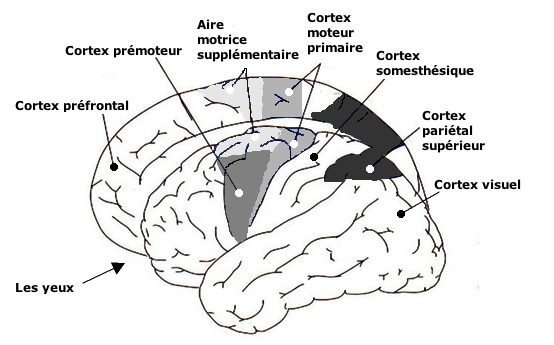 |
|
|
FARRAR, C.B. (1903). On the motor cortex. American
Journal of Insanity, 59, 477-514. |
|
CHAPIN, J., MOXON, K., MARKOWITZ, R. & NICOLELIS, M.
(1999). Real-time control of a robot arm using
simultaneously recorded neurons in the motor cortex.
Nature Neuroscience, 2, 664-670. |
| |
|
Voir aussi Cortex,
Lésion, Lobe et
Cerveau |
| CARPENTER, M.B. & SUTIN, J. (1983). Human neuroanatomy. Londres : Williams & Wilkins. |
|
|
Cortex orbitofrontal : Orbitofrontal cortex.
| |
|
|
VOLKOW, N.D. & FOWLER, J.S. (2000). Addiction, a
disease of compulsion and drive : involvement of the
orbitofrontal cortex. Cerebral Cortex 10 (3),
318-325. |
|
BECHARA, A., DAMASIO, H. & DAMASIO, A.R. (2000).
Emotion, decision making and the orbitofrontal cortex. Cerebral
Cortex, 10 (3), 295-307. |
|
BLAIR, R.J., COLLEDGE E. & MITCHELL, D.G. (2001).
Somatic markers and response reversal : is there
orbitofrontal cortex dysfunction in boys with psychopathic
tendencies ? Journal of Abnormal Child Psychology, 29,
499-511. |
| |
| PINEL, J. (2007). Biopsychologie. Pearsons. |
Voir aussi Cortex,
Lésion, Lobe et
Cerveau |
|
|
Cortex perirhinal :
Perirhinal cortex.
| |
|
|
GAFFAN, D. & MURRAY, E.A. (1992). Monkeys (Macaca
fascicularis) with rhinal cortex ablations succeed in
object dis- crimination learning despite 24-hr intertrial
intervals and fail at matching to sample despite double
sample presentations. Behavioral Neuroscience, 106, 30-38. |
|
GAFFAN, D. (1994). Dissociated effects of perirhinal
cortex ablation, fornix transection and amygdal ectomy :
evidence for multiple memory systems in the primate
temporal lobe. Experimental Brain Research, 99,
411-422. |
|
GAFFAN, D. & PARKER, A. (1996). Interaction of
perirhinal cortex with the fornix-fimbria : memory for
objects and object-in-place memory. Journal of
Neuroscience, 16, 5864-5869. |
|
UCKLEY, M.J. & GAFFAN, D.. (1998). Learning and
transfer of object : reward associations and the role of
the perirhinal cortex. Behavioral Neuroscience, 112,
15-23. |
|
BOGASZ, R., BROWN, M.W. & GIRAUD-CARRIER, C. (2001).
Model of familiarity discrimination in the perirhinal
cortex. Journal of Computational Neuroscience, 10, 5-23. |
|
| CARPENTER, M.B. & SUTIN, J. (1983). Human neuroanatomy. Londres : Williams & Wilkins. |
Voir aussi Cortex,
Lésion, Lobe et
Cerveau |
|
|
Cortex pariétal :
= Pariétal.
Parietal cortex.
| |
|
|
|
|
JONIDES, J., SCHUMACHER, E.H., SMITH, E.E., KOEPPE, R.A.,
AWH, E., REUTER-LORENZ, P.A., MASHUETZ, C. & WILLIS,
C.R. (1998). The role of parietal cortex in verbal working
memory. The Journal of Neuroscience, 18 (13),
5026-5034. [PDF] |
BALDO, J.V. & DRONKERS, N.F. (2006). The role of
inferior parietal and inferior frontal cortex in working
memory. Neuropsychology, 20 (5), 529-538. [PDF] |
|
PLATT, M.L. & GLIMCHER, P.W. (1999). Neural correlates
of decision variables in parietal cortex. Nature, 400,
233-238. |
HUSAIN, M. & NACHEV, P. (2007). Space and the parietal
cortex. Trends in Cognitive Scence, 11, 30-36 |
|
RAVIZZA, S.M., DELGADO, M.R., CHEIN, J.M., BECKER, J.T.
& FIEZA J.A. (2004). Functional dissociations within
the inferior parietal cortex in verbal working memory. NeuroImage,
22, 562-573. [PDF] |
SERENCES, J.T. & YANTIS, S. (2007). Representation of
attentional priority in human occipital, parietal, and
frontal cortex. Cerebral Cortex, 17, 284-293. [PDF] |
|
HUBBARD, E.M., PIAZZA, M., PINEL, P. & DEHAENE, S.
(2005). Interactions between number and space in parietal
cortex. Nature Reviews in Neuroscience, 6,
435-447. [PDF] |
GRABNER R.H., ANSARI D., REISHOFER G., STERN, E., EBNER,
F. & NEUPER, C. (2007). Individual differences in
mathematical competence predict parietal brain activation
during mental calculation. NeuroImage, 38 (2),
346-356. [PDF] |
|
ESTERMAN, M., CHIU, Y.-C., TAMBER-ROSNEAU & YANTIS, S.
(2009). Decoding congitive control in human parietal
cortex. Proceedings of the National Academy of
Sciences, 106, 17974-17979. [PDF] |
| |
| CARPENTER,
M.B. & SUTIN, J. (1983). Human neuroanatomy. Londres
: Williams & Wilkins. |
Voir aussi Cortex,
Lésion, Lobe
pariétal et Cerveau |
|
|
Cortex préfrontal :
= Préfrontal.
Prefrontal cortex, PFC, prefrontal mechanisms.
| |
|
|
|
|
BAUER, R.H. & FUSTER, J.M. (1976). Delayed-matching
and delayed- response deficit from cooling dorsolateral
prefrontal cortex in monkeys. Journal of Comparative
& Physiological Psychology, 90, 293-302. |
LEPAGE, M., GHAFFAR, O., NYBERG, L. & TULVING, E.
(2000). Prefrontal cortex and episodic memory retrieval
mode. Proceedings of the National Academy of
Sciences, 97 (1), 506-511. [PDF] |
|
FUSTER, J.M., BAUER, R.H. & JERVEY, J.P. (1985).
Functional interactions between inferotemporal and
prefrontal cortex in a cognitive task'. Brain
Research, 330 (2), 299-307. |
GORELOVA, N.A. & YANG, C.R. (2000). Dopamine d1/d5
receptor activation modulates a persistent sodium current
in rats prefrontal cortical neurons in vitro. Journal
of Neurophysiology, 84, 75. |
|
ASANUMA, C., ANDERSEN, R.A. & COWAN WM. (1985). The
thalamic relations of the caudal inferior parietal lobule
and the lateral prefrontal cortex in monkeys : divergent
cortical projections from cell clusters in the medial
pulvinar nucleus. Journal of Comparative Neurology,
241, 357-381. |
ROBBINS, T.W. (From arousal to cognition : the integrative
position of the prefrontal cortex. Progress in Brain
Research, 126, 469-483. |
|
MacDONALD, A.W., COHEN, J.D., STENGER, V.A. & CARTER,
C.S. (2000). Dissociating the role of dorsolateral
prefrontal cortex and anterior cingulate cortex in
cognitive control. Science, 288, 1835-1837. [PDF] |
|
EHRING, W.J. & KNIGHT, R.T. (2000).
Prefrontal-cingulate interactions in action monitoring. Nature
Neuroscience, 3 (5), 516-520. [PDF] |
|
GOLDMAN-RAKIC, P.S. (1987). Circuitry of primate
prefrontal cortex and regulation of behavior by
representational memory. In F. Plum (Ed.), Handbook
of physiology : The nervous system (pp. 373-317).
Bethesda, MD : American Physiology Society. |
LEVY, R. & GOLDMAN-RAKIC, P.S. (2000). Segregation of
working memory functions within the dorsolateral
prefrontal cortex. Experimental Brain Research, 133,
23-32. [PDF] |
|
FUNAHSHI, S., BRUCE, C.J. & GOLDMAN-RAKIC, P.S.
(1989). Mnemonic coding of visual space in the monkey's
dorsolateral prefrontal cortex. Journal of
Neurophysiology, 61 (2), 331-349. |
SHIMAMURA, A.P. (2000). The role of the prefrontal cortex
in dynamic filtering. Psychobiology, 28, 207-218.
[PDF] |
|
BECHARA, A. TRANEL, D. & DAMASIO, H. (2000).
Characterization of the decision- making deficit of
patients with ventromedial prefrontal cortex lesions.
Brain, 123, 21892202. |
|
DEHAENE, S. & CHANGEUX, J.P. (1989). A simple model of
prefrontal cortex function in delayed-response tasks. Journal
of Cognitive Neuroscience, 1, 244-261. |
MILLER, E.K. & COHEN, J.D. (2001). An integrative
theory of prefrontal cortex function. Annual Reviews
of Neuroscience, 24 (1), 167-202. [PDF] |
|
GOLDMAN-RAKIC, P.S., LIDOW, M.S. & GALLAGER, D.W.
(1990). Overlap of dopaminergic, adrenergic, and
serotoninergic receptors and complementarity of their
subtypes in primate prefrontal cortex. Journal of
Neuroscience, 10, 2125-2138. |
CONSTANTINIDIS, C., FRANOWICZ, M.N. & GOLDMAN-RAKIC,
P.S. (2001). Coding specificity in cortical microcircuits
: A multiple-electrode analysis of primate prefrontal
cortex. The Journal of Neuroscience, 21 (10),
3646-3655. [PDF] |
|
KEENAN, J.P., WHEELER, M.A., GALLUP, G.G. &
PASCUAL-LEONE, A. (2001). Self-recognition and the right
prefrontal cortex. Trends in Cognitive Sciences, 4, 338-344.
[PDF] |
|
PIAZZA, P.V. ROUGÉ-PONT, F., DEMINIÈRE, J.M., KHAROUBI,
M., LE MOAL, M. & SIMON, H. (1991). Dopaminergic
activity is reduced in the prefrontal cortex and increased
in the nucleus accumbens of rats predisposed to develop
amphetamine self-administration. Brain Research, 567,
169-174. |
DUNCAN J. (2001). An adaptive coding model of neural
function in prefrontal cortex. Nature Reviews
Neuroscience 2, 820-829. [PDF] |
|
BECHARA, A., DAMASIO, A.R., DAMASIO, H. & ANDERSON,
S.W. (1994). Insensitivity to future consequences
following damage to human prefrontal cortex. Cognition,
50 (1-3), 7-15. |
FUNAHASHI S. (2001). Neuronal mechanisms of executive
control by the prefrontal cortex. Neuroscience
Research, 39, 147-165. [PDF] |
|
COHEN, J.D., FORMAN, S.D., BRAVER, T.S., CASEY, B.J. &
SERVAN-SCHREIBER, D. NOLL, D.C. (1994). Activation of
prefrontal cortex in a non-spatial working memory task
with functional MRI. Human Brain Mapping, 1,
293-304. [PDF] |
MILLER, E.K. & COHEN, J.D. (2001). An integrative
theory of prefrontal cortex function. Annual Review
of Neuroscience, 24 (1), 167-202.
[PDF] |
|
GOLDMAN-RAKIC, P.S. (1995). Architecture of the prefrontal
cortex and the central executive. Annals of the New
York Academy of Sciences, 769, 71-83. |
KANE, M. & ENGLE, R.W. (2002). The role of prefrontal
cortex in working-memory capacity, executive attention,
and general fluid intelligence : An individual differences
perspective. Psychonomic Bulletin & Review, 9, 637-671.
[PDF] |
|
BUCKNER, R.L., RAICHLE, M.E. & PETERSEN, S.E. (1995).
Dissociation of human prefrontal cortical areas across
different speech production tasks and gender groups. Journal
of Neurophysiology, 74 (5), 2163-2173. |
KOECHLIN, E., ODY, C. & KOUNEIHER, C. (2003). The
architecture of cognitive control in the human prefrontal
cortex. Science, 302 (5648), 1181-1185. |
|
WEST, R.L. (1996). An application of prefrontal cortex
functioning theory to cognitive aging. Psychological
Bulletin, 120 (2), 272-292. [PDF] |
SLOTNICK, S.D., MOO, L.R., SEGAL, J.B. & HART, J.
(2003). Distinct prefrontal cortex activity associated
with item memory and source memory for visual shapes. Cognitive
Brain Research, 17, 75-82. [PDF] |
|
ELLENBROEK, B.A., BUDDE, S. & COOLS, A.R. (1996).
Prepulse inhibition and latent inhibition : the role of
dopamine in the medial prefrontal cortex. Neuroscience,
75 (2), 535-542.
[PDF] |
ROSENKRANZ, J.A., MOORE, H. & GRACE, A.A. (2003). The
prefrontal cortex regulates lateral amygdala neuronal
plasticity and responses to previously conditioned
stimuli. Journal of Neuroscience, 23, 11054-11064.
[PDF] |
|
WEST, R.L. (1996). An application of prefrontal cortex
functioning theory to cognitive aging. Psychological
Bulletin, 120 (2), 272-292. [PDF] |
POTENZA, M.N., LEUNG H.C., BLUMBERG, H.P., BRADLEY S.,
PETERSON, B.S., FULBRIGHT, R.K., LACADIE, C.M., AWEL
SKUDLARSKI, A. & GORE, J.C. (2003). An fMRI Stroop
task study of ventromedial prefrontal cortical function in
pathological gamblers. American Journal of
Psychiatry, 160, 1990-1994. [PDF] |
|
|
LEPAGE, M., BRODEUR, M. & BOURGOUIN, P. (2003).
Prefrontal cortex contribution to associative recogni-
tion memory in humans : an event related functional
magnetic imaging study. Neuroscience Letters, 346,
7376.
|
|
DAMASIO, A.R. (1996). The somatic marker hypothesis and
the possible functions of the prefrontal cortex. Philosophical
Transactions of the Royal Society of London. Series B:
Biological Sciences, 351 (1346), 1413-1420. |
CURTIS, C.E. & D'ESPOSITO, M. (2003). Persistent
activity in the pre- frontal cortex during working memory.
Trends in Cognitive Sciences, 7 (9), 415-423. [PDF] |
|
SUTTON, S.K. & DAVIDSON, R.J. (1997). Prefrontal brain
asymmetry : A biological substrate of the behavioral
approach and inhibition systems. Psychological
Science, 8, 204-210. |
NYBERG, L., MARKLUND, P., PERSSON, J., CABEZA, R.,
FORKSTAM, C., PETERSSON, K.M. & INGVAR, M. (2003).
Common prefrontal activations during working memory,
episodic memory, and semantic memory. Neuropsychologia,
41, 371-377.
[PDF] |
|
BRAVER, T.S., COHEN, J.D., JONIDES, J., SMITH, E.E. &
NOLL, D.C. (1997). A parametric study of prefrontal cortex
involvement in human working memory. NeuroImage, 5
(1), 49-62.
[PDF] |
POLDRACK, R.A. & WAGNER, D.A. (2004). What can
neuroimaging tell us about the mind ? Insights from
prefrontal cortex. Current Directions in
Psychological Science, 13, 177-181. [PDF] |
|
GOLDMAN-RAKIC, P.S. & SELEMON, L.D. (1997). Functional
and anatomical aspects of prefrontal pathology in
schizophrenia. Schizophrenia Bulletin, 23, 437-458. |
DAVIDSON, R.J. (2004). What does the prefrontal cortex
"do" in affect : Perspectives on frontal EEG asymmetry
research. Biological Psychology, 67, 219-233. [PDF] |
|
THUT, G., SCHULTZ, W., ROELCKE, U., NIENHUSMEIER, M.,
MISSIMER, J., MAGUIRE, R.P. & LEENDERS, K.L. (1997).
Monetary reward activates human prefrontal cortex. Neuroreport,
8, 1225-1228. |
SCHNYER D.M., VERFAELLIE, M., ALEXANDER, M.P., LAFLECHE,
G., NICHOLLS, L. & KASZNIAK, A.W. (2004). A role for
right medial prefrontal cortex in accurate
feeling-of-knowing judgments : evidence from patients with
lesions to frontal cortex. Neuropsychologia, 42,
957-966. [PDF] |
|
FUSTER, J.M. (1997). The prefrontal cortEX: Anatomy,
physiology, and neurophysiology of the frontal lobe.
Philadelphia : Lippincott-Raven. |
MILAD, M.R., VIDAL-GONSALEZ, I. & QUIRK, G.J. (2004).
Electrical stimulation of medial prefrontal cortex reduces
conditioned fear in a temporally specific manner.
Behavioral Neuroscience, 118 (2), 389-394. [PDF] |
|
DOLAN, R.J. & FLETCHER, P.C. (1997). Dissociating
prefrontal and hippocampal function in episodic memory
encoding. Nature 388, 582-585. |
LEBRON, K., MILAD, M.R. & QUIRK, G.J. (2004). Delayed
recall of fear extinction in rats with lesions of ventral
medial prefrontal cortex. Learning & Memory, 11,
544-548. [PDF] |
|
CURTIS, C.E. & D'ESPOSITO, M. (2004). The effects of
prefrontal lesions on working memory performance and
theory. Cognitive, Affective, & Behavioral
Neuroscience, 4 (4), 528-539. [PDF] |
BECHARA, A., DAMASIO, H., TRANEL, D. & ANDRSON, S.W.
(1998). Dissociation of working memory from
decision-making within the human prefrontal cortex. Journal
of Neuroscience,
18, 238-437. |
MITCHELL, J., McRAE, C.N. & BANAJI, M.R. (2005).
Forming impressions of people versus inanimate objects :
Social-cognitive processing in the medial prefrontal
cortex. Neuroimage, 26 (1), 251-257. [PDF] |
|
ROUGIER, N.P., NOELLE, D., BRAVWER T.S., COHEN, J. &
O'REILLY, R.C. (2005). Prefrontal cortex and the
flexibility of cognitive control : Rules without symbols.
Proceedings of the National Academy of Sciences, 102,
7338-7343. |
|
COURTNEY, S.M., PETIT, L., HAXBY, J.V. & UNGERLEIDER
L.G. (1998). The role of prefrontal cortex in working
memory : Examining the contents of consciousness.
Philosophical Translations of the Royal Society B, 353
(1377) 1819-1828. [PDF] |
MITCHELL, J., BANAJI, M.R. & McRAE, C.N. (2005).
General and specific contributions of the medial
prefrontal cortex to knowledge about mental states. Neuroimage,
28 (4), 757-762. [PDF] |
|
SHALLICE, T. & BURGESS, P. (1998). The domain of
supervisory processes and the temporal organisation of
behaviour. In A. Roberts, T. Robbins & L. Weiskrantz
(Eds.), The prefrontal cortEX: Executive and
cognitive functions (pp. 22-35). Oxford, UK :
Oxford University Press. |
MITCHELL, J., BANAJI, M.R. & McRAE, C.N. (2005). The
link between social cognition and self-referential thought
in the medial prefrontal cortex. Journal of Cognitive
Neuroscience, 17 (8), 1306-1315. [PDF] |
|
NOLDE, S.F., JOHNSON, M.K. & RAYE, C.L. (1998). The
role of prefrontal cortex during tests of episodic memory.
Trends in Cognitive Sciences, 2, 399-406. [PDF] |
QUIRK, G.J., GARCIA, R. & GONZALEZ-LIMA, F. (2006).
Prefrontal mechanisms in extinction of conditioned fear.
Biological Psychiatry, 60, 337-347. |
|
GABRIELI, J.D., POLDRACK, R.A. & DESMOND, J.E. (1998).
The role of left prefrontal cortex in language and memory.
Proceedings of the National Academy of Sciences, 95
(3), 906-913. [PDF] |
MONK, C.S., NELSON, E.E., MCCLURE, E.B., MOGG, K.,
BRADLEY, B.P., LEINBENLUFT, E., BLAIR, R.J.R., CHEN, G.,
CHARNEY, D.S., ERNST, M. & PINE, D.S. (2006).
Ventrolateral prefrontal cortex activation and attentional
bias in response to angry faces in adolescents with
generalized anxiety disorder. American Journal of
Psychiatry, 163, 1091-1097.
[PDF] |
|
KNOCH, D., PASCUAL-LEONE, A., MEYER, K. & TREYER, V.
(2006). Diminishing reciprocal fairness by disrupting
right prefrontal cortex. Science, 314, 829-832. |
|
VERTES, R.P. (2006). Interactions among the medial
prefrontal cortex, hippocampus and midline thalamus in
emotional and cognitive processing in the rat.
Neuroscience, 142, 1-20. |
|
O'REILLY, R.C. & FRANK, M.J. (2006). Making working
memory work : a computational model of learning in the
prefrontal cortex and basal ganglia. Neural Computer,
18, 283-328. [PDF] |
|
ENGLE, R.W., KANE, M.J. & TUHOLSKI, S.W. (1999).
Individual differences in working memory capacity and what
they tell us about controlled attention, general fluid
intelligence, and functions of the prefrontal cortex. In
A. Miyake & P. Shah (Eds.), Models of working
memory (pp. 102-134). Cambridge : Cambridge
University Press. [PDF] |
STARK, R., WOLF, O.T., TABBERT, K., KAGERER S.,
ZIMMERMANN, M., KIRSCH, P., SCHIENLEE, A. & VAITLA, D.
(2006). Influence of the stress hormone cortisol on fear
conditioning in humans : evidence for sex differences in
the response of the prefrontal cortex. Neuroimage, 32
(3), 1290-1298. [PDF] |
|
HAZY, T.E., FRANK, M.J. & O'REILLY, R.C.. (2007).
Toward an executive without a homunculus : Computational
models of the prefrontal cortex/basal ganglia system.
Philosophical Transactions of the Royal Society, Series
B, 362, 1601-1613. [PDF] |
|
RUGG, M.D., FLETCHER, P.C., CHUA, P.M. & DOLAN, R.J.
(1999). The role of the prefrontal cortex in recognition
memory and memory for source : an fMRI study. Neuroimage,
10 (5), 520-529. |
SHAMOSH, N.A., DEYOUNG, C.G., GREEN, A.E., REIS, D. L.,
JOHNSON, M.R., CONWAY, A.R.A., ENGLE, R.W., BRAVER, T.S.
& GRAY, J.R. (2008). Individual differences in delay
discounting : Relation to intelligence, working memory,
and anterior prefrontal cortex. Psychological
Science, 9, 904-911. [PDF] |
|
WALTZ, J.A., KNOWLTON, B.J., HOLYOAK, K.J., BOONE, K.B.,
MISHKIN, F.S., DE MENEZES SANTOA, M., THOMAS, C.R. &
MILLER, B.L. (1999). A system for relational reasoning in
human prefrontal cortex. Psychological Science, 10,
119-125. [PDF] |
PETERS J., KALIVAS, P.W. & QUIRK, G.J. (2009).
Extinction circuits for fear and addiction overlap in
prefrontal cortex. Learning & Memory, 16,
279-288. [PDF] |
|
MAIER, S.F. & WATKINS, L.R. (2010). Role of the medial
prefrontal cortex in coping and resilience. Brain
Research, 1355, 52-60. [PDF] |
|
O'REILLY, R.C. (2010). The what and how of prefrontal
cortical organization. Trends in Neurosciences, 33, 355-361.
[PDF] |
|
BALLARD, I.C., MURTY, V.P., McKELL-CARTER, R., MacINNES,
J.J., HUETTEL, S.A. & ADCOK, R.A. (2011). Dorsolateral
prefrontal cortex drives mesolimbic dopaminergic regions
to initiate motivated behavior. The Journal of
Neuroscience, 31 (28), 10340-10346. [PDF] |
|
REYNOLDS, J.R., O'REILLY, R.C. COHEN, J.D. & BRAVER,
T.S. (2012). The function and organization of lateral
prefrontal cortEX: A test of competing hypotheses.
PLoS ONE, 7 (2), 1-15. [PDF] |
|
NODA, Y., BARR, M.S., ZOMORRODI, R., CASH, R.F.H., FARZAN,
F., RAJJI, T.K., CHEN, R., DASKALASKIS, Z.J. &
BLUMBERGER, D.M. (2017). Evaluation of short interval
cortical inhibition and intracortical facilitation from
the dorsolateral prefrontal cortex in patients with
schizophrenia. Scientific Reports, 7, 1-12. [PDF] |
|
|
Voir aussi Cortex,
Lésion, Lobe et
Cerveau |
|
|
Cortex
prémoteur : Premotor cortex.
| |
|
|
| |
|
RIZZOLATTI, G., FADIGA, L., GALLESE, V. & FOGASSI, L.
(1996). Premotor cortex and the recognition of motor
actions. Cognitive Brain Research, 3, 131-141.
[PDF] |
|
| PINEL,
J. (2007). Biopsychologie. Pearsons. |
Voir aussi Cortex,
Lésion, Lobe et
Cerveau |
|
|
Cortex strié :
Striate cortex.
| |
|
|
DEVALOIS, K.K., DEVALOIS, R.L. & YUN, W.W. (1979).
Responses of striate cortex cells to grating and
checkerboard patterns. Journal of Physiology, 291, 483-505. |
|
ALBRETCH, D.G. & DEVALOIS, R.L. (1981). Striate cortex
responses to periodic patterns with and without the
fundamental harmonics. Journal of Physiology, 319,
497-514.
[PDF] |
|
ALBRETCH, D.G. & HAMILTON, D.B. (1982). Striate cortex
of monkey and cat : Contrast response function.
Journal of Neurophysiology, 48 (1), 217-237.
[PDF] |
| PINEL,
J. (2007). Biopsychologie. Pearsons. |
|
|
Cortex temporal :
Temporal cortex.
| |
|
|
STEINMETZ, H., VOLKMAN, J., JANCKE, L. & FREUND, H-J.
(1991). Anatomical left-right asymmetry of
language-related temporal cortex is different in left- and
right-handers. Annals of Neurology, 29, 315-319.
|
EASTON, A. & GAFFAN, D. (2000). Comparison of
perirhinal cortex ablation and crossed unilateral lesions
of the medial forebrain bundle from the inferior temporal
cortex in the rhesus monkey : effects on learning and
retrieval. Behavioral Neuroscience, 114,
1041-1057. |
|
ISHAI, A., UNGERLEIDER, L.G., MARTIN, A. & HAXBY, J.V
(2000). The representation of objects in the human
occipital and temporal cortex. Journal of Cognitive
Neuroscience, 12 (2), 35-51. |
|
MILLER, E.K., LI, L. & DESIMONE, R. (1991). A neural
mechanism for working and recognition memory in inferior
temporal cortex. Science, 254, 1377-1379. |
TANAKA, H.K., ONOE, H., TSUKADA, H. & FUJITA, I.
(2001). Attentional modulation of neural activity in the
macaque inferior temporal cortex during global and local
processing. Neuroscience Research, 39, 469-472.
|
|
BAKER, C. I., KEYSERS, C., JELLEMA, J., WICKER, B., AND
PERRETT, D. (2001). Neuronal representation of
disappearing and hidden objects in temporal cortex of
macaque. Experimental Brain Research, 140,
375-381. |
|
GAFFAN, D., PARKER, A. & EASTON, A. (2002). Dense
amnesia in the monkey after transection of fornix,
amygdala and anterior temporal stem. Neuropsychologia,
39, 5170.
|
|
MILLER, E.K. LI, L. & DESIMONE, R. (1993). Activity of
neurons in anterior inferior temporal cortex during a
short-term memory task. Journal of Neuroscience, 13 (4),
1460-1478. |
SIGALA, N. & LOGOTHETIS, N. (2002). Visual
categorization shapes feature selectivity in the primate
temporal cortex. Nature, 415, 318-320. |
|
GAFFAN, D., EASTON, A. & PARKER, A. (2002).
Interaction of inferior temporal cortex with frontal
cortex and basal forebrain : double dissociation in
strategy implementation and associative learning. Journal of Neurosciences, 22, 72887296. |
|
TIBERGHIEN, G., BAUDOIN, J-Y., GUILLAUME, F. &
MONTOUTE, T. (2003). Should the temporal cortex be chopped
in two ? Cortex, 39 (1), 121-126. |
|
HUNG, C.P., KREIMAN, G., POGGIO, T. & DICARLO, J.J.
(2005). Fast readout of object identity from macaque
inferior temporal cortex. Science, 31, 863-866. |
|
WITELSON, S.F., GLEZER, I.I. & KIGAR, D.L. (1995).
Women have greater density of neurons in posterior
temporal cortex. Journal of Neuroscience, 15, 3418-3428.
|
BALDO, J.V., SCHWARTZ, S., WILKINS, D. & DRONKERS,
N.F. (2006). Role of frontal versus temporal cortex in
verbal fluency as revealed by voxel-based lesion symptom
mapping. Journal of the International
Neuropsychological Society, 12, 896-900. |
|
ROGERS, T.T., HOCKING, J., NOPPENEY, U., MECHELLI, A.,
GORNO-TEMPINI, M., PATTERSON, K. & PRICE, C. (2006).
The anterior temporal cortex and semantic memory :
Reconciling findings from neuropsychology and functional
imaging. Cognitive, Affective & Behavioral
Neuroscience, 6 (3), 201-213. |
|
DEGUTIS, J.M., BENTIN, S., ROBERTSON, L.C. &
DESPOSITIO, M. (2007). Functional plasticity in ventral
temporal cortex following cognitive rehabilitation of a
congenital prosopagnosic. Journal of Cognitive
Neuroscience, 19, 1790-1802. [PDF] |
|
|
Voir Cortex,
Lésion, Lobe
temporal et Cerveau |
|
|
Cortex
visuel : Visual cortex, occipital
cortex, visual perceptive systems.
| |
|
|
|
|
BOLTON, J.S. (1900). The exact histological
localisation of the visual area of the human cerebral
cortex. Philosophical Transactions of the Royal Society
of London, Series B 193 165-222.
|
|
|
LEGROS CLARK, W.E. (1942). The cells of Meynert in the
visual cortex of the monkey. Journal of Anatomy, 76 369-376.
|
TOOTELL, R.B.H., DALE, A.M., SERENO, M.I. & MALACH, R.
(1996). New images from human visual cortex. Trends
in Neurosciences, 19, 481-489. |
|
MYERS, R.E., SCHRIER, A.M. & SPERRY, R.W. (1960).
Perceptual capacity of the isolated visual cortex in the
cat. The Quarterly Journal of Experimental
Psychology, 12, 65-67. |
MOUTOUSSIS, K. & ZEKI, S.M. (1997). Functional
segregation and temporal hierarchy of the visual
perceptive systems. Proceedings of the Royal Society B
: Biological Sciences, 264, 1407-1414. |
|
COWEY, A. & WEISKRANTZ, L. (1961). Role of experience
in misreaching produced by visual cortex lesions. Nature,
192, 1319. |
GEISLER, W.S. & ALBRETCH, D.G. (1997). Visual cortex
neurons in monkeys and cats : Detection, discrimination,
and identification. Visual Neuroscience, 14, 897-919.
[PDF] |
|
HUBEL, D.H. & WIESEL, T.N. (1962). Receptive fields,
binocular interaction and functional architecture in the
cats visual cortex. Journal of Physiology, 160, 106-154.
|
CORTHOUT, E., UTTL, B., WALSH, V., HALLETT, M. &
COWEY, A. (1999). Timing of activity in early visual
cortex as revealed by transcranial magnetic stimulation.
NeuroReport, 10, 2631-2634. [PDF] |
|
HUBEL, D.H. (1963). The visual cortex of the brain. Scientific
American, 209, 54-62. |
BULLIER, J.C. HUPÉ, J.-M., JAMES, A.C. & GIRARD, P.
(2001). The role of feedback connections in shaping the
responses of visual cortical neurons. In C. Casanova &
M. Pfito (Eds.), Progress in brain research (Vol.
34, pp. 193-204). Elsevier Science.
[PDF] |
|
HUPÉ, J.-M., JAMES, A.C., GIRARD, P., LOMBER, S.G., PAYNE,
B.R. & BULLIER, J. (2001). Feedback connections act on
the early part of the responses in monkey visual cortex.
Journal of Neurophysiology, 85, 134-145. |
|
ZEKI, S.M. (1969). Representation of central visual fields
in prestriate cortex of monkey. Brain Research, 14,
271-291. |
|
|
ZEKI, S.M. (1976). The functional organization of
projections from striate to prestriate visual cortex in
the rhesus monkey. Cold Spring Harbor Symposia on
Quantitative Biology, 40, 591-600. |
KASTNER, S. & UNGERKEIDER, L.G.. (2001). The neural
basis of biased competition in human visual cortex. Neuropsychologia,
39, 1263-1276. |
|
HUBEL, D.H. & WIESEL, T. (1977). Functional
architecture of macaque monkey visual cortex. Proceedings
of the Royal Society of London Series B, 198, 1-59.
|
BAR, M. & AMINOFF, E. (2003). Cortical analysis of
visual context. Neuron, 38, 347-358. [PDF] |
|
ZEKI, S.M. (1978). Functional specialisation in the visual
cortex of the rhesus monkey. Nature, 274,
423-428. |
KOSSLYN, S.M. & THOMPSON, W.L. (2003). Early visual
cortex activated during visual mental imagery ? Psychological
Bulletin, 129 (5), 723-746. [PDF] |
|
ALBRETCH, D.G., DE VALOIS, R.L. & THORELL, L.S.
(1980). Visual cortical neurons : Are bars or gratings the
optimal stimuli ? Science, 207, 88-90.
[PDF] |
McMAINS S.A. & SOMERS, D.C. (2004). Multiple
spotlights of attentional selection in human visual
cortex. Neuron, 42, 677-686. [PDF] |
|
ZEKI, S.M. WATSON, J.D., LUECK, C.J., FRISTON, K.J.,
KENNARD, C. & FRACKOWSKI, R.S. (1991). A direct
demonstration of functional specialization in human visual
cortex. Journal of Neuroscience, 11, 641-649. |
SERENCES, J. T. & YANTIS, S. (2007). Representation of
attentional priority in human occipital, parietal, and
frontal cortex. Cerebral Cortex, 17, 284-293. [PDF] |
|
CARANDINI, M. & HEEGER, D. (1994). Summation and
division by neurons in primate visual cortex. Science,
264, 1333-1336. |
ZHANG, S., XU, M., KAMIGAKI, T., HOANG DO, J.P., CHANG,
W.C., JENVAY, S., KAZUNARI, M., LIQUN, L. & YANG, D.
(2014). Long-range and local circuits for top-down
modulation of visual cortex processing. Science, 345,
660-665. [PDF] |
|
| PINEL,
J. (2007). Biopsychologie. Pearsons. |
Voir aussi Cortex,
Lésion, Lobe
occipital et Cerveau |
|
|
Corticotropine : Corticosteroïde : ACTH : L'une des
principales hormones du
stress. Elle est sécrétée par l'hypophyse.
Cette hormone agit sur
les glandes surrénales
qui, à leur tour, libèrent un groupe d'hormones (exemple : le
cortisol). Corticosteroid.
| |
|
|
MASSON, J.W., BRADY, J.V., POLISH, E., BAUER, J.A.,
ROBINSON, J.A., ROSE, R.M. & TALOR, E.D. (1961).
Patterns of corticosteroid and pepsinogen change related
to emotional stress in the monkey. Science, 133
(3464), 1596-1598. |
BELANOFF, J.K., GROSS, K., YAGER, A. & SCHATZBERG,
A.F. (2001). Corticosteroids and cognition. Journal of
Psychiatric Research, 35, 127-145. [PDF] |
|
WOLKOWITZ, O.M., REUS, V.I. & WRINGARTNER, H. 1990.
Cognitive effects of corticosteroids. Amrican Journal
of Psychiatry, 147, 1297-1303. |
|
|
KOOB, G.F. HEINRICHS, S.C., MENZAGHI, F., PICH, E.M. &
BRITTON, K.T. (1994). Corticotropin releasing factor,
stress and behavior. Seminars in Neuroscience, 6, 221-229 |
BROWN, E.S. & CHANDLER, P.A. (2001). Mood and
cognitive changes during systemic corticosteroid therapy.
Primary Care Companion to the Journal of Clinical
Psychiatry, 3 (1), 17-21.
[PDF] |
|
GRAY, T.S. & BINGAMAN, E.W. (1996). The amygdala :
Corticotropin-releasing factor, steroids, and stress. Critical
Reviews in Neurobiology, 10,155-168. |
|
|
NEMEROFF, C.B. (1996). The corticotropin-releasing factor
(CRF) hypothesis of depression : new findings and new
directions. Molecular Psychiatry, 1 (4),
336-342. |
|
|
KOOB, G.F. (1999). Corticotropin-releasing factor,
norepinephrine and stress. Biological Psychiatry, 46,
1167-1180. |
|
|
KOOB, G.F. & HEINRICHS, S.C. (1999). A role for
corticotropin-releasing factor and urocortin in behavioral
responses to stressors. Brain Research, 848, 141-152. |
|
|
LYNCH, P.J. (1999). Hostility, type A behavior, and stress
horrmones at rest and after playing violent video games in
teenagers. Psychosomatic Medicine, 61, 113. |
BANGASSER, D.A., CURTIS, A., REYES, B., BETHEA, T.T.,
PARASTATIDIS, I., ISCHIROPOULOS, H., VAN BOCKSTAELE, E.J.
& VALENTINO, R.J. (2010). Sex differences in
corticotropin-releasing factor receptor signaling and
trafficking : potential role in female vulnerability to
stress-related psychopathology. Molecular Psychiatry,
15 (9), 896-904. [PDF] |
|
| PINEL,
J. (2007). Biopsychologie. Pearsons. |
Voir aussi
Hormones du stress et Hypophyse |
|
|
Cortisol
: Hormone du stress.
Cortisol, corticosteroid.
| |
|
|
RUBINOW, D., POST, R., SAVARD, R. & GOLD, P. (1984).
Cortisol hypersecretion and cognitive impairment in
depression. Archives of General Psychiatry, 41,
279-283. |
LUPIEN, S.J., FIOCCO, A., WAN, N., MAHEU, F., LORD, C.,
SCHRAMEK, T. & TU, M.T. (2005). Stress hormones and
human memory function across the lifespan. Psychoneuroendocrinology,
30 (3), 225-242. [PDF] |
|
MARIN, P., DARIN, N., AMEMIYA, T., ANDERSSON, B., JERN, S.
& BJORNTORP, P. (1992). Cortisol secretion in relation
to body fat distribution in obese premenopausal women. Metabolism,
41, 882-886. |
|
|
HIGLEY, J.D., SUOMI, S.J. & LINNOILA, M. (1992). A
longitudinal assessment of CSF monoamine metabolite and
plasma cortisol concentrations in young rhesus monkeys. Biological
Psychiatry, 32, 127-145. |
|
|
LUPIEN, S.J., LECOURS, A.R., SCHARWTZ, N.P. & MEANEY,
M.J. (1994). Basal cortisol levels and cognitive deficits
in human aging. Journal of Neuroscience, 14,
2893-2903.
[PDF] |
POLK, D.E., COHEN, S., DOYLE, W.J., SKONER, D.P. &
KIRSCHBAUM, C. (2005). State and trait affect as
predictors of salivary cortisol in healthy adults.
Psychoneuroendocrinology, 30, 261-272.
[PDF] |
|
KIRSCHBAUM, C. & HELLHAMMER, D.H. (1994). Salivary
cortisol in psychoneuroendocrine research : Recent
developments and applications.
Psychoneuroendocrinology, 19, 313-333. |
DAHLGREN, A., KEKLUND, G. & ÄKERSTEDT, T. (2005).
Different levels of work-related stress and the effects on
sleep, fatigue and cortisol. Scandinavian Journal of
Work, Environment & Health, 31 (4), 277-285. |
|
MOYER, A., RODIN, J., GRILO, C., CUMMINGS, N., LARSON, L.
& REBUFFE- SCRIVE, M. (1994). Stress-induced cortisol
response and fat distribution in women. Obesity
Research, 2, 255-262. |
|
|
WHITWORTH, J.A., BROWN, M.A., KELLY, J.J. &
WILLIAMSON, P.M. (1995). Mechanisms of cortisol-induced
hypertension in humans. Steroids, 60, 76-80. |
|
|
LUPIEN, S.J. & McEWEN, B.S. (1997). The acute effects
of corticosteroids on cognition : Integration of animal
and human model studies. Brain Research Reviews, 24,
1-27. |
DAHLGREN, A., KECKLUND, G. & ÄKERSTEDT, T. (2006).
Overtime work and its effects on sleep, sleepiness,
cortisol and blood pressure in an experimental field
study. Scandinavian Journal of Work, Environment
& Health, 32 (4), 318-327. [PDF] |
|
LUPIEN, S.J., DE LEON, M., DE SANTI, S., CONVIT, A.,
TARSHISH, C., NAIR, N.P.V., THAKUR, M., McEWEN, B.S.,
HAUGER, R.L. & MEANEY, M.J. (1998). Cortisol levels
during human aging predict hippocampal atrophy and memory
deficits. Nature Neuroscience 1, 69-73. [PDF] |
STARK, R., WOLF, O.T., TABBERT, K., KAGERER S.,
ZIMMERMANN, M., KIRSCH, P., SCHIENLEE, A. & VAITLA, D.
(2006). Influence of the stress hormone cortisol on fear
conditioning in humans : evidence for sex differences in
the response of the prefrontal cortex. Neuroimage, 32
(3), 1290-1298. [PDF] |
|
SHANNON, C., CHAMPOUX, M. & SUOMI, S.J. (1998).
Rearing condition and plasma cortisol in rhesus monkey
infants. American Journal of Primatology, 46,
311-321. |
COHEN, S., SCHWARTZ, J.E., EPEL, E., KIRSCHBAUM, C.,
SIDNEY, S. & SEEMAN, T. (2006). Socioeconomic status,
race, and diurnal cortisol decline in the Coronary Artery
Risk Development in Young Adults (CARDIA) Study. Psychosomatic
Medicine, 68, 41-50. [PDF] |
|
NEWCOMER, J. W., SELKE, G., MELSON, A. K., HERSHEY, T.,
CRAFT, S., RICHARDS, K. & ALDERSON, A.L. (1999).
Decreased memory performance in healthy humans induced by
stress-level cortisol treatment. Archives of General
Psychiatry, 56, 527-533. |
McCULLOUGH, M.E., BRANDON, E., ORSULAK, P. & AKERS, L.
(2007). Rumination, fear, and cortisol : An in vivo study
of interpersonal transgressions. Health Psychology,
26 (1), 126-132. [PDF] |
|
KORTE, S.M. (2001). Corticosteroids in relation to fear,
anxiety, and psychopathology. Neuroscience &
Biobehavioral Reviews, 25, 117-142. |
WOHL, M.J.A., MATHESON, K., YOUNG, M.M. & ANISMAN, H.
(2008). Morning cortisol elevations among problem gamblers
: Dissociation from comorbid symptoms of depression and
impulsivity. Journal of Gambling Studies, 24, 79-90. |
|
LUPIEN, S.J., KING, S., MEANEY, M., McWEN, B S. (2001).
Can poverty get under your skin ? basal cortisol levels
and cognitive function in children from low and high
socioeconomic status. Development &
Psychopathology, 13 (3), 653-676. |
TAYLOR, S.E., BURKLUND, L.J., EISENBERGER, N.I., LEHMAN,
B.J., HILMERT, C.J. & LIEBERMAN, M.D. (2008). Neural
bases of moderation of cortisol stress responses by
psychosocial resources. Journal of Personality &
Social Psychology, 95, 197-211.
[PDF] |
|
AARDAL-ERIKSSON, E., ERIKSSON, T.E. & THORELL, L.H.
(2001). Salivary cortisol, posttraumatic stress symptoms,
and general health in the acute phase and during 9-month
follow-up. Biological Psychiatry, 15, 986-993. |
POWER, C., LI. L. & HETZMAN, C. (2008). Cognitive
development and cortisol patterns in mid-life : findings
from a British birth cohort. Psychoneuroendocrinology,
33, 530-539. |
|
BERG, S.J. & WYNNE-EDWARDS, K.E. (2001). Changes in
testosterone, cortisol, and estradiol levels in men
becoming fathers. Mayo Clinic Proceedings, 76
(6), 582-592. |
|
|
STONE, A.A., SCHWARTZ, J.E., SMYTH, J., KIRSCHBAUM, C.,
COHEN, S., HELHAMMER, D. & GROSSMAN, S. (2001).
Individual differences in the diurnal cycle of salivary
free cortisol : a replication of flattened cycles for some
individuals. Psychoneuroendocrinology, 26 (3),
295-330. |
DITZEN, B., SCHINDT, S., STRAUSS, B., NATER, U.M., EHLERT,
U. & HEINRICHS, M. (2008). Adult attachment and social
support interact to reduce psychological but not cortisol
responses to stress. Journal of Psychosomatic
Research, 64 (5), 479-486. [PDF] |
|
|
SHIMIZU, D., GUNJI, H., HOSAKA, K., HUFFMAN M.A.,
KAWANAKA, K., MATSUMOTO, A. & NISHIDA, T. (2002). The
four chimpanzee skulls collected in the Mahale Mountains,
Tanzania. Anthropological Sciences, 110 (3),
251-266. |
GRANGER, D., HIBEL, L., FORTUNATO, C. & KAPELEWSKI, C.
(2009). Medication effects on salivary cortisol : Tactics
and strategy to minimize impact in behavioral and
developmental science. Psychoneuroendocrinology, 34,
1437-1348. |
|
ABBOTT, D.H., KEVERNE, E.B., BERCOVITCH, F.B., SHIVELY,
C.A., MENDOZA, S.P., SALTZMAN, W., SNOWDON, C.T., ZIEGLER,
T.E., BANJECIC, M., GARLAND, T. & SAPOLSKY, R.M.
(2003). Are subordinates always stressed ? A comparative
analysis of rank differences in cortisol levels among
primates. Hormones & Behavior, 43, 67-82. [PDF] |
DAHLGREN, A., KECKLUND, G. THEORELL, T. & ÄKERSTEDT,
T. (2009). Day-to-day variation in saliva
cortisol-relation with sleep, stress and self-rated
health. Biological Psychology, 82 (2), 149-155. |
|
HAWES, D., BRENNAN, J. & DADDS, M.R. (2009). Cortisol,
callous-unemotional traits, and pathways to antisocial
behavior. Current Opinion in Psychiatry, 22,
357-362. |
|
ELZINGA, B.M., SCHMAHL, C.G., VERMETTEN, E., VAN DYCK, R.
& BREMNER, J.D. (2003). Higher cortisol levels
following exposure to traumatic reminders in abuse-related
PTSD. Neuropsychopharmacology, 28, 1656-1665. |
DENSON, T.F., SPANOVIC M. & MILLER, N. (2009).
Cognitive appraisals and emotions predict cortisol and
immune responses : A meta-analysis of acute laboratory
social stressors and emotion inductions. Psychological
Bulletin, 135, 823-853. [PDF] |
|
DELAHANTY, D.L., RAIMONDE, A.J., SPOONSTER, E. &
CULLADO, M. (2003). Injury severity, prior trauma history,
urinary cortisol levels, and acute PTSD in motor vehicle
accident victims. Journal of Anxiety Disorders, 17, 149-164. |
SUSMAN, E.J., DOCKRAY, S., GRANGER, D.A., BLADES K.T.,
RANDAZZO, W., HEATON, J.A. & DORN, L.D. (2010).
Cortisol and alpha amylase reactivity and timing of
puberty : Vulnerabilities for antisocial behavior in young
adolescents. Psychoneuroendocrinology, 35 (4),
557-569. [PDF] |
|
VIGIL, J.M., GEARY, D.C., GRANGER, D.A. & FLINN, M V.
(2010). Sex differences in salivary cortisol,
alpha-amylase, and psychological functioning following
Hurricane Katrina. Child Development, 81 (4),
1228-1240. [PDF] |
|
SAXBE, D. & REPPTI, R.L. (2010). For better or worse ?
Coregulation of couples cortisol levels and mood states.
Journal of Personality & Social Psychology, 98
(1), 92-103. [PDF] |
|
CARRÉ, J.M. & MEHTA, P.J. (2011). Importance of
considering testosterone-cortisol interactions in
predicting human aggression and dominance. Aggressive
Behavior, 37, 1-3. [PDF] |
|
MARCHAND, A., DURAND, P. & LUPIEN, S. (2012). Work
hours and cortisol variation from non-working to working
days. Psychoneuroendocrinology,
40, 27-36. [PDF] |
|
BARKER, E.T., GREENBERG, J.S., SELTZER, M.M. &
ALMEIDA, D.M. (2012). Daily stress and cortisol patterns
in parents of adult children with a serious mental
illness. Health Psychology, 31 (1), 130-134. [PDF] |
|
DICKERSON, S.S. & KEMENY, M.E. (2004). Acute stressors
and cortisol responses : A theoretical integration and
synthesis of laboratory research. Psychological
Bulletin, 130, 355-391. [PDF] |
BUSS, C., DAVIS, E.P., SHAHBABA, B., PRUESSNER, J.C.,
HEAD, K. & SANDMAN, C.A. (2012). Maternal cortisol
over the course of pregnancy and subsequent child amygdala
and hippocampus volumes and affective problems. Proceedings
of the National Academy of Sciences, 109 (20),
1312-1319. [PDF] |
|
DYKENS, E.M. & LAMBERT, W. (2013). Trajectories of
diurnal cortisol in mothers of children with autism and
other developmental disabilities : Relations to health and
mental health. Journal of Autism & Developmental
Disorders, 43, 2426-2434. |
|
DAHLGREN, A., ÄKERSTEDT, T. & KEKLUND, G. (2004).
Individual differences in the diurnal cortisol response to
stress. Chronobiology International, 21 (6),
913-922. |
DENSON, T.F., MEHTA, P.H. & HO TAN, D. (2013).
Endogenous testosterone and cortisol jointly influence
reactive aggression in women.
Psychoneuroendocrinology, 38, 416-424. [PDF] |
|
PAYNE, J.D. & NADEL, L. (2004). Sleep, dreams, and
memory consolidation : The role of the stress hormone
cortisol. Learning & Memory, 11, 671-678. [PDF] |
WONG, J.D., MAILICK, M.R., GREENBERG, J.S., HONG, J. &
COE, C.L. (2014). Daily work stress and awakening cortisol
in mothers of individuals with autism spectrum disorders
or fragile X syndrome. Family Relations, 63,
135-147. [PDF] |
|
GARTLAND, N., O'CONNOR, D.B., LAWTON, R. & BRISTOW, M.
(2014). Exploring day-to-day dynamics of daily stressor
appraisals, physical symptoms and the cortisol awakening
response. Psychoneuroendocrinology, 50, 130-138.
[PDF] |
|
|
|
Voir aussi Hormone, Hypertension
et Stress |
| PURVES.
D., AUGUSTINE, G.J., FITZPATRICK, D., HA, W.C. LAMANTIA,
A., MCNAMARA, J.O., LEONARD E. & WHITE, L.E. (2011). Neurosciences.
Sinauer Associates, Inc. Deboeck |
|
|
|
Corvidé : Famille de grands
oiseaux, reconnu pour leur intelligence.
Corvid, corvid species.
| |
|
HOLYOAK, D. (1968). A comparative study of the food of
some British Corvidae. Bird Study, 15, 147-153.
|
EMERY, N.J. (2004). Are corvids "feathered apes" ?
Cognitive evolution in crows, jays, rooks and jackdaws.
In Watanabe, S. (Ed.), Comparative analysis of
minds. Keio University Press : Tokyo. In press. [PDF]
|
|
SHANK, C.C. (1986). Territory size, energetics, and
breeding strategy in the Corvidae. The American
Naturalist, 128, 642-652. |
|
|
BALDA, R.P., KAMIL, A.C. & BEDNEKOFF, P.A. (1997).
Predicting cognitive capacities from natural histories :
Examples from four corvid species. Current
Ornithology, 13, 33-66. |
|
|
TEMPLETON, J.J., KAMIL, A.C. & BALDA, R.P. (1999).
Sociality and social learning in two species of corvids.
Journal of Comparative Psychology, 113,
450-455. |
CAPSTICK, L.A. & MADDEN, J.R. (2021). Factors
predicting susceptibility of songbirds to nest predation
by corvids. European Journal of Wildlife
Research, 67, 6. |
|
|
Voir aussi Intelligence
animale |
|
|
Cosanguinité
: Lien phylogénétique
étroit entre deux individus (ou groupe d'individus) qui résulte
d'une reproduction
sexuée apparentés de leurs ancêtres communs (au moins un). =
lien de sang. Cosanguinité, hérédité
et parenté
biologique.
Cosanguinity, blood relation.
| |
|
|
COSTEFF, H., COHEN, B.E. & WELLER, L. (1972). Mental
retardation in Israel : Diagnosis severity and parental
consanguinity. Acta Paediatrica Scandinavica, 61,
452-458. |
|
COSTEFF, H., COHEN, B.E. & WELLER, L. (1972). Parental
consanguinity among Israeli mental Rretardates. Acta
Paediatrica Scandinavica, 61, 452-458. |
|
BOUCHARD, C.B. (1981). Consanguinity and noble marriages
in the tenth and eleventh centuries. Speculum, 56
(2), 269-270. |
|
CHAPAIS, B. (2016). Lien de sang. Montréal : Boréal. |
|
|
|
|
|
Cosmides
Leda (Philadelphie 1957-) : Psychologue
américaine et figure de proue de la psychologie
évolutionniste. Collaboratrice de Barlev,
Barrett, Brace,
Klein et Tooby.
Étudiante de Shepard et Trivers.
 |
COSMIDES, L. (1989). The logic of social exchange : Has
natural selection shaped how humans reason ? Studies with
the Wason selection task. Cognition, 31, (3),
187-276. [PDF] |
|
TOOBY, J. & COSMIDES, L. (1990). On the
universality of human nature and the uniqueness of the
individual : The role of genetics and adaptation. Journal
of Personality, 58 (1), 17-67. |
|
COSMIDES, L. & TOOBY, J. (1994). Origins of
domain specificity : The evolution of functional
organization. In L.A. Hirschfeld & S.A. Gelman (Eds.),
Mapping the mind. Cambridge : Cambridge
University Press. |
|
COSMIDES, L. & TOOBY, J. (2000). Consider the
source : The evolution of adaptations for decoupling and
metarepresentation. In D. Sperber (Ed.), Metarepresentations
: A multidisciplinary perspective (pp. 53-115).
New York : Oxford University Press. |
|
TOOBY, J. & COSMIDES, L. & BARRETT, H.C.
(2005). Resolving the debate on innate ideas :
Learnability constraints and the evolved interpenetration
of motivational and conceptual functions. In P.
Carruthers, S. Laurence & S. Stich (Eds.), The
innate mind : Structure and content. New York :
Oxford University Press. |
|
|
|
Cossette Louise ( ) :
Psychologue cognitivo-béhavioriste
et féministe québécoise,
spécialisée dans l'étude développement
socioaffectif des enfants. Elle
enseigne à l'UQÀM. Étudiante
de Pomerleau.
Collaboratrice de Malcuit, Strayer et Turgeon.
 |
COSSETTE, L., POMERLEAU, A., MALCUIT, G. &
KACZOROWSKI, J. (1996). Emotional expressions of female
and male infants in a social and a nonsocial context. Sex
roles, 35 (11-12), 693-709. |
|
COSSETTE, L. (1997). Pierrette Bouchard et Jean-Claude
St-Amant : Garçons et filles. Stéréotypes et réussite
scolaire. Recherches Féministes, 10 (1),
168-170. [PDF] |
|
COSSETTE, L., DUHAMEL, C., LÉVEILLÉ, É. & GAUDREAU, M.
(1999). Émergence de la distinction personne-objet.
Revue Canadienne des Sciences du Comportement, 31 (1),
54-61. |
|
LÉVEILLÉ, É., COSSETTE, L., BLANCHETTE, I. et GAUDREAU, M.
(2001). La socialisation des émotions chez le nourrisson :
le rôle des expressions faciales contingentes des mères. International
Journal of Psychology, 36 (4), 260-273. |
|
LÉVEILLÉ, É., COSSETTE, L., GAUDREAU, M. et CÔTÉ, N.
(2001). La socialisation des émotions chez le nourrisson :
le rôle du langage maternel. Revue Canadienne des
Sciences du Comportement, 33 (4), 233-244. |
|
|
|
Costa Paul T. (New Hampshire-) : Psychologue
cognitiviste américain
spécialisé dans l'étude de la personnalité.
Avec McCrae, il a développé la théorie
du Big Five.
= P.T. Costa Jr.
Collaborateur de Bagby, John,
Loehlin, McCrae
et Terracciano.
 |
COSTA, P.T. & McCRAE, R.R. (1977). Age
differences in personality structure revisited : Studies
in validity, stability, and change. International
Journal of Aging & Human Development, 8,
261-275. |
|
COSTA, P.T. & McCRAE, R.R. (1983). Contribution
of personality research to an understanding of stress and
aging. Marriage & Family Review, 6, 157-173. |
|
COSTA, P.T. & McCRAE, R.R. (1992). Normal
personality assessment in clinical practice : The NEO
Personality Inventory. Psychological Assessment, 4, 5-13. |
|
McCRAE, R.R. & COSTA, P.T. (1997). Personality
trait structure as a human universal. American
Psychologist, 52, 509-516. |
|
COSTA, P.T., TERRACCIANO, A. & McCRAE, R.R. (2001).
Gender differences in personality traits across cultures :
Robust and surprising findings Journal of Personality
& Social Psychology, 81 (2), 322-331.
[PDF] |
|
|
|
Costall Alan P. ( ) : Psychologue américain et historien des sciences. Il s'intéresse notamment à Morgan et ses canons. Collaborateur de Matsuzawa, Thinès et Wozniak.
 |
COSTALL, A. (1995). Socializing affordances Theory of Psychology, 5 (4), 467-481. |
|
COSTALL, A., CLARK, J.F.M. & WOZNIAK, R.H. (1997). Conway Lloyd Morgan (1852-1936) : An introduction to his work and a bibliography of his writings. Teorie & Modelli, 2, 65-92 |
|
COSTALL, A. (1998). How Lloyd Morgan, and the rise and fall of "animal psychology". Society & Animal, 5, 13-29. |
|
COSTALL, A. (2004). From Darwin to Watson (and
cognitivism) and back again : The principle of
animal-environment mutuality. Behavior &
Philosophy, 32, 179-195. [PDF]
|
|
COSTALL, A. (2006). "Introspection" and the mythical origins of scientific psychology. Consciousness & cognition, 15 (4), 634-654. 179-195.
|
|
|
|
Costanzo Mark A. ( ) : Psychosociologue
américain, spécialisé en psychologie
légale. Il s'est notamment intéressé aux conséquences
psychologiques et sociales de la torture
et de la peine de mort.
Collaborateur de Magnuson.
|
COSTANZO, M.A. & McKENNA, C. (1994). An overview
of the death penalty and capital trials : History, current
status, legal procedures, and cost. Journal of Social
Issues, 50 (2), 1-18 |
|
COSTANZO, M.A. (1997). Just revenge : Costs and
consequences of the death penalty. Worth
Publishers. |
|
COSTANZO, M.A. (2003). Psychology applied to
law. Wadsworth Publishing. |
|
COSTANZO, M.A. & LEO, R.A. (2006). Research and
expert testimony on interrogation and confessions. In M.
Costanzo, D. Krauss & K. Pezdek (Eds.), Expert
psychological testimony for the courts (pp.
69-98). Erlbaum : New Jersey. |
|
COSTANZO, M.A., GERRITY, E. & LYKES, M.B. (2007).
Psychologists and the use of torture in interrogations. Analyses
of Social Issues & Public Policy, 7 (1), 7-20. |
|
|
|
Côté Steeve D. ( ) : Biologiste,
écologiste et éthologiste
québécois, spécialisé dans l'étude des grands mammifères,
notamment la chèvre des montagnes et le caribou.
Il enseigne à l'Université
Laval. Étudiant de Couturier.
Collaborateur de Barrette.
 |
DUCHESNE, M., CÔTÉ, S.D. & BARRETTE, C. (2000).
Responses of woodland caribou to winter ecotourism in the
Charlevoix Biosphere Reserve, Canada. Biological
Conservation, 96, 311-317. |
|
CÔTÉ, S.D. & FESTA-BIANCHET, M. (2001).
Reproductive success in female mountain goats : the
influence of maternal age and social rank. Animal
Behaviour, 62, 173-181. |
|
CÔTÉ, S.D., ROONEY, T.P., TREMBLAY, J-P., DUSSAULT,
C. & WALLER, D.M. (2004). Ecological impacts of deer
overabundance. Annual Review of Ecology, Evolution
& Systematics, 35, 113-147. |
|
CÔTÉ, S.D. (2005). Extirpation of a large black bear
population by introduced white-tailed deer. Conservation
Biology, 19, 1668-1671. |
|
COUTURIER, S., CÔTÉ, S.D., OTTO, R., WELADJI, B.
& HUOT, J. (2009). Variations in calf body mass in
migratory caribou : the role of habitat, climate, and
movements. Journal of Mammalogy, 90, 442-452. |
|
|
|
Cote Z : En statistique,
mesure de position qui indique à combien d'écarts-types
au-dessus ou au-dessous de la moyenne
se situe le résultat d'un individu x. Cette cote permet de
comparer les valeurs de distributions
différentes EX: Les statistiques moyennes de
deux joueurs de hockey provenant de deux ligues différentes (et
qui ont des moyennes différentes).
= Cote standard, différence relative.
|
|
COTNOIR, P.A., BEAUGRAND, J.P. & GOULET, C.
(1986). Des différences liées au sexe dans les stratégies
de répartition spatiale chez des poissons Porte-épée
(Xiphophorus helleri) maintenus en captivité. Naturaliste
Canadien (Rev. Écol. Syst.), 113, 257-262. [PDF] |
|
BEAUGRAND, J.P. & COTNOIR, P.A. (1996). The role
of individual differences in the determination of triadic
rank orders of male green swordtail fish (Xiphophorus
helleri). Behavioural Processes, 38 (3), 287-296. [LIRE] |
|
GUAY, J.H., NOREAU, P., DROUILLY, P. et COTNOIR, P.A.
(1997). Entre le lys et lérable. Dans P. Drouilly (Dir.),
Indépendance et démocratie. Montréal-Paris :
LHarmattan. |
|
GUAY, J.H., NOREAU, P., DROUILLY, P. et COTNOIR, P.A.
(1997). Lintellectuel dans la société.
Bulletin dHistoire Politique, 4 (2), 93-99. |
|
COTNOIR, P.A. (2024). Le changement. PAC. [LIRE] |
|
|
|
|
|
|
|
Couleur : Propriété des objets que l'on peut voir,
percevoir et
nommer. On se sert souvent des couleurs pour symboliser
des aspects importants de la vie en société, notmnotamment des émotions
(EX: rouge = amour, sexualité, Noir = la mort) ou de grand
principe (La paix = vert, or et argent = richesse). Couleur, apparence
et habillement.
Color effect, color preference.
| |
|
|
WELLS, N.A. (1910). A description of the affective
character of the colors of the spectrum. Psychological
Bulletin, 7, 181-195. |
BARTELS, A. & ZEKI, S. (2000). The architecture of the
colour centre in the human visual brain : new results and
a review. European Journal of Neuroscience, 12,
172-193. |
| |
BÄUML, K.-H.T., ZHANG, X. & WANDELL, B.A. (2001).
Color spaces and color metrics. In C.J. van den Branden
Lambrecht (Ed.), Vision Models and Applications to Image
and Video Processing (pp. 99-122). Kluwer Academic
Publisher. [PDF]
|
|
TANAKA, J.W., WEISKOPF, D. & WILLIAMS, P. (2001). Of
color and objects : The role of color in high-level
vision. Trends in Cognitive Sciences, 5,
211-215. [PDF] |
|
BÄUML, K.-H.T. (2001). Increments and decrements in color
constancy. Journal of the Optical Society of America
A, 18 (10), 2419-2429. [PDF]
|
|
WICHMANN, F.A., SHARPE, L.T. & GEGENFURTNER, K.R.
(2002). The contributions of color to recognition memory
for natural scenes. Journal of Experimental Psychology
: Learning, Memory, & Cognition, 28 (3),
509-520. [PDF]
+ [PDF]
|
| |
GEGENFURTNER, K.R. & KIPER, D.C. (2003). Color vision.
Annual Review of Neurosciences, 26, 181-206. [PDF] |
| |
BÄUML, K.-H.T. (2002). Color appearance of spatial pattern
: the role of increments and decrements. Vision
Research, 42, 1627-1637. [PDF] |
|
SKINNER, B.F. (1932). A paradoxical color effect.
Journal of General Psychology, 7, 481-482. |
GERALD, M. (2003). How color may guide the primate world :
Possible relationships between sexual selection and sexual
dichromatism. In C. Jones (Ed.), Sexual selection and
reproductive competition in primates : New perspectives
and directions (pp. 141-171). Norman : American
Society of Primatologists. |
|
LIGON, E.M. (1932). A genetic study of color naming and
word reading. American Journal of Psychology, 4
(1), 103-122. [PDF] |
GEGENFURTNER, K.R. (2003). Cortical mechanisms of colour
vision. Nature Reviews Neuroscience, 4, 563-572.
[PDF] |
|
GRETHER, W.F. (1940). Chimpanzee color vision. I. Hue
discrimination at three spectral points. Journal of
Comparative Psychology, 29, 167177. |
FEHRMAN, K.R. & FEHRMAN, C. (2004). Color : The
secret influence. Upper Saddle River : Pearson
Prentice Hall. |
|
GRETHER, W.F. (1940). comparison of human and chimpanzee
spectral hue discrimination curves. Journal of
Comparative Psychology, 28, 41927. |
GUÉGUEN, N. (2004). The effect of glass colour on the
evaluation of a beverage's thirst-quenching quality. Current
Psychology Letters, 11 (2), 2-6. [PDF] |
|
WRIGHT, B.D. & RAINWATER, L. (1962). The meanings of
color. Journal of General Psychology, 67, 89-99. |
HUTCHING, J. (2004). Color in folklore and tradition - The
principles. Color Research & Application, 29
57-66. |
|
FANGER, P., BREUM, N. & JERKING, E. (1971). Can colour
and noise influence man's thermal comfort ?
Ergonomics, 20, 236-238. |
LAENG, B., SVARTDAL, F. & OELMANN, H. (2004). Does
color synesthesia pose a paradox for early-selection
theories of attention ? Psychological Science, 15
(4), 277-281. |
|
CHESKIN, MSI-ITM et CMCD VISUAL SYMBOLS LIBRARY (2004).
Color. The Global Market Bias Research Series, 1
(1), 1-20. |
|
BARTON, R.A. & HILL, R.A. (2005). Sporting contests -
Seeing red ? Putting sportswear in context - Reply.
Nature, 437, 10-11. [PDF] |
|
ROWE, C., HARRIS, J. & ROBERTS, C. (2005). Seeing red
? Putting sports-wear in context. Nature, 435,
E10. |
|
MORTON, J. & CHAMBERS, S.M. (1973). Selective
attention to words and colours. Quarterly Journal of
Experimental Psychology, 25, 387-397. |
GREENFIELD, A.B. (2005). A perfect red : Empire,
espionage, and the quest for the color of desire. New
York : Harper Collins Books. |
|
ADAMS, F.M. & OSGOOD, C.E. (1973). A cross-cultural
study of affective meanings of color. Journal of
Cross-Cultural Psychology, 4, 135-156. |
MONTOYA, P, CAMPOS, J.J. & SCHRANDY, R. (2005). See
red ? Turn pale ? Unveiling emotions through
cardiovascular and hemodynamic changes. Spanish
Journal of Psychology, 8, 79-85. |
|
TIRYAKI, M. & SCEDILFIK, S. (2005). Assessing whether
black uniforms affect the decisions of Turkish soccer
referees : Is the finding of Frank and Gilovich's study
valid for Turkish culture ? Perceptual & Motor
Skills, 100, 51-57. |
|
MATTESON, M. (1974). Type of transmittal letter and
questionnaire colour as two variables influencing response
rates in a mail survey. Journal of Applied Psychology,
39, 533-536. |
HILL, R.A. & BARTON, R.A. (2005). Red enhances human
performance in contests. Nature, 435, 293. [PDF] |
| |
SETCHELL, J. & WICKINGS, E. (2005). Dominance, status
signals, and coloration in male mandrills (Mandrillus
sphinx). Ethology, 111, 25-50. |
| |
HACKNEY, A.C. (2006). Testosterone and human performance :
Influence of the color red. European Journal of
Applied Physiology, 96, 330-333. |
|
MAGA, J. (1974). Influence of colour on taste thresholds.
Chemical Senses & Flavor, 1, 115-119. |
DAOUTIS, C., PILING, M. & DAVIES, I. (2006).
Categorical effects in visual search for color. Visual
Cognition, 14, 217-240. |
|
YUND, E.W. & ARMINGTON, J.C. (1974). Color and
brightness contrast effects as a function of spatial
variables. Vision Research, 15, 917-929. |
ASLAM, M.M. (2006). Are you selling the right colour ? A
cross-cultural review of colour as a marketing cue.
Journal of Marketing Communications, 12, 15-30. |
|
ESSOCK, S.M. (1977). Color perception and color
classification. In D.M. Rumbaugh (Ed.), Language
learning by a chimpanzee : the Lana project. (p.
207240). New York : Academic Press. |
ELLIOT, A.J., MAIER, M.A., MOLLER, A.C., FRIEDMAN, R.
& MEINHARDT, J. (2007). Color and psychological
functioning : The effect of red on performance attainment.
Journal of Experimental Psychology : General, 136
(1), 154-168. [PDF] |
|
|
IOAN, S., SANDULACHE, M., AVRAMESCU, S., ILIE, A., NEASCU,
A., ZAGREAN, L. & MOLDOVAN, M. (2007). Red is a
distractor for men in competition. Evolution &
Human Behavior, 28, 285-293. |
|
DA POS, O. & GREEN-ARMYTAGE, P. (2007). Facial
expressions, colours and basic emotions. Design &
Creativity, 1 (2), 1-20. [PDF] |
|
ZEKI, S.M. (1980). The representation of colours in the
cerebral cortex. Nature 284, 412-418 |
CONNELL, L. (2007). Representing object colour in language
comprehension. Cognition, 102, 476-485. |
|
SPARKMAN, R. & AUSTIN, L. (1980). Effect on sales of
colors in newspaper advertisements. Journal of
Advertising, 9, 39-42. |
LITTLE, A.C. & HILL, R.A. (2007). Attribution to red
suggests special role in dominance signaling. Journal
of Evolutionary Psychology, 5 (1-4), 161-168. [PDF] |
|
RUBINOFF, M. & MARSH, D. (1980). Candidates and colors
: An investigation. Perceptual & Motor Skills,
50, 868-870. |
SHEVELL, S.K. & KINGDOM, F.A. (2008). Color in complex
scenes. Annual Review of Psychology, 59, 143-166.
[PDF] |
|
HAGEMANN, N., STRAUSS, B. & LEIBING, J. (2008). When
the referee sees red. Psychological Science, 19
(8), 769-772. |
|
DIJKSTRA, P. & PRENNEN, P. (2008). No effect of blue
on winning contests in judo. Proceedings of the Royal
Society : Biological Sciences, 275, 1157-1162. |
|
JONHSON, J. & CLYDESDALE, F. (1982). Perceived
sweetness and redness in coloured sucrose solutions. Journal
of Food Science, 47, 747-752. |
ATTRILL, M.J., GRESTY, K.A., HILL, R.A. & BARTON, R.A.
(2008). Red shirt colour is associated with long-term team
success in English football. Journal of Sports
Sciences, 26, 577-582. [PDF] |
|
ILLIE, A., IOAN, S., ZAGREAN, L. & MOLDOVAN, M.
(2008). Better to be red than blue in virtual competition.
Cyberpsychology & Behavior, 11, 375-377. |
|
MAIER, M.A., ELLIOT, A.J. & LICHTENFELD, S. (2008).
Mediation of the negative effect of red on intellectual
performance. Personality & Social Psychology
Bulletin, 34, 1530-540. [PDF] |
|
JONHSON, J., DZENDOLET, E., DAMON, R., SAWYER, M. &
CLYDESDALE, F. (1982). Psychophysical relationship between
perceived sweetness and colour in cherry-flavoured
beverages. Journal of Food Protection, 45,
601-606. |
ELLIOT, A.J. & NIESTA, D. (2008). Romantic red : Red
enhances men's attraction to women. Journal of
Personality & Social Psychology, 95, 1150-1164.
[PDF] |
|
BURLEY, N., KRANTZBERG, G. & RADMAN, P. (1982).
Influence of color-banding on the conspecific preferences
of zebra finches. Animal Behaviour, 30, 444-455. |
MEHTA, R. & ZHU, R. (2009). Blue or red ? Exploring
the effect of color on cognitive task performances.
Science, 323, 1226-1229. |
|
CONNELL, L. & LYNOTT, D. (2009). Is a bear white in
the woods ? Parallel representation of implied object
color during language comprehension. Psychonomic
Bulletin & Review, 16 (3), 573-577. |
|
KAISER, P.K. (1984), Physiological response to color : A
critical review. Color Research & Application, 9
(1), 29-36. |
LICHTENFELD, S., MAIER, M.A., ELLIOT, A.J. & PEKRUN,
R. (2009). The semantic red effect : Processing the word
red undermines intellectual performance. Journal of
Experimental Social Psychology, 45, 1273-1276. [PDF] |
|
ELLIOT, A.J., MAIER, M.A., BINSER, M.J., FRIEDMAN, R.
& PEKRUN, R. (2009). The effect of red on avoidance
behavior in achievement contexts. Personality &
Social Psychology Bulletin, 35 (3), 365-375. |
|
ZEKI, S.M. (1984). The construction of colours by the
cerebral cortex. Journal and Proceedings of the
Institute of Chemistry of Great Britain, 56,
231-257. |
URAL, S.E. & YILMAZER, S. (2010). The architectural
colour design process : An evaluation of sequential media
via sematic ratings. Color Research &
Application, 35, 343-351. |
|
O'CONNELL, B.J., HARPER, R.S. & MCANDREW, F.T. (1985).
Grip strength as a function of exposure to red and green
visual stimulation. Perceptual & Motor Skills,
61, 1157-1158. |
ROBERTS, S.C., OWEN, R.C. & HAVLICEK, J. (2010).
Distinguishing between perceiver and wearer effects in
clothing color-associated attributions. Evolutionary
Psychology, 8, 350-364. |
|
ZENTALL, S.S. (1986). Effects of color stimulation on
performance and activity of hyperactive and nonhyperactive
children. Journal of Educational Psychology, 78
(2), 159-165. |
KAYSER, D.N., ELLIOT, A.J. & ELTMAN, R. (2010). Red
and romantic behavior in men viewing women. European
Journal of Social Psychology, 40, 901-908. |
|
|
SMITH, J.M., BELL P.A. & FUSCO, M.E. (1986). The
influence of color and demand characteristics on muscle
strength and affective ratings of the environment. Journal
of General Psychology, 113, 289-297. |
ELLIOT, A.J., KAYSER, D.N., GREITEMEYER, T., LICHTENFELD,
S., GRAMZOW, R.H., MAIER, M.A. & LIU, H. (2010). Red,
rank, and romance in women viewing men. Journal of
Experimental Psychology : General, 139, 399-417. [PDF] |
|
PASHLER, H. (1987). Detecting conjunctions of color and
form : Reassessing the serial search hypothesis. Perception
& Psychophysics, 41, 191-201. |
BONNARDEL, N., PIOLAT, A. & Le BIGOT L. (2011). The
impact of colour on website appeal and users' cognitive
processes. Displays, 32(2), 69-80. |
|
GARRETT, J. & BROOKS, C. (1987). Effect of ballot
colour, sex of candidate, and sex of college students of
voting age on their voting behaviour. Psychological
Reports, 60, 39-44. |
BRAMÂO, I., REIS, A., PETERSEN, K.M. & FAISCA, L.
(2011). The role of color information on object
recognition : A review and meta-analysis. Acta
Psychologica, 138 (1), 244-253. |
|
PROFUSEK, P.J. & RAINEY, D.W. (1987). Effects of
Baker-Miller pink and red on state anxiety, grip strength,
and motor precision. Perceptual & Motor Skills,
65, 941-942. |
ELLIOT, A.J. & AARTS, H. (2011). Perception of the
color red enhances the force and velocity of motor output.
Emotion, 11 (2), 445-449. |
|
KWOK, V., NIU, Z., KAY, P., ZHOU, K., MO, L., JIN, Z. SO,
K.-F. & TAN, L.H. (2011). Learning new color names
produces rapid increase in gray matter in the intact adult
human cortex. Proceedings of the National Academy of
Sciences of the United States of America, 108, 6686-6688.
[PDF] |
|
CALDWELL, D.F. & BURGER, J.M. (2011). On thin ice :
Does uniform color really affect aggression in
professional hockey ? Social Psychological &
Personality Science, 2, 306-310. [PDF] |
|
WELLER, L. & LIVINGSTONE, R. (1988). Effect of color
of questionnaire on emotional responses. Journal of
General Psychology, 115, 440-443. |
FELTMAN, R. & ELLIOT, A.J. (2011). The influence of
red on perceptions of relative dominance and threat in a
competitive context. Journal of Sport & Exercise
Psychology, 33, 308-314. |
|
FRANK, M. & GILOVICH, T.D. (1988). The dark side of
self- and social perception : Black uniforms and
aggression in professional sports. Journal of
Personality & Social Psychology, 54, 74-85. |
GARCIA-RUBIO, M.A., PICAZO-TADEO, A.J. &
GONZALEZ-GOMEZ, F. (2011). Does a red shirt improve
sporting performance ? Evidence from Spanish football. Applied
Economics Letters, 18 (11), 1001-1004. |
|
WALSH, L., TOMA, R., TUVESON, R. & SONDHI, L. (1989).
Color preference and food choice among children. The
journal of Psychology, 124, 645-653. |
PIATTI, M., SAVAGE, D.A. & TORGLER, B. (2012). The red
mist ? red shirts, success and team sports. Sport in
Society, 15 (9), 1209-1227. [PDF] |
|
BIELERT, C., GIROLAMI, L. & JOWELL, S. (1989). An
experimental examination of the color component in
visually mediated sexual arousal of the male chacma baboon
(Papio ursinus). Journal of Zoology | Zoological
Society of London, 219, 569-579. |
ELLIOT, A.J., TRACY, J.L. & PRAZDA, A.D. (2012).
Dressed for sEX: Red as a female sexual signal in humans.
Plos One, 7 (4), 1-5. [PDF] |
|
GUÉGUEN, N. (2012). Color and women hitchhikers'
attractiveness : Gentlemen drivers prefer red. Color
Research & Application, 37, 76-78. |
WICKENS, C.D. & ANDRE, A.D. (1990). Proximity
compatibility and information display : effects of color,
space, and onjectness on information integration.
Human Factors, 32, 61-77. |
MEIER, B.P., D'AGOSTINO, P.R., ELLIOT, A.J., MAIER, M.A.
& WILKOWSKI, B.M. (2012). Color in context :
Psychological context moderates the influence of red on
approach-and avoidance-motivated behavior. PLoS One,
7 (7), 1-5. [PDF] |
|
VAN HOUTEN, R. & ROLIDER, A. (1990). The use of color
mediation techniques to teach number identification and
single digit multiplication problems to children with
learning problems. Education & Treatment of
Children, 13, 216-225. |
GUÉGUEN, N. (2012). Color and women attractiveness : When
red clothed women are perceived to have more intense
sexual intent. The Journal of Social Psychology, 152
(3), 261-265. |
|
SIEGEL, S., ALLAN, L. G. & EISSENBERG, T. (1992). The
associative basis of contingent color after effects. Journal
of Experimental Psychology : General, 121, 79-94. |
YEE, E., AHMED, S.Z. & THOMPSON-SCHILL, S.L. (2012).
Colorless green ideas (can) prime furiously. Psychological
Science, 23, 364-369. |
|
BÄUML, K.-H.T. (1993). A ratio principle for a red/green
and a yellow/blue channel ? Perception &
Psychophysics, 53, 338-344. |
MEIER, B.P., D'AGOSTINO, P.R., ELLIOT, A.J., MAIER, M.A.
& WILKOWSKI, B.M. (2012). Color in context :
Psychological context moderates the influence of red on
approach- and avoidance-motivated behavior. PLoS One,
7 (7), 1-5. |
|
BÄUML, K.-H.T. (1994). Color appearance : The effect of
illuminant changes under different surface collections. Journal
of the Optical Society of America A, 11, 531-543. [PDF] |
TAKAHASHI, S. (2012). Effect of red vs black clothing on
the impression of persons engaged in a dialogue. Journal
of the International Colour Association, 7, 4-12 [PDF] |
|
VALDEZ, P. & MEHRABIAN, A. (1994). Effects of color on
emotions. Journal of Experimental Psychology :
General, 123 (4), 394-409. |
GUÉGUEN, N. & JACOB, C. (2012). Clothing color and
tipping : Gentlemen patrons give more tips to waitresses
with red clothes. Journal of Hospitality &
Tourism, 38 (2), 275-280. [PDF] |
|
SILVER C. & FERRANTE, R. (1995). Sex differences in
color preferences among an elderly sample. Perceptual
& Motor Skills, 80, 920-922. |
ELLIOT, A.J. & MAIER, M.A. (2012). Color-in-context
theory. Advances in Experimental Social Psychology,
45, 63-125. |
|
BÄUML, K.-H.T. (1995). Illuminant changes under different
surface collections : examining some principles of color
appearance. Journal of the Optical Society of America
A, 12, 261-271. [PDF] |
ELLIOT, A.J., TRACY, J.L., PRAZDA, A.D. & BEALL, A.T.
(2013). Red enhances women's attractiveness to men : First
evidence suggesting universality. Journal of
Experimental Social Psychology, 49, 165-168 [PDF] |
|
MILLS, B. & FRENCH, L. (1996). Assertive behavior and
jersey color in the national hockey and football leagues :
The black uniform myth and reality. Journal of Human
Movement Studies, 31, 47-60. |
ZEKI, S.M. & SLUTTERS, J. (2013). Functional
specialization and generalization for grouping of stimuli
based on colour and motion. Neuroimage, 73, 156-166. |
|
|
BEALL, A.T. & TRACY, J.L. (2013). Women are more
likely to wear red or pink at peak fertility. Psycholgical
Science, 24 (9), 1837-1841. [PDF] |
|
BÄUML, K.-H.T. & WANDELL, B.A. (1996). Color
appearance of mixture gratings. Vision Research, 36,
2849-2864. [PDF] |
ALVIN, K.L., WANG, H.H.L. (2013). Colour & concept
associations : a cross-occupational and cultural
comparison. Color Research & Application, 39,
630-635. |
|
LEONARDS, U. & SINGER, W. (1997). Selective temporal
interactions between processing streams with differential
sensitivity for colour and luminance contrast. Vision
Research, 37 (9), 1129-1140. [PDF] |
ELLIOT, A.J., TRACY, J.L. & PRAZDA, A.D. (2013).
Women's use of red clothing as sexual signal in
intersexual interaction. Journal of Experimental
Social Psychology, 49, 599-602. |
|
CUTHILL, I. C., HUNT, S., CLEARY, C. & CLARK, C.
(1997). Colour bands, dominance, and body mass regulation
in male zebra finches (Taeniopygia guttata). Proceedings
of the Royal Society of London Series B -Biological
Sciences, 264, 1093-1099. |
DREISKAMPER, D., STAUSS, B., HAGEMANN, N. & BUESCH, D.
(2013). Influence of red jersey colour on physical
parameters in combat sports. International Journal of
Sport & Exercise Psychology, 35, 44-49. [PDF] |
|
HUPKA, R.B., ZALESKI, Z., OTTO, J., REIDL, L. &
TARABRINA, N.V. (1997). The colors of anger, envy, fear,
and jealousy - A cross-cultural study. Journal of
Cross-Cultural Psychology 28, 156-171. |
GUÉGUEN, N. & JACOB, C. (2013). Color and
cyber-attractiveness : Red enhances men's attraction to
women's internet personal ads. Color Research &
Application, 38 (4), 309-312. |
|
KIM, S. & TOKURA, H. (1997). Cloth colour preference
under the influence of menstrual cycle. Applied Human
Science, 16, 149-151. [PDF] |
KANEMATSU, E. & BRAINARD, D.H. (2014). No measured
effect of a familiar contextual object on color constancy.
Color Research & Application, 39 (4),
347-359. [PDF] |
|
STEELE, K.M. (2014). Failure to replicate the Mehta and
Zhu (2009) color-priming effect on anagram solution times.
Psychonomic Bulletin and Review, 21, 771-776 |
|
STEELE, K.M., DELTO STRITTO, M.E. & BRIGNER, W.L.
(1997). Changes in perceived color with intermittent
illumination. Perceptual & Motor Skills, 85,
759-765. |
SHIBASAKI, M. & MASATAKA, K. (2014). The color red
distorts time perception for men, but not for women. Scientific
Reports, 4, 5899. |
|
GUÉGUEN, N. & JACOB, C. (2014). Clothing color and
tipping : Gentlemen patrons give more tips to waitresses
with red clothes. Journal of Hospitality &
Tourism Research, 38 (2), 275-280. |
|
OR, C.K. & WANG, H.H. (2014). Color-concept
associations : A cross-occupational and-cultural study and
comparison. Color Research & Application, 39
(6), 630-635. |
|
MOHEBBI, B. (2014). The art of packaging : An
investigation into the role of color in packaging,
marketing, and branding. International Journal of
Organizational Leadership, 3 (2), 92-102. |
|
PRINZMETAL, W., AMIRI, H., ALLEN, K. & EDWARDS, T.
(1998). Phenomenology of attention : 1. Color, location,
orientation, and spatial frequency. Journal of
Experimental Psychology : Human Perception &
Performance, 24 (1), 261-282.
[PDF] +
[PDF] |
KOLEOSO, O.N., EHIGIE, B.O. & AKHIGBE, K.O. (2014).
Colour preference among children in a Nigerian Montessori
school Mediterranean Journal of Social Sciences, 5
(1), 325-332. [PDF] |
|
GNAMBS, T., APPEL, M. & OEBEST, A. (2015). Red color
and risk-taking behavior in online environments. PLoS,
10 (7), 1-12. [PDF] |
|
KIM, S. & TOKURA, H. (1998). Cloth colour preference
under the influence of face cooling. Journal of
Thermal Biology, 23, 335-340.
[PDF] |
AMSTEUS, M., AL-SHAABAN, S., WALLIN, E. & SJÖQUIST, S.
(2015). Colors in marketing : A study of color
associations and context (in) Dependence. International
Journal of Business & Social Science, 6 (3),
32-45.
[PDF] |
|
READ, M., SUGAWARA, A. & BRANDT, J. (1999). Impact of
space and color in the physical environment on preschool
children's cooperative behavior. Environment &
Behavior, 31, 413-428. |
LYNN, M., GIEBELHAUSEN, M., GARCIA, S., LI, Y. &
PATUMANON, I. (2016). Clothing color and tipping: An
attempted replication and extension. Journal of
Hospitality & Tourism Research, 40 (4),
516-524. |
|
BÄUML, K.-H.T. (1999). Simultaneous color constancy : how
surface color perception varies with the illuminant. Vision
Research, 39, 1531-1550. [PDF] |
HOEBEN-MAMMAERT, L., DIIJKSTRA, K. & ZWAAN, R.A.
(2017). Is color an integral part of a rich mental
simulation ? Memory & Cognition, 45 (6),
974-982. |
|
BÄUML, K.-H.T. (1999). Color constancy : the role of image
surfaces in illuminant adjustment. Journal of the
Optical Society of America A, 16, 1521-1530. [PDF] |
WIEDEMANN, D, BURT, D.M., HILL, R.A. & BARTON, R.A.
(2018). Red clothing increases perceived dominance,
aggression and anger. Biology Letters, 11, 1-4.
[PDF] |
|
| |
|
Voir aussi Attirance
physique, Attraction
interpersonnelle, Perception
des couleurs, Habillement
et Mode |
| |
|
|
|
|
Coulson Neil ( ) :
Psychologue anglais et spécialiste de l'étude des groupes
de soutien à distance et de la cyberpsychologique.
Il s'intéresse notamment au cancer et au syndrome
du côlon irritable.
 |
COULSON, N.S. (2004). Communicating social support online
: a qualitative analysis of an Irritable Bowel Syndrome
support network. Health Psychology Update, 13 (2),
45-46. |
|
COULSON, N.S. & KNIBB, R.C. (2007). Coping with food
allergy : exploring the role of the online support group.
CyberPsychology & Behaviour, 10 (1), 145-148. |
|
COULSON, N.S, BUCHANAN, H. & AUBEELUCK, A. (2007).
Social support in cyberspace : A content analysis of
communication within a Huntingtons disease online support
group. Patient, Education & Counseling, 68 (2),
173-178. |
|
COULSON, N.S. & BUCHANAN, H. (2008). Self-reported
efficacy of an online dental anxiety support group : a
pilot study. Community Dentistry & Oral
Epidemiology, 36 (1), 43-46. |
|
COULSON, N.S. & GREENWOOD, N. (2012). Families
affected by childhood cancer : An analysis of the
provision of social support within online support groups.
Child : Care, Health & Development, 38 (6),
370-377. |
|
|
|
|
|
Counseling Psychologist (The...) :
Revue de psychologie
clinique. Éditeur : Sage.
ROGERS, C.R. & RYBACK, D. (1984). One
alternative to nuclear planetary suicide. The
Counseling Psychologist, 12, 3-12.
|
| |
|
|
|
|
Coup d'état : Prise du pouvoir
de l'état par des
voies illégales (une fois éteintes ou baîllonnées les voix
dissidentes de l'opposition ou du contre-pouvoir) et souvent violentes,
généralement orchestrée par
l'armée ou réalisée grâce à son soutien moral, tactique et
logistique.
/Élection.
Coup.
| |
|
|
RUSTIN, M.M. (1994). Coups d'état and catastrophic change
: Shakespeare's Julius Caesar. British Journal of
Psychotherapy, 11, 242-259. |
|
ABRAHAMIAN, E. (2001). The 1953 Coup in Iran. Science
& Society, 65 (2), 182-215. |
|
BEHROOZ, M. (2001). Tudeh factionalism and the 1953 Coup
in Iran. International Journal of Middle East Studies,
33 (3), 363-382. |
|
GASIOROWSKI, M.J., BYRNE, M. & BOUJOUERDI, M. (2004)
(Eds.). Mohammad Mosaddeq and the 1953 Coup in Iran.
Syracuse University Press. |
|
MOCKLER, A. (2007). Hired guns and coups d'etat :
Mercenaries : Thirty Years 1976-2006. Hunter Mackay. |
|
|
Voir Société
militaire privée, Armée
et Mercenaire |
|
|
|
|
|
|
|
|
|
Coup monté : Voir Complot.
Conspiracy, coup.
|
Coup (monté) de la Brink's : Voir Complot.
|
Couper(Se) : Symptôme ou
comportement d'automutilation.
Self-cutting.
| |
|
|
SIOMOPOULUS, V. (1974). Repeated self-cutting : An impulse
neurosis. American Journal of Psychotherapy, 28 (1),
162-171. |
|
SUYEMOTO, K.L. & MACDONALD, M.L. (1995). Self-cutting
in female adolescents. Psychotherapy, 32 (1),
162-171. |
|
LEVENKRON, S. (1998). Cutting : Understanding and
overcoming self-mutilation. New York : Norton. |
|
KLONSKY, E.D. (2009). The functions of self-injury in
young adults who cut themselves : Clarifying the evidence
for affect-regulation. Psychiatry Research, 166,
260-268. [PDF] |
|
FRANKLIN, J.C., PUZIA, M.E., LEE, K.M., LEE, G.E., HANNA,
E.K., SPRING, V.L. & PRINSTEIN, M.J. (2013). Recent
and frequent nonsuicidal self-injury is associated with
diminished implicit and explicit aversion toward
self-cutting stimuli. Clinical Psychological Science,
1 (2), 110-118. [PDF] |
|
|
Voir aussi Automutilation |
|
|
Couper Mick P. ( ) : Sociologue
et méthodologiste
américain, spécialisé dans l'élaboration des enquêtes,
notamment celles menées par
internet. Collaborateur de Banaji, Cialdini, Groves, Kraut,
Presser, Singer
et Tourangeau.
 |
COUPER, M.P. & GROVES, R.M. (1992). The role of the
interviewer in survey participation. Survey
Methodology, 18 (2), 263-277. [PDF] |
|
COUPER, M.P. & GROVES, R.M. (1996). Social
environmental impacts on survey cooperation. Quality
& Quantity, 30, 173-188. |
|
COUPER, M.P. (2000). Web surveys : A review of issues and
approaches. Public Opinion quarterly, 64 (4),
464-494. [PDF] |
|
COUPER, M.P., SINGER, E., CONRAD, F.G. & GROVES, R.M.
(2010). Experimental studies of disclosure risk,
disclosure harm, topic sensitivity and survey
participation Journal of Official Statistics, 26
(2), 287-300.
[PDF] |
|
COUPER, M.P., KENNEDY, C., CONRAD, F.G. & TOURANGEAU,
R. (2010). Designing input fields for non-narrative
open-ended responses in web surveys. Journal of
Official Statistics, 27 (1), 1-22. |
|
|
|
Couple : Vie à deux, généralement au même endroit (foyer,
ménage), au sein du mariage
ou non (union libre). Lorsqu'un
couple a un enfant, il
devient une famille.
Couple, séparation
et divorce.
= Union.
/Célibat.
Couple.
| |
|
|
RAVEN, B.H., CENTERS, R. & RODRIGUES, A. (1970).
Studies in conjugal power. De Psycholoog, 8,
382-388. |
CORDOVA, J. (2003). Behavior analysis and the scientific
study of couples. The Behavior Analyst Today, 3
(4), 412-425. |
|
GRANGER, L. (1980). La communication dans le couple.
Montréal : Centre interdisciplinaire de Montréal. |
GAUNT, R. (2006). Couple similarity and marital
satisfaction : Are similar spouses happier ? Journal
of Personality, 74, 14011420. |
|
FICHTEN, C. & WRIGHT, J. (1983). Problem-solving
skills in happy and distressed couples : Effects of
videotape and verbal feedback. Journal of Clinical
Psychology, 39, 340-352. [PDF] |
VERHOFSTADT, L.L., BUYSSE, A. ROSSEEL, Y. & PEENE,
O.J. (2006). Confirmatory factor analysis of the Quality
of Relationships Inventory : An examination of the three-
factor structure within couples. Psychological
Assessment, 18, 15-21. |
|
FICHTEN, C.S. (1984). See it from my point of view :
Videotape and attributions in happy and distressed
couples. Journal of Social & Clinical Psychology,
2, 125-142. [PDF] |
BUSS, D.M. (2007). The evolution of human mating. Acta
Psychologica Sinica, 39 (3), 502-512. [PDF] |
|
WRIGHT, J. (1985). La survie du couple. Ottawa :
La presse. |
FEENEY, J.A. (2008). Adult romantic attachment :
Developments in the study of couple relationships. In J.
Cassidy & P.R. Shaver (Eds), Handbook of
attachment : Theory, research and clinical applications
(pp. 456-481). New York : Guilford Press. |
|
BEAUDRY, M. et BOISVERT, J.-M. (1988). Psychologie du
couple. Montréal : éditions du Méridien. |
MANNE, S. & BADR, H. (2008). Intimacy and relationship
processes in couples' psychosocial adaptation to cancer. Cancer,
112 (S11), 2541-2555. |
|
CENTERS, R., RAVEN, B.H. & RODRIGUES, A. (1971).
Conjugal power structure : A reexamination. American
Sociological Review, 36, 264-278. |
HICKS, A.M. & DIAMOND, L.M. (2008). How was your day ?
Couples' affect when telling and hearing daily events. Personal
Relationships, 15, 205-228. [PDF] |
|
BLAIS, M.R., SABOURIN, S., BOUCHER, C. & VALLERAND,
R.J. (1990). Toward a motivational model of couple
happiness. Journal of Personality & Social
Psychology, 59 (5), 1021-1031. [PDF] |
DUNCAN, S. & PHILLIPS, M. (2010). People who live
apart together (LATs) : How different are they ? The
Sociological Review, 58 (1), 112-134. |
|
BUEHLMAN, K.T., GOTTMAN, J.M. & KATZ, L.F. (1992). How
a couple views their past predicts their future :
Predicting divorce from an oral history interview. Journal
of Family Psychology, 5, 295-318. |
MILETTE, K., EL-BAALBAKI, G. & THOMBS, B.D. (2010).
Intimacy processes and psychological distress among
couples coping with head and neck or lung cancer. Psycho-Oncology,
19, 1235-1236. |
|
BUSS, D.M. & SCHMITT, D.P. (1993). Sexual strategies
theory : An evolutionary perspective on human mating. Psychological
Review, 100 (2), 204-232.
[PDF] |
HALCHUK, R.E., MAKINEN, J.A. & JOHNSON, S.M. (2010).
Resolving attachment injuries in couples using emotionally
focused therapy : A three-year follow-up. Journal of
Couple & Relationship Therapy, 9, 31-47. [PDF] |
|
THOMPSON, A. & BOLGER, N. (1999). Emotional
transmission in couples under stress. Journal of
Marriage & the Family, 61, 38-48. |
MANNE, S. & BADR, H. (2010). Intimacy processes and
psychological distress among couples coping with head and
neck or lung cancers. Psycho-Oncology, 19 (9),
941-954. [PDF] |
|
KENNY, D.A. & ACITELLI, L.K. (1994). Measuring
similarity in couples. Journal of Family Psychology,
8, 417-431. |
FINCHAM, F., AJAYI, C. & BEACH, S.R.H. (2011).
Spirituality and marital satisfaction in African American
couples. Psychology of Religion & Spirituality,
3, 259-268. [PDF] |
WALKER, A.J. (1996). Couples watching television : Gender,
power, and the remote control. Journal
of Marriage & Family, 58, 8138203. |
OVERALL N.C., FLETCHER, G.J.O. & KENNY, D.A. (2012).
When bias and insecurity promote accuracy : Mean-level
bias and tracking accuracy in couples' conflict . Personality
& Social Psychology Bulletin Discussions, 38
(5), 642-655.
[PDF] |
|
JULIEN, D., CHARTRAND, E. & BÉGIN, J. (1999). Social
network, structural interdependence, and dyadic adjustment
in heterosexual, gay and lesbian couples. Journal of
Marriage & the Family, 61, 516-530. |
BJORNHOLT, M. (2012). "Am i rambling ?" on the advantages
of interviewing couples together. Qualitative
Research, 14 (1), 3-19. [PDF] |
|
|
|
Voir aussi Mariage,
Relation intime,
Divorce,
Séparation,
Union libre et Famille |
|
|
|
Couples (Formation) : Ensemble des
caractéristiques physiques ( EX: aparence),
psychologique ( EX: personnalité),
sociologique ( EX: classe
et ethnie) et économique ( EX: salaire et revenu) qui
favorise la formation des couples. Mating.
| |
|
|
BUSS, D.M. & SCHMITT, D.P. (1993). Sexual strategies
theory : An evolutionary perspective on human mating. Psychological
Review, 100, 204-232. |
|
ROWE, D.C., VAZSONYI, A.T. & FIGUEREDO, J. (1997).
Mating effort in adolescence : Conditional or alternative
strategy ? Personality & Individual Differences,
23, 105-115. |
|
GANGESTAD, S.W. & SIMPSON, J.A. (2000). The evolution
of human mating : Tradeoffs and strategic pluralism.
Behavioral & Brain Sciences, 23, 473-644. [PDF] |
|
FIGUEREDO, J., SEFCEK, J.A. & JONES, D.N. (2006). The
ideal romantic partner personality. Personality &
Individual Differences, 41, 431-441. |
|
HASELTON, M.G. & GANGESTAD, S.W. (2006). Conditional
expression of women's desires and men's mate guarding
across the ovulatory cycle. Hormones & Behavior,
49, 509-518. [PDF] |
|
BUSS, D.M. (2007). The evolution of human mating. Acta
Psychologica Sinica, 39 (3), 502-512. [PDF] |
|
KIRSHNER, R.B., FIGUEREDO, J. & JACOBS, J. (2009).
Structural relations among negative affect, mate value,
and mating effort. Evolutionary Psychology, 7 (3),
374-397.
[PDF] |
|
|
Voir aussi Choix du
partenaire et Couple |
|
|
Couple homosexuel : Vie à deux, au sein du mariage
ou non, d'un couple d'individus homosexuels.
Gay and esbian couple.
| |
|
|
JULIEN, D., CHARTRAND, E. & BÉGIN, J. (1999). Social
network, structural interdependence, and dyadic adjustment
in heterosexual, gay and lesbian couples. Journal of
Marriage & the Family, 61, 516-530. |
|
|
Voir aussi Couple et
Homosexuel |
|
|
Couple mixte : Couple formé par deux
indivdus de culture ou d'ethnie différente.
Mixed-race.
| |
|
|
UDRY, J.R., LI, R.M. & HENDRIKSON-SMITH, J. (2003).
Health and behavior risks of adolescents with mixed-race
identity. American Journal of Public Health, 93
(11), 1865-1870. |
|
THERRIEN, C. et LE GALL, J. (2012). Nouvelles perspectives
sur la mixité conjugale : le sujet et l'acteur au coeur de
l'analyse. Enfances, Familles, Générations, 17, 1-20. |
|
PLATT, L. (2012). How do children of mixed partnerships
fare in the United Kingdom ? Understanding the implications
for children of parental ethnic homogamy and heterogamy. The
Annals of the American Academy of Political & Social
Science, 643 (1), 239-266. |
|
UNTERREIRER, A. (2017). The identity construction of
nationally mixed people : The impact of parental
transmission and socialization outside the family. Studies
in Ethnicity & Nationalism, 17 (1), 25-43. |
|
TARDIEU-BERTHEAU, R. & LASRY, J.C. (20181). Identité
ethno-culturelle, bien-être psychologique et performance
scolaire de jeunes adultes issus de couples mixtes au
Québec. Revue Québécoise de Psychologie, 39 (1),
85-105. [PDF] |
|
|
Voir aussi Couple,
Ethnie ou Culture |
|
|
|
|
Courage Mary L. ( ) : Psychologue
cognitiviste américaine,
d'origine canadienne, et spécialiste de l'étude du rôle des
écrans sur le développement.
Collaboratrice de Howe.
|
COURAGE, M.L. & HOWE, M.L. (2004). Advances in early
memory development research : Insights about the dark side
of the moon. Developmental Review, 24, 6-32. |
|
COURAGE, M.L. & REYNOLDS, J.E. & RICHARDS, J.E.
(2006). Richards Infants' attention to patterned stimuli :
Developmental change from 3 to 12 months of age. Child
development, 77 (3), 680-695. [PDF]
|
|
COURAGE, M.L. & SETLIFF, A.E. (2009). Debating the
impact of television and video material on very young
children : Attention, learning, and the developing brain.
Child Development Perspectives, 3, 72-78. |
|
COURAGE, M.L. & HOWE, M.L. (2010). To watch or not to
watch : Infants and toddlers in a brave new electronic
world. Developmental Review, 30 101-115. [PDF]
|
|
COURAGE, M.L. & SETLIFF, A.E. (2010). When babies
watch television : Attention getting, attention holding,
and implications for learning. Developmental Review,
30 (2), 220-238. |
|
|
|
Courage : Courageux : Capacité de surmonter ses craintes
ou ses peurs (ou toute
situation qui provoque de l'aversion).
Une personne courageuse agit donc malgré sa peur. On dira que le courage
se transforme en témérité lorsque le danger est trop grand
ou que le geste courageux risque de provoquer des blessures ou la mort.
= Affronter l'adversité, le danger.
Courage.
| |
|
|
MARSTON, W.M. (1941). March on! Facing life with
courage. New York : Doubleday, Doran. |
|
RACHMAN, S.J. (1978). Fear and courage. San
Francisco : Freeman. |
|
MADDI, S.R. (2004). Hardiness : An operationalization of
existential courage. Journal of Humanistic
Psychology, 44, 279-298. |
|
MADDI, S.R. (2005). Hardiness : The courage to be
resilient. In J.C. Thomas, D.L. Degal and M. Hersen
(Eds.), Comprehensive handbook of personality and
psychopathology : Personality and everyday functioning
(Vol. 1, pp. 306-321). John Wiley & Sons Inc. |
|
MADDI, S.R. (2006). Hardiness : The courage to grow from
stresses. Journal of Positive Psychology, 1,
160-168. |
|
|
Voir aussi Persévérance
et Résilience |
|
|
|
|
Courbe : Illustration graphique d'un phénomène ou d'une probabilité. Une courbe décrit un phénomène, elle ne l'explique pas, faut-il le
rappeler.
Curve.
| |
|
|
RUDOLPH, K.D., TROOP-GORDON, W., HESSEL, E.T. &
SCHMIDT, J.D. (2011). A latent growth curve analysis of
early and increasing peer victimization as predictors of
mental health across elementary school. Journal of
Clinical Child & Adolescent Psychology, 40 (1),
111-122. [PDF] |
|
|
|
Courbe d'apprentissage : En phase d'apprentissage, courbe qui décrit le rapport entre la fréquence d'un comportement
(Y) et le temps (X).
Learning curve.
| |
|
|
PETERSON, J. (1917). Experiments in ball-tossing : The
significance of learning curves. Journal of
Experimental Psychology, 2 (3), 178-224. |
|
KRUEGER, W.C.F. (1947). Influence of difficulty of
perceptual-motor task upon acceleration of curves of
learning. Journal of Educational Psychology, 38
(1), 51-53. |
|
CHURCH, R.M. (1958). Individual learning curves. Journal
of the Experimental Analysis of Behavior, 1, 380. |
|
YELLE, L.E. (1979). The learning curve : Historical review
and comprehensive survey. Decision Sciences, 10
(2), 302-328. |
|
LOGAN, G.D. (1992). Shapes of reaction-time distributions
and shapes of learning curves : a test of the instance
theory of automaticity. Journal of Experimental
Psychology : Learning, Memory & Cognition, 18
(5), 883-914. [PDF] |
|
ADDIS, K.M. & KAHANA, M.J. (2004). Decomposing serial
learning : What is missing from the learning curve ? Psychonomic
Bulletin & Review, 11, 118-124. |
|
GALLISTEL, C.R., FAIRHURST, S. & BALSAM, P.D. (2004).
The learning curve : Implications of a quantitative
analysis. Proceedings of the National Academy of
Sciences, 101, 13124-13131. [PDF] |
|
KEHOE, E.J. (2013). Jump starting the learning curve :
instructional design for the military. In C. Best, G.
Galanis, J. Kerry & R. Sottilare (Eds), Fundamental
issues in defence training and simulation (pp.
69-95). Farnham, England : Ashgate. |
|
|
Voir aussi Phase
d'apprentissage et Apprentissage
|
|
|
|
Courbe d'oubli : Courbe qui décrit le
rapport entre la performance de la mémoire
(capacité de rappel en Y)
et le temps (X).
Forgetting curve.
|
Courbe de Laffer : Modèle
développée par Laffer, qui
s'appuie sur le principe que la relation positive entre la
croissance du taux réel d'imposition (X) des particuliers et des
entreprises et la croissance des revenus de l'État (T) s'inverse
lorsque le taux d'imposition devient trop élevé (T).
Laffer curve.
| |
|
 |
|
|
LAFFER, A.B. & RANSON, D.R. (1971). A formal model of
the economy. Journal of Business, 44 (3),
247-270. |
|
LAFFER, A.B. (1986). The ellipse : An explication of the
Laffer curve in a two-factor model. In The financial
analyst's guide to fiscal policy (p. 1-35). New
York : Greenwood Press. |
|
HEIJMAN, W.J.M. & VAN OPHEM, J.A.A.C. (2005).
Willingness to pay tax The Laffer curve revisited for 12
OECD countries.The Journal of Socio-Economic, 34, 714-723.
[PDF] |
|
|
|
Courbe en U : Courbe qui illustre la
capacité de rappel de la mémoire à court terme. Courbe en U, effet
d'arche et effet
de position.
U-shape curve, U-shape
function.
| |
|
 |
|
BAHRICK, H.P. (1984). Semantic memory content in
permastore : Fifty years of memory for Spanish learned in
school. Journal of Experimental Psychology : General,
113, 1-29.
|
|
SCHERVISH, P.G. & HAVENS, J.J. (1995) Do the poor pay
more : Is the U-shaped curve correct. Nonprofit &
Voluntary Sector Quarterly, 24 (1), 79-90. [PDF] |
|
MARCUS, G.F. (2004). What's in a U : The shapes of
cognitive development. Journal of Cognitive
Development, 5, 119-122. [PDF] |
|
SALEHI, B., CORDERO, I. & SANDI, C. 2010). (Learning
under stress : The inverted-U-shape function revisited.
Learning & Memory, 1, 522-530. [PDF] |
|
|
|
|
|
|
Courir : Se mouvoir rapidement. Courir et
marcher.
| |
|
|
HUNDT, A.G. & PREMACK, D. (1963). Running as both a
positive and negative reinforcer. Science, 142 (359),
1087-1088. |
|
PREMACK, D., HUNDT, A. & SCHAEFFER, R.W. (1964).
Reinforcement of drinking by running : Effect of fixed
ratio and reinforcement time. Journal of the
Experimental Analysis of Behavior, 7 (1), 91-96. [PDF] |
|
TERHUNE, J.G. & PREMACK, D. (1970). Proportionality
between probability of not-running and punishment effect
of being forced to run. Learning & Motivation, 1
(2), 141-149. |
|
|
|
Courneya Kerry S. (1963-) : Psychosociologue
canadien et spécialiste de la psychologie
du sport et de la psychologie
de la santé, notamment de la médecine
béhaviorale. Il s'intéresse aux effets de l'exercice
physique et de la sédentarité sur la santé mentale et
physique, notamment du cancer.
Collaborateur de Carron, Conner,
Hayduk, Mcauly et
Rhodes.
|
COURNEYA, K.S. & CARRON, A.V. (1990). Batting first
versus last : Implications for the home advantage.
Journal of Sport & Exercise Psychology, 12,
312-316. |
|
COURNEYA, K.S. & McAULEY, E. (1993). Can short range
intentions predict physical activity participation ? Perceptual
& Motor Skills, 77, 115-122. |
|
COURNEYA, K.S. & McAULEY, E. (1994). Are there
different determinants of the frequency, intensity, and
duration of physical activity ? Behavioral Medicine,
20, 84-90. |
|
COURNEYA, K.S. (2001). Exercise interventions during
cancer treatment : Biopsychosocial outcomes. Exercise
& Sport Sciences Reviews, 29, 60-64. |
|
COURNEYA, K.S., KATZMARZYK, P.T. & BACON, E. (2008).
Physical activity and obesity in Canadian cancer survivors
: Population-based estimates from the 2005 Canadian
Community Health Survey. Cancer, 112, 2475-2482. |
|
|
CARRON, A.V., LOUGHEAD, T.M. & BRAY, S.R. (2005). The
home advantage in sport competitions : Courneya and
Carron's (1992) conceptual framework a decade later. Journal
of Sports Sciences, 23, 395-407. |
|
|
|
Cournot Antoine Augustin (Gray 1801-1877 Paris) : Mathématicien
et épistémologue
français. Il a développé une théorie du hasard
et des probabilités.
 |
COURNOT, A.A. (1838). Recherches sur les
principes mathématiques de la théorie des richesses. |
|
COURNOT, A.A. (1841). Traité élémentaire de la
théorie des fonctions et du calcul infinitésimal. |
|
COURNOT, A.A. (1851). Essai sur les fondements
de nos connaissances et sur les caractères de la
critique philosophique. |
|
COURNOT, A.A. (1861). Traité de l'enchaînement des
idées fondamentales dans les sciences et dans
l'histoire. |
|
COURNOT, A.A. (1872). Considérations sur la
marche des idées et des évènements dans les temps
modernes. |
|
|
MILHAUD, G. (1927). Études sur Cournot. Paris :
Vrin. |
|
ROY, R. (1933). Cournot et l'école mathématique. Econometrica,
1 (1), 13-22. |
|
SAINT-SERNIN, B. (1998). Cournot, le réalisme.
Paris : Vrin. |
|
LEROUX, R. (20004). Cournot sociologue. Paris :
PUF. |
|
MARTIN, T. (2006). Cournot, mathématicien et philosophe
novateur. Les Génies de la Science, 28, 10-14. |
|
|
|
Courriel : Message
transmis par internet au
moyen d'un logiciel de
communication (Outlook, Mail, G-mail, Entourage, Eudora, etc.). E-mail,
mail.
| |
|
|
GUÉGUEN, N. & JACOB, C. (2002). Solicitation by
e-mail and solicitor's status : A field study of social
influence on the Web. CyberPsychology & Behavior,
5 (4), 377-383. [PDF] |
|
GUÉGUEN, N. & JACOB, C. (2002), Social presence
reinforcement and computer-mediated communication : The
effect of the photography of a solicitor on compliance to
a survey request made by e-mail. CyberPsychology
& Behavior, 5 (2), 139-142. [PDF] |
|
JACOB, C. et GUÉGUEN, N. (2002), Sollicitation d'une
enquête par courriel (e-mail) : L'effet du statut du
solliciteur sur le taux de réponse. La Revue des
Sciences de Gestion, Direction et Gestion, 193,
87-95. [PDF] |
|
GUÉGUEN, N., JACOB, C. et FISHER-LOKOU, J. (2002). Similarité
entre personnes et influence : l'impact de l'homonymie
lors d'une sollicitation par e-mail. CNR'IUT (pp.
547-552). Le Creusot, Publications de l'IUT du Creusot. |
|
GUÉGUEN, N. (2003). Help on the Web : The effect of
the same first-name between the sender and the receptor in
a request made by e-mail. Psychological Record, 53,
459-466. |
|
|
|
Cours : Ensemble des activités pédagogiques (enseignement)
prévu par un programme
scolaire et qui permettent à un professeur/ enseignant
de transmettre les connaissances
et les habiletés
cognitives nécessaires à l'apprentissage
de ses élèves/étudiants.
Ces activités se déroulent habituellement en classe,
conformément à un plan
de cours, mais ils peuvent également être réalisées à
distance. Cours, cursus
et
formation.
( ): Voir tableau ci-dessous.
Course.
| |
|
|
McMICHAEL, J.S. & COREY, J.R. (1969). Contingency
management in an introductory psychology course produces
better learning. Journal of Applied Behavior
Analysis, 2 (2), 79-83.
[PDF] |
|
ZUCKERMAN, M., TUSHUP, R. & FINNER, S. (1976).
Sexual attitudes and experience : Attitude and personality
correlates and changes produced by a course in sexuality.
Journal of Consulting & Clinical Psychology, 44,
1-19. |
|
|
|
|
|
|
|
|
|
|
|
Courtiser : Ensemble des
stratégies visant à séduire
autrui, généralement une personne pour qui on éprouve de l'attirance
physique. Courtiser, formation
des couples et attirance
physique.
Courtship.
| |
|
|
BASTOCK, M. & MANNING, A. (1955). The courtship of
drosophila melanogaster. Behaviour, 8, 85-111. |
WHITE, G.L. (1980). Physical attractiveness and courtship
progress. Journal of Personality & Social
Psychology, 39,660-668. |
|
BASTOCK, M. (1967). Courtship : a zoological study. London
: Heinemann. |
QUINN, W.G. & GREENSPAN, R.J. (1984). Learning and
courtship in drosophila : two stories with mutants. Annual
Review of Neuroscience, 7, 67-93. |
|
MOORE, M.M. & BUTLER, D.L. (1989). Predictive aspects
on nonverbal courtship behavior in women. Semiotica,
3, 201-214. |
|
MOORE, M.M. (2002). Courtship communication and
perception. Perceptual & Motor Skills, 94,
97-105. |
|
SILVERMAN, I. (1971). Physical attractiveness and
courtship. Sexual Behavior, 1 (6), 22-25. |
GUÉGUEN, N. & CICCOTI, S. (2008). Domestic dog as a
facilitator in social interaction : An evaluation on
helping and courtship behaviors. Anthrozoös, 21
(40), 339-349. [PDF] |
|
PENKE, L. & ASENDORPF, J.B. (2008). Beyond global
sociosexual orientations : A more differentiated look at
sociosexuality and its effects on courtship and romantic
relationships. Journal of Personality & Social
Psychology, 95, 1113-1135. [PDF] |
|
HALL, J.C. (1978). Courtship among males due to a
male-sterile mutation in Drosophila melanogaster. Behavior
Genetics, 8, 125-141. |
GUÉGUEN, N. (2009). Mans uniform and receptivity of women
to courtship request : Three field experiments with a
firefighters uniform. European Journal of Social
Sciences, 12 (2), 235-240. [PDF] |
|
|
Voir aussi Séduire
et Attirance physique |
|
|
Courtney Susan M. ( ) : Neurocognitiviste
américaine et spécialiste de l'étude
de la mémoire de travail et de la la reconnaissance.
Collaboratrice de Haxby et
Ungerleider.
|
COURTNEY, S.M. & BUCHSBAUM, G. (1991). Temporal
differences between color channels within the retina as a
possible origin of subjective. Colors, Vision
Research, 31 (9), 1541-1548. |
|
COURTNEY, S.M., UNGERLEIDER, L.G., KEIL, K. & HAXBY,
J.V. (1997). Transient and sustained activity in a
distributed neural system for human working memory.
Nature, 386, 608-611. |
|
COURTNEY, S.M. & UNGERLEIDER, L.G. (1997). What fMRI
has taught us about human vision. Current Opinion in
Neurobiology, 7 (4), 554-561. |
|
COURTNEY, S.M., PETIT, L., HAXBY, J.V. & UNGERLEIDER
L.G. (1998). The role of prefrontal cortex in working
memory : Examining the contents of consciousness.
Philosophical Translations of the Royal Society B, 353
(1377) 1819-1828. [PDF] |
|
COURTNEY, S.M. (2004). Attention and cognitive control as
emergent properties of information representation In
working memory. Cognitive, Affective, &
Behavioral Neuroscience, 4 (4), 501-516. |
|
|
|
Cousineau Denis ( ) : Psychologue
connexioniste québécois.
Collaborateur de Hélie, Lacouture,
Lacroix et
Shiffrin.
|
COUSINEAU, D., LACROIX, G.L. & HÉLIE, S. (2003).
Redefining the rules : Providing race models with a
connectionist learning rule. Connection Science, 15 (1),
27-43. [PDF] |
|
COUSINEAU, D. & HÉLIE, S. & LEFEBVRE, C. (2003).
Testing curvatures of learning functions on individual and block average data. Behavior Research Methods,
Instruments & Computer, 35, 493-509. |
|
COUSINEAU, D. & SHIFFRIN, R.M. (2004). Termination of
a visual search with large display size effects. Spatial
Vision, 17, 327-352. [PDF] |
|
COUSINEAU, D. (2005). The rise of quantitative methods in
psychology. Tutorials in Quantitative Methods for
Psychology, 1, 1-3. |
|
COUSINEAU, D. (2009). Nearly unbiased estimators for the
three-parameter Weibull distribution with greater
efficiency than the iterative likelihood method. British
Journal of Mathematical & Statistical Psychology, 62
(1), 167-191. |
|
|
|
Coût : Ce qu'il faut donner (argent, temps, souffrance, etc)
pour obtenir quelque chose, ce que l'on convoite.
/avantage.
Cost.
| |
BUCHANAN, J.M. (1969/77). Cost and choice.
Chicago : University of Chicago Press. |
|
MASTEN, S., MEEHAN, J. & SNYDER, E. (1991). The costs
of organization. Journal of Laws, Economics, &
Organization, 7, 1-25. |
|
GOEREE, J.K., HOLT, C.A. & LAURY, S.K. (2002). Private
costs and public benefits : unraveling the effects of
altruism and noisy behavior. Journal of Public
Economics, 83, 255-276. |
|
KESSLER, R.C. (2012). The costs of depression. Psychiatric
Clinics of North America, 35, 114. |
|
|
|
Coût d'option : Ce à quoi il faut renoncer lorsqu'on
choisit A plutôt que B ou C et qui peut être évalué, ou à tout le
moins pris en considération, avant de
choisir.
Opportunity cost.
| |
|
|
WINTERHALDER, B. (1983). Opportunity-cost foraging models
for stationary and mobile predators. The American
Naturalist, 122 (1), 73-84. |
KURZBAN, R., DUCKWORTH, A., KABLE, J.W. & MYERS, J.
(2013). An opportunity cost model of subjective effort and
task performance. Behavioral & Brain Sciences, 36
(6), 661-679. |
|
BUCHANAN, J.M. (1991). Opportunity cost. In J. Eatwell, M.
Milgate & P. Newman (Eds.), The world of
economics (pp. 520-525). London : Palgrave
Macmillan. |
KEELEY, J.G. & PEVEHOUSE, J.C. (2015). An opportunity
cost theory of US treaty behavior. International
Studies Quarterly, 59 (3), 531-543. |
|
NORTON-GRIFFITHS, M. & SOUTHEY, C. (1995). The
opportunity costs of biodiversity conservation in Kenya. Ecological
Economics, 12 (2), 125-139. |
PARKIN, M. (2016). Opportunity cost : A reexamination.
The Journal of Economic Education, 47 (1), 12-22. |
|
PLUMB, S.T., NIELSEN, E.A. & KIM, Y.S. (2012).
Challenges of opportunity cost analysis in planning REDD+
: a Honduran case study of social and cultural values
associated with indigenous forest uses. Forests, 3 (2),
244-264. |
MOCHE, H., ERLANDSSON, A., ANDERSSON, D. & VÄSTJFÄLL,
D. (2020). Opportunity cost in monetary donation decisions
to non-identified and identified victims. Frontiers
in Psypchology, 10 [3035], 1-11. [PDF] |
|
|
Voir Choix, Décision
et Dilemme du prisonnier
|
|
|
|
Coût de la vie :
Cost of living.
| |
|
|
WALD, A. (1939). A new formula for the index of cost of
living. Econometrica, 7 (4), 319-331. |
|
|
|
Coût social :
Social cost of living.
| |
|
|
DOOLEY, D. & CATALANO, R. (2003). Introduction to
underemployment and its social costs. American
Journal of Community Psychology, 32 (1-2), 1-7. [PDF] |
|
SHELTON, J.N. & STEWART, R E. (2004). Confronting
perpetrators of prejudice : The inhibitory effects of
social costs. Psychology of Women Quarterly,
28 (3), 215-223. |
|
KESSLER, R.C. (2012). The costs of depression. Psychiatric
Clinics of North America, 35, 114. |
|
|
|
|
|
Couturier Serge ( ) : Biologiste
et éthologiste
québécois, spécialisé dans l'étude du
caribou (migrateur et forestier). Collaborateur de Côté.
 |
COUTURIER, S., BRUNELLE, J., VANDAL, D. & ST-MARTIN.
G. (1990). Changes in the population dynamics of the
George River caribou herd, 1976-87. Arctic, 43, 9-20. |
|
COUTURIER, S., COURTOIS, R., CRÉPEAU, H., RIVEST, L.P.
& LUTTICH, S. (1996). Calving photocensus of the
Rivière George caribou herd and comparison with an
independent census. Rangifer Special Issue, 9, 283-296. |
|
COUTURIER, S., JEAN, D., OTTO, J.R. & RIVARD, S.
(2004). Démographie des troupeaux de caribous
migrateurs-toundriques (Rangifer tarandus) au
Nord-du-Québec et au Labrador. Québec : Ministère
des Ressources naturelles, de la Faune et des Parcs,
Direction de laménagement de la faune du Nord-du-Québec
et Direction de la recherche sur la faune. [PDF] |
|
COUTURIER, S., CÔTÉ, S.D., OTTO, R., WELADJI, B. &
HUOT, J. (2009). Variations in calf body mass in migratory
caribou : the role of habitat, climate, and movements. Journal
of Mammalogy, 90, 442-452. [PDF] |
|
COUTURIER, S., OTTO, R.D., CÔTÉ, S.D., LUTHER, G. &
MAHONEY, S.P. (2010). Body size variations in caribou
ecotypes and relationships with demography. Journal
of Wildlife Management, 74 (3), 395-404. [PDF] |
|
|
|
Covariable : Covariance : Covariation : Voir Variation.
|
Covid-19 : Virus et maladie.
Covid-19, théorie du
complot et distance
sociale.= Covid.
| |
|
|
LESSER, I.A. & NIENHUIS, C. (2020). The impact of
COVID-19 on physical activity behavior and well-being of
canadians. International Journal of Environmental
Research & Public Health, 17 (11), 3899. |
GHAZY, R.M., ALMAGRHABY, A., SHAABAN, R., KAMAL, A.,
BESHIR, H., MOURSI, A., RAMADAN, A. & TAHA, S.H.N.
(2020). A systematic review and meta-analysis on
chloroquine and hydroxychloroquine as monotherapy or
combined with azithromycin in COVID-19 treatment. Scientific
Reports, 10 (22139), 1-18. [PDF] |
|
SUTTON, R.M. & DOUGLAS, K.M. (2020). Agreeing to
disagree : Reports of the popularity of Covid-19
conspiracy theories are greatly exaggerated. Psychological
Medicine, 52 (4), 791-793. [PDF] |
GARCÍA-FERNÁNDEZ, L., ROMERO-FERREIRO, V., PADILLA, S.,
DAVID LÓPEZ-ROLDÁN, P., MONZÓ-GARCÍA, M. &
RODRIGUEZ-JIMENEZ, R. (2021). Gender differences in
emotional response to the COVID-19 outbreak in Spain.
Brain & Behavior, 11, |
DALTON, L., RAPA, E. & STEIN, A. (2020). Protecting
the psychological health of children through effective
communication about COVID-19. Lancet Child &
Adolescent Health, 4, 346347.
|
ZHONG, B.-L., LUO, W., LI, H.-M., ZHANG, Q.-Q., LIU,
X.-G., LI, W.-T. & LI, Y. (2020). Knowledge,
attitudes and practices towards COVID-19 among Chinese
residents during the rapid rise period of the COVID-19
outbreak : A quick online cross-sectional survey.
International Journal of Biological Sciences, 16 (10),
17451752. |
|
McMANUS, S., D'ARDENNE, J. & WESSELEY, S. (2020).
Covid conspiracies : Misleading evidence can be more
damaging than no evidence at all. Psychological
Medicine, 52 (3),
597-598. [PDF] |
SWAMI, V., HORNE, G. & FURNHA, A. (2020).
COVID-19-related stress and anxiety are associated
with negative body image in adults from the United
Kingdom. Personality & Individual Differences,
170, 1-5. [PDF]
|
|
KHOSRAVI, M. (2020). Perceived risk of COVID-19 pandemic :
The role of public worry and trust. Electronic
Journal of General Medicine, 17 (4), 1-2. |
TOUYZ, S., LACEY H. & HAY, P. (2020). Eating disorders
in the time of COVID-19. Journal of Eating Disorders,
8, [19], 1-3.
|
|
BROUARD, S., VASILOPOULOS, P. & BECHER, M. (2020).
Sociodemographic and psychological correlates of
compliance with the COVID-19 public health measures in
France. Canadian Journal of Political Science, 1-6.
[PDF]
|
WONG, L.P., ALIAS, H., WONG, P.F., LEE, H.Y. &
ABUBAKAR, S. (2020). The use of the health belief model to
assess predictors of intent to receive the COVID-19
vaccine and willingness to pay. Human Vaccines Immunotherapeutics, 16, 22042214. [PDF]
|
|
FREEMAN, D., WAITE, F., ROSEBROCK, L., PETIT, A., CAUSIER,
C., EAST, A. & LAMBE, S. (2020). Coronavirus
conspiracy beliefs, mistrust, and compliance with
government guidelines in England. Psychological
Medicine, 21, 1-13. |
MOUSSAOUI. S., OFOSU, N.D. & DESRICHARD, O. (2020).
Social psychological correlates of protective behaviours
in the COVID-19 outbreak : evidence and recommendations
from a nationally representative sample. Applied
Psychology : Health & Well Being, 12,
11831204
|
|
GALLOTTI, R., VALLE, F., CASTALDO, N., SACCO, P. & DE
DOMENICO, M. (2020). Assessing the risks of "infodemics"
in response to COVID-19 epidemics. Nature Human
Behaviour, 4 (12), 1285-1293. |
BENDAU A., PLAG, J., KUNAS S., WYKA, S., STRÖHLE, A. &
PETZOLD, M.B. (2021). Longitudinal changes in anxiety and
psychological distress, and associated risk and protective
factors during the first three months of the COVID-19
pandemic in Germany. Brain & Behavior, 11, 1-13.
[PDF] |
|
YUSKEL, B. & OZGOR, F. (2020). Effect of the
COVID-19 pandemic on female sexual behavior.
International Journal of Gynecology & Obstetrics,
150 (1), 98-102. [PDF]
|
JONES, A., CLARK, J.S. & MOHAMMAD, R.A. (2021).
Burnout and secondary traumatic stress in health-system
pharmacists during the COVID-19 pandemic. Journal of
Health-System Pharmacy, 78 (9), 818-824. |
|
JETTEN, J., REICHER, S.A. & KASLAM, T. (Eds.)
(2020). Together apart : The psychology of
COVID-19. Sage Publishing. |
AXFORS, C. et al. (2021). Mortality outcomes with
hydroxychloroquine and chloroquine in COVID-19 from an
international collaborative meta-analysis of randomized
trials. Nature Communications, 12 (2349), 1-13.
[PDF] |
|
MURPHY, K., WILLIAMSON, H., SARGEANT, E. & McCARTHY,
M. (2020). Why people comply with COVID-19 social
distancing restrictions : Self-interest or duty ?
Australian & New Zealand Journal of Criminology 0
(0) 1-20. [PDF] |
ELHAI, J.D., McKAY, D., YANG, H., MINAYA, C., MONTAG, C.
& ASMUNDSON, G.J.G. (2021). Health anxiety related to
problematic smartphone use and gaming disorder severity
during COVID-19 : Fear of missing out as a mediator. Human
Behavior & Emerging Technologies, 3, 137-146. |
|
FREEMAN, D., WAITE, F., ROSEBROCK, L., PETIT, A., CAUSIER,
C., EAST, A., JENNER, L., TEALE. A.L. CARR, L., MULHALL,
S., BOLD, E. & LAMBE, S. (2020). Coronavirus
conspiracy beliefs, mistrust, and compliance with
government guidelines in England. Psychological
Medicine, 52 (2), 251-263. [PDF]
|
ASWORTH, M., THUNSTRÖM, L., CHERRY, T.L. & FINNOFF,
D.C. (2021). Emphasize personal health benefits to boost
COVID-19 vaccination rates. Proceeding of National
Academy of Science, 118, [32]. |
|
BACK, A., TULSKY, J.A. & ARNOLD, R.M. (2020).
Communication skills in the age of COVID-19. Annals of
Internal Medicine, 172, 759760.
|
OLESKY, T., WNUK, A., MAISON D. & LYS, A. (2021).
Content matters. Different predictors and social
consequences of general and government-related conspiracy
theories on COVID-19. Personality & Individual
Differences, 168, 1-7. [PDF] |
|
PLOHL, N. & MUSIL, B. (2020). Modeling compliance with
COVID-19 prevention guidelines : the critical role of
trust in science. Psychology, Health & Medicine,
26 (1), 1-12. |
DELCEA, C., CHIRILÂ, V.-I. & SÂUCHA, A.-M. (2021).
Effects of COVID-19 on sexual life a meta-analysis. Sexologies,
30, e49-e54. [PDF] |
WANG, G., ZHANG, Y., ZHAO, J., ZHANG, J. &
JIANG, F. (2020). Mitigate the effects of home confinement
on children during the COVID-19 outbreak. Lancet, 395,
945947.
|
LORANT, V., SMITH, P., VAN DEN BROECK, K. & NICAISE,
P. (2021). Psychological distress associated with the
COVID-19 pandemic and suppression measures during the
first wave in Belgium. BMC Psychiatry, 21, 112. |
|
QIU, J., SHEN, B., ZHAO, M., WANG, Z., XIE, B. & XU,
Y. (2020).A nationwide survey of psychological distress
among Chinese people in the COVID-19 epidemic :
implications and policy recommendations. General
Psychiatry, 33 (2), 1-3. [PDF]
|
ZYSSET, A.E., SCLATTER, N., VON WYL, A., HUBER, M.,
VOLKEN, T. & DRATVA, J. (2021). Students experience
and adherence to containment measures during COVID-19 in
switzerland. Health Promotion International, 36,
16831693 |
|
IMHOFF, R. & LAMBERTY, P. (2020). A
bioweapon or a hoax ? The link between distinct conspiracy
beliefs about the coronavirus disease (COVID-19) outbreak
and pandemic behavior. Social Psychological &
Personality Science, 11 (8), 1110-1118. |
STEFÂNU, T,A.M., VINTILÂ, M., BUCUR, V.M. & BLABOLI, T.
(2021). Gender and age-related differences in depression,
anxiety and stress during the COVID-19 pandemic : a cross-sectional study. Social Working Review, 123134. |
|
TONG, K.K., CHEN, J.H., YU, E.W. & WU, A.M. (2020).
Adherence to COVID-19 precautionary measures : applying
the health belief model and generalised social beliefs to a probability community sample. Applied Psychology : Health & Well Being, 12, 12051223. |
ZHAO, Y., DING, Y., SHEN, Y. & LIU,W. (2022). Gender
difference in psychological, cognitive, and behavioral
patterns among university students during COVID-19 : A
machine learning approach. Frontiers in Psychology, 13, 1-11. [PDF] |
|
RUS, M., SANDU, L.M., TÂNASE, T., BOUMEDIENE, S. &
DELCEA, C. (2020). The effect of the corona virus
(COVID-19) on mental health. International Journal of
Advanced Studies in Sexology, 2 (2), 116-120. |
MEUNIER, S., BOUCHARD, L., COULOMBE, S., DOUCERAIN, M.,
PACHECO, T. & AUGER, E. (2022). The association
between perceived stress, psychological distress and job
performance during the COVID-19 pandemic : The buffering
role of health-promoting management practices. Trends
in Psychology, 30, 549-569. [PDF]
|
|
RODGERS, R.F., LOMBARDO, C., CEROLINI, S., FRANKO, D.L.,
OMORI, M., FULLER-TYSZKIEWICZ, M. & GUILLAUME, S.
(2020). The impact of the COVID-19 pandemic on eating
disorder risk factors and symptoms. International
Journal of Eating Disorders, 53 (7), 11661170. |
KITAYAMA, S., CAMP, N.P. & SALVADOR, C.E. (2022).
Culture and the COVID-19 Pandemic : Multiple Mechanisms
and Policy Implications. Social Issues & Policy
Review, 16 (1), 164-211. [PDF]
|
|
| |
|
Voir aussi Virus, Maladie,
Théorie
du complot, Grippe,
épidémie, Quartier,
Isolement social et Distance sociale |
|
|
|
Covington Martin V. ( ) : Psychologue
cognitiviste
américain et spécialiste de
l'éducation.
|
COVINGTON, M.V. & OMELICH, C.L. (1979). Effort : The
double-edged sword in school achievement. Journal of
Educational Psychology, 71 (2), 169-182. |
|
COVINGTON, M.V. & OMELICH, C.L. (1981). As failures
mount : affective and cognitive consequences of ability
demotion in the classroom. Journal of Educational
Psychology, 73, 799-808. |
|
COVINGTON, M.V. & OMELICH, C.L. (1988). Achievement
dynamics : the interaction of motives, cognition and
emotions over time. Anxiety Journal, 1, 165-183. |
|
COVINGTON, M.V. (2000). Goal theory, motivation, and
school achievement : An integrative review. Annual
Review of Psychology, 51, 171-200. [PDF] |
|
COVINGTON, M.V. (2000). Intrinsic versus extrinsic
motivation in schools : A reconciliation. Current
Directions in Psychological Science, 9 (1), 22-25.
[PDF] |
|
|
|
|
|
Cowan Nelson (Washington 1951-) : Psychologue
cognitiviste
américain, spécialisée dans l'étude de la mémoire,
notamment de sa capacité et de sa vitesse.
Il s'intéresse également à la mémoire
de travail et à la mémoire
échoïque. Collaborateur de
Baddeley, Conway,
Engle, Halford, Greene,
Hitch, Naveh-Benjamin, Öztekin,
Rouder et Towse.
|
COWAN, N. & LEAVIT, L.A. (1982). Talking backward :
Exceptional speech play in late childhood. Journal of
Child Language, 9, 481-495. |
|
COWAN, N. (1995). Verbal working memory : A view with a
room. American Journal of Psychology, 108,
123-155. |
|
COWAN, N. (2001). The magical number 4 in short-term
memory : A reconsideration of mental storage capacity.
Behavioral & Brain Sciences, 24, 87-114. |
|
COWAN, N. (2010). The magical mystery four : How is
working memory capacity limited, and why ? Current
Directions in Psychological Science, 19, 51-57. |
|
COWAN, N., BLUME, C.L. & SAAUKTS, J.S. (2013).
Attention to attributes and objects in working memory. Journal
of Experimental Psychology : Learning, Memory, &
Cognition, 39, 731-747. |
|
|
|
Cowan Richard ( ) : Psychologue
britannique et spécialiste de l'étude de l'acquisition des habiletés
mathématiques et de l'enseignement
des mathématiques.
|
COWAN, R. & RETON, M. (1996). Do they know what they
are doing ? Children's use of economical addition
strategies and knowledge of commutativity. Educational
Psychology, 16, 407-420. |
|
COWAN, R., DONLAN, C., NEWTON, E.J. & LLOYD, D.
(2005). Number skills and knowledge in children with
specific language impairment. Journal of Educational
Psychology, 97, 732-744. |
|
COWAN, R. (2008). Why children differ in their
mathematical attainment at primary school. Anales de
Psicología, 24 (2), 180-188. [PDF] |
|
COWAN, R. & FRITH C. (2009). Do calendrical savants
use calculation to answer date questions ? A functional
magnetic resonance imaging study. Philosophical
Transactions of the Royal Society London B 364,
1417-1424. [PDF] |
|
COWAN, R. & POWELL, D. (2014). The contributions of
domain-general and numerical factors to third-grade
arithmetic skills and mathematical learning disability.
Journal of Educational Psychology, 106 (1),
214-229.
[PDF] |
|
|
|
Cowie Helen ( ) : Psychologue
anglaise et spécialiste de l'étude du harcèlement
scolaire. Collaboratrice de Smith.
|
COWIE, H. & OLAFSSON, R. (1999). The role of peer
support against bullying. School Psychology
International, 20, 96-105. |
|
COWIE, H. (2000). Bystanding or standing by : Gender
issues in coping with bullying. Aggressive Behavior,
26, 85-97. |
|
COWIE, H., NAYLORA, P., RIVERBS, I., SMITH, P.K. &
PEIRAD, B. (2002). Measuring workplace bullying. Aggression
& Violent Behavior, 7 (1), 33-51. |
|
COWIE, H., HUTSON, N., OZTUG, O. & MYERS, C. (2008).
The impact of peer support schemes on pupils perceptions
of bullying, aggression and safety at school. Emotional
& Behavioural Difficulties, 13 (1), 63-71. |
|
COWIE, H. (2009). Understanding why children and young
people engage in bullying. Hiroshima University
Journal of Learning Science, 2, 103-110. |
|
|
|
|
|
Cox David Roxbee (Birmingham 1924-2022) :
Méthodologiste et statisticien
anglais, spécialiste des plans
expérimentaux, de l'inférence statistique et de l'analyse des données binaires (Régression de Cox). Collaborateur de Barnard.
 |
COX, D.R. (1951). Some systematic experimental designs.
Biometrika, 38, 312-323. |
|
COX, D.R. (1958). Some problems connected with statistical
inference. Annals of Mathematical Statistics, 29, 357-372.
[PDF] |
|
COX, D.R. (1965). A remark on multiple comparison methods.
Technometrics, 7, 223-224. |
|
COX, D.R. (1972). The analysis of multivariate binary
data. Journal of the Royal Statistical Society :
Series C, 21, 113-120. |
|
COX, D.R. & FAREWELL, V.T. (1997). Qualitative and
quantitative aspects should not be confused. British
Medical Journal, 314, 73-77. [PDF] |
|
|
|
Cox Gertrude Mary (Dayton 1900-1978 Durham) :
Statisticienne américaine.
Étudiante de Snedecor.
Collaboratrice de Cochran.
 |
COCHRAN, W.G. & COX, G.M. (1957). Experimental
designs. New York : Wiley. |
|
COX, G.M. (1957). Statistical frontiers. Journal of
the American Statistical Association, 52, 1-12. |
|
|
YATES, F. (1979). Obituary : Gertrude Mary Cox, 1900-1978.
Journal of Royal Statistical Society, 4, 516-517. |
|
ANDERSON, R.L., NELSON L. & MONROE, R. (1979).
Obituary of Gertrude Cox. Biometrics, 35, 2-7. |
|
ANDERSON, R.L. (1983). Biography of Gertrude Cox. In S.
Kotz & N.L. Johnson (Eds.), Encyclopedia of
statistical sciences (Vol. 2). New York : Wiley. |
|
ANDERSON, R.L. (1990). Biography of Gertrude Cox. Biographical
Memoirs, 59, 117- 132. |
|
|
|
Cox Richard H. ( ) : Psychologue
américain spécialisé dans l'étude des athlètes et du sport.
Collaborateur de Martens.
|
COX, R.H. & WILLIAMS, K. (1994). Development of the
concept of middleness in children : response time and
complexity. Perceptual & Motor Skills, 77
(3), 1275-1281 |
|
COX, R.H. & YOO, H.S. (1995). Position and
psychological skill in American football. Journal of
Sport Behavior Playing, 18 (3), 183-194. |
|
COX, R.H., MARTENS, M.P. & RUSSELL, W.D. (2003).
Measuring anxiety in athletics : The revised Competitive
State Anxiety Inventory-2. (1985). Journal of Sport
& Exercise Psychology, 25, 519-533. [PDF] |
|
COX, R.H. & THOMAS, T.R. (2004). Publication preview
examination of the recommendation that anxietymeasured in
association with exercise should focus upon cognitive
anxiety. Medicine & Science in Sports &
Exercise, 36 (S), 163-164. |
|
COX, R.H. (2012). Sport psychology : Concepts
and applications. Boston : McGraw Hill. |
|
|
|
Cox Thomas ( ) : Psychologue
organisationel et industriel américain, spécialisé dans
l'étude du cancer et du stress
dans le milieu du travail.
|
COX, T. (1985). The nature and measurement of stress. Ergonomics,
28, 1155-1163. |
|
COX, T. (1987). Stress, coping and problem solving. Work
& Stress, 1, 5-14. |
|
COX, T. & HOWARTH, I. (1990). Organizational health,
culture and helping. Work & Stress, 4,
107-110. |
|
COX, T. & FERGUSON, E. (1994). Measurement of the
subjective work environment. Work & Stress, 8
(2), 98-109. |
|
COX, T., KARANIKA-MURRAY, M., GRIFFITHS, A. &
HOUDMONT, J. (2007). Evaluating organizational-level work
stress interventions : Beyond traditional methods. Work
& Stress, 21, 348-362. |
|
|
|
Coyote (Canis latrans) : Mammifère
carnassier de la famille des canidés. Coyote.
| |
|
|
GUSTAVSON, C.R., GARCIA, J., HANKINS, W.G. & RUSINIA,
K.W. (1974). Coyote predation control by aversive
conditioning. Science, 184, 581-583. |
RYON, J., BROWN, R.E. & FENTRESS, J.C. (1990). Food
provisioning in captive coyotes (Canis latrans).
American Zoologist, 30, 108. |
|
LINHART, S.B., ROBERTS, J.D., SCHUMAKE, A. & JOHNSON,
R. (1977). Avoidance of prey by captive coyotes punished
with electric shock. Proceedings of the 7th
Vertebrate Pest Conference, 302-306. [PDF] |
PAQUET, P.C. (1991). Scent-marking behavior of sympatric
wolves (Canis lupus) and coyotes (Canis latrans) in Riding
Mountain National Park. Canadian Journal of Zoology,
69, 1721-1727. |
|
BEKOFF, M. (1977). Canis latrans. Mammalian Species,
79, 1-9. |
GAINES, W.L., NEALE, G.K. & NANEY, R.H. (1995).
Response of coyotes and gray wolves to simulated howling
in north-central Washington. Northwest Science, 69, 217-222. |
|
ANDREWS, R.D. & BOGGESS, E.K. (1978). Ecology of
coyotes in Iowa. In M. Bekoff (Ed.), Coyotes :
biology, behavior and management (pp. 249-265). New
York : Academic Press. |
GESE, E.M., RUFF, R.L. & CRABTREE, R.L. (1996). Social
and nutritional factors influencing the dispersal of
resident coyotes. Animal Behaviour, 52, 102-1043. |
|
GESE, E.M., STOTTS, T.E. & GROTHE, S. (1996).
Interactions between coyotes and red foxes in Yellowstone
National Park, Wyoming. Journal of Mammalogy, 77,
377-382. |
|
RYON, C.J. (1979). Aspects of dominance behavior in groups
of sibling coyote/red wolf hybrids. Behavioral &
Neural Biology, 25, 69-78. |
McLEOD, P.J. & FENTRESS, J.C. (1997). Developmental
changes in the sequential behaviour of interacting timber
wolf pups. Behavioural Processes, 39, 127-136. |
|
CADIEUX, C.L. (1983). Coyotes : predators and
survivors. Stone Wall Press Inc, Washington, D.C. |
ODONOGHUE, M.E., BOUTIN, S., KREBS, C.J., MURRAY, D.L.
& HOFER, E.J. (1998). Behavioural responses of coyotes
and lynx to the snowshoe hare cycle. Oikos, 82,
169-183. |
|
KITCHEN, A.M., GESE, E.M. & SCHAUSTER, E.R. (1999).
Resource partitioning between coyotes and swift foxes :
space, time, and diet. Canadian Journal of Zoology
77, 1645-1656. |
| ANDELT, W.F. (1985). Behavioral ecology of coyotes in
south Texas. Wildlife Monographs, 94, 1-45. |
GEHRT, S.D. & CLARK. W.R. (2003). Raccoons, coyotes,
and reflections on the mesopredator release hypothesis. Wildlife
Society Bulletin, 31, 836-842. |
|
RYON, C.J. (1986). Den digging and pup care in captive
coyotes (Canis latrans). Canadian Journal of Zoology,
64, 1582-1585. |
ATWOOD, T.C., WEEKS, H.P. & GEHRING, T.M. (2004).
Spatial ecology of coyotes along a suburban-to-rural
gradient. Journal of Wildlife Management, 68,
1000-1009. |
|
WAY, J.G., SZTUMYLO, D.L. & STRAUSS, E. (2006). An
ethogramdeveloped on captive Eastern ncoyotes Canis
latrans. Canadian Field Naturalist, 120 (3),
263-287. |
|
FENTRESS, J.C., RYON, J. & McLEOD, P.J. (1987). Coyote
adult-pup interactions in the first 3 months. Canadian
Journal of Zoology, 65, 760-763. |
GEHRT, S.D. & PRANGE, S. (2007). Interference
competition between coyotes and raccoons : a test of the
mesopredator release hypothesis. Behavioral Ecology,
18 (1), 204-214. [PDF] |
|
HARRINGTON, F.H., RYON, J. & FENTRESS, J.C. (1987).
Multiple or extended estrus in a coyote (Canis latrans). American
Midland Naturalist, 117, 218-220. |
PRANGE, S. & GEHRT, S.D. (2007). Response of skunks to
a simulated increase in coyote activity. Journal of
Mammalogy, 88 (4), 1040-1049. [PDF] |
|
GEHRT, S.D., ANCHOR, C. & WHITE, L.A. (2009). Home
range and landscape use of coyotes in a metropolitan
landscape : conflict or coexistence ? Journal of
Mammalogy, 90, 1045-1057. |
|
HENNESSY, C.A., DUBACH, J. & GEHRT, S.D. (2012).
Long-term pair bonding and genetic evidence for monogamy
among urban coyotes (Canis latrans). Journal of
Mammalogy, 93 (3), 732-742. [PDF] |
|
| BURNIE,
D. (Dir.) (2001). Animal/Le règne animal. Londres
: Dorling Kindersley /Saint-Laurent : Erpi. |
Voir aussi Animal,
Loup et Canidé |
|
|
CPJ : C'est Pas Juste.
Expression utilisée pour désigner une situation où le sort
s'acharne contre nous.
|
CQFD : Ce qu'il fallait
démontrer. Expression qui désigne un raisonnement
juste ou, plus précisément, l'argument
qui manquait à un raisonnement pour qu'il soit vrai. CQFD,
raisonnement et raisonnement.
|
| COR - CRAIK - CRASKE - CRÉATIONISME -
CRÉATIVITÉ - CRÉDIBILITÉ
- CRI - CRIME -
CRISE - CRITIQUE
- CRONBACH - CROYANCE - CU |
Crabe (Cancer irroratu, Cancer pagrus) : Animal de la classe
des crustacés.
Crab.
| |
|
|
THORPE, K.E. & TAYLOR, A.C. & HUNTINGFORD, F.A.
(1995). How costly is fighting ? Physiological effects of
sustained exercise and fighting in swimming crabs, Necora
puber (L.) (Brachyura, Portunidae). Animal Behaviour,
50, 1657-1666. |
|
BRIFFA, M. & ELWOOD, R.W. (2000). Analysis of the
finescale timing of repeated signals : does shell rapping
in hermit crabs signal stamina ? Animal Behaviour,
59, 159-165. |
|
BRIFFA, M. & ELWOOD, R.W. (2001). Decision rules,
energy metabolism and vigour of hermit-crab fights. Proceedings
of the Royal Society B, 268, 1841-1848. |
|
BRIFFA, M. & ELWOOD, R.W. (2004). Use of energy
reserves in fighting hermit crabs. Proceedings of the
Royal Society B, 271, 373-379. |
|
MORRELL, L.J., BACKWELL, P.R.Y. & METCALFE, N.B.
(2005). Fighting in fiddler crabs Uca mjoebergi : what
determines duration ? Animal Behaviour, 70,
653-662. |
|
| BURNIE, D. (Ed.) (2001). Animal . Londres : Dorling
Kindersley / Le règne animal. Saint-Laurent :
Erpi. |
Voir aussi Animal |
|
|
|
|
Crahay Marcel (Sprimont 1951-) : Spécialiste
belge de l'éducation et
de l'analyse
qualitative.
 |
CRAHAY, M. & DELHAXHE, A. (1991). How do preschool
teachers' requests influence children's behaviors ? Teaching
& Teacher Education, 7 (3), 221-229. |
|
CRAHAY, M. (2000). L'école peut-elle être juste et
efficace ? De l'égalité des chances à l'égalité des
acquis. Bruxelles : De Boeck. |
|
CRAHAY, M. (2005). Peut-on lutter contre l'échec
scolaire ? Bruxelles : De Boeck. |
|
CRAHAY, M. (2006). Dangers, incertitudes et incomplétude
de la logique de la compétence en éducation. Revue
Française de Pédagogie, 154, 97-110. |
|
CRAHAY, M. (2010). Psychologie de léducation. Paris
: Presses Universitaires de France |
|
|
|
|
|
Craig A.D. (1951-2023) : Neuroanatomiste
britannique et spécialiste de l'étude du cortex insulaire
Il a découvert les propriétés interoceptives du cortex insulaire.
|
CRAIG, A.D. & KNIFFKI, K.D.(1985).Spinothalamic lumbosacral lamina I cells responsive to skin and muscle stimulation in the cat ? The Journal of Physiology, 365 (1), 197-221.
|
|
CRAIG, A.D. (2002). How do you feel? Interoception: the sense of the physiological condition of the body, Nature Reviews Neuroscience, 3/i> (8), 655-666. |
| CRAIG, A.D. (2003). A new view of pain as a homeostatic emotion. Trends in Neurosciences, 26, 303-307.
|
|
CRAIG, A.D. (2009). How do you feel -- now ? The anterior insula and human awareness. Nature Reviews Neuroscience, 10 (1), 59-70. |
|
CRAIG, A.D. (2003). Interoception : the sense of the physiological condition of the body. Current Opinion in Neurobiology, 13 (4), 500-505. |
|
|
BLOMQVIST, A., EVRARD, H.C., DOSTROVSKY, J.O., STRIGO, I.A. & JÂNIG, W. (2023). A.D. (Bud)Jr. *1951-2023). Nature Reviews Neuroscience, 26, 11835-1836. |
|
STRIGO, I.A., SIMMOMS, A.N. & WITTMANN, M. (2025). A personal and scientific introduction to the work of A.D. (Bud) Craig on interoception and the insular cortex Current Topics in Behavioral Neurosciences, 70, 1-13. |
|
MEHLING, W.E. (2025). How Bud Craig's Insights Reshape the Research on Pain and Mind-Body Therapies Current Topics in Behavioral Neurisciences, 70, 143-158. |
|
|
|
Craig Wendy M. ( ) : Psychologue
canadienne et spécialiste de l'étude du harcèlement,
notamment en milieu
scolaire. Collaboratrice de Pepler.
|
CRAIG, W. & PEPLER, D.J. (1995). Peer processes in
bullying and victimization : An observational study.
Exceptionality Education Canada, 5, 81-95. |
|
CRAIG, W. & PEPLER, D.J. (1997). Observations of
bullying and victimization in the school yard. Canadian
Journal of School Psychology, 13, 41-59. |
|
CRAIG, W. (1998). The relationship among aggression types,
depression, and anxiety in bullies, victims, and
bully/victims. Personality & Individual
Differences, 24, 123-130. |
|
CRAIG, W., PEPLER, D.J. & ATLAS, R. (2000).
Observations of bullying on the playground and in the
classroom. International Journal of School Psychology,
21, 22-36. |
|
CRAIG, W., PEPLER, D.J. & BLAIS, J. (2007). Responding
to bullying : What works ? International Journal of
School Psychology, 28, 15-24. |
|
|
|
Craik Fergus Ian Muirden (Édimbourg 1935-) : Psychologue
cognitiviste américain
d'origine écossaise, spécialisé dans l'étude du traitement
de l'information et du vieillissement
cognitif. On lui doit le concept de traitement
en profondeur. Professeur de Watkins
et West. Collaborateur de Bialystock,
Houle,
Jacoby, Kapur, Lockhart,
Markowitsch,Naveh-Benjamin,
Salthouse et
Tulving.
 |
CRAIK, F.I.M. & LOCKHART, R.S. (1972). Levels of
processing : A framework for memory research. Journal
of Verbal Learning & Verbal Behavior, 11, 671-684.
[PDF]
+ [PDF] |
|
CRAIK, F.I.M. & TULVING, E. (1975). Depth of
processing and the retention of words in episodic memory.
Journal of Experimental Psychology : General, 104,
268-294. [PDF] |
|
CRAIK, F.I.M. & WATKINS, M.J. (1973). The role of
rehearsal in short term memory. Journal of Verbal
Learning & Verbal Behaviour, 12, 599-607. |
|
CRAIK, F.I.M. (1979). Human memory. Annual Review of
Psychology, 30, 63-102. |
|
CRAIK, F.I.M. & LOCKHART, R.S. (2008). Levels of
processing and Zinchenko's approach to memory research. Journal of Russian & East European Psychology, 46 (6),
52-60. [PDF] |
|
|
BADDELEY, A.D. (1978). The trouble with "levels" : A
re-examination of Craik and Lockhart's framework for
memory research. Psychological Review, 85 (3),
139-152. |
|
|
|
Crain Stephen ( ) : Psychologue
australien et spécialiste de l'étude du langage,
notamment chez les enfants.
|
CRAIN, S. (1994). Language acquisition in the absence of
experience. Behavioral & Brain Sciences, 14
(4), 597-612. |
|
CRAIN, S., GULAMINI, A. & MERONI, L. (2000). The
acquisition of logical words. LOGOS & Language 1,
49-59. |
|
CRAIN, S. & PIETOSKI, P. (2001). Nature, nurture and
universal grammar. Linguistics & Philosophy, 24
(2), 139-186. |
|
CRAIN, S. & PIETOSKI, P. (2001). Why language
acquisition is a snap. The Linguistic Review, 19 (1),
163-183. |
|
CRAIN, S., KORING, L. & THORTHON, R. (2017). Language
acquisition from a biolinguistic perspective. Neuroscience
& Biobehavioral Reviews, 81 (B), 120-149. |
|
|
|
|
|
|
|
Cramér Harald (Stockolm 1893-1985 Stockholm) : Mathématicien,
actuaire et statisticien
suédois. On lui doit l'élaboration d'un test statistique - le V de Cramér (1946) - pour les tableaux de contingence avec variables à plusieurs niveaux.
|
CRAMÉR, H. (1937). Random variables and probability
distributions. Cambridge Tract in Mathematics, 36. Cambridge.
|
|
CRAMÉR, H. (1940). On the theory of
stationary random processes. Annal of Mathematics, 41, 215-230. |
|
CRAMÉR, H. (1946). Mathematical methods of statistics.
Princeton : Princeton University. |
|
CRAMÉR, H. (1976). Half a century with
probability theory : Some personal recollections.
Annals of Probability, 4 (4), 509-546. |
| CRAMÉR, H. (1978). On some points of the theory of stochastic processes. Sankhya, 40, 91-115. |
|
|
|
WEGMAN, E.J. (1986). Some personal recollections
of Harald Cramér on the development of statistics and
probability. Statistical Science, 1 (4), 528-535. |
|
BLOM, G. & MATEM, B. (1984).
Bibliography : publications by Harald Cramér. Scandinavian Actuarial Journal, (1), 1-10. |
|
KINGMAN, F.C. (1986). Obituary : Harald Cramér : 1893-1985. Journal of the Royal Statistical Society Series A,
149 (2), 186. |
| BLOM, G. (1987). Harald Cramér 1893-1985. Annals of Statististics, 15 (4), 1335-1350. |
|
MASANI, P.R. (1995). The aftermath of Cramér's
work on stochastic processes. Harald Cramér
Symposium, 1995 (1), 66-96. |
|
|
|
Cramer Katherine J. ( ) : Politologue
américaine est spécialiste de l'étude du racisme.
= Katherine Cramer Walsh, Kathy Cramer.
|
CRAMER, K.J. (2007). Talking about race : Community
dialogues and the politics of difference. Chicago :
University Chicago Press. |
|
CRAMER, K.J. (2012). Putting inequality in its place :
rural consciousness and the power of perspective. American
Political Science Review, 106 (3), 517-532. |
|
CRAMER, K.J. (2016). The politics of resentment :
Rural consciousness in Wisconsin and the rise of Scott
Walker. Chicago : University Chicago Press. |
|
CRAMER, K.J. (2016). The turn away from government and the
need to revive the civic purpose of higher education.
Perspectives on Politics, 14 (2), 442-450. |
|
CRAMER, K.J. (2020). Understanding the role of racism in
contemporary US public opinion. Annual Review of
Political Science, 23, 153-169. [PDF] |
|
|
|
Cramer Phebe (San Francisco 1935-2021 Pittsfield) :
Psychanalyste
anglaise et spécialiste de l'étude des mécanismes
de défense et du narcissisme.
Collaboratrice de Blatt.
|
CRAMER, P. (1987). The development of defense mechanisms.
Journal of Personality, 55 (4), 597-614. |
|
CRAMER, P., BLATT, S.J. & FORD, R.Q. (1988). Defense
mechanisms in the anaclitic and introjective personality
configurations. Journal of Consulting & Clinical
Psychology, 56, 610-616. |
|
CRAMER, P. (1999). Ego functions and ego development :
Defense mechanism and intelligence as predictors of ego
level. Journal of Personality, 67 (5), 735-760. [PDF] |
|
CRAMER, P. (2011). Young adult narcissism : a 20 year
longitudinal study of the contribution of parenting
styles, preschool precursors of narcissism and denial. Journal
of Research in Personality, 45, 19-28. |
|
CRAMER, P.. (2012). Psychological maturity and change in
adult defense mechanisms. Journal of Research in
Personality, 46, 306-316. |
|
|
|
|
|
Cranney Jacquelyn ( ) : Psychologue
australienne et spécialiste de l'étude de la littéracie
psychologique. Elle s'intéresse également aux réflexes.
|
CRANNEY, J., HOFFMANN, H.S. & COHEN, M. (1984). Tonal
frequency shifts and gaps in acoustic stimulation as
reflex-modifying events. Perception &
Psychophysics, 35, 165-172. [PDF] |
|
CRANNEY, J., MORRIS, S., SPEHAR, B. & SCOUFIS, M.
(2008). Helping first year students think like
psychologists : Supporting information literacy and
team-work skill development. Psychology Learning
& Teaching, 7, 28-36. [PDF] |
|
CRANNEY, J., TURNBULL, C., PROVOST, S.C., MARTIN, F.,
KATSIKITIS, M., WhITE, F.A., VOUDOURIS, N.J., MONTGOMERY,
I.M., HEAVEN, P.C.L., MORRIS, S. & VARCIN, K.J.
(2009). Graduate attributes of the four-year Australian
undergraduate psychology program. Australian
Psychologist, 44 (4), 253-262. [PDF] |
|
CRANNEY, J., AHN, M., McKINNON, R., MORRIS, S. &
WATTS, K. (2009). The testing effect, collaborative
learning, and retrieval-induced facilitation in a
classroom setting. European Journal of Cognitive
Psychology, 21, 919-940. [PDF] |
|
CRANNEY, J. (2013). Towards psychological literacy : A
snapshot of evidence-based learning and teaching. Australian
Journal of Psychology, 65, 1-4. [PDF] |
|
|
|
|
|
Crano William Dean (1948-) : Psychosociologue
américain, spécialisé dans l'étude de la relation
comportement-attitude. Il s'intéresse également à l'influence
des groupes
majoritaire/minoritaire.
|
CRANO, W.D. (1983). Assumed consensus of attitudes : the
effect of vested interest. Journal of Applied Social
Psychology, 9, 597-608. |
|
CRANO, W.D. (1995). Components of vested interest and
attitude-behavior consistency. Basic & Applied
Social Psychology, 17, 1-21. |
|
CRANO, W.D. (1997). Vested interest, symbolic politics,
and attitude-behavior cconsistency. Journal of
Personality & Social Psychology, 7 (3),
485-491. |
|
CRANO, W.D. & ALVARO, E.M. (1998). Indirect minority
influence : The leniency contract revisited. Group
Process & Intergroup Relations, 1, 99-115. |
|
CRANO, W.D. & CHEN, X. (1998). The leniency contract
and persistence of majority and minority influence.
Journal of Personality & Social Psychology, 74, 1437-1450. |
|
|
|
Crapaud : Animal de la
famille des amphibiens. Crapaud
et grenouille.
Toad.
| |
|
|
SCHMAJUK, N.A., SEGURA, E.T. & REBOREDA, J.C.
(1980). Appetitive conditioning and discriminatory
learning in toads. Behavioral & Neural Biology,
28, 392-397. |
|
ARAK, A. (1983). Sexual selection by male-male competition
in natterjack toad choruses. Nature, 306,
261-262. |
|
| BURNIE,
D. (Dir.) (2001). Animal. Londres : Dorling
Kindersley /Le règne animal. Saint-Laurent :
Erpi. |
Voir aussi Animal
et Grenouille |
|
|
|
|
Craske Michelle G. ( ) :
Psychologue cognitivo-béhavioriste
américaine et spécialiste de l'étude et du traitement de l'anxiété,
de l'agoraphobie et de
la panique. Collaboratrice
de Barlow, Fava,
Foa, Heimberg, Lewinshon,
Mineka, Rachman
et Rapee.
|
CRASKE, M.G. & CRAIG, K.D. (1984). Musical performance
anxiety : the three-systems model and self-efficacy
theory. Behaviour Research & Therapy, 22,
267-280. |
|
CRASKE, M.G. & RACHMAN, S. (1986). Return of fear :
Heart rate responsivity and perceived skill. British
Journal of Clinical Psychology, 26, 187-199. |
|
CRASKE, M.G., SANDERSON, W. & BARLOW, D.H. (1987). The
relationships among panic, fear and avoidance. Journal
of Anxiety Disorders, 1, 153-160. |
|
CRASKE, M.G. & ROWE, M.K. (1997). A comparison of
cognitive & behavioural treatments of phobias. In
G.C.L. Davey (Ed.), Phobias : A handbook of theory :
research and treatment (pp. 247-280). London :
Wiley. |
|
CRASKE, M.G., ROSE, R.D., LANG, A., WELCH, S.S.,
CAMPBELL-SILLS, L., SULLIVAN, G., SHERBOURNE, C.,
BYSTRITSKY, A., STEIN, M.B. & ROY-BYRNE, P.P. (2009).
Computer-assisted delivery of cognitive behavioral therapy
for anxiety disorders in primary-care settings. Depression
& Anxiety, 26
(3), 235-242. [PDF] |
|
|
|
Craver Carl F. ( ) : Philosophe
cognitiviste
américain et connexioniste.
Collaborateur de Bechtel,
Rosenbaum et Stuss.
|
CRAVER, C.F. (2001). Role functions, mechanisms and
hierarchy. Philosophy of Science, 68, 31-55. [PDF] |
|
CRAVER, C.F. (2002). Interlevel experiments and
multilevel mechanisms in the neuroscience of memory. Philosophy of Science, 69 (S), 83-97. |
|
CRAVER, C.F. (2003). The making of a memory
mechanism. Journal of the History of Biology, 36, 153-195.
[PDF] |
|
CRAVER, C.F. (2005). Beyond reduction : Mechanisms,
multifield integration, and the unity of science. Studies
in History & Philosophy of Biological &
Biomedical Sciences, 36, 373-396. [PDF] |
|
CRAVER, C.F., GRAHAM, B. & ROSENBAUM, R.S. (2014).
Remembering Mr. B. Cortex, 59, 153-184. |
|
|
|
Crawford Mary ( ) : Psychologue
et féministe américaine.
Collaboratrice de Hare-Mustin,
Kimmel, Marecek
et Unger.
|
CRAWFORD, M. (1979). Evolution made me do it : Women, men
and animal behavior. International Journal of Women's
Studies, 1, 533-543. |
|
CRAWFORD, M. & MARECEK, J. (1989). Feminist theory,
feminist psychology : A bibliography of epistemology,
critical analysis, and applications. Psychology of
Women Quarterly, 13, 477-491. |
|
CRAWFORD, M. & POPP, D. (2003). Sexual double
standards : A review and methodological critique of two
decades of research. The Journal of Sex Research, 40,
13-26. |
|
CRAWFORD, M. (2004). Mars and Venus collide : A discursive
analysis of marital self-help psychology. Feminism
& Psychology, 14, 63-80. |
|
CRAWFORD, M. & KAUFMAN, M. (2008). Sex trafficking in
Nepal : Survivor characteristics and long term outcomes. Violence
Against Women, 14, 905-916. |
|
|
|
Créationisme : Explication de l'existence des espèces, incluant l'humain, qui se
fonde sur des forces divines.
= Dessein intelligent.
/Darwinisme,
évolutionnisme.
Creationism.
| |
|
|
KITCHER, P. (1982). Abusing science : The case
against creationism. MlT Press. |
EVANS, E.M. (2000). Beyond scopes : Why creationism is
here to stay. In K. Rosengren, C. Johnson & P. Harris
(Eds.), Imagining the impossible : Magical, scientific
and religious thinking in children (pp. 305331).
Cambridge : Cambridge University Press. [PDF] |
|
MOORE, J. (1983). Why are there creationists ? Journal
of Geological Education, 31, 95-104. |
EVANS, E.M. & (2001). Cognitive and contextual factors
in the emergence of diverse belief systems : Creation
versus evolution. Cognitive Psychology, 42, 217-266. |
|
NUMBERS, R.L. (1992). The creationists : The
evolution of scientific creationism. New York :
Knopf. |
PIGLIUCCI, M. (2002). Denying evolution :
Creationism, scientism, and the nature of science. Sinauer. |
|
ASHLEY, M. (Ed.) (1994). Science and creationism.
Oxford : Oxford University Press. |
EVANS, E.M. & LANE, J.D. (2011). Contradictory or
complementary ? Creationist and evolutionist explanations
of the origin (s) of species. Human Development, 54 (3),
144-159. [PDF] |
|
|
|
Créativité : Apparition d'une nouvelle réponse
ou d'une chaîne de comportements
dans le répertoire
d'un organisme.
Ce comportement est souvent le produit d'apprentissages
antérieurs et son apparition «spontanée» a tendance à surprendre
ceux qui l'observe. Créativité, imprévisibilité
et nouveauté.
Creativity.
| |
|
|
SPEARMAN, C.E. (1930). Creative mind. London :
Nisbet & Co., Ltd. |
STERNBERG, R.J. & WILLIAMS, W.M. (1996). How to
develop student creativity. Alexandria, VA :
Association for Supervision and Curriculum Development. |
|
GUILFORD, J.P. (1950). Creativity. American
Psychologist, 5 (9), 444-454. |
EPSTEIN, R. (1996). Cognition, creativity, and
behavior : Selected essays. New York : Praeger. |
|
GUILFORD, J.P. (1956). The relation of intellectual
factors to creative thinking in science. In C.W. Taylor
(Ed.), Research conference on the identification of
creative scientific talent (pp. 69-95). Salt Lake
City, Utah : University of Utak. |
AMABILE, T.M. (1996). Creativity in context.
Boulder, CO : Westview. |
|
MOSCOVICI, S. (1958). Étude sur la créativité des groupes.
I-tâche, situation individuelle et groupe. Bulletin
de Psychologie, 11 (15), 863-874. |
MARSH R.L., LANDAU, J.D. & HICKS, J.L. (1996). How
examples may (and may not) constrain creativity.
Memory & Cognition, 24, 669-680.
[PDF] |
|
FAUCHEUX, C. & MOSCOVICI, S. (1958). Quelques
résultats d'une étude sur la créativité des groupes. Psychologie
Française, 3 (2), 151-159. |
STERNBERG, R.J. & LUBART, T.I. (1996). Investing in
creativity. American Psychologist, 51 (7),
677-688. |
|
ANDERSON, H.H. (1959). Creativity as personality
development. In H.H. Anderson (Ed.), Creativity and
its cultivation (pp. 236-267). New York : Harper
& Row. |
EPSTEIN, R. (1996). Creativity games for trainers.
New York : McGraw-Hill. |
|
MEAD, M. (1959). Creativity in cross-cultural perspective.
In H.H. Anderson (Ed.), Creativity and its
cultivation (pp. 222-235). New York : Harper &
Row. |
AUZMENDI, E., VILLA, A. & ABEDI, J. (1996).
Reliability and validity of a newly constructed
multiple-choice creativity instrument. Creativity
Research Journal, 9, 8995. |
|
ANDERSON, H.H. (1959). Creativity in Perspective. In H.H.
Anderson (Ed.), Creativity and its cultivation
(pp. 236-267). New York : Harper & Row. |
AMABILE, T.M., CONTI, R., COON, H., LAZENBY, J. &
HERRON, M. (1996). Assessing the work environment for
creativity. Academy of Management Journal, 39
(5), 11-54. |
|
MASLOW, A. (1959). Creativity in self-actualizing people.
In H.H. Anderson (Ed.), Creativity and its
cultivation (pp. 83-95). New York : Harper. |
TREFFINGER, D.J. (1996). Creativity, creative
thinking, and critical thinking : In search of
definitions. Sarasota, FL : Center for Creative
Learning. |
|
ELLIS, A. (1959). Homosexuality and creativity. Journal
of Clinical Psychology, 15, 376-379. |
HELSON, R., (1996). In search of the creative personality.
Creativity Research Journal, 9 (4), 295-306. |
|
FAUCHEUX, C. & MOSCOVICI, S. (1960). Étude sur la
créativité des groupes. II- Tâche, structure de
communication et réussite. Bulletin du C.E.R.P., 9
(1), 11-22. |
SCHNEIDER, S.M. (1997). Learning to be creative [A
response to Sternberg & Lubart's (1996). Investing in
creativity. American Psychologist, 52, 745. |
|
TORRANCE, E.P. (1962). Guiding creative talent. Englewood
Cliffs, NJ : Prentice Hall. |
CSIKSZENTMIHALYI, M. (1997). Creativity : Flow and
the psychology of discoveryand invention. New York
: Harper Collins. |
|
|
MacKINNON, D.W. (1962). The nature and nurture of creative
talent. American Psychologist, 17 (7), 484-495. |
EISENBERGER, R. & ARMELI, S. (1997). Can salient
reward increase creative performance without reducing
intrinsic creative interest ? Journal of Personality
& Social Psychology, 72, 652-663. [PDF] |
|
TORRANCE, E.P. (1962). Non-Test Ways of identifying the
creatively gifted. Gifted Child Quarterly, 6,
71-75. |
SIMONTON, D.K. (1997). Creative productivity : A
predictive and explanatory model of career trajectories
and landmarks. Psychological Review, 104, 66-89. |
|
WALLACH, M.A. & KOGAN, N. (1965). Modes of
thinking in young children : A study of the creativity
intelligence distinction. New York : Holt, Rinehart
& Winston. |
KUMAR, V.K., KEMMLER, D. & HOLMAN, E. (1997). The
creativity styles questionnaire-revised. Creativity
Research Journal, 10, 51-58. |
|
MADDI, S.R. (1965). Motivational aspects of creativity. Journal of Personality, 33, 330-347. |
|
|
CUMMINGS, L. (1965). Organizational climates for
creativity. Academy of Management Journal, 8,
220-227. |
|
|
BARRON, F. (1965). The psychologyof creativity. In New
directions in psychology II (pp. 1-134). New York :
Holt, Rinehart & Winston. |
|
|
TORRANCE, E.P. (1965). Scientific views of creativity and
factors affecting its growth. Daedalus, 94 (3),
663-681. [PDF] |
|
|
MacKINNON, D.W. (1966). What makes a person creative ? Theory
into Practive, 5 (4), 151-156. |
|
|
WILLIAM, F.E. (1966). Instructional media and
creativity. New York : John Wiley. |
HENNESSEY, B.A. & AMABILE, T.M. (1998). Reality,
intrinsic motivation, and creativity. American
Psychologist, 53 (6), 674-675 |
|
MacKINNON, D.W. (1966). What makes a person creative ? Theory
into Practive, 5 (4), 151-156. |
LUBART, T.I. & STERNBERG, R.J. (1998). Creativity
across time and place : Lifespan and cross-cultural
perspectives. High Ability Studies, 9 (1),
59-74. |
|
MacKINNON, D.W. (1966). The identification of creativity.
Applied Psychology, 12 (1), 25-46. |
|
|
HELSON, R. (1967). Personality characteristics and
developmental history of creative college women.
Genetic Psychology Monographs, 76, 205-256. |
|
|
MacKINNON, D.W. (1967). Assessing creative persons. Journal
of Creative Behavior, 1 (3), 291-304. |
EISENBERGER, R., ARMELI, S. & PRETZ, J. (1998). Can
the promise of reward increase creativity ? Journal
of Personality & Social Psychology, 74,
704-714. [PDF] |
|
GUILFORD, J.P. (1968). Intelligence, creativity and
their educational implications. San Diego,
California : R.R. Knapp. |
SIMONTON, D.K. (1998). Fickle fashion versus immortal fame
: Transhistorical assessments of creative products in the
opera house. Journal of Personality & Social
Psychology, 75, 198210. |
|
MOSCOVICI, S. (1968). Studies on group creativity : III.
Noise and complexity in the inferential p processes. Human
Reactions, 21 (1), 29-40. |
AMABILE, T.M. (1998). How to kill creativity. Harvard
Business Review, 76 (5), 76-87. [PDF] |
|
WALBERG, H.J. & ANDERSON, G.J. (1968). The
achievement-creativity dimension and classroom climate. Journal
of Creative Behavior, 2, 281-291. |
EISENBERGER, R. & CAMERON, J. (1998). Rewards,
intrinsic interest and creativity : New findings.
American Psychologist, 53, 676-679. |
|
WINDHOLZ, G. (1968). The relation of creativity and
intelligence constellations to traits of temperament,
interest, and value in college students. Journal of
General Psychology, 79, 291-299. |
SCOTT, C.L. (1999). Teachers' biases toward creative
children. Creativity Research Journal, 12,
321337. |
|
PRYOR, K.W., HAAG, R. & O'REILLY, J. (1969). The
creative porpoise : training for novel behavior.
Journal of the Experimental Analysis of Behavior, 12 (4),
653-661.
[PDF] |
RUNCO, M.A. (1999). Longitudinal study of exceptional
giftedness and creativity. Creativity Research
Journal, 12, 161-164. |
|
TORRANCE, E.P. (1969). Prediction of adult creative
achievement among high school seniors. Gifted Child
Quarterly, 13, 223-229. |
HELSON, R. (1999). A longitudinal study of creative
personality in women. Creativity Research Journal, 12
(2), 89-101. |
|
HELSON, R. & CRUTCHFILED, R.S. (1970). Mathematicians
: The creative researcher and the average PhD. Journal
of Consulting & Clinical Psychology, 34,
250-257. |
|
|
MAIER, N.R.F. (1970). Problem solving and creativity
in individuals and groups. Belmont, CA :
Brooks/Cole Pub. Co. |
AVERILL, J.R. (1999). Individual differences in emotional
creativity : Structure and correlates. Journal of
Personality, 67, 331-371. |
|
YARNELL, T.D. (1971). Percentile norms for the Adjective
Check List (ACL) creativity scale. Psychoogical
Reports, 29, 675-678. |
STERNBERG, R.J. (1999). A propulsion model of creative
contributions. Review of General Psychology, 3, 83-100. |
|
TREFFINGER, D.J., RENZULLI, J. & FELDHUSEN, J. (1971).
Problems in the assessment of cre- ative thinking. The
Journal of Creative Behavior, 5, 104-112. |
MAYER, R.E. (1999). Fifty years of creativity research. In
R. J. Sternberg (Ed.), Handbook of creativity
(pp. 449-460). Cambridge : Cambridge University Press. |
|
GOETZ, E.M. & SALMONSON, M.N. (1972). The effect of
general and descriptive reinforcement on "creativity"
ineasel painting. In G.B. Semb (Ed.), Behavior
analysis in education (pp. 53-61). Lawrence, K.S. :
University of Kansas Press. |
AVERILL, J.R. (1999). Creativity in the domain of emotion.
In T. Dalgleish & M.J. Power (Eds.), Handbok of
cogntion and emotion (pp. 765-782). Chichester,
England : John Wiley & sons. |
|
|
EISENMAN, R., BOROD, J. & GROSSMAN, J.C. (1972). Sex
differences in interrelationships of authoritarianism,
anxiety, creative attitudes, preference for complex
polygons, and the Barron-Welsh Art Scale. Journal of
Clinical Psychology, 28, 549-550. |
|
|
TORRANCE, E.P. (1972). Career patterns and peak creative
achievements of creative high school students 12 years
later. Gifted Child Quarterly, 16 75-88. |
|
|
MALONEY, K.B. & HOPKINS, K. (1973). The modification
of sentence structure and its relationship to subjective
judgements of creativity in writing. Journal of
Applied Behavior Analysis, 6 (3), 425-433. [PDF] |
AMABILE, T.M. & CONTI, R. (1999). Changes in the work
environment for creativity during downsizing. Academy
of Management Journal, 42 (6), 630-640. |
|
TORRANCE, E.P. (1974). Torrance tests of creative
thinking. Lexington, MA : Personnel Press. |
EISENBERGER, R., HASKINS, F. & GAMBLETON, P. (1999).
Promised reward and creativity : Effects of prior
experience. Journal of Experimental Social
Psychology, 35, 308-325. [PDF] |
|
MARTINDALE, C. & ARMSTRONG, J. (1974). The
relationship ofcreativity to cortical activation andits
operant control. Journal of Genetic Psychology, 124,
311-320. |
SIMONTON, D.K. (1999). Creativity from a historiometric
perspective. In R.J. Sternberg (Ed.), Handbook of
creativity (pp. 116-133). Cambridge : Cambridge
University Press. |
|
MADDI, S.R. (1975). The strenuousness of the creative
life. In I.A. Taylor & G.W. Getzels (Eds.), Perspectives
in creativity. New York : Aldine. |
EPSTEIN, R. & LAPTOSKY, G. (1999). Behavioral
approaches to creativity. In M.A. Runco & S. Pritzker
(Eds.), Encyclopedia of creativity (pp.
175-183). New York : Academic Press. |
|
GLOVER, J. & GARY, L. (1976). Procedures to increase
some aspects of creativity. Journal of Applied
Behavior Analysis, 9 (1), 79-84. [PDF] |
McCRAE, R.R. (1999). Consistency of creativity across the
lifespan. In M.A. Runco & S. Pritzker (Eds.),
Encyclopedia of creativity (pp. 361-366). San
Diego : Academic Press. |
|
GOUGH, H.G. (1976). Studying creativity by means of word
association tests. Journal of Applied Psychology, 61 (3), 348-353. |
|
|
SIMONTON, D.K. (1977). Creative productivity, age, and
stress : A biographical time-series analysis of 10
classical composers. Journal of Personality &
Social Psychology, 35, 791-804. |
WEISEBERG, R.W. (1999). Creativity and knowledge : A
challenge to theories. In R.J. Sternberg (Ed.), Handbook
of creativity. New York : Cambridge University
Press. |
|
FASCHINGBAUEUR, T.R. & EGLEVSKY, D.A. (1977). Relation
of dogmatism to creativity. Psychological Reports,
40, 391-394. |
|
|
BAYARD-de-VOLO, C.L. & FIEBERT, M.S. (1977).
Creativity in the preschool child and its relationship to
parental authoritarianism. Perceptual & Motor
Skills, 45, 170. |
SIMONTON, D.K. (2000). Creative development as acquired
expertise : Theoretical issues and an empirical test. Developmental Review, 20, 283318. |
|
HELSON, R. (1977). The creative spectrum of authors of
fantasy. Journal of Personality, 45, 310-326. |
AVERILL, J.R. (2000). Intelligence, emotion and creativity
: From trichotomy to triunity. In R. Bar-On & D. A.
Parker (Eds.), Handbook of emotional intelligence (pp.
277-298). San Francisco : Jossey-Bass. |
|
WESTERN, T.A. (1978). Barriers to creativity. Journal
of Communication, 28, 36-42. |
COOPER, R.B. (2000). Information technology development
creativity : A case study of attempted radical change. MIS
Quarterly, 24, 245-276. |
|
MacKINNON, D.W. (1978). In search of human
effectiveness : Identifying and developing creativity.
Creative Education Foundation |
AVERILL, J.R. (2000). Intelligence, emotion and creativity
: From trichotomy to triunity. In R. Bar-On & D.A.
Parker (Eds.), Handbook of emotional intelligence (pp.
277-298). San Francisco : Jossey-Bass. |
|
TAYLOR, I.A. & FISH, R.A. (1979). The creative
disposition scale : A canadian validation. Canadian
Journal of Behavior Science, 11, 95-97. |
EPSTEIN, R. (2000). The big book of creativity games.
New York : McGraw-Hill. |
|
EPSTEIN, R. (1980). Defining creativity. The Behavior
Analyst, 3 (2), 65. [PDF] |
MEEKER, M. & MEEKER, R. (2000). Advanced
assessment for creative thinking. Vida, OR : SOI
Systems. |
|
KUBOSE, S.K. & UMENETO, T. (1980). Creativity and the
Zen Koan. Psychologia, 23 (1), 1-9. |
AMABILE, T.M., (2001). Beyond talent : John Irving and the
pas- sionate craft of creativity. American
Psychologist, 56, 333-336.
|
|
SLOANE, H.N., ENDO, G.T. & DELLA-PIANA, G.M. (1980).
Creative behavior. Behavior Analyst, 3, 11-22. [PDF] |
GRIGORENKO, E.L. & STERNBERG, R.J. (2001). Analytical,
creative, and practical intelligence as predictors of
self-reported adaptive functioning : A case study in
Russia. Intelligence, 29, 57-73. |
|
BARRON, F. & HARRINGTON, D.M. (1981). Creativity,
intelligence, and personality. Annual Review of
Psychology, 32, 439-476. [PDF] |
LYNCH, M.D. & HARRIS, C.R. (2001). Fostering
creativity in children, K-8. Needham Heights, MA :
Allyn & Bacon. |
|
AMABILE, T.M. (1982). The social psychology of creativity
: A consensual assessment technique. Journal of
Personality & Social Psychology, 43, 997-1013. |
STERNBERG, R.J. (2001). Teaching psychology students that
creativity is a decision. The General Psychologist, 36
(1), 811. |
|
GOETZ, E.M. (1982). A review of functional analyses of
preschool children's creative behaviors. Education
& Treatment of Children, 5 (2), 157-177. |
LUBART, T.I. (2001). Models of the creative process :
Past, present and future. Creativity Research
Journal, 13 (3), 295308. |
|
GARDNER, H. (1982). Art, mind, and brain : A
cognitive approach to creativity. New York : Basic
Books. |
STERNBERG, R.J., KAUFMAN, J.C. & PRETZ, J.E. (2001).
The propulsion model of creative contributions applied to
the arts and letters. Journal of Creative Behavior,
35 (2), 75-101. |
|
|
PAUL, E. (1982). Direction, past experience, and hints in
creative problem solving : Reply to Weisberg and Alba. Journal of Experimental Psychology : General, 111 (3),
316-325. |
AVERILL, J.R., CHON, K.K. & HAHN, D.W. (2001).
Emotions and creativity, East and West. Asian Journal
of Social Psychology, 4, 165-183. |
|
MADDI, S.R., HOOVER, M.C. & KOBASSA, S.C. (1982). High
activation and internal orientation as factors in
creativity. Journal of Creative Behavior, 16,
250-255. |
NIU, W. & STERNBERG, R.J. (2001). Cultural influences
on artistic creativity and its evaluation.
International Journal of Psychology, 36 (4),
225-241. |
|
AMABILE, T.M. (1983). The social psychology of
creativity. New York : Springer-Verlag. |
DORST, K. & CROSS, N. (2001). Creativity in the design
process : co-evolution of problem-solution. Design
Studies, 22 (5), 425-437. [PDF] |
|
AMABILE, T.M. & GITOMER, J. (1984). Children'sartistic
creativity : Effects of choice in task materials. Personality
& Social Psychology Bulletin, 10, 209-215. |
EISENBERGER, R. & RHOADES, L. (2001). Incremental
effects of reward on creativity. Journal of
Personality & Social Psychology, 81, 728-741. [PDF] |
|
SIMONTON, D.K. (1984/1999). Genius, creativity and
leadership : Historiometric inquiries. Cambridge :
Harvard University Press. |
CARRUTHERS, P. (2002). Human creativity : its evolution,
its cognitive basis, and its connections with childhood
pretence. British Journal for the Philosophy of
Science, 53, 225-249. [PDF] |
|
RUNCO, M.A. & PEZDEK, K. (1984). The effect of radio
and television on children's creativity. Human
Communications Research, 11, 109-120. |
STERNBERG, R.J., KAUFMAN, J.C. & PERETZ, J.E. (2002).
The creativity conundrum. Philadelphia :
Psychology Press. |
|
MATYUSKIN, A.M. (1984). Main trends in research on
thinking and creating. Psikologicheskii Zhurnal, 5,
9-17. |
STOKOLS, D., CLITHEROE, C. & ZMUIDZINAS, M. (2002).
Qualities of work environments that promote perceived
support for creativity. Creativity Research Journal,
14, 127-137. |
|
WINSTON, A.S. & BAKER, J.E. (1985). Behavior analytic
studies of creativity : A critical review. The
Behavior Analyst, 8, 191-205. [PDF] |
KASHDAN, T.B. & FINCHAM, F.D. (2002). Facilitating
creativity by regulating curiosity. American
Psychologist, 5, 373-374.
[LIRE] |
|
BASS, B.M. (1985). Leadership and performance beyond
expectations. New York : Free Press. |
AVERILL, J.R. (2002). Emotional creativity : Toward
"spiritualizing the passions". In C.R. Snyder & S.J.
Lopez (Eds.), Handbook of positive psychology (pp.
172-185). New York : Oxford University Press. |
|
HELSON, R. & SRIVISTAVA, S. (2002). Creative and wise
people : Similarities, differences, and how they develop.
Personality & Social Psychology Bulletin, 28 (10),
1430-1440. |
|
WINSTON, A.S. & BAKER, J.E. (1985). Behavior analytic
studies of creativity : A critical review. The
Behavior Analysis, 8 (2), 191-205. [PDF] |
SARACHO, O.N. (2002). Young Children's creativity and
pretend play. Early Child Development & Care,
172, 431-443 |
|
ZHOU, J. & SHALLEY, C.E. (2003). Research on employee
creativity : A critical review and directions for future
research. Research in Personnel & Human Resources
Management, 22, 165-217. |
|
BENNIS, W.G. & NANUS, B. (1985). Leaders : The
strategies for taking charge. New York : Harper
& Row. |
MARR, M.J. (2003). The stitching and the unstitching :
What can behavior analysis have to say about creativity ?
The Behavior Analyst, 26, 15-27. [PDF] |
|
WEISEBERG, R.W. (1986). Creativity : Genius and other
myths. Freeman. |
NEURINGER, A. (2003). Reinforced variability and
creativity. In K.A. Lattal & P.N. Chase (Eds.), Behavior
theory and philosophy (pp 323-338). New York :
Plenum Publishing. |
|
DOLLINGER, S.J. ( 2003). Need for uniqueness, need for
cognition, and creativity. Journal of Creative
Behavior, 37, 99-116. |
|
|
SEITZ, J.A. (2003). The political economy of creativity. Creativity Research Journal, 15, 385-392. |
|
SCHLESINGER, J. (2003). Issues in creativity and madness,
part three : Who cares ? Ethical Human Sciences &
Services, 5, 149152. |
|
RUBINSTEIN, G. (2003). Authoritarianism and its relation
to creativity : A comparative study among students of
design, behavioral sciences and law. Personality
& Individual Differences, 34, 695-705. |
|
EPSTEIN, R. (1986). Bringing cognition and creativity into
the behavioral laboratory. In T.J. Knapp & L.C.
Robertson (Eds.), Approaches to cognition : Contrasts
and controversies (pp. 91-109). Hillsdale, NJ :
Erlbaum. |
LUBART, T.I., MOUCHIROUD, C., TORDJMAN, S. & ZENASNI,
F. (2003). Psychologie de la créativité. Paris :
Armand Colin. |
|
DOLLINGER, S.J. (2003). Need for uniqueness, need for
cognition, and creativity. Journal of Creative
Behavior, 37, 99-116. |
|
KAUFMAN, J.C. & KAUFMAN, A.B. (2004). Applying a
creativity framework to animal cognition. New Ideas in
Psychology, 22 (2), 143-155.
[PDF] |
|
RUNCO, M.A. & ALBERT, R.S. (1986). The threshold
hypothesis regarding creativity and intelligence : An
empirical test with gifted and nongifted children. Creative
Child & Adult Quarterly, 11, 212-218. |
VYGOTSKY, L.S. (2004). Imagination and creativity in
childhood. Journal of Russian & East European
Psychology, 42, 797. |
|
RUNCO, M.A. (1986). Predicting children's creative
performance. Psychological Reports, 59, 1247-1254. |
SIMONTON, D.K. (2004). Creativity in science :
Chance, logic, genius, and zeitgeist. Cambridge,
UK : Cambridge University Press. |
|
KAUFMAN, J.C. & BAER, J. ( 2004). Sure, I'm creative-
But not in mathematics ! Self-reported creativity in
diverse domains. Empirical Studies of the Arts, 22,
143-155. |
|
DOLLINGER, S.J., URBAN, K.K. & JAMES, T.A. (2004).
Creativity and openness : Further validation of two
creative product measures. Creativity Research
Journal, 16, 35-47. |
|
AVERILL, J.R. (2004). A tale of two snarks : Emotional
intelligence and emotional creativity compared. Psychological
Inquiry, 15, 228-233. |
|
RUNCO, M.A. (2004). Creativity. Annual Review of
Psychology, 55, 657-687. [PDF] |
|
BODEN, M.A. (2004). The creative mind : Myths and
mechanisms. London : Routledge. |
|
PLUCKER, J.A., BEGHETTO, R.A. & DOW, G.T. (2004). Why
isn't creativity more important to educational
psychologists ? Potentials, pitfalls, and future
directions in creativity research. Educational
Psychologist, 39 (2), 83-96. |
|
STERNBERG, R.J., GRIGORENKO, E.L. & SINGER, J.L.
(2004). Creativity : From potential to realization. Washington,
DC : American Psychological Association. |
|
JEFFREY, B. & CRAFT, A. (2004). Teaching creatively
and teaching for creativity : Distinctions and
relationships. Educational Studies, 30 (1),
7787. |
|
SHALLEY, C.E., ZHOU, J. & OLDHAM, G.R. (2004). The
effects of personal and contextual characteristics on
creativity : Where should we go from here ? Journal
of Management 933-958. |
|
NEMETH, C.J., PERSONNAZ, B., PERSONNAZ, M. & GONCALO,
J.A. (2004). The liberating role of conflict in group
creativity : A study in two countries. European
Journal of Social Psychology, 34, 365-374. [PDF] |
|
TERR, L.C. (1987). Childhood trauma and the creative
product : A look at the early lives and later works of
Poe, Wharton, Magritte, Hitchcock, and Bergman. Psychoanalytic
Study of the Child, 42, 545-572. |
DOLLINGER, S.J., CLANCY-DOLLINGER, S.M. & CENTENO, L.
(2005). Identity and creativity. Identity, 5, 315-
339. |
|
KOPFF, E.C. (2005). Conservatism and creativity in A.E.
Housman. Modern Age, 47, 229-239. |
|
SUEDFELD, P., METCALFE, J. & BLUCK, S. (1987).
Enhancement of scientific creativity by flotation REST
(Restricted Environmental Stimulation Technique). Journal
of Environmental Psychology, 7, 219-231. |
STARKO, A.J. (2005). Creativity in the classroom :
Schools of curious delight. Mahwah, NJ : Lawrence
Erlbaum. |
|
McCRAE, R.R. (1987). Creativity, divergent thinking, and
openness to experience. Journal of Personality &
Social Psychology, 52, 1258-1265. |
AMABILE, T.M., BARSADE, S.G., MUELLER, J.S. & STAW,
B.M. (2005). Affect and creativity at work. Administrative
Science Quarterly, 50, 367-403. [PDF] |
|
DOLLINGER, S.J., CLANCY-DOLLINGER, S.M. & CENTENO, L.
(2005). Identity and creativity. Identity, 5, 315-339. |
DOLLINGER, S.J. (2006). Autophotographic individuality
predicts creativity : A seven-year follow-up. Journal
of Creative Behavior, 40, 111-124. |
|
VANGUNDY, A.B. (1987). Creative problem solving.
New York : Quorum. |
RUNCO, M.A. (2006). The development of children's
creativity. In B. Spodek & N. Saracho (Eds.), Handbook
of the research on the education of young children
(pp. 121-131). Mahwah, NJ : Erlbaum. |
|
|
RICHARDS, R., KINNEY, D., BENET, M. & MERZEL, A.
(1988). Assessing everyday creativity : Characteristics of
the lifetime creativity scales and validation with three
large samples. Journal of Personality & Social
Psychology, 54, 476-485. |
WEISEBERG, R.W. (2006). Creativity : Understanding
innovation in problem solving, science, invention, and
the arts. Hoboken, NJ : John Wiley. |
|
KAUFMAN, J.C. (2006). Self-reported differences in
creativity by ethnicity and gender. Applied Cognitive
Psychology, 20, 1065-1082. |
|
BATEY, M. & FURNHAM, A. (2006). Creativity,
intelligence, and personality : A critical review of the
scattered literature. Genetic, Social, & General Psychology Monographs, 132, 355-429. |
|
CSIKSZENTMIHALYI, M. (1988). Society, culture, and person
: A systems view of creativity. In R.J. Sternberg (Ed.),
The nature of creativity (pp. 325-339). New York :
Cambridge University Press. |
TURNER, M. (2006). The artful mind : Cognitive
science and the riddle of human creativity. New
York : Oxford University Press. [PDF] |
|
STERNBERG, R.J. (1988). The nature of creativity. New
York : Cambridge University Press. |
STERNBERG, R.J. (2006). The nature of creativity. Creativity
Research Journal, 18 (1), 87-98. [PDF] |
|
GLOVER, J.A., RONNING, R.R. & REYNOLDS, C.R. (1989). Handbook of creativity. New York, NY : Plenum Press. |
SAWYER, K. (2006/12). Explaining creativity : The
science of human innovation. Oxford, England :
Oxford University Press. |
|
AMABILE, T.M. & GRYSKIEWICK, S.S. (1989). The creative
environment scales : Work environment inventory. Creativity
Research Journal, 2, 231-253. |
RUNCO, M.A. (2007). Creativity theories and themes :
Research, development, and practice. Boston, MA :
Elsevier. |
|
WITT, L.A. & BEOKREM, M.N. (1989). Climate for
creative productivity as a predictor of research
usefulness and organizational effectiveness in a R & D
organization. Creativity Research Journal, 2, 30-40. |
TROMAN, G., JEFFREY, B. & RAGGL, A. (2007). Creativity
and performativity policies in primary school cultures. Journal of Education Policy, 22 (5), 549-572. |
|
WEST, M.A. & FARR, L. (1990). Innovation and
creativity at work : Psychological and organizational
strategies. Chichester, England : Wiley. |
RUNCO, M.A. (2007). To understand is to create : An
epistemological perspective on human nature and personal
creativity. In R. Richards (Ed.), Everyday creativity
and new views of human nature : Psychological, social,
and spiritual perspectives (pp. 91-107).
Washington, DC : American Psychological Association. |
|
DOLLINGER, S.J., BURKE, P.A. & GUMP, N.W. (2007).
Creativity and values. Creativity Research Journal,
19, 91-103. |
|
DOLLINGER, S.J. (2007). Creativity and conservatism. Personality & Individual Differences, 43 (2007) 1025-1035.
[PDF] |
|
ROTHENBERG, A. (1990). Creativity, mental health, and
alcoholism. Creativity Research Journal, 3, 179-201. |
HEALY, D. & RUNCO, M.A. (2007). Could creativity be
associated with insomnia ? Creativity Research
Journal, 18, 39-43. |
|
AMABILE, T.M. (1990). Cataloguing creativity.
Contemporary Psychology, 35, 451. |
SAWYER, K. (2007). Group genius. The creative power of
collaboration. New York : Basic Books. |
|
RUNCO, M.A. (2007). Hierarchical framework for the study of
creativity. New Horizons in Education, 55 (3),
1-9. |
|
RUNCO, M.A. (2007). Correcting the research on creativity.
Creativity Research Journal, 19 (4), 321-327. |
|
LUBART, T.I. (1990). Creativity and cross-cultural
variation. International Journal of Psychology, 25,
39-59. |
EPSTEIN, R., SCHMIDT, M. & WARFEL, R. (2008).
Measuring and training creativity competencies :
Validation of a new test. Creativity Research
Journal, 20 (1), 7-12. |
|
BATEY, M. & FURNHAM, A. (2008). The relationship
between measures of creativity and schizotypy. Personality
& Individual Differences, 45 (8), 816-821. |
|
OKUDA, S.M., RUNCO, M.A. & BERGER, D.E. (1991).
Creativity and the finding and solving of real-world
problems. Journal of Psychoeducational Assessment, 9,
45-53. |
AMABILE, T.M. & KHAIRE, M. (2008). Creativity and the
role of leader. Harvard Business Review, 86 (10),
1-11. [PDF] |
|
RUNCO, M.A. (1991). On economic theories of creativity.
[Comment] Creativity Research Journal, 4, 198-200. |
SAHLBERG, P. (2009). Creativity and innovation through
lifelong learning. LifeLong Learning in Europe, 1,
53-60. [PDF] |
| |
ZENG, L., PROCTOR, R.W. & SALVENDY, G. (2009).
Fostering creativity in service development : Facilitating
service innovation by the creative cognition approach. Service Science, 1, 142-153. |
|
STERNBERG, R.J. & LUBART, T.I. (1991). An investment
theory of creativity and its development. Human
Development, 34 (1), 131. |
EISENBERGER, R. & ASELAGE, J. (2009). Incremental
effects of reward on experienced performance pressure :
Positive outcomes for intrinsic interest and creativity. Journal
of Organizational Behavior, 30, 95-117. [PDF] |
| |
IVCEVIC, Z. & MAYER, J.D. ( 2009). Mapping dimensions
of creativity in the life-space. Creativity Research
Journal, 21, 152-165. |
|
| |
KAUFMAN, J.C., WATERSTREET, M.A., AILABOUNI, H.S.,
WHITCOMB, H.J., ROE, A.K. & RIGGS, M. ( 2009).
Personality and self-perceptions of creativity across
domains. Imagination, Cognition & Personality, 29,
193-209. |
| |
KAUFMAN, J.C., COLE, J.C. & BAER, J. ( 2009). The
construct of creativity : A structural model for self-
reported creativity ratings. Journal of Creative
Behavior, 43, 119-134. |
|
AVERILL, J.R. & NUNLEY, E.P. (1992). Voyages
of the heart : Living an emotionally creative life.
New York : The Free Press. |
SILVIA, P.J., KAUFMAN, J.C. & PRETZ, J.E. (2009). Is
creativity domain-specific ? Latent class models of
creative accomplishments and creative self-descriptions. Psychology
of Aesthetics, Creativity, & the Arts, 3, 139-148. |
|
FINKE, R.A., WARD, T.B. & SMITH, S.M. (1992).
Creative cognition. Cambridge, MA : Bradford/MIT
Press. |
JUNG, R.E., GASPAROVIC, C., CHAVEZ, R., FLORES, R.A.,
SMITH, S.A., CAPRIHAN, A. & YEO, R.A. (2009).
Biochemical markers of creativity : A magnetic resonance
spectroscopy study. Journal of Neuroscience, 29, 5319-5325.
[PDF] |
|
LUDWIG, A. (1992). The creative achievement scale. Creativity
Research Journal, 5, 109-124. |
KAUFMAN, J.C. & BEGHETTO, R.A. (2009). Beyond big and
little : The four c model of creativity. Review of
General Psychology, 13 (1), 1-12. [PDF] |
|
RUBENSON, D.L. & RUNCO, M.A. (1993). The
psychoeconomic approach to creativity. New Ideas in
Psychology, 10, 131-147. |
SILVIA, P.J., MARTIN, C. & NUSBAUM, E.C. (2009). A
snapshot of creativity : Evaluating a quick and simple
method for assessing divergent thinking. Thinking
Skills & Creativity, 4, 79-85. |
| |
SILVIA, P.J., NUSBAUM, E.C., BERG, C. MARTIN, C. &
O'CONNOR, A. ( 2009). Openness to experience, plasticity,
and creativity : Exploring lower-order, higher-order, and
interactive effects. Journal of Research in
Personality, 43, 1087-1090. |
| |
KAUFMAN, J.C., WATERSTREET, M.A., AILABOUNI, H.S.,
WHITCOMB, H.J., ROE, A.K. & RIGGS, M. (2009).
Personality and self-perceptions of creativity across
domains. Imagination, Cognition & Personality,
29, 193-209. |
| |
KÉRI, S. (2009). Genes for psychosis and creativity : A
promoter polymorphism of the Neuregulin 1 gene is related
to creativity in people with high intellectual achievement
. Psychological Science, 20, 1070-1073. |
|
AMABILE, T.M. & HENNESEY, B.A. (1992). The motivation
for creativity in children. In A.K. Boggiano & T.S.
Pittman (Eds.), Achievement and motivation : A
social-developmental perspective. New York :
Cambridge University Press. |
EISENBERGER, R. & ASELAGE, J. (2009). Incremental
effects of reward on experienced performance pressure :
Positive outcomes for intrinsic interest and creativity. Journal of Organizational Behavior, 30, 95-117. [PDF] |
|
FEIST, G. & RUNCO, M.A. (1993). Trends in the
creativity literature : An analysis of research published
in the Journal of Creative Behavior (1967-1989). Creativity
Research Journal, 6, 271-286. |
NADERI, H., ABDULLAH, R., TENGKU-AIZAN, H., JAMALUDDIN,
S.V. & KUMAR, V. (2010). Intelligence, creativity and
gender as predictors of academic achievement among
undergraduate students. Marsland Press Journal of
American Science, 5 (3) 8-19 . [PDF] |
|
NOBLE, E.P., RUNCO, M.A. & OZKARAGOZ, T.Z. (1993).
Creativity in alcoholic and nonalcoholic families.
Alcohol, 10, 317-322. |
VAN KLEEF, G.A., ANASTASOPOULOU, C. & NIJSTAD, B.A.
(2010). Can expressions of anger enhance creativity ? A
test of the emotions as social information (EASI) model. Journal of Experimental Social Psychology, 46, 1042-1048.
[PDF] |
|
RUNCO, M.A. (1993). Creativity, causality, and the
separation of personality and cognition. Psychological
Inquiry, 4, 221-225. |
CHO, S.H., TE NIJENHUIS, J., VAN VIANEN, A.E.M., KIM, H.B.
& LEE, K.H. (2010). The relationship between diverse
components of intelligence and creativity. Journal of
Creative Behavior, 44 (2), 125-137. |
|
BATEY, M. & FURNHAM, A. & SAFIULLINA, X. (2010).
Intelligence, general knowledge and personality as
predictors of creativity. Learning & individual
differences, 20 (5), 532-535. |
|
FUNK, J.B., CHESSARE, J.B., WEAVER, M.T. & EXLEY, A.R.
(1993). Attention deficit hyperactivity disorder,
creativity, and the effects of methylphenidate. Pediatrics,
91 (4), 816-819. |
HÉLIE, S. & SUN, R. (2010). Incubation, insight, and
creative problem solving : A unified theory and a
connectionist model. Psychological Review, 117,
994-1024. [PDF] |
|
|
PIZZINGRILLI, P. & ANTONIETTI, A. (2010). Implicit
theories of creativity in school children an exploratory
study. Procedia Social & Behavioral Sciences, 2,
4732-4736. [PDF] |
|
ISAKSEN, S.G., MURDOCK, M.C., FIRESTIEN, R.L. &
TREFFINGER, D.J. (1993). Understanding and
recognizing creativity : The emergence of a discipline.
Norwood, NJ : Ablex. |
KAUFMAN, J.C. (2010). Using creativity to reduce ethnic
bias in college admissions. Review of General
Psychology, 14, 189-203. |
|
HÉBERT, T.P. (1993). Reflections at graduation : The
long-term impact of elementary school experiences in
creative productivity. Roeper Review, 16, 22-28. |
AVERILL, J.R. & NUNLEY, E.P. (2010). Neurosis : The
dark side of emotional creativity. In A. Cropley, D.
Cropley, J. Kaufman & M. Runco (Eds.), The dark
side of creativity (pp. 255-276). New York, NY :
Cambridge University Press. |
|
BAER, J.M. (1993). Creativity and divergent thinking.
Hillsdale, NJ : Erlbaum |
HENNESSEY, B.A. & AMABILE, T.A. (2010). Creativity.
The Annual Review of Psychology, 61, 569-598. [PDF]
|
|
SILVIA, P.J. & KIMBREL, N.A. ( 2010). A dimensional
analysis of creativity and mental illness : Do anxiety and
depression symptoms predict creative cognition, creative
accomplishments, and creative self-concepts ?
Psychology of Aesthetics, Creativity, & the Arts, 4,
2-10. [PDF]
|
|
WEISBERG, R.W. (1993). Creativity : Beyond the myth
of genius. New York : Freeman. |
ELLIOTT, R. (2011). Painting monkey or painting elephant ?
Some comments on measuring research in the creative arts.
Australian Universities Review, 53 (2), 103-109.
[PDF]
|
|
EYSENK, H.J. (1993). Creativity and personality :
suggestions for a theory. Psychological Inquiry, 4,
147-178. |
GRANT, A.D. & BERRY, J.W. (2011). The necessity of
others is the mother of invention : intrinsic and
prosocial motivations, perspective taking, and creativity.
Academy of Management Journal, 54 (1), 73-96.
[PDF] |
|
BODEN, M. (1993). The creative mind : Myths and
mechanisms. New York, NY : Basic Books, Inc. |
SANCHEZ-RUIZ, M.J., HERNANDEZ-TORRANO, D., PEREZ-GONZALEZ,
J.C., BATEY, M. & PETRIDES, K.V. (2011). The
relationship between trait emotional intelligence and
creativity across different subject domains. Motivation
& Emotion, 35 (4), 461-473. [PDF] |
|
RUNCO, M.A., McCARTHY, K.A. & JOHNSON, D.J. (1993).
Judgments of the creativity of art- work from students and
professional artists. The Journal of Psychology, 128,
23-31. |
ZENG, L., PROCTOR, R.W. & SALVENDY, G. (2011). Can
traditional divergent thinking tests be trusted in
measuring and predicting real-world creativity ? Creativity
Research Journal, 23 (1), 24-37. |
|
|
DELCOURT, M.A.B. (1993). Creative productivity among
secondary school students : Combining energy, interest,
and imagination. Gifted Child Quarterly, 37,
23-31. |
KOP, R. & CARROLL, F. (2011). Cloud computing and
creativity : Learning on a massive open online course. European
Journal of Open, Distance & E-learning, 14 (2),
1-11. |
|
RUNCO, M.A. JOHNSON, D.J. & BEAR, P.K. (1993).
Parents' and teachers' implicit theories of children's
creativity. Child Study Journal, 23, 91-113. |
EISENBERGER, J. & THOMPSON, W.F. (2011). The effects
of competition on improvisers' motivation, stress, and
creative performance. Creativity Research Journal, 23
(2), 129-136.
[PDF] |
|
FEIST, G.J. & RUNCO, M.A. (1993). Trends in the
creativity literature : An analysis of research in the
Journal of Creative Behavior (1967-1989). Creativity
Research Journal, 6, 271-286. |
NUSBAUM, E.C. & SILVIA, P.J. ( 2011). Are intelligence
and creativity really so different ? Fluid intelligence,
executive processes, and strategy use in divergent
thinking. Intelligence, 39, 36-45. |
|
EISENBERGER, R. & SELBST, M. (1994). Does reward
increase or decrease creativity ? Journal of
Personality & Social Psychology, 66, 1116-1127.
[PDF] |
EPSTEIN, R. (2012). Which competencies are most important
for creative expression ? Creativity Research
Journal, 24 (4) 278-282.
[PDF] |
|
LUBART, T.I. (1994). Creativity. In R.J. Sternberg (Ed.),
Thinking and problem solving (pp. 290-332). San
Diego, CA : Academic. |
CARRUTHERS, P. & PICCIUTO, E. (2012). The origins of
creativity. In E. Paul & S. Kaufman (Eds.), The
philosophy of creativity. Oxford University Press.
[PDF] |
|
SOLSO, R.L. (1994). Creativity. New York :
Time-Life. |
RUNCO, M.A. & JAEGER G.J. (2012). The standard
definition of creativity. Creativity Research Journal,
24, 92-96. |
|
CRAMOND, B. (1994). Attention-deficit hyperactivity
disorder and creativity : What is the connection ?
Journal of Creative Behavior, 28 (3), 193-210. |
JACKSON, L.A., WITT, E.A., GAMES, A.I., FITZGERALD, H.E.,
VON EYE, A. & ZHAO, Y. (2012). Information technology
use and creativity : Findings from the Children and
Technology Project. Computers in Human Behavior, 28,
370-376.
[PDF] |
|
SANGER, J. (1994). Seven types of creativity : Looking for
insights in data analysis. British Educational
Research Journal, 20, 175-185. |
SILVIA, P.J., WIGERT, B., REITER-PALMON, R. & KAUFMAN,
J.C. (2012). Assessing creativity with self-report scales
: A review and empirical evaluation. Psychology of
Aesthetics, Creativity, & the Arts, 6, 19-34.
[PDF] |
|
RUNCO, M.A. & NEMIRO, J. (1994). Problem finding,
creativity, and giftedness. Roeper Review, 16,
235-241. |
EPSTEIN, R., KAMINAKA, K., PHAN, V. & UDA, R. (2013).
How Is creativity best managed ? Some Empirical and
Theoretical Guidelines. Creativity & Innovation
Management, 22, 359-374. |
|
FELDHUSEN, J.F. (1995). Creativity : A knowledge base,
metacognitive skills, and personality factors. Journal
of Creative Behavior, 29 (4), 255-268. |
JEFFREY, B. & TROMAN, G. (2013). Managing creative
teaching and performative practices. Thinking Skills
& Creativity, 9 (0), 2434. |
|
HELSON, R., ROBERTS, B.W. & AGRONICK, G. (1995).
Enduringness and change in creative personality and the
prediction of occupational creativity. Journal of
Personality & Social Psychology, 69, 1173-1183. |
SAWYER, K. (2013). Zig zag : The surprising path to
greater creativity. San Francisco, CA :
Jossey-Bass. |
|
CSIKSZENTMIHALYI, M. & SAYER, K. (1995). Creative
Insight : The social dimension of a solitary moment. In
R.J. Sternberg, & J. Davidson (Eds.), Mechanisms
of insight (pp 329-363). Cambridge : MA. MIT press.
|
CSIKSZENTMIHALYI, M. (2014). Motivation and creativity :
Toward a synthesis of structural and energistic approaches
to cognition. In M. Csikszentmihalyi (Ed.), Flow and
the foundations of positive psychology : The collected
works of Mihaly Csikszentmihalyi (pp. 155173).
Cham, Switzerland : Springer International. |
|
RUBENSON, D.L. & RUNCO, M.A. (1995). The
psychoeconomic view of creative work in groups and
organizations. Creativity & Innovation
Management, 4, 232-241. |
BLAKE, S., McCARTHY, C. & KRAUSE, J.A. (2014). The
paradoxical nature of academic measures and creativity. Creative Education, 5, 797-802. [PDF] |
| |
SILVIA, P.J. (2015). Intelligence and creativity are
pretty similar after all. Educational Psychology
Review, 27 (4), 599-606. |
| |
RUNCO, M.A. (2015). Assessment of creativity.
Billund, Denmark : Lego Education. |
|
WARD, T.B., FINKE, R.A. & SMITH, S.M. (1995).
Creativity and the mind : Discovering the genius within.
New York : Plenum Press. |
SALE, D. (2015). Creative teaching : An
evidence-based approach. Singapore : Springer. |
| |
RUNCO, M.A. (2016). The dark side of creativity :
Potential better left unfulfilled In J.A. Plucker (Ed.), Creativity and innovation : Current understandings and debates (pp.
49-59). Waco, TX : Prufrock Press. |
|
GELADE, G. (1995). Creative style and divergent
production. Journal of Creative Behavior, 29, 36-53. |
WILLIAMS, R., RUNCO, M.A. & BERLOW, E. (2016). Mapping
the themes, impact, and cohesion of creativity research
over the last 25 years. Creativity Research Journal,
28, 385-394. |
|
WESTBY, E.L. & DAWSON, V.L. (1995). Creativity : Asset
or burden in the classroom ? Creativity Research
Journal, 8, 1-10. |
FURNHAM, A. (2016). The relationship between cognitive
ability, emotional intelligence and creativity. Psychology,
7, 193-197. [PDF] |
| |
SHEPARD, A. & RUNCO, M.A. (2016). Recent research on
creativity and education. Ricercazione, 8 (2),
21-38. |
|
HELSON, R., ROBERTS, B. & AGRONICK, G. (1995).
Enduringiness and change in creative personality and
prediction of occupational creativity. Journal of
Personality & Social Psychology, 69, 1173-1183. |
CHENG, L., HU, W., JIA, X. & RUNCO, M.A. (2016). The
role of cognitive inhibition in early versus late creative
problem finding. Psychology of Aesthetics,
Creativity, & the Arts, 10, 32-41. |
|
LUBART, T.I. & STERNBERG, R.J. (1995). An investment
approach to creativity : Theory and data. In S.M. Smith,
T.B. Ward & R.A. Finke (Eds.), The creative
cognition approach (pp. 271-302). Cambridge, MA :
MIT Press. |
LEE, S.Y. & MIN, J. (2016). The profiles of creative
potential and personality characteristics of adult
professionals. Creativity Research Journal, 28
(3), 298-309. [PDF] |
|
TYAGI, V., HANOCH, Y., HALL, S.D., RUNCO, M. & DENHAM,
S.L. (2017). The risky side of creativity : Domain
specific risk taking in creative individuals. Frontiers
in Psychology, 8 [145], 1-9. [PDF] |
|
HUNTER, J.D., ABRAHAM, E.H., HUNTER, A.G., GOLDBERG, L.C.
& EASTWOOD, J.D. (2018). Personality and boredom
proneness in the prediction of creativity and curiosity. Thinking
Skills & Creativity, 22, 48-57. |
|
SHELDON, K.M. (1995). Creativity and goal conflict. Creativity
Research Journal, 8, 299-306. [PDF] |
FISCHER, B. & GOLDEN J. (2018). Modelling and
fostering creativity : Two post- secondary EAL teachers'
journey. Canadian Journal of Education / Revue
Canadienne de l'Éducation, 41 (1), 98-123. [PDF] |
|
| |
|
Voir aussi
Intelligence, Comportement
nouveau, Artiste, Pensée
divergente et Nouveauté |
|
|
| EPSTEIN, R. (1980). Defining creativity. The Behavior Analyst, 3 (2), 65.
[PDF] |
|
|
|
Créativité : (Mesures/Évaluations) :
Ensemble des critères
de diagnostic, des
tests et des outils de collecte de données qui permettent d'évaluer et de mesurer la créativité. Measuring creativity, psychometric approaches to creativity.
| |
|
|
TORRANCE, E.P. (1962). Non-Test Ways of identifying the
creatively gifted. Gifted Child Quarterly, 6,
71-75. |
LUDWIG, A. (1992). The creative achievement scale. Creativity
Research Journal, 5, 109-124. |
|
TORRANCE, E.P. (1966). The Torrance Tests of Creative
Thinking : Norms-technical manual. Lexington, MA :
Personal Press. |
AUZMENDI, E., VILLA, A. & ABEDI, J. (1996).
Reliability and validity of a newly constructed
multiple-choice creativity instrument. Creativity
Research Journal, 9, 89-95. |
|
MacKINNON, D.W. (1967). Assessing creative persons. Journal
of Creative Behavior, 1 (3), 291-304. |
KUMAR, V.K., KEMMLER, D. & HOLMAN, E. (1997). The
creativity styles questionnaire-revised. Creativity
Research Journal, 10, 51-58. |
|
WALBERG, H.J. & ANDERSON, G.J. (1968). The
achievement-creativity dimension and classroom climate. Journal of Creative Behavior, 2, 281-291. |
PLUCKER, J.A. & RUNCO, M.A. (1998). The death of
creativity measurement has been greatly exaggerated :
Current issues, recent advances, and future directions in
creativity assessment. Roeper Review, 21, 36-39. |
|
YARNELL, T.D. (1971). Percentile norms for the Adjective
Check List (ACL) creativity scale. Psychological
Reports, 29, 675-678. |
TORRANCE, E.P. (1998). The Torrance Tests of Creative
Thinking Norms - technical manual figural (streamlined)
forms A & B. Bensenville, IL : Scholastic
Testing Service. |
|
PLUCKER, J.A. & RENZULLI, J.S. ( 1999). Psychometric
approaches to the study of human creativity. In R.J.
Sternberg (Ed.), Handbook of creativity (pp.
35-61). New York : Cambridge University Press. |
|
TORRANCE, E.P. (1972). Predictive validity of the Torrance
Tests of Creative Thinking. The Journal of Creative
Behavior, 6, 236-252. |
MEEKER, M. & MEEKER, R. (2000). Advanced
assessment for creative thinking. Vida, OR : SOI
Systems. |
|
TORRANCE, E.P. (1974). Torrance tests of creative
thinking. Lexington, MA : Personnel Press. |
TORRANCE, E.P. & HAENSLEY, P.A. (2003). Assessment of
creativity in children and adolescents. In C.R. Reynoolds
& R.W. Kamphaus (Eds.), Handbook of psychological
and educational assessment of children : Intelligence,
aptitude and achievement (pp. 584-607). New York
: The Guildford Press. |
|
KHATENA, J. & TORRANCE, E.P. (1976).
Khatena-Torrance creative perception inventory.
Chicago, IL : Stoelting. |
WECHSLER, S. (2006). Validity of the Torrance Tests of
Creative Thinking to the Brazilian culture. Creativity
Research Journal, 18, 15-25. |
|
BATEY, M. & FURNHAM, A. (2008). The relationship
between measures of creativity and schizotypy. Personality
& Individual Differences, 45 (8), 816-821. |
|
TAYLOR, I.A. & FISH, R.A. (1979). The creative
disposition scale : A canadian validation. Canadian
Journal of Behavior Science, 11, 95-97. |
TORRANCE, E.P.. (2008). The Torrance Tests of
Creative Thinking-norms-technical manual-figural
(streamlined) forms A and B. Bensenville, IL :
Scholastic Testing Service. |
|
GOUGH, H.G. (1979). A creative personality scale for the
Adjective Check List. Journal of Personality &
Social Psychology, 37 (8), 13981405. |
EPSTEIN, R., SCHMIDT, M. & WARFEL, R. (2008).
Measuring and training creativity competencies :
Validation of a new test. Creativity Research
Journal, 20 (1), 7-12. |
|
TORRANCE, E.P. (1980). Growing up creatively gifted: The
22-year longitudinal study. The Creative Child and
Adult Quarterly, 5, 148-158. |
KAUFMAN, J.C., PLUCKER, J. & BAER, J. (2008).
Essentials of creativity assessment. New York :
Wiley. |
|
SILVIA, P.J. MARTIN, C. & NUSBAUM, E.C. (2009). A
snapshot of creativity : Evaluating a quick and simple
method for assessing divergent thinking. Thinking
Skills & Creativity, 4, 79-85. |
|
|
PLUCKER, J.A. & MAKEL, M.C. (2010). Assessment of
creativity. In J.C. Kaufman & R.J. Sternberg (Eds.), Cambridge
handbook of creativity (pp. 48-73). New York :
Cambridge University Press. |
|
BATEY, M. (2012). The measurement of creativity :
From definitional consensus to the introduction of a new
heuristic framework. Creativity Research Journal, 24 (1),
55-65. |
|
SILVIA, P.J., WIGERT, B., REITER-PALMON, R. & KAUFMAN,
J.C. (2012). Assessing creativity with self-report scales
: A review and empirical evaluation. Psychology of
Aesthetics, Creativity, & the Arts, 6, 19-34.
[PDF] |
|
TORRANCE, E.P. (1981a). Empirical validation of criterion
referenced indicators of creative ability through a
longitudinal study. The Creative Child & Adult
Quarterly, 6, 136-140. |
BLAKE, S., McCARTHY, C. & KRAUSE, J.A. (2014). The
paradoxical nature of academic measures and creativity. Creative
Education, 5, 797-802. [PDF] |
|
RICHARDS, R., KINNEY, D., BENET, M. & MERZEL, A.
(1988). Assessing everyday creativity : Characteristics of
the lifetime creativity scales and validation with three
large samples. Journal of Personality & Social
Psychology, 54, 476-485. |
RUNCO, M.A. (2015). Assessment of creativity.
Billund, Denmark : Lego Education. |
|
AMABILE, T.M. & GRYSKIEWICK, S.S. (1989). The creative
environment scales : Work environment inventory. Creativity
Research Journal, 2, 231-253. |
SAID-METWALY, S., KYNDT, E. & VAN DEN NOORTGATE, W.
(2017). Approaches to measuring creativity : A systematic
literature review. Creativity, 4 (2), 238-275. [PDF] |
|
|
|
Voir aussi créativité |
|
|
|
|
Crédibilité : Attribut d'un individu
(ou d'un groupe) que l'on
croit, qui est digne de confiance
(généralement parce que l'on considère que la probabilité
qu'il se trompe ou mente
est faible). Pour les tenants de la recherche
qualitative et phénoménologique,
le degré de crédibilité des répondants
d'une recherche joue un
rôle analogue à la validité
interne dans les plans
des recherches
quantitatives. Crédibilité, confiance et enseignant
et scientifique.
= Source crédible.
Credibility, ethos.
| |
|
|
BAILEY, A.L. (1945). A generalized theory of credibility.
Proceedings of the Casualty Actuarial Society, 32,
13-20. |
MUGNY, G., TAFANI, E., FALOMIR, J.-M. & LAYAT, C.
(2000). Source credibility, social comparison and social
influence. International Review of Social Psychology,
13 (3), 151-175. [PDF] |
|
HOVLAND, C.I. & WEISS, W. (1951). The influence of
source credibility on communication effectiveness. Public
Opinion Quarterly, 15, 635-650. [PDF] |
FLANAGIN, A.J. & METZGER, M.J. (2000). Perceptions of
Internet information credibility. Journalism &
Mass Communication Quarterly, 77 (3), 515-540.
[PDF] |
|
FOGG, B.J., MARSHALL, J., LARAKI, O., OSIPOVICH, A.,
VARMA, C. & FANG, N. (2001). What makes web
sites credible ? A report on a large quantitative study.
Proceedings ofthe Conference on Human Factors in Computing
Systems CHI 2001 (pp. 61-68). New York : ACM Press. |
| LONGLEY-COOK, L.H. (1962). An introduction to credibility theory. Proceedings of the Casualty Actuarial
Society, 49, 194-221. [PDF] |
WATHEN, N. & BURKELL, J. (2002). Believe it or not :
factors influencing credibility on the web. Journal
of The American Society for Information Science &
Technology, 53 (2), 134-144. [PDF] |
|
ROSENBAUM, M.E. & LEVIN, I.P. (1968). Impression
formation as a function of source credibility and order of
presentation of contradictory information. Journal of
Personality & Social Psychology, 10, 167-170. |
MARTINEZ-EGGER, A.D. & POWERS, W.G. (2003). Student
respect for a teacher : Measurement and relationships to
teacher credibility and classroom behaviour perceptions. Human Communication, 10 (2), 145-155. |
|
ROSENBAUM, M.E. & LEVIN, I.P. (1969). Impression
formation as a function ot source credibility and the
polarity of information. Journal of Personality &
Social Psychology, 12, 34-37. |
METZGER, M., FLANAGIN, A. & ZWARUN, L. (2003). College
student web use, perceptions of information credibility,
and verification behavior. Computers & Education,
41 (3), 271-290. |
|
BAUDHIN, S. & DAVIS, M. (1972). Scales for the
measurement of Ethos : Another attempt. Speech
Monographs, 39, 296-301. |
PRATKANIS, A.R. & GLINER, M.D. (2005). And when shall
a little child lead them ? Evidence for an altercasting
theory of source credibility. Current Psychology :
Development, Learning, Personality, Social, 23 (4),
279-304. |
|
BIRNBAUM, M.H., WONG, R. & WONG, L. (1976). Combining
information from sources that vary in credibility. Memory
& Cognition, 4, 330-336. [PDF] |
TEVEN J.J. & HERRING, J.E. (2005). Teacher influence
in the classroom : A preliminary investigation of
perceived instructor power, credibility, and student
satisfaction. Communication Research Reports, 22
(3), 235-246. |
|
BURGOON, J.K. (1976). The ideal source : A re-examination
of credibility measurement. Central States Speech
Journal, 27, 200-206. |
CORNAN, S., HESS, A. & JUSTUS, Z. (2006). Credibility
in the global war in terrorism : Strategic principles
and research agenda. Consortium for Strategic
Communication, Phoenix Metropolitan Area : Arizona State
University. |
|
TAYLOR, G.C. (1977). Abstract credibility. Scandinavian
Actuarial Journal, 149-168. |
BANFIELD, S.R., RICHMOND, V.P. & McCROSKEY, J.C.
(2006). The effect of teacher misbehaviors on teacher
credibility and affect for the teacher. Communication
Education, 55 (1), 63-73.
[PDF] |
|
BIRNBAUM, M.H. & STEGNER, S.E. (1979). Source
credibility in social judgment : bias, expertise, and the
judge's point of view. Journal of Personality &
Social Psychology, 37 (1), 48-74. [PDF] |
EISEND, M. (2006). Source credibility : Dimensions in
marketing communication - A generalized solution.
Journal of Empirical Generalizations in Marketing
Science, 10, 1-33. |
|
NOCK, M.K., FERRITER, C. & HOLMBERGE. B. (2007).
Parent beliefs about treatment credibility and
expectancies for improvement : Assessment and relation to
treatment adherence. Journal of Child & Family
Studies, 16, 27-38. |
|
McCROSKEY, J.C. & YOUNG, T.J. (1981). Teacher
credibility. In R.B. Rubin, P. Palmgreen & H.E. Sypher
(Eds.), Communication research measures : A
sourcebook (pp. 352-355). New York, London : The
Guilford Press. |
TEVEN, J. (2008). An examination of perceived credibility
of the 2008 presidential candidates : Relationships with
believability, likeability, and deceptiveness. Human
Communications, 11, 383-400. |
|
McCROSKEY, J.C. & YOUNG, T.J. (1981). Ethos and
credibility : The construct and its measurement after
three decades. Central States Speech Journal, 32,
24-34. [PDF] |
PORTER, S. & BRINKE, L.T. (2009). Dangerous decisions
: A theoretical framework for understanding how judges
assess credibility in the courtroom. Legal &
Criminological Psychology, 14, 119-134. [PDF] |
|
PATZER, G.L. (1983). Source credibility as a function of
communicator physical attractiveness. Journal of
Business Research, 11, 229-241. |
LAVIN, A.M., DAVIES, T.L. & CARR, D.L. (2010). The
impact of instructor attire on student perceptions of
faculty credibility. American Journal of Business
Education, 3 (6), 51-62. [PDF] |
|
BIRNBAUM, M.H. & MELLERS, B.A. (1983). Bayesian
inference : Combining base rates with opinions of sources
who vary in credibility. Journal of Personality &
Social Psychology, 45, 792-804. |
KUMKALE, G.T. & ALBARRACIN, D. (2010). The effects of
source credibility in the presence or absence of prior
attitudes. Journal of Applied Social Psychology, 40,
1325- 1356.
[PDF] |
|
WITTING, T. (1987). The linear Markov property in
credibility theory. ASTIN Bulletin 17, 71-84. |
LIGHTSTONE, K., FRANCIS, R. & KOCUM, L. (2011).
University faculty style of dress and students' perception
of instructor credibility. International Journal of
Business & Social Science, 2 (15), 15-22.
[PDF] |
|
DHOLAKIA, R.R. (1987). Source credibility effects : A test
of behavior persistence. Advances in Consumer
Research, 14, 426-430. |
UMEOGU, B. (2012). Source credibility : A philosophical
analysis. Open Journal of Philosophy, 2 (2),
112-115. [PDF] |
|
GOTLIEB, J. & SARREL, D. (1991). Comparative
advertising effectiveness : The role of involvement and
source credibility. Journal of Advertising, 20,
38-45. |
KRISCAUTZKY, M. & FERREIRO, E. (2014). The credibility
of information on the Internet : criteria stated and
criteria used by Mexican students. Educação e
Pesquisa, 40 (4), 913-934. [PDF] |
|
JUNGERMANN, H., PFISTER, H.R. & FISCHER, K. (1996).
Credibility, information preferences, and information
interests. Risk Analysis, 16 (2), 251-261. |
XU, Q. (2013). Social recommendation, source credibility
and recency : Effects of news cues in a social bookmarking
website. Journalism & Mass Communication
Quarterly, 90 (4), 757-775. |
|
TSENG, S. & FOGG, B.J. (1999). Credibility and
computing technology. Communications of the
Association of Computing Machinery, 42, 39-44. |
LEBEL, E.P., McCARTHY, R.J., EARP, B.D., ELSON, M. &
VANPAEMEL, W. (2018). A unified framework to quantify the
credibility of scientific findings. Advances in
Methods & Practices in Psychological Science,
1-14. [PDF] |
| |
|
Voir aussi Crédibilité
d'un enseignant, Confiance,
Honnêteté,
Prestige, Persuasion
et Mensonge |
|
|
|
Crédibilité : (Mesures/Évaluations) :
Ensemble des critères
de diagnostic, des
tests et des outils
de collecte de données qui permettent
d'évaluer et de mesurer
la crédibilité.
Measurement
of credibility.
| |
|
|
BAUDHIN, S. & DAVIS, M. (1972). Scales for the
measurement of Ethos : Another attempt. Speech
Monographs, 39, 296-301. |
|
BURGOON, J.K. (1976). The ideal source : A re-examination
of credibility measurement. Central States Speech
Journal, 27, 200-206. |
|
McCROSKEY, J.C. & YOUNG, T.J. (1981). Ethos and
credibility : The construct and its measurement after
three decades. Central States Speech Journal, 32,
24-34. [PDF] |
|
MARTINEZ-EGGER, A.D. & POWERS, W.G. (2003). Student
respect for a teacher : Measurement and relationships to
teacher credibility and classroom behaviour perceptions. Human
Communication, 10 (2), 145-155. |
|
|
Voir aussi Crédibilité |
|
|
|
|
|
|
|
|
|
|
Crenshaw Martha (1945-) : Spécialiste
américaine de l'étude du
terrorisme. Collaboratrice de Horgan.
|
CRENSHAW, M. (1985). An organizational political approach
to the analysis of political terrorism. Orbis, 29
(3), 465-489. |
|
CRENSHAW, M. (1986). The psychology of political
terrorism. In M.G. Hermann (Ed.), Political
psychology : contemporary problems and issues (pp.
379-413). London : Josey-Bass. |
|
CRENSHAW, M. (1992). Decisions to use terrorism :
Psychological constraints on instrumental reasoning. International Social Movements Research, 4, 29-42. |
|
CRENSHAW, M. (1992). Current research on terrorism : The
Academic Perspective. Studies in Conflict &
Terrorism, 15, 1-11. |
|
CRENSHAW, M. (2001). The psychology of terrorism : An
agenda for the 21st century. Political Psychology, 21
(2), 405-420. |
|
|
|
Crenshaw Kimberlé Williams (Canton 1959-) :
Avocate, féministe
américaine et spécialiste de l'étude du racisme.
On lui doit le concept d'intersectionnalité.
|
CRENSHAW, K. (1988). Race, reform and retrenchment :
Transformation and legitimation in anti discrimination
law. Harvard Law Review, 101 (7), 1331-1387. |
|
CRENSHAW, K. (1989). Demarginalizing the intersection of
race and sEX: A Black feminist critique of
antidiscrimination doctrine, feminist theory and
antiracist politics. In D. Kairys (Ed.), The
politics of law : A progressive critique (pp.
195-217). Basic Books. [PDF]
|
|
CRENSHAW, K. (1991). Mapping the margins :
intersectionality identity politics, and violence against
women color. Stanford Law Review, 43, 1241-1299.
/ Cartographie des marges : Intersectionnalité, politiques
de l'identité et violences contre les femmes de couleur. Les
Cahiers du Genre, 39, 51-82. [PDF]
+ [PDF]
|
|
CRENSHAW, K. (1997). Beyond racism and misogyny : Black
feminism and 2 live crew. In D. Tiejens-Meyes (Ed.), Feminist
social thought : A reader (pp. 247-263). New York :
Routledge. [PDF]
|
|
CRENSHAW, K. (2011). Twenty years of critical race theory
: Looking back to move forward. Connecticut Law
Review, 43 (5), 1253-1352. [PDF]
|
|
|
|
Creswell John W. (1945-) : Spécialiste
américain des méthodes
mixtes. Collaborateur de Tashakkori.
|
CRESWELL, J.W., TASHAKKORI, A., JENSEN, K.D. &
SHARPLEY, K. L. (2003). Teaching mixed methods research:
Practices, dilemmas, and challenges. In A. Tashakkori
& C. Teddlie (Eds.), Handbook of mixed methods in
social & behavioral research (pp. 619-637).
Thousand Oaks, CA : Sage. |
|
CRESWELL, J.W. (2003). Research design : Qualitative,
quantitative, and mixed approaches. Thousand Oaks,
CA : Sage. |
|
CRESWELL, J.W. & PLANO CLARK, V.L. (2007/11).
Designing and conducting mixed methods research. Thousand
Oaks, California, London : Sage. |
|
CRESWELL, J.W. & TASHAKKORI, A. (2008). Developing
publishable mixed methods manuscripts. Journal of
Mixed Methods Research, 1 (2), 107-111. [PDF] |
|
CRESWELL, J.W. & CRESWELL-BÀEZ, J. (2020). 30
essential skills for the qualitative researcher. Sage. |
|
|
|
Cri : Cri, grognement
et signal.
Scream.
| |
|
|
GOUZOULES, H. & GOUZOULES, S. (1989). Design features
and developmental modification of pigtail macaque (Macaca
nemestrina) agonistic screams. Animal Behaviour, 37,
383-401. |
|
SLOCOMBE, K.E. & ZUBERUHLER, K. (2005). Agonistic
screams in wild chimpanzees (Pan troglodytes
schweinfurthii ) vary as a function of social role. Journal
of Comparative Psychology, 119, 67-77. |
|
SLOCOMBE, K.E. & ZUBERUHLER, K. (2007). Chimpanzees
modify recruitment screams as a function of audience
composition. Proceedings of the National Academy of
Sciences, USA, 104, 17228-17233. |
|
SLOCOMBE, K.E., TOWNSEND, S.D. & ZUBERUHLER, K.
(2009). Wild chimpanzees (Pan troglodytes schweinfurthii)
distinguish between different scream types : evidence from
a playback study. Animal Cognition, 12, 441-449. |
| |
|
Voir aussi Grognement |
|
|
|
|
Crick Francis Harry Compton (Northampton Angleterre
1916-2004 San Diego) : Généticien
et biochimiste anglais. Avec Watson, il a découvert l'ADN.
Lauréat du prix Nobel de
physiologie et de médecine en 1962 (avec Watson). Il est membre du
Comittee for the
Scientific Investigation of Claims of the Paranormal.
Collaborateur de Watson.
 |
CRICK, F.H.C. (1979). Thinking about the brain. Scientific
American, 241 (3), 219-232. |
|
CRICK, F.C. (1989). Une vie à découvrir : de la
double hélice à la mémoire. Paris : Éditions Odile
Jacob. |
|
CRICK, F.C. & KOCH, C. (1992). The problem of
consciousness. Scientific American, 267, 152-159. |
|
CRICK, F.C. & MITCHISON, G. (1995). REM sleep and
neural nets. Behavioural Brain Research, 69, 147-155. |
|
CRICK, F.C. & KOCH, C. (2005). What is the function of
the claustrum ? Philosophical Transactions of the
Royal Society B : Biological Sciences, 360 (1458),
1271-1279. |
|
|
SCHAFFNER, K.F. (1969). The Watson-Crick model and
reductionism. British Journal for the Philosophy of
Science, 20, 325-348. |
|
OLBY, R. (1970). Francis Crick, DNA, and the central
dogma. In G. Holton (Ed.), The twentieth century
sciences (pp. 227-280). New York : W.W. Norton. / (4), 938-987. |
|
RIDLEY, M. (2006). Francis Crick : discoverer of the
genetic code. Ashland, OH : Eminent Lives, Atlas
Books. |
|
OLBY, R.C. (2009). Francis Crick : A biography.
Plainview, N.Y : Cold Spring Harbor Laboratory Press. |
|
BRETSCHER, M.S. & MITCHISON, G. (2017). Francis Harry
Compton Crick OM. 8 June 1916-28 July 2004.
Biographical Memoirs of Fellows of the Royal Society,
63, 159-196. |
|
|
|
Cricket : Sport. Cricket.
| |
|
|
MULLER, S. & ABERNETHY, B. (2006). Skill learning from
an expertise perspective : issues and implications for
practice and coaching in cricket. In J. Dosil (Ed.), The
sport psychologist's handbook : a guide for
sport-specific performance enhancement (pp.
245-261). Chichester, UK : John Wiley & Sons. |
MULLER, S. & ABERNETHY, B. REECE, J., ROSE, M., EID,
M., McBEAN, R., HART, T. & ABREAU, C. (2009). An
in-situ examination of the timing of information pick-up
for interception by cricket batsmen of different skill
levels. Psychology of Sport & Exercise, 10
(6), 644-652 |
|
WEISSENSTEINER, J.R., ABERNETHY, B., FARROW, D. &
MULLER, S. (2008). The development of anticipation : A
cross-sectional examination of the practice experiences
contributing to skill in cricket batting. Journal of
Sport & Exercise Psychology, 30 (6), 663-684. |
MANN, D.L. & ABERNETHY, B. & FARROW, D. (2010). The
resilience of natural interceptive actions to refractive
blur. Human Movement Science, 29 (3), 386-400. |
|
WEISSENSTEINER, J.R., ABERNETHY, B., FARROW, D. &
GROSS, J. (2009). Towards the development of a conceptual
model of expertise in cricket batting : A grounded theory
approach. Journal of Applied Sport Psychology, 21 (3),
276-292. |
WEISSENSTEINER, J.R., ABERNETHY, B., FARROW, D. &
GROSS, J. (2012). Distinguishing psychological
characteristics of expert cricket batsmen. Journal of
Science & Medicine in Sport, 15 (1), 74-79. |
|
|
Voir aussi Sport |
|
|
Crime : Criminel : Criminalité : Ensemble des comportements
qui contreviennent aux lois
et aux règlements d'une société
donnée. Criminalité et prison.
= Acte criminel.
Criminality.
| |
|
|
TARDE, G. (1890). La misère et la criminalité. Revue
Philosophique, 29, 505. |
DABBS, J.M., CARR, T.S., FRADY, R.L. & RIAD, J.K.
(1995). Testosterone, crime, and misbehavior among 692
male prison inmates. Personality & Individual
Differences, 18 (5), 627-633. |
|
TARDE, G. (1898). Études criminelles et pénales. Revue
Philosophique, 32, 483-517. |
HONEY, J., OSGOOD, D.W. & MARSHALL, I.H. (1995).
Criminal careers in the short-term : Intra-individual
variability in crime and its relation to local life
circumstances. American Sociological Review, 60 (5),
655-673. [PDF] |
|
TARDE, G. (1898). Qu'est-ce que le crime ? Revue
Philosophique, 66, 337. |
FREEMAN, R.B. (1996). Why do so many young American men
commit crimes and what might we do about it ? Journal
of Economic Perspectives, 10 (1), 25-42. |
|
TARDE, G. (1899). L'âme criminelle. Archives
d'Anthropologie Criminelle, de Criminologie et de
Psychologie Normale et Pathologique, 14, 297. |
ELLIS, L. & WALSH, A. (1997). Gene-based evolutionary
theories in criminology. Criminology, 35 (2),
229-276. |
|
HALL, G.S. (1904). Adolescence : Its psychology and
its relations to physiology, anthropology, sex, crime,
religion, and education. New York :
Appleton-Century-Crofts. |
BIGLAN, A. & TAYLOR, T. (2000). Why have we been more
successful in reducing tobacco use than violent crime ? American
Journal of Community Psychology, 28, 269-302. |
|
MÜNSTERBERG, H. (1908). On the witness stand : Essays
on psychology and crime. London : T.F. Unwin. |
DIXON, T.L. & LINZ, D. (2000). Race and the
misrepresentation of victimization on local television
news. Communication Reseach, 27 (5), 547-573. [PDF] |
|
KLEIN, M. (1927). Criminal tendencies in normal children.
British Journal of Medical Psychology, 7,
177-192. |
GRIFFITHS, M. (2000). Internet gambling and crime.
Police Journal, 73, 25-30. |
|
BURR, E.T. (1937). Preventing crime. Journal of
Consulting Psychology, 1 (5), 87-88. |
DUGGAN, M. (2001). More guns, more crime. Journal of
Political Economy, 109 (5), 1086-1114. |
|
QUILLIAN, L. & PAGER, D. (1999). Black neighbors,
higher crime ? The role of racial stereotypes in
evaluations of neighborhood crime. American Journal of
Sociology 107 (3), 717-767. |
|
SUTHERLAND, E.H. (1940). White-collar criminality. Sociological Review, 5 (1), 1-12. |
JOSEPH, J. (2001). Is crime in the genes ? A critical
review of twin and adoption studies of criminality and
antisocial behavior. Journal of Mind & Behavior,
22, 179-218.
[PDF] |
|
WELLS, W.R. (1941). Experiments in the hypnotic production
of crime. Journal of Psychology, 11, 63-102. |
FRIEDRICHS, D.O. (2002). Occupational crime, occupational
deviance, and workplace crime. Criminal Justice, 2
(3), 243-256. [PDF] |
|
SUTHERLAND, E.H. (1949). White-collar crime. New
York : Holt, Rinehart & Winston. |
HUESMANN, L.R. & ERON, L.D. & DUBOW, E.F. (2002).
Childhood predictors of adult criminality : Are all risk
factors reflected in childhood aggressiveness ? Criminal
Behavior & Mental Health, 12 (3), 185-208. |
|
SCHACHTER, S. (1971). Emotion, obesity and crime.
New York : Academic. |
RAINE, A. (2002). The biological basis of crime. In J.Q.
Wilson & J. Petersilia (Eds.), Crime : Public
policies for crime control (pp. 43-74). Oakland,
California : ICS Press. [PDF] |
|
BEN-VENISTE, R. (1971). Pornography and sex crime : The
Danish experience. In Technical Reports of the
Commission on Obscenity and Pornography (Vol.7).
Washington, DC : U.S. Government Printing Office. |
RAINE, A. (2002). The biological basis of crime. In J.Q.
Wilson & J. Peetrsilia (Eds.), Crime : Public
policies for crime control (pp. 43-74). Oakland,
California : ICS Press. [PDF] |
|
CORTÈS, J.B. & GATTI, F.M. (1972). Delinquency and
crime : A biopsychological approach. New York :
Seminar Press. |
INNES, M. (2004). Crime as signal, crime as a memory. Journal
for Crime, Conflict & the Media, 1 (2), 15-22. |
|
KUTCHINSKY, B. (1973). The effect of easy availability of
pornography on the incidence of sex crimes : The Danish
experience. Journal of Social Issues, 29,
163-181. |
LINZ, D., PAUL, B., LAND, K., EZELL, M. & WILLIAM, J.
(2004). An examination of the assumption that adult
businesses are associated with crime in surrounding areas
: A secondary effects study in Charlotte, North Carolina.
Law & Society Review, 38, 69-104. |
|
SOWAID, M. & SINGH, U.P. (1975). Hostlity, guilt and
conflict over hostility as correlates of criminality. Australian & New Zealand Journal of Criminology, 8 (3/4),
209-214. [PDF] |
SAVAGE, J. (2004). Does viewing violent media really cause
criminal violence ? A methodological review.
Aggression & Violent Behavior, 10, 99-128. |
|
MORIARTY, T. (1975). Crime, commitment, and the responsive
bystander : Two field experiments. Journal of
Personality & Social Psychology, 31, 370-376 |
ROSENFELD, R. (2004). The case of the unsolved crime
decline. Scientific American, 290, 82-89. |
|
|
MacNAMARA, D. & SAGARIN, E. (1978). Sex, crime,
and the law. New York : The Free Press. |
LEVITT, S. (2004). Understanding why crime fell in the
1990s : Four factors that explain the decline and six that
do not. Journal of Economic Perspectives, 18,
163-190. |
|
COHEN, L.E. & FELSON, M. (1979). Social change and
Crime rate trends : A routine activity approach. American
Sociological Review, 44, 588-608. |
FETCHENHAUER, D. & BUUNK, B. (2005). How to explain
gender differences in fear of crime : Towards an
evolutionary approach. Sexualities, Evolution &
Gender, 7 (7), 95-113. [PDF] |
|
GOTTFREDSON, G.D. (1979). Models and muddles : An
ecological examination of high school crime rates. Journal
of Research in Crime & Delinquency, 16,
307-331. |
DIXON, T.L. & MADDOX, K.B. (2005). Skin tone, crime
news, and social reality judgments : Priming the
stereotype of the dark and dangerous Black criminal. Journal
of Applied Social Psychology, 35 (8), 1555-1570. [PDF] |
|
MEDNICK, S.A. & VOLAVKA. J. (1980). Biology and crime.
Crime & Justice, 2, 85-158. |
BRISMAN, A. (2010). Creative crime and the phytological
analogy. Crime Media Culture, 6 (2), 205-225. |
|
CHAIKEN, J.M. & CHAIKEN, M. (1982). Varieties of
criminal behavior. Santa Monica. CA : Rand
Corporation. |
TRZESNIEWSKI, K.H., DONNELLAN, M.B., MOFFITT, T.E.,
ROBINS, R.W., POULTON, R. & CASPI, A. (2006). Low
self-esteem during adolescence predicts poor health,
criminal behavior, and limited economic prospects during
adulthood. Developmental Psychology, 42,
381-390. |
|
CUSSON, M. (1983). Le contrôle social du crime.
Paris : Les Presses Universitaires de France. [PDF] |
BLICKLE, G., SCHLEGEL, A., FASSBENDER, P. & KLEIN, U.
(2006). Some personality correlates of business
white-collar crime. Applied Psychology : An
International Review, 55 (2), 220-233. [PDF] |
|
TEMPLER, D., BROONER, R. & CORGIAT, M. (1983). Lunar
phase and crime : Fact or artifact. Perceptual &
Motor Skills, 57, 993-994. |
ZIMRING, F. (2007). The great American crime decline.
New York : Oxford University Press. |
|
THAKUR, C.P. & SHARMA, D. (1984). Full moon and crime.
British Medical Journal, 289, 1789-1791. [PDF] |
ROSSENGER, A., WETLI, N. URBANIOK, F., ELBERT, T.,
CORTONI, F. & ENDRASS, J. (2009). Women convicted for
violent offenses : Adverse childhood experiences, low
level of education and poor mental health. BMC
Psychiatry, 9 (81), doi:10.1186/1471-244X-9-81. [PDF] |
|
ANDERSON, C.A. & ANDERSON, D.C. (1984). Ambient
temperature and violent crime : Tests of the linear and
curvilinear hypotheses. Journal of Personality &
Social Psychology, 46, 91-97. |
MASTRO, D.E. LAPINSKI, M.K. & KOPACZ, M. &
BEHM-MORAWITZ, E. (2009). The influence of exposure to
depictions of race and crime in TV news on viewers social
judgments. Journal of Broadcasting & Electronic
Media, 53 (4), 615-635. [PDF] |
|
WILSON, J.Q. & HERRNSTEIN, R.J. (1985). Crime and
human nature. New York : Simon & Schuster. |
DAHL, G. & DELLAVIGNA, S. (2009). Does movie violence
increase violent crime ? Quarterly Journal of
Economics, 124, 677-734. [PDF] |
|
SCHACTER, D.L. (1986). Amnesia and crime : How much do we
really know ? American Psychologist, 41,
286-295. |
MASTRO, D., LAPINSKI, M.K., KOPACZ, M.A. &
BEHM-MORAWITZ, E. (2009). The influence of exposure to
depictions of race and crime in TV News on viewer's social
judgments. Journal of Broadcasting & Electronic
Media, 53 (4), 615-635. [PDF] |
|
COTTON, J.L. (1986). Ambient temperature and violent
crime. Journal of Applied Social Psychology, 16, 786-801. |
BOBO, L.D. (2009). Crime, urban poverty, and social
science. Du Bois Review : Social Science Research on
Race, 6 (2), 273-278. [PDF] |
|
CUSSON, M. (1990). Croissance et décroissance du
crime. Paris : Les Presses Universitaires de
France. [PDF] |
HANSON, R.K. (2009). The psychological assessment of risk
for crime and violence. Canadian
Psychology/Psychologie canadienne, 50 (3),
172-182. |
|
GOTTFREDSON, M.R. & HIRSHI, T. (1990). A general
theory of crime. Stanford, CA : Stanford
University Press. |
FERGUSON, C.J. (2010). Media violence effects and violent
crime good science or moral panic ? In C.J. Ferguson
(Dir.), Violent crime : Clinical and Social
Implications (pp. 37-56). Sage Publications. [PDF] |
|
RAINE, A., VENABLES, P.H. & WILLIAMS, M. (1990).
Relationships between central and autonomic measures of
arousal at age 15 years and criminality at age 24 years. Archives
of General Psychiatry, 47, 1003-1007. |
VALLA, J., WILLIAMS, W. & CECI, S.J. (2011). The
accuracy of inferences about criminality based on facial
appearance. Journal of Social, Evolutionary, &
Cultural Psychology, 5 (1), 66-91. [PDF] |
|
PASTWA-WOJCIECHOWSKA, B. (2011). relationship of
pathological gambling to criminality behavior in a sample
of Polish male offenders. Medical Science Monitor, 17
(11), 668-675. [PDF] |
|
|
PERR, I.N. (1991). Crime and multiple personality disorder
: A case history and discussion. Bulletin of the
American Academy Psychiatry & Law, 19, 203-
214. |
BRISMAN, A. (2011)."Green harms" as art crime, art
criticism as environmental dissent. Journal
of Contemporary Criminal Justice, 27, 465-499. |
|
McCORD, J. (1991). Family relationships, juvenile
delinquency, and adult criminality. Criminology, 29,
397-417. |
WEBER, C. & CASSESE, E. (2011). Emotion, attribution,
and attitudes toward crime. Journal of Integrated
Social Sciences, 2 (1), 63-97. [PDF]
|
|
BLACKBURN, R. (1993). The psychology of criminal
conduct : theory, research and practice.
Chichester, England : Wiley. |
VALLA, J., WILLIAMS, W. & CECI, S.J. (2011). The
accuracy of inferences about criminality based on facial
appearance. Journal of Social, Evolutionary &
Cultural Psychology, 5 (1), 66-91. [PDF] |
|
BARNES, J.C. & BOUTWELL, B.B. (2012). On the
relationship of past to future involvement in crime and
delinquency : A behavior genetic analysis. Journal of
Criminal Justice, 40 (1), 94-102. |
|
RAINE, A. (2013). The anatomy of violence : The
biological roots of crime. New York Pantheon /
Random House : London : Allen Lane / Penguin. |
|
GLENN, A.L. & RAINE, A. (2014). Neurocriminology :
Implications for the punishment, prediction and prevention
of criminal behavior. Nature Reviews Neuroscience,
15, 54-63. |
|
DELISI, M. (2016). Measuring the cost of crime. In T.S.
Bynum and B.M. Huebner (Eds.), The handbook of
measurement issues in criminology and criminal justice
(pp. 416-433). Hoboken, NJ : John Wiley & Sons
|
|
RAINE, A. (1993). The psychopathology of crime :
Criminal behavior as a clinical disorder. San Diego,
CA : Academic Press. |
WADE, K.A., GARRY, M. & PEZDEK, K. (2018).
Deconstructing rich false memories of committing crime : Commentary on Shaw and Porter (2015). Psychological
Science, 29 (3), 471-476. |
|
CULLEN, D. & FRITZON, K. (2019). A typology of familicide perpetrators in Australia. Psychiatry, Psychology Law, 26 (6), 970-988. |
|
| |
|
Voir aussi Criminologie, Meurtrier
et Délinquance |
|
|
Criminalisation : Solution sociale à laquelle ont recours presque toutes les sociétés pour punir
et réprimer le crime ou
tout autre comportement
que l'on juge nuisible ou inacceptable. Cette solution, en quatre
temps, consiste d'abord à définir ce qu'est une infraction (rôle
du Parlement et des politiciens),
puis à arrêter les individus qui commettent ces infractions (rôle
de la police), ensuite à
traduire les inculpés en justice (travail des avocats et des juges)
et, finalement, s'il sont reconnus coupables, à leur
attribuer une peine de prison
conséquente ou une punition équivalente (rôle du personnel des prison
et des pénitenciers). Cette solution n'est pas unique, et
la plupart des sociétés mettent également de l'avant d'autres
solutions comme la prévention, les thérapies, intervention
psycho-sociale, la prise en charge par la communauté, etc. Dans
certains cas, comme les drogues douces, les problèmes sexuels,
l'état opte plutôt pour la décriminalisation.
= Judiciarisation.
Criminalization.
| |
|
|
HINTON, E. & COOK, D. (2021). The mass criminalization
of Black Americans : A historical overview. Annual
Review of Anthropohology, 4, 261-266. |
|
BRISSON, J., BLAIS, É., GAGNON, F. et LEMAY, S-A.
(2021). Les mesures alternatives à la criminalisation
des personnes interpellées pour possession simple de
drogues : une perspective de santé publique (rapport
du INSPQ). Gouvernement du Québec. [PDF]
|
|
|
Voir aussi Décriminalisation<
et Criminalité |
|
|
|
|
|
|
|
|
|
|
Criminal Behaviour & Mental Health : Revue
scientifique qui consacre ses pages à l'étude de la criminalité.
Éditeur : Wiley.
NG, I.Y.H., SHEN, X., SIM, H., SARRI, R.C., STOFFREGEN,
E. & SHOO, J.J. (2011). Incarcerating juveniles in
adult prisons as a factor in depression. Criminal
Behaviour & Mental Health, 21, 21-34.
[PDF]
|
|
|
|
|
|
Criminologie : Criminologue : Du grec crimen, qui
signifie "crime" et logos qui veut dire "discours". Science
au carrefour de la sociologie,
de la psychologie et
du droit, qui tentent de décrire
et l'expliquer la criminalité
et ses conséquences sur les individus
et la société. Celui
ou celle qui pratique la criminologie est un criminologue.
( ): Akers, Beauchesne,
Bertrand, Brodeur,
Cohen, Cusson,
Ellenberger,
Gottfredson, Kutchinsky,
Le Blanc, Lombroso,
Moffitt, Murphy, Nagin, Proulx,
Raine, Russell,
Sutherland,
Tarde, Sighele.
Criminology.
| |
|
|
TARDE, G. (1888). La criminologie. Revue
dAnthropologie, 3, 521-533. |
|
BRANTINGHAM, P.J. & BRANTINGHAM, P.L. (1991). Environmental criminology. Prospect Heights, IL : Waveland Press. |
|
ELLIS, L. & WALSH, A. (1997). Gene-based evolutionary
theories in criminology. Criminology, 35 (2),
229-276. |
|
CUSSON, M. (2005). L'art de la sécurité. Ce que
l'histoire de la criminologie nous enseigne. Lausanne,
Suisse. Presses polytechniques et universitaires romande. |
|
BRISMAN, A. (2011). Advancing critical criminology through
anthropology. Western Criminology Review, 12
(2), 55-77. [PDF] |
|
|
Voir aussi Criminalité |
|
|
Criquet Gryllus bimaculatus :
= Insecte sauteur ou insecte destructeur/ravageur.
Cricket.
| |
|
|
ADAMO, S.A. & HOY, R.R. (1995). Agonistic behavior in
male and female field crickets, Gryllus bimaculatus, and
how behavioral context influences its expression. Animal Behaviour, 49 (6), 1491-1501. |
|
BROWN, W.D., SMITH, A.T., MOSKALIK, B. & GABRIEL, J.
(2006). Aggressive contests in house crickets : size,
motivation and the information content of aggressive
songs. Animal Behaviour, 72, 225-233. |
|
BRIFFA, M. (2008). Decisions during fights in the house
cricket, Acheta domesticus : mutual or self assessment of
energy, weapons and size ? Animal Behaviour, 75,
1053-1062. [PDF] |
|
BAILEY, N.W. & NICHOLAS, F. (2012). Same-sex sexual
behaviour and mistaken identity in male field crickets,
Teleogryllus oceanicus. Animal Behaviour, 84,
1031-1038. |
|
|
Voir aussi Animal |
|
|
Cris : Nation autochtone.
Cree.
| |
|
|
WINTROB, R. & SINDELL, P. (1972). Culture change and
psychopathology : The case of Cree adolescent students in
Quebec. In J.W. Berry & G.J.S. Wilde (Eds.), Social
psychology : The Canadian context. Toronto, Canada :
McClelland & Stewart. |
ADELSON, N. (1998). Health beliefs and the politics of
Cree well-being. Health, 2 (1), 522. |
TANNER, A. (1979). Bringing home animals : Religious
ideology and mode of production of the Mistassini Cree
hunters. Social and Economic Studies No. 23. St.
Johns, Canada : Memorial University Institute of Social
and Economic Research. |
ARMSTRONG, H., ROBINSON, E.J. & GRAY-DONALD, K.
(1998). Prevalence of low and high birthweight among the
James Bay Cree of Northern Québec. Canadian Journal of
Public Health, 89 (6), 419420. |
|
DARNELL, R. (1981). Taciturnity in Native American
etiquette : A Cree case. Culture, 1 (2), 5560.
|
BARSS, P. (1998). Suicide and parasuicide among the Cree
of eastern James Bay, Canada : Circumstances and
prevention. Montreal, Canada : Cree Board of Health &
Social Services of James Bay and Régie régionale de la
santé et des services sociaux. |
|
ROBISNON, E. (1985). Mortality among the James Bay Cree,
Quebec 1975-1982. In R. Fortuine (Ed.), Circumpolar
health 84 (pp.166169). Seattle : Washington Press. |
BARSS, P. (1998). Injuries from guns in Cree
communities of Eeyou Istchee, Québec, Canada : A ten
year study. Montreal, Canada : Cree Board of Health
& Social Services of James Bay and Régie régionale de la santé et
des services sociaux. |
|
SALISBURY, R.F. (1986). A homeland for the Cree : Regional
development in James Bay, 1971-1981. Montreal, Canada : McGill-Queens University
Press. |
BURNABY, B. & MACKENZIE, M. (1999). Native language
for every subject : The Cree language of instruction
project. In J. Reyhner, G. Cantoni, R.N. St. Clair et E.
Parsons Yazzie (Dirs.), Revitalizing indigenous
languages. Flagstaff : Northern Arizona University.
|
|
ATKINSON, H.B. & MAGONET, G. (Ed.) (1990). The
James Bay experience : A guide for health professionals
working among the Crees of northern Quebec. Quebec,
Canada : Government of Quebec. |
ADELSON, N. (2000). "Being alive well" : Health
and the politics of Cree well-being. Toronto :
University of Toronto Press. |
LAVALLÉE, C., ROBINSON, E. et LAVERDURE, J. (1991).
Description de la clientèle et des services de santé
mentale au sein de la population crie du nord québécois.
Santé Culture Health, 8 (3), 265284. |
KIRMAYER, L.J., BOOTHROYD, L.J., TANNER, A., ADELSON, N.
& ROBINSON, E. (2000). Psychological distress among
the cree of James Bay. Transcultural Psychiatry, 37 (1),
35-56. [PDF] |
|
PRINCE, R.H. (1993). Psychiatry among the James Bay Cree :
A focus on pathological grief reactions. Transcultural
Psychiatry Research Review, 30 (1), 3-50. |
BURNABY, B. & MACKENZIE, M. (2001). Cree decision
making concerning language : A case study. Journal
of Multilingual & Multicultural Development, 22 (3),
191-209. |
|
McALPINE, L. & HERODIER, D. (1994). Schooling as a
vehicle for Aboriginal language maintenance : Implementing
Cree as the language of instruction in Northern Quebec.
Canadian Journal of Education, 19 (2), 128-141. |
ADELSON, N. (2003). Cree. In C.R. Ember & M. Wmber
(Eds), Encyclopedia of medical anthropology : Health
and illness in the world's cultures (pp. 614-622).
Kluwer/Plenum Press. |
|
SAINT-PIERRE. M.-H. (1995). Mortalité de la
population des huit villages cris de la Baie James
19871992. Montreal, Canada : Module de santé
publique région crie de la Baie James and Régie régionale
de la Santé et des Services sociaux de Montréal-Centre. |
ADELSON, N. (2008). The shifting landscape of Cree
well-being. In G. Matthews & C. Izquierso
(Eds.), Pursuits of happiness : Well-being in
anthropological perspective (pp. 109-123). Oxford :
Berghahn Book. |
|
TERAZA, J. (2009). Langue et éducation chez les Cris
de Eeyou Istchee. Rapport de recherche. Montréal :
Cahiers Dialogs. [PDF]
|
|
|
|
Voir aussi Québec, Nation
et Autochtone |
|
|
|
Crise : Le terme a au moins quatre acceptions : a)
Sur le plan
psychologique, il désigne une période de la vie
particulièrement difficile à traverser ( EX:
crise d'adolescence).
= Bouleversement.
Crisis.
b) Le concept renvoie également à un ensemble de réactions vives, souvent à la suite d'une frustration,
ensemble composé de pleurs, de cris, de menaces, de comportement
agressifs ou hostiles, etc. Chez les enfants, on observe aussi
parfois des roulades, des tonneaux, des frétillements (le fameux
«bacon») et autres figures de style.
= Colère, se fâcher.
c) En sociologie
et en science
politique, le terme désigne soit une situation hors de contrôle
impliquant une partie de la société,
soit des tensions engendrées
par un conflit entre deux
forces ou de groupe
opposés de cette société, situation/conflit qui semblent insoluble
et qui peuvent se solder par un changement profond, une rupture ou
une guerre.
=crise sociale, rixe, émeute,
conflit social.
d) En économie,
on utilise le terme pour désigner une période économique
particulièrement difficile qui peut se traduire par une baisse de
la croissance, une correction de la bourse ou même un effondrement. =
récession. Financial
crisis. e) On utilise également le
terme pour désigner un problème important qui survient au sein
d'une organisation.= crise interne, crise de communication.
f) À tort, on utilise le mot crise cardiaque pour
désigner l'infarctus du
myocarde.
Crisis.
| |
|
| a |
|
ERIKSON, E.H. (1968/72). Identity : Youth and
crisis. London : Faber & Faber. /
Adolescence et crise : la quête de l'identité.
Paris : Flammarion. |
|
BAZELEY, P. & VINEY, L.L. (1974). Women coping with
crises : A preliminary community study. Journal of
Community Psychology, 2, 321-329. |
|
|
Voir aussi Crise
d'adolescence et Crise
d'identité |
| b |
|
|
Voir aussi Colère |
| c |
|
ALLISON, G.T. (1971). Essence of decision : explaining
the Cuban missile crisis. Boston : Little Brown. |
|
CLARKE, S. (1990). Crisis of socialism or crisis of the
state. Capital & Class, 14 (3), 19-29. [PDF] |
| BELZAK, L. & HALVERSON, J. (2018). The opioid crisis in Canada : a national perspective. Health Promotion
and Chronic Disease Prevention in Canada : Research,
Policy & Practice, 38 (6), 224-233. [PDF]
|
|
JALALI, M.S., BOTTICELLI, M., HWANG, R.C., KOH, H.K. &
McHUGH, R.K. (2020). The opioid crisis : a
contextual, social-ecological framework Health
Research Policy & System, 18 [87], 1-9. [PDF] |
|
Voir aussi Crise sociale et Conflit
social |
| d |
|
KRUGMAN, P. (2009). Pourquoi les crises reviennent
toujours. Paris : Seuil. |
|
WAGNER, M. (2013). Fear and anger in Great Britain : Blame
assignment and emotional reactions to the financial
crisis. Political Behavior, 36 (3), 683-703. |
|
|
Voir aussi Crise économique
et Cycle économique |
| e |
|
COOMBS, W.T. (2007). Protecting organizational reputations
during a crisis : The development and application of
situational crisis communication theory. Corporate
Reputation Review, 10 (3), 163-176. |
|
|
Voir aussi Organisation |
| f |
| |
|
Voir aussi
Infarctus du myocarde |
|
|
|
Crise alimentaire :
Food crisis.
|
|
|
|
|
|
|
|
|
Crise de l'énergie :
Energy crisis.
| |
|
|
SEARS, D.O. TYLER, T., CITRIN, J. & KINDER, D.R.
(1978). Political system support and public response to the energy crisis. American Journal of Political Science, 22, 56-82. |
|
|
|
Crise économique : En économie,
on utilise le terme pour désigner une période économique (et
souvent sociale) particulièrement difficile, en raison d'une
baisse importante de la croissance,
d'une sévère correction de la bourse ou même d'un effondrement.
= Crise financière, récession.
Economic crisis, financial crisis.
| |
|
|
KRUGMAN, P. (1979). A model of balance of payments crises.
Journal of Money, Credit & Banking 11, 311325. |
|
OBSFELD, M. (1984). The logic of currency crisis. Cahiers
Économiques et Monétaires, 43, 189213. |
|
CHOWDHRY, B. & GOYAL, A. (2000). Understanding the
financial crisis in Asia. Pacific-Basin Finance
Journal, 8, 135152. [PDF] |
|
KRUGMAN, P. (2009). Pourquoi les crises reviennent
toujours. Paris : Seuil. |
|
WANG, P. & WEN, Y. (2010). Speculative bubbles and
financial crises. American Economic Journal :
Macroeconomics, 4 (3), 184-221. |
|
WAGNER, M. (2013). Fear and anger in Great Britain : Blame
assignment and emotional reactions to the financial
crisis. Political Behavior, 36 (3), 683-703. |
|
BUKOWSKI, M., DE LEMUS, S., RODRIGUEZ-BAILÓN, R. &
WILLIS, G. B. (2017). Whos to blame ? Causal attributions
of the economic crisis and personal control. Group
Processes & Intergroup Relations, 20 (6),
909923. |
|
|
Crise politique : Situation problématique, souvent hors de contrôle, impliquant les forces antagonistes d'une société, parfois un groupe en particulier, et que les autorités en place doivent calmer ou résoudre rapidement
avant qu'elle ne dégénère (violence, émeute,
mort, guerre civile,
épidémie, etc).
Crisis, social crisis.
| |
|
|
BRODEUR, J.-P. (1994).La crise d'octobre et les
commissions d'enquête. Criminologie, 13 (2),
73-98, |
KEABLE, J. (1981). Rapport de la Commission d'enquête
sur des opérations policières en territoire québécois.
Québec : Ministère de la justice.
|
DUCHAÎNE, J.-F. (1981). Rapport sur les événements
d'octobre 1970. Gouvernement du Québec, Ministère de la
justice.
|
|
COMEAU, R. et GILL, L. (2020). Mon Octobre 70 : la
crise et ses suites. Montréal : VLB Éditeur. |
|
|
Voir aussi Crise
d'octobre |
|
|
|
Crise sociale : Situation problématique hors de contrôle impliquant une partie de la société, parfois un groupe en
particulier, et que les
autorités en place doivent calmer ou résoudre rapidement
avant qu'elle ne dégénère (violence, émeute,
mort, guerre civile,
épidémie, etc).
Crisis, social crisis.
| |
|
|
WRIGHT, E.O. (1978). Class, crisis, and the state.
London : New Left Books. |
|
CLARKE, S. (1990). Crisis of socialism or crisis of the
state. Capital & Class, 14 (3), 19-29. [PDF] |
|
McDERMOTT, R., COWDEN, J. & KOOPMAN, C. (2002).
Framing, uncertainty and hostile communications in a
crisis experiment. Political Psychology, 23 (1),
133-149. |
|
COOMB, W.T. & HOLLYDAY, S.J. (2002). Helping crisis
managers protect reputational assets : Initial tests of
the situational crisis communication theory.
Management Communication Quarterly, 16, 165-186. |
|
LACHAPELLE, G. (2005). Claude Ryan et la violence du
pouvoir : Le Devoir et la Crise d'octobre 1970 ou le
combat de jounalistes démocrates. Québec : Presses
de l'Université Laval. |
|
BROCKNER, J. & HAYES, J.E. (2008). Toward an
understanding of when executives see crisis as
opportunity. Journal of Applied Behavioral Science,
44 (1), 94-115. |
|
BELZAK, L. & HALVERSON, J. (2018). The opioid crisis
in Canada : a national perspective. Health Promotion
and Chronic Disease Prevention in Canada : Research,
Policy & Practice, 38 (6), 224-233. [PDF]
|
|
|
|
|
Crisis : The Journal of Crisis Intervention & Suicide Prevention
: Revue
scientifique qui consacre ses pages à l'étude du suicide.
Éditeur : Heldref Publications.
MONTROSS THOMAS, L.P., PALINKAS, L.A., MEIER, E.A.,
IGLEWICZ, A., KIRKLAND, T. & ZISOOK, S. (2016).
Yearning to be heard : What veterans teach us about
suicide risk and effective interventions. Crisis :
The Journal of Crisis Intervention & Suicide
Prevention, 35 (3), 161-167.
|
|
|
|
Cristalliser : Cristallisation : Par analogie avec le
cristallisation, qui décrit le passage d'un état liquide
désordonné à un état solide plus stable - se dit de tout phénomène
psychologique qui acquiert une forme définitive ou qui résiste à
de nouveaux changements majeurs. EX: Certains
psychologues considèrent que la personnalité
se cristalise dans la mi-vingtaine. Cristalliser et
intelligence cristallisée.
Crystallized intelligence.
| |
|
|
HORN, J.L. & CATTELL, R.B. (1966). Refinement and test
of the theory of fluid and crystallized general
intelligences. Journal of Educational Psychology, 57,
253-270. |
|
CATTELL, R.B. (1967). La théorie de l'intelligence fluide
et cristallisée. Revue de Psychologie Appliquée, 16
(3), 135-154. |
|
HORN, J.L. & CATTELL, R.B. (1967). Age differences in
fluid and crystallized intelligence. Acta
Psychologica, 26, 107-129. |
|
STANKOV, L. (2000). The theory of fluid and crystallized
intelligence : New findings and recent developments. Learning
& Individual DIfferences, 12 (1), 1-3. |
|
ACKERMAN, P.L., BEIER, M.E. & BOWEN, K.R. (2000).
Explorations of crystallized intelligence : Completion
tests, cloze tests, and knowledge. Learning &
Individual Differences, 12 (1), 105-121. |
|
HUNT, E. (2000). Let's hear it for crystallized
intelligence. Learning & Individual Differences,
12, 123-129. |
|
|
Voir aussi Intelligence |
|
|
Critère : Référent ou norme - généralement assez
précis - que l'on utilise afin de poser un jugement,
déclarer qu'une chose est vraie ou fausse, bonne ou mauvaise. Un
critère peut être empirique (fondé sur les
faits), théorique (provenir d'une
théorie) ou arbitraire
(fixé sans justification empirique ou théorique).
= Condition à remplir, ce sur quoi on s'appuie ou on se fonde pour dire ceci ou cela.
Criteria.
|
| Critère de correction/d'évaluation : Voir Évaluation
des apprentissages.
Assessing students, student evaluation, classroom assessment, testing, assessment for learning, classroom measurement, classroom evaluation, educational measurement, testing.
|
Critère de diagnostic : Voir
Diagnostic.
Diagnostic criteria.
|
|
|
Critère de scientificité d'une source scientifique : Voir Source
scientifique.
Source, scientific source, scientific text, paper.
|
|
|
|
|
Critchfield Thomas S. ( ) : Psychologue béhavioriste américain et spécialiste de l'étude l'étude du renforcement et de la punition.
Collaborateur de Lattal,
Mace et Perone.
|
CRITCHFIELD, T.S. & PERONE, M. (1990). Verbal
self-reports of delayed matching to sample by humans. Journal
of the Experimental Analysis of Behavior, 53 (3),
321-344. [PDF] |
|
CRITCHFIELD, T.S. & LATTAL, K.A. (1993). Acquisition
of a spatially defined operant with delayed reinforcement.
Journal of the Experimental Analysis of Behavior, 59
(2), 373-387. [PDF] |
|
CRITCHFIELD, T.S. & RASMUSSEN, E.R. (2007). It's
aversive to have an incomplete science of behavior. Mexican
Journal of Behavior Analysis, 33, 1-6. |
|
CRITCHFIELD, T.S. (2011). Interesting times : practice,
science, and professional organizations in behavior
analysis. The Behavior Analyst, 34, 297-310. |
|
CRITCHFIELD, T.S. (2014). Skeptic's corner : Punishment -
Destructive force or valuable social "adhesive" ? Behavior
Analysis Practice, 7, 36-44. [PDF] |
|
|
|
Critique : Analyse -
parfois rapide et succincte - qui met en lumière les points forts
et faibles d'une chose (livre, film, oeuvre d'art, recherche
scientifique, musique, les autres, soi-même, etc). Criticism.
|
Critique (d'un groupe) :
Criticizing group.
| |
|
|
HORNSEY, M.J. & IMANI, A. (2004). Criticizing groups
from the inside and the outside : An identity perspective
on the intergroup sensitivity effect. Personality
& Social Psychology Bulletin, 30, 365-383. |
|
ELDER, T.J., SUTTON, R.M. & DOUGLAS, K.M. (2005).
Keeping it to ourselves : Effects of audience size and
composition on reactions to criticisms of the in-group. Group
Processes & Intergroup Relations, 8, 231-244 |
|
HORNSEY, M.J. (2005). Why being right is not enough :
Predicting defensiveness in the face of group criticism. European Review of Social Psychology, 16, 301-334. |
|
HORNSEY, M.J., ROBSON, E., SMITH, J., ESPOSO, S. &
SUTTON, R.M. (2008). Sugaring the pill : Assessing
rhetorical strategies designed to minimize defensive
reactions to group criticism. Human Communication
Research, 34, 70-98. |
|
HORNSEY, M.J. & ESPOSO, S. (2009). Resistance to group
criticism and recommendations for change : Lessons from
the intergroup sensitivity effect. Social &
Personality Psychology Compass, 3, 275-291. |
|
RABINOVICH, A. & MORTON T.A. (2010). Who says we are
bad people ? The impact of criticism source and
attributional content on responses to group-based
criticism. Personality & Social Psychology
Bulletin, 36, 524-536. |
|
THÜRMER, LUKAS, J., McINTYRE, B. & McCREA, S.M.
(2018). Motivated collective defensiveness : Group members
prioritize counterarguing out-group criticism over getting
their work done. Social Psychological &
Personality Science, 10 (3) 382-392. |
|
|
|
|
|
|
Critique d'un-e concept/théorie : Critique, pensée critique et mythe.
Criticism, critical review, critical overview,
critical view, critique.
| |
|
|
BUDDENBROCK, W.V. (1916). A criticism of the tropism
theory of Jacques Loeb. Journal of Animal Behavior, 6
(5), 341-366. |
|
JOSEPH, J. (1999). A critique of the Finnish adoptive
family study of schizophrenia. Journal of Mind &
Behavior, 20, 133-154. [PDF] |
|
JOSEPH, J. (1999). The genetic theory of schizophrenia : A
critical overview. Ethical Human Sciences &
Services, 1, 119-145. [PDF] |
|
JOSEPH, J. (2000). Not in their genes : A critical view of
the genetics of attention-deficit hyperactivity disorder.
Developmental Review, 20, 539-567. [PDF] |
|
JOSEPH, J. (2001). Is crime in the genes ? A critical
review of twin and adoption studies of criminality and
antisocial behavior. Journal of Mind & Behavior,
22, 179-218.
[PDF] |
|
JOSEPH, J. (2001). Separated twins and the genetics of
personality differences : A critique. American Journal
of Psychology, 114, 1-30. [PDF] |
|
JUSSIM, L. (2005). Accuracy : Criticisms, controversies,
criteria, components, and cognitive processes.
Advances in Experimental Social Psychology, 37, 1-93.
[PDF] |
|
|
Voir aussi Mythe
|
|
|
|
|
|
Critique méthodologique : Critique d'une étude, d'une explication ou d'une théorie qui concerne les
méthodes de recherche utilisées pour obtenir les données qui
confirment ou infirment cette explication/théorie/étude. Cette
critique est habituellement faite dans la section
interprétation d'un article
scientifique.
Methodological critique.
| |
|
|
RAINS, C., PENZIEN, D.B., McCORY, D.C. & GRAY, R.N.
(2005). Behavioral headache treatment : History, review of
the empirical literature, and methodological critique. Headache, 5 (S2), 92-109. [PDF] |
|
|
|
Critique par les pairs : Principe
scientifique qui stipule que tout article scientifique doit faire l'objet d'un examen minitieux et rigoureux avant d'être soumis pour publication.
Cet examen (review) est fait par un comité
de lecture formé d'experts
en la matière, généralement des collègues ou des chercheurs dans
le même domaine que l'auteur (peer). Si ce comité de lecture le
juge bon, il recommandera la publication de l'article, sinon le
chercheur devra refaire ses devoirs et soumettre une nouvelle
version révisée et corrigée.
= Révision par les pairs.
Review process, peer review, review process, journal-review process, referee system.
|
Critique théorique externe : Critique d'une
théorie ou d'une explication
au moyen d'une autre
théorie. Il s'agit ici de confronter deux théories (ou
plus).
= Guerre de chapelles.
| |
|
|
JUSSIM, L. (2005). Accuracy : Criticisms, controversies,
criteria, components, and cognitive processes.
Advances in Experimental Social Psychology, 37, 1-93.
[PDF] |
|
|
|
Critique théorique interne : Critique d'une théorie
ou d'une explication sur le plan de sa cohérence
conceptuel.
|
Crits-Christoph Paul ( ) : Psychologue
américain et spécialiste de l'évaluation
des thérapies et de leur efficacité,
ainsi que de
l'effet du thérapeute. Collaborateur de Beck,
Beutler, Chambless,
Luborsky et Newman.
|
CRITS-CHRISTOPH, P. & MINTZ, J. (1991). Implications
of therapist effects for the design and analysis of
comparative-studies of psychotherapies. Journal of
Consulting & Clinical Psychology, 59 (1),
20-26. [PDF] |
|
CRITS-CHRISTOPH, P., FRANK, E., CHAMBLESS, D.L., BRODY, C.
& KARP, J.F. (1995). Training in empirically validated
treatments : What are clinical psychology students
learning ? Professional Psychology : Research &
Practice, 26 (5), 514-522. |
|
CRITS-CHRISTOPH, P. (1997). Limitations of the "Dodo bird"
verdict and the role of clinical trials in psychotherapy
research : Comment on Wampold et al. (1997). Psychological
Bulletin, 122, 216-220. [PDF] |
|
CRITS-CHRISTOPH, P., CONNOLL, Y. & GIBBONS, M.B.
(2001). Relational Interpretations. Psychotherapy, 38
(4), 423-428. [PDF] |
|
CRITS-CHRISTOPH, P., CONNOLLY GIBBONS, M.B.,
CRITS-CHRISTOPH, K., NARDUCCI, J., SCHAMBERGER, M. &
GALLOP, R. (2006). Can therapists be trained to improve
their alliances ? A pilot study of alliance-fostering
therapy. Psychotherapy Research, 13, 268-281. |
|
|
|
Cro Magnon :
Cro-Magnon.
| |
|
|
BRACE, C.L. (1998). Crô-Magnon Redux. Anthropology
Newsletter, 39 (3), 4-6. |
|
|
|
Crocodile ( ) : Animal
de la classe des
reptiles.
Crocodile.
| |
|
|
HERZOG, H.A. & BURGHARDT, G.M. (1977). Vocal
communication signals in juvenile crocodilians.
Zeitschrift für Tierpsychologie, 44, 294-304. |
|
DUGAN, B.A., RAND, A.S., BURGHARDT, G.M. & BOCK, B.C.
(1981). Interactions between nesting crocodiles and
iguanas. Journal of Herpetology, 15, 409-414. |
|
|
Voir aussi Animal et
Reptile |
|
|
|
|
Croissance :
Growth.
|
Croissance économique :
Economic growth.
| |
|
SOLOW, R. (1956). A contribution to the theory of economic
growth. Quarterly Journal of Economics, 70, 65-69.
|
|
|
SHEARER, R.A. (1961). The concept of economic growth.
Kyklos, 14 (4), 497-532. [PDF] |
MANKIW, G.N., ROMER, D. & WEIL, D.N. (1992). A
contribution to the empirics of economic growth. Quarterly
Journal of Economics, 107, 407-437. |
|
TOBIN, J. (1965). Money and economic growth. Econometrica, 33, (4), 671-684. [PDF] |
|
|
MEADOWS, D.H., MEADOWS, D.L., RANDERS, J. & BEHRENS,
W.W. (1972). The limits to growth : a report for the
Club of Rome's project on the predicament of mankind. New
York : Universe Books. |
FIREBAUGH, G. & BECK, F. (1994). Does economic growth
benefit the masses ? Growth, dependence, and welfare in
the third world. American Sociological Review, 59,
631-653. |
|
WEEDE, E. (1983). The impact of democracy on economic
growth. Kyklos, 36, 21-39. |
ENGEN, E. & SKINNER, J. (1996). Taxation and economic
growth. National Tax Journal, 49 (4), 617-642.
[PDF] |
|
COHEN, Y. (1985). The impact of bureaucratic-authoritarian
rule on economic growth. Comparative Political
Studies, 18, 123-136. |
BARRO, R.J. (1997). Determinants of economic growth :
A cross-country empirical study. Cambridge : MIT
Press. |
|
MARTIN, P. & ROGERS, C. (2000). Long-term growth and
short-term economic stability. European Economic
Review, 44(2), 359-381. |
|
SOROKIN, G. (1987). Growth rates of the Soviet economy. The
Soviet Review, 28, 9-26. |
KURZMAN, C., WERUM, R. & BURKHART, R.E. (2002).
Democracy's effect on economic growth : A pooled
time-series analysis. Studies in Comparative
International Development, 37 (1), 3-33. [PDF] |
|
VANDENBUSSCHE, J., AGHION, P. & MEGHIR, C. (2006).
Growth, distance to frontier and composition of human
capital. Journal of Economic Growth, 11 (2),
97-127. |
|
HERD, R. & DOUGHERTY, S. (2007). Growth prospects in
China and India compared. The European Journal of
Comparative Economics, 4 (1), 65-89. [PDF] |
|
SIROWY, L. & INKELES, A. (1990). The effects of
democracy on economic growth and inequality : A Review. Studies Comparative International Development, 25, 126-157. |
REINHART, C.M. & . ROGOFF, K.S. (2010). Growth in a
time of debt. American Economic Review, 100 (2),
573-578. [PDF] |
|
HERRERA, R. & LONG, Z. (2013). L'énigme de la
croissance chinoise. La Pensée, 396 (4), 121-131 |
|
ALESINA, A. & RODRICK, D. (1990). Distributional
politics and economic growth. Quarterly Journal of
Economics, 109, 465-490. |
HANUSHEK, E.A. (2016). Will more higher education improve
economic growth ? Oxford Review of Economic Policy,
32 (4), 538-552. [PDF] |
|
|
Voir aussi Économie,
Récession, Crise
économique, Croissance, Développement
durable et Déterminant
économique |
|
|
|
Croissance personnelle (Cours/Livres) :
Désigne toute une gamme de pratiques visant à améliorer
sa santé mentale, la
plupart du temps sans l'aide d'un professionnel reconnu en la
matière. Self-help.
| |
|
|
GLASGOW, R.E. & ROSEN, G.M. (1978). Behavioral
bibliotherapy : A review of self-help behavior therapy
manuals. Psychological Bulletin, 85, 1-23. |
|
ROSEN, G.M. (1978). Suggestions for an editorial policy on
the review of self-help treatment books. Behavior
Therapy, 9, 960. |
|
GLASGOW, R.E. & ROSEN, G.M. (1979). Self-help behavior
therapy manuals : Recent developments and clinical usage.
Clinical Behavior Therapy Review, 1, 1-20. |
|
ROSEN, G.M. (1987). Self-help treatment books and the
commercialization of psychotherapy. American
Psychologist, 42, 46-51. |
|
ROSEN, G.M. (1993). Self-help or hype ? : Comments on
psychology's failure to advance self-care. Professional
Psychology : Research & Practice, 24, 340-345. |
|
|
Voir aussi Croissance |
|
|
Croissance psychologique : Concept humaniste
qui désigne la tendance innée des individus à s'auto-actualiser.
= auto-actualisation, actualisation de soi, croissance personnelle.
= Grandir.
Growth.
| |
|
|
ALDERFER, C. (1972). Existence, relatedness &
growth. New York : Free Press. |
|
|
|
Croisement sélectif : Technique de sélection artificielle utilisée pour étudier les interactions gène-comportement, et qui consiste à croiser plusieurs générations successives d'animaux possédant une caractéristique que l'on désire étudie ou commercialiser.
|
Cronbach Lee J. (1916-2001) : Psychométricien,
statisticien et psychopédagogue américain. On lui doit
notamment le coefficient alpha
de Cronbach. Président de l'APA
en 1957. Collaborateur de Meehl
et Snow.
No
48 |
CRONBACH, L.J. (1951). Coefficient alpha and the
internal structure of tests. Psychometrika, 16, 297-333.
[PDF] |
|
CRONBACH, L.J. & MEEHL, P.E. (1955). Construct
validity in psychological tests. Psychological
Bulletin, 52, 281-302. [PDF] |
|
CRONBACH, L.J. (1975). Beyond the two disciplines of
scientific psychology. American Psychologist, 30 (2),
116-127. |
|
CRONBACH, L.J. (1987). Statistical tests for
moderator variables : Flaws in analyses recently proposed.
Psychological Bulletin, 102, 414-417. |
|
CRONBACH, L.J. (2004). My current thoughts on coefficient
alpha and successor procedures. Educational &
Psychological Measurement, 64, 391-418. |
|
|
SHAVELSON, R.J. & GLESER, G. (2002). Lee J. Cronbach
(1916-2001) : Obituary. American Psychologist, 57
(5), 360-361. |
|
|
|
Cronin Mary E. ( ) : Spécialiste
américaine de l'éducation
spécialisée. Collaboratrice de Patton.
|
CRONIN, M.E. (1996). Life skills curricula for
students with learning disabilities : A review of the
literature. Journal of Learning Disabilities, 29
(1), 53-68 |
|
PATTON, J.R., CRONIN, M.E. & JAIRRELS, V. (1997).
Curricular implications of transition : Life skills
instruction as an integral part of transition education. Remedial
& Special Education, 18 (5), 294-306. |
|
CRONIN, M.E., PATTON, J.R. & WOOD, S.J. (1999). Infusing
real-life topics into existing curricula : Recommended
procedures and instructional examples for the
elementary, middle, and high school levels. Pro Ed. |
|
WOOD, S.J., MURDOCK, J.Y. & CRONIN, M.E. (2002).
Self-monitoring and at-risk middle school students. Behavior
Modification, 26 (5), 605-626. |
|
PATTON, J.R., CRONIN, M.E. & WOOD, S.J. (2006). Life
skills instruction : A practical guide for integrating
real-life content into the curriculum at the elementary
and secondary levels for students with special needs or
who. Pro Ed. |
|
|
|
|
|
|
|
Cross William E. (Chicago 1940-2024) : Psychologue
américain et spécialiste de l'étude de
l'identité ethnique des Noirs
et de la négritude. Collaborateur
de Worrell.
|
CROSS, W.E. (1971). The Negro-to-Black conversion
experience. Black World, 20 (9), 13-27. |
|
CROSS, W.E. (1978). The Cross and Thomas models of
psychological nigrescence. Journal of Black
Psychology, 5, 13-19. |
|
CROSS, W.E., PARHAM, T.A. & HELMS, J.E. (1991). The
stages of Black identity development : Nigrescence models.
In R.L. Jones (Ed.), Black psychology (pp.
319-338). Cobb & Henry Publishers. |
|
CROSS, W.E. (1994). Nigrescence theory : Historical and
explanatory notes. Journal of Vocational Behavior, 44
(2), 119-123. |
|
CROSS, W.E., VANDIVER, B., WORRELL, F.C. &
FHAGEN-SMITH, P. (2002). Validating the Cross Racial
Identity Scale. Journal of Counseling Psychology, 49
(1), 71-85. |
|
|
VANDIVER, B.J., FHAGEN-SMITH, P.E., COKLEY, K.O., CROSS,
W.E. & WORREL, F.C. (2001). Cross's nigrescence model
: From theory to scale to theory. Journal of
Multicultural Counseling & Development, 29 (3),
174-200. |
|
|
|
Crossman Edward K. ( ) : Psychologue
béhavioriste américain
et spécialiste des programmes
de renforcement.
|
CROSSMAN, E.K. (1968). Pause relationships in multiple and
chained fixed-ratio schedules. Journal of the
Experimental Analysis of Behavior, 1 (2), 117-126.
[PDF] |
|
CROSSMAN, E.K. (1974). The effects of number of responses
on pause length with temporal variables controlled. Journal
of the Experimental Analysis of Behavior, 22 (1),
115-120. [PDF] |
|
CROSSMAN, E.K., TRAPP, N., BONEM, E.J. & BONEM, M.K.
(1985). Temporal patterns of responding in small
fixed-ratio schedules. Journal of the Experimental
Analysis of Behavior, 43 (1), 115-130.
[PDF] |
|
CROSSMAN, E.K. & SILVERMAN, L.T. (1973). Altering the
proportion of components in a mixed fixed-ratio schedule.
Journal of the Experimental Analysis of Behavior, 20 (2),
273-279. [PDF] |
|
CROSSMAN, E.K., BONEM, E.J. & PHELPS, B.J. (1987). A
comparison of response patterns on fixed-, variable-, and
random-ratio schedules. Journal of the Experimental
Analysis of Behavior, 48 (3), 395-406.
[PDF] |
|
|
|
Crossman E.R.F.W. ( ) : Psychologue
dont l'identité exacte demeure encore mystérieuse.
= Edward Robert Francis Ward Crossman.
|
CROSSMAM, E.R.F.W. (1955). The measurement of
discriminability. Quarterly Journal of Experimental
Psychology, 7, 176195.
|
|
CROSSMAM, E.R.F.W. (1959). A theory of the acquisition of
speed skill. Ergonomics, 2, 153166. |
|
CROSSMAM, E.R.F.W., GOODEVE, P.J. & MARG, F. (1970). A
computer-based automatic method for determining visual
acuity. Optometry & Vision Science, 47,
344355. |
|
CROSSMAM, E.R.F.W. & GOODEVE, P.J. (1983). Feedback
control of hand-movement and Fitts Law. Quarterly
Journal of Experimental Psychology, 35A, 251278 |
|
|
ROSENBAUM, D.A. & JANCZYK, M. (2019). Who is or was E.
R.F.W. Crossman, the champion of the Power Law of
Learning and the developer of an influential model of
aiming ? Psychonomic Bulletin & Review, 26, 14491463.
[PDF]
|
|
|
|
|
|
Crow James F. (Phoenixville 1922-2012) : Généticien
et historien des
sciences américain, spécialiste de la génétique
des populations et des mutations.
Étudiant de Wright.
Collaborateur de Kimura.
 |
CROW J.F. & KIMURA, M. (1972). The effective number of
a population with overlapping generations : A correction
and further discussion. American Journal of Human
Genetics, 24 (1), 1-10. [PDF] |
|
CROW J.F. (1995). Spontaneous mutation as a risk factor. Experimental & Clinical Immunogenetics, 12, 121-128. |
|
CROW J.F. (1997). The high spontaneous mutation rate : Is
it a health risk ? Proceedings of the National
Academy of Sciences of the United States of America, 94
(16), 8380-8386. [PDF] |
|
CROW J.F. (1999). Unmasking a cheating gene. Science,
283, 1651-1652. |
|
CROW J.F. (2000). The origins, patterns and implications
of human spontaneous mutation. Nature Reviews
Genetics, 1, 40-47. |
|
|
HART, D.L. (2011). James F. Crow and the art of teaching
and mentoring. Genetics, 189 (4), 1129-1133. |
|
TURELLI, M. & LANGLEY, C. (2011). Honoring our
colleague James F. Crow, an outstanding gentleman,
citizen, and scientist. Genetics, 189 (4), 1127. |
|
DOVE, W. & SUSMAN, M. (2012). James F. Crow
(1916-2012). Science, 335 (6070), 812. |
|
ABRAHAMSON, S. (2012). James Crow : His life in public
service. Genetics, 190 (1), 1-4. |
|
KONDRASHOV, A. (2012). James Crow (19162012). Nature,
481 (7382), 444. |
|
|
|
Crow Timothy John (1938-2024) : Psychiatre
et généticien anglais,
spécialisé dans l'étude des déterminants
biogénétiques de la psychose
et de la schizophrénie.
| |
CROW, T.J. (1980). Molecular pathology of schizophrenia :
more than one disease process ? British Medical
Journal, 280 (6207), 66-68.
[PDF] |
|
CROW, T.J. (1985). The two syndrome concept : origins and
current status. Schizophrenia Bulletin, 11 (3),
471-486. |
|
CROW, T.J. (1990). Temporal lobe asymmetries as the key to
the etiology of schizophrenia. Schizophrenia
Bulletin, 16 (3), 433-443. |
|
CROW, T.J. (1995). A continuum of psychosis, one human
gene, and not much else - the case for homogeneity. Schizophrenia Research, 17, 135-145. [PDF] |
|
CROW, T.J. (2007). How and why genetic linkage has not
solved the problem of psychosis : Review and hypothesis. American Journal of Psychiatry, 164, 13-21.
[PDF] |
|
|
DE LISI, L.E. & TORREY, E.F. (2042). In memoriam, Timothy J. Crow, 1838-2024. Neuropsychopharmacology, 50, 606.
[PDF] |
|
|
|
Croyance : Idée ou explication
que l'on tient pour vraie au moment où on la formule, ou en
laquelle on a fortement confiance,
mais qui soit : 1) ne correspond pas à la réalité
(superstition); 2) s'avère bel et bien vraie (connaissance);
3) est impossible à vérifier (foi).
EX: La terre est plate ou l'homéopathie est
efficace (superstition); certains poissons du Dévonien ont acquis
la capacité de se hisser hors de l'eau (connaissance) ou Dieu
existe (indémontrable= foi). Pour les psychologues, une croyance
est donc une proposition hypothétiquement vraie pour le locuteur
et croire consiste à formuler ce type de proposition. Pour les béhavioristes,
les croyances sont des comportement
verbaux qui décrivent le monde mais uniquement sous le
contrôle des contingences
sociales. Une croyance qui est empiriquement vraie acquiert
le statut de connaissance;
si cette croyance acquiert ce statut grâce à la méthode scientifique, elle devient une connaissance scientifique. On peut donc affirmer que croyance et connaissance scientifique s'opposent. Croyance, mythe
et superstition.
=Foi.
/Connaissance scientifique.
Belief, misconception, superstitious.
| |
|
|
PEIRCE, C.S. (1869). Comment se fixe la croyance. Revue
Philosophique de la France et de L'Étranger, 6, 553-569. |
BRITON, N.J. & HALL, J.A. (1995). Gender-based
expectancies and observers judgments of smiling. Journal
of Nonverbal Behavior, 19, 49-65. |
|
TARDE, G. (1880). La croyance et le désir; la possibilité
de leur mesure. Revue Philosophique, 10,
150-180/264-283. |
VANCE, D.E. (1995). Belief in lunar effects on human
behavior. Psychological Reports, 76 (1),
32-34. |
|
OKABE, T. (1910). An experimental study of belief. American
Journal of Psychology, 21, 563-596. |
BRITON, N.J. & HALL, J.A. (1995). Beliefs about female
and male nonverbal communication. Sex Roles, 32, 79-90. |
|
SCHILLER, F.C.S. (1924). Problems of belief. George
H. Doran. |
MEURGER, M. (1995). Alien abduction. L'enlèvement
extraterrestre de la fiction à la croyance. Paris
: Encrage. |
|
CALDWELL, O.W. & LUNDEEN, C.E. (1931). Students'
attitudes regarding unfounded beliefs. Science
Education, 15, 246-266. |
SAPP, M. (1996). Irrational beliefs that can lead to
academic failure for African American middle school
students who are academically at risk. Journal of
Rational-Emotive & Cognitive-Behavior Therapy, 14
(2), 123-134. |
|
RESCHER, N. (1961). Belief-contravening suppositions. The
Philosophical Review, 70 (1961), 176-196. |
WINER, G.A. & COTTRELL, J.E., KAREFILAKI, K. &
GREGG, V.R. (1996). Images, words and questions :
Variables that influence beliefs about vision in children
and adults. Journal of Experimental Child Psychology,
63, 499-525. |
|
FISHBEIN, M. (1963). An investigation of the relationships
between beliefs about an object and the attitude toward
that object. Human Relations, 16, 233-240. |
WINER, G.A. & COTTRELL, J.E. (1996). Does anything
leave the eye when we see ? Extramission beliefs of
children and adults. Current Directions in
Psychological Science, 5, 137-142. |
CONVERSE, P.E. (1964). The nature of belief systems
in mass publics. In D.E. Apter (Ed.), Ideology and
discontent (pp. 206261). New York : Free
Press. |
FANG, Z. (1996). A review of research on teacher beliefs
and practices. Educational Research, 38 (1),
47-64. |
|
TRIANDIS, H.C. & TRIANDIS, I.M. (1965). Race and
belief as determinant of behavioral intentions. Journal
of Personality & Social Psychology, 2 (5),
715-725. [PDF] |
TAYLOR, M.G. (1996). The development of childrens belief
about social and biological aspects of gender. Child
Development, 67 (4), 1555-1571. |
|
STEIN, D.D., HARDYCK, J.A. & SMITH, M.B. (1965). Race
and belief : an open and shut case. Journal of
Personality & Social Psychology, 1, 281-289. |
ANGERMEYER, M. & MATSCHINGER, H. (1996). Relatives
beliefs about the causes of schizophrenia. Acta
Psychiatrica Sccandinavica, 93, 199-204. |
|
STEIN, D.D. (1966). The influence of belief systems on
interpersonal preference : A validation study of Rokeachs
theory of prejudice. Psychological Monographs, 80 (8,
Whole No. 616) |
|
|
FISHBEIN, M. & RAVEN, B.A. (1967). The AB scales : An
operational definition of belief and attitude. Human
Relations, 15 (1), 355-440. |
UTTAL, D. (1997). Beliefs about genetic influences on
mathematics achievement : a cross- cultural comparison.
Genetica, 99 (2), 165-172. |
|
SMITH, C.R., WILLIAMS, L. & WILLIS, R.H. (1967). Race,
sex and belief as determinants of friendship acceptance. Journal of Personality & Social Psychology, 5, 127137. |
|
|
ROKEACH, M. (1968). Beliefs, attitudes, and values.
San Francisco : Jossey-Bass. |
ELIO, R. & PELLETIER, F.J. (1997). Belief change as
propositional update. Cognitive Science, 21, 419-460. |
|
KIESLER, C.A., NISBBETT, R.E. & ZANNA, M.P. (1969). On
inferring ones beliefs from ones behavior. Journal
of Personality & Social Psychology, 11, 321-327. |
HUESMANN, L.R. & GUERRA, N.C. (1997). Children's
normative beliefs about aggression and aggressive
behavior. Journal of Personality & Social
Psychology, 72 (2), 408-419. [PDF] |
|
PRICE, H.H. (1969). Belief. London : Allen &
Unwin. |
SHERMER, M. (1997). Why people believe weird things.
New York : W.H. Freeman. |
|
KELLEY, H.H. (1970). The social interaction basis of
cooperators' and competitors' beliefs about others. Journal
of Personality & Social Psychology, 16, 66-91.
|
LUNDH, L.G. & RADON, V. (1998). Death anxiety as a
function of belief in an afterlife. A comparison between a
questionnaire measure and a Stroop measure of death
anxiety. Personality & Individual Differences,
25, 487-494. |
|
WILLIAMS, B. (1970/73). Deciding to believe in B. Williams
(ED.), Problems of the self (pp.136-151).
Cambridge : Cambridge University Press. |
BANAJI, M.R. & DASGUPTA, N. (1998). The consciousness
of social beliefs : A program of research on stereotyping
and prejudice. In V.Y. Yzerbyt, G. Lories & B.
Dardenne (Eds.), Metacognition : Cognitive and social
dimensions (pp. 157-170). London, UK : Sage
Publications. |
| |
CARLSON, S.M., MOSES, L.J. & HIX, H.R. (1998). The
role of inhibitory processes in young children's
difficulties with deception and false belief. Child
Development, 69, 672-691. |
|
BLACK, C. (1971). Knowledge without belief. Analysis,
31, 152-158. |
RAWWAS, M.Y.A. & SINGHAPAKDI, A. (1998). Do consumers'
ethical beliefs vary with age ? : A substantiation of
Kohlberg's typology in marketing. Journal of
Marketing Theory & Practice, 6, 26-38. |
|
TVERSKY, A. & KAHNEMAN, D. (1971). Belief in the law
of small numbers. Psychological Bulletin, 76
(2), 105-110. |
HIGBEE, K.L. & CLAY, S.L. (1998). College students
beliefs in the ten-percent myth. Journal of
Psychology, 132, 469-476. |
|
|
PETERSON, J.B. (1999). Maps of meaning : the
architecture of belief. New York : Routledge. |
|
SCHWITZGEBEL, E. (1999). Gradual belief change in
children. Human Development, 42, 283-296. |
|
MEZEI, L. (1971). Perceived social pressure as an
explanation of shifts in the relative influence of race
and belief on prejudice across social interactions. Journal
of Personality & Social Psychology, 19, 69-81. |
ZELLI, A., DODGE, K.A., LOCHMAN, J.E. & LAIRD,
L.D. (1999). The distinction between beliefs legitimizing
aggression and deviant processing of social cues. Testing
measurement validity and the hypothesis that biased
processing mediates the effects of beliefs on aggression.
Journal of Personality & Social Psychology, 77
(1), 150-166. |
|
DIENSTBIER, R.A. (1972). A modified belief theory of
prejudice emphasizing the mutual causality of racial
prejudice and anticipated belief differences. Psychological
Review, 79 (2), 146-160. [PDF] |
ABALAKINA-PAAP, M., STEPHAN, W., CRAIG, T. & GREGORY,
W.L. (1999). Beliefs in conspiracies. Political
Psychology, 20, 637-647. |
|
MAZEN, R. & LEVENTHAL, H. (1972). The influence of
communicator-recipient similarity upon the beliefs and behavior of pregnant women. Journal of Experimental Social Psychology, 8, 289-302. |
JEX, S.M. & BLIESE P.D. (1999). Efficacy beliefs as a
moderator of the impact of work-related stressors : A
multilevel study. Journal of Applied Psychology, 84,
349-361. [PDF] |
|
CROCKER, J., LUHTANEN, R., BROADNAX, S. & BLAINE, B.E.
(1999). Belief in U.S. government conspiracies against
blacks among black and white college students :
Powerlessness or system blame ? Personality &
Social Psychology Bulletin, 25, 941-953. |
|
ARMSTRONG, D.M. (1973). Belief, truth and
knowledge. London : Press.
|
PACINI, R. & EPSTEIN, S. (1999). The relation of
rational and experiential information processing styles to
personality, basic beliefs, and the ratio-bias phenomenon.
Journal of Personality & Social Psychology, 76
(6), 972-987. [DOC] |
|
BOBO, L. (2000). Race and beliefs about affirmative
action. In D.O. Sears, J. Sidanius & L. Bobo (Eds.),
Racialized politics : The debate about racism in
America. Chicago : University of Chicago Press. |
|
EVANS, E.M. (2000). The emergence of beliefs about the
origins of species in school-age children.
Merrill-Palmer Quarterly : Journal of Developmental
Psychology, 46, 221-254. |
|
GELLNER, E. (1974). Legitimation of belief. Cambridge
: Cambridge University Press. |
LEVI, M. & STOKER, L. (2000). Political trust and
trustworthiness. Annual Review of Political Science,
3, 475-507. |
|
KINDER, D.R. & REEDER, L.G. (1975). Ethnic differences
in beliefs about control. Sociometry, 38 (2),
261-272. |
STETSENKO, A., LITTLE, T.D., GORDEEVA, T., GRASSHOF, M.
& OETTINGEN, G. (2000). Gender effects in children's
beliefs about school performance : A cross-cultural study.
Child Development, 71, 517-527. [PDF] |
|
FISHBEIN, M.E. & AIZEN, I. (1975). Belief,
attitude, intention and behavior : An introduction to
theory and research. Reading, MA : Addison-Wesley. |
SCHACTER, D.L. & SCARRY, E. (2000). Memory,
brain, and belief. Cambridge : Harvard University
Press. |
|
RING, M. (1977). Knowledge : The cessation of belief. American
Philosophical Quarterly, 14, 51-59. |
AGARWAL, R. & KARAHANNA, E. (2000). Time flies when
you're having fun : cognitive absorption and beliefs about
information technology usage. MIS Quarterly, 24
(4), 665-694. |
|
ALBARRACIN, D. & WYER, R.S. (2000). The cognitive
impact of past behavior : Influences on beliefs, attitudes
and future behavioral decisions. Journal of
Personality & Social Psychology, 79, 5-22. |
|
ANNIS, D. (1977). Knowledge, belief, and rationality. The
Journal of Philosophy, 74, 217-225. |
CONNER, M. & KIRK, S.F.L., CADE, J.E. & BARRETT,
J.H. (2001). Why do women use dietary supplements ? The
use of the theory of planned behaviour to explore beliefs
about their use. Social Science & Medicine, 52 (4),
621-633. |
|
PARSONS, T. (1978). Belief, unbelief, and disbelief. In T.
Parsons (Ed.), Action theory and the human condition
(pp. 233-263). The Free Press. |
STANGOR, C., SECHRIST, G.B. & JOST, J.T. (2001).
Changing racial beliefs by providing consensus
information. Personality & Social Psychology
Bulletin, 27, 486-496. |
|
BUTTEL, F.H. & FLINN, W.L. (1978). Social class and
mass environmental beliefs : A reconsideration.
Environment and Behavior, 10, 433-450. |
POVINELLI, D.J. & GIAMBRONE, S. (2001). Reasoning
about beliefs : A human specialization ? Child
Development, 72, 691-695. |
|
QUINE, W.V.O. & ULLIAN, J.S. (1978). Web of
belief. New York : McGraw-Hill. |
SAMUELOWICZ, K. & BAIN, J.D. (2001). Revisiting
academics' beliefs about teaching and learning. Higher
Education, 49, 299-352. |
|
EVANS, E.M. & (2001). Cognitive and contextual factors
in the emergence of diverse belief systems : Creation
versus evolution. Cognitive Psychology, 42, 217-266. |
|
GOLDMAN, A. (1979). What is justified belief ? In G.
Pappas (Ed.), Justification and knowledge (pp.
1-23). D. Reidel. [PDF] |
GREGG, V., WINER, G.A., COTTRELL, J.E., HEDMAN, K.E. &
FOURNIER, J.S. (2001). The persistence of a misconception
about vision after educational interventions. Psychonomic
Bulletin & Review, 8 (3), 622-626. [PDF]
|
|
STICH, S.P. (1979). Do animals have beliefs ? Australasian
Journal of Philosophy, 57, 15-28. |
PELTZER, K. (2002). Paranormal beliefs and personality
among black South African students. Social Behavior
& Personality, 30, 391-398. |
|
SCHWITZGEBEL, E. (2002). Acting contrary to our professed
beliefs, or the Gulf between occurrent judgment and
dispositional belief. Pacific Philosophical
Quarterly, 91, 531-553. |
|
ALLEN, V.L. & WILDER, D.A. (1979). Group
categorization and attribution of belief similarity. Small
Group Behavior, 10, 73-80. |
ALVAREZ, C.X. & BROWN, S.W. (2002). What people
believe about memory despite the research evidence. The
General Psychologist, 37, 1-6. |
|
ECCLES, J.S. & WIGFIELD, A. (2002). Motivational
beliefs, values, goals. Annual Review of Psychology,
53, 109-132. [PDF] |
|
SCHWITZGEBEL, E. (2002). In-between believing. Philosophical
Quarterly, 51, 56-62. |
|
NOSEK, B. & BANAJI, M.R. & GREENWALD, A.G. (2002).
Harvesting implicit group attitudes and beliefs from a
demonstration web site. Group Dynamics : Theory,
Research, & Practice, 6, 101-115. |
|
TRIANDIS, H.C. (1980). Values, attitudes and interpersonal
behavior. In M.M. Page (Ed.), Nebraska symposium on
motivation : Beliefs, attitudes and values. Lincoln
: University of Nebraska Press. |
WINER, G.A., COTTRELL, J.E., GREGG, V., FOURNIER, J.S.
& BICA, L.A. (2002). Fundamentally misunderstanding
visual perception : Adults belief in visual emissions. American
Psychologist, 57 (6/7), 417-424. [PDF] |
|
FRIEZE, I.H. & SNYDER, H.N. (1980). Children's beliefs
about the causes of success and failure in school
settings. Journal of Educational Psychology, 72,
186-196. |
SCHWITZGEBEL, E. (2002). A phenomenal, dispositional
account of belief. Noûs, 36, 249-275. |
|
LERNER, M.J. (1980). The belief in a just world : A
fundamental delusion. New York : Plenum. |
HASLAM, N., ROTCHILD, L. & ERNST, D. (2002). Are
essentialist belief associated with prejudice ? British
Journal of Social Psychology, 41, 87-100. |
|
McCLOSKEY, M., CARAMAZZA, A. & GREEN, B. (1980).
Curvilinear motion in the absence of external forces :
Naive beliefs about the motion of objects. Science,
210, 1139-1141. |
WINER, G.A., RADER, A.W. & COTTRELL, J.E. (2003).
Testing different interpretations for the mistaken belief
that rays exit the eyes during vision. The Journal of
Psychology, 137, 243-261. |
|
HARKER, J.E. (1980). A note on believing that one knows
and Lehrers proof that knowledge entails belief. Philosophical
Studies, 37, 321-324. |
BOGART, L.M. & BIRD, S.T. (2003). Exploring the
relationship of conspiracy beliefs about HIV/AIDS to
sexual behaviors and attitudes among African American
adults. Journal of the National Medical Association,
95, 1057-1065. |
|
|
ALCOCK, J.E. & OTIS, L.P. (1980). Critical thinking
and belief in the paranormal. Psychological Reports,
46, 479-482. |
DAY, L. & MALTBY, J. (2003). Belief in good luck and
psychological well-being : The mediating role of optimism
and irrational beliefs. The Journal of Psychology :
Interdisciplinary & Applied, 137 (1), 99-110.
[PDF] |
|
GLICKMAN, C.D. & TAMASHIRO, R.T. (1980). Clarifying
teachers' beliefs about discipline. Educational
Leadership, 37, 459-464. |
OWENS, D.J. (2003). Does belief have an aim ? Philosophical
Studies, 115, 283-305. |
|
BULBULIA, J. (2004). The cognitive and evolutionary
psychology of religion. Biology & Philosophy 19, 655-686. |
|
ZUCKERMAN, M., KNEE, C.R., KIEFFER, S.C. & GAGNE,
M. (2004). What people believe they can and cannot do :
Explorations of realistic and unrealistic control beliefs.
Journal of Personality Assessment, 82 (2), 215-232.
|
|
SINGER, B. & BENASSI, V.A. (1981). Occult beliefs. American
Scientist, 69, 49-55. |
SCOBORIA, A., MAZZONI, G., KIRSCH, I. & RELYEA, M.
(2004). Plausibility and belief in autobiographical
memory. Applied Cognitive Psychology, 18,
791-807. |
|
FRIEZE, I.H., KNOBLE, J.M. & MITROFF, I. (1981).
American university students' beliefs about success in
science : A case study. Scientometrics, 3,
115-126. |
BASTURKMEN, H.S., LOEWEN, S. & ELLIS, R. (2004).
Teachers' stated beliefs about incidental focus on form
and their classroom practices. Applied Linguistics,
25, 243-272. |
|
MOE, J.L., NACOSTE, R.W. & INSKO, C.A. (1981). Belief
versus race as determinant of discrimination : A study of
southern adolescents in 1966 and 1979. Journal of
Personality & Social Psychology, 41, 1031-1050. |
TOBACYK, J.J. (2004). A revised paranormal belief scale. International
Journal of Transpersonal Studies, 23, 94-98. [PDF] |
|
BICKHARD, M.H. (2004). Why believe in beliefs ? Behavioral
& Brain Sciences, 27 (1), 100-101. |
|
TOBACYK, J.J. (1982). Halloween and paranormal belief. Psychological
Reports, 50 (3), 1006. [LIRE] |
ONISHI, K.H. & BAILLARGEON, R. (2005). Do 15-month-old
infants understand false beliefs ? Science, 308
(5719), 255-258. |
|
TOBACYK, J.J. (1982). Paranormal belief and trait anxiety.
Psychological Reports, 51 (3), 861-862. |
WOODS, T.A., KURTZ-COSTES, B. & ROWLEY, S.J. (2005).
The development of stereotypes about the rich and poor :
Age, race, and family income differences in beliefs. Journal
of Youth & Adolescence, 34 (5), 437-445.
[PDF] |
|
ZEMBYLAS, M. (2005). Beyond teacher cognition and teacher
beliefs : The value of the ethnography of emotions in
teaching. International Journal of Qualitative Studies
in Education, 18 (4), 465-487. |
|
WERNER, N.E. & NIXON, C.L. (2005). Normative beliefs
and relational aggression : An investigation of the
cognitive bases of adolescent aggressive behavior. Journal
of Youth & Adolescence, 34 (3), 229-243. |
|
SMITH, E.R. (1982). Beliefs, attributions, and evaluations
: Nonhierarchical models of mediation in social cognition.
Journal of Personality & Social Psychology, 43, 248-259. |
HASSON, U., SIMMONS, J.P. & TODOROV, A. (2005).
Believe it or not : On the possibility of suspending
belief. Psychological Science, 16, 566-571. |
|
MAGNUSSEN, S., ANDERSSON, J., CORNOLDI, C. & DE BENI,
R. (2006). What people believe about memory. Memory,
14 (5), 595-613. |
|
PARSONS, J.E., KACZALA, C.M. & MEECE, J.L. (1982).
Socialization of achievement attitudes and beliefs :
Classroom influences. Child Development, 53, 322-339. |
ROETS, A. & VAN HIEL, A. (2006). Need for closure
relations with authoritarianism, conservative beliefs and
racism : the impact of urgency and permanence tendencies.
Psychologica Belgica, 46 (3), 235-252. [PDF] |
|
TABER, C.S. & LODGE, M. (2006). Motivated skepticism
in the evaluation of political beliefs. American
Journal of Political Science, 50 (3), 755-769. |
|
MAGGIONI, L., RICONSCENTE, M.M. & ALEANDER, P.A.
(2006). Perceptions of knowledge and beliefs among
undergraduate students in Italy and the United States. Learning
& Instruction, 16, 467-491. |
|
STANGOR, C. & LEARY, S.P. (2006). Intergroup beliefs :
Investigations from the social side. Advances in
experimental social psychology, 38, 243-281. |
|
GÄRDENFORS, P. (1982). Epistemic importance and minimal
changes of belief. Australasian Journal of
Philosophy, 62, 136157. |
WISEMAN, R. & WATT, C. (2006). Belief in psychic
ability and the misattribution hypothesis : A qualitative
review. British Journal of Psychology, 97,
323-338. [PDF] |
|
WENZEL, A., SHARP, I.R., BROWN, G.K., GREENBERG, R.L.
& BECK, A.T. (2006). Dysfunctional beliefs in panic
disorder : The Panic Belief Inventory. Behaviour
Research & Therapy, 44 (6), 819-833. |
|
WIMMER, H. & PERNER, J. (1983). Beliefs about beliefs
: Représentation and constraining function of wrong
beliefs in young children's understandign of deception. Cognition,
13 (1), 103-128. [PDF] |
MARKOVITS, H. & SCHROYENS, W. (2007). A curious
belief-bias effect : Reasoning with false premises and
inhibition of real-life information. Experimental
Psychology, 54 (1), 38-43. |
|
INSKO, C.A., NACOSTE, R.W. & MOE, J.L. (1983). Belief
congruence and racial discrimination : Review of the
evidence and critical evaluation. European Journal of
Social Psychology, 13 (2), 153-174. |
HADJICHRISTIDIS, C., HANDLEY, S.J., SLOMAN, S.A., EVANS,
J.St.B.T, OVER, D.E. & STEVENSON, R.J. (2007). Iffy
beliefs : conditional thinking and belief change. Memory
& Cognition 35, 20522059. |
|
MAGNUSSEN, S., ENDESTAD, T, KORIAT, A.S. & HELSTRUP,
T. (2007). What people believe about memory despite the
research evidence. In S. Magnussen & T. Helstrup
(Eds.), Everyday memory (pp. ). Hove :
Psychology Press. [PDF] |
|
STECKER, T., FORTNEY, J., HAMILTON, F. & AJZEN, I.
(2007). An assessment of beliefs about mental health care
among veterans who served in Iraq. Psychiatric
Services, 58 (10), 1358-1361. |
|
TOBACYK, J. & MILFORD, G. (1983). Belief in paranormal
phenomena : assessment instrument development and
implications for personality functioning. Journal of
Personality & Social Psychology, 44, 1029-1037. |
MARKOVITS, H. & SCHMELTZER, C. (2007). What makes
people revise their beliefs following contradictory
anecdotal evidence ? The influence of systemic variability
and direct experience. Cognitive Science, 31
(3), 535-547. |
|
TOBACYK, J. (1983). Paranormal beliefs, interpersonal
trust and social interest. Psychological Reports, 53,
229-230. |
APPERLY, I., RIGGS, K., SIMPSON, A., CHIAVARINO, C. &
SAMSON, D. (2007). Is belief reasoning automatic ? Psychological
Science, 17, 841-44. [PDF] |
|
SNYDER, M. (1984). When belief creates reality. Advances
inexperimental social psychology, 18, 247-305. |
OGDEN, J. & JUBB, A. (2008). How consistent are
beliefs about cause and solutions to illness : an
experimental study. Psychology Health & Medicine,
13, 505-515. |
|
|
SMITH, J. & RUSSELL, G. (1984). Why do males and
females differ ? Children's beliefs about sex differences.
Sex Roles, 11, 1111-1120. |
DENEAULT, J., RICARD, M., GOUIN-DÉCARIE, T., MORIN, P.L.,
QUINTAL, G., BOIVIN, M., TREMBLAY, R.E. & PÉRUSSE, D.
(2008). False belief and emotion understanding in
monozygotic twins, dizygotic twins and non-twin childrens
Cognition & Emotion, 22 (4), 697-708. |
|
SINGER, J.L., SINGER, D.G. & RAPACZYNSK, W.S. (1984).
Family patterns and television viewing as predictors of
children's beliefs and aggression. Journal of
Communication, 34 (2), 73-89. |
AAMODT, M.G. (2008). Reducing misconceptions and false
beliefs in police and criminal psychology. Criminal
Justice & Behavior, 35, 1231-1240. [PDF] |
|
SHARIFF, A.F., COHEN, A.B. & NORENZAYAN, A. (2008).
The devil's advocate : Secular arguments diminish both
implicit and explicit religious belief. Journal of
Cognition & Culture, 8, 417-423. |
|
TOBACYK, J. (1985). Paranormal beliefs, alienation, and
anomie in college students. Psychological Reports,
57, 844-846. |
DIXON, T.L. (2008). Network news and racial beliefs :
Exploring the connection between national television news
exposure and stereotypical perceptions of African
Americans. Journal of Communication, 58, 321-337.
[PDF] |
|
WINSTON, A.S. & BAKER, J.E. (1985). Behavior analytic
studies of creativity : A critical review. The
Behavior Analysis, 8, 191-205. |
MALTBY, J., DAY, L., GILL, P. COLLEY, A. & WODD, A.M
(2008). Beliefs around luck : Confirming the empirical
conceptualization of beliefs around luck and the
development of the Darke and Freedman Beliefs Around Luck
scale. Personality & Individual Differences, 45,
655-660. [PDF] |
|
KLUEGEL, J.R. & SMITH, E.R. (1986/2017). Beliefs
about inequality : Americans' views of what is and what
ought to be. Hawthorne, NY : Aldine de Gruyter. |
DE NEYS, W. & VAN GELDER, E. (2008). Logic and belief
across the life span : The rise and fall of belief
inhibition during syllogistic reasoning. Developmental
Science, 12, 123-130. [PDF] |
|
GENDLER, T.S. (2008). Alief and Belief. Journal of
Philosophy, 105, 634-663. |
|
MOSER, P.K. (1986). Perception and belief : A regress
problem. Philosophy of Science, 53 (1), 120-126. |
DWECK, C.S. (2008). Can personality be changed ? : The
role of beliefs in personality and change. Current
Directions in Psychological Science, 17 (6),
391-394. [PDF] |
|
ENOCH, D. & SCHECTER, J. (2008). How are basic
belief-forming methods justified ? Philosophy &
Phenomenological Research, 76 (3), 547-579. [PDF] |
|
PEARL, J. (1986). Fusion, propagation, and structuring in
belief networks. Artificiel Intelligence, 29,
241-288. |
RHODES, J. & GIPPS, R.G.T. (2008). Delusions,
certainty, and the background. Philosophy, Psychiatry
& Psychology, 15 (4), 295-310. |
|
ABELSON, R.P. (1986). Beliefs are like possessions.
Journal of the Theory of Social Behaviour, 16,
223-250. |
HARRIS, S. KAPLAN, J.T., CURIEL, A., BOOKHEIMER, S.Y.,
IACOBONI, M. & COHEN, M.S. (2009). The neural
correlates of religious and nonreligious belief. PLoS
ONE, 4 (10), e7272. [PDF] |
|
BOLDRIN, A. & MASON, L. (2009). Distinguishing between
knowledge and beliefs : Students epistemic criteria for
differentiating. Instructional Science, 37,
107-127. |
|
AMES, C. & ARCHER, J. (1987). Mothers' beliefs about
the role of ability and effort in school learning.
Journal of Educational Psychology, 79 (4),
409-414. |
McKAY, R.T. & DENNETT, D.C. (2009). The evolution of
misbelief. Behavioral & Brain Sciences, 32,
493-561. [PDF] |
|
BULBULIA, J. & SOSIS, J. (2009). Belief as
ideology. Behavior & the Brain Sciences, 32,
515516. |
|
DION, K.L. & DION, K.K. (1987). Belief in a just world
and physical attractiveness stereotyping. Journal of
Personality & Social Psychology, 52 (4),
775-780. [PDF] |
TERJESEN, M.D. SALHANY, J. & SCIUTTO, M.J. (2009). A
psychometric review of measures of irrational beliefs :
Implications for psychotherapy. Journal of Rational
Emotive & Cognitive-Behavior Therapy, 27,
83-96. |
|
FAGIN, R. & HALPERN, J.Y. (1987). Belief, awareness,
and limited reasoning. Artificial Intelligence, 34
(1), 39-76. |
CHEYNE, J.A. (2009). Intelligence, science, and the
decline of belief. Skeptic, 15 (2), 33-37. [PDF] |
|
AMES, C. & ARCHER, J. (1987). Mothers' beliefs about
the role of ability and effort in school learning.
Journal of Educational Psychology, 79 (4),
409-414. [PDF] |
SWAMI, V., CHAMORRO-PREMIUZIC, T. & FURNHAM, A.
(2010). Unanswered questions : A preliminary investigation
of personality and individual difference predictors of
9/11 conspiracist beliefs. Applied Cognitive
Psychology, 24, 749-761. [PDF] |
|
TOBACYK, J.J., PRITCHETT, G. & MITHELL, T. (1988).
Paranormal beliefs in late-adulthood. Psychological
Reports, 62 (3), 965-966. |
BACK, E. & APPERLY, I. (2010). Two sources of evidence
on the non-automaticity of true and false belief
ascription. Cognition, 115 (1), 54-70. [PDF] |
|
TOBACYK, J., NAGOT, E. & MILLER, M. (1988). Paranormal
beliefs and locus of control : A multidimensional
examination. Journal of Personality Assessment, 52 (2),
241-246. |
VILLATTE, M., MONESTES, J.L. & McHUGH, L. FREIXA i
BAQUÉ, E. & LOAS, G. (2010). Adopting the perspective
of another in belief attribution : Contribution of
relational frame theory to the understanding of
impairments in schizophrenia. Journal of Behavior
Therapy & Experimental Psychiatry, 41, 125-134. |
|
KEIL, F.C.(1989). Spiders in the web of
belief: The tangled relations between concepts and
theories. Mind & Language, 4, 43-50. |
NORENZAYAN, A., SHARIFF, A.F. & GERVAIS, W.M. (2010).
The evolution of religious misbelief. Behavioral &
Brain Sciences, 32 (6), 531. |
|
SPRINGER, K. & KEIL, F.C. (1989). On the
development of biologically specific beliefs : The case of
inheritance. Child Development, 60, 637-648. |
KALISH, C.W., ROGERS, T.T., LANG, J. & ZHU, X. (2011).
Can semi-supervised learning explain incorrect beliefs
about categories ? Cognition, 120 (1), 106-118. |
|
BAR-TAL, D. (1990). Group beliefs : A conception for
analyzing group structure, processes and behavior. New
York : Springer-Verlag. |
LINDEMAN, M. (2011). Biases in intuitive reasoning and
belief in complementary and alternative medicine. Psychology
& Health, 26, 371382. [PDF] |
|
DARWIN, H., NEAVE, N. & HOLMES, J. (2011). Belief in
conspiracy theories : The role of paranormal belief,
paranoid ideation and schizotypy. Personality &
Individual Differences, 50, 1289-1293. |
WOOLFOLK, A. & HOY, W. (1990). Prospective teachers'
sense of efficacy and beliefs about control. Journal
of
Educational Psychology, 82 (1), 81-91. |
NEWHEISER, A.K., FARIAS, M. & TAUSH, N. (2011). The
functional nature of conspiracy beliefs : Examining the
underpinnings of belief in the Da Vinci Code conspiracy. Personality
& Individual Differences, 58, 1007-1011 |
|
SPERBER, D. (1990). The epidemiology of beliefs. In C.
Fraser & G. Gaskell (Eds.), The social
psychological study of widespread beliefs (pp.
25-44). Oxford : Clarendon Press. |
LEWIS, G.J., RITCHIE, S.J. & BATES, T.C. (2011). The
relationship between intelligence and multiple domains of
religious belief : Evidence from a large adult US sample.
Intelligence, 39, 468-472. [PDF] |
|
O'NEILL D. & A. GOPNIK, A. (1991). Young children's
ability to identify the sources of their beliefs. Developmental
Psychology, 27, 390-397. |
DOUGLAS, P.K., HARRIS, S., YUILLE, A. & COHEN, M.S.
(2011). Performance comparison of machine learning
algorithms and number of independent components used in
fMRI decoding of belief vs. disbelief. Neuroimage, 56
(2), 544-553. [PDF] |
|
MILLS, R. & RUBIN, K. (1991). A longitudinal study of
matemal beliefs about children's social behaviors.
Merrill-Palmer Quarterly, 38 (4), 494-512. |
HAIMOVITZ, K., WORMINGTON, S.V. & HENDERLONG-CORPUS,
J. (2011). Dangerous mindsets : How beliefs about
intelligence predict motivational change. Learning
& Individual Differences, 21 (6), 747-752.
[PDF] |
|
TSAY, C.-J. & BANAJI, M.R. (2011). Naturals and
strivers : Preferences and beliefs about sources of
achievement. Journal of Experimental Social
Psychology, 47 (2), 460-465. [PDF] |
|
CATLIN, G. & EPSTEIN, S. (1992). Unforgettable
experiences : The relation of life-events to basic beliefs
about self and world. Social Cognition, 10,
189-209. |
LINDEMAN, M. (2011). Biases in intuitive reasoning and
belief in complementary and alternative medicine.
Psychology & Health, 26, 371-382. [PDF] |
|
HOGARTH, R.M. & EINCHORN, H.J. (1992). Order effects
in belief updating : The belief-adjustment model.
Cognitive Psychology, 24, 1-55. |
PENNYCOOK, G., CHEYNE, J.A., SELI, P., KOEHLER, D.J. &
FUGELSANG, J.A. (2012). Analytic cognitive style predicts
religious and paranormal belief. Cognition, 123,
335-346. |
|
BEGG, I. M., ANAS, A. & FARINACCI, S. (1992).
Dissociation of pro- cesses in belief : Source
recollection, statement familiarity, and the illusion of
truth. Journal of Experimental Psychology : General,
121, 446-458. |
WOOD, M.J., DOUGLAS, K.M. & SUTTON, R.M. (2012). Dead
and alive : beliefs in contradictory conspiracy theories.
Journal of Personality & Social Psychology, 3,
767-773. |
|
CLIFFORD, W.K. (2012). The ethics of belief. In M. R. L.
Pojman (Ed.), Philosophy of religion; an anthology.
Wadsworth. |
|
KLEIN, W.M. & KUNDA, Z. (1992). Motivated person
perception : Constructing justifications for desired
beliefs. Journal of Experimental Social Psychology,
28 (2), 145-168. |
SCOBORIA, A., MAZZONI, G., JARRY, J.L. & SHAPERO, D.
(2012). Implausibility inhibits but does not eliminate
false autobiographical beliefs. Canadian Journal of
Experimental Psychology, 66, 259-267. |
|
KAGAN, D.M. (1992). Implication of research on teacher
belief. Educational Psychologist, 27, 65-90. |
VAN PROOIJEN, J.-W. (2012). Suspicions of injustice : The
sense-making function of belief in conspiracy theories. In
E. Kals & J. Maes (Eds.), Justice and conflicts :
Theoretical and empirical contribution (pp.
121-132). Berlin Heidelberg, Germany : Springer-Verlag. |
|
COHEN, J. (1992). An essay on belief and acceptance.
New York : Clarendon Press. |
MALTBY, J., DAY, L., PINTO, D.G., HOGAN, R.A. & WODD,
A.M. (2013). Beliefs in being unlucky and deficits in
executive functioning. Consciousness & Cognition,
22, 137-147.
[PDF] |
| |
VAN PROOIJEN, J.-W. & JOSTMANN, N.B. (2013). Belief in
conspiracy theories : The influence of uncertainty and
per- ceived morality. European Journal of Social
Psychology, 43, 109-115. |
|
IRWIN, H.J. (1993). Belief in the paranormal : A review of
the empirical literature. Journal of the American
Society for Psychical Research, 87, 1-39. |
BEN HAGAI, ZURBRIGGEN, E.L., HAMMACK, P.L. & ZIMAN, M.
(2013). Beliefs predicting peace, beliefs predicting war :
Jewish Americans and the Israeli-Palestinian conflict. Analyses
of Social Issues & Public Policy, 13, 286-309. |
| |
MASHURI A. & ZADUQISITI, E. (2013). The role of social
identification, intergroup threat, and out-group
derogation in explaining belief in conspiracy theory about
terrorism in Indonesia. International Journal of
Research Studies in Psychology, 3, 35-50. |
|
FARIAS, M., NEWHEISER A., KAHANE G., DE TOLEDO Z. (2013).
Scientific faith : Belief in science increases in the face
of stress and existential anxiety. Journal of
Experimental Social Psychology, 49 (6), 12101213. |
|
OETTINGEN, G., LITTLE, T.D., LINDENBERGER, U. &
BALTES, P.B. (1994). Causality, agency, and control
beliefs in East versus West Berlin children : A natural
experiment on the role of context. Journal of
Personality & Social Psychology, 66 (3),
579-595. [PDF] |
HEIPHETZ, L., SPELKE, E.S. & BANAJI, M.R. (2014). The
formation of belief-based social preferences. Social
Cognition, 32 (1), 22-47.
[PDF] |
|
|
SWAMI, V., VORACEK, M., STIEGER, S., TRAN, U.S. &
FURNHAM, A. (2014). Analytic thinking reduces belief in
conspiracy theories. Cognition, 133, 572-585. |
|
SCHANK, R.C. & LANGER, E. (Eds.) (1994), Beliefs,
reasoning and decision-making : Psychologic in honor of
Robert Abelson. New Jersey : Erlbaum Publishing. |
HEIPHETZ, L., SPELKE, E.S. HARRIS, P.L. & BANAJI, M.R.
(2014). What do different beliefs tell us ? An examination
of factual, opinion-based, and religious beliefs. Cognitive
Development, 30, 15-29.
[PDF] |
|
AGORASTOS, A., DEMIRALAY, C. & HUBERT, C.G. (2014).
Influence of religious aspects and personal beliefs on
psychological behavior : focus on anxiety disorders. Psychology
Research & Behavior Management, 7, 93-101. [PDF] |
|
PAYLOR, B., LONGSTAFF, H., ROSSIL, F. & ILLES. J.
(2014). (2014). Collision or convergence ? Beliefs and
politics in neuroscience discovery, ethics, and
intervention. Trends in Neuroscience, 37 (8),
409-412. |
|
VAN PROOIJEN, J.-W. & VAN DIJK, E. (2014). When
consequence size predicts belief in conspiracy theories :
The moderating role of perspective taking. Journal of
Experimental Social Psychology, 55, 63-73. |
|
SCOBORIA, A., JACKSON, D.L., TALARICO, J., HANCZAKOWSKI,
M., WYSMAN, L. & MAZZONI, G. (2014). The role of
belief in occurrence within autobiographical memory. Journal
of Experimental Psychology : General, 143, 1242-1258. |
|
BROTHERTON, R. & FRENCH, C. (2014). Belief in
conspiracy theories and susceptibility to the conjunction
fallacy. Applied Cognitive Psychology, 28, 238-248. |
|
LINDEMAN, M., SVEDHOLM-HAKKINEN, A.M. & LIPSANEN, J.
(2015). Ontological confusions but not mentalizing
abilities predict religious belief, paranormal beliefs,
and belief in supernatural purpose. Cognition, 134, 63-76. |
|
VAN PROOIJEN, J.-W., KROUWEL, A.P.M. & POLLET, T.
(2015). Political extremism predicts belief in conspiracy
theories. Social Psychological & Personality
Science, 6, 570-578. |
|
DIEGUEZ, S., WAGNER-EGGER, P. & GAUVRIT, N. (2015).
Nothing happens by accident, or does it ? A low prior for
randomness does not explain belief in conspiracy theories.
Psychological Science, 26, 1762-1770. |
|
BOOTH, A.R. (2016). Islamic philosophy and the ethics
of belief. Palgrave Macmillan. |
|
ANGEL, H.-F. & SEITZ, R.J. (2016). Process of
believing as fundamental brain function : The concept of
credition. SFU Research
Bulletin, 4 (1),
1-20. |
|
GRIMES, D.R. (2016). On the viability of conspiratorial
beliefs. PLoS ONE, 11 (1), 1-17.
[PDF] |
|
LEEDS, S.M. (1995). Personality, belief in the paranormal
and involvement with satanic practices among young adult
males : Dabblers versus gamers. Cultic Studies
Journal, 12, 148-165. |
HAGGER, M.S. HARDCASTLE, S.J., HINGLEY, C., STRICKLAND,
E., PANG, J. & WATTS, G.F. (2016). Predicting
self-management behaviors in familial hypercholesterolemia
using an integrated theoretical model : The impact of
beliefs about illnesses and beliefs about behaviors.
International Journal of Behavioral Medicine, 23,
282-294. |
|
LEITGEB, H. (2017). The stability of belief: How
rational belief coheres with probability. Oxford
University Press. |
|
IMHOFF, R. & LAMBERTY, P.K. (2017). Too special to be
duped: Need for uniqueness motivated conspiracy beliefs. European
Journal of Social Psychology, 47(6), 724-734. |
|
PEELS, R. (2017). Responsible beliefs. Oxford
University Press. |
|
FLYNN, D.J., NYHAN, B. & REIFLER, J. (2017). The
nature and origins of misperceptions : Understanding false
and unsupported beliefs about politics. Political
Psychology, 38 (S1), 127-150. |
|
SEITZ, R.J., PALOUTZIAN, R.F. & ANGEL, H.-F. (2018).
From believing to belief : A general theoretical model.
Journal of Cognitive Neuroscience,
30 (9), 1254-1264.
|
|
BAUTISTA, J.S., ESCOBAR, V.H. & MIRANDA, R.C. (2018).
Psychological study on the origin of life, death and life
after death : Differences between beliefs according to age
and schooling. Universal Journal of Educational
Research, 6 (6), 1175-1186. [PDF] |
|
SEITZ, R.J. & ANGEL, H.-F. (2020). Belief
formation - a driving force for brain evolution. Brain
Cognition, 140, 18. |
|
SEITZ, R.J. (2022). Beliefs : A challenge in
neuropsychological disorders.
Journal of Neuropsychology, 16
(1), 21-37. |
|
PALOUTZIAN, R.F., SEITZ, R.J. & ANGEL, H.-F.
(2022). The processes of believing and communicating with
the unseen. In T.G. Plante & G.E. Schwartz (Eds.), Human
interaction with the divine, the sacred, and the
deceased: Psychological, scientific, and theological
perspectives (pp. 213233). Routledge/Taylor &
Francis Group. |
|
SCHWITZGEBEL, E. (2023).
Belief. In E.N. Zalta & U. Nodelman (Ed.), The
Stanford encyclopedia of philosophy. |
|
MOUSAVIRAD, S.J. (2024). Is
knowledge a justified belief ? Journal of
Philosophical Theological Research, 26 (3),
175-192. [PDF] |
|
ANGEL, H.-F. & SEITZ, R.J. (2024). Credition and the
neurobiology of belief : the brain function in believing.
Academia Biology, 2, 1-5. [PDF] |
|
| |
|
Voir Théorie implicite de la personnalité, Mythe,
Superstition,
Principe, Valeur,
Connaissance,
Religion,
Idéologie et Foi |
| |
|
|
Croyance (Mesures/Évaluations) :
Ensemble des critères
de diagnostic, des
tests et des outils
de collecte de données qui permettent
d'évaluer et de mesurer
les croyances. Belief
scale.
| |
|
|
TOBACYK, J. (1985). The Paranormal Belief Scale and social
desirability. Psychological Reports, 57, 624. |
|
MALTBY, J. & DAY, L. (2001). The Irrational Beliefs
Survey, one factor or four ? A replication of Mahoney's
(1997) findings. The Journal of Psychology, 135,
462-464. |
|
TOBACYK, J.J. (2004). A revised paranormal belief scale. International
Journal of Transpersonal Studies, 23, 94-98. [PDF] |
|
McCROSKEY, J.C. (2006). Reliability and validity of the
Generalized Attitude Measure and Generalized Belief
Measure. Communication Quarterly, 54 (3),
265-274. [PDF] |
|
TERJESEN, M.D. SALHANY, J. & SCIUTTO, M.J. (2009). A
psychometric review of measures of irrational beliefs :
Implications for psychotherapy. Journal of Rational
Emotive & Cognitive-Behavior Therapy, 27,
83-96. |
|
KRYSINSKA, K., DE ROOVER, K. BOUWENS, J., CEULEMANS, E.,
CORVELEYN, J., DEZUTTER, J., DURIEZ, B., HUTSEBAUT, D.
& POLLEFEYT, D. (2014). Measuring religious attitudes
in secularized western european context : A psychometric
analysis of the post-critical belief scale. The
International Journal for the Psychology of Religion, 24 (4), 263-281. [PDF]
|
| |
|
Voir aussi Croyance |
|
|
Croyance ésotérique : Ensemble de croyances
qui concernent les
phénomènes paranormaux, la
para-psychologie, les
théories du complot et
les superstitions.
Paranormal belief, occult belief, paranormal believer, irrational belief.
| |
|
|
ZAPF, R.M. (1945). Relationship between belief in
superstitions and other factors. The Journal of
Educational Research, 38 (8), 561-579. |
LINDEMAN, M., KESKIVAARA, P. & ROSCHIER, M. (2000).
Assessment of magical beliefs about food and health.
Journal of Health Psychology, 5 (2), 195-209. [PDF] |
|
LAYTON, B.D. & TURNBULL, B. (1975). Belief, evaluation
and performance on an ESP task. Journal of
Experimental Social Psychology, 11, 166-179. |
IRWIN, H.J. (2001). Age and sex differences in paranormal
beliefs after controlling for differential item
functioning. European Journal of Parapsychology, 16,
102-106. |
|
ALCOCK, J.E. & OTIS, L P. (1980). Critical thinking
and belief in the paranormal. Psychological Reports,
46, 479-482. |
MALTBY, J. & DAY, L. (2001). The Irrational Beliefs
Survey, one factor or four ? A replication of Mahoney's
(1997) findings. The Journal of Psychology, 135,
462-464. |
|
SINGER, B. & BENASSI, V.A. (1981). Occult beliefs. American
Scientist, 69, 49-55. |
BECK, R. & MILLER, J.P. (2001). Erosion of belief and
disbelief : Effects of religiosity and negative affect on
beliefs in the paranormal and supernatural. The
Journal of Social Psychology, 14, 277-287. |
|
EMMONS, C.F. & SOBAL, J. (1981). Paranormal beliefs :
Functional alternatives to mainstream religion ?
Review of Religious Research, 22, 301-312. |
PELTZER, K. (2002). Paranormal beliefs and personality
among black South African students. Social Behavior
& Personality, 30, 391-398. |
|
IRWIN, H.J. & YOUNG, J.M. (2002). Intuitive versus
reflective processes in the formation of paranormal
beliefs. European Journal of Parapsychology, 17,
45-54. |
|
BERING, J.M. (2002). Intuitive conceptions of dead agents'
minds : the natural foundations of afterlife beliefs as
phenomenological boundary. Journal of Cognition &
Culture, 2, 263-308. |
|
TOBACYK, J.J. (1982). Paranormal belief and trait anxiety.
Psychological Reports, 51 (3), 861-862. |
WISEMAN, R., GREENING, E. & SMITH, M. (2003). Belief
in the paranormal and suggestion in the seance room. British
Journal of Psychology, 94, 285-297. |
|
TOBACYK, J.J. (1982). Halloween and paranormal belief. Psychological
Reports, 50 (3), 1006. [LIRE] |
BRIDGESTOCK, M. (2003). Paranormal beliefs among science
students. Australasian Science, 24 (4), 33-35. |
|
IRWIN, H.J. (2003). Paranormal beliefs and the maintenance
of assumptive world views. Journal of the Society for
Psychical Research, 67, 18-25. |
|
TOBACYK, J. & MILFORD, G. (1983). Belief in paranormal
phenomena : assessment instrument development and
implications for personality functioning. Journal of
Personality & Social Psychology, 44, 1029-1037. |
RICE, T.W. (2003). Believe it or not : Religious and other
paranormal beliefs in the United State. Journal for
the Scientific Study of Religion, 42 (1), 95-106. |
|
CALLAGHAN, A. & MALTBY, J. (2003). Paranormal belief
as a psychological coping mechanism. Journal of the
Society for Psychical Research, 67, 200-207. |
|
|
TOBACYK, J. (1983). Paranormal beliefs, interpersonal
trust and social interest. Psychological Reports, 53,
229-230. |
COLLIER, A. (2003). On Christian belief : A defence of
a cognitive conception of religious belief in a
Christian context. Routledge. |
|
TOBACYK, J. & JONES, G. (1984). Paranormal belief of
high school students. Psychological Reports, 55,
255-261. |
FARIAS, M., CLARIDGE, G. & LALLJEE, M. (2005).
Personality and cognitive predictors of New Age practices
and beliefs. Personality & Individual Differences,
39, 979-989. |
|
TOBACYK, J. (1984). Paranormal belief and college grade
point average. Psychological Reports, 54,
217-218. |
TOBACYK, J.J. (2004). A revised paranormal belief scale. International
Journal of Transpersonal Studies, 23, 94-98. [PDF] |
|
ADELMAN, A.S. & ADELMAN, S.J. (1984). Pseudoscientific
beliefs of sixth-grade students in the Charleston, S.C.
Area. The Skeptical Inquirer, 9, 71-74. |
AARNIO, K. & LINDEMAN, M. (2006). Paranormal beliefs,
education, and thinking styles. Personality &
Individual Differences, 39 (7), 1227-1236. |
|
TOBACYK, J. & MILFORD, G. (1985). Intensionality and
irrational beliefs. Psychological Reports. 56, 236
- 238. |
WISEMAN, R. & WATT, C. (2006). Belief in psychic
ability and the misattribution hypothesis : A qualitative
review. British Journal of Psychology, 97,
323-338. [PDF] |
|
TOBACYK, J. (1985). The Paranormal Belief Scale and social
desirability. Psychological Reports, 57, 624. |
LINDEMAN, M. & AARNIO, K. (2006). Paranormal beliefs :
their dimensionality and correlates. European
Journal of Personality, 20 (7), 58-602. |
|
TOBACYK, J. (1985). Paranormal beliefs, alienation, and
anomie in college students. Psychological Reports,
57, 844-846. |
FARHA, B. & STEWART, G.R. (2006). Paranormal beliefs :
An analysis of college students. The Skeptical
Inquirer, 30 (1), 37-40. |
|
TOBACYK, J. (1985). Paranormal beliefs and identity
achievement. Psychological Reports, 56, 26. |
LINDEMAN, M. & AARNIO, K. (2007). Superstitious,
magical, and paranormal beliefs : An integrative model.
Journal of Research in Personality, 41, 731-744. [PDF] |
|
|
IRWIN, H.J. (1986). The relationship between locus of
control and belief in the paranormal. Parapsychological
Journal of South Africa, 7, 1-23. |
LINDEMAN, M., CEDERSTRÖM, S., SIMOLA, P., SIMULA, A.,
OLLIKAINEN, S. & RIEKKI, T. (2008). Sentences with
core knowledge violations increase the size of n400 among
paranormal believers. Cortex, 44, 1307-1315. |
|
IRWIN, H.J. (1986). The relationship between locus of
control and belief in the paranormal.
Parapsychological Journal of South Africa, 7, 1-23. |
IRWIN, H.J. (2009). The psychology of paranormal
belief. Hatfield, UK : University of
Hertfordshire. |
|
DAVIES, M.F. (1988). Paranormal beliefs in British and
southern USA college students. Psychological Reports,
62, 163-166. |
LINDEMAN, M., RIEKKI, T., HOOD, B.M. (2011). Is weaker
inhibition associated with supernatural beliefs ? Journal
of Cognition & Culture 11 231239. [PDF] |
|
TOBACYK, J., NAGOT, E. & MILLER, M. (1988). Paranormal
beliefs and locus of control : A multidimensional
examination. Journal of Personality Assessment, 52 (2),
241-246. |
SUGARMAN, H., IMPEY, C., BUXNER, S. & ANTONELLIS, J.
(2011). Astrology beliefs among indergraduate. Astronomy
Education Review, 10 (1), 1-10. [PDF]
|
|
TOBACYK, J.J., PRITCHETT, G. & MITHELL, T. (1988).
Paranormal beliefs in late-adulthood. Psychological
Reports, 62 (3), 965-966. |
NEWHEISER, A.K., FARIAS, M. & TAUSH, N. (2011). The
functional nature of conspiracy beliefs : Examining the
underpinnings of belief in the Da Vinci Code conspiracy. Personality
& Individual Differences, 58, 1007-1011. |
|
EVE, R.A. & DUNN, D. (1989). High school biology
teachers and pseudoscientific beliefs : Passing It on ? The
Skeptical Inquirer 13, 260-263. |
DARWIN, H., NEAVE, N. & HOLMES, J. (2011). Belief in
conspiracy theories : the role of paranormal belief,
paranoid ideation and schizotypy. Personality &
Individual Differences, 50 (8), 1289-1293 [PDF] |
|
GRIMMER, M.R. & WHITE, K.D. (1990). The structure of
paranormal beliefs among Australian psychology students. Journal
of Psychology, 124, 357-370. |
LINDEMAN, M. (2011). Biases in intuitive reasoning and
belief in complementary and alternative medicine.
Psychology & Health, 26, 371-382. [PDF] |
|
IRWIN, H.J. (1993). Belief in the paranormal : A review of
the empirical literature. The Journal of the American
Society for Psychical Research, 87, 1-39. |
IMPEY, C., BUXNER, S. & ANTONELLIS, J. (2012).
Non-scientific beliefs among undergraduate students. Astronomy
Education Review, 11 (1), 1-12. [PDF] |
|
LEEDS, S.M. (1995). Personality, belief in the paranormal
and involvement with satanic practices among young adult
males : Dabblers versus gamers. Cultic Studies
Journal, 12, 148-165. |
LINDEMAN, M. & SVEDHOLM, A.M. (2012). What's in a term
? Paranormal, superstitious, magical and supernatural
beliefs by any other name would mean the same. Review
of General Psychology, 16, 241-255. |
|
|
LAWRENCE, T., EDWARDS, C., BARRACLOUGH, N., CHURCH, S.
& HETHERINGTON, F. (1995). Modelling childhood causes
of paranormal belief and experience : Childhood trauma and
childhood fantasy. Personality & Individual
Differences, 19, 209-215. |
FLANNELLY, K.J., ELLISON, C.G., GALEK, K. & SILTON,
N.R. (2012). Belief in life-after-death, beliefs about the
world, and psychiatric symptoms. Journal of Religion
& Health, 51 (3), 651-662. [PDF] |
|
VANCE, D.E. (1995). Belief in lunar effects on human
behavior. Psychological Reports, 76 (1),
32-34. |
RIEKKI, T.J.J., LINDEMAN, M.J. & LIPSANEN, J. (2013).
Conceptions about the mind-body problem and their
relations to afterlife beliefs, paranormal beliefs,
religiosity, and ontological confusions. Advances in
Cognitive Psychology, 9, 112-120. [PDF] |
|
THALBOURNE, M.A. (1996). Belief in life after death :
Psychological origins and influences. Personality
& Individual Differences, 21 (6), 1043-104. |
RIEKKI, T.J.J., LINDEMAN, M., ALENEFF, M., HALME, A. &
NUORTIMO, A. (2013). Paranormal and religious believers
are more prone to illusory face perception than skeptics
and non-believers. Applied Cognitive Psychology, 27,
150-155. |
|
IRWIN, H.J. (1997). An empirically-derived typology of
paranormal believers. European Journal of
Parapsychology, 13, 1-14. |
PENNYCOOK, G., CHEYNE, J.A., SELI, P., KOEHLER, D.J. &
FUGELSANG, J.A. (2012). Analytic cognitive style predicts
religious and paranormal belief. Cognition, 123,
335-346. [PDF] |
|
SHERMER, M. (1997). Why people believe weird things.
New York : MJF Books. |
IRWIN, H.J., DAGNALL, N. & DRINKWATER, K. (2012).
Paranormal belief and biases in reasoning underlying the
formation of delusions. Australian Journal of
Parapsychology, 12, 7-21. |
|
MALTBY, J. & DAY, L. (2001). The Irrational Beliefs
Survey, one factor or four ? A replication of Mahoney's
(1997) findings. The Journal of Psychology, 135, 462-464. |
LEWANDOWSKY, S., GIGNAC, G.E. & OBERAUER, K. (2013).
NASA faked the moon landing - therefore (climate) science
is a hoax : An anatomy of the motivated rejection of
science. Psychological Science, 24, 622-633. [PDF] |
|
BLACKMORE, S.J. (1997). Probability misjudgment and belief
in the paranormal : A newspaper survey. British
Journal of Psychology, 88, 683-689. |
RIEKKI, T.J.J., LINDEMAN, M. & RAIJ, T. (2014).
Supernatural believers attribute more intentions to random
movement than skeptics : An fMRI study. Social
Neuroscience, 9 (4), 400-411. |
|
SOLOMON, A., HAAGA, D.A.F., BRODY, C., FRIEDMAN, D.G.
& KIRK, L. (1998). Priming irrational beliefs in
recovered-depressed people. Journal of Abnormal
Psychology, 107, 440-449. |
LOBATO, E., MENDOZA, J., SIMS, V. & CHIN, M. (2014).
Examining the relationship between conspiracy theories,
paranormal beliefs, and pseudoscience acceptance among a
university population. Applied Cognitive Psychology,
28, 617-625. |
|
IRWIN, H.J. (2014). Paranormal beliefs, spoken and
unspoken. Australian Journal of Parapsychology, 14,
11-27. |
|
IRWIN, H.J. & GREEN, M.J. (1998-1999). Schizotypal
processes and belief in the paranormal : A
multidimensional study. European Journal of
Parapsychology, 14, 1-15. |
SEN, M. & YESILYURT, E. (2014). The development of
Paranormal Belief Scale (PBS) for science education in the
context of Turkey. International Journal of Education
in Mathematics, Science & Technology, 2 (4),
107-115. [PDF]
|
|
CLOBERT, M. & SAROGLOU, V. (2015). Religion,
paranormal beliefs, and distrust in science : Comparing
East versus West. Archive for the Psychology of
Religion, 37, 185-199. |
|
LLIQVIST, O. & LINDEMAN, M. (1998). Belief in
astrology as a strategy for self-verification and coping
with negative life-events. European Psychologist, 3,
202-208. |
LINDEMAN, M., SVEDHOLM-HAKKINEN, A.M. & LIPSANEN, J.
(2015). Ontological confusions but not mentalizing
abilities predict religious belief, paranormal beliefs,
and belief in supernatural purpose. Cognition, 134, 63-76. |
|
MAKASOVSKI, T. & IRWIN, H.J. (1999). Paranormal
belief, dissociative tendencies, and parental
encouragement of imagination in childhood. Journal of the American Society for Psychical Research, 93, 233-247. |
WHITSON J.A., GALINSKY, A.D. & KAY, A. (2015). The
emotional roots of conspiratorial perceptions, system
justification, and belief in the paranormal. Journal
of Experimental Social Psychology, 56, 89-95. |
|
SCHWITZGEBEL, E. (1999). Gradual belief change in
children. Human Development, 42, 283-296. |
LANTIAN, A., MULLER, D., NURRA, C. & DOUGLAS, K.M.
(2016). Measuring belief in conspiracy theories :
Validation of a French and English single-item scale.
International Review of Social Psychology, 29 (1),
114. |
|
IRWIN, H.J. (2017). An assessment of the worldview theory
of belief in the paranormal. Australian Journal
of Parapsychology, 17, 7-21. |
|
IRWIN, H.J. (2017). The minimal self and belief in
paranormal phenomena. Journal of Parapsychology, 81 (2),
177-195. |
|
GREELEY, A.M. & HOUT, M. (1999). Americans'
increasing belief in life after death : Religious
competition and acculturation. American Sociological
Review, 64, 813-835. |
IRWIN, H.J., MARKS, A.D.G. & GEISER, C. (2018). Belief
in the paranormal : A state, or a trait ? Journal of
Parapsychology, 82 (1), 24-40. |
|
IM, S., CHO, J.-Y., DUBINSKY, J.M. & VARMA, S. (2018).
Taking an educational psychology course improves
neuroscience literacy but does not reduce belief in
neuromyths. PLoS One, 13 (2), 1-19. |
|
| |
|
Voir aussi Pseudoscience,
Croyance, Para-psychologie,
Scepticisme, Complot,
Mythe et Superstition |
| |
|
|
Croyance
raciale : Croyance en
l'existence des races. /athéisme.
Racist belief, racist value.
| |
|
|
JARMON, C. (1980). Racial beliefs among Blacks and Whites
: An evaluation of perspectives. Journal of Black
Studies, 11 (2), 235-247. |
|
STANGOR, C., SECHRIST, G.B. & JOST, J.T. (2001).
Changing racial beliefs by providing consensus
information. Personality & Social
Psychology Bulletin, 27, 486-496. |
|
CLOUGH, S. & LOGES, W. (2008). Racist value judgments
as objectively false beliefs : A philosophical and
social-psychological analysis. Journal of Social
Philosophy, 39 (1), 77-95. |
|
BASU, R. (2019). The wrongs of racist beliefs.
Philosophical Studies, 176, 2497-2515. |
|
|
Voir aussi Croyance, Racisme
et Race |
|
|
Croyance religieuse : Croyance en une divinité.
/Athéisme.
Religious belief.
| |
|
|
FRANZBLAU, A.N. (1934). Religious belief and character
among Jewish adolescents. Teachers College
Contributions to Education, 634, 1-51. |
NORENZAYAN, A. SHARIFF, A.F. & GERVAIS, W.M. (2010).
The evolution of religious misbelief. Behavioral &
Brain Sciences, 32, 531-532. |
|
GRAGG, D. B. (1942). Religious attitudes of denominational
college students. The Journal of Social Psychology,
15, 245-254. |
|
|
BROWN, D.G. & LOWE, W.L. (1951). Religious beliefs and
personality characteristics of college students. The
Journal of Social Psychology, 33, 103-129. |
SCHWADEL, P. (2011). Age, period, and cohort effects on
religious activities and beliefs. Social Science
Research, 40, 181-192. |
|
LACK, D. (1957). Evolutionary theory and Christian
belief : the unresolved conflict. London : Methuen. |
LEWIS, G.J., RITCHIE, S.J. & BATES, T.C. (2011). The
relationship between intelligence and multiple domains of
religious belief : Evidence from a large adult US sample.
Intelligence, 39, 468-472. [PDF] |
|
BOCK, D.C. & WARREN, N.C. (1972). Religious belief as
a factor in obedience to destructive authority. Review
of Religious Research, 13 (3), 185-191. |
SHENHAV, A., RAND, D.G. & GREENE, J.D. (2012). Divine
intuition : Cognitive style influences belief in God. Journal
of Experimental Psychology : General, 141, 423-428.
[PDF] |
|
EVANS, E.M. (2000). The emergence of beliefs about the
origins of species in school-age children.
Merrill-Palmer Quarterly : Journal of Developmental
Psychology, 46, 221-254. |
JONG, J., HALBERTADT J. & BLUEMKE, M. (2012). Foxhole
atheism, revisited : The effects of mortality salience on
explicit and implicit religious belief. Journal of
Experimental Social Psychology, 48 (5), 983-989. |
|
|
ELLIS, A. (2000). Can rational emotive behavior therapy
(REBT) be effectively used with people who have devout
beliefs in God and religion ? Professional Psychology
: Research & Practice, 31 (1), 29-33. |
RIEKKI, T.J.J., LINDEMAN, M.J. & LIPSANEN, J. (2013).
Conceptions about the mind-body problem and their
relations to afterlife beliefs, paranormal beliefs,
religiosity, and ontological confusions. Advances in
Cognitive Psychology, 9, 112-120. [PDF] |
|
MURPHY, P.E., CIARROCCHI, J.W., PIEDMONT, R.L., CHESTON,
S., PEYROT, M. & FITSCHETT, G. (2000). The relation of
religious belief and practices, depression, and
hopelessness in persons with clinical depression. Journal
of Consulting & Clinical Psychology, 68,
1102-1106. [PDF] |
WILLARD, A.K. & NORENZAYAN, A. (2013). Cognitive
biases explain religious belief, paranormal belief, and
belief in life's purpose. Cognition, 129, 379-391. |
|
EVANS, E.M. & (2001). Cognitive and contextual factors
in the emergence of diverse belief systems : Creation
versus evolution. Cognitive Psychology, 42, 217-266. |
GERVAIS, W.M. (2013). Perceiving minds and gods : How mind
perception enables, constrains, and is triggered by belief
in gods. Perspectives on Psychological Science, 8,
380-394. |
|
LE GALL, A., MULET, E. & SHAFIGI, S. (2002). Age,
religious beliefs, and sexual attitudes. Journal of
Sex Research, 39, 207-216. |
NORENZAYAN, A. & GERVAIS, W.M. (2013). The origins of
religious disbelief. Trends in Cognitive Sciences, 17
(1), 20-25. [PDF] |
|
GANZACH, Y., ELLIS, S. & GOTLIBOVSKI, C. (2013). On
intelligence, education, and religious beliefs.
Intelligence, 41, 121-128. |
|
RICE, T.W. (2003). Believe it or not : Religious and other
paranormal beliefs in the United State. Journal for
the Scientific Study of Religion 42 (1), 95-106. |
RIEKKI, LINDEMAN, M., ALENEFF, M., HALME, A. &
NUORTIMO, A. (2013). Paranormal and religious believers
are more prone to illusory face perception than skeptics
and non-believers. Applied Cognitive Psychology, 27, 150-155. |
|
BENORE, E.R. & PARK, C.L. (2004). Religiousness and
beliefs in continued attachment after death. International
Journal of the Psychology of Religion, 14, 1-22. |
LINDEMAN, M., SVEDHOLM-HAKKINEN, A.M. & LIPSANEN, J.
(2015). Ontological confusions but not mentalizing
abilities predict religious belief, paranormal beliefs,
and belief in supernatural purpose. Cognition, 134, 63-76. |
|
HARRIS, S. KAPLAN, J.T., CURIEL, A., BOOKHEIMER, S.Y.,
IACOBONI, M. & COHEN, M.S. (2009). The neural
correlates of religious and nonreligious belief. PLoS
ONE, 4 (10), e7272. [PDF] |
BARLEV, M., MERMELSTEIN, S. & GERMAN, T.C. (2017).
Core intuitions about persons coexist and interfere with
acquired Christian beliefs about God. Cognitive
Science, 41, 425-454. |
|
| |
|
Voir aussi Religion,
Scepticisme, Foi,
Divinité
et Croyance |
| |
|
|
Croyant : Toute personne
qui adhère aux croyances d'une secte
ou d'une religion. On
utilise également le terme par extension pour désigner les gens
qui croient aux affirmations d'une autre forme autorité
(État, école, média), même si ces affrimations
sont sans fondements
empriques ou logiques.
Believer.
| |
|
|
RIEKKI, LINDEMAN, M., ALENEFF, M., HALME, A. &
NUORTIMO, A. (2013). Paranormal and religious believers
are more prone to illusory face perception than skeptics
and non-believers. Applied Cognitive Psychology, 27,150-155. |
|
JACKSON, J.C. (2020). Believers use science and religion,
non-believers use science religiously. |
|
|
Voir aussi Disciple
et Adepte |
|
|
|
|
|
|
|
Crozier
William John (New York 1892-1955 Belmont) :
Physiologiste
américain et spécialiste de l'étude des tropismes
et de la variabilité
comportementale. Étudiant de Loeb. Professeur de Skinner.
|
CROZIER, W.J. (1928). Tropisms. Journal of General
Psychology, 1, 213-218. |
|
CROZIER, W.J. (1935). Déterminisme et variabilité
dans le comportement des organismes. Paris :
Hermann & Cie. |
|
CROZIER, W.J., WOLF, E. & ZERRAHN-WOLF, G. (1938). On
the duplexity theory of visual response in vertebrates. PNAS, 24, 125-130. |
|
CROZIER, W.J. & HOLWAY, A.H. (1938). On the law for
minimal discrimination of intensities. PNAS, 24,
130-135. |
|
|
BRITISH JOURNAL OF OPHTALMOLOGY (1956). William John
Crozier. British Journal of Ophthalmology 40 (2),
128. [PDF] |
|
HOAGLAND, H. & MITCHELL, R.T. (1956). William John
Crozier : 1892-1955. The American Journal of
Psychology, 69 (1), 135-138. |
|
|
|
Crozier W. Raymond ( ) : Psychologue
américain et spécialiste de l'étude de la timidité
et de la réponse de rougir (blushing).
Collaborateur de Clark.
|
CROZIER, W.R. (1979). Shyness as anxious
self-preoccupation. Psychological Reports, 44,
959- 962. |
|
CROZIER, W.R. (1982). Explanations of social shyness. Current
Psychological Reviews, 2 (1) 47-59. |
|
CROZIER, W.R. & BURNHAM, M. (1990). Age-related
differences in children understanding of shyness. British
Journal of Developmental Psychology, 8, 179-185. |
|
CROZIER, W.R. (2014). Children's shyness : A suitable case
for treatment ? Educational Research in Practice, 30,
156-166. |
|
CROZIER, W.R. (2016). The blush : Literary and
psychological perspectives. Journal of the Theory of
Social Behaviour, 46, 4, 502-516. [PDF] |
|
|
|
Cruauté :
Cruelty.
| |
|
|
BANDURA, A. (2006). A murky portrait of human cruelty.
Behavioral & Brain Sciences, 29, 225-226. |
|
|
|
Crus cerebri : Structure en deux exemplaires du mésencéphale,
qui contient les faisceaux cortico-nucléaires,
cortico-pontiques et cortico-spinaux.
Cerebral crus.
|
|
| |
CARPENTER,
M.B. & SUTIN, J. (1983). Human neuroanatomy.
Londres : Williams & Wilkins. |
|
|
Crutchfield Richard S. (Pittsburg 1912-1977) : Psychosociologue
et ingénieur américain. Collaborateur de
Helson et Krech.
|
KRECH, D. & CRUTCHFIELD, R.S. (1948). Theory and
problems of social psychology. New York :
McGraw-Hill. |
|
CRUTCHFIELD, R.S. (1951). Assessment of person through a
quasi-inteaction technique. Journal of Abnormal &
Social Psychology, 46 (4), 577-588. |
|
CRUTCHFIELD, R.S. (1954). Social psychology and group
processes. Annual Review of Psychology, 5, 171-200. |
|
CRUTCHFIELD, R.S. (1955). Conformity and character. American
Psychologist, 10, 191-198. |
|
ALLEN, V.L. & CRUTCHFIELD, R.S. (1963). Generalization
of experimentally reinforced conformity. Journal of
Abnormal & Social Psychology, 67, 326-333. |
|
|
HELSON, R. (1979). Obituary : Richard S. Crutchfield
(1912-1977). American Psychologist, 34 (3),
268-269. |
|
|
|
|
|
Crystal Jonathon D. ( ) : Psychologue cognitiviste
américain, spécialisée dans l'étude de la mémoire, notamment de la mémoire épisodique chez le rat.
|
CRYSTAL, J.D. & FOOTE, A.L. (2009). Metacognition in
animals : Trends and challenges. Comparative Cognition
& Behavior Reviews, 4, 54-55.
[PDF] |
|
CRYSTAL, J.D. (2011). Navigating the interface between
learning and cognition. International Journal of
Comparative Psychology, 24, 412436. |
|
CRYSTAL, J.D., ALFORD, W.T, ZHOU, W. & HOHMANN, A.G.
(2013). Source memory in the rat. Current Biology, 23,
387391. |
|
CRYSTAL, J.D. & GLANZMAN, D.L. (2013). A biological
perspective on memory. Current Biology, 23,
728731. |
|
CRYSTAL J.D. & SMITH, A.E. (2014). Binding of episodic
memories in the rat. Current Biology, 24 (24),
2957-2961. [PDF]
|
|
|
|
|
|
Csànyi Vilmos (Budapest 1935-) : Biologiste
et éthologiste hongrois.
Collaborateur de Gàsci, Miklosi,
Pongràcz et Topàl.
 |
CSÀNYI, V. (1989). Evolutionary systems and society : a
general theory. Durham : Duke University Press. |
|
CSÀNYI, V. (1989). Shift from group to idea cohesion is a
major step in cultural evolution. Futura, 8 (1),
36-42. |
|
CSÀNYI, V. (1992). Ethology and the rise of the conceptual
thoughts. In J. Deely (Ed.), Symbolicity (pp.
479-484). Lanham : University Press of America. |
|
CSÀNYI, V. (1992).The "human behavior complex" and the
compulsion of communication : Key factors of human
evolution. Semiotica, 128 (3/4), 45-60. [LIRE| |
|
CSÀNYI, V. (1992). Individuality and the emergence of
culture during evolution. World Futures 40 (4),
207-213. |
|
|
|
|
|
| CR
- CULPABILITÉ
- CULTE -
CULTURALISME - CULTURE - CUMMING
- CURE - CURIOSITÉ -
CURTIS - CUSSON - CUVIER
- CY |
Cuba :
Pays.
| |
|
|
ALLISON, G.T. (1971). Essence of decision : explaining
the Cuban missile crisis. Boston : Little Brown. |
|
|
Voir aussi Pays |
|
|
|
|
CUIJPERS, P., VAN STRATEN, A., VAN OPPEN, P. &
ANDERSSON, G. (2008). Are psychological and pharmacologic
interventions equally effective in the treatment of adult
depressive disorders ? A meta-analysis of comparative
studies. Journal of Clinical Psychiatry, 69,
1675-1685. |
|
CUIJPERS, P., VAN STRATEN, A., BOHLMEIJER, E., HOLLON,
S.D. & ANDERSSON, G. (2010). The effects of
psychotherapy for adult depression are overestimated : a
meta-analysis of study quality and effect size. Psychological
Medicine, 40 (2), 211-223. |
|
CUIJPERS, P., DRIESSEN, E., HOLLON, S.D., VAN OPPEN, P.,
BART, J. & ANDERSSON, G. (2012). The effi cacity of
non-directive supportive therapy for adult depression : a
meta-analysis. Clinical Psychology Review, 32 (4),
280-291. |
|
CUIJPERS, P., BERKING, M., ANDERSSON, G., QUIGLEY, L.,
KLEIBOER, A. & DOBSON, K.S. (2013). A meta-analysis of
cognitive-behavioural therapy for adult depression, alone
and in comparison with other treatments. Canadian
Journal of Psychiatry/Revue Canadienne de Psychiatrie,
58 (7), 376-385. |
|
CUIJPERS, P., KARYOTAKI, E., REIJENDES, M. &
EBERT, D.D. (2019).Was Eysenck right after all ? A
reassessment of the effects of psychotherapy for adult
depression. Epidemiology & Psychiatric Sciences,
28, 2130. [PDF] |
|
|
|
Cuisiner : Cuisine :
Cooking.
| |
|
|
WRANGHAM, R.W., HOLLAND JONES, J., LADEN, G., PILBEAM, D.
& CONKIN-BRITAAIN, N. (1999). The raw and the stolen :
Cooking and the ecology of human origins. Current
Anthropology, 40 (5), 567-594.
[PDF] |
|
|
|
Culpabilité : Le concept a deux significations voisines : a)
Sentiment désagréable que
l'on éprouve à la suite d'un comportement,
d'une pensée ou d'une
émotion que l'on
désapprouve et qui conduit habituellement l'individu à se blâmer. Culpabilité et honte.
Guilt, self-blame. b)
Il renvoie également à l'une des alternatives d'un procès :
coupable ou innocent.
Guilty.
| |
|
| a |
|
ISAACS, S.S. (1929). Privation and guilt.
International Journal of Psychoanalysis, 10,
335-347. |
O'KEEFE, D.J. (2000). Guilt and social influence. In M.E.
Roloff (Ed.), Communication yearbook 23 (pp.
67-101). Thousand Oaks, CA : Sage. [PDF] |
|
KLEIN, M. (1948). A contribution to the theory of anxiety
and guilt. International Journal of Psycho-Analysis,
29, 114-123. |
ZAHN-WAXLER, C. (2000). The development of empathy, guilt,
and internalization of distress : Implications for gender
differences in internalizing and externalizing problems.
In R. Davidson (Ed.), Wisconsin symposium on emotion :
Anxiety, depression, and emotion (Vol. 1, pp.
222-265). Oxford : Oxford University Press. |
|
AUSUBEL, D.P. (1955). Relationships between shame and
guilt in the socializing process. Psychological
Review, 62, 378-390. |
FEE, R.L. & TANGNEY, J.P. (2000). Procrastination : A
means of avoiding shame or guilt ? Journal of Social
Behavior & Personality, 15, 167-184. |
|
LYKKEN, D.T. (1959). The GSR in the detection of guilt. Journal
of Applied Psychology, 43, 385-388. |
GINER-SOROLLA, R. (2001). Guilty pleasures and grim
necessities : Affective attitudes in dilemmas of
self-control. Journal of Personality & Social
Psychology, 80 (2), 206-221. [PDF] |
|
MEEHL, P.E. (1960). Treatment of guilt-feelings. In 1957
Symposium of the American Catholic Psychological
Association (pp. 34-41). New York : Fordham
University. [PDF] |
MILLAR, M. (2002). Effects of a guilt induction and guilt
reduction on door in the face. Comminication
Research, 29 (6), 666-680. [PDF] |
|
LYKKEN, D.T. (1960). The validity of the guilty knowledge
technique : The effects of faking. Journal of Applied
Psychology, 44, 258-262. |
O'KEEFE, D.J. (2002). Guilt as a mechanism of persuasion.
In J.P. Dillard & M. Pfau (Eds.), The persuasion
handbook : Developments in theory and practice (pp.
329-344). Thousand Oaks, CA : Sage. [PDF] |
|
LEIMAN, A.H. & EPSTEIN, S. (1961). Thematic sexual
responses as related to sexual drive and guilt.
Journal of Abnormal & Social Psychology, 63,
169-175. |
|
|
SALTZ, G. & EPSTEIN, S. (1963). Thematic hostility and
guilt responses as related to self-reported hostility,
guilt, and conflict. Journal of Abnormal & Social
Psychology, 67, 469-479. |
|
|
GRINBERG, L. (1964). On two kinds of guilt : their
relation with normal and pathological aspects of mourning.
International Journal of Psychoanalysis, 45, 366-371. |
KASSIN, S.M., GOLDSTEIN, C.C. & SAVITSKY, K. (2003).
Behavioral confirmation in the interrogation room : On the
dangers of presuming guilt. Law & Human Behavior,
27 (2), 187-203. [PDF] |
|
BICUDO, V.L. (1964). Persecuting guilt and ego
restriction. International Journal of Psychoanalysis,
45, 358-63. |
BEDFORD, O. & HWANG, K.-K. (2003). Guilt and shame in
Chinese culture : A cross-cultural framework from the
perspective of morality and identity. Journal for the
Theory of Social Behaviour, 33, 127-144. [PDF] |
|
CHESS, S., THOMAS, A. & BIRCH, H.G. (1965). Your
child is a person : A psychological approach to
childhood without guilt. The Viking Press : New
York. |
|
|
LEWIS, H.B. (1971). Shame and guilt in neurosis.
New York : International Universities Press. |
JOIREMAN, J. (2004). Empathy and the self-absorption
paradox II : Self-rumination and self-reflection as
mediators between shame, guilt, and empathy. Self
& Identity, 3, 225-238. |
|
REGAN, D.T., WILLIAMS, M. & SPARLING, S. (1972).
Voluntary expiation of guilt : A field experiment. Journal
of Personality & Social Psychology, 24, 42-45. |
MEISSNER, C.A. & KASSIN, S.M. (2004). "Youre guilty,
so just confess !" Cognitive and confirmational biases in
the interrogation room. In G.D. Lassiter (Ed.), Interrogations,
confessions, and entrapment (pp. 85106). New York
: Kluwer Academic. |
|
KONECNI, V.J. (1972). Some effects of guilt on compliance
: A field replication. Journal of Personality &
Social Psychology, 23 (1), 0-32. [PDF] |
McGARTY, C., PEDERSEN, A., LEACH, C., MANSELL, T., WALLER,
J. & BLIUC, A. (2005), Group-based guilt as a
predictor of commitment to apology. British Journal
of Social Psychology, 44, 659-680. |
|
SOWAID, M. & SINGH, U.P. (1975). Hostlity, guilt and
conflict over hostility as correlates of criminality. Australian
& New Zealand Journal of Criminology, 8 (3/4),
209-214. [PDF] |
|
|
|
SMALE, G.J.A. & SPICKENHEUER, H.L.P. (1979). Feelings
of guilt and need for retaliation in victims of serious
crimes against property and persons. Victimology, 4,
78-85. |
ANOLLI, L. & PASCUCCI, P. (2005). Guilt and
guilt-proneness, shame and shame-proneness in Indian and
Italian young adults. Personality & Individual
Differences, 39, 763-773. |
|
ZUGER, B. (1980). Homosexuality and parental guilt. British ournal of Psychiatry, 137, 55-57. |
BENETTI-McQUOID, J. & BURSIK, K. (2005). Individual
differences in experiences of and responses to guilt and
shame : Examining the lenses of gender and gender role. Sex Roles, 53, 133-142. [PDF] |
|
CUMMINS, R. (1980). Culpability and mental disorder. The Canadian Journal of Philosophy, 10 (2), 207-232. |
BENNET, D.S., SULLIVAN, M.W. & LEWIS, M. (2005). Young
childrens adjustment as a function of maltreatment,
shame, and anger. Child Maltreatment, 10,
311-323.
[PDF] |
|
LEBRA, T.S. (1983). Shame and guilt : A psychocultural
view of the Japaneses self. Ethos, 11, 192-209.
|
|
|
MILLER, D.T. & PORTER, C.A. (1983). Self-blame in
victims of violence. Journal of Social Issues, 39,
139-152. |
WOHL, M.J.A., BRANSCOMBE, N.R. & KLAR, Y. (2006).
Collective guilt : An emotional response to perceived
ingroup misdeeds. European Review of Social
Psychology, 17, 1-37. |
|
SHAPRIO, J. (1989). Self-blame versus helplessness in
sexually abused children : An attributional analysis with
treatment implications. Journal of Social &
Clinical Psychology, 8, 442-455. |
AMODIO, D.M., DEVINE, P.G. & HARMON-JONES, E. (2007).
A dynamic model of guilt : Implications for motivation and
self-regulation in the context of prejudice. Psychological
Science, 18, 524-530. [PDF] |
|
JONES, W.H. & KUGLER, K. (1993). Interpersonal
correlates of the Guilt Inventory. Journal of
Personality Assessment, 61 (2), 246-258. |
WONG, Y. & TSAI, J.L. (2007). Cultural models of shame
and guilt. In J. Tracy, R. Robins & J. Tangney (Eds.),
Handbook of self-conscious emotions (pp.
210-223). New York : Guilford Press. |
|
BARRETT, K.C., ZAHN-WAXLER, C. & COLE, P.M. (1993).
Avoiders versus amenders : implication for the
investigation of guilt and shame during toddlerhood ? Cognition
& Emotion, 7, 481-505. |
PATRY, M.W. (2008). Attractive but guilty : deliberation
and the physical attractiveness bias. Psychological
Reports, 102 (3), 727-733. [PDF] |
|
BAUMEISTER, R.F., STILLWELL A.M. & HEATHERTON, T.F.
(1994). Guilt : an interpersonal approach.
Psychological Bulletin, 115, 243-267. |
SCARNIER, M., SCHMADER, T. & LICKEL, B. (2009).
Parental shame and guilt : Distinguishing emotional
responses to a childs wrongdoings. Personal
Relationships, 16, 205220. [PDF]
|
|
O'KEEFE, D.J. & FIGGE, M. (1997). A guilt-based
explanation of the door-in-the-face influence strategy. Human
Communication Research, 24 (1), 64-81. [PDF] |
ORTH, U., ROBINS, R.W. & SOTO, C.J. (2010). Tracking
the trajectory of shame, guilt, and pride across the life
span. Journal of Personality & Social Psychology,
99, 1061-1071. [PDF] |
|
LOPEZ, F.G., GOVER, M.R., LESKELA, J., SAUER, E.M.,
SCHIRMER, L. & WYSSMANN, J. (1997).Attachment styles,
shame, guilt, and collaborative problem-solving
orientations. Personal Relationships, 4,
187-199.
[PDF] |
XU, H., BÈGUE, L. & SHANKLAND, R. (2011). Guilt and
guiltlessness : An Integrative Review. Social &
Personality Psychology Compass, 5 (7), 440-457. [PDF] |
|
O'CONNOR, L.E., BERRY, J.W., WEISS, J., BUSH, M. &
SAMPSON, H. (1997). Interpersonal guilt : The development
of a new measure. Journal of Clinical Psychology, 53
(1), 73-89. [PDF] |
WOHL, M.J.A. & BRANSCOMBE, N.R. (2011). Guilt :
Personal and collective. In D.J. Christie (Ed.), Encyclopedia
of peace psychology (pp. 501-505). New York :
Wiley-Blackwell. |
|
O'KEEFE, D.J. & FIGGE, M. (1999). Guilt and expected
guilt in the door-in-the-face technique. Communication
Monographs, 66, 312-324. [PDF] |
SCHVEY, N.A., PUHL, R.M., LEVANDOSKI, K.A. & BROWNELL,
K.D. (2013). The influence of a defendant's body weight on
perceptions of guilt. International Journal of
Obesity, 37 (9), 1-7. [PDF] |
|
SWIM, J.K. & MILLER, D.L. (1999). White guilt : Its
antecedents and consequences for attitudes toward
affirmative action. Personality & Social
Psychology Bulletin, 25 (4), 500-514. |
|
|
|
Voir aussi Sentiment
et Honte |
|
| b |
|
KASSIN, S. & FONG, C. (1999). "I'm Innocent !":
Effects of training on judgments of truth and deception in
the interrogation Room. Law & Human Behavior, 23,
499-516. |
MEISSNER C. & KASSIN, S. (2002). "Hes guilty !":
Investigator bias in judgments of truth and deception. Law
& Human Behavior, 26, 469-480. |
|
GRAY, K. & WEGNER, D.M. (2010). Torture and judgments
of guilt. Journal of Experimental Social Psychology,
46, 233-235. |
|
REYNOLDS, J.J., ESTRADA-REYNOLDS, V., FRENG, S. &
MCCREA, S.M. (2021). Cheese it, it's the fuzz : Testing
the belief that guilt predicts police avoidance. Applied
Psychology in Criminal Justice, 16, 84-106. |
|
|
|
|
|
|
Culpabilité (Mesures/Évaluations) : Critères
de diagnostic, des
tests et des outils
de collecte de données qui permettent d'évaluer et de mesurerla culpabilité.
| |
|
|
JONES, W.H. & KUGLER, K. (1993). Interpersonal
correlates of the Guilt Inventory. Journal of
Personality Assessment, 61 (2), 246-258. |
|
O'CONNOR, L.E., BERRY, J.W., WEISS, J., BUSH, M. &
SAMPSON, H. (1997). Interpersonal guilt : The development
of a new measure. Journal of Clinical Psychology, 53
(1), 73-89. [PDF] |
|
JONES, W.H. (2000). The guilt inventory. In J. Maltby,
C.A. Lewis & A. Hill (Eds), A handbook of
psychological tests (pp 723-724). Lampeter, Wales,
UK : Edwin Mellen Press. |
|
COHEN, T.R., WOLF, S.T., PANTER, A.T. & INSKO, C.A.
(2011). Introducing the GASP scale : a new measure of
guilt and shame proneness. Journal of Personality
& Social Psychology, 100 (5), 947-966. |
|
|
|
Culte : Manifestation, parfois ostentatoire,
de sa foi envers une divinité
ou un individu (ou
parfois un objet ou un animal qui symbolise cette divinité ou cet
individu), qui prend la forme de rituels
d'adoration et de vénération. EX: Vouer un
culte à la vierge Marie.
= Admiration excessive.
Cult.
| |
|
|
SINGER M.T. & ADDIS M.E. (1992). Cults, coercion, and
contumely. Cultic Studies Journal, 9 (1),
116-123. |
|
ROSZAK, T. (1994). The cult of information : A
neo-luddite treatise on high-tech, artificial
intelligence, and the true art of thinking.
University of California Press. |
|
WHITEHOUSE, H. (1995). Inside the cult : Religious
innovation and transmission in Papua New Guinea.
New York : Oxford University Press. |
|
|
Voir aussi Culte, Rite,
Religion et
Comportement
ritualisé |
|
|
|
Culte du cargo : Phénomène de mimétisme
ou d'imitation qui
consiste à faire ou à penser une chose sans en comprendre la
logique ou les mécanismes sous-jacents. Le mot cargo
renvoie ici au culte que les indigènes de Malaisie vouaient aux
postes de radios-émetteurs étrangers, qui permettaient aux
populations locales d'obtenir l'envoi de nourriture par cargos et
avions, une vénération tellement grande qu'ils ont construit de
faux postes en bois pour imiter les vrais, dans l'espoir d'obtenir
de la nourriture. Culte du cargo, mimétisme
et imitation.
= Nouvelle religion.
Cargo culte.
| |
|
|
INGLIS, J. (1957). Cargo cults : The problem of
explanation. Oceania, 27 (4). |
FEYNMAN, R.P. (1974). Cargo cult science. In G.W
Trompf (Ed.), Cargo cults and millenarian movements.
Berlin/New York : Caltech/Mouton de Gruyter. |
|
KNAUFT, B.M. (1978). Cargo cults amd relational
separation. Behavior Science Reseach, 13,
185-240. |
|
WOSLEY, P. (1957/68). The trumpet shall sound : A
study of "cargo" cults in Melanesia. London :
Macgibbon & Kee. |
KILANI, M. (1980). Cultes du cargo et changement social en
Mélanésie : Problèmes d'interprétation. Journal de la
Société des Océanistes, 36 (68), 173-179. [PDF] |
|
BURRIDGE, K. (1960). Mambu : A study of Melanesian
cargo movements and their social and ideological
background. London : Methuen. |
McDOWELL, N. (1988). A note on cargo cults and cultural
constructions of change. Pacific Studies, 11,
121-134. [PDF] |
|
DEVEREUX, G. (1964). An ethnopsychiatric note on property
destruction in Cargo cult. Man, 64, 184-185. |
TROMPF, G.W. (1990). Cargo cults and millenarian
movements : Transoceanic comparisons of new religious
movements. Berlin : Mouton de Gruyter. |
|
COCHRANE, G. (1970). Big men and cargo cults.
Oxford : Clarendon Press. |
PRATKANIS, A.R. (1992). The cargo-cult science of
subliminal persuasion. Skeptical Inquirer, 16,
260-272. |
|
BRUNTON, R. (1971). Cargo Cults and systems of exchange in
Melanesia. Mankind, 8 (2), 115-128. |
LINDSTROM, L. (1993). Cargo cult : Strange stories of
desire from Melanesia and beyond. Honolulu :
University of Hawaii Press. |
|
LAWRENCE, P. (1974). Le culte du cargo. Paris :
Éditions Fayard. |
LATTAS, A. (1998). Cultures of secrecy : Reinventing
race in Bush Kaliai cargo cults. Madison :
University of Wisconsin Press. |
|
JEBERNS, H. (Ed.) (2004). Cargo, cult, and culture
critique. Honolulu : University of Hawaii Press. |
|
|
|
|
|
|
Culturalisme : Culturation : Culture
: Suffixe.
|
|
|
Culturalisme
(Inter-) : Idéologie
qui prône l'intégration des diverses cultures au sein d'une
culture dominante, qui,
elle, se transforme progressivement sans modifier
substantiellement son noyau
dur. /multiculturalisme.
Interculturalism.
| |
|
|
GAGNON, A.-G. (2000). Plaidoyer pour l'interculturalisme.
Possibles, 24 (4), 11-25. |
|
LABELLE, M. (2000). La politique de la citoyenneté et de
l'interculturalisme au Québec : Défis et enjeux. Dans H.
Greven-Borde et J. Tournon (Dirs.), Multiculturalisme
? (p. 269-294). Paris : L'Harmattan. |
|
LABELLE, M. (2008). Les intellectuels québécois face au
multiculturalisme : hétérogénéité des approches et des
projets politiques. Canadian Ethnic Studies, 40
(1-2), 33-56. |
|
ROCHER, F. et LABELLE, M. (2010). L'interculturalisme
comme modèle d'aménagement de la diversité : Compréhension
et incompréhension dans l'espace public québécois. Dans B.
Gagnon (Dir.), La diversité québécoise en débat :
Bouchard, Taylor et les autres (p. 179-203).
Montréal : Québec-Amérique. [PDF] |
|
LABELLE, M. et DIONNE, X. (2011). Les fondements
théoriques de l'interculturalisme. (Rapport de
recherche). Montréal : Ministère de l'Immigration et des
Communautés culturelles du Québec. |
|
|
|
Culturalisme
(Multi-) : Idéologie
qui prône l'intégration des diverses cultures au sein d'une culture
dominante, qui, elle, se transforme progressivement en
modifiant son noyau dur.
Multiculture, culture et
psychologie
culturelle. /interculturalisme.
Multiculturalism.
| |
|
|
BENSOUSSAN, M. & ZEIDNER, M. (1989). Anxiety and
achievement in a multicultural situation. Assessment
& Evaluation in Higher Education, 14, 40-54. |
HELLY, D. (2000). Le multiculturalisme canadien. Cahiers
de l'Urmis, 6
[LIRE]. |
|
MOGHADDAM, F.M. & SOLLIDAY, E.A. (1991). "Balanced
multiculturalism" and the challenge of peaceful
coexistence in pluralistic societies. Psychology &
Developing Societies, 3, 51-72. |
BERRY, J.W. (2000). Costs and benefits of
multiculturalism. CEIFO Occasional Papers (Stockholm)
3, 1-89. |
|
TAYLOR, C. (1992/94). Multiculturalism and the
politics of recognition / Multiculturalisme, différence
et démocratie. Princeton : Princeton University
Press/France : Aubie. |
BRETON, G. et DUCHASTEL, J. (2000). Multiculturalisme,
pluralisme et communauté politique : Le Canada et le
Québec. Dans M. Elbaz et D. Helly (Dir.), Mondialisation,
citoyenneté et multiculturalisme (p. 147-170).
Montréal : L'Harmattan. |
|
BRETON, E. (2000). Canadian federalism, multiculturalism
and the twenty-first Century. Revue Internationale
d'Études Canadiennes, 21, 155-175. |
|
DORAIS, L.-J. (1994). Immigration, multiculturalisme et
identités canadiennes. Dans J. Blomart et B. Krewer
(Dir.), Perspectives de l'interculturel (p.
145-150). Paris : L'Harmattan. |
GREVEN-BORDE, H. et TOURNON, J. (Dirs.) (2000). Multiculturalisme
? Paris : LHarmattan. |
|
GOLDBERG, D.T. (Ed.) (1994). Multiculturalism : a
critical reader. Oxford (UK) and Cambridge (USA),
Blackwell. |
ELBAZ, M. et HELLEY, D. (Dirs.) (2001). Mondialisation,
citoyenneté et multiculturalisme. Laval :
L'Harmattan, Les Presses de L'Université Laval. |
|
BERRY, J.W. & KALIN, R. (1995). Multicultural and
ethnic attitudes in Canada : An overview of the 1991
National Survey. Canadian Journal of Behavioural
Science, 27, 301-320. |
CITRIN, J., SEARS D.O., MUSTE, C. & WONG, C. (2001).
Multiculturalism in American public opinion. British
Journal of Political Science, 31, 247-275. |
|
LABELLE, M. et MARHRAOUI, A. (2001). Intégration et
multiculturalisme : discours et paradoxes. Dans Y. Resch
(Dir.), Définir l'intégration, Actes du colloque de
l'Association internationale d'études québécoises (AIEQ)
et Institut d'Études politiques (p. 19-31).
Montréal : XYZ éditeur. |
|
VERKUYTEN, M. & THIJS, J. (2002). Multiculturalism
among minority and majority adolescents in the
Netherlands. International Journal of Inter-Cultural
Relations, 26, 91-108. [PDF] |
|
BISSOONDATH, N. (1995). Le marché aux illusions : la
méprise du multiculturalisme. Montréal :
Boréal/Liber. |
ABU-LAHAN, Y. & GABRIEL, C. (2002). Selling
diversity : Immigration, multiculturalism, employment
equity and globalization. Peterborough : Broadview
Press. |
|
FOWERS, B.J. & RICHARDSON, F.C. (1996). Why is
multiculturalism good ? American Psychologist, 51, 609-621. |
BOUCHARD, G. (2002). Réflexion sur le multiculturalisme
canadien. Canadian Issues / Thèmes canadiens, 2, 12-14.
|
|
HELLY, D. (1996). Le multiculturalisme canadien. Homme
et Migration, 1200, 25-34. |
ENTZINGER, H. (2003). The rise and fall of
multiculturalism : The case of the Netherlands. In C.
Joppke & E. Morawska (Eds.), Toward assimilation
and citizenship (pp. 5986). New York : Palgrave
Macmillan. |
|
TAYLOR, D.M. & LAMBERT, W.E. (1996). The meaning of
multiculturalism in a culturally diverse urban American
area. The Journal of Social Psychology, 136,
727-740. |
KATZ, P.A. (2003). Racists or tolerant multiculturalists ?
How do they begin ? American Psychologist, 58,
897-909. |
|
KYMLICKA, W. (2003). La voie canadienne. Repenser le
multiculturalisme. Montréal : Boréal. |
|
JOPPKE, C. (2004). The retreat of multiculturalism in the
liberal state : Theory and policy. British Journal of
Sociology, 55, 237-257. |
|
INGOLD, T. (2004). Culture on the ground. Journal of
Material Culture, 9 (3), 315-340. [PDF] |
|
RICHESON, J.A. & NUSSBAUM, R.J. (2004). The impact of
multiculturalism versus color-blindness on racial bias. Journal
of Experimental Social Psychology, 40, 417-423. |
|
VERKUYTEN, M. (2005). Ethnic group identification and
group evaluation among minority and majority groups :
Testing the multiculturalism hypothesis. Journal of
Personality & Social Psychology, 88 (1),
121-138. [PDF] |
|
GARCEA, J. (2006). Provincial multiculturalism policies in
Canada, 1974-2004 : A content analysis. Canadian
Ethnic Studies/Études Ethniques au Canada, 38 (3),
1-20. |
|
GLAZER, N. (1997). We are all multiculturalists now.
Cambridge (Mass) and London (UK) : Harvard University
Press. |
KYMLICKA, W. & BANTING, K. (2006). Immigration,
multiculturalism and the welfare state. Ethnics &
International Affairs, 20 (3), 281-304. |
|
LABELLE, M. (2006). Racisme et multiculturalisme au
Québec. Dans M.H. Parizeau et S. Kash (Dirs.),
Néoracisme et dérives génétiques (p. 8-119).
Québec : Presses de l'Université Laval. |
|
BERRY, J.W. (1997). Official multiculturalism. In J.
Edwards (Ed.), Language in Canada (pp. 84-101).
Cambridge : Cambridge University Press. |
WOLSKO, C., PARK, B. & JUDD, C.M. (2006). Considering
the Tower of Babel : Correlates of assimilation and
multiculturalism among ethnic minority and majority groups
in the United States. Social Justice Reasearch, 19, 277-306. |
|
VERKUYTEN, M. (2007). Social psychology and
multiculturalism. Social & Personality Psychology
Compass, 1 (1), 280-297.
[PDF] |
|
|
GIGNAC, J.L. (1997). Sur le multiculturalisme et la
politique de la différence identitaire : Taylor, Walzer,
Kymlicka. Politique et Sociétés, 16 (2), 31-65. |
WARBURTON, R. (2007). Canadas multicultural policy. In
S.P. Hier & B.S. Bolaria (Eds.), Race
and racism in 21st Century Canada (pp. 275-290).
Toronto : Broadview Press. |
|
BOCK-CÔTÉ, M. (2007). Le multiculturalisme en débat :
retour sur une tentation thérapeutique. Bulletin
d'Histoire Politique, 18 (3), 227267. |
|
GOTTFREDSON, L.S. (1997). Multiculturalism in the
workplace. The Psychologist-Manager, 1, 23-34. |
COURTOIS, S. (2007). La politique du multiculturalisme
est-elle compatible avec le nationalisme québécois ? Globe
: Revue Internationale d'Études Québécoises, 10
(1), 53-72. [PDF] |
| |
WARBURTON, R. (2007). Canadas multicultural policy. In
S.P. Hier et B.S. Bolaria (Dir.), Race and racism in
21st century (pp. p. 275-290). Toronto : Broadview
Press. |
|
LABELLE, M. (2008). Les intellectuels québécois face au
multiculturalisme : hétérogènéité des approches et des
projets politiques. Canadian Ethnic Studies, 40
(1), 33-56. [PDF] |
|
BOCK-CÔTÉ, M. (2008). Derrière la laïcité, la nation :
retour sur la controverse des accommodements raisonnables
et sur la crise du multiculturalisme québécois. Globe,
Revue Internationale dÉtudes Québécoises, 11 (1),
95-113. [PDF] |
|
BOCK-CÔTÉ, M. (2009). Le multiculturalisme dÉtat et
lidéologie antidiscriminatoire. Recherches
Sociographiques, 50 (2), 348-364.
[PDF] |
|
RIOS-MORRISON, K., PLAUT, V.C. & YBARRA, O. (2010).
Predicting whether multiculturalism positively or
negatively influences white Americans intergroup
attitudes : The role of ethnic identification.
Personality & Social Psychology Bulletin, 36
(12), 1648-1661.
[PDF] |
|
JUTEAU, D., McANDREW, M. & PIETRATONIO, L. (1998).
Multiculturalisme à la Canadian and integration à la
Québécoise. Transcending their limits. In R. Bauböck &
J. Rundell (Eds.), Blurred boundaries : Migration,
ethnicity, citizenship (pp. 95-110).
Vienne/Brookfield, European Center, Vienna/Ashgate
Publishing. |
BAUER, J. (2010). Multiculturalism, cultural community :
Is it about culture or ethnicity ? The Canadian approach.
International Journal of Cultural Policy, 7 (1),
77-95. [PDF] |
|
BANTING, K.G. (2010). Is there a progressive's dilemma in
Canada ? Immigration, multiculturalism and the welfare
state. Canadian Journal of Political Science / Revue
Canadienne de Science Politique, 43 (4), 797-820.
[PDF] |
|
VERKUYTEN, M. (2010). Multiculturalism and tolerance : An
intergroup perspective. In R. Crisps (Ed.), The
psychology of social and cultural diversity. Oxford
: Blackwell. |
|
LOOT, B. (2010). Multiculturalism and diversity : A
social psychological perspective. UK : Wiley. |
|
VERKUYTEN, M. & THIJS, J. (2010). Religious group
relations among Christian, Muslim and non-religious early
adolescents in the Netherlands. Journal of Early
Adolescence, 30, 27-49. |
|
ZEMBYLAS, M. (2011). Multiculturalism in a deeply divided
society : The case of Cyprus. In Z. Bekerman & T.
Geisen (Eds.), International hand- book of migration,
minorities, and education - Understanding cultural and
social differences in processes of learning (pp.
605-622). Dordrecht, The Netherlands : Springer. |
|
LABELLE, M. et DIONNE, X. (2011). Les fondements
théoriques de l'interculturalisme. (Rapport de
recherche). Montréal : Ministère de l'Immigration et des
Communautés culturelles du Québec. |
|
THIJS, J. & VERKUYTEN, M. (2011). In-group bias
in the classroom : The role of co-ethnic and other-ethnic
peers and multiculturalism. Anales de Psychologia, 27,
662-669. |
|
LEVIN, S., MATTHEWS, M., GUIMOND, S., SIDANIUS, J.,
PRATTO, F., KTEILY, N., PIPITAN, E.V. & DOVER, T.
(2012). Assimilation, multiculturalism, and colorblindness
: Mediated and moderated relationships between social
dominance orientation and prejudice. Journal of
Experimental Social Psychology, 48, 207-212. [PDF] |
|
HOULE, F. (1999). Citoyenneté, espace public et
multiculturalisme : la politique canadienne de
multiculturalisme. Sociologie et Sociétés, 31
(2), 101-123. |
MARCELLO, A.K. & HUYNH, Q.L. (2013). Multiculturalism.
In D. Keith (Ed.), The encyclopedia of cross-cultural
psychology. John Wiley & Sons, Inc.
[PDF] |
|
BOCK-CÔTÉ, M. (2015). Le multiculturalisme est une
religion politique. Le Débat, 186, 122-136. |
|
BOCK-CÔTÉ, M. (2015). Nation, laïcité, identité : à propos
du débat entourant le projet de loi 60 du gouvernement
québécois. Dans C. Leblanc (Dir.), Laïcité et
humanisme. Ottawa : Presses de l'Université
d'Ottawa. |
|
NG TSEUNG WONG, C. & VERKUYTEN, M. (2018). Diversity
ideologies and intergroup attitudes : When
multiculturalism is beneficial for majority group members.
Group Processes & Intergroup Relations, 21,
336-350. |
|
MAHFUD Y., BADEA, C., VERKUYTEN, M. & REYNOLDS, K.
(2018). Multiculturalism and attitudes towards immigrants
: The impact of perceived cultural distance. Journal
of Cross-Cultural Psychology, 49 (6), 945-958. |
|
GEERLINGS, J., THIJS, J. & VERKUYTEN, M. (2019).
Preaching and practicing multicultural education :
Predicting students outgroup attitudes from perceived
teacher norms and perceived teacher-classmate relations.
Journal of School Psychology, 75, 89-103. |
|
|
|
Voir aussi Culture,
Immigrant et Interculturalisme |
|
|
Culturation (Ac-) : L'accultuation renvoie aux
efforts déployés par un nouvel arrivant (immigrant)
pour s'adapter à ses
nouvelles conditions de vue et à la culture
du groupe ou du pays
d'accueil.
= Transmission de la culture au nouvel arrivant/immigrant.
* Enculturation.
Acculturation.
| |
|
|
REDFIELD, R., LINTON, R. & HERSKOVITS, M. (1936).
Memorandum for the study of acculturation. American
Psychologist, 38, 149-152. |
DE LA ROSA, M., VEGA, R. & RADISCH, M.A. (2000). The
role of acculturation in the substance abuse behavior of
African American and Latino adolescents : Advances, issues
and recommendations. Journal of Psychoactive Drugs, 32
(1), 33-42. |
|
HERSKOVITS, M.E. (1945). The processes of cultural
change. Bobbs-Merrill. |
LIEBKIND, K. & JASIJSKAJA-LAHTI, I. (2000).
Acculturation and psychological well-being among immigrant
adolescents in Finland : A comparative study of
adolescents from different cultural backgrounds. Journal
of Adolescent Research, 15, 446-469. |
|
HERSKOVITS, M.E. (1950/67). Acculturation. The study
of culture contact. Gloucester Mass. : P. Smith. |
RYDER, A.G., ALDEN L.E. & PAULHUS, D.L. (2000). Is
acculturation unidimensional or bidimensional ? A head to
head comparison in the prediction of personality,
self-identity, and adjustment. Journal of Personality
& Social Psychology, 79 (1), 77-88.
[PDF] |
|
CUELLAR, I., HARRIS, L.C. & JASO, R. (1980). An
acculturation scale for Mexican Americans normal and
clinical populations. Hispanic Journal of Behavioral
Sciences, 2, 199-217. |
ORTEGA, A.N., ROSENHECK, R., ALEGRIA, M. & DESAI, R.A.
(2000). Acculturation and the lifetime risks of
psychiatric and substance use disorders among. Hispanics.
Journal of Nervous & Mental Disorders, 188 (11),
728-740. |
|
BERRY, J.W. (1980). Acculturation as variations of
adaptation. In A.M. Padilla (Ed.), Acculturation :
Theory, models and some new findings (pp. 9-25).
Boulder, CO : Westview. |
ZICK, A., WAGNER, U., VAN DICK, R. & PETZEL, T.
(2001). Acculturation and prejudice in Germany : Majority
and minority perspectives. Journal of Social Issues,
57, 541-557. |
|
ZANE, N. & MAK, W. (2002). Major approaches to the
measurement of acculturation among ethnic minority
populations : A content analysis and an alternative
empirical strategy. In K.M. Chun, P. Balls Organista &
G. Marin (Eds.), Acculturation : Advances in theory,
measurement, and applied research (pp. 39-60).
Washington, D.C.: American psychological association. |
|
BURMAN, M.A., HOUGH, R.L., KARNO, M., ESCOBAR, J.I. &
TELLES, C.A. (1987). Acculturation and lifetime prevalence
of psychiatric illnesses among Mexican Americans in Los
Angeles. Journal of Health & Social Behavior, 28,
89-102. |
ZAGEFKA, H. & BROWN, R. (2002). The relationship
between acculturation strategies and relative fit and
intergroup relations : Immigrant-majority relations in
Germany. European Journal of Social Psychology, 32, 171-188. |
|
BERRY, J. & KIM, U. (1988). Acculturation and mental
health. In P.R. Dasen, J.W. Berry & N. Sartorius
(Eds.), Health and cross-cultural psychology :
Towards Application (pp. 207-238). Newbury Park, CA
: Sage. |
TRIMBLE, J.E. (2003). Introduction : Social change and
acculturation. In K.M. Chun, P.M. Organista & G. Marin
(Eds.), Acculturation : Advances in theory,
measurement and applied research (pp. 3-13).
Washington DC : American Psychological Association. |
|
WELLS, K.B., GOLDING, J.M., HOUGH, R.L., BURMAN, M.A.
& KARNO, M. (1989). Acculturation and the probability
of use of health services by Mexican Americans. Health
Services Research, 24 (2), 237-257. |
PADILLA, A.M. & PEREZ, W. (2003). Acculturation,
social identity, and social cognition : A new perspective.
Hispanic Journal of Behavioral Sciences, 25 (1),
35-55. [PDF] |
|
AMARO, H., WHITAKER, R., COFFMAN, G. & HEEREN, T.
(1990). Acculturation and marijuana and cocaineuse :
Findings from HANES 1982-84. American Journal of
Public Health, 80, 54-60. |
RUDMIN, F.W. (2003). Critical history of the acculturation
psychology of assimilation, separation, integration, and
marginalization. Review of General Psychology, 7,
3-37. |
|
MARKIDES, K.S., RAY, L.A., STROUPE-BENHAM, C.A. &
TREVINO, F. (1990). Acculturation and alcohol consumption
in Mexican American population of the Southwestern United
States : Findings from HANES 1982-84. American Journal
of Public Health, 80, 42-46. |
CABASSA, L.J. (2003). Measuring acculturation : Where we
are and where we need to go. Hispanic Journal of
Behavioral Sciences, 25, 127-146. [PDF] |
|
ROGLER, L.H., CORTES, D.E. & MALGADY, R.G. (1991).
Acculturation and mental health studies among Latinos. American
Psychologist, 46 (6), 585-597. |
MONTREUIL, A., BOURHIS, R.Y. & VANBESELAERE, N.
(2004). Perceived threat and host community acculturation
orientations toward immigrants : Comparing Flemings in
Belgium and Francophones in Quebec. Canadian Ethnic
Studies, 36, 113-135. |
|
|
MOYERMAN, D.R. & FORMAN, B.D. (1992). Acculturation
and adjustment : A meta-analyticnstudy. Hispanic
Journal of Behavioral Sciences, 14 (2), 163-200. |
HUNT, L.M., SCHNEIDER, S. & COMER, B. (2004). Should
"acculturation" be a variable in health research? A
critical review of research on US Latinos. Social
Science & Medicine, 59, 973-986. |
|
NEGY, C. & WOODS, D.J. (1992). The importance of
acculturation in understanding research with Hispanic
Americans. Hispanic Journal of Behavioral Sciences,
14 (2), 224-247. |
BOURHIS, R.Y. & DAYAN, J. (2004). Acculturation
orientations towards Israeli Arabs and Jewish immigrants
in Israel. International Journal of Psychology, 39,
118-131. |
|
GRENON, M. (1992). La notion d'acculturation entre
l'anthropologie et l'historiographie. Lekton, 2
(2), 13-42. |
BARRETTE, G. BOURHIS, R.Y., PERSONNAZ, M. & PERSONNAZ,
B. (2004). Acculturation orientations of French and North
African undergraduates in Paris. International
Journal of Intercultural Relations, 28, 415-438. |
|
SABATIER, C. & BERRY, J.W. (1994). Immigration et
acculturation. In R.Y. Bourhis & J.P. Leyens (Eds.), Stéréotypes,
discrimination et relations intergroupes (pp.
261-291). Liège : Mardaga. |
ZAMBOANGA, B.L., RAFFAELLI, M. & HORTON, N.J. (2006).
Acculturation status and heavy alcohol use among Mexican
American college students : An investigation of the
moderating role of gender. Addictive Behaviors, 31, 2188-2198. |
|
HARDWOOD, A. (1994). Acculturation in the postmodern world
: Implications for mental health research. In R.G. Malgady
& O. Rodriguez (Eds.), Theoretical and conceptual
issues in Hispanic mental health. Malabar, FL :
Kreiger. |
EHRENSAFT, E. & TOUSIGNANT, M. (2006). Immigration and
resilience. In D.L. Sam & J.W. Berry (Eds.), The
Cambridge handbook of acculturation psychology (pp.
467-483). Cambridge : Cambridge University Press. |
|
BERRY, J.W. (1994). Acculturative stress. In W.J. Lonner
& R.W. Malpass (Eds.), Psychology and culture.
Boston : Allyn & Bacon. |
BERRY, J.W., PHINNEY, J.S., SAM, D.L & VEDDER, P.
(2006). Immigrant youth : Acculturation, identity, and
adaptation. Applied Psychology, 55, 303-332. |
|
CORTÈS, D.E. (1994). Acculturation and its relevance to
mental health. In R.G. Malgady & O. Rodriguez (Eds.),
Theoretical and conceptual issues in Hispanic mental
health (pp. 54- 67). Malabar, FL : Kreiger. |
SAROGLOU, V. & MATHIJSEN, F. (2006). Religion,
multiple identities, and acculturation : A study of Muslim
immigrants in Belgium. Archiv für Religions
Psychologie, 29, 177-198. [PDF] |
|
CUELLAR, I., ARNOLD, B. & MALDONADO, R. (1995).
Acculturation rating scale for Mexican Americans II : A
revision of the original ARSMA scale. Hispanic
Journal of Behavioral Sciences, 17, 275-304. |
PHINNEY, J., BERRY, J.W., VEDDER, P. & LIEBKIND, K.
(2006). The acculturation experience : Attitudes,
identities, and behaviors of immigrant youth. In J.W.
Berry, J.S. Phinney, D.L. Sam & P. Vedder (Eds.), Immigrant
youth in transition : Acculturation, identity, and
adaptation across national contexts (pp. 71-116).
Mahwah, NJ : Lawrence Erlbaum. |
|
BERRY, J.W. & SAM, D.L. (1996). Acculturation and
adaptation. In J.W. Berry, M.H. Segall & C.
Kagitcibasi (Eds.), Handbook of cross-cultural
psychology, social behavior and applications (Vol.
3). Boston : Allyn & Bacon. |
BOURHIS, R.Y., BARRETTE, G. & MORICONI, P.A. (2008).
Appartenance nationales et orientations d'acculturation au
Québec. Canadian Journal of Behavioural Science, 40,
90-103. |
|
HORENCZYK, G. (1996). Migrant identities in conflict :
Acculturation attitudes and perceived acculturation
ideologies. In G.M. Breakwell & E. Lyons (Eds.), Changing
European identities : Social psychological analyses of
social change (pp. 241-250). Oxford :
Butterworth-Heinemann. |
BHATTACHARYA, G. (2008). Acculturating Indian immigrant
men in New York City : Applying the social capital
construct to understand their experiences and health. Journal
of Immigrant Minority Health, 10, 91-101. |
|
MARIN, G. & GAMBOA, R.J. (1996). A new measurement of
acculturation for Latinos : The Bidimensional
Acculturation Scale for Latinos (BAS). Hispanic
Journal of Behavioral Sciences, 18, 297-316. |
BOURHIS, R.Y., BARRETTE, G., ELl-GELEDI, S. & SCHMIDT,
R. (2009). Acculturation orientations and social relations
between immigrant and host community members in
California. Journal of Cross-Cultural Psychology, 40,
443-446. |
|
MAGAÑA, R.J., DE LA RONCHA, O., AMSEL, H.A., FERNANDEZ,
M.I. & AMPRULNICK, S. (1996).Revisiting the dimensions
of acculturation : Cultural theory and psychometric
practice. Hispanic Journal of Behavioral Sciences, 18
(4), 444-468. |
KIM, B.S.K., AHN, A.J. & LAM, A. (2009). Theories and
research on acculturation and enculturation experiences
among Asian American families. In N.-H. Trinh, Y.-C. Rho,
F.G. Lu & K.M. Sanders (Eds.), Handbook of mental
health and acculturation in Asian. Humana Press. [PDF] |
|
BOURHIS, R.Y., MOISE, L.C., PERREAULT, S. & SENÉCAL,
S. (1997). Towards an interactive acculturation model : A
social psychological approach. International Journal
of Psychology, 32, 369-386. |
BOURHIS, R.Y., MONTREUIL, A., BARRETTE, G. &
MONTARULI, E. (2009). Acculturation and immigrant/host
community relations in multicultural settings. In S.
Demoulin, J.-P. Leyens & J. Dovidio (Eds.), Intergroup
misunderstanding : Impact of divergent social realities
(pp. 39-61). New York & London : Psychology
Press. |
|
BERRY, J.W. (1997). Immigration, acculturation and
adaptation. Applied Psychology, 46, 5-68. [PDF] |
PLAUT, V.C., THOMAS, K.M. & GOREN, M.J. (2009). Is
multiculturalism or color blindness better for minorities
? Psychological Science, 20, 444-446. |
|
BOURHIS, R.Y. et BOUGIE, E. (1998). Le modèle
d'acculturation interactif : une étude exploratoire.
Revue Québécoise de Psychologie, 19, 75-114. |
ZAMBRANA, R.E. & CARTER-POKRAS, O. (2010). Role of
acculturation research in advancing science and practice
in reducing health care disparities among Latinos. American
Journal of Public Health, 100 (1), 18-23. [PDF] |
|
BERRY, J.W. (1998). Acculturative stress. In P.B.
Organista, K.M. Chun & G. Marin (Eds.), Readings
in ethnic psychology (pp. 117-122). New York :
Routledge. |
SCHWARTZ, S.J., UNGER, J.B., ZAMBOANGA, B.L. &
SZAPOCZNIK, J. (2010). Rethinking the concept of
acculturation : implications for theory and research. Journal
of American Psychologist, 65 (4), 237-251. [PDF] |
|
VAN DE VIJVER, F.J.R., HELMS-LORENZ, M. & FELTZER,
M.J.A. (1999). Acculturation and cognitive performance of
migrant children in the Netherlands. International
Journal of Psychology, 34, 149-162. |
BÉLANGER, E. & VERKUYTEN, M. (2010). Hyphenated
identities and acculturation : Second generation Chinese
of Canada and the Netherlands. Identity : An
International Journal of Theory & Research, 10, 141-163. |
|
WARD, C. & RANA-DEUBA, A. (1999). Acculturation and
adaptation revisited. Journal of Cross-Cultural
Psychology, 30, 422-442. |
DE LEERSNYDER, J., MESQUITA, B. & KIM, H. (2013).
Emotional acculturation. In D. Hermans, B. Rime & B.
Mesquita (Eds.), Changing emotions (pp.
127-133). New York, NY : Psychology Press. |
|
|
|
Voir aussi
Immigration, Adaptation
et Culture |
|
|
Culturation (En-) : L'enculturation est un
développé par Mead pour
désigner les moyens par lesquels un groupe
transmet aux individus (souvent dès la naissance), les normes et
valeurs partagées de leur culture.
= socialisation,
transmission de la culture au nouveau-né.
b) En
éthologie et en primatologie, l'enculturation désigne la
transmission d'un nouveau comportement
aux générations suivantes. Acculturation, enculturation
et relation
intergroupe.
= Transmission de la culture au nouvel arrivant/immigrant.
* Acculturation.
Enculturation.
| |
|
| a |
|
KIM, B.S.K., AHN, A.J. & LAM, A. (2009). Theories and
research on acculturation and enculturation experiences
among Asian American families. In N.-H. Trinh, Y.-C. Rho,
F.G. Lu & K.M. Sanders (Eds.), Handbook of mental
health and acculturation in Asian. Humana Press. [PDF] |
|
DEL PRADO, A. & CHURCH, A. (2010). Development
and validation of the enculturation scale for Filipino
Americans. Journal of Counseling Psychology, 57,
469-483. |
|
DUNHAM, Y., CHEN, E.E. & BANAJI, M.R. (2013). Two
signatures of implicit intergroup attitudes :
Developmental invariance and early enculturation. Psychological Science, 24 (6), 860-868. [PDF] |
|
|
Voir aussi Mead et Culture
|
| b |
|
BERING, J.M. (2004). A critical review of the
"enculturation hypothesis" : the effects of human rearing
on great ape social cognition. Animal Cognition, 7
(4), 201-212. [PDF] |
|
BUTTELMANN, D., CARPENTER, M., CALL, J. & TOMASELLO,
M. (2007). Enculturated chimpanzees imitate rationally. Developmental
Science, 10 (4), 3138. [PDF] |
|
KIM, B.S.K., AHN, A.J. & LAM, A. (2009). Theories and
research on acculturation and enculturation experiences
among Asian American families. In N.-H. Trinh, Y.-C. Rho,
F.G. Lu & K.M. Sanders (Eds.), Handbook of mental
health and acculturation in Asian. Humana Press. [PDF] |
|
|
Voir aussi Relation
intergroupe |
|
|
|
Culture : Ensemble des valeurs,
des habitudes, des normes
et des croyances transmises
et partagées par une société, un groupe, un sous-groupe.
Culture, différences
culturelles et psychologie culturelle.
= Influence culturelle, variation culturelle. Culture et société.
( ): Voir tableau ci-dessous.
Culture.
| |
|
|
STRATTON, G.M. (1908). Experimental psychology and
its bearing upon culture. New York and London :
Macmillan. |
GREENFIELD, P.M. (2000). Three approaches to the
psychology of culture : Where do they come from ? Where
can they go ? Asian Journal of Social Psychology, 3,
223-240. [PDF] |
| |
LEWIS, P., BURKHART, B., O'LEARY, V., WEATHERS, F.,
SMITH, W.G. & FACTEAU, J. (2000). Psychology and
culture. New York : McGraw-Hill. |
|
KANTOR, J.R. (1923). Anthropology, race, psychology, and
culture. American Anthropologist, 27, 267-283. |
PAUNONEN, S. V., ZEIDNER, M., ENGVIK, H.A., OOSTERVELD, P.
& MALIPHANT, R. (2000). The nonverbal assessment of
personality in five-cultures. Journal of
Cross-Cultural Psychology, 31, 220-239. |
|
SAPIR, E. (1924). Culture, genuine and spurious. The
American Journal of Sociology, 29 (4), 401-429. |
KING, K.C. (2000). Culture and medicine : Myths and
medicine. The Western Journal of Medicine, 172
(3), 208-210. [PDF] |
|
BOAS, F. (1940). Race, language and culture. Chicago
: University of Chicago Press. |
LALAND, K.N., ODLING-SMEE, J. & FELDMAN, M.W. (2000).
Niche construction, biological evolution, and cultural
change. Behavioral & Brain sciences, 23,
131-175. [PDF] |
|
STETSENKO, A., LITTLE, T.D., GORDEEVA, T., GRASSHOF, M.
& OETTINGEN, G. (2000). Gender effects in children's
beliefs about school performance : A cross-cultural study.
Child Development, 71, 517-527. [PDF] |
|
BENEDICT, R. (1946). The chrysanthemum and the sword
: Patterns of Japanese culture. Boston : Houghton
Mifflin Co. |
KITAYAMA, S., MARKUS, H.R. & KUROKAWA, M. (2000).
Culture, emotion, and well-being : Good feelings in Japan
and the United States. Cognition & Emotion, 14, 93-124.
|
|
KROEBER, A.L. & KLUCKKOHN, C.K. (1952). Culture :
A critical review of concepts and definitions. New
York : Random House. |
INGLEHART, R. & KLINGEMANN, H.-D. (2000). Genes,
culture, democracy, and happiness. In E. Diener & E.M.
Suh (Eds.), Culture and subjective well-being
(pp. 165-184). Cambridge, MA : MIT Press. |
|
CATTELL, R.B. (1953). A quantitative analysis of the
changes in the culture pattern of Great Britain 1837-1937,
by P-techniques. Acta Psychologica, 9, 99-121. |
WARD, C., BOCHNER, S. & FURNHAM, A. (2001). The
psychology of culture shock. London, UK :
Routledge. |
|
SKINNER, B.F. (1955). The design of culture. Daedalus,
90, 534-546. |
JAHODA, G. (2001). Crossing cultures. In G.C. Bunn (Ed.),
Psychology in Britain : Historical essays and personal
reflections (pp. 402-410). British Psychological
Society. |
|
JAHODA, M. (1961). A social-psychological approach to the
study of culture. Human Relations, 14, 23-30. |
PLOTKIN, H.C. (2001). Some elements of a science of
culture. In E. Whitehouse (Ed.), The debated mind :
Evolutionary psychology versus ethnography (pp.
91-109). New York : Berg. |
|
JESSOR, R. (1962). A social learning approach to culture
and behavior. In T. Gladwin & W.C. Sturtevant (Eds.),
Anthropology and human behavior (pp. 94-114).
Washington, DC : The Anthropological Society of
Washington. |
ADAMS, G. & MARKUS, H.R. (2001). Culture as patterns :
An alternative approach to the problem of reification. Culture
& Psychology, 7, 283-296. |
|
SKINNER, B.F. (1966). Contingencies of reinforcement in
the design of a culture. Behavioral Science, 11, 159-166. |
GLENN, S.S. (2001). On The design of cultures : 1961-2001.
Behavior & Social Issues, 11, 14-15. |
|
SEGALL, H.H., CAMPBELL, D.T. & HERSKOVITS, M.J.
(1966). The influence of culture on visual perception.
Indianapolis : Bobbs-Merrill. |
NISBETT, R.E., PENG, K., CHOI, I. & NORENZAYAN,
A. (2001). Culture and systems of thought : Holistic vs.
analytic cognition. Psychological Review, 108, 291-310. |
|
McLUHAN, M. (1967). Culture is our business. New
York : McGraw-Hill. |
RENDELL, L. & WHITEHEAD, H. (2001). Culture in whales
and dolphins. Behavioral & Brain Sciences, 24,
309-382. |
|
MALINOWSKI, B. (1968). Une théorie scientifique de la
culture. Paris : Maspéro. |
BRACKEN, P. (2002). Trauma : Culture, meaning and
philosophy. London : Whurr. |
|
HOLLOWAY, R.L. (1969). Culture : a human domain.
Current Anthropology, 10 (4), 395-412.
[PDF] |
|
|
|
EFRON, D. (1972). Gesture, race and culture. The
Hague : Mouton. |
GLICK, P., FISKE, S.T., MLADINIC, A., SAIZ, J.L., ABRAMS,
D., MASSER, B., ADETOUN, B., OSAGIE, J.E., AKANDE, A.,
ALAO, A., BRUNNER, A., WILLEMSEN, T.M., CHIPETA, K.,
DARDENNE, B., DIJKSTERHUIS, A., WIGBOLDUS, D., ECKES, T.,
SIX-MATERNA, I., EXPOSITO, F., MOYA, M., FODDY, M., KIM,
H-J., LAMEIRAS, M., SOTELO, M.J., MUCCHI-FAINA, A.,
ROMANI, M., SAKALLI, N., UDEGBE, B., YAMAMOTO, M., UI, M.,
FERREIRA, M.C. & LOPEZ-LOPEZ, W. (2000). Beyond
prejudice as simple antipathy : Hostile and benevolent
sexism across cultures. Journal of Personality &
Social Psychology, 79 (5), 763-775. [PDF] |
|
GEERTZ, C. (1973). The interpretation of culture.
New York : Basic Books. |
|
ADAMS, F. M. & OSGOOD, C.E. (1973). Cross-cultural
study of affective meanings of color. Journal of
Cross-Cultural Psychology 4, 135-156. |
TRIANDIS, H.C. & SUH, E.M. (2002). Cultural influences
on personality. Annual Review of Psychology, 53, 133-160.
[PDF] |
|
COLE, M. & SCRIBNER, S. (1974). Culture and
thought. New York : Wiley. |
KITAYAMA, S. (2002). Cultural and basic psychological
processes - Toward a system view of culture : Comment on
Oyserman et al. (2002). Psychological Bulletin, 128,
189-196. [PDF] |
|
COLE, M. (1975). Culture, cognition and IQ testing. The
National Elementary Principal, 54, 49-52. |
NISBETT, R.E. & NOREENZAYAN, A. (2002). Culture and
cognition. In D.L. Medin (Ed.), Stevens handbook of
experimental psychology (pp. 1-40). New York : John
Wiley & Sons. [PDF] |
|
HARRIS, M. (1979). Cultural materialism. New
York : Random House. |
MARKUS, H.R. & KITAYAMA, S. (2003). Culture,
self, and the reality of the social. Psychological
Inquiry, 14, 277-283. |
|
PETERSON, R. (1979). The culture concept. Annual
Review of Sociology, 5, 137-166. |
COLE, M. (2003). Culture and cognitive science. Outlines,
1, 3-15. [PDF] |
|
DUMONT, F. (1980). Le sort de la culture.
Montréal : L'Hexagone. |
SCHWARZ, N. (2003). Self-reports in consumer research :
The challenge of comparing cohorts and cultures. Journal
of Consumer Research, 29, 588-594. [PDF] |
|
HOLLOWAY, R.L. (1981). Culture, symbols, and human brain
evolution : a synthesis. Dialectical Anthropology, 5,
287-303. [PDF]
|
NISBETT, R.E. & MASUDA, T. (2003). Culture and
point of view. Proceedings of the National Academy of
Sciences of the United States of America, 100, 11163-11175. |
|
BOYD, R. & RICHERSON, P.J. (1982). Cultural
inheritance and the evolution of cooperative behavior. Human
Ecology, 10, 325-352. |
RADAY, F. (2003). Culture, religion, and gender.
International Journal of Constitutional Law, 1 (4),
663-715. [PDF] |
|
MESQUITA, B. & WALKER, R. (2003). Cultural differences
in emotions : A context for interpreting emotional
experiences. Behaviour Research & Therapy, 41 (7),
777-793. [PDF] |
|
SUSSMAN, N. & ROSENFELD, H. (1982). Influence of
culture, language and sex on conversational distance. Journal
of Personality & Social Psychology, 42, 66-74.
[PDF] |
KITAYAMA, S., DUFFY, S., KAWAMURA, T. & LARSEN,
J.T. (2003). Perceiving an object and its context in
different cultures : A cultural look at new look. Psychological
Science, 14 (3), 201-206. |
|
HOFSTEDE, G. (1984). The cultural relativity of the
quality of life concept. Academy of Management Review,
9 (3), 389-398. [PDF] |
FRIEDMAN, R.D. & YATES, J.F. (2003). The triangle of
culture, inference, and litigation system. Law,
Probability & Risk, 2, 137-150. |
|
HOFSTEDE, G. (1984). Culture's consequences :
International differences in work-related values.
Beverly Hills, CA : Sage. |
ADAMS, G. & PLAUT, V.C. (2003). The cultural grounding
of personal relationship : Friendship in North American
and West African worlds. Personal Relationships, 10,
333-348. |
|
SHWEDER, R.A. & LEVINE, R.A. (Eds.) (1984).
Culture theory : Essays on mind, self, and emotion.
New York : Cambridge University Press. |
GLENN, S.S. (2003). Operant contingencies and the origin
of cultures. In K.A. Lattal & P.N. Chase (Eds.), Behavior
theory and philosophy (pp. 223-242). New York :
Kluwer Academic/Plenum Publishers. |
|
BOYD, R. & RICHERSON, P.J. (1985). Culture and
the evolutionary process. Chicago : University of
Chicago Press. |
GUTIÉRREZ, K.D. & ROGOFF, B. (2003). Cultural ways of
learning : Individual traits or repertoires of practice. Educational
Researcher, 32 (5), 19-25.
[PDF] |
|
NEEL, R.G., TZENG, O.C. & BAYSAL, C. (1986). Need
achievement in a cross-culture contact study. Revue
Internationale de Psychologie Appliquée, 35 (2),
225-229. |
BOYD, R. & RICHERSON, P.J. (2004). The
origin and evolution of cultures. New York : Oxford
University Press. |
|
GLENN, S.S. (2004). Individual behavior, culture, and
social change. The Behavior Analyst, 27 (2),
133-151. [PDF] |
|
MALAGODI, E.F. (1986). On radicalizing behaviorism; A call
for cultural anaysis. Behavior analyst, 9 (1),
1-19. |
ADAMS, G. & MARKUS, H.R. (2004). Toward a
conception of culture suitable for a social psychology of
culture. In M. Schaller & C.S. Crandall (Eds.), The
psychological foundations of culture (pp.
335-360). Hillsdale, NJ : Erlbaum. |
|
STANLEY, S. & ZANE, N. (1987). The role of culture and
cultural techniques in psychotherapy : a critique and
reformulation. American Psychologist, 42, 37-45. |
ALLIK, J. & McCRAE, R.R. (2004). Toward a
geography of personality traits : Patterns of profiles
across cultures. Journal of Cross-Cultural Psychology
35, 13-28. |
|
MALAGODI, E.F. & JACKSON, K. (1989). Behavior analysis
and cultural analysis : Troubles and issues. The
Behavior Analyst, 12, 17-33. [PDF] |
LEE, Y.T., McCAULEY, C., MOGHADDAM, F.M. & WORCHEL, S.
(2004). The psychology of ethnic and cultural
conflict. Westport : Praeger. |
|
TRIANDIS, H.C. (1989). The self and social behavior in
differing cultural contexts. Psychological Review,
96, 506-520.
[PDF] |
JENKINS, J.H. (2004). Schizophrenia, culture, and
subjectivity : The edge of experience. Cambridge
Studies in Medical. |
|
BUSS, D.M., ABBOTT, M., ANGLEITNER, A., ASHERIAN, A.,
BIAGGIO, A., BLANCO-VILLASENOR, A., BRUCHON-SCHWEITZER,
M., CH'U H.-Y., CZAPINSKI, J., DE RAAD, B., EKEHAMMAR, B.,
EL LOHAMY, N., FIORAVANTI, M., GEORGAS, J., GJERDE, P.,
GUTTMAN, R., HAZAN, F., IWAWAKI, S., JANAKIRAMAIAH, N.,
KHOSROSHANI, F., KREITLER, S., LACHENICHT, L., LEE, M.,
LIIK, K., LITTLE, B., MIKA, S., MOADEL-SHAHID, M., MOANE,
G., MONTERO, M., MUNDY-CASTLE, A.C., NIIT, T., NSENDELUKA,
E., PIENKOWSKI, R., PIRTTILA-BACKMAN, A.-M., PONCE DE LEO,
J., ROUSSEAU, J., RUNCO, M.A., SAFIR, M.P., SAMUELS, C.,
SANITIOSO, R., SERPELL, R., SMID, N., SPENCER, C.,
TADINAC, M., TODOROVA, E.N., TROLAND, K., VAN DEN BRANDE,
L., VAN HECK, G., VAN LANGENHOVE, L. & YANG, K.-S.
(1990). International preferences in selecting mates : A
study of 37 cultures. Journal of Cross-Cultural
Psychology, 21, 5-47. [PDF] |
MESQUITA, B. & HAIRE, A. (2004). Emotion and culture.
In C.D. Spielberger (Ed.), Encyclopedia of applied
psychology (Vol. 1, pp. 731-737). San Diego, CA :
Academic Press. [PDF] |
|
COLE, M. (2005). Cross-cultural and historical perspective
on the developmental consequence in education. Human
Development, 48, 195-216. |
|
|
DURHAM, W.H. (1991). Coevolution : Genes, culture,
and human diversity. Stanford, CA : Stanford
University Press. |
ROHDE, L.A., SZOBOT, C., POLANCZYK, G., SCHMITZ, M.,
MARTINS, S. & TRAMONTINA, S. (2005).
Attention-deficit/hyperactivity disorder in a diverse
culture : do research and clinical findings support the
notion of a cultural construct for the disorder ? Biological
Psychiatry, 57 (11), 1436-1441. [PDF] |
|
GLENN, S.S. & MALAGODI, E.F. (1991). Process and
content in behavioral and cultural phenomena. Behavioral
& Social Issues, 1 (2), 1-14. |
McCRAE, R.R. & TERRACCIANO, A. (2005). 79 Members of
the Personality Profiles of Cultures Project : Aggregate
personality traits. Journal of Personality &
Social Psychology, 89, 407-425. |
|
RUSSELL, J.A. (1991). Culture and the categorization of
emotions. Psychological Bulletin, 110, 426-450.
[PDF] |
MASUDA, T., ELLSWORTH, P.C., MESQUITA, B., LEU, J.,
TANIDA, S. & VAN DE VEERDONK, E. (2005). Placing the
face in context : Cultural differences in the perception
of facial emotion. Journal of Personality & Social
Psychology, 94, 365-381. |
|
BERRY, J.W. (1991). Cultural variations in cognitive
style. In S. Wapner (Ed.), Biological, social and
cultural factors in cognitive style (pp. 289-308).
Hillsdale : Erlbaum. |
ADAMS, G. (2005). The cultural grounding of personal
relationship : Enemyship in North American and West
African worlds. Journal of Personality & Social
Psychology, 88, 948-968.
[PDF] |
|
MARKUS, H.R. & KITAYAMA, S. (1991). Culture and the
self : Implications for cognition, emotion, and
motivation. Psychological Review, 98, 224-253. |
CORNEILLE, M.A., ASHCRAFT, A.M. & BELGRAVE, F.Z.
(2005). Whats culture got to do with it ? Prevention
Programs for African American adolescent girls. Journal
of Health Care for the Poor & Underserved, 16, 38-47. |
|
CSÀNYI, V. (1992). The evolution of culture. World
Futures, 34 (3), 215-223. |
TERRACCIANO, A. et al. (2005). National character does not
reflect mean personality trait levels in 49 cultures. Science,
310 (5745), 96-100. [PDF] |
|
KITAYAMA, S. (1992). Some thoughts on the
cognitive-psychodynamic self from a cultural perspective.
Psychological Inquiry, 3, 41-44. |
HATFIELD, E. & RAPSON, R.L. (2005). Social justice and
the clash of cultures. Psychological Inquiry, 1
(4), 172-175. [PDF] |
|
ROBERTSON, R. (1992). Globalization : Social theory
and global culture. Sage Publications. |
ROBINS, R.W. (2005). The nature of personality : Genes,
culture, and national character. Science, 310,
62-63. |
|
ADAMS, G., FRYBERG, S., GARCIA, D.M. & DELGADO-TORRES,
E.U. (2006). The psychology of engagement with indigenous
identities : A cultural perspective. Cultural
Diversity & Ethnic Minority Psychology, 12,
493-508. |
|
TOOBY, J. & COSMIDES, L. (1992). The psychological
foundations of culture. In J. Barkow, L. Cosmides & J.
Tooby (Eds.), The adapted mind : Evolutionary
psychology and the generation of culture (pp.
19-136). Oxford University Press. |
ZITTOUN, T., MULLER-MIRZA, N. & PERRET-CLERMONT, A.-N.
(2006). Quand la culture entre dans les recherches en
psychologie du développement. Enfance, 2,
126-134. |
|
HEYES, C.M. (1993). Imitation, culture and cognition. Animal
Behaviour, 46, 999-1010. [PDF] |
TSAI, J.L., KNUTSON, B. & FUNG, H.H. (2006). Cultural
variation in affect valuation. Journal of Personality
& Social Psychology, 90, 288-307. |
|
JAHODA, G. (1993). Crossroads between culture and mind
: Continuities and change in theories of human nature.
Cambridge, MA : Harvard University Press. |
MOGHADDAM, F.M. (2006). Catastrophic evolution, culture,
and diversity management policy. Culture &
Psychology, 12, 45-434. [PDF] |
|
PERILLA, J.L., BAKEMAN, R. & NORRIS, F.H. (1994).
Culture and domestic violence : The ecology of
abused Latinas. Violence & Victims, 9,
325339 |
VALLI, L. & CHAMBLISS, M. (2007). Creating classroom
cultures : One teacher, two lessons, and a high-stakes
test. Anthropology & Education Quarterly, 38
(1), 57-75. |
|
CSÀNYI, V. (1994). Individuality and the emergence of
culture during evolution. World Futures, 40 (4),
207-213. |
MEUNIER, J.-G. (2007). Comment méthaphoriser la culture ?
Les Cahiers du Laboratoire d'Analyse Cognitive de
l'Information, 2, 1-16. [PDF] |
|
MORRIS, M.W. & PENG, K. (1994). Culture and cause :
American and Chinese attributions for social and physical
events. Journal of Personality & Social
Psychology, 67 (6), 949-971.
[PDF] |
GUISO, L., MONTE, F., SAPIENZA, P. & ZINGALES, L.
(2008). Culture, gender, and math. Science, 320,
1164-1165. [PDF] |
|
KITAYAMA, S. & MARKUS, H.R. (Eds.) (1994). Emotion
and culture : Empirical studies of'mutual influence. Washington,
DC : American Psychological Association. |
MARKUS, H.R. & KITAYAMA, S. (2008). Culture and the
self : Implications for cognition, emotion, and
motivation. Psychological Review, 98 (2),
224-253. [PDF] |
|
TRIANDIS, H.C. (1994). Culture and social behavior.
New York : McGraw-Hill. |
ADAMS, G. & STOCKS, E. (2008). A cultural analysis of
the experiment and an experimental analysis of culture. Social
Psychology & Personality Compass, 2, 1895-1912. |
|
GRAHAM, J.L., MINTU, A.T. & RODGERS, W. (1994).
Explorations of negotiation behaviors in 10 foreign
cultures using a model developed in the United States. Management
Science, 40, 72-95. |
OYSERMAN, D. & LEE, S. (2008). Does culture
influence what and how we think ? Effects of priming
individualism and collectivism. Psychological
Bulletin, 134, 311-342. [PDF] |
|
OETTINGEN, G. (1995). Cross-cultural perspectives on self-
efficacy. In A. Bandura (Ed.), Self-efficacy in a
changing society (pp. 149-176). New York :
Cambridge University Press. |
OYSERMAN, D. & LEE, S. (2008). A siutated cognition
perspective on culture : Effects of priming cultural
syndromes on cognition and motivation. In R.M. Sorrentino
and S. Yamaguchi (Eds.), Handbook of motivation and
cognition across culture (pp. 237-265). Academic
Press. [PDF] |
|
LATANÉ, B. (1996). Dynamic social impact : The creation of
culture by communication. Journal of Communication, 46
(4), 13-25. [PDF] |
OYSERMAN, D., SORENSEN, N., REBER, R. & CHEN, S.X.
(2009). Connecting and separating mind-sets : Culture as
situated cognition. Journal of Personality &
Social Psychology, 97 (2), 217-235. [PDF] |
|
CRUCHE, D. (1996). La notion de culture dans les
sciences sociales. Paris : La Découverte. |
|
|
SHORE, B. (1996). Culture in mind : Cognition,
culture and the problem of meaning. New York :
Oxford University Press. |
AMBADY, N. & BHARUCHA, J. (2009). Culture and the
brain. Current Directions in Psychological Science,
18 (6), 342-345. [PDF] |
|
BOND, R. & SMITH, P. (1996). Culture and conformity :
a meta-analysis of studies using Asch's (1952, 1956). line
judgment task. Psychological Bulletin, 119,
111-137. [PDF] |
TORRES, L. & ROLLOCK, D. (2009). Psychological impact
of negotiating two cultures : Latino coping and
self-Esteem. Journal of Multicultural Counseling &
Development, 37 (4), 219-228. [PDF] |
|
KWAN, V.S.Y, BOND, M.H. & SINGELIS, T.M. (1997).
Pancultural explanations for life satisfaction : Adding
relationship harmony to self- esteem. Journal of
Personality & Social Psychology, 73, 1038-
1051. |
CHENTSOVA-DUTTON, Y.E. & TSAI, J.L. (2010).
Self-focused attention and emotional reactivity : The role
of culture. Journal of Personality & Social
Psychology, 98, 507-519. |
|
JAHODA, G. (1997). Always something new out of Africa. In
M.H. Bond (Ed.), Working at the interface of cultures
: Eighteen lives in social science (pp. 27-37).
Routeledge. |
RAMIREZ, L., LEVY, S.R., VELILA, E. & HUGHES, J.M.
(2010). Considering the roles of culture and social status
: The protestant work ethic and egalitarianism. Revista
Latinoamericana de Psicología, 42 (3), 381-390. [PDF] |
|
DIMAGGIO, P. (1997). Culture and cognition. Annual
Review of Sociology, 23, 263-287. |
YATES, J.F. (2010). Culture and probability judgment.
Social & Personality Psychology Compass, 4 (3),
174-188. |
|
TSAI, J.L. & LEVENSON, R.W. (1997). Cultural
influences on emotional responding : Chinese American and
European American dating couples during interpersonal
conflict. Journal of Cross-Cultural Psychology, 28,
600-625. [PDF]
|
ZHOU, H. & CACIOPPO, J.T. (2010). Culture and the
brain : Opportunities and obstacles. Asian Journal of
Social Psychology, 13, 59-71. |
|
HEINE, S.J. & LEHMAN, D.R. (1997). Culture,
dissonance, and self affirmation. Personality &
Social Psychology Bulletin, 23 (4), 389-400. [PDF]
|
CASSELS, T.G., CHAN, S., CHUNG, W. & BIRCH, S.A.J.
(2010). The role of culture in affective empathy :
Cultural and bicultural differences. Journal of
Cognition & Culture 10, 309-326. [PDF] |
|
YOON, C. (1997). Age differences in consumers' processing
strategies : An investigation of moderating influences. Journal
of Consumer Research, 34, 329-342. |
BAUER, J. (2010). Multiculturalism, cultural community :
Is it about culture or ethnicity ? The Canadian approach.
International Journal of Cultural Policy, 7 (1),
77- 95. [PDF] |
|
|
BÉLANGER, E. & VERKUYTEN, M. (2010). Hyphenated
identities and acculturation : Second generation Chinese
of Canada and the Netherlands. Identity : An
International Journal of Theory & Research,
10, 141-163. |
|
AAKER, J.L. & MAHESWARAN, D. (1997). The effect of
cultural orientation on persuasion. Journal of
Consumer Research, 24, 315-328.
[PDF] |
MARKUS, H.R. & KITAYAMA, S. (2010). Cultures and
selves : A cycle of mutual constitution. Perspectives
on Psychological Science, 5 (4) 420-430. [PDF] |
|
MARKUS, H.R., KITAYAMA, S. & HEIMAN, R. (1997).
Culture and "basic" psychological principles. In E.T.
Higgins & A.W. Kruglanski (Eds.), Social
psychology : Handbook of basic principles (pp.
857-913). New York : Guilford. |
CERULO, K.A. (2010). Mining the intersections of culture
and cognitive science. Poetics, 38, 115132. |
|
YATES, J.F., LEE, J.W., YUAN, H.C., SHINOTSUK, PATALANO,
A.L. & SIECK, W.R. (1998). Cross-cultural variations
in probability judgment accuracy : beyond general
knowledge confidence ? Organizational Behavior &
Human Decision Processes, 74 (2), 89-117.
[PDF] |
MOON, S. (2011). Cultural perspectives on attention
deficit hyperactivity disorder : A comparison between
Korea and the U.S. Journal of International Business
& Cultural Studies, 6, 1-11. [PDF] |
|
WILLIAMS, W.L. (1998). Social acceptance of same-sex
relationships in families : Models from other cultures. In
C.J. Patterson & A.R. D'Augelli (Eds.), Lesbian,
gay and bisexual identities in families (pp.
53-71). New York : Oxford University Press |
OYSERMAN, D. (2011). Culture as situated cognition :
Cultural mindsets, cultural fluency and meaning-making. European
Review of Social Psychology, 22 (1) 164-214. [PDF] |
|
FISKE, A., KITAYAMA, S., MARKUS, H.R. & NISBETT, R.E.
(1998). The cultural matrix of social psychology. In D.
Gilbert, S. Fiske & G. Lindzey (Eds.), The
handbook of social psychology (pp. 915-981). San
Francisco : McGraw-Hill. |
BUUNK, B.P., CARMONA, C., PEIRO, J.M., DIJKSTRA, A. &
DIJKSTRA, P. (2011). Social comparison at work : The role
of culture, type of organization and gender. Cross-Cultural
Communication, 7 (2), 22-34. [PDF] |
|
SRIVASTAVA, S.B. & BANAJI, M.R. (2011). Culture,
cognition, and collaborative networks in organizations. American
Sociological Review, 76 (2), 207-233. [PDF] |
|
CRYSTAL, J.D. (2011). Navigating the interface between
learning and cognition. International Journal of
Comparative Psychology, 24, 412436. |
|
TOMASELLO, M. (1999). The cultural origins of human
cognition. Cambridge : Harvard University Press. |
LECHUGA, J. & WIEBE, J.S. (2011). Culture and
probability judgment accuracy : The influence of holistic
reasoning. Journal of Cross-Cultural Psychology, 42
(6), 1054-1065. [PDF] |
|
WICH, S.A., KRÜTZEN, M., LAMEIRA , A.R., NATER, A., ARORA,
N., BASTIAN, M.L., MEULMAN, E., MORROGH-BERNARD, H.C.,
UTAMI ATMOKO, S.S., PAMUNGKAS, J., PERWITASARI-FARAJALLAH,
D., HARDUS, M.E., VAN NOORDWIJK, M. & VAN SCHAIK, C.P.
(2012). Call cultures in orang-utans ? PLoS one, 7
(5), 1-9. [PDF] |
|
TOMASELLO, M. (1999). The human adaptation for culture. Annual
Review of Anthropology, 28, 509-529. |
ROSENTHAL, L., LEVY, S.R. & MOSS, I. (2012).
Polyculturalism and openness about criticizing one's
culture : Implications for sexual prejudice. Group
Processes & Intergroup Relations, 15, 149-166.
[PDF] |
|
IYENGAR, S.S. & LEPPER, M. (1999). Rethinking the
value of choice : A cultural perspective on intrinsic
motivation. Journal of Personality & Social
Psychology, 76 (3), 349-366. [PDF] |
YOUSSEF-MORGAN, C.M. & LUTHANS, F. (2013). Positive
leadership : Meaning and application across cultures. Organizational
Dynamics, 42 (3), 198-208. [PDF] |
|
ORTEGA, F. & VIDAL, F. (2016). Culture : by the brain
and in the brain ? História, Ciências, Saúde
Manguinhos, 23 (4), 965-983. [PDF] |
|
BAUMEISTER, R.F. & MASICAMPO, E.J. (2010). Conscious
thought is for facilitating social and cultural
interactions : How mental simulations serve the
animal-culture interface. Psychological Review, 11
(3), 945-971. [PDF] |
|
| |
|
Voir aussi Différences
culturelles, Ethnie
et Transmission
culturelle |
|
|
|
|
|
Culture (Contre-) : Ensemble des sous-cultures marginales qui s'opposent ouvertement aux valeurs
et aux principes de la culture
dominante.
Counterculture.
| |
|
|
ROSZAK, T. (1970/2011). The making of counter culture
/ Vers une contre-culture. Paris : Stock. |
|
ZIMMERMAN, D.H. (1978). Generational experience and the
development of freak culture. Journal of Social
Issues, 30 (2), 137162. |
FOX, K.J. (1987). Real punks and pretenders : The social
organization of a counterculture. Journal of
Contemporary Ethnography, 16, 344-370.
|
|
NELSON, E. (1989). The British counterculture 1966-73
: A study of the underground press. London :
Macmillan. |
|
HEATH, J. & POTTER, A. (2004). Nation of rebels :
Why counterculture became consumer culture. Collins
Books. |
|
GOFFMAN, K. (2004). Counterculture through the ages.
Villard Books. |
|
|
Voir aussi Culture |
|
|
|
|
Culture (Différences) : Ensemble des différences
entre les cultures qui
contribue à l'explication des
phénomènes psychologiques. Différences, multiculturalisme
et diversité
culturelle.
= Différences culturelles, différences ethniques.
Cultural differences, cultural variation, racial differences,
cross-cultural study.
| |
|
|
THOMAS, W.I. (1936). The comparative study of cultures. American
Journal of Sociology, 42, 177-85. |
NYBORG, H. & JENSEN, A.R. (2000). The Black-White
Differences on various psychometric tests : Spearman's
hypothesis tested on American trmed services veterans. Personality
& Individual Differences, 28, 593-599. |
|
SEGALL, H.H., CAMPBELL, D.T. & HERSKOVITS, M.J.
(1966). The influence of culture on visual perception.
Indianapolis : Bobbs-Merrill. |
REID, R., RICCIO, C.A., KESSLER, R.H., DUPAUL, G.J.,
POWER, T.J., ANASTOPOULOS, A.D., ROGERS-ADKINSON, D. &
NOLL, M.B. (2000). Gender and ethnic differences in ADHD
as assessed by behavior ratings. Journal of Emotional
& Behavioral Disorders, 8, 38-48. |
|
SISTRUNK, F. & McDAVID, J.W. (1970). Cross-cultural
comparisons of the conforming behavior of college
students. Journal of Social Psychology, 82 (2),
273-274. |
HAIDT, J. & HERSH, M. (2001). Sexual morality : The
cultures and emotions of conservatives and liberals. Journal
of Applied Social Psychology, 31, 191-221. |
|
SISTRUNK, F. (1970). Negro-White comparisons in social
conformity. The Journal of Social Psychology, 85
(1), 77-85. |
LEVINE, R.V., NORENZAYAN, A. & PHILBRICK, K. (2001).
Cross-cultural differences in helping strangers.
Journal of Cross-Cultural Psychology, 32 (5),
543-560.
[PDF] |
|
COLE, M. & CIBROWSKI, T. (1971). Cultural differences
in learning conceptual rules. International Journal of
Psychology, 6, 25-37. |
|
|
SISTRUNK, F., CLEMENT, D.E. & GUENTHER, Z.C. (1971).
Developmental comparisons of conformity across two
cultures. Child Development, 42 (4), 1175-1185. |
LEE, K., XU, F., FU, G., CAMERON, C.A. & CHEN, S.
(2001). Taiwan and Mainland Chinese and Canadian
children's categorization and evaluation of lie- and
truth-telling : A modesty effect. British Journal of
Developmental Psychology, 19, 525-542.
[PDF] |
|
ADAMS, F. M. & OSGOOD, C.E. (1973). Cross-cultural
study of affective meanings of color. Journal of
Cross-Cultural Psychology 4, 135-156. |
|
|
PINARD, A., MORIN, E. et LEFEBVRE, M. (1973).
Apprentissage de la conservation des quantités liquides
chez des enfants rwandais et canadiens français. International
Journal of Psychology, 8 (1), 15-23. |
McCRAE, R.R. (2001). Trait psychology and culture :
Exploring intercultural comparisons. Journal of
Personality, 69, 819-846. |
|
WHITING, J.W.M. & WHITING, B.B. (1973). Altruistic and
egoistic behavior in six cultures, In L. Nader & T.W.
Maretski (Eds.), Cultural illness and health
(pp. 56-66). Washington, D.C. : American Anthropology
Association. |
FURNHAM, A. (2001). Self-estimates of intelligence :
culture and gender difference in self and other estimates
of both general g) and multiple intelligences. Personality
& Individual Differences, 31, 1381-1405. [PDF] |
|
DRENTH, P.J.D. & FLIER, H. (1976). Cultural
differences and comparability of test scores. International
Review of Applied Psychology, 25, 137-144. |
|
|
ZUCKERMAN, M., EYSENK, S. & EYSENK, H.J. (1978).
Sensation seeking in England and America : Cross-cultural,
age, and sex comparisons. Journal of Consulting &
Clinical Psychology, 46, 139-149. |
DU, W., GREEN, L. & MYERSON, J. (2002). Cross-cultural
comparisons of discounting delayed and probabilistic
rewards. Psychological Record, 52, 479-492. [PDF] |
|
LEVINE, R.V., WEST, L. & REIS, H. (1980). Perceptions
of time and punctuality in the United States and Brazil. Journal
of Personality & Social Psychology, 38, 541-550. |
HEINE, S.J. & RENSHAW, K. (2002). Interjudge
agreement, self-enhancement, and liking : Cross-cultural
divergences. Personality & Social Psychology
Bulletin, 28, 442-451. [PDF] |
|
NYBORG, H., EYSENCK, S.B.G. & KROLL, N. (1982).
Cross-cultural comparison of personality in Danish and
English children. Scandinavian Journal of Psychology,
23, 291-297. |
TSAI, J.L. & CHENTSOVA-DUTTON, Y. (2002).
Understanding depression across cultures. In I. Gotlib
& C. Hammen (Eds.), Handbook of depression
(pp. 467-491). New York : Guilford Press. |
|
SUSSMAN, N. & ROSENFELD, H. (1982). Influence of
culture, language and sex on conversational distance. Journal
of Personality & Social Psychology, 42, 66-74.
[PDF] |
|
|
SUPER, C.M. (1983). Cultural variation in the meaning and
uses of children's "intelligence". In J.B. Deregowski, S.
Dziurawiec & R.C. Annis (Eds.), Explorations in
cross-cultural psychology. Lisse : The Netherlands
: Swets & Zeitlinger. |
FAGAN, J.F. & HOLLAND, C.R. (2002). Equal opportunity
and racial differences in IQ. Intelligence, 30,
361-387. |
|
YU, B., ZHANG, W., JING, Q., PENG, R., ZHANG, G. &
SIMON, H.A. (1985). STM capacity for Chinese and English
language material. Memory & Cognition, 13,
202-207. |
TRIANDIS, H.C. & SUH, E.M. (2002). Cultural influences
on personality. Annual Review of Psychology, 53,
133-160. [PDF] |
|
CHOE, J.-H., WILCOX G.B. & HARDY, A.P. (1986). Facial
expression in magazine ads : A cross-cultural comparison.
Journalism Quarterly, 63, 122-126. |
WOOD, W. & EAGLY, A.H. (2002). A cross-cultural
analysis of the behavior of women and men : Implications
for the origin of sex differences. Psychological
Bulletin, 128, 699-727. [PDF] |
|
ZEIDNER, M. (1988). Sociocultural differences in
examinees' attitudes towards scholastic ability exams.
Journal of Educational Measurement, 25, 67-76. |
WAID, L. & LESLIE, F. (2003). Cultural differences in
possible selves during later life. Journal of Aging
Studies, 17, 251-268. |
|
LEVINE, R.V. (1988). The pace of life across cultures. In
J.E. McGrath (Ed.), The social psychology of time :
New perspectives (pp. 39-62). Newbury Park, CA :
Sage. |
COOPER, L.A., GONZALES, J.J., GALLO, J.J., ROST, K.M.,
MEREDITH, L.S., RUBINSTEIN, L.V., WANG, N.Y. & FORD,
D.E. (2003). The acceptability of treatment for depression
among African-American, Hispanic, and white primary care
patients. Medecal Care, 1 (4), 479-489. [PDF] |
|
TRIANDIS, H.C. (1989). The self and social behavior in
differing cultural contexts. Psychological Review,
96, 506-520. |
|
|
|
SMITH, P.B., MISUMI, J., TAYEB, M., PETERSON, M. &
BOND, M.H. (1989). On the generality of leadership style
measures across cultures. Journal of Occupational
Psychology, 62, 97-109. [PDF] |
JUHASZ, G., ESZLARI, N., PAP, D. & GONDA, X. (2012).
Cultural differences in the development and
characteristics of depression.
Neuropsychopharmacologia Hungarica, 4, 259-264. [PDF] |
|
BUSS, D.M. (1989). Sex differences in human mate
preferences : Evolutionary hypotheses tested in 37
cultures. Behavioral & Brain Sciences, 12,
1-49. [PDF] |
FISCHER, A.H., RODRIGUEZ MOSQUERA, P.M., VAN VIANEN A.E.
& MANSTEAD, A.S. (2004). Gender and culture
differences in emotion. Emotion, 4, 87-94. |
|
BOND, C.F., OMAR, A., MAHMOUD, A. & BONSER, R.N.
(1990). Lie detection across cultures. Journal of
Nonverbal Behavior, 14, 189-204. |
KOTSOPOLOU, A. & HALLAM, S. (2004). Cross cultural
differences in listening to music while studying. In S.D.
Lipscomb, R. Ashley, R.O. Gjerdingen & P. Webster
(Eds.), Cross cultural differences in listening to
music while studying. Adelaide, Australia : Causal
Production. [PDF] |
|
MARKUS, H. & KITAYAMA, S. (1991). Culture and the self
: Implications for cognition, emotion, and motivation. Psychological
Review, 98, 224-253. |
YANG, C. & HAWKINS, A.J. (2004). A cross-cultural test
of the work-family interface in 48 countries. Journal
of Marriage & Family, 66, 1300-1316. |
|
VINCENT, K.R. (1991). Black/White IQ differences : Does
age make the difference ? Journal of Clinical
Psychology, 47, 266-270. |
ROSS, M., HEINE, S.J., WILSON, A.E. & SUGIMORI, S.
(2005). Cross-cultural discrepancies in self-appraisals. Personality
& Social Psychology Bulletin, 31, 1175-1188. [PDF] |
|
MESQUITA, B. & FRIJDA, N.H. (1992). Cultural
variations in emotions : A review. Psychological
Bulletin, 112, 179-204. |
TERRACCIANO, A. et al. (2005). National character does not
reflect mean personality trait levels in 49 cultures. Science,
310 (5745), 96-100. [PDF] |
|
HAIDT, J., KOLLER, S. & DIAS, M. (1993). Affect,
culture, and morality, or is it wrong to eat your dog ? Journal
of Personality & Social Psychology, 65,
613-628. [PDF]
|
LAM, K.C.H., BUEHLER, R., McFARLAND, C., ROSS, M. &
CHEUNG, I. (2005). Cultural differences in affective
forecasting : The role of focalism. Personality &
Social Psychology Bulletin, 31, 1296-1309. |
|
MATSUMOTO, D. & KUDOH, T. (1993). American- Japanese
cultural differences in attributions of personality based
on smiles. Journal of Nonverbal Behavior, 17 (4),
231-243. |
|
|
SIDANIUS, J. & PRATTO, F. (1993). Racism and support
of free-market capitalism : A cross-cultural analysis. Political
Psychology, 14, 383-403. |
LEVY, S.R., WEST, T., BIGLER, R., KARAFANTIS, D., RAMIREZ,
L. & VELILA, E. (2005). Messages about the uniqueness
and similarities of people : Impact on U.S. Black and
Latino youth. Journal of Applied Developmental
Psychology, 26, 713-733. [PDF] |
|
RUSSELL, J.A. (1994). Is there universal recognition of
emotion from facial expression ? A review of the
cross-cultural studies. In A. J. Fridlund (Ed.), Human
facial expression : An evoltuionary view (pp.
194-268). San Diego, CA : Academic. |
|
|
MORRIS, M.W. & PENG, K. (1994). Culture and cause :
American and Chinese attributions for social and physical
events. Joumal of Personality & Social
Psychology, 67 (6), 949-971. [PDF] |
FLAHERTY, M. (2005). Gender differences in mental rotation
ability in three cultures : Irleland, Ecuador and Japan. Psychologia,
48 (1), 31-38. |
|
DIENER, E., SUH, E., SMITH H. & SHAO, L. (1995).
National differences in reported subjective well-being :
Why do they occur ? Social Indicators Research, 34,
7-32. |
LAM, J. & TORGLER, B. (2006). Culture differences and
tax morale in the United States and in Europe. Journal
of Economic Psychology, 27 (2), 224-246. |
|
LEUNG, K., BOND M.H. & SCHAWARTZ, S.H. (1995). How to
explain cross-cultural differences : Values, valences, and
expectancies ? Asian Journal of Psychology, 1,
70-75. |
TSAI, J.L., LEVENSON, R.W. & McCOY, K. (2006).
Cultural and temperamental variation in emotional
response. Emotion, 6, 484-497. |
|
LEVINE, R.V., SATO, S., HASHIMOTO, T. & VERMA, J.
(1995). Love and marriage in eleven cultures. Journal
of Cross-Cultural Psychology, 26 (5), 554-571. |
|
|
GEARY, D.C. (1996). Biology, culture, and cross-national
differences in arithmetical ability. In R.J. Sternberg
& T. Ben-Zeev (Eds.), The nature of mathematical
thinking (pp. 145-171). Hillsdale, NJ : Erlbaum. |
TSAI, J.L., KNUTSON, B. & FUNG, H.H. (2006). Cultural
variation in affect valuation. Journal of Personality
& Social Psychology, 90, 288-307. |
|
BOND, R. & SMITH, P. (1996). Culture and conformity :
a meta-analysis of studies using Asch's (1952, 1956). line
judgment task. Psychological Bulletin, 119,
111-137. [PDF] |
ARCHER, J. (2006). Cross-cultural differences in physical
aggression between partners : A social-structural
analysis. Personality & Social Psychology Review,
10, 133-153. [PDF] |
|
FELDMAN, M.W. & LALAND, K. (1996). Gene-culture
coevolutionary. Trends in Ecology & Evolution,
11, 453-457. [PDF] |
|
|
GEARY, D.C., BOW-THOMAS, C.C., LIU, F. & SIEGLER, R.S.
(1996). Development of arithmetical competencies in
Chinese and American children : Influence of age,
language, and schooling. Child Development, 67,
2022-2044. |
TSAI, J.L., LEVENSON, R.W. & McCOY, K. (2006).
Cultural and temperamental variation in emotional
response. Emotion, 6, 484-497. |
|
FLAHERTY, M. (1997). The validity of tests of
visuo-spatial skills in cross-cultural studies. The
Irish Journal of Psychology, 18, 404-412. |
SOSIS, R., KRESS, H. & BOSTER, J. (2007). Scars for
war : Evaluating alternative signaling explanations for
cross-cultural variance in ritual costs. Evolution
& Human Behavior, 28, 234-247. [PDF] |
|
CLAASSEN, N.C.W. (1997). Cultural differences, politics
and test bias in South Africa. European Review of
Applied Psychology, 47, 297-307. |
TAYLOR, S.E., WELCH, W.T., KIM, H.S. & SHERMAN, D.K.
(2007). Cultural differences in the impact of social
support on psychological and biological stress responses.
Psychological Science, 18, 831-837. [PDF] |
|
TSAI, J.L. & LEVENSON, R.W. (1997). Cultural
influences on emotional responding : Chinese American and
European American dating couples during interpersonal
conflict. Journal of Cross-Cultural Psychology, 28,
600-625. |
TSAI, J.L., MIAO, F.F., SEPPALA, E., YEUNG, D. & FUNG,
H.H. (2007). Influence and adjustment goals : Sources of
cultural differences in ideal affect. Journal of
Personality & Social Psychology, 92, 1102-1117.
[PDF] |
|
UTTAL, D. (1997). Beliefs about genetic influences on
mathematics achievement : a cross- cultural comparison. Genetica,
99 (2), 165-172. |
SCHMITT, D.P., ALLIK, J., MCCRAE, R.R. &
BENET-MARTINEZ, V. (2007). The geographic distribution of
Big Five Personality Traits : Patterns and profiles of
human self-description Across 56 nations. Journal of
Cross-Cultural Psychology, 38, 173-212. [PDF]
|
|
WILLIAMS, D., YU, Y., JACKSON J. & ANDERSON, N.
(1997). Racial differences in physical and mental health:
Socioeconomic status, stress, and discrimination. Journal
of Health Psychology, 2, 335-341. |
CAMPBELL, S.W. (2007). Perceptions of mobile phone use in
public settings : A cross-cultural comparison. International
Journal of Communication, 1, 738-757 [PDF]
|
|
HRIMECH, M. et THÉORÊT, M. (1997). L'abandon scolaire au
secondaire : une comparaison entre les élèves montréalais
nés au Canada et ceux nés à l'étranger. Revue
Canadienne de l'Éducation, 22 (1), 268-282. |
FU, G., CAMERON, C.A., BEIJING, F.X., HEYMAN, G. &
LEE, K. (2007). Cross-cultural differences in children's
choices, categorizations, and evaluations of truths and
lies. Developmental Psychology, 43 (2),
278-293. [PDF] |
|
HOFSTEE, W.K. B., KIERS, H.A.L., DE RAAD, B., GODLBERG,
L.R. & OSTENDORF, F. (1997). Comparison of Big-Five
structures of personality traits in Dutch, English, and
German. European Journal of Personality, 11, 15-31. |
PETROVA, K., CIALDINI, R.B. & SILLS, S.J. (2007).
Consistency-based compliance across cultures. Journal
of Experimental Social Psychology, 43, 104-111. [PDF] |
|
|
CHANG, C.E. (1998). Cultural differences, perfectionism,
and suicidal risk in a college population : Does social
problem solving still matter ? Cognitive Therapy
& Research, 22, 237-254. |
STEELE, R.G., LITTLE, T.D., ILARDI, S.S., FOREHAND, R.,
BRODY, G.H. & HUNTER, H.L. (2008). A con rmatory
comparison of the factor structure of the Children's
Depression Inventory between European American and African
American youth. Journal of Child & Family
Studies, 15, 779-794. |
|
REID, R., DUPAUL, G.J., POWER, T.J., NSTOPOULOS, A.D.,
ROGERS-ADKINSON, D., NOLL, M. & RICCO, C. (1998).
Assessing culturally different students for attention
deficit- hyperactivity disorder using behavior rating
scales. Journal of Abnormal Child Psychology, 26,
187-198. |
SCHMITT, D.P., REALO, A., VORACEK, M. & ALLIK, J.
(2008). Why can't a man be more like a woman ? Sex
differences in Big Five personality traits across 55
cultures. Journal of Personality & Social
Psychology, 94 (1), 168-182. [PDF] |
|
CHEN, C.C., BROCKNER, J. & KATZ, T. (1998). Toward an
explanation of cultural differences in ingroup favoritism
: The role of individual versus collective primacy.
Journal of Personality & Social Psychology, 75 (6),
1490-1502. |
KIM, H.S., SHERMAN, D.K. & TAYLOR, S.E. (2008).
Culture and social support. American Psychologist, 63,
518-526. [PDF] |
|
REID, R., DUPAUL, G.J., POWER, T.J., ANATOPOULOS, A.D
& RICCIO, C. (1998). Assessing culturally different
students for attention deficit hyperactivity disorder
using behavior rating scales. Journal of Abnormal
Child Psychology, 26, 187-198. |
YBARRA, O., CHAN, E., PARK, H., BURNSTEIN, E., MONIN, B.
& STANIK, C. (2008). Life's recurring challenges and
the fundamental dimensions : An integration and its
implications for cultural differences and similarities. European
Journal of Social Psychology, 38, 1083-1092. [PDF] |
|
WIRTZ, D., CHIU, C., DIENER, E. & OISHI, S. (2009).
What constitutes a good life ? Cultural differences in the
role of positive and negative affect in subjective
well-being. Journal of Personality, 77, 1167-1196.
[PDF] |
|
IMBO, I. & LEFEVRE, J.A. (2009). Cultural differences
in complex addition : efficient Chinese versus adaptive
Belgians and Canadians. Journal of Experimental
Psychology : Learning, Memory, & Cognition, 35,
1465-1476. |
|
VARNUM, M., GROSSMAN, I., KITAYAMA, S. & NISBETT, R.E.
(2010). The origin of cultural differences in cognition :
The social orientation hypothesis. Current Directions
in Psychological Science, 19 (1), 9-13.
[PDF] |
|
WEBER, E.U. & HSEE, C.K. (1999). Models and mosaics :
Investigating cross-cultural differences in risk
perception and risk preference. Psychonomic Bulletin
Review, 6 (4), 611-617. [PDF] |
CORREA-CHAVEZ, M. & ROGOFF, B. (2009). Children's
attention to interactions directed to others : Guatemalan
Mayan and European American patterns. Developmental
Psychology, 45 (3), 630-641. [PDF] |
|
LEVINE, R.V. & NORENZAYAN, A. (1999). The pace of life
in 31 countries. Journal of Cross-Cultural
Psychology, 30 (2), 178-205.
[PDF] |
LIPPA, R.A., COLLAER, M.L. & PETERS, M. (2010). Sex
differences in mental rotation and line angle judgments
are positively associated with gender equality and
economic development across 53 nations. Archives of
Sexual Behavior, 39, 990-997. [PDF] |
|
SUH, E., DIENER, E., OISHI, S. & TRIANDIS, H.C.
(1998). The shifting basis of life satisfaction judgments
across cultures : Emotions versus norms. Journal of
Personality & Social Psychology, 74, 482-493.
[PDF] |
DeBRUINE, L.M., JONES, B.C., CRAWFORD, J.R., WELLING,
L.L.M. & LITTLE, A.C. (2010). The health of a nation
predicts their mate preferences : cross-cultural variation
in women's preferences for masculinized male faces. Proceedings
of the Royal Society of London B, 277, 2405-2410.
[PDF] |
|
YATES, J.F., LEE, J.W., YUAN, H.C., SHINOTSUK, PATALANO,
A.L. & SIECK, W.R. (1998). Cross-cultural variations
in probability judgment accuracy : beyond general
knowledge confidence ? Organizational Behavior &
Human Decision Processes, 74 (2), 89-117.
[PDF] |
KIM, H.S, SHERMAN, D.K., TAYLOR, S.E., SASAKI, J.Y., CHU,
T.Q. & RYU, C. (2010). Culture, the serotonin receptor
polymorphism (5-HTR1A), and locus of attention. Social
Cognitive & Affective Neuroscience, 5, 212-218.
[PDF] |
|
ROBERTS, A.L., GILMAN, S.E., BRELAU, J. & KOENEN, K.C.
(2010). Race/ethnic differences in exposure to traumatic
events, development of post-traumatic stress disorder, and
treatment-seeking for post-traumatic stress disorder in
the United States. Psychological Medicine, 41 (1),
71-83.
[PDF] |
|
MURRAY, D.R., TRUDEAU, R. & SCHALLER, M. (2011). On
the origins of cultural differences in conformity : Four
tests of the pathogen prevalence hypothesis. Personality
& Social Psychology Bulletin, 37 (3), 318-329.
[PDF] |
|
IMBO, I. & LEFEVRE, J.A. (2011). Cultural differences
in strategic behavior : a study in computational
estimation. Journal of Experimental Psychology :
Learning, Memory, & Cognition, 37, 1294-1301. |
|
HILL, K. (2012). Experimental studies of animal social
learning in the wild : Trying to untangle the mystery of
human culture. Learning & Behavior, 38 (3),
319-328 |
|
BOYER, P., LIENARD, P. & XU, J. (2012). Cultural
differences in investing in others and in the future : Why
measuring trust is not enough. PLoS One, 7 (7),
1-5. [PDF] |
|
DAVIS, J.M., TAKAHASHI, T., SHINODA, H. & GREGG, N.
(2012). Cross-cultural comparison of ADHD symptoms among
Japanese and US university students. International
Journal of Psychology, 47 (3), 203-210. |
|
LEFEBVRE, R. & FRANKE, V. (2013). Culture matters :
Individualism vs. collectivism in conflict
decision-making. Societes, 3, 128-146. [PDF] |
|
IMBO, I. & LEFEVRE, J.A. (2009). Cultural differences
in complex addition : efficient Chinese versus adaptive
Belgians and Canadians. Journal of Experimental
Psychology : Learning, Memory, & Cognition, 35 (6),
1465-1476. |
|
JUHASZ, G., ESZLARI, N., PAP, D. & GONDA, X. (2012).
Cultural differences in the development and
characteristics of depression. Neuropsychopharmacologia
Hungarica, 4, 259-265. [PDF] |
|
FURNHAM, A., RAKOW, T., SARMANY-SCHULLER, I. & DE
FRUYT, F. (1999). European differences in self-perceived
multiple intelligences. European Psychologist, 4
(3), 131-138. |
PARK, J., HASLAM, N., SHIMIZU, H., KASHIMA, Y. &
UCHIDA, Y. (2013). More human than others, but not always
better : The robustness of self-humanizing across cultures
and interpersonal comparisons. Journal of
Cross-Cultural Psychology, 44, 671-683. |
|
NILSSON, J.E., PAUL, B.D., LUPINI, L.N. & TATEM, B.
(1999). Cultural differences in perfectionism : A
comparison of African American and White college students.
Journal of College Student Development, 40, 141-150. |
MOYA, C. & HENRICH, J. (2016). Culture-gene
coevolutionary psychology : Cultural learning, language,
and ethnic psychology. Current Opinion in Psychology,
8, 112-128. [PDF] |
|
| |
|
Voir aussi Différence,
Ethnie et
Culture |
|
|
|
|
|
|
|
|
Culture (Sous-) : Sous-culture et
culture. Subculture,
subcultural group.
| |
|
|
AIELLO, J.R. & JONES, S.E. (1971). Field study of the
proxemic behavior of young children in three subcultural
groups. Journal of Personality & Social
Psychology, 19, 351-356. |
LOK, P. & CRAWFORD, J. (1999). The relationship
between commitment and organizational culture, subculture,
leadership style and job satisfaction in organizational
change and development. Leadership & Organization
Development Journal, 20 (7), 365-373. [PDF] |
|
HEBDIGE, D. (1979). Subculture : the meaning of
style. London : Methuen. |
|
|
O'GUINN, T.C. & FABER, R.J. (1986). Advertising and
subculture : The role of ethnicity and acculturation in
market segmentation. Current Issues & Research in
Advertising, 9 (1-2), 133- 147. |
|
|
ROSENBAUM, J.L. & PRINSKY, L. (1991). The presumption
of influence : Recent responses to popular music
subcultures. Crime & Delinquency, 37,
528-535. |
CLARK, D. (2003). The death and life of punk, The last
subculture. In D. Muggleton and R. Weinzierl (Eds.), The
post-subcultures reader (pp. 223-236). Oxford :
Berg. [PDF] |
|
LATANÉ, B. & BOURGEOIS, M.J. (1996). Experimental
evidence for dynamic social impact : The formations of
subcultures in electronic groups. Journal of
Communication, 46, 35-47. |
NETTING, N.S., MATTHEW, L. & BURNETT, M.L. (2004).
Twenty years of student sexual behaviour : Subcultural
adaptations to a changing health environment. Adolescence,
39 (153), 19-38. |
|
McROBBIE, A. & GARBER, J. (1997). Girls and
subcultures. In K. Gelder and S. Thornton (Eds.), The
subcultures reader (pp. 112-120). London and New
York : Routledge. |
GELDER, K. (2007). Subcultures : Cultural histories
and social practice. Routledge. |
|
|
Voir aussi Culture |
|
|
Culture (Variations) : Variation et
différence culturelle.
Cultural variation.
| |
|
|
HEINE, S.J. & LEHMAN, D.R. (1995). Cultural variation
in unrealistic optimism : Does the West feel more
vulnerable than the East ? Journal of Personality
& Social Psychology, 68, 595-607. |
|
COHEN, D. (2001). Cultural variation : Considerations and
implications. Psychological Bulletin, 127,
451-471. |
|
MIYAMATO, Y. & KITAYAMA, S. (2002). Cultural variation
in correspondence bias : The critical role of attitude
diagnosticity of socially constrained behavior.
Journal of Personality & Social Psychology, 83 (5),
1239-1248. [PDF] |
|
TSAI, J.L., KNUTSON, B. & FUNG, H.H. (2006). Cultural
variation in affect valuation. Journal of Personality
& Social Psychology, 90, 288-307. [PDF] |
|
NETTLE, D. (2009). Beyond nature versus culture : Cultural
variation as an evolved characteristic. Journal of the
Royal Anthropological Institute, 15, 223-240. |
|
BROESCH, T.L., CALLAGHAN, T., HENRICH, J., MURPHY, C.
& ROCHAT, P. (2011). Cultural variations in children's
mirror sef-recognition. Journal of Cross-Cultural
Psychology, 42 (6), 1018-1029.
[PDF] |
|
|
Voir aussi Variation,
Différence culturelle et Culture |
|
|
|
|
Culture animale : Culture animale, transmission
culturelle et fabrication
d'outil. Animal culture.
| |
|
|
BONNER, J.T. (1980). The evolution of culture in
animals. Princeton : Princeton University Press. |
WHITEN, A. (2000). Primate culture and social learning. Cognitive
Science, 24, 477-508. [PDF] |
|
HOLLOWAY, R.L. (1981). Culture, symbols, and human brain
evolution : a synthesis. Dialectical Anthropology, 5,
287-303. [PDF]
|
WHITEN, A. & BOESCH, C. (2001). The cultures of
chimpanzees. Scientific American, 284, 48-55. [PDF] |
|
GALEF, B.G. (1992). The question of animal culture. Human
Nature, 3 (2), 157-178. [PDF] |
BOESCH, C. (2001). Sacrileges are welcome in
sciences! Opening a discussion about animal culture. Behavioral
& Brain Sciences, 24 (2), 327-328. |
|
MCGREW, W.C. (1992). Chimpanzee material culture
: Implications for human evolution. Cambridge
University Press. |
IMANISHI, K. (2002). A Japanese view of nature :
The world of living things. London : Routledge
Curzon. |
|
VAN SCHAICK, C.P., ANCRENACZ, M., BORGEN, G., GALDIKAS,
B., KNOTT, C.D., SINGLETON, I., SUZUKI, A., UTAM, S.S.
& MERRILL, M. (2003). Orangutan cultures and the
evolution of material culture. Science, 299, 102-105. |
|
MCGREW, W.C. (Ed.) (2004). The cultured
chimpanzee : Reflections on cultural primatology.
Cambrige : Cambridge University Press. |
|
SAPOLSKY, R.M. & SHARE, L.J. (2004). A pacific culture
among wild baboons, its emergence and transmission.
PLOS Biology, 2, 106-111. [PDF] |
|
BOESCH, C., MARCHESI, P., MARCHESI, N., FRUTH, B.,
JOULIAN, F. (1994). Is nut cracking in wild chimpanzees a
cultural behaviour ? Journal of Human Evolution, 26,
325-338. [PDF] |
BYRNE, R.W., BARNARD, P.J., DAVIDSON, I., JANIK, V.M.,
MCGREW, W.C., MIKLOSI, A. & WIESNNER, P. (2004).
Understanding culture across species. Trends in
Cognitive Sciences, 8, 341-346. [PDF] |
|
DENISION, D.R. & ANEIL, K. MISHRA, A.K. (1995). Toward
a theory of organizational culture and effectiveness.
Organization Science, 6 (2), 204-223. |
WHITEN, A. (2005). The second inheritance system of
chimpanzees and humans. Nature, 437 (7055),
52-55. [PDF] |
|
MCGREW, W.C. (1998). Behavioral diversity in
populations of free-ranging chimpanzees in Africa : Is it
culture ? Human Evolution, 13, 209-220. |
PERRY, S.E. (2006). What cultural primatology can tell
anthropologists about the evolution of culture. Annual
Review of Anthropology, 35, 171-190. |
|
|
LECA, J.B., GUNST, N. & HUFFMAN, M.A. (2007). Japanese
macaque cultures : Inter- and intra-troop behavioural
variability of stone handling patterns across 10 troops. Behaviour,
144, 251-281. [PDF] |
|
GUNST, N. & HUFFMAN, M.A. (2007). Japanese macaque
cultures : Inter- and intra-troop behavioural variability
of stone handling patterns across 10 troops. Behaviour,
144, 251-281. [PDF] |
|
MCGREW, W.C. (1998). Culture in nonhuman primates ? Annual
Review of Anthropology, 27, 301-328. |
BYRNE, R.W. (2007). Culture in great apes : Using
intricate complexity in feeding skills to trace the
evolutionary origin of human technical prowess. Philosophical
Transactions of the Royal Society B, 362, 577-585.
[PDF] |
|
HUFFMAN, M.A., NALLHAGE, C.A.D. & LECA, J.B. (2008).
Cultured monkeys : Social learning cast in stones. Current
Directions in Psychological Science, 17, 410-414. |
|
HILL, K. (2009). Animal culture? In K. N. Laland &
B. G. Galef (Eds.), The question of animal culture
(pp. 269-287). Cambridge, MA : Harvard University Press. |
|
WICH, S.A., KRÜTZEN, M., LAMEIRA , A.R., NATER, A., ARORA,
N., BASTIAN, M.L., MEULMAN, E., MORROGH-BERNARD, H.C.,
UTAMI ATMOKO, S.S., PAMUNGKAS, J., PERWITASARI-FARAJALLAH,
D., HARDUS, M.E., VAN NOORDWIJK, M. & VAN SCHAIK, C.P.
(2012). Call cultures in orang-utans ? PLoS One, 7
(5), 1-9. [PDF] |
|
WHITEN, A., GOODALL, J., McGREW, W.C., NISHIDA, T.,
REYNOLDS, V., SUGIYAMA, Y., TUTIN, C.E.G., WRANGHAM, R.W.
& BOESCH, C. (1999). Cultures in chimpanzees. Nature,
399, 682-685. [PDF] |
GADAGKAR, R. (2017). The evolution of culture (or the lack
thereof): mapping the conceptual space. Journal of
Genetics, 96, 513-516. [PDF] |
|
BRAKES, P., DALL, S.R.X., APLIN, L.M.,
BEARSHOP, S., CARROLL, E.L., CIUCCI, P.,
FISHLOCK, V., FORD, J.K.B., GARLAND, E.C., KEITH, S.A.,
McGREGOR, P.K., MESNICK, S.L., NOAD, M.J., NOTARBARTALON
DI SCIARA, G., ROBBINS, M.M., SIMMONDS, M.P., SPINA, F.,
THORTHON, A., WADE, PR., WHITING, M.J., WILLIAMS, J.,
RENDELL, L., WHITEHEAD, H., WHITEN, A. & RUTZ, C.
(2019). Animal cultures matter for conservation. Science,
363 (6431), 1032-1034.
|
|
APLIN, L.M. (2019). Culture and cultural evolution in
birds : A review of the evidence. Animal Behaviour,
147, 179-187. |
|
| |
|
Voir Culture,
Transmission culturelle et Animal |
|
|
Culture dominante : Culture qui, en raison de son histoire, de son économie, de sa culture de sa
position géo-stratégique ou de son armée,
parvient à imposer ses valeurs
et son mode de vie aux
autres cultures. EX: La culture américaine.
Dominant-culture.
| |
|
|
FENSTER, M. (1995). Understanding and incorporating rap :
The articulation of alternative popular musical practices
within dominant cultural practices and institutions. Howard
Journal of Communications, 5 (3), 223-244. |
|
PARKER, P.S. (2001). African American women executives'
leadership communication within dominant-culture
organizations : (Re)conceptualizing notions of
collaboration and instrumentality. Management
Communication Quarterly, 15 (1), 42-82. |
|
|
Voir aussi Dominance
sociale |
|
|
Culture du bannissement : Il ne s'agit pas d'une culture, ni même d'une sous-culture,
mais plutôt d'une idéologie
qui prétend que l'on peut juger et exclure (bannissement, censure)
certaines idées ou certains pratiques sociales qui contreviennent
à la "bonne cause" et à sa nouvelle conception de la morale,
centrée sur la justice immanente, la vérité individuelle (ma
vérité), l'anathème-éclair, l'auto-justice, la survalorisation de
la pureté morale et l'hyper-sensibilité individuelle (les
micro-agressions). Cette pseudo-culture s'oppose à la science qui
promeut une vérité empirique par accord et se méfie des intuitions
et des raccourcis intellectuels.
= Culture de l'annulation.
Cancel culture, call-out culture.
| |
|
|
LUKIANOFF, G. & HAIDT, J. (2018). The coddling of
the American mind : How good intentions and bad ideas
are setting up a generation for failure. Penguin
Press. |
|
ANTONIUS, R. (2021). Une question de méthode : Les
carences argumentaires de la culture de l'annulation. Dans
R. Antonius et N. Baillargeon (Dirs.), Identité,
"race", liberté d'expression (p. 103-126). Québec
: Presses de l'Université Laval. |
|
|
Voir aussi Wokisme
et Rectitude
politique |
| |
|
|
|
Culture
organisationnelle : Culture organisationelle, organisation
et entreprise.
= Culture d'entreprise.
Organizational culture.
| |
|
|
GAMST, F.C. (1989). The concept of organizational and
corporate culture : An ethnological view. Anthropology
of Work Review, 10 (3), 12-16. |
BATTEAU, A.W. (2001). Negations and ambiguities in the
cultures of organization. American Anthropologist,
102, 726-740. |
|
WALCK, C. (1989). Why organizational culture cannot
survive the rational paradigm. Anthropology of Work
Review, 10 (4), 1-4. |
HALLETT, T. (2003). Symbolic power and organizational
culture. Sociological Theory, 21 (2), 128-149. |
|
BABA, M.L. (1989). Organizational culture : Revisiting the
small-society metaphor. Anthropology of Work Review,
10 (3), 7-10. |
|
|
JORDAN, A.T. (1989). Organizational culture : It's here,
but is it anthropology ? Anthropology of Work Review,
10 (3), 2-5. |
|
|
HOFSTEDE, G. (1991). Cultures and organizations :
Software of the mind. London : McGraw-Hill. |
CAMERON, K.S. & QUINN, R.E. (2006). Diagnosing
and changing organizational culture : Based on the
competing values framework. The Jossey-Bass
business & management series. San Francisco : Jossey-
Bass. |
|
KOTTER, J. & HESKETT, J. (1992). Corporate culture
and performance. New York, NY : The Free Press. |
|
|
SCHEIN, E.H. (1992/2004). Organizational culture and
leadership. New York : Wiley Publishers. |
FITZEK, H. (2008). The gestalt-psychological principles of
the concept of organizational culture. Gestalt
Theory, 30 (1), 487-494. |
|
MAWHINNEY, T.C. (1992). Evolution of organizational
cultures as selection by consequences : the Gaia
hypothesis, metacontingencies, and organizational ecology.
In T. C. Mawhinney (Ed.), Organizational culture,
rule-governed behavior and organizational behavior
management (pp. 126). New York : The Haworth
Press, Inc. |
BUUNK, B.P., CARMONA, C., PEIRO, J.M., DIJKSTRA, A. &
DIJKSTRA, P. (2011). Social comparison at work : The role
of culture, type of organization and gender. Cross-Cultural
Communication, 7 (2), 22-34. [PDF] |
|
ALVESSON, M. & BERG, P.O. (1992). Corporate
culture and organizational symbolism. Berlin :
Walter de Gruyter. |
NYAMEH, J. (2013). Application of the Maslow's hierarchy
of need theory; impacts and implications on organizational
culture, human resource and employee's performance. International
Journal of Business & Management Invention, 2 (3),
39-45. [PDF] |
|
DENISION, D.R., ANEIL, K. & MISHRA, A.K. (1995).
Toward a theory of organizational culture and
effectiveness. Organization Science, 6 (2),
204-223. |
|
|
MAWHINNEY, T.C. (1996). Organizational culture,
rule-governed behavior and organizational behavior
management : Theoretical foundations and implications
for research and practice. Haworth Press. |
HOUMANFAR, M.A., ALAVOSIUS, M.P., MORFORD, Z.H., REIMER,
D. & HERBST, S.A. (2015). Functions of organizational
leaders in cultural change : financial and social
well-being. Journal of Organizational Behavior
Management, 35, 4-27. |
|
SCHEIN, E.H. (1996). The three cultures of management :
Implications for organizational learning. Sloan
Management Review, 38, 9-20. |
HOUMANFAR, M.A. & MATTAINI, M.A. (2016). Leadership
and cultural change : Implications for behavior analysis.
The Behavior Analyst, 39 (1), 41-46. [PDF] |
|
|
|
Voir aussi Culture, Entreprise
et Organisation |
|
|
Culture populaire : Ensemble des valeurs
et des pratiques valorisées par une société,
souvent par opposition à la culture
et aux valeurs des élites.
Popular culture, mass culture.
| |
|
|
GOTTDIENER, M. (1985). Hegemony and mass culture : A
semiotic approach. American Journal of Sociology, 90,
979-1001. |
|
LEVINE, L.W. (1992). The folklore of industrial society :
Popular culture and its audiences. American Historical
Review, 97 (5), 1369-1399. |
|
GOLDSMAN-CANTOR, M. & POWER, G.J. (1994). Popular
culture through social research. Communication
Research, 21, 677-682. |
|
HOLBROOK, M.B. (1995). The three faces of elitism :
Postmodernism, political correctness, and popular culture.
Journal of Macromarketing, 15 (2), 128-165. |
|
HOLBROOK, M.B., BLOCK, L.G. & FITZSIMONS, G.J. (1998).
Personal appearance and consumption in popular culture : A
framework for descriptive and prescriptive anlysis. Consumption,
Markets Culture, 2 (1), 1-55. |
|
HOLBROOK, M.B. & ADDIS, M. (2007). Taste versus the
market : An extension of research on the consumption of
popular culture. Journal of Consumer Research, 34,
415-424. |
|
|
|
|
|
Culture scientifique : Intérêt et ensemble de connaissances
scientifiques que possède un individu, qu'il soit ou non
scientifique. Le concept est parfois utilisé de manière
prescriptive pour désigner les connaissances scientifiques que les
les individus devraient possèder de nos jours ( EX:
Théorie de l'évolution), ainsi que leur degré de maîtrise (Littéracie
scientifique) = culture
savante. Scientific culture.
| |
|
|
DUMONT, F. (1982). La culture savante : reconnaissance du
terrain. Questions de culture, 1, 17-34. |
|
GODIN, B. (1999). Les usages sociaux de la
culture Ssientifique. Quebec : Presses de
l'université Laval. |
|
GODIN, B. & GINGRAS, Y. (2000). What is
scientific and technological culture and how is it
measured ? A multidimensional model. Public
Understanding of Science, 9 (1), 4358. |
|
FEUER, M.J., TOWNE, L. & SHAVELSON, R.J. (2002).
Scientific culture and educational research. Educational
Researcher, 31 (8), 4-14.
[PDF] |
|
YUAN, J. (2022). What is scientific culture ?
Culture of Science, 5 (3), 124-127. [PDF] |
|
Voir Connaissances
scientifique,
Vulgarisation scientifique et Littéracie
scientifique
|
|
|
|
Culturelle (Diversité) : Variation - parfois importante -
dans les règles et les comportements au sein d'une même culture
(sous-cultures). Diversité et différence
culturelles.
= Diversité ethnique.
Cultural diversity, ethnic diversity.
|
|
| |
SCARR, S.W. (1993). Biological and cultural diversity :
The legacy of Darwin for development. Child
Development, 64, 1333-1353. [PDF] |
HUO, Y.J. & MOLINA, L.E. (2006). Is pluralism a viable
model of diversity ? The benefits and limits of subgroup
respect. Group Processes & Intergroup Relations,
9 (3), 359-376. [PDF] |
|
CAVALLI-SFORZA, L.L. & CAVALLI-SFORZA, F. (1995). The
great human diasporas. The history of diversity and
evolution. Basic Books Perseus. |
JUVONEN, J., NISHINA, A. & GRAHAM, S. (2006). Ethnic
diversity and perceptions of safety in urban middle
schools. Psychological Science, 17, 393-400. [PDF] |
|
PUTMAN, R.D. (2007). E Pluribus Unum : Diversity and
community in the twenty-first century. Scandinavian
Political Studies, 30 (2), 137-174. |
|
COLE, M. (1998). Can cultural psychology help us think
about diversity ? Mind, Culture & Activity, 5
(4), 291-304. [PDF] |
RICHARDS, H., BROWN, A. & FORDE, T. (2007). Addressing
diversity in schools : Culturally responsive pedagogy.
Teaching Exceptional Children, 39 (3), 64-68. |
|
SEARS, D.O. CITTRIN, J., CHELEDEN, S.V. & VAN LAAR, C.
(1999). Cultural diversity and multicultural politics : Is
ethnic balkanization psychologically inevitable ? In D. A.
Prentice & D.T. Miller (Eds.), Cultural divides :
Understanding and overcoming group conflict (pp.
35-79). New York : Russell Sage Foundation. |
ANDRÉANI, J.-C., CONCHON, F., MOULI, J.-L. et DE
VAISSIÈRE, G. (2008). La communication de diversité en
marketing : approche exploratoire. Management &
Avenir, 15 (1), 156-173. [PDF] |
|
PAGE, S.E. (2008). The difference : How the power of
diversity creates better groups, firms, schools, and
societies. Princeton University Press. |
|
GURIN, P., NAGDA, B.A. & LOPEZ, G. E. (2004). The
benefits of diversity in education for democratic
citizenship. Journal of Social Issues, 60, 17-34.
[PDF] |
BODENHAUSEN, G.V. (2010). Diversity in the person,
diversity in the group : Challenges of identity complexity
for social perception and social interaction. European
Journal of Social Psychology, 40, 1-16. [PDF] |
|
THYER, B.A. & MYERS, L.L. (2010). Cultural diversity
and social work practice : An evidence-based approach. In
B.A. Thyer, J.S. Wodarski, L.L. Myers & D.F. Harrison
(Eds.), Cultural diversity and Social Work Practice (pp.
3-28). Springfield, IL : Charles C. Thomas, Publisher. |
|
PROCTOR, G. (2011). Diversity : The depoliticization of
inequalities. Person-Centered & Experiential
Psychotherapies, 10 (4), 231-234. |
|
| |
Voir aussi Différence
culturelle et Multiculturalisme |
|
|
|
|
|
|
|
Cumming Geoff ( ) : Psychologue méthodologiste
et statisticien
australien. Il s'intéresse notamment aux
test statistique de signification, à la valeur
P et aux intervalles
de confiance. Collaborateur de Finch.
|
CUMMING, G. & FINCH, S. (2001). A primer on the
understanding, use and calculation of confidence intervals
based on central and noncentral distributions. Educational
& Psychological Measurement, 61, 530-572. |
|
CUMMING, G., WILLIAMS, J. & FIDLER, F. (2004).
Replication, and researchers understanding of confidence
intervals and standard error bars. Understanding
Statistics, 3, 299-311. |
|
CUMMING, G. & FINCH, S. (2005). Inference by eye :
confidence intervals and how to read pictures of data. American
Psychologist, 60, 170-180. [PDF] |
|
CUMMING, G. & MAILLARDET, R. (2006). Confidence
intervals and replication : where will the next mean fall
? Psychological Methods, 11, 217-227. [PDF] |
|
CUMMING, G. FIDLER, F., KALINOWSKI, P. & LAI, J.
(2012). The statistical recommendations of the American
Psychological Association Publication Manual : Effect
sizes, confidence intervals, and meta-analysis. Australian
Journal of Psychology, 64, 138-146. |
|
|
|
Cumming Wiliam W. (1927-1970) : Psychologue
béhavioriste américain.
Étudiant de Schoenfeld.
Professeur de Malott.
Collaborateur de Hearst et
Nevin.
|
CUMMING, W.W. & SCHOENFELD, W.N. (1960). Behavior
stability under extended eExposure to a time-correlated
reinforcement contingency. Journal of the
Experimental Analysis of Behavior, 3 (1), 71-82. [PDF] |
|
CUMMING, W.W. & SCHOENFELD, W.N. (1961).
Characteristics of responding under a temporally defined
reinforcement schedule of long cycle length. Journal
of the Experimental Analysis of Behavior, 4 (1),
73-80. [PDF] |
|
CUMMING, W.W. & SCHOENFELD, W.N. (1963). Effects of
varying cycle length in a tau reinforcement schedule. Journal
of the Experimental Analysis of Behavior, 6 (4),
623-626. [PDF] |
|
CUMMING, W.W., BERRYMAN, R. & COHEN, L.R. (1965).
Acquisition and transfer of zero delay matching. Psychological
Reports, 17, 434-445. |
|
CUMMING, W.W., BERRYMAN, R., COHEN, L.R. & LANSON,
R.N. (1967). Some observations on extinction of a complex
discriminated operant. Psychological Reports, 20,
1328-1330.
[PDF] |
|
|
|
Cummings E. Mark ( ) : Psychologue
américain, spécialisé dans l'étude du développement
des enfants. Collaborateur
de Bjork, Rubin
et Zahn-Waxler.
|
CUMMINGS, E.M. & BJORK, E.L. (1981). The search
behavior of 12 to 14 month-old infants on a five-choice
invisible displacement hiding task. Infant Behavior
& Development, 4, 47-60.
[PDF] |
|
CUMMINGS, E.M., ZAHN-WAXLER, C. & RADKE-YARROW, M.
(1981). Young children's responses to expressions of anger
and affection by others in the family. Child
Development, 52, 1274-1282. |
|
CUMMINGS, E.M. (1987). Coping with background anger in
early childhood. Child Development, 58, 976-984. |
|
CUMMINGS, E.M., VOGEL, D., CUMMINGS, J.S. & EL-SHEIKH,
M. (1989). Children's - responses to different forms of
expression of anger between adults. Child
Development, 60, 1392-1404. |
|
CUMMINGS, E.M. & DAVIES, P.T. (1994). Maternal
depression and child development. Journal of Child
Psychology & Psychiatry, 35, 73-112.
[PDF] |
|
|
|
Cummins Denise D. ( ) : Psychologue
cognitiviste américaine, spécialisée dans
l'étude de la pensée et du
raisonnement.
= Denise Dellarosa. Collaboratrice d'Allen,
Cummins et Poirier.
|
CUMMINS, D.D. (1996). Dominance hierarchies and the
evolution of human reasoning. Minds & Machines,
6, 463-480. |
|
CUMMINS, D.D. (1996). Evidence for the innateness of
deontic reasoning. Mind & Language, 11, 160-190. |
|
CUMMINS, D.D. & CUMMINS, R. (1999). Biological
preparedness and evolutionary explanation. Cognition,
73 37-55. [PDF] |
|
CUMMINS, D.D. (2000). How the social environment shaped
the evolution of mind. Synthese, 122, 3-28. [PDF] |
|
CUMMINS, D.D., CUMMINS, R. & POIRIER, P. (2003).
Cognitive evolutionary psychology without representational
nativism. Journal of Experimental & Theoretical
Artificial Intelligence, 15, 143-159. [PDF] |
|
|
|
Cummins Robert C. ( ) : Philosophe
et logicien américain. Il s'intéresse notamment au raisonnement
et à la nature et au rôle de l'explication
en science. Collaborateur de Cummins et
Poirier.
 |
CUMMINS, R. (1974). Dispositions, states and causes. Analysis,
34 (6), 94-204. [PDF] |
|
CUMMINS, R. (1975). Truth and logical form. Journal
of Philosophical Logic, 4, 29-44. [PDF] |
|
CUMMINS, R. (1997). The lot of the causal theory of
reference. The Journal of Philosophy, 94, 535-542.
[PDF] |
|
CUMMINS, R., BLACKMON, J. BYRD, D., POIRIER, P., ROTH, M.
& SCHWARTZ, G. (2001). Systematicity and the cognition
of structured domains. The Journal of Philosophy, 98
(4), 1-19. [PDF] |
|
CUMMINS, R., POIRIER, P. & ROTH, M. (2004).
Epistemological strata and the rules of right reason. Synthese,
141, 287-331. [PDF] |
|
|
|
Cunningham Anne E. ( ) :
Psychologue canadienne et spécialiste de l'éducation.
Elle s'intéresse notamment à l'orthographe,
à la lecture et à la
littéracie. Collaboratrice de Stanovich.
|
CUNNINGHAM, A.E. & STANOVICH, K.E. (1990). Assessing
print exposure and orthographic processing skill in
children : A quick measure of reading experience. Journal
of Educational Psychology, 82, 733-740. [PDF] |
|
CUNNINGHAM, A.E. & STANOVICH, K.E. (1997). Early
reading acquisition and its relation to reading experience
and ability 10 years later. Developmental Psychology,
33 (6), 934-945. [PDF] |
|
CUNNINGHAM, A.E. PERRY, K.E. & STANOVICH, K.E. (2001).
Converging evidence for the concept of orthographic
processing. Reading & Writing : An
Interdisciplinary Journal, 14, 549-568.
[PDF] |
|
CUNNINGHAM, A.E. & STANOVICH, K.E. (2001). What
reading does for the mind. Journal of Direct
Instruction, 1 (2), 137-149. [PDF] |
|
CUNNINGHAM, A.E., PERRY, K.E., STANOVICH, K.E. &
STANOVICH, P. (2004). Disciplinary knowledge of K-3
teachers and their knowledge calibration in the domain of
early literacy. Annals of Dyslexia, 51, 139-168.
[PDF] |
|
|
|
Curare : Substance extraite de certaines plantes qui provoque la paralysie momentanée des
muscles. Curare, rat et
conditionnement instrumental
| |
|
|
MILLER, N.E. & DICARA, L.V. (1967). Instrumental
learning of heart rate changes in curarized rats :
Shaping, and specificity to discriminative stimulus. Journal
of Comparative & Physiological Psychology, 63
(1), 12-19. |
|
MILLER, N.E. & BANUAZIZI, A. (1968). Instrumental
learning by curarized rats of a specific visceral
response, intestinal or cardiac. Journal of
Comparative & Physiological Psychology, 65 (1),
1-7. |
|
DICARA, L.V. & MILLER, N.E. (1968). Long term
retention of instrumentally learned heart-rate changes in
curarized rats. Communication Behavioral Biology, 2,
19-23. |
|
DICARA, L.V. & MILLER, N.E. (1968). Instrumental
learning of peripheral vasomotor responses by the
curarized rat. Communication Behavioral Biology, 2,
209-212. |
|
|
Voir aussi Rat et Conditionnement instrumental |
|
|
Curatif : Curative : Qualifie ce qui agit ou devrait agir comme une
cure, un remède, dans le but de guérir.
|
Curci Antonietta ( ) : Psychologue
cognitiviste américaine,
d'origine italienne, et spécialiste de l'étude de la mémoire événementielle. Collboratrice de Conway,
Lanciano, Luminet
et Rimé.
|
CURCI, A., LUMINET, O., FINKENAUER, C. & GISLE, L.
(2001). Flashbulb memories in social groups : A
comparative test-retest study of the memory of French
President Mitterrand's death in a French and a Belgian
group. Memory, 9, 81-101. |
|
CURCI, A. (2005). Latent variable models for the
measurement of flashbulb memories : A comparative
approach. Applied Cognitive Psychology, 19, 3-22. |
|
CURCI, A. & RIMÉ, B. (2012). The temporal evolution of
social sharing of emotions and its consequences on
emotional recovery : A longitudinal study. Emotion,
12, 1004-1014. |
|
CURCI, A. & CONWAY, M.A. (2013). Playing the flashbulb
memory game. A comment on Cubelli and Della Sala.
Cortex, 49, 352-355. |
|
CURCI, A., LANCIANO, T., MADDELENA, C., MASTANDREA, S.
& SARTORI, G. (2015). Flashbulb memories of the Pope's
resignation : Explicit and implicit measures across
differing religious groups. Memory, 23, 529-544. |
|
|
|
Cure : Du latin cura qui
signifie "soin". a) Terme générique qui désigne
les soins prodigués à un malade.
Cure. b) Le terme est
aussi utilisé en psychologie pour désigner la thérapie psychanalytique,
offerte en cabinet ou dans les institutions
psychiatriques.
= Psychanalyse,
analyse, cure
verbale, cure par le langage.
Cure, talking cure.
| |
|
| a |
|
MONCRIEFF, J. (2008). The myth of the chemical cure :
A critique of psychiatric drug treatment. London :
Palgrave Macmillan. |
| b |
|
DAVOINE, F. (2007). The characters of madness in the
talking cure. Psychoanalytic Dialogues, 17,
627-638. [PDF] |
|
BOUVET, M. (2007). La cure psychanalytique classique.
Paris : Presses Universitaires de France. |
|
|
|
|
Curiosité : Curieux : Qui cherche à découvrir de nouveaux objets
(ou leurs propriétés), à explorer
de nouveaux environnements.
Curiosité, intérêt et
comportement exploratoire.
Curiosity.
| |
|
|
BERLYNE, D.E. (1950). Novelty and curiosity as
determinants of exploratory behavior. British Journal
of Psychology, 41, 68-80. |
LANGEVIN, R. (1971). Is curiosity a unitary construct ? Canadian
Journal of Psychology, 25, 360-374. |
|
BERLYNE, D.E. (1954). A theory of human curiosity. British
Journal of Psychology, 45, 180-191. |
OLSON, K., CAMP, C. & FULLER, D. (1984). Curiosity and
need for cognition. Psychological Reports, 54,
71-74. |
|
BERLYNE, D.E. (1960). Conflict, arousal, and
curiosity. New York : McGraw-Hill. |
KRAPP, A. (1994). Interest and curiosity. The role of
interest in a theory of exploratory action. In H. Keller,
K. Schneider & B. Henderson (Eds.), Curiosity and
exploration. Berlin : Springer-Verlag. |
|
FOWLER, H. (1963). Curiosity and exploratory
behavior. New York : The MacMillan Company. |
LOEWENSTEIN, G. (1994). The Psychology of curiosity : A
review and reinterpretation. Psychological Bulletin,
116 (1), 75-98. |
|
BERLYNE, D.E. (1963). Motivational problems raised by
exploratory and epistemic behavior. In S. Koch (Ed.), Psychology
: A study of science (Vol. 5.). New York :
McGraw-Hill. |
KASHDAN, T.B. & FINCHAM, F.D. (2002). Facilitating
creativity by regulating curiosity. American
Psychologist, 5, 373-374.
[LIRE] |
|
BESWICK, D.G. (1971). Cognitive process theory of
individual differences in curiosity. In H.I. Day, D.E.
Berlyne & D.E. Hunt (Eds.), Intrinsic motivation
: A new direction in education. Toronto : Holt,
Rinehart and Winston of Canada. |
KASHDAN, T.B., DEWALL, C.N., POND, R.S., SILVIA, P.J.,
LAMBERT, N.M., FINCHAM, F.D., SAVOSTYANOVA, A.A. &
KELLER, P.S. (2013). Curiosity protects against
interpersonal aggression : Cross-sectional, daily process,
and behavioral evidence. Journal of Personality, 81, 87-102.
[PDF] |
|
HUNTER, J.D., ABRAHAM, E.H., HUNTER, A.G., GOLDBERG, L.C.
& EASTWOOD, J.D. (2018). Personality and boredom
proneness in the prediction of creativity and curiosity. Thinking
Skills & Creativity, 22, 48-57. |
| |
|
Voir aussi Intérêt |
|
|
Curran Thomas ( ) : Psychologue
britannique et spécialiste de l'étude du perfectionnisme
dans le sport. Collaborateur
Flett, Hewitt,
Hill, Sherry,
Smith et Vallerand.
|
CURRAN, T., HILL, A.P. & NIEMIEC, C.P. (2013). A
conditional process model of children's behavioral
engagement and behavioral disaffection in sport based on
self-determination theory. Journal of Sport &
Exercise Psychology, 35 (1), 30-43 |
|
CURRAN, T. & HILL, A.P., APPLETON, P.R., VALLERAND,
R.J. & STANDAGE, M. (2015). The psychology of passion
: A meta-analytical review of a decade of research on
intrapersonal outcomes. Motivation & Emotion, 39,
631-655. |
|
CURRAN, T. & HILL, A.P. (2017). Perfectionism is
increasing over time : A meta-analysis of birth cohort
differences from 1989 to 2016. Psychological
Bulletin, 145 (4), 410-429.
[PDF] |
|
CURRAN, T. (2018). Parent conditional regard and the
development of perfectionism in adolescent athletes : The
mediating role of competence contingent self-worth. Sport,
Exercise, & Performance Psychology, 7, 284-296. |
|
CURRAN, T. & HILL, A.P. (2019). PeCnrfectionism is
increasing over time : A meta-analysis of birth cohort
differences from 1989 to 2016. Psychological
Bulletin, 145 (4), 410-429.
[PDF] |
|
|
|
|
|
|
|
Current Drug Safety : Revue
scientifique qui consacre ses pages à l'examen des drogues,
à leur efficacité et à leurs effets
secondaires. Éditeur : Bentham Science.
GOLDSMITH, L. & MONCRIEFF, J. (2011). The
psychoactive effects of antidepressants and their
association with suicidality. Current Drug Safefy, 6
(2), 115-121.
|
| |
|
|
Current Opinion in Neurobiology : Revue
scientifique de neurobiologie.
Éditeur : Elsevier.
= Curr Opin Neurobiol.
ROBBINS, T.W. & EVERITT, B.J. (1996).
Neurobehavioural mechanisms of reward and motivation. Current
Opinion Neurobiology, 6 (2), 228-236.
|
| |
|
|
Current Opinion in Psychiatry : Revue scientifique de psychiatrie.
Éditeur : Wolters Kluwers.
= Curr. Opin. Psychiatry.
CLONINGER, C.R. (2000). Biology of personality
dimensions. Current Opinion in Psychiatry, 13, 611-616.
|
| |
|
|
Current Psychiatric Reports : Revue
scientifique de psychiatrie.
Éditeur : Springer.
ALEGRIA, M., NEMOYER, A., FALGAS, I., WANG, Y. &
ALVAREZ, K. (2018). Social determinants of mental health
: Where we Are and where we need to go. Current
Psychiatry Reports, 20 (11), 1-20. [PDF]
|
| |
|
|
Current Psychiatric Therapy : Revue
scientifique de psychiatrie.
Éditeur : Bentham Science.
LINDSLEY, O.R. (1963). Free-operant conditioning
and psychotherapy. Current Psychiatric Therapy, 3,
47-56.
|
| |
|
|
Current Psychology : Developmental, Learning, Personality, Social :
Revue
scientifique de psychologie.
Éditeur : University of Calgary Press.
RIVIS, A. & SHEERAN, P. (2003). Descriptive norms as
an additional predictor in the theory of planned
behavior : a meta-analysis. Current Psychology :
Developmental, Learning, Personality, Social, 22,
218-233. [PDF]
|
| |
|
|
|
|
|
|
|
|
Curriculum vitae : CV : Document - papier ou électronique - qui permet à un candidat de faire état de ses qualifications et de ses expériences. Voir aussi Chercher du travail.
= CV.
Curricula vitae, vitae.
| |
|
|
CROSSMAN, E.K. & NAZZARO. J.R. (1976). The vita. In
P.J. Woods (Ed.), Career opportunities for
psychologists (pp. 5361). American Psychological
Association. |
|
STEINPREIS, R.E., RITZKE, D. & ANDERS, K.A. (1999).
The impact of gender on the review of the curricula vitae
of job applicants and tenure candidates : a national
empirical study. Sex Roles, 41, 509-528. |
|
|
|
|
|
Curry John F. ( ) : Psychologue
d'origine américaine, spécialiste de l'étude de la dépression,
notamment chez les adolescents.
Collaborateur de Flessner,
Foa, Greenspan
et Khanna.
|
CURRY, J.F. & HOCK, R.A. (1981). Sex differences in
sex role ideals in early adolescence. Adolescence,
16, 779-789. |
|
CURRY, J.F. (2001). Specific psychotherapies for childhood
and adolescent depression. Biological Psychiatry, 49,
1091-1100. |
|
CURRY, J.F. (2009). Research psychotherapy : Aspirin or
music ? Clinical Psychology : Science & Practice,
16, 318-322. |
|
CURRY, J.F. & HERSH, J. (2014). Development and
evolution of cognitive behavior therapy for depressed
adolescents. Journal of Rational-Emotive &
Cognitive-Behavior Therapy, 32, 15-30. |
|
CURRY, J.F. & MEYER, A.W. (2016). Can less yield more
? Behavioral activation for adolescent depression. Clinical
Psychology : Science & Practice, 23 (1),
62-65. |
|
|
|
|
|
Curtin Richard (1945-) : Économiste
américain et spécialiste des enquêtes,
notamment sur la consommation.
|
CURTIN, R. (1982). Indicators of consumer behavior : The
University of Michigan Surveys of Consumers. Public
Opinion Quarterly, 46, 340-352. |
|
CURTIN, R., PRESSER, S. & SINGER, E. (2000). The
effects of response rate changes on the index of consumer
sentiment. Public Opinion Quarterly, 64 (2),
413-428. [PDF] |
|
CURTIN, R., PRESSER, S. & SINGER, E. (2005). Changes
in telephone survey nonresponse over the past quarter
century. Public Opinion Quarterly, 69 (1),
87-98. [PDF] |
|
CURTIN, R. (2007). Consumer sentiment surveys : Worldwide
review andassessment. Journal of Business Cycle
Measurement & Analysis, 3 (1), 7-42. |
|
ANDERSON, S.T., KELLOGG, R., SALLEE, J. & CURTIN, R.T.
(2011). Forecasting gasoline prices using consumer
surveys. American Economic Review : Papers &
Proceedings, 101 (3), 110114. [PDF] |
|
|
|
|
|
Curtis James (1942-2005) : Sociologue
et psychologue
canadien, spécialisé dans l'étude des inégalités sociales. Collaborateur de Grabb.
|
CURTIS, J. & CUNEO. C. (1974). Quebec separatism : An
analysis of determinants within social-class levels. Canadian
Review of Sociology & Anthropology, 11 (1),
1-29. |
|
CURTIS, J., GRABB, E., GUPPY, N. & GILBERT, S.
(Eds.) (1988/2004). Social inequality in Canada :
Patterns, problems & policies. Toronto :
Prentice-Hall. |
|
CURTIS, J., LAMBERT, R., BROWN, S. & KAY, B. (1989).
Affiliating with voluntary associations :
Canadian-American comparisons. Canadian Journal of
Sociology, 14 (2), 143-162. |
|
CURTIS, J., BAER, D.E & GRABB, E. (2001). Has
voluntary association activity declined ? Analyses for
thirteen countries. Canadian Review of Sociology
& Anthropology, 38 (3), 249-274. |
|
CURTIS, J. & DESMARAIS, S. (2001). Gender and
perceived income entitlement among full-time workers :
Analyses for Canada at two points in time. Basic
& Applied Social Psychology, 24 (3), 157-168. |
|
|
|
Curtis Susan ( ) : Spécialiste de l'étude
des études à temps
partiel.
|
CURTIS, S. (2000). Undergraduates are now filling the
McJobs. Professional Manager, 44-46. |
|
CURTIS, S. & LUCA, R. (2001). A coincidence of needs ?
employers and full time students. Employee Relations,
23 (1), 38-54. |
|
CURTIS, S. & WILLIAMS, J. (2002). The reluctant
workforce : Undergraduates' part-time employment.
Education & Training, 44 (1), 5-10. |
|
CURTIS, S. (2005). Support for working undergraduates :
the view of academic staff. Education &
Training, 47 (7), 496-505. |
|
CURTIS, S. & SHANI, N. (2010). The effect of taking
paid employment during term-time on students' academic
studies. Journal of Further & Higher Education,
26 (2), 129-138. |
|
|
|
|
|
Cury François ( ) : Psychosociologue
français et spécialiste de l'étude du sport,
notamment de la
motivation. Collaborateur de Boiché
et Sarrazin.
|
CURY, F., BIDDLE, S., FAMOSE, J.P., GOUDAS, M., SARRAZIN,
P. & DURAND, M. (1996). Personal and situational
factors influencing intrinsic interest of adolescent girls
in physical education : A structural equation modeling
analysis. Educational Psychology, 16, 305-314. |
|
CURY, F., ELLIOT, A., SARRAZIN, P., DA FONSéCA, D. &
RUFO, M. (2002). The trichotomous achievement goal model
and intrinsic motivation : A sequential mediational
analysis. Journal of Experimental Social Psychology,
38, 473-481. |
|
CURY, F., DA FONSéCA, D., RUFO, M., PERES, C. &
SARRAZIN, P. (2003). The trichotomous model and investment
in learning to prepare for a sport test : A mediational
analysis. British Journal of Educational Psychology,
73, 529-543. |
|
CURY, F., ELLIOT, A., DA FONSéCA, D. & MOLLER, A.
(2006). The social-cognitive model of achievement
motivation and the 2 X 2 achievement goal framework. Journal
of Personality & Social Psychology, 90, (4),
666-679. |
|
CURY, F., DA FONSÉCA, D., ZAHN, I. & ELLIOT, A.
(2008). Implicit theories and IQ test performance : A
sequential mediational analysis. Journal of
Experimental Social Psychology, 44, 783-791. |
|
|
|
Cusson Maurice (1942-) : Criminologue
québécois et spécialiste de la
délinquance. Il enseigne à
l'Université de Montréal. Collaborateur de Proulx.
 |
CUSSON, M. (1974). La resocialisation du jeune
délinquant. Montréal : Le Presses de l'Université
de Montréal. [PDF] |
|
CUSSON, M. (1983). Le contrôle social du crime.
Paris : Les Presses Universitaires de France. [PDF] |
|
CUSSON, M. (1990). Croissance et décroissance du
crime. Paris : Les Presses Universitaires de
France.[PDF] |
|
CUSSON, M. (2011). L'art de la sécurité. Ce que
l'histoire de la criminologie nous enseigne. Lausanne,
Suisse : Presses polytechniques et universitaires romande. |
|
CUSSON, M., GUAY, S., PROULX, J. et CORTRONI, F. (2013).
S. Guay, J.Proulx et F. Cortoni (Dirs.), Traité des
violences criminelles. Les questions posées par la
violence, les réponses de la science. Montréal :
Hurtubise. |
|
|
|
|
|
|
|
| CU
- CYBERNÉTIQUE
- CYBERPSYCHOLOGIE -
CYBERTHÉRAPIE - CYBERSEXUALITÉ
- CYCLE - CYERT - CYNISME
- CYRULNICK - Fin |
|
|
|
|
|
|
|
|
|
|
|
|
Cybernétique : Terme forgé par Wiener
en 1947. La cybernétique est la science
et la technologie des
systèmes autorégulés
vivants et non-vivants (ordinateur), au carrefour de la physique,
de la robotique, des mathématiques,
de l'informatique, de la biologie
et de la psychologie.
= Intelligence artificielle,
( ): Ashby,
Babbage, Bigelow, Holland,
Klüver,
Pitts, McCulloch, Nolfi,
Shannon, Touretzky,
Traill, Turing, Uttley,
Walter,
Weaver, Wenger, Wiener.
Cybernetic.
| |
|
|
WIENER, N. (1948). Cybernetics. New York :
Wiley. |
UTTLEY, A.M. (1966). The design of conditional probability
computers. Information & Control, 2 (1),
1-24. |
|
TURING, A.M. (1950). Computing machinery and intelligence.
Mind, 59, 433-460. |
LANDA, L. (1976). Instructional regulation and control
: Cybernetics, algorithmization, and heuristics in
education. Englewood Cliffs, NJ : Educational
Technology Publications. |
|
TURCHIN, V. (1977). The phenomenon of science : A
cybernetic theory of human evolution. Columbia
University Press. |
|
WALTER, W.G. (1951). A machine that learns. Scientific
American, 60-63. |
RICHARDSON, R.C. (1982). Turing tests for intelligence :
Ned Block's defense of psychologism. Philosophical
Studies, 34, 421-426. |
|
UTTLEY, A.M. (1953). Information, machines, and brains. IEEE
Transactions on Information Theory, 1, 143-149. |
GALISON, P. (1994). The ontology of the enemy : Norbert
Wiener and the cybernetic vision. Critical Inquiry,
21, 228-266. |
|
ASHBY, W.R. (1956). An introduction to cybernetics.
London : Chapman & Hall. [PDF] |
NOLFI, S. & FLOREANO, D. (2000). Evolutionary robotics : The biology, intelligence, and technology of
self-organizing machines. Cambridge, MA : MIT
Press/Bradford Books. |
|
PAPERT, S. (1963). Étude comparée de l'intelligence chez
l'enfant et chez le robot. In L. Apostel, J.B. Grize, S.
Papert et J. Piaget (Dirs.), La filiation des
structures. Études d'épistémologie génétique (Vol
14, p. 131-194). Paris : Presses Universitaires de France.
|
HEYLIGHEN, F. & JOSLYN, C. (2001). Cybernetics and
second order cybernetics. In R.A. Meyers (Ed.), Encyclopedia
of physical science & technology (Vol. 4, p.
155-170). New York : Academic Press. |
|
|
Voir aussi Intelligence
artificielle et Robotique |
|
|
Cyberpsychologie/Cyberthérapie
: Voir Thérapie
(Cyber).
Cybertherapy, cyberpsychology.
|
CyberPsychology & Behavior & Social Networking : Revue
scientifique de psychologie qui consacre ses pages aux
études de cyberpsychologie.
Autrefois CyberPsychology & Behavior.
KLINGER, E., BOUCHARD, S., LÉGÉRON, P., ROY, S.,
LAUEUR, F., CHEMIN, I. & NUGUES, P. (2005). Virtual
reality therapy for social phobia : A preliminary
controlled study. CyberPsychology & Behavior, 8
(1), 76-88.
|
| |
|
|
Cybersexualité : Le terme renvoie à la production et à la
consommotation d'érostisme,
de pornographie et de
pornographie
infantile pour/sur Internet.
Erotic cyberspace, cybersex.
| |
|
|
DURKIN, K.F. & BRYANT, C.D. (1995). Log on to sEX:
Some notes on the carnal computer and erotic cyberspace as
an emerging research frontier. Deviant Behavior, 16 (3),
179-200. |
|
CATE, F.H. (1996). CybersEX: Regulating sexually explicit
expression on the Internet. Behavioral Sciences &
the Law, 14 (2), 146-166. |
|
JENKINS, P. (2000). Beyond tolerance : Child
pornography on the Intenet. New York : New York
University Press. |
|
WÉRY, A. & BILLIEUX, J. (2016). Online sexual
activities : An exploratory study of problematic and
non-problematic usage patterns in a sample of men. Computers
in Human Behavior, 56, 257-266. [PDF] |
|
|
Voir aussi Érostisme,
Pornographie
et Pornographie
infantile |
| |
|
|
|
|
|
|
|
|
|
|
|
|
|
|
Cycle économique : Concept
proposé par Schumpeter
pour décrire les variations
récurentes (et plus ou moins prévisibles) de la croissance économique. Ces variations cycliques (phase d'expansion et de récession) sont
produites par l'innovation
technologique ( EX: machine
à vapeur, ordinateur),
l'organisation du
travail ( EX: fordisme,
taylorisme), les guerres ( EX
: Les 2 guerres
mondiales), les désastres
naturels et autres catastrophes (Pandémie de COVID), etc.
Business cycle.
| |
| Auteurs |
Durée du cycle |
| Kitchin |
4
ans |
| Juglar |
8
ans |
| Kondratieff |
50
ans |
| Schumpeter |
Indéterminée |
|
|
| |
|
|
SCHUMPETER, J.A. (1911/99). Théorie de l'évolution
économique : recherches sur le profit, le crédit,
l'intérêt et le cycle de la conjoncture. Paris :
Dalloz-Sirey. |
|
SCHUMPETER, J.A. (1939). Business cycles : a
theoretical, historical and statistical analysis of the
capitalist process / Les cycles des affaires. |
|
MORGENSTERN, O. (1959). International financial
transactions and business cycles. Princeton, NJ :
Princeton University Press. |
|
MORGENSTERN, O. (1959). The question of national
defense and international transactions and business
cycles. New York : Random House. |
|
|
Voir aussi Économie,
Récession, Crise
économique et Cycle |
| |
|
|
Cycle menstruel : Voir Menstruation.
Menstrual cycle, ovulation cycle.
|
Cyclisme : Sport. Cycling.
| |
|
|
O'CONNOR, D.M., CROWE, M.J. & SPINKS, W.L. (2006).
Effects of static stretching on leg power during cycling.
Journal of Sports Medicine & Physical Fitness, 46
(1), 52-56. |
|
|
Voir aussi Sport |
|
|
Cyclothymie : Désigne l'alternance plus ou moins systématique
d'états dépressif et
euphorique que l'on nomme parfois humeur.
Ce terme a été proposé par Kahlbaum
en 1882. De nos jours, on utilise davantage le terme trouble bipolaire.
Cyclothymia.
| |
|
|
KOUKOPOULOS, A. (2003). Ewald Heckers description of
cyclothymia as a cyclical mood disorder : its relevance to
the modern concept of bipolar II. Journal of
Affective Disorders, 73, 199-205. |
HANTOUCHE, E.G., MAJDALANI, C. & TRYBOU, V. (2007). Psychoeducation in group-therapy for cyclothymic patients ; a novel
approach. ROME : IRBD. |
|
KOCHMAN, F.J., HANTOUCHE, E.G., FERRARI,
P., LANCRENON, S., BAYART, D. &
AKISKAL, H.S. (2005). Cyclothymic temperament as a
prospective predictor of bipolarity and suicidality in
children and adolescents with major depressive disorder. Journal
of Affective Disorders, 85 (1-2), 181-189. |
HANTOUCHE, E.G. & PERUGI, G. (2012). Should
cyclothymia be considered as a specific and distinct
bipolar disorder ? Neuropsychiatry, 2 (5),
407-414. |
|
PERUGI, G., HANTOUCHE, E.G. & VANNUCCHI, G. (2017).
Diagnosis and treatment of cyclothymia : The "primacy" of
temperament. Current Neuropharmacology, 15 (3),
372-379. [PDF] |
|
|
Voir Kahlbaum,
Hecker et Trouble
bipolaire |
|
|
Cyert Richard M. (Winona États-Unis 1921-1998 Fox Chapel) :
Statisticien et
économiste béhavioriste,
spécialisé dans l'étude des organisations. Étudiant de Simon.
Collaborateur de March.
 |
CYERT, R.M., FEIGENBAUM, E.A. & MARCH, J.G. (1959).
Models in a behavioral theory of the firm. Behavioral
Science, 4 (2), 81-95. [PDF] |
|
CYERT, R.M. & MARCH, J.G. (1963). A behavioral
theory of the firm. Englewood Cliffs :
Prentice-Hall. |
|
CYERT, R.M. & MOWERY, D.C. (1987). Technology and
employment : Innovation and growth in the U.S. economy.
National Academy Press. |
|
CYERT, R.M. (1988). The place of nonprofit management
programs in higher education. In M. O'Neill & D.R.
Young (Eds.), Educating managers of nonprofit
organizations. New York : Praeger Publishers. |
|
CYERT, R.M. & DE GROOT, M.H. (1959). Multi-period
decision models with alternating choice as a solution to
the duopoly problem. Quarterly Journal of Economics,
84 (3), 410-429. |
|
|
WINTER, S. (1964). Review of "A behavioral theory of
the firm" by Richard M. Cyert and James G. March. American
Economic Review, 54, 144-148. |
|
DAY, R. & SUNDER, S. (1996). Ideas and work of Richard
M. Cyert. Journal of Economic Behavior &
Organization, 31, 139-148. |
| |
|
|
Cylindre sous-marin (Épreuve) : Voir Épreuve
de nage forcée.
Forced-swimming test, behavioural despair test, Porsolt forced swimming test.
|
Cynisme : Attitude de
désabusement et
d'immoralité vis-à-vis les
institutions et la société
en général.
Cynicism.
| |
|
|
ANDERSSON, L.M. & BATEMAN, T. (1997). Cynicism in the
workplace : Causes and consequences. Journal of
Organizational Behavior, 18, 449-469. |
|
ABRAHAM, R. (2000). Organizational cynicism : Bases and
consequences. Generic, Social & Psychological
Monographs, 126 (3), 269-292. |
|
EATON J. & STRUTHERS, C.W. (2002). Using the internet
for organizational research : A study of cynicism in the
workplace. Cyber Psychology & Behavior, 5, 305-313. |
|
NAIR, P. & TKAMALANABHAN, T.J. (2010). The impact of
cynicism on ethical intentions of indian managers : the
moderating role of seniority. Journal of
International Business Ethics, 3 (1), 14-29. [PDF] |
|
|
|
Cyr François (1952-2012) : Politologue
et avocat québécois. Il a enseigné au Collège
Ahuntsic et à l'Université
du Québec à Montréal. Co-fondateur des Nouveaux
Cahiers du Socialisme (avec Beaudet, Boudreau,
Martin et Poulin). Collaborateur de Beaudet
et Poulin.
 |
CYR, F., LALANDE, J. et POULIN, R. (1982). Heurs et
malheurs d'En Lutte. Cahiers du Socialisme, 10-11,
263-286. |
|
CYR, F. et LAMOUREUX, D. (1983). Comprendre la défaite.
Conjoncture politique au Québec, 4, 25-31. |
|
CYR, F. et BEAUDET, P. (2008). La montée de la droite :
une guerre de position. Possibles, 32 (1-2),
123-131. |
|
CYR, F. et BEAUDET, P. (2009). La crise et au delà de la
crise. Nouveaux Cahiers du Socialisme, 1, 39-46.
|
|
CYR, F. et VINCENT, A. (2011). Le syndicalisme québécois :
un mouvement social en panne sèche ? Nouveaux Cahiers
du Socialisme, 5, 233-237. |
|
|
|
|
|
| CAC-
CAP - CAS -
CE - CHA - CHE - CHI - CHO - CI - CL
- CO - COGNITION - COM
- COMPOR. - CON
- CONS - CONT -
COR - CR - CU -
CY |

|
|
Comment
citer ce site ?  |
|
Pl@nète
Psy©/Claude Goulet |
| |


 Cognition (Fusion) :
Cognitive fusion.